Clarifying the facts on North Korea
North Korea also has the collective memory of the horror wrought by the US in the three year conflict on a country then with a population of just 9.6 million souls. US General Curtis Lemay in the aftermath stated: “After destroying North Korea’s seventy eight cities and thousands of her villages, and killing countless numbers of her civilians … Over a period of three years or so we killed off – what – twenty percent of the population.”

 North Korea, An Aggressor? A Reality Check http://www.globalresearch.ca/north-korea-an-aggressor-a-reality-check/5605534, By Felicity Arbuthnot, Global Research, August 24, 2017
“ … war in our time is always indiscriminate, a war against innocents, a war against children.”(Howard Zinn, 1922-2010.)
“All war represents a failure of diplomacy.” (Tony Benn, MP. 1925-2014.)
“No country too poor, too small, too far away, not to be threat, a threat to the American way of life.” (William Blum, “Rogue State.”)
The mention of one tiny country appears to strike at the rationality and sanity of those who should know far better. On Sunday, 6th August, for example, The Guardian headed an editorial: “The Guardian view on sanctions: an essential tool.” Clearly the average of five thousands souls a month, the majority children, dying of “embargo related causes” in Iraq, year after grinding year – genocide in the name of the UN – for over a decade has long been forgotten by the broadsheet of the left.
This time of course, the target is North Korea upon whom the United Nations Security Council has voted unanimously to freeze, strangulate and deny essentials, normality, humanity. Diplomacy as ever, not even a consideration. The Guardian, however, incredibly, declared the decimating sanctions: “A rare triumph of diplomacy …” (Guardian 6th August 2017.)
As US Secretary of State, Rex Tillerson, the US’ top “diplomat” and his North Korean counterpart Ri Yong-ho headed for the annual Ministerial meeting of the Association of Southeast Asian Nations (ASEAN) in Manila on 5th August, a State Department spokesperson said of Tillerson:
“The Secretary has no plans to meet the North Korean Foreign Minister in Manila, and I don’t expect to see that happen”
Pathetic. In April, approaching his hundredth day in office, Trump said of North Korea:
“We’d love to solve things diplomatically but it’s very difficult.”
No it is not. Talk, walk in the other’s psychological shoes. Then, there they were at the same venue but the Trump Administration clearly does not alone live in a land of missed opportunities, but of opportunities deliberately buried in landfill miles deep. This in spite of his having said in the same statement:
“There is a chance that we could end up having a major, major conflict with North Korea. Absolutely.”
A bit of perspective: 27th July 2017 marked sixty four years since the armistice agreement that ended the devastating three year Korean war, however there has never been a peace treaty, thus technically the Korean war has never ended. Given that and American’s penchant for wiping out countries with small populations which pose them no threat (think most recently, Afghanistan, Iraq, Libya) no wonder North Korea wishes to look as if it has some heavy protective gear behind the front door, so to speak.
Tiny North Korea has a population of just 25.37 million and landmass of 120,540 km² (square kilometres.) The US has a population of 323.1 million and a landmass of 9.834 MILLION km² (square kilometres.) Further, since 1945, the US is believed to have produced some 70,000 nuclear weapons – though now down to a “mere” near 7,000 – but North Korea is a threat?
America has fifteen military bases in South Korea – down from a staggering fifty four – bristling with every kind of weapons of mass destruction. Two bases are right on the North Korean border and another nearly as close. See full details of each, with map at (1.)
North Korea also has the collective memory of the horror wrought by the US in the three year conflict on a country then with a population of just 9.6 million souls. US General Curtis Lemay in the aftermath stated: “After destroying North Korea’s seventy eight cities and thousands of her villages, and killing countless numbers of her civilians … Over a period of three years or so we killed off – what – twenty percent of the population.”
“It is now believed that the population north of the imposed 38th Parallel lost nearly a third its population of 8 – 9 million people during the 37-month long ‘hot’ war, 1950 – 1953, perhaps an unprecedented percentage of mortality suffered by one nation due to the belligerence of another.” (2)
In context:
“During The Second World War the United Kingdom lost 0.94% of its population, France lost 1.35%, China lost 1.89% and the US lost 0.32%. During the Korean war, North Korea lost close to 30 % of its population.” (Emphasis added.)
“We went over there and fought the war and eventually burned down every town in North Korea anyway, some way or another …”, boasted Lemay.
Gen. Douglas MacArthur said during a Congressional hearing in 1951 that he had never seen such devastation.
“I shrink with horror that I cannot express in words … at this continuous slaughter of men in Korea,” MacArthur said. “I have seen, I guess, as much blood and disaster as any living man, and it just curdled my stomach, the last time I was there.” (CNN, 28th July 2017.)
Horrified as he was, he did not mention the incinerated women, children, infants in the same breath.
Moreover, as Robert M. Neer wrote in “Napalm, an American Biography”:
‘“Practically every U.S. fighter plane that has flown into Korean air carried at least two napalm bombs,” Chemical Officer Townsend wrote in January 1951. About 21,000 gallons of napalm hit Korea every day in 1950. As combat intensified after China’s intervention, that number more than tripled (…) a total of 32,357 tons of napalm fell on Korea, about double that dropped on Japan in 1945. Not only did the allies drop more bombs on Korea than in the Pacific theater during World War II – 635,000 tons, versus 503,000 tons – more of what fell was napalm …’
In the North Korean capitol, Pyongyang, just two buildings were reported as still standing.
In the unending history of US warmongering, North Korea is surely the smallest population they had ever attacked until their assault on tiny Grenada in October 1983, population then just 91,000 (compulsory silly name: “Operation Urgent Fury.)
North Korea has been taunted by the US since it lay in ruins after the armistice sixty five years ago, yet as ever, the US Administration paints the vast, self appointed “leader of the free world” as the victim.
As Fort-Russ pointed out succinctly (7th August 2017):
“The Korean Peninsula is in a state of crisis not only due to constant US threats towards North Korea, but also due to various provocative actions, such as Washington conducting joint military exercises with Seoul amid tensions, and which Pyongyang considered a threat to its national security.”
This month “massive land, sea and air exercises” involving “tens of thousands of troops” from the US and South Korea began on 21st of August and continue until 31st.
‘In the past, the practices are believed to have included “decapitation strikes” – trial operations for an attempt to kill Kim Jong-un and his top Generals …’, according to the Guardian (11th August 2017.)
The obligatory stupid name chosen for this dangerous, belligerent, money burning, sabre rattling nonsense is Ulchi-Freedom Guardian. It is an annual occurrence since first initiated back in 1976.
US B-1B bombers flying from Guam recently carried out exercises in South Korea and “practiced attack capabilities by releasing inert weapons at the Pilsung Range.” In a further provocative (and illegal) move, US bombers were again reported to overfly North Korea, another of many such bullying, threatening actions, reportedly eleven just since May this year.
Yet in spite of all, North Korea is the “aggressor.”
“The nuclear warheads of United States of America are stored in some twenty one locations, which include thirteen U.S. states and five European countries … some are on board U.S. submarines. There are some “zombie” nuclear warheads as well, and they are kept in reserve, and as many as 3,000 of these are still awaiting their dismantlement. (The US) also extends its “nuclear umbrella” to such other countries as South Korea, Japan, and Australia.” (worldatlas.com)
Russian Foreign Minister Sergey Lavrov who also attended the ASEAN meeting in Manila, did of course, do what proper diplomats do and talked with his North Korean counterpart Ri Yong-ho. Minister Lavrov’s opinion was summed up by a Fort Russ News observer as:
“The Korean Peninsula is in a state of crisis not only due to constant US threats towards North Korea, but also due to various provocative actions, such as Washington conducting joint military exercises with Seoul amid tensions, and which Pyongyang considered a threat to its national security.”
The “provocative actions” also include the threatening over-flights by US ‘planes flying from Guam. However when North Korea said if this continued they would consider firing missiles in to the ocean near Guam – not as was reported by some hystericals as threatening to bomb Guam – Agent Orange who occasionally pops in to the White House between golf rounds and eating chocolate cake whilst muddling up which country he has dropped fifty nine Tomahawk Cruise missiles on, responded that tiny North Korea will again be: “… met with fire and fury and frankly power, the likes of which the world has never seen before.”
It was barely noticed that North Korea qualified the threat of a shot across the bows by stating pretty reasonably:
(The US) “should immediately stop its reckless military provocation against the State of the DPRK so that the latter would not be forced to make an unavoidable military choice.” (3)
As Cheryl Rofer (see 3) continued, instead of endless threats, US diplomacy could have many routes:
“We could have sent a message to North Korea via the recent Canadian visit to free one of their citizens. We could send a message through the Swedish embassy to North Korea, which often represents US interests. We could arrange some diplomatic action on which China might take the lead. There are many possibilities, any of which might show North Korea that we are willing to back off from practices that scare them if they will consider backing off on some of their actions. That would not include their nuclear program explicitly at this time, but it would leave the way open for later.”
There are in fact, twenty four diplomatic missions in all, in North Korea through which the US could request to communicate – or Trump could even behave like a grown up and pick up the telephone.
Siegfried Hecker is the last known American official to inspect North Korea’s nuclear facilities. He says that treating Kim Jong-un as though he is on the verge of attacking the U.S. is both inaccurate and dangerous.
“Some like to depict Kim as being crazy – a madman – and that makes the public believe that the guy is undeterrable. He’s not crazy and he’s not suicidal. And he’s not even unpredictable. The real threat is we’re going to stumble into a nuclear war on the Korean Peninsula.” (5)
Trump made his crass “fire and fury” threat on the eve of the sixty second commemoration of the US nuclear attack on Nagasaki, the nauseating irony seemingly un-noticed by him.
Will some adults pitch up on Capitol Hill before it is too late?
Notes
- https://militarybases.com/ south-korea/
- http://www.globalresearch.ca/ know-the-facts-north-korea- lost-close-to-30-of-its- population-as-a-result-of-us- bombings-in-the-1950s/22131
- https://nucleardiner. wordpress.com/2017/08/11/ north-korea-reaches-out/
- https://www.commondreams.org/ news/2017/08/08/sane-voices- urge-diplomacy-after-lunatic- trump-threatens-fire-and-fury
Climate change will boost some infectious diseases
the pathogen with the highest sensitivity to climate factors was Vibrio cholera, the microbe that causes the serious, and often deadly, diarrheal disease, cholera. Cholera had nine climate drivers, indicating high volatility in the face of climate change.
 These Infections Are Likely to Get Worse as the Climate Changes, Invisiverse, BY CYNTHIA WALLENTINE, 08/23/2017
When the climate changes, so do all the things that rely on the climate, including people, plants, and pathogens. A European study recently took a broad look at what kind of microorganisms are most likely to be affected as climate change heats, cools, dries, and wets the world around us.
In a study published in the journal Scientific Reports, a research team from the University of Liverpool performed a broad assessment of how factors of climate change impact pathogens that make humans and animals sick. By understanding which microorganisms are more sensitive to environmental change, we have a better idea of how infection rates might change as the environment grows progressively less stable.
What Are Climate Drivers?
In the study, the authors note there is evidence that climate shifts are already causing changes in the incidence of disease — allowing some to appear at higher or lower altitudes and latitudes. The authors note modeling is frequently used to predict which pathogens could advance, but this study uses climate variables, along with data on selected pathogens, to get an idea of which pathogens we should worry about the most.
Climate variables that affect these pathogens are an important part of this study. The research team refers to these variables as “climate drivers” that include:
Primary drivers: Extreme weather events, climate change, climate oscillations, moisture, rainfall, temperature, and wind fluctuations.
Secondary drivers: Altitude, salinity, particulate matter, and vegetation.
The team chose to analyze 101 pathogens considered “high impact” to humans and animals in Europe and categorized them by how sensitive they are to these factors. These pathogens included bacteria, fungi, helminths, protozoa, and viruses. Overall, there are 157 pathogens categorized because some pathogens are affected by both primary and secondary variables.
Which Pathogens Are Set to Be Destabilized by Climate Change?
Humans, animals, plants, and microorganisms rely on climate variables that are always in some local flux. When climate drivers swing far enough beyond the expected spectrum, larger change is bound to happen.
When comparing pathogens to climate drivers, the study team found that 99, or 63% of the pathogens were likely to respond to at least one climate driver. Fifty-eight, or 37%, of the pathogens, like HIV, did not show sensitivity to climate variables. That narrows the field of pathogens likely to go askew because of environmental change.
More than 90% of that initial group of 99 pathogens were sensitive to between one and five climate drivers. Other statistical findings on the numbers of pathogens likely to be affected by climate change include:
- 81 of 99 pathogens were affected by primary climate drivers
- 56 of the 99 pathogens also had secondary climate drivers
- 18 of the 99 agents had sensitivity to secondary, but not primary climate drivers
Overall, pathogens were found to be most sensitive to climate drivers (primary and secondary) that include rainfall, temperature, moisture, and particulate matter.
- The pathogen with the highest sensitivity to climate factors was Vibrio cholera, the microbe that causes the serious, and often deadly, diarrheal disease, cholera. Cholera had nine climate drivers, indicating high volatility in the face of climate change.
- First runner up was the helminth, a parasite known as the “liver fluke” found throughout the world where sheep and cattle are present. A “helminth,” is the term for any parasitic nematode, worm, or fluke.
- Next up is anthrax, Bacillus anthracis, a naturally occurring bacteria that can prove fatal depending on infection type, and available treatment.
- Rounding out the top four is Borrelia burgdorferi, the tick-borne bacteria that causes Lyme disease. (We’re already seeing increased incidence of Lyme-bearing ticks in the Northeast US.)
Linear accelerators – a much safer way to obtain medical isotopes, than from nuclear reactors
Cobalt-60 radiation machines are one of the many tools doctors have used in the treatment of cancer for the past 50 years. In North America, nearly all of these units have been replaced with more advanced technology called linear accelerators, which do not contain radioactive material and provide medically superior treatment. In developing countries, the cobalt-60 radiation machines remain prevalent. They are cost-effective and appealing in states with limited or intermittent electricity supplies and other physical infrastructure as well as a shortage of medical and technical expertise.
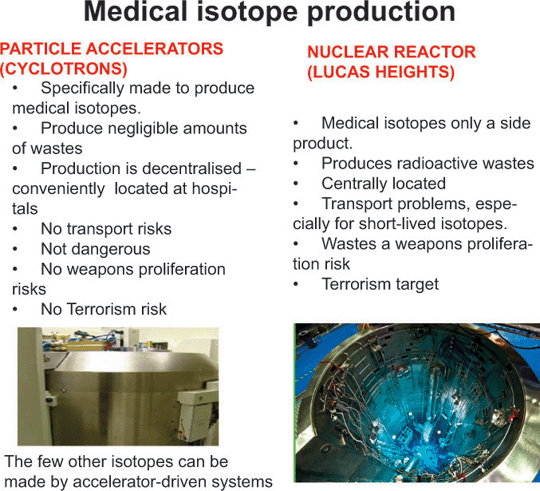
Iraq still has two cobalt-60 machines, according to the International Atomic Energy Agency, having already transitioned to linear accelerators for its 10 other treatment machines. But as Mosul made clear, using even one or two of these radiation machines comes with security risks. If the wrong people, such as members of the Islamic State or another terrorist group, got hold of cobalt-60, they could potentially create a dirty bomb or a radiation exposure device. With more than 70 percent of all cancer deaths now occurring in developing countries, the problem of balancing cancer treatment with security risks will only get worse.
The surest way to prevent terrorists from acquiring these materials, while not limiting people’s access to necessary cancer treatment, is to phase out cobalt-60 radiation machines and replace them with linear accelerators. The U.S. National Nuclear Security Administration, which is in charge of efforts to secure potentially dangerous radioactive material, has been supporting this approach for several years. To do so, developing countries need better technology and treatment environments, not only to support this transition away from cobalt-60 machines but to improve cancer treatment overall. Continue reading this article in World Politics Review

Cancer and other health problems still being caused because of past nuclear explosions
Nuclear explosions from the past are still causing cancer and health problems today https://www.businessinsider.com.au/nuclear-explosion-fallout-cancer-health-effects-2017-8?r=US&IR=T, KEVIN LORIA AUG 18, 2017
Will potassium iodide protect you from nuclear fallout?
 Verify: Will potassium iodide protect you from nuclear fallout?http://www.abc10.com/news/local/verify/verify-will-potassium-iodide-protect-you-from-nuclear-fallout/464777998 In 1999, the World Health Organization released guidelines on the use of potassium iodide, citing the exposure of children to radiation after the Chernobyl disaster.
Pyroprocessing causes MORE nuclear wastes, not less
The Pyroprocessing Files http://allthingsnuclear.org/elyman/the-pyroprocessing-files. ED LYMAN, SENIOR SCIENTIST | AUGUST 12, 2017, The ARTICLE BY RALPH VARTABEDIAN in the Los Angeles Times highlights the failure of the Department of Energy’s decades-long effort to chemically process a stockpile of spent nuclear fuel at Idaho National Laboratory, ostensibly to convert the waste to forms that would be safer for disposal in a geologic repository. A secondary goal was to demonstrate the viability of a new type of processing spent fuel—so-called pyroprocessing. Instead, it has demonstrated the numerous shortcomings of this technology.
It is particularly important to disseminate accurate information about the failure of this DOE program to dispel some of the myths about pyroprocessing. The concept of the “Integral Fast Reactor”—a metal-fueled fast neutron reactor with co-located pyroprocessing and fuel fabrication facilities—has attracted numerous staunch advocates.
In addition to Argonne National Laboratory, which first developed the technology, the concept has been promoted in the popular media (most notably in the 2013 documentary Pandora’s Promise) and by GE-Hitachi, which seeks to commercialize a similar system. South Korea has long sought to be able to implement the technology, and countries such as China, Japan and Russia all have expressed interest in pursuing it. But this interest has been driven largely by idealized studies on paper and not by facts derived from actual experience.
DOE internal documents reveal problems
The LA Times article refers to a June 2017 Union of Concerned Scientists (UCS) report that draws on documents that UCS received in response to a Freedom of Information Act (FOIA) request. UCS initiated the request in 2015 to seek information that could shed light on DOE’s troubled program for pyroprocessing 26 metric tons of “sodium-bonded” metallic spent fuel from the shutdown Experimental Breeder Reactor-II (EBR-II).
Pyroprocessing is a form of spent fuel reprocessing that dissolves metal-based spent fuel in a molten salt bath (as distinguished from conventional reprocessing, which dissolves spent fuel in water-based acid solutions). Understandably, given all its problems, DOE has been reluctant to release public information on this program, which has largely operated under the radar since 2000.

The FOIA documents we obtained have revealed yet another DOE tale of vast sums of public money being wasted on an unproven technology that has fallen far short of the unrealistic projections that DOE used to sell the project to Congress, the state of Idaho and the public. However, it is not too late to pull the plug on this program, and potentially save taxpayers hundreds of millions of dollars.
History of the pyroprocessing program
DOE originally initiated the pyroprocessing program for EBR-II spent fuel in the mid-1990s as a consolation prize to Argonne-West National Laboratory (now part of present-day Idaho National Laboratory) after it cancelled the Integral Fast Reactor (IFR) program. The idea was that the metal-based spent fuel from the reactor could be pyroprocessed in a facility connected to the reactor, which would extract plutonium, uranium and other elements to be fabricated into new reactor fuel. In theory, this could be a system that could convert its nuclear waste into usable fuel on site and thus could be largely self-contained. Pyroprocessing was billed as a simpler, cheaper and more compact alternative to the conventional aqueous reprocessing plants that have been operated in France, the United Kingdom, Japan and other countries.
Although DOE shut down the EBR-II in 1994 (the reactor part of the IFR program), it allowed work at the pyroprocessing facility to proceed. It justified this by asserting that the leftover spent fuel from the EBR-II could not be directly disposed of in the planned Yucca Mountain repository because of the potential safety issues associated with presence of metallic sodium in the spent fuel elements, which was used to “bond” the fuel to the metallic cladding that encased it. (Metallic sodium reacts violently with water and air.)
Pyroprocessing would separate the sodium from other spent fuel constituents and neutralize it. DOE decided in 2000 to use pyroprocessing for the entire inventory of leftover EBR-II spent fuel – both “driver” and “blanket” fuel – even though it acknowledged that there were simpler methods to remove the sodium from the lightly irradiated blanket fuel, which constituted nearly 90% of the inventory.
Little progress, big cost overruns
However, as the FOIA documents reveal in detail, the pyroprocessing technology simply has not worked well and has fallen far short of initial predictions (Figure 1) (Refs. 1-3). Although DOE initially claimed that the entire inventory would be processed by 2007, as of the end of Fiscal Year 2016, only about 15% of the roughly 26 metric tons of spent fuel had been processed. Over $210 million has been spent, at an average cost of over $60,000 per kilogram of fuel treated. At this rate, it will take until the end of the century to complete pyroprocessing of the entire inventory, at an additional cost of over $1 billion.
But even that assumes, unrealistically, that the equipment will continue to be usable for this extended time period. Moreover, there is a significant fraction of spent fuel in storage that has degraded and may not be a candidate for pyroprocessing in any event (Ref. 4). The long time to completion is problematic because DOE has an agreement with the state of Idaho to remove all spent fuel from the state by the year 2035. The FOIA documents reveal that DOE is well aware that it is not on track to comply with this obligation (Ref 5). Yet DOE has not made any public statements to that effect and continues to insist that it can meet the deadline.
More waste, not less
What exactly is the pyroprocessing of this fuelaccomplishing? Instead of making management and disposal of the spent fuel simpler and safer, it has created an even bigger mess. Pyroprocessing separates the spent fuel into three principal waste streams. The first is an enriched uranium metal material called the “spent fuel treatment product.” Because this material contains unacceptably high levels of plutonium and other contaminants, the uranium cannot be used to make new nuclear fuel unless it is further purified; thus it is a waste product. Meanwhile, the material is accumulating and taking up precious space at INL storage facilities, causing its own safety issues.
The second waste stream is the molten salt bath that is used to dissolve the spent fuel. Fission products and plutonium have accumulated in this salt for 20 years. Eventually it will have to be removed and safely disposed of. But for various reasons—including cost and a lack of available space for the necessary equipment—INL is reconsidering the original plan to convert this waste into a stable ceramic waste form. Instead, it may just allow it to cool until it hardens and then directly dispose of it in the Waste Isolation Pilot Plant (WIPP) in New Mexico (Ref. 6).
The third waste stream consists of the leftover metal cladding tubes that encased the nuclear fuel, and the metal plenums that extended above the fuel region, which are contaminated with fission products and sodium. The original plan was to convert these scraps into a stable, homogeneous waste form. But the FOIA documents reveal that DOE is also reconsidering this plan, and considering redefining this material as transuranic or low-level waste so it could be disposed of without further processing in WIPP or a low-level radioactive waste disposal facility. Storage of the accumulating metal scrap material is also becoming an increasing burden at INL (Ref. 7).
In other words, pyroprocessing has taken one potentially difficult form of nuclear waste and converted it into multiple challenging forms of nuclear waste. DOE has spent hundreds of millions of dollars only to magnify, rather than simplify, the waste problem. This is especially outrageous in light of other FOIA documents that indicate that DOE never definitively concluded that the sodium-bonded spent fuel was unsafe to directly dispose of in the first place. But it insisted on pursuing pyroprocessing rather than conducting studies that might have shown it was unnecessary.
Everyone with an interest in pyroprocessing should reassess their views given the real-world problems experienced in implementing the technology over the last 20 years at INL. They should also note that the variant of the process being used to treat the EBR-II spent fuel is less complex than the process that would be needed to extract plutonium and other actinides to produce fresh fuel for fast reactors. In other words, the technology is a long way from being demonstrated as a practical approach for electricity production. It makes much more sense to pursue improvements in once-through nuclear power systems than to waste any more time and money on reprocessing technologies that pose proliferation, security and safety risks. DOE continues to consider alternatives to pyroprocessing for the blanket fuel (Ref. 8). It should give serious thought to the possibility of direct disposal of the remaining inventory without processing.
Links to FOIA documents
Below are links to some of the documents that UCS obtained from its FOIA request. We will provide more documents and analyses of them soon.
- Argonne National Laboratory Spent Fuel Treatment Implementation Plan (2000)
- INL Preferred Disposition Plan for Sodium-Bonded Spent Nuclear Fuel (2007)
- History of Processing (through 2013)
- Technical Evaluation of Disposition of Non-Candidate Fuels (2014)
- 2014 INL Environmental Liabilities Spreadsheet
- Technical Evaluation of Alternatives for Salt Waste Disposition (2014)
- Disposal Solutions for Metal Scraps Derived from Treatment of Irradiated Sodium Bonded Fuel (2014)
- Technical Evaluation of EBR-II Blanket Disposition Alternatives (2014)
In the effort to deal with nuclear waste, pyroprocessing created even more problems
Since the project began 17 years ago, 15% of the waste has been processed, an average of one-fourth of a metric ton per year. That’s 20 times slower than originally expected, a pace that would stretch the work into the next century — long past the 2035 deadline.
Lyman said he was determined to explore the Idaho program in light of increasing interest in the scientific and regulatory communities in advanced nuclear reactors — including breeder reactors — and what he believed was misleading information by advocates.
The Idaho National Lab created a ‘wonder fuel.’ Now, it’s radioactive waste that won’t go away, http://www.latimes.com/local/california/la-na-idaho-nuclear-waste-2017-story.html, Ralph VartabedianContact Reporter, 13 Aug 17 In the early days of atomic energy, the federal government powered up an experimental reactor in Idaho with an ambitious goal: create a “wonder fuel” for the nation.
The reactor was one of the nation’s first “breeder” reactors — designed to make its own new plutonium fuel while it generated electricity, solving what scientists at the time thought was a looming shortage of uranium for power plants and nuclear weapons.
It went into operation in 1964 and kept the lights burning at the sprawling national laboratory for three decades.
But enthusiasm eventually waned for the breeder reactor program owing to safety concerns, high costs and an adequate supply of uranium. Today, its only legacy is 26 metric tons of highly radioactive waste. What to do with that spent fuel is causing the federal government deepening political, technical, legal and financial headaches.
The reactor was shut down in 1994. Under a legal settlement with Idaho regulators the next year, the Department of Energy pledged to have the waste treated and ready to transport out of the state by 2035.
The chances of that happening now appear slim. A special treatment plant is having so many problems and delays that it could take many decades past the deadline to finish the job.
“The process doesn’t work,” said Edwin Lyman, a physicist at the Union of Concerned Scientists, who has documented the problems in a new report. “It turned out to be harder to execute and less reliable than they promised.”
Many of the cleanup efforts, like the one in Idaho, are years or even decades behind schedule, reflecting practices that were far too optimistic when it came to technology, costs and management know-how.
Jim Owendoff, the acting chief of the Energy Department’s environmental management program, recently ordered a 45-day review of the entire $6-billion-a-year radiation cleanup effort. “What I am looking at is how we can be more timely in our decision-making,” he said in a department newsletter.
The Idaho reactor, located at the 890-square-mile Idaho National Laboratory, was designed to produce electricity while it “breeds” new fuel by allowing fast-moving neutrons to convert non-fissionable uranium into fissionable plutonium.
But the complexity of breeder reactors led to safety problems.
Only one breeder reactor ever went into commercial operation in the U.S. — the Enrico Fermi I near Detroit, which suffered a partial core meltdown in 1966. Construction of a breeder reactor on the Clinch River in Tennessee was stopped in 1983.
A reactor using similar technology above the San Fernando Valley experienced fuel core damage in 1959 that is believed to have released radioactive iodine into the air.
Ultimately, the nation never faced a shortage of uranium fuel, and now the Energy Department is spending billions of dollars to manage its surplus plutonium. Unlike uranium, the “wonder fuel,” as the lab called it, was bonded to sodium to improve heat transfer inside the reactor.
The sodium has presented an unusual waste problem.
Sodium is a highly reactive element that can become explosive when it comes in contact with water and is potentially too unstable to put in any future underground dump — such as the one proposed at Yucca Mountain in Nevada.
To remove the bonded sodium, the government used a complex process, known as pyroprocessing, which was developed to also separate plutonium from the spent fuel. The spent fuel parts from the reactor are placed in a chemical bath and subjected to an electrical current, which draws off the sodium onto another material. The process is similar to electroplating a kitchen faucet.
Back in 2000, the project managers estimated in an environmental report that they could treat 5 metric tons annually and complete the job in six years.
But privately, the department estimated that it would take more than twice that long, according to internal documents that Lyman obtained under the Freedom of Information Act. Even that was unrealistic, because it assumed that the treatment plant could work around the clock every day of the year, without down time for maintenance or allowance for breakdowns. Lyman found that during one year — 2012 — no waste at all was processed.
Since the project began 17 years ago, 15% of the waste has been processed, an average of one-fourth of a metric ton per year. That’s 20 times slower than originally expected, a pace that would stretch the work into the next century — long past the 2035 deadline.
The problem with the breeder reactor waste is just one of many environmental issues at the lab, located on a high desert plateau near Idaho Falls. The federal government gifted the Idaho lab with additional radioactive waste for decades.
After the highly contaminated Rocky Flats nuclear weapons plant near Denver was shut down in 1993, the waste was shipped to Idaho. The Navy has been sending in its spent fuel from nuclear-powered ships.
The lab is dealing with tons of waste containing artificial elements, so-called transuranic waste. The Energy Department promised to move an average of 2,000 cubic meters to a special dump in New Mexico, but it has missed that goal for several years, because of an underground explosion at the dump. The Energy Department declined to answer specific questions about the breeder waste cleanup, citing the sensitivity of nuclear technology. It blamed the slow pace of cleanup on inadequate funding but said it was still trying to meet the deadline.
“When the implementation plan for the treatment of the [spent fuel] was developed in 2000, there was very limited nuclear energy research and development being performed in the United States,” a department spokesperson said in a statement.
“The funding for this program has been limited in favor of other research and development activities. The Department remains strongly committed to the treatment of this fuel in time to meet its commitments to the State of Idaho.”
Susan Burke, who monitors the cleanup at the laboratory for the state’s Department of Environmental Quality, said the state will continue to demand that the waste be ready for shipment out of Idaho by 2035.
“The Energy Department is doing the best it can, but our expectation is that they will have to meet the settlement agreement,” she said.
Idaho watchdogs are skeptical.
“There is some bad faith here on the part of the Energy Department,” said Beatrice Brailsford, nuclear program director at the Snake River Alliance, a group that monitors the lab. “The department is misleading the public. Not much information has been given out, but enough to be skeptical that the technology works well enough to meet the settlement.”
Lab officials declined to comment.
Lyman said he was determined to explore the Idaho program in light of increasing interest in the scientific and regulatory communities in advanced nuclear reactors — including breeder reactors — and what he believed was misleading information by advocates.
He presented a technical paper about pyroprocessing at a conference held in July by the International Atomic Energy Agency.
Lyman said he believes the Energy Department has little chance of success in the program.
“They are just blowing smoke,” he said. “It is a failure and they can’t admit it, because they don’t have a backup plan that would satisfy the state.”
Haunting photographs of 1945 Hiroshima and Nagasaki
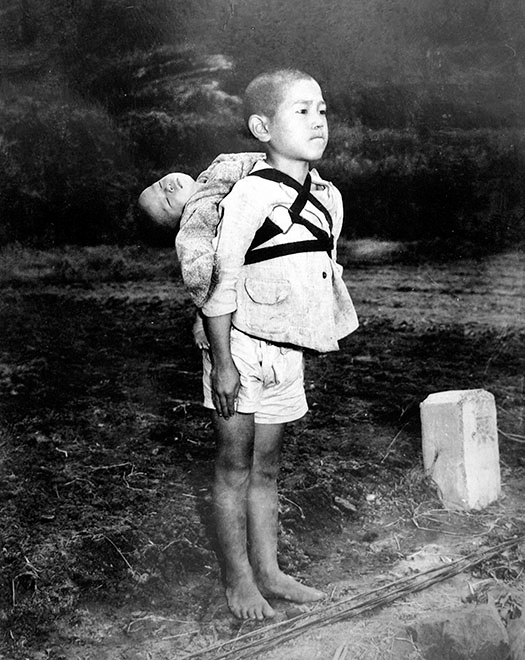 If you’re against war, get this book: The photos will haunt you http://www.asahi.com/ajw/articles/AJ201708100035.html By SONOKO MIYAZAKI/ Staff Writer August 10, 2017 A boy standing at rigid attention with the dead body of his infant brother strapped to his back at a crematorium in Nagasaki is one of searing images of the city’s destruction after the U.S. atomic bombing in 1945.
In a book published Aug. 9, Kimiko Sakai, the widow of Joe O’Donnell, the photographer who snapped the image, tells the story of her husband’s life work through photographs he shot in Japan in the immediate aftermath of the war.
Aug. 9 marked the 72nd anniversary of the bombing as well as the 10th anniversary of O’Donnell’s death at the age of 85.
The 192-page book, titled “Kamisama no Finder: Moto-Beijugun Cameraman no Isan” (God’s finder: the legacy of a former war photographer), was published by the Tokyo-based Word of Life Press Ministries.
After Japan’s surrender, O’Donnell, who was attached to the U.S. Marine Corps, traveled to Hiroshima, Nagasaki and other Japanese cities to document the wartime devastation. He stayed in Japan from September 1945 to March 1946.
He took 300 or so photographs for his private use.
He believed it was wrong to drop the atomic bombs after witnessing the sufferings of the victims.
But O’Donnell didn’t exhibit these pictures for decades because of prevailing U.S. sentiment that the atomic bombings of Hiroshima and Nagasaki hastened the end of World War and saved many American lives.
O’Donnell later decided to exhibit the photographs in the hope they would help advance the anti-war movement.
The catalyst for this was when he gazed on a sculpture evoking Jesus on the cross and engulfed by flames at a church in Kentucky in 1989. The life-size work, titled “Once,” was created for the repose of the tens of thousands of people killed in that atomic bombings, with photos of victims pasted all over the body. O’Donnell was stunned.
After that, O’Donnell until his death held exhibitions of his photos in the United States and Japan to convey the horrors of nuclear war.
The image of the boy at the crematorium stayed with him. O’Donnell recalled that the boy stared motionless as bodies were being burned and he awaited his turn. He also noticed that the boy’s lips were caked with blood because he was biting them so hard, although no blood spilled.
Sakai agreed to a proposal to publish the book after she was contacted by the publisher two years or so ago. Sakai, who lives in Tennessee, said she accepted out of respect for her husband’s commitment to the anti-war cause.
“My husband photographed his subjects as fellow human beings, not as an occupier,” she said in a recent interview with The Asahi Shimbun.
Asked if she had a message for those working to rid the world of nuclear arsenals, she said, “Just ‘not to forget,’ which is important.”
Dispelling the myths about U.S. President Harry Truman’s decision to nuclear bomb Japanese cities
The destruction of Hiroshima and Nagasaki was a war crime worse than any that Japanese generals were executed for in Tokyo and Manila. If Harry Truman was not a war criminal, then no one ever was.
 Mises Institute 10 Aug 17 [Excerpted from “Harry S. Truman: Advancing the Revolution,” in Reassessing the Presidency: The Rise of the Executive State and the Decline of Freedom, John Denson, ed.]
The most spectacular episode of Harry Truman’s presidency will never be forgotten but will be forever linked to his name: the atomic bombings of Hiroshima on August 6, 1945, and of Nagasaki three days later. Probably around two hundred thousand persons were killed in the attacks and through radiation poisoning; the vast majority were civilians, including several thousand Korean workers. Twelve US Navy fliers incarcerated in a Hiroshima jail were also among the dead.1
Great controversy has always surrounded the bombings. …….
the rationale for the atomic bombings has come to rest on a single colossal fabrication, which has gained surprising currency — that they were necessary in order to save a half-million or more American lives. These, supposedly, are the lives that would have been lost in the planned invasion of Kyushu in December, then in the all-out invasion of Honshu the next year, if that had been needed. But the worst-case scenario for a full-scale invasion of the Japanese home islands was forty-six thousand American lives lost.7 The ridiculously inflated figure of a half-million for the potential death toll — nearly twice the total of US dead in all theaters in the Second World War — is now routinely repeated in high-school and college textbooks and bandied about by ignorant commentators. Unsurprisingly the prize for sheer fatuousness on this score goes to President George H.W. Bush, who claimed in 1991 that dropping the bomb “spared millions of American lives.”8
Still, Truman’s multiple deceptions and self-deceptions are understandable, considering the horror he unleashed. It is equally understandable that the US occupation authorities censored reports from the shattered cities and did not permit films and photographs of the thousands of corpses and the frightfully mutilated survivors to reach the public.9 Otherwise, Americans — and the rest of the world — might have drawn disturbing comparisons to scenes then coming to light from the Nazi concentration camps.
The bombings were condemned as barbaric and unnecessary by high American military officers, including Eisenhower and MacArthur.10 The view of Admiral William D. Leahy, Truman’s own chief of staff, was typical:
the use of this barbarous weapon at Hiroshima and Nagasaki was of no material assistance in our war against Japan. … My own feeling was that in being the first to use it, we had adopted an ethical standard common to the barbarians of the Dark Ages. I was not taught to make wars in that fashion, and wars cannot be won by destroying women and children.11
The political elite implicated in the atomic bombings feared a backlash that would aid and abet the rebirth of horrid prewar “isolationism.” Apologias were rushed into print, lest public disgust at the sickening war crime result in erosion of enthusiasm for the globalist project.12 No need to worry. A sea change had taken place in the attitudes of the American people. Then and ever after, all surveys have shown that the great majority supported Truman, believing that the bombs were required to end the war and save hundreds of thousands of American lives, or, more likely, not really caring one way or the other.
Those who may still be troubled by such a grisly exercise in cost-benefit analysis — innocent Japanese lives balanced against the lives of Allied servicemen — might reflect on the judgment of the Catholic philosopher G.E.M. Anscombe, who insisted on the supremacy of moral rules.13 When, in June 1956, Truman was awarded an honorary degree by her university, Oxford, Anscombe protested.14 Truman was a war criminal, she contended, for what is the difference between the US government massacring civilians from the air, as at Hiroshima and Nagasaki, and the Nazis wiping out the inhabitants of some Czech or Polish village?……
While the mass media parroted the government line in praising the atomic incinerations, prominent conservatives denounced them as unspeakable war crimes. Felix Morley, constitutional scholar and one of the founders of Human Events, drew attention to the horror of Hiroshima, including the “thousands of children trapped in the thirty-three schools that were destroyed.” He called on his compatriots to atone for what had been done in their name, and proposed that groups of Americans be sent to Hiroshima, as Germans were sent to witness what had been done in the Nazi camps.
The Paulist priest, Father James Gillis, editor of The Catholic World and another stalwart of the Old Right, castigated the bombings as “the most powerful blow ever delivered against Christian civilization and the moral law.” David Lawrence, conservative owner of US News and World Report, continued to denounce them for years.21 The distinguished conservative philosopher Richard Weaver was revolted by
the spectacle of young boys fresh out of Kansas and Texas turning nonmilitary Dresden into a holocaust … pulverizing ancient shrines like Monte Cassino and Nuremberg, and bringing atomic annihilation to Hiroshima and Nagasaki.
Weaver considered such atrocities as deeply “inimical to the foundations on which civilization is built.”22
Today, self-styled conservatives slander as “anti-American” anyone who is in the least troubled by Truman’s massacre of so many tens of thousands of Japanese innocents from the air. This shows as well as anything the difference between today’s “conservatives” and those who once deserved the name.
Leo Szilard was the world-renowned physicist who drafted the original letter to Roosevelt that Einstein signed, instigating the Manhattan Project. In 1960, shortly before his death, Szilard stated another obvious truth:
If the Germans had dropped atomic bombs on cities instead of us, we would have defined the dropping of atomic bombs on cities as a war crime, and we would have sentenced the Germans who were guilty of this crime to death at Nuremberg and hanged them.23
The destruction of Hiroshima and Nagasaki was a war crime worse than any that Japanese generals were executed for in Tokyo and Manila. If Harry Truman was not a war criminal, then no one ever was. https://mises.org/blog/harry-truman-and-atomic-bomb
Harm from inhaled radioactive dust: new evidence from Hiroshima’s teenagers of 1945
 Extent of A-bomb dust inhalation in 1945 underestimated: researchers https://mainichi.jp/english/articles/20170731/p2a/00m/0na/004000cJuly 31, 2017 (Mainichi Japan)HIROSHIMA — The prevalence of acute symptoms among teenage soldiers exposed to dust particles as they helped out with relief operations in the aftermath of the 1945 U.S. atomic bombing of Hiroshima has been found to be at least 10 times higher than those who were unexposed, it has been learned.
The findings came to light following a questionnaire conducted in February last year by a team of researchers including Megu Otaki, a professor emeritus of statistics at Hiroshima University, covering 142 former army cadets aged between 15 and 19 at the time of the atomic bombing.
The army cadets were gathered together outside Hiroshima on the day the bomb was dropped — Aug. 6, 1945 — before venturing into the city to assist with relief operations between noon and around 5 p.m. In the 2016 questionnaire, the former cadets were asked questions about operation content and locations, inhalation of dust particles, as well as their subsequent health conditions — eliciting responses from 64 of them in total.
In its decision on the effects of internal exposure from inhaling dust particles tainted with radioactive materials, the Japan-U.S. research organization Radiation Effects Research Foundation said that, “The amount in this case is low enough to be ignored.” This decision has been used by the Japanese government in recognizing A-bomb survivors as suffering from A-bomb related diseases.
However, Otaki states that, “It is very likely that the acute symptoms and the disorders that A-bomb victims later developed were mainly caused by internal exposure to radiation (from dust particles). The impact (of the dust particles) has been underestimated.”
The survey found that the frequency of acute symptoms such as hair loss and diarrhea was 11.7 times higher in the group (21 people) exposed to dust particles while operating within a 2-kilometer radius of the bomb’s hypocenter than those who weren’t exposed at locations 2 kilometers or more away (22 people, including some unknown). Similarly, the frequency of acute symptoms was also found to be 5.5 times higher among those who were exposed to dust particles more than 2 kilometers away from ground zero (9 people) than those who weren’t exposed. In addition, there were more cases of people developing cancer and leukemia among the groups exposed to the dust particles.
Commenting on these results, Otaki says, “Although the sample size is small, the conditions of the subjects such as age, health conditions, and the length of relief operation time are almost the same, meaning the data is very reliable.”
In addition, upon re-examining data released by the foundation in 2001 — which showed the relationship between estimated radiation dose and the frequency of chromosomal abnormalities in 3,042 atomic bomb victims — it has become clear that the radiation dose received by victims who were indoors is possibly 30 percent higher than initially thought. Based on this, the team of researchers has concluded that, “It is very likely that people developed chromosomal abnormalities after being exposed to radiation by inhaling dust particles upon going back into damaged buildings.”
With regard to residual radiation and internal exposure to radiation, the foundation has previously concluded that compared to the initial levels of radiation emitted at the time of the explosion, the residual radiation values are lower, making residual radiation “less of a threat to people’s health.” Based on this conclusion, the foundation devised a formula for calculating the estimated exposed dosage deriving only from the initial radiation, which the government has used to recognize “A-bomb related diseases.”
However, there has been a string of judicial rulings determining that the extent of internal exposure has been underestimated, based on examinations of symptoms and experiences of plaintiffs involved in “A-bomb related disease” certification lawsuits.
With this kind of reality in mind, Otaki says, “There are concerns that atomic bomb victims who should have been supported have actually been abandoned. We must reconsider the calculation method.”
Nuclear weapons wastes polluting America’s soil: 12 hotspots

 The Invisible War On American Soil, Topic, 29 July 17 Photographs by Nina Berman
War is a dirty, dirty business. Beyond the damage inflicted on the battlefields themselves, every part of a military operation marks the earth. From munitions factories to massive supply lines, collateral costs abound.GIVEN THE SIZE OF OUR DEFENSE BUDGETS, it should come as no surprise that the United States military is one of the planet’s most prolific and chronic polluters. Perhaps more surprising is that this impacts life within the U.S. as well as overseas. Vast stretches of the American landscape are contaminated by the business of war and armed aggression; it’s littered with unexploded ordnance, toxic chemicals, depleted uranium, radioactive particles, and more.
In this essay, we examine seven such sites of environmental damage wrought by the nation’s military and its weapons contractors. The places range from sites in New Mexico, where nuclear weapons have been produced, to the Passaic River in New Jersey, where dioxin from Agent Orange used during the Vietnam War has poisoned the riverbed. As the technology of warfare changes, so has its impact, with current contamination coming from the skies—such as on Whidbey Island, Washington, where Navy testing of EA-18G Growler planes might be making residents ill.
Acid Canyon; Los Alamos, New Mexico……
Trinity Site; White Sands Missile Range, New Mexico……
Haystack Mine; Haystack Mountain, New Mexico……
White Sands Missile Range Museum; New Mexico……
Luis Lopez Cemetery; New Mexico……
San Antonio, New Mexico…….
Fort Wingate, New Mexico …..
Whidbey Island, Washington…..
Big Oaks National Wildlife Refuge; Madison, Indiana…..
Near the Starmet Superfund site; Concord, Massachusetts…..
Passaic River; Lyndhurst, New Jersey…..
Tularosa, New Mexico….. https://www.topic.com/the-invisible-war-on-american-soil
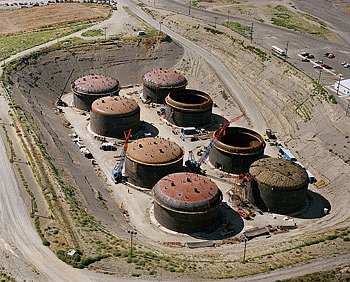
Hanford nuclear waste site – a national disaster they don’t want to talk about.
“Nobody in the world has waste like ours,” says one of my guides as we enter the site. No one has so much strontium 90, for instance, which behaves a lot like calcium and lodges inside the bones of any living creatures it penetrates, basically forever. Along with chromium and tritium and carbon tetrachloride and iodine 129 and the other waste products of a plutonium factory it is already present in Hanford’s groundwater. There are other nuclear-waste sites in the United States, but two-thirds of all the waste is here. Beneath Hanford a massive underground glacier of radioactive sludge is moving slowly, but relentlessly, toward the Columbia River.
The place is now an eerie deconstruction site, with ghost towns on top of ghost towns. Much of the old plutonium plant still stands: the husks of the original nine reactors, built in the 1940s, still line the Columbia River, like grain elevators. Their doors have been welded shut, and they have been left to decay—for another century.
Only one stakeholder in the place wanted to know what was going on beneath its soil: the tribes.
 WHY THE SCARIEST NUCLEAR THREAT MAY BE COMING FROM INSIDE THE WHITE HOUSE, Vanity Fair, BY MICHAEL LEWIS, September 2017 “………By the early 1940s the United States government understood that for democracy to survive it needed to beat Hitler to the atom bomb, and that the race had two paths—one required enriched uranium, the other plutonium. In early 1943, the United States Army was evicting everyone from an area in Eastern Washington nearly half the size of Rhode Island and setting out to create plutonium in order to build a nuclear bomb. The site of Hanford was chosen for its proximity to the Columbia River, which could supply the cooling water while its dams provided the electricity needed to make plutonium. Hanford was also chosen for its remoteness: the army was worried about both enemy attacks and an accidental nuclear explosion. Hanford was, finally, chosen for its poverty. It was convenient that what would become the world’s largest public-works project arose in a place from which people had to be paid so little to leave.
More or less overnight Hanford went from the business of making plutonium to the even more lucrative business of cleaning it up. In its last years of production the plutonium plant employed around 9,000 people. It still employs 9,000 people and pays them even more than it used to. “It’s a good thing that we live in a country that cares enough to take the time it will take, and spend the money it will spend, to clean up the legacy of the Cold War,” said MacWilliams. “In Russia they just drop concrete on the stuff and move on.”
The Department of Energy wires 10 percent of its annual budget, or $3 billion a year, into this tiny place and intends to do so until the radioactive mess is cleaned up. And even though what is now called the Tri-Cities area is well populated and amazingly prosperous—yachts on the river, $300 bottles of wine in the bistros—the absolute worst thing that could happen to it is probably not a nuclear accident. The worst thing that could happen is that the federal government loses interest in it and slashes the D.O.E.’s budget—as President Trump has proposed to do. And yet Trump won the county in which Hanford resides by 25 points. Continue reading
Just Moms, St Louis
The Fallout, In St. Louis, America’s nuclear history creeps into the present, leaching into streams and bodies. Guernica,
Joe Trunko from the Missouri Department of Natural Resources … told Dawn that there is a landfill near her home, that it is an EPA Superfund site contaminated with toxic chemicals, that there has been an underground fire burning there since 2010. “These things happen sometimes in landfills,” he said. “But this one is really not good.”
Joe told Dawn that this landfill fire measures six football fields across and more than a hundred and fifty feet deep; it is in the floodplain of the Missouri River, less than two miles from the water itself, roughly twenty-seven miles upstream from where the Missouri River joins the Mississippi River before flowing out to the sea. “But to be honest, it’s not even the fire you should be worrying about,” Joe continued. “It’s the nuclear waste buried less than one thousand feet away.”

Joe explained how almost fifty thousand tons of nuclear waste left over from the Manhattan Project was dumped in the landfill illegally in 1973…….
Weeks later, she found herself standing outside the chain-link fence that surrounds the landfill with half a dozen environmental activists who had gotten hold of some air-sampling equipment……..
Karen Nickel didn’t know much about the landfill—she’d only just learned about it a few weeks before—but she knew about the waste……
Karen did look into it and learned that many of her classmates and neighbors and childhood friends had died of leukemias and brain cancers and appendix cancers—rare in the general population, but, again, apparently common among those who live or had lived near the creek. It couldn’t possibly be a coincidence…..
When Dawn and Karen learned what the EPA had proposed years earlier, in their Record of Decision, they immediately pushed back. They called the media, gave interviews, started a Facebook page. “I remember getting so excited when we hit two hundred members,” Karen told me. “Now we have over seventeen thousand.” They all lobbied their representatives, their senators, City Council members, mayors…….
“We’re just moms!” Karen and Dawn would answer. “We’re just citizens concerned about the health and safety of our kids and our community!”
Soon after, Karen and Dawn, along with another resident, Beth Strohmeyer, officially formed Just Moms STL………
After a few weeks of making these graphs, they realized the fire wasn’t under control, it wasn’t going out. It was, in fact, moving toward the waste, inching toward the known edge, spreading through the old limestone quarry. Now one thousand feet away. Now seven hundred………
Robbin and Mike Dailey moved to this house in 1999, after their kids had moved out and started families of their own. It’s a relief their children never lived here, she tells me. In this neighborhood children fall ill. There are brain cancers and appendix cancers, leukemias and salivary-gland cancers. Up the street from Robin and Mike there’s a couple with lung and stomach cancer. They bought their home just after it was built in the late 1960s.
I ask what they think might happen if the fire ever reaches the waste. The question hangs in the air for a moment as the TV flickers from the far wall. “Look, we know it won’t explode,” Robbin explains. “We’re not stupid. We know that’s not how it works. But just because there’s no explosion doesn’t mean there won’t be fallout.”…….
I’ve looked at thousands of pictures of this landfill, aerial photos and historical photos, elevation photos and topographical maps, but nothing has prepared me to see it in person, this giant belching mound of tubes and pumps and pipes. There’s some kind of engineered cover over the dirt itself, which is supposed to suffocate the fire and capture the fumes. It looks like little more than a green plastic tarp patched together over a hundred acres of sagging hills.
“This is the burning side,” Robbin tells me. “The radwaste is on the other side.” The patchwork is topographical and bureaucratic: the burning side is the southern section of the landfill and falls under the jurisdiction of the Missouri Department of Natural Resources; the radioactive waste is mostly on the northern side, and under EPA jurisdiction. On the burning side, workers drive over the tarp on utility carts, wearing hard hats and work clothes. No gloves, no masks, no protection from the destruction buried underneath their feet……….https://www.guernicamag.com/the-fallout/
The continuing horror story of nuclear weapons’ waste in North St Louis, USA
The reports don’t acknowledge these stories, these illnesses, those who are dying or dead. Most residents of St. Louis—including and especially the residents of predominantly African-American neighborhoods—don’t even know the contamination is there. …….
the half-life of Thorium 232: fourteen billion years, a half-life so long that by the time this element is safe for human exposure
a contradiction I can’t resolve: that the massive crime here began with a belief in a kind of care, a belief that protection comes only in the form of wars and bombs, and that its ultimate expression is a technology that can destroy in a single instant any threat to our safety with perfect precision and efficiency. But hundreds of thousands lost their lives to those bombs in Japan, and the fallout from building them has claimed at least as many lives right here at home.
The Fallout, In St. Louis, America’s nuclear history creeps into the present, leaching into streams and bodies. Guernica, By Lacy M. Johnson, 10 July 2017 “………Months ago, when a high-school friend reached out to me asking that I give my attention to this story, she told me that a company tasked decades ago with disposing of nuclear waste for the federal government had instead dumped thousands of barrels of the waste somewhere in North St. Louis County. The barrels were left exposed to the elements for decades, and the waste had leaked into the ground and into the water of a nearby creek……
When the federal government filed suit to acquire the property under eminent domain, officials refused to disclose the exact nature of the waste “for security reasons.” They assured the local government that the waste they’d be storing there wasn’t dangerous. They shook hands and signed papers. They looked people squarely in the eye.
During the next twenty years, truckload by truckload, the green patchwork of farm fields by the airfield turned into a foreign world. Mountains of raffinate rose up across from row after row of rusty black drums, stacked two or three high.

……..The reports tell only so much, only certain parts of certain versions of the story. The rest I have to piece together using articles in the local newspaper, phone calls with these residents, oral histories collected by others, newsletters from various companies celebrating one anniversary or another…..
In my pile of reports there is a series of letters from Cotter to the Atomic Energy Commission, in which Cotter tries to convince the government to take these wastes back. Commercial disposal would cost upwards of two million dollars (about twelve million dollars today). They couldn’t afford it. They knew that the AEC was using a quarry at the recently decommissioned second Mallinckrodt facility at Weldon Spring, roughly twenty miles southwest of the airport, as a dump for nuclear waste. They asked the AEC if they could use it, asked for guidance, and for help.
That help never came……
A lengthy investigation discovered that from August to October 1973, a private construction firm drove truckloads of the leached barium sulfate—along with roughly forty thousand tons of soil removed from the top eighteen inches of the Latty Avenue site—to West Lake Landfill, all around the clock, sometimes in the middle of the night. To the landfill operator it looked like dirt, so he waved the trucks in and charged them nothing, using it as landfill cover over the municipal refuse…..
the reports express the detection of this contamination in charts, as numbers and statistics. They’ve found contamination at the airport, in the drainage ditches leading away from the airport, and all along the creek—along the trucking routes, in ballfields and in parks and gardens and backyards, in driveways, in people’s basements and under their kitchen cabinets. Even now, as I write this, they are still trying to figure out just how far it has spread.
The reports measure the health risk of exposure to this contamination as an equation, with a threshold of acceptable risk. But what the reports don’t say is that the contamination has already done so much damage that cannot be measured or undone. The Mallinckrodt uranium workers are some of the most contaminated in the history of the atomic age. So contaminated, in fact, that in 2009 all former Mallinckrodt uranium workers were added as a “special exposure cohort” to the Energy Employees Occupational Illness Compensation Program Act. The act provides compensation and lifetime medical benefits to employees who became ill with any of twenty-two named cancers as a result of working in the nuclear-weapons industry. Because of this special cohort status, if a former Mallinckrodt worker develops any of these named illnesses, exposure to the uranium is assumed. But the people who live near the creek didn’t work for Mallinckrodt. They aren’t entitled to compensation or to medical benefits.
A woman named Mary Oscko, for instance, has lived her whole life in North St. Louis County, most of it near that small creek. Now she is dying of stage-four lung cancer, though she has never smoked a day in her life. Shari Riley, a nurse who lived near the creek, died recently of appendix cancer—rare in the general population, but several dozen cases have been reported among those who live or lived near the airport or along the creek. My friend—the one who contacted me about this story—never lived in St. Louis, but her mother grew up two houses away from that creek. My friend suspects that her mother’s exposure to the contamination as a child changed her DNA in ways she passed on to her children, which would explain why my friend was diagnosed with an aggressive form of cancer a few years ago, at the age of thirty-five. Could it also explain why my friend’s mother once gave birth to a set of conjoined twins? Conjoined twins are an anomaly in the general population, but these make the fourth set born to women who grew up near that creek. And those are just the ones we know about.

The reports don’t acknowledge these stories, these illnesses, those who are dying or dead. Most residents of St. Louis—including and especially the residents of predominantly African-American neighborhoods—don’t even know the contamination is there. …….
“My librarian,” Kay Drey tells me—has filed the EPA’s Record of Decision for the West Lake Landfill, and then on the drawer where I might find studies that contradict the EPA’s assessment that the radioactive waste in the landfill doesn’t pose a threat to residents—the radiological surveys of the site conducted in the 1970s and 1980s by the Nuclear Regulatory Commission and the Department of Energy, as well as more current studies by independent researchers. She explains that the radioactive waste buried in West Lake Landfill covers about twenty acres in two locations in one or many layers, estimated at two to fifteen feet thick, some of it mixed in with municipal refuse and some of it sitting right at the surface. It is in the trees surrounding the landfill and the vacuum bags in nearby homes. This waste contains not only uranium, but also thorium and radium, all long-lived, highly radio-toxic elements. And because Mallinckrodt removed most of the naturally occurring uranium from this ore, the Cotter Corporation, in effect, created an enriched thorium deposit when they dumped the residues at West Lake Landfill. “In fact,” Kay muses, “West Lake Landfill might now be the richest deposit of thorium in the world.”
Thorium and uranium in particular are among the radioactive primordial nuclides, radioactive elements that have existed in their current form since before Earth was formed, since before the formation of the solar system even, and will remain radioactive and toxic to life long after humans are gone. We’re sitting back in Kay’s dining room when she pulls out a tiny booklet labeled “Nuclear Wallet Cards.” What its intended purpose is, I don’t know, but Kay flips to the back to show me the half-life of Thorium 232: fourteen billion years, a half-life so long that by the time this element is safe for human exposure, the Appalachian Mountains will have eroded away, every ocean on Earth’s surface will have evaporated, Antarctica will be free of ice, and all the rings of Saturn will have decayed. Earth’s rotation will have slowed so much that days will have become twenty-five hours long, photosynthesis will have ceased, and multicellular life will have become a physical impossibility.
“You know, tritium is my favorite,” Kay tells me before I leave. It’s produced as a side effect of operating nuclear reactors and released into the air, or leaks into the waterways; it contaminates the water supply and condenses in our food. One official who worked at the nuclear reactor Kay had tried to prevent once told her that tritium was no big deal. “It only destroys DNA molecules.” A few years ago they found tritium in the groundwater in Callaway County. “There is no way to remove it,” she says…..
….the Weldon Spring site. After it was decommissioned, the plant—a second one run by Mallinckrodt—was found to be so contaminated that the Department of Energy eventually entombed the whole site in layers upon layers of clay and soil, gravel, engineered filters and limestone rocks, creating a mountain covering forty-five acres, containing approximately 1.5 million cubic yards of hazardous waste. With its own educational center located near the base, the containment dome has become a kind of memorial for a tragedy that hasn’t finished happening. The top of the dome is the highest point in the county.
“Oh, you don’t want to go there anyway,” Kay says, waving the idea away with her slender hand. “It’s leaking.”……..
a contradiction I can’t resolve: that the massive crime here began with a belief in a kind of care, a belief that protection comes only in the form of wars and bombs, and that its ultimate expression is a technology that can destroy in a single instant any threat to our safety with perfect precision and efficiency. But hundreds of thousands lost their lives to those bombs in Japan, and the fallout from building them has claimed at least as many lives right here at home.
There is no one to arrest for this, to send to jail, to fine or execute or drag to his humiliation in the city square. Even if Karen and Dawn win their fight and convince the government to remove every gram of radioactive waste in the landfill and the creek and the airport and the backyards and gardens here, people will still be sick. Thousands of them. Chronic exposure to radiation has changed their DNA, and they’ll likely pass those changes on to their children, and to their children’s children, and on and on through every generation. In this regard, no one is immune……..
The EPA Region 7 offices are located in a sprawling modern government building in a suburb of Kansas City. The small conference room just to the side of the main entrance is filled with a surprising number of people……
During our too-short conversation I learn that the EPA has over 1,300 sites in the Superfund program, and Region 7 alone has ninety-eight sites on the National Priorities List. Each of these communities is demanding that their toxic sites be scrubbed clean. ………https://www.guernicamag.com/the-fallout/
Vast areas of America’s land poisoned by mismanagement of military wastes
More than three decades ago, Congress banned American industries and localities from disposing of hazardous waste in these sorts of “open burns,’’ concluding that such uncontrolled processes created potentially unacceptable health and environmental hazards.
That exemption has remained in place ever since, even as other Western countries have figured out how to destroy aging armaments without toxic emissions.
Federal environmental regulators have warned for decades that the burns pose a threat to soldiers, contractors and the public stationed at, or living near, American bases.
“They are not subject to the kind of scrutiny and transparency and disclosure to the public as private sites are,”
 How The Pentagon’s Handling Of Munitions And Their Waste Has Poisoned America
Many nations have destroyed aging armaments without toxic emissions. The U.S., however, has poisoned millions of acres. Huffington Post, Co-published with ProPublica 20 July 17 RADFORD, Va. — Shortly after dawn most weekdays, a warning siren rips across the flat, swift water of the New River running alongside the Radford Army Ammunition Plant. Red lights warning away boaters and fishermen flash from the plant, the nation’s largest supplier of propellant for artillery and the source of explosives for almost every American bullet fired overseas.
Nearby, Belview Elementary School has been ranked by researchers as facing some the most dangerous air-quality hazards in the country. The rate of thyroid diseases in three of the surrounding counties is among the highest in the state, provoking town residents to worry that emissions from the Radford plant could be to blame. Government authorities have never studied whether Radford’s air pollution could be making people sick, but some of their hypothetical models estimate that the local population faces health risks exponentially greater than people in the rest of the region.
In the United States, outdoor burning and detonation is still the military’s leading method for dealing with munitions and the associated hazardous waste. It has remained so despite a U.S. Senate resolution a quarter of a century ago that ordered the Department of Defense to halt the practice “as soon as possible.” It has continued in the face of a growing consensus among Pentagon officials and scientists that similar burn pits at U.S. bases in Iraq and Afghanistan sickened soldiers.
Federal records identify nearly 200 sites that have been or are still being used to open-burn hazardous explosives across the country. Some blow up aging stockpile bombs in open fields. Others burn bullets, weapons parts and — in the case of Radford — raw explosives in bonfire-like piles. The facilities operate under special government permits that are supposed to keep the process safe, limiting the release of toxins to levels well below what the government thinks can make people sick. Yet officials at the Environmental Protection Agency, which governs the process under federal law, acknowledge that the permits provide scant protection.
Consider Radford’s permit, which expired nearly two years ago. Even before then, government records show, the plant repeatedly violated the terms of its open burn allowance and its other environmental permits. In a typical year, the plant can spew many thousands of pounds of heavy metals and carcinogens — legally — into the atmosphere. But Radford has, at times, sent even more pollution into the air than it is allowed. It has failed to report some of its pollution to federal agencies, as required. And it has misled the public about the chemicals it burns. Yet every day the plant is allowed to ignite as much as 8,000 pounds of hazardous debris.
“It smells like plastic burning, but it’s so much more intense,” said Darlene Nester, describing the acrid odor from the burns when it reaches her at home, about a mile and a half away. Her granddaughter is in second grade at Belview. “You think about all the kids.”
Internal EPA records obtained by ProPublica show that the Radford plant is one of at least 51 active sites across the country where the Department of Defense or its contractors are today burning or detonating munitions or raw explosives in the open air, often in close proximity to schools, homes and water supplies. The documents — EPA PowerPoint presentations made to senior agency staff — describe something of a runaway national program, based on “a dirty technology” with “virtually no emissions controls.” According to officials at the agency, the military’s open burn program not only results in extensive contamination, but “staggering” cleanup costs that can reach more than half a billion dollars at a single site.
The sites of open burns — including those operated by private contractors and the Department of Energy — have led to 54 separate federal Superfund declarations and have exposed the people who live near them to dangers that will persist for generations.
In Grand Island, Nebraska, groundwater plumes of explosive residues spread more than 20 miles away from the Cornhusker Army Ammunition Plant into underground drinking water supplies, forcing the city to extend replacement water to rural residents. And at the Redstone Arsenal, an Army experimental weapons test and burn site in Huntsville, Alabama, perchlorate in the soil is 7,000 times safe limits, and local officials have had to begin monitoring drinking water for fear of contamination.
Federal environmental regulators have warned for decades that the burns pose a threat to soldiers, contractors and the public stationed at, or living near, American bases. Local communities – from Merrimac, Wisconsin, to Romulus, New York – have protested them. Researchers are studying possible cancer clusters on Cape Cod that could be linked to munitions testing and open burns there, and where the groundwater aquifer that serves as the only natural source of drinking water for the half-million people who summer there has been contaminated with the military’s bomb-making ingredients……..
ProPublica reviewed the open burns and detonations program as part of an unprecedented examination of America’s handling of munitions at sites in the United States, from their manufacture and testing to their disposal. We collected tens of thousands of pages of documents, and interviewed more than 100 state and local officials, lawmakers, military historians, scientists, toxicologists and Pentagon staff. Much of the information gathered has never before been released to the public, leaving the full extent of military-related pollution a secret.
“They are not subject to the kind of scrutiny and transparency and disclosure to the public as private sites are,” said Mathy Stanislaus, who until January worked on Department of Defense site cleanup issues as the assistant administrator for land and emergency management at the EPA.
Our examination found that open burn sites are just one facet of a vast problem. From World War I until today, military technologies and armaments have been developed, tested, stored, decommissioned and disposed of on vast tracts of American soil. The array of scars and menaces produced across those decades is breathtaking: By the military’s own count, there are 39,400 known or suspected toxic sites on 5,500 current or former Pentagon properties. EPA staff estimate the sites cover 40 million acres — an area larger than the state of Florida — and the costs for cleaning them up will run to hundreds of billions of dollars.
The Department of Defense’s cleanups of the properties have sometimes been delegated to inept or corrupt private contractors, or delayed as the agency sought to blame the pollution at its bases on someone else. Even where the contamination and the responsibility for it are undisputed, the Pentagon has stubbornly fought the EPA over how much danger it presents to the public and what to do about it, letters and agency records show.
Chapter 1. Rules With Exceptions……..
Chapter 2. Debating the Dangers…….
Chapter 3. Awakening to Threats…….
Chapter 4. Risks and Choices……. alternatives only seem to be deployed after communities have mobilized to fight the burning with a vigor that has proven elusive in many military towns. “Sometimes it’s easier for everybody to just lie low and keep doing what they are doing,” Hayes added. “Short term thinking is the problem. In the immediate, it costs them nothing to keep burning.”
The success in Louisiana could be the start of a shift in momentum. In the 2017 Defense Department funding bill, Sen. Mitch McConnell, the majority leader, supported an amendment ordering the National Academy of Sciences to evaluate alternatives to open burning. ………
For Devawn Bledsoe, the foot dragging and decades of delay have led to profound disillusionment. For a long time, she thought her responsibility was to bring light to the issue. Now she thinks it takes more than that. “There’s something so immoral about this,” she said. “I really thought that when enough people in power — the Army, my Army — understood what was going on, they would step in and stop it.”
“It’s hard to see people who ought to know better look away.”
Nina Hedevang, Razi Syed and Alex Gonzalez, students in the NYU Arthur L. Carter Journalism Institute graduate studies program, contributed reporting for this story. Other students in the program who also contributed were Clare Victoria Church, Lauren Gurley, Clare Victoria Church, Alessandra Freitas and Eli Kurland. http://www.huffingtonpost.com.au/entry/open-burns-ill-winds_us_5970112de4b0aa14ea770b08
1 This Month



26 September – International Day for the Total Elimination of Nuclear Weapons


PLEASE OPPOSE HR 8255 AND S.3639 – bills would accelerate satellite deployment, with no environmental review or safeguards – https://ncstd5li.quorum.us/campaign/169331/
To see nuclear-related stories in greater depth and intensity – go to https://nuclearinformation.wordpress.com
-
Archives
- September 2026 (219)
- August 2026 (330)
- July 2026 (355)
- June 2026 (287)
- May 2026 (306)
- April 2026 (356)
- March 2026 (251)
- February 2026 (267)
- January 2026 (308)
- December 2025 (358)
- November 2025 (359)
- October 2025 (375)
-
Categories
- 1
- 1 NUCLEAR ISSUES
- business and costs
- climate change
- culture and arts
- ENERGY
- environment
- health
- history
- indigenous issues
- Legal
- marketing of nuclear
- media
- opposition to nuclear
- PERSONAL STORIES
- politics
- politics international
- Religion and ethics
- safety
- secrets,lies and civil liberties
- spinbuster
- technology
- Uranium
- wastes
- weapons and war
- Women
- 2 WORLD
- ACTION
- AFRICA
- Atrocities
- AUSTRALIA
- Christina's notes
- Christina's themes
- culture and arts
- Events
- Fuk 2022
- Fuk 2023
- Fukushima 2017
- Fukushima 2018
- fukushima 2019
- Fukushima 2020
- Fukushima 2021
- general
- global warming
- Humour (God we need it)
- Nuclear
- RARE EARTHS
- Reference
- resources – print
- Resources -audiovicual
- Weekly Newsletter
- World
- World Nuclear
- YouTube
-
RSS
Entries RSS
Comments RSS
 nuclear-news