Times 24th Nov 2019, The jet stream – the powerful transatlantic wind that dominates British weather – is being shrunk by climate change, scientists say. It means that Britain is at growing risk of more violent storms in winter and searing heatwaves in summer.
Tim Woollings, associate professor of atmospheric physics at Oxford University, who has published a new book, Jet Stream,
said: “The planet is warming rapidly due to humanity’s greenhouse gases. It
means the whole of the Earth’s tropical belt is likely to expand, pushing
the jet stream north so it shrinks in size and accelerates.”
https://www.thetimes.co.uk/article/e154bfe6-0e24-11ea-93be-ccf3f2ed7d1d
November 25, 2019
Posted by Christina Macpherson |
2 WORLD, climate change, Reference |
Leave a comment
Uncertainties surround spent nuclear fuel disposal https://www.ft.com/content/496254ae-0a38-11ea-bb52-34c8d9dc6d84 Dr Paul Dorfman, et al
We beg to differ with Jonathan Ford’s view on nuclear waste, that decommissioning and storage should be manageable problems (“
Nuclear liabilities need to be put into a clearer perspective”, Inside Business, November 18). As the recent World Nuclear Waste Report 2019, states, no country in the world has a deep geological repository for spent nuclear fuel in operation, and there remain significant scientific uncertainties associated with the deep disposal concept. Moreover, with costs of both interim and permanent storage of spent nuclear fuel ramping, no country has either securely estimated costs nor closed the gap between secured funds and cost estimates. The report adds that there is a lack of comprehensive, quantitative and qualitative information on risks associated with nuclear waste, with meta-analyses on the health impacts of nuclear waste notable for their virtual absence.
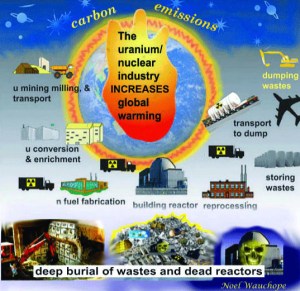
We also take issue with Mr Ford’s claim that “nuclear power remains one of the few technologies the world has for reliably generating zero-carbon electricity”.
The evidence base concludes that, taking account of the nuclear fuel cycle (uranium mining, fuel enrichment, construction of power stations and the waste stream), nuclear has CO2 emissions between 10 and 18 times those of renewables. And, in the light of major accidents, incidents, technical failures and outages, it is difficult to comprehend how the world’s ageing nuclear fleet can conceivably be described as reliable.
Dr Paul Dorfman Senior Research Associate, UCL Energy Institute, University College London Prof Andy Blowers Author, ‘The Legacy of Nuclear Power’ Prof Keith Barnham Emeritus Professor of Physics, Imperial College London Paul Brown Co-Editor, Climate News Network Prof Tom Burke Founder and Chair, E3G Prof Steve Thomas Emeritus Professor of Energy Policy, University of Greenwich Dr David Toke Reader in Energy Policy, University of Aberdeen Prof Andy Stirling Science Policy Research Unit, Sussex Energy Group, University of Sussex Prof Brian Wynne Professor Emeritus of Science Studies, Lancaster University
November 21, 2019
Posted by Christina Macpherson |
2 WORLD, climate change, Reference, wastes |
Leave a comment
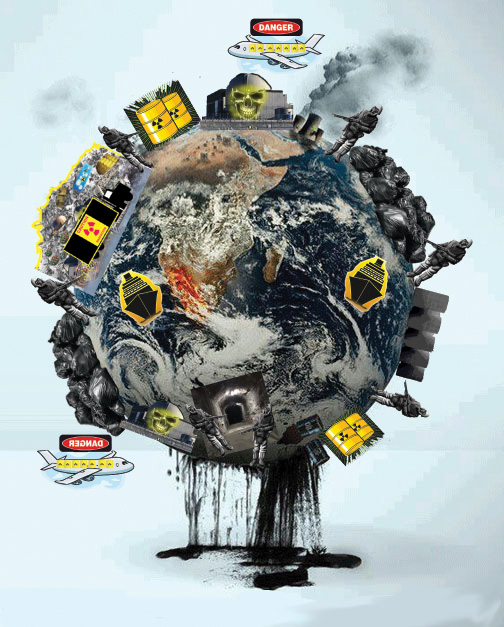
The final disposal of high-level radioactive waste presents governments worldwide with major challenges that have not yet been addressed, and entails incalculable technical, logistical, and financial risks. This is the conclusion of the first “World Nuclear Waste Report ‒ Focus Europe” launched in Berlin in November.
The World Nuclear Waste Report (WNWR) is a project by a group of renowned international experts who want to draw more attention to radioactive waste as a significant and growing challenge with no long-term solutions yet available. The project was initiated by Rebecca Harms, and the original outline was produced by Wolfgang Neumann, Mycle Schneider (coordinator of the annual World Nuclear Industry Status Reports) and Gordon MacKerron. Numerous experts have contributed to the first edition of the WNWR (including former US Nuclear Regulatory Commission chair Allison Macfarlane).
The WNWR aims to make a substantial contribution to understanding nuclear waste challenges for countries around the world. It does so by describing national and international classification systems, the risks posed by specific radioactive waste forms, generated and estimated future waste quantities, the waste management and disposal strategies of governments and their financing mechanisms.
According to the WNWR, over 60,000 tons of spent nuclear fuel alone are stored in interim storage facilities across Europe (excluding Russia and Slovakia). Spent fuel rods are highly radioactive waste. To date, no country in the world has a repository for high-level waste from nuclear power in operation. Within the EU, France accounts for 25 percent of the current spent nuclear fuel, followed by Germany (15 percent) and the United Kingdom (14 percent).
In addition, more than 2.5 million cubic metres of low- and intermediate-level waste has been generated in Europe (excluding Slovakia and Russia). Over its lifetime, the European nuclear reactor fleet will produce an estimated 6.6 million cubic metres of nuclear waste. Four countries are responsible for most of this waste: France (30 percent), the UK (20 percent), the Ukraine (18 percent) and Germany (8 percent).
According to the WNWR, many governments underestimate the costs of interim and final storage. No country has a consistent financing model to date in places. This poses further financial risk for taxpayers.
Marcos Buser, a Swiss geologist and co-author of the report, said: “Increasing amounts of high level waste have to be interim stored for ever longer periods of time, as no country in the world has yet commissioned a deep geological repository for such waste. The problem is that interim storage facilities have not been designed for such long-term use.”
The Swiss nuclear expert warned that the storage facilities are already reaching the limits of their capacities. For example, storage capacity for spent fuel in Finland has already reached 93 percent saturation. Sweden’s decentralized storage facility CLAB is at 80 percent saturation. “The shutdown and decommissioning of many nuclear power plants will again drastically increase the quantities of nuclear waste,” warns Buser.
In addition to the safety aspects, the report identifies the enormous costs of interim storage and final disposal as another risk. “National governments and operators often significantly underestimate the costs of decommissioning, storage, and disposal of nuclear waste,” said Ben Wealer, co-author of the study and industrial engineer at the Technical University of Berlin.
In many countries there is a large gap between the expected costs and the financial resources earmarked for them. The problem would be exacerbated by the fact that final disposal also involves incalculable risks, which could lead to enormous cost increases, as the German government experiences with the Asse repository illustrate.
Nearly every government claims to apply the polluter-pays-principle, which makes operators liable for the costs of managing, storing, and disposing of nuclear waste. In reality, however, governments fail to apply the polluter-pays-principle consistently. “No country in Europe has taken sufficient precautions to finance the costs of the final disposal of nuclear waste. There is a threat that the real, massive costs will ultimately be borne by the taxpayers,” Wealer warned.
Ellen Ueberschär, President of the Heinrich-Böll-Stiftung, said: “The numerous unsolved problems in dealing with nuclear waste show that nuclear power has no future. At the same time, the report makes clear that phasing out nuclear power is not enough. Insufficient financial provisions for disposing of nuclear waste must not undermine the care and safety of decisions for interim storage and final disposal. The search for a suitable final repository needs greater public attention. The report is intended to facilitate a qualified international debate.”
World Nuclear Waste Report https://worldnuclearwastereport.org/
World Nuclear Waste Report 2019 ‒ Focus Europe: https://worldnuclearwastereport.org/wp-content/themes/wnwr_theme/content/World_Nuclear_Waste_Report_2019_Focus_Europe.pdf
November 17, 2019
Posted by Christina Macpherson |
2 WORLD, Reference, wastes |
1 Comment
 Zac Eagle Nuclear Fuel Cycle Watch Australia, 11 Nov 19,
This is from the International Atomic Energy Agency admitting some radionuclides will be released into the environment even in Storage!
“The specific aims of disposal are:
(c) To inhibit, reduce and delay the migration of radionuclides at any time from
the waste to the accessible biosphere;
(d) To ensure that the amounts of radionuclides reaching the accessible
biosphere due to any migration from the disposal facility are such that
possible radiological consequences are acceptably low at all times.”
Some radionuclides can NOT be contained as they will diffuse in transport and storage, eg tritium.
Tritium is a carcinogen (causes cancer), teratogen (causes deformations of the embryo during pregnancy) and mutagen (causes mutations to DNA). Even very low rates of tritium exposure can lead to cancer, leukemia, and birth defects. https://www.facebook.com/groups/1021186047913052/
November 12, 2019
Posted by Christina Macpherson |
2 WORLD, radiation, Reference |
Leave a comment
Panel deciding whether to dump radioactive water from Fukushima into the ocean https://www.seafoodsource.com/news/environment-sustainability/panel-deciding-whether-to-dump-radioactive-water-from-fukushima-into-the-ocean By Chris Loew October 30, 2019
The Japanese government may allow Tokyo Electric Power Company (TEPCO) to dump more than 250 million gallons of contaminated water accumulated in tanks around its Fukushima nuclear power plants into the ocean.
Environment Minister Yoshiaki Harada commented in September that he supports the plan, as it may be the only solution for the wastewater. An expert panel is now studying the options, and its recommendation is likely to become policy.
The contaminated water was used to cool the superheated fuel rods in the Fukushima Daiishi facility prior to and during the nuclear meltdown that occurred as a result of the Tōhoku earthquake and tsunami in March 2011. The water has already been treated by multiple facilities, including a multi-nuclide removal facility (an advanced liquid processing system, or “ALPS”), which removed most of the radioactive materials, including cesium and strontium, but not tritium. Tritium is difficult to separate from water, because it closely resembles hydrogen, which is a natural component of water.
Many methods, both practically tried and theoretical, do exist for separation and removal of tritium, and they were assessed in a report presented by the International Research Institute for Nuclear Decommissioning in 2013. But all of them had the drawback of requiring a large amount of energy and equipment. Also, performance is poor for the low concentrations in the water at Fukushima Daiichi.
Last year, a team of researchers from Kindai University and private companies in western Japan developed an aluminum filter with holes of five nanometers or less in diameter. Steam of water containing tritium can be stopped, while that of water can pass. However, another issue is that 400 cubic meters of groundwater flowing into the basements of the buildings every day needs to be pumped and treated, necessitating treatment on a very large scale. This may not be justified when considering the actual danger of release to the ocean, according to the report.
Before the accident, tritium in cooling water was thinned with circulated sea water so that the allowable concentration might not be exceeded, and the diluted tritium was routinely released into the sea. Releasing the water at a rate that would allow it to be well diluted may be the best option, the report said.
While tritium has a radioactive half-life of 12.3 years, its biological half-life in the human body is only 10 days, and in fish it is less than two days. This is because tritium easily bonds to water, replacing the hydrogen atom. So as we drink and expel water, the tritium is carried away rather than accumulating in tissues. While some radioactive materials become concentrated as they move up the food chain, tritium is diluted.
The main danger of the policy is not actual harm, but rather public perceptions about the safety of seafood from Fukushima and its neighboring prefectures. Countries that have been gradually relaxing restrictions on imports of Japanese seafood may be forced by public fears to take a wait-and-see approach before further easing—a setback to local seafood firms, which have waited for years to return to their pre-disaster export figures.
October 31, 2019
Posted by Christina Macpherson |
Fukushima continuing, Reference |
Leave a comment
Quite apart from the technological challenges and ethical issues these solutions present, both have one major drawback: to be successful they rely on external, uncontrollable factors. How could the knowledge required to interpret these things this be guaranteed to last?
Semiotician Thomas Sebeok recommended the creation of a so-called Atomic Priesthood. Members of the priesthood would preserve information about the waste repositories and hand it on to newly initiated members, ensuring a transfer of knowledge through the generations.
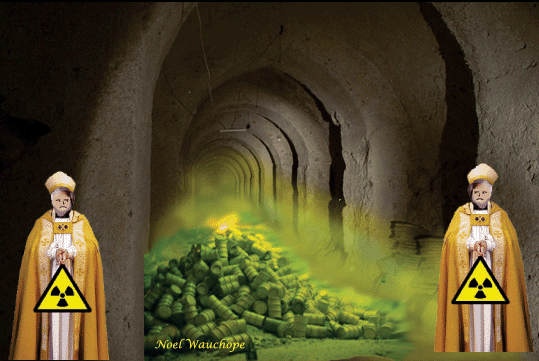
Buried nuclear waste stays dangerous for a million years — here’s how scientists plan to stop a future disaster
In thousands of years’ time, will they even understand the language written on our ‘keep out’ signs? https://inews.co.uk/news/long-reads/buried-nuclear-waste-danger-underground-future-disasters-814704
By Helen Gordon, Monday, 14th October 2019 The red metal lift takes seven juddering minutes to travel nearly 500 metres down. Down, down through creamy limestone to reach a 160-million-year-old layer of clay.
Here, deep beneath the sleepy fields and quiet woods along the border of the Meuse and Haute-Marne departments in north-east France, the French National Radioactive Waste Management Agency (Andra) has built its underground research laboratory.
The laboratory’s tunnels are brightly lit but mostly deserted, the air dry and dusty and filled with the hum of a ventilation unit.
Blue and grey metal boxes house a series of ongoing experiments – measuring, for example, the corrosion rates of steel, the durability of concrete in contact with the clay. Using this information, Andra wants to build an immense network of tunnels here.
It plans to call this place Cigéo, and to fill it with dangerous radioactive waste. It is designed to be able to hold 80,000 cubic metres of material.
October 15, 2019
Posted by Christina Macpherson |
France, Reference, wastes |
Leave a comment
Below are extracts from this very thoroughly researched article. The original contains much historical detail, good diagrams and excellent references
 Ekipazh: Russia’s top-secret nuclear-powered satellite, The Space Review, by Bart Hendrickx, Monday, October 7, 2019 There is strong evidence from publicly available sources that a Russian company called KB Arsenal is working on a new type of military satellite equipped with a nuclear power source. Called Ekipazh, its mission may well be to perform electronic warfare from space.
KB Arsenal, based in St. Petersburg, is no newcomer to the development of nuclear-powered satellites. In the Soviet days it built satellites known as US-A (standing for “active controllable satellite”), which carried nuclear reactors to power radars used for ocean reconnaissance (in the West they were known as “radar ocean reconnaissance satellites” or RORSAT for short.) ……………
evidence emerged in the past few years for the existence of another KB Arsenal project with the odd name Ekipazh (a French loanword meaning both “crew” and “horse-drawn carriage”). The name first surfaced in the 2015 annual report of a company called NPP KP Kvant, which manufactures optical sensors for satellite orientation systems. It revealed that the company had signed a contract with KB Arsenal under project Ekipazh to deliver an Earth sensor (designated 108M) for “transport and energy modules.” According to the 2015 report, test flights of Ekipazh were to be completed in 2021.
Documentation published in recent weeks and months on Russia’s publicly accessible government procurement website
zakupki.gov.ru has now confirmed that Ekipazh and TEM are indeed separate efforts. While TEM is a civilian project started jointly by Roscosmos and Rosatom in 2010, Ekipazh officially got underway on August 13, 2014, with a contract signed between KB Arsenal and the Ministry of Defense. It has the military index 14F350, an out-of-sequence number in the 14F satellite designation system, pointing to the satellite’s unusual nature………
While this procurement documentation reveals little about the true nature of Ekipazh and its “transport and energy module,” contractual information that appeared on the procurement website this summer provides conclusive evidence that Ekipazh is a nuclear-powered satellite and leaves little doubt that it uses the Plazma-2010 platform or an outgrowth of it…………
Regulatory issues
Despite the safety risks associated with launching nuclear reactors into space, there are no international rules forbidding nations from doing so. In September 1992, the General Assembly of the United Nations did adopt the so-called “Principles Relevant to the Use of Nuclear Power Sources in Outer Space,” but these do not have the same binding force as the UN Outer Space Treaties.
One of the Principles stipulates that nuclear reactors may be operated on interplanetary missions, orbits high enough to allow for a sufficient decay of the fission products, or in low-Earth orbits if they are boosted to sufficiently high orbits after the operational part of the mission. As explained earlier, the latter procedure was followed for the Soviet-era RORSAT missions, but it is highly unlikely that Russia would want to risk repeating the Cosmos 954 experience of 1978. In fact, the very presence of a “transport and energy module” on Ekipazh is a sure sign that it will be placed into an orbit high enough to prevent any harm. Before the nuclear-powered TEM is even activated, a liquid-fuel propulsion system may first boost the satellite to an orbital altitude of at least 800 kilometers, the same procedure that has been described for the one-megawatt TEM. During a recent question-and-answer question with students in St. Petersburg, Roscosmos chief Dmitri Rogozin confirmed that 800 kilometers is the minimum operating altitude for nuclear reactors. Judging from Russian press reports, Rogozin was actually replying to a question about Ekipazh, but seemingly dodged that by talking about the one-megawatt reactor instead.[38]
Another Principle states that launching nations should make a thorough and comprehensive safety assessment and share the results of that with other nations before launch:
The results of this safety assessment, together with, to the extent feasible, an indication of the approximate intended time-frame of the launch, shall be made publicly available prior to each launch and the Secretary-General of the United Nations shall be informed on how States may obtain such results of the safety assessment as soon as possible prior to each launch.
Russia adhered to this rule on the only occasion that it launched nuclear material into space after the adoption of the 1992 Principles. This was on the ill-fated Mars-96 interplanetary mission, which carried two surface penetrators powered by small radioisotope thermoelectric generators (RTGs). However, unlike Ekipazh, Mars-96 was an international scientific mission and the presence of the RTGs was widely known. It will be interesting to see how Russia deals with this issue once the top-secret Ekipazh nears launch.
Outlook
It may well be several more years before that launch takes place. Although the initial goal appears to have been to finish test flights by 2021, the available procurement documentation suggests that the first mission is still some time off. Ekipazh may well be experiencing the same kind of delays suffered by many other Russian space projects due to both budgetary issues and Western-imposed sanctions that have complicated the supply of electronic components for space hardware. On top of that, the development of a nuclear-powered satellite is bound to pose some daunting technical challenges that may further contribute to the delays.
One also wonders if the Russians are biting off more than they can chew by simultaneously working on two nuclear electric space tugs (Ekipazh and the one-megawatt TEM). An attempt to streamline this effort seems to have been made by giving KB Arsenal a leading role in both projects in 2014, making it possible to benefit from the company’s earlier experience in the field and infrastructure that it may already have in place to test related hardware. Still, the two projects use fundamentally different nuclear reactors built by different organizations.
The slow progress made in developing the one-megawatt gas-turbine reactor has left many wondering if it will ever fly in space. If Russia plans to use nuclear reactors solely for practical applications in Earth orbit, it may make more sense to abandon the gas-turbine reactor altogether and upgrade the capacity of Krasnaya Zvezda’s thermionic reactors. The company has already done conceptual work on thermionic reactors with a maximum capacity of several hundred kilowatts, even though their operational lifetime would be limited.[39] If this path is chosen, Ekipazh could serve as a testbed for all the nuclear reactors that Russia intends to fly in the near future. However, the country is unlikely to let all the money and effort invested in the one-megawatt TEM go to waste, even if its capabilities may not be needed until well into the 2030s or even later.
October 14, 2019
Posted by Christina Macpherson |
Reference, Russia, space travel |
Leave a comment
 What we know about nuclear weapons and the nuclear
  industry thanks to WikiLeaks, https://www.opendemocracy.net/en/can-europe-make-it/what-we-know-about-nuclear-weapons-and-nuclear-industry-thanks-wikileaks/ “The Nobel Peace Prize will be awarded on 11 October. Why I support the nomination of Julian Assange and WikiLeaks.” Felicity Ruby, 7 October 2019 The Nobel Peace Prize will be awarded on 11 October. Julian Assange and WikiLeaks have been nominated for the prize again this year, as they have since 2010. As the first staffer of the campaign that won the Peace Prize in 2017, the International Campaign to Abolish Nuclear Weapons (ICAN), I support this nomination for a number of reasons.
The vast majority of governments on this planet want nuclear disarmament negotiations to occur and produce results. ICAN has been mobilising this willingness to push for a new treaty to ban nuclear weapons. From the outset, the campaign deployed accurate information to mobilise public opinion and reeducate a new generation. In facing the truth about nuclear dangers, answers became available and courageous action was taken. Facing the truth about climate change similarly involves the public having accurate information and courageously acting on it.
WikiLeaks and Assange have made a great deal of information available about nuclear weapons and the nuclear industry. A search on the WikiLeaks site for the word ‘nuclear’ brings up 284, 493 results. These documents traverse the nuclear fuel cycle – from uranium mining to nuclear waste – with many thousands exposing nuclear energy industry giants, and nuclear weapon threat assessments, numbers, doctrines and negotiations.
Ten examples
Below are just ten examples of where WikiLeaks exposed wrongdoing on the part of governments and corporations that meant citizens could take action to protect themselves from harm, or governments were held to account:
– Chalk River nuclear reactor shut down – released 11 January 2008 – Canadian Nuclear Safety Commission on Chalk River reactor.
After the Chalk River nuclear reactor was shut down for routine maintenance on 18 November 2007, inspectors verified the reactor’s cooling systems had not been modified as required by an August 2006 licensing review. Atomic Energy of Canada Limited (AECL) did not start the reactor but said upgrades could be done as part of maintenance while still operating safely. This impasse lasted a month, with the government intervening to grant an exemption to the reactor to allow its restart. The responsible Minister for Natural Resources, Gary Lunn MP, fired Linda Keen, the President of the Nuclear Safety Commission. Their exchange of letters revealed much about the safety standards and routine practices of the Canadian nuclear regulatory system, and particular problems with the ageing Chalk River reactor previously unknown to the public.
– Footage of the 1995 disaster at the Japanese Monju nuclear reactor – released 25 January 2008
Following the 2008 announcement that the Japanese Monju fast breeder nuclear reactor would be reopened, activists leaked the suppressed video footage of the sodium spill disaster that led to its closure in 1995. Named after the Buddhist divinity of wisdom, Monju, located in Japan’s Fukui prefecture, is Japan’s only fast-breeder reactor. Unlike conventional reactors, fast-breeder reactors, which “breed” plutonium, use sodium rather than water as a coolant. This type of coolant creates a potentially hazardous situation as sodium is highly corrosive and reacts violently with both water and air. On December 8, 1995, 700 kg of molten sodium leaked from the secondary cooling circuit of the Monju reactor, resulting in a fire that did not result in a radiation leak, but the potential for catastrophe was played down the extent of damage at the reactor and denied the existence of a videotape showing the sodium spill. Further complicating the story, the deputy general manager of the general affairs department at the PNC, Shigeo Nishimura, 49, jumped to his death the day after a news conference where he and other officials revealed the extent of the cover-up.
– Serious nuclear accident lay behind Iranian nuke chief’s mystery resignation – released 16 July 2009
WikiLeaks revealed that a source associated with Iran’s nuclear program confidentially told the organisation of a serious, recent, nuclear accident at Natanz. Natanz is the primary location of
Iran’s nuclear enrichment program and the site targeted with the Stuxnet worm that contained 4 zero days and was designed to slow down and speed up centrifuges enriching uranium. WikiLeaks had reason to believe the source was credible, however contact with this source was lost.
– 180 confirmed US tactical nuclear weapons stationed in Europe – released 7 December 2010
In advance of the nuclear posture review, a briefing was provided by US Principal Deputy Under Secretary of Defense for Policy Jim Miller to NATO in July 2009. Federation of American Scientists nuclear weapons expert Hans Kristensen stated, “Whether Miller was providing certified U.S. intelligence numbers or simply referenced good-enough nonofficial public estimates is less clear. But his use of a specific number (180) for Europe rather than a range suggests that it might an official number.”
– Italian nuclear industry corruption – released 18 March 2011 American diplomatic cables published by WikiLeaks revealed how, “bribes could have a major impact on the future of the country’s energy industry,” in a four-year US campaign, which began in 2005, to encourage Italy to re-start a nuclear power program with a view to reducing its energy dependence on Russian gas and limiting the influence of the partnership between Italian energy company ENI and Russia’s Gazprom.
– Cash payments were made to Indian MPs for support of US India nuclear deal – released 18 March 2011 WikiLeaks revealed a cable by US Charge d’Affaires Steven White dated 17 July 2008 that indicated that the ruling Congress Party in India had bought MPs a vote on the 2008 India-US nuclear deal. Nachiketa Kapur, a political aide to Congress leader Satish Sharma showed a US Embassy employee “two chests containing cash” saying it was part of a bigger fund of Rs. 50 crore to Rs. 60 crore that the party had assembled to purchase the support of MPs.
– The IAEA warned Japan about safety issues at nuclear plants in 2009 – released 17 March 2011 In 2009, years before the Fukushima disaster, Japan was warned that its power plants could not withstand powerful earthquakes. The US was highly critical of Japan’s senior safety director at the International Atomic Energy Association “particularly with respect to confronting Japan’s own safety practices.”
– Safety and security issues with the UK Trident nuclear weapon system – released 17 May 2015
In an exclusive report to WikiLeaks, Trident nuclear weapons submariner, Royal Navy Able Seaman William McNeilly, aged 25, stated, “Please make sure this information is released. I don’t want to be in prison without anyone knowing the truth,” about the detailed nuclear safety problems he says he has been “gathering for over a year… This is bigger than me, it’s bigger than all of us. We are so close to a nuclear disaster it is shocking, and yet everybody is accepting the risk to the public… Our Nuclear weapon systems are the prime target and we are wide open to attack. We must unite globally in order to eliminate the biggest threat the world has ever seen.”
– Western and Chinese companies expose workers in African uranium grab – released 5 February 2016 WikiLeaks released a collection of documents that open up a corrupt multi-billion dollar war by Western and Chinese companies which grab uranium and other mining rights in the Central African Republic (CAR) and escape paying for the environmental consequences. French giant Areva failed to protect miners from high levels of radiation who processed soil samples with no radiation protection, and neglected local employees when pulling out of a financially and politically disastrous venture in the CAR.
– Uranium One links with the Clinton Foundation – released 7 October 2016
As Russian Rosatom company Uranium One gained control of 1/5th of the US uranium production between 2009 – 2013, its chairman used his family foundation to make donations of over USD$ 2 million to the Clinton Foundation. Because uranium is a strategic asset, such a deal had to be approved by a Committee, whose decision was signed off by Secretary of State Hillary Clinton. Uranium One paid $20,000 to The Podesta Group to lobby the State Department for this deal, a lobbying firm founded by Hillary Clinton campaign Chairman, John Podesta.
WikiLeaks and Assange have brought forward many truths that are hard to face, publishing well over 10 million documents since 2006. Often forgotten is that each one was provided by a whistleblower who trusted this platform to publish, and who sought reform of how political, corporate and media power elites operate. Each release has shared genuine official information about how governments, companies, banks, the UN, political parties, jailers, cults, private security firms, war planners and the media actually operate when they think no one is looking.
Assange is nominated for the Nobel Peace Prize because of these many releases of information, used as evidence in court cases, freeing prisoners and exposing scandals, torture, murder and surveillance for which redress is only possible when the wrongdoing is dragged into the light. For publishing this true information, Assange, an Australian based in the UK at the time of publication, is on the health ward of Belmarsh Prison, facing extradition and charges attracting 175 years in a US jail, an effective death sentence.
October 12, 2019
Posted by Christina Macpherson |
Reference |
Leave a comment
 Google and other companies were engaged in a “functional greenwashing” given the contradiction in their public pronouncements and private donations.
Revealed: Google made large contributions to climate change deniers https://www.theguardian.com/environment/2019/oct/11/google-contributions-climate-change-deniers
Firm’s public calls for climate action contrast with backing for conservative thinktanks. The obscure law that explains why Google backs climate deniers, Stephanie Kirchgaessner in Washington @skirchy Email 11 Oct 2019
Google has made “substantial” contributions to some of the most notorious climate deniers in Washington despite its insistence that it supports political action on the climate crisis.
Among hundreds of groups the company has listed on its website as beneficiaries of its political giving are more than a dozen organisations that have campaigned against climate legislation, questioned the need for action, or actively sought to roll back Obama-era environmental protections.
The list includes the Competitive Enterprise Institute (CEI), a conservative policy group that was instrumental in convincing the Trump administration to abandon the Paris agreement and has criticised the White House for not dismantling more environmental rules.
Google said it was disappointed by the US decision to abandon the global climate deal, but has continued to support CEI.
Google is also listed as a sponsor for an upcoming annual meeting of the State Policy Network (SPN), an umbrella organisation that supports conservative groups including the Heartland Institute, a radical anti-science group that has chided the teenage activist Greta Thunberg for “climate delusion hysterics”.
SPN members recently created a “climate pledge” website that falsely states “our natural environment is getting better” and “there is no climate crisis”.Google has defended its contributions, saying that its “collaboration” with organisations such as CEI “does not mean we endorse the organisations’ entire agenda”
It donates to such groups, people close to the company say, to try to influence conservative lawmakers, and – most importantly – to help finance the deregulatory agenda the groups espouse.A spokesperson for Google said it sponsored organisations from across the political spectrum that advocate for “strong technology policies”.“We’re hardly alone among companies that contribute to organisations while strongly disagreeing with them on climate policy,” the spokesperson said.
Amazon has, like Google, also sponsored a CEI gala, according to a programme for the event reported in the New York Times.CEI has opposed regulation of the internet and enforcement of antitrust rules, and has defended Google against some Republicans’ claims that the search engine has an anti-conservative bias.
But environmental activists and other critics say that, for a company that purports to support global action on climate change, such tradeoffs are not acceptable.“You don’t get a pass on it. It ought to be disqualifying to support what is primarily a phoney climate denying front group. It ought to be unacceptable given how wicked they have been,” said Sheldon Whitehouse, a Democratic senator from Rhode Island who is one of the most vocal proponents of climate action in Congress.“What all of corporate America should be doing is saying if you are a trade organisation or lobby group and you are interfering on climate, we are out. Period,” he added.On its website, Google says it is committed to ensuring its political engagement is “open, transparent and clear to our users, shareholders, and the public”.
Bill McKibben, a prominent environmentalist who has been on the frontline of the climate crisis for decades, said Google and other companies were engaged in a “functional greenwashing” given the contradiction in their public pronouncements and private donations. He said Google and other technology companies had also not used their own lobbyists to advocate for change on climate.
“Sometimes I’ll talk to companies and they will be going on and on about their renewable server farm or natural gas delivery, and I say thank you, but what we really need is for your lobbying shop in Washington to put serious muscle behind it. And they never do,” McKibben said. “They want some tax break or some regulations switch and they never devote the slightest muscle behind the most important issue of our time or any time.”A spokesperson for Google said: “We’ve been extremely clear that Google’s sponsorship doesn’t mean that we endorse that organisation’s entire agenda – we may disagree strongly on some issues.“Our position on climate change is similarly clear. Since 2007, we have operated as a carbon neutral company and for the second year in a row, we reached 100% renewable energy for our global operations.”The company said it called for “strong action” at the climate conference in Paris in 2015 and helped to sponsor the Global Climate Action summit in San Francisco last year.But that position is at odds with the support it gives to CEI.The group’s director of energy and environment policy, Myron Ebell, helped found the Cooler Heads Coalition 20 years ago, a group of libertarian and rightwing organisations that have sowed the seeds of climate denial with funding from the fossil fuel industry.
When Donald Trump was elected to the White House in 2016, Ebell joined the transition team and advised the new president on environmental issues, successfully lobbying Trump to adhere to a campaign promise and abandon the Paris agreement.
Kert Davies, the founder of the Climate Investigations Center, a research group that examines corporate campaigning, said Ebell had led the anti-climate-action crusade for decades.
“They’re extremists,” he said, referring to the Cooler Heads Coalition. “They are never finished,” he said. “Myron has taken a lot of credit for Trump’s actions and is quite proud of his access.”
Recently, however, Ebell – who declined a request for an interview – has criticised the White House for not rolling back environmental protections aggressively enough, even though the Trump administration has gutted every major environmental act established under Obama.
His wishlist now includes reversing a 2009 finding by the Environmental Protection Agency that CO2 and other greenhouse gases endanger the health and welfare of Americans.
CEI said it “respects the privacy of its donors” and declined to answer questions about Google. A CEI spokesperson told the Guardian: “On energy policy, CEI advances the humanitarian view that abundant and affordable energy makes people safer and economies more resilient. Making energy accessible, especially for the most vulnerable, is a core value.”
One source who is familiar with Google’s decision-making defended the company’s funding of CEI.
“When it comes to regulation of technology, Google has to find friends wherever they can and I think it is wise that the company does not apply litmus tests to who they support,” the source said.
October 12, 2019
Posted by Christina Macpherson |
2 WORLD, climate change, Reference, secrets,lies and civil liberties |
1 Comment
Lane, 6 Oct 19 Mayak Explosion
Ten Thousand Gallon Tank at Mayak Exploded from Heat Decay. The Heat Deacy was from Strontium 90, Cesium 137, Cobalt 60 and Plutonium Stored in the Underground Tank. The explosion was equivalent to 100 tons of TNT. There are55 million gallons of the same Radionuclide Mix stored at Hanford, in UnderGround Tanks. If they become too concentrated and hot, the same thing will Happen there, contaminating a Great Portion of the Pacific NW USA and southe western Canada.
Medvedev, Zhores A. (4 November 1976). “Two Decades of Dissidence”. New Scientist.
Medvedev, Zhores A. (1980). Nuclear disaster in the Urals translated by George Saunders. 1st Vintage Books ed. New York: Vintage Books. ISBN 978-0-394-74445-2. (c1979)
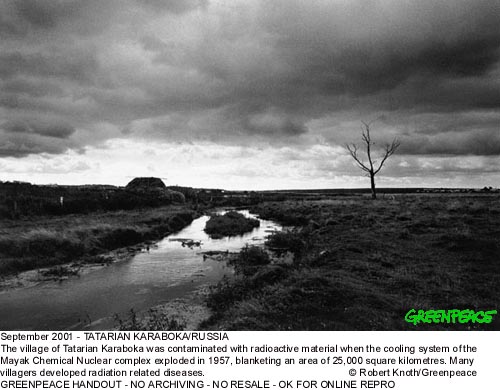
In 1957 the cooling system in one of the tanks containing about 70–80 tons of liquid radioactive waste failed and was not repaired. The temperature in it started to rise, resulting in evaporation and a chemical explosion of the dried waste, consisting mainly of ammonium nitrate and acetates (see ammonium nitrate/fuel oil bomb). The explosion, on 29 September 1957, estimated to have a force of about 70–100 tons of TNT,[10] threw the 160-ton concrete lid into the air.[8] There were no immediate casualties as a result of the explosion, but it released an estimated 20 MCi (800 PBq) of radioactivity. Most of this contamination settled out near the site of the accident and contributed to the pollution of the Techa River, but a plume containing 2 MCi (80 PBq) of radionuclides spread out over hundreds of kilometers.[11] Previously contaminated areas within the affected area include the Techa river, which had previously received 2.75 MCi (100 PBq) of deliberately dumped waste, and Lake Karachay, which had received 120 MCi (4,000 PBq).[7]
In the next 10 to 11 hours, the radioactive cloud moved towards the north-east, reaching 300–350 km (190–220 mi) from the accident. The fallout of the cloud resulted in a long-term contamination of an area of more than 800 to 20,000 km2 (310 to 7,720 sq mi), depending on what contamination level is considered significant, primarily with caesium-137 and strontium-90.[7] This area is usually referred to as the East-Ural Radioactive Trace EURT
October 6, 2019
Posted by Christina Macpherson |
history, incidents, Reference, Russia |
Leave a comment
The audience found it noteworthy that no seats had been assigned to tribal representation.
the public has known very little about the decommissioning process. No seats on the CAB were given to the media, no one on the CAB thought it was their job to speak with the press, PG&E did not speak with the press, and the NRC has a very hands off approach to the decommissioning process and the utility’s relationship with the CAB.
Input from the public included a strong sentiment that this was a very poor storage location for the spent fuel.
Laird went on to say that while there’s already been half a meter of sea level rise, a meter more, which is predicted to occur within 40 years, will fully inundate the generation station, 101 in that area and cause the dry cask storage area to become an island, until it is eroded away.
Notably, PG&E’s Decommissioning Fund will run out in 2025, a mere 5 years from now, the casks the waste are in only have a shelf life of 40 to 50 years, and the half life of the waste in storage in those casks in PG&E’s custody, is 24,000 years.
NUCLEAR WASTE BEING STORED 115 FT FROM HUMBOLDT BAY AS SEA LEVEL RISES
Bruce Watson the Branch Chief in charge of Reactor Decommissioning at the NRC led the meeting. He instructed everyone that the sole purpose of the meeting was for him to collect their input on the best practices of the Citizen Advisory Boards. He said, “We are not here to talk about other issues related to decommissioning.” The speakers allowed some of their remarks to drift over to address what should be done about the spent fuel rod still being stored at the King Salmon site.
On January 14th, the Nuclear Energy Innovation and Modernization Act (NEIMA) was signed into law. According to Jurist Legal News and Research website, NEIMA makes several changes to the licensing process for nuclear reactors. The NEIMA gave the NRC less than a year to “develop and implement a staged licensing process for commercial advanced nuclear reactors.” Continue reading →
September 22, 2019
Posted by Christina Macpherson |
investigative journalism, Reference |
Leave a comment

Boeing, Northrop spar over $85 billion nuclear missile program With Northrop poised to  become the Defense Department’s primary provider of ballistic missiles, Boeing has launched an aggressive lobbying campaign,
There was an $85 billion elephant in the room at this year’s Air Force Association conference, an annual trade show where thousands of uniformed airmen rub shoulders with suit-clad defense contractors hawking the latest advanced weaponry.
Those entering the conference hotel in National Harbor, Md., were welcomed by an enormous blue banner splashed with the Northrop Grumman logo and the words “LEGENDARY DETERRENCE” ― a not-so-subtle reference to the company’s ballistic missile ambitions.
Northrop is poised to take over a massive Air Force nuclear weapons program called Ground Based Strategic Deterrent, or GBSD, which will call on a team of contractors to replace the U.S. military’s aging stock of Minuteman III intercontinental ballistic missiles. But Boeing’s Arlington-based defense business, which has handled the Minuteman program since 1958, has launched an aggressive lobbying campaign in defense of its interests.
Northrop “is on a path to a sole-source opportunity,” Boeing GBSD Program Manager Frank McCall warned in an interview Wednesday on the floor of the trade show.
“There has never been a time in the history of the Minuteman when the Air Force wasn’t supported by both companies,” he said, adding that he thinks the Pentagon is taking “a winner-take-all approach” that is “unprecedented in the history of intercontinental ballistic missiles.”
The ground-based missiles make up one leg of the U.S. nuclear triad, which aims to be ready to deliver warheads at a moment’s notice from air, land or sea. They are meant to deter other countries from launching a nuclear strike by sending a message that any first-mover will be destroyed immediately.
The different components of the triad are extremely expensive to build and keep at the ready. For the new ground-based missiles, the Pentagon faces a difficult dilemma as it tries to get the best solution for the best price.
The Air Force had hoped to evaluate multiple competing options. But Boeing, thought to be the only viable competitor aside from Northrop, says it won’t participate unless the Air Force changes its approach.
With Boeing out, the Northrop-led team appears to be the Pentagon’s only option, something that could make it hard for the government to negotiate a fair price.
It is a common dilemma facing Defense Department weapons buyers, who have the impossible task of running a competitive marketplace when there are, at best, two or three potential suppliers for the most expensive weapons systems. The U.S. defense industry has consolidated to a worrying degree in the decades since the Cold War, officials and analysts say, with a handful of dominant suppliers exerting tremendous influence.
A White House report released last year found 300 cases in which important defense products are produced by just a single company, a “fragile” supplier, or a foreign supplier.
There is big money at stake for Boeing and Northrop: Defense Department estimates for the long-term cost of the program range between $62 billion and $100 billion. Both companies have formidable lobbying operations, spending $7.2 million and $8.3 million, respectively, on Washington lobbyists in 2019.
Boeing’s stewardship of the Minuteman program brought it roughly 600 defense contracts totaling $8 billion in the first 30 years of the programs, according to estimates provided by the company. Northrop has traditionally taken a secondary role handling complex systems integration.
In 2017, Northrop and Boeing were awarded contracts worth $349.2 million and $328.6 million, respectively, to develop their own version of a next-generation replacement for the Minuteman. In July, the Air Force asked each company to submit a proposal, hoping to compare the two missile designs and negotiate a fair price.
Boeing quickly threw a wrench into that plan, announcing July 25 that it would walk away from the competition because the Air Force’s request for proposals allegedly favored Northrop.
Boeing’s concerns stem from Northrop Grumman’s 2017 acquisition of a company called Orbital ATK for $7.8 billion. Orbital ATK ― which operates as a Northrop Grumman business unit called Innovation Systems ― is a dominant producer of rocket motors that power ballistic missiles. Aerojet Rocketdyne, the other U.S. manufacturer of rocket motors, also is working with Northrop.
Boeing has taken its case to the Pentagon, as well as to the Federal Trade Commission, but has failed to block the deal.
“We continue to stand ready to support this important program,” wrote Leanne Caret, president of Boeing’s Arlington-based defense business, in a July 23 letter seen by The Washington Post. “As we have discussed, we believe there are other procurement structures that could provide this capability more rapidly at less cost, and we will look for ways to leverage the work … to help support this critical national security mission.”
Boeing later approached Northrop about the possibility of teaming up but was rejected, a Boeing official said. So it came as little surprise Monday when Northrop released the list of companies it is teaming up with, and Boeing isn’t on it.
Air Force officials stood by their approach but declined to comment on how they will proceed.
“We are very open to a variety of proposals. … We are open to teaming relationships. We just don’t want to dictate,” Will Roper, the Air Force’s assistant secretary for acquisition, technology and logistics, told reporters Monday. “We think it should be decided by industry and what they think is best value.”
Soon afterward, Boeing countered that it is pursuing a multifaceted advocacy and lobbying campaign asking the government to force Northrop to collaborate.
“We believe it is a path to a better weapons system solution that will allow us to field the solution more quickly than either company could handle on its own,” said McCall, the Boeing official.
Analysts expressed concern over the current arrangement, in which Northrop will almost certainly be the only bidder. Whether Boeing’s proposal will resolve the problem is less clear.
“I would much rather see a direct competition between Northrop and Boeing,” said Dan Grazier, a former Marine Corps captain working at the Project on Government Oversight, a watchdog group. “The best practice for any acquisition system would be a solid, honest, competitive prototyping, where the government can weigh competing options and get a competitive price.”
September 22, 2019
Posted by Christina Macpherson |
business and costs, politics, Reference, weapons and war |
Leave a comment
https://theecologist.org/2019/sep/10/advanced-nuclear-power-sector-dystopian, Jim Green – Nuclear Monitor 10th September 2019 The ‘advanced’ nuclear power sector is dystopian because of its connections to fossil fuel mining and nuclear weapons proliferation.
A documentary called
New Fire was released promoting ‘advanced’ nuclear power concepts last year. The heroes of the film were young entrepreneurs Leslie Dewan and Mark Massie, founders of a start-up called Transatomic Power that was developing a ‘Waste-Annihilating Molten-Salt Reactor’.
Problems arose during the long gestation of New Fire. Transatomic Power gave up on its plan to use nuclear waste as reactor fuel after its theoretical calculations were proven to be false, and the waste-annihilating reactor was reinvented as a waste-producing, uranium-fuelled reactor.
Worse was to come: just before the release of New Fire, Transatomic Power went broke and collapsed altogether. An epic fail.
Reactor
The Australian parliament’s ‘inquiry into the prerequisites for nuclear energy‘ is shaping up to be another epic fail. The conservative chair of the inquiry claims that “new technologies in the field are leading to cleaner, safer and more efficient energy production.”
But the ‘advanced’ nuclear power sector isn’t advanced and it isn’t advancing.
The next ‘advanced’ reactor to commence operation will be Russia’s floating nuclear power plant, designed to help exploit fossil fuel reserves in the Arctic ‒ fossil fuel reserves that are more accessible because of climate change. That isn’t ‘advanced’ ‒ it is dystopian.
Russia’s enthusiastic pursuit of nuclear-powered icebreaker ships (nine such ships are planned by 2035) is closely connected to its agenda of establishing military and economic control of the Northern Sea Route ‒ a route that owes its existence to climate change.
China General Nuclear Power Group (CGN) says the purpose of its partly-built ACPR50S demonstration reactor is to develop floating nuclear power plants for oilfield exploitation in the Bohai Sea and deep-water oil and gas development in the South China Sea.
God-awful
‘Advanced’ nuclear reactors are advancing climate change. Another example comes from Canada, where one potential application of small reactors is providing power and heat for the extraction of hydrocarbons from tar sands.
Some ‘advanced’ reactors could theoretically consume more nuclear waste than they produce. That sounds great ‒ until you dig into the detail.
An article in the Bulletin of the Atomic Scientists ‒ co-authored by Allison Macfarlane, a former chair of the US Nuclear Regulatory Commission ‒ states that “molten salt reactors and sodium-cooled fast reactors – due to the unusual chemical compositions of their fuels – will actually exacerbate spent fuel storage and disposal issues.”
The subclass of sodium-cooled fast reactors called ‘integral fast reactors’ (IFRs) could theoretically gobble up nuclear waste and convert it into low-carbon electricity, using a process called pyroprocessing.
But an IFR R&D program in Idaho has left a god-awful mess that the Department of Energy (DOE) is struggling to deal with. This saga is detailed in a 2017 article and a longer report by the Union of Concerned Scientists’ senior scientist Dr. Edwin Lyman, drawing on documents obtained under Freedom of Information legislation.
Breeder
Dr. Lyman writes: “Pyroprocessing has taken one potentially difficult form of nuclear waste and converted it into multiple challenging forms of nuclear waste. DOE has spent hundreds of millions of dollars only to magnify, rather than simplify, the waste problem. …
The FOIA documents we obtained have revealed yet another DOE tale of vast sums of public money being wasted on an unproven technology that has fallen far short of the unrealistic projections that DOE used to sell the project”.
Some ‘advanced’ reactors could theoretically consume more fissile (explosive) nuclear material than they produce. Instead of contributing to weapons proliferation risks and problems, they could contribute to the resolution of those problems.
That sounds great ‒ until you dig into the detail. After Russia’s floating nuclear plant, the next ‘advanced’ reactor to commence operation may be the Prototype Fast Breeder Reactor (PFBR) in India.
 Weapons
The PFBR has a blanket with thorium and uranium to breed fissile uranium-233 and plutonium respectively ‒ in other words, it will be ideal for weapons production.
India plans to use fast breeder reactors (a.k.a. fast neutron reactors) to produce weapon-grade plutonium for use as the initial ‘driver’ fuel in thorium reactors.
As John Carlson, the former Director-General of the Australian Safeguards and Non-proliferation Office, has repeatedly noted, those plans are highly problematic with respect to weapons proliferation and security.
There’s nothing “cleaner, safer and more efficient” about India’s ‘advanced’ reactor program. On the contrary, it is dangerous and it fans regional tensions and proliferation concerns in South Asia ‒ all the more so since India refuses to allow International Atomic Energy Agency safeguards inspections of its ‘advanced’ nuclear power program.
And if those regional tensions boil over into nuclear warfare, catastrophic climate change will likely result. Fossil fuels provide the surest route to catastrophic climate change; nuclear warfare provides the quickest route.
Reactors
The ‘advanced’ nuclear power sector isn’t advanced ‒ it is dystopian. And it isn’t advancing ‒ it is regressing.
The Russian government recently clawed back US$4 billion from Rosatom’s budget by postponing its fast neutron reactor program; specifically, by putting on hold plans for what would have been the only gigawatt-scale fast neutron reactor anywhere in the world.
France recently abandoned plans for a demonstration fast reactor. Pursuit of fast reactor technology is no longer a priority in France according to the World Nuclear Association.
And funding is tight because of yet another failing project: a 100-megawatt materials testing reactor that is 500 percent over-budget (and counting) and eight years behind schedule (and counting).
Other fast reactor projects have collapsed in recent years. TerraPower abandoned its plan for a prototype fast reactor in China last year due to restrictions placed on nuclear trade with China by the Trump administration, and requests for US government funding have reportedly received a negative reception.
The US and UK governments have both considered using GE Hitachi’s ‘PRISM’ fast reactor technology to process surplus plutonium stocks ‒ but both governments have rejected the proposal.
Failed
Fast reactors and other ‘advanced’ concepts are sometimes called Generation IV concepts.
But fast reactors have been around since the dawn of the nuclear age. They are best described as failed Generation I technology ‒ “demonstrably failed technology” in the words of Allison Macfarlane.
The number of operating fast reactors reached double figures in the 1980s but has steadily fallen and will remain in single figures for the foreseeable future.
Currently, just five fast reactors are operating ‒ all of them described by the World Nuclear Association as experimental or demonstration reactors.
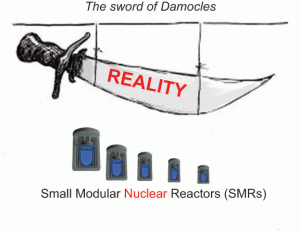 Modular
As discussed previously in The Ecologist, most of the handful of small modular reactors (SMRs) under construction are over-budget and behind schedule; there are disturbing connections between SMRs, weapons proliferation and militarism more generally; and about half of the SMRs under construction are intended to be used to facilitate the exploitation of fossil fuel reserves.
SMRs aren’t leading to “cleaner, safer and more efficient energy production”. And SMRs aren’t advancing ‒ projects are falling over left, right and centre:
- Babcock & Wilcox abandoned its mPower SMR project in the US despite receiving government funding of US$111 million.
- Westinghouse sharply reduced its investment in SMRs after failing to secure US government funding.
- China is building a demonstration high-temperature gas-cooled reactor (HTGR) but it is behind schedule and over-budget and plans for additional HTGRs at the same site have been “dropped” according to the World Nuclear Association.
- MidAmerican Energy gave up on its plans for SMRs in Iowa after failing to secure legislation that would force rate-payers to part-pay construction costs.
- Rolls-Royce sharply reduced its SMR investment in the UK to “a handful of salaries” and is threatening to abandon its R&D altogether unless massive subsidies are provided by the British government.
Zombie reactors
Fast reactors are demonstrably failed technology. SMRs have failed previously and are in the process of failing yet again. What else is there in the ‘advanced’ nuclear sector?
Fusion? At best, it is decades away and most likely it will forever remain decades away. Two articles in the Bulletin of the Atomic Scientists by Dr. Daniel Jassby ‒ a fusion scientist ‒ comprehensively debunk all of the rhetoric spouted by fusion enthusiasts.
Thorium? There are no fundamental differences between thorium and uranium, so building a thorium fuel cycle from scratch to replace the uranium fuel cycle would be absurd ‒ and it won’t happen.
High-temperature gas-cooled reactors (HTGRs) including the pebble-bed modular reactor sub-type? This zombie concept refuses to die even as one after another country embarks on R&D, fails, and gives up. As mentioned, China is building a prototype but has dropped plans for further HTGRs.
Paper reactors
Claims that new nuclear technologies are leading to “cleaner, safer and more efficient energy production” could only be justified with reference to concepts that exist only as designs on paper.
As a nuclear industry insider quipped: “We know that the paper-moderated, ink-cooled reactor is the safest of all. All kinds of unexpected problems may occur after a project has been launched.”
There’s nothing that can be said about ‘advanced’ reactor rhetoric that wasn’t said by Admiral Hyman Rickover ‒ a pioneer of the US nuclear program ‒ all the way back in 1953.
“An academic reactor or reactor plant almost always has the following basic characteristics: (1) It is simple. (2) It is small. (3) It is cheap (4) It is light. (5) It can be built very quickly. (6) It is very flexible in purpose (‘omnibus reactor’). (7) Very little development is required. It will use mostly off-the-shelf components. (8) The reactor is in the study phase. It is not being built now.
“On the other hand, a practical reactor plant can be distinguished by the following characteristics: (1) It is being built now. (2) It is behind schedule. (3) It is requiring an immense amount of development on apparently trivial items. Corrosion, in particular, is a problem. (4) It is very expensive. (5) It takes a long time to build because of the engineering development problems. (6) It is large. (7) It is heavy. (8) It is complicated.”
This Author
Dr. Jim Green is the national nuclear campaigner with Friends of the Earth Australia and editor of the Nuclear Monitor newsletter.
September 20, 2019
Posted by Christina Macpherson |
2 WORLD, Reference, technology |
Leave a comment
“The ashes of half a dozen unidentified laborers ended up at a Buddhist temple in a town just north of the crippled Fukushima nuclear plant. Some of the dead men had no papers; others left no emergency contacts. Their names could not be confirmed and no family members had been tracked down to claim their remains. They were simply labeled “decontamination troops”
Addressing the issue, Japan’s environmental minister Yoshiaki Harada held a news conference (September 2019). Unfortunately, he proffered the following advice: “The only option will be to drain it into the sea and dilute it.” (Source: Justin McCurry in Tokyo, Fukushima: Japan Will Have to Dump Radioactive Water Into Pacific, Minister Says, The Guardian, Sept. 10, 2019)
“The only option”… Really?
Over the past 8 years, Tokyo Electric Power (TEPCO) has scrambled like a Mad Hatter to construct emergency storage tanks (1,000) to contain upwards of one million tonnes of contaminated radioactive water, you know, the kind of stuff that, over time, destroys human cells, alters DNA, causes cancer, or produces something like the horrific disfigured creature in John Carpenter’s The Thing! That’s the upshot of a triple nuclear meltdown that necessitates constant flow of water to prevent further melting of reactor cores that have been decimated and transfigured into corium or melted blobs. It’s the closest to a full-blown “china syndrome” in all of human history. Whew! Although, the truth is it’ll be a dicey situation for decades to come.
Ever since March 11, 2011, TEPCO has scrambled to build storage tanks to prevent massive amounts of radioactive water from pouring into the ocean (still, some lesser amounts pour into the ocean every day by day). Now the government is floating a trial balloon in public that, once the tanks are full, it’ll be okay to dump the radioactive water into the ocean. Their logic is bizarre, meaning, on the one hand, the meltdown happens, and they build storage tanks to contain the radioactive water, but on the other hand, once the storage tanks run out of space, it’s okay to dump radioactive water into the ocean. Seriously?
Meantime, the Fukushima meltdown brings the world community face to face with TEPCO and the government of Japan in an unprecedented grand experiment that, so far, has failed miserably. Of course, dumping radiation into the Pacific is like dumping radiation into everybody’s back yard. But, for starters, isn’t that a non-starter?
Along the way, deceit breeds duplicity, as the aforementioned Guardian article says the Japanese government claims only one (1) death has been associated with the Fukushima meltdown but keep that number in mind. Reliable sources in Japan claim otherwise, as explained in previous articles on the subject, for example, “Fukushima Darkness, Part Two” d/d November 24, 2017, and as highlighted further on in this article.
When it comes to nuclear accidents, cover-ups reign supreme; you can count on it.
As such, it is believed the Japanese government is lying and should be held accountable for hoodwinking the world about the ravages of Fukushima, especially with the Olympics scheduled for next year.
For example, the following explains how death by radiation is shamefully hidden from the public via newspeak: Fukushima Daiichi Nuclear Power Station worker deaths “that expire at home” are not officially counted. Accordingly, how many workers on a deathbed with radiation sickness leave home to go to work (where deaths are counted) just before they die? Oh, please!
Meanwhile, the last thing the world community needs in the face of an uncontrollable nuclear meltdown, like Fukushima, is deceptiveness and irresponsibility by the host government. Too much is at stake for that kind of childish nonsense. And just to think, the 2020 Olympics are scheduled with events held in Fukushima. Scandalously, the International Olympic Committee (IOC) is A-Okay with that.
In contrast, a Greenpeace International March 8th 2019 article entitled: Japanese Government Misleading UN on Impact of Fukushima Fallout on Children, Decontamination Workers: “The Japanese government is deliberately misleading United Nations human rights bodies and experts over the ongoing nuclear crisis in areas of Fukushima… In areas where some of these decontamination workers are operating, the radiation levels would be considered an emergency if they were inside a nuclear facility.” Enough said!
“In its reporting to the United Nations, the Japanese government deliberately misrepresents the scale, complexity, and radiation risks in areas of Fukushima, the working practice and conditions for workers, and its disregard for children’s health and wellbeing. This reality should shame the government to radically change its failing policies,” said Kazue Suzuki, Energy Campaigner of Greenpeace Japan.
As such, either Greenpeace or the IOC is “dead wrong” about the conditions at Fukushima. Take your pick.
After all, the trend of misrepresentation of nuclear accidents has been established for decades. Not only Fukushima, Chernobyl (1986) is a nuclear disaster zone where the “official death count from radiation exposure” has been considerably discounted by various governmental agencies and NGOs. For inexplicable reasons (actually explicable but a long story), nuclear accidents are given Get Out Jail Free cards by the world’s press and associated governmental orgs and NGOs.
Yet, over time, the truth comes out, and when it does it’s dreadfully atrocious: A BBC special report, The True Toll of the Chernobyl Disaster d/d July 26, 2019 says: “The official, internationally recognized death toll, just 31 people died as an immediate result of Chernobyl while the UN estimates that only 50 deaths can be directly attributed to the disaster.”
That’s the official tally. Ugh! It’s so far off the mark that, if it were a baseball pitch, it’d be in the dirt, and a prime example of the public not getting the truth about the ravages of nuclear power accidents.
Of course, it is important to take note of how “wordsmiths” describe the death numbers, i.e., “died as an immediate result of Chernobyl” can only include someone standing at the site when it happened, leaving out all cases of radiation exposure that kills and cripples over subsequent days, months, and years. Or, in the case of the UN statement, “only 50 deaths can be directly attributed.” Only those standing there when it happened… ahem!
According to the BBC article, the Russian Academy of Sciences said as many as 112,000-125,000 died by 2005. That’s 2,500xs more deaths than the official reports, which also never increase in number over time as radiation takes its merry ole time blasting, destroying, and/or altering human cell structure. Ukrainian authorities claim death rates of Chernobyl cleanup workers rose from 3.5 to 17.5 deaths per 1,000 between 1988 and 2012 on a database of 651,453 cleanup workers, which equates to 11,392 deaths. Additionally, Belarus had 99,693 cleanup workers, equating to 1,732 deaths. Not only that, disability among workers shows that approximately 5% are still healthy in 2012 (only 5%, meaning 95% unhealthy) with commonality of cardiovascular and circulatory diseases and nervous system problems.
By 2008 in Belarus alone 40,049 liquidators or cleanup workers of Chernobyl were registered with cancer.
Viktor Sushko, deputy director general of the National Research Centre for Radiation Medicine (NRCRM) based in Kiev, Ukraine, describes the Chernobyl disaster as: “The largest anthropogenic disaster in the history of humankind,” Ibid.
Thus begging the most obvious of questions re Fukushima victims in the years ahead; how many cases of cancer, and how many will die? Unfortunately, radioactive isotopes don’t stop once they’re activated in a nuclear meltdown. They’re pernicious over time destroying and/or grotesquely altering human cell structure. For proof, visit second-generation Chernobyl children locked up in orphanages in Belarus.
“As of January 2018, 1.8 million people in Ukraine, including 377,589 children, carried status of victims of the disaster, according to Sushko and his colleagues. Not only that, there has been a rapid increase in the number of people with disabilities, rising from 40,106 in 1995 to 107,115 in 2018,” Ibid.
According to a USA Today article – Chernobyl’s Legacy: Kids With Bodies Ravaged by Disaster, April 17, 2016: “There are 2,397,863 people registered with Ukraine’s health ministry to receive ongoing Chernobyl-related health care. Of these, 453,391 are children — none born at the time of the accident. Their parents were children in 1986. These children have a range of illnesses: respiratory, digestive, musculoskeletal, eye diseases, blood diseases, cancer, congenital malformations, genetic abnormalities, trauma.” Many of the children are hidden away deep in the forested countryside in orphanages in Belarus.
Back to Fukushima, there are numerous instances of governmental meddling to hide the truth, starting with passage of the 2013 government secrecy act, The State Secrecy Law, aka: Act on the Protection of Specially Designated Secrets (SDS), Act No. 108, which says that civil servants or others who “leak secrets” will face up to 10 years in prison, and those who “instigate leaks,” especially journalists, will be subject to a prison term of up to 5 years. Subsequently, Japan fell below Serbia and Botswana in the Reporters Without Borders 2014 World Press Freedom Index.
Horrifically, at the end of the day, when nuclear goes bad, it takes everyone along on a daunting trip for years and years and more years, outliving life spans but continuing generation after generation, like the 453,391 Chernobyl-radiated-influence children born after the nuclear blowout in 1986. Chernobyl altered their genes before they were born…. Imagine that!
Cliodhna Russell visited children’s orphanages in Belarus in 2014: “Children rocking back and forth for hours on end, hitting their heads against walls, grinding their teeth, scraping their faces and putting their hands down their throats.” (Source: How My Trip to a Children’s Mental Asylum in Belarus Made Me Proud to be Irish, the journal.ie, March 18, 2014.)
Postscript: “It’s a real shame that the authorities hide the truth from the whole world, from the UN. We need to admit that actually many people are dying. We are not allowed to say that, but TEPCO employees also are dying. But they keep mum about it,” Katsutaka Idogawa, former mayor of Futaba (Fukushima Prefecture) Fukushima Disaster: Tokyo Hides Truth as Children Die, Become Ill from Radiation – Ex-Mayor, RT News, April 21, 2014)
Post-Postscript: “The ashes of half a dozen unidentified laborers ended up at a Buddhist temple in a town just north of the crippled Fukushima nuclear plant. Some of the dead men had no papers; others left no emergency contacts. Their names could not be confirmed and no family members had been tracked down to claim their remains. They were simply labeled “decontamination troops” — unknown soldiers in Japan’s massive cleanup campaign to make Fukushima livable again five years after radiation poisoned the fertile countryside,” (Source: Mari Yamaguchi, Fukushima ‘Decontamination Troops’ Often Exploited, Shunned, AP & ABC News, Minamisona, Japan, March 10, 2016)
September 17, 2019
Posted by Christina Macpherson |
Japan, Reference, secrets,lies and civil liberties, spinbuster |
1 Comment
Unbeknownst to most Canadians, the Darlington nuclear power plant 70 kilometres east of Toronto has been playing a not-so-small role in the U.S. race to weaponize space
The 50th anniversary of the Apollo 11 mission added momentum to the new push to go farther into outer space than humans have ever gone before.
Ontario’s nuclear industry could receive both a reflected glow from the extraterrestrial travel hype and a new revenue stream. It could also potentially increase international nuclear-weapons proliferation.
Unbeknownst to most Canadians, the Darlington nuclear power plant 70 kilometres east of Toronto has already been playing a not-so-small role in the space race.
The plant has been producing radioactive plutonium-238 as fuel for spacecraft in NASA’s mushrooming space pipeline since 2017.
That’s when Ontario Power Generation (OPG) announced excitedly that it would start making plutonium-238 for space exploration. The plant produces about 10 kilograms of plutonium-238 a year.
“We are proud to have Ontario play a part, however small, in this most noble of human endeavours,” OPG’s then-president and CEO Jeff Lyash said in a news release.
Canadian Nuclear Laboratories (CNL), which runs the Chalk River facility near Ottawa, another participant in the initiative, posted a “Success Stories” article on its website seven days later. It cautioned that “this opportunity is still subject to regulatory and licensing processes.” But it quotes a CNL official as saying “staff should take a lot of pride in the fact that we are key partners.”
CNL has continued communicating with other project stakeholders. But when NOW contacted CNL for a comment it responded on September 5 that it is no longer involved in the project. OPG has removed the news release from its website and did not respond to NOW’s request for information. Turns out a company called Technical Solutions Management (TSM) is steering the initiative now.
TSM is owned by former nuclear-industry executives Billy Shipp, Pierre Tremblay and Paul Spekkens. CEO Shipp told NOW in an August 29 phone interview that NASA has yet to give its formal thumbs-up.
“For us to get out ahead of our client [NASA], in terms of anticipated need [for plutonium-238], or making statements of their need, is not that professional on our part. So we really have been very low-key on this,” Shipp says when reached for an interview aboard a boat off Vancouver Island.
But he noted that U.S. President Donald Trump’s establishment of a Space Command makes the project more likely to proceed.
Plutonium-238 has long been used to fuel flight, via conversion into electricity of the intense heat the atom pumps out. The U.S. powered military satellites with it in the 1960s. NASA also harnessed it most recently to propel Curiosity Rover to Mars in 2011.
The steps involved for the manufacture of made-in-Canada plutonium-238 to supplement the U.S.’s production involves first synthesizing neptunium-237, plutonium-238’s precursor at the Pacific Northwest National Laboratory in Richland, Washington.
From there, the material is transported to Chalk River where it is put into bundles before it’s sent to Darlington and inserted into CANDU reactors. There, the neptunium-237 catches stray neutrons, transforming it into plutonium-238. The bundles are shipped back to Chalk River where the plutonium-238 is separated from by-products and packaged into pellets. The pellets are transported to Idaho National Lab where they are readied as ‘nuclear batteries’ for spacecraft engines. The current price of plutonium-238 isn’t public, but back in 2003 one kilogram was worth about $8 million U.S.
Gordon Edwards, co-founder and president of the Canadian Coalition for Nuclear Responsibility, says the form of radioactivity emitted by plutonium (namely, alpha particles) is highly toxic when inhaled but often isn’t picked up by radiation detectors.
For example, in November 2009, hundreds of workers at OPG’s Bruce nuclear plant breathed in plutonium dust (a by-product of nuclear-energy production) but the plutonium remained undetected for weeks. Many of the workers had not been given respirators. It was the largest preventable exposure of workers to internal radioactive contamination in the history of the civilian nuclear industry.
Even worse, says Edwards, is the fact the process used to create plutonium-238 can also be used to transform depleted uranium into plutonium-239, the key explosive in nuclear bombs.
“I grant that TSM’s plutonium-238 program does not fundamentally enhance this danger, but it does provide an opportunity to tell the public and politicians that if you can produce one kind of plutonium for the space program you can just as easily produce another kind of plutonium for a nuclear-weapons program, using essentially the same CANDU technology,” Edwards tells NOW.
However, no one inside the space or nuclear industries appears be seriously addressing these well-known problems. And there is plenty of money potentially available for a new plutonium-238 venture. NASA projects its research and development budget – including developing power and propulsion systems – will be $1.5 billion next year, rising to $3.4 billion by 2024.
TSM’s other co-owners, Tremblay and Spekkens, are well-placed to move such a project forward. Tremblay was OPG’s chief nuclear operating officer and president of OPG’s subsidiary Canadian Nuclear Partners. He became AECOM Canada Nuclear Operations’ president and CEO in August 2018. The American multinational is playing key roles in the multi-billion-dollar Darlington refurbishment. Tremblay started consulting for AECOM in June 2016; an industry article about this said the firm “has recruited key expertise that will undoubtedly position the company to play a key part in the massive nuclear power projects anticipated for Ontario over the next decade.”
Spekkens retired in 2016 as OPG’s vice president of science and technology and as chair of the CANDU Owners Group, a Toronto-based private organization that promotes CANDU use around the world. He then became a consultant and director of nuclear technology at Kinectrics.
He opined on the nuclear industry’s future at a June 2017 conference. In the abstract of his lecture, Spekkens says “this future will, of course, depend heavily on technology. But also (and perhaps equally) important will be non-technical considerations such as public acceptance, a pipeline full of qualified future employees, public policy in several levels of government, and of course, finances.”
@nowtoronto
September 17, 2019
Posted by Christina Macpherson |
Reference, secrets,lies and civil liberties, space travel, weapons and war |
Leave a comment



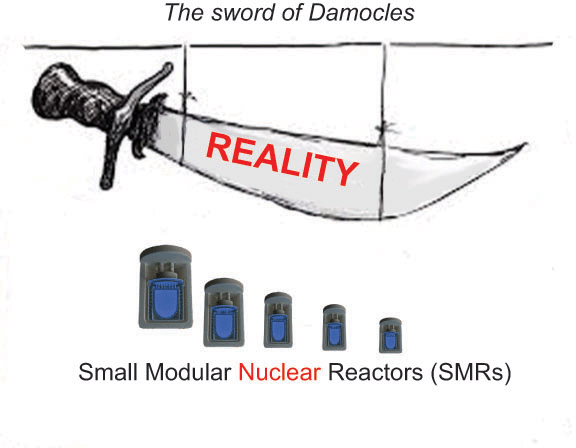






 nuclear-news
