Marie Curie’s illness and death caused by ionising radiation
 John Wayne squares off against Jim Hansen, Medium, Albert Bates, 11 Jan 2020 “…….. In 1896, Henri Becquerel discovered that uranium emitted rays that resembled X-rays. Marie Curie suspected that the radiation was not the outcome of some interaction but came from the atom itself. Her work with uranium disproved the conventional wisdom going back to ancient Greece that atoms were indivisible and set up the later discovery of subatomic particles. Curie discovered that thorium, radium, polonium and radioactive bismuth occurred naturally with uranium. Radium was known to glow in the dark, which made it useful for painting the hour and minute hands on watches and clocks. It was later discovered that radium “radiated” more than just neutrons, but also protons and electrons, becoming another unstable element, radon, and that element radiated its subatomic particles to become others, polonium and bismuth, until those eventually became a stable element, lead. Indeed, the radium Curie discovered was the progeny of another unstable element, thorium, which was the progeny of yet another unstable element, uranium.
Madame Curie was a physicist, not a medical doctor, so she did not recognize the health effects of handling uranium, thorium, radium and the other radionuclides. Indeed, she suspected the effects would be beneficial. One of the papers she and her husband published in the late 19th century announced that, when exposed to radium, diseased, tumor-forming cells were destroyed faster than healthy cells (the basis for today’s radio-chemotherapy). She carried test tubes containing radioactive isotopes in her pockets and stored them in her desk drawer. Although her many decades of exposure to radiation caused chronic illnesses (including near-blindness due to cataracts) and ultimately her death, she never acknowledged the inherent health risks. She likely did not recognize the symptoms when she began to feel weak and lose her hair. She died in 1934 from aplastic anemia without ever knowing that she fought the same mortal enemy as those who had painted the hands on watches and clocks, or those who had mined and processed the uranium on which she worked. After her death, and to this day, her papers and effects are too radioactive to be handled and her laboratory is unsafe to enter.also……..https://medium.com/@albertbates/john-wayne-squares-off-against-jim-hansen-42a258b2260d
Britain’s £1.2bn cleanup begins, of Berkeley power station, closed 30 years ago
 Nuclear waste removal begins 30 years after power station closure, https://www.bbc.com/news/uk-england-somerset-50866867 5 Jan 2029, Work has begun on removing nuclear waste from Berkeley power station, 30 years after it was decommissioned.The disused Magnox generator, situated on the banks of the River Severn in Gloucestershire, closed in 1989. Nuclear waste removal begins 30 years after power station closure, https://www.bbc.com/news/uk-england-somerset-50866867 5 Jan 2029, Work has begun on removing nuclear waste from Berkeley power station, 30 years after it was decommissioned.The disused Magnox generator, situated on the banks of the River Severn in Gloucestershire, closed in 1989.
It was the world’s first commercial power station and its laboratories and many of its buildings have already been dismantled. Work emptying its vast concrete vaults of the nuclear waste Berkeley generated is only now able to safely begin. But it will not be safe for humans to go inside its reactor cores until 2074. The BBC has been given a rare glimpse of what is stored under the disused site.For the past 50 years parts of the coastline of the west of England have been dominated by nuclear power stations. The 1960s saw the construction of Hinkley A and Hinkley B in Somerset, with both Oldbury and Berkeley built on the banks of the River Severn in the 1950s. Only Hinkley B is still in use but the nuclear waste the stations generated has remained in place. It takes hundreds of years to decompose and has to be stored underground. It will cost an estimated £1.2bn to fully decommission Berkeley. About 200 people are currently working on the site under strict security. Work emptying waste products from the concrete vaults, eight metres (26ft) underground, is a complicated process. They contain used graphite from the fuel elements in the nuclear generating process, material from the cooling ponds and from the laboratories. The removal is expected to take five or six years to complete. Rob Ledger, waste operations director at Berkeley, said: “When the power stations first started generating I don’t think there was much thought put into how the waste was going to be dealt with or retrieved. “It’s taken a while to develop the equipment and the facilities [to do this]. “A mechanical arm moves the debris into position and then a ‘grab’ comes down through an aperture in the vaults and picks up the debris [and] puts it into a tray. “Each debris-filled tray weighs up to 100kg (220lb). “The automated machinery is controlled by computers [and] tips [the waste] into a cast iron container.” The containers will house the waste in an intermediate storage facility until a long-term solution can be found. “Nuclear waste does take a long time to decay… it’s hundreds of years. And that’s why we have to go to these lengths, to store it safely,” said Mr Ledger. Eventually the boxes will be housed deep underground in a long-term storage facility. The location has not yet been decided by the government. There are currently estimated to be almost 95,000 tonnes of nuclear waste in the form of graphite blocks across the UK. But if the Carbon 14 can be extracted from the blocks, they become much safer and easier to deal with. A new process is being explored, by scientists at Bristol University, to ensure not all of the waste will be discarded. They have developed a process that uses reactor core spent contents in a new power form. Carbon 14 from nuclear reactors is infused into wafer-thin diamonds, man-made in a lab at Bristol University. They then become radioactive and form the heart of a battery that would last for many thousands of years. The tiny batteries could be used in pacemakers, hearing aids or sent into space as part of the space programme. The process is being piloted in association with the UK Atomic Energy Authority in Abingdon. It is hoped the decommissioned Gloucestershire site may be redeveloped to manufacture the new batteries, creating jobs in the region. |
|
War planners ignore the fire effects of nuclear bombing

City on fire, Nuclear Darkness, by Lynne Eden, 30 Dec 19, By ignoring the fire damage that would result from a nuclear attack and taking into account blast damage alone, U.S. war planners were able to demand a far larger nuclear arsenal than necessary.
For more than 50 years, the U.S. Government has seriously underestimated damage from nuclear attacks. The earliest schemes to predict damage from atomic bombs, devised in 1947 and 1948, focused only on blast damage and ignored damage from fire, which can be far more devastating than blast effects.
The failure to include damage from fire in nuclear war plans continues today. Because fire damage has been ignored for the past half-century, high-level U.S. decision makers have been poorly informed, if informed at all, about the extent of damage that nuclear weapons would actually cause. As a result, any U.S. decision to use nuclear weapons almost certainly would be predicated on insufficient and misleading information. If nuclear weapons were used, the physical, social, and political effects could be far more destructive than anticipated.
How can this systematic failure to assess fire damage have persisted for more than half a century? The most common response is that fire damage from nuclear weapons is inherently less predictable than blast damage. This is untrue. Nuclear fire damage is just as predictable as blast damage.
One bomb, one city
To visualize the destructiveness of a nuclear bomb, imagine a powerful strategic nuclear weapon detonated above the Pentagon, a short distance from the center of Washington, D.C.1 Imagine it is a “near-surface” burst-about 1,500 feet above the ground-which is how a military planner might choose to wreak blast damage on a massive structure like the Pentagon. Let us say that it is an ordinary, clear day with visibility at 10 miles, and that the weapon’s explosive power is 300 kilotons-the approximate yield of most modern strategic nuclear weapons. This would be far more destructive than the 15-kilotonbomb detonated at Hiroshima or the 21-kiloton bomb detonated at Nagasaki.2
Washington, D.C., has long been a favorite hypothetical target.3 But a single bomb detonated over a capital city is probably not a realistic planning assumption.
When a former commander in chief of the U.S. Strategic Command read my scenario, he wanted to know why I put only one bomb on Washington. “We must have targeted Moscow with 400 weapons,” he said. He explained the military logic of planning a nuclear attack on Washington: “You’d put one on the White House, one on the Capitol, several on the Pentagon, several on National Airport, one on the CIA, I can think of 50 to a hundred targets right off. . . . I would be comfortable saying that there would be several dozens of weapons aimed at D.C.” Moreover, he said that even today, with fewer weapons, what makes sense would be a decapitating strike against those who command military forces. Today, he said, Washington is in no less danger than during the Cold War.
The discussion that follows greatly understates the damage that would occur in a concerted nuclear attack, and not only because I describe the effects of a single weapon. I describe what would happen to humans in the area, but I do not concentrate on injury, the tragedy of lives lost, or the unspeakable loss to the nation of its capital city. These are important. But I am concerned with how organizations estimate and underestimate nuclear weapons damage; thus, I focus largely, as do they, on the physical environment and on physical damage to structures.
With this in mind, let us look at some of the consequences of a nuclear weapon detonation, from the first fraction of a second to the utter destruction from blast and fire that would happen within several hours. This will allow us to understand the magnitude of the damage from both effects, but particularly from fire, which is neither widely understood nor accounted for in damage prediction in U.S. nuclear war plans.
Unimaginable lethality
The detonation of a 300-kiloton nuclear bomb would release an extraordinary amount of energy in an instant-about 300 trillion calories within about a millionth of a second. More than 95 percent of the energy initially released would be in the form of intense light. This light would be absorbed by the air around the weapon, superheating the air to very high temperatures and creating a ball of intense heat-a fireball.
Because this fireball would be so hot, it would expand rapidly. Almost all of the air that originally occupied the volume within and around the fireball would be compressed into a thin shell of superheated, glowing, high-pressure gas. This shell of gas would compress the surrounding air, forming a steeply fronted, luminous shockwave of enormous extent and power-the blast wave.
By the time the fireball approached its maximum size, it would be more than a mile in diameter. It would very briefly produce temperatures at its center of more than 200 million degrees Fahrenheit (about 100 million degrees Celsius)-about four to five times the temperature at the center of the sun.
This enormous release of light and heat would create an environment of almost unimaginable lethality. Vast amounts of thermal energy would ignite extensive fires over urban and suburban areas. In addition, the blast wave and high-speed winds would crush many structures and tear them apart. The blast wave would also boost the incidence and rate of fire-spread by exposing ignitable surfaces, releasing flammable materials, and dispersing burning materials.
Within minutes of a detonation, fire would be everywhere. Numerous fires and firebrands-burning materials that set more fires-would coalesce into a mass fire. (Scientists prefer this term to “firestorm,” but I will use them interchangeably here.) This fire would engulf tens of square miles and begin to heat enormous volumes of air that would rise, while cool air from the fire’s periphery would be pulled in. Within tens of minutes after the detonation, the pumping action from rising hot air would generate superheated ground winds of hurricane force, further intensifying the fire.4
Virtually no one in an area of about 40-65 square miles would survive.
A little farther away…….
Within minutes of a detonation, fire would be everywhere. Numerous fires and firebrands-burning materials that set more fires-would coalesce into a mass fire. (Scientists prefer this term to “firestorm,” but I will use them interchangeably here.) This fire would engulf tens of square miles and begin to heat enormous volumes of air that would rise, while cool air from the fire’s periphery would be pulled in. Within tens of minutes after the detonation, the pumping action from rising hot air would generate superheated ground winds of hurricane force, further intensifying the fire.4
Virtually no one in an area of about 40-65 square miles would survive.
A little farther away……
Three miles from ground zero……..
A hurricane of fire…..
|
….The first indicator of a mass fire would be strangely shifting ground winds of growing intensity near ground zero. (Such winds are entirely different from and unrelated to the earlier blast-wave winds that exert “drag pressure” on structures.) These fire-winds are a physical consequence of the rise of heated air over large areas of ground surface, much like a gigantic bonfire.
The inrushing winds would drive the flames from combusting buildings horizontally toward the ground, filling city streets with hot flames and firebrands, breaking in doors and windows, and causing the fire to jump hundreds of feet to swallow anything that was not yet violently combusting. These extraordinary winds would transform the targeted area into a huge hurricane of fire. Within tens of minutes, everything within approximately 3.5 to 4.6 miles of the Pentagon would be engulfed in a mass fire. The fire would extinguish all life and destroy almost everything else. Firestorm physicsThis description of the physics of mass fire is based on the work of a few scientists who have examined in detail the damaging effects of nuclear weapons, including nuclear engineer Theodore A. Postol and physicist Harold Brode. Postol is one of the country’s leading non-government funded technical experts on nuclear weapons, missiles, and arms control. Brode’s five-decade career has been devoted to the study of nuclear weapons effects. That mass fires have occurred, and that something like the firestorm described here could occur, is not in dispute. What is not widely accepted is that nuclear weapons detonated in urban or suburban areas would be virtually certain to set mass fires, and that the resulting damage is as predictable as blast damage. The much more widely held view is that the probability and range of mass fire depends on many unpredictable environmental variables, including rain, snow, humidity, temperature, time of year, visibility, and wind conditions. But the work of Postol, Brode, and Brode’s collaborators shows that mass fire creates its own environment. Except in extreme cases, environmental factors do not affect the likelihood of mass fire. Weather can affect the fire’s range, but this can be reasonably well predicted. For nuclear weapons of approximately 100 kilotons or more, the range of destruction from mass fire will generally be substantially greater than from blast. The extraordinarily high air temperatures and wind speeds characteristic of a mass fire are the inevitable physical consequence of many simultaneous ignitions occurring over a vast area. The vacuum created by buoyantly rising air follows from the basic physics of combustion and fluid flow (hydro- or fluid dynamics). As the area of the fire increases, so does the volume of rising air over the fire zone, causing even more air to be sucked in from the periphery of the fire at increasingly higher speeds. Only a few mass fires have occurred in human history: those created by British and U.S. conventional incendiary weapons and by U.S. atomic bombs in World War II. These include fires that destroyed Hamburg, Dresden, Kassel, Darmstadt, and Stuttgart in Germany, and Tokyo, Hiroshima, and Nagasaki in Japan. History’s first mass fire began on the night of July 27, 1943, in Hamburg-created by allied incendiary raids. Within 20 minutes, two thirds of the buildings within an area of 4.5 square miles were on fire. It took fewer than six hours for the fire to completely burn an area of more than five square miles. Damage analysts called it the “Dead City.” Wind speeds were of hurricane force; air temperatures were 400-500 degrees Fahrenheit. Between 60,000 and 100,000 people were killed in the attack.6 A mass fire from a modern nuclear bomb could be expected to destroy a considerably larger urban or suburban area, in a similarly short time. The unique features of the mass fire fundamentally distinguish it from the more slowly propagating line fire. …….. Fire environments created by mass fires are fundamentally more violent and destructive than smaller-scale fires, and they are far less affected by external weather conditions. They are not substantially altered by seasonal and daily weather conditions. ….. Average air temperatures in the burning areas after the attack would be well above the boiling point of water; winds generated by the fire would be hurricane force; and the fire would burn everywhere at this intensity for three to six hours. Even after the fire burned out, street pavement would be so hot that even tracked vehicles could not pass over it for days, and buried, unburned material from collapsed buildings could burst into flames if exposed to air even weeks after the fire. Those who sought shelter in basements of strongly constructed buildings could be poisoned by carbon monoxide seeping in, or killed by the ovenlike conditions. Those who tried to escape through the streets would be incinerated by the hurricane-force winds laden with firebrands and flames. Even those able to find shelter in the lower-level sub-basements of massive buildings would likely die of eventual heat prostration, poisoning from fire-generated gases, or lack of water. The firestorm would eliminate all life in the fire zone. All publication data from “Whole World on Fire” by Lynn Eden at Google Books http://www.nucleardarkness.org/web/cityonfire/ |
|
Ionising radiation damages brain connections
|
How Radiation Can Affect Brain Connections https://www.technologynetworks.com/neuroscience/news/how-radiation-can-affect-brain-connections-328547 Dec 17,| 2019 Original story from University of Rochester Medical Center, One of the potentially life-altering side effects that patients experience after cranial radiotherapy for brain cancer is cognitive impairment. Researchers now believe that they have pinpointed why this occurs and these findings could point the way for new therapies to protect the brain from the damage caused by radiation.
The new study – which appears in the journal Scientific Reports – shows that radiation exposure triggers an immune response in the brain that severs connections between nerve cells. While the immune system’s role in remodeling the complex network of links between neurons is normal in the healthy brain, radiation appears to send the process into overdrive, resulting in damage that could be responsible for the cognitive and memory problems that patients often face after radiotherapy. Continue reading |
USA’s Hanford nuclear site could suffer the same fate as Russia’s Mayak – or worse

Comment from Dtlt 21 Dec 19, TRUMP IS CUTTING THE BUDGET TO MONITOR AND TRY TO CLEAN THE HANFORD MESS IN HALF
Massive Nuclear Explosion similar to Kyrshtym by Mayak Can Happen at Hanford if the site is not Monitored and tanks not taken care of.
A Ten Thousand Gallon Tank at Mayak Exploded from Heat Decay. The Heat Deacy was from Strontium 90, Cesium 137, Cobalt 60 and Plutonium Stored in the Underground Tank. The explosion was equivalent to 100 tons of TNT. There are 55 million gallons of the same Radionuclide Mix stored at Hanford, in UnderGround Tanks. They used nitic acid to extract radionuclides at hanford as they did at Kyahym, by Mayak. The nitrates mixed with heat decaying rand hydrogen gas generating radionuclides are very much like the explosive brew that went off in Kyshtym in 1957 and there are 55 million gallons of the explosive brew at Hanford. The heat decay, heat emitting Radionuclides and Hydrogen gas generating explosive mix and the nitrates in the brew are very much at risk for a massive catastrophic chemical-radionuclide explosion . The Kyshtym disaster was a radioactive contamination accident that occurred on 29 September 1957 at Mayak, a plutonium production site in Russia for nuclear weapons and nuclear fuel reprocessing plant of the Soviet Union.

If the exlplosive stew becomes too concentrated and hot, the same thing will Happen there, contaminating a Great Portion of the Pacific NW USA and southe western Canada.
Medvedev, Zhores A. (4 November 1976). “Two Decades of Dissidence”. New Scientist.
Medvedev, Zhores A. (1980). Nuclear disaster in the Urals translated by George Saunders. 1st Vintage Books ed. New York: Vintage Books. ISBN 978-0-394-74445-2. (c1979)
In 1957 the cooling system in one of the tanks containing about 70–80 tons of liquid radioactive waste failed and was not repaired. The temperature in it started to rise, resulting in evaporation and a chemical explosion of the dried waste, consisting mainly of ammonium nitrate and acetates (see ammonium nitrate/fuel oil bomb). The explosion, on 29 September 1957, estimated to have a force of about 70–100 tons of TNT,[10] threw the 160-ton concrete lid into the air.[8] There were no immediate casualties as a result of the explosion, but it released an estimated 20 MCi (800 PBq) of radioactivity. Most of this contamination settled out near the site of the accident and contributed to the pollution of the Techa River, but a plume containing 2 MCi (80 PBq) of radionuclides spread out over hundreds of kilometers. Previously contaminated areas within the affected area include the Techa river, which had previously received 2.75 MCi (100 PBq) of deliberately dumped waste, and Lake Karachay, which had received 120 MCi (4,000 PBq).
In the next 10 to 11 hours, the radioactive cloud moved towards the north-east, reaching 300–350 km (190–220 mi) from the accident. The fallout of the cloud resulted in a long-term contamination of an area of more than 800 to 20,000 km2 (310 to 7,720 sq mi), depending on what contamination level is considered significant, primarily with caesium-137 and strontium-90. This area is usually referred to as the East-Ural Radioactive Trace EURT
USA House Democrats let Jared Kushner suck them in to a very bad space weapons deal
|
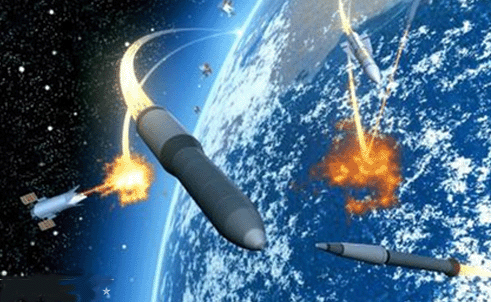
The Very Bad Space Force Deal, https://www.counterpunch.org/2019/12/18/the-very-bad-space-force-deal/ by KARL GROSSMAN Unless grassroots action somehow stops it, it looks likely that the Trump scheme for a Space Force, a sixth branch of United States armed forces, will happen. The U.S. House of Representatives last week passed the $738 billion military policy bill that gives Trump his sought-for Space Force as he moves for what he terms “American dominance in space.”The vote for what is titled the National Defense Authorization Act (NDAA) for 2020 was 377 to 48. Some 189 Republicans and 188 Democrats voted for it. Six Republican House members voted no, along with 41 Democrats and one independent. The large Democratic yes vote came as a result of a trade-off for 12 weeks of paid parental leave for civilian federal employees. The New York The U.S. Senate now will consider the measure and pass it considering the Trump-controlled majority in the Senate, and Trump will sign it. Indeed, last week Trump tweeted: “Wow! All our priorities have made it into the final NDAA: Pay Raises for our Troops, Rebuilding our Military, Paid Parental Leave, Border Security, and Space Force!” Establishment of a U.S. Space Force would come despite the landmark Outer Space Treaty of 1967, put together by the U.S., then Soviet Union and the U.K., designating space as a global commons to be used for peaceful purposes. The U.S. move to negate the intent of the Outer Space Treaty will cause Russia and China to respond in kind—especially considering Trump’s declaration that “it is not enough to merely have an American presence in space. We must have American dominance in space.” This will lead to an arms race in space. The Trump administration and the U.S. military have been claiming that a Space Force is necessary because of Russia and China moving into space militarily but, in fact, Russia and China and U.S. neighbor Canada have been leaders for decades in pushing for an expansion of the Outer Space Treaty. It bans weapons of mass destruction in space. The Prevention of an Arms Race in Outer Space (PAROS) treaty that the three nations have sought to expand would prohibit the placement of any weapons in space. The U.S.—under both Republican and Democratic presidential administrations—has opposed the PAROS treaty and effectively vetoed its enactment at the United Nations. The leading organization internationally in opposing the plan for a U.S. Space Force has been the Global Network Against Weapons & Nuclear Power in Space (www.space4peace.org). Commenting on the House vote, Bruce Gagnon, the network’s coordinator, said: “It is not surprise, but still disheartening, to see that 188 Democrats joined with Republicans to pass the NDAA bill in the House.” He noted that “the Democrats were led by Rep. Adam Smith from the Seattle area which means that the aerospace giant Boeing Corp., which stands to make a gold mine off Space Force, clearly pulls Mr. Smith’s chain.” (Smith, chairman of the House Armed Services Committee, called the bill “the most progressive defense bill we have passed in decades.”) Gagnon continued: “Another Democrat, Rep. Jim Cooper from Tennessee chimed in saying, ‘Trump’s belated support for a Space Force does not make this a Republican idea.’ Cooper chairs the House Armed Services Strategic Forces Subcommittee and clearly is trying to stake out Democratic Party ‘bragging rights’ on passage of this proposal to move warfare into the heavens.” Gagnon said, “About three-dozen progressive and anti-war groups worked hard to stop this NDAA and called the Democrats support for it ‘near complete capitulation.’” “With this newly enshrined Space Force—the NDAA will easily pass in the Senate—Trump will now be poised to tweet that Washington will be able to ‘control and dominate’ space on behalf of corporate interests,” Gagnon stated. “With technology now nearly in place to allow ‘mining the sky’ for precious minerals on planetary bodies, the Space Force fits in nicely with the long-planned Pentagon ability to control which nations, corporations and wealthy individuals will be able to venture into space and which will not. The idea was spelled out in a 1989 Congressional study called ‘Military Space Forces: The Next 50 Years.’” “Thus, Space Force would have two primary missions—give the Pentagon full control of the Earth and control the pathway on and off the Earth—both on behalf of corporate interests,” he said. “These provocative, expensive and destabilizing plans to control space will not be taken lightly by the rest of the world’s space faring nations. Even the Pentagon has lately been predicting the inevitability of war in the heavens.” Gagnon recounted: “In 1989 at a protest I organized at the Kennedy Space Center in Florida, Apollo astronaut Edgar Mitchell, the sixth man to walk on the moon [who took part in the protest] told the assembled that any war in space would be the one and only. By destroying satellites in space massive amounts of space debris would be created that would cause a cascading effect and even the billion-dollar International Space Station would likely be broken into tiny bits. So much space junk would be created, Mitchell told us, that we’d never be able to get a rocket off the planet again because of the mine field of debris orbiting the Earth at 15,000 mph.” “That would mean,” said Gagnon, “activity on Earth below would immediately shut down—cell phones, ATM machines, cable TV, traffic lights, weather prediction and more—all hooked up to satellites, would be lost. Modern society would go dark.” “The aerospace industry has long claimed that Star Wars would be the largest industrial project in the history of our planet,” said Gagnon. “So much money would be needed that the industry has identified the ‘entitlement programs’ for defunding to pay for ‘everything space.’ That means Social Security, Medicare, Medicaid and the remaining tattered social safety net would be cut to pay for Space Force.” “Everything has an Achilles heel,” said Gagnon. He said that “if you want to help defeat plans for Space Force, fight for social and environmental progress. Demand that the compromised Congress not fund this disastrous plan to move the arms race into space. It is going to cost all of us dearly.” A return in many respects to President Reagan’s “Star Wars” scheme of the 1980s, the Space Force notion “started as a joke,” National Public radio reported in August in a report by correspondent Claudia Grisales titled, “With Congressional Blessing, Space Force Is Closer to Launch.” She related: “Early last year President Trump riffed on an idea he called ‘Space Force’ before a crowd of Marines in San Diego. It drew laughs, but the moment was a breakthrough for a plan that had languished for nearly 20 years.” She continued: “’I said maybe we need a new force, we’ll call it the Space Force,’ Trump said at Marine Corps Air Station Miramar in March 2018. ‘And I was not really serious. Then I said, ‘What a great idea, maybe we’ll have to do that.’” The Outer Space Treaty was spurred, as Craig Eisendrath, involved as a U.S. State Department officer in its creation, by the Soviet Union launching the first space satellite, Sputnik, in 1957, as he noted in the 2001 TV documentary that I wrote and narrate, “Star Wars Returns.” Eisendrath said “we sought to de-weaponize space before it got weaponized…to keep war out of space.” The Reagan “Star Wars” program also used a defense rationale—it was formally called the Strategic Defense Initiative. It was based on orbiting battle platforms with nuclear reactors or “super” plutonium systems on board providing the power for hypervelocity guns, particle beams and laser weapons. Despite its claim of being defensive, it was criticized for being offensive and a major element in what the U.S. military documents then and since have described as “full spectrum dominance” over the Earth below which the U.S. has been seeking by taking the “ultimate high ground” of space. Among those voting against the NDAA bill last week were Representatives Jerry Nadler, chair of the House Judiciary Committee which has just approved articles of impeachment against Trump; Alexander Ocasio-Cortez; Tulsi Gabbard; and Ro Khanna, who earlier, with Senator Bernard Sanders, issued a joint statement decrying it as a “bill of astonishing moral cowardice.” Meanwhile, the U.S. military is gearing up for a selling campaign for a Space Force. On a website called “Space War Your World At War” , Barbara Barrett, Air Force secretary, is quoted as saying that the Air Force has come up with a “strategy to find support among not just U.S. lawmakers, but also among the public for Trump’s new branch of the country’s armed forces, the Space Force. She opined that this could clarify to the broader public what the U.S. is doing in this domain and why exactly it needs a separate force for operations in space, as well as funding. More articles by:KARL GROSSMAN
Karl Grossman, professor of journalism at State University of New York/College at Old Westbury, and is the author of the book, The Wrong Stuff: The Space’s Program’s Nuclear Threat to Our Planet. Grossman is an associate of the media watch group Fairness and Accuracy in Reporting (FAIR). He is a contributor to Hopeless: Barack Obama and the Politics of Illusion. |
|

Analysis of decontamination of irradiated soil of Fukushima area
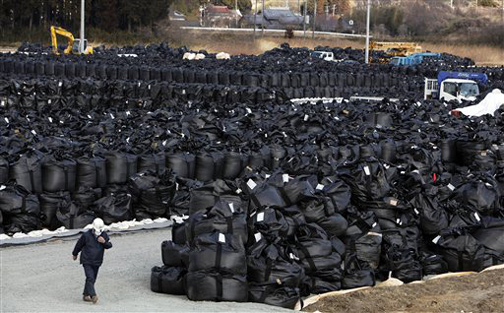
Fukushima: Lessons learned from an extraordinary case of soil decontamination https://www.sciencedaily.com/releases/2019/12/191212081926.htm
- Source:
- European Geosciences Union
- Summary:
- Following the accident at the Fukushima nuclear power plant in March 2011, the Japanese authorities decided to carry out major decontamination works in the affected area, which covers more than 9,000 km2. On Dec. 12, 2019, with most of this work having been completed, researchers provided an overview of the decontamination strategies used and their effectiveness.
- On December 12, 2019, with most of this work having been completed, the scientific journal SOIL of the European Geosciences Union (EGU) is publishing a synthesis of approximately sixty scientific publications that together provide an overview of the decontamination strategies used and their effectiveness, with a focus on radiocesium. This work is the result of an international collaboration led by Olivier Evrard, researcher at the Laboratoire des Sciences du Climat et de l’Environnement [Laboratory of Climate and Environmental Sciences] (LSCE — CEA/CNRS/UVSQ, Université Paris Saclay).
Soil decontamination, which began in 2013 following the accident at the Fukushima Dai-ichi nuclear power plant, has now been nearly completed in the priority areas identified1. Indeed, areas that are difficult to access have not yet been decontaminated, such as the municipalities located in the immediate vicinity of the nuclear power plant. Olivier Evrard, a researcher at the Laboratory of Climate and Environmental Sciences and coordinator of the study (CEA/CNRS/UVSQ), in collaboration with Patrick Laceby of Alberta Environment and Parks (Canada) and Atsushi Nakao of Kyoto Prefecture University (Japan), compiled the results of approximately sixty scientific studies published on the topic.
This synthesis focuses mainly on the fate of radioactive cesium in the environment because this radioisotope was emitted in large quantities during the accident, contaminating an area of more than 9,000 km2. In addition, since one of the cesium isotopes (137Cs) has a half-life of 30 years, it constitutes the highest risk to the local population in the medium and long term, as it can be estimated that in the absence of decontamination it will remain in the environment for around three centuries.
“The feedback on decontamination processes following the Fukushima nuclear accident is unprecedented,” according to Olivier Evrard, “because it is the first time that such a major clean-up effort has been made following a nuclear accident. The Fukushima accident gives us valuable insights into the effectiveness of decontamination techniques, particularly for removing cesium from the environment.”
- This analysis provides new scientific lessons on decontamination strategies and techniques implemented in the municipalities affected by the radioactive fallout from the Fukushima accident. This synthesis indicates that removing the surface layer of the soil to a thickness of 5 cm, the main method used by the Japanese authorities to clean up cultivated land, has reduced cesium concentrations by about 80% in treated areas. Nevertheless, the removal of the uppermost part of the topsoil, which has proved effective in treating cultivated land, has cost the Japanese state about €24 billion. This technique generates a significant amount of waste, which is difficult to treat, to transport and to store for several decades in the vicinity of the power plant, a step that is necessary before it is shipped to final disposal sites located outside Fukushima prefecture by 2050. By early 2019, Fukushima’s decontamination efforts had generated about 20 million cubic metres of waste.
Decontamination activities have mainly targeted agricultural landscapes and residential areas. The review points out that the forests have not been cleaned up — because of the difficulty and very high costs that these operations2 would represent — as they cover 75% of the surface area located within the radioactive fallout zone. These forests constitute a potential long-term reservoir of radiocesium, which can be redistributed across landscapes as a result of soil erosion, landslides and floods, particularly during typhoons that can affect the region between July and October. Atsushi Nakao, co-author of the publication, stresses the importance of continuing to monitor the transfer of radioactive contamination at the scale of coastal watersheds that drain the most contaminated part of the radioactive fallout zone. This monitoring will help scientists understand the fate of residual radiocesium in the environment in order to detect possible recontamination of the remediated areas due to flooding or intense erosion events in the forests.
The analysis recommends further research on:
- the issues associated with the recultivation of decontaminated agricultural land3,
- the monitoring of the contribution of radioactive contamination from forests to the rivers that flow across the region,
- and the return of inhabitants and their reappropriation of the territory after evacuation and decontamination.
This research will be the subject of a Franco-Japanese and multidisciplinary international research project, MITATE (Irradiation Measurement Human Tolerance viA Environmental Tolerance), led by the CNRS in collaboration with various French (including the CEA) and Japanese organizations, which will start on January 1, 2020 for an initial period of 5 years.
Complementary approaches
This research is complementary to the project to develop bio- and eco-technological methods for the rational remediation of effluents and soils, in support of a post-accident agricultural rehabilitation strategy (DEMETERRES), led by the CEA, and conducted in partnership with INRA and CIRAD Montpellier.
Decontamination techniques
- In cultivated areas within the special decontamination zone, the surface layer of the soil was removed to a depth of 5 cm and replaced with a new “soil” made of crushed granite available locally. In areas further from the plant, substances known to fix or substitute for radiocesium (potassium fertilizers, zeolite powders) have been applied to the soil.
- As far as woodland areas are concerned, only those that were within 20 metres of the houses were treated (cutting branches and collecting litter).
- Residential areas were also cleaned (ditch cleaning, roof and gutter cleaning, etc.), and (vegetable) gardens were treated as cultivated areas.
1 In Fukushima prefecture and the surrounding prefectures, the decision to decontaminate the landscapes affected by the radioactive fallout was made in November 2011 for 11 districts that were evacuated after the accident (special decontamination zone — SDZ — 1,117 km2) and for 40 districts affected by lower, but still significant levels of radioactivity and that had not been evacuated in 2011 (areas of intensive monitoring of the contamination — ICA, 7836 km2). 2 128 billion euros according to one of the studies appearing in the review to be published on 12 December 2019 in SOIL. 3 Relating to soil fertility and the transfer of radiocesium from the soil to plants, for example.
The study was conducted by Olivier Evrard (Laboratoire des Sciences du Climat et de l’Environnement (LSCE/IPSL), Unité Mixte de Recherche 8212 (CEA/CNRS/UVSQ), Université Paris-Saclay), J. Patrick Laceby (Environmental Monitoring and Science Division (EMSD), Alberta Environment and Parks (AEP)), and Atsushi Nakao (Graduate School of Life and Environmental Sciences, Kyoto Prefectural University).
Paducah, Kentucky – its nuclear waste tragedy is compounded by climate change
“I never said a bad thing about the plant the whole time I was growing up,” Lamb said. “It made the economy good. But then we got sick.”
“People who were not highly educated could make really good money working in these industries
“Not only that but the government was saying, this is your patriotic duty. We need this. So everybody just went along because the compensation was pretty good.”
a GAO report released in November showed that 60 percent of U.S. Superfund sites are at risk from the impacts of climate change.
Instead of focusing on cleanup plans, some state lawmakers and federal agencies are loosening regulations on hazardous sites…… Last year, the DOE also moved to relax restrictions on the disposal and abandonment of radioactive waste
|
For over half a century, the plant was Paducah’s main employer, providing up to 7,000 jobs in a place where nearly a quarter of people now live in poverty. But poor working conditions and unregulated waste disposal also harmed Paducah residents. The legacy of these problems have cost the town and taxpayers. Despite multiple recommendations from a watchdog government agency, the Department of Energy is decades behind schedule on cleanup efforts.
Some experts say the federal government doesn’t know the full cost or scope of what cleaning them up will entail, and that becomes more complicated with more frequent extreme weather. It’s a problem Superfund sites — and especially nuclear waste sites — around the country face.Lynn said there’s a lot of secrecy surrounding the cleanup, as well as the health risks that may be associated with it. He’s just one Paducah resident, along with a slew of former workers, who say they’ve been left in the dark about problems with a complex cleanup. ….
There are 16 nuclear sites still managed by the U.S. Department of Energy (DOE) across the country — from Vermont to Washington, Nevada to South Carolina — most of them built between the 1940s and 1950s. Some created nuclear defense materials like plutonium — a core ingredient in atomic bombs that is 100,000 times as radioactive as uranium and can cause liver, lung, and bone cancer.
The Paducah Gaseous Diffusion Plant was one of the smallest projects in the U.S. When the plant was built in 1952, the town proudly adopted a new moniker: “Atomic City.” While gaseous diffusion was the public face of the plant, there were other operations, including programs with NASA, storing defunct materials from Oak Ridge, and work for Sandia, a nuclear security laboratory. By the early 1990s, many of the plants, including Paducah, had started transitioning to produce uranium for the nuclear power reactors that now provide a fifth of U.S. electricity generation.
“People who were not highly educated could make really good money working in these industries so you could have a good house, a boat, a couple of cars, raise your kids and send them to college,” said Mark Donham, who used to manage the DOE’s Citizens Advisory Board, which helps the agency monitor the plant’s environmental remediation. “Not only that but the government was saying, this is your patriotic duty. We need this. So everybody just went along because the compensation was pretty good.” However, a 1999 investigation by The Washington Post revealed the federal government used the plant to illegally recycle over 103,000 tons of used nuclear reactor fuel containing plutonium and other transuranics — man-made heavy metals derived from splitting atoms. The same year, workers filed a $10 billion class action lawsuit against three federal government contractors that led to the passage of a federal law intended to compensate current and former employees (or their survivors) for exposure to cancer-causing radiation.
Greg Landhorff, a utilities worker at the plant for 30 years, wasn’t involved in the lawsuit, but said he was exposed to “all kinds of different chemicals.” He said the exposure was an open secret, and workers weren’t given proper equipment or training. He claims operators told him about the exposure when he was hired, but didn’t report it because they didn’t want to lose their jobs. Landhorff now rattles off his health issues like a grocery list: beryllium disease, COPD, chronic bronchitis, and skin cancer.
Although the plant closed in 2013, hundreds of people still work on site. Nuclear sites often function like small towns, with wastewater treatment and steam plants, sewers, landfills and lagoons, administrative offices, enormous water towers, and medical centers. David Trimble, director of the Government Accountability Office, or GAO, said 30 to 60 percent of the DOE’s cleanup budget goes toward these “recurring activities.” The same is true for Paducah: Dawn Harris-Young, a spokesperson for the southeast regional EPA, said that only a “small fraction” goes toward environmental cleanup post-closure. This means that until the site is torn down, day-to-day operation often takes up more of the DOE’s cleanup budget than the necessary environmental remediation.
The DOE has demolished 84 facilities, removed over 66 million pounds of contaminated scrap material, and dug up over a million cubic feet of contaminated soil. While there is no official estimation of how much contaminated material remains, at least 400 buildings — and everything inside them — still need to be decontaminated and demolished at the Paducah site. The DOE requested $277 million specifically for Paducah in 2020, despite its budget for nuclear cleanup shrinking by $50 million in the last five years. But it’s still a small fraction of the budget DOE will need: cleanup isn’t expected to be completed until 2065, and the EPA has said it could take even longer because of the lack of knowledge about sources of contamination and the vast size of the facility. The waste at Paducah includes the gaseous diffusion plant, buried radioactive disposal sites, and waste leftover from neighboring nuclear sites in Ohio and Tennessee. It also includes over 52,000 cylinders of uranium hexafluoride, or spent uranium fuel, much of it from Oak Ridge. But there is still no solution for how to dispose of spent nuclear fuel, except to bury it. In recent decades, federal and state regulators have strategized for the remediation of these sites. But some have faced major problems like fires, radioactive leaks, and spills. According to Rodney Ewing, nuclear security expert at Stanford University, “there’s no path forward” to dispose of uranium hexafluoride, either. “That’s why they’re still stored in tanks out back,” he said. When the leaves fall on Ronald Lamb’s property, he can see the water tower and the grey siding of facility buildings at the Paducah plant just two miles away. On the road near Big Bayou Creek, which runs through both the plant and his 120-acre property, signs warn against getting in the water. His well is padlocked because of groundwater contamination from trichloroethylene, or TCE — a degreaser used to clean uranium equipment — which can impact childhood development, damage the central nervous system, and is linked to cancer. Lamb said the well water left his family with severe gastrointestinal problems. “I never said a bad thing about the plant the whole time I was growing up,” Lamb said. “It made the economy good. But then we got sick.” DOE officials report that the agency has cleaned over four billion gallons of contaminated groundwater through a pump and treat system, but two toxic plumes of TCE still flow through four miles of groundwater that lead to the Ohio River. The DOE lacks a national strategy for nuclear cleanup, instead relying on site managers to contract with companies that manage, operate, and cleanup nuclear facilities. The Paducah cleanup is now being managed by Four Rivers Nuclear Partnership, a conglomeration of companies hired by the DOE for soil and groundwater remediation. One of them is Jacobs Engineering, a contractor that was sued for exposing hundreds of workers to toxic substances during cleanup of the nation’s largest coal ash spill in Tennessee; more than 40 have died. At least three other nuclear sites — Oak Ridge, Hanford in Washington, and Savannah River in South Carolina — have also contracted with Jacobs. (Jacobs Engineering declined an interview for this story.) The DOE also declined to answer questions but said the agency was committed to the safe remediation of the plant and that they “look forward to continuing successful cleanup efforts in the future.” The agency works with the Citizens Advisory Board — a group of community members who apply and are appointed as well as liaisons from Kentucky and the regional EPA office — on environmental management at the Paducah site, including the monitoring of groundwater and planning for the site’s future use. Lamb advocated for the board many years ago, and the bi-monthly meetings are supposed to serve as a public comment period. The board doesn’t have any power beyond giving recommendations to the agency, and current and former members are divided about its effectiveness. Lesley Davis joined for about a year in 2016; her grandfather had worked at the plant and died of cancer. “It was informational at times, but it didn’t feel like it was making much of a difference,” she said. “In hindsight, it felt like they were trying to keep a good public face.”…….. In February, Paducah put up its floodgates, families stacked sandbags, and the bridge over the Ohio River to Illinois closed as floodwaters as rains drowned the region. According to local news stations, highway crews reported so much water they had trouble setting up warning signs. Former Kentucky Gov. Matt Bevin declared a statewide emergency due to heavy rainfall and flooding. The Ohio River, three miles north of the Paducah plant, had record flooding in 2018 and 2019. Record flooding this year across the Midwest hit eight Superfund sites, and a GAO report released in November showed that 60 percent of U.S. Superfund sites are at risk from the impacts of climate change. By mid-century, there will be heavier rainfall, increased flooding, and more intense hurricanes in the Southeast, which has nearly a quarter of the 1,335 active Superfund sites on the EPA’s National Priority List. ……… The Green New Deal resolution, which has not yet passed through the U.S. House of Representatives, identified cleaning up brownfields — contaminated sites previously used for development — and hazardous waste sites like Paducah as a key priority in restoring the American landscape — but there’s not yet a road map for that plan. While underground waste repositories may provide a solution, Ewing said that over the long term, the changing climate could make it more challenging: in a wetter environment, the amount of water leaking through the rock over the repository could be expected to increase. Instead of focusing on cleanup plans, some state lawmakers and federal agencies are loosening regulations on hazardous sites. In 2017, Kentucky passed a bill lifting a nuclear moratorium, a move that some hope will turn the site into a research facility or nuclear reactor; the law loosens the requirements for toxic waste management. Last year, the DOE also moved to relax restrictions on the disposal and abandonment of radioactive waste………..https://www.scalawagmagazine.org/2019/12/nuclear-waste-paducah-kentucky/ . |

New report on Iraqi babies, deformed due to thorium and uranium from U.S. military actions and bases
IRAQI CHILDREN BORN NEAR U.S. MILITARY BASE SHOW ELEVATED RATES OF “SERIOUS CONGENITAL DEFORMITIES,” STUDY FINDS https://theintercept.com/2019/11/25/iraq-children-birth-defects-military/ Murtaza Hussain, November 26 2019, MORE THAN A decade and a half after the 2003 U.S. invasion of Iraq, a new study found that babies are being born today with gruesome birth defects connected to the ongoing American military presence there. The report, issued by a team of independent medical researchers and published in the journal Environmental Pollution, examined congenital anomalies recorded in Iraqi babies born near Tallil Air Base, a base operated by the U.S.-led foreign military coalition. According to the study, babies showing severe birth defects — including neurological problems, congenital heart disease, and paralyzed or missing limbs — also had corresponding elevated levels of a radioactive compound known as thorium in their bodies.
The suffering of Iraqis has been particularly acute. The results of the new study added to a laundry list of negative impacts of the U.S.’s long war there to the long-term health of the country’s population. Previous studies, including some contributed by a team led by Savabieasfahani, have pointed to elevated rates of cancer, miscarriages, and radiological poisoning in places like Fallujah, where the U.S. military carried out major assaults during its occupation of the country.
SOME OF THESE negative health effects of the American war in Iraq can be put down to U.S. forces’ frequent use of munitions containing depleted uranium. Depleted uranium, a byproduct of the enriched uranium used to power nuclear reactors, makes bullets and shells more effective in destroying armored vehicles, owing to its extreme density. But it has been acknowledged to be hazardous to the environment and the long-term health of people living in places where the munitions are used.
“Uranium and thorium were the main focus of this study,” the authors note. “Epidemiological evidence is consistent with an increased risk of congenital anomalies in the offspring of persons exposed to uranium and its depleted forms.” In other words: The researchers found that the more you were around these American weapons, the more likely you were to bear children with deformities and other health problems.
In response to an outcry over its effects, the U.S. military pledged to not use depleted uranium rounds in its bombing campaigns against the Islamic State group in Iraq and Syria, but, despite this pledge, a 2017 investigation by the independent research group AirWars and Foreign Policy magazine found that the military had continued to regularly use rounds containing the toxic compound.
These depleted-uranium munitions are among the causes of hazards not only to the civilians in the foreign lands where the U.S. fights its wars, but also to American service members who took part in these conflicts. The chronic illnesses suffered by U.S. soldiers during the 1991 war in Iraq — often from exposure to uranium munitions and other toxic chemicals — have already been categorized as a condition known as “Gulf War syndrome.” The U.S. government has been less interested into the effects of the American military’s chemical footprint on Iraqis. The use of “burn pits” — toxic open-air fires used to dispose military waste — along with other contaminants has had a lasting impact on the health of current and future Iraqi generations.
Researchers conducting the latest study said that a broader study is needed to get definitive results about these health impacts. The images of babies born with defects at the hospital where the study was conducted, Bint Al-Huda Maternity Hospital, about 10 kilometers from Tallil Air Base, are gruesome and harrowing. Savabieasfahani, the lead researcher, said that without an effort by the U.S. military to clean up its radioactive footprint, babies will continue to be born with deformities that her study and others have documented.
“The radioactive footprint of the military could be cleaned up if we had officials who wanted to do so,” said Savabieasfahani. “Unfortunately, even research into the problem of Iraqi birth defects has to be done by independent toxicologists, because the U.S. military and other institutions are not even interested in this issue.”
On nuclear radiation – past and future – extract from article on Chernobyl
DOES CHERNOBYL STILL MATTER? Public Books, BY GABRIELLE HECHT , 25 Nov 19, “……. The question is not whether an accident of Chernobyl’s gravity can happen elsewhere, but how to prepare for the consequences when it does.
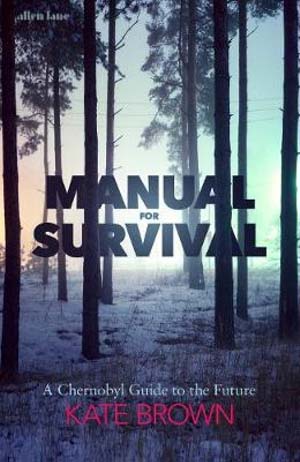 That’s one of the questions Kate Brown considers in Manual for Survival. Offering a wealth of new information and analysis, Brown speeds past the reactor explosion. Instead, she focuses on dozens of previously untold stories about how people coped with their newly radioactive lives.
Brown’s protagonists include women who worked at a wool factory fed by contaminated sheep and butchers ordered to grade meat according to radioactivity. Ukraine, we learn, kept serving as the Soviet breadbasket, despite food radiation levels that exceeded norms. The concentrations of radionuclides were biomagnified by receptive organisms and ecologies, such as mushrooms, wild boar, and the Pripyat Marshes. Defying expectations, some foods, over time, have even become more contaminated.
Brown’s descriptions add historical flesh to arguments first developed by Olga Kuchinskaya, in her 2014 book on Belarus’s Chernobyl experience, The Politics of Invisibility: Public Knowledge about Radiation Health Effects after Chernobyl.
Since the first studies of bomb survivors in Hiroshima and Nagasaki, science on the biological effects of radiation exposure has been subject to controversy. Like all scientific work, these early survivor studies had limitations. Exposure estimates were unreliable.
The largest study began data collection five years after the Hiroshima and Nagasaki blasts, so it didn’t include people who died or moved between 1945 and 1950. Another problem lies in the applicability of these studies. Bomb exposures, such as those in Japan, mostly consist of high, external doses from one big blast. Yet postwar exposures have mainly consisted of low doses, delivered steadily over a long period. They often involve internal exposures—such as inhalation of radioactive particles or consumption of irradiated food—which can be deadlier.
Irrespective of their limitations, however, the findings of these survivor studies have served as the basis for establishing regulatory limits for all types of radiation exposures. Critics argue that extrapolating from the Japan data underestimates low-dose effects: If you’ve already decided that the only possible health effects are the ones you’ve already found, surely you’re missing something? Among other limitations, studies of external gamma radiation exposures cannot illuminate the long-term health effects of inhaling radioactive alpha particles.
Brown injects the work of Dr. Angelina Gus’kova into this story. Gus’kova started treating radiation-induced illnesses in the 1950s, while working at the top-secret Mayak plutonium plant (where the radioactive spills from a 1957 accident continue to contaminate people, land, and water). A neurologist, Gus’kova made observations that extended beyond the narrow cancer focus of most Western practitioners who studied the health effects of radiation exposure. Her patients displayed a wide range of symptoms, which Gus’kova and her colleagues dubbed “chronic radiation syndrome.” Not that they neglected cancer: a 40-year study of 1.5 million people who lived near Mayak found significantly higher cancer and death rates than those reported in Hiroshima and Nagasaki.
The Soviet rubric of “chronic radiation syndrome” did not exist in the West. Yet Gus’kova’s findings did align with those of dissident scientists in the US and the UK. Thomas Mancuso, for example, was pushed out of the US Atomic Energy Commission because he refused to give the Hanford plutonium plant a clean bill of health after finding that workers there sustained high rates of cardiovascular disease, immune system damage, and other illnesses.
Alice Stewart, meanwhile, was shunned by the British establishment after her 1956 research showed that x-raying pregnant women increased the risk of cancer and leukemia in their children by 50 percent. Over the years, these and other scientists whose data challenged the findings of American and European nuclear establishments found themselves sidelined and defunded.
In tandem with perestroika, Chernobyl opened communication between Soviet and Western nuclear experts, engendering what Brown calls an “unholy alliance.” In 1990, the International Atomic Energy Agency (IAEA) sent a mission to Belarus and Ukraine to assess radiation damage. Belarusian scientists reported rising rates of many diseases in contaminated areas. Nevertheless, the IAEA team rejected radiation as a possible cause. Such correlations didn’t appear in Western data.
Instead, the IAEA teams used dose estimates provided by distant Moscow colleagues and ignored local Belarusian and Ukrainian descriptions of people’s actual consumption habits, which included significant amounts of contaminated food and milk. The IAEA assessments neglected the internal exposures resulting from this consumption. Yet these assessments now serve as international reference points. “Underestimating Chernobyl damage,” Brown warns, “has left humans unprepared for the next disaster.” …….
Brown is on the right track. Many modes of scientific inquiry aren’t equipped to address our most urgent questions. Clear causal chains are a laboratory ideal. The real world brims with confounding variables. Some scientists studying Chernobyl’s “exclusion zone”—the region officially declared uninhabitable due to contamination—are trying new techniques to grapple with this reality. Tim Mousseau and Anders Møller, for example, collect data on the zone in its ecological entirety, rather than focusing on single organisms. Their findings belie romantic tales of wildlife resurgence (such as the one offered up by a 2011 PBS special on the radioactive wolves of Chernobyl). They too have met resistance. …..
we can refuse to see Chernobyl and its kin as discrete events of limited duration. Brown, for example, treats Chernobyl as an acceleration of planetary-scale contamination that began with the atomic arms race.
Let’s be clear: the contamination continues. After the triple meltdown at Fukushima, scientists found highly radioactive, cesium-rich microparticles in Tokyo, 150 miles south of the accident site. When inhaled, such particles remain in human lungs, where their decay continues to release radioactivity for decades. Contaminants from future accidents will, in turn, accrete on the radioactive residues of their predecessors. https://www.publicbooks.org/does-chernobyl-still-matter/
The global uranium industry is really on the skids

Uranium bulls ‘as rare as white unicorns’ Jim Green, Online Opinion, 26 November 2019, https://onlineopinion.com.au/view.asp?article=20623&page=0
Uranium bulls are “as rare as white unicorns” according to a commentary in FNArena in September 2019, and the market is “sick and dying” with uranium “quickly becoming a dinosaur of a commodity”.
Canadian company Cameco recently said it cannot see any case for construction of new uranium mines for some years to come. Chief financial officer Grant Isaac said that new mines will not win financial backing without a far stronger recovery in demand for uranium than is currently on the horizon.
“It’s pretty hard to say you’re going to take the risk on an asset … that isn’t licensed, isn’t permitted, probably doesn’t have a proven mining method, when you have idle tier one capacity that’s licensed, permitted, sitting there,” Isaac said.
Moreover, Cameco has no plans to restart mines put into care-and-maintenance in 2016 and 2017: McArthur River (and the Key Lake mill) and Rabbit Lake in Canada, and the Crow Butte and Smith Ranch-Highland in-situ leach mines in the US. Plans to expand Crow Butte were abandoned in March 2019.
Instead, Cameco will continue to meet its contracts by purchasing uranium on the spot market. Delivering the company’s third-quarter results (a small loss), chief executive Tim Gitzel said that only 9 million pounds of uranium oxide will be produced from its mines next year, with the remainder of its requirement of 30‒32 million pounds supplied from spot market purchases.
Cameco’s workforce in Canada has halved. Before the Fukushima disaster, the company employed more than 2,100 people in Saskatchewan. Since then, 810 mine and mill workers have been sacked, along with 219 head office employees in Saskatoon. Continue reading
Studies on Chernobyl nuclear disaster show that it’s relevant today, and for the future
 DOES CHERNOBYL STILL MATTER? https://www.publicbooks.org/does-chernobyl-still-matter/ 11.22.2019 BY GABRIELLE HECHT Since it first announced electricity “too cheap to meter,” in the 1950s, the nuclear industry has promised bountiful futures powered by a peaceful—and safe—atom. Design principles, the industry claims, limit the chances of core damage to one incident every 50,000 reactor-years of operation. History, however, has delivered a different verdict: together, Three Mile Island, Chernobyl, and the three Fukushima reactors represent five meltdowns in only 100 reactor-years. What lessons do these accidents hold for the future of nuclear power?
Each meltdown has impelled design, operational, and regulatory changes, increasing the cost of nuclear power. Today, says the industry, the technology is safer and more vital than ever. No other source of electricity can offer so much baseload power with so few carbon emissions. But who can make money when a single US Nuclear Regulatory Commission (NRC) inspection costs $360,000?
For the current US administration, the remedy for waning profits lies in cutting inspection hours. In a July 2019 proposal, which drew heavily on nuclear industry recommendations, the NRC also suggested crediting utility self-assessments as “inspections” and discontinuing press releases about problems of “low to moderate safety or security significance.” Translation: fewer inspections, less transparency, and weaker environmental and health oversight at the nation’s nuclear power plants.
The cause, costs, and consequences of the 1986 Chernobyl accident loom large in these battles. Was Chernobyl a fluke, the result of faulty technology and a corrupt political system? Or did it signal a fundamentally flawed technological system, one that would never live up to expectations?
Even simple questions are subject to debate. How long did the disaster last? Who were the victims, and how many were there? What did they experience? Which branches of science help us understand the damage? Whom should we trust? Such questions are tackled, with markedly different results, in Serhii Plokhy’s Chernobyl, Adam Higginbotham’s Midnight in Chernobyl, Kate Brown’s Manual for Survival, and HBO’s Chernobyl (created by Craig Mazin).
Serhii Plokhy’s book and Craig Mazin’s miniseries, both entitled Chernobyl, focus primarily on the accident and its immediate aftermath. Both build on the standard plotline embraced by nuclear advocates.
In this narrative, Soviet love of monumental grandeur—or “gigantomania”—led to the selection and construction of Chernobyl’s RBMK1 design: an enormous 1000-megawatt reactor, powered by low-enriched uranium fuel, moderated by graphite, and cooled by water. The utterly unique RBMK had fundamental design flaws, hidden by corrupt state apparatchiks obsessed with secrecy, prestige, and productivism. Operators made inexcusable errors. The accident was inevitable. But the inevitability, Plokhy and Mazin affirm, was purely Soviet.
Plokhy gives more backstory. The enormous scale of Soviet industrialization put huge strains on supply chains, resulting in shoddy construction. Some of the men in charge had no nuclear background. The pressure to meet production quotas—and the dire consequences of failure—led bureaucrats and engineers to cut corners.
For both Plokhy and Mazin, these conditions at Chernobyl came to a head during a long-delayed safety test. When the moment to launch the test finally arrived, shortly before midnight on April 25, 1986, there was confusion about how to proceed. The plant’s deputy chief engineer, Anatolii Diatlov, who did have extensive nuclear experience, believed he knew better than the woefully incomplete manuals. He pushed operators to violate the poorly written test protocol. (Disappointingly, Mazin’s miniseries portrays Diatlov more as a deranged bully than as someone with meaningful operational knowledge.)
The reactor did not cooperate: its power plummeted, then shot back up. Operators tried to reinsert the control rods. The manual didn’t mention that the RBMK could behave counterintuitively: in other reactor models, inserting control rods would slow down the fission reaction, but in the RBMK—especially under that night’s operating conditions—inserting the rods actually increased the reactivity. Steam pressure and temperature skyrocketed. The reactor exploded, shearing off its 2000-ton lid. Uranium, graphite, and a suite of radionuclides flew out of the core and splattered around the site. The remaining graphite in the core caught fire.
At first, plant managers didn’t believe that the core had actually exploded. In the USSR—as elsewhere—the impossibility of a reactor explosion underwrote visions of atomic bounty. Nor did managers believe the initial radiation readings, which exceeded their dosimeters’ detection limits. Their disbelief exacerbated and prolonged the harm, exposing many more people to much more radiation than they might have otherwise received. Firefighters lacked protection against radiation; the evacuation of the neighboring town of Pripyat was dangerously delayed; May Day parades proceeded as planned. Anxious to blame human operators—instead of faulty technology or (Lenin forbid!) a broken political system—the state put the plant’s three top managers on trial, in June 1987, their guilt predetermined.
Mazin’s miniseries follows a few central characters. Most really existed, though the script takes considerable liberties. The actions of the one made-up character, a Belarusian nuclear physicist, completely defy credibility. But hey, it’s TV. Dramatic convention dictates that viewers must care about the characters to care about the story. Familiar Cold War tropes are on full display: defective design, craven bureaucrats, and a corrupt, secrecy-obsessed political system. A few anonymous heroes also appear: firefighters, divers, miners, and others who risked their lives to limit the damage.
Nuclear advocates—many of whom believe that Chernobyl was a fluke, one whose lessons actually improved the industry’s long-term viability—object to the unrealistically gory hospital scenes portraying acute radiation sickness. But these advocates should feel appeased by the closing frames, which ignore the long-term damage caused by the accident.
Instead, the miniseries skates over post-1987 events in a few quick captions. The managers went to prison, a scientist committed suicide, people were evacuated. Yes, controversy persists over the number of casualties (31? That was the official Soviet number. How about 4,000? That’s the number issued by the Chernobyl Forum, an entity that includes representatives from the World Health Organization, the International Atomic Energy Agency, and other international organizations. As for the 41,000 cancers suggested by a study published in the International Journal of Cancer—that number isn’t even mentioned). But all is under control now, thanks to the new confinement structure that will keep the area “safe” for a hundred years. Mazin himself insists that the show isn’t antinuclear.
Instead, the miniseries skates over post-1987 events in a few quick captions. The managers went to prison, a scientist committed suicide, people were evacuated. Yes, controversy persists over the number of casualties (31? That was the official Soviet number. How about 4,000? That’s the number issued by the Chernobyl Forum, an entity that includes representatives from the World Health Organization, the International Atomic Energy Agency, and other international organizations. As for the 41,000 cancers suggested by a study published in the International Journal of Cancer—that number isn’t even mentioned). But all is under control now, thanks to the new confinement structure that will keep the area “safe” for a hundred years. Mazin himself insists that the show isn’t antinuclear.
Plokhy also addresses the accident’s role in the breakup of the USSR. In 2006, Mikhail Gorbachev famously speculated that “the nuclear meltdown at Chernobyl, even more than my launch of perestroika, was perhaps the real cause of the collapse of the Soviet Union.” Plokhy delivers details. Ukrainian dissidents trained their writerly gaze on Chernobyl, vividly describing the damage. Street demonstrations depicted the accident and its coverup as “embodiments of Moscow’s eco-imperialism.” This vision spread and morphed, animating protests in Belarus—also severely contaminated by the accident—and elsewhere. Chernobyl served as Exhibit A for why the republics should shed the Soviet yoke.
If you’re hoping for clear technical explanations, however, you’ll be disappointed. A stunning error mars the first few pages: Plokhy declares that each RBMK produced 1 million megawatts of electricity. This is off by a factor of 1,000. Typo? No, because he doubles down in the next sentence, affirming that the station produced 29 billion megawatts of electricity in 1985. He gets the orders of magnitude right later on, but these early missteps undermine reader confidence. Muddled technical descriptions and uninformative diagrams add to the confusion.
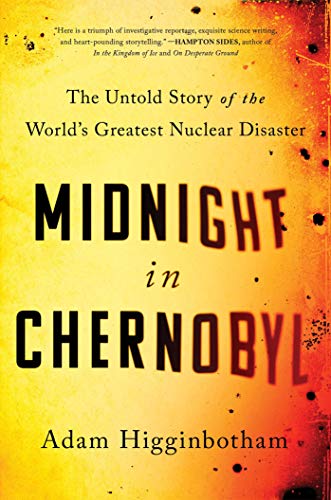 Readers seeking to understand the technology should turn instead to journalist Adam Higginbotham’s Midnight in Chernobyl. He uses global nuclear history to illuminate Soviet efforts to manage the Chernobyl crisis. By comparing the crisis to reactor accidents elsewhere, Higginbotham shows that deep vulnerabilities are widespread. Plokhy’s engineers and managers seem bumbling, verging on incompetent. Higginbotham’s more nuanced portrayal reflects how complex engineering projects of all types necessitate informed improvisation. The three-dimensional world doesn’t faithfully obey manuals. Adjustments are always required.
Higginbotham and Plokhy differ most starkly in their treatment of Soviet reactor choice. In the1960s, technocrats weighed the RBMK design against the VVER,2 the Soviet version of a pressurized light water reactor similar to those sold by Westinghouse and used in the United States. For Plokhy, it’s simple. The VVER was “safe.” The RBMK was not, but its size and cost appealed to Soviet productivism.
Higginbotham, however, wisely relies on Sonja Schmid’s pathbreaking Producing Power: The Pre-Chernobyl History of the Soviet Nuclear Industry (2015) to show that reactor safety isn’t a yes-no proposition. Plutonium-producing reactors similar to the Soviet RBMK (albeit half its size) existed in North America and Western Europe. Like nine of its French cousins, the RBMK could be refueled while continuing to operate. This presented significant advantages: light water reactors had to shut down for refueling, which entailed several weeks of outage. Even the risks presented by RBMK design vulnerabilities seemed manageable. “Nuclear experts elsewhere considered the RBMK design neither technologically novel nor particularly worrisome,” Schmid writes, noting that “what we consider good and safe always depends on context.” In the Soviet context, “selecting the RBMK made very good sense.”
Neither Schmid nor Higginbotham absolves the Soviet technopolitical system. The specific circumstances that led to Chernobyl’s explosions might not recur. But, as sociologist Charles Perrow has been arguing since his 1983 book Normal Accidents, highly complex technological systems create unpredictable situations, which inevitably lead to system failures. The question is not whether an accident of Chernobyl’s gravity can happen elsewhere, but how to prepare for the consequences when it does.
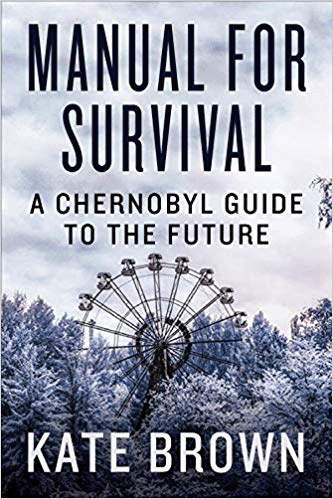 That’s one of the questions Kate Brown considers in Manual for Survival. Offering a wealth of new information and analysis, Brown speeds past the reactor explosion. Instead, she focuses on dozens of previously untold stories about how people coped with their newly radioactive lives.
Brown’s protagonists include women who worked at a wool factory fed by contaminated sheep and butchers ordered to grade meat according to radioactivity. Ukraine, we learn, kept serving as the Soviet breadbasket, despite food radiation levels that exceeded norms. The concentrations of radionuclides were biomagnified by receptive organisms and ecologies, such as mushrooms, wild boar, and the Pripyat Marshes. Defying expectations, some foods, over time, have even become more contaminated.
Brown’s descriptions add historical flesh to arguments first developed by Olga Kuchinskaya, in her 2014 book on Belarus’s Chernobyl experience, The Politics of Invisibility: Public Knowledge about Radiation Health Effects after Chernobyl.
Since the first studies of bomb survivors in Hiroshima and Nagasaki, science on the biological effects of radiation exposure has been subject to controversy. Like all scientific work, these early survivor studies had limitations. Exposure estimates were unreliable.
The largest study began data collection five years after the Hiroshima and Nagasaki blasts, so it didn’t include people who died or moved between 1945 and 1950. Another problem lies in the applicability of these studies. Bomb exposures, such as those in Japan, mostly consist of high, external doses from one big blast. Yet postwar exposures have mainly consisted of low doses, delivered steadily over a long period. They often involve internal exposures—such as inhalation of radioactive particles or consumption of irradiated food—which can be deadlier.
Irrespective of their limitations, however, the findings of these survivor studies have served as the basis for establishing regulatory limits for all types of radiation exposures. Critics argue that extrapolating from the Japan data underestimates low-dose effects: If you’ve already decided that the only possible health effects are the ones you’ve already found, surely you’re missing something? Among other limitations, studies of external gamma radiation exposures cannot illuminate the long-term health effects of inhaling radioactive alpha particles.
Brown injects the work of Dr. Angelina Gus’kova into this story. Gus’kova started treating radiation-induced illnesses in the 1950s, while working at the top-secret Mayak plutonium plant (where the radioactive spills from a 1957 accident continue to contaminate people, land, and water). A neurologist, Gus’kova made observations that extended beyond the narrow cancer focus of most Western practitioners who studied the health effects of radiation exposure. Her patients displayed a wide range of symptoms, which Gus’kova and her colleagues dubbed “chronic radiation syndrome.” Not that they neglected cancer: a 40-year study of 1.5 million people who lived near Mayak found significantly higher cancer and death rates than those reported in Hiroshima and Nagasaki.
The Soviet rubric of “chronic radiation syndrome” did not exist in the West. Yet Gus’kova’s findings did align with those of dissident scientists in the US and the UK. Thomas Mancuso, for example, was pushed out of the US Atomic Energy Commission because he refused to give the Hanford plutonium plant a clean bill of health after finding that workers there sustained high rates of cardiovascular disease, immune system damage, and other illnesses.
Alice Stewart, meanwhile, was shunned by the British establishment after her 1956 research showed that x-raying pregnant women increased the risk of cancer and leukemia in their children by 50 percent. Over the years, these and other scientists whose data challenged the findings of American and European nuclear establishments found themselves sidelined and defunded.
In tandem with perestroika, Chernobyl opened communication between Soviet and Western nuclear experts, engendering what Brown calls an “unholy alliance.” In 1990, the International Atomic Energy Agency (IAEA) sent a mission to Belarus and Ukraine to assess radiation damage. Belarusian scientists reported rising rates of many diseases in contaminated areas. Nevertheless, the IAEA team rejected radiation as a possible cause. Such correlations didn’t appear in Western data.
Instead, the IAEA teams used dose estimates provided by distant Moscow colleagues and ignored local Belarusian and Ukrainian descriptions of people’s actual consumption habits, which included significant amounts of contaminated food and milk. The IAEA assessments neglected the internal exposures resulting from this consumption. Yet these assessments now serve as international reference points. “Underestimating Chernobyl damage,” Brown warns, “has left humans unprepared for the next disaster.”
For some, hope springs eternal. In 2017, Chernobyl’s “New Safe Confinement” finally became operational, after two decades of design and construction. This $1.7 billion structure aims to contain the spread of radioactive rubble while workers inside dismantle the reactor and its crumbling sarcophagus. Ownership was transferred from the builders of the structure to the Ukrainian government in July 2019.
At the transfer ceremony, newly elected Ukrainian President Volodymyr Zelensky announced a tourism development plan for the radioactive exclusion zone, including a “green corridor” through which tourists could travel to gawk at the remains of Soviet hubris. “Until now, Chernobyl was a negative part of Ukraine’s brand,” declared Zelensky, who was nine years old when the reactor exploded. “It’s time to change.” (Zelensky further demonstrated his dedication to “branding” two weeks after this ceremony, when he emphasized his recent stay in a Trump hotel during his now-infamous phone conversation with the US president.)
Change also seems possible to Plokhy, who optimistically predicts that new reactor designs will be “cheaper, safer, and ecologically cleaner.” But Allison Macfarlane, who chaired the US Nuclear Regulatory Commission under Obama, recently noted that these “new” options are actually “repackaged designs from 70 years ago.” They still produce significant quantities of highly radioactive, long-lived waste.
Meanwhile, regulators in France—the world’s most nuclear nation—are taking the opposite approach from the United States’ NRC. Rather than rolling back oversight, France is intensifying inspections of their aging reactor fleet. After four decades of operation, many French reactors have begun to leak and crack. Keeping them operational will cost at least $61 billion. Despite the phenomenal cost, there are many who believe such an investment in the nuclear future is worthwhile.
Brown is far less sanguine about our nuclear future. Predictably, she has been denounced for believing marginal scientists and relying too heavily on anecdotal evidence. She does occasionally go overboard in suggesting conspiracy. Cover-ups clearly occurred on many occasions, but sometimes people were just sticking to their beliefs, trapped by their institutional and disciplinary lenses. Brown’s absence of nuance on this point matters, because the banality of ignorance—its complicity in all forms of knowledge production—can be more dangerous than deliberate lies: more systemic, harder to detect and combat.
Overall, though, Brown is on the right track. Many modes of scientific inquiry aren’t equipped to address our most urgent questions. Clear causal chains are a laboratory ideal. The real world brims with confounding variables. Some scientists studying Chernobyl’s “exclusion zone”—the region officially declared uninhabitable due to contamination—are trying new techniques to grapple with this reality. Tim Mousseau and Anders Møller, for example, collect data on the zone in its ecological entirety, rather than focusing on single organisms. Their findings belie romantic tales of wildlife resurgence (such as the one offered up by a 2011 PBS special on the radioactive wolves of Chernobyl). They too have met resistance.
How, then, can we harness the immense power of scientific analysis while also acknowledging its limitations? The nuclear establishment is quick to lump its opponents together with climate change deniers and anti-vaxxers. Some may deserve that. But much dissident science is well executed. So how do we, the lay public, tell the difference? How can dissent and uncertainty serve, not as a block to action, but as a call?
One way: we can refuse to see Chernobyl and its kin as discrete events of limited duration. Brown, for example, treats Chernobyl as an acceleration of planetary-scale contamination that began with the atomic arms race.
Let’s be clear: the contamination continues. After the triple meltdown at Fukushima, scientists found highly radioactive, cesium-rich microparticles in Tokyo, 150 miles south of the accident site. When inhaled, such particles remain in human lungs, where their decay continues to release radioactivity for decades. Contaminants from future accidents will, in turn, accrete on the radioactive residues of their predecessors.
And, we might add, on the ocean floor. The Russian state-run firm Rosatom recently announced the inauguration of its first floating reactor, towed across the melting Arctic to serve a community in Siberia: yet another manifestation of how climate change favors nuclear development. Rosatom is currently negotiating contracts for reactors (floating and otherwise) in some 30 countries, from Belarus to Bangladesh, Egypt to South Africa.
Threatened, the US nuclear industry sees Russian expansion as “another reason that the United States should maintain global leadership in nuclear technology exports.” And so we hurtle forward: rolling back oversight, acceleration unchecked.
This article was commissioned by Caitlin Zaloom.
As the Runit nuclear waste dome crumbles, Marshall Islanders want honesty and justice
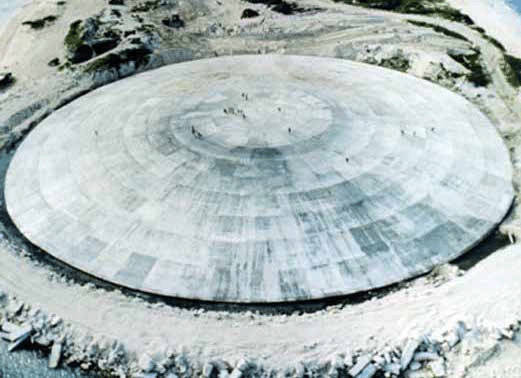
‘People want justice’: Marshalls’ fury over nuclear information US withheld– https://www.rnz.co.nz/international/programmes/datelinepacific/audio/2018723289/people-want-justice-marshalls-fury-over-nuclear-information-us-withheld From Dateline Pacific, 21 November 2019
|
The caretaker president of the Marshall Islands says it’s unconscionable that the United States kept secret key information about its nuclear tests for decades. New details reveal the US withheld information about the nuclear waste it left behind when the Marshall Islands gained independence, and the extent of the tests it carried out. Now, a dome that contains hundreds of tonnes of nuclear waste is at risk of crumbling into the ocean. But with Washington increasingly jittery about China, the small Pacific country’s finding it might now have some leverage to get something done. TRANSCRIPTEnewetak was once a paradise – a long atoll in the clear blue waters of the north Pacific, white sand and thick green palms. Today, it’s rutted with scars, after the US detonated dozens of nuclear bombs on, in and above it in the 1940s and ’50s. Whole islands were vaporised, deep craters carved into the coral. Jack Ading is a senator from Enewetak. His family was forced to move for the tests, and then allowed to return in the 1980s. “It appears that when we moved back to Enewetak in the 1980s after we were assured by the US government that it was safe. We were actually subjecting ourselves to a risk that we were never warned about.” Government documents reveal that beyond the nuclear blasts, the US also tested biological weapons, including an aerosol bacteria. Jamie Tahana reports. TRANSCRIPTEnewetak was once a paradise – a long atoll in the clear blue waters of the north Pacific, white sand and thick green palms. Today, it’s rutted with scars, after the US detonated dozens of nuclear bombs on, in and above it in the 1940s and ’50s. Whole islands were vaporised, deep craters carved into the coral. Jack Ading is a senator from Enewetak. His family was forced to move for the tests, and then allowed to return in the 1980s. “It appears that when we moved back to Enewetak in the 1980s after we were assured by the US government that it was safe. We were actually subjecting ourselves to a risk that we were never warned about.” Government documents reveal that beyond the nuclear blasts, the US also tested biological weapons, including an aerosol bacteria. But this was kept secret when the people from Enewetak were allowed to return, and other documents show that people were subjected to tests and experiments about the lingering effects of radiation. Last week, the Los Angeles Times also uncovered that the US didn’t tell the Marshallese it had shipped 130 tonnes of soil from its atomic testing grounds in Nevada in 1958 and dumped it at Enewetak. The caretaker president of the Marshall Islands, Hilda Heine, says the new details are disturbing. “To say the least you would have thought that all that information would have been shared with the Enewetak people before they went back to Enewetak. It is unbelievable that such information was held back, and as a result people have gone back and lived there for many years.” The nuclear waste from the era is stored in a pile at the end of the island of Runit, covered in a concrete dome. But a recent study by the Marshall Islands Nuclear Commission found the dome is now at risk of collapsing, and as rising seas erode beneath it, much of that waste is seeping into the lagoon. The commission’s chair, Rhea Moss-Christian, says information about the dome and the testing era was withheld throughout the independence process, while a compact of free association was negotiated in the 1980s. “We signed the compact in 1986 on the understanding that we had all the information we needed to have. It’s pretty hard for us to see this information, to have the level of detail that we now have, and to think that any of those previous agreements could stand.” The Marshall Islands has sought US help to clean up contamination and to shore up the dome, but American officials have declined, saying it’s on Marshallese land and, therefore, is the Marshall Islands’ responsibility. Ms Moss-Christian says that’s ridiculous. “How can it be that this radioactive waste and structure that we didn’t ask for. How can it be that this is ours and ours to deal with?” A Nuclear Claims Tribunal formed by the two countries in 1988 concluded that the US should pay $US2.2 billion in claims and settlements. But documents from both the Nuclear Commission and a 2010 US House inquiry show only $4 million has been paid. Last month, the Marshall Islands parliament – the Nitijela – endorsed a Nuclear Commission strategy which calls for, among other things, full compensation, better healthcare, and environmental protections. The US maintains it is upholding its responsibilities. It says it’s paid nearly a billion dollars, which has gone towards resettlement, rehabilitation and healthcare costs for affected communities, and that it’s funding tests of the water and atmosphere around the Runit dome. But Giff Johnson, the editor of the Marshall Islands journal and an author of books about the nuclear legacy, says that’s not enough. “People want justice for Marshall Islanders. The US government has to step up and address issues that it has addressed for American victims but is ignoring out here.” For the Marshall Islands, a smattering of atolls in the North Pacific – population 53,000 – it might be an opportune time to twist a superpower’s arm. Washington is increasingly nervous about a growing Chinese presence, and the compact of free association – which guarantees relations and funding from the US – expires in three years. Having initially maintained there won’t be a replacement compact, Washington is now keen to open talks for a new one, and has sent a string of high-ranking officials for visits. The caretaker president, Hilda Heine – who a few months ago was invited to the White House to meet President Donald Trump – says that could bode well. “The geopolitical situation in the Pacific is really helpful to the cause of the Marshall Islands. The US is now paying more attention to the Marshall Islands, so our issues around climate change, around our nuclear legacy, I think those will come to the forefront of our discussions going forward with the United States.” Whatever comes from those discussions, the people of Enewetak want more than they’re getting now. |
|
New Mexico not keen to take South Carolina’s plutonium wastes
|
LETHAL LEGACY, The US wants to bury SC’s plutonium stockpile forever. Its new home isn’t sure it wants it. Post and Courier, By Thad Moore tmoore@postandcourier.com Nov 23, 2019 In the time it will take for South Carolina’s stockpile of weapons-grade plutonium to decay, you could repeat most of human history, starting back in the Stone Age.
By the time its byproducts lose the explosive potential to be used in nuclear weapons, some 7 billion years will have passed. The Earth itself will have doubled in age, and then some. The U.S. government will officially decide in the next few years where the plutonium — the metal used to trigger nuclear weapons — will spend that eternity. And when it does, it will ask another part of the country to bear a profound burden: to house thousands of barrels filled with scraps of the Cold War and America’s nuclear arms race, a legacy that may well outlast our civilization.
That question will soon be posed to New Mexico, where the U.S. Department of Energy has excavated cavernous vaults deep below the ruddy soil in the state’s southeastern corner. The government hopes it will eventually hold tons of plutonium it has decided it no longer needs — enough to build a few thousand bombs the size of the one dropped over Nagasaki, Japan.
If it says yes, trucks will carry the plutonium load by load down Interstate 20 for the next three decades, and workers will lower it almost half a mile underground, where it will await its final fate: the mine’s slow collapse, and salt entombing it forever.
If New Mexico says yes, the Energy Department will bury some 20,000 steel drums deep underground there, in a ribbon of salt as thick as Charleston’s Ashley River is wide. And if New Mexico says yes, South Carolina will secure a new home for a nuclear stockpile it was wary of taking in the first place. The problem is, New Mexico isn’t sure if it will say yes. A new path The U.S.’s policy for disposing of plutonium has been in limbo for years. Congress had long planned to burn the material in commercial power plants, altering its atomic structure and making it harder to use in bombs. But the Energy Department’s project to convert plutonium into reactor fuel was deeply flawed: It started building a factory to do that work before it had a complete design, and it later discovered that finishing the plant would cost billions more than expected and stretch into the middle of the century. So the department proposed an alternative. It would convert its plutonium into a fine powder, and it would hire dozens of people in South Carolina to dilute it by hand, working in shifts around the clock. They would blend it with a secret combination of chemicals called “stardust,” designed to make it difficult to get the plutonium back out. When mixed with plutonium, stardust is said to foam up, create a gel and harden like concrete. Department officials have said the final product looks like sand on the beach. They’ve said it would save billions of dollars………. A long decay The Department of Energy grappled in the early 1990s with just how long WIPP’s legacy would survive. It hadn’t decided yet that plutonium should spend an eternity in the New Mexico desert, but it knew that America’s other nuclear waste would persist as long as anyone could comprehend. And it worried that some far-off civilization would find WIPP without understanding the invisible danger of radiation inside………When the calendar reaches the year 12000 — around the end of the team’s 10,000-year mandate — the plutonium underground will be less than halfway through its first half-life. The stockpile that currently sits in South Carolina will still be more than 200,000 years from completing its transformation into a potent type of uranium that is capable of powering cities or destroying them…… https://www.postandcourier.com/news/the-us-wants-to-bury-sc-s-plutonium-stockpile-forever/article_cbe6029e-07eb-11ea-9622-639a44471d1a.html |
|
1 This Month



26 September – International Day for the Total Elimination of Nuclear Weapons


PLEASE OPPOSE HR 8255 AND S.3639 – bills would accelerate satellite deployment, with no environmental review or safeguards – https://ncstd5li.quorum.us/campaign/169331/
To see nuclear-related stories in greater depth and intensity – go to https://nuclearinformation.wordpress.com
-
Archives
- September 2026 (206)
- August 2026 (330)
- July 2026 (355)
- June 2026 (287)
- May 2026 (306)
- April 2026 (356)
- March 2026 (251)
- February 2026 (267)
- January 2026 (308)
- December 2025 (358)
- November 2025 (359)
- October 2025 (375)
-
Categories
- 1
- 1 NUCLEAR ISSUES
- business and costs
- climate change
- culture and arts
- ENERGY
- environment
- health
- history
- indigenous issues
- Legal
- marketing of nuclear
- media
- opposition to nuclear
- PERSONAL STORIES
- politics
- politics international
- Religion and ethics
- safety
- secrets,lies and civil liberties
- spinbuster
- technology
- Uranium
- wastes
- weapons and war
- Women
- 2 WORLD
- ACTION
- AFRICA
- Atrocities
- AUSTRALIA
- Christina's notes
- Christina's themes
- culture and arts
- Events
- Fuk 2022
- Fuk 2023
- Fukushima 2017
- Fukushima 2018
- fukushima 2019
- Fukushima 2020
- Fukushima 2021
- general
- global warming
- Humour (God we need it)
- Nuclear
- RARE EARTHS
- Reference
- resources – print
- Resources -audiovicual
- Weekly Newsletter
- World
- World Nuclear
- YouTube
-
RSS
Entries RSS
Comments RSS
 nuclear-news