Do we need highly enriched uranium in space (again)? Bulletin of the Atomic Scientists By Christopher Fichtlscherer, September 12, 2019 “……. Weapon-grade fuel for the Mars mission. In this rush to realize the old dream of space colonization, a central question is how to

provide a planetary base with electrical power. Currently it seems as though NASA is in favor of nuclear energy. Most recently, on August 20, 2019, President Trump
issued a presidential memorandum authorizing the possible launch into space of nuclear reactors fueled by highly enriched uranium (HEU) for “orbital and planetary surface activities.” But sending HEU reactors into space is risky and unnecessary because there are viable options for using low-enriched uranium (LEU), or for avoiding nuclear power altogether by harnessing solar energy.
Since 2015, NASA has funded a group at Los Alamos National Laboratory to build what is called the Kilopower reactor, a nuclear fission reactor for space applications. The Kilopower reactor is a sodium-cooled fast-neutron reactor with a block core that produces electrical energy with Stirling engine heat converters. NASA plans to build four or five Kilopower reactors, each with a lifetime of 12 to 15 years and a continuous energy output of 10 kilowatts, which could meet the energy needs of a possible Mars base. This Kilopower fast reactor could be fueled with either LEU or HEU. While the LEU fuel for the Kilopower reactor would contain 19.75 percent uranium 235, the HEU fuel would contain 93 percent of this isotope, a degree of enrichment that is called “weapon-grade.” In the newest prototype, these two versions of the fast reactor have essentially the same design but differ by size and weight. Los Alamos published a white paper about the Kilopower reactor in August 2017 supporting the LEU designs, but half a year later the lab successfully tested the HEU design. In October 2018, Los Alamos published a second white paper that favored HEU on the grounds that it would have a lighter weight.
Indeed, the HEU version of the Kilopower reactor is lighter, but it comes with alarming risks: the block fuel element contains around 43 kilograms of HEU, enough material for a terrorist group to build a nuclear weapon. There is also a proliferation risk. Kilopower would establish a precedent that other states could use to justify their own production of weapon-grade uranium. That is why, over the last four decades, the United States has led an international effort to persuade research reactor operators to switch from using HEU to using LEU. Building an HEU-fueled space reactor would undermine those attempts and the nonproliferation policies that inform them.
There are other downsides beyond the security risks. For example, the use of HEU would exclude private industry from taking part in space-reactor research and development. Such a reactor would also be more expensive than the LEU version because of the high costs required to secure significant quantities of HEU during the development and the launch. Finally, an HEU reactor would be sure to stir controversy for the reasons mentioned above and would be subject to cancellation by Congress.
Beyond that, the main advantage of the HEU reactor may not actually be much of an advantage. In 2015 scientists from the Korea Atomic Energy Research Institute, and in 2018 scientists from the Colorado School of Mines, each published designs for different, lighter LEU reactor models with a similar power output to the Kilopower LEU version. Moreover, it seems realistic that we can expect further weight and launching cost reductions well before a Mars colonization mission could start.
Accident risks. Sending nuclear reactors into space is not a new idea. The Soviet Union launched over 30 into orbit during the Cold War to power radars that tracked the US Navy. The United States launched only one reactor, in 1965. Dubbed the SNAP-10A, it had to be shut down after only 43 days due to an electrical component failure.
Most of these reactors are still orbiting above us—but not all of them. For example, the Soviet Kosmos 954 reactor crashed to earth in 1978, spreading radioactive material over a large area of northern Canada. In total there is about one ton of nuclear material in orbit, and all of it is at risk of colliding with other space debris and coming back to earth.
Major accidents have occurred in over 20 percent of space reactor missions. That is probably one of the reasons why no country has launched a reactor into space since the Cold War. Given these issues, why not avoid radioactive material for space missions altogether? Perhaps solar energy should be the first choice for electrical energy in space. Most satellites launched into space get their energy from solar panels, as does the international space station, which has successfully operated for over 10 years with solar arrays that produce up to 120 kilowatts of electricity. The NASA Mars rover Opportunity ran for over 14 years powered by solar panels. In short, the difficulties of running a solar power system on Mars seem manageable.
If we really want to build a Mars base in the not-so-distant future, why should we go with weapon-grade uranium, with all its security and proliferation risks, when we have both the option of affordable alternative LEU designs and solar options that eliminate these risks? https://thebulletin.org/2019/09/do-we-need-highly-enriched-uranium-in-space-again/?utm_source=Newsletter&utm_medium=Email&utm_campaign=Newsletter09162019&utm_content=NuclearRisk_UraniumInSpace_09122019
September 17, 2019
Posted by Christina Macpherson |
Reference, space travel |
Leave a comment
Getting Julian Assange The Guardian also appears to have been engaged in a campaign against the WikiLeaks publisher Julian Assange, who had been a collaborator during the early WikiLeaks revelations in 2010.
It seems likely this was innuendo being fed to The Observer by an intelligence-linked individual to promote disinformation to undermine Assange.
In 2018, however, The Guardian’s attempted vilification of Assange was significantly stepped up. A new string of articles began on 18 May 2018 with one alleging Assange’s “long-standing relationship with RT”, the Russian state broadcaster. The series, which has been closely documented elsewhere, lasted for several months, consistently alleging with little or the most minimal circumstantial evidence that Assange had ties to Russia or the Kremlin.

 How the UK Security Services neutralised the country’s leading liberal newspaper. https://www.dailymaverick.co.za/article/2019-09-11-how-the-uk-security-services-neutralised-the-countrys-leading-liberal-newspaper/ By Matt Kennard and Mark Curtis• 11 September 2019, The Guardian, Britain’s leading liberal newspaper with a global reputation for independent and critical journalism, has been successfully targeted by security agencies to neutralise its adversarial reporting of the ‘security state’, according to newly released documents and evidence from former and current Guardian journalists.
The UK security services targeted The Guardian after the newspaper started publishing the contents of secret US government documents leaked by National Security Agency contractor Edward Snowden in June 2013.
Snowden’s bombshell revelations continued for months and were the largest-ever leak of classified material covering the NSA and its UK equivalent, the Government Communications Headquarters. They revealed programmes of mass surveillance operated by both agencies.
According to minutes of meetings of the UK’s Defence and Security Media Advisory Committee, the revelations caused alarm in the British security services and Ministry of Defence. Continue reading →
September 14, 2019
Posted by Christina Macpherson |
media, Reference, secrets,lies and civil liberties, UK |
Leave a comment
 HELEN CALDICOTT: Small modular reactors — same nuclear
  disasters https://independentaustralia.net/politics/politics-display/helen-caldicott-small-modular-reactors–same-nuclear-disasters,13087
By Helen Caldicott | 9 September 2019 The Morrison Government has opened the door to the notion of nuclear power as peddled by the nuclear sociopaths.
Now that the “nuclear renaissance” seems dead and buried following the Fukushima catastrophe (one-sixth of the world’s nuclear reactors were closed after the accident), the corporations invested in making nuclear plants and radioactive waste –including Toshiba, Nu-Scale, Babcock and Wilcox, GE Hitachi, General Atomics and the Tennessee Valley Authority – are not to be defeated.
Their new strategy is to develop small modular reactors (SMR), which can be sold around the world without, they say, the dangers inherent in large reactors — safety, cost, proliferation risks and radioactive waste.
There are basically three types of SMRs which generate less than 300 megawatts of electricity compared to the current 1,000-megawatt reactors.
These will be smaller versions of present-day pressurised water reactors using water as the moderator and coolant but with the same attendant problems as Fukushima and Three Mile Island. They are to be built underground, which obviously makes them dangerous to access in the event of an accident or malfunction.
They will be mass-produced (turnkey production) and large numbers must be sold yearly to make a profit. This is an unlikely prospect because major markets – China and India – will be uninterested in buying U.S. reactors when they can make their own.
If a safety problem arises, such as with the Dreamliner plane, all of them will have to be shut down — interfering substantially with electricity supply.
SMRs will be expensive because the cost of unit capacity increases with decrease in the size of the reactor. Billions of dollars of government subsidies will be required because Wall Street will not touch nuclear power. To alleviate costs, it is suggested that safety rules be relaxed — including reducing security requirements and a reduction in the ten-mile emergency planning zone to 1,000 feet.
These are high-temperature gas-cooled reactors (HTGR) or pebble bed reactors. Five billion tiny fuel kernels of high-enriched uranium or plutonium will be encased in tennis-ball-sized graphite spheres which must be made without cracks or imperfections — or else they could lead to an accident. A total of 450,000 such spheres will slowly be released continuously from a fuel silo, passing through the reactor core, and then re-circulated ten times. These reactors will be cooled by helium gas operating at very high temperatures (900 C).
The plans are to construct a reactor complex consisting of four HTGR modules located underground to be run by only two operators in a central control room. It is claimed that HTGRs will be so safe that a containment building will be unnecessary and operators can even leave the site — “walk-away-safe” reactors.
However, should temperatures unexpectedly exceed 1600 degrees Celsius, the carbon coating will release dangerous radioactive isotopes into the helium gas and at 2000 C, the carbon would ignite creating a fierce graphite Chernobyl-type fire.
If a crack develops in the piping or building, radioactive helium would escape and air would rush in igniting the graphite.
Although HTGRs produce small amounts of low-level waste, they create larger volumes of high-level waste than conventional reactors.
Despite these obvious safety problems and despite the fact that South Africa has abandoned plans for HTGRs, the U.S. Department of Energy has unwisely chosen the HTGR as the “Next Generation Nuclear Plant”.
It is claimed by the proponents that fast reactors will be safe, economically competitive, proliferation-resistant and sustainable.
They are to be fueled by plutonium or highly enriched uranium, and cooled by either liquid sodium or a lead-bismuth molten coolant creating a potentially explosive situation. Liquid sodium burns or explodes when exposed to air or water and lead-bismuth is extremely corrosive producing very volatile radioactive elements when irradiated.
Should a crack occur in the reactor complex, liquid sodium would escape burning or exploding. Without coolant, the plutonium fuel would melt and reach critical mass, inciting a massive nuclear explosion. One-millionth of a gram of plutonium induces cancer and it lasts for 500,000 years. Yet it is claimed that fast reactors will be so safe that no emergency sirens will be required and emergency planning zones can be decreased from ten miles to 1,300 feet.
There are two types of fast reactors, a simple plutonium fueled reactor and a “breeder”. The plutonium reactor core can be surrounded by a blanket of uranium 238, the uranium captures neutrons and converts to plutonium creating ever more plutonium.
Some are keen about fast reactors because plutonium waste from other reactors can be fissioned converting it to shorter-lived isotopes like caesium and strontium which last “only” 600 years instead of 500,000. But this is fallacious thinking because only ten per cent is fissioned leaving 90 per cent of the plutonium for bomb-making and so on.
Construction
Three small plutonium fast reactors will be arranged together forming a module. Three of these modules will be buried underground and all nine reactors will connect to a fully automated central control room. Only three reactor operators situated in one control room will be in control of nine reactors. Potentially, one operator could simultaneously face a catastrophic situation triggered by the loss of off-site power to one unit at full power, in another shut down for refuelling and in one in start-up mode.
There are to be no emergency core cooling systems.
Fast reactors will require a massive infrastructure including a reprocessing plant to dissolve radioactive waste fuel rods in nitric acid, chemically removing the plutonium and a fuel fabrication facility to create new fuel rods. A total of 15,000 to 25,000 kilos of plutonium are required to operate a fuel cycle at a fast reactor and just 2.5 kilos is fuel for a nuclear weapon.
Thus, fast reactors and breeders will provide the perfect plan for nuclear weapons proliferation and despite this danger, the industry plans to sell them to many countries.
September 10, 2019
Posted by Christina Macpherson |
2 WORLD, Reference, safety, Small Modular Nuclear Reactors |
1 Comment
It can therefore be stated with certainty that the “isotopic source of energy” referred to by Rosatom was a nuclear reactor.
The Mysterious Explosion of a Russian Nuclear Missile Engine The BESA CENTER. By Lt. Col. (res.) Dr. Raphael Ofek, September 6, 2019 BESA Center Perspectives Paper No. 1,280, September 6, 2019
EXECUTIVE SUMMARY: The fatal explosion that occurred recently during testing of the Russian Burevestnik nuclear cruise missile raises many questions. Could it have been avoided? Was it a fundamental failure of the ambitious armaments plan declared by President Putin in 2018? Whatever the answers to these questions, the renewed trend toward an unconventional armaments race could deteriorate into a second Cold War.
On August 8, during a test of the nuclear-powered engine of the 9M730 Burevestnik cruise missile (petrel in Russian; nicknamed the SSC-X-9 Skyfall in the West), held on a floating platform in the White Sea near the Nyonoksa missile test site in the far north of Russia, a mysterious explosion occurred that killed eight people. The blast raised questions about the status of a new generation of five advanced weapons introduced by Putin in 2018, of which Burevestnik, described by the Russian president as supersonic and of unlimited range, occupied pride of place.
Five of the eight people killed in the explosion were Rosatom (Russian State Atomiс Energy Corporation) employees, and three more employees were injured. According to the company’s announcement, the disaster occurred while testing an “isotopic energy source for a liquid propulsion system.”
Shortly after the explosion, the weather monitoring agency Roshydromet reported a significant spike in radiation 40 km from the blast site. Also, in the city of Severodvinsk, which is near the explosion site in the Archangelsk district, the radiation level was reported to have jumped to 16 times the normal level. This led the alarmed residents to rush to stock up on iodine, which reduces the effects of radiation exposure.
The initial response of the Russian authorities to the incident was befuddling (if reminiscent of their conduct in the wake of the Chernobyl disaster). Following the blast, residents of the village of Nyonoksa, which is close to the beach and adjacent to the blast site, were told to evacuate immediately – but the order was soon rescinded. Information about the blast was difficult to obtain. …….
According to the DIA (US Army Intelligence), 13 tests of the Burevestnik or its systems have been conducted since 2016, including the August 8 disaster. Only two can be classified as having been relatively successful. In a November 2017 test, a missile was launched from a site in Novaya Zemlya and all missile systems were tested during flight. But the flight lasted only about two minutes, during which the missile went 35 km and then crashed into the Barents Sea. Another test of the missile’s nuclear reactor was carried out in January 2019; according to the Russian news agency TASS, it was a success. …..
The nuclear jet engine sucks air through its nozzle and then compresses and heats it to a very high temperature through the nuclear reactor inside the engine, which is shaped like a hollow cylinder. The air is then emitted sharply outward from the rear, providing the missile with the thrust to move forward.
Rosatom said the failed experiment of August 8 was testing an “isotopic energy source for a rocket engine fueled with liquid fuel.” This negates the possibility that the source of energy applied to the Burevestnik missile is the metallic plutonium-238 isotope, as does the steep jump in the level of radioactivity in the areas near the explosion site. This is because plutonium-238 is not fissionable and therefore cannot be used as fuel for a nuclear reactor. Although this isotope is an alpha radiation emitter, it has very short-range radiation that is stopped after 5 cm of air.
With that said, the isotope’s potent alpha emission renders it usable as a radioisotope thermoelectric generator (RTG). Indeed, it was used by the US space program as an energy source. It can therefore be stated with certainty that the “isotopic source of energy” referred to by Rosatom was a nuclear reactor. The advantage of a nuclear reactor is that it allows a cruise missile to move through the air for a very long time, giving it an essentially unlimited flight range.
However, the jump in radioactivity in the air near the blast site reduces the likelihood that the nuclear reactor installed in the Burevestnik missile is fueled with enriched uranium, or even highly enriched. It is therefore reasonable to conjecture that the nuclear fuel of the reactor is plutonium-239, which, in addition to being toxic, is radioactive. It is also more suitable for refueling a miniature reactor because its critical mass is five times lower than that of uranium-235, which makes it possible to reduce the reactor’s dimensions.
Moreover, it is possible that the plutonium fuel in the reactor was not metallic but in a saline state, which would further reduce the amount of plutonium needed to fuel it. This hypothesis might explain Rosatom’s reference to “an isotopic source of energy for a liquid-fueled rocket engine.” Rosatom conducts many activities related to the development of molten salt reactors (MSR). These are nuclear fission reactors in which the primary reactor coolant and/or nuclear fuel is a molten salt mixture, and they use plutonium-239 as fuel.
The August 8 rocket engine explosion appears to have been caused by a rapid jump in reactor criticality beyond the permitted level. Nuclear missiles use a liquid-fueled booster rocket to accelerate to a speed that will enable their reactors to operate. There is thus a high probability of failure during the launch phase due to an obstacle hindering synchronization between the rocket’s acceleration and the nuclear reactor system, or – either alternatively or in addition – a failure of the reactor’s criticality control system.
Taking an overall view, it appears we now have a resurgence of an unconventional armaments race between the big powers, at least for purposes of deterrence – a situation that could deteriorate into a second Cold War.
View PDF
Lt. Col. (res.) Dr. Raphael Ofek, a BESA Center Research Associate, is an expert in the field of nuclear physics and technology who served as a senior analyst in the Israeli intelligence community. https://besacenter.org/perspectives-papers/russia-nuclear-missile-engine/
September 7, 2019
Posted by Christina Macpherson |
Reference, Russia, Small Modular Nuclear Reactors |
Leave a comment
AS AUSTRALIA is grappling with the notion of introducing nuclear powerinto the country, it seems imperative the general public understand the intricacies of these technologies so they can make informed decisions. Thorium reactors are amongst those being suggested at this time.
The U.S. tried for 50 years to create thorium reactors, without success. Four commercial thorium reactors were constructed, all of which failed. And because of the complexity of problems listed below, thorium reactors are far more expensive than uranium fueled reactors.
The longstanding effort to produce these reactors cost the U.S. taxpayers billions of dollars, while billions more dollars are still required to dispose of the highly toxic waste emanating from these failed trials.
The truth is, thorium is not a naturally fissionable material. It is therefore necessary to mix thorium with either enriched uranium 235 (up to 20% enrichment) or with plutonium – both of which are innately fissionable – to get the process going.
While uranium enrichment is very expensive, the reprocessing of spent nuclear fuel from uranium powered reactors is enormously expensive and very dangerous to the workers who are exposed to toxic radioactive isotopes during the process. Reprocessing spent fuel requires chopping up radioactive fuel rods by remote control, dissolving them in concentrated nitric acid from which plutonium is precipitated out by complex chemical means.
Vast quantities of highly acidic, highly radioactive liquid waste then remain to be disposed of. (Only is 6 kilograms of plutonium 239 can fuel a nuclear weapon, while each reactor makes 250 kilos of plutonium per year. One millionth of a gram of plutonium if inhaled is carcinogenic.)
So there is an extraordinarily complex, dangerous and expensive preliminary process to kick-start a fission process in a thorium reactor.
When non-fissionable thorium is mixed with either fissionable plutonium or uranium 235, it captures a neutron and converts to uranium 233, which itself is fissionable. Naturally it takes some time for enough uranium 233 to accumulate to make this particular fission process spontaneously ongoing.
Later, the radioactive fuel would be removed from the reactor and reprocessed to separate out the uranium 233 from the contaminating fission products, and the uranium 233 then will then be mixed with more thorium to be placed in another thorium reactor.
But uranium 233 is also very efficient fuel for nuclear weapons. It takes about the same amount of uranium 233 as plutonium 239 – six kilos – to fuel a nuclear weapon. The U.S. Department of Energy (DOE) has already, to its disgrace, ‘lost track’ of 96 kilograms of uranium 233.
A total of two tons of uranium 233 were manufactured in the United States. This material naturally requires similar stringent security measures used for plutonium storage for obvious reasons. It is estimated that it will take over one million dollars per kilogram to dispose of the seriously deadly material.
An Energy Department safety investigation recently found a national repository for uranium 233 in a building constructed in 1943 at the Oak Ridge National Laboratory.
It was in poor condition. Investigators reported an environmental release from many of the 1,100 containers could
‘… be expected to occur within the next five years because some of the packages are approaching 30 years of age and have not been regularly inspected.’
The DOE determined that this building had:
Deteriorated beyond cost-effective repair and significant annual costs would be incurred to satisfy both current DOE storage standards, and to provide continued protection against potential nuclear criticality accidents or theft of the material.
The DOE Office of Environmental Management now considers the disposal of this uranium 233 to be ‘an unfunded mandate’.
Thorium reactors also produce uranium 232, which decays to an extremely potent high-energy gamma emitter that can penetrate through one metre of concrete, making the handling of this spent nuclear fuel extraordinarily dangerous.
Although thorium advocates say that thorium reactors produce little radioactive waste, they simply produce a different spectrum of waste to those from uranium-235. This still includes many dangerous alpha and beta emitters, and isotopes with extremely long half-lives, including iodine 129 (half-life of 15.7 million years).
No wonder the U.S. nuclear industry gave up on thorium reactors in the 1980s. It was an unmitigated disaster, as are many other nuclear enterprises undertaken by the nuclear priesthood and the U.S. government.
September 5, 2019
Posted by Christina Macpherson |
AUSTRALIA, Reference, thorium |
1 Comment
History is replete with instances in which it seems, in retrospect, that nuclear war could have started were it not for some flesh-and-blood human refusing to begin Armageddon. Perhaps the most famous such hero was Stanislav Petrov, a Soviet lieutenant colonel, who was the officer on duty in charge of the Soviet Union’s missile-launch detection system when it registered five inbound missiles on Sept. 26, 1983. Petrov decided the signal was in error and reported it as a false alarm. It was. Whether an artificial intelligence would have reached the same decision is, at the least, uncertain.
 Strangelove redux: US experts propose having AI control nuclear weapons https://thebulletin.org/2019/08/strangelove-redux-us-experts-propose-having-ai-control-nuclear-weapons/
By Matt Field, AA August 30 2019 Hypersonic missiles, stealthy cruise missiles, and weaponized artificial intelligence have so reduced the amount of time that decision makers in the United States would theoretically have to respond to a nuclear attack that, two military experts say, it’s time for a new US nuclear command, control, and communications system. Their solution? Give artificial intelligence control over the launch button.
In
an article in
War on the Rocks titled, ominously, “America Needs a ‘Dead Hand,’” US deterrence experts Adam Lowther and Curtis McGiffin propose a nuclear command, control, and communications setup with some eerie similarities to the Soviet system referenced in the title to their piece. The Dead Hand was a semiautomated system developed to launch the Soviet Union’s nuclear arsenal under certain conditions, including, particularly, the loss of national leaders who could do so on their own. Given the increasing time pressure Lowther and McGiffin say US nuclear decision makers are under, “[I]t may be necessary to develop a system based on artificial intelligence, with predetermined response decisions, that detects, decides, and directs strategic forces with such speed that the attack-time compression challenge does not place the United States in an impossible position.”
In case handing over the control of nuclear weapons to HAL 9000 sounds risky, the authors also put forward a few other solutions to the nuclear time-pressure problem: Bolster the United States’ ability to respond to a nuclear attack after the fact, that is, ensure a so-called second-strike capability; adopt a willingness to pre-emptively attack other countries based on warnings that they are preparing to attack the United States; or destabilize the country’s adversaries by fielding nukes near their borders, the idea here being that such a move would bring countries to the arms control negotiating table.
Still, the authors clearly appear to favor an artificial intelligence-based solution.
“Nuclear deterrence creates stability and depends on an adversary’s perception that it cannot destroy the United States with a surprise attack, prevent a guaranteed retaliatory strike, or prevent the United States from effectively commanding and controlling its nuclear forces,” they write. “That perception begins with an assured ability to detect, decide, and direct a second strike. In this area, the balance is shifting away from the United States.”
History is replete with instances in which it seems, in retrospect, that nuclear war could have started were it not for some flesh-and-blood human refusing to begin Armageddon. Perhaps the most famous such hero was Stanislav Petrov, a Soviet lieutenant colonel, who was the officer on duty in charge of the Soviet Union’s missile-launch detection system when it registered five inbound missiles on Sept. 26, 1983. Petrov decided the signal was in error and reported it as a false alarm. It was. Whether an artificial intelligence would have reached the same decision is, at the least, uncertain.
One of the risks of incorporating more artificial intelligence into the nuclear command, control, and communications system involves the phenomenon known as automation bias. Studies have shown that people will trust what an automated system is telling them. In one study, pilots who told researchers that they wouldn’t trust an automated system that reported an engine fire unless there was corroborating evidence nonetheless did just that in simulations. (Furthermore, they told experimenters that there had in fact been corroborating information, when there hadn’t.)
University of Pennsylvania political science professor and Bulletin columnist Michael Horowitz, who researches military innovation, counts automation bias as a strike against building an artificial intelligence-based nuclear command, control, and communications system. “A risk in a world of automation bias is that the Petrov of the future doesn’t use his judgment,” he says, “or that there is no Petrov.”
The algorithms that power artificial intelligence-systems are usually trained on huge datasets which simply don’t exist when it comes to nuclear weapons launches. “There have not been nuclear missile attacks, country against country. And so, training an algorithm for early warning means that you’re relying entirely on simulated data,” Horowitz says. “I would say, based on the state-of-the-art in the development of algorithms, that generates some risks.”……..
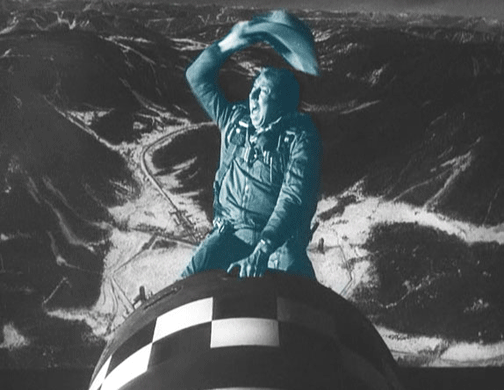
There is some precedent for the system proposed by the War on the Rocksauthors, who have served in government or in the military in nuclear-weapons-related capacities. In the fictional world of Hollywood, that precedent was established in Stanley Kubrick’s nuclear satire Dr. Strangelove and called the “Doomsday Machine,” which author Eric Schlosser described this way for The New Yorker:
“The device would trigger itself, automatically, if the Soviet Union were attacked with nuclear weapons. It was meant to be the ultimate deterrent, a threat to destroy the world in order to prevent an American nuclear strike. But the failure of the Soviets to tell the United States about the contraption defeats its purpose and, at the end of the film, inadvertently causes a nuclear Armageddon. ‘The whole point of the Doomsday Machine is lost,’ Dr. Strangelove, the President’s science adviser, explains to the Soviet Ambassador, ‘if you keep it a secret!’”
About two decades later, satire became closer to reality with the advent of the Soviet Union’s semiautomated Dead Hand system, formally known as Perimeter. When that system perceived that the Soviet military hierarchy no longer existed and detected signs of a nuclear explosion, three officers deep in a bunker were to launch small command rockets that would fly across the country initiating the launch of all of the Soviet Union’s remaining missiles, in a sort of revenge-from-the-grave move. The system was intended to enhance deterrence. Some reports suggest it is still in place.
The possibility that taking humans out of the loop might lead to an accidental launch and unintended nuclear war is a main element in US Naval War College Prof. Tom Nichols’ harsh characterization of the Dead Hand system in a 2014 article in The National Interest: “Turns out the Soviet high command, in its pathetic and paranoid last years, was just that crazy.”
But Lowther and McGiffin say a hypothetical US system would be different than Dead Hand because “the system itself would determine the response based on its own assessment of the inbound threat.“ That is to say, the US system would be better, because it wouldn’t necessarily wait for a nuclear detonation to launch a US attack.
Still, the authors clearly appear to favor an artificial intelligence-based solution.
August 31, 2019
Posted by Christina Macpherson |
Reference, USA, weapons and war |
Leave a comment

|
Oceans turning from friend to foe, warns landmark UN climate report, Phys Org, by Marlowe Hood, Patrick Galey 30 Aug 19, The same oceans that nourished human evolution are poised to unleash misery on a global scale unless the carbon pollution destabilising Earth’s marine environment is brought to heel, warns a draft UN report obtained by AFP.
Destructive changes already set in motion could see a steady decline in fish stocks, a hundred-fold or more increase in the damages caused by superstorms, and hundreds of millions of people displaced by rising seas, according to the Intergovernmental Panel on Climate Change (IPCC) “special report” on oceans and Earth’s frozen zones, known as the cryosphere.
As the 21st century unfolds, melting glaciers will first give too much and then too little to billions who depend on them for fresh water, it finds.
Without deep cuts to manmade emissions, at least 30 percent of the northern hemisphere’s surface permafrost could melt by century’s end, unleashing billions of tonnes of carbon and accelerating global warming even more.
The 900-page scientific assessment is the fourth such tome from the UN in less than a year, with others focused on a 1.5-Celsius (2.6-Farenheit) cap on global warming, the state of biodiversity, and how to manage forests and the global food system.
All four conclude that humanity must overhaul the way it produces and consumes almost everything to avoid the worst ravages of climate change and environmental degradation.
Governments meet in Monaco next month to vet the new report’s official summary. While the underlying science—drawn from thousands of peer-reviewed studies—cannot be modified, diplomats with scientists at their elbow will tussle over how to frame the findings, and what to leave in or out.
The final advice to policymakers will be released on September 25, too late to be considered by world leaders gathering two days earlier for a summit convened by UN Secretary-General Antonio Guterres to extract stronger national commitments in confronting the climate crisis.
Guterres may be disappointed by what the world’s major greenhouse gas emitters put on the table, according to experts tracking climate politics in China, the United States, the European Union and India………..
1,000-fold flood damage increase
By 2050, many low-lying megacities and small island nations will experience “extreme sea level events” every year, even under the most optimistic emissions reduction scenarios, the report concludes.
By 2100, “annual flood damages are expected to increase by two to three orders of magnitude,” or 100 to 1,000 fold, the draft summary for policymakers says.
Even if the world manages to cap global warming at two degrees Celsius, the global ocean waterline will rise enough to displace more than a quarter of a billion people. The report indicated this could happen as soon as 2100, though some experts think it is more likely to happen on a longer timescale………
Marine heatwaves
Oceans not only absorb a quarter of the CO2 we emit, they have also soaked up more than 90 percent of the additional heat generated by greenhouse gas emissions since 1970.
Without this marine sponge, in other words, global warming would already have made Earth’s surface intolerably hot for our species.
But these obliging gestures come at a cost: acidification is disrupting the ocean’s basic food chain, and marine heatwaves—which have become twice as frequent since the 1980s—are creating vast oxygen-depleted dead zones.
In the Tasman Sea, for example, a 2015-16 heatwave lasted for 251 days, causing disease outbreaks and a die-off of farmed shellfish.https://phys.org/news/2019-08-oceans-friend-foe-landmark-climate.html
|
|
August 31, 2019
Posted by Christina Macpherson |
2 WORLD, climate change, oceans, Reference |
Leave a comment
|
Fukushima tragedy: The day of black snow https://www.greenpeace.org/international/story/23925/fukushima-tragedy-the-day-of-black-snow/ by Sean Lee 30 August 2019 Toru Anzai is a former resident of Iitate, a small village in Fukushima, Japan, and dearly missed the bamboo shoots that grew in his hometown. During autumn, the bamboo shoots would blanket the mountains that overlooked the residents’ homes in the village. The residents would climb the mountains, gather the plants, and prepare them for dinner. But ever since that tragic day, no one climbed the mountains, and the wild plants vanished from their dinner tables. For Anzai, the bamboo shoots became sad reminders of what used to be.
Anzai remembers the day as the “black snow” day. He heard the explosions on 12 March, 2011. Black smoke rose from the Fukushima nuclear power plant, and the smell of burning iron pervaded the village. It started to rain. The rain turned into snow. The snow was black.
The black snow filled Anzai with an ominous dread, and soon, his fears became reality.
After the black snow shrouded the village, Anzai described in an interview how he started to feel throbbing pain on his skin. It was almost like being sunburned after sunbathing for too long. Both of his legs darkened then peeled in white patches. The only remedy to the peeling was applying medicinal ointment.
Soon after, his entire body began to suffer. The headaches came, followed by shoulder pains. Then the hair loss occurred. Three months after the disaster, he left behind his home and evacuated to survive. Unfortunately, the tragedy did not end there.
Three years later, Anzai started having strokes and heart attacks. A stent was placed in his blood vessel; the tube held open his narrowed blood vessel and kept the blood flowing to his heart. With treatment, his pain somewhat subsided, but whenever Anzai visited Iitate, the pain throughout his entire body relapsed. While these symptoms have not been conclusively connected to the radiation exposure, Anzai believed that they were the realities of the black snow day.
Anzai’s temporary housing was very narrow and consisted of a living room and a bedroom. He had moved into this subsidised housing complex eight years ago. He was one of the first of the 126 families. Often, evacuees gathered around the common area and shared fond memories of their hometowns with each other. Whatever solace could be found, the evacuees found it in each other.
Since allegedly completing the decontamination operation in Iitate, the Japanese government have been urging people to return to their village. In fact, Fukushima prefectural government had ended housing subsidies this past March, and by the end of the month, most people had left the complex. Only around ten families were still looking for a new place to live.
Absently gazing into the dark, clouded sky, Anzai spoke bitterly. “I was kicked out of my hometown for doing nothing wrong. It was heartbreaking. Now, Iitate is polluted, and some of my neighbours have died. When the government asked me to evacuate last minute, I left. Now, they want me to go back. Back to all of the radioactive contamination. I’m so angry, but I don’t know what to do. We have repeatedly petitioned the government, but they’re not willing to listen. Our government has abandoned us.”
Prior to the nuclear incident, there were about 6,300 residents in Iitate. Eight years later, only a little over 300 evacuees have returned at the government’s persistent urging. Most of the returning residents were elderly, aged 60 or older. Even counting the non-natives who had recently relocated to the village, the total figure hovered around only 900 residents.
Iitate’s old and new residents are exposed to radioactive substances on a daily basis. The Japanese government claimed to have completed the decontamination work, but a full decontamination is impossible due to the village’s terrain. More than 70% of Iitate is forest, and unlike in the farmlands, the removal of contaminants that have fallen among the mountainous forest is nearly impossible.
Each year, Greenpeace Germany conducts extensive research on Fukushima villages including Iitate. The findings confirm that the radiation exposure in these villages exceeds the established international safety standards. Anzai believes that the Japanese government is behind the forced homecoming of the Iitate residents.
“The government hopes to publicise good news: the nuclear accident has been dealt with, and the residents have returned home. People who had no choice but to leave are now being pressured to return and put their lives on the line,” lamented Anzai.
The Japanese government hopes to release more than one million tonnes of highly radioactive water into the Fukushima coast. If the contaminated water becomes flushed into the ocean, the contamination will only add to the harm already inflicted by the Fukushima accident. Furthermore, the ocean currents will shift the radioactive materials through the surrounding waters including the Pacific Ocean.
The industrial pollution and toxins have already caused much distress to our oceans. Discharging the Fukushima’s radioactive water will only worsen the situation, and we cannot, and should never, let this happen.
|
|
August 31, 2019
Posted by Christina Macpherson |
Fukushima continuing, PERSONAL STORIES, Reference |
Leave a comment
What Does ’12 Years to Act on Climate Change’ (Now 11 Years) Really Mean? https://insideclimatenews.org/news/27082019/12-years-climate-change-explained-ipcc-science-solutionsIt doesn’t mean the world can wait until 2030 to cut greenhouse gas emissions, or that chaos will erupt in 2030. Here’s what the science shows., BY BOB BERWYN, INSIDE CLIMATE NEWS, AUG 27,2019We’ve been hearing variations of the phrase “the world only has 12 years to deal with climate change” a lot lately.Sen. Bernie Sanders put a version of it front and center of his presidential campaign last week, saying we now have “less than 11 years left to transform our energy system away from fossil fuels to energy efficiency and sustainable energy, if we are going to leave this planet healthy and habitable.”
But where does the idea of having 11 or 12 years come from, and what does it actually mean?
The number began drawing attention in 2018, when the United Nations’ Intergovernmental Panel on Climate Change released a report describing what it would take to keep global temperatures from rising more than 1.5 degrees Celsius, a goal of the Paris climate agreement. The report explained that countries would have to cut their anthropogenic carbon dioxide emissions, such as from power plants and vehicles, to net zero by around 2050. To reach that goal, it said, CO2 emissions would have to start dropping “well before 2030” and be on a path to fall by about 45 percent by around 2030 (12 years away at that time).
Mid-century is actually the more significant target date in the report, but acting now is crucial to being able to meet that goal, said Duke University climate researcher Drew Shindell, a lead author on the mitigation chapter of the IPCC report.
We need to get the world on a path to net zero CO2 emissions by mid-century,” Shindell said. “That’s a huge transformation, so that if we don’t make a good start on it during the 2020s, we won’t be able to get there at a reasonable cost.”
How Do Scientists Know?
Basics physics and climate science allow scientists to calculate how much CO2 it takes to raise the global temperature—and how much CO2 can still be emitted before global warming exceeds 1.5°C (2.7°F) compared to pre-industrial times.
Scientists worked backward from that basic knowledge to come up with timelines for what would have to happen to stay under 1.5°C warming, said Scott Denning, who studies the warming atmosphere at Colorado State University.
“They figured out how much extra heat we can stand. They calculated how much CO2 would produce that much heat, then how much total fuel would produce that much CO2. Then they considered ‘glide paths’ for getting emissions to zero before we burn too much carbon to avoid catastrophe,” he said.
“All this work gets summarized as ‘in order to avoid really bad outcomes, we have to be on a realistic glide path toward a carbon-free global economy by 2030.’ And that gets translated to something like ’emissions have to fall by half in a decade,’ and that gets oversimplified to ’12 years left.’
“There’s certainly a grain of truth in the phrase, but it’s so oversimplified that it leads to comically bad misconceptions about how to get there, conjuring up ridiculous cartoon imagery suggesting we just go on with life normally for the next 11 years and then the world ends,” Denning said.
That’s not what the IPCC writers envisioned, he said.
The science on the 2030 date is clear, said Michael Mann, a climate scientist at Pennsylvania State University. The controversy stems from people mischaracterizing the carbon reduction timeline as a threshold for climate disaster. He noted that people promoting climate science denial and delay have also latched on to the phrase “to intentionally try to caricature the concern about climate change.”
What Would Success Look Like?
It would be helpful if people looked at the 2030 target in terms of what success looks like rather than what failure means, Denning said.
“Solving the problem by 2030, 2040 or 2050 requires a new global energy infrastructure, which is arguably easier and less expensive than past infrastructure shifts like indoor plumbing, rural electrification, the automobile and paved roads, telecommunications, computers, mobile phones or the internet.
“All of these past changes cost tens of trillions of dollars, adjusted for inflation. All of them were hugely disruptive. All of them took a decade or more, completely changed the industrial and economic and social landscape, and created bursts of growth and productivity and jobs. And arguably, all of them made life better for huge numbers of people.”
This time, the shift is from heavy reliance on carbon-emitting fossil fuels to carbon-free energy sources, like wind power. And even with a speedy energy transition, the IPCC says keeping temperatures from warming more than 1.5°C will also likely require removing CO2 from the atmosphere on a large scale.
Missing the target doesn’t imply the onset of cataclysmic climate change in 2030, Denning said.
“Things just keep getting worse and worse until we stop making them worse, and then they never get better,” he said. “But no matter what, the world has to move on from fossil fuels just as we moved on from tallow candles and outhouses and land lines.”
What Would Exceeding 1.5°C Warming Mean?
The IPCC report described how increasing greenhouse gas emissions will result in more dangerous and costly disruptions to global societies and ecosystems, including longer, hotter heat waves and more frequent crop-killing droughts.
Mountain glaciers will melt faster as the planet warms, creating new risks for settlements in the valleys below. The meltdown of polar ice sheets is also projected to accelerate, intensifying flooding and speeding up sea level rise to a rate that will be hard to adapt to. More Arctic permafrost will thaw, releasing more greenhouse gases to the atmosphere.
Despite the rising risks, it’s important to understand that, “in the physical climate system, there are no scientists claiming that there is a magical threshold that we breach or don’t breach that determines whether we have a habitable climate system,” said Daniel Swain, a climate scientist at UCLA and the National Center for Atmospheric Research’s Center for Climate and Weather Extremes.
The 2030 target is useful because it shows how the “next decade is incredibly consequential for what we do.” Swain said. “But I think the emphasis that’s being placed on this specific 12-year window as a differentiator between existential crisis or not is problematic.
“First of all, it negates some of the risks that already exist and that will continue to build no matter what. And it also potentially suggests that anything short of complete victory in the next 12 years is pointless, which is exactly the opposite of the truth. At any point along the spectrum, more progress is always going to be better than less progress, less warming is always going to be better than more warming.”
Have We Passed Tipping Points Already?
In some ways, the “12 years” narrative may set up a deadline that’s too lenient, because some key part of the climate system may already be at or past tipping points, Swain said.
It creates the false illusion that there is some sort of guardrail moving forward, that if we just get in under the deadline we’ll be OK, he said. But “twelve years from now, it could be too late for some of these things, like the ice sheets.”
Research in the past few years reinforces the idea that some climate tipping points have already been breached. Studies show some parts of the Greenland Ice Sheet are unlikely to recover, and parts of the West Antarctic Ice Sheet may also be at or very near a tipping point to rapid disintegration.
A study published in June suggested that the rate of permafrost thawing is progressing much faster than climate models projected. And scientists studying the link between global warming and European heat waves said those recent extremes are also outside the scope of what they expected at current levels of warming.
The world will still exist if we breach 1.5°C and 2°C, but “the climate impacts and risks will be higher and the temperature will be higher,” said Glen Peters, research director at the CICERO climate research center in Oslo. That all seems to be sinking in to public awareness, he said.
“But in terms of deadlines, we have already missed the deadline,” he said. “We should have started mitigating decades ago, then we would have the problem solved.”
August 29, 2019
Posted by Christina Macpherson |
2 WORLD, climate change, Reference |
Leave a comment
France Is Still Cleaning Up Marie Curie’s Nuclear Waste, Her lab outside Paris, dubbed Chernobyl on the Seine, is still radioactive nearly a century after her death. Bloomberg Business Week , By Tara Patel, 28 Aug 19,
In 1933 nuclear physicist Marie Curie had outgrown her lab in the Latin Quarter in central Paris. To give her the space needed for the messy task of extracting radioactive elements such as radium from truckloads of ore, the University of Paris built a research center in Arcueil, a village south of the city. Today it’s grown into a crowded working-class suburb. And the dilapidated lab, set in an overgrown garden near a 17th century aqueduct, is sometimes called Chernobyl on the Seine.
No major accidents occurred at the lab, which closed in 1978. But it’s brimming with radioactivity that will be a health threat for millennia, and France’s nuclear watchdog has barred access to anyone not wearing protective clothing. The lab is surrounded by a concrete wall topped by barbed wire and surveillance cameras. Monitors constantly assess radiation, and local officials regularly test the river. “We’re proof that France has a serious nuclear waste problem,” says Arcueil Mayor Christian Métairie. “Our situation raises questions about whether the country is really equipped to handle it……. (subscribers only) https://www.bloomberg.com/news/articles/2019-08-28/france-is-still-cleaning-up-marie-curie-s-nuclear-waste
August 29, 2019
Posted by Christina Macpherson |
France, Reference, wastes |
Leave a comment
 Urgent appeal to save nuclear agreements https://www.japantimes.co.jp/opinion/2019/08/25/commentary/japan-commentary/urgent-appeal-save-nuclear-agreements/#.XWL9GugzbIU
BY RAMESH THAKUR HIROSHIMA, 25 Aug !9 – The Hiroshima Round Table held its seventh annual meeting last Wednesday and Thursday. For the first time, in recognition of the uniquely dangerous international security environment since the dawn of the atomic age in this beautiful city, the Round Table issued an urgent appeal to maintain existing nuclear arms control, disarmament and nonproliferation pacts and to build on them in order to deepen strategic stability. Continue reading →
August 26, 2019
Posted by Christina Macpherson |
2 WORLD, politics international, Reference, weapons and war |
Leave a comment
 The danger of sourcing food and material from the Fukushima region Ground-
 level nuclear disasters leave much more radioactive fallout than Tokyo is willing to admit Hankyoreh By Seok Kwang-hoon, energy policy consultant of Green Korea Aug.25,2019 International concerns are growing over the Japanese government’s plans to provide meals from the Fukushima area to squads participating in the 2020 Tokyo Olympics. The starting point for the Olympic torch relay, and even the baseball stadium, were placed near the site of the Fukushima Nuclear Power Plant. It seems to be following the model of the Tokyo Olympics in 1964, where Japan’s rise from the ashes of the atomic bombs was underscored by having a young man born the day of the Hiroshima bombing act serve as the relay’s last runner. Here we can see the Shinzo Abe administration’s fixation on staging a strained Olympic reenactment of the stirring Hiroshima comeback – only this time from Fukushima.
But in terms of radiation damages, there is a world of difference between Hiroshima and Fukushima. Beyond the initial mass casualties and the aftereffects suffered by the survivors, the atomic bombing of Hiroshima resulted in little additional radiation exposure. Nuclear technology being as crude as it was back then, only around one kilogram of the Hiroshima bomb’s 64kg of highly enriched uranium actually underwent any reaction, resulting in a relatively small generation of nuclear fission material.
Whereas ground-based nuclear testing results in large quantities of radioactive fallout through combining with surface-level soil, the Hiroshima bomb exploded at an altitude of 580m, and the superheated nuclear fission material rose up toward the stratosphere to spread out around the planet, so that the amount of fallout over Japan was minimal. Even there, most of the nuclides had a short half-life (the amount of time it takes for half the total atoms in radioactive material to decay); manganese-56, which has a half-life of three hours, was the main cause of the additional radiation damages, which were concentrated during the day or so just after the bomb was dropped. The experience of Nagasaki was similar. As a result, both Hiroshima and Nagasaki were able to fully resume as functioning cities by the mid-1950s without additional decontamination efforts.
Ground-level nuclear disasters leave much more radioactive fallout than Tokyo is willing to admit
nternational concerns are growing over the Japanese government’s plans to provide meals from the Fukushima area to squads participating in the 2020 Tokyo Olympics. The starting point for the Olympic torch relay, and even the baseball stadium, were placed near the site of the Fukushima Nuclear Power Plant. It seems to be following the model of the Tokyo Olympics in 1964, where Japan’s rise from the ashes of the atomic bombs was underscored by having a young man born the day of the Hiroshima bombing act serve as the relay’s last runner. Here we can see the Shinzo Abe administration’s fixation on staging a strained Olympic reenactment of the stirring Hiroshima comeback – only this time from Fukushima.But in terms of radiation damages, there is a world of difference between Hiroshima and Fukushima.
Beyond the initial mass casualties and the aftereffects suffered by the survivors, the atomic bombing of Hiroshima resulted in little additional radiation exposure. Nuclear technology being as crude as it was back then, only around one kilogram of the Hiroshima bomb’s 64kg of highly enriched uranium actually underwent any reaction, resulting in a relatively small generation of nuclear fission material. Whereas ground-based nuclear testing results in large quantities of radioactive fallout through combining with surface-level soil, the Hiroshima bomb exploded at an altitude of 580m, and the superheated nuclear fission material rose up toward the stratosphere to spread out around the planet, so that the amount of fallout over Japan was minimal. Even there, most of the nuclides had a short half-life (the amount of time it takes for half the total atoms in radioactive material to decay); manganese-56, which has a half-life of three hours, was the main cause of the additional radiation damages, which were concentrated during the day or so just after the bomb was dropped. The experience of Nagasaki was similar. As a result, both Hiroshima and Nagasaki were able to fully resume as functioning cities by the mid-1950s without additional decontamination efforts……
http://www.hani.co.kr/arti/english_edition/e_editorial/907055.html
August 26, 2019
Posted by Christina Macpherson |
environment, Japan, Reference |
Leave a comment
|
 The danger of sourcing food and material from the Fukushima region The danger of sourcing food and material from the Fukushima region Ground-level nuclear disasters leave much more radioactive fallout than Tokyo is willing to admit Hankyoreh By Seok Kwang-hoon, energy policy consultant of Green Korea Aug.25,2019 “………….. Fukushima’s radiation increases over time. The Fukushima disaster did not result in mass casualties, but the damages from radiation have only increased over time. The nuclear power plants experiencing core meltdowns had the equivalent of around 12 tons of highly enriched uranium in nuclear fuel – roughly 12,000 times more than the amount of uranium that underwent nuclear fission in the Hiroshima bomb. At one point, the Japanese government announced that Fukushima released 168 times more cesium than the Hiroshima bomb. But even that was merely a difference in emissions; there’s an immeasurable difference between the amount of fallout from Hiroshima, which was left over from a total spread out over the planet at a high altitude, and the amount from Fukushima, which was emitted at ground level. Hiroshima also experienced little to no exposure to cesium-137 and strontium-90 – nuclides with half-lives of around 30 years that will continue to afflict Japan for decades to come. Due to accessibility issues, most of the forests that make up around 70% of Fukushima’s area have been left unaddressed. According to Japanese scholars, around 430 square kilometers of forest was contaminated with high concentrations of cesium-137. The danger of this forest cesium is that it will be carried toward residential or farm land by wind and rain, or that contaminated flora and fauna will be used in processing and distribution. Indeed, cedar wood from Fukushima remains in distribution in the region, and was even shipped off recently to serve as construction material for the Tokyo Olympics. Meanwhile, the incidence of thyroid cancer in children – a rare condition – has risen all the way from one to two cases before the incident to 217 in its wake. Yet the Abe administration has only impeded a study by physicians, using various government-controlled Fukushima-related investigation committees as vehicles for sophistry and controlling media reporting on the issue. http://www.hani.co.kr/arti/english_edition/e_editorial/907055.htmlAbe administration hoping to cut costs in nuclear waste disposal The economic consequences have been astronomical as well. From an expert group’s analysis, the Japan Center for Economic Research estimated that the 14 million tons of radioactive waste from collecting Fukushima’s cesium-contaminated soil would result in a financial burden of 20 trillion yen (US$187.98 billion) based on the acceptance costs at the Rokkasho-mura radioactive waste disposal center. Contaminated water from the Fukushima Nuclear Power Plant – which already amounts to 1.2 million tons and is expected to increase to 2 million – was predicted to cost fully 51 trillion yen (US$479.35 billion) in tritium and strontium removal costs alone. Factor in the 10 trillion yen (around US$94 billion) in resident compensation, and the amount is close to the Japanese government’s total annual budget. Hoping to cut costs, the Abe administration announced plans to reuse soil waste in civil engineering, while the contaminated water is expected to be dumped into the Pacific after the formalities of a discussion. But few if any Japanese news outlets have been doing any investigative reporting on the issue.
When Abe declared the situation “under control” during the Olympic bidding campaign in 2013, this truthfully amounted to a gag order on the press and civil society. Having the world’s sole experience of filing and winning a World Trade Organization (WTO) case on Fukushima seafood, South Korea may be in the best position to alert the world to the issue of radioactivity and the Tokyo Olympics. I look forward to seeing efforts from the administration.By Seok Kwang-hoon, energy policy consultant of Green Korea
|
|
August 26, 2019
Posted by Christina Macpherson |
environment, Japan, Reference |
Leave a comment
Assessing the possible safety issues in the second nuclear era, by Bob Yirka , Phys.org 25 Aug 19, A team of researchers with the Chinese Academy of Sciences has carried out an assessment of possible safety issues tied to the rise of the second nuclear era. In their paper published in Proceedings of the National Academy of Sciences, the group describes the factors that led to the rise of a second nuclear era and possible safety concerns that need to be addressed……
now, the researchers claim, a new nuclear era has begun—this time, driven by less-developed countries such as India and China, and to some degree, Russia. The researchers suggest this new, unexpected second nuclear era is fraught with great risk. They note that despite efforts by the parties involved in implementing nuclear power plants in the first era, major accidents occurred. They further note that recent history suggests that safely producing nuclear energy has still not been fully realized. In their paper, they outline some of the safety issues involved with the second nuclear era.
The researchers note that unlike most advanced countries, less-developed countries suffer from poor infrastructure and the means for safely maintaining a complex nuclear plant. They also note that the laws in some of the countries developing nuclear plants are less stringent, and that there is more corruption. They also note there is often less political stability. And there are differences in social values regarding risk and the need for safety practices. They also note that many such countries do not have well-established communications channels between those operating nuclear facilities and the public at large. The recent nuclear accident in Russia highlights why such communications are needed—to protect those in the path of radiation leaks.
More information: Yican Wu et al. Nuclear safety in the unexpected second nuclear era, Proceedings of the National Academy of Sciences(2019). DOI: 10.1073/pnas.1820007116– https://phys.org/news/2019-08-safety-issues-nuclear-era.html Journal information: Proceedings of the National Academy of Sciences
August 26, 2019
Posted by Christina Macpherson |
China, Reference, safety |
Leave a comment

|
Russia’s closed cities hold the secrets to global nuclear disasters you’ve never heard of https://www.abc.net.au/news/2019-08-24/russia-closed-cities-hold-secrets-to-global-nuclear-disasters/11437734
By Lauren Beldi The lack of information from the Russian Government following the deadly explosion on August 8 has some questioning whether the situation might be worse than originally thought.
Key points:
- There are at least 40 closed cities in Russia, officially known by the acronym ZATO
- Some have also been home to some of the world’s worst nuclear incidents
- President Vladimir Putin is trying to encourage more Russians to move to closed cities
But it makes sense why Russia might be vague on the detail.
Both the city near the accident site, Severodvinsk, and the one where the victims were buried, Sarov, are “closed cities” — highly controlled areas that house the country’s most important weapons sites.
The Government does not want outsiders knowing what goes on there, especially when accidents happen.
And when accidents do happen in closed cities, like a radioactive explosion or an outbreak of anthrax, Russia has a long history of covering them up.
Russia is far from the only country to have closed cities, but it does have a lot of them.
It’s thought there are about 40 closed cities in Russia, though it’s suspected there are others whose very existence is highly classified.
First established in the 1940s, closed cities — officially known by the acronym ZATO in Russian — are most often associated with either military installations or major research centres and are used to house employees and their families.
For example, Sarov, where the five scientists killed in the explosion were buried, is the site of a nuclear weapons design facility.
It’s been a closed city since 1946, when it was renamed Arzamas-16 and its location was removed from all unclassified maps.
The movement of people and information in and out of these cities is highly restricted, and residents are often not allowed to disclose where they live to outsiders.
“There’s levels of security inside levels of security, it’s like a series of concentric circles,” Kate Brown, MIT Professor of Science, Technology and Society, told the ABC.
“And when you have those it is easy to gloss over problems, perhaps cover up accidents, there’s not a lot of ways for information to get out.”
The nuclear disaster you probably haven’t heard of
While Chernobyl and Fukushima might be synonymous with nuclear disasters, that might not be the case for Kyshtym.
It was the third most-serious nuclear accident ever recorded, and it happened at the Mayak facility in the closed city of Ozyorsk, in Russia’s Ural Mountains, in 1957.
A cooling system in a radioactive waste tank broke down and the rise in temperature resulted in an explosion that released an estimated 20 million curies of radioactivity into the environment.
During the Chernobyl explosion, about 50–200 million curies of radioactivity was estimated to have been released.
The Kyshtym disaster contaminated an area up to 20,000 square kilometres, known as the East-Ural Radioactive Trace, and thousands of people near the plant were evacuated.
But the Soviet government didn’t publicly acknowledge the accident until 1989.
The incident was happening at the time of the Cold War so it was also an attempt by the Soviet authorities to prevent the news from reaching the outside world,” Alexey Muraviev, a specialist in Russian strategic and defence policy at Curtin University, told the ABC.
But the area had been contaminated even before the Kyshtym disaster, when high-level radioactive waste from the production of plutonium at Mayak had been intentionally dumped into the nearby Techa river.
“They put about 3.2 million curies into that small river, and the people who lived downstream drank from it, swam in it, ate from it, fished in it, watered their crops in it,” Professor Brown said.
Twenty-eight communities live down that river, several tens of thousands of people, and they didn’t tell anybody that they were putting high-level waste [in the river].”
Mayak now serves as a reprocessing plant for spent radioactive fuel.
In October 2017, a network of monitoring sites picked up a cloud of radioactive material, Ruthenium-106, above Europe.
In a report published just last month, a team of scientists say the most likely source was a fire or explosion at Mayak that occurred during the reprocessing of spent fuel to create enriched caesium for an Italian laboratory.
Russia’s nuclear energy agency continues to deny anything happened at Mayak in 2017, but at the time, the Russian Meteorological Service admitted there was “extremely high contamination” in the air around the Ural mountains.
And it’s not just nuclear accidents that happen at closed cities.
In 1979, spores of anthrax leaked from a biological weapons facility in the closed city of Sverdlovsk and killed at least 68 people, many of whom were civilians from a nearby ceramics plant.
The Soviet government blamed the deaths on the consumption of contaminated meat, and it was only in 1992 that then-president Boris Yeltsin publicly linked the anthrax outbreak with the military facility.
While some have a bad safety reputation, there’s a big reason why Russians might want to move to a closed city: they’ve historically gotten the best of everything.
As part of the privileges of working on important, secret and dangerous processes, residents are promised a higher standard of living and better resources.
During the Soviet era, those who lived in closed cities were spared the austerity of other parts of the country.
“So there were no problems with, for example, food supplies; people could buy anything they wanted,” Dr Muraviev said.
“They also provided better living conditions, so people who would work at closed cities would be guaranteed state funding accommodation and so on.”
The reputation of the living standards and privileges of those cities meant the jobs that would allow you to move to one were highly sought after.
“This is an important element, otherwise it sounds like [closed cities] are like a giant concentration camp,” Dr Muraviev said.
And according to Dr Muraviev, Russian President Vladimir Putin has been actively trying to restore the glamour of the country’s remaining closed cities.
“Back in the 1990s those privileges kind of really lapsed, so there were no incentives anymore, but now they’re sort of back on the agenda and the Government is really pumping funds into these cities,” he said.
“That’s part of [Mr Putin’s] strategy to rebuild Russia’s national security as well as rebuild Russia’s national defence capability.”
And as far as the risks go of moving to a secretive town next to a nuclear facility or a military installation?
Dr Muraviev said the people who chose to move to closed cities knew what came with the job.
“They understand risks associated with it and they’re not just doing it for money; they’re also doing it for the idea of making Russia safe,” he said.
|
|
August 24, 2019
Posted by Christina Macpherson |
Reference, Russia, secrets,lies and civil liberties |
Leave a comment










 nuclear-news