New Zealand groups oppose launch of U.S. military nuclear satellite

a security expert has suggested it puts New Zealand into “the kill chain” and makes New Zealand a military target.
|
NZ rocket launches may breach nuclear-free laws, say peace groups, The Spinoff
Ollie Neas | 8 Mar 21, Rocket Lab launches of satellites honing US military targeting capabilities have been criticised by the Peace Foundation, which is calling on the PM to step in.Peace groups are calling on the prime minister, Jacinda Ardern, to stop the launch of a controversial US military satellite that is scheduled for lift-off from Mahia this month, saying it may contravene nuclear-free legislation.Rocket Lab’s next mission is due to carry a satellite for the US Army’s Space and Missile Defence Command, called the Gunsmoke-J. The satellite is designed to improve US military targeting capabilities by improving how data is provided to “warfighters”.The satellite has previously been condemned by the Green Party, while a security expert has suggested it puts New Zealand into “the kill chain” and makes New Zealand a military target. Non-profit group The Peace Foundation has now added to those concerns: the launch may breach New Zealand’s nuclear-free laws. In an open letter to the prime minister, the Peace Foundation’s International Affairs and Disarmament Committee says Rocket Lab’s launches for US military agencies risk drawing New Zealand “into supporting the weaponisation of space and the related nuclear arms race”. Satellites contributing to nuclear weapons programmes cannot be approved under New Zealand law. But the Peace Foundation says New Zealand may lack the technical expertise and information necessary to properly assess whether a satellite is making such a contribution. As a result, the Peace Foundation says approvals of US military satellites should be suspended, and approval of the Gunsmoke-J satellite revoked, until greater oversight of space launches is implemented. The letter has been endorsed by 17 civic, peace and religious groups, as well as members of the public………… The US Army says the technology being demonstrated could, among other purposes, assist in “long-range precision fires” – a type of missile used to provide “precision surface-to-surface deep-strike capability”. The minister responsible for approving the satellite, Stuart Nash, told parliament last month that he was “unaware” of its “specific military capabilities”. Otago University conflict resolution and disarmament expert Kevin Clements said it is “astonishing” that Nash was unaware of the Gunsmoke-J’s specific military capabilities. “It is even worse that he is willing to rely on the US Army alone to provide the information required by him and New Zealand’s space agency in relation to the approval process,” Clements said in a statement. “Rocket Lab’s launch programme is increasingly opaque. The precise content of each payload seems intentionally ambiguous and approvals do not seem to take New Zealand’s anti-nuclear legislation into account.” Strong parallel’ with nuclear ships issue The Peace Foundation says there is a “strong parallel” between the launch of US military satellites from New Zealand and the “neither confirm nor deny” issue of the 1980s. The US policy of neither confirming nor denying whether its ships were nuclear armed led to a ban on US warships visiting New Zealand ports – the seminal moment in the anti-nuclear campaign. As with that issue, the Peace Foundation says New Zealand cannot be confident that US military satellites launched from New Zealand are not contributing to nuclear weapons systems. The Peace Foundation says assessing whether the Gunsmoke-J complies with the nuclear free law would require detailed technical knowledge of how the technology might be used in the future. “Increasingly, space-based US military assets are ‘dual-capable’ (can support nuclear and non-nuclear weapons), and dual-capable satellites used for non-nuclear targeting today can easily be used for nuclear targeting tomorrow………. Call to reform space law In light of its concerns, the Peace Foundation says greater oversight is needed over New Zealand’s space regime. It proposes assigning oversight of space launches to the prime minister, strengthening space regulations, and mandating oversight of space-launch activity to the Public Advisory Committee on Disarmament and Arms Control (PACDAC) – a body set up by the Nuclear Free Zone Act to advise the government on disarmament matters. Minutes of PACDAC meetings obtained by The Spinoff under the Official Information Act show the committee has had ongoing concerns about the consistency of space activity with New Zealand’s nuclear free law. Space Agency officials have met with the committee to assure members of the legality of launches. The Peace Foundation also calls for changes to the Technology Safeguards Agreement that New Zealand signed with the US to allow for the transfer of sensitive rocket technology. The treaty requires the US to provide “sufficient information” about its spacecraft to allow New Zealand to assess them, but also allows the US government to veto any space launch from New Zealand. “There are some very big moral questions at stake here,” says Clements. “Is this current Labour government willing for New Zealand soil to be used by Rocket Lab in order to assist US government targeting in conventional and nuclear warfare?” The Peace Foundation’s letter comes a week after Rocket Lab announced that it would list publicly on the Nasdaq stock exchange, with a valuation of $5.7 billion. Although its main launch site and production facility is in New Zealand, Rocket Lab is US owned. Its investors include major US venture capital firms as well as aerospace and defence company Lockheed Martin, which produces nuclear weapons. Rocket Lab also unveiled plans to launch a larger rocket called the Neutron, which will allow it to launch astronauts. Since 2018, Rocket Lab has launched military or intelligence payloads on seven different missions for agencies ranging from US Special Operations Command to the National Reconnaissance Office, a major US spy agency. Rocket Lab says around 30% of its business is for defence agencies. https://thespinoff.co.nz/politics/09-03-2021/nz-rocket-launches-may-breach-nuclear-free-laws-say-peace-groups/ |
|
The radiation danger to astronauts- cancer, heart disease -an ethical problem

“These are all crucial studies to be conducted in order to really understand the risks we’re exposing astronauts to,” says Meerman. “Therefore, we believe we are not there yet and we should debate whether it is safe to expand human space travel significantly
|
Long-distance space travel: addressing the radiation problem https://physicsworld.com/a/long-distance-space-travel-addressing-the-radiation-problem/ 08 Mar 2021 A team of US and Netherlands-based scientists has published a review paper highlighting ways to protect astronauts from the negative cardiovascular health impacts associated with exposure to space radiation during long-distance space travel.Cardiovascular impacts Space radiation is currently regarded as the most limiting factor for long-distance space travel because exposure to it is associated with significant negative effects on the human body. However, data on these effects are currently only available for those members of the Apollo programme that travelled as far as the Moon – too small a number from which to draw any significant conclusions about the effects of the space environment on the human body. In addition, although exposure to space radiation, including galactic cosmic rays and solar “proton storms”, has previously been linked to the development of cancer and neurological problems, data on the consequences of space radiation exposure for the cardiovascular system are lacking. In an effort to address these limitations, researchers based at the University Medical Center (UMC) Utrecht, Leiden University Medical Center, Radboud University and the Technical University Eindhoven in the Netherlands, as well as Stanford University School of Medicine and Rice University in the US, have carried out an exhaustive review of existing evidence to establish what we know about the cardiovascular risks of space radiation. They present their findings in the journal Frontiers in Cardiovascular Medicine.
“You can argue that if NASA, ESA and other space agencies want to expand space travel, both in terms of location – for example, to Mars – and time, astronauts will be exposed to the specific space environment for longer periods of time. However, we currently do not know what the effects of exposure to these space-specific factors are,” says Meerman. “NASA currently sees space radiation as the most limiting factor for long-distance space travel, but the exact short- and long-term effects are not fully understood yet. We are therefore exposing astronauts to extremely uncertain risks. However, research into the effects of space radiation has increased over the past few years and we’re constantly gaining more knowledge on this topic,” she adds. Advanced modelsAccording to Meerman, another important factor in this discussion is the fact that we currently cannot adequately protect astronauts from space radiation. Shielding with radiation-resistant materials is very difficult since exposure levels are far higher than on Earth and the type of radiation is much more penetrating. Pharmacological methods of protecting the cardiovascular system are hampered by the fact that no effective radioprotective compounds have yet been approved. “The most important conclusion is that we actually do not know enough about the exact risks that long-distance space travel pose for the human body. Therefore, in our opinion, we should keep looking for new ways to protect astronauts from the harmful space environment before we expand human space travel,” says Meerman. Moving forward, Meerman stresses that research on the effects of space radiation should incorporate advanced models that provide a more accurate representation of the cardiovascular impacts of space radiation – such as those based on lab-created human cardiac tissue and organ-on-a-chip testing technologies. Studies should also examine the effects of combinatorial exposure to different space radiation particles, as well as combined exposure to space radiation components and other space-specific factors, like microgravity, weightlessness and prolonged hypoxia. “These are all crucial studies to be conducted in order to really understand the risks we’re exposing astronauts to,” says Meerman. “Therefore, we believe we are not there yet and we should debate whether it is safe to expand human space travel significantly.” |
|
Sorry saga of America’s plutonium waste problems
Can the Energy Department store 50 tons of weapons-grade plutonium for 10,000 years? Robert Alvarez Bulletin of the Atomic Scientists, 8 Mar 21,
”…………The US-Russia plutonium disposal disagreement.
The end of the Cold War led to deep cuts in the US and Russian nuclear arsenals, and in 1993 President Clinton issued a directive declaring that the United States is “committed to eliminating, where possible, the accumulation of stockpiles of highly enriched uranium and plutonium.” In September 2000, the United States and Russia signed the Plutonium Management Disposition Agreement, under which 34 metric tons of plutonium from weapons would be blended with uranium and serve as mixed-oxide or MOX reactor fuel to produce electricity.
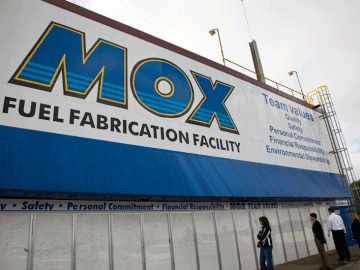 Construction on the Mixed Oxide Fuel Fabrication Plant at the Savannah River Site began in 2007, but the United States abandoned the project because of delays and estimated cost overruns of $30 billion to $50 billion. After a “Red Team” expert review in 2015, the Energy Department decided to pursue a “dilute and dispose” option for storing plutonium, which, the team reported, would cost about half as much as the MOX project. Plutonium from weapons and other forms would be converted from metal to oxide, diluted with a secret adulterant, and then placed a special container for shipment and disposal at WIPP.
The dilute and dispose project.
The Energy Department optimistically estimates that its dilution and disposal project will start up in 2027 and store 34 metric tons of weapons-grade plutonium by 2049, at a cost of $18 billion. That time estimate seems likely to be unrealistic; according to the Institute for Defense Analysis, “we could find no successful historical major project that both costs more than $700 million and achieved [Energy Department project startup] … in less than 16 years.”
The dilute and dispose project i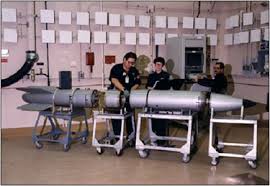
- The Pantex weapons assembly and disassembly plant near Amarillo, Texas, where thousands of pits and other forms of plutonium have to be prepared for safe and secure shipment to Los Alamos National Laboratory (LANL) in New Mexico. The majority of the plutonium at Pantex is stored in facilities at that were built in the 1940s. In 2010 and 2017, unexpected 2,000-year rains flooded a major plutonium storage area with several inches of water, which shut down the plant. It cost of hundreds of millions of dollars to deal with about 1,000 containers affected by the flooding.
 At the Los Alamos National Laboratory, pits will be converted from metal to an oxide that resembles a yellow-to-olive-green talcum-like powder, which is highly dispersible if it escapes from leaking glove boxes. The conversion process takes place at the PF-4 facility, a 69-year-old complex where the Energy Department has a major multibillion-dollar project underway to upgrade aged processes to produce new plutonium bomb triggers. In 2020, a panel of the National Academies of Science warned that “LANL may be a major bottleneck” impacting the plutonium disposal mission. The disposal and production projects could be on a collision course by the middle of this decade, when both are planned to scale up by 10 times.
 Once Los Alamos produces plutonium oxides, they will be sent to the Savannah River Site in South Carolina, where the plutonium will be diluted and mixed with a secret adulterant, sometimes via the use of mortars and pestles. About 166,000 specially designed drums will be filled with the dilute fissile material. This task is a tall order for the Savannah site, where the round-the-clock work is expected to scale up by 10 times in a facility that officially exceeded its design life years ago. The facility will be almost 100 years old by 2049 when the dilute and disposal project is expected to be completed.
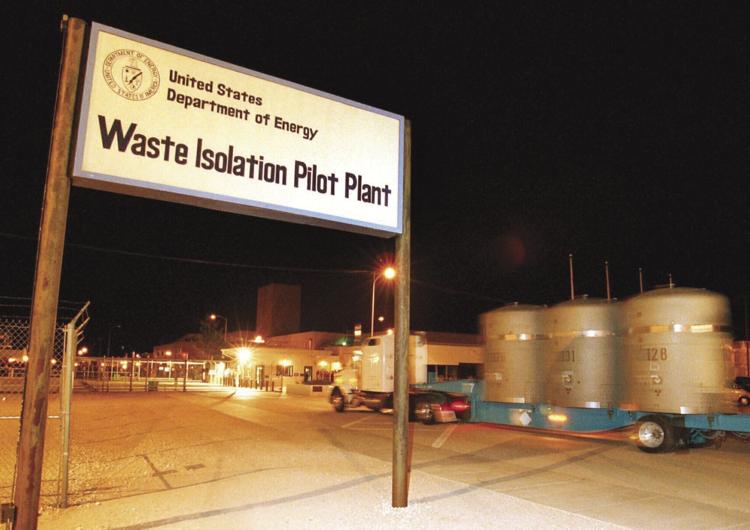
- Once the drums are filled, commercial trucks are expected to transport them across
 the country, from South Carolina to New Mexico and WIPP, in more than 3,888 shipments.
 - As it plans to dispose of its excess plutonium, the Energy Department has, notably, paid little attention to inspections and verification by the International Atomic Energy Agency, a key element of the Nuclear Non-Proliferation Treaty. As noted by the report of an expert panel of the National Research Council, “IAEA monitoring and inspections are an important component of the [Plutonium Management and Disposition Agreement with Russia] requirements, and they could also provide enhanced public and international confidence that the material is properly accounted for and emplaced in WIPP.”
Plutonium disposal beyond dilute and dispose.
- Over the past three years, WIPP and the nearby area have become ground zero for several storage and disposal plans for the bulk of civilian and military radioactive wastes. In addition to trans-uranic wastes set for WIPP and plutonium related to weapons production, the Energy Department seeks to dispose of six tons of fuel-grade plutonium from its research and development program, sludge from 15 of Hanford’s high-level radioactive waste tanks, trans-uranic waste generated from the production of new plutonium pits, and other radioactive waste.
- Even after the Energy Department recently recalculated its excess plutonium and other radioactive wastes, resulting in a 30 percent reduction in the total volume to be sent to WIPP, the federal statutory limit set in the Land Withdrawal Act, which authorized the opening of WIPP, will be exceeded by these planned disposal efforts. Congress would have to amend the law to expand the volume, set for WIPP at 175,564 cubic feet, by as much as than 50 percent to accommodate all the waste. Moreover, it appears that new plutonium pit production is projected to generate huge amounts more waste.Lurking in the shadows, 71 miles from the WIPP, sits an Energy Department effort to dispose of as much as 500,000 gallons of grouted wastes from Hanford’s high-level radioactive waste tanks at the Waste Control Specialists landfill in Andrews County Texas.

- That firm is also seeking a license from the Nuclear Regulatory Commission to establish centralized interim storage of spent nuclear fuel from the nation’s power reactor fleet. So, too, is the Holtec Corporation with a proposed spent nuclear fuel storage site 16 miles from WIPP in Lea County, New Mexico.If these interim storage efforts succeed, by mid-century up to 10,000 spent fuel cannisters containing nearly the entire US commercial spent nuclear fuel inventory will be transported across the country for storage near WIPP. They may sit there for more than 100 years. (See sidebar: “The long-term problem of “peaceful” plutonium.) If these plans are realized, WIPP and the nearby area will have become the recipients of an enormous, decades-long, radioactive-waste-transport funnel directing the bulk of the nation’s commercial and military radioactive detritus to New Mexico and far West Texas……… https://thebulletin.org/2021/03/can-the-energy-department-store-50-tons-of-plutonium-for-10000-years/#.YEa37PTkUIk.twitter



How Scotland’s Dunoon became an American nuclear base, and a target
|
60 years on: The day the US Navy came armed with nuclear missiles https://www.heraldscotland.com/news/19140712.60-years-day-us-navy-came-armed-nuclear-missiles/ By Sandra Dick 7 Mar 21, THE sun shone brightly over the calm Holy Loch on a beautiful early March day in 1961, as USS Proteus – 18,000 tons of American might – glided towards her foe.
By late afternoon, she was passing Islay. And as the US Navy vessel drew closer to her final destination, anti-nuclear demonstrators who had been waiting for weeks for the chance to pounce, braced themselves for their attack. The first salvo of a David versus Goliath battle saw protesters in dinghies and canoes pitted against the most menacing of modern warfare, and it would rage – on and off – for months to come. It’s now 60 years since USS Proteus, soon followed by a fleet of US Navy Polaris submarines, set up base close to Dunoon. And although the area was not unfamiliar with submarine activity – Royal Navy submarines were based in the area throughout the Second World War – the Americans, with their terrifying nuclear arsenal, a raging Cold War and the relatively fresh memories of Hiroshima and Nagasaki, meant this was no normal military manoeuvre. The US Navy and Polaris would remain a feature of the Dunoon landscape for the next 31 years. For those who could put aside any concerns of living with nuclear missiles on their doorstep, it brought economic and social benefits – and more than a few weddings between US sailors and local women. For others, the presence of the American nuclear force put a picturesque and peaceful corner of the country in Soviet crosshairs, and propelled Scotland into the very core of a deadly nuclear war machine. The announcement that the Americans were coming was completely unexpected, recalls historian Trevor Royle, who has written about the Holy Loch base in his book on the Cold War in Scotland, ‘Facing The Bear’. “It came as a great surprise to people of Scotland – it was a shock to suddenly have the Cold War on their doorstep,” he says. America needed an operating base for their Polaris fleet,” he adds. “At the time Britain’s nuclear deterrent was V Bomber Force, obsolete bombers that could fly to Moscow and drop bombs but couldn’t get back. It was a one-way mission, and Britain wanted a system which worked better than that.” Faced with being left behind as a nuclear nation, Prime Minister Harold Macmillan struck a deal with President Dwight D. Eisenhower for the Holy Loch to become an extension of US territory and a berth for nuclear bombs. In return, Britain would acquire the Polaris nuclear delivery system, enabling the Royal Navy to operate its own fleet from Faslane. However, the announcement in November 1960, propelled Holy Loch communities into a world of US and Soviet war games, which would see submarines play cat and mouse across fishing grounds and Atlantic waters. Most Scots, says Trevor, accepted what was heading their way. Some, among them taxi drivers and bed and breakfast businesses around Dunoon who had feared cheap foreign holidays were set to scupper the tourist trade, were more than happy. Others were outraged. Isobel Lindsay was just 17 years old at the time and secretary of Lanarkshire CND. Soon, she’d be among hundreds to descend on Dunoon to express outrage at the arrival of nuclear weapons in Scottish waters. “The announcement came out of the blue,” she recalls. “Until then, there had been a small anti-nuclear movement in Scotland. But this ignited it.” The arrival of the Polaris fleet’s support ship, USS Proteus, with its crew of 980 officers and men and the prospect of up to 500 dependent families on the way, signalled a call to action; protestors took to the water in tiny crafts to wave anti-nuclear banners and flags and 1,000 protesters marched along the loch. A week later, the Patrick Henry arrived, the first of ten Polaris submarines and with its 135 crew primed at a minute’s notice to blast off up to 16 Polaris rockets, each capable of destroying a city 1500 miles away. It was greeted by a lone canoeist who, after a valiant 15-minute chase by eight patrol vessels, was deliberately tipped in the water. Isobel, whose father had been among the first British forces to enter Hiroshima in the wake of the 1945 atomic bomb, remembers the protest movement growing in size. “Very quickly there were demonstrations in Glasgow and at the Holy Loch,” she says. “One march was organised from London to a 24-hour sit down that blocked Ardnadam pier. “The police tactics were to leave us sitting there – the sailors had to clamber over us to get to the pier.” Protest songs were hastily written, including Ding Dong Dollar, which set those keen to benefit financially from the base against those opposed to nuclear weapons, while protests were laboriously organised by letter, calls from phone boxes and plotted on maps. By May, a two storey floating barracks had been towed to the Holy Loch, providing accommodation for up to 350 personnel, and attitudes towards the protestors hardened. Canoeists who dared to approached US vessels were sprayed with jet hoses, on land, demonstrators were met by dozens of police, wire mesh, iron railings, barbed wire and ‘black Marias’. In Dunoon, locals picked their way between protestors and US Navy sailors. And while taxi drivers enjoyed a boom in business and generous tips, Glasgow’s prostitutes also descended. “It was a great culture shock,” adds Trevor. “Until then, the only knowledge most people had of Americans came from the movies. The Americans came with the crew cuts and smart clothes. It was like Hollywood had come to Dunoon.” Up to 4,000 Americans were attached to the Holy Loch base, their children attended local schools and accommodation was snapped up. But, says Trevor: “Dunoon was very much a target in the event of any nuclear hostilities. “In addition to Polaris submarines, the Holy Loch was home to Hunter Killer submarines, and they all played the most dangerous games of cat and mouse with their Soviet opposite numbers. “Many fishing boats were caught up, among them the Antares.” The small trawler sank in November 1990 after its nets became tangled with an RN submarine. All four crew lost their lives. By that time, Polaris protestors had turned their attention to Faslane instead. And as the Cold War ended, the US Navy packed up. The last ship left in March 1992. “They left nothing behind,” adds Trevor. “Apart from the American sailors who found themselves in a foreign country and made friends with the local girls, fell in love and married, you would have to search hard to know there had been a US presence there at all.” |
|
Reuters gives a timeline of events: Fukushima 2011 – 2021
|
Events following Japan’s worst quake and nuclear incident https://www.reuters.com/article/us-japan-fukushima-anniversary-file-idUSKCN2AW034 By Reuters Staff Compiled by Karishma Singh. Editing by Gerry Doyle, 5 Mar 21,
On March 11, Japan marks a decade since a huge earthquake and tsunami left more than 22,000 people dead or missing and triggered the world’s worst nuclear accident since Chernobyl. Here is a brief timeline of events after the 9.0 magnitude quake, the biggest recorded in Japan’s history: March 11, 2011: A 9.0 magnitude quake hits off the coast of northeast Japan, triggering a tsunami that devastates towns and villages. The tsunami swamps backup power and cooling systems at Tokyo Electric Power Co’s (TEPCO) Fukushima Daiichi nuclear plant, eventually causing meltdowns at three of six reactors. Two months later, TEPCO confirms meltdowns occurred. Government declares a nuclear emergency and tells residents within a 3 km radius of the plant to evacuate. The evacuation zone is expanded in stages to a 20 km radius over the next two days. More than 160,000 people are eventually evacuated. March 12: TEPCO begins injecting seawater to cool the reactors’ fuel rods. People stock up on groceries and supplies in Tokyo, about 250 km away, amid radiation fears. Naoto Kan, prime minister at the time, says later he feared he might have to evacuate Tokyo. March 16: Emperor Akihito gives a rare televised address expressing deep worry about the crisis. March 22: Technicians working at the plant attach power cables to all six reactors and start a pump at one to cool overheating nuclear fuel rods. April 4: Engineers release over 10,000 tons of contaminated water – about 100 times more radioactive than legal limits – that had been used to cool overheated fuel rods after running out of storage capacity. May 20: TEPCO’s president, Masataka Shimizu, 66, resigns, taking responsibility for the nuclear crisis. Aug. 26: Kan confirms he will resign. Dec. 16: Japan declares damaged reactors are in a stable state of “cold shutdown”. July 1, 2012: Kansai Electric Power Co restarts the 1,180-megawatt No. 3 unit at its Ohi atomic plant, Japan’s first nuclear reactor to come back online since the Fukushima crisis, despite public concerns about nuclear safety. July 5, 2012: A commission appointed by parliament concludes Fukushima was a “profoundly man-made disaster” that could have been prevented, and mitigated by a more effective response. Dec. 26, 2012: Shinzo Abe elected prime minister after his Liberal Democratic Party wins general election, ousting the Democratic Party of Japan, in power at the time of the crisis. July 22, 2013: TEPCO admits that since the 2011 reactor breaches, radioactive water has continued to leak from the plant into groundwater, making it radioactive, with implications for drinking water and for the Pacific Ocean. Sept. 7, 2013: In a bid led by Abe, Tokyo is declared the host of the 2020 Summer Olympic Games, with a promise of showcasing a reconstructed Fukushima. Abe says the crippled plant is “under control”. April 1, 2014: People begin to return to the 20-km exclusion zone around Fukushima as decontamination of the area is completed. June 3, 2014: TEPCO begins work on an “ice wall” to slow the flow of ground water into the wrecked plant, but the buildup of contaminated water continues, slowing recovery efforts. Nov. 5, 2014: TEPCO removes 400 tonnes of spent uranium fuel from a damaged reactor building, the first of four sets of used rods to be removed in a cleanup expected to last decades. Feb. 7, 2018: TEPCO ordered to pay about 1.1 billion yen ($10 million) to 321 Fukushima residents for damages in a class action suit. Sept. 5, 2018: Japan acknowledges for the first time that radiation at the Fukushima plant killed a worker there, ruling that compensation should be paid to the family of the man in his 50s who died of lung cancer. Sept. 19, 2019: Former TEPCO chairman Tsunehisa Katsumata, and former executives Ichiro Takekuro and Sakae Muto cleared of criminal charges of professional negligence resulting in injury and death in the only criminal case to arise from the crisis. March 1, 2021: TEPCO said it had moved spent uranium fuel from a damaged reactor to a safer location – the second successful operation of its kind and the first to be carried out by remote control, because of the high radiation in the reactor building. |
|
French report on the unfairness of France’s nuclear history in Algeria

French report grapples with nuclear fallout from Algerian War https://thebulletin.org/2021/03/french-report-grapples-with-nuclear-fallout-from-algerian-war/?utm_source=Newsletter&utm_medium=Email&utm_campaign=ThursdayNewsletter03042021&utm_content=NuclearRisk_AlgerianWar_03042021&__cf_chl_captcha_tk__=32bfe924bf6171eab26d9deb08cd73459b5e69dc-1614896664-0-AWxxiguytXLkG_ERcOpFeDyCqmv7X1FYZmZBNGAnlwY6ZlI8PgWd2By Austin R. Cooper | March 4, 2021 n January, the French historian Benjamin Stora filed a report commissioned by the French President Emmanuel Macron aimed at “reconciliation of memories between France and Algeria,” which France ruled as the jewel of its colonial empire for more than 130 years.
The Stora Report addressed several scars from the Algerian War for Independence (1954–62), a bloody struggle for decolonization that met savage repression by French troops. One of these controversies stems from French use of the Algerian Sahara for nuclear weapons development.
France proved its bomb in the atmosphere above this desert, naming the inaugural blast , or Blue Jerboa, after the local rodent. Between 1960 and 1966, France detonated 17 nuclear devices in the Algerian Sahara: four atmospheric explosions during the Algerian War, and another 13 underground, most of these after Algerian Independence.
French nuclear ambitions became inextricable from the process of Algerian decolonization. The Saharan blasts drew international outrage, stalled ceasefire negotiations, and later threatened an uneasy peace across the Mediterranean.
The Stora Report signaled that radioactive fallout from the Algerian War has remained a thorn between the two nations. But the document comes up short of a clear path toward nuclear reconciliation.
A United Nations dispute. The French bomb collided with the Algerian War before the first mushroom cloud rose above the Sahara. In November 1959, Algerian allies representing independent states in Africa and Asia contested French plans for the desert in the First Committee on Disarmament at the United Nations.
Part of the French strategy at the United Nations was to drive a wedge between the nuclear issue and what French diplomats euphemistically termed the “Question of Algeria.” French obfuscation continued for decades.
France would not, until 1999, call the bloodshed a war, preferring the line that what happened in Algeria, as part of France, amounted to a domestic dispute, rather than UN business. Macron became, in 2018, the first French president to acknowledge “systemic torture” by French troops in Algeria.
The Afro-Asian challenge to Saharan explosions hurdled France’s diplomatic barricades at the United Nations. The French delegation tried to strike references to the Algerian War as irrelevant. But their African and Asian counterparts painted the desert blasts as a violation of African sovereignty.
The concern was not only for contested territory in Algeria, but also for independent states bordering the desert, whose leaders warned that nuclear fallout could cross their national borders. Radiation measurements taken in the wake of Gerboise bleue proved many of them right.
Nuclear weapons represented another piece of French imperialism on the continent.
Secret negotiations resumed in September 1961, with US Ambassador to Tunisia Walter N. Walmsley serving as France’s backchannel. The US State Department worried that French attachment to the test sites might thwart the decolonization process.
Lead Algerian negotiator Krim Belkacem asked Walmsley if prospects for a ceasefire still hinged on France retaining control of the test sites. Krim got his answer when Franco-Algerian talks resumed the following month, at the end of October 1961.
France did not abandon its goal to continue nuclear explosions in the Sahara. But the Algerian position appeared to have softened. So long as further blasts did not impinge on Algeria’s “eventual sovereignty” over the desert, as one archival document put it, a deal looked possible.
The Evian Accords marked a nuclear compromise. Finally signed in March 1962, the landmark treaty granted France a five-year lease to the Saharan test sites but did not specify terms of use.
Going underground. Advice from the French Foreign Ministry played a key role in pushing France’s weapons program beneath Saharan mountains. French diplomats suggested that underground explosions would present, according to one archival document, “significantly less serious” challenges than atmospheric ones for future relations with Algeria and its African neighbors.
This did not stop Algeria’s first president, Ahmed Ben Bella, from winning political capital with the nuclear issue. In public, Ben Bella cast Saharan blasts as an intolerable violation of Algerian sovereignty, as had his allies at the United Nations. In private, however, Ben Bella acquiesced to the Evian terms and reportedly tried to squeeze French financial aid out of the deal.
The Hoggar Massif shook 13 times before France handed over its two Saharan test sites to Algeria in 1967. An accident occurred during one of these underground blasts, dubbed Béryl, when containment measures failed. Several French soldiers and two high-ranking French officials suffered the highest radiation exposures, but roughly 240 members of “nomadic populations” in the region received lower doses.
Meanwhile, France began construction on its Pacific test range in French Polynesia, the site of nearly 200 nuclear explosions between 1966 and 1996. Most took place underground, but France also conducted atmospheric detonations in Polynesia, and these continued into the 1970s. Even though the Limited Test Ban Treaty had gone into effect in 1963—prohibiting nuclear blasts in the atmosphere, underwater, and in outer space—France refused to sign it.
Contamination and compensation. As part of its reconciliation proposal, the Stora Report encouraged Franco-Algerian cooperation on environmental remediation of the Saharan test sites. An expert report from the International Atomic Energy Agency, however, concluded in 2005 that environmental interventions were “not required” unless human traffic near the sites should increase.
The Stora Report briefly mentioned compensation linked to radiation exposure from French nuclear weapons development, but this deserves a closer look. In 2010, the French Parliament passed a law recognizing these victims and establishing funds and procedures to provide compensation for illness and injury. So far, France has earmarked 26 million euros for this purpose, but almost none of that has gone to Algerians.
Decades earlier, France’s nuclear allies turned to compensation programs in an attempt to reconcile with marginalized groups affected by weapons development without disclosure or consent. In 1993, for example, the United Kingdom settled with Australia as redress for indigenous people and personnel involved in UK explosions conducted in the former colony.
Facing similar lawsuits, the United States provided monetary compensation and health benefits to the indigenous people of the Marshall Islands, where US nuclear planners “offshored” their most powerful blasts during the Cold War arms race. Other US programs have made compensation available to communities “downwind” of the Nevada Test Site and surrounded by the uranium mines fueling the US nuclear arsenal, including Tribal Nations in the Four Corners region.
Compensation programs map a global history of colonial empire, racial discrimination, and dispossession of indigenous land, but postcolonial inequalities look particularly stark from the Sahara. Including appeals, France has granted 545 of 1,739 total requests filed by French soldiers and civilian participants in the nuclear detonations, as well as exposed populations in Algeria and Polynesia. Only 1 of 52 Algerian dossiers has proven successful.
French officials responsible for evaluating these files report that the ones from Algeria often arrive incomplete or in a shoddy state, and pin the blame on the Algerian government’s inability or unwillingness to provide the geographical, historical, and biomedical evidence that French assessment procedures demand. Claims must demonstrate that an individual worked or lived in a fixed area surrounding one of the two Saharan test sites, between February 1960 and December 1967, and suffered at least one of 21 types of cancer recognized as radiation-linked by French statute.
A step toward reconciliation. If Macron really wants to tackle France’s nuclear history in Algeria—and its aftermath—his government should start here. The French Parliament opened the door to Algerian compensation in 2010, and important revisions to the evaluation procedures took place in 2017, but there has never been a level playing field. Macron could, for example, require that French diplomats posted in Algeria help Algerians build their cases and locate supporting documents.
Another option: Macron could declassify archival materials documenting the intensity and scope of radioactive fallout generated by French nuclear blasts. Draconian interpretations of French statutes on the reach of military secrecy continue to block access to the vast majority of military, civil, and diplomatic collections on France’s nuclear weapons program—including radiation effects. Foreign archives have provided useful information, but official documentation from the French government would help exposed populations—like those in the Sahara—understand what happened, evaluate the risks, bolster their claims, and likely find these more successful.
The Stora Report did well to acknowledge nuclear fallout from the Algerian War. Giving Algerians a fair shot at compensation should mark France’s first step toward reconciliation.
Despite the problems, small nuclear reactor salesmen aggressively marketing: it’s make or break time for the nuclear industry.

Entrepreneurs Look to Small-Scale Nuclear Reactors, The American Society of Mechanical Engineers, Mar 2, 2021, by Michael Abrams ‘‘……… even concepts that are predicated on being small, modular, and fast to build seem locked into decades-long development cycles.
The key to reviving the nuclear power industry is building these small reactors not as projects, but as factory-made products. That’s easier said than done. “Usually, a bunch of nuclear engineers go in a room and then they come out after a year or two, and they have a design that doesn’t have a lot of foundation in realty, and nobody can make it, and the projects dies,” said Kurt Terrani, a senior staff scientist at Oak Ridge National Laboratory………..
In terms of reactor physics, the NuScale concept is fairly bog standard: low-enriched uranium, light-water cooling. In essence, their reactor is just a smaller version of the nuclear plants already in operation. That NuScale didn’t go with a more revolutionary design to mitigate waste or utilize an alternative fuel cycle is no accident. To do so would require the Nuclear Regulatory Commission to come up with an entirely new licensing framework, said José Reyes, cofounder and chief technology officer at NuScale.
“Pressurized water-cooled reactors have benefited from billions of dollars of research and development and millions of hours of operating experience over the past 50 year,” Reyes said. “NuScale went with a more traditional approach to assure a design that is cost-competitive and capable of near-term deployment.”
So far, the concept and design have been convincing enough to win funding from the DoE and to move NuScale farther along in the regulatory process than any of its would-be competitors.
“The whole idea of SMRs is that smaller is better,” said Jacopo Buongiorno, a professor of nuclear science and engineering at MIT and the director of the Center for Advanced Nuclear Energy Systems. “But within the class of small reactors, larger is still better. If you can design a reactor that is still simple, that is still passively safe, that can still be built in a factory, but that generates 300 megawatts, that for sure is going to be more economically attractive than the same thing that generates 60 megawatts.”
Make or Break for Nuclear
Moltex is aiming for build costs at around $2,000 per kW—more than wind or solar, but less than newly built coal or gas plants, let alone competing nuclear concepts. “We’ve believe we’ve come up with a concept that can radically reduce the cost of nuclear power,” ……
Fukushima nuclear mess 2021 – the tasks ahead

“………..Decommissioning and contaminated water management
The work to decommission the plants, deal with contaminated water and solid waste, and remediate the affected areas is immense. A “Mid-and-Long Term Roadmap”2 was developed soon after the disaster to set out how this will be achieved. Also, to facilitate decommissioning units 1-6, and dealing with contaminated water, TEPCO announced, at the end of 2013 the establishment of an internal entity: the Fukushima Daiichi Decontamination & Decommissioning Engineering Company, which commenced operations in April 2014. The entire decommissioning process will take 30–40 years, and, as noted above, the volume of tasks is gigantic. Therefore, the Government of Japan and TEPCO have prioritised each task and set the goal to achieve them. Essentially, it is a continuous risk reduction activity to protect the people and the environment from the risks associated with radioactive substances by:
- removing spent fuel and retrieval of fuel debris from the reactor buildings;
- establishing measures to deal with contaminated water; and
- establishing measures to deal with radioactive waste material.
Fuel removal from the reactor buildings
In the Fukushima Daiichi design of reactor, used and new fuel rod assemblies are stored in the upper part of the reactor. The used fuel rods are highly radioactive and continue to generate heat, and thus require continued cooling.
Depending on the degree of damage, the process of removing the fuel assemblies presents different challenges in each of the reactors. For example, one of the significant challenges is to firstly remove the large quantities of rubble caused by the hydrogen explosions. As noted above, reactors 5 and 6 were shut down at the time of the accident. The reactor cores were successfully cooled, and thus suffered no damage. Given that the conditions of the buildings and the equipment for storing the fuel are stable, and risks of causing any problem in the decommissioning process are estimated to be low compared to the other units, the fuel assemblies of units 5 and 6 continue to be safely stored in the spent fuel pool in each building for the time being. The next step will be to carefully remove the fuel from the fuel pools in units 5 and 6 without impact on fuel removal from units 1, 2 and 3.
All the remaining units are going through a number of stages to achieve fuel removal. They differ slightly for each unit, but essentially the stages are: survey of internal state, removal of rubble, installation of fuel handling facility, and removal of fuel. By way of example, the position regarding unit 3 is shown in Figure 3 [on original].
At unit 3, rubble removal and other work at the upper part of the reactor building, together with installation of a cover for fuel removal was completed in February 2018.
After all preparations were in place, work to remove the 566 fuel rod assemblies, including 52 non-irradiated fuel assemblies, began in April 2019. The process of fuel removal is shown diagrammatically in Figure 4.
The four stages are:
- Fuel rod assemblies stored on fuel racks in the spent fuel pool are transferred in the water one at a time to transport casks, using fuel handling equipment;
- after closing the cask cover and washing, a crane is used to lower the cask to ground level and load into a trailer;
- the cask is transported to a common pool on the site; and
- the fuel in the cask is stored in the common pool.
As of 8 January 2021, 468 assemblies including the 52 non-irradiated fuel assemblies had been removed from unit 3. Measurements of airborne contamination levels are being monitored in the surrounding environment throughout the fuel removal operations. The plan is that all fuel will have been removed from all of the reactor units by sometime during 2031.
Retrieval of fuel debris
At the time of the accident, units 1–3 were operating and had fuel rods loaded in the reactors. After the accident occurred, emergency power was lost, preventing further cooling of the cores. This resulted in overheating and melting of the fuel, together with other substances. Fuel debris refers to this melted fuel and other substances, which have subsequently cooled and solidified, and, of course, still remains dangerously radioactive. This clearly poses a very complex and difficult decommissioning challenge.
Currently the state inside the containment vessel is being confirmed, and various kinds of surveys are being conducted prior to retrieval of the debris. The current aim is to begin retrieval from the first unit (unit 2), and to gradually enlarge the scale of the retrieval. The retrieved fuel debris will be stored in the new storage facility that will be constructed within the site.
The distribution of debris between the pressure and containment vessels differs in each of the 3 units. By way of example, Figure 5 [on original] shows the current position in unit 2. Large amounts of debris are located in the bottom of the pressure vessel, with little in the containment vessel.
The investigation to capture the location of fuel debris inside unit 2 was conducted from 22 March–22 July 2016. This operation applied the muon transmission method, of which effectiveness was demonstrated in its appliance for locating the debris inside unit 1. (Muon transmission method is a technique that uses cosmic ray muons to generate three-dimensional images of volumes using information contained in the Coulomb scattering of the muons.) These operations used a small device developed through a project called “Development of Technology to Detect Fuel Debris inside the Reactor’’.
- establishing measures to deal with contaminated water; and
- establishing measures to deal with radioactive waste material.
…….. Understanding of the situation inside the stricken reactors was urgently needed following the accident in order to prevent the spread of damage and to mitigate
Purification treatment of contaminated water and management of treated water…….
The storage management plan is updated once a year, while reviewing the waste generation forecasts, taking account of progress of the decommissioning work.
For example, the latest edition of the roadmap estimates the amount of solid waste which will be generated over the next 10 years to be 780,000 m3
NuScale’s small nuclear reactor dream – dead on arrival?

in order to make advanced reactors accessible within the next few decades—even relatively simple reactors, like NuScale’s—the government would need to provide hundreds of billions of dollars in subsidies …… the nuclear dream looks dead on arrival….
Biden’s Other Nuclear Option, Smaller nuclear reactors might be the bridge to a carbon-free economy. But are they worth it? Mother Jones, 22 Feb 21, BOYCE UPHOLT ”………..
But are these investments worth the money—and the risks? New designs or not, nuclear plants face daunting issues of waste disposal, public opposition, and, most of all, staggering costs. We must ramp up our fight against climate change. But whether nuclear is a real part of the solution—or just a long-shot bid to keep a troubled industry alive—is a debate that will come to the fore in the short window we have to overhaul the nation’s energy portfolio.
Few issues divide us as cleanly as nuclear power. According to a 2019 Pew Research Center poll, 49 percent of Americans support opening new plants, while 49 percent are opposed.
The popular argument against nuclear power can be summed up in a few names: Chernobyl. Fukushima. Three Mile Island. Nuclear dread is palpable. Some formerly pro-nuclear countries, like Germany, began phasing out plants in the wake of the 2011 disaster in Japan. The dangers begin well before nuclear fuel arrives at a plant, and persist long afterward; the rods that fuel today’s plants remain radioactive for millennia after their use. How to ethically store this waste remains a Gordian knot nobody has figured out how to cut.
The argument in favor of nuclear power boils down to the urgent need to combat climate change. [Ed, but nuclear does not really combat climate change.]
But if nuclear power is going to help us mitigate climate change, a lot more reactors need to come online, and soon. Eleven nuclear reactors in the United States have been retired since 2012, and eight more will be closed by 2025. (When nuclear plants are retired, utility companies tend to ramp up production at coal- or natural gas–fired plants, a step in the wrong direction for those concerned about lowering emissions.) Since 1970, the construction of the average US plant has wound up costing nearly three-and-a-half times more than the initial projections. Developers have broken ground on just four new reactor sites since Three Mile Island. Two were abandoned after $9 billion was.. sunk into construction; two others, in Georgia, are five years behind schedule. The public is focused on risks, but “nuclear power is not doing well around the world right now for one reason—economics,” says Allison Macfarlane, a former commissioner of the Nuclear Regulatory Commission.
Until Three Mile Island, public support was strong. Dozens of plants came online. In the 1970s, Reyes, seeing an industry full of promise, decided to pursue a degree in nuclear engineering.
……… Utah Associated Municipal Power Systems, a state-owned agency that sells electricity across six Western states aims to offer its members the choice of fully carbon-free power, sees NuScale as the best available option for undergirding its existing wind and solar plants. In 2015, UAMPS announced a plan to build 12 NuScale reactors at the federally run Idaho National Laboratory. NuScale projected total construction costs at $3 billion—nearly a third less than the most recently completed US reactor, which came online in 2016 at a cost of $4.7 billion (though it will supply more power). And the next plant should cost even less, since NuScale’s small reactors will be built on an assembly line, rather than on-site. But the price will drop only if more customers buy them. “Taxes are more popular than nuclear power,” jokes Doug Hunter, the CEO of UAMPS.
To change that perception, Hunter and his team have spent the last few years visiting towns and utility companies that buy power from UAMPS, explaining the potential role of nuclear power and the safety of NuScale’s design. His persistence paid off. By 2020, the majority had signed on to the NuScale project—though only as long as they had plenty of chances to back out if the project went south……….
Even with new technology, we will need to mine uranium—a process that has leached radioactive waste into waterways—and find somewhere to put the spent fuel. (The current practice, which persists at Trojan and will be employed at NuScale’s plants, is to hold waste on-site. This is intended to be a temporary measure, but every attempt to find a permanent disposal site has been stalled by geological constraints and local opposition.) Lloyd Marbet, Director of the non-profit Oregon Conservancy Foundation believes we need to transition away from coal and gas immediately. But he worries that nuclear is too expensive, and a new round of investment might pull money away from more effective, and cleaner, solutions. ……….
These days, he’s watching the industry creep back. A Republican state senator named Brian Boquist has proposed a bill three times that would permit city or county voters to exempt themselves from the 1980 law, allowing a nuclear facility to be built within their borders. (The bill has failed twice; the latest version is with the senate committee.) Boquist does not seem particularly committed to fighting climate change: He and other members of the Republican minority refused to show up to vote on a cap-and-trade bill in early 2020, causing the Senate to fall short of a quorum. (When Gov. Kate Brown threatened to retrieve legislators using state troopers, Boquist said to “send bachelors and come heavily armed.”)
In 2017, as the legislature debated Boquist’s first pro-nuclear bill, Marbet testified that NuScale was making “an end run around [voters] in their quest for corporate profit.” He also noted the company’s ties to the Fluor Corporation. The Texas-based multinational engineering firm that has been NuScale’s majority owner since 2011 has invested $9.9 million in campaign contributions over the past 30 years, with nearly two-thirds going toward Republican candidates. (Fluor is currently under investigation by the Securities and Exchange Commission due to allegedly sloppy accounting practices.)
Marbet admits his view of the industry is jaundiced, but his experiences make him skeptical of NuScale and its claims. He worries, too, that if small reactors take off, operators will revert to old habits, cutting corners to make a buck. He points to a draft rule approved last year by the Nuclear Regulatory Commission, over the objections of FEMA, that would reduce the size of the emergency planning zone around nuclear plants: Rather than a 10-mile-wide circle, a plant would only need an evacuation plan for the space within its fence lines. NRC commissioner Jeff Baran opposed the change, noting it is based on assumptions about small reactors, like NuScale’s, that remain on the drawing board, and might open the door to weakening safety standards for existing plants.
Old-line environmental groups like Greenpeace and the Sierra Club remain staunchly opposed to nuclear power, but politicians have been more open to it.
President Barack Obama was an outspoken proponent of nuclear’s potential. For 2020, the Senate Appropriations Committee unanimously agreed to spend more than President Trump requested on nuclear research, and the Senate is currently considering a bipartisan bill that will streamline the permitting process and establish a national uranium reserve.
Now, as part of his $2 trillion climate plan, Biden is calling for a federal research agency that would pursue carbon-free energy sources, including small reactors. Biden’s was the first Democratic Party platform in 48 years that explicitly supported an expansion of nuclear energy. His pick to lead the Department of Energy—which devotes the majority of its budget to nuclear projects—is former Michigan Gov. Jennifer Granholm, who has little experience in the field. Gina McCarthy, the former EPA administrator who is Biden’s chief domestic climate coordinator, has said that nuclear could play a key role in baseload power supply but indicated that waste disposal issues ought to be resolved before the technology is widely adopted.
A major hurdle for any advanced nuclear product is the regulatory process. NuScale spent more than $500 million developing its licensing application. The path to approval has consumed 12 years already, and it’s not over yet. In the months after my visit to NuScale, the Nuclear Regulatory Commission noted “several potentially risk-significant” questions that remain unanswered about the company’s reactor design, especially about its new version of a steam generator. Nonetheless, the NRC granted its initial approval of the design at the end of the summer; now NuScale awaits official, final certification by the commissioners, which is expected sometime this year. But further analysis of the generators will be required before a license is granted to actually build a plant.
A decade ago, NuScale suggested it might have a plant in operation by 2018. Now construction won’t begin until 2025 at the earliest. The plant at Idaho National Laboratory won’t be fully operational until 2030. Factoring in interest and other costs not included in NuScale’s $3 billion estimate, UAMPS expects a total 40-year lifetime cost of $6 billion for the plant. Some critics see this as the same old story: grand, early promises—a “dog and pony show,” as Marbet calls NuScale’s PR—followed by cost overruns and delays. Reyes intentionally used materials familiar to regulators, so as to speed along the process. But other advanced reactor designs, which use new kinds of fuel and coolant, may face an even slower and more expensive journey.
Recently, nine towns—more than a quarter of the subscribed members—pulled out of UAMPS’s project after changing their minds about their energy needs or worrying that it was becoming a financial sinkhole. (Meanwhile, one new town signed on.) The plant’s economics depend on running near full capacity, which will only happen if utilities outside of UAMPS also buy some of its power. The Department of Energy says it will chip in nearly $1.4 billion over the next nine years, which should help bring down the cost of the plant’s energy. But the projected price—$55 per megawatt-hour—is still above the current costs for solar and wind projects. And the federal money will require annual congressional approval. It’s possible that other new ideas might pop up, competing for limited dollars.
Biden’s climate plan hinges on a massive expenditure on research. What his administration will have to quickly decide, though, is how to divvy that pot. Allison Macfarlane, the former NRC commissioner, told me other industries deserve far more of our resources and attention than nuclear. Batteries, in particular, could steady out the uneven flow of renewables. They may even work better, since nuclear plants are difficult to power up or down in response to changing conditions. Once a pie-in-the-sky idea, battery storage now offers costs at least “in the ballpark” of nuclear, says Stan Kaplan, a former US Energy Information Administration analyst. Prices have dropped 70 percent in the past few years and are projected to drop another 45 percent before NuScale’s plant comes online. California—which also has a moratorium on nuclear builds—is rapidly expanding its storage capacity. Within 10 years, the niche that NuScale is aiming for might already be filled.
……. For nuclear to persist as a hedge, it all but requires government assistance, given the enormous upfront costs of R&D. Another challenge is vetting which projects have real promise. “You have all these reactor vendors pitching their wares, and making all sorts of outrageous and false claims,” says Edwin Lyman, the director of nuclear power safety with the Union of Concerned Scientists. These claims have also been the basis of lowering safety standards, which offers a large indirect subsidy for operators. There needs to be a stronger peer-review process, he says, to make sure the government is only sponsoring truly worthwhile projects.
A recent study from Princeton found that even without nuclear power, the relative cost of a decarbonized energy system in 2050 could be about the same as in 2015, which at the time was a historic low. The study found nuclear could reduce costs even further—if it becomes as cheap as its advocates hope. But Abdulla, the UC San Diego researcher, has calculated that in order to make advanced reactors accessible within the next few decades—even relatively simple reactors, like NuScale’s—the government would need to provide hundreds of billions of dollars in subsidies and substantially simplify the regulatory process. Abdulla believes nuclear energy should have been “an arrow in our quiver.” But given the economics, he says, “I fear the arrow has broken.”
 if money were no object—if we could snap our fingers and scatter reactors across the landscape—…… But if Abdulla’s numbers are right, the nuclear dream looks dead on arrival…. https://www.motherjones.com/environment/2021/02/nuclear-energy-climate-change-nuscale-green-power-uranium/
 A great article. Just one problem. The whole article runs with the assumption that nuclear power is effectively ”low carbon”. Yet this assumption is not challenged. There are several ways in which nuclear power is actually quite high carbon. Just for one comparison with reneewable energy: wind and solar power are delivered directlly to the turbines and panels – with no digging up of fuel required, no regular transport by road, rail etc. The entire nuclear fuel chain with all its steps – mining, milling, conversion, fuel fabrication, reactor, waste ponds, waste canisters , deep repositaory … all this is carbon emitting.
The Children with Cancer UK conference: nuclear power and nuclear weapons are two sides of the same coin
 Low level radiation – a game changer for the nuclear power and weapons industries? Pete Wilkinson, 21 February 2021 https://yorkshirebylines.co.uk/low-level-radiation-a-game-changer-for-the-nuclear-power-and-weapons-industries/
Phil Hallington, head of operations and development, Sellafield. BBC Radio 4, 7/1/15 ‘How to dismantle a nuclear power station’
In order to gain public acceptance of atmospheric bomb testing in Nevada, President Dwight E. Eisenhower declared the policy of the US government to be “keep the public confused”…
(Extracts from ‘The Dangers of Low Level Radiation’, Charles Sutcliffe, Avebury Press, 1987 ISBN 0 566 05482 5)
These two quotations sum up the murky world of deceit, lies and deliberate withholding of information that characterised the race to develop the A and H-bombs in the immediate aftermath of WW2 as former allies became cold war enemies. The greater ‘good’ of possessing weapons of mass destruction to deter an aggressor outweighed the need to inform people of the unknowns surrounding the long-term effects of exposure to radiation. “Keeping the public confused” made it possible to develop those weapons without the encumbrance of protests.
The raw materials for weapons of mass destruction – plutonium and enriched uranium – come from the nuclear reactors developed under the guise of generating electricity ‘too cheap to meter’. The policies of secrecy and obfuscation have likewise haunted the nascent civil nuclear power industry. Nuclear power stations have been essential for producing the materials that have incinerated and liquidised tens of thousands of innocents, and left thousands more with crippling genetic malformations all in the name of defence through the threat of mass murder.
The Windscale Calder Hall reactors, opened by HM the Queen in 1956 and heralded as the first power station to provide nuclear-generated electricity to the UK grid, concealed the true impetus for their construction: to produce plutonium for domestic and American nuclear weapons. Nuclear power and nuclear weapons are two sides of the same coin, despite minister after minister, decade after decade, telling parliament and the public the opposite.
It is thought that around 200,000 people – mostly civilians – died as a result of the two atomic bombs dropped on Japan in 1945. The US sent teams of officials into the fallout zones soon after the attacks to catalogue the effects on people as well as to evaluate their destructive capability. The US authorities developed a measure of radioactivity’s effect on human health which assumed that the greater the exposure to radiation, the greater the effect on the individual, leading to the ‘linear no threshold’ or LNT principle which has underpinned the relationship between dose and risk ever since.
With little concern for detail, the authorities assumed that the LNT model was good for calculating the effects of both whole body exposure as well as internal exposure through nuclear particulate inhalation or ingestion and that the relationship between dose and risk remained constant. But in fact, in case after case of exposure to ionising radiation, the observed effect on health outstrips the theoretical effect LNT would suggest.
Decades of grudging engagement from the authorities with its critics has still not delivered open and transparent examination of the uncertainties around the issue. The government, the nuclear industry itself, the regulators, nuclear industry trades unions, the supply chain companies, cheerleading university research and science departments all support and defend an industry which is well aware of these uncertainties. Yet still we commit to new nuclear build while wringing our hands about the rising cancer rate now affecting every second person in the country.
Particulates of plutonium and uranium, invisible to the naked eye, produce energetic and highly interactive emissions that, while presenting little danger when outside the body, can present a serious internal hazard when inhaled or ingested. They represent a small ‘dose’ but can have a disproportionate effect on health if the body doesn’t manage to rid itself of the particle. The reality is actually ‘small dose, large risk’, the opposite of the LNT principle. It is perhaps no surprise that neither government nor its agencies wish to engage in fact-based debate on the issues: any recognition that critics of LNT have a case would require a fundamental review of nuclear discharges, their safety and the number of people qualifying for compensation.
Nuclear weapons were routinely tested until the practice was banned, sometimes requiring the enforced removal of the inhabitants over whose remote atolls and islands the bombs were tested. Of the 2,000+ tests since the 1950s, more than 200 took place in the atmosphere, releasing unknown quantities of uranium and plutonium. Accidents at nuclear power stations – notably Chernobyl, Fukushima and the accident in 1957 at our own plutonium production plant in Cumbria, then known as Windscale – have also released unknown amounts of plutonium into the environment.
Nuclear power plants routinely discharge small amounts of radioactive material into sea, land and air. Plutonium has been deliberately and routinely discharged into the Irish Sea since the 1950s from the Sellafield nuclear fuel reprocessing plant. These materials circle the earth in the jet stream and wash around our oceans. And the authorities, particularly the Committee on Medical Aspects of Radiation in the Environment (CoMARE), refuse to debate key issues with their critics.
In 1983, a ten-fold excess of childhood leukaemia was identified in the small village of Seascale, a few miles south of Sellafield. At the end of a Yorkshire TV documentary film screened in the November of that year, nuclear bosses refused to concede that the plutonium discharges from the plant to the Irish Sea which were shown to be returning to shore and even turning up in household dust, could possibly have anything to do with the children’s illnesses. In December 1984, Hansard recorded the following speech from Lord Skelmersdale (extract):
“As from next year, discharges of caesium to the sea will be reduced to one-tenth of the maximum released in recent years. The revised authorisation sent to the company in draft will, when implemented, reduce discharges of plutonium and other alpha emitters to 200 curies a year, which is also a very sharp reduction from previous levels.”
In 2008, the German government financed a report known by the acronym KiKK. It showed that children under five years of age living within five kilometres of every German nuclear power station ran a risk of contracting leukaemia that was twice the national average in the country.
Following a Children with Cancer UK international conference in 2018, a modest grant was awarded to the Low Level Radiation Campaign to write a report, compiling the evidence that supported the view that the health effects of exposure to low doses of alpha emitting radioactive materials are woefully underestimated.
The report has been sent to every major government department, to MPs and to regulators. The response has been totally underwhelming. The government is unable even to consider that the industry on which it has relied since the 1940s to provide its plutonium, its nuclear engineers, its nuclear research facilities, much of its electricity and its medical isotopes, might be contributing to disease and death in the population. And it refuses to instruct its publicly funded expert body, CoMARE, to do so on its behalf.
The Children with Cancer UK conference was addressed by one contributor who spoke movingly about the conditions required for a healthy and contented population – a sustainable and peaceful planet. Instead, we have created a soup of chemical, radioactive and other toxic materials casually tossed into the air while we have little or no idea as to their health effects. This, along with the 500,000 cubic metres of nuclear waste, is our legacy to our descendants. How on earth are we going to acknowledge this and begin the process of reconciliation and redress?
‘Medical Scientific’ committee, stacked with nuclear executives, promotes nuclear power in space
 “The nuclear industry views space as a new—and wide-open—market for their toxic product that has run its dirty course on Mother Earth.”
“Now it appears that the nuclear industry has also infiltrated the National Academies of Sciences, Engineering, and Medicine that has been studying missions to Mars. ”
It’s going to take enormous grassroots action—and efforts by those in public office who understand the error of the space direction being taken—to stop it.
Nuclear Rockets to Mars?, BY KARL GROSSMAN– CounterPunch, 16 Feb 21,
A report advocating rocket propulsion by nuclear power for U.S. missions to Mars, written by a committee packed with individuals deeply involved in nuclear power, was issued last week by the National Academies of Sciences, Engineering and Medicine.
The 104-page report also lays out “synergies” in space nuclear activities between the National Aeronautics and Space Administration and the U.S. military, something not advanced explicitly since the founding of NASA as a civilian agency supposedly in 1958.
The report states: “Space nuclear propulsion and power systems have the potential to provide the United States with military advantages…NASA could benefit programmatically by working with a DoD [Department of Defense] program having national security objectives.”’
The report was produced “by contract” with NASA, it states.
The National Academy of Sciences, Engineering and Medicine (NAS) describes itself as having been “created to advise the nation” with “independent, objective advice to inform policy.”
The 11 members of the committee that put together the report for the National Academy includes: Jonathan W. Cirtain, president of Advanced Technologies, “a subsidiary of BWX Technologies which is the sole manufacturer of nuclear reactors for the U.S. Navy,” the report states; Roger M. Myers, owner of R. Myers Consulting and who previously at Aerojet Rocketdyne “oversaw programs and strategic planning for next-generation in-space missions [that] included nuclear thermal propulsion and nuclear electric power systems; Shannon M. Bragg-Sitton, the “lead for integrated energy systems in the Nuclear Science and Technology Directorate at the Idaho National Laboratory:” Tabitha Dodson, who at the U.S. government’s Defense Advanced Research Project Agency is chief engineer of a program “that is developing a nuclear thermal propulsion system;” Joseph A. Sholtis, Jr., “owner and principal of Sholtis Engineering & Safety Consulting, providing expert nuclear, aerospace, and systems engineering services to government, national laboratories, industry, and academia since 1993.” And so on.
The NAS report is titled: “Space Nuclear Propulsion for Human Mars Exploration.” It is not classified and is available here.
Bruce Gagnon, coordinator of the Global Network Against Weapons and Nuclear Power in Space, from its offices in Maine in the U.S., declared: “The nuclear industry views space as a new—and wide-open—market for their toxic product that has run its dirty course on Mother Earth.”
“During our campaigns in 1989, 1990, and 1997 to stop NASA’s Galileo, Ulysses and Cassini plutonium-fueled space probe launches, we learned that the nuclear industry positioned its agents inside NASA committees that made the decisions on what kinds of power sources would be placed on those deep space missions,” said Gagnon. “Now it appears that the nuclear industry has also infiltrated the National Academies of Sciences, Engineering, and Medicine that has been studying missions to Mars. The recommendation, not any surprise, is that nuclear reactors are the best way to power a Mars mission.”
“It’s not the best for us Earthlings because the Department of Energy has a bad track record of human and environmental contamination as they fabricate nuclear devices. An accident at launch could have catastrophic consequences.”
Stated Gagnon: “We fought the DoE and NASA on those previous nuclear launches and are entering the battle again. The nuclear industry has its sights set on nuclear-powered mining colonies on an assortment of planetary bodies—all necessitating legions of nuclear devices being produced at DoE and then launched on rockets that blow up from time to time.”
“We urge the public to help us pressure NASA and DoE to say no to nukes in space. We’ve got to protect life here on this planet. We are in the middle of a pandemic and people have lost jobs, homes, health care and even food on their table.”
“Trips to Mars can wait,” said Gagnon.
There have been accidents in the history of the U.S.—and also the former Soviet Union and now Russia—using nuclear power in space……
(Article goes on to explain how solar power can be, and is being used for space travel and research)
The NAS committee, however, was mainly interested in a choice between a “nuclear thermal propulsion” (NTP) or “nuclear electric propulsion” (NEP) for rocket propulsion…….
“Advanced nuclear propulsion systems (along or in combination with chemical propulsion systems) have the potential to substantially reduce trip time” to Mars “compared to fully non-nuclear approaches,” says the report.
An issue: radioactivity from either of the systems affecting human beings on the rockets with nuclear reactors propelling them. Back after World War II with the Cold War beginning, the U.S. began working on bombers propelled by onboard nuclear reactors—even built one. The idea was that such bombers could stay aloft for days ready to drop nuclear weapons on the Soviet Union. No crews would need to be scrambled and bombers then sent aloft.
But, as The Atlantic magazine noted in a 2019 article titled, “Why There Are No Nuclear Airplanes”:
“The problem of shielding pilots from the reactor’s radiation proved even more difficult. What good would a plane be that killed its own pilots? To protect the crew from radioactivity, the reactor needed thick and heavy layers of shielding. But to take off, the plane needed to be as light as possible. Adequate shielding seemed incompatible with flight. Still, engineers theorized that the weight saved from needing no fuel might be enough to offset the reactor and its shielding. The United States spent 16 years tinkering with the idea, to no avail”
The Eisenhower administration concluded that the program was unnecessary, dangerous, and too expensive. On March 28, 1961, the newly inaugurated President John F. Kennedy canceled the program. Proposals for nuclear-powered airplanes have popped up since then, but the fear of radiation and the lack of funding have kept all such ideas down.”……
The “synergies” in space nuclear activities between NASA and the U.S. military advanced in the NAS report mark a change in public acknowledgement. The agency was supposed to have a distinctly civilian orientation, encouraging peaceful applications in space science.
However, throughout the decades there have been numerous reports on its close relationship with the U.S. military—notably during the period of NASA Space Shuttle flights. As a 2018 piece in Smithsonian Magazine noted, “During the heyday of the space shuttle, NASA would routinely ferry classified payloads into orbit for the Department of Deense among other projects the agencies have collaborated on.”
With the formation of a U.S. Space Force by the Trump administration in 2019, the NASA-Pentagon link would appear to be coming out of the shadows, as indicated by the NAS report. The Biden administration is not intending to eliminate the Space Force, despite the landmark Outer Space Treaty of 1967 put together by the U.S., the then Soviet Union and the U.K, setting aside space for peaceful purposes. It is giving the new sixth branch of U.S. armed forces “full support,” according to his spokesperson Jen Psaki.
The NAS report says, “Areas of common interest include (1) fundamental questions about the development and testing of materials (such as reactor fuels and moderators) that can survive NTP conditions and (2) advancing modeling and simulation capabilities that are relevant to NTP.” And, “Additionally, a NASA NTP system could potentially use a scaled-up version of a DoD reactor, depending on the design.”
It declares: “Threats to U.S. space assets are increasing. They include anti-satellite weapons and counter-space activities. Crossing vast distances of space rapidly with a reasonably sized vehicle in response to these threats requires a propulsion system with high Isp [Specific Impulse] and thrust. This could be especially important in a high-tempo military conflict.”
Moreover, on December 19, just before he was to leave office, Trump signed Space Policy Directive-6, titled “National Strategy for Space Nuclear Propulsion.” Its provisions include: “DoD [Department of Defense] and NASA, in cooperation with DOE [Department of Energy}, and with other agencies and private-sector partners, as appropriate, should evaluate technology options and associated key technical challenges for an NTP [Nuclear Thermal Propulsion] system, including reactor designs, power conversion, and thermal management. DoD and NASA should work with their partners to evaluate and use opportunities for commonality with other SNPP [Space Nuclear Power and Propulsion] needs, terrestrial power needs, and reactor demonstration projects planned by agencies and the private sector.”
It continues: “DoD, in coordination with DOE and other agencies, and with private sector partners, as appropriate, should develop reactor and propulsion system technologies that will resolve the key technical challenges in areas such as reactor design and production, propulsion system and spacecraft design, and SNPP system integration.”
It’s going to take enormous grassroots action—and efforts by those in public office who understand the error of the space direction being taken—to stop it.
Karl Grossman, professor of journalism at State University of New York/College at Old Westbury, and is the author of the book, The Wrong Stuff: The Space’s Program’s Nuclear Threat to Our Planet, and the Beyond Nuclear handbook, The U.S. Space Force and the dangers of nuclear power and nuclear war in space. Grossman is an associate of the media watch group Fairness and Accuracy in Reporting (FAIR). He is a contributor to Hopeless: Barack Obama and the Politics of Illusion. more https://www.counterpunch.org/2021/02/16/nuclear-rockets-to-mars/

Solar sails for space voyages
 Nuclear Rockets to Mars?, BY KARL GROSSMAN– CounterPunch, 16 Feb 21,”………. As for rocket propulsion in the vacuum of space, it doesn’t take much conventional chemical propulsion to move a spacecraft—and fast.
And there was a comprehensive story in New Scientist magazine this past October on “The new age of sail,” as it was headlined. The subhead: “We are on the cusp of a new type of space travel that can take us to places no rocket could ever visit.”
The article began by relating 17th Century astronomer Johanne Kepler observing comets and seeing “that their tails always pointed away from the sun, no matter which direction they were traveling. To Kepler, it meant only one thing: the comet tails were being blown from the sun.”
Indeed, “the sun produces a wind in space” and “it can be harnessed,” said the piece. “First, there are particles of light streaming from the sun constantly, each carrying a tiny bit of momentum. Second, there is a flow of charged particles, mostly protons and electrons, also moving outwards from the sun. We call the charged particles the solar wind, but both streams are blowing a gale”—that’s in the vacuum of space.
Japan launched its Ikaros spacecraft in 2010—sailing in space using the energy from the sun. The LightSail 2 mission of The Planetary Society was launched in 2019—and it’s still up in space, flying with the sun’s energy.
New systems using solar power are being developed – past the current use of thin-film such as Mylar for solar sails.
The New Scientist article spoke of scientists “who want to use these new techniques to set a course for worlds currently far beyond our reach—namely the planets orbiting our nearest star, Alpha Centauri.”……. more https://www.counterpunch.org/2021/02/16/nuclear-rockets-to-mars/
Accidents in both USA’s and Russia’s use of nuclear power in space
 Nuclear Rockets to Mars?, BY KARL GROSSMAN– CounterPunch, 16 Feb 21”…………There have been accidents in the history of the U.S.—and also the former Soviet Union and now Russia—using nuclear power in space.
And the NAS report, deep into it, does acknowledge how accidents can happen with its new scheme of using nuclear power on rockets for missions to Mars.
It says: “Safety assurance for nuclear systems is essential to protect operating personnel as well as the general public and Earth’s environment.” Thus under the report’s plan, the rockets with the nuclear reactors onboard would be launched “with fresh [uranium] fuel before they have operated at power to ensure that the amount of radioactivity on board remains as low as practicable.” The plans include “restricting reactor startup and operations in space until spacecraft are in nuclear safe orbits or trajectories that ensure safety of Earth’s population and environment” But, “Additional policies and practices need to be established to prevent unintended system reentry during return to Earth after reactors have been operated for extended periods of time.”
The worst U.S. accident involving the use of nuclear power in space came in 1964 when the U.S. satellite Transit 5BN-3, powered by a SNAP-9A plutonium-fueled radioisotope thermoelectric generator, failed to achieve orbit and fell from the sky, disintegrating as it burned up in the atmosphere, globally spreading plutonium—considering the deadliest of all radioactive substances. That accident was long linked to a spike in global lung cancer rates where the plutonium was spread, by Dr. John Gofman, an M.D. and Ph. D., a professor of medical physics at the University of California at Berkeley. He also had been involved in developing some of the first methods for isolating plutonium for the Manhattan Project.
NASA, after the SNAP-9A (SNAP for Systems Nuclear Auxiliary Power) accident became a pioneer in developing solar photovoltaic power. All U.S. satellites now are energized by solar power, as is the International Space Station.
The worst accident involving nuclear power in space in the Soviet/Russian space program occurred in 1978 when the Cosmos 954 satellite with a nuclear reactor aboard fell from orbit and spread radioactive debris over a 373-mile swath from Great Slave Lake to Baker Lake in Canada. There were 110 pounds of highly-enriched (nearly 90 percent) of uranium fuel on Cosmos 954.
Highly-enriched uranium—90 percent is atomic bomb-grade—would be used in one reactor design proposed in the NAS report. And thus there is a passage about it under “Proliferation and security.” It states that “HEU [highly enriched uranium] fuel, by virtue of the ease with which it could be diverted to the production of nuclear weapons, is a higher value target than HALEU [high assay low enriched uranium], especially during launch and reentry accidents away from the launch site. As a result, HEU is viewed by nonproliferation experts as requiring more security considerations. In addition, if the United States uses HEU for space reactors, it could become more difficult to convince other countries to reduce their use of HEU in civilian applications.”
As for rocket propulsion in the vacuum of space, it doesn’t take much conventional chemical propulsion to move a spacecraft—and fast……..more https://www.counterpunch.org/2021/02/16/nuclear-rockets-to-mars/
Continued use of nuclear energy brings pollution, cancers and birth defects
 A growing body of evidence supports a grim reality: that living in radioactively contaminated areas over multiple years results in harmful health impacts, particularly during pregnancy.
This is borne out in a recent study by Anton V. Korsakov, Emilia V. Geger, Dmitry G. Lagerev, Leonid I. Pugach and Timothy A. Mousseau, that shows a higher frequency of birth defects amongst people living in Chernobyl-contaminated areas (as opposed to those living in areas considered uncontaminated) in the Bryansk region of Russia.
Because the industry and governments are pushing to spend more money on new nuclear reactors — or to keep the old ones running longer — they have been forced to come up with a deadly workaround to surmount the strongest argument against nuclear power: its potential for catastrophic accidents.
Even the nuclear industry and the governments willing to do its bidding understand that you cannot really clean up after a nuclear catastrophe. For example, in Japan, where the March 2011 nuclear disaster has left lands radioactively contaminated potentially indefinitely, there is an attempt to mandate that people return to live in these areas by claiming there are no “discernible” health impacts from doing so.
 Bodies that are supposed to protect health and regulate the nuclear industry, including the U.S. Environmental Protection Agency, the International Commission on Radiological Protection and Nuclear Regulatory Commission are raising recommended public exposure limits, considering halting evacuations from radiation releases, and encouraging people to live on, and eat from, contaminated land.
The public justification for continued nuclear energy use is, ostensibly, to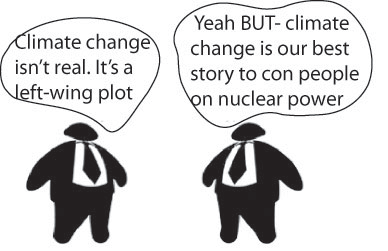 address the climate crisis. The reality is more likely a desperate last-ditch effort by the nuclear industry to remain relevant, while in some countries the nuclear energy agenda remains inextricably linked to nuclear weapon programs.
Forcing people to live on and consume produce grown from radioactively contaminated land is contrary to scientific evidence indicating that these practices harm humans and all animals, especially over the long-term. By the time these health impacts are unearthed, decades later, the false narratives of “harmless low radiation doses” and “no discernible impact” have solidified, covering up the painful reality that should be a touchstone informing our debate over nuclear power.
The recent joint study, whose implementation, says Korsakov, would not have happened without the support and efforts of co-author Mousseau, found that birth defects like polydactyly (having more than five fingers or toes), and multiple congenital malformations (including those that are appearing for the first time — called de novo), were “significantly higher… in newborns in regions with elevated radioactive, chemical and combined contamination.”
Uniquely, Korsakov also examines areas contaminated by both Chernobyl radioactivity and industrial chemicals. Multiple congenital malformations (MCM) were much higher in areas of combined contamination, indicating an additive and potentially synergistic effect between pollutants for these birth defects.
Congenital malformations (CM) are thought to originate in the first trimester of pregnancy and represent a main cause of global disease burden. They are considered “indicators of adverse factors in the environment,” including radioactive pollution, and can afflict numerous organs (heart, brain, lungs, bones, intestines) with physical abnormalities and metabolic disorders. Counted among these are clubfoot, hernias, heart and neural tube defects, cleft palate and lip, and Down syndrome.

CMs are the leading cause of infant mortality in many developed nations, accounting for 20% of U.S. infant deaths. For those living past infancy, the effects can be lifelong. While a number of CMs are obvious early in life, some may not be identified until later, even into adulthood. Countries of low- and middle-income are affected disproportionately.
In the Bryansk region of Russia, birth defects were examined over the 18-year period from 2000-2017. For areas contaminated with radiation alone, dose estimations from Chernobyl radiation (released from the 1986 nuclear catastrophe) ranged from 0.6 mSv to 2.1 mSv per year, while in areas contaminated with radiation and chemicals, dose ranges were 1.2 to 2.0 mSv per year.
As the Bryansk study authors point out, “[n]early all types of hereditary defects can be found at doses as low a [sic] 1–10 mSv indicating that current radiation risk models are inadequate for low dose environments.”
In comparison, Japan and the U.S. maintain that there is little risk to resettling or inhabiting areas contaminated by nuclear catastrophe where estimated doses would range from 5-20 mSv/year. Yet harm was found among Bryansk populations exposed to doses far lower than the much higher ones proclaimed “livable” by nuclear proponents.
One explanation for the disconnect between the expected and actual health effects is an underestimate of the impact of ingesting or inhaling manmade radioactive isotopes, particularly beta emitters, a large source of exposure following radiation releases from nuclear power catastrophes.
A number of these isotopes mimic nutrients that our bodies need such as calcium (radiostrontium) and potassium (radiocesium), so our body doesn’t know to avoid them. Of course, nuclear proponents recognize that economic recovery of polluted places will be difficult without being able to grow, sell and consume food that might be contaminated with isotopes that give off this radiation,.
Korsakov et al. point to yet another explanation for the disconnect — the assumption that dose reconstruction models properly fit all realistic exposures. When experts estimate doses they often do so without adequate knowledge of local culture and habits. Therefore, they fail to capture variations in exposure pathways, creating enormous errors in dose reconstruction. As a starting point, radiation science would be better served by directly measuring contamination levels where people actually live, play, breathe and eat.
But it seems dose models also fail to adequately represent the damage done to fetuses and neonates, not least because damage can be random (stochastic) making it difficult to predict. Stochastic health impacts include cancer and other genetic damage, and may be severe even at low doses. During pregnancy, one hit from radiation could damage or destroy cells meant to form entire organs, making accounting for stochastic impacts during fetal development extremely important — especially as fetal tissue collects some radionuclides in greater amounts than maternal tissue.
Health impacts in the Bryansk region could be a result both of direct radiation exposure during pregnancy and of cumulative impact over a “series of generations (genetic load)” raising the specter of heritability of genetic damage. Past studies have indicated that radiation damage can be heritable — passing from parents to offspring; that living in environments of elevated natural background radiation will increase mutations and disease; that the ability to withstand radiation doses appears to diminish as continually-exposed generations progress; and that doses from catastrophic releases should be accounted for across generations, not just in the generation initially exposed.
These currently sparse, yet growing data, support long-held conclusions that humans do not differ significantly from every other animal and plant — they, too, suffer heritable damage from radiation.
The Korsakov study projects that overall, multiple congenital malformations will increase in the next few years in the contaminated regions. Increases in birth defects are occurring despite access to free in-depth medical exams for pregnant women residing in areas of higher contamination and, if warranted, pregnancy termination. Such access has apparently greatly decreased the number of stilbirths in the region, as did a similar program at the end of the 1990s in Belarus, the country which bore the brunt of radioactive Chernobyl contamination. But even with such programs, overall birth defects have increased in the contaminated areas in Russia.
So not only is it unhealthy to live in radiologically-contaminated areas, attempts at mitigating the effects, particularly those on pregnancy, have limited impact. Encouraging, or worse yet, forcing people to live in contaminated areas and eat contaminated food, is foolishly cruel (particularly to people of reproductive age who may face wrenching decisions about wanted pregnancies) and not in the interest of public health.
Meanwhile, the continued use of nuclear energy that has forced us into this Faustian bargain in the name of mitigating climate change, is both unnecessary and downright harmful.
1 This Month


PLEASE OPPOSE HR 8255 AND S.3639 – bills would accelerate satellite deployment, with no environmental review or safeguards – https://ncstd5li.quorum.us/campaign/169331/
To see nuclear-related stories in greater depth and intensity – go to https://nuclearinformation.wordpress.com
-
Archives
- September 2026 (194)
- August 2026 (330)
- July 2026 (355)
- June 2026 (287)
- May 2026 (306)
- April 2026 (356)
- March 2026 (251)
- February 2026 (267)
- January 2026 (308)
- December 2025 (358)
- November 2025 (359)
- October 2025 (375)
-
Categories
- 1
- 1 NUCLEAR ISSUES
- business and costs
- climate change
- culture and arts
- ENERGY
- environment
- health
- history
- indigenous issues
- Legal
- marketing of nuclear
- media
- opposition to nuclear
- PERSONAL STORIES
- politics
- politics international
- Religion and ethics
- safety
- secrets,lies and civil liberties
- spinbuster
- technology
- Uranium
- wastes
- weapons and war
- Women
- 2 WORLD
- ACTION
- AFRICA
- Atrocities
- AUSTRALIA
- Christina's notes
- Christina's themes
- culture and arts
- Events
- Fuk 2022
- Fuk 2023
- Fukushima 2017
- Fukushima 2018
- fukushima 2019
- Fukushima 2020
- Fukushima 2021
- general
- global warming
- Humour (God we need it)
- Nuclear
- RARE EARTHS
- Reference
- resources – print
- Resources -audiovicual
- Weekly Newsletter
- World
- World Nuclear
- YouTube
-
RSS
Entries RSS
Comments RSS
 nuclear-news