Systemic corruption in the American nuclear industry

Big money, nuclear subsidies, and systemic corruption, Bulletin of the Atomic Scientists, By Cassandra Jeffery, M. V. Ramana | February 12, 2021
The “largest bribery, money-laundering scheme ever perpetrated against the people and the state of Ohio” came to light during an unexpected press conference in July 2020 in Columbus. Speaking haltingly and carefully, US Attorney for the Southern District of Ohio David DeVillers announced “the arrest of Larry Householder, Speaker of the House of the state of Ohio and four other defendants for racketeering. The conspiracy was to pass and maintain a $1.5 billion bailout in return for $61 million in dark money.”
Unravelling an intricate web of alleged illegal activities used to launder money, DeVillers broke down the complicated modus operandi of “Company A.” With a gentle smile on his face, he said, “everyone in this room knows who Company A is, but I will not be mentioning the name of Company A because of our regulations and rules. They have not, and no one from that company has as of yet, been charged”.
Company A is FirstEnergy Solutions, a fact most Ohians had been aware of long before the July 2020 press conference. FirstEnergy, now called Energy Harbour, is one of Ohio’s largest utility corporations. For years, the firm lobbied to get a subsidy to continue operating its unprofitable nuclear plants and maintain its revenue flow. When lobbying efforts failed to produce subsidies, it resorted to bribery to gain legislative support for House Bill 6, 2019 legislation that forces state consumers to pay into something called “the Ohio Clean Air Fund.” The green language is a smoke screen for the real purpose: to siphon nearly $150 million annually to FirstEnergy to keep its Perry and Davis-Besse nuclear power plants and two coal-fired power plants operating, while simultaneously gutting Ohio’s renewable energy standards. Also gone were the state’s energy efficiency programs, which had saved consumers and corporations millions of dollars. When citizens tried to organize a referendum to repeal the bill, FirstEnergy indulged in various dirty tactics to thwart this democratic opposition.
Ohio is not alone in its nuclear energy corruption. Also in July 2020, Commonwealth Edison (ComEd), a subsidiary of Exelon, was charged with bribery to “Public Official A” in Illinois. Though not named, the filing makes it clear that “Public Official A” is Illinois House Speaker Michael Madigan, who has denied wrongdoing. ComEd has agreed to pay a $200 million fine to resolve this case. Exelon also finds itself at the centre of another ongoing investigation by the United States Securities and Exchange Commission. The focus of the investigation is reportedly Anne Pramaggiore, a former Exelon CEO who stepped down from the company and from his post chair of the Federal Reserve Bank of Chicago. As in Ohio, the corruption charges relate to lobbying for state subsidies and special treatment of nuclear power plants.
Three other states—New Jersey, Connecticut, and New York—have implemented similar subsidies (although, to date, no allegations of wrongdoing related to them have been made public). Changes in the economics of electricity markets are threatening the profitability of nuclear power plants, a shifting reality driving a demand for these financial bailouts. As the New Jersey-based energy company Public Service Enterprise Group (PSEG) explained in October 2020, across the nation “nuclear plants continue to struggle economically to survive. Since 2018, three nuclear plants have closed in the eastern US, all for economic reasons, and the impact has had a ripple effect.”
Changing economics of electricity generation. These “economic reasons” have to do with an ongoing massive transformation of the energy sector. Over the last decade, the cost of renewables like solar and wind have dropped substantially; these renewables can generate electricity at much lower costs than fossil fuels and, especially, nuclear power. In the United States, unsubsidized wind power costs fell by 71 percent between 2009 and 2020, whereas unsubsidized utility scale solar energy costs declined by 90 percent during the same period. Nuclear energy costs increased by 33 percent between 2009 and 2020. The International Energy Agency has dubbed solar energy “the new king of electricity” and foresees it dominating future deployment in the electricity sector for decades.
The major beneficiaries of the subsidies for nuclear plants are large corporations: PSEG in New Jersey and Dominion in Connecticut, besides Exelon and FirstEnergy. These, and other electrical utility companies in the United States, have historically invested primarily in nuclear reactors and fossil fuel plants. Thanks to the changing economics of electricity, these companies are finding it harder to maintain their profits while operating the older power plants that are now more expensive as sources of electricity.
These companies and various associated organizations have engaged in extensive lobbying and large-scale propaganda campaigns to get governments pass legislation that makes consumers pay more for the electricity they use. In that sense, what has resulted would be better described as corporate welfare than as subsidies. The subsidies have improved these companies’ financial situation, which in turn contributes to their clout in state and national policy making and their ability to fund advocacy efforts—and even to pay politicians tidy sums of money. The larger significance of the political power these large utilities have amassed is their ability to block transition to a fully renewable and more environmentally sustainable energy system.
Financial subsidies. Subsidies take different forms in different states. In New York and Illinois, utility companies are required to purchase a specific amount of zero-emission credits from authorized nuclear generating stations, all of which are owned and operated by Exelon Corporation. Purchasing contracts in both states will be in effect for 10 to 12 years, and utility companies are mandated to tack on the cost to consumer bills. Over in New Jersey, “each electric public utility” is required to purchase “Nuclear Diversity Certificates” from nuclear power plants, with consumers paying for these programs through higher utility bills.
The deal that Dominion Energy struck in Connecticut was different, taking the form of a contract that requires the state’s two electric distribution utilities to purchase about 50 percent of the electricity output of Dominion’s Millstone nuclear generating plant for 10 years. Millstone houses two operational nuclear reactors. In all of these cases, the annual financial benefits to these large corporations run in to the hundreds of millions of dollars.
The modus operandi was developed by multiple stakeholders and publicly released in 2016 in the form of a toolkit by the American Nuclear Society (ANS). Produced by a special committee consisting of senior nuclear officials, the toolkit outlined “a variety of policy pathways to support the current nuclear fleet and prevent early retirement.” The states mentioned above have implemented polices that incorporate one or more of the strategies outlined in the ANS toolkit, including amalgamations of low-carbon portfolio standards and mandated purchase of nuclear energy. The toolkit even went so far as to suggest that state government entities could acquire nuclear power plants or suspend collecting taxes, but these suggestions have not been implemented so far.
Building political support. While the American Nuclear Society led the policy-development charge, the Nuclear Energy Institute (NEI)—the nuclear industry’s lobbying arm—reinforced the advocacy message on the ground. The NEI’s 2017 report outlined specific plans and efforts instituted around the same time as many of these nuclear bailouts were pushed through state legislatures. Substantial resources were funnelled toward lobbying efforts aimed at key political and public actors. NEI’s deliberate intention, as outlined in the 2017 report, was to build political support to “avoid placing additional financial burden on US nuclear plants.”
Large-scale media dissemination, educational campaigns, relationship-building with regulatory bodies, think tanks, and policy institutions, and direct political lobbying are some of the tactics outlined in the report. Not all of the tactics aimed at subsidies; some were aimed at lowering expenses for nuclear companies by finding ways to lessen their environmental obligations. For example, the NEI managed to terminate annual fees charged to nuclear generating plants for hazardous material cleanup, which made taxpayers liable for these costs. The NEI took full credit for this shift: “After targeting the House and Senate Appropriations Committees, NEI successfully prevented reimplementation of a $200 million annual fee placed on the industry.”
The NEI also tried to influence the appointment of officials to oversight bodies, including the Nuclear Regulatory Commission (NRC), declaring that it “shared names of potential candidates with the Trump administration and worked with member companies to urge Congress to communicate with the White House the need to nominate and confirm commissioners.” The NRC is the agency tasked with overseeing safety, and in 2017, the NEI proudly announced that it had “worked with the House Appropriations Committee to again reduce the NRC’s budget.”
The institute took credit for engaging “across the Ohio state government to support enactment of zero-emission nuclear credit legislation,” for convening “meetings with the governor’s staff on the value of nuclear energy,” and for testifying “at legislative hearings on the issue.” Not surprisingly, NEI’s efforts were supported by large cash payments allegedly provided by FirstEnergy.
The power game. Many energy companies are actively involved in local or state-level lobbying. In recent years, Illinois has been a site of intense lobbying by Exelon and its subsidiary, Commonwealth Edison (ComEd), primarily to get more and more subsidies from the state. “At least two dozen former Illinois state lawmakers have lobbied on behalf of ComEd or Exelon since 2000,” according to Illinois Policy, an independent public policy organization. Exelon’s hold on Illinois decision-making has been characterized by David Kraft of the Nuclear Energy Information Service as “nuclear blackmail,” a result of politics that “forced environmentalists wanting to see new legislation pass that would expand renewables, into a reluctant and grudging alliance with Exelon, but on Exelon’s terms.”
The process works as follows. Every so often, Exelon or ComEd would declare that one or more of their nuclear plants are no longer profitable and threaten to shut the plants down within a year. The threats have tended to be successful; lobbyists can argue, with some truth on their side, that a shutdown will lead to job losses and a cut in tax revenue, also leaving Illinois with an energy shortage that may increase reliance on carbon-based sources.
The same strategy was used successfully in New York, Connecticut, and New Jersey, where state officials described the process in colorful terms like “highway robbery” and “ransom.” The nuclear sector has extensively resorted to this kind of power politics, even using it in regard to nuclear plants that eventually shut down, such as the Vermont Yankee Nuclear Power Station.
Money begets money. The effects of enacting laws that favor nuclear energy firms are clear from the financial status of these corporations. Exelon share prices increased from $34.63 on April 1, 2017 to a high of $50.95 exactly two years later, while Dominion’s stock price grew from $64.19 on May 1, 2018 to $83.70, as of November 6, 2020. Similar increases have been recorded by FirstEnergy and PSEG.
Apart from stock owners, the other major beneficiaries from the utility business are, of course, executives in these companies. CEOs like Dominion’s Thomas Farrell and Exelon’s Christopher Crane are among the highest paid executives in the electrical generation and utility industry………..
Dealing with corruption, legal and illegal. The crimes that people like Larry Householder and Michael Madigan are accused of committing are shameful; they are, however, just examples of the apparent systemic corruption that seems to permeate the nuclear industry.
While the actions taken against these individuals have captured headlines, the picture painted in the media still misses the mark on less egregious, everyday forms of political action. Lobbying by deep-pocketed industries and other efforts to capture regulators are pernicious but often go unremarked, in part because under the rules that govern politics in the United States, such actions are often legal. Addressing these problems with the urgency they require will necessarily involve confronting the economic and political system that privileges profits and capital over people and the environment.https://thebulletin.org/2021/02/big-money-nuclear-subsidies-and-systemic-corruption/
Busting the propaganda that the nuclear industry wants to reduce carbon emissions
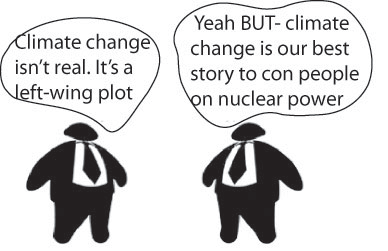
Big money, nuclear subsidies, and systemic corruption, Bulletin of the Atomic Scientists, By Cassandra Jeffery, M. V. Ramana | February 12, 2021 ”………..Material interests and policy interests.
The most common argument used by these companies and those who support nuclear subsidies is the need to fight climate change. There are two problems with this argument.
First, it is based on the false idea that nuclear power, if shut down, will necessarily be replaced by fossil fuel plants. A June 2016 decision by Pacific Gas and Electric (PG&E) demonstrates the invalidity of this assumption. PG&E will close the last two nuclear power plants in California (the Diablo Canyon units) by 2024 and 2025, replacing the lost electrical capacity “with a cost-effective, greenhouse gas free portfolio of energy efficiency, renewables and energy storage.” This move to renewables is more cost-effective today than it was in 2016 because of declining costs of renewables and energy storage. As Matthew McKinzie of the Natural Resources Defense Council argued at that time, the decision “shows that given sufficient time to prepare, retiring nuclear capacity can transition smoothly to a mix of energy efficiency measures; clean, renewable resources; and energy storage without any role for fossil fuels – an outcome that can be optimal for the environment, the market, and the reliability of the electric grid.” At a larger scale, Germany has shown that it is possible to retire nuclear plants and reduce emissions at the same time.
The second problem is the assumption that corporations owning nuclear plants are primarily interested in rapidly reducing emissions. Many utilities have large fossil fuel investments— investments that suggest a shutdown won’t be happening anytime soon. This suggestion seems especially true with natural gas plants. Although utilities often describe natural gas as clean (for example, Exelon describes its fleet as powered by “clean burning natural gas”), the climate implications of continued natural gas use are substantial. Exelon, the company with the most nuclear plants in the country, also owns and operates, along with its subsidiaries, 11 oil-fired power plants, five dual-fuel (natural gas and oil-powered) power stations, and 10 natural gas-based power plants throughout North America. In addition to its four nuclear power plants, Dominion owns 17 power plants fueled by natural gas and 14 power plants fueled by coal or oil. The company’s estimate of carbon dioxide emissions from its power plants is around 40 million metric tons in 2018, roughly the same level as in 2012. Likewise, PSEG owns just two nuclear power plants, but the company owns or has a stake in 10 fossil fuel generating plants with one more natural gas powered plant under construction.
With such large stakes in fossil fuel-based power plants, it is clear that these utilities are not about to switch immediately to renewables—or even to nuclear power—and give up on years and years of future profits that they and their shareholders are hoping for. In all of the states that offered nuclear subsidies, and elsewhere, the utilities have tried to hold back the deployment of renewables in more or less obvious ways. US utilities are not alone. Studies show that electric utilities around the world have “hindered the transition of the global electricity sector towards renewables, which has to date mostly relied on non-utility actors (such as independent power producers) for expanding the use of renewables.”
Rather than adapting to the necessity of building up renewables, these utilities resort to tactics that have been used in the past to justify nuclear power plant construction. As former Nuclear Regulatory Commission member Peter Bradford listed at the beginning of the so-called nuclear renaissance, these include “subsidy, tax breaks, licensing shortcuts, guaranteed purchases with risks borne by customers, political muscle, ballyhoo, and pointing to other countries (once the Soviet Union, now China) to indicate that the US is ‘falling behind.’”…. https://thebulletin.org/2021/02/big-money-nuclear-subsidies-and-systemic-corruption/
The merging of the economic and the political power of big nuclear corporations
 Big money, nuclear subsidies, and systemic corruption, Bulletin of the Atomic Scientists, By Cassandra Jeffery, M. V. Ramana | February 12, 2021, ”………… the long-term impact of legislation that favors nuclear energy firms involves the great economic and political power that these large utilities possess. To better understand the basis of the economic power of these corporations, we analyzed financial data from electric utilities listed on the New York Stock Exchange (NYSE) between 1970 and 2019 on the standard Compustat database.
The first trend that is evident is one of increasing market concentration. From the 1970s through to the mid-1990s, there were roughly 80 to 85 companies listed in this sector on the NYSE. By 2000, that number had dropped to 56. The reason was a series of mergers and acquisitions through which large companies absorbed smaller companies. For example, Commonweath Edison became part of Unicom in 1994. Unicom and the Philadelphia Electric Company merged in 2000 to form Exelon. Similar mergers and acquisitions have continued, and by 2019 there were only 36 utility companies operating in the United States.
Measured through their market capitalization values, these 36 corporations are not equal. By and large, the corporations with the largest market cap values are the ones that own nuclear plants. Exelon is a good example, owning 17 of the 94 nuclear units that are operating in the United States as of November 2020. In 2019, Exelon’s average market capitalization was $44.3 billion. But Exelon is by no means the largest utility. Nextera Energy ($118 billion), Dominion ($69 billion), Duke ($67 billion), and American Electric ($47 billion) dominate the industry in terms of market capitalization. All of these five companies had a higher market capitalization in 2019 than the largest utility that did not own nuclear plants: Sempra Energy ($44.1 bn).
Over the last six years, when there have been no mergers or acquisitions among these companies, 11 out of the 14 companies that own nuclear assets have consistently held market capitalization values well above the median (based on 36 companies in all). Two of the remaining three hover near the median value, sometimes higher, sometimes lower. (The one remaining utility, El Paso, was recently bought out by JP Morgan, and will no longer be a publicly traded company.) On the whole, companies with nuclear plants have recorded larger market capitalization values than the median of 22 utilities that don’t own nuclear assets.
The legislative means used to take money away from electricity consumers and bail out economically failing nuclear plants owned by these large corporations helps further their market power, as illustrated by Dominion’s value rising from $49.5 billion in 2018 to $69.4 billion in 2019. While it is well known that wealthy corporations have a lot of political power, it seems from these examples that the converse might also be true: The political power enjoyed by these large corporations is at the root of their economic power. Indeed, as political economists Jonathan Nitzan and Shimshon Bichler have argued at length, the standard economic concept of capital symbolizes “organized power writ large,” challenging the conventional division between politics and economics. The various bills passed in state legislatures offer a political assurance to investors that revenues for these utilities are assured for the foreseeable future, which naturally translates into higher stock prices and market capitalizations.………https://thebulletin.org/2021/02/big-money-nuclear-subsidies-and-systemic-corruption/
Even a pro nuclear enthusiast admits that Small Nuclear Reactors cause toxic radioactive wastes
 13 Feb 21 I was quite fascinated to note a paragraph in a long nuclear propaganda article, (by Stikeman Elliott, in Mondaq) yesterday, in which this, hitherto rather hidden problem, gets a mention.
Of course, this pro nuclear writer is not really worried all that much about the actual problem.
Oh no – his concern is about the public’s perception of it – that public perception might hamper the develoment of the nuclear lobby’s newest gimmick. Can’t have that!
”…….efforts need to be made to address the perceived risks so as to establish confidence in the ability of SMRs to operate safely while proving to be a viable source of low-carbon energy.
While SMRs produce less nuclear waste than traditional reactors, the issue of radioactive waste still exists. Nuclear waste needs to be safely stored and transported to secure facilities. SMRs have often been proposed as a solution for electricity generation in remote areas, but this proves problematic from a waste perspective as any nuclear waste would need to be transported over long distances. There is currently no permanent nuclear waste storage site in Canada……”
American media and politicians, including Biden, in the grip of the war profiteers
Who Are the Ultimate War Profiteers? A U.S. Air Force Veteran Removes the Veil, Covert Action Magazine By Christian Sorensen, February 10, 2021 “………….The most well-known industry pressure comes in the form of lobbying both political parties and funding their congressional campaigns (with extra focus on members of pertinent committees, such as Armed Services, Intelligence, Appropriations, and Foreign Relations)
This produces tangible results. As Steven Semler of the non-corporate Security Policy Reform Institute calculated, Democratic votes on the National Defense Authorization Act
correlate strongly with the campaign cash members accepted from the war industry. On average, House Democrats who voted for the NDAA accepted four times the amount of war industry cash as those who voted against it. In the Senate, Democrats who cast supporting votes took in six times as much industry cash.
Warmonger-In-Chief
 The Executive Branch is not exempt. Rapacious financiers—including hedge fund chiefs and venture capitalists—top the list of donors to the Biden Administration, though dark money groups prevent a full understanding of the overall campaign finance picture. Between July and September at least 67 billionaires and their spouses made contributions of more than $100,000 to committees supporting Joe Biden and the Democratic Party, according to records filed with the Federal Election Commission.
Biden’s campaign received over $9 million from Donald Sussman, CEO of Palmora Partners, a multi-billion dollar hedge fund, which has more than 260,000 shares in Raytheon, a preeminent weapons manufacturer and supplier of weapons to Saudi Arabia, which recently won a $100 million contract for Afghan Air Force training.
Another of Biden’s top donors, Jim Simons, who gave over $7 million, founded Renaissance Capital, which owns 1.2 million shares in Raytheon worth over $75 million, and 130,000 shares in Lockheed Martin worth $50 million.
Big Tech is positioned prominently among donors to the Biden inauguration celebration. Biden has been clear on the campaign trail that he does not intend to cut the military budget, even going so far as stating, “I’ve met with a number of my advisors and some have suggested in certain areas the budget is going to have to be increased.” Biden’s advisors are part and parcel of the military-industrial-congressional complex. Cozying up to wealthy donors, Biden infamously assured them that “nothing would fundamentally change” in a Biden presidency. https://covertactionmagazine.com/2021/02/10/who-are-the-ultimate-war-profiteers-a-u-s-air-force-veteran-removes-the-veil/
Corporate Media Kool-aid
Corporate media prevent the public from understanding the nature of the problem. A handful of business interests owns media outlets in the United States. Profit drives corporate media. U.S. corporate media (e.g. CNN, MSNBC, FoxNews) share the same business model: air what attracts the highest ratings in order to get more advertising revenue.
Corporate media air info-tainment, designed not to inform or foster critical thinking. Informing the public is not a priority. Maintaining the existing economic order is.
To the extent that corporate media air any information at all, the information reflects the opinions of the ruling class and the dogma of Corporate America.
Politically conditioning the U.S. public, corporate media never blame the military-industrial-congressional complex or capitalism for any of the problems in the world. Aiming for high ratings and lucrative advertising revenue, corporate media self-censor and taper the spectrum of acceptable foreign policy debate. War corporations purchase advertisements on corporate “news” shows to further confine the debate. Corporate pundits and newscasters do not speak out against advertisers.
Corporate media hire career militants (e.g. former CIA Director John Brennan, MSNBC; former CIA Deputy Director Mike Morrell, CBS News; retired General Jack Keane, FoxNews) who further confine the debate. Retired generals and admirals regularly contribute to all forms of corporate media, often without disclosing existing ties to war corporations or financial investments in war.
The Smith-Mundt Modernization Act of 2012 allowed government to increase its propaganda in corporate media. Drawing funding from the wealthy donor class and large corporate interests, National Public Radio is similarly confined. NPR’s new CEO as of September 2019 is John Lansing, who recently led U.S. propaganda at the U.S. Agency for Global Media.
Other industry pressure comes in the form of funding and running pressure groups [e.g. National Defense Industrial Association (NDIA), Aerospace Industries Association (AIA), Association of the United States Army (AUSA)] to dominate the Pentagon, administer arms fairs, and push favorable policies; funding think tanks to keep the narrative neoliberal and pro-war; recruiting retired generals and admirals (e.g. Dunford at Lockheed Martin, Mattis at General Dynamics, Winnefeld at Raytheon) to leverage their knowledge for financial gain; and flooding the Pentagon’s civilian offices with corporate executives (e.g., Esper and then Austin, Secretary of Defense; Lord, Undersecretary for Acquisition and Sustainment; McCarthy, Secretary of the Army). …………
Christian Sorensen is an Air Force veteran and author of the new book entitled Understanding the War Industry. See CAM’s review of the book: Wars R Us: A Review of Christian Sorensen’s New Book. https://covertactionmagazine.com/2021/02/10/who-are-the-ultimate-war-profiteers-a-u-s-air-force-veteran-removes-the-veil/
Wall Street: the Ultimate War Profiteers

Wall Street: the Ultimate War Profiteers
Wall Street plays the foundational role in the war industry by outright owning war corporations……
Big Finance sits at the top of the war industry by purchasing most shares of war corporations and by owning war corporations. Insatiable demand for profit places immense structural pressure on the Pentagon and Capitol Hill for sky-high U.S. military and intelligence budgets, broad deployment of troops overseas, and the opening up of governmental jobs to corporations. …………
Wars must be created and expanded, and military bases, through which to route goods and services, must be established and entrenched to satisfy investors. Notwithstanding, ending the wars first requires addressing the embedded profit motive, otherwise it is business as usual.
Who Are the Ultimate War Profiteers? A U.S. Air Force Veteran Removes the Veil, Covert Action Magazine By Christian Sorensen February 10, 2021
While war corporations, or so-called “defense contractors,” make billions in profits, Wall Street is the ultimate beneficiary of today’s nonstop wars. The prosaic nature of war profiteering—far from the work of a shadowy cabal—is precisely why the collusion is so destructive and should be outlawed.
The U.S. ruling class deploys the military for three main reasons: (1) to forcibly open up countries to foreign investment, (2) to ensure the free flow of natural resources from the global south into the hands of multinational corporations, and (3) because war is profitable. The third of these reasons, the profitability of war, is often lacking detail in analyses of U.S. imperialism: The financial industry, including investment banks and private equity firms, is an insatiable force seeking profit via military activity.
The war industry is composed of corporations that sell goods and services to the U.S. government and allied capitalist regimes around the world. Investment banks and asset management firms hold most shares of every major public war corporation.
The best-known financial firms holding the stock of war corporations include: Vanguard Group, BlackRock, State Street, JPMorgan Chase, Wells Fargo, and Wellington Management Continue reading
America’s ”fleet” of dangerously embrittled nuclear reactors
|
Embrittlement in Nuclear Power Plants, https://www.counterpunch.org/2021/02/01/embrittlement-in-nuclear-power-plants/ BY KARL GROSSMAN – HARVEY WASSERMAN
– 1 Feb 2021
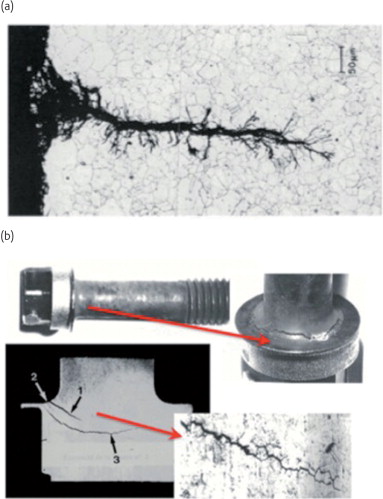
Of all the daunting tasks Joe Biden faces, especially vital is the inspection of dangerously embrittled atomic reactors still operating in the United States. A meltdown at any one of them would threaten the health and safety of millions of people while causing major impact to an already struggling economy. The COVID-19 pandemic would complicate and add to the disaster. A nuclear power plant catastrophe would severely threaten accomplishments Biden is hoping to achieve in his presidency. The problem of embrittlement is on the top of the list of nuclear power concerns. The “average age”—length of operation—of nuclear power plants in the U.S., the federal government’s Energy information Agency, reported in 2019 was 38 years. That’s why the operating licenses originally issued for the plants were limited to 40 years. Here’s how Arnold “Arnie” Gundersen, a nuclear engineer with more than 44 years of experience in the nuclear industry, who became a whistleblower and is now chief engineer at Fairewinds Associates, explains embrittlement: “When exposed to radiation, metal becomes embrittled and eventually can crack like glass. The longer the radiation exposure, the worse the embrittlement becomes.” A nuclear reactor is just like a pressure cooker and is a pot designed to hold the radioactive contents of the atomic chain reaction in the nuclear core,” continues Gundersen, whose experience includes being a licensed Critical Facility Reactor Operator. “And metals in reactors are exposed to radiation every day a plant operates” “If the reactor is embrittled and cracks,” says Gundersen, “it’s ‘game over’ as all the radiation can spew out into the atmosphere.Diablo Canyon [a twin-reactor facility in California] is the worst, the most embrittled nuclear power facility in the U.S., but there are plenty of others that also could crack. Starting with Diablo, every reactor in the U.S. should be checked to determine they are too embrittled to continue to safely operate.” Metals inside a nuclear power plant are bombarded with radiation, notes Gundersen. The steel used in reactor pressure vessels—which contain the super-hot nuclear cores—is not immune. Every U.S. reactor has an Emergency Core Cooling System and a Core Spray System to flood the super-hot core in the event of a loss-of-coolant accident. Embrittled metal would shatter when hit with that cold water. The ensuing explosion could then blow apart the containment structure—as happened at the Chernobyl and Fukushima nuclear power plants—morphing into a radioactive plume moving into the atmosphere and be carried by the winds, dropping deadly fall-out wherever it goes. This apocalyptic outcome was barely missed in Pennsylvania where, starting at 4 a.m. on March 28, 1979, fuel inside the Three Mile Island Unit Two nuclear power plant began to melt. Its Emergency Core Cooling System was activated. But only the year before—in 1978—did the plant receive a license to operate and begin operating. Had TMI, like so many of U.S. nuclear power plants now, been decades old and its metal pressure vessel embrittled and had shattered—a far greater disaster would have occurred. The entire northeastern U.S. could have been blanketed with deadly radioactivity The “fleet” of old, decrepit nuclear power plants in the U.S.—with embrittled metal components—must be inspected. And with embrittlement they must be shut down. Biden must jump into the situation—for the sake of American lives, for the sake of the nation’s future. Nuclear power in the U.S. is under the jurisdiction of the Nuclear Regulatory Commission, or NRC. That acronym NRC should really stand for Nuclear Rubberstamp Commission. Whatever the nuclear industry wants, the NRC says yes to. As the result of the series of globally infamous catastrophic nuclear power plant accidents—at Three Mile Island, Chernobyl and Fukushima—and the availability of safe, green, cost-effective, clean renewable energy, led by solar and wind, coupled with increasing energy efficiency, the nuclear industry is in its death throes. Only two nuclear power plants are being built now in the U.S., Vogtle 3 and 4 in Georgia. At nearly $30 billion for the pair, they’re hugely over budget—and their construction costs are still rising. In fact, virtually all operating atomic reactors are producing electricity at much higher base costs than solar and wind. The NRC is currently seeking to try to bail out the nuclear industry—to keep it going—by allowing nuclear power plants to operate for 100 years. In recent years it agreed to let nuclear power plants to run for 60 years and then it upped that to 80 years. On January 21 the Nuclear Rubberstamp Commission held a “public meeting” on its plan to now extend operating licenses for U.S. nuclear power plants and allow them to run for 100 years. Speaker after speaker protested this scheme. “It’s time to stop this whole nuke con job,” testified Erica Gray nuclear issues chair of the Virginia Sierra Club, at the meeting. There is “no solution” to dealing with nuclear waste, she said. It is “unethical to continue to make the most toxic waste known to mankind.” And renewable energy” with solar and wind “can power the world.” “Our position… is a resounding no,” declared Paul Gunter, director of the Reactor Oversight Project of the national organization Beyond Nuclear, for letting nuclear power plants run for 100 years. Speakers cited the greatly increased likelihood of accidents if nuclear plants were allowed to run for a century. Biden must step in and order the inspection for embrittlement of U.S. nuclear power plants. The “fleet” of old, decrepit nuclear power plants in the U.S.—with embrittled metal components—must be inspected. And with embrittlement and other likely age-induced problems, they must be shut down. Biden must act to prevent what would constitute nuclear suicide in the United States. On January 27, Biden announced a climate change agenda transitioning the U.S. towards renewable energy. But taking action against fossil fuel is not enough. Nuclear power plants are also engines of global warming. The “nuclear fuel chain” which includes uranium mining, milling and fuel enrichment is carbon intensive. Nuclear plants themselves emit Carbon-14, a radioactive form of carbon. Biden must take the lead. NOW! Harvey Wasserman wrote the books Solartopia! Our Green-Powered Earth and The Peoples Spiral of US History. He helped coin the phrase “No Nukes.” He co-convenes the Grassroots Emergency Election Protection Coalition at www.electionprotection2024.org Karl Grossman is the author of Cover Up: What You Are Not Supposed to Know About Nuclear Power and Power Crazy. He the host of the nationally-aired TV program Enviro Close-Up with Karl Grossman (www.envirovideo.com) |
|
Unsafe plan for abandoning nuclear reactors onsite, and developing Small Nuclear Reactors
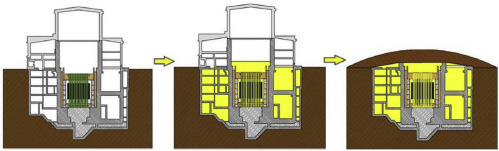
“IAEA guidance that entombment is not considered an acceptable strategy for planned decommissioning of existing [nuclear power plants] and future nuclear facilities.”
|
Groups oppose plans to abandon defunct nuclear reactors and radioactive waste, https://rabble.ca/columnists/2021/02/groups-oppose-plans-abandon-defunct-nuclear-reactors-and-radioactive-wasteThe Canadian Nuclear Safety Commission (CNSC) has just given a green light to the preferred industry solution for disposal of nuclear reactors — entomb and abandon them in place, also known as “in-situ decommissioning.” This paves the way for the introduction of a new generation of “small modular” nuclear reactors or SMRs. Over 100 Indigenous and civil society groups have signed a public statement opposing SMR funding, noting that the federal government currently has no detailed policy or strategy for what to do with radioactive waste. Many of these groups are also participating in a federal radioactive waste policy review launched in November 2020. The Assembly of First Nations passed resolution 62/2018 demanding that the nuclear industry abandon plans for SMRs and that the federal government cease funding them. It calls for free, prior and informed consent “to ensure that no storage or disposal of hazardous materials shall take place in First Nations lands and territories.”
An SMR emits no radiation before start-up (other than from uranium fuel) and could easily be transported at that stage. But during reactor operation, metal and concrete components absorb neutrons from the splitting of uranium atoms — and in the process, transform into radioactive waste. Removing an SMR after shut-down would be difficult and costly, and comes with the need to shield workers and the public from its radioactivity. Abandoning nuclear reactors on site has been in the works for some time. CNSC helped draft a 2014 nuclear industry standard with in-situ decommissioning as an option and then included it in a July 2019 draft regulatory document. However, when the International Atomic Energy Agency (IAEA) released a peer-reviewed report on Canada’s nuclear safety framework last February, it said in-situ decommissioning is “not consistent” with IAEA safety standards. The IAEA suggested that CNSC “consider revising its current and planned requirements in the area of decommissioning to align with the IAEA guidance that entombment is not considered an acceptable strategy for planned decommissioning of existing [nuclear power plants] and future nuclear facilities.” It also noted that CNSC is reviewing license applications for in-situ decommissioning of shut-down federal reactors in Ontario and Manitoba, and encouraged Canada “to request an international peer review of the proposed strategy” for legacy reactors. But CNSC continued to pursue this strategy. Clever language in a June 2020 document appeared to rule out on-site reactor disposal, but left the door open where removal is not “practicable”:
At public meeting last June, CNSC Commissioner Sandor Demeter asked: “why are future facilities in this sentence when in fact we should be designing them so that in-situ decommissioning is not the option?” Former CNSC staff member Karine Glenn replied that “leaving some small parts of a structure behind…especially if you are in a very, very remote area, may be something that could be considered.” Glenn is now with the industry-run Nuclear Waste Management Organization, tasked with leading the development of a radioactive waste management strategy for Canada. Commissioners decided to approve the regulatory document, but with added text to clarify where in-situ decommissioning would be acceptable. They asked for additional text on “legacy sites” and “research reactors,” stating that “[t]he Commission need not see this added text if it aligns with the oral submissions staff made in the public meeting.” But no new clarifying text was added to the final version of the document published on January 29, 2021. It enables abandonment of SMRs — by retaining the reference to future nuclear facilities — and of “research and demonstration facilities, locations or sites dating back to the birth of nuclear technologies in Canada for which decommissioning was not planned as part of the design.” The CNSC seems willing to ignore international safety standards — and a decision of its own commission — to accommodate nuclear industry proponents of SMRs and allow radioactive waste to be abandoned in place. Meanwhile, the federal government has assigned the nuclear industry itself — via the Nuclear Waste Management Organization — the task of developing a radioactive waste strategy for Canada. Barring public outcry, that strategy will be abandonment. Ole Hendrickson is a retired forest ecologist and a founding member of the Ottawa River Institute, a non-profit charitable organization based in the Ottawa Valley. |
|
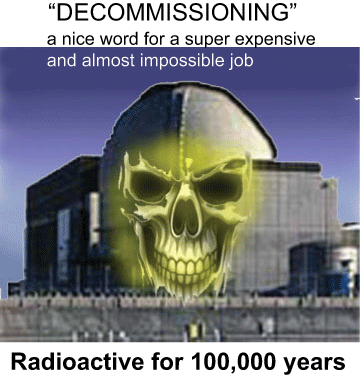
Rapacious nuclear company Holtec: its dodgy record on safety, finance and lack of transparency

-” ………………There really is no fixed date on a repository,” said Rod McCullum of the Nuclear Energy Institute, an industry trade group. In the absence of a permanent storage place, the conversation has turned to interim storage sites that could save companies money until a final destination is established.Enter Holtec. The company was formed in the 1980s to design spent-fuel storage technology for nuclear plants. By the early 2000s, Holtec had secured contracts to provide specialized dry storage casks for a never-built interim facility on the Skull Valley Goshute reservation in Utah and the Tennessee Valley Authority’s Sequoyah Nuclear and Browns Ferry Nuclear plants. By 2018, Holtec operated branches in seven countries, including Ukraine and Spain.
In 2019, Holtec began acquiring decommissioned nuclear power plants. (Such plants can bring large profits, including whatever decommissioning funds are left over after they’ve been cleaned up.) Holtec purchased New Jersey’s Oyster Creek Generating Station; Massachusetts’ Pilgrim Nuclear Power Station; New York’s Indian Point Energy Center; and Michigan’s Palisades Nuclear Generating Station, as well as spent fuel from the former Big Rock Point Nuclear Power Plant.
But the company’s record was not without concern. Holtec has received an estimated nine violation notices since 2001 for failing to follow NRC quality assurance procedures, including rules meant to ensure that the company’s storage casks — the kind it would be using in New Mexico — consistently met safety standards.
The most recent violation occurred in 2018 when Holtec modified its casks without notifying the NRC, as mandated. The change was only discovered when workers preparing to load a cask at San Onofre Generating Station in California noticed a four-inch pin, meant to hold the fuel basket, loose at the bottom of the cask — an obvious manufacturing flaw. When asked for comment on the incidents, a Holtec spokesman told Searchlight that the company is an industry leader in quality assurance.
Holtec has run into other problems as well. An investigation conducted in 2010 by the Tennessee Valley Authority into suspected overbilling revealed that the company had bribed a TVA employee in order to secure a contract. In 2007, the employee pleaded guilty to concealing more than $54,000 received from Holtec. In the wake of the investigation, the TVA ordered the company to pay a $2 million fine, open its operations to outside monitors and face a largely symbolic 60-day ban from doing federal business — the first debarment in TVA history.
In 2014, Holtec failed to mention that debarment on tax credit application forms. The misrepresentation initially went unnoticed, allowing the company to receive $260 million in tax credits from the New Jersey Economic Development Authority (NJEDA), a story first reported by ProPublica and WNYC.
In 2019, the NJEDA announced it would investigate Holtec’s use of tax credits, prompting the company to sue the agency for withholding money. (The NJEDA declined to answer questions about the investigation’s status, saying it did not comment on matters related to pending litigation.)
Holtec’s use of offshore banking has also come under scrutiny. According to leaked records called the Paradise Papers, Holtec has operated at least one shell corporation in Bermuda between 2005 and 2007. The records, which were obtained by the German daily newspaper Süddeutsche Zeitung and shared with the International Consortium of Investigative Journalists, listed Krishna P. Singh II as an officer: He is the son of Holtec CEO Krishna P. Singh. Several of the CEO’s other family members were also listed as officers, as was Niraj Chaudhary, director of the executive committee for Holtec Asia. An additional offshore company in Bermuda that operated during the same time period, Southampton Technologies Ltd., included nearly identical officers and was listed at the same address.
Holtec did not respond to questions from Searchlight about why the accounts were used and whether the company still keeps bank accounts in tax havens. The leaked records don’t reveal this information, either. But tax havens like Bermuda can allow companies to avoid paying taxes.
“There’s nothing inherently nefarious about [the accounts],” said Jack Blum, a national authority on international tax evasion and money laundering whose anti-corruption work contributed to the establishment of the U.S. Foreign Corrupt Practices Act. However, Blum told Searchlight, Holtec “is a closely held company that has a history of being controlled by its founders, and wherever it goes, it wants to keep its finances as secret as it can and its taxes as low as it can.”
In general, Blum said: “Companies that are dealing in nuclear materials are in a world where there’s very little transparency.”
Holtec did not respond to questions from Searchlight about why the accounts were used and whether the company still keeps bank accounts in tax havens. ……. https://searchlightnm.org/new-mexicos-nuclear-rush/
Universities in collusion with nuclear industry
U.S. universities have continued to build connections to the U.S. nuclear weapons complex. Although students and faculty have opposed university participation in nuclear weapons research and development at various points in the last 70 years, such participation continues.
November 15, 2020 by beyondnuclearinternational https://wordpress.com/read/feeds/2663585/posts/3150281214 An ICAN report
Universities across the United States are identified in this report for activities ranging from directly managing laboratories that design nuclear weapons to recruiting and training the next generation of nuclear weapons scientists. Much of universities’ nuclear weapons work is kept secret from students and faculty by classified research policies and undisclosed contracts with the Defense Department and the Energy Department. The following is the executive summary from ICAN’s report: Schools of Mass Destruction, with some changes made for timeliness.
Over the next ten years, the Congressional Budget Office estimates U.S. taxpayers will pay nearly $500 billion to maintain and modernize their country’s nuclear weapons arsenal, or almost $100,000 per minute. A separate estimate brings the total over the next 30 years to an estimated $1.7 trillion. In a July 2019 report, National Nuclear Security Administrator Lisa Gordon-Haggerty wrote, “The nuclear security enterprise is at its busiest since the demands of the Cold War era.”
In addition to large amounts of funding, enacting these upgrades requires significant amounts of scientific, technical and human capital. To a large extent, the U.S. government and its contractors have turned to the nation’s universities to provide this capital.
Over the next ten years, the Congressional Budget Office estimates U.S. taxpayers will pay nearly $500 billion to maintain and modernize their country’s nuclear weapons arsenal, or almost $100,000 per minute. A separate estimate brings the total over the next 30 years to an estimated $1.7 trillion. In a July 2019 report, National Nuclear Security Administrator Lisa Gordon-Haggerty wrote, “The nuclear security enterprise is at its busiest since the demands of the Cold War era.”
Despite these debates, U.S. universities have continued to build connections to the U.S. nuclear weapons complex. Although students and faculty have opposed university participation in nuclear weapons research and development at various points in the last 70 years, such participation continues.
Universities involve themselves in the nuclear weapons complex through the four channels listed below. In return for this engagement, universities receive funding, access to research facilities, and specific career opportunities for students.
1) Direct Management
A handful of universities directly manage nuclear weapons related activities on behalf of the federal government, retaining contracts worth billions of dollars per year collectively. These include the University of California, Texas A&M University, Johns Hopkins University, the Massachusetts Institute of Technology, and the University of Rochester.
2) Institutional Partnerships
Many of the National Nuclear Security Administration’s (NNSA) sites advertise collaborative agreements with local and national universities. These formal agreements allow the institutions to cooperate on research and share personnel and expertise. They can also provide university researchers access to funding and advanced facilities in the NNSA laboratories. The report highlights more than 30 such agreements with schools in 18 states.
3) Research Programs and Partnerships
In addition to formal institutional partnerships, numerous connections exist between universities and the nuclear weapons complex at the research project level. In a report delivered to Congress in July 2019, the NNSA highlights that more than $65 million in grants were delivered to academic institutions in the last year to support stockpile stewardship. When including grants and subcontracts from the NNSA labs as well, the total amount of funding to universities for research may be higher than $150 million per year.
4) Workforce Development Programs
Former Department of Energy Secretary Rick Perry has written that finding “the next generation workforce of world-class scientists, engineers and technicians is a major priority.” Through university partnerships, vocational training programs and research fellowships, the NNSA creates employment pipelines for the development of its future workforce.
A primary goal of this report is to facilitate a shared understanding of university connections to nuclear weapons research and development. A common factual basis will help communities of university faculty, students and administrations engage in robust internal debates and take action. Universities would not willingly participate today in the production of chemical and biological weapons; for the same humanitarian reasons, no university should seek an association with the other category of weapons of mass destruction: nuclear weapons.
While American universities have played a key role in the development and continuation of nuclear weapons, they can now join U.S. cities and states that have rejected U.S. nuclear weapons and called on the federal government to support nuclear reductions and the Treaty on the Prohibition of Nuclear Weapons. In light of the research presented, this report offers the following recommendations to universities:
Recommendations
• Provide greater transparency into connections with the nuclear weapons complex;
• Stop directly managing nuclear weapons production sites and dissolve research contracts solely related to nuclear weapons production;
• For contracts with dual-purpose research applications, demand greater transparency and create specific processes for ethical review of this research;
• Advocate for reinvestment of weapons activities funding to non-proliferation and environmental remediation efforts; and
• Join cities and state legislatures in urging the federal government to support the 2017 Treaty on the Prohibition of Nuclear Weapons and reverse course on nuclear arms control backsliding.
See the full list of universities.
The above is the Executive Summary of ICAN’s report on US Universities. Read the full report. Beyond Nuclear is a member of ICAN.
In addition to large amounts of funding, enacting these upgrades requires significant amounts of scientific, technical and human capital. To a large extent, the U.S. government and its contractors have turned to the nation’s universities to provide this capital.
At the same time, the United States is shirking its previous commitments to nuclear arms control and reducing nuclear risks despite its obligation under Article VI of the Nuclear Non-Proliferation Treaty to pursue good-faith measures towards nuclear disarmament.
In August 2019, the United States officially withdrew from the landmark 1987 Intermediate-Range Nuclear Forces Treaty, testing a treaty-prohibited missile shortly thereafter. The Trump Administration’s 2018 Nuclear Posture Review expanded the circumstances under which the United States would consider the first use of nuclear weapons and called for the development of two new sea-based low-yield nuclear weapon systems.
Internationally, many member states of the United Nations have recognized the devastating humanitarian and environmental impacts of nuclear weapons: debating, adopting, signing and now ratifying the 2017 Treaty on the Prohibition of Nuclear Weapons.

Dangers of plutonium fuelled, sodium cooled “Versatile Nuclear Reactor”

|
Experimental Nuclear Reactor Design Could Come to ID https://www.publicnewsservice.org/2021-01-25/nuclear-waste/experimental-nuclear-reactor-design-could-come-to-id/a72914-1January 25, 2021
BOISE, Idaho — The public can weigh in this week on an experimental nuclear reactor which could be coming to the Idaho National Laboratory. The U.S. Department of Energy (DOE) has released a draft Environmental Impact Statement (EIS) for a new design known as a “versatile nuclear reactor.” The DOE said it will be used to test nuclear-energy innovations, helping to push the sector forward. Edwin Lyman, director of nuclear power safety for the Union of Concerned Scientists, believes its construction would pose risks for eastern Idaho. “People should ask questions about whether the DOE has really done the accident analysis that it needs to, and is being honest with the people about the potential consequences of accidents at that reactor,” Lyman contended. The versatile nuclear reactor is cooled by liquid sodium, which Lyman noted is highly potent. Reactors currently in operation in the U.S. are cooled by water. The public hearings on the EIS will be held online Wednesday and Thursday. Lyman added there is another concern with the fuel the reactor would use. “Unlike the fuels that are used for light-water reactors, which is called low-enriched uranium fuel, that fuel is not directly usable in a nuclear weapon,” Lyman explained. “But plutonium is directly usable.” Lyman argued it raises questions about the potential for nuclear proliferation. The DOE estimated the project will cost between $2.6 and $5.8 billion dollars. Lyman cautioned that’s a lot of money for an experimental project. “The DOE needs to reconsider this whole project, and whether they can spend that money more wisely in helping to improve the safety of existing technologies,” Lyman concluded. |
|
South Africa the only country to have nuclear weapons, then abandon them
|
The Story Of The Jet That Would Have Delivered South Africa’s Nuclear Bomb, The British-made Buccaneer strike aircraft was adapted to carry apartheid-era South Africa’s guided nuclear bomb. The War Zone, BY THOMAS NEWDICK JANUARY 18, 2021
“………South Africa, an international pariah for much of the Cold War due to its apartheid policy, remains the only country to have developed nuclear weapons and then voluntarily given them up. Before it did so, the main focus of these developments was an air-launched weapon that was intended to be delivered by a Hawker Siddeley Buccaneer strike aircraft. This combination could potentially have struck targets in other countries in sub-Saharan Africa, as partof South Africa’s long-running campaign against regional rebel groups, or even hostile revolutionary governments.
……..The final death knell for South Africa’s nuclear weapons program was the presidency of F. W. de Klerk, who came to power in 1989, deciding to do away with it. There was apparently no significant opposition from the military, whose experience in years cross-border campaigns had not revealed any requirement for a weapon of this type. Ultimately, the actual utility of a nuclear weapon in the conflict in Angola was always negligible, and its use would represent an unprecedented escalation while further ostracizing the South African regime. Moreover, the end of apartheid now seemed to be in sight, and possession of weapons of mass destruction would do nothing to enhance South Africa’s international position then, or in the future. While a veil of secrecy remained over the program, de Klerk oversaw the removal of enriched uranium from the weapons that had been completed. In 1991, South Africa finally signed the 1968 Non-Proliferation Treaty and, two years later, de Klerk acknowledged the existence of the nuclear weapons program. Survivors of the SAAF Buccaneer fleet were withdrawn in the same year, by which time only five examples were reportedly still airworthy. …
|
|
|
How the Treaty on the Prohibition of Nuclear Weapons Impacts the United States
 How the Treaty on the Prohibition of Nuclear Weapons Impacts the
 United States, and Why the United States Must Embrace its Entry into Force, Columbia SIPA Journal of International Affairs, ALICIA SANDERS-ZAKRE AND SETH SHELDEN, JAN 15, 2021 The United Nations Treaty on the Prohibition of Nuclear Weapons (TPNW) will enter into force on January 22, 2021, two days following the inauguration of Joseph Biden as the 46th president of the United States. Despite the TPNW’s widespread support throughout the world, the United States has attempted to thwart the treaty’s progress at every step, boycotting the negotiations from the start and urging other countries to withdraw as the treaty neared its entry into force. These efforts have proven unsuccessful. This article explores the implications of the entry into force of the TPNW, with special attention to the United States and how the new Biden administration can play a more constructive role in the international treaty regime.
With the TPNW, nuclear weapons will be subject to a global ban treaty for the first time, at last aligning nuclear weapons with other weapons of mass destruction, all already the subject of treaty-based prohibitions. The TPNW provides a framework to verifiably eliminate nuclear weapons and requires its States Parties, i.e., states that have ratified or acceded to the treaty, to assist victims and remediate environments affected by nuclear weapons use and testing. The treaty was negotiated in recognition of the increasing likelihood of use of nuclear weapons, whether intentionally or accidentally, and the catastrophic humanitarian consequences that would result from any such use.
The United States has aggressively attempted to thwart the TPNW despite support for the treaty from more than two-thirds of the world’s states. These efforts have been unsuccessful. If President-elect Biden truly intends “to prove to the world that the United States is prepared to lead again—not just with the example of our power but also with the power of our example,” his administration must reverse the U.S. position on the TPNW.
Past United States Approach to TPNW
Before treaty negotiations had begun, in a 2016 nonpaper the United States urged NATO members to vote against proceeding with the initiative, claiming that such a treaty would “undermine…long-standing strategic stability.” Despite U.S. urging, the resolution to proceed with negotiations was adopted in December 2016 with clear global support. After Donald Trump assumed the presidency, the United States intensified its opposition, publicly dismissing and ridiculing the TPNW while privately pressuring countries not to support it. On the first day of treaty negotiations, U.S. Ambassador to the UN, Nikki Haley, hosted a press conference outside the room where negotiations were to take place, criticizing the pursuit of a prohibition treaty and questioning if nations participating were “looking out for their people.”
In October 2020, as the treaty approached the threshold of 50 ratifications for its entry into force, the United States sent a letter to countries that had joined the TPNW, restating its “opposition to the potential repercussions” of the treaty and encouraging states to withdraw their instruments of ratification. Once the treaty reached 50 States Parties, U.S. Assistant Secretary of State Christopher Ford retweeted his remarks from 2018 in which he had called the treaty “harmful to international peace and security.” China, France, Russia, the United Kingdom, and the United States have consistently issued joint statements disparaging the treaty at various international fora, including the International Atomic Energy Agency (IAEA) General Conference, the United Nations General Assembly, and Nuclear Non-Proliferation Treaty (NPT) meetings.
U.S. opposition to the TPNW is predicated on the falsehood that nuclear weapons provide security, as well as mischaracterizations about the treaty itself. Despite legal obligations and decades of commitments to bring about a world without nuclear weapons, in truth the United States relies steadfastly upon deterrence doctrines that are incompatible with these obligations and commitments, and it views any threat to the legitimacy of nuclear weapons as a threat to its national security. In clutching to deterrence doctrines, despite recognition—even from conservatives and libertarians—that nuclear weapons offer no military or practical value, U.S. policymakers undoubtedly are influenced also by the trillion dollar industry supporting its nuclear weapon arsenal. They thus have advanced spurious claims about the TPNW’s failings, arguing that the treaty will undermine the NPT, weaken IAEA safeguards, and only impact democracies, all of which are untrue.
These false assertions have been debunked in numerous more thorough examinations, so it suffices to say that the majority of countries do not share U.S. and like-minded states’ concerns about the TPNW
…………Nuclear-armed states aggressively denouncing an initiative with global support impairs unity in other international fora needed to advance other nuclear disarmament, nonproliferation, and risk reduction measures.
Implications of Entry Into Force
U.S. denouncements of the TPNW also ignore the significant impact of this treaty internationally, and on the United States itself. When the TPNW enters into force, States Parties will immediately need to adhere to the treaty’s Article 1 prohibitions, prohibiting them from developing, testing, producing, manufacturing, acquiring, transferring, possessing, stockpiling, using, or threatening to use nuclear weapons, or allowing nuclear weapons to be stationed in their territories. It also prohibits States Parties from assisting, encouraging, or inducing anyone to engage in these activities.
Under Articles 6 and 7 of the TPNW, States Parties also are obligated to assist victims of and remediate environments contaminated by nuclear weapon use and testing. These “positive obligations” break new ground in international nuclear weapons law. States with affected victims and contaminated lands under their jurisdiction have the primary responsibility for providing assistance, in a nod to state sovereignty and practical facilitation. However, Article 7 requires all States Parties to cooperate in implementing the treaty and, particularly for those in a position to do so, to assist affected states. ………..more https://jia.sipa.columbia.edu/online-articles/how-treaty-prohibition-nuclear-weapons-impacts-united-states-and-why-united-states
Thyroid cancer at ages 0 and 2 at the time of the nuclear accident-Health survey in Fukushima Prefecture January 2021
Thyroid cancer at ages 0 and 2 at the time of the nuclear accident-Health survey in Fukushima  Prefecture Posted by: ourplanet Posted on: Thu, 01/14/2021 –00:46 http://ourplanet-tv.org/?q=node/2537 (Japanese only)
(Translated from Google) The “Prefectural Health Survey” Review Committee was held in Fukushima City on the 15th to discuss the health survey of Fukushima citizens following the accident at the Fukushima Daiichi Nuclear Power Plant. For the first time, it was discovered that two infants, a 0-year-old girl and a 2-year-old girl at the time of the accident, were diagnosed with thyroid cancer.
Material https://www.pref.fukushima.lg.jp/site/portal/kenkocyosa-kentoiinkai-40.html

This time, the result of the fourth round of thyroid examination until June last year was newly announced. The number of children diagnosed with suspected thyroid cancer by fine needle cytology increased by 6 from the previous time to 27, and the number of children who underwent thyroidectomy increased by 3 from the previous time to 16 children. Up to now, 252 patients have been diagnosed with thyroid cancer or suspected thyroid cancer from prior examination, of which 203 have undergone thyroid surgery. 202 people, excluding one, were confirmed to have thyroid cancer.
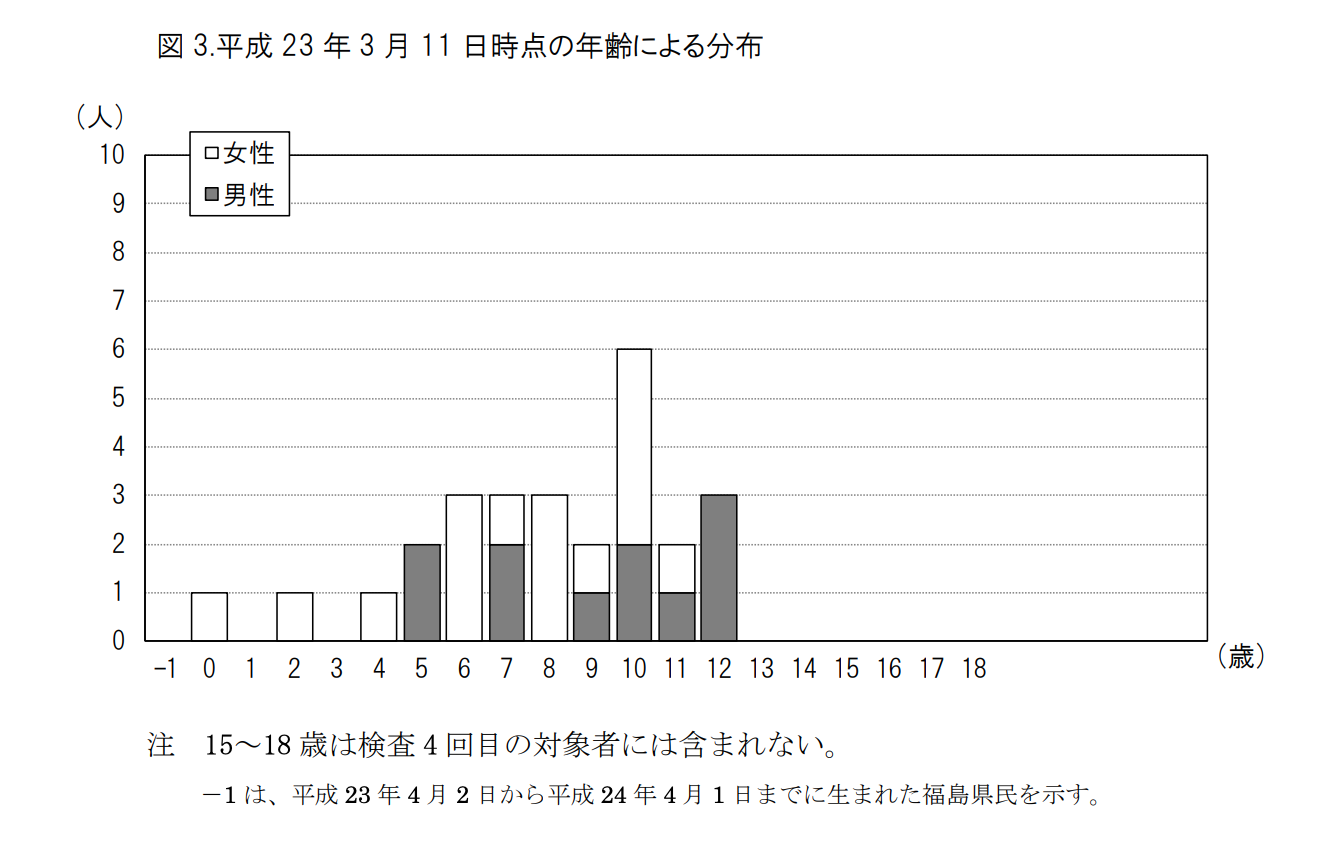
In the fourth round of examination, it was found for the first time that a girl who was 0 years old and a girl who was 2 years old at the time of the accident were diagnosed with thyroid cancer. Since the age of the examination is not the actual age but the grade, the ages at the time of the examination are 9 years old (3rd grade of elementary school) and 11 years old (5th grade of elementary school), respectively. According to the previous test results of 27 patients, 5 patients had “A1 judgement” without nodules or tumors, and 16 people had “A2 judgement” with nodules of 5 mm or less or cysts of 2 cm or less, 5 mm or more. 5 people had a “B-judgement” with nodules or cysts of 2 cm or more, and 1 had not been examined. He had the smallest tumor size of 6.1 mm and the largest tumor was 29.4 mm.
What stands out in the results of the fourth round of examination is the high dose of radiation for people diagnosed with thyroid cancer. Of the 27 patients diagnosed as suspected of being malignant by fine needle cytology, 11 patients (40.7%) who submitted the basic survey questionnaire had an exposure dose of less than 1 mSv in 2 patients (18.1%) 4 months after the accident. The number of children exposed to 2mSv or more was the highest, with 4 (36.3%) from 1mSv to 2mSv and 5 (45.5%) from 2mSv to 5mSv. In particular, the two boys who were five years old at the time of the accident were both over 2mSv.
According to the results of the basic survey of all Fukushima residents, 62.2% are less than 1mSv, 31.6% are from 1mSv to 2mSv, and 5.5% are from 2mSv to 3mSv. Very different.

To review the mass examination at school At this review committee, a major shift was made to reviewing simultaneous examinations at schools. The test, which has found more than 200 people with thyroid cancer, raises the theory of “overdiagnosis” among experts who deny the effects of radiation exposure, saying that they are finding thyroid cancer that they do not have to find. There is a growing opinion that the mass examination at school should be reviewed.
Based on these opinions, the review committee decided to conduct an interview survey at schools in the prefecture on August 31st last time. This time, there was a report on the results of a survey conducted by the prefecture at 26 elementary and junior high schools and high schools in the prefecture.
At many schools, thyroid examinations were performed during class hours, criticized by Shoichiro Tsugane, a member of the National Cancer Center, saying, “You can’t take this without a strong will.” “The benefits of the test are not except that you can be reassured when you get negative. The discovery of thyroid cancer has little benefit in avoiding death or poor quality of life, especially when you are diagnosed with thyroid cancer. “I think it will be a huge disadvantage for those who do,” he said. “Thyroid examination in a group of asymptomatic healthy people is not desirable. I asked him to stop the mass examination at school. ..
In addition, Professor Toshiya Inaba of Hiroshima University also cut out at the school examination that “they are left behind” and said, “Parents are not worried. The school rents the venue. The prefectural medical college has an inspection. I understand each position well, but in the end, it is the people who are left unattended. ” He emphasized that the prefectures and medical colleges that are the subjects of the survey should explain more to children and students the significance of the test and the fact that it can be rejected.

In response, Professor Satoshi Tomita of Fukushima University argued head-on. He criticized that “many Fukushima residents have anxiety about their health” and that members of the Prefectural Health Investigation Committee, especially members outside Fukushima Prefecture, are calling for the cancellation or reduction of examinations. He said that thyroid examination is a way to relieve the anxiety of Fukushima residents, “the anxiety of Fukushima residents, especially those with children, is left behind.” “It is dangerous to go in the direction of reduction easily.” “Thinking” was pointed out.
Ikuko Abe, chairman of the Fukushima Clinical Psychologists Association, who also lives in Fukushima Prefecture and has a close relationship with schools, agrees with this, saying, “I agree with Professor Tomita’s opinion.” “Given the anxiety about radiation that Fukushima residents have, thyroid examinations are very reassuring,” she said. “Reducing or eliminating the examinations still takes the opposite position. I want you to do it. “
What caught my eye in the discussion was the presence of Katsushi Tahara, director of the Ministry of the Environment’s Health and Welfare Department. The members of the review committee from the Ministry of the Environment have not said much, but have played a role in important aspects of policy change. This time too, Mr. Tahara considers the fact that the school is cooperating with the implementation of the examination, such as encouraging households whose delivery to Fukushima Medical University is delayed to submit again when the deadline has passed. About 30% of the children undergoing medical examinations at school were asked intensively about this point, such as confirming that the school side took over the collection of consent forms.
To conduct hearings with the person to be inspected Following a survey of the school, the prefecture proposed to have a place to hear directly from the children and students who had been inspected. Questions were raised about the representativeness of the interviewees, and there was an opinion requesting a quantitative survey such as a questionnaire, but the prefecture’s proposal was approved because the survey took too long.
Regarding this “interview survey,” there was a harsh debate over the neutrality of the content, such as the opinion that a pilot study was unavoidable and that the voices of patients diagnosed with thyroid cancer should also be heard. With the strong push back of the constellation chairman, it was decided that the selection of the target audience and the holding method would be left to the chairperson and the prefecture. The results will be reported at the next meeting.
In response to the further shift to reviewing mass screening at school in this “interview,” Chiba parent and child of the “thyroid cancer support group Hydrangea Association” that supports families with thyroid cancer said, “Accident Among the 0-year-old and 2-year-old children at that time, a child with thyroid cancer appeared and my chest hurts. Thyroid cancer also has recurrence and metastasis, and early detection and early treatment are beneficial for the child. Given that the cancer was found in a school test, there can be no argument to eliminate the school test. ” The group has made offers to the prefecture three times in the past and opposes the reduction of inspections.
”Small Modular Reactors”’- governments are being sucked in by the ”billionaires’ nuclear club”

SNC-Lavalin Scandal-ridden SNC-Lavalin is playing a major role in the push for SMRs.
Terrestrial Energy….. Terrestrial Energy’s advisory board includes Dr. Ernest Moniz, the former US Secretary of the Dept. of Energy (2013-2017) who provided more than $12 billion in loan guarantees to the nuclear industry. Moniz has been a key advisor to the Biden-Harris transition team, which has come out in favour of SMRs.
The “billionaires’ nuclear club” …“As long as Bill Gates is wasting his own money or that of other billionaires, it is not so much of an issue. The problem is that he is lobbying hard for government investment.”
Going after the public purse
Bill Gates was apparently very busy during the 2015 Paris climate talks. He also went on stage during the talks to announce a collaboration among 24 countries and the EU on something called Mission Innovation – an attempt to “accelerate global clean energy innovation” and “increase government support” for the technologies.
Gates’ PR tactic is effective: provide a bit of capital to create an SMR “bandwagon,” with governments fearing their economies would be left behind unless they massively fund such innovations.
governments “are being suckers. Because if Wall Street and the banks will not finance this, why should it be the role of the government to engage in venture capitalism of this kind?”
It will take a Herculean effort from the public to defeat this NICE Future, but along with the Assembly of First Nations, three political parties – the NDP, the Bloc Quebecois, and the Green Party – have now come out against SMRs.
|
Mini-Nukes, Big Bucks: The Interests Behind the SMR Push https://watershedsentinel.ca/articles/mini-nukes-big-bucks-the-money-behind-small-modular-reactors/
It’s remarkable that only five years ago, the National Energy Board predicted: “No new nuclear units are anticipated to be built in any province” by 2040.So what happened? The answer involves looking at some of the key influencers at work behind the scenes, lobbying for government funding for SMRs. |

1 This Month


PLEASE OPPOSE HR 8255 AND S.3639 – bills would accelerate satellite deployment, with no environmental review or safeguards – https://ncstd5li.quorum.us/campaign/169331/
To see nuclear-related stories in greater depth and intensity – go to https://nuclearinformation.wordpress.com
-
Archives
- September 2026 (194)
- August 2026 (330)
- July 2026 (355)
- June 2026 (287)
- May 2026 (306)
- April 2026 (356)
- March 2026 (251)
- February 2026 (267)
- January 2026 (308)
- December 2025 (358)
- November 2025 (359)
- October 2025 (375)
-
Categories
- 1
- 1 NUCLEAR ISSUES
- business and costs
- climate change
- culture and arts
- ENERGY
- environment
- health
- history
- indigenous issues
- Legal
- marketing of nuclear
- media
- opposition to nuclear
- PERSONAL STORIES
- politics
- politics international
- Religion and ethics
- safety
- secrets,lies and civil liberties
- spinbuster
- technology
- Uranium
- wastes
- weapons and war
- Women
- 2 WORLD
- ACTION
- AFRICA
- Atrocities
- AUSTRALIA
- Christina's notes
- Christina's themes
- culture and arts
- Events
- Fuk 2022
- Fuk 2023
- Fukushima 2017
- Fukushima 2018
- fukushima 2019
- Fukushima 2020
- Fukushima 2021
- general
- global warming
- Humour (God we need it)
- Nuclear
- RARE EARTHS
- Reference
- resources – print
- Resources -audiovicual
- Weekly Newsletter
- World
- World Nuclear
- YouTube
-
RSS
Entries RSS
Comments RSS
 nuclear-news