Aging nuclear reactors, like Pilgrim, Plymouth, become more dangerous
Nuclear facilities are licensed to operate for forty years and all have experienced age-related degradation before the termination of their original license. Despite this, the NRC continues to extend licenses to facilities throughout the U.S.
from 1952-2009 there have been 99 major nuclear power station incidents worldwide.
NUKE MATTERS: Three Mile Island, Chernobyl, Fukushima…Plymouth?
http://www.wickedlocal.com/plymouth/news/opinions/x35738056/NUKE-MATTERS-Three-Mile-Island-Chernobyl-Fukushima-Plymouth#axzz2CQF4Vofv By Karen Vale, Campaign Coordinator, Cape Cod Bay Watch Wicked Local Plymouth, 18 Nov 12, Three Mile Island in 1979, Chernobyl in 1986, and most recently Fukushima – these catastrophic nuclear accidents thrust the debate about the safety of nuclear power into the public
spotlight.
Fukushima also triggered a critical examination of nuclear stations with the same type and operational design as the reactors that failed in March 2011. In the U.S., there are 23 reactors with the same design as Fukushima – including Pilgrim Nuclear Power Station
(Pilgrim) on Cape Cod Bay in Plymouth. Continue reading
No real planning for burying Europe’s aging nuclear reactors
Aging Nuke Plants Add to Europe’s Economic Woes, By GARY PEACH Washington Examiner, Associated Press VISAGINAS, Lithuania November 17, 2012“…….Other EU countries will have to foot the bill for closing their own plants, adding to taxpayers’ woes. In Germany, it will be in addition to energy price increases as the government scrambles to finance an ambitious switch from nuclear to renewables, which should account for 60 percent of total energy consumption by 2030.
Just last month Germany’s main utilities announced that households could see their
electricity bill jump up to 50 percent in order to finance this transition from nuclear power.
Experts say that disassembling atomic plants promises to be far costlier than previously estimated, given the lack of experience worldwide and nuclear operators’ propensity to underestimate decommissioning costs to make new projects look more attractive.
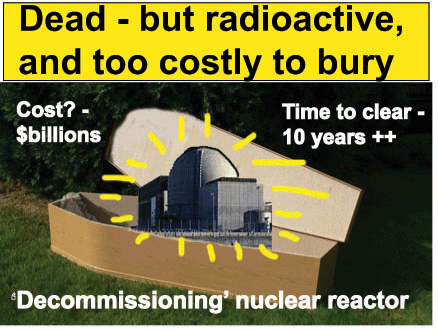
Thomas of Greenwich University said in Britain nuclear operators were supposed to pay for the decommissioning, but over the decades the cost was passed to the government, which will have to come up with €120 billion ($153 billion) over the next century to dismantle the
country’s existing nuclear power plants.
Just abandoning the facilities with radioactivity trapped inside is not an option. But given the enormous expenditures, some governments are opting to drag out the decommissioning over many decades…… http://washingtonexaminer.com/aging-nuke-plants-add-to-europes-economic-woes/article/2513836
Germany well on track to nuclear free success
The nuclear industry and its supporters pounced on Merkel’s decision. They predicted blackouts on a scale Germany hadn’t experienced since World War II and skyrocketing electricity prices that would wreck the nation’s heavy manufacturing sector, the bedrock of the German economy. They warned that Germany would cease to be an energy exporter and be forced to import electricity from, of all places, French nuclear power plants. Utilities would have to burn more coal to make up for the lost nuclear power, they said, pumping huge amounts of greenhouse gases into the atmosphere. The British weekly The Economist branded Merkel’s action “a lunatic gamble.”
More than a year and a half later, however, those dire predictions haven’t materialized.
”You have to choose between the old system and the new one. And we have chosen renewables.”
 Germany Abandons Nuclear Power and Lives to Talk About It, Bloomberg Business Week By Osha Gray Davidson November 16, 2012“……..Like all revolutions, the German Energiewende was set in motion by many factors and its course altered by a multitude of events and actors along the way. A few key moments stand out, however, and the Chernobyl catastrophe is one of them. To fully understand the Energiewende, and to anticipate its future twists and turns, it’s essential to understand the role Chernobyl played in shaping the German public’s view of nuclear power. Continue reading
Spiralling costs of UK’s nuclear wastes
Recommend that you go to this link, as the page has many very informative graphics.
 http://www.guardian.co.uk/environment/2012/nov/16/
 nuclear-waste-sellafield How much do we spend on nuclear waste? Duncan Clark guardian.co.uk, 16 November 2012 Last week, a new report by the National Audit Office (NAO)highlighted the spiralling costs of running Sellafield, the UK’s huge nuclear
reprocessing and storage site. Duncan Clark reviews the data Continue reading
Highly radioactive fish in seas near Fukushima
 Asahi: Gov’t worried about highly radioactive fish — Why are radiation readings still 100s of times over official safe limits? http://enenews.com/asahi-govt-worried-about-highly-radioactive-fish-why-are-radiation-readings-still-100s-of-times-over-official-safe-limit
November 13th, 2012
(Subscription Only) Title: Worries over highly radioactive fish prompt study
Source: Asahi
Author: HIROSHI ISHIZUKA
Date: November 13, 2012
Persistently high radioactivity in some fish caught close to the Fukushima nuclear plant has sparked a government investigation into the physiological basis for contamination and why radiation readings in some specimens remain hundreds of times over the official safe limit.
[…] The overall trend has been a decline in detected amounts of radioactive cesium.
However, in August, two greenlings caught 20 kilometers north of the Fukushima plant were found to have cesium levels of 25,800 becquerels per kilogram, the highest level ever measured in fish since the nuclear accident. The government standard for food is 100 becquerels per kilogram.
And in March, tests recorded a level of 18,700 becquerels per kilogram
in freshwater salmon in the Niidagawa river near Iitate […]
[…] cesium in freshwater salmon and char caught since March has not been decreasing, leading to restrictions on the shipment […]
The forthcoming study will analyze cesium levels in the fish’s otolith, a part of the inner ear. The otolith is widely used in such research because it is an organ where trace elements tend to accumulate over the animal’s lifespan, leaving a growth record that can be likened to the rings of a tree. […]
Wind and solar energy have the advantage, as water becomes scarcer
 Water scarcity could drive push towards wind and solar REneweconomy By Giles Parkinson 14 November 2012 In 2010, more water – 583 billion cubic metres – than is discharged each year by the mighty Ganges River in India was used to meet the world’s growing energy needs.
It’s an interesting statistic, but why should that matter? Well, if the world continues on its merry way, power capacity – particularly with water-hungry energy technologies such as coal and nuclear – and water-dependent extractive techniques such as coal, shale gas and tar sands, are going to grow quickly, and, according to the International Energy Agency, the world’s demand for water will grow at twice the pace, putting pressure on increasingly scarce water resources. Continue reading
The insidious climate change danger – acidification of sea, land and air
 Earth on Acid: The Present & Future of Global Acidification http://www.geosociety.org/news/pr/12-89.htm GSA Annual Meeting & Exposition, Charlotte, North Carolina, USA, 4–7 November 2012 Boulder, CO, USA – Climate change and extreme weather events grab the headlines, but there is another, lesser known, global change underway on land, in the seas, and in the air: acidification.
It turns out that combustion of fossil fuels, smelting of ores, mining of coal and metal ores, and application of nitrogen fertilizer to soils are all driving down the pH of the air, water, and the soil at rates far faster than Earth’s natural systems can buffer, posing threats to both land and sea life. Continue reading
Ionising radiation – the killer for super fast space travel
 Super-Fast Space Travel Would Kill You In Minutes http://www.gizmodo.com.au/2012/11/super-fast-space-travel-would-kill-you-in-minutes/ JAMIE CONDLIFFE, 6 Nov 12, Everyone thinks it would be cool to travel at the speed of light, which is why scientists devote their lives to working out if it would be possible and NASA is trying to develop its own warp drive. But easy, tiger: turns out super-fast space travel would be fatal. A paper published in Natural Science brings some boring common sense to the speed-of-light-travel table. In order to travel huge distances in next to no time, people need to travel close to the speed of light. In so doing, travellers cover extremely large distances very quickly, and thanks to the quirks of relativity, it would feel like it took mere minutes because of an effect known as time dilation , which squashes perceived time.
The trouble is that travelling close to the speed of light brings about other effects too. In Natural Science , Edelstein and Edelstein point out that hydrogen in any craft cable of travelling at the speed of light would also prevent it from travelling at the speed of light. They explain :
Unfortunately, as spaceship velocities approach the speed of light, interstellar hydrogen H, although only present at a density of approximately 1.8 atoms/cm3, turns into intense radiation that would quickly kill passengers and destroy electronic instrumentation. In addition, the energy loss of ionizing radiation passing through the ship’s hull represents an increasing heat load that necessitates large expenditures of energy to cool the ship.
In other words, travel close to the speed of light and you’ll be bombarded with so much radiation that you kick the bucket. The knock-on effect is that even if it’s possible to create a craft capable of travelling close the speed of light, it wouldn’t be able to transport people.
Instead, there’s a natural speed limit imposed by safe levels of radiation due to hydrogen, which means humans couldn’t travel faster than half the speed of light unless they were willing to die almost immediately. Dammit. [Natural Science ]
Death and illness rate in Chernobyl’s fallout area
USA -Questions arise about shuttering of Kewaunee Nuclear PP -Waste storage problems!
According to that report, about 3,000 metric tons of spent nuclear fuel is in storage at nine sites across the country where commercial reactors have been shuttered.
“This all came as an awful surprise,” said Paplham. “That waste may be sitting there for 200 years.”
In the meantime, the residents around the Kewaunee plant are preparing for life without one of the area’s biggest employers and an indeterminate number of years living next to an impromptu nuclear waste storage facility.
“They were going to bury those rods under a mountain,” said Hardtke. “And yet now they are just going to let them sit there. I have kids here and grandkids, and we’re leaving them a mess.”
WSJ, 4 Nov 12 Residents who live near the Kewaunee Power Station with its 556-megawatt nuclear reactor still are absorbing the recent news that the plant will shut down in May, taking with it 655 jobs and leaving behind — possibly for decades — scores of concrete canisters filled with spent nuclear waste.
The loss of the jobs as well as the hundreds of thousands of dollars Dominion Resources pays locally in lieu of property taxes is unsettling enough, local officials say. More disturbing, they say, are the 42 containers of nuclear waste that will remain sitting just off the shore of Lake Michigan.
“We’ve been lied to for 35 years,” Dave Hardtke, chairman of the town of Carlton, said of the waste. “When they built that plant, the federal government said they were going to move the waste. That was 35 years ago, and look where it is sitting.”
The impending shutdown of the plant renewed attention on the national impasse over the disposal of spent nuclear fuel. And it is not just an issue at Kewaunee. More than 300 assemblies of spent nuclear fuel rods are submerged in a cooling pool on the site of the now-closed nuclear reactor at the Genoa Generating Station on the banks of the Mississippi River near La Crosse. The small reactor, adjacent to a traditional coal plant, was closed in 1987 but the fuel rods, with no central federal storage available, remain.
USA: nuclear reactors – assurances of safety precautions
they are unlikely to be affected by strong winds or unusually high tides.

 Hurricane Sandy and N.J. nuclear power plants: Keeping it cool in high
winds http://www.newjerseynewsroom.com/science-updates/nj-nukes-prepare-for-sandy , 28 OCTOBER 2012 BY ROBERT KINKEAD On Sunday, New Jersey’s four nuclear power stations, along with another dozen or so along the Eastern Seaboard,were prepped to deal with Hurricane Sandy as that massive storm crawls up the East Coast toward the Garden State.
Federal regulators require nuclear reactors to be in a safe shutdown condition at least two hours before hurricane force winds strike, according to Alec Marion, VP of nuclear operations at the Nuclear Energy Institute, an energy industry association.
Typically, plant operators begin shutting down reactors about 12 hours before winds exceeding 74 miles per hour arrive. One of the most significant challenges in the shutting down process is keeping the reactor core cool. Continue reading
Nuclear fusion – pie in the sky – years away from even feasibility study
 Nuclear Fusion Project Struggles to Put the Pieces Together Scientific America, 27 Oct 12, Contracting woes may cause further delays for $19.4-billion ITER, a project designed to show the feasibility of nuclear fusion as a power source
By Geoff Brumfiel and Nature magazine The world’s largest scientific project is threatened with further delays, as agencies struggle to complete the design and sign contracts worth hundred of millions of euros with industrial partners, Nature has learned.
ITER is a massive project designed to show the feasibility of nuclear fusion as a power source. Continue reading
Price Anderson Nuclear Industries Indemnity Act – a whopper government subsidy
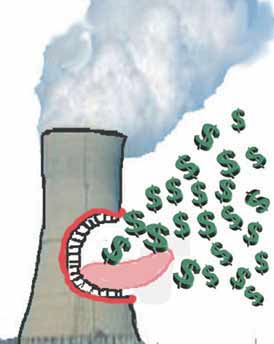 It is worth noting that Exelon, as an owner and operator of more nuclear power plants than any other American company, benefits to a considerable degree from what is potentially one of the largest government subsidies of energy production in world history, the Price Anderson Nuclear Industries Indemnity Act.
Nuclear Company Blasts Wind Industry Tax Incentive KCET, by Chris Clarke
on October 23, 2012 The largest operator of nuclear power plants in the United States has blasted the Wind Production Tax Credit in a commissioned study…… Continue reading
The world’s nuclear industry continues to decline
World Nuclear Industry Status Report maps nuclear power’s global decline http://www.beyondnuclear.org/home/2012/10/22/world-nuclear-industry-status-report-maps-nuclear-powers-glo.html A new World Nuclear Industry Status Report 2012, authored by Mycle Schneider with Antony Froggatt and Julie Hazemann, maps the continuing global decline of nuclear power. The report shows that nuclear’s future rests not on new construction, but that “Plant life extension seems the most likely survival strategy of the nuclear industry at this point” – a good reason to continue to block reactor license extensions. The report noted that: “Only seven reactors started up, while 19 were shut down in 2011.” By July 2012, “only two were started up, just compensating for two that were shut down so far this year”. Other highlights:
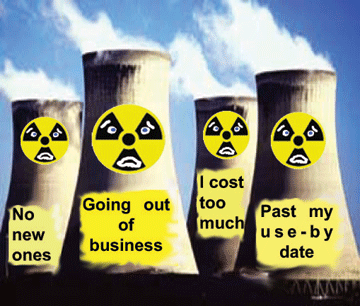
China is spending five times more on renewables than nuclear post-Fukushima with no new nuclear construction since 3/11; nine reactors have been listed as “under construction” for more than 20 years; four countries – Belgium, Germany, Switzerland and Taiwan – will phase out nuclear power and five more to date – Egypt, Italy, Jordan, Kuwait and Thailand – have abandoned plans to develop, or re-develop nuclear power; new builds have been canceled in Brazil, France, India and the US; certification of new reactor technologies has been delayed numerous times; in the US, of the 28 license applications received, 16 were subsequently delayed and eight were suspended indefinitely or officially canceled; of the 59 units under construction in the world, at least 18 are experiencing multi-year delays, while the remaining 41 projects were started within the past five years or have not yet reached project start-up dates.
The nuclear fusion dream – ever elusive
Fusion: Maybe Less Than 30 Years, But This Year Unlikely Bill Chameides Dean, Duke University’s Nicholas School of the Environment, August 2012 No ignition at the U.S. National Ignition Facility , home to the world’s largest laser….. Scientists have been thinking about how to bring this game changer into the energy game for decades. (See fusion/fission timeline .) As far back as 1946, two British scientists — Sir George Paget Thomson and Moses Blackman — filed the first patent for a fusion power plant .
But there have been a couple of hold-ups . To get a fusion reaction started, you need to slam the hydrogen atoms together really, really hard and that requires a lot of energy. (In a hydrogen bomb, the fusion reaction gets ignited by an atomic bomb, using fission. Not exactly the preferred method for your local fusion power plant.)
Even trickier is controlling the fusion reaction. It’s one thing to make a fusion bomb, it’s a lot harder to get the reaction going and keep it under control in a way that the amount of energy extracted is larger than that expended to initiate and manage the reaction.
Over the almost 70-year pursuit of the fusionary holy grail, it’s been fairly common for scientists working on the problem to say that they’re about 30 years away from achieving a power plant based on fusion. (See here and here .) The problem has been that while time has marched on, the 30-year horizon has remained fixed. Suffice to say it has proven to be a very tough problem…. http://www.huffingtonpost.com/bill-chameides/fusion-maybe-less-than-30_b_1949573.html
1 This Month

of the week- – THE ONENESS of HUMANITY
We the Nuclear Free North

1st July – Webinar Waste of Space: The Environmental Harm of Military and Civil Space Activity st July, 7 pm

Report Launch Online: We are seeing an increasing exploitation of space for military and commercial purposes. This must change.

Protect Sazan Island from the Trump family! https://secure.avaaz.org/campaign/en/protect_sazan_island_from_the_trump_family_loc/?bqFCVab&v=174511&cl=22707147157&_checksum=5e9dde668860e8231c33699735e16a1fbf22ab2cb01da50c999fe8732b9775ef&utm_source=email&utm_medium=blast_email&utm_campaign=174511


Cuba Is Not a Failed State – It Is a Besieged State
PETITION: “Global Appeal to Endorse Palestinian Right of Return of Refugees”
To see nuclear-related stories in greater depth and intensity – go to https://nuclearinformation.wordpress.com
-
Archives
- June 2026 (251)
- May 2026 (306)
- April 2026 (356)
- March 2026 (251)
- February 2026 (268)
- January 2026 (308)
- December 2025 (358)
- November 2025 (359)
- October 2025 (376)
- September 2025 (257)
- August 2025 (319)
- July 2025 (230)
-
Categories
- 1
- 1 NUCLEAR ISSUES
- business and costs
- climate change
- culture and arts
- ENERGY
- environment
- health
- history
- indigenous issues
- Legal
- marketing of nuclear
- media
- opposition to nuclear
- PERSONAL STORIES
- politics
- politics international
- Religion and ethics
- safety
- secrets,lies and civil liberties
- spinbuster
- technology
- Uranium
- wastes
- weapons and war
- Women
- 2 WORLD
- ACTION
- AFRICA
- Atrocities
- AUSTRALIA
- Christina's notes
- Christina's themes
- culture and arts
- Events
- Fuk 2022
- Fuk 2023
- Fukushima 2017
- Fukushima 2018
- fukushima 2019
- Fukushima 2020
- Fukushima 2021
- general
- global warming
- Humour (God we need it)
- Nuclear
- RARE EARTHS
- Reference
- resources – print
- Resources -audiovicual
- Weekly Newsletter
- World
- World Nuclear
- YouTube
-
RSS
Entries RSS
Comments RSS
 nuclear-news