Navy men’s lawsuit against Japan alleges cover-up of radiation harm
 Navy rescue workers sue Japan over Fukushima cover-up — “Irreparable harm to life expectancy” — Gov’t and Tepco conspired http://enenews.com/navy-rescue-workers-sue-japan-over-fukushima-cover-up-irreparable-harm-to-their-life-expectancy-govt-and-tepco-conspired
Title: U.S. Sailors Sue Japan Over Fukushima
Source: Courthouse News Service
Author: By ELIZABETH WARMERDAM
Date: Dec 26, 2012
 […] Eight crew members of the U.S.S. Ronald Reagan, whose home port is San Diego, sued the Tokyo Electric Power Co. in Federal Court. […]
 Lead plaintiff Lindsay R. Cooper claims Tokyo Electric (TEPCO) intentionally concealed the dangerous levels of radiation in the environment from U.S. Navy rescue crews working off the coast of Japan […]
The complaint states: “Defendant TEPCO and the government of Japan, conspired and acted in concert, among other things, to create an illusory impression that the extent of the radiation that had leaked from the site of the FNPP was at levels that would not pose a threat to the plaintiffs, in order to promote its interests and those of the government of Japan, knowing that the information it disseminated was defective, incomplete and untrue, while omitting to disclose the extraordinary risks posed to the plaintiffs who were carrying out their assigned duties aboard the U.S.S. Ronald Reagan.” […]
And, they say: “Defendants had actual and/or constructive knowledge of the properties of radiation that would ensure that, once released into the environment, radiation would spread further and in concentrations that would cause injury to the plaintiffs.” […]
The sailors say they “face additional and irreparable harm to their life expectancy, which has been shortened and cannot be restored to its prior condition.”
Radiation exposure to residents of Treasure Island, USA
Alarming Radiation Levels Found on Treasure Island (includes Video –
 on cancers in former residents) )
The Navy’s own data suggests that island residents were at risk of
radiation exposure.
East Bay Express, By Ashley Bates, 27 Dec 12, Navy officials have repeatedly downplayed the risks of
radiation exposure to current and former residents on Treasure Island.
But data from the US Navy shows that measurements taken in former
residential areas of the island revealed pockets of alarmingly high
radiation levels. The data, which the Express obtained as a result of
a public records request, also raises questions as to whether former
residents were, in fact, exposed to high amounts of radiation and
whether soil on the island can be sufficiently cleaned up for the
massive “eco-friendly” housing and commercial development planned for
the former Navy base…..
Despite the newly released data, much is still unknown about the
radiation levels on Treasure Island. Continue reading
An overview of the Fukushima nuclear plant situation
 Two high school girls that were affected by the disaster are launching a peace discussion forum devoted to expanding the dialogue about nuclear power and weapons. One of the young women said, “My parents’ and grandparents’ generations may be to blame for allowing the nuclear power plants, but both adults and children are responsible for thinking together about the problem.”
 Japan Continues Struggle with Aftermath from the Fukushima Nuclear Disaster http://blog.cleanenergy.org/2012/12/26/japan-continues-fukushima-struggle/
December 26th, 2012 › As 2012 draws to a close, evaluating the ongoing effects of the March 2011 Fukushima Daiichi nuclear disaster on the people of Japan is a difficult and depressing task. After having fled their homes due to the tsunami and resulting triple nuclear meltdown, 21 months later an estimated160,000 citizens still have not returned home.
Reports of illness in humans and livestock continue to underscore the far reaching and difficult to predict impacts that a nuclear accident can cause. In July, 36% of Japanese children screened were found to have abnormal thyroid growths. This fall, an illness dubbed the “Fukushima syndrome” was reported to be killing cattle near the Fukushima prefecture. Mutations are already observed inbutterflies and other insects, whose shorter life cycles allow genetic disruptions to display more quickly than in mammals or humans.

Official data now estimates Chernobyl death toll at 1.5 million
Death toll estimate from Chernobyl now around 1.5 Million -Expert (VIDEO) http://enenews.com/expert-death-toll-estimate-chernobyl-around-15-million-people-video
December 22nd, 2012
Title: Pr A.Yablokov and Pr C.Busby on Fukushima victim estimations
Uploaded by: radioactivebsr
Date: April 6-8, 2011
Description: Interview by an unidentified Austrian radio reporter
h/t Nuclear_Problem
Prof. Alexey Yablokow, PhD, Centre for Russian Environmental Policy, N. K. Koltzoff Institute of Developmental Biology, Russian Academy of Sciences:
9,000 additional deaths from cancer, nothing more – This is official data from so called Chernobyl Forum, by International Atomic Energy Agency and World Health Organization. […]
And when I calculate this, of course it’s not precise. But level of death toll was more than 1 million. If you not only for 15 years, but for 25 years, maybe to close one and a half million – than 9,000 deaths which I mentioned before.
Lynas radioactive waste plans: unsafe?
 Lynas’ waste plans a toxic pipe dream Aliran, 19 December 2012 by Wendy Bacon ” ……While Lynas says it is confident in the current by-product plans, they are yet to be tested. Dr Peter Karamoskas, who has been a nuclear radiologist for 13 years and represents the Australian public on the Radiation Safety Committee of Australia’s nuclear safety agency, shares none of that confidence.
Speaking on his own behalf, Karamoskas said that to be safe more than a million tons of WLP residue with a radioactive reading of 6Bq have to be mixed with five times the amount of aggregate to reduce its reading to 1Bq. While he said that a similar process had been used in the Netherlands, the waste was far less radioactive, sitting near 1Bq, which is the threshold for safety.
Karamoskas said it has never been used with material with the Lamp WLP reading of 6Bq. He says that it is extremely unlikely to be a long term solution from a safety or economic point of view: “If this was all ready to go they would be trumpeting it in the public arena … already it looks slippery. If this was possible wouldn’t most countries around the world be doing it?” He thinks it is extremely unlikely that the road mix could be imported, other than to a country with “lax standards” because it would breach international best practice standards. Continue reading
National Christian Council finds nuclear power incompatible with life and peace
 The science in play is not fiction. Children are growing up forbidden to play outdoors, young women worry that no one will want to marry them, a mother tests her rice harvest to see if she can share it with her children, families are paying off loans on radioactive homes they will never use. These are the kind of stories heard every day at a parish radiation information centre in Aizu Wakamatsu, Japan.
The conference concluded that “there is no safe use of nuclear power, no safe level of exposure to radiation, and no compatibility between nuclear power, life and peace.”
Nuclear tragedy finds a human face in Fukushima, Insights, ON 19 DEC 2012 BY STEPHENW
The everyday effects of radiation borne by survivors of the 2011 Fukushima disaster in Japan add up today to an involuntary experiment with public health, community life and environmental affairs.
An ecumenical conference, called to listen to local residents, found that last year’s chain reaction of earthquake, tsunami and nuclear calamity has generated a “live” human tragedy, across a province, with no end in sight.
The Geiger counters that priests and parishioners pull out of their pockets like cell phones made the local anxieties and fears real for their visitors.
“I cannot tell my children that there will be something good if they live,” one mother told a Buddhist priest. Continue reading
Lynas rare earths project – the saga in Malaysia
The IAEA also recommended that Lynas proceed no further until it had filed comprehensive plans for the permanent disposal of waste, decommissioning of the plant and remediation of the site at the end of its life.
Lynas’ waste plans a toxic pipe dream Aliran, 19 December 2012 Scientists and community leaders are concerned about radioactive waste from Lynas’ Malaysian plant but the company representative who took Wendy Bacon’s questions brushed off the criticism. This is the second of two articles about Lynas by Wendy Bacon.Read the first here.http://aliran.com/11005.html
Australian rare earth company Lynas has always known it had a waste problem.
It plans to process rare earth concentrate, imported from its mine at Mount Weld in Western Australia, at its Lynas Advanced Materials Plant (Lamp) in Malaysia. It will not only produce rare earths for export but also a huge amount of waste, including more than a million cubic metres of low level radioactive material. Continue reading
Shutting down the critics of Lynas rare earths Malaysain project
Lynas’ waste plans a toxic pipe dream Aliran, 19 December 2012 Scientists and community leaders are concerned about radioactive waste from Lynas’ Malaysian plant but the company representative who took Wendy Bacon’s questions brushed off the criticism. This is the second of two articles about Lynas by Wendy Bacon “………Shutting down the critics
New Matilda asked to interview Lynas Executive Chairperson Nick Curtis but he was not available. Instead we interviewed a Lynas spokesperson who insists that the waste products of the Lamp project are “not hazardous in any way”. He refers to the safety record of Lynas which in “all of its constructions … has been achieved with zero lost time injury”.
When New Matilda suggested that problems are more likely to arise in the long term, even 20 or 30 years away, he replied: “I would be lying if I categorically tell you there is no risk in 20 or 30 years time from anything. What I can tell you is that the unanimous conclusion of all of the scientific experts from all of the different organisations that have investigated this material and everything else is that there will be no discernible risk for the public or anyone else from this facility.”
But this is far from true.
For example, in April this year, the National Toxic Network (NTN), a community-based network “working to ensure a toxic-free future for all”, published a preliminary assessment of the waste steam of Lynas’s Lamp project. It was prepared by Lee Bell, a qualified environmental scientist with 20 years experience in analysis of industrial process plants, groundwater monitoring and contaminated sites. He co-chaired the Core Consultative Committee on Waste under the former Labor government in Western Australia, which reformed the state’s hazardous waste sector. Readers of his 29 page NTN report (pdf), which was reviewed by another scientist, are likely to be concerned about the company’s environmental plans.
I asked Lynas’ spokesperson about the NTN report: “Whatever you think of it, it [the report] is a solid document. It appears to be academically referenced and it also appears to have had some form of review. If you read it, on a number of scores, you would be concerned?”…..
The Lynas spokesman rejected an NTN claim that Lamp’s location on a reclaimed swamp with a high rainfall is relevant to disposal of low level radioactive waste. Asked if he was aware it was a “marshy site”, he said, “I have no idea”. He explained that although there is a pristine fishing village and beach at Kuantan three and a half kilometres away on the coast, “if there is a risk there, it is much wider than just Lynas because the Lamp is in a petrochemical zone”. In fact, the site is on a reclaimed peat swamp……..http://aliran.com/11018.html
.Mining uranium – A recent history of uranium on Navajo lands
 Uranium cleanup on Navajo Nation complicated by scope, history of problem 19, 2012 By MARYANN BATLLE Cronkite News “…..
• 1940s: The mining and milling of uranium ore for U.S defense and energy begins on the Navajo Nation. Continue reading
Contradictory information about Lynas rare earths project in Malaysia
Lynas will be in court in Malaysia on 19 December. The Save Malaysia Stop Lynas (SMSL) campaignerswill be appealing against the Kuantan High Court decision to lift its stay on the company being able to exercise its rights to proceed under the temporary licence.
The toxic waste that’s not in Australia’s backyard http://aliran.com/11005.html 18 Dec 12, Australian-owned company Lynas is quietly shipping rare earth to a processing plant in Malaysia – without a firm plan in place to dispose of dangerous radioactive waste. Wendy Bacon reports.
If a manufacturing plant involving radioactive materials moved into your community, one of the first things you would ask is, “what’s going to happen to the waste?”
This is exactly how residents of Kuantan on Malaysia’s east coast reacted when the Australian company Lynas announced plans to build Lamp, the world’s biggest rare earth processing plant in their area.
Several years later, they have no clear answer. Indeed last week, while the plant that will use concentrate imported from Lynas’s rare earth mine at Mount Weld in Western Australia was finally ramping up for production, the Malaysian government and the company were in direct conflict about what would happen to the waste. Continue reading
Research shows radiation exposure causing thyroid cancer
 Fingerprint of radiation exposure discovered in thyroid cancer http://www.healthcanal.com/cancers/17423-Fingerprint-radiation-exposure-discovered-thyroid-cancer.html 25/05/2011 Neuherberg,-Scientists from the Helmholtz Zentrum München have discovered a genetic change in thyroid cancer that points to a previous exposure of the thyroid to ionising radiation. The gene marker, a so-called „radiation fingerprint“ was identified in papilliary thyroid cancer cases from Chernobyl victims, but was absent from the thyroid cancers in patients with no history of radiation exposure. The results are published in the current issue of PNAS. Continue reading
Global decline in electricity from nuclear power, as renewables rise
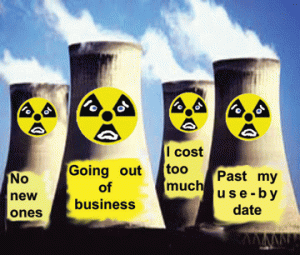 [In China, Russia, South Korea, and India] Some reactors have been listed as “under construction” for over two decades
Plagued by cost overruns, construction delays, and a dearth of private investment interest, the world’s nuclear reactor fleet is aging quickly as new reactor connections struggle to keep up with retirements.
In contrast to the decline in nuclear power, electricity generation from the wind and the sun has grown 27 percent and 62 percent, respectively, per year since 2006
World Nuclear Electricity Generation Down 5 Percent Since 2006 Tree Hugger, Lester Brown, December 13, 2012 By J. Matthew Roney World nuclear electricity-generating capacity has been essentially flat since 2007 and is likely to fall as plants retire faster than new ones are built. In fact, the actual electricity generated at nuclear power plants fell 5 percent between 2006 and 2011. In 2011, following Japan’s Fukushima Daiichi nuclear disaster, 13 nuclear reactors in Japan, Germany, and the United Kingdom were permanently taken offline. Seven new reactors, three of them in China, were connected to the grid. The net result was a two percent reduction in world nuclear capacity to 369,000 megawatts by the end of 2011. In 2012, the world has added a net 3,000 megawatts of nuclear capacity, with new additions in South Korea and Canada partly offset by more U.K. shutdowns.
The United States, with 104 nuclear reactors generating some 19 percent of the country’s electricity, leads the world in nuclear generating capacity. Continue reading
Britain’s taxpayers up for more than 100 billion pounds in nuclear cleanup
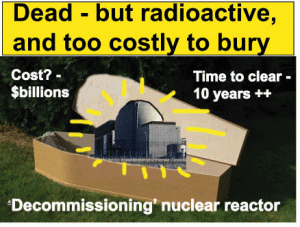 Nuclear clean-up to cost £100bn and take 120 years. Decommissioning, no2nuclearpower, 9 December 2012 BRITAIN’S taxpayers will be landed with a bill of more than £100bn for cleaning up radioactive waste from sites such as Sellafield and Dounreay, according to the chief executive of the Nuclear Decommissioning Authority (NDA).
The amount represents a near-doubling of the £56bn cleanup cost announced when the NDA began operating in 2005, and could rise still more. The warning comes as NDA engineers start work on some of the biggest and most expensive engineering projects seen in Britain — building giant robotic grabs to lift deadly nuclear waste from Sellafield’s decaying 1950s repositories.
The buildings being targeted include Sellafield’s B29 and B30 cooling ponds, where decaying 1950s fuel rods are stored. This weekend John Clarke, chief executive of the NDA, said he was spending £3bn a year on the cleanup, with about £1.6bn of that going on Sellafield alone. Such sums are similar to those spent on the London Olympic site at the peak of construction.
Figures released by the Department of Energy and Climate Change show that, since Britain’s first nuclear power station opened in 1956, they have generated 2.5 billion megawatt hours of electricity — worth £125 billion at today’s prices. If the cost of building Britain’s 20-odd nuclear power stations (around £10bn-£12bn each in today’s money), is included, it would far exceed the value of the power produced, say experts.
Such figures show why power companies, which would be responsible for the waste, are refusing to build new nuclear power stations without government guarantees of a consumer subsidy that will almost double the market price for their power.
Sunday Times 9th Dec 2012 more >> http://www.no2nuclearpower.org.uk/news/daily12/daily.php?dailynewsid=343
Nuclear weapons proliferation risk from Thorium reactors
just 1.6 tonnes of thorium metal would be enough to produce 8kg of uranium-233 which is the minimum amount required for a nuclear weapon.
”Small-scale chemical reprocessing of irradiated thorium can create an isotope of uranium – uranium-233 – that could be used in nuclear weapons. If nothing else, this raises a serious proliferation concern.”
Thorium: Proliferation warnings on nuclear ‘wonder-fuel’ , Phys Org, December 5, 2012Thorium is being touted as an ideal fuel for a new generation of nuclear power plants, but in a piece in this week’s Nature, researchers suggest it may not be as benign as portrayed.
The element thorium, which many regard as a potential nuclear “wonder-fuel”, could be a greater proliferation threat than previously thought, scientists have warned. Continue reading
Despite the hype, the nuclear industry is nervous about its future
 Nuclear industry faces up to reality of ‘interesting times’ The
  Engineer, 7 December 2012 | ByStuart Nathan ”………Part of the problem is that the nuclear landscape is so complicated, especially in the UK, with its history as a nuclear
pioneer and the legagcy of experiment that has left behind. John Clarke of the Nuclear Decommissioning Authority, again reflecting the mood of realism, put it in a way which pretty much everyone would understand. ‘It’s like telling children to put their toys away before getting out new ones. Clearing up the mess is a key enabler to new build.’
…… .it’s relatively easy to put toys away. Nuclear is different. ‘At Sellafield, we’re dealing with structures which were put up in the 1940s in great haste to support military programmes, where the only concern was “is it safe for today”,’ he said. ‘They were neverdesigned to have waste taken out of them, and the waste is poorly categorised — we often don’t really know what it is.’
The situation isn’t much better even at industrial-scale power stations, said Peter Walkden, commercial director of Magnox. ‘It was never going to be easy to decommission a 50 year old plant that was never designed to be decommissioned, under a regime that was designed for operation,’ he said. Decommissioning a Magnox plant takes the best part of a century — three years to defuel, then ten years of preparation for care and maintenance while radioactivity subsides (the stage that current decommissioning projects are in), followed by 85 years of care and maintenance, then about ten years to clear the site.
A bit more than just putting the toys away, and something that can’t be done before building new plants’. ….”
1 This Month



26 September – International Day for the Total Elimination of Nuclear Weapons


PLEASE OPPOSE HR 8255 AND S.3639 – bills would accelerate satellite deployment, with no environmental review or safeguards – https://ncstd5li.quorum.us/campaign/169331/
To see nuclear-related stories in greater depth and intensity – go to https://nuclearinformation.wordpress.com
-
Archives
- September 2026 (269)
- August 2026 (330)
- July 2026 (355)
- June 2026 (287)
- May 2026 (306)
- April 2026 (356)
- March 2026 (251)
- February 2026 (267)
- January 2026 (308)
- December 2025 (358)
- November 2025 (359)
- October 2025 (375)
-
Categories
- 1
- 1 NUCLEAR ISSUES
- business and costs
- climate change
- culture and arts
- ENERGY
- environment
- health
- history
- indigenous issues
- Legal
- marketing of nuclear
- media
- opposition to nuclear
- PERSONAL STORIES
- politics
- politics international
- Religion and ethics
- safety
- secrets,lies and civil liberties
- spinbuster
- technology
- Uranium
- wastes
- weapons and war
- Women
- 2 WORLD
- ACTION
- AFRICA
- Atrocities
- AUSTRALIA
- Christina's notes
- Christina's themes
- culture and arts
- Events
- Fuk 2022
- Fuk 2023
- Fukushima 2017
- Fukushima 2018
- fukushima 2019
- Fukushima 2020
- Fukushima 2021
- general
- global warming
- Humour (God we need it)
- Nuclear
- RARE EARTHS
- Reference
- resources – print
- Resources -audiovicual
- Weekly Newsletter
- World
- World Nuclear
- YouTube
-
RSS
Entries RSS
Comments RSS

