Tepco is concealing the situation of the reactor fuel in reactor 2.
Incapacitation and Protection AGAINST Truth, Blog by Jan Hemmer June 2, 2013 by Mikkai “…..People are amazed by the emission rates given out by TEPCO. But if you compare TEPCO’s officials numbers with normal legal emissions, it seems Fukushima is emitting LESS than before the explosions. How is this possible? TEPCO is criminal. The industry is. If a reactor explodes THEY give out numbers. From the textbook. Not from measurements. You can scale down or up the instruments or put them out of order, or simply conceal. You can do everything. And if independent civilian monitoring stations contradict this, they are called “panic makers”. What we are for people that we tolerate that? Is that pride or courage? Is it more cowardice and stupidity and Slow suicide for our children?
Tepco is concealing the situation of the reactor fuel in reactor 2. it has nothing to to with a technical blackout or “problems”. tepco knows excatly that: situation a) – meltdown much much deeper – or: b) the whole reactor fuel inventory was blown out. if b) is the case, the contamination is so brutal high with actual reactor fuel – that there are no words to describe it. the IAEA supports the cover up and advises them. part of the cover up agenda are the fake fact finding missions. the devil is relying on the bible, from day one.
The Radioactivity and Becquerel Inventory of ONE Reactor
is the Equivalent of one or more Full Scale Nuclear Wars.
It is not “Living in irradiated areas”
It is “dying in irradiated areas“
It is not “2 years after Fukushima”
It is “2 years with Fukushima”…… http://tekknorg.wordpress.com/2013/06/02/incapacitation-and-protection-against-truth
Time that UK Labour rejected replacement of useless Trident Nuclear Submarines
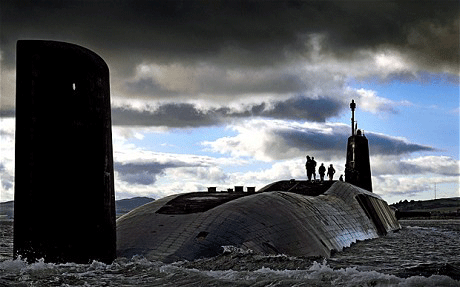
 Pro-nuclear propaganda in 1983: lessons for 2013 50/50 Inclusive Democracy REBECCA JOHNSON 9 August 2013 Read the first.]
“……..As nuclear weapons are increasingly marginalised in the 21st century and Britain faces another hundred-billion-pound question on whether to replace the Trident system we didn’t need for the past 30 years and can’t find any good reason for getting now, it’s time for the Labour Party to stop running scared about reframing security and nuclear policy.
The intellectual and security arguments against Trident replacement are overwhelming. It’s time to change the discourse on nuclear weapons in Britain. If this country is to avoid committing the stupid, expensive mistake of signing away billions of pounds more to build some lumbering submarines to chain us to nuclear dependency for the next fifty years, we need our politics to catch up with the facts and arguments. Since so many in the Labour Party still seem paralysed by the mistaken belief that advocating nuclear disarmament kept them out of power for the 1980s, let’s take a look at that time again, assisted by hindsight and the 1983 documents……
By the time the first of the very expensive Vanguard submarines rolled out of Barrow in 1994, the Cold War had been consigned to the trashcan of history. Sadly its nuclear assumptions and doctrines live on in the minds of those responsible for the 2013 Trident Alternatives Review…………..
Is it too much to ask that today’s media would stop perpetuating the Tory narrative and its over-simplification of unilateral and multilateral disarmament? As noted in a 2000 programme of action for nuclear non-proliferation and disarmament, negotiated and adopted by Non-Proliferation Treaty (NPT) parties (including the UK), unilateral, bilateral and multilateral steps will all be necessary. Similarly, getting prohibition treaties in international law as well as decisive steps to reduce and eliminate existing arsenals are not mutually exclusive but jointly necessary measures to achieve the world free of nuclear weapons that so many leaders now say they want.
Britain’s politicians seem to be sleepwalking into disaster. What will it take to overcome Labour’s “electoral defeat traumatic syndrome” so that we can have a sensible, fact-based discussion of the pros and cons of Trident replacement? http://www.opendemocracy.net/5050/rebecca-johnson/pro-nuclear-propaganda-in-1983-lessons-for-2013
Unfortunate halt in USA-Russia moves to limit nuclear warheads
The End of a Nuclear Era NYT, By JAMES E. GOODBY August 14, 2013 PALO ALTO, California — President Barack Obama’s cancellation of his planned meeting next month with President Vladimir Putin was followed by a statement at his Aug. 9 press conference regarding a “pause” to “reassess where it is that Russia is going.”
The president had hoped that before his term ended U.S. and Russian nuclear weapons could be limited to ceilings of about 1,000 warheads for each country. That was going to be hard to do even without a pause, given disputes over U.S. ballistic-missile defense programs and Russian short-range nuclear weapons. Now the odds are against any U.S.-Russian treaty calling for deeper reductions than those already achieved in the 2011 New Start treaty during the remaining years of the Obama administration.
It is a lost opportunity, but does it matter? Mutual assured destruction, the essence of U.S. deterrence policy during the Cold War, remains a condition of life in the 21st century. It will remain so for as long as thousands of nuclear weapons continue to exist. Ninety percent of those nuclear warheads are held by the United States and Russia. So, yes, that lost opportunity makes a difference…… http://www.nytimes.com/2013/08/15/opinion/global/the-end-of-a-nuclear-era.html
Nuclear disarmament – UN’s message for Nagasaki Day
 In Nagasaki message, Ban stresses need for education on benefits of nuclear disarmament http://un.org.au/2013/08/12/in-nagasaki-message-ban-stresses-need-for-education-on-benefits-of-nuclear-disarmament/ In his message to a ceremony marking the 68th anniversary of the atomic bombing of the Japanese city of Nagasaki, Secretary-General Ban Ki-moon stressed that the benefits of nuclear disarmament must be spread worldwide through education. “We must eliminate all nuclear weapons in order to eliminate the grave risk they pose to our world. This will require persistent efforts by all countries and peoples,” Mr. Ban said in his message to the Nagasaki Peace Memorial Ceremony.
“We may take a lead from the scholars and researchers at Nagasaki University who have studied this issue, and strengthen disarmament and non-proliferation education worldwide so a younger generation of emerging leaders, voters, and taxpayers can understand the vital need for policies to advance disarmament goals.” More than 400,000 people died as a result of the attacks on Hiroshima on 6 August, 1945, and Nagasaki, which occurred three days later. The ceremony honoured those who died in the attack as well as the survivors, known as hibakusha, and their families.
Mr. Ban said he was “enormously impressed” by the hibakusha’s efforts to educate the world about the full humanitarian consequences of the use of nuclear weapons, and called on civil society groups around the world to help inform the general public about the benefits of disarmament and the terrible risks of failing to achieve it.
“I especially appeal to the States currently possessing nuclear weapons, particularly those with the largest nuclear arsenals, to agree on deep and verified reductions, stop developing new or modernized weapons, and accelerate their individual and collective efforts to achieve a world free of nuclear weapons,” Mr. Ban said.
The Secretary-General also reiterated the UN’s commitment to nuclear disarmament, noting it is one of the greatest legacies that can be passed on to future generations.
Crumbling nuclear industry clutches at straw of Nuclear Fusion

Young people of Israel and Iran want peaceful co-operation
 Link Peace and Nuclear Talks August 12, 2013 NYT, Reginald Zell, 12 Aug 13 Regarding “Iran’s Plan B for the bomb” (Views, Aug. 10) by Amos Yadlin and Avner Golov: Whenever there is talk about peace negotiations, Israel plays up threats like Iran’s production of a nuclear bomb, now upgraded to a plutonium bomb. Both countries consider the other as a mortal enemy out for the other’s destruction. The median age of the population of Iran is 27 years; in Israel it is 30 years. In both countries however, despite an overwhelming young population, politics is conceived by elderly minorities that are only kept in power through imagined threats and fears…….
Unfortunately there is no neutral power to initiate and implement this complex but simple undertaking. The United States has no credibility, as demonstrated by its forays in Vietnam, Iraq and Afghanistan, where it squandered trillions of dollars, nor does Europe with its geriatric, bland leadership. Thus any vision of young Israelis imagining Iran as a huge market of 79 million consumers and of young Iranians studying nuclear science in the Negev will remain dreams. Reginald Zell, Bures-sur-Yvette, France http://www.nytimes.com/2013/08/13/opinion/global/link-peace-and-nuclear-talks.html?_r=0
Call upon St. Louis County Executive Charlie Dooley to get rid of nuclear wastes
Could Dooley Do More to Rid County of Nuclear Waste? CBS St Louis, August 12, 2013 BRIDGETON, Mo. (KMOX) – With an underground landfill fire burning near a nuclear dump site, activists want St. Louis County Executive Charlie Dooley to champion the removal of nuclear waste.
“People want this radioactive waste removed,” said Dawn Chapman, a Maryland Heights mother of three who helps run a Facebook page on the West Lake Landfill.
Chapman says among the north St. Louis County residents she regularly meets with, there is a growing alarm over the status quo of raising children near a nuclear waste site……….
In 2009, the St. Louis County Council passed a resolution calling for the removal of nuclear waste from the West Lake Landfill but Dooley never signed the resolution.
A Dooley spokesman says it’s not unusual for the County Executive to leave a symbolic resolution unsigned.
In late July, KMOX asked Dooley about concerns of residents and activists that he is taking too low a profile on the nuclear waste issue…… http://stlouis.cbslocal.com/2013/08/12/could-dooley-do-more-to-rid-county-of-nuclear-waste/
Cost and safety impediments to Small Modular Nuclear Reactors (SMRs)
 Think Too Much: Is this the time to rethink nuclear power? By Mike McInally, Albany Democrat-Herald NuScale, the Corvallis company that’s trying to develop smaller, modular nuclear reactors, got caught in a national crossfire last week.
It’s all part of a fascinating national debate about the future of nuclear power – and, frankly, it only was a matter of time before NuScale, which is working to commercialize technology developed at Oregon State University, got drawn into the debate.
A bit of background: NuScale is one of a number of companies trying to develop these smaller reactors. NuScale says its design is safer and more cost-effective than traditional, larger nuclear reactors. The company, like others involved in developing these so-called SMRs (small, modular reactors), still faces a lengthy process to get its design licensed by the federal government.
Last week, though, a Washington think tank, the Institute for Energy and Environmental Research, launched a broadside against the entire SMR notion.
The organization, which is upfront about its anti-nuclear agenda, challenged both of the key ideas helping to propel work on the smaller reactors.
First, the institute questioned the idea that the smaller reactors would, in fact, be cheaper to build. In essence, the institute’s position is that building the reactors would require enormous government subsidies to create the necessary supply chains.
The institute also questioned the idea of whether the smaller reactors would, in fact, be safer…
Nagasaki mayor calls on youth to join anti nuclear movement
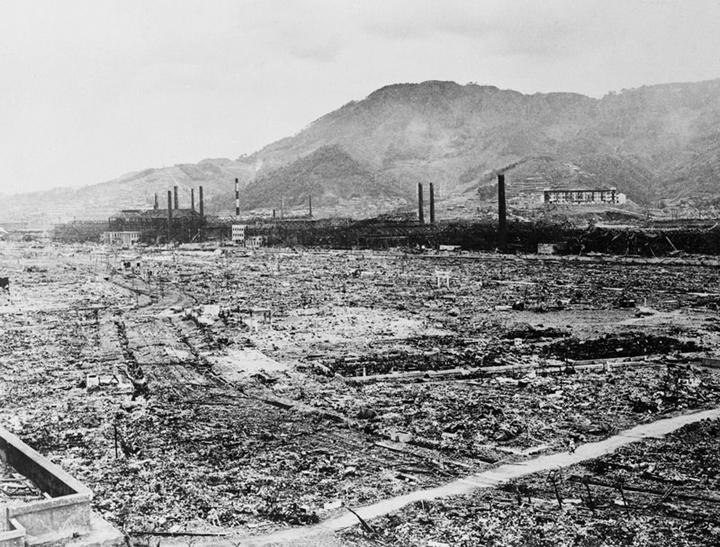 Nagasaki mayor slams Abe’s nuclear policy on atom bomb anniversary http://www.abc.net.au/news/2013-08-09/nagasaki-mayor-slams-abe-nuclear-policy/4877418 10 Aug 13,
VIDEO: Nagasaki mayor slams Abe’s nuclear policy on atom bomb anniversary (ABC News)
As tens of thousands of people gathered in Nagasaki for the anniversary, mayor Tomihisa Taue used the occasion to call for stronger anti-nuclear leadership from Tokyo.
Mr Taue says the recent failure to sign a statement rejecting the use of nuclear weapons under any circumstances was a betrayal. “If we cannot accept the wording that usage of nuclear weapon will never be permitted, it means the Japanese government is showing that nuclear weapons can be used depending on the circumstance,” he said.
Mr Taue called on Japan’s younger generation to hear the voices of the World War II bomb survivors and remember its devastating effects. The memorial was held at Nagasaki’s Peace Park, close to the spot where the US military dropped its bomb on August 9, 1945.
Seventy-four thousand of the city’s population of 240,000 were killed immediately or were dead within a year.
Japan’s Prime Minister Shinzo Abe also spoke at the event, reminding the audience that the Japanese are the only people to have experienced a nuclear attack. “We have the responsibility to bring about a world without nuclear weapons and it is our duty to continue to remind the world of the inhumanity (of nuclear weapons),” Mr Abe said.
Loss of trust in nuclear power, in North Asia
 In North Asia, a growing crisis of confidence in nuclear power By Faith Hung and Antoni Slodkowski TAIPEI/TOKYO | Fri Aug 9, 2013 A nuclear power plant in Taiwan may have been leaking radioactive water for three years, the government has said, adding to a growing crisis of confidence in North Asia about nuclear safety.
Japan is struggling to contain radioactive water pouring out of the Fukushima nuclear plant that was wrecked by a 2011 tsunami. In South Korea, prosecutors are conducting a massive investigation into forged safety certificates and substandard parts at many of its reactors.
Nuclear power has long been used as a reliable alternative to fossil fuels in natural resource-starved parts of Asia like Japan, Taiwan and South Korea, but the safety worries are forcing a rethink. A plan to build Taiwan’s fourth nuclear plant has been held up for years by street protests and a brawl in the legislature over safety issues. Most nuclear plants in Japan remain closed and nine of South Korea’s reactors have been shut down, six for maintenance and three to replace cables that were supplied using forged certificates.
Taiwan’s government watchdog, the Control Yuan, has said The First Nuclear Power Plant, located at Shihmen in a remote northern coastal location but not far from densely populated Taipei, has been leaking toxic water from storage pools of two reactors…….
The use of nuclear power on resource-poor Taiwan has long been controversial, not least because the island is comparatively small and any major nuclear accident would likely affect its entire land area…….. In South Korea, six reactors are currently closed – three for maintenance or expiry of operational approval, and the other three to replace cables supplied with forged documents.
Prosecutors are conducting a massive investigation into flawed nuclear reactors, arresting dozens of officials and parts makers on bribery and forgery charges in relation to falsified safety certificates.
Those arrested include the former the CEO of the state-run Korea Hydro & Nuclear Power that runs all the country’s nuclear plants, who faces bribery charges……. http://www.reuters.com/article/2013/08/09/us-asia-nuclear-idUSBRE9780BD20130809.
Mayors For Peace commit to a Nuclear Weapons-Free World
 After the bombing, the American military censored all documentation and photo images of the two bombs’ unparalleled human devastation, sheltering Americans from the horrors of what our government perpetrated on Japanese civilians: women, men, and children instantly reduced to ash.
The mayors of Easthampton, Holyoke and Northampton co-sponsored this resolution for a nuclear weapons-free world and are members of Mayors for Peace, the leading international organization with 5,600 member cities in 156 countries devoted to protecting cities from the scourge of war and mass destruction.
We honor their public commitment to a genuinely secure world
Doug Renick & Pat Hynes: Years after nuclear dawn, world lacks true security that people deserveBy DOUG RENICK and PAT HYNES August 8, 2013 NORTHAMPTON — This week is the anniversary of the use of atomic bombs on the cities of Hiroshima and Nagasaki, an act that launched the perilous era of nuclear weapons and nuclear power. After the first atomic blast Aug. 6, 1945, which killed 100,000 residents of Hiroshima immediately, the grievous radiation sickness of survivors was not anticipated, nor was it believed when reported.
Without any reconsideration, the United States dropped a second bomb 68 years ago today — this one plutonium — on Nagasaki, killing 70,000 citizens outright.
On Friday at 7 p.m. in Northampton, an event commemorating the victims of nuclear weapons and nuclear power will take place at McConnell Hall at Smith College. Continue reading
Now is the time for a Nuclear Weapons Convention
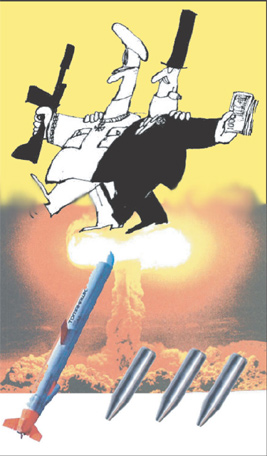 the manufacture and maintenance of nuclear warheads and the missiles, planes and submarines to deliver them anywhere in the world has grown into a huge business. In excess of $50 billion a year, this business — including Air Force bases, nuclear laboratories, manufacturing plants and other facilities — employs people in almost every congressional district, though far more Americans could be employed rebuilding infrastructure teaching, or providing health care if an equivalent sum were spent creating those jobs. The corporations that manufacture and manage these facilities spend millions a year in campaign contributions and lobbyists persuading our representatives in Congress not to cut the budget from any part of this huge “defense” conglomerate.
There is now a draft convention for the abolition of nuclear weapons at the United Nations, similar to those that ended chemical and germ warfare.
Peter G. Cohen: Time for a convention to abolish nuclear weapons The Cap Times, PETER G. COHEN | author of www.nukefreeworld.com 7 Aug 13 We now know that nuclear winter, ozone layer destruction, phytoplankton reduction and other effects of a nuclear exchange would massively affect health and life everywhere on Earth. How  can we respond to something so overwhelming, so huge, so threatening that there is nowhere to hide except in denial? We’ve been trying that for almost 70 years. The numbers of weapons are down, their accuracy and lethality are up. It is time to try something new.
After the disaster of Fukushima, several nations, including Germany, abandoned nuclear generation because of its dangers. But 13 nations are now constructing new power reactors. The problem is that the refinement of nuclear reactor fuel, if carried further, becomes weapons-grade highly enriched uranium. The operation of nuclear plants results in the byproduct of plutonium, which also can be used to make a bomb. Continue reading
Prime Minister Abe sees Fukushima clean-up as urgent government problem
 Japan’s leader weighs into nuclear clean-up debacle (includes video) The Age, August 7, 2013 – Japan’s prime minister says the government will get more involved in cleaning up the crippled Fukushima nuclear plant, as he described as “urgent” a battle to stop radioactive water from leaking into the ocean.
The government’s more prominent role comes as critics slam plant operator Tokyo Electric Power and its handling of the more than two-year-old atomic crisis, the worst nuclear accident in a generation.
The embattled power company, kept afloat by a government bail-out, last month admitted for the first time that radioactive groundwater had been leaking outside the plant, confirming long-held suspicions of ocean contamination from its shattered reactors. http://www.theage.com.au/world/japans-leader-weighs-into-nuclear-cleanup-debacle-20130807-2rgwx.html#ixzz2bPP2QbmG
Hiroshima Day commemorated by International Red Cross
 Switzerland: Ceremony recalls dangers of nuclear weapons http://www.icrc.org/eng/resources/documents/feature/2013/08-06-switzerland-japan-nuclear-bomb.htm 06-08-2013
A descendant of a Gingko biloba tree that survived the atomic bombing of Hiroshima in 1945 was planted at a ceremony at the ICRC’s headquarters in Geneva today, standing as a reminder of the horrific consequences of nuclear weapons and as a sign of hope that they will one day be eliminated.
The Gingko biloba planted today is the first sapling of the 200-year-old Hiroshima survivor tree to be planted in Switzerland.
The ICRC and the city of Hiroshima have a unique bond. Dr Marcel Junod, then head of the ICRC’s delegation in Japan, was the first foreign doctor to enter the devastated city a little over a month after the bombing, bringing with him desperately needed medical supplies. Since then, the ICRC, and the Red Cross and Red Crescent Movement more broadly, have regularly urged States to pursue the prohibition and elimination of nuclear weapons, drawing conviction from Junod’s shocking findings in Hiroshima.
ICRC delegate Fritz Bilfinger reached Hiroshima shortly after the bombing. He sent Dr Junod a shocked telegram describing the situation in the city.
Speaking at the event in Geneva today, ICRC vice-president Olivier Vodoz said: “Nuclear weapons are unique in their destructive power. The scale of the destruction, and the risk associated with exposure to ionizing radiation, make it nearly impossible to deliver adequate humanitarian assistance to victims in the aftermath of a nuclear blast.
We firmly believe that States must ensure such weapons are never used again.”
Read why there’s no way to deliver assistance in the event of a nuclear explosion.
Junod came face-to-face with the grim reality of medical care in the bombed city. The explosion had killed or injured 90% of Hiroshima’s doctors. There was a desperate need for blood, but most potential donors were either dead or injured. Junod’s memoirs bear witness to the appalling conditions he encountered in Hiroshima.
Find out more about Marcel Junod’s life and work in photos.
The seeds and saplings of a 200-year-old tree that survived the explosion have been nurtured and protected over the intervening decades and are now being planted worldwide. Today’s ceremony, organized in collaboration with Green Legacy Hiroshima and the United Nations Institute for Training and Research (UNITAR), featured a reading from Dr Junod’s Hiroshima memoirs by Olivier Vodoz. Deputy permanent representative of Japan in Geneva Takashi Okada delivered words of support, and the mayors of Hiroshima and Nagasaki sent messages of appreciation. Isabel Rochat, councillor of state of the republic and canton of Geneva, also attended the event.
The atomic bomb struck Hiroshima at 8.15 a.m. on 6 August 1945. When Junod visited a month later, he found the city frozen in time. In his book Warrior without Weapons he writes:: “On what remained of the station facade the hands of the clock had been stopped by the fire at 8.15. It was perhaps the first time in the history of humanity that the birth of a new era was recorded on the face of a clock.”
Visit the section of our site on nuclear weapons.
Harvey Wasserman wants copy of “Pandora’s Promise” for review
Harvey Wasserman edits www.nukefree.org. His Solartopia Green Power & Wellness Show is at www.prn.fm.  SOLARTOPIA! OUR GREEN-POWERED EARTH is at www.solartopia.org.
The producers of the pro-SMR Pandora’s Promise have refused to send us a review copy; if you have one, please write us at www.nukefree.org
1 This Month

petition to oppose the rapid increase of space-military industry threatening Jeju Island and the region.
[Petition by April 19th (KST)] Stop the joint military-Hanwha Systems-Jeju Provincial Government Sea Launch!
World Nuclear Power. Reactors 1951-2026, 75 Years of Nuclear Power.
Interactive Map– https://dv.worldnuclearreport.org/
Chernobyl: The Lost Tapes – A good documentary on Chernobyl on SBS available On Demand for the next 3 weeks– https://www.sbs.com.au/ondemand/tv-program/chernobyl-the-lost-tapes/2352741955560

of the week–London Campaign for Nuclear Disarmament

Tell the Ukrainian Government to Drop Prosecution of Peace Activist Yurii Sheliazhenko
To see nuclear-related stories in greater depth and intensity – go to https://nuclearinformation.wordpress.com
-
Archives
- April 2026 (194)
- March 2026 (251)
- February 2026 (268)
- January 2026 (308)
- December 2025 (358)
- November 2025 (359)
- October 2025 (376)
- September 2025 (257)
- August 2025 (319)
- July 2025 (230)
- June 2025 (348)
- May 2025 (261)
-
Categories
- 1
- 1 NUCLEAR ISSUES
- business and costs
- climate change
- culture and arts
- ENERGY
- environment
- health
- history
- indigenous issues
- Legal
- marketing of nuclear
- media
- opposition to nuclear
- PERSONAL STORIES
- politics
- politics international
- Religion and ethics
- safety
- secrets,lies and civil liberties
- spinbuster
- technology
- Uranium
- wastes
- weapons and war
- Women
- 2 WORLD
- ACTION
- AFRICA
- Atrocities
- AUSTRALIA
- Christina's notes
- Christina's themes
- culture and arts
- Events
- Fuk 2022
- Fuk 2023
- Fukushima 2017
- Fukushima 2018
- fukushima 2019
- Fukushima 2020
- Fukushima 2021
- general
- global warming
- Humour (God we need it)
- Nuclear
- RARE EARTHS
- Reference
- resources – print
- Resources -audiovicual
- Weekly Newsletter
- World
- World Nuclear
- YouTube
-
RSS
Entries RSS
Comments RSS
 nuclear-news