“Nuclear strikes on Syria” – the news item that disappeared from the Web

Polynesians paid the radioactive price of atomic bomb testing
Battle against nuclear risks unending Stuff.co.nz LIZ WILLIS 6 Aug 13, Health problems for people close to atomic bomb testing at Mururoa are a reminder of why public pressure against nuclear weapons is so important, peace campaigner John Buckland says.
New Zealand’s anti-nuclear stance is back in the spotlight as navy veterans mark 40 years since two Kiwi frigates sailed to protest against French testing in the Pacific.
Mr Buckland says the veterans deserve to be involved in a comprehensive state-supported investigation into deaths and radiation-linked illnesses.
The Birkenhead resident, who received a lifetime peacemakers award from the Peace Foundation for his education work, gathered information about testing during a holiday in Tahiti.
Tahiti is a dream destination but visitors are often unaware of the darker side of life for French Polynesians – the ongoing medical impact of exposure to radioactive fallout, Mr Buckland says.
He says the extent of deaths and radiation sickness from more than 30 years of testing by the French government has been hidden and locals are scared to talk about it. “It is known that 200 victims of radiation were flown from Tahiti for treatment in French hospitals, but nothing is known of their fate.”…..http://www.stuff.co.nz/auckland/local-news/north-shore-times/9003381/Battle-against-nuclear-risks-unending
Small Modular Nuclear reactors (SMRs) – the new “too cheap to meter” con
 Nuclear Reactors Can’t Handle Global Warming, Progressive, By Harvey Wasserman, August 5, 2013
“…….many are pushing an entirely new radioactive gizmo–a “Small Modular Reactor”–with no working prototypes. True to form, the budget and timetable stretch deep into the unknown.
Lead SMR manufacturer Babcock & Wilcox brought us both Three Mile Island and Ohio’s Davis-Besse, whose pressure head was infamously eaten through to the brink by boric acid. The core SMR technology has already been distinguished by a long line of generic failures.
The Tennessee Valley Authority has just postponed the target date to apply for the first SMR construction license until at least 2015. Ultimate development costs are a giant question mark. The huge Savannah River facility meant to convert weapons-grade materials into nuclear fuel for such projects is on the brink of cancellation, with untold billions already down the tubes.
So as its backers claim an unproven ability to help solve an ultra-urgent climate crisis, there won’t be an SMR prototype deployed for an unknowable number of years, at what is certain to be a staggering cost.
With taxpayer money pouring in, even industry supporters already warn of an “atomic Solyndra.”…..
SMR backers still chant the original “too cheap to meter” mantra, claiming a miraculous but unproven ability to somehow burn up old warheads and avoid small annoyances like TMI, Chernobyl, and Fukushima.
But the SMR is already on that familiar atomic go-round of production delays, cost overruns, immediate obsolescence and serious dangers its makers won’t disclose.
Despite a concerted attack from the corporate media, today’s world gets far more usable energy from renewables than SMRs can produce now (none) or for many years to come.
Our sustainable future depends on proven green power, not a supremely expensive failed atomic experiment and its pie-in-the-sky reruns. http://www.progressive.org/nuclear-reactors-global-warming
Nuclear Test Ban Treaty ended all but underground nuclear bomb testing
History was made fifty years ago today, as the superpowers agreed to end all nuclear weapons tests in the atmosphere, water, and outer space. The treaty signed on August 5, 1963 sharply reduced the amount of dangerous nuclear fallout in the human diet, and saved thousands, perhaps millions of lives worldwide. Now we need to extend the ban to nuclear power plants to achieve the same benefits to humankind.
The test ban marked the end of a long and sometimes terrifying period of history. Just four years after the U.S. dropped the first atom bombs on Japan, the Soviet Union successfully developed its own nuclear devices, putting these unprecedented weapons of mass destruction at the core of the Cold War. The Communist goal of world domination and the determination of anti-Communists to prevent it now became entangled with a sprint to win an all-out nuclear war.
The arms race meant that the Americans and Soviets ultimately conducted 422 nuclear weapons tests that spewed nuclear isotopes into the atmosphere in an effort to stockpile staggering numbers of nuclear weapons. The eventual peak number of weapons was 26,000 for the U.S. and 37,000 for the Soviet Union. Some were hydrogen bombs, which were thousands of times more powerful than those used in Japan…………….http://www.counterpunch.org/2013/08/05/the-legacy-of-the-comprehensive-test-ban-treaty/
Exempt from normal market rules – the nuclear zomby industry
It’s a testament to how exempt nuclear power appears to be from ordinary market rules.
Nuclear Infant Zombies? City Watch by Peter Dykstra 30 Jul 2013
Perhaps the oddest thing about nuclear power’s journey through American history is that we can’t seem to decide whether nukes are dying, being reborn, or walking around as zombies.
On the one hand, nuclear plants have had a bad-news few years. In June, Southern California Edison announced that it would permanently shut its trouble-plagued reactors at San Onofre, which powered 1.4 million homes in the region. By September, the plant will have laid off nearly two-thirds of its 1,500 workers. (The plant was already doomed by a legacy of breakdowns and failed fixes when the Fukushima disaster in Japan persuaded many Californians it posed a threat to the 8.5 million people who live within 50 miles of it.)
This spring, Dominion Resources closed its Kewaunee nuclear plant south of Green Bay, Wisconsin. The plant was in good working order, but falling energy prices made Kewaunee not worth the trouble. (Ironically, Dominion had just received a hard-fought renewal of its operating license for the plant.) …….
The industry’s origins date to the 1950s, when “too-cheap-to-meter” nuclear energy was touted as a sidekick to the H-bomb and a mascot for the Cold War. …..
, Wall Street also noticed that nuclear plants were not the financial performers they were cracked up to be. After the near-disaster at Pennsylvania’s Three Mile Island, financial interests in new nukes went into cold shutdown.
As Forbes put it in 1985, “The failure of the U.S. nuclear power program ranks as the largest managerial disaster in business history, a disaster on a monumental scale. … It is a defeat for the U.S. consumer and for the competitiveness of U.S. industry, for the utilities that undertook the program and for the private enterprise system that made it possible.” Continue reading
Despite government propping up, the nuclear industry is failing globally
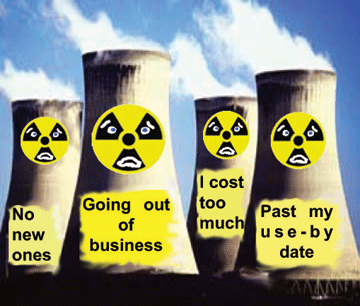
 Nuclear Power Is Being Abandoned Worldwide Nuclear Power Is Being Abandoned Worldwide | Global By Washington’s Blog Global Research, July 27, 2013
Even though the American government has done everything possible to encourage nuclear power – bywholly subsidizing nuclear power, reducing safety standards after Fukushima, forcing Japan to re-start its nuclear program, covering up the severity of the Fukushima accident, raising acceptable radiation limits and agreeing to buy radioactive Japanese seafood – the number of nuclear plants worldwide and percentage of electricity provided by nuclear is declining.
The Economist reports:
The [nuclear] industry’s role in electricity production is continuing to decline, according to this year’s World Nuclear Industry Status Report, a compendium of analysis and data by the activist and expert Mycle Schneider. The number of reactors peaked in 2002 at 444, compared with 427 today. The share of electricity they produce is down 12% from its 2006 peak, largely because of post-Fukushima shutdowns in Japan. As a proportion of all electricity generated, nuclear peaked in 1993 at 17% and has now fallen to 10%. The average age of operating plants is increasing, with the number over 40 years old (currently 31 plants) set to grow quite rapidly.
This is no loss. Nuclear power is expensive and bad for the environment. And – no matter what you may have heard – it does not help reduce carbon dioxide.
But the answer is not fossil fuels, either … it is decentralization
Malawi’s losses due to unfair uranium deal with Paladin Energy
Malawian dies on duty at Kayelekera Uranium Mine in Karonga, By Nyasa Times Reporter July 31, 2013
| “………The tragic incident has cast a shadow over the company which is already facing mounting criticism following reports the country was losing out from the favourable tax regime agreed with the company by the former administration of late President Bingu wa Mutharika. |
Last week, the United Nations’ Special Rapporteur on the Right to Food, Olivier de Schutter, also reiterated that Malawi was losing out due to tax incentives given to Paladin……..
As a result of tax incentives, one estimate suggests that Malawi may lose between US$ 205 million and US$ 281 million over the 13 years of the project.
But the current government of Joyce Banda has indicated it has started negotiations with the company to have the agreement reviewed. http://www.nyasatimes.com/2013/07/31/malawian-dies-on-duty-at-kayelekera-uranium-mine-in-karonga/
Communities’ Inheritance of radioactive trauma
The Inheritance of Trauma: Radiation Exposed Communities Around the World The Inheritance of Trauma: Radiation Exposed Communities Around ... HNN Huntingtonnews.net Monday, July 29, 2013 There have been over 2,000 nuclear weapon tests since 1945. Tests have been conducted on every continent except South America and Antarctica. Many nuclear weapons were tested above ground spreading large amounts of radioactive fallout across communities located downwind from the various test sites. Additionally, the production of materials for nuclear weapons has also contaminated large areas near to weapon production facilities. Accidents at nuclear power plants have also contaminated communities and made large areas uninhabitable for the foreseeable future.
Here in Japan where we are still in the early stages of understanding the impacts of the Fukushima nuclear meltdowns on the people and the environment of Tohoku and Japan as a whole, the lessons of previous historical exposures of communities to radiation offers lessons and warnings of the challenges only now unfolding. Jacobs will discuss how the presentation of these challenges as unprecedented and therefore unknowable and unforeseeable is typical of the management of exposed communities.
Hold up to plan to ship radioactive steam generators across Great Lakes
Nuclear power plant puts radioactive shipping plans on hold Plan to move 16 radioactive steam generators was met with strong opposition CBC News Jul 28, 2013
A plan to ship 16 radioactive steam generators through the Great Lakes and the St. Lawrence River for recycling in Sweden has been cancelled after delays caused by public opposition.
An agreement was reached in 2009 between Bruce Power in Tiverton, Ont., and Swedish company Studsvik, but Bruce Power president Duncan Hawthorne said the plans have been put on hold to allow further discussion with First Nations, Métis and other groups.
The move has been strongly opposed by aboriginal groups, the Bloc Quebecois, the NDP and a number of community and environmental organizations over the past two years.
Emma Lui of the Council of Canadians said there are many concerns, but the “big one” is the possible threat to the Great Lakes if something went wrong with the shipment.
Kahnawake Mohawk Council spokesman Joe Delaronde said the change in plans shows that public pressure can keep companies like Bruce Power in check.
“We’re pretty happy that they’ve done the right thing here. And, when they come up with other options, I’m sure they’ll be publicized as well,” Delaronde said…..
“You can’t keep this kind of thing secret and try to sneak it through……
A plan to ship 16 radioactive steam generators through the Great Lakes and the St. Lawrence River for recycling in Sweden has been cancelled after delays caused by public opposition.
An agreement was reached in 2009 between Bruce Power in Tiverton, Ont., and Swedish company Studsvik, but Bruce Power president Duncan Hawthorne said the plans have been put on hold to allow further discussion with First Nations, Métis and other groups.
The move has been strongly opposed by aboriginal groups, the Bloc Quebecois, the NDP and a number of community and environmental organizations over the past two years.
Emma Lui of the Council of Canadians said there are many concerns, but the “big one” is the possible threat to the Great Lakes if something went wrong with the shipment.
Kahnawake Mohawk Council spokesman Joe Delaronde said the change in plans shows that public pressure can keep companies like Bruce Power in check.
“We’re pretty happy that they’ve done the right thing here. And, when they come up with other options, I’m sure they’ll be publicized as well,” Delaronde said.
“You can’t keep this kind of thing secret and try to sneak it through…….
Time to counter the exploitation of indigenous peoples
Canada’s history awash with crimes against First Nations Rabble Ca By Gerry Caplan
| July 29, 2013 “………There’s been a lot of talk recently of Canada being guilty of genocidal policies against its Indian population. One Globe and Mail op-ed. gave several shake-your-heads examples of these, concluding with “the uncomfortable truth that modern Canada is founded upon ethnic cleansing and genocide.” I teach about the 1948 UN Convention on the Prevention and Punishment of Genocide, and even a quick glance at the document reveals that such accusations are by no means reckless hyperbole. Since we began as a nation, as the Assembly of First Nations said last week, we have treated aboriginals as “less than human.” That’s precisely what allows genocidal policies to be pursued.
Heavy stuff, for sure. And extremely un-Canadian. Aboriginal-wise, I’m afraid, the conceit of Canada as the caring-sharing peaceable kingdom has been plain old malarkey from Day One. As the record makes only too clear, the right words would actually include racist, cruel and hypocritical.
So those with power keep repeating century-old mistakes, mostly because they refuse to change the basic relationship between whites and Indians (to use Tom King’s terms) to one of respectful partnerships between equals. That’s what should make us shudder and shake our heads, but it hardly counts as new news.
And yet, besides the monotonous horror stories, there are all the many positive initiatives across the country that rarely make the news at all, accounts of First Nations people who are fighting back thoughtfully, peacefully, creatively. They’re mad as hell and clever as hell and won’t take it any more. Now all they need is for the rest of us to join in putting pressure on a government that’s devoted to the rights of energy and mining companies instead of the rights of our founding peoples…..
USA still gearing up for nuclear war
 Still getting ready for nuclear war City Watch by Lawrence S. Wittner 26 Jul 2013 Nearly a quarter century after the disappearance of the Soviet Union and the end of the Cold War, the U.S. government is still getting ready for nuclear war.
This fact was underscored on June 19, 2013, when the Pentagon, on behalf of President Barack Obama, released a report to Congress outlining what it called the U.S. government’s “Nuclear Employment Strategy.” Although the report indicated some minor alterations in U.S. policy, it exhibited far more continuity than change.
In 2010, the administration’s Nuclear Posture Review declared that it would work toward making deterrence of nuclear attack the “sole purpose” of U.S. nuclear weapons. The 2013 report, however, without any explanation, reported that “we cannot adopt such a policy today.” Thus, as in the past, the U.S. government considers itself free to initiate a nuclear attack on other nations……………
This administration unwillingness to discard the immensely dangerous, outdated nuclear policies of the past flies in the face of public support for abolishing nuclear weapons, whether expressed in public opinion polls or in the resolutions of mainstream bodies like the National Council of Churches and the U.S. Conference of Mayors. But, unless there is a substantial public mobilization to end the American government’s reliance on nuclear war, it seems likely that U.S. officials will continue to prepare for it. http://www.citywatchla.com/8box-left/5458-still-getting-ready-for-nuclear-war
Depleted uranium discovery causes Florida airport evacuation
Florida airport evacuated after depleted uranium discovered http://rt.com/usa/uranium-depleted-miami-airport-595/
Nuclear Abolition Week activities in 25 countries
Nuclear Abolition Week: A great success http://www.icanw.org/campaign-news/nuclear-abolition-week-a-great-success/#.Ue2mrtJwo6I In Africa, Asia, Europe, Latin America, the Middle East, North America and in the Pacific, for Nuclear Abolition Week 2013, ICAN campaigners organised bike trips, Target X actions, flag hoisting, parties, cabin trips, church services, beach days, press conferences, exhibitions, public meetings, round tables, meetings with government officials, social media outreach, film screenings, pub quizzes, and many other activities. In addition to this, more than five hundred people shared their shadows in solidarity with the victims of nuclear detonations, and several thousands signed ICAN’s online petition calling for a treaty banning nuclear weapons. This report outlines the main achievements of Nuclear Abolition Week 2013.
25 countries…
Mochizuki ‘s Fukushima Diary is for those who want to know the truth
 I want Fukushima Diary to be a monster / Make a hole on the information great wall http://fukushima-diary.com/2013/07/column-i-want-fukushima-diary-to-be-a-monster-make-a-hole-on-the-information-great-wall/ by Mochizuki on July 18th, 2013 The asian face reflected on the screen is being covered with the alphabets as I write articles.
This is the best thing I can do to the world.
Sometimes I suddenly stop and think what the hell I’m doing. Shouldn’t I go back to my land and die together ?
and then I remember.
Everyone says I must miss my land. In movies and TV drama, that’s likely. but actually I’m scared of it. All the good memories end with 311. Everything was on the path to Fukushima accident.
I know my past life was a lie. I used to feel like it was lie but didn’t do anything lazily. I was thinking questioning was immature. I hate myself having thought so.
It may be the difficult feeling to share.
I’m not doing Fukushima Diary for everyone. It’s just for the people who want to know the truth. Continue reading
Japanese public do not trust Prime Minister Abe on restart of nuclear plants
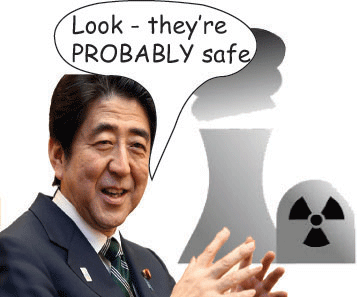 The problem is that few Japanese now trust the government’s promises that it can make nuclear power safe.
The public will not accept a sudden, complete restart anytime soon. Even in the long term, chances are
slim.
 Abe’s Nuclear Promises and the Trust Deficit. WSJ The nuclear impasse will be an early test of whether Mr. Abe can lead the country through much-needed reforms By MINAMI FUNAKOSHI, 19 July 13 Prime Minister Shinzo Abe is expected to win a majority in Sunday’s Upper House elections Sunday, but governing Japan will still be difficult. To implement the Liberal Democratic Party’s economic revival platform he needs not just citizens’ votes but their trust—and that is in short supply nowadays. Continue reading
1 This Month

petition to oppose the rapid increase of space-military industry threatening Jeju Island and the region.
[Petition by April 19th (KST)] Stop the joint military-Hanwha Systems-Jeju Provincial Government Sea Launch!
World Nuclear Power. Reactors 1951-2026, 75 Years of Nuclear Power.
Interactive Map– https://dv.worldnuclearreport.org/

Chernobyl: The Lost Tapes – A good documentary on Chernobyl on SBS available On Demand for the next 3 weeks– https://www.sbs.com.au/ondemand/tv-program/chernobyl-the-lost-tapes/2352741955560

of the week–London Campaign for Nuclear Disarmament

Tell the Ukrainian Government to Drop Prosecution of Peace Activist Yurii Sheliazhenko
To see nuclear-related stories in greater depth and intensity – go to https://nuclearinformation.wordpress.com
-
Archives
- April 2026 (194)
- March 2026 (251)
- February 2026 (268)
- January 2026 (308)
- December 2025 (358)
- November 2025 (359)
- October 2025 (376)
- September 2025 (257)
- August 2025 (319)
- July 2025 (230)
- June 2025 (348)
- May 2025 (261)
-
Categories
- 1
- 1 NUCLEAR ISSUES
- business and costs
- climate change
- culture and arts
- ENERGY
- environment
- health
- history
- indigenous issues
- Legal
- marketing of nuclear
- media
- opposition to nuclear
- PERSONAL STORIES
- politics
- politics international
- Religion and ethics
- safety
- secrets,lies and civil liberties
- spinbuster
- technology
- Uranium
- wastes
- weapons and war
- Women
- 2 WORLD
- ACTION
- AFRICA
- Atrocities
- AUSTRALIA
- Christina's notes
- Christina's themes
- culture and arts
- Events
- Fuk 2022
- Fuk 2023
- Fukushima 2017
- Fukushima 2018
- fukushima 2019
- Fukushima 2020
- Fukushima 2021
- general
- global warming
- Humour (God we need it)
- Nuclear
- RARE EARTHS
- Reference
- resources – print
- Resources -audiovicual
- Weekly Newsletter
- World
- World Nuclear
- YouTube
-
RSS
Entries RSS
Comments RSS
 nuclear-news