Fukushima businesses struggling to stay afloat despite government help

Rokutaro Kurihara, managing director of a company that runs a shopping complex in Iitate village in Fukushima Prefecture, is struggling to keep his business afloat.
Jan 29, 2021
Commercial complexes built as part of revitalization projects in areas affected by the triple meltdown at the Fukushima No. 1 nuclear power plant in March 2011 are struggling to stay afloat.
Faced with difficulties due to swelling costs, business operators often turn to local municipalities for financial aid to help them overcome crises. But the financial struggles will not end soon, given that only a portion of the residents who evacuated from the disaster-stricken areas have returned or are expected to.
Those outlets are now facing a testing moment that will determine whether they can continue with their businesses.
A small village in Fukushima Prefecture located northwest of the power plant, Iitate, which was issued evacuation orders after the nuclear disaster, built the commercial complex Michi no Eki Madeikan for ¥1.4 billion. However, business at the commercial building, which has a convenience store and a vegetable stand, has always been touch and go.
Madei Garden Village Iitate runs the business using a ¥33 million payment from the local government. But even with those funds, the operator saw a deficit of ¥9 million in fiscal 2017 and ¥8 million the following year.
Faced with a severe financial crisis, the company was forced to seek financial aid worth ¥35 million from Iitate in 2018.
After revising its business strategy, the company managed to reduce running costs and decrease the deficit to ¥300,000 in fiscal 2019.
“We are expecting a profit in fiscal 2020. I’ll be dealing with the accumulating debt as a priority,” says Rokutaro Kurihara, the company’s managing director.
Kurihara’s company is among those operating at 12 commercial facilities in 10 towns in areas that used to be designated as no-go zones, including the town of Namie and Tamura city.
Since most of the stores and shops shut down when residents evacuated from the region, local governments have built them for returning residents.
But many of them share the same fate as Kurihara’s.
In the town of Tomioka, Sakura Mall Tomioka, which houses various shops including a grocery store, operates with support from the the town and Fukushima Prefecture, covering its yearly losses worth ¥22 million.
But an official at the municipal government warns that the town will need to raise its rent after the prefecture’s subsidy program ends at the end of fiscal 2021.
Not all tenants deal with financial stress. However, businesses that continue to attract customers worry they may lose them to competitors outside the region.
The operator of Kokonara Shopping Street, a shopping complex that opened in 2018 in the town of Naraha, believes that they cannot meet customers’ needs because they do not have much space. Recent estimates show that cashiers at the center’s 10 stores, including a supermarket and a retailer with daily necessities, served as many as 570,000 customers in fiscal 2019.
But Shigeki Nemoto, who runs a supermarket at the Kokonara shopping facility with limited products available, says he may lose his customers to a nearby, larger shopping complex.
“Our shop is really small and we are struggling to source the product lineup we would like to offer to respond to the needs of our customers,” Nemoto said, adding that he had to reduce its range of meat and fish products.
His store is about 500 square meters, about half the floor space of an average supermarket.
“The neighboring city of Iwaki has a supermarket twice as big as ours with a floor space of 1,000 square meters and we’re worried that we’ll lose out to the competition,” Nemoto added.
Meanwhile, shops operating in areas where the government-run revitalization projects are ongoing depend on workers engaged in the projects for their business.
For instance, Minamisoma city built the only supermarket in its Odaka district, which had its no-go status lifted in 2016, for ¥240 million in 2018.
But the daily number of customers now hovers at around 250.
Many workers for the government reconstruction project visit the store in the afternoon or in the evening to purchase take-out meals or daily necessities. But when the reconstruction project finishes, those workers will disappear as well.
“Operators in the area should invest more in mobile catering and delivery services to boost potential demand and lure former residents back,” a Minamisoma official said.
This section features topics and issues from the Tohoku region covered by the Kahoku Shimpo, the largest newspaper in Tohoku. The original article was published Dec. 30.
https://www.japantimes.co.jp/news/2021/01/29/national/fukushima-business-struggles/
Newly found Fukushima plant high radiation to delay cleanup process

This Jan. 31, 2014, image released by Tokyo Electric Power Company Holdings shows the aerial view of the No. 3 reactor, with its roof blown off and shield plug (circle in the middle) exposed, in Okuma town, Fukushima prefecture, northeastern Japan. A draft investigation report into the 2011 Fukushima nuclear meltdown, adopted by Japanese nuclear regulators Wednesday, Jan. 27, 2021, says it has detected dangerously high levels of radioactive contamination at two of the three reactors, adding to concerns about decommissioning challenges.
Newly found Fukushima plant contamination may delay cleanup
January 27, 2021
TOKYO – A draft investigation report into the 2011 Fukushima nuclear meltdown, adopted by Japanese nuclear regulators Wednesday, says it has detected dangerously high levels of radioactive contamination at two of the three reactors, adding to concerns about decommissioning challenges.
The interim report said data collected by investigators showed that the sealing plugs sitting atop the No. 2 and 3 reactor containment vessels were as fatally contaminated as nuclear fuel debris that had melted and fell to the bottom of the reactors following the March 2011 tsunami and earthquake.
The experts said the bottom of the sealed plug, a triple-layered concrete disc-shaped lid 12 meters (39 feet) in diameter sitting atop the primary containment vessel, is coated with high levels of radioactive Cesium 137.
The No. 1 reactor lid was less contaminated, presumably because the plug was slightly knocked out of place and disfigured due to the impact of the hydrogen explosion, the report said.
The experts measured radiation levels at multiple locations inside the three reactor buildings, and examined how radioactive materials moved and safety equipment functioned during the accident. They also said venting attempt at Unit 2 to prevent reactor damage never worked, and that safety measures and equipment designs still need to be examined.
The lid contamination does not affect the environment as the containment vessels are enclosed inside the reactor buildings. The report did not give further details about if or how the lid contamination would affect the decommissioning progress.
Nuclear Regulation Commission Chairman Toyoshi Fuketa called the findings “extremely serious” and said they would make melted fuel removal “more difficult.” He said figuring out how to remove the lids would be a major challenge.
Removing an estimated 900 tons of melted fuel debris from three reactors is a daunting task expected to take decades, and officials have not been able to describe exactly when or how it may end.
The Fukushima plant was to start removing melted fuel debris from Unit 2, the first of three reactors, later this year ahead of the 10th anniversary of the accident. But in December, plant operator Tokyo Electric Power Co. and the government announced a delay until 2022. They said the development of a robotic arm for the debris removal — a joint project with Britain — has been delayed due to the pandemic.
Under the current plan, a remote-controlled robotic arm will be inserted from the side of the reactor to reach the molten fuel mixed with melted parts and concrete floor of the reactor. Eventually the lids also would have to be removed, but their contamination is a major setback.
The team of experts entered areas inside the three reactors that were previously highly contaminated and inaccessible after radiation levels came down significantly. They’re seeking data and evidence before they get lost in the cleanup.
Massive radiation from the reactors has caused some 160,000 people to evacuate from around the plant. Tens of thousands are still unable to return home.
https://www.local10.com/tech/2021/01/27/newly-found-fukushima-plant-contamination-may-delay-cleanup/
High radiation facilities inside Fukushima No. 1 nuclear power plant may delay decommissioning process
January 27, 2021
Ahead of the 10-year anniversary of the March 2011 accident at Tokyo Electric Power Company Holdings Inc.’s Fukushima No. 1 nuclear power plant, a panel of the Nuclear Regulation Authority on Tuesday released a draft interim report on the accident investigation, which resumed in September 2019. The on-site investigation found that there were areas with extremely high radiation levels near the fifth floor of the reactor buildings of Units 2 and 3. This may lead to a delay in the decommissioning process of the plant.
According to the draft report, high levels of contamination were found at the bottom of a concrete lid called a shield plug, located at the top of the reactor containment vessel. Radioactive cesium there was estimated to be giving off about 20 to 40 petabecquerels of radiation at Unit 2 and about 30 petabecquerels at Unit 3. (The prefix peta indicates 1,000 trillion.)
In terms of radiation dosage, this is likely to be equivalent to several sieverts per hour. If a person were to enter the area, a fatal dose would accumulate in just a few hours.
TEPCO plans to first remove the nuclear fuel debris, which is a mixture of melted nuclear fuel and other materials, from the Unit 2 reactor. Depending on the removal route, it may be necessary to remove the shield plug. The removal of this structure is expected to take a long time, not only because of the high radiation levels but also because the shield plug weighs a total of 465 tons.
Looking back at what had happened during the crisis at the plants in 2011, the panel also examined the effects of venting, or releasing steam containing radioactive materials into the atmosphere to reduce pressure, which was done to prevent damage to the containment vessels. As a result of examining the piping and other parts, the panel found that steam flowed back into the reactor buildings of Units 1 and 3, where the venting was successful.
They also analyzed the TV footage from that time and noted that there had been multiple hydrogen explosions at the Unit 3 reactor
Fukushima College robot wins top prize for nuclear decommissioning

The Mehikari robot developed by a team at Fukushima College
Jan 25, 2021
Fukushima – A robot created by a team from a technology college in northeastern Japan recently won the top prize in a robotics competition that had the theme of decommissioning the Fukushima No. 1 nuclear power plant.
The Mehikari robot of Fukushima College earned praise for its speed as well as ability to employ different methods to retrieve mock debris similar in size to that at the plant, the site of a nuclear disaster triggered by a massive earthquake and tsunami on March 11, 2011.
The robot completed the set task in about 2 minutes, the fastest time, in the annual competition aimed at fostering future engineers that was attended by students from 13 colleges belonging to the National Institute of Technology.
Sunday’s competition was the fifth of its kind. Students in 14 teams from the colleges across the country such as in Osaka and Kumamoto prefectures were tasked this year with developing robots to remove fuel debris from the plant, organizers said.
“I’ll be happy if our robot is useful on the ground,” said Hiroha Toba, the 18-year-old leader of the winning team.
The robots were required to pass through a 4-meter-long pipe, land on a pedestal, collect balls representing fuel debris situated 3.2 meters below and return within 10 minutes.
The robots had to be remotely operable without a direct line of sight.
Also according to the contest rules, radio waves could not penetrate certain sections of the field, resembling the real-life situation in which the Fukushima No. 1 plant is covered by thick concrete walls. This meant the teams had to transmit directions by wire when the robots passed those areas.
Due to the coronavirus pandemic, the teams submitted videos of the robots’ performance to the organizers in advance. They were evaluated based on speed, accuracy and originality of retrieval method.
The competition was mainly organized by the Japan Atomic Energy Agency and had the support of the education ministry and other entities.
Ex-classmates reunite at school abandoned after Fukushima disaster

Old friends Nozomi Kaminagakura (L) and Mari Yamamoto hug each other in a schoolyard before parting on Jan. 9, 2021
Jan 24, 2021
Namie – “Take care. Let’s meet again,” Nozomi Kaminagakura and Mari Yamamoto said repeatedly as they hugged in a corner of a weed-strewn schoolyard in the town of Namie in Fukushima Prefecture that is still partly under an evacuation order.
The friends were neighbors until they were forced to leave their hometown when they were in the fourth grade because of the Fukushima nuclear disaster triggered by the March 2011 earthquake and tsunami in northeastern Japan.
They smiled for most of the day when they visited Namie in January but became tearful as they were about to part. Wearing kimono, they had attended a coming-of-age ceremony in the town earlier in the day.
Amid the COVID-19 pandemic, seats at the ceremony were spaced apart and the participants only took off their face masks for the commemorative photograph. There was no reunion party afterward.

Former classmates visit Karino Elementary School
Eleven former classmates along with their families visited the abandoned building of Karino Elementary School, which is set to be demolished.
In contrast to the bleak schoolyard, the young adults were cheerful as they shared stories of their school days and took photos.
Their parents also looked delighted to see them enjoying their reunion.
“Where do you live now?” they asked one another. One even asked, “Do you really remember me?”
It was their first return to the school together since the disaster forced all the residents of the town to evacuate.
“We were separated without any time to prepare,” one of them said.

Former classmates take a photo in the schoolyard. As many as 11 of them gathered for the first time in almost a decade
Kaminagakura, now a university student in Sendai in adjacent Miyagi Prefecture, said the area where she and Yamamoto used to lived remains basically off limits because radiation levels are still high.
Affectionately calling each other “Non-chan” and “Mari-chan,” they played almost every day back then, at a nearby river in the summer and sledding on a hill in the winter.
“I never thought we’d be unable to see each other,” Kaminagakura said, adding she had expected to return to the town after a short time.
“It’s not the Namie I knew,” she said.
At the school, however, she was able to freely converse with her former classmates, even after such a long time. “I was glad they haven’t changed.”
Minori Yoshida, who attends a technical school in Yokohama, near Tokyo, was forced to evacuate in the midst of moving to her new home in the town. The house remains vacant.
“I feel at ease whenever I come to Namie,” said Yoshida, who was visiting for the first time in three years with her family, who now live in the city of Fukushima.
When asked why she feels so, Yoshida said, “Because it is in the countryside? I have mixed feelings though, looking at the scenery now.”
About her friends from Namie, she said, “They are special to me.”

The 11 young adults stand side-by-side for a group photo in front of a school building to be demolished.
It might be the last time the former classmates could gather at the school before its demolition. They took a group photo in front of the school building.
A banner placed on the three-story building’s balcony read, “Forever in the hearts of Karino pupils. Thank you, Karino Elementary School.”
The 11 former classmates were slow to leave, even though the sun was setting, and kept repeating, “Take care. Let’s meet again.”

Nozomi Kaminagakura (L) and Mari Yamamoto in kimono pose in the schoolyard.
Tokyo High Court rules state not liable in 2011 nuclear accident
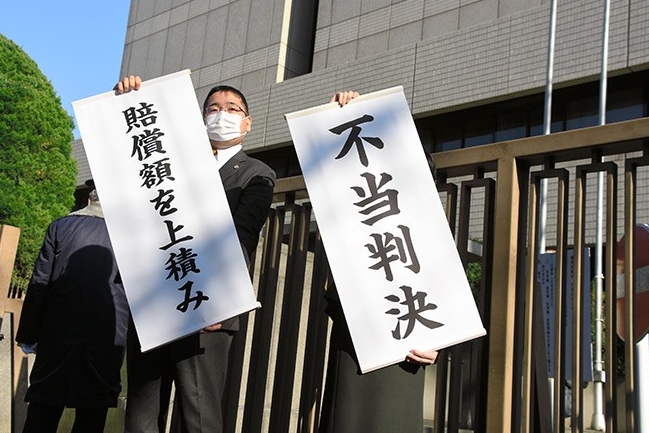
The Tokyo High Court finds the state not liable for the 2011 Fukushima nuclear power plant accident. A legal team member for the plaintiffs holds up a sign stating, “It is an unjust ruling,” in Tokyo on Jan. 21.
January 22, 2021
The Tokyo High Court has ruled the government should not be held responsible for the 2011 Fukushima No.1 nuclear power plant accident and be forced to pay compensation to evacuees.
Residents who evacuated to Gunma Prefecture due to the accident claimed damages against the government and Tokyo Electric Power Co. (TEPCO). But according to the Jan. 21 appellate ruling, the court found the state was not liable and ordered only TEPCO to pay compensation.
That followed a lower court ruling by the Maebashi District Court that found both parties liable.
The Tokyo High Court also raised the total compensation from about 40 million yen ($386,160) for 62 plaintiffs in the lower court ruling to about 120 million yen for 90 plaintiffs.
But the plaintiffs’ lawyers criticized the ruling afterward, contending the court was led astray by the government’s “phony” line of argumentation, and said the increase in compensation still falls far short of the “complete compensation” their clients deserve.
There are about 30 class action suits nationwide filed by evacuees and others over the triple meltdown at the nuclear power plant. Out of 14 lower court rulings, the state was held responsible in seven cases.
The higher court appellate ruling was the second such case since the Sendai High Court ruling last September. But the Sendai court held the state responsible. The rulings were divided both at the lower and higher court levels.
The main issue of contention in this latest ruling was the credibility of a long-term evaluation report, prepared by the government’s Headquarters for Earthquake Research Promotion in 2002.
The Maebashi District Court found the evaluation to be credible in establishing liability. The report suggested the possibility that an 8.2-magintude earthquake and tsunami could occur off the coast of the Tohoku region.
But on the other hand, the Tokyo High Court did not find the evaluation to be credible at establishing liability, partly because it differed from the perspective given by a civil engineering society at the time.
“We can’t say that the occurrence of the tsunami was foreseeable based on the long-term evaluation,” the court said.
Furthermore, the higher court said, “You couldn’t have avoided the accident even if preventative measures were taken based on the long-term evaluation.” That is because there was a big difference between the size and type of the tsunami risk calculated by TEPCO based on the evaluation and the actual tsunami that hit.
The higher court concluded that the government was not acting in a significantly unreasonable manner by not invoking its regulatory authority to order TEPCO to take preventative measures.
Meanwhile, the higher court did find TEPCO responsible, and said that the “plaintiffs’ interests to lead their peaceful daily lives were infringed upon due to the accident.”
The Maebashi District Court had ordered TEPCO to pay 38.55 million yen to 62 out of 137 plaintiffs. But the higher court evaluated their areas of residence prior to the evacuation on a case-by-case basis, and therefore increased the overall amount to about 120 million yen for 90 plaintiffs, with payments to individuals ranging from 70,000 yen to 14.94 million yen.
After the higher court ruling, the legal team for the plaintiffs issued a statement disapproving of the logic behind the ruling.
“The court was tricked by the government’s phony argument and put more importance on the civil engineering evaluation–which was nothing but the standard within the industry–than the long-term evaluation.”
“The ruling was the exact opposite of the Sendai High Court decision,” Izutaro Managi, a lawyer for the plaintiffs, said at a news conference. “The reason why the court did not admit the foreseeability (of the tsunami) is the worst of all the rulings so far.”
Fukushima residents demand stricter decontamination to enable safe return
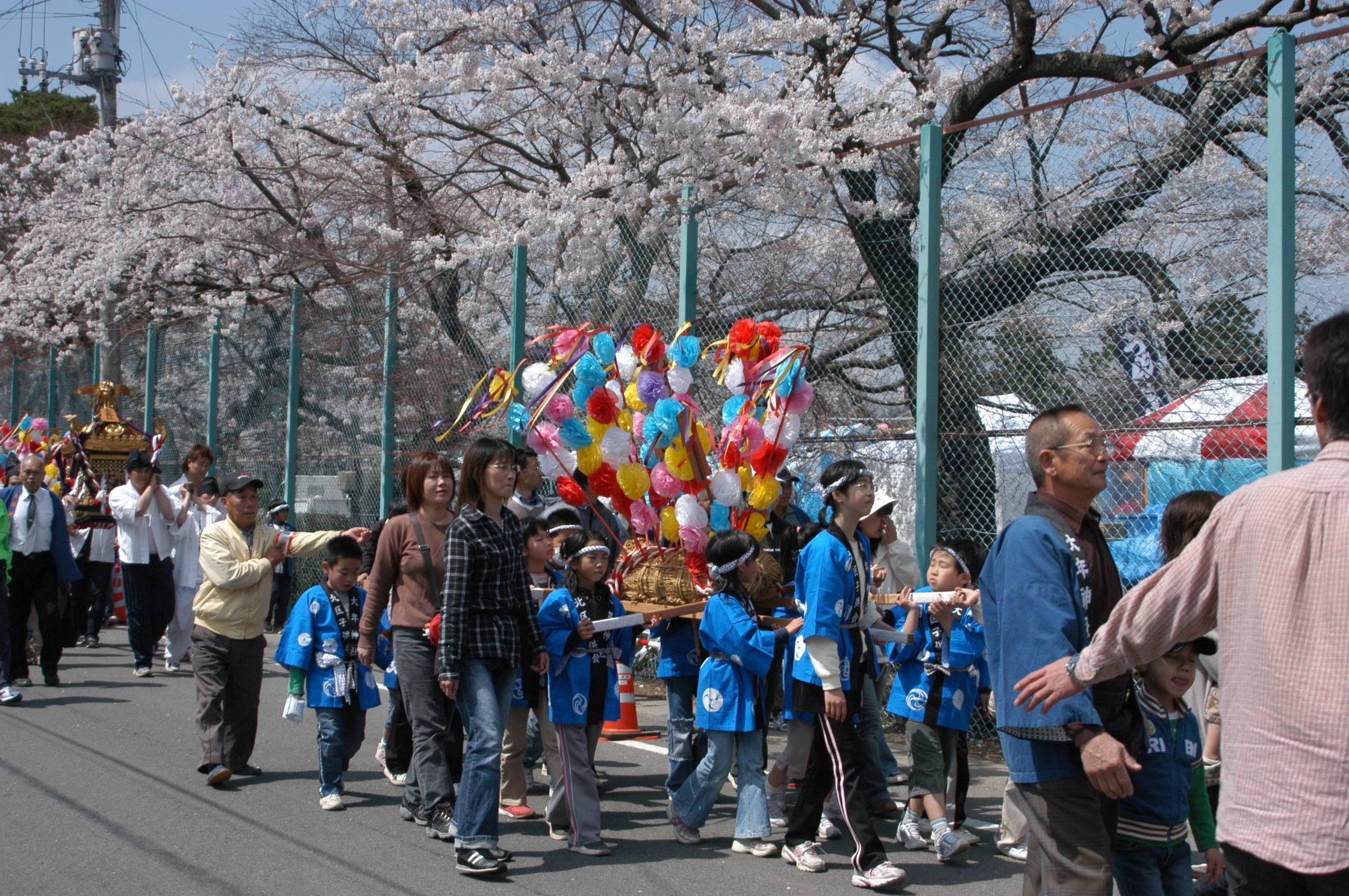
Residents of the Yonomori district in Tomioka, Fukushima Prefecture, march with a portable shrine in April 2007.
January 22, 2021
“Will Tomioka go back to how it was before?” Looking at the results of a survey, Kazuyoshi Kamata, vice head of the Yonomori Station northern administrative district in Tomioka, Fukushima Prefecture, reflects on his hometown and its reconstruction following the Fukushima No. 1 nuclear power plant triple meltdown in 2011.
In the surveys conducted by the Reconstruction Agency last fall, Tomioka residents listed important conditions in deciding whether they would return to their hometown or not, such as the reopening and construction of new medical, welfare and elder care facilities as well as the resumption and improvement of shopping complexes.
One condition that stands out among the list, though, is a further reduction in the amount of radiation, which 1 in 3 residents raised as an important issue. The government has been decontaminating specially designated areas, where it was once thought that settlement was limited for good but which can be reopened for residents. It has set the annual radiation exposure limit to be lower than 20 millisieverts as one of the standards to lift the evacuation orders.
Now that nearly 10 years have passed since the nuclear crisis at the Fukushima No. 1 plant, Kamata stressed the need for the government to decontaminate the area under stricter standards so that residents will feel safer returning to their hometown.
“In order to maintain people’s feelings for their hometowns, I want (the government) to stick to the stance of rebuilding our Tomioka in the form that we all want, including restoring the (basic living) environment.”
Tomioka’s Yonomori district used to be bustling with an increasing population, said Kamata, adding that younger generations supported the local community by planning events utilizing a famous row of cherry blossom trees and developing agriculture centered around rice crops.
“The district was a place full of energy where everyone, regardless of generation, was involved in making the local community,” said Kamata.
At the Yonomori cherry blossom festival held in spring, for example, smiles spread among residents as children strolled around, and the event also featured a mikoshi, or Shinto palanquin, from Otoshi Shrine.
The government is also doing its part in reconstructing the specially designated area in Tomioka by establishing zones focused on revitalizing businesses and agriculture. With creating agricultural corporations and making use of tourism resources such as roadside cherry blossom trees as the two main pillars, the government is working to attract about 1,600 people to live there, which is 40% of the population before the accident.
In the meantime, residents have been raising concerns about the 20 millisieverts condition, demanding a higher standard and more decontamination. In places that have recorded higher radiation levels, it is expected there will be damage from harmful rumors about things including tourism and agriculture.
“Without people, reconstruction would not begin. Creating conditions to invite more people without concerns is of utmost importance,” said Kamata, arguing that alongside other areas, restoring the living environment, including decontamination with the aim of lowering the annual radiation exposure to 1 millisevert or less, will be needed for future generations to live in Yonomori.
“Once the evacuation order is lifted, I want the local community to regain its connections within (the district),” said Kamata, hoping to take on a role of handing down the district’s traditions and way of life, as well as traditional scenery, to younger generations once he returns. As a vice-head of the administrative district, though, Kamata also intends to communicate crucial issues to the local government while residing in the area.
The lifting of the evacuation order in the specially designated area is expected in the spring of 2023, 12 years after the order was first issued.
“Without tackling issues such as restoring the living environment and infrastructure, as well as decommissioning of the Fukushima No.1 plant in a diligent manner, people won’t come back,” said Kamata. Now he hopes the government will share his passion for the hometown’s rebuilding.
This section features topics and issues covered by the Fukushima Minpo, the prefecture’s largest newspaper. The original article was published Jan. 12.
https://www.japantimes.co.jp/news/2021/01/22/national/fukushima-decontaminating-town/
High court denies government responsibility for Fukushima nuclear crisis
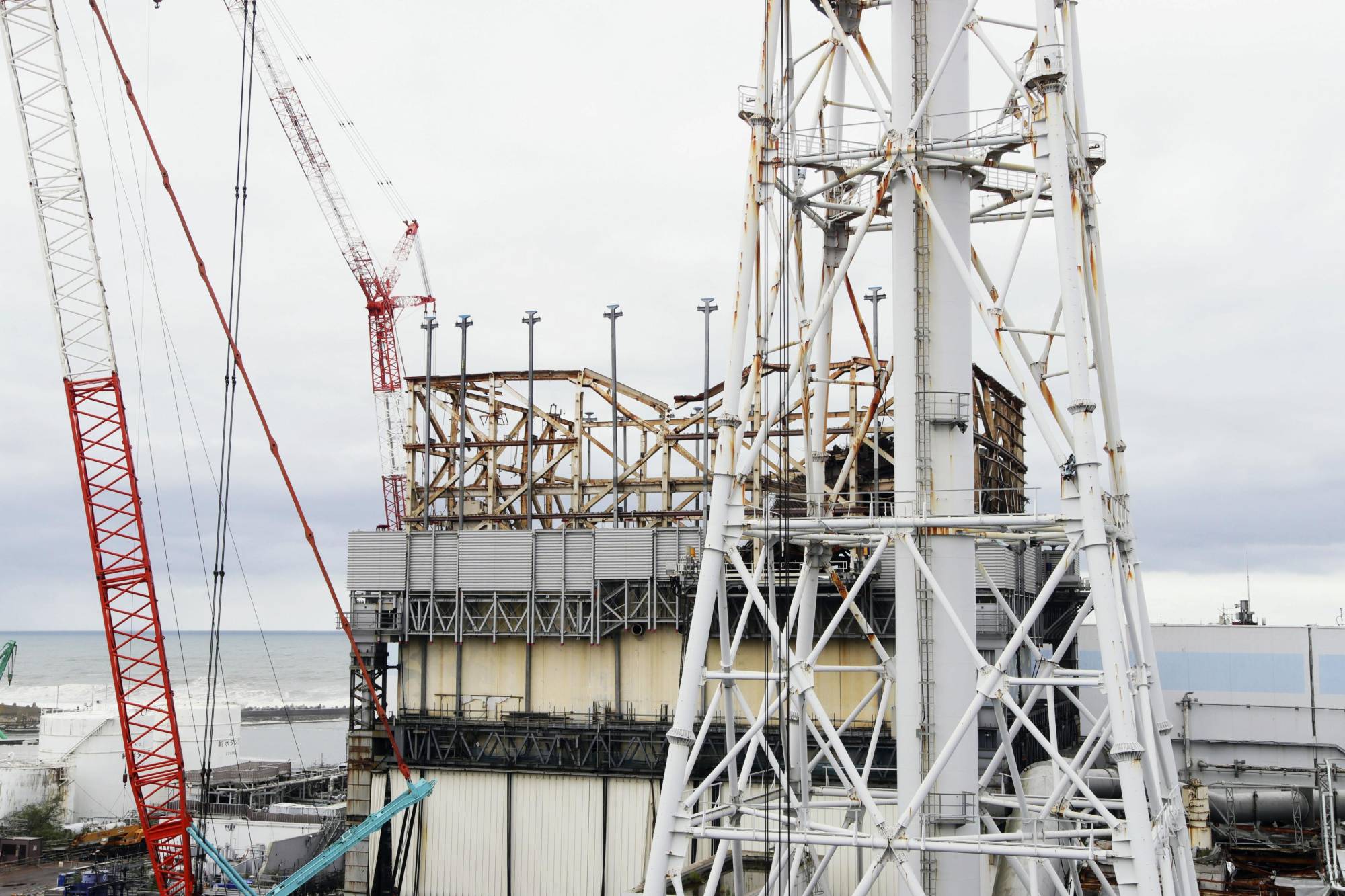
Decommissioning work is under way at the disaster-stricken Fukushima No. 1 nuclear power plant.
January 21, 2021
The Tokyo High Court on Thursday ordered the operator of the crippled Fukushima No. 1 nuclear power plant to pay damages to evacuated residents, but it overturned an earlier ruling by Maebashi District Court that had also acknowledged the central government’s responsibility over the 2011 nuclear crisis.
Among around 30 such lawsuits across the country, the decision of the Tokyo High Court was the first high court ruling absolving the state of responsibility, contradicting an earlier decision of the Sendai High Court in September that ordered both the state and Tokyo Electric Power Company Holdings Inc. to pay damages.
The government’s failure to instruct Tepco to take measures against tsunamis “is not found to be significantly unreasonable,” Presiding Judge Akira Adachi said in handing down the ruling.
The lawsuit focused on the reliability of an official long-term quake assessment made in 2002, which has been used in previous rulings to determine the liability of the state and Tepco for their failure to prevent the nuclear disaster.
Adachi noted the assessment had caused a debate since its release, and that the government was unable to predict a huge tsunami.
Implementing measures such as constructing seawalls would not have prevented the tide from entering the nuclear plant, he added.
Thursday’s ruling instead ordered Tepco to pay a total ¥119.72 million to 90 plaintiffs, more than triple the amount awarded in the lower court ruling.
In March 2017, the Maebashi District Court awarded a total of ¥38.55 million to 62 plaintiffs who evacuated from Fukushima Prefecture, including those who voluntarily left, acknowledging the government and the utility were negligent in preparing for a tsunami like the one that struck the facility.
The district court said the disaster was caused by a failure to cool nuclear fuel as water entered turbine buildings through air supply openings in the wake of the tsunami triggered by a massive earthquake, crippling emergency switchboards.
The lawsuit was filed by a total of 137 plaintiffs relocated to Gunma Prefecture and elsewhere. They sought a combined ¥1.5 billion — ¥11 million each — in damages for emotional distress.
They were forced to leave their hometowns as three reactors suffered meltdowns at the plant after the magnitude 9.0 earthquake and ensuing tsunami hit northeastern Japan on March 11, 2011.
The plaintiffs said they had lost their livelihoods and faced inconvenience for an extensive period, and the amount they received under the current state compensation guidelines was not enough.
Dumping Fukushima’s contaminated water into the ocean could be a violation of international law
Environmental implications require an international conversation
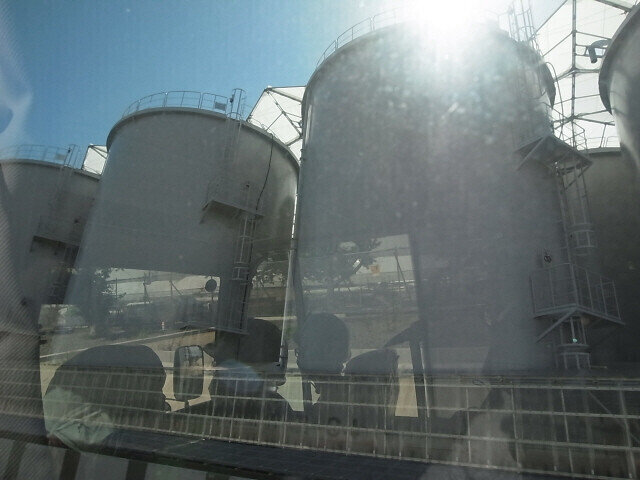
Storage tanks for radioactive water at the Fukushima Daiichi Nuclear Power Plant.
January 10,2021
At a meeting of parties to the London Convention and Protocol on Dec. 14, the South Korean Ministry of Oceans and Fisheries (MOF) clearly stated that the release of contaminated water from the Fukushima Nuclear Power Plant into the ocean was not a sovereign decision for the Japanese government to make. Its reason was that the damage would extend beyond the scope of Japan’s jurisdiction, affecting nearby countries including South Korea.
While the US and France have stated their trust in the safety of releasing the water and referred to it as a matter for the International Atomic Energy Agency (IAEA) to oversee, delegations from China, Russia, and Canada indicated their support for the South Korean government’s position. David Santillo, a Greenpeace Research Laboratories senior scientist who took part in the meeting, stressed that the matter of releasing the water into the ocean was something to be discussed at an international level.
During the meeting, the MOF worked to encourage other countries in the region to indicate their support, while also ensuring an opportunity to continue the debate at the next meeting. Despite these efforts by the South Korean government, some in South Korea still maintain that there is nothing wrong with dumping the water because it’s been treated. This conclusion is faulty.
The 1.37 million tons (as of summer 2022) that are currently set to be released into the Pacific Ocean are just the start of the issue. Even after that enormous amount has been discharged, radioactive material — hundreds of tons produced each week at the Fukushima plant — will continue to be released. Some of the radioactive substances have half-lives in the tens of thousands of years or more. The main reason for the water’s contamination has to do with three reactors that melted down in the Fukushima disaster. Cooling water has to be added daily to control the reactors as they continue to undergo nuclear fission. This means that water is going to continue to be contaminated until the reactors’ nuclear fuel and waste have been completely removed.
The amount of nuclear fuel remaining after the Chernobyl disaster, commonly viewed as the worst nuclear catastrophe in history, has been reported at around 570 tons. The Ukrainian government predicted it would take 100 years to remove it all. This means there is no way to pledge any concrete timeline. Within the Fukushima reactors, there are more than 1,100 tons of remaining nuclear fuel and waste, nearly twice as much as Chernobyl. In particular, most of the strontium, which inflicts the most biological damage, is still in the reactors.
As more water is contaminated by this highly concentrated radioactive material, it accumulates in the ecosystem. The amount of contaminated water that the Japanese government plans to release into the Pacific already exceeds 1 million tons; over the next 10 years, it could rise to 2 million. The radioactive substances in the water are another issue. As cesium and strontium deposit and accrete on the ocean floor, they can release radioactive matter over the long term. The effects on marine life are likewise severe.
The problem is that there is no way of gauging or preventing the damage ahead of time. This is why there are such strict regulations on the disposal of radioactive material into the ocean. The Japanese government has argued that its release of Fukushima water is justified by likening it to the release of cooling water from normally operating nuclear power plants, but no precedent exists where permission has been granted to discharge waste from a nuclear accident into the marine environment. As such, South Korea needs to stop the Japanese government’s decision to avoid a tragic outcome.
To begin with, Seoul has the right to demand that Tokyo perform an official environmental impact assessment. The release of the contaminated water into the ocean would be a violation of international law if it does not conform to the principle of prior notification and the obligation to perform an environmental assessment.
Even the IAEA, which has sided with the Japanese government, explicitly mentioned the need for an environmental impact assessment in its report. The South Korean government must speak out and ensure it happens.
By Chang Mari, Greenpeace energy campaigner
http://english.hani.co.kr/arti/english_edition/english_editorials/978035.html
Radiation levels at Fukushima plant found worse and more lethal than previously assumed

January 5, 2021
Radiation at the Fukushima No. 1 nuclear plant is far worse than previously thought, with the levels estimated at 10 sieverts per hour– a fatal dose for anyone who stays in the vicinity for an hour, according to experts. This means it will be extremely difficult for crews to move shield plugs, raising concerns that the plan to decommission the reactors will have to be reassessed.
Exceedingly high radiation levels inside crippled reactor buildings at the Fukushima No. 1 nuclear plant were described by nuclear regulators as an “extremely serious” challenge to the overall decommissioning of the site.
According to the Nuclear Regulation Authority (NRA), a huge amount of radioactive materials had attached to shield plugs of the containment vessels in the No.2 and No. 3 reactors.
With an estimated 10 sieverts per hour, the radiation levels are fatal for anyone who stays even an hour in the area. The finding also means that it would be extremely difficult for workers to move the shield plugs, which raised the prospect that the decommissioning plan will have to be reassessed.
Removing the highly contaminated shield plugs added to the challenge of recovering unclear fuel debris– the most taxing part of the process, said NRA chairman, Toyoshi Fuketa.
“It appears that nuclear debris lies at an elevated place,” Fuketa said at a news conference in December 2020. “This will have a huge impact on the whole process of decommissioning work.”
At normal times, the shield plug blocks radiation from the reactor core. Workers remove a shield plug to get access to the containment vessel’s interior when unclear fuels need to be replaced.

The Fukushima I Nuclear Power Plant after the 2011 Tōhoku earthquake and tsunami. Reactor 1 to 4 from right to left.
In a study that resumed in September after a five-year hiatus, the NRA conducted fresh measurements of radiation levels in the surrounding areas of the No. 2 and No. 3 reactors.
It found that the amount of radioactive cesium 137 was at 20-40 petabecquerels between the top and middle layers of the No. 2 reactor’s shield plug. This works out to more than 10 sieverts per hour– radiation at these levels can be fatal to a person if they spend an hour in the vicinity. Meanwhile, the estimated figure was 30 petabecquerels for the No. 3 reactor.
The 2011 earthquake and tsunami disaster in Fukushima caused the shield plug of the No. 1 reactor to slip out of place. It was also damaged by a hydrogen explosion at the reactor building.
As larger amounts of cesium 137 leaked from the No. 1 reactor through the damaged plug, the amount of radioactive material was estimated at 0.16 petabecquerels, lower than for the No. 2 and No. 3 reactors. On the other hand, the shield plugs, for the No. 2 and No. 3 reactors remained secure.
The Tokyo Electric Power Co. (TECPO) announced that the removal of nuclear fuel debris will be moved to 2022 or later, rather than the initially planned operation in 2021, due to a delay in the development of equipment.
55% oppose release of treated water from Fukushima plant

Numerous tanks containing contaminated water from the stricken reactors at the Fukushima No. 1 nuclear power plant occupy a large portion of the site’s premises in October.
January 4, 2021
Fifty-five percent of voters in a survey expressed opposition to the government’s plan to release treated contaminated water from the crippled Fukushima No. 1 nuclear power plant into the sea, while 32 percent support the measure.
The Asahi Shimbun survey also found that more than 80 percent of respondents fear the reputation of local seafood would be hurt if the treated water were discharged.
The government is moving to release tons of water from the stricken facility situated on the Pacific coast of northeastern Japan because the plant’s capacity to store radioactive water on its premises is projected to reach its limit in summer 2022.
This will be accomplished by removing most of the extremely hazardous radioactive substances and diluting the polluted water sufficiently so that it comfortably clears the government’s safety standards for disposal.
However, local fishermen and the national federation of fishermen’s groups, along with local municipalities, all staunchly oppose discharging the water.
Fifty percent of voters supporting the Cabinet headed by Prime Minister Yoshihide Suga and 47 percent of Suga’s Liberal Democratic Party are against the plan, outnumbering those who favor it, the survey showed.
By gender, men were sharply divided over the question, with 44 percent endorsing it and 46 percent opposing the plan.
But 62 percent of women took exception to it, compared with 22 percent who approved of the plan.
Asked whether the image of local seafood would be adversely affected after the water is released, 42 percent said they were “deeply concerned” about the matter, while 44 percent replied they were “somewhat concerned.”
The ratio of those who were “not concerned so much” came to 9 percent. Those who were “not concerned at all” stood at 2 percent.
But the survey also showed that 68 percent of voters backing the discharge said it will undermine the reputation of local seafood.
With regard to the government’s handling of the Fukushima nuclear disaster to date, 67 percent gave the thumbs down and 20 percent rated its performance highly.
Among supporters of the LDP, 56 percent had a low opinion of the government’s approach.
The survey also showed that 64 percent of respondents who took exception to government’s response were against the planned discharge of treated contaminated water into the sea.
The survey was conducted from November to December by sending questionnaires to 3,000 eligible voters nationwide selected at random. There were 2,126 valid responses, or 71 percent of the total.
Emperor’s evacuation to Kyoto weighed after Fukushima nuclear disaster
January 2, 2021
The government led by the now-defunct Democratic Party of Japan unofficially proposed that then Emperor Akihito evacuate to Kyoto or somewhere further in the west from Tokyo immediately after the start of the Fukushima nuclear disaster in March 2011, a former administration official has said.
However, the Imperial Household Agency flatly dismissed the idea, saying there was “no way” the emperor would do it at a time when people were not evacuating from Tokyo, leading to the government of Prime Minister Naoto Kan to give up the proposal.
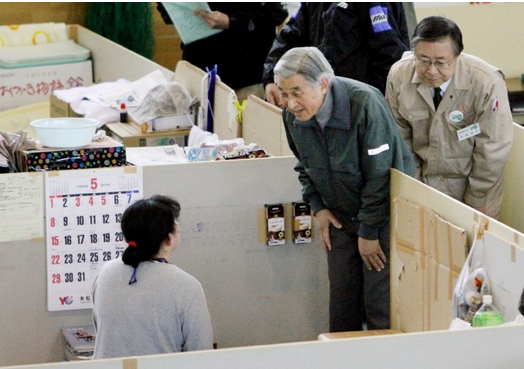
Then-Emperor Akihito speaks to an evacuee in May 2011 in Fukushima Prefecture, which hosts the Fukushima Daiichi Nuclear Power Station that was crippled in the earthquake-tsunami catastrophe of the same year.
Several former senior officials at the prime minister’s office separately said the then DPJ administration also briefly considered evacuating Prince Hisahito, the son of Crown Prince Fumihito and Crown Princess Kiko, from Tokyo to Kyoto.
Prince Hisahito became second in line to the throne when his uncle, Emperor Naruhito, ascended the Chrysanthemum Throne in May 2019. The prince was 4 years old when the Fukushima Daiichi nuclear plant suffered core meltdowns following a devastating earthquake and tsunami in northeastern Japan.
Former Emperor Akihito stepped down from the throne on April 30, 2019, becoming the first Japanese monarch to abdicate in around 200 years, his eldest son succeeding him the following day.
Kan, a House of Representatives member now belonging to the main opposition Constitutional Democratic Party of Japan, admitted he was “thinking in my head” of evacuating the emperor at the time but denied he had conveyed the idea to the then emperor or suggested it to someone else.
However, according to the former Kan administration official, at Kan’s request he unofficially asked Shingo Haketa, then chief of the Imperial Household Agency, via a mediator whether Emperor Akihito would agree to evacuate from the Imperial Palace, possibly to the Kyoto Imperial Palace in the ancient capital in western Japan.
A former agency official said he remembers the agency turned down the proposal.
Asked whether the agency actually conveyed the evacuation proposal to the emperor, he said “maybe, but only after” saying no to the administration.
The Kan administration also treated Prince Hisahito’s evacuation as among items that should be considered in case of a spike in Tokyo’s radiation levels, but eventually decided not to formally consider it, according to the former senior officials at the prime minister’s office.
On March 11, 2011, the six-reactor plant on the Pacific coast was flooded by tsunami waves exceeding 10 meters triggered by the magnitude 9.0 quake, causing the reactor cooling systems to lose their power supply.
The Nos. 1 to 3 reactors subsequently suffered core meltdowns, while hydrogen explosions damaged the buildings housing the Nos. 1, 3 and 4 units. Around 160,000 people were evacuated at one point in the nuclear disaster with a severity level rated on a par with the 1986 Chernobyl accident at maximum 7 on an international scale.
Yutaka Kawashima, who was the agency’s grand chamberlain at the time, wrote in a magazine article shortly after the triple disaster, “It is utterly inconceivable for his majesty to abandon the people of Tokyo and leave Tokyo,” as rumors had circulated about the emperor escaping the capital.
On March 16, 2011, five days after the quake and tsunami, Emperor Akihito said in an unprecedented video message he was hurt by the devastation caused by the disaster and expressed hope the people of Japan would overcome the challenges they faced by caring for each other.
He and his wife then Empress Michiko also voluntarily cut electricity at their residence in Tokyo for two hours daily as they wanted to share the hardship experienced by the people under the power rationing measure taken by electric companies, the agency said at the time.
In parts of Tokyo and its vicinity, rolling blackouts were implemented in the face of substantial power shortages stemming from the crippled nuclear power plant in Fukushima Prefecture. Areas in central Tokyo hosting government offices, parliament and the Imperial Palace were excluded from the measure.
Only 30% of Fukushima residents happy with disaster recovery progress
January 1, 2021
Nearly 10 years after the 2011 earthquake-tsunami and nuclear disasters in northeastern Japan, only 30 percent of Fukushima Prefecture residents say reconstruction has been sufficient, a Kyodo News survey showed Thursday.
The figure was notably lower than 80 percent in Miyagi and 66 percent in Iwate prefectures, which were also affected by the natural disasters.
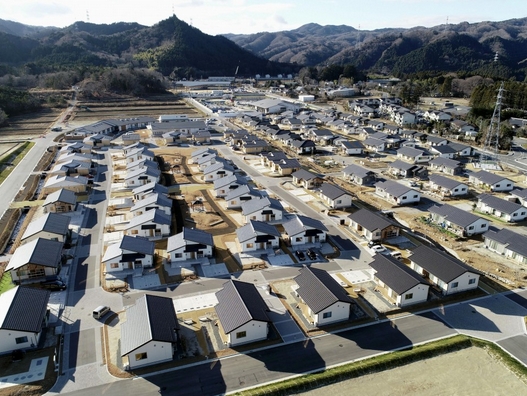
Photo taken Dec. 23, 2020, from a drone shows rows of public houses for residents who lost their homes in the disaster in Okuma, Fukushima Prefecture.
The low number in Fukushima reflects how the nuclear meltdowns at the Fukushima Daiichi power plant and subsequent evacuation orders have slowed reconstruction work.
Face-to-face surveys were conducted in November involving 100 residents in each of the three prefectures to ask about reconstruction of the communities where they lived when the magnitude-9.0 earthquake and subsequent tsunami hit the region March 11, 2011.
A total of 176 people, or 59 percent, across the three prefectures said reconstruction was “progressing” or “progressing to some degree,” while 123 people, or 41 percent, said there had not been enough progress. One person did not answer.
“My hometown is full of vacant plots of land,” said a man in his 50s who evacuated from Futaba, which hosts the Fukushima Daiichi plant, to Iwaki in Fukushima Prefecture. “I cannot imagine the town becoming a place we can return to.”
Many respondents appreciated the rebuilding of infrastructure, but some said it has taken too much time. Among Fukushima residents unhappy with the reconstruction progress, many said they are disappointed that they are still not allowed to return to their hometowns due to radioactive contamination and that townscapes have not been restored.

Photo taken on Sept. 26, 2020, in Okuma, northeastern Japan, shows the disaster-stricken Fukushima Daiichi nuclear power plant where decommissioning work is taking place
Across the three prefectures, 66 percent said their lives were back on track as they were able either to move to public housing for disaster victims or build new homes. By prefecture, the rate was 80 percent in Miyagi and 70 percent in Iwate but significantly lower at 49 percent in Fukushima.
The cost of rebuilding homes and a decrease in income have also been a burden for residents.
“To reconstruct my house, I needed to get another loan (in addition to that for the home destroyed by the disaster). I won’t finish the payments until I’m 80 years old,” said Toshiyuki Naganuma, 58, who runs a construction firm in Natori, Miyagi Prefecture.
The local government in Natori declared the completion of the city’s recovery in March 2020. More houses have been built and tourists are returning. But Naganuma said that while “it may look like the city has recovered, reconstruction is not finished.”
“Jobs are still gone. My income is unstable,” said a man in his 40s who changed jobs three times after the disasters. He used to work at a restaurant in Rikuzentakata, Iwate, but sales dropped when construction workers and others engaged in work to rebuild the city left.
Yukihisa Ojima, 49, who operates a home appliance store in Rikuzentakata, worries about the city’s declining population. “Public facilities were rebuilt but things are slack for businesses here,” he said.
For those affected by the disasters, recovery means “getting back one’s life before the disasters,” said Jun Oyane, a professor at Senshu University and head of the Japan Society for Disaster Recovery and Revitalization.
“The next step after restoring infrastructure will be to focus on the varying needs of individual residents and to stand by them in rebuilding” their lives, he said.
1 This Month

of the week – Shut Down Drone Warfare!


Tell the Ukrainian Government to Drop Prosecution of Peace Activist Yurii Sheliazhenko

Petition to revoke the licensing of the Near Surface Nuclear Disposal Facility (NSDF) at Chalk River. https://www.ourcommons.ca/petitions/en/Petition/Details?Petition=e-7247
To see nuclear-related stories in greater depth and intensity – go to https://nuclearinformation.wordpress.com
-
Archives
- April 2026 (68)
- March 2026 (251)
- February 2026 (268)
- January 2026 (308)
- December 2025 (358)
- November 2025 (359)
- October 2025 (376)
- September 2025 (257)
- August 2025 (319)
- July 2025 (230)
- June 2025 (348)
- May 2025 (261)
-
Categories
- 1
- 1 NUCLEAR ISSUES
- business and costs
- climate change
- culture and arts
- ENERGY
- environment
- health
- history
- indigenous issues
- Legal
- marketing of nuclear
- media
- opposition to nuclear
- PERSONAL STORIES
- politics
- politics international
- Religion and ethics
- safety
- secrets,lies and civil liberties
- spinbuster
- technology
- Uranium
- wastes
- weapons and war
- Women
- 2 WORLD
- ACTION
- AFRICA
- Atrocities
- AUSTRALIA
- Christina's notes
- Christina's themes
- culture and arts
- Events
- Fuk 2022
- Fuk 2023
- Fukushima 2017
- Fukushima 2018
- fukushima 2019
- Fukushima 2020
- Fukushima 2021
- general
- global warming
- Humour (God we need it)
- Nuclear
- RARE EARTHS
- Reference
- resources – print
- Resources -audiovicual
- Weekly Newsletter
- World
- World Nuclear
- YouTube
-
RSS
Entries RSS
Comments RSS
 nuclear-news