Fukushima exports beef to the U.S. ?
I am sure that some of our american friends will be interested to know that there is not enough beef in the U.S., that U.S. needs to import Fukushima beef!!!
Fukushima agricultural exports bounce back from nuclear disaster to hit record high
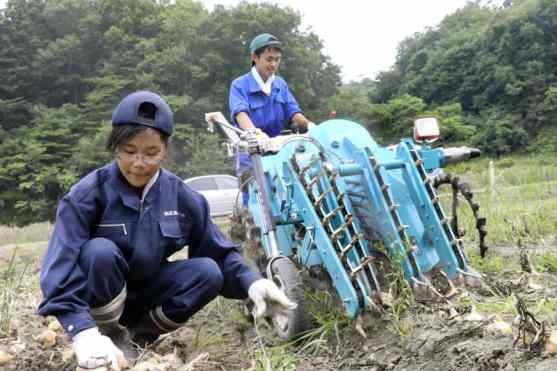
Farmers harvest onions in Minamisoma, Fukushima Prefecture.
April 23, 2019
FUKUSHIMA – Exports of agricultural products produced in Fukushima Prefecture rose about 2 percent in fiscal 2018 to a record 217.8 tons, according to the prefectural government.
Fukushima’s agricultural exports suffered a long slump due to the 2011 nuclear crisis.
But exports hit a record high for the second straight year, backed by an expansion in rice exports to Malaysia in fiscal 2017 and in exports of Japanese pears and other items to Vietnam and Thailand in fiscal 2018.
In fiscal 2018, which ended last month, exports of peaches and Japanese persimmons were sluggish due in part to unfavorable weather.
Shipments of rice to Malaysia, at about 115 tons, led the total exports, as in fiscal 2017. Exports of apples to Thailand and beef to the United States also grew.
Following the disaster at the Fukushima No. 1 nuclear plant, the prefecture’s agricultural exports plunged due to import restrictions by countries concerned about radioactive contamination, falling to 2.4 tons in fiscal 2012.
The prefectural government has strengthened efforts to boost exports to Southeast Asian countries since the restrictions were scrapped.
In fiscal 2017, Fukushima’s agricultural exports came to 213.3 tons, exceeding the then-record of 152.9 tons in fiscal 2010, helped by about 101 tons of rice shipments to Malaysia.
Fukushima soccer facility, repurposed after 3/11 disaster, fully reopens
The madmen’s denial continues, pretending that it is all clean and safe. Like if nothing ever happened. Children’s future sacrificed in the name of politicians’ holy economics.

Children exercise at the J-Village national soccer training center in the town of Naraha, Fukushima Prefecture, on Saturday after it resumed full operations.
April 20, 2019
FUKUSHIMA – The J-Village national soccer training center in Fukushima Prefecture resumed full operation Saturday, eight years after it was converted into an operational base to cope with the nuclear disaster that hit the prefecture in 2011.
The facility, established in 1997, has already been selected as the starting point for the Japan leg of the 2020 Tokyo Olympic torch relay, a move aimed at highlighting the country’s efforts to recover from the devastating earthquake and tsunami on March 11, 2011, that triggered the meltdown at the Fukushima No. 1 nuclear plant.
The torch relay will start at the facility in March 2020.
Until March 2017, the training center was used as a logistics hub and a lodging facility for workers involved in the cleanup and other disaster response operations at the crippled facility located some 20 kilometers to the north. The operational base function has been moved to the power plant.
The training complex has been renovated, and an indoor practice field and hotel with conference rooms have been added.
A large part of the complex had already resumed operations by July 2018, with the exception of two playing fields.
Also on Saturday, East Japan Railway Co. opened a new station near the J-Village.
“I hope (the full reopening) will contribute to Fukushima’s revival,” said a 42-year-old woman arriving at the station on Saturday morning.
The woman, who lives in the prefecture, was planning to visit the J-Village site.
Ministry limits foreigners doing Fukushima cleanup

April 19, 2019
Japanese Justice Minister Takashi Yamashita has outlined a restriction pertaining to the country’s new visa program. He said foreign nationals won’t be allowed to work in Japan if their main task is to do decontamination work at the crippled Fukushima Daiichi nuclear power plant.
Yamashita’s remark on Friday follows the plant operator’s statement that it will accept foreign workers hired under the new visa program to help decommission the facility.
Tokyo Electric Power Company says that construction, industrial machinery and automobile maintenance will be relevant to the decommissioning. The utility told the contractors to make sure they hire foreign workers legally.
TEPCO also says it’s not aware of a shortage of workers in the decommissioning process, but that it is up to the contractors to decide whether to hire foreigners under the new visa category.
Yamashita said that the Justice Ministry and other relevant ministries will ensure that foreigners in the program are eligible for the jobs they are hired to do.
Yamashita said foreigners coming to work in the construction sector must not be hired if their main job is decontamination work.
Chief Cabinet Secretary Yoshihide Suga said the industry ministry will supervise TEPCO to make sure the utility’s operations are legal and that the plant’s reactors are decommissioned safely and stably.
A revised immigration law that took effect on April 1 allows foreign nationals with certain vocational skills to work in a range of sectors under a new visa category.
TEPCO plans to use new foreign workers at Fukushima plant
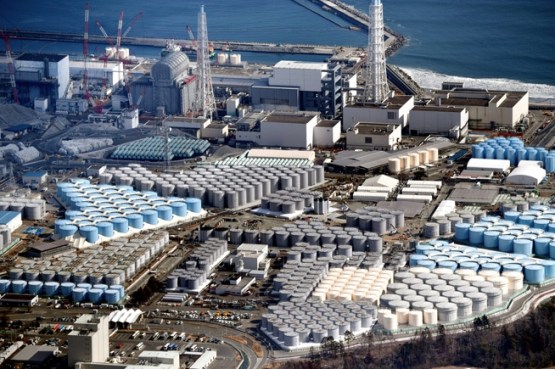
Rows of storage tanks hold radiation-contaminated water on the grounds of the Fukushima No. 1 nuclear power plant.
April 18, 2019
Tokyo Electric Power Co. plans to use the new visa program to deploy foreign workers to its crippled Fukushima No. 1 nuclear plant, sparking concerns that language barriers could cause safety hazards and accidents.
The specified skills visa program started in April to alleviate labor shortages in 14 different industrial sectors. TEPCO says it has long lacked enough workers for decommissioning work at the Fukushima nuclear plant.
At a March 28 meeting, the utility explained its plan to hire foreign workers to dozens of construction and other companies that have been contracted for decommissioning work.
TEPCO officials asked the companies to be aware that workers sent to radiation monitoring zones must wear dosimeters and receive special education about the dangers they will face.
The new work visa program requires the foreign workers to have a minimum level of Japanese language ability needed for daily life.
But TEPCO officials reminded the company representatives that Japanese language skills would be even more important at the Fukushima plant because of the need to accurately understand radiation levels and follow instructions by superiors and colleagues regarding work safety.
TEPCO officials said they would ask the contracting companies to check on the Japanese language skills of prospective foreign workers.
But at least one construction company has already decided not to hire any foreign workers.
“The work rules at the No. 1 plant are very complicated,” said a construction company employee who has worked at the Fukushima plant. “I am also worried about whether thorough education can be conducted on radiation matters. It would be frightening if an accident occurred due to a failure of communication.”
According to TEPCO officials, an average of about 4,000 people work at the nuclear plant each day, mostly in zones where radiation levels must be constantly monitored.
To stay within the legal limits on exposure levels, workers often have to be replaced, leading to difficulties for TEPCO in gathering the needed number of workers.
Between April 2018 and February this year, 11,109 people worked at the Fukushima plant. Of that number, 763 were found to have levels of radiation exposure between 10 and 20 millisieverts, while 888 had levels between 5 and 10 millisieverts.
The legal limit for radiation exposure for workers at nuclear plants is 50 millisieverts a year, and 100 millisieverts over a five-year period.
The Justice Ministry has disciplined companies that used technical intern trainees for decontamination work without adequately informing them of the dangers. The ministry has also clearly stated that such trainees are prohibited from doing decommissioning work at the Fukushima plant.
However, Justice Ministry officials told TEPCO that foreigners with the new visa status could work alongside Japanese staff at the nuclear plant.
Although their numbers are small, foreign workers and engineers have been accepted at the Fukushima plant. As of February, 29 foreigners had been registered as workers engaged in jobs that expose them to radiation.
A construction company official said such foreign workers were hired after their Japanese language ability was confirmed.
But concerns remains on whether the new foreign workers will be able to properly understand how much radiation exposure they have experienced.
“Even Japanese workers are not sure about how to apply for workers’ compensation due to radiation exposure,” said Minoru Ikeda, 66, who has published a book about his experiences in decommissioning work at the Fukushima plant until 2015. “The problem would only be exacerbated for foreign workers.”
Kazumi Takagi, a sociology professor at Gifu University, has conducted interviews with nuclear plant workers.
Noting the need for special protective gear to work at the Fukushima site, Takagi said: “Unless workers can instantly understand the language when minor mistakes or sudden problems occur, it could lead to a major accident. That, in turn, could cause major delays in the work.”
Removal of fuel in pool at Fukushima’s melted reactor begins
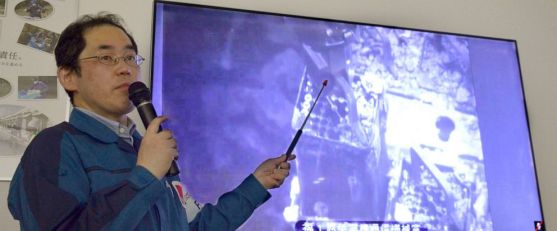
A Tokyo Electric Power Co. worker explains the operation at Unit 3 of Fukushima nuclear plant, in Okuma, Fukushima Prefecture, northeastern Japan Monday. April 15, 2019. The operator of the tsunami-wrecked nuclear plant has begun removing fuel from a cooling pool at one of three reactors that melted down in the 2011 disaster, a milestone in the decades-long process to decommission the plant.
April 15, 2019
The operator of the tsunami-wrecked Fukushima nuclear plant began removing fuel Monday from a cooling pool at one of three reactors that melted down in the 2011 disaster, a milestone in what will be a decades-long process to decommission the facility.
Tokyo Electric Power Co. said workers started removing the first of 566 used and unused fuel units stored in the pool at Unit 3. The fuel units in the pool located high up in reactor buildings are intact despite the disaster, but the pools are not enclosed, so removing the units to safer ground is crucial to avoid disaster in case of another major earthquake similar to the one that caused the 2011 tsunami.
TEPCO says the removal at Unit 3 will take two years, followed by the two other reactors, where about 1,000 fuel units remain in the storage pools.
Removing fuel units from the cooling pools comes ahead of the real challenge of removing melted fuel from inside the reactors, but details of how that might be done are still largely unknown. Removing the fuel in the cooling pools was delayed more than four years by mishaps, high radiation and radioactive debris from an explosion that occurred at the time of the reactor meltdowns, underscoring the difficulties that remain.
Workers are remotely operating a crane built underneath a jelly roll-shaped roof cover to raise the fuel from a storage rack in the pool and place it into a protective cask. The whole process occurs underwater to prevent radiation leaks. Each cask will be filled with seven fuel units, then lifted from the pool and lowered to a truck that will transport the cask to a safer cooling pool elsewhere at the plant.
The work is carried out remotely from a control room about 500 meters (yards) away because of still-high radiation levels inside the reactor building that houses the pool.
“I believe everything is going well so far,” plant chief Tomohiko Isogai told Japanese public broadcaster NHK. “We will watch the progress at the site as we put safety first. Our goal is not to rush the process but to carefully proceed with the decommissioning work.”
About an hour after the work began Monday, the first fuel unit was safely stored inside the cask, TEPCO spokesman Takahiro Kimoto said. Monday’s operation was to end after a fourth unit is placed inside the cask, he said. No major damage was found on the fuel unit Monday, but plant officials will closely examine if there are any pinholes or other irregularities, Kimoto said.
The removal, however, raises a storage capacity concern at the plant because the common pool, where fuel from the Unit 3 pool heads to, already has 6,000 fuel units and is almost full. Kimoto said TEPCO has made room at the common pool for the incoming fuel by moving years-old and sufficiently cooled fuel into dry casks for safer, long-term storage, though further details are being worked out.
In 2014, TEPCO safely removed all 1,535 fuel units from the storage pool at a fourth reactor that was idle and had no fuel inside its core when the March 11, 2011, earthquake and tsunami occurred.
Robotic probes have photographed and detected traces of damaged nuclear fuel in the three reactors that had meltdowns, but the exact location and other details of the melted fuel are largely unknown. Removing fuel from the cooling pools will help free up space for the subsequent removal of the melted fuel, though details on how to gain access to it have yet to be decided.
Experts say the melted fuel in the three reactors amounts to more than 800 tons, an enormous amount that is more than six times that of the 1979 accident at Three Mile Island, where one reactor had a partial core melt.
In February, a remote-controlled robot with tongs removed pebbles of nuclear debris from the Unit 2 reactor but was unable to remove larger chunks, indicating a robot would need to be developed that can break the chunks into smaller pieces. Toshiba Corp.’s energy systems unit, which developed the robot, said the findings were key to determining the proper equipment and technologies needed to remove the melted fuel, the most challenging part of the decommissioning.
TEPCO and government officials plan to determine methods for removing the melted fuel from each of the three damaged reactors later this year so they can begin the process in 2021.
Abe visits Fukushima Daiichi plant

During a visit Sunday, Prime Minister Shinzo Abe listens as technicians explain the current situation at the Fukushima No. 1 nuclear power plant in Okuma, Fukushima Prefecture.
April 14, 2019
Prime Minister Shinzo Abe says the government will continue the task of decommissioning the Fukushima Daiichi nuclear power plant. The nuclear accident at the plant in 2011 was triggered by an earthquake and tsunami that hit northeastern Japan.
Abe visited Fukushima Prefecture on Sunday to inspect the decommissioning work and the ongoing reconstruction of the prefecture.
He attended a ribbon-cutting ceremony for the opening of a new municipal office in the town of Okuma.
An evacuation order was lifted for two districts of Okuma on Wednesday. This was the first lifting of restrictions in a town hosting the plant.
Abe then visited the plant for the first time in five years and seven months.
He encouraged workers taking part in the decommissioning project, and handed them a letter of thanks.
Abe later told reporters that his cabinet ministers are united in reconstructing Fukushima Prefecture as well as northeastern Japan after the 2011 disaster. He said they have reconfirmed his administration’s basic policy that they are all reconstruction ministers.
He said that although the decommissioning work has been making steady progress, there are still many problems to cope with. These include the disposal of contaminated water accumulating in the plant compound. Abe said the project is facing a crucial moment. He said he plans to visit the prefecture again at the start of the torch relay for the 2020 Tokyo Olympics.
South Korea ban on Fukushima seafood divides Seoul, Tokyo

Japanese seafood from Fukushima is banned in South Korea.
April 12, 2019
April 12 (UPI) — South Korea welcomed — while Japan condemned — a World Trade Organization decision to uphold a South Korea ban on Japanese seafood originating from the Fukushima nuclear disaster zone.
Japan is criticizing the decision despite evidence the product is not widely consumed or avoided entirely by Japanese consumers.
“Even though the ruling did not acknowledge that South Korea’s measures comply with the WTO rules, it is extremely regrettable that Japan’s argument was not approved,” Tokyo’s foreign ministry said Friday, after the WTO’s highest court overturned a judgment from 2018. The verdict is final, according to Kyodo and other Japanese news services.
In Seoul, the ruling Democratic Party welcomed the WTO decision. Party spokesman Lee Hae-sik said in statement the verdict reflects the current administration of South Korean President Moon Jae-in to “actively defend the nation’s health and food safety” and described the outcome as a “diplomatic victory,” South Korean news service News 1 reported Friday.
Lee also said the ban on imports of seafood originating from the eight prefectures of Japan’s Tohoku region, which are “at risk” due to the nuclear accidents at Fukushima plants, will be sustained.
Following the WTO verdict, Japan is turning its attention to the specialized United Nations agency.
Japanese Chief Cabinet Secretary Yoshihide Suga suggested Tokyo will “cooperate closely with the United States” on WTO reform in order to “maintain and strengthen the multilateral trading system.”
But the United States also has partial bans in place against Fukushima products. The U.S. Food and Drug Administration continues to monitor the public health risks due to radionuclide contamination and has placed an “import alert” on select Japanese products.
In Japanese fish markets in Tokyo, products labeled “Fukushima region” do not sell well and frequently at below market prices, South Korea television network MBC reported from Japan.
The seafood is not in demand despite safety screenings, according to the report.
TEPCO to start removing fuel at Fukushima’s No. 3 reactor

Workers lower the last part of a semi-cylindrical covering on top of the No. 3 reactor building.
April 12, 2019
The operator of the crippled Fukushima No. 1 nuclear power plant will start removing nuclear fuel from the No. 3 reactor as early as next week through equipment controlled remotely due to high radiation levels inside the building.
This will mark Tokyo Electric Power Co.’s first attempt to remove spent fuel from one of the three reactors that experienced a meltdown during the 2011 nuclear accident.
All spent fuel has already been removed from the No. 4 reactor.
TEPCO workers will use remote control to remove nuclear fuel assemblies kept in the pool on the upper floors of the No. 3 reactor building.
Utility officials acknowledge that the process will not be easy, as they have no experience conducting such a dangerous task remotely.
The 566 nuclear fuel assemblies in the storage pool will be removed under a plan expected to take two years to complete.
TEPCO wants to remove the assemblies as quickly as possible owing to concerns that another major earthquake or tsunami could further damage the reactor building and equipment. The No. 3 reactor will also serve as a test case for eventually removing spent nuclear fuel from the No. 1 and No. 2 reactor buildings.
Under the plan, workers will be stationed in a control room about 500 meters from the reactor building and use remote control equipment while observing the process through monitors.
Each nuclear fuel assembly will be lifted and transferred to a special transport container that can hold up to seven such assemblies in water. The container will then be carried out of the reactor building by crane, which will then lower the container outside of the building to a trailer about 30 meters below at ground level.
As a hydrogen explosion blew off the roof of the No. 3 reactor building in the wake of the 2011 nuclear accident, a semi-cylindrical copper covering has been placed over the building to prevent radioactive materials from spreading when the spent nuclear fuel is being removed.
All 1,535 nuclear fuel assemblies at the No. 4 reactor building were removed by the end of 2014. Radiation levels were comparatively low so workers could enter the building to work on the removal.
A TEPCO official in charge of the process called the removal at the No. 4 reactor “normal operating procedures,” but admitted that remote control operations added a new dimension of difficulty.
The utility has experienced problems with the crane and other equipment to be used at the No. 3 reactor.
Under TEPCO’s plan compiled shortly after the nuclear accident, all spent nuclear fuel was to have been removed from all four reactors by the end of fiscal 2021.
“We do not believe the process will proceed with zero problems,” said Akira Ono, president of the Fukushima Daiichi Decontamination and Decommissioning Engineering Co.
The work at the No. 3 reactor will serve as a model for a similar process planned for the No. 1 and No. 2 reactor buildings to start in fiscal 2023.
Government and TEPCO officials have said they will consider a detailed plan for removing spent nuclear fuel from those two buildings after reviewing the work done at the No. 3 reactor building.
The two other reactor buildings present different hurdles for workers.
The top floor of the No. 1 reactor building is covered with debris from a collapsed ceiling and damaged crane, the removal of which has proved difficult. Workers have also confirmed that the lid on top of the containment vessel has shifted, meaning radiation levels inside the building are likely even higher than in the No. 3 reactor building.
It thus remains to be seen if the same equipment to be used for the No. 3 reactor can be used for the No. 1 building. To prevent leaking of radioactive materials, the lid for the containment vessel will first have to be moved back into place.
While the No. 2 reactor building did not suffer major structural damage, large amounts of radioactive materials are believed to be trapped inside the building, meaning radiation levels are also very high there.
The level at the top floor is so high that any worker remaining there for one hour would quickly exceed the annual radiation exposure level. After decontamination, the upper part of the No. 2 reactor building will have to be taken apart to remove the spent fuel. However, this poses the major problem of preventing the spewing of radioactive materials during that process.
“To be honest, it will be difficult to say that no problems will emerge that will force a change in plans,” said Toyoshi Fuketa, chairman of the Nuclear Regulation Authority.
Japan pitches safety of food from Fukushima and Tohoku in wake of WTO ruling for South Korea

April 12, 2019
Japan will seek to reassure other countries about the safety of food produced in areas affected by the 2011 Fukushima nuclear crisis, officials said Friday, after the World Trade Organization supported South Korea’s import ban on some Japanese seafood.
Fishermen in Tohoku, the region hit hardest by the devastating earthquake and subsequent tsunami that triggered the triple core meltdown at the Fukushima No. 1 nuclear power plant, expressed disappointment with the WTO’s decision, saying their catches clear strict safety checks before shipment.
The WTO “maintained factual findings that Japanese food products are scientifically safe and satisfy safety standards in South Korea,” Chief Cabinet Secretary Yoshihide Suga said at a press briefing.
“We will continue to ask South Korea and other countries to lift or ease import restrictions based on scientific evidence,” the top government spokesman said.
Japan has taken a series of steps over the years, such as screening food products for radioactive substances before shipment, to alleviate safety concerns.
“It’s been eight years since the nuclear accident. Does it mean that it’s still early (for the ban to be lifted) by global standards?” asked a frustrated Norio Takahashi, a 59-year-old fisherman from Fukushima.
In Iwate Prefecture, Mikio Morishita, 69, who runs a fish processing company, pointed to the difficulty of regaining consumer trust.
“Although food products (from the disaster-hit areas) are safe, we have yet to dispel bad perceptions (among consumers). The ruling is unfortunate because it suggests the world does not have a positive image” of items from Fukushima and its vicinity, Morishita said.
Japan has been promoting its agricultural and seafood exports, which have been growing in recent years and reached ¥906.8 billion ($8.1 billion) in 2018, putting the government’s target of ¥1 trillion for this year in sight.
By holding baseball and soccer games in the disaster-hit region, Japan hopes to present the Tokyo Olympics and Paralympics in 2020 as a symbol of reconstruction.
“I will promote the high quality of food products (in the disaster-hit areas),” Olympics minister Shunichi Suzuki said at a news conference held just a day after he was reappointed to his role.
The WTO’s appellate body for dispute settlement on Thursday ruled in favor of South Korea’s import ban on fishery products from Fukushima and seven other prefectures, reversing an earlier decision.
Thursday’s ruling is final as the appellate body is the highest authority in the WTO’s dispute settlement mechanism.
Due to fears of radioactive contamination, South Korea expanded its initial ban to include all fishery products from Fukushima and the seven other prefectures in 2013.
A total of 54 countries and regions introduced import restrictions following the meltdowns. The number has since declined, but South Korea is among 23 that are keeping the restrictions in place, according to the Japanese government.
Seoul welcomes WTO’s ruling on Fukushima seafood ban

Japanese newspapers report about the World Trade Organization’s decision in favor of Korea’s import restrictions on Japanese seafood. Yonhap
April 12, 2019
South Korea on Friday welcomed the World Trade Organization’s decision to rule in favor of Seoul’s import restrictions on Japanese seafood in the wake of the 2011 Fukushima nuclear disaster and said it would keep the ban in place going forward.
The WTO appellate body overturned several points of the 2018 verdict earlier in the day, saying the Seoul government’s measures are not unfair trade restrictions and do not fall into the category of arbitrary discrimination.
The appellate body, however, sided with Japan on one point, saying that Seoul has not provided enough information to Tokyo in terms of the import ban measures.
“The government has been making all-out efforts to follow the principle of making the health and safety of the people a priority, and the government highly appraises the WTO’s decision,” the Ministry of Trade, Investment and Energy said in a statement.
The South Korean government said it hopes that there would be no further trade dispute with Japan.
In 2015, Japan officially lodged a complaint at the WTO to challenge South Korea’s import bans and additional testing requirements on fish caught after 2013. Tokyo argued that radioactive levels of its fishery product were lower than those from a number of other nations.
The WTO’s dispute settlement body ruled in favor of Japan in February 2018.
South Korea has been placing import restrictions on 28 kinds of fish caught from eight prefectures near Fukushima since the nuclear power plant accident.
The South Korean government said it will keep the existing import ban on all seafood from the eight prefectures. All Japanese seafood companies will be required to hand in safety certificates when any traces of radiation are found, it added.
About 50 countries have maintained bans on imports since the nuclear disaster, but Japan has complained to the WTO about only one country — South Korea.
“Currently, 19 more countries have implemented an import ban (on Japanese seafood) at different levels,” said Yoon Chang-yul, the head of the social policy coordination office under the Office for Government Policy Coordination.
South Korea, meanwhile, has been replacing its imports of Japanese pollack and mackerel with supplies from Russia and Norway respectively, the Ministry of Oceans and Fisheries said.
“In the past, (South Korea) imported around 20,000 to 40,000 tons of pollack and mackerel from Japan. Now the volume is below 3,000 tons,” an official from the ocean ministry said.
“It is a sovereign country’s right to implement an appropriate level of protection,” an official from the ministry said. “All countries have different standards, and they cannot be judged under the same standard. The Fukushima crisis broke out in a neighboring country, and we needed to review our protection level in a more strict and thorough manner.” (Yonhap)
Japan’s Yoshitaka Sakurada resigns as Olympics minister

11 April 2019
Japan’s Olympics Minister Yoshitaka Sakurada has resigned over comments that offended people affected by a huge tsunami and earthquake in 2011.
At a fund-raising event, he suggested that backing the governing LDP member of parliament for the region was more important than its economic revival.
It is not the first time Mr Sakurada has been forced to apologise.
He said in February that he was disappointed by a Japanese swimmer’s leukaemia diagnosis.
He said he was worried that medal favourite Rikako Ikee’s illness might dampen enthusiasm for next year’s Olympics.
Mr Sakurada also admitted last year to never having used a computer, despite being Japan’s cyber security minister.
After accepting Mr Sakurada’s resignation, Prime Minister Shinzo Abe apologised for appointing him.
“I deeply apologise for his remark to the people in the disaster-hit areas,” said Mr Abe.
The 2011 tsunami left more than 20,000 dead and caused a meltdown at the Fukushima Daiichi nuclear plant.
Shunichi Suzuki, who had been Olympics minister before Mr Sakurada was appointed last October, will return to the post.
In February Mr Sakurada had to make another apology, after arriving three minutes late to a parliamentary meeting.
Opposition MPs said his poor timekeeping showed disrespect for his office and boycotted a meeting of the budget committee for five hours in protest.
He also came under fire in 2016 for describing so-called comfort women forced to provide sexual services to Japanese war-time troops as “professional prostitutes”.
Local firm to take on hazardous demolition at Fukushima plant

A crane and equipment used for training to demolish an exhaust stack in Hirono, Fukushima Prefecture
April 11, 2019
OKUMA, Fukushima Prefecture–Work will soon start at the crippled Fukushima No. 1 nuclear power plant to demolish a 120-meter-tall exhaust stack that has kept workers at bay due to high radiation levels.
Given the hazardous nature of the project, Able Co., the local company that will undertake the task, will use remote controlled equipment deployed on a 750-ton crane to “slice” through the upper half of the structure.
The work will begin in May at the earliest and is expected to take up to six months. It is regarded as a crucial phase in the decommissioning process of the plant’s reactors.
The exhaust stack was badly damaged in a hydrogen explosion caused by the nuclear accident following the 2011 Great East Japan Earthquake and tsunami.
A 2015 survey showed radiation levels of 2 sieverts per hour around the stack, sufficient to kill anybody who spends more than a few hours in the area.
Able, originally headquartered just 2 kilometers from the nuclear plant, put together a special squad for training last autumn.
There are four exhaust stacks at the plant designed to ventilate reactor buildings.
The stack to be demolished is situated between the No. 1 and No. 2 reactor buildings. Its upper part was damaged when the No. 1 reactor building blew up on March 12, 2011.
The inside and outside of the stack were heavily contaminated because Tokyo Electric Power Co., operator of the plant, used it to release highly radioactive gases to lower pressure inside the reactor during the nuclear crisis.
Some parts of the exhaust stack are badly compromised. The Nuclear Regulation Authority noted that the structure would pose a danger if it fell.
TEPCO asked Able, which has been involved in regular reactor checkups and piping work at the nuclear plant, to demolish it. Able developed special equipment to cut the upper part of the exhaust stack with a rotary cutter.
At one point, the company considered using a hydraulic or laser cutter, but decided not to for fear of increasing the volume of radioactive water or triggering a fire.
“We are a construction company, so we concentrated on combining technologies to deal with the issue, not producing equipment from scratch,” said Tetsuo Sato, 45, leader of the on-site project team.
The demolition equipment will be manipulated remotely from a control room in a converted bus.
One fear is that strong gusts of winds could affect the operation. Workers will operate the equipment by watching images captured by 160 cameras mounted on and around the device.
Able has switched its headquarters to Hirono, also in Fukushima Prefecture, as a temporary measure. About 70 percent of its 200-strong work force hails from the prefecture.
The exterior of the bus is festooned with messages by children of employees, such as, “Be careful” and “Operate safely.”
“We, as a local company, want to bring back peace of mind to residents by completing this task successfully,” said Isamu Okai, 51, who oversees the demolition project.
Fukushima Japan nuclear fallout: Okuma residents encouraged home
April 10, 2019
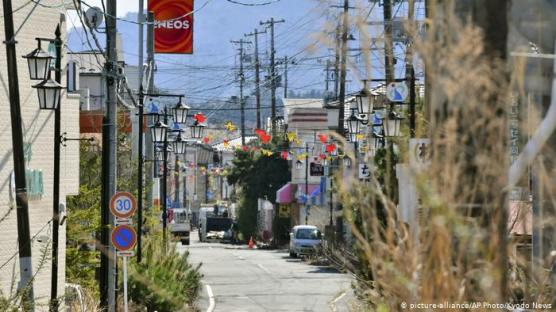
Eight years after a triple meltdown at the Fukushima nuclear power plant, part of nearby Okuma has been declared safe for residents to return. But there has been no rush to go home as radiation levels remain high.
The evacuation order for parts of Okuma was lifted by the Japanese government on Wednesday.
But just 367 of the town’s pre-2011 population of 10,341 have registered to go home, according to local media reports in Japan.
Okuma sits alongside the Fukushima Daiichi Nuclear Power Station and 40% of the town has been declared safe for a permanent return. But a survey last year found only 12.5% of former residents wanted to do so.
Prime Minister Shinzo Abe is to attend a ceremony in Okuma on Sunday to mark the occasion. But the government has been accused of promoting the return of residents to showcase safety ahead of the Tokyo Olympics next summer.
“This is a major milestone for the town,” Mayor Toshitsuna Watanabe said in a written statement. “But this is not the goal, but a start toward the lifting of the evacuation order for the entire town.”
Lingering radiation
There are plans to open a new town hall in May to encourage more people to go back to their town which was devastated by the earthquake, tsunami and triple meltdown at the plant in March 2011. But the town center near the main train station remains closed due to high radiation levels which exceed the annual exposure limit. There will be no functioning hospital for another two years.
Much of Okuma still records high radiation levels and is off-limits. All of nearby Futaba remains closed, with the former 40,000 residents unable to return home. In a report from an investigation published last month, environmental campaign group Greenpeace said “radiation levels remain too high for the safe return of thousands of Japanese citizen evacuees.”
Reluctance to return
The government lifted the evacuation order for much of neighboring Tomioka two years ago. But only 10% of Tomioka’s population has so far returned. Some 339 square kilometers (131 square miles) of the area around the plant are designated unsafe.
Fears of exposure to radiation remain high among former residents, especially those with children. In its report, Greenpeace accused the government of failure: “In the case of workers and children, who are in the frontline of hazards resulting from the Fukushima Daiichi nuclear disaster, the Japanese government continues to ignore international radioprotection recommendations.”
Part of the Okuma is being used to store millions of cubic meters of toxic soil collected during the decontanimation operation. Authorities say it will be removed by 2045 but no alternative storage site has yet been found.
In all, 160,000 people were evacuated out of the area when three of Fukushima’s six reactors went into meltdown, leading to radiation leaks.
Unclear debris map casts shadow over decommissioning of Fukushima plant
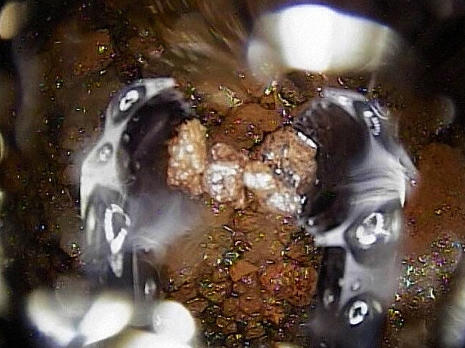
Pebble-like sediment believed to be nuclear fuel debris is lifted by a special device inside the No. 2 reactor containment vessel at the Fukushima Daiichi Nuclear Power Station.
April 9, 2019
TOKYO — The government and Tokyo Electric Power Co. (TEPCO) are set to launch full-scale probes of the inside of the No. 1 through No. 3 reactors at the disaster-stricken Fukushima Daiichi Nuclear Power Station this fiscal year, in an attempt to determine which reactor to work on first to remove fuel debris — a critical step for decommissioning the facility.
However, the interior of the No. 2 reactor, which is most likely to be the first to go through the debris removal process, has turned out to be different from what had originally been expected, underscoring the difficulties entailing the removal work. Since many companies are involved in the process, how to pass down the know-how acquired over the course of the more than 30 year-decommissioning process also poses a challenge.
“At present, it is difficult to clearly say we are going to remove all fuel debris,” said Akira Ono, who leads the decommissioning project, at a regular press conference by TEPCO on March 28, while noting that the utility will not back down from its ultimate goal of full debris removal.
If TEPCO fails to take out all debris from the nuclear plant, the very premise for dismantling the facility and returning the plot to its original state will be undermined. Such a scenario would adversely affect the disaster recovery plans envisaged by the national government and the Fukushima Prefectural Government. While awareness about the difficulty of debris removal has been shared among concerned parties, the actual dismal situation had not been recognized until TEPCO conducted the first debris survey at the No. 2 reactor on Feb. 13.
In that survey, a remotely controlled special device that was injected into the No. 2 reactor’s containment vessel succeeded in lifting portions of sediment accumulated at the bottom, which were believed to be fuel debris. Officials involved were relieved because they “had been worried the material would not move at all,” according to Ono.
The radiation level of the material, measured at a distance of some 30 centimeters, was 7.6 sieverts per hour, far less than anticipated. If the sediment contained a good portion of nuclear fuel, the radiation doses ought to have been several hundred sieverts per hour, even eight years after the 2011 nuclear meltdowns.
This finding suggested that the sediment that TEPCO came in contact with in the survey was not the main nuclear fuel debris it was looking for. Many speculate that the surface of the sediment may mainly consist of metals including cladding tubes that used to cover nuclear fuels.
The question now is whether fuel debris exists beneath the surface of the sediment or if nuclear fuel still remains within the reactor pressure vessel, or even somewhere else. There are currently no prospects for TEPCO to ascertain an accurate distributions of debris.
The material that was lifted in the survey mostly comprised pebble-like sediment, weighing less than 1 kilogram in total. Meanwhile, fuel debris generated in the core meltdowns is estimated to total 237 metric tons at the No. 2 reactor alone and a combined 880 tons at the No. 1 through No. 3 reactors.
At the No. 2 reactor, TEPCO will conduct a more detailed survey on debris possibly in the latter half of this fiscal year and attempt to collect small amounts of samples. At the No. 1 reactor, several apparatus including a robot submarine will be used to launch a full-scale survey inside the reactor to try to collect debris this fiscal year. As for the No. 3 reactor, the power company is apparently planning to prioritize removal of spent fuel, as related devices have gone through a series of glitches.
Unlike the other reactors, the No. 2 reactor did not suffer a hydrogen explosion in the 2011 disaster. Therefore, the No. 2 reactor remains the primary candidate for the first full-scale debris removal work, which is hoped to start in 2021.
With regard to the No. 1 and No. 3 reactors, the utility has yet to be able to reach materials appearing to be debris. The decommissioning of the nuclear plant is scheduled to be completed in 2051, a full 40 years after the triple meltdowns, but a concrete path toward that goal is not yet in sight.
“We have no choice but to remove whichever debris we can,” said a senior official with the Ministry of Economy, Trade and Industry.
Naoyuki Takaki, professor of nuclear engineering at Tokyo City University, commented, “There could ultimately be a decision to stop debris removal after pulling out as much debris as possible. In that case, we would have no option but to consider building a sarcophagus like the one at the Chernobyl nuclear plant.”
Government must help rebuild Fukushima evacuees’ lives
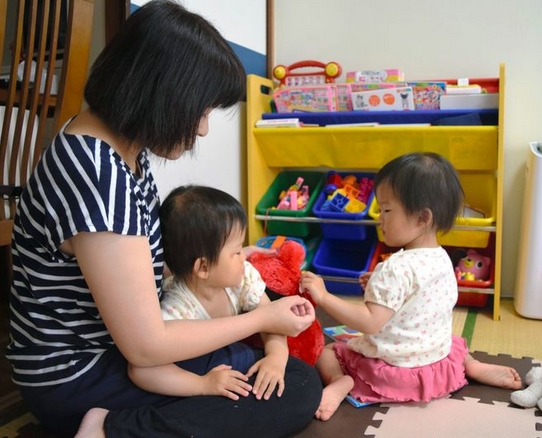
In this May 20, 2015, file photo, a Fukushima evacuee in her thirties is living in Tokyo with her two children. Her husband chose to stay in Fukushima for work.
April 8, 2019
Eight years on since the nuclear disaster, there are still many evacuees living away from their homes in other parts of the nation, unable to return to their communities after the catastrophic accident at the Fukushima No. 1 nuclear power plant.
But the situations of these Fukushima evacuees have been fading into the fog of obscurity over time.
The central government and the Fukushima prefectural government should step up their flagging efforts to grasp the realities of their life as evacuees and help them rebuild their destroyed livelihoods.
Some 40,000 former residents of areas around the nuclear plant still live away from their homes, either within or outside Fukushima Prefecture, according to statistics compiled by the Reconstruction Agency and the prefectural government. The figure is one-quarter of its peak level.
But the statistics have been criticized for failing to give a true picture of the problem.
Critics say the data is distorted by questionable government criteria for recognizing evacuees. They point out that the prefecture stopped treating people living in makeshift housing as evacuees when it terminated providing such temporary housing for free.
In many of the municipalities in areas close to the stricken nuclear plant, most local residents have not returned even after the evacuation order was lifted.
There are also people who have “voluntarily” fled their communities even though they were not in evacuation areas.
It is believed that the number of people who regard themselves as “evacuees” is far larger than 40,000. But nobody knows exactly how many.
Many Fukushima evacuees have opted not to return to their former communities after the evacuation order was lifted for various reasons. Some have already purchased new houses while living away from their homes, while others don’t want to force their children to change their schools.
Many others are hesitating to return or wavering about what to do because of concerns about the living conditions in affected areas and possible safety risks, especially radiation.
After years of living away from home, many evacuees are also struggling with problems such as reduced incomes, the difficulties of finding jobs, deteriorating health and isolation.
Some are suffering from poverty, anxiety about losing their housing due to the termination of public financial support and physical and mental illness.
The plights of these evacuees have been only partially made known by surveys of host local governments and support groups.
The government’s response to the problem has been grossly insufficient. The government conducted a survey of Fukushima evacuees last year, but it only covered former residents of areas subject to an evacuation order or other disaster response administrative action.
The government should try to see the entire and accurate picture of the problem including the situations of “voluntary evacuees” to understand what kind of support and systems are needed.
The most pressing issue for evacuees at the moment is housing. The Fukushima prefectural government and some local municipalities discontinued at the end of March most of their programs to provide free housing to evacuees from the areas where the evacuation order has been lifted as well as housing support for voluntary evacuees.
As a result, dozens of families have been left without housing. The local governments should take a more flexible stance in making such decisions. They should, for example, allow evacuees struggling with serious problems such as diseases to live in their current homes under the same conditions.
Behind the moves to cut housing support to evacuees is the policy of the central and prefectural governments of placing the top priority on encouraging them to return home.
While policy efforts to make it easier for evacuees to return to their homes are important, this policy is clearly out of tune with the realities of evacuees. These victims have come from a wide range of areas and already spent many years away from their homes.
Instead of imposing certain time frames for ending their life as evacuees, the authorities should readjust their support programs for evacuees so that they can receive effective help for any of the three options: returning to their hometowns, continuing to live as evacuees and settling down in their current communities.
The Reconstruction Agency has a particularly important role to play. Even though it often stresses its commitment to supporting evacuees and the central government’s leading role in helping these people, the agency has actually left most of the heavy lifting to the prefectural government.
The agency should take more specific actions to fulfill its responsibility to support victims of the nuclear accident that match its words.
1 This Month

of the week – Shut Down Drone Warfare!


Tell the Ukrainian Government to Drop Prosecution of Peace Activist Yurii Sheliazhenko

Petition to revoke the licensing of the Near Surface Nuclear Disposal Facility (NSDF) at Chalk River. https://www.ourcommons.ca/petitions/en/Petition/Details?Petition=e-7247
To see nuclear-related stories in greater depth and intensity – go to https://nuclearinformation.wordpress.com
-
Archives
- March 2026 (244)
- February 2026 (268)
- January 2026 (308)
- December 2025 (358)
- November 2025 (359)
- October 2025 (376)
- September 2025 (257)
- August 2025 (319)
- July 2025 (230)
- June 2025 (348)
- May 2025 (261)
- April 2025 (305)
-
Categories
- 1
- 1 NUCLEAR ISSUES
- business and costs
- climate change
- culture and arts
- ENERGY
- environment
- health
- history
- indigenous issues
- Legal
- marketing of nuclear
- media
- opposition to nuclear
- PERSONAL STORIES
- politics
- politics international
- Religion and ethics
- safety
- secrets,lies and civil liberties
- spinbuster
- technology
- Uranium
- wastes
- weapons and war
- Women
- 2 WORLD
- ACTION
- AFRICA
- Atrocities
- AUSTRALIA
- Christina's notes
- Christina's themes
- culture and arts
- Events
- Fuk 2022
- Fuk 2023
- Fukushima 2017
- Fukushima 2018
- fukushima 2019
- Fukushima 2020
- Fukushima 2021
- general
- global warming
- Humour (God we need it)
- Nuclear
- RARE EARTHS
- Reference
- resources – print
- Resources -audiovicual
- Weekly Newsletter
- World
- World Nuclear
- YouTube
-
RSS
Entries RSS
Comments RSS
 nuclear-news