0.72μSv in Nasunagahara Park, Nasu, Tochigi Prefecture
People when thinking about the nuclear disaster of Tepco’s Fukushima Daiichi often are misled by the mainstream media to think that only Fukushima Prefecture is affected by the radiation. That is so untrue.
Actually the Fukushima Daiichi ‘s radioactive plume has contaminated many other prefectures of Eastern Japan, prefectures of Tohoku region and prefectures of Kanto region (Tokyo area), radiation having being spread unevenly as a leopard skin, with hot spots everywhere, needing to be identified, indicated for public protection, and decontaminated..

This measurement was taken in the public park of Nasu, Tochigi Prefecture, 122km from Fukushima Daiichi and 188km from Tokyo.

Nasu, Tochigi Prefecture, 122km from Fukushima Daiichi

Nasu, Tochigi Prefecture, 188km from Tokyo
The children playing there will be exposed to radiation if it is not decontaminated nor indicated by a warning sign.

Source: http://ameblo.jp/kienaiyoru/entry-12234453760.html
Bullying of evacuated children
Recently, the Japanese mass media are busy reporting on the bullying of evacuated children at school. As a matter of fact, this kind of bullying has existed for quite a while. However, after a long silence, the mass media have suddenly started reporting about it. Often, it tends to be reduced to the common bullying found in the education system without reference to the particular environmental hazards caused by the nuclear accident. Akiko MORIMATSU analyzes the bullying from the viewpoint of the nuclear disaster evacuees. She was interviewed in “Minna no News Wonder” at Kansai TV on December 5th 2016.
【3.11 evacuees’ voices】
“The courage to escape” and “the power to ask for help”
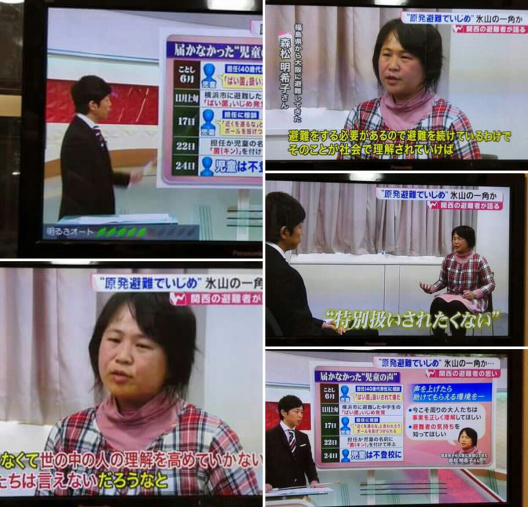
I am worried about what children will learn when they face a society incapable of helping people who have fled from calamity and are asking for aid.
I think that when society does not show how it is possible to help, children won’t be able to have the “courage to escape” or to deploy the power to “ask for help” at school.
I’ve noticed the following through my exerience with the nuclear disaster. We accept too easily that people facing danger will be able to escape without difficulty, and that it is natural to do so.
However, it is possible to create social situations which won’t allow for people to escape from danger, which won’t let them flee, or which pose such big obstacles that people can’t escape even when they are told that they are allowed to do so. This has indeed been our situation for the last 5 years and 8 months. I feel this way as an internal nuclear refugee.
This is how adult society is. In this society in which our evasion is not fully accepted, children are exposed to the risk of bullying, which can happen anywhere unfortunately, amplified by incomprehension, indifference, prejudice and discrimination of the society. I must say that they are facing even greater risks in response to the recent reporting by mass media.
At anytime, evacuee children are facing “the risk which is present here and now”.
This may be true for any children in this country.
And the “bullying” is not limited to children’s society.
It can be certainly said that there are second and third levels (TN 1) of damage from the nuclear disaster.
This is why society as a whole should accept the real situation of the nuclear disaster and set our eyes more directly on the truth.
The evacuees and evacuee children really exist all over Japan.
“They continue being evacuees because it is necessary to evacuate (TN2)”.
That is the truth and reality.
The only thing which counts is to start from this fact and decide how society should deal with it.
(Akiko MORIMATSU evacuated with two children from Fukushima to Osaka)
Broadcasted by Kansai TV on December 5th 2016
Sources: 東日本大震災避難者の会 Thanks & Dream
森松明希子さんのfacebookページ
Facebook of Akiko MORIMATU
(TN 1) For example, psychological, familial or social levels.
(TN2) because the environment is contaminated
https://fukushima311voices.wordpress.com/2017/01/01/bullying-of-evacuated-children/
Seaborne Fukushima Radiation Plume Hit West Coast, Corporate Media Reported It Dangerously
(EnviroNews DC News Bureau) — “It is not a question any more: radiation produces cancer, and the evidence is good all the way down to the lowest doses,” says the late Dr. John Gofman, Professor Emeritus at the University of California, Berkley, in his book Nuclear Witnesses: Insiders Speak Out.
On December 12, 2016, EnviroNews USA‘s own Editor-in-Chief Emerson Urry touched off a firestorm with his news article titled, “It’s Finally Here: Radioactive Plume From Fukushima Makes Landfall on America’s West Coast,” which claimed “medical science and epidemiological studies have demonstrated time and again that there is no safe amount of radiation for a living organism to be subjected to — period.”
In his piece, Urry also exposed other news agencies like NBC, the New York Post, USA Today and The Inquisitr, catching them with their pants down, in the act of repeating the false assertions of the U.S. and Canadian researchers, telling people not to worry about the recently detected low amounts of cesium 134 found in salmon, and that the levels were within “safe” or “accepted” thresholds for human health. [EDITOR’S NOTE: Emerson Urry recused himself from all editorial duties on this news story.]
Thom Hartmann picked up the article by Urry and read it on his show. Then Hartmann offered up his own journalistic explanation on how radiation works, and addressed the problem with the proclamation that there is a “safe” level of radiation to consume or be exposed to.
“As the element is decaying it is throwing off radiation, and the radiation, if it hits the DNA in the nucleolus and the nucleus of a cell, can alter that DNA in ways that can produce things like cancer,” Hartmann said. “Now it can also cause simply the cell to die or it can mutate the cell in all kinds of other weird ways, and so it’s kind of a numbers game. If you irradiate a million cells… you might get two or three that become cancerous. That’s all it takes, right? You’ve got cancer,” Hartmann continued in his video report. “The cesium could cause no cancer, or it could cause cancer in the first cell it irradiates. To say that there is a safe level of radiation is frankly wrong. It’s just wrong.”
Urry said later in a statement, “It’s one thing for the media to regurgitate trivial facts on trivial matters, but to blindly repeat that consuming low levels of radiation is ‘safe,’ is irresponsible reporting and borders on dangerous. News editors should take care to do their due diligence on a matter as serious as leading readers to believe consuming any amount of radiation is ‘safe’ when medical science and epidemiology, dating back 50 years to the present, have demonstrated repeatedly that that’s just not true. Even the smallest exposures increase the risk of cancer to the subject.”
According to the Agency for Toxic Substances and Disease Registry’s (ATSDR) report titled, “Public Health Statement for Cesium” from 2004, “stable and radioactive cesium can enter your body from the food you eat or the water you drink, from the air you breathe, or from contact with your skin. When you eat, drink, breathe, or touch things containing cesium compounds that can easily be dissolved in water, cesium enters your blood and is carried to all parts of your body… No known taste or odor is associated with cesium compounds.”
Cesium is similar enough to potassium that it can fool the body. This results in its bioaccumulation. When cesium enters the biological system of a fish, which is then eaten by a larger fish, the larger fish becomes contaminated. As the larger fish eats more, it becomes more contaminated. The cesium accumulates in its body. When a person eats that fish, he or she also ingests the cesium that hasn’t decayed or been excreted. The more seafood that person eats, the more radioactive material he or she will be exposed to.
The researchers who discovered the cesium recently also made the mistake of equating the dangers of consuming seaborne isotopes to that of receiving an x-ray, missing the point entirely that ingested or inhaled “internal particle emitters” are known to be especially hazardous.
“Consuming food containing radionuclides is particularly dangerous. If an individual ingests or inhales a radioactive particle, it continues to irradiate the body as long as it remains radioactive and stays in the body,” said Dr. Alan Lockwood, MD in an article on Fox News Health.
“Children are much more susceptible to the effects of radiation and stand a much greater chance of developing cancer than adults,” said Andrew Kanter, MD, President of the Board for Physicians for Social Responsibility (PSR) in that same Fox News Health article. “So it is particularly dangerous when they consume radioactive food or water.”
Those who might expect the government to protect them from contamination by radiation have only to look at the downwinder situation in Utah or the consequences of Gofman’s research in the late 1960s. According to Gofman’s obituary in the L.A. Times, “Gofman and his colleague at Lawrence Livermore National Laboratory, Arthur R. Tamplin, developed data in 1969 showing that the risk from low doses of radiation was 20 times higher than stated by the government. Their publication of the data, despite strong efforts to censor it, led them to lose virtually all of their research funding and, eventually, their positions at the government laboratory.” Their conclusions were for the most part, later validated.
“There is no safe level of radionuclide exposure, whether from food, water or other sources, period,” said Jeff Patterson, DO, immediate past President of PSR, in late March of 2011 in the immediate aftermath of the meltdowns. “Exposure to radionuclides, such as iodine 131 and cesium 137, increases the incidence of cancer. For this reason, every effort must be taken to minimize the radionuclide content in food and water.”
“There is no safe dose of radiation,” says Prof. Edward P. Radford, Physician and Epidemiologist as quoted by GreenMedInfo.
In an email to EnviroNews, nuclear expert Arnie Gundersen said Japan had raised the maximum allowable exposure by 20 times the previous number for civilians to be able to return to their homes. The U.S. and the EPA have considered such plans in the case of a nuclear accident. In food, the U.S. has an allowable dosage of radiation that is 12 times what Japan allows.
“Corporations get the benefit, civilians take the risk,” Gundersen wrote.
While Urry and Hartmann have sounded the alarm, there remain unanswered questions that desperately need to be resolved. Who will clean up the contamination in the food chain? How much radiation exposure will governments continue to say is safe in spite of the medical research? How can people trust what’s on their plate and in their corporate owned media?
Doctor who stayed in Fukushima after meltdowns thought to have died in fire
HIRONO, Fukushima — A doctor who chose to stay in an area affected by the Fukushima nuclear crisis and continued to provide medical services may have died in a fire at his home here, police said.
At around 10:30 p.m. on Dec. 30, a fire broke out at the home of Hideo Takano, 81, director of Takano Hospital in Hirono, Fukushima Prefecture. Part of the wooden structure was destroyed in the blaze, local police said.
The body of a man was found in one of the rooms. Investigators believe the corpse is that of Takano, whom they have been unable to contact, and are trying to confirm the identity of the body.
A security guard at the hospital, located on the same grounds as Takano’s home, noticed smoke coming out of the home and alerted a local fire station. Takano had lived alone at the address.
A hospital official told the Mainichi Shimbun that until recently, Takano had treated patients as usual.
Takano Hospital is situated about 22 kilometers south of the crippled Fukushima No. 1 Nuclear Power Plant. Takano chose to stay home and continued to treat inpatients at his hospital even after the town of Hirono was designated as a zone in which residents were urged to prepare for evacuation following the outbreak of the nuclear disaster. He also examined local residents and those engaged in the decommissioning of the nuclear plant.
http://mainichi.jp/english/articles/20161231/p2a/00m/0na/011000c
Court denies disclosure of Tepco officials’ testimony about Fukushima disaster

The Tokyo District Court has dismissed an appeal by Tepco shareholders calling for disclosure of a government panel’s records of questioning of executives over the March 2011 crisis at the Fukushima No. 1 nuclear power plant.
“The decision accepted all of what the government claimed and therefore is regrettable,” the shareholders said in a statement following the ruling Tuesday. They said they would file an immediate appeal.
The Fukushima Nuclear Accident Independent Investigation Commission was formed in 2011 to investigate the causes of the nuclear disaster by questioning executives of the utility, now called Tokyo Electric Power Company Holdings Inc., including Tsunehisa Katsumata, former chairman of the utility, and others.
The questioning was conducted on condition that it would not be used to assign blame.
Only the records of the interviews of those who agreed that their answers would be made public have been disclosed, including Masao Yoshida, the late former chief of Fukushima No. 1.
The shareholders are seeking disclosure of the records on 11 Tepco officials and three officials of the now-defunct Nuclear and Industrial Safety Agency.
“If the records are disclosed, it would be extremely difficult to gain cooperation from related parties in future investigations,” presiding Judge Akihiko Otake said, deciding that the disclosure could disrupt the execution of official duties.
The court also concluded that the undisclosed portion of the records that was not revealed in previous disclosures should be kept confidential.
Initially, the records of questioning of some 770 Tepco and government officials in 2011 and 2012 were all kept under wraps. But following media reports on the Yoshida interview, the government decided to change its policy and disclose them with interviewees’ consent.
Since September 2014, the government has disclosed the records of some 240 interviewees.
1 This Month


10 March A LIVE WEBINAR THE REAL EFFECTS OF NUCLEAR POWER
What the Industry Isn’t Telling Us
1:00 PM Mountain, 2 pm Central, 3 pm Eastern. Live on the Keepers of the Water Facebook page


18 March Webinar @ 1 PM EST: An Assessment of SMR Projects: The Case of Canada
register for the zoom:
https://us02web.zoom.us/webinar/register/WN_o8BIIOUvQ2ONJR1nta65DQ#/registration


of the week – STOP SMALL MODULAR REACTORS IN CANADA
To see nuclear-related stories in greater depth and intensity – go to https://nuclearinformation.wordpress.com
-
Archives
- March 2026 (87)
- February 2026 (268)
- January 2026 (308)
- December 2025 (358)
- November 2025 (359)
- October 2025 (376)
- September 2025 (258)
- August 2025 (319)
- July 2025 (230)
- June 2025 (348)
- May 2025 (261)
- April 2025 (305)
-
Categories
- 1
- 1 NUCLEAR ISSUES
- business and costs
- climate change
- culture and arts
- ENERGY
- environment
- health
- history
- indigenous issues
- Legal
- marketing of nuclear
- media
- opposition to nuclear
- PERSONAL STORIES
- politics
- politics international
- Religion and ethics
- safety
- secrets,lies and civil liberties
- spinbuster
- technology
- Uranium
- wastes
- weapons and war
- Women
- 2 WORLD
- ACTION
- AFRICA
- Atrocities
- AUSTRALIA
- Christina's notes
- Christina's themes
- culture and arts
- Events
- Fuk 2022
- Fuk 2023
- Fukushima 2017
- Fukushima 2018
- fukushima 2019
- Fukushima 2020
- Fukushima 2021
- general
- global warming
- Humour (God we need it)
- Nuclear
- RARE EARTHS
- Reference
- resources – print
- Resources -audiovicual
- Weekly Newsletter
- World
- World Nuclear
- YouTube
-
RSS
Entries RSS
Comments RSS
 nuclear-news