Robot probe of Fukushima reactor halted due to glitch
An operation to prepare to examine the inside of the No. 2 reactor at the disaster-struck Fukushima Daiichi nuclear plant was halted Thursday due to a technical glitch, the plant operator said.
Tokyo Electric Power Company Holdings Inc. said it sent a robot with a high-pressure water nozzle into a containment structure housing the pressure vessel, but suspended the work after video images from a camera on the robot became dark.
TEPCO said high radiation levels may have caused the camera glitch. The camera was designed to withstand cumulative radiation exposure up to 1,000 sieverts. Previously the company said up to 530 sieverts per hour of radiation was detected within the reactor containment structure in late January. The radiation reading during the robot operation Thursday was 650 sieverts, TEPCO said.
In this image released by Tokyo Electric Power Co. (TEPCO), a remote-controlled “cleaning” robot, bottom, enters the reactor containment chamber of Unit 2 for inspection and cleaning a passage for another robot as melted materials are seen at Fukushima Dai-ichi nuclear power plant in Okuma town, Fukushima prefecture, northeastern Japan, Thursday, Feb. 9, 2017. The “cleaning” robot that entered one of three tsunami-wrecked Fukushima reactor containment chambers was withdrawn before completing its mission due to glitches most likely caused by high radiation.
Cleaner robot pulled from Fukushima reactor due to radiation
TOKYO (AP) — A remote-controlled cleaning robot sent into a damaged reactor at Japan’s Fukushima nuclear plant had to be removed Thursday before it completed its work because of camera problems most likely caused by high radiation levels.
It was the first time a robot has entered the chamber inside the Unit 2 reactor since a March 2011 earthquake and tsunami critically damaged the Fukushima Da-ichi nuclear plant.
Tokyo Electric Power Co. said it was trying to inspect and clean a passage before another robot does a fuller examination to assess damage to the structure and its fuel. The second robot, known as the “scorpion,” will also measure radiation and temperatures.
Thursday’s problem underscores the challenges in decommissioning the wrecked nuclear plant. Inadequate cleaning, high radiation and structural damage could limit subsequent probes, and may require more radiation-resistant cameras and other equipment, TEPCO spokesman Takahiro Kimoto said.
“We will further study (Thursday’s) outcome before deciding on the deployment of the scorpion,” he said.
TEPCO needs to know the melted fuel’s exact location and condition and other structural damage in each of the three wrecked reactors to figure out the best and safest ways to remove the fuel. It is part of the decommissioning work, which is expected to take decades.
During Thursday’s cleaning mission, the robot went only part way into a space under the core that TEPCO wants to inspect closely. It crawled down the passage while peeling debris with a scraper and using water spray to blow some debris away. The dark brown deposits grew thicker and harder to remove as the robot went further.
After about two hours, the two cameras on the robot suddenly developed a lot of noise and their images quickly darkened — a sign of a problem caused by high radiation. Operators of the robot pulled it out of the chamber before completely losing control of it.
The outcome means the second robot will encounter more obstacles and have less time than expected for examination on its mission, currently planned for later this month, though Thursday’s results may cause a delay.
Both of the robots are designed to withstand up to 1,000 Sieverts of radiation. The cleaner’s two-hour endurance roughly matches an estimated radiation of 650 Sieverts per hour based on noise analysis of the images transmitted by the robot-mounted cameras. That’s less than one-tenth of the radiation levels inside a running reactor, but still would kill a person almost instantly.
Kimoto said the noise-based radiation analysis of the Unit 2’s condition showed a spike in radioactivity along a connecting bridge used to slide control rods in and out, a sign of a nearby source of high radioactivity, while levels were much lower in areas underneath the core, the opposite of what would normally be the case. He said the results are puzzling and require further analysis.
TEPCO officials said that despite the dangerously high figures, radiation is not leaking outside of the reactor.
Images recently captured from inside the chamber showed damage and structures coated with molten material, possibly mixed with melted nuclear fuel, and part of a disc platform hanging below the core that had been melted through.
The ongoing Fukushima nuclear catastrophe has been back in the news lately following record high readings at the reactor site. Radiation levels were a maximum of 530 sieverts per hour, the highest recorded since the triple core meltdown in March 2011.
But upon further examination, the story has been misreported, in part due to mistranslation. In fact, according to Nancy Foust of SimplyInfo.org, interviewed on Nuclear Hotseat, there was no spike. High readings were in expected locations that TEPCO was only able to access recently. Therefore, the reading became evident because workers were getting closer to the melted fuel in more dangerous parts of the facility. In other words, it’s not a new hot mess, just the same hot mess it’s always been, pretty much from the beginning. The good news is nothing has changed. The bad news is – nothing has changed.
The confusion was initially caused by a translation error that SimplyInfo.org thinks occurred between the Kyodo News and Japan Times. Since this happened, Foust and her group have been trying to get news sources to correct the stories, with limited success.
The elevated radiation levels are inside containment (good news) in ruined unit 2 and were discovered using a camera, not proper radiation monitors. Therefore, the high reading may not be reliable since it is an estimate based on interference data with the camera. TEPCO is planning on sending in a robot properly equipped with radiation detectors to take a reliable reading. Although no date has been given, TEPCO indicates it expects to deploy the robot within 30 days or so.
Foust theorizes that the bulk of spent fuel is probably right below the reactor vessel burned into the concrete below. No one knows if fuel has gone into the ground water below that.
Coming from the Japan Times today publishing this without facing their own mistake and apologizing for it, it is really quite hypocritical because it is their own mistranslation of the Kyodo news article which started this misled interpretation by all the western media during the past week.
U.S. expert decries misleading Fukushima reports about ‘soaring’ radiation
WASHINGTON – A member of the American Nuclear Society has written online that radiation levels at the crisis-hit Fukushima No. 1 nuclear power plant in Japan are not “soaring” as reported by some media last week.
Will Davis, a consultant and writer for the professional membership organization, left a post on its blog, ANS Nuclear Cafe, saying the claims that experts are finding the levels unimaginable are “demonstrably false.”
Tokyo Electric Power Company Holdings Inc., better known as Tepco, said on Feb. 2 that it estimated the radiation below the pressure vessel in the No. 2 reactor’s primary containment vessel to be as high as 530 sieverts per hour based on readings from a remotely controlled camera it stuck in there.
Following the announcement, some media ran reports suggesting the radiation levels had recently risen or mentioned unnamed experts as calling the reading unimaginable.
In his post, dated Tuesday, Davis noted that the earlier readings in the reactor 2 had not been taken at the same spot.
“This is not a ‘soaring’ level but actually just the first detection of the actual level at a place nearer to the damaged fuel.
“No announcement of any altered radiation levels anywhere on the site, or outside of it, has been made because there are no level changes,” he wrote.
The post said the radiation estimate is far from unimaginable, adding that readings taken near the melted fuel at Chernobyl were described as well over 100 sieverts per hour, while an actual level of 1,000 sieverts was reported near the aqueous homogeneous HRE-2 reactor after it developed a hole in its reactor vessel in the late 1950s.
Tepco must conduct more robot probes of the three meltdown-hit reactors to clean up the fuel and decommission them.
Lost in translation: Fukushima readings are not new spikes, just the same “hot mess” that’s always been there
The ongoing Fukushima nuclear catastrophe has been back in the news lately following record high readings at the reactor site. Radiation levels were a maximum of 530 sieverts per hour, the highest recorded since the triple core meltdown in March 2011.
But upon further examination, the story has been misreported, in part due to mistranslation. In fact, according to Nancy Foust of SimplyInfo.org, interviewed on Nuclear Hotseat, there was no spike. High readings were in expected locations that TEPCO was only able to access recently. Therefore, the reading became evident because workers were getting closer to the melted fuel in more dangerous parts of the facility. In other words, it’s not a new hot mess, just the same hot mess it’s always been, pretty much from the beginning. The good news is nothing has changed. The bad news is – nothing has changed.
The confusion was initially caused by a translation error that SimplyInfo.org thinks occurred between the Kyodo News and Japan Times. Since this happened, Foust and her group have been trying to get news sources to correct the stories, with limited success.
The elevated radiation levels are inside containment (good news) in ruined unit 2 and were discovered using a camera, not proper radiation monitors. Therefore, the high reading may not be reliable since it is an estimate based on interference data with the camera. TEPCO is planning on sending in a robot properly equipped with radiation detectors to take a reliable reading. Although no date has been given, TEPCO indicates it expects to deploy the robot within 30 days or so.
Foust theorizes that the bulk of spent fuel is probably right below the reactor vessel burned into the concrete below. No one knows if fuel has gone into the ground water below that.
The operator of the damaged Fukushima nuclear plant has suspended a preliminary survey using a robot inside the containment vessel of one of its reactors.
On Thursday, a remote-controlled robot was sent toward the middle of the No. 2 reactor, but the operation was later suspended after images captured by one of the robot’s 3 cameras turned out black.
The survey is part of efforts toward decommissioning the No.1 to No. 3 reactors, which suffered meltdowns.
Officials of Tokyo Electric Power Company say they will find out what went wrong before deciding how to proceed with the survey. The utility originally planned to use the same robot on Tuesday, but put it off to Thursday due to mechanical trouble.
The exact conditions inside the containment vessel must be determined before a full survey can be undertaken. The full survey will use a scorpion-shaped robot to measure radiation levels and temperatures.
A remote-controlled camera used in a survey last week captured footage of what seemed to be debris of molten fuel on the partially broken floor grate in the vessel.
First I would like to thank Kurumi Sugita, for her essential work in translating and writing this article (and many others) about the situation that the evacuees are now facing, suffering on location, forced out of their temporary housing to make them return in their evacuated homes to live with radiation, all sacrificed for the sake of the Japanese government propaganda that everything is now back to normal in Fukushima Prefecture, everything is now fine and safe in Japan, to welcome all the future visitors to come for the 2020 Tokyo olympics. It is plainly criminal.
At the end of March, 2017 (except for Tomioka village for which the date will be April 1st), the evacuation order will be lifted from many towns and villages accompanied by the end of housing aid and mental damage compensation. The people evacuated by order will become “voluntary evacuees” , those who evacuate even though they are not obliged to. What will happen to them after March ?
To have an idea of what is likely to happen, we shall have a look of the situation of the people of Kawauchi village, where the mental damage compensation ended in August 2012.
We will start with a Facebook posting of Mme Saki Okawara dated January 16th, 2017, followed by a comment of Mr Atsushi SHIDA, president of residents association of Kawauchi villagers living in temporary houses in Koriyama city.
***
I brought about 200 knitted items, such as caps, mufflers, vests, knee blankets, to a temporary housing complex of Kawauchi village. A friend of mine running a knitting café at the Environment Study Information Center in Shinjuku, Tokyo, sent them to me. She has a project named “Sending the Warmth” which is to send hand-knitted items to disaster victims. She wanted to send them to Fukushima too, and I received 5 boxes.
The evacuation order was lifted from Kawauchi village following the mayor’s return declaration of January 2012. Consequently, in August 2012, compensation for mental damage came to the end. The president of the residents association of the temporary housing in Koriyama city issued a call for help on the internet in December 2013, for the residents were lacking such necessities as rice and blankets to get through the winter. I read the message, brought some materials to help, and since then I visit them from time to time.
When the evacuation order is lifted, people living in the temporary housing or in private / public housing considered as “temporary housing” and thus qualified for housing aid, are regarded as “those who continue to evacuate because they want to do so, whereas they can return”. Although they were evacuated by order, they have become jishu hinansha “auto-evacuees“, those who evacuate “voluntarily”. Fukushima prefecture is going to stop the housing aid at the end of March this year. This applies to these people too.
Currently, about 150 people from Kawauchi village are living in temporary housing. Most of them are using the hospitals in Koriyama city because of their frail conditions related to their age or disease.
Since temporary housing belongs to Fukushima prefecture, in September 2016, prefectural employees came to explain about the end of the housing aid. On January 6th this year, employees of Kawauchi village handed out documents entitled “Necessary procedures to quit temporary housing and the donation of housing items”. They say that housing items (translator’s note: air conditioner, lighting, curtains, storage units, fire extinguisher) can be given to the inhabitants if so desired, but to do so they have to leave the housing. Only this page of the document was in yellow. How shrewd! Probably 90% of them would believe that they would have to leave, and might return to the village or move to private apartments. The remaining 10% can’t move, for they are elderly in need of medical care and cannot go anywhere else.
The evacuees are told to return to their homes. But there are only one or two consultations per week at the village medical center. There is no transport service. There are three persons in need of dialysis here. The situation is as follows: at the nearest general hospital at Ono Shinmachi (translator’s note: about 30 minutes by car from Kawauchi village), 27 people are on the waiting list; at the day care of Kawauchi Social Service, the available 30 places are already taken; at the elderly people’s home, 57 households are on the waiting list. How can you go back there? In this situation, if they expel the residents from temporary housing by force, what will happen to people who have nowhere to go? And if Fukushima prefecture forces its way to stop the housing aid, it will likewise affect many more people beyond Kawauchi village.
***
Mr. Shida, President of the residents association of temporary houses, commented to us about the residents and their situation.。
Even after the lifting of the evacuation order, many people living in temporary housing or in housing “considered as temporary”, cannot go back home and will remain evacuated for reasons such as follows: to have access to medical or long-term care, to keep the children in the same schools, or for employment related reasons.
90% of the residents are hoping to continue living in the temporary housing, because there already exists a community here. The residents support each other and check to see if everybody is all right. If you fall ill, somebody will call an ambulance to go to a hospital and get in touch with the family. You feel secure here. However, the end of March (translator’s note: with the end of housing aid) might be the moment of separation. People will try to rebuild their lives. There will be those who return to the village, others will go join their children elsewhere, the younger generations will remain evacuated because of the low-dose radiation related health hazards.
The residents association of the South Temporary Housing Units required an extension of the temporary housing in the 2015 fiscal year, reflecting the needs of the majority of the residents. However, we did not require an extension this year. The reason is that many of the residents are elderly, in their 80s and 90s. Many of them are suffering from cognitive problems and aggravation of health conditions. If they continue their lives in temporary housing, with the weakening of their physical conditions, it will become more difficult to rebuild their lives elsewhere. Starting from April this year, it is very probable that administrative services will be minimalized. This is like living in an elderly people’s home without helpers. As an association, we have reached the conclusion that living in such conditions represents too much risk, and we decided not to require the extension.
Nevertheless, the elderly persons living here had to change places (translator’s note: shelters, etc.) several times and have gone through lots of struggles before finally settling down here. Six years’ life in temporary housing! However, when you live somewhere for 6 years, it is more than temporary life. How many more years can they live? Isn’t it normal that they hope to spend the rest of their lives here? Many people would like to let them have this choice.
Nevertheless, as an association, at the occasion of the termination of housing aid in March 2017, we are appealing for the following:
let each person decide if they leave the temporary housing or remain;
let us have a supplementary delay of 2 or 3 years;
allocate more than 50,000 yen per household, as this amount proposed to cover the moving fee seems insufficient from a practical point of view.
We, the inhabitants of areas affected by the nuclear power station accident, have learned over past six years that the evacuation can last for a long period and that the environmental contamination will remain over several decades or even several centuries.
Currently, there are about 100,000 nuclear accident evacuees dispersed all over Japan. People have different perceptions. For some, the number of 100,000 evacuees is just a simple figure you find in newspapers. For others it represents 100,000 individual lives.
Damages suffered by inhabitants from the current nuclear accident include: the violation of environmental rights by environmental contamination; the violation of moral rights by the disparity and inequality of compensation in the areas of 20 to 30km of distance from the crippled nuclear power station; the violation of the right to have a happy family life by the separation of the family because of the low-dose radiation related health hazards.
We are especially worried about the possibility of rebuilding the lives of 46,000 people from the Futaba district at a distance of 30km, and of 11,000 households (more than 30,000 souls) of so-called “voluntary” evacuees from either inside or outside of Fukushima prefecture. Many have not been supported by financial compensation.
We have also been worried for some time about childless households, old couple’s households, single elderly person’s households, and those people who have chronic disease, or who are having financial difficulties.
It has been six years since the nuclear accident. It is really from now on that the damaged areas need support. It is my strong desire to transmit this message.
A wide area of northeastern Japan, the Tohoku and Kantou regions, was contaminated by the radioactive material emitted from the accident at the Fukushima Daiichi Nuclear Power Station (FDNPS) of the Tokyo Electric Power Company (TEPCO), as manifested by various environmental investigations (Nakajima et al. 2014). The accident was caused by the Great East Japan Earthquake, which struck at 14:46 Japan Standard Time (JST; Coordinated Universal Time, UTC+ 9 h) on 11 March 2011.
Takemura et al. (2011) show that the negative anomaly of a 500-hPa height over the Okhotsk Sea area along 145° E made the westerly jet stronger than the climatological mean during mid-March; consequently, 70 to 80% of the radioactive material from the FDNPS was driven to the Pacific Ocean and the rest of the globe (Takemura et al. 2011; Stohl et al. 2012; Mészáros et al. 2016). The remaining material spread over and deposited onto the land area of Japan, producing characteristic hot spot patterns (Yasunari et al. 2011; JAEA 2012; SCJ 2014). The total emission of 137Cs into the atmosphere until the end of April was estimated to be 14.6 ± 3.5 PBq (SCJ 2014). The ratio of the total deposition over the Japanese land area to the total atmospheric emission was estimated as 20 ± 6%, according to the airborne monitoring conducted by the Ministry of Education, Culture, Sports, Science, and Technology, Japan (MEXT 2011), whereas the ratio was calculated as 27 ± 10% based on the multi-model intercomparison by the Science Council of Japan (SCJ 2014). To date, this inconsistency has not been fully understood, owing to the lack of observation data, which is attributable to instrumental damage and electric outages as well as modeling uncertainties. In addition, there is still great uncertainty in the emission time series of the radioactive material, as shown in Fig. 1. Yumimoto et al. (2016) conducted an inverse analysis to optimally estimate the emission rate using the time series of the deposition map, but the result is very different from that of Katata et al. (2015).
Time series of the 137Cs emission rate from the FDNPS, as estimated by Terada et al. (2012), Katata et al. (2015), and Yumimoto et al. (2016)
Recently, Tsuruta et al. (2014) developed a method to directly measure the hourly time series of the atmospheric 137Cs concentration at surface level, from the aerosol sampling tapes of the national suspended particulate matter (SPM) network. The SPM network monitors air pollution by employing beta-ray attenuation counters. Four laboratories, namely, those of Tokyo Metropolitan University, the Nuclear Professional School of the University of Tokyo, the Japan Atomic Energy Agency, and the Japan Chemical Analysis Center, retrieved the atmospheric loading from the hourly aerosol spots on the SPM tape. This method offers the potential for studying the atmospheric transport of 137Cs, although the data is from surface level, during the entire post-accident period; the SPM dataset has high temporal and spatial sampling, with observations every hour at 90 out of 400 sites (Fig. 2). In Fig. 2, it can be seen that the Nakadori region is a channel basin area between the Ou and Abukuma mountains, while the Hamadori region is a coastal region to the east of the Abukuma mountains. The FDNPS is located in the northern part of the Hamadori region. In this report, we compare the ensemble results of two aerosol transport models with SPM data. An important purpose of the comparison is to investigate the validity of the combined use of SPM data and multi-model simulations to depict the transportation of atmospheric 137Cs over the Japan land area. Once validated, further analysis can be performed on a larger volume of SPM data, such as the most recent data from 99 SPM sites, which has recently been made available to the public (Oura et al. 2015). In addition, the results could be a useful input for our second model intercomparison, which is intended as a follow-up to the first comparison, which was made by the SCJ (SCJ 2014), and this can contribute to future discussions of the use of models in emergency protocols.
Names of key regions and locations of SPM sites at the time of accident for the present study. The Tohoku region is the northeastern part of the Japanese islands and includes the Fukushima and Miyagi prefectures; the Kantou region is the area that includes the Tokyo, Saitama, Chiba, Kanagawa, and Ibaraki prefectures. The FDNPS is located in the northern part of the Hamadori region, a coastal area to the east of the Abukuma Mountains. The Nakadori region is a channel basin area between the Ou and the Abukuma mountains. Open circles are SPM monitoring sites managed and maintained by local governments in eastern Japan before the accident. The base map was modified by using the original map in Fig. 1 of Tsuruta et al. (2014)
Tsuruta et al. (2014) identified nine plumes, as listed in Fig. 3, that transported particulates to the land area of Japan and in which the maximum atmospheric 137Cs concentration exceeded 10 Bq m−3, based on a synoptic analysis using a time series of the SPM data and the wind vector field. For purposes of comparison, we selected plumes P2 to P9 in the period 14–24 March 2011. In this period, there were two migrations of low pressure systems over Japan; these occurred on 15 and 20 March, according to the weather maps shown in Fig. 4.
Plumes identified by Tsuruta et al. (2014). Horizontal bars show the period with high 137Cs concentrations (>10 Bq m−3). Closed and open circles indicate areas in the Hamadori, Nakadori, and Kantou regions where the concentrations were larger or smaller, respectively, than 100 Bq m−2
a–f Weather maps based on JMA analysis at 9:00 JST in the analysis period
The government on Feb. 7 submitted a legal revision bill to the Diet to stabilize funding for the decommissioning of the Fukushima No. 1 nuclear plant.
The subject of the revisions is the law establishing the Nuclear Damage Compensation and Decommissioning Facilitation Corp. (NDF), which manages the flow of funds to nuclear accident victims and the long process of dismantling the disaster-stricken Fukushima No. 1 plant.
The revisions will require plant operator Tokyo Electric Power Co. (TEPCO) to set aside funds secured through corporate restructuring with the NDF. The revisions will also give the Ministry of Economy, Trade and Industry the right to perform spot inspections of TEPCO offices to make sure the utility is making appropriate deposits.
Furthermore, the revision bill states that TEPCO must submit a reactor decommissioning plan and a financing scheme to fund that plan to the industry ministry every fiscal year. The NDF and the industry ministry will examine the utility’s decommissioning project structure, and judge if it is being properly implemented.
The government is looking to have the revisions enter force within the year, with TEPCO capital transfers to the NDF to commence as early as next fiscal year, which starts on April 1, 2017.
Last year, the industry ministry increased the total estimated cost for Fukushima No. 1 plant decommissioning from 2 trillion yen to 8 trillion yen, in preparation for the difficult work of removing the melted fuel from three of the power station’s reactors.
TEPCO’s annual revenues currently stand at about 400 billion yen, while reactor decommissioning alone is expected to cost some 300 billion yen per year. Nevertheless, the industry ministry believes the utility should be able to cover its obligations if it can improve its earning power through management restructuring and the restart of the Kashiwazaki-Kariwa Nuclear Power Plant in Niigata Prefecture.
However, the governor of Niigata Prefecture has been reluctant to green-light the restart of the Kashiwazaki-Kariwa reactors, and there is no projected schedule to bring the plant back on line. In addition, it is possible that the cost of decommissioning the Fukushima No. 1 plant reactors will continue to swell.
Namie Junior High School, Namie, Futaba, Fukushima prefecture.
Measures taken on February 5, 2017, on March 31, 2017 the japanese government will lift the evacuation order in Namie, for its inhabitants to return….
There are many shoes still to drop at Fukushima Daiichi, said Kevin Kamps, radioactive waste monitor at Beyond Nuclear. If something goes wrong with the radioactive waste storage pools, there could be a release of high-level radioactivity into the air, he added.
Radiation at Fukushima’s nuclear power plant is at its highest level since the tsunami-triggered meltdown nearly six years ago. Tokyo Electric Power Company (TEPCO) is reporting atmospheric readings inside Daiichi’s reactor No.2 are as high as 530 sieverts an hour, while a human exposed to a single dose of 10 sieverts would die in a couple of weeks.
RT: Can you explain what is likely going on here?
Kevin Kamps: This catastrophe that is ongoing is nearly six years old at this point. The fuel, the melted cores have been missing an action. TEPCO doesn’t know where they are; the Japanese government doesn’t know where they are; nobody knows where they are. What could have happened is these probes, these cameras, these robots, these radiation monitors that are being sent in by TEPCO to try to figure out what is going on, may have encountered the closest they have come yet to these melted cores. They may even have come upon melted fuel that is not under water, and water serves as a radiation shielding. So if this is an open area and there is no water – that could explain.
But what you’ve got are melted reactor cores. Of course, human beings can’t be in operating atomic reactors. They also can’t be in this area where there is a meltdown. There is also imagery – it looks like a melt through of a metal grade. It all stands to reason that the cores melted through the reactor pressure vessels and down into the containment structures right through that metal grating.
It is not unexpected, but we still don’t know where the cores are. There are claims that “it’s all contained, don’t worry about it.” It is indisputable that there is a daily flow of radioactively contaminated groundwater into the ocean. The figures something like 80,000 gallons per day of relatively low-level radioactive waste water. Then you’ve got those storage tanks – we’re talking 800,000 tons of highly radioactive water stored in tanks. Every day they pour a hundred tons of water on each of these three melted down cores. Sometimes they lose those tanks. They leak, they overflow – it is an ongoing catastrophe.
RT: So the contamination, in this case, could leak out, couldn’t it?
KK: There is some leakage on a daily basis. Then they try to capture as much as they can and contain it in the storage tanks, which they sometimes lose, whether during a typhoon or through human error – they have had overflows. So many shoes can still drop at Fukushima Daiichi. One of the ones is the high radioactive waste storage pools that aren’t even inside radiological containment. They don’t have all of that spent nuclear fuel transferred to a safer location in a couple of the units still. If something were to go wrong with that – those would be open air releases of very high-level radioactivity.
The prime minister at the time the catastrophe began, [Naoto] Kan, had a contingency plan to evacuate all of North-East Japan – up to 50 million people. It was predominantly because of those storage pools. We’re still in that predicament- if one of those pools were to go up in flames. As Tokyo plans to host the 2020 Olympics and bring in many millions of extra people into this already densely populated area -it is not a good idea.
RT: Going back to this specific leak: how does this complicate the cleanup efforts there? Is it possible even to get something in there right now to examine what is going on?
KK: State of the art robotic technology – Japan is a leader in robotics – can only last so long, because the electronics get fried by the gamma radiation, and probably neutron radiation that is in there. That is the situation deep in there. They are already saying it will take 40 years to so-called decommission this, but that may be optimistic.
RT:Also in December the government said it is going to take twice as much money – nearly twice as much as they originally thought – to decommission that. Does this make matters ever worse – this leak? Or is this just kind of the situation to expect at this point?
KK: It just shows how dire the situation is. The figures of $150 billion to decommission – I have seen figures from a think tank in Japan sided by Green Peace Japan up to $600 billion. If you do full cost accounting: where is this high-level radioactive waste going to go? It is going to need a deep geological depository. You have to build that and operate it. That costs a hundred billion or more. So when you do full cost accounting, this catastrophe could cost hundreds of billions of dollars to recover from. We’re just in the beginning.
The news headlines concerning Fukushima Daiichi over the last week have been rather confusing because some seem to imply that radiation levels have risen, as illustrated in this article by The Guardian:
I have not interpreted the latest news from TEPCO as indicating that radiation levels have risen.
Rather, I interpret the latest news as indicating that TEPCO was successful in getting a robot into an existing high-radiation area in the plant, under the reactor-pressure vessel of unit 2, as explained in this excerpt from an article published in The Japan Times:
The radiation level in the containment vessel of reactor 2 at the crippled Fukushima No. 1 power plant has reached a maximum of 530 sieverts per hour, the highest since the triple core meltdown in March 2011, Tokyo Electric Power Co. Holdings Inc. said.
Tepco said on Thursday that the blazing radiation reading was taken near the entrance to the space just below the pressure vessel, which contains the reactor core…
Tepco also announced that, based on its analysis of images taken by a remote-controlled camera, that there is a 2-meter hole in the metal grating under the pressure vessel in the reactor’s primary containment vessel. It also thinks part of the grating is warped.
As the article observes, the hole was probably made when the fuel “escaped the pressure vessel after the mega-quake and massive tsunami triggered a station blackout.”
Simply Info, an excellent source of information and technical analysis about Fukushima, offers this summary analysis of the origins of the hole:
This large but concentrated hole appears to be the failure point for the unit 2 reactor pressure vessel (RPV). Melted fuel (corium) likely flowed through this hole and collected into the sump in the containment structure floor. The slow failure and small opening melted through the RPV likely allowed the molten fuel to burn down as it collected in the sump. This new visual evidence shows conditions that could have led to the molten fuel burning down into the reactor building concrete basemat. Without sufficient cooling, it could have potentially burned down through the basemat.
Simply Info has a follow up article where Nancy Foust offers her analysis. Here is her hypothesis concerning what happened to the fuel in reactor 2 after the earthquake 3/11:
What has been found seems to track with the theory of a slow failure and melt out that may have burned down into the concrete basemat rather than flowed out across the containment floor.
These reports beg the question as to where the reactor fuel from unit 2 is now located. Is it under the site? Is it in the basement? How structurally intact is the basement? TEPCO stated several years ago that water in the basement of unit 2 was encountering melted fuel and that this contaminated water was not entirely contained by the building (I have this documented in my published work on Fukushima).
And what are the conditions of reactors 1 and 3? These reactors remain too hot for robots.
There is a near continuous stream of atmospheric emissions that can be seen nightly on the webcam around unit 3. I always presumed that the MOX remains of unit 3 reactor’s fuel were responsible for that stream of visible heat/steam.
Could slumped fuel from unit 2 have ended up moving toward unit 3?
Here is a screenshot from today of the emission stream:
Well, no way to know for sure but I do feel safe concluding that Daiichi’s mysterious missing fuel is probably dispersing in ground water, ocean, earth, and atmosphere….
Dec 18, 2015 – As I’ve mentioned previously on my blog, there was no word on the fuel … are in danger of collapse due to an earthquake or liquefaction of the …
Sep 28, 2012 – Majia here: When I listened to Arnie Gundersen’s recent interview and … 2012, the loose soil under Fukushima underwent liquefaction during a …
Jan 11, 2014 – Majia here: Ok so strontium levels in the ground water and in ocean … This explains why site liquefaction is occurring at the Daiichi site. So, we …
Jan 29, 2017 – The New York Times has a poignant article about the plight of US service men who were required to clean up Enewetak atoll, part of the …
Aug 28, 2016 – Liquefaction has been a risk for years now at the plant. It is amazing (what’s left of) the buildings are still standing…. Posted by Majia’s Blog at …
Mar 30, 2016 – [xv] Water saturation from the underground river and TEPCO’s injections contribute to ground liquefaction, which poses direct risks to the …
Feb 22, 2014 – The ground water saturation is contributing to ground liquefaction, which poses direct risks to the reactor buildings and common spent fuel pool …
Video footage of the inside of the No. 2 reactor at the Fukushima No. 1 Nuclear Power Plant has proved that it is more difficult than initially believed to decommission the tsunami-ravaged plant. The camera that was inserted into an area below the reactor’s pressure vessel shows a deposited substance near a foothold in the area. The substance is highly likely to be melted nuclear fuel.
Nearly six years have passed since the March 2011 Great East Japan Earthquake and tsunami that triggered the nuclear crisis. The fact that the condition of the inside of the reactor has been confirmed represents a step forward. However, analysis conducted by Tokyo Electric Power Co. (TEPCO), the operator of the crippled power station, shows that the levels of radiation in the reactor building are so high that someone would die within less than a minute if they were exposed to radiation inside the facility. The footage shows that the deposited substances are scattered around in a wide area of the structure. TEPCO had planned to introduce a robot equipped with a camera into the reactor building possibly by the end of this month to fully probe the condition inside, but the footage has forced the utility to reconsider the plan.
If the situation is left as it is, the time required to decommission and dismantle the power station, which is believed to take 30 to 40 years, could be prolonged and the estimated costs of decommissioning the plant, which has already been revised upward from the initial 2 trillion yen to 8 trillion yen, could further rise. TEPCO is required to foot the costs of decommissioning the Fukushima plant, but the expenses will be passed on to consumers who pay electric power charges.
The government and TEPCO should fundamentally review their responses to the nuclear disaster, such as the development of technologies necessary to decommission the plant and ways to reduce decommissioning costs.
Meltdowns occurred in the cores of the No. 1 to 3 reactors at the Fukushima No. 1 Nuclear Power Plant in the accident. According to the road map toward decommissioning the plant, drawn up by the government and TEPCO, the utility is supposed to determine a method to remove melted fuel at one of the reactors by the end of fiscal 2018 and begin work within 2021.
To do so, it is necessary to ascertain where and how deposits of melted fuel are scattered, but this remains unclear.
TEPCO hit a snag at the beginning of the recent survey on the No. 2 reactor. Still, the condition of the reactor is far better than those of the No. 1 and 3 reactors — which were badly damaged in hydrogen explosions, obstructing surveys of their interiors.
Reactor core meltdowns occurred in an accident at a nuclear plant on Three Mile Island in the United States in 1979. Work to remove melted fuel commenced six years after the outbreak of the disaster and was completed 11 years after the accident. Workers remotely controlled a device to remove melted fuel from the pressure vessel while filling the vessel with water to block radiation.
Work at the Fukushima plant is far more difficult than at the Three Mile power station because nuclear fuel has melted and leaked out of the pressure vessels of the No. 1 to 3 reactors. How and where the melted fuel will be stored has not been decided yet. The government and TEPCO should obtain knowledge both from Japan and overseas to develop technologies to store melted fuel.
In considering the road map toward decommissioning the plant, it should be kept in mind that the degree of progress in the work will affect the restoration of areas hit by the nuclear disaster and the prospects for evacuated residents to return to their homes. However, if an unreasonably tight schedule is created, it could increase the risks of worker accidents and exposure to radiation.
Although it is a difficult task, the government and TEPCO are required to ensure transparency and steadily overcome obstacles to decommission the crippled power station.
Some pages and websites choose to publish sensationalism about Fukushima, as a mean to draw big numbers of visitors, like flies on the sh@t, hooking the adrenaline kick hungry crowd to get there their daily junk dose of B.S.
Fukushima is a serious catastrophe, after almost 6 years it’s only at its beginning and will not be resolved after 100 years, the technology needed to clean-up 3 reactors’ meltdowns has not yet been invented.
The mainstream media are minimizing the scale of that still ongoing catastrophe, gagged by governments having their own economic and political priorities.
Those reactors are opened belly up and still spitting nonstop radioactive nanoparticles into our skies and environment, contaminating the food chain with many consequences not yet well known, being not properly studied, identified and quantified.
The nuclear lobby and their accomplices, are muzzling in many ways the scientific community, and there is no funding to be found for those studies to be made.
We have only few dedicated straight scientists, such as Tim Mousseau, Chris Busby and a few others who still believe science as being more important than their personal career and moneyed interests, who are not selling out to pressure and personal rewards. They do work hard to bring us the real facts, the hard facts, and with very little means. As an example the biologist Tim Mousseau has been the scientist making the highest number of field trips to Chernobyl and Fukushima to research the effects of radiation on the wild life there, always on a shoe string budget.
We also have many Japanese citizen-scientists on location in Fukushima, who betrayed by their government and the Japanese scientific community, are organizing themselves to measure radiation in their environment and in their food so as to protect themselves and their families.
Those are the people we must look up to, the people who dig for the facts and fight for the real facts to be known.
I refuse to deal in sensationalism, we will stick to facts, time passing by only facts can and will prevail.
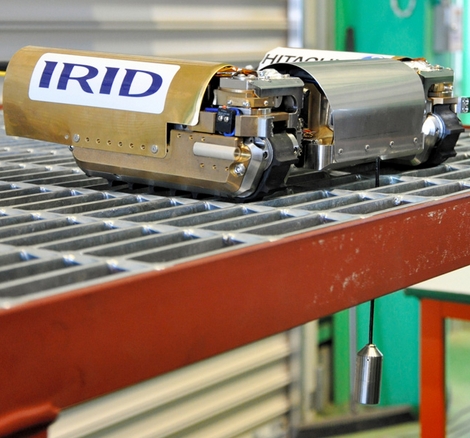
A new investigative robot, equipped with a censoring unit hanging through metal grating, is scheduled to be send into the No. 1 reactor at the Fukushima No. 1 nuclear power plant in the coming months. (Kohei Tomida)
HITACHI, Ibaraki Prefecture–Another robot has been developed for the elusive goal of locating melted fuel and surveying the interior of the No. 1 reactor at the Fukushima No. 1 nuclear plant.
A team of engineers and researchers from Hitachi-GE Nuclear Energy Ltd. and the International Research Institute for Nuclear Decommissioning revealed the robot on Feb. 3.
Tokyo Electric Power Co., operator of the plant, plans to deploy the robot into the No. 1 reactor before the end of March.
The robot will be fitted with a censoring unit mounted with a camera, dosimeter and lighting. Its purpose is to give TEPCO an idea of the location and condition of the melted nuclear fuel in the reactor.
Most of the melted fuel is believed to have fallen through the reactor’s pressure vessel, landed on the bottom of the surrounding containment vessel, and is soaking in cooling water about 2 meters deep.
The new robot will maneuver around metal grating originally set up for maintenance work about 3.5 meters above the bottom of the containment vessel.
At each of five survey points, the robot will lower the censoring unit through the grating. The unit can operate in water.
In April 2015, TEPCO sent two robots into the No. 1 reactor, but they could not locate the melted fuel.
One of them became stuck, and high radiation levels disabled the camera on the other. TEPCO abandoned the machines in the reactor.
On Jan. 30, a remote controlled video camera sent into the No. 2 reactor took what are believed to be the first images of melted fuel at the plant.
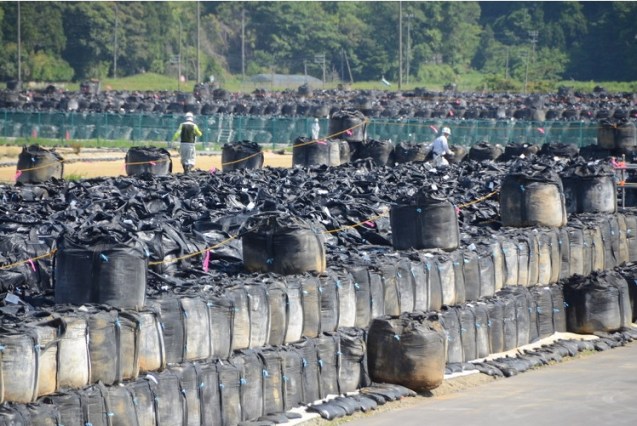
Black bags containing radioactively contaminated soil are seen piled up at a temporary storage site in Minamisoma, Fukushima Prefecture, in this June 2016 file photo. (Mainichi)
The radiation limit for soil contaminated by the Fukushima nuclear disaster in an experiment to reuse it in construction was lowered from 8,000 becquerels per kilogram to 3,000 becquerels per kilogram after strong opposition from a local mayor, it has been learned.
The experiment is to be carried out at a temporary storage site in Minamisoma, Fukushima Prefecture, where around 1,000 bags of contaminated soil will be opened, made into construction foundations, and their radiation levels measured. The experiment will be done to check, among other things, whether the radiation exposure dose remains at the yearly limit of 1 millisievert or less. The experiment will cost around 500 million yen. The results are expected to be put together next fiscal year or later.
From soon after the Great East Japan Earthquake in 2011, municipalities including Minamisoma asked the national government to separate out lower-radiation level concrete and other debris for reuse in things like groundwork for coastal forests used to defend against tsunami. At first, the Ministry of the Environment was negative about this, but in December 2011 the ministry allowed such reuse for debris with a limit of 3,000 becquerels per kilogram. According to documents released in response to a release of information request made by the Mainichi Shimbun, some 350,000 metric tons of this kind of debris have been used in Minamisoma and the towns of Namie and Naraha in projects such as groundwork for coastal forests.
Then in June last year, the Ministry of the Environment decided on a policy of reusing contaminated soil with 8,000 becquerels or less per kilogram in structures such as soil foundations for public works projects.
The same month, Minamisoma’s Mayor Katsunobu Sakurai visited then vice-minister of the environment Soichiro Seki, where he questioned Seki about the 3,000 becquerel limit that had been used until being replaced by the 8,000 becquerel limit. Sakurai reportedly called for the 3,000 becquerel limit to be used in the upcoming experiment in Minamisoma.
Sakurai says, “If they don’t use the 3,000 becquerel limit it is inconsistent. It doesn’t make sense for a ministry that is supposed to protect the environment to relax the standards it has set.”
The ministry confirmed to the Mainichi Shimbun that the experiment will only use soil up to the 3,000 becquerel limit, and said that the soil used will on average contain about 2,000 becquerels per kilogram.




 nuclear-news