Fukushima Nuclear Power Plant, Study Continues – IAEA

April 29, 2022
Berlin, April 29, 2022 – The International Atomic Energy Agency (IAEA) announced on April 29 that it will continue its investigation into the discharge into the ocean of treated water containing tritium from TEPCO’s Fukushima No. 1 nuclear power plant. On April 29, the International Atomic Energy Agency (IAEA) compiled the first report by a team of investigators to verify the safety of the discharge of treated water containing tritium from TEPCO’s Fukushima Daiichi Nuclear Power Plant. The report noted that, based on TEPCO’s analysis of the impact of radiation on the human body if the treated water were to be released, “it has been confirmed that the level of radiation is significantly smaller than that set by the Japanese regulatory authorities. However, he also explained that a final decision on safety will be announced before the release of the water. He indicated that he would not draw any conclusions for the time being, but would continue his investigation.
The survey team visited Japan in February, inspected the Fukushima Daiichi Nuclear Power Plant, and held hearings with related ministries and agencies and TEPCO. The report will be released two months after each survey that will be conducted before the release of the water in the future. TEPCO has set the timing of when the tanks storing the treated water will be full at around the summer or fall of 2023.
https://www.jiji.com/jc/article?k=2022042900719&g=soc&fbclid=IwAR0H-Z3MNHHCUoyzBkx3tRDUufnVKN3yB3eDhHoSde4y9ooHVFfhsbTP7Ys
IAEA Releases First Report on Safety of Planned Water Discharge from Fukushima Daiichi Site

April 298, 2022
The International Atomic Energy Agency (IAEA) Task Force, which is reviewing Japan’s policy to discharge treated water from the Fukushima Daiichi nuclear power station against relevant international safety standards, today released its first report.
The report summarizes the overall progress in the technical preparations for the water discharge. It compiles the initial findings from the Task Force’s first review mission to Japan’s Tokyo Electric Power Company (TEPCO), the Fukushima Daiichi nuclear power station operator, and the Ministry of Economy, Trade and Industry (METI) in February 2022.
Director General Rafael Mariano Grossi welcomed the initial findings. “Japan has made significant progress in its preparations and the Task Force is satisfied that TEPCO and METI have identified the appropriate next steps for the water discharge scheduled for 2023,” he said. “The work will continue so the Task Force can provide its conclusions before the discharge”.
The report includes a summary of the Task Force’s review and assessment activities across a range of topics such as the characteristics of the Advanced Liquid Processing System (ALPS) treated water, safety related aspects of the system built to discharge the water, the radiological environmental impact assessment, regulatory oversight, source and environmental monitoring programmes, occupational radiation protection, and the involvement of interested parties.
Preparing for the next steps in their review, the Task Force identified technical topics for further discussions and clarifications as Japan continues with its preparations. They also noted that TEPCO and METI put significant efforts into consulting with, and communicating to, interested parties and the public about the process to discharge the water. They look forward to seeing this continue as Japan approaches the 2023 water discharge.
“The Task Force highlighted the effective cooperation with the Japanese counterparts, which made it possible to clearly and promptly convey the results of the review mission to the international community” said Gustavo Caruso, Director, Department of Nuclear Safety and Security and Chair of the Task Force.”
The Task Force report is the first in a series of reports as the Task Force carries out more missions to Japan in the coming months and years to assess the water discharge against IAEA safety standards, which constitute the worldwide reference for protecting the public and the environment from harmful effects of ionizing radiation.
The report is available here.
TEPCO pushes back timeline for storage tanks at Fukushima plant
Tactics: one step backward to later jump two steps forward…

April 28, 2022
Tokyo Electric Power Co. said the tanks that store treated but still contaminated water at its Fukushima No. 1 nuclear power plant will reach full capacity later than expected.
It projected on April 27 they will be full in either the summer or fall of 2023, not its previous estimate of spring 2023.
The tanks store water treated through a filtration system, called ALPS (advanced liquid processing system), which is a multi-nuclide removal system that removes various radioactive materials from contaminated water.
TEPCO said on April 27 that the amount of contaminated water at the plant only increased by an average of 130 tons a day.
The amount of contaminated water was lower than what the company had expected because of its measures to prevent underground water or rainwater from coming into the buildings in which nuclear power reactors and other facilities are located, it said.
The estimate for when the storage tanks will be completely full has been modified several times before.
The government and TEPCO initially said the tanks could be full by sometime around summer 2022. That estimate was later amended to “by around the fall of 2022.”
When the company announced plans to add 23 storage tanks with a total capacity of about 30,000 tons at the plant in May 2021, it said the tanks would be full by around spring 2023.
TEPCO plans to dilute the tritium concentration in the ALPS treated water using seawater as the radioactive hydrogen atom cannot be removed through the filtration system. It then aims to discharge it into the sea in spring 2023.
Japan’s Toxic Dumping Faces Growing Protests

April 29, 2022 by Robert Hunziker
The Japanese government’s decision one year ago to dump radioactive water from Fukushima Daiichi Nuclear Power Plant storage tanks into the Pacific Ocean, starting in the spring of 2023, is facing increasing pressure to back off, especially in light of the facts that not only is it illegal but also morally reprehensible as well as a despicable disregard for the lifeblood of the ocean.
Meanwhile, in a startling maneuver indicative of desperation to convince citizens of its true worthiness, the Japanese government is using mind control tactics reminiscent of Aldous Huxley’s Brave New World (Chatto & Windus, 1932), which depicts harmful effects that the expansion and development of a capitalist ideology can impose on a society.
To wit: Japanese citizens are outraged over a new government policy of brainwashing children by distributing flyers to primary school students claiming TEPCO’s “diluted, nuclear-contaminated water is safe.”
“The government sent a total of 2.3 million booklets directly to elementary, junior and senior high schools across the nation in December in an effort to prevent reputational damage caused by the planned water discharge. The school staffers say the leaflets are unilaterally imposing the central government’s views on children.” (Source: Booklets Touting Fukushima Plant Water Discharge Angers Schools, The Asahi Shimbun, March 7, 2022)
“A Fukushima resident surnamed Kataoka told the Global Times on Wednesday that the Japanese government’s move was a kind of mind control, and she was strongly opposed to it.” (Source: Japanese Groups Voice Growing Opposition, Organize Rallies Over Govt’s Nuclear-Contaminated Water Dumping Plan Decided One Year Before, Global Times, April 13, 2022)
Japanese citizens are fighting back as four separate civic organizations from Fukushima and Miyagi prefectures submitted a petition signed by 180,000 people to the Ministry of Economy, Trade and Industry and to Tokyo Electric Power Company on March 30th 2022 expressing opposition to the government’s plan.
Additionally, Japanese environmental protection groups have organized national rallies in Tokyo and Fukushima, stating they will continue to rally in the streets until the government revokes its decision: “Once the nuclear-contaminated water is discharged into the sea, the result is irreversible. It’s not only Fukushima. The ocean connects the whole world. We hope we don’t discharge toxic substances into the sea,” said protester Ayumu Aoyanagi. “I am angry. They completely ignored public opinion. I hope people understand that the danger may not appear soon but will definitely affect our health in the future,” said another protester named Makiyo Takahashi.” (Source: Fukushima Residents Oppose Government Dumping Radioactive Water Into Ocean, CGTN News, April 14, 2022)
Zhao Lijian of the Chinese Foreign Ministry claims the Japanese government has turned a deaf ear to any and all opposition, failing to provide any convincing evidence of the legitimacy of the discharge program, no reliable data on the contaminated water and effectiveness of purification devices, and no convincing evidence about environmental impact. (Source: Japan Severely Breaches Obligations Under International Law by Persisting in Discharge of Nuclear-contaminated Water Into Ocean, People’s Daily Online, April 15, 2022)
Moreover, “this water adds to the already nuclear polluted ocean. This threatens the lives and livelihoods of islanders heavily reliant on marine resources. These include inshore fisheries as well as pelagic fishes such as tuna. The former provides daily sustenance and food security, and the latter much needed foreign exchange via fishing licenses for distant water fishing nation fleets,” Vijay Naidu, adjunct professor at the School of Law and Social Sciences at the University of the South Pacific in Fiji, told Al Jazeera. (Source: ‘Not a Dumping Ground’: Pacific Condemns Fukushima Water Plan, Al Jazeera, Feb. 14, 2022)
The principal radioactive isotope to be released “tritium is a normal contaminant from the discharges, the cooling water from normal reactor operations, but this is the equivalent of several centuries worth of normal production of tritium that’s in this water, so it is a very large amount,” according to Tilman Ruff, a Nobel laureate and associate professor at the Institute for Global Health at the University of Melbourne in Australia, Ibid.
Japan claims the radioactive water dump will be safe, however: “Obviously, the higher the level of exposure [to radiation], the greater the risk, but there is no level below which there is no effect,” Ruff said. “That is now really fairly conclusively proven, because in the last decade or so there have been impressive very large studies of large numbers of people exposed to low doses of radiation. At levels even a fraction of those that we receive from normal background [radiation] exposure from the rocks, from cosmic radiation. At even those very low levels, harmful effects have been demonstrated,” Ibid.
Chang Yen-chiang, director of the Yellow Sea and Bohai Sea Research Institute of Dalian Maritime University is urging the international community to stop the discharge by first requesting the International Court of Justice to issue an advisory opinion on the illegality of Japan’s dumping plan followed by motions to stop the process by China, South Korea, Russia, North Korea, and Pacific Island nations at the UN General Assembly.
Japan, as a signatory to: (1) the United Nations Convention on the Law of the Sea (2) the Convention on Early Notification of a Nuclear Accident (3) the Convention on Nuclear Safety (4) the Joint Convention on the Safety of Spent Fuel Management, and (5) the Safety of Radioactive Waste Management has clearly and knowingly breached its obligations under international law.
According to the plan released by TEPCO for the disposal of nuclear-contaminated water generated by Fukushima Daiichi Nuclear Power Plant, the country will soon begin official preparations for the release of the contaminated water and plans to begin long-term discharge of radioactive water into the Pacific Ocean in the spring of 2023.
However, according to an article in People’s Daily Online d/d April 15, 2022: “Data from TEPCO showed that the contaminated water from the Fukushima nuclear accident still contains many kinds of radionuclides with a long half-life even after secondary treatment.”
Shaun Burnie, senior nuclear specialist at Greenpeace East Asia claims the toxic water dump risks additional nuclear debris into the Pacific Ocean whereas the discharge is not the only option as “ the Japanese government once admitted that there is enough space near the Fukushima Daiichi nuclear power plant and areas around Fukushima prefecture to build more storage facilities for the water.” (Global Times)
The Citizens Committee on Nuclear Energy recommends proper storage on land in Japan similar to storage the country uses for its national oil and petroleum reserves. “The argument that they make… is that, if this water was stored not for an indeterminate period, but even for a period of about 50-60 years, then, by then, the tritium will have decayed to a tiny fraction of what it is today and hardly be an issue.” (Al Jazeera)
Even though the US boldly approves of the dumping plan, the Northern Mariana Islands, a US territory with a population of over 50,000 people, has declared Japan’s plan as “unacceptable.” In December 2021, the US territory adopted a joint resolution opposing any nation disposing of nuclear waste in the Pacific Ocean as well as suggesting the only acceptable option is long-term storage and processing using the best technology available.
In all similar circumstances, historical events have a way of swinging back and forth in time and landing smack dab in the middle of new controversies, for example, when it comes to radioactivity in the Pacific, memories are long. More than 300 atmospheric and underwater nuclear tests by the US, UK, and France from the 1940s, especially in the Republic of the Marshall Islands and French Polynesia, left uninhabitable land in many locations as well as long-term health disorders throughout the region. Japan’s dumping plans bring back haunting memories.
“Satyendra Prasad, the Chair of Pacific Islands Forum Ambassadors at the United Nations, reminded the world in September last year of the Pacific’s “ongoing struggle with the legacy of nuclear testing from the trans boundary contamination of homes and habitats to higher numbers of birth defects and cancers.” (Al Jazeera)
Meantime, and especially over the past couple of decades, Japan increasingly and fearlessly adheres to, and puts into actual practice, the overriding theme as expressed in Aldous Huxley’s Brave New World, which is “the dangers of state control” whilst the father of liberalism John Locke (1632-1704) not surprisingly spins in his grave.
For example, in December 2013 Japan passed the Protection of Specially Designated Secrets Act providing for whistleblowing civil servants to face up to 10 years in prison and the journalists who work with them could face up to five years for leaking state secrets.
Here’s a major twist to that law: The guidelines empower the heads of 19 ministries and agencies to subjectively “designate which documents and subjects comprise state secrets.” In short, subjective judgment by any given state official determines who goes to jail.
“The result is that while civil servants will be aware of a document’s classification, journalists cannot be sure just what comprises a state secret. Whistleblowing civil servants and journalists could face arrest even if they are convinced they are acting in the public’s interest.” (Source: Japan’s State Secrets Law, A Minefield for Journalist, Committee to Protect Journalists-NY, Nov. 4, 2014)
Since Japan appears to be adhering to the precepts of Brave New World, it’s interesting to note that thirty years following publication of Brave New World, Huxley wrote Brave New World Revisited: “If the first half of the twentieth century was the era of the technical engineers, the second half may well be the era of the social engineers— and the twenty-first century, I suppose, will be the era of World Controllers, the scientific caste system and Brave New World.” (Aldous Huxley, Brave New World Revisited, Harper & Brothers, 1958)
Huxley warned that a Brave New World type of order could be the “final” or “ultimate” revolution when people have their liberties taken from them, but “they will enjoy their servitude and so never question it, let alone rebel.”
Really?
TEPCO Reports Slowdown in Fukushima N-Plant Water Increase

Tokyo, April 27 (Jiji Press)–Tokyo Electric Power Company Holdings Inc. on Wednesday reported a slowdown in the pace of increase in radioactive water at its meltdown-hit Fukushima No. 1 nuclear plant.
As a result, TEPCO expects to reach the full storage capacity for water treated through water cleanup equipment by around summer or autumn 2023, later than the previously expected period of spring the same year.
In fiscal 2021 through last month, the daily increase of radioactive water at the northeastern Japan power plant averaged 130 tons, down from 140 tons in fiscal 2020.
At the plant, rainfall in fiscal 2021 was larger than usual years. But TEPCO said it managed to reduce the amount of contaminated water accumulating at the plant partly by repairing the damaged roof of a reactor building.
At the plant, radioactive water keeps increasing, because TEPCO uses water to cool damaged reactors while rainwater and groundwater flow into damaged buildings. The company treats the radioactive water to remove most of the radioactive substances.
Fukushima: The Curse of Groundwater
April 23, 2022
The decommissioning of the Fukushima Dai-ichi Nuclear Power Plant continues to produce contaminated water. Filtered to remove much of its radioactive content, it is stored on the site as treated water, now filling 1,000 massive tanks. In April 2021, the Japanese government announced plans to dilute the water to contamination levels far below legal limits before discharging it into the sea. However, people in the local fishing industry continue to harbor deep distrust. Why has this problem become so entrenched? The program explores a plan that was proposed soon after the accident 11 years ago, to build an impermeable wall around the plant and prevent the buildup of contaminated water, and why this plan was abandoned.
Release of Fukushima water to have ‘limited’ impact on consumer habits, poll shows
What a smooth piece of propaganda by Japan’s spin doctors on behalf of the will to dump all that ‘treated’ radioactive water into OUR Pacific ocean!!!

Apr 27, 2022
The impact on consumers of the planned release into the ocean of treated water from the disaster-crippled Fukushima No. 1 nuclear plant is seen as limited both in Japan and abroad, a government survey has shown.
Among respondents from Japan in the online survey, the proportion of those who said they would refrain from buying food items produced in Fukushima Prefecture, where the nuclear plant is located, after the start of the water release came to 14.7%, against 13.3% who said they are already avoiding such items.
The two comparable figures among respondents from the United States stood at 38.3% against 32%, and at 41% against 41.3% among those from Taiwan.
Of respondents from South Korea, 77.7% said they are currently avoiding Fukushima food products while 76% said they would do so after the water release.
The survey polled 300 people from each of Japan, South Korea, Hong Kong, Taiwan, Singapore, the U.K., the United States and France and 150 from each of Australia and New Zealand in January and February.
The attitude survey by the Reconstruction Agency was the first to be conducted over the planned discharge of treated water, which contains radioactive tritium from the plant, run by Tokyo Electric Power Company Holdings Inc., that was the site of the 2011 triple reactor meltdown.
The survey also suggested that only 29% in Japan and only 16% in the United States know that tritium is released to rivers and the sea in many countries based on existing laws and regulations.
“We need to spread knowledge (about tritium) in and outside our country,” Reconstruction Minister Kosaburo Nishime told a meeting Tuesday, where the survey results were reported.
The government will strengthen measures to prevent reputational damage to food items due to the planned water release, he stressed.
https://www.japantimes.co.jp/news/2022/04/27/national/fukushima-water-consumer-impact-limited/
Scientists: Japan’s Plan To Dump Nuclear Waste Into The Pacific Ocean May Not Be Safe

April 25, 2022
A panel of scientists has identified critical gaps in the data supporting the safe discharge of wastewater into the Pacific.
Independent scientists are questioning Japan’s plans to dump just over 1 million tons of nuclear wastewater into the Pacific Ocean, following a review of the available evidence.
The panel of multi-disciplinary scientists, hired by the intergovernmental Pacific Islands Forum, has not found conclusive evidence that the discharge would be entirely safe, and one marine biologist fears contamination could affect the food system.
Last year Japan announced that wastewater from the Fukushima-Daiichi Nuclear Power Plant, destroyed in March 2011 following the Tohoku Earthquake and tsunami, would be dropped into the Pacific in 2023.
The announcement triggered immediate concern from nations and territories in the Asia-Pacific region and led the Pacific Islands Forum to hire a panel of five independent experts to review the plan.
Previously, it was broadly believed that dropping the wastewater into the ocean would be safe, given it had been treated with “advanced liquid processing system” technology, which removes radioactive materials from contaminated water.
But panel scientist Robert Richmond, director of the University of Hawaii Kewalo Marine Laboratory, says the panel unanimously believes that critical gaps in information remain.
Previous discussions over the safety of Japan’s plans emphasized the chemistry of the discharge, but not how it could interact with marine life, he said.
“If the ocean were a sterile glass vessel, that would be one thing,” Richmond said. “But it’s not, you know, there’s lots of biology involved.”
Richmond has been particularly concerned about the potential for tritium – a key compound of concern – being absorbed into the food system because the radioactive isotope can bind to phytoplankton.
Through phytoplankton, Richmond says, the radioactive element could then find its way into the greater food system as the microscopic plants are consumed by mollusks and small fish, which are later consumed by other fish and eventually humans.
“Things like mercury in fish are now of an international concern. Radionuclides will be the same,” Richmond said.
The situation is dynamic too, as climate change affects the temperature of waters and weather patterns change.
“As temperatures go up, many chemicals become more interactive, they become a little bit different in terms of break down,” he said. “So these are all the things we need to consider.”
Confusing The Masses
The Pacific Islands Forum convened its panel of experts – specializing in policy and different scientific disciplines – because of the highly technical nature of Japan’s plan.
The PIF did not respond to a request for an interview for this story.
But Forum Secretary General Henry Puna has said that while Japan was open and frank in several information sessions held with the Forum, it wanted to bring on its own group of experts to look at the data and advise them.
“I just want to note that, for us, the issue is very urgent but also requires very careful thinking,” Puna said in September.
Since Japan announced it would release the treated water into the Pacific, it has been working with the International Atomic Energy Association to ensure its plans are safe. In February the IAEA made its first assessment and recently completed a second assessment at the end of March.
The IAEA is expected to deliver reports from its site visits in the next two months, according to its website, and would release a fully comprehensive report before any water is released.
Richmond said the panel wants to work with Japan and the IAEA to ensure the best outcome.
Nonetheless, the information seen by the panel showed less than 1% of the tanks of wastewater had been treated and less than 20% had been adequately sampled, Richmond says.
“Based on those numbers alone, we’re uncomfortable in making predictions of where things are going to end up,” Richmond said.
The Pacific Perspective
Community groups and environmental organizations were quick to respond to the news last year, raising concerns about the longterm effects to their region, with its legacy of nuclear testing and the fallout. And coastal communities and fishermen in Japan have also raised concerns.
The U.S. expressed its support for the plan in April last year, which has since been criticized by U.S. territories and affiliated states.
Rep. Sheila Babauta of the Commonwealth of Northern Mariana Islands introduced a resolution to CNMI’s House of Representatives opposing any nuclear testing, storage or waste disposal in the Pacific.
It was passed in December, months after the U.S. stated its position and after other Pacific groups and governments condemned the move.
“I’m really disappointed in the lack of engagement, the lack of information and the lack of free, prior and informed consent,” Babauta, who chairs the Natural Resources Committee, said.
The mistrust that is harbored by many in the Pacific stems back to U.S nuclear testing in the Republic of Marshall Islands following World War II, British testing in Kiribati and the French in French Polynesia, which had flow-on effects to the environment and long term health of Pacific people. And in 1979, Japan provoked backlash when it revealed plans to dump 10,000 drums of nuclear waste in the Marianas Trench.
Babauta says she introduced the resolution as a show of solidarity for the rest of the Pacific.
“The ocean is our oldest ancestor. The ocean is our legacy,” Babauta said. “It’s what we’re going to leave for our children.”
Scientists: Japan’s Plan To Dump Nuclear Waste Into The Pacific Ocean May Not Be Safe
Supreme Court Arguments in Fukushima Nuclear Power Plant and Livelihood Lawsuits Plaintiffs: “Our Lives Have Been Changed” Ruling in June

April 26, 2022
Residents who lived in Fukushima Prefecture and neighboring prefectures at the time of the accident at TEPCO’s Fukushima Daiichi Nuclear Power Plant have filed a class action lawsuit, “Give us back our community, give us back our livelihood! Fukushima Nuclear Power Plant Lawsuit (Livelihood Lawsuit)” was held on April 25 at the Second Petty Bench of the Supreme Court.
Since the Second Petty Bench of the Supreme Court has already rejected TEPCO’s appeal in March 2022, the only remaining point of contention is the responsibility of the national government.
The Supreme Court has already rejected TEPCO’s appeal in March 2022, so the only remaining point of contention is the responsibility of the government. In the Ikigyo lawsuit, the Sendai High Court in the second trial accepted the government’s responsibility, saying that the accident could have been prevented if measures had been taken.
The plaintiffs, referring to the reliability of the “long-term assessment” that the government agency was supposed to have warned about earthquakes, claimed that the Nuclear and Industrial Safety Agency (NISA) and TEPCO failed to take tsunami countermeasures despite warnings in 2002 that a tsunami was coming, and that the government, which has regulatory authority, is responsible for this.
The government, on the other hand, argued that the long-term assessment (issued by the government) was unreliable, and that even if it had ordered countermeasures, the accident could not have been prevented. The trial concluded with a request that the plaintiffs’ claims be dismissed.
At a press conference held after the hearing, Takashi Nakajima, the leader of the plaintiffs in the Ikigyo lawsuit, said, “The government has shown absolutely no remorse, so it will repeat the damage, as evidenced, for example, by its policy of discharging tritium-contaminated water into the ocean. If it is not condemned, it will continue to do so,” he said, harshly criticizing the government’s stance. (Chia Yoshida, writer)
- We have had our lives changed.

On the day of the argument, five buses from Fukushima Prefecture, one from Soso in Hamadori, one from Fukushima (northern part of the prefecture), one from Koriyama (central part of the prefecture), one from Shirakawa (southern part of the prefecture), and one from the National Federation of Peasant Movements (Fukushima), headed for the Supreme Court. 350 people gathered from Fukushima Prefecture and beyond, and many banners and banners were raised in front of the Supreme Court.
One of the plaintiffs, a woman who said she left by bus from Fukushima City at 6:00 a.m. that day, spoke her mind along the roadside in front of the Supreme Court, “At the time of the nuclear accident, I had two elementary school children, and I did not allow them to participate in marathons and other events held outside because of concerns about radiation.
The nuclear accident increased radiation levels in their living environment, and many parents made the decision to stop their children from outdoor activities as much as possible in order to prevent them from being exposed to radiation.
I feel sorry for them now because they don’t have the same memories as everyone else,” she said. The children didn’t say anything at the time, but recently they told me, ‘We wanted to do it with everyone. Our lives have been changed. There is no such thing as the government not being responsible. I want my life back to the way it was before.
Another plaintiff, who was standing next to me, added, “If you talk to each and every one of the victims, they all have their own story of the nuclear accident.
●“I moved 11 times in 11 years” after the nuclear accident.
Keiko Fukaya, who lived in Tomioka Town, Fukushima Prefecture, was the one who presented her argument that day. At the press conference, she said, “I have moved 11 times in the past 11 years. How hard it has been for me. I wanted the presiding judge to understand that,” she said.
Ms. Fukaya opened a beauty salon in her home at the age of 60 after working for 40 years as a hair stylist in stores in Namie Town and Tomioka Town while raising her children. Welcoming customers from the community, eating vegetables from her own garden together, and chatting happily with them were the things that made her life worth living.
When the nuclear accident occurred, he was at work and evacuated with almost nothing. Since then, he has moved 11 times, but no matter where he went, he never felt at ease. He turned 70 during the evacuation and did not have the energy to build a house or store in a new place.
I want them to give me back my life itself, which the nuclear accident took away from me,” he said. If that is not possible, I joined the trial because I want them to clarify how the accident happened and who is responsible,” said Fukaya.
At the appeal hearing three years ago, a judge from the Sendai High Court came to see Mr. Fukaya’s home and store. That judge ruled in the appeal trial that not only TEPCO was negligent, but also that the national government was responsible.
●”The trial is a major stepping stone, but it is not the end.

In their arguments on this day, the plaintiffs referred to the reliability of the “long-term assessment” that the government agency was supposed to have warned about the earthquake.
They argued that the Nuclear and Industrial Safety Agency (NISA) (the national government) and TEPCO, which has regulatory authority, are responsible for not taking tsunami countermeasures, even though there were warnings in 2002 that a tsunami was coming and could not be ignored.
Attorney Guntaro Managi, who represents the plaintiffs, said, “The government is responsible for not exercising its regulatory authority properly because it has been entrusted with the authority to prevent accidents from happening, even if they should happen, because of the enormous damage that could occur to people’s lives and health.
The government, on the other hand, argues that the long-term evaluation (issued by the government) was unreliable and that the accident could not have been prevented even if countermeasures had been ordered.
Mr. Nakajima, the leader of the plaintiffs’ group, said at a press conference after the argument date, “The government has shown absolutely no remorse, so it will repeat the damage, as evidenced, for example, by its policy of discharging tritium-contaminated water into the ocean. If it is not absolved, it will continue to do so,” he said, criticizing the government’s refusal to accept responsibility.
He continued, “I believe that our trial is required to make the government admit its illegality, and at the same time, to make the government change its attitude through public opinion, not only that of the plaintiffs. The trial is a major stepping stone, but I don’t think it will be the end of the story,” said Nakajima.
In addition to the Ikigyo lawsuits, three other cases in Chiba, Gunma, and Ehime are being argued before the Supreme Court. The Ikigyo lawsuit is the third case to be argued before the Supreme Court, and the Ehime nuclear power plant lawsuit is scheduled to be argued on May 16 before the ruling in June.
Chia Yoshida: Freelance writer. After the Fukushima Daiichi nuclear power plant accident, she has continued to cover victims and evacuees. She is the author of “Reporto: Mother and Child Evacuation” (Iwanami Shinsho), “Sotoko no Fukushima: Nukei no Koto o Koto wo Ikiru Hitobito” (After Fukushima: People Living After the Nuclear Accident) (Jinbunshoin), “Korunin Futaba-gun Firefighters’ 3/11” (Iwanami Shoten), and co-author of “Nukei Hakusho” (White Paper on Nuclear Evacuation) (Jinbunshoin).
https://www.bengo4.com/c_18/n_14414/?fbclid=IwAR0tC3Wv4waE-11sRewA_DCDDB6AbL_NwHW8gSbtHRze0koA5jgMVQ-inL4
Shield machine to dig undersea tunnel to discharge ‘treated water’ has not yet been approved nor has the local government… Preparations are steadily underway at TEPCO’s Fukushima Daiichi Nuclear Power Plant.

April 25, 2022
On April 25, TEPCO installed a “shield machine” at the launch site to dig an undersea tunnel to the discharge port 1 km offshore over plans to discharge contaminated water from the Fukushima Daiichi Nuclear Power Plant (Okuma and Futaba towns, Fukushima Prefecture) into the sea after purification treatment. The plan for the facilities to discharge the contaminated water has not been approved by the Nuclear Regulation Authority, and the local government has not yet given its approval for the start of construction. However, TEPCO explained at a press conference on the same day, “We are preparing for the construction work, and we will move ahead to the extent that there are no problems.
Contaminated water generated when cooling water injected into the reactors of Units 1-3 came into contact with nuclear fuel debris melted down in the accident and mixed with groundwater and rainwater that entered the buildings. Tritium, a radioactive substance that cannot be removed, remains in concentrations exceeding the national discharge standard. The government and TEPCO have been working on a plan to use large amounts of seawater to dilute the tritium concentration to less than 1/40th of the discharge standard and discharge the water into the sea.
TEPCO began preparatory work on the 24th, bringing a shield machine (about 3 meters in diameter and 7 meters in length) to the port of the power plant, and on the 25th, placed it at the bottom of a shaft (16 meters deep) where they will begin digging an undersea tunnel built in the port area. The tunnel is now ready for construction to begin immediately. The tunnel will connect the shaft, which will temporarily store water to be discharged, with the offshore water discharge port.
Preparations for the construction of the water discharge outlet will begin on the 25th, and excavation of the seafloor will begin on the 29th.
Although the regulatory commission has completed its review of the facility plan, TEPCO has yet to submit a revised plan to the regulatory commission based on the content of the review. The approval is expected to come after June, when the public will be invited to comment on the plan. The approval of Fukushima Prefecture and the towns of Okuma and Futaba must also be obtained before tunnel excavation can begin. (Kenta Onozawa)
https://www.tokyo-np.co.jp/article/173859?fbclid=IwAR3gMcpXQMAGSFHMfpukggr2I_RPWcgqZifR2PCYgIdmtSOGRu72k9UYjcQ
Fukushima farm products still dealing with negative image

April 24, 2022
NIHONMATSU, Fukushima Prefecture–Rice farmer Toshio Watanabe felt strongly embarrassed when he saw the estimate for the selling price of rice to be harvested in 2022.
Farm products of Fukushima Prefecture faced consumer pullback and canceled orders following the Fukushima No. 1 nuclear power plant disaster of 2011.
“People drive a hard bargain against rice from Fukushima Prefecture, which they buy only at lower prices than products of other prefectures, even for the same quality and taste,” said Watanabe, who farms in Nihonmatsu, Fukushima Prefecture.
“We could have put up a good fight if only it had not been for the nuclear disaster. As things stand now, however, we have ended up as the sole loser.”
More than 11 years on, farmers like Watanabe and the public sector in this northeastern prefecture still continue to struggle with lingering reverberations of the effects of negative publicity due to radiation fears.
FUKUSHIMA RICE THE ‘SOLE LOSER’
A document distributed by a local farming association in late February said this year’s rice crop is likely to sell at only 9,500 yen ($77) per 60 kilograms, falling below the 10,000-yen mark for the second straight year.
A rice farmer risks posting a deficit when the take-home selling price is less than 10,000 yen per 60 kg, considering the current production cost of nearly 9,000 yen per 60 kg.
Farmers will likely have to endure difficulties this year like they did in 2021, when rice prices dropped sharply due to a general oversupply and weak demand in the restaurant industry.
Rice harvested in Fukushima Prefecture disappeared from many supermarket shelves following the nuclear disaster, as consumers avoided Fukushima labels due to radiation fears.
More than 11 years on, rice grown in the prefecture has seen its market ratings always stuck in the lower reaches, with trading prices hovering below the national average.
Rice of the Koshihikari variety from the Nakadori (central strip) area of Fukushima Prefecture, which contains Nihonmatsu, was being traded at 11,047 yen per 60 kg, down 17 percent year on year, according to a preliminary report on the “direct trading prices” of rice harvested in 2021, which the farm ministry released in February.
The average price of all brands from all areas of Japan stood at 12,944 yen per 60 kg, down only 11 percent from the previous year. That means the gap has only spread.
CONSUMERS SHOWING MORE UNDERSTANDING
Apart from rice, peaches, grapes and other farm products, which face harsh competition from rivals grown in other prefectures, have also seen, over the past several years, their market trading prices remain stuck nearly 10 percent below the national average.
“Dealers from other prefectures sometimes decline to take products of Fukushima Prefecture when there is too much of products from a good harvest,” said the president of a wholesaler based in the prefectural capital of Fukushima that has dealt in fruits and vegetables from the prefecture for more than 50 years.
“Negative publicity effects remain deep-rooted overseas,” said Koji Furuyama, a 46-year-old farmer who grows peaches and apples in the prefectural capital.
Furuyama has aggressively been venturing into overseas markets. In 2017, for example, he exported peaches to a department store in Thailand.
Following the nuclear disaster, however, food products from Fukushima Prefecture came under embargoes and other import restrictions by 55 nations and regions of the world, 14 of which continue to impose restrictions of some kind or another.
The central government and Tokyo Electric Power Co., operator of the crippled Fukushima No. 1 nuclear plant, have decided to release treated contaminated water from the plant into the ocean.
The water release, which will start as early as spring next year, could cause additional negative publicity effects, Furuyama said.
By comparison, effects of the negative public image are seldom perceptible these days in food items for which product differentiation is feasible, such as by supplying the items in large amounts when there are few shipments of rival products from other prefectures.
Figures of the Tokyo Metropolitan Central Wholesale Market show that vegetables from Fukushima Prefecture, such as tomatoes and cucumbers, have been priced above the national average over the past several years.
Consumers are coming to show more understanding toward the prefecture’s food products.
In a survey conducted by the Consumer Affairs Agency in February 2022, only 6.5 percent of the respondents said they hesitate to buy food products from Fukushima Prefecture for fear of radiation. The percentage is the lowest ever and is below the 10-percent mark for the second straight year.
SALES PROMOTION CAMPAIGN ALONE ‘NOT ENOUGH’
The government of Fukushima Prefecture has so far allocated large chunks of post-disaster rebuilding budgets for campaigns against negative publicity and for sales promotion.
A centerpiece of the latest years, among other things, is a program for promoting sales on major online marketplaces operated by Amazon.com Inc., Rakuten Group Inc. and Yahoo Japan Corp. Dentsu East Japan Inc., an ad agency, has been commissioned to operate the project.
In fiscal 2020, the program earned proceeds of about 3.4 billion yen, a record since the project started in fiscal 2017, although more than 500 million yen was spent on subsidizing the initial costs for sellers on the marketplaces and issuing discount coupons worth 10 to 30 percent.
In fiscal 2021, the prefectural government project earned sales of more than 2.6 billion yen on a consignment budget of only 360 million yen.
That is not bad in terms of cost-effectiveness. However, that is tempered by the fact that marketing efforts that rely on coupons do not necessarily help empower the production areas, and no information is provided to sellers that would allow them to analyze what kind of customers purchased which products.
“This program is premised on the availability of the post-disaster rebuilding budgets,” said an official in charge of the project. “It is certainly not sustainable.”
“Fukushima Prefecture’s products stuck in low price ranges would need to venture into new markets other than the existing ones, but such a venture can seldom be achieved through public relation efforts of the public sector and an ad agency alone,” said Ryota Koyama, a professor of agricultural economics with Fukushima University.
He added: “More money should be spent on production areas to support efforts for improving breeds and the equipment.”
How dangerous is the Fukushima nuke plant today?

By MARI YAMAGUCHI March 12, 2021
OKUMA, Japan (AP) — A decade ago, a massive tsunami crashed into the Fukushima Daiichi nuclear power plant. Three of its reactors melted down, leaving it looking like a bombed-out factory. Emergency workers risked their lives trying to keep one of history’s worst nuclear crises from spiraling out of control.
Proper equipment has now replaced ragged plastic hoses held together with tape and an outdoor power switchboard infested by rats, which caused blackouts. Radiation levels have declined, allowing workers and visitors to wear regular clothes and surgical masks in most areas.
But deep inside the plant, danger still lurks. Officials don’t know exactly how long the cleanup will take, whether it will be successful and what might become of the land where the plant sits.
Journalists from The Associated Press recently visited the plant to document progress in its cleanup on the 10th anniversary of the meltdowns and the challenges that lie ahead.

WHAT HAPPENED 10 YEARS AGO?
After a magnitude 9.0 earthquake on March 11, 2011, a tsunami 17 meters (56 feet) high slammed into the coastal plant, destroying its power supply and cooling systems and causing meltdowns at reactors No. 1, 2 and 3.
The plant’s three other reactors were offline and survived, though a fourth building, along with two of the three melted reactors, had hydrogen explosions, spewing massive radiation and causing long-term contamination in the area.

The plant’s operator, Tokyo Electric Power Co., says the tsunami couldn’t have been anticipated, but reports from government and independent investigations and recent court decisions described the disaster at the plant as human-made and a result of safety negligence, lax oversight by regulators and collusion.


WHAT’S INSIDE THE MELTED REACTORS?
About 900 tons of melted nuclear fuel remain inside the three damaged reactors, and its removal is a daunting task that officials say will take 30-40 years. Critics say that’s overly optimistic.
Separate efforts to remove spent fuel from cooling pools inside the reactor buildings were hampered by high radiation and debris and have been delayed for up to five years. If the plant’s pools lose their cooling water in another major quake, exposed fuel rods could quickly overheat and cause an even worse meltdown.
The melted cores in Units 1, 2 and 3 mostly fell to the bottom of their primary containment vessels, some penetrating and mixing with the concrete foundation, making removal extremely difficult.
Remote-controlled robots with cameras have provided only a limited view of the melted fuel in areas still too dangerous for humans to go.
Plant chief Akira Ono says the inability to see what’s happening inside the reactors means that details about the melted fuel are still largely unknown.

ARE THERE UNDERGROUND LEAKS?
Since the disaster, contaminated cooling water has constantly escaped from the damaged primary containment vessels into the reactor building basements, where it mixes with groundwater that seeps in. The water is pumped up and treated. Part is recycled as cooling water, with the remainder stored in 1,000 huge tanks crowding the plant.
Early in the crisis, highly contaminated water that leaked from damaged basements and maintenance ditches escaped into the ocean, but the main leakage points have been closed, TEPCO says. Tons of contaminated sandbags used to block the leaks early in the disaster remain in two basements.
Tiny amounts of radiation have continued leaking into the sea and elsewhere through underground passages, though the amount today is small and fish caught off the coast are safe to eat, scientists say.

WHAT WILL HAPPEN TO THE STORED RADIOACTIVE WATER?
The 1,000 tanks filled with treated but still radioactive water tower over workers and visitors at the plant.
TEPCO says the tanks’ 1.37 million ton storage capacity will be full in 2022. A government panel’s recommendation that the water be released into the sea is facing fierce opposition from local residents, especially fishermen concerned about further damage to the area’s reputation. A decision on that recommendation is pending.
TEPCO and government officials say tritium, which is not harmful in small amounts, cannot be removed from the water, but all other isotopes selected for treatment can be reduced to safe levels for release.
TEPCO has managed to cut the amount of contaminated water to one-third of what it used to be through a series of measures.


WHAT’S IT LIKE TO VISIT THE PLANT?
The first thing visitors see is a stylish office building that holds the TEPCO decommissioning unit.
In another building, plant workers — about 4,000 per day now — go through automated security checkpoints and radiation measurements.
Because radiation levels have fallen significantly following decontamination, full protection gear is only needed in a few places in the plant, including in and around the melted reactor buildings.
On a recent visit, AP journalists donned partial protective gear to tour a low-radiation area: a helmet, double socks, cotton gloves, surgical masks, goggles and a vest with a personal dosimeter.
Full protection gear, which means hazmat coveralls, a full-face mask, a head cover, triple socks and double rubber gloves, was required at a shared storage pool where fuel relocation from the No. 3 reactor pool was recently completed.


WHAT’S THE ENDGAME?
A decade after the accident, Japan doesn’t yet have a plan to dispose of the highly radioactive melted fuel, debris and waste at the plant. Technology also isn’t advanced enough yet to manage the waste by reducing its toxicity.
TEPCO says it needs to get rid of the water storage tanks to free up space at the plant so workers can build facilities that will be used to study and store melted fuel and other debris.
There are about 500,000 tons of solid radioactive waste, including contaminated debris and soil, sludge from water treatment, scrapped tanks and other waste.
It’s unclear what the plant will look like when the work there is done. Local officials and residents say they expect the complex to one day be open space where they can walk freely. But there’s no clear idea if or when that might happen.
___


Tokyo correspondent Mari Yamaguchi has visited the Fukushima nuclear plant nine times, starting in 2012.
Fear of broken contaminated pipes being fixed with wire ropes, which may break and sag due to earthquakes, TEPCO Fukushima Daiichi Nuclear Power Plant.
April 20, 2022
On April 20, Tokyo Electric Power Company (TEPCO) announced that it will fix a pipe contaminated with highly radioactive materials between Units 1 and 2 of the Fukushima Daiichi Nuclear Power Plant (Okuma and Futaba, Fukushima Prefecture) to another nearby pipe with a wire rope because the pipe has become brittle due to multiple problems during cutting. Some of the contaminated pipes are on the verge of breaking, and there is a risk that they may break off and hang down due to earthquakes or other causes.

The pipes to be cut are about 30 cm in diameter. 90% of the pipes to be removed for the first time (about 11 meters long and weighing about 1 ton) were cut on March 27 by a remote-controlled device on one side. The strength of the piping has decreased.
On March 19, an investigation revealed that the warping of the broken pipe had increased, and on March 20, work began to wrap the wire rope around the pipe by remote control using a crane. (Note: A TEPCO spokesperson corrected the explanation on the 21st, saying that “workers entered the site to wrap the rope around the pipes.)

The investigation into the cause of the trouble has not been completed, and the resumption of removal is not expected. TEPCO had planned to remove the piping, which totals 135 meters, in 26 sections by the end of April, but has changed the target to the end of September.
The pipes were used in the venting of contaminated steam inside the reactor to prevent the containment vessel from rupturing immediately after the accident in March 2011. 11 years have passed, but people still cannot get to them. (Eleven years have passed, and no one can get close to it.)
https://www.tokyo-np.co.jp/article/172904?fbclid=IwAR0V8O72lyq_ymfivHwfFbYrclEM_6ZsJD6ymkLBMCWV5lHkw-O1lyoujcM
Fukushima farmers’ efforts serve to undo TEPCO’s damage

April 19, 2022
About Fukushima farmers’ compensation, here is the Tweet thread posted by Mako Oshidori (see note at bottom) translated by us :

“The financial compensation given to farmers after the nuclear accident is designed so that the difference between sales before and after the accident is paid to them as compensation for ‘image damage.
Farmers are developing their own varieties, developing their own sales networks, and conducting experiments to limit the transfer of cesium from the soil to the vegetables.
As a result of all these efforts, when sales returned to pre-accident levels, the compensation became zero.
“Thus, our efforts serve to cancel the damage caused by TEPCO!”

2) Cesium in the soil is still present, so “this is not just an image problem, but real damage.”
Members of the Fukushima Farmers Federation continue to renew their demands for “radiation protection policy for farmers.”
It is TEPCO that benefits from the effects of the slogan “Eating Fukushima products for solidarity” which leads to reducing the amount of compensation received by farmers.
Moreover, if a farmer does not continue to operate in Fukushima, there will be no compensation.

3) Farmers in Fukushima have been trying to find a way to prevent the transfer of cesium from the soil to the crops.
In the years immediately following the accident, vegetables from neighboring counties have been found to have higher levels of cesium than those from Fukushima.
There are still agricultural lands with surface contamination above the standard of the radiation control zone defined by the Ordinance on the Prevention of Radiation Risks.
Negotiations for the establishment of the radiation protection policy for farmers are continuing this year.
Note:
The couple Mako and Ken OSHIDORI are known in Japan as manzaishi (comedy duo in the style of folk storytellers). As soon as the Fukushima nuclear accident began in March 2011, Mako decided to attend TEPCO press conferences in order to access information that was dramatically missing from the media. With the help of Ken, her husband and work partner, she became a freelance journalist, one of the most knowledgeable on the Fukushima issue, and feared as such by TEPCO.
https://nosvoisinslointains311.home.blog/2022/04/19/les-efforts-des-agriculteurs-servent-a-annuler-les-actes-prejudiciables-de-tepco/?fbclid=IwAR1Q9OkhLPO07bp6RxeTxwqHZ-U5HO4Wwaj_igq-aK7dunkrkKvx9J_jy1Y
TEPCO to Remove Contaminated Pipes at Fukushima Daiichi Nuclear Power Plant by “First Half of FY2022” Due to Continuing Troubles

April 18, 2022
On April 18, at a meeting of the Nuclear Regulation Authority to review the status of the accident at the Fukushima Daiichi Nuclear Power Plant, TEPCO announced that it had changed its target date for the completion of work to “the first half of FY2022 (April to September)” regarding the removal of pipes between Units 1 and 2 that were contaminated with high concentrations of radioactive materials. Previously, the target was “within FY 2009. The scope of the removal work includes the areas that interfere with the installation of rainwater inflow countermeasures in the waste treatment buildings of Units 1 and 2 and the installation of a large cover in Unit 1.
The removal work began on February 24, but has not progressed at all due to a series of problems with the cutting equipment. The timing for the resumption of work is not clear, as investigations are still underway to determine whether the cutting equipment and method used to lift the pipes up by a large crane are appropriate.
The pipes to be removed were used in the venting process immediately after the accident to release contaminated air inside the reactor to prevent the containment vessel from rupturing. The pipes are 30 cm in diameter and measure 65 meters on the Unit 1 side and 70 meters on the Unit 2 side. The current plan is to cut the piping into 26 sections and remove them. The surface dose at the connection with the exhaust stack is 4 sievert per hour, which is high enough to kill a person if he or she stays there for several hours. For this reason, all work will be carried out remotely. (Shinichi Ogawa)
https://www.tokyo-np.co.jp/article/172472?rct=national&fbclid=IwAR1DYTcIpK–IpNqQfheOVBWKG8-G1Eonb274DLuS8FOMWxZ9ciYQLdmaiM
1 This Month
To see nuclear-related stories in greater depth and intensity – go to https://nuclearinformation.wordpress.com/
12 February – Webinar The Big Push: New Nuclear Projects in Canada
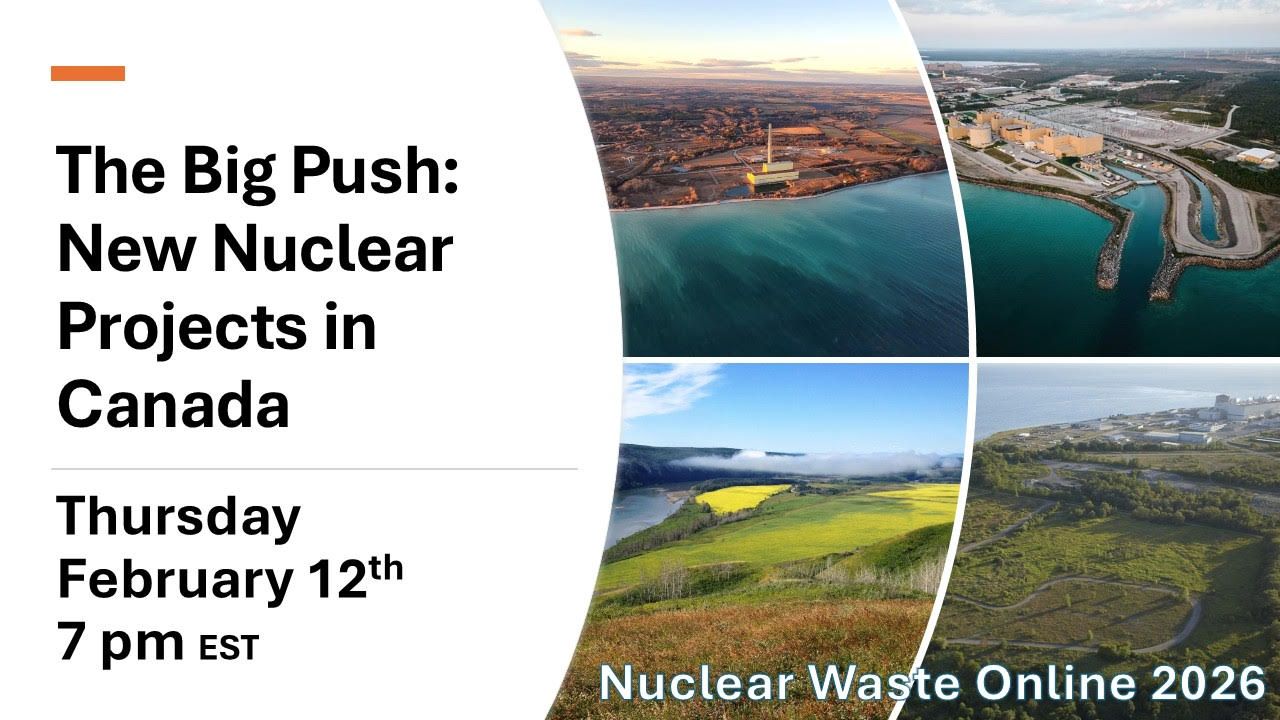
Thursday, February 12, 7 pm Eastern | 2nd of 4 sessions in the 2026 Nuclear Waste Online webinar series
Join a webinar on the push for new nuclear generation in Canada. Go to Northwatch.org to register or use the registration link https://us02web.zoom.us/webinar/register/WN_ZfWOf1GITqSRIZX8CB-A9w
-
Archives
- February 2026 (127)
- January 2026 (308)
- December 2025 (358)
- November 2025 (359)
- October 2025 (376)
- September 2025 (258)
- August 2025 (319)
- July 2025 (230)
- June 2025 (348)
- May 2025 (261)
- April 2025 (305)
- March 2025 (319)
-
Categories
- 1
- 1 NUCLEAR ISSUES
- business and costs
- climate change
- culture and arts
- ENERGY
- environment
- health
- history
- indigenous issues
- Legal
- marketing of nuclear
- media
- opposition to nuclear
- PERSONAL STORIES
- politics
- politics international
- Religion and ethics
- safety
- secrets,lies and civil liberties
- spinbuster
- technology
- Uranium
- wastes
- weapons and war
- Women
- 2 WORLD
- ACTION
- AFRICA
- Atrocities
- AUSTRALIA
- Christina's notes
- Christina's themes
- culture and arts
- Events
- Fuk 2022
- Fuk 2023
- Fukushima 2017
- Fukushima 2018
- fukushima 2019
- Fukushima 2020
- Fukushima 2021
- general
- global warming
- Humour (God we need it)
- Nuclear
- RARE EARTHS
- Reference
- resources – print
- Resources -audiovicual
- Weekly Newsletter
- World
- World Nuclear
- YouTube
-
RSS
Entries RSS
Comments RSS
 nuclear-news