Plutonium: How Nuclear Power’s Dream Fuel Became a Nightmare.

The history of nuclear power’s imagined future: Plutonium’s journey from asset to waste, Bulletin of the Atomic Scientists, By William Walker, September 7, 2021

Bill Gates is deluded in believing that the plutonium-fuelled, sodium-cooled, “Versatile Power Reactor” in which his company Terrapower is involved, has a commercial future.[18] His support is also unwelcome insofar as it helps to perpetuate the myth that plutonium is a valuable fuel, posing acceptable risks to public safety and international security. Reprocessing is a waste-producing, not an asset-creating, technology. It adds cost rather than value. It merits no future when seen in this way.
‘ ………..Plutonium’s history and its legacies are the subject of a recent book by Frank von Hippel, Masafumi Takubo and Jungmin Kang.[1] Plutonium: How Nuclear Power’s Dream Fuel Became a Nightmare. It is an impressive study of technological struggle and ultimate failure, and of plutonium’s journey from regard as a vital energy asset to an eternally troublesome waste
Toward heaven or hell? The conflict over plutonium’s future…………..
From creation of a future to preservation of the present
Construction of the British and French reprocessing plants at Sellafield and Cap de la Hague proceeded throughout the 1980s.[6] Their primary justification—preparing for the introduction of fast breeder reactors—had lost all credibility by the time of their completion. The German, British and French breeder programs had been cut back, soon to be abandoned, and in 1988 Germany cancelled plans to build its own bulk reprocessing plant at Wackersorf. Although Japan’s confidence in its fast breeder reactor program also waned, it was kept alive to avoid disrupting construction of the reprocessing plant at Rokkasho-mura.
Faced by the plutonium economy’s demise, reprocessing was re-purposed by its supporters to provide the industry and its governmental backers with reason not to do the obvious—abandon ship. Creating an essential future was replaced by a rationale designed to preserve and activate the newly established reprocessing infrastructures. ……. plutonium’s energy value could be realised through its replacement of fissile uranium in “mixed-oxide fuels” for use in existing thermal reactors………
Thirty years after the Euro-Japanese reprocessing/recycling system’s launch, the experiment can only be judged a failure. The reasons are set out in persuasive detail in von Hippel, Takubo and Kang’s book. It is a system undergoing irreversible contraction after a long struggle, involving heavy expenditure and many troubles. Germany and the UK have already exited, the UK shutting its THORP reprocessing plant in 2018 and delaying its Magnox reprocessing plant’s closure only because of the coronavirus pandemic.[9] Instead, its Nuclear Decommissioning Authority has been given the costly (more than $138 billion) and long-lasting (more than 100 years) task of returning Sellafield and Dounreay to “green-field sites.”
Japan’s engagement with reprocessing and plutonium recycling was already deeply troubled before the Fukushima accident closed reactors: The Rokkasho-mura reprocessing plant was operating only fitfully, MOX recycling was not happening, and plutonium separated from Japanese spent fuels in France and the UK was marooned there, probably indefinitely, by inability to manage its return in MOX fuel (cutting a very long story short).[10] The declared intention to soldier on with bulk reprocessing seems increasingly bizarre and is surely unsustainable. ……….
France’s national utility EDF, saddled with enormous debts, is striving to reduce its exposure to reprocessing. It is symptomatic that no spent fuel discharged from EDF-owned and -operated reactors in the UK, including those under construction at Hinkley Point, will be reprocessed………
The move away from reprocessing is being accompanied by a transition towards dry-cask storage of spent fuels. It entails their removal from water pools at reactors after a few years’ cooling and their insertion in large concrete or stainless steel containers, ………
Reprocessing continues in India and Russia, if fitfully, where fast reactor programmes are still being funded. Japan’s commitment remains. ………
There is particular concern about China’s engagement with reprocessing and its dual civil and military purposes…………
……………. Separated plutonium is a waste
The authors remind readers of the persistent dangers that reprocessing poses to public safety and international security: the risks of accident and exposure to radiation, the proliferation of weapons, the possibility of diversion into nuclear terrorism, and the undesirable complication of radioactive waste disposal. “In our view, it is time to ban the separation of plutonium for any purpose” (their italics) is their concluding sentence. This may be the case, but the US and other governments are unlikely to respond to their call. They have so much else to contend with—climate change, pandemics, economic distress, arms racing on a long list—leaving a ban on plutonium separation low in their priorities. They are also all too aware of past failures to institute such bans, whether in commercial or military domains, from the Carter Policy in the 1970s to the stalled Fissile Material Cutoff Treaty in the 1990s and subsequently.
Another conclusion cries out to be drawn from this book. Plutonium’s separation and usage for energy purposes was an experiment that can now decisively be pronounced a failure. Experience has shown that separated civil plutonium is a waste. The book’s first of many figures, reproduced below, is the most telling. Up to the mid-1980s, the global stock of separated plutonium was predominately military and held in warheads, peaking at around 200 tons. It now exceeds 500 tons. The increase is due to the ballooning of civil stocks as plutonium’s separation has outstripped consumption. The global stock of separated plutonium now includes material extracted from the post-Cold War dismantlement of Russian and US nuclear warheads that is also effectively a waste.[16]

Civil plutonium is therefore not an asset, it is not “surplus to requirement;” it is a waste. This is the message that needs to be proclaimed and acknowledged, especially by governments, utilities, and industries desiring that nuclear power have a solid future and make a contribution to the avoidance of global warming. For reasons set out in von Hippel’s recent article in the Bulletin, Bill Gates is deluded in believing that the plutonium-fuelled, sodium-cooled, “Versatile Power Reactor” in which his company Terrapower is involved, has a commercial future.[18] His support is also unwelcome insofar as it helps to perpetuate the myth that plutonium is a valuable fuel, posing acceptable risks to public safety and international security. Reprocessing is a waste-producing, not an asset-creating, technology. It adds cost rather than value. It merits no future when seen in this way.
Even if all civil reprocessing ceased tomorrow, the experiment would have bequeathed the onerous task of guarding and disposing of over 300 tons of plutonium waste, and considerably more when US and Russia’s military excess is added in. Proposals come and go. Burn it in specially designed reactors? Blend it with other radioactive wastes? Bury it underground after some form of immobilization? Send it into space? All options are costly and hard to implement. Lacking ready solutions, most plutonium waste will probably remain in store above ground for decades to come, risking neglect. How to render this dangerous waste eternally safe and secure is now the question. Extensive References . https://thebulletin.org/premium/2021-09/the-history-of-nuclear-powers-imagined-future-plutoniums-journey-from-asset-to-waste/?utm_source=Newsletter&utm_medium=Email&utm_campaign=ThursdayNewsletter09272021&utm_content=NuclearRisk_HistoryOfNuclearPowersImagined_09102021
AUKUS and confronting China throws fuel on the fire of Indo-Pacific tensions. An accelerating arms race will follow.

Australia commits fully to China containment
Canberra is now a fully paid-up member of a China containment front, whether it wants to admit it, or not. In the process, it has yielded sovereignty to the US by committing itself to an interlocking web of military procurement decisions that includes the acquisition of a nuclear-propelled submarine fleet.
New drives to counter China come with a major risk: throwing fuel on the Indo-Pacific arms race SMH, Tony Walker Tony Walker is a Friend of The Conversation.Vice-chancellor’s fellow, La Trobe University September 27, 2021 An accelerating arms race in the Indo-Pacific is all but guaranteed now that China finds itself a target of new security arrangements — AUKUS and the Quad — aimed at containing its power and influence.
This has the makings of a new great game in the region in which rival powers are no longer in the business of pretending things can continue as they are.
The AUKUS agreement, involving Australia, the US and UK to counter China’s rise means a military power balance in the Indo-Pacific will come more sharply into focus.
The region has been re-arming at rates faster than other parts of the world due largely to China’s push to modernise its defence capabilities.
In their latest surveys, the London-based International Institute of Strategic Studies (IISS) and the Stockholm International Peace Research Institute (SIPRI) report no let-up in military spending in the Indo-Pacific. This is despite the pandemic.
SIPRI notes a 47% increase in defence spending in the Indo-Pacific in the past decade, led by China and India.
China can be expected to respond to threats posed by the new security arrangements by further expediting its military program.
It will see the formation of AUKUS as yet another attempt to contain its ambitions — and therefore a challenge to its military capabilities.
The Quad makes clear its ambitions
Unambiguously, AUKUS implies a containment policy.
Likewise, the further elevation of the Quad security grouping into a China containment front will play into an atmosphere of heightened security anxiety in the Indo-Pacific.
The four Quad participants – the US, Japan, India and Australia – have their own reasons and agendas for wanting to push back against China.
After their summit last week in Washington, the Quad leaders used words in their joint statement that might be regarded as unexceptional in isolation.
Together with other developments such as AUKUS, however, the language was pointed, to say the least:
Together, we re-commit to promoting the free, open, rules-based order, rooted in international law and undaunted by coercion, to bolster security in the Indo-Pacific and beyond.
The “beyond” part of the statement was not expanded on, but might be read as a commitment to extend the Quad collaboration globally.
All this has come together at the dawn of a new US administration whose members include several conspicuous China hawks, and at a moment when China has shown itself to be ever-willing to throw its weight around.
Beijing’s crude campaign against Australian exports in an effort to bend Australia’s policy to its will is a prime example. It is doubtful an AUKUS or an invigorated Quad would have emerged without this development.
The Obama administration talked about pivoting to the Asia-Pacific without putting much meat on the bones.
Under President Joe Biden, this shift will be driven by a hardening in American thinking that now recognises time is running out, and may already have expired, in the US ability to constrain China’s rise.
These are profound geopolitical moments whose trajectory is impossible to predict.
Australia commits fully to China containment
Canberra is now a fully paid-up member of a China containment front, whether it wants to admit it, or not. In the process, it has yielded sovereignty to the US by committing itself to an interlocking web of military procurement decisions that includes the acquisition of a nuclear-propelled submarine fleet.
Whether these submarines are supplied by the US or Britain is a bit immaterial since the technology involved originates in America.
The submarines will not be available for the better part of two decades under the most optimistic forecasts. However, in the meantime, Australia could base US or British submarines in its ports or lease American submarines.
Meanwhile, Australia is committing itself to a range of US-supplied hardware aimed at enhancing the inter-operability of its military with the US.
This is the reality of fateful decisions taken by the Morrison government in recent months. Such a commitment involves a certain level of confidence in America remaining a predictable and steadfast superpower, and not one riven by internal disputes.
Australian defence spending likely to rise. What is absolutely certain in all of this is that an Indo-Pacific security environment will now become more, not less, contentious. …………………………………
What other Indo-Pacific nations are doing
Many other Indo-Pacific states can now be expected to review their military acquisition programs with the likelihood of a more combative security environment.
Taiwan, for example, is proposing to spend $US8.69 billion (A$11.9 billion) over the next five years on long-range missiles, and increase its inventory of cruise missiles. It is also adding to its arsenal of heavy artillery.
South Korea is actively adding to its missile capabilities. This includes the testing of a submarine-launched ballistic missile.
Seoul has also hinted it might be considering building its own nuclear-propelled submarines (this was among President Moon Jae-in’s election pledges in 2017). Signs that North Korea may have developed a submarine capable of firing ballistic missiles will be concentrating minds in Seoul.
All this indicates how quickly the strategic environment in the Indo-Pacific is shifting.
Australia — perhaps more so than others — is the prime example of a regional player that has put aside a conventional view of a region in flux. It now sees an environment so threatening that a policy of strategic ambiguity between its custodial partner (the US) and most important trade relationship (China) has been abandoned.
The price tag for this in terms of equipment and likely continuing economic fallout for Australian exporters will not come cheap. https://theconversation.com/new-drives-to-counter-china-come-with-a-major-risk-throwing-fuel-on-the-indo-pacific-arms-race-168734
Why America is ecstatic about Morrison’s AUKUS pact

Why Washington was so ecstatic about Morrison’s AUKUS pact, SMH, 28 Sept 21,
Political and international editor ”………….. For many years, a critical element of American war planning has been to defeat China’s navy by bottling it up in the shallow waters of the South China Sea.
It would do this by blocking choke-points that allow passage in and out. And submarines are the most effective tool for achieving this.
If much of China’s navy is contained in those coastal waters, it’s relatively easy for the US to find and destroy. China’s submarines are at their most vulnerable in the shallow littorals nearest their homeland. It’s easier to shoot fish in a barrel than in a pond.
“US forces and their allies will stand a far greater chance of finding Chinese submarines, hemmed into the South China Sea, than China will of finding America’s in the vast Pacific,” as Rory Medcalf of the ANU’s National Security College puts it.
This helps explain why Beijing has put such effort into asserting control of the South China Sea and, just to its north, the East China Sea. In the event of a crisis, China’s priority is to scramble its submarines well beyond the first island chain into the deep waters of the Pacific where they can operate freely, concealed and lethal.
……………In the event of all-out war, the US wants Tokyo’s 22 subs and Canberra’s six to complement the US fleet of 68. Japan’s have been pencilled in to operate in the north and Australia’s in the south.
This is where AUKUS come in. It includes in-principle agreement from Washington and London to supply Australia with nuclear propulsion technology for a new fleet of eight submarines instead of the planned 12 diesel-electric subs, now ditched.
Why was this greeted rapturously in Washington? “The long-term prospect of eight nuclear-powered RAN subs prowling the Pacific resets the naval balance of power,” says Mike Green of the Centre for Strategic and International Studies in Washington.
…….. Australian officials say it will take almost 20 years to actually get the first Australian-built, nuclear propelled sub into the water. ……. The Australian Strategic Policy Institute’s subs expert, Marcus Hellyer says that the only plausible way that Australia could put a nuclear-powered sub in the water in time to be relevant to the looming US-China contest would be if America handed over some of its ageing Los Angeles class subs. The Pentagon is currently pensioning them off. They’d need to be refurbished. But that’d still be a lot faster, taking years rather than the decades of waiting for the first Australian-made one…..
And AUKUS is about much more than subs. “It’s about areas like cyber and emerging technologies…….https://www.smh.com.au/national/why-washington-was-so-ecstatic-about-morrison-s-aukus-pact-20210927-p58v3c.html
AUKUS deal leaves France out of South East Asian security arrangement.

Australian Prime Minister Scott Morrison on Wednesday said the three nations had agreed to “a new enhanced trilateral security partnership”.
The subtext of France and Australia’s submarine deal, Aljazeera, 27 Sep 21,
What do a new security pact and a cancelled military contract say about France’s place in the world? It was supposed to be an announcement of a pact, not the start of a foreign relations crisis between allies. But as Australia announced a new security partnership with the United Kingdom and the United States, dubbed AUKUS, it also cancelled a multibillion-dollar contract to buy submarines from France. So how did an abandoned deal for a dozen submarines turn in to the diplomatic version of a lover’s quarrel?Australia’s decision to cancel a multibillion-dollar order for French submarines in favour of American and British technology has sparked a diplomatic row of unprecedented proportions between longtime Western allies.
The French foreign ministry recalled its ambassadors to the United States and Australia citing “duplicity, disdain and lies”.
China’s Xi warns of ‘interference’ as Australia brushes off angerHundreds arrested in Australian anti-lockdown protestsFrance accuses Australia, US of ‘lying’ over submarine deal
Alongside the economic damage for tens of billions of euros, France said it resents the way Australia and its partners have handled the matter. French Foreign Minister Jean-Yves Le Drian, said, “There has been contempt so it’s not going well between us, not at all.”
President Emmanuel Macron will have a call with his US counterpart, Joe Biden, in the next few days, the French government said on Sunday.
Australia’s strategic alignment
Australia announced on Wednesday it would ditch a contract worth more than 50 billion euros ($59bn) to acquire 12 French-made diesel-electric submarines.
Instead, it will commission at least eight US nuclear-powered submarines in the framework of a new alliance – known by its acronym AUKUS – which will see Australia, the US, and the United Kingdom share advanced technologies with one another.
Australian Prime Minister Scott Morrison on Wednesday said the three nations had agreed to “a new enhanced trilateral security partnership”.
CIA Reportedly Considered Kidnapping, Assassinating Julian Assange
CIA Reportedly Considered Kidnapping, Assassinating Julian Assange
Mike Pompeo was apparently motivated to get even with Wikileaks following its publication of sensitive CIA hacking tools https://www.rollingstone.com/politics/politics-news/cia-julian-assange-kidnap-assasinate-1232546/
ByWILLIAM VAILLANCOUR The CIA reportedly plotted to kidnap Julian Assange, and some senior officials in the agency and the Trump administration allegedly went so far as to consider options for how to assassinate the WikiLeaks founder, Yahoo! Newsreported Sunday.
According to the report, then-director Mike Pompeo was apparently motivated to get even with Wikileaks following its publication of sensitive CIA hacking tools, which the agency found to be “the largest data loss in CIA history.”
Pompeo and others “were completely detached from reality because they were so embarrassed about Vault 7,” according to a former Trump national security official, referring to the document dump. “They were seeing blood.”
Additional CIA plans allegedly included “extensive spying on WikiLeaks associates, sowing discord among the group’s members, and stealing their electronic devices.”
The report, based on conversations with more than 30 former officials, notes that the CIA’s plans for Assange reportedly led to strenuous debates regarding their legality. Some administration officials were so concerned that they felt the need to tell members of Congress about Pompeo’s suggestions.
Assange is currently imprisoned in London as courts weigh a U.S. request to extradite him.
Nuclear submarine for Japan? Kono says yes, Kishida says no
Poll leader believes capability is ‘extremely important’ for country

September 26, 2021
TOKYO — Following a recent deal by the U.S. and the U.K. to offer Australia classified technology to build nuclear-powered submarines, should fellow Quad member Japan also seek such a capability? The four candidates running for the Liberal Democratic Party presidential race to succeed Prime Minister Yoshihide Suga were asked the question Sunday on Fuji TV.
Poll leader Taro Kono, minister for administrative reform and also in charge of vaccine distribution, gave a thumbs-up. “As a capability, it is very important for Japan to have nuclear submarines,” he said.
“Whether there are regions [in Japan] willing to host them as a home port, or whether the operating capabilities or costs are pragmatic, these are issues we need to consider going forward,” he added.
Sanae Takaichi, the former internal affairs minister, also looked favorably upon the idea. “If we think of the worst-case risks in the international environment ahead, I do believe we could have [submarines] that can travel a little longer,” she said, referring to the advantage of nuclear propulsion in that they can stay submerged longer without refueling.
Japan’s Atomic Energy Basic Law stipulates that the use of nuclear power will be limited to peaceful purposes. Takaichi said there was “a need to sort things out” but added she did not believe nuclear-powered submarines to be unconstitutional.
Former LDP policy chief Fumio Kishida, meanwhile, was less receptive to the idea. “When I think about Japan’s national security arrangements, to what extent do we need it?” he asked.
Nuclear-powered submarines are faster and can travel longer compared to the diesel-electric submarines that Japan currently has. But Kishida was alluding to the fact that the Self-Defense Forces’ operations are primarily in areas close to Japan.
“To maintain stealth, it will require long hours of work,” he said. “We have to prioritize improving working conditions [of sailors] and secure the personnel.”
Japan’s Maritime Self-Defense Force has struggled to hire sailors in a country whose population is declining. Submarines are especially unpopular among young recruits, partly because they are unable to use their smartphones for extended periods.
Seiko Noda, the LDP’s executive acting secretary-general, said: “I have no intention to hold such a capability. I want to make clear that we are a nation with three non-nuclear principles,” she said, pointing to Japan’s long-held position of neither possessing nor manufacturing nuclear weapons, nor permitting their introduction into Japanese territory.
“This is not a situation where we can immediately buy and start to use the submarines,” she said. “We must properly establish a national consensus.”
On Sept. 16, the U.S., the U.K. and Australia announced an enhanced trilateral security partnership called AUKUS, that will see Washington and London share sensitive nuclear-propulsion technology with Canberra to develop a fleet of nuclear-powered submarines. It is a move to bolster deterrence against China’s growing maritime power.
https://asia.nikkei.com/Politics/Nuclear-submarine-for-Japan-Kono-says-yes-Kishida-says-no
Texas sues federal government to block nuclear waste facility along New Mexico border
Texas sues federal government to block nuclear waste facility along New Mexico border, Adrian Hedden, Carlsbad Current-Argus, 27 Sept 21, A lawsuit filed by the State of Texas last week stated a proposal to build a storage facility for nuclear waste in the state “unlawful” and called on a federal appeals court to vacate a federal license issued for the project earlier this month..
Interim Storage Partners (ISP) received the license from the Nuclear Regulatory Commission (NRC) to build a temporary storage facility for spent nuclear fuel rods in Andrews, Texas along the state’s western border to New Mexico.
The project, an expansion of the company’s facility in Andrews that holds low-level waste, would ultimately hold up to 40,000 metric tons of the high-level waste temporarily until a permanent repository is available.
There is presently no permanent holding place for the waste and critics of the project feared it could become a “de facto” permanent resting place for the waste.
The lawsuit filed Sept. 23 by Abbott and the Texas Commission on Environmental Quality in the Fifth Circuit U.S. Court of Appeals demanded the court review and ultimately vacate the license.
“Petitioners pray that, upon review, the Court will hold unlawful and set aside the order issuing Materials License No. SNM-2515 and vacate the License,” the lawsuit read……………….. https://www.currentargus.com/story/news/local/2021/09/27/texas-sues-block-nuclear-waste-facility-along-new-mexico-border/5883388001/
SNP and the Greens aim to block Boris Johnson’s plan for new nuclear plants in Scotland.
Nicola Sturgeon is expected to temper Boris Johnson’s energy plans by
signalling her intention to block the creation of nuclear plants in
Scotland. The Sunday Times yesterday revealed a push by Rishi Sunak, the
chancellor, for more nuclear power stations to be built to help Britain
reach net-zero carbon emissions by 2050.
A source close to Sunak said:
“His general view is that we should have been doing this ten years ago
when it was cheaper, but we can’t rely on wind and solar power.”
However, the Scottish government, which controls the planning process north
of the border, opposes the technology. Asked for its response to the news
from Whitehall, it referred The Times to a recent statement that it was
“absolutely clear in its opposition to the building of new nuclear power
plants in Scotland under current technologies”.
Times 27th Sept 2021
New Natrium Fast Reactors’ Also Present a Fast Path to Nuclear Weapons

This is worse than hypocrisy. Once nations have easy access to nuclear explosive material, no inspections can prevent them from making bombs.
‘Fast Reactors’ Also Present a Fast Path to Nuclear Weapons, New “fast reactors” promise sustainable nuclear energy. They also pose serious proliferation risks because they can make lots of plutonium. https://nationalinterest.org/feature/%E2%80%98fast-reactors%E2%80%99-also-present-fast-path-nuclear-weapons-194272, by Victor Gilinsky Henry Sokolski 6 Sep 21, The Energy Department’s choice for the leading reactor design for reviving nuclear power construction in the United States is so at odds with U.S. nonproliferation policy that it opens America to charges of rank hypocrisy. The Biden administration is proposing to use nuclear fuels that we are telling others—most immediately Iran—not to produce. It will make it difficult to gain the restraints the United States seeks to limit nations’ access to bomb-grade uranium and plutonium.
We are talking here about the Department of Energy’s (DOE’s) enthusiastic support of TerraPower’s proposed Natrium “fast reactor” demonstration plant and similar fast reactor projects, which DOE has showered with grants and supports with department-funded enrichment, test reactor, and spent nuclear fuel recycling programs. TerraPower and DOE expect to build hundreds of fast reactors for domestic use and export.
Unlike conventional nuclear plants that exploit fission reactions triggered by slow neutrons, fast reactors maintain nuclear chain reactions with much more energetic fast neutrons. These reactors are billed as advanced technology, but they are an old idea. The first fast reactor designs date back to post-World War II.

Fast reactors’ main advantage is that they can make lots of plutonium, which can be extracted and used as reactor fuel instead of mining and using more uranium. This sounded good, so good to the Nixon administration that it set a goal to shift electric generation to plutonium-fueled fast reactors by the turn of the century. But the project came a cropper when it ran into safety hurdles that escalated costs. And then the increased awareness of the dangers of putting plutonium—one of the two key nuclear explosives—into the world’s commercial channels finally caused President Gerald Ford to announce the United States would not rely on plutonium fuel until the world could cope with it.
Continue reading
How AUKUS May Damage NATO
How AUKUS May Damage NATO https://www.pressenza.com/2021/09/how-aukus-may-damage-nato/ 24.09.21 – US, United States – Independent Media Institute The fallout over the AUKUS deal, as we are now seeing, has been a severe rift in relations between two historic allies, the U.S. and France. And the collateral damage may also include NATO.
By James W. Carden
Only weeks after U.S. President Joe Biden courageously ended the war in Afghanistan—in the face of bitter opposition from the media and Congress—came the announcement of the formation of AUKUS, a new trilateral security alliance between the U.S., the UK and Australia.
The creation of AUKUS is only further confirmation—as if more was needed—that the Biden administration intends to wage a new cold war in Asia with China as its target.
This is not a development we should welcome. As the Quincy Institute for Responsible Statecraft’s Anatol Lieven has recently observed, a new cold war “with China… will continue to lock in place the power of the U.S. military-industrial complex and squander trillions more on wasteful and unnecessary military programs designed to benefit American corporations rather than defend the actual security of actual American citizens.”
And so, as Biden puts an end to one hot war, he finds himself starting yet another cold war: One step forward, two steps back.
AUKUS’s debut has been marred by a high-profile controversy with France, which believed it had reached a deal with Australia to provide it with 12 diesel-electric submarines. Australian Prime Minister Scott Morrison, meanwhile, noted in a statement that, instead, the Americans and the British will be providing Australia with nuclear-powered submarines.
European leaders have come out strongly against AUKUS. Both European Council President Charles Michel and European Commission President Ursula von der Leyen condemned the move. And the French are furious. French President Emmanuel Macron has recalled his ambassadors to the U.S. and Australia, while the former French Ambassador to the U.S. Gérard Araud observed on Twitter, “The new reality of the world rivalry of great and middle powers should lead France to a 2.0 Gaullist stance. Allied but not aligned. Some confrontations are not ours.”
And so, the fallout over the AUKUS deal, as we are now seeing, has been a severe rift in relations between two historic allies, the U.S. and France.
And the collateral damage may also include NATO.
The AUKUS controversy puts the future of the transatlantic alliance in question. Recall that Macron has long been a vocal and perceptive critic of the nearly 75-year-old alliance. A self-described disciple of France’s wartime leader and former President Charles de Gaulle, Macron has criticized the foreign policy of his immediate predecessors as a kind of “imported neoconservatism.” His own foreign policy forays can be characterized as a quest for strategic autonomy, away from the dictates of Washington and London.
Biden’s AUKUS debacle just may give Macron the leverage he needs to move the rest of Europe in his direction, toward a foreign policy that rejects the decades-old Atlanticist consensus in favor of a continental security architecture that takes into account the interests of all of Europe, as de Gaulle once put it, “from the Atlantic to the Urals.”
At a minimum, the AUKUS debacle may have the effect of pushing France closer together with its old ally Russia. Macron may double down on his policy of detente with the Kremlin, which only recently was the target of criticism by his partners in the EU.
This would leave Anglo-American neoconservatives and liberal hawks seething, but such a development might be just what is needed for a stable and peaceful future for Europe.
This article was produced by Globetrotter in partnership with the American Committee for U.S.-Russia Accord. James W. Carden is a writing fellow at Globetrotter and a former adviser to the U.S. State Department. Previously, he was a contributing writer on foreign affairs at the Nation, and his work has also appeared in the Quincy Institute’s Responsible Statecraft, the American Conservative, Asia Times, and more.
Uncertainty on how UK will exclude Chinese involvement in Sizewell and Bradwell nuclear projects
China set to be banned from investing in the UK’s nuclear power stations on security grounds – leaving a huge financial gap which may be plugged by pension funds.
- Exactly how the Chinese will be frozen out of Sizewell on Suffolk coast is unclear
- CGN is also involved at Bradwell, where progress is understood to have stalled
- By ALEX LAWSON and GLEN OWEN FOR THE MAIL ON SUNDAY
Chinese investment in Britain’s next generation of nuclear power stations is set to be banned on security grounds, leaving a multi-billion pound funding hole in the plans……
The Government has committed to making a final investment decision on at least one large nuclear project during this parliament.
Officials are understood to be keen to publish a decision on the future of Sizewell C ahead of next month’s spending review and the UN climate change conference in Glasgow in November.
A senior industry source said: ‘The Chinese will not be involved at Sizewell. This is part of a long journey and is politically much bigger than just one plant.’ Exactly how the Chinese will be frozen out of Sizewell, on the Suffolk coast, is unclear.
They have a 20 per cent stake in development of the project and an option to remain once it is built.
CGN is also involved at Bradwell in Essex, where progress is understood to have stalled, and in the EDF-led Hinkley Point in Somerset, due to be completed in 2026.
Treasury officials have studied several options to replace China’s funds at the plant.
Sources said the favoured option is a regulated asset base (RAB) model, which has been used in other big infrastructure projects such as the Thames Tideway and requires legislation.
Last week, it emerged that Ministers are in talks with the US nuclear reactor manufacturer Westinghouse over a proposal to build a new plant in Anglesey, North Wales.
Separate proposals have been mooted for a series of small modular reactors (SMRs) to complement larger plants, including a programme led by Rolls-Royce.
A Government spokeswoman said: ‘CGN is currently a shareholder in Sizewell C up until the point of the Government’s final investment decision. Negotiations are ongoing and no final decision has been taken.’ https://www.dailymail.co.uk/news/article-10028807/China-set-banned-investing-UKs-nuclear-power-stations-security-grounds.html
Japan’s election campaign – Liberal Democratic Party candidates’ differing views on nuclear recycling.
Three of the four candidates vying to lead the Liberal Democratic Party
called Sunday for Japan to maintain its nuclear fuel recycling program as
they geared up for the last few days of campaigning prior to Wednesday’s
vote. During a Fuji TV program, vaccination minister Taro Kono, the only
contender who has pushed for phasing out nuclear power generation, went
against his leadership rivals and said Japan should pivot away from fuel
recycling “as soon as possible.”
Japan Times 26th Sept 2021
https://www.japantimes.co.jp/news/2021/09/26/national/ldp-hopefuls-nuclear-fuel/
UK government close to deal for Regulated Asset Base (RAB) funding for Sizewell nuclear project

Ministers close to deal that could end China’s role in UK nuclear power station. Exclusive: deal in which UK government would take stake in Sizewell C would risk inflaming geopolitical tensions. Ministers are
closing in on a deal that could kick China off a project to build a £20bn nuclear power station on the Suffolk coast and pump in tens of millions of pounds of taxpayer cash instead – a move that would heighten geopolitical tensions.
The government could announce plans to take a stake in Sizewell C power station, alongside the French state-backed power giant EDF, as early as next month, ahead of the Cop26 climate summit. That would be likely to result in China General Nuclear (CGN), which currently has a 20% stake in Sizewell, being removed from the project.
Under plans for Sizewell being discussed by Whitehall officials and EDF, the government could take a stake in a development company that will push it through various stages of planning and bureaucracy, sharing the costs with EDF.
Private sector investors such as the insurance funds L&G and Aviva would then be lured in
at a later stage in return for a government-backed funding model called the regulated asset base (RAB), diluting the taxpayer and EDF. Legislation on RAB funding – the same model used to fund airports such as Heathrow and water companies – is due to progress through parliament next month.
Observer 25th Sept 2021
Democrat politicians, who get big donations from weapons corporations, vote against cuts to Pentagon spending
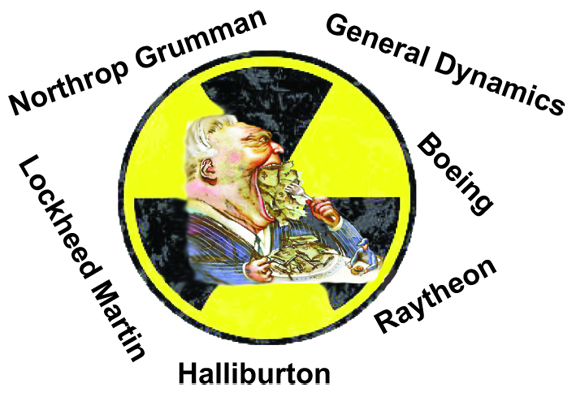
Since fiscal year 2001, military contractors have received over 54% of Pentagon spending, totaling about $8 trillion,” Sludge noted. “Over $2.2 trillion of that went to the five largest weapons firms: Lockheed Martin, Raytheon, General Dynamics, Boeing, and Northrop Grumman. These five firms comprise about 40% of military industry cash given to federal candidates.”
Dems Who Opposed Pentagon Cuts Received Nearly 4x More Donations From Weapons Makers, Common Dreams The latest passage of the NDAA “is particularly strong evidence that Pentagon contractors’ interests easily take precedence over national security and the public interest for too many members of Congress,” said one critic.
Dems Who Opposed Pentagon Cuts Received Nearly 4x More Donations From Weapons Makers, Common Dreams The latest passage of the NDAA “is particularly strong evidence that Pentagon contractors’ interests easily take precedence over national security and the public interest for too many members of Congress,” said one critic.
KENNY STANCIL Common Dreams, September 24, 2021 In a bipartisan 316-113 vote on Thursday night, the U.S. House authorized a $778 billion military budget for fiscal year 2022. Every Republican voted against two amendments to reduce Pentagon spending, but Democrats were split, and a new analysis reveals that lawmakers who rejected the proposed cuts received far more campaign cash from the weapons industry than those who supported the cuts.
One amendment to the National Defense Authorization Act (NDAA), introduced by Rep. Mark Pocan (D-Wis.), would have slashed the overall spending authorization level by 10%, exempting the paychecks and health benefits of military personnel and the Defense Department’s federal civilian workforce.
The measure failed by a tally of 86-332. According to an analysis of OpenSecrets data by the Security Policy Reform Institute (SPRI) and Sludge, the Democrats who voted against the 10% Pentagon budget cut have taken, on average, 3.7 times more campaign money from arms manufacturers since January 2019 than the Democrats who voted for it.
Sludge‘s Donald Shaw and SPRI’s Stephen Semler wrote Friday that “the average amount of defense cash received by Democrats who opposed the amendment was $60,680, while the Democrats who supported it received an average of $16,497” in contributions from the PACs of Defense Department contractors “as well as donations larger than $250 from those companies’ employees.”
“The vote was a step backwards for House progressives,” noted Shaw and Semler, who added that:
Last year, an identical amendment was put forward and it received 93 votes in favor, seven more than it received yesterday. Nine Democrats switched from supporting the 10% reduction last year to opposing it this year: Emanuel Cleaver (Mo.), Dwight Evans (Pa.), Al Green (Texas), Bill Keating (Mass.), Robin Kelly (Ill.), Stephen Lynch (Mass.), Richard Neal (Mass.), Brad Sherman (Calif.), and Bennie Thompson (Miss.).
Earlier this month, the House Armed Services Committee voted in favor of a Republican-sponsored amendment to add $23.9 billion on top of President Joe Biden’s proposed $753 billion military budget for fiscal year 2022—already up from the $740 billion approved for the previous fiscal year under the Trump administration.
A second NDAA amendment, led by Rep. Barbara Lee (D-Calif.), would have restored military spending to the level requested by the president. That proposal for a modest 3% cut to the NDAA’s top-line figure garnered the support of a majority of—but not all—House Democrats and was shot down in a 142-286 vote.
Sludge reported that “the 77 Democrats who opposed the 3% cut have received, on average, $52,211 from the defense sector since January 2019, and the 142 Democrats who supported it have received an average of $35,898.”
Lindsay Koshgarian, program director of the National Priorities Project at the Institute for Policy Studies (IPS), told Common Dreams on Friday that “the passage of the $23.9 billion increase in the House is particularly strong evidence that Pentagon contractors’ interests easily take precedence over national security and the public interest for too many members of Congress.”
As she spoke in support of Pocan’s amendment on Wednesday, Rep. Alexandria Ocasio-Cortez (D-N.Y.) pushed back against the narrative that cutting Pentagon spending would make Americans less safe, emphasizing how easy it would be to find the funds.
“The Pentagon could save almost $58 billion by eliminating obsolete weapons, weapons like Cold War-era bombers and missiles designed and built in the last century that are completely unsuitable for this one,” said Ocasio-Cortez.
“We could find another $18 billion by simply preventing the end-of-year spending sprees that lead to contract money being shoveled out the door every September,” she added, echoing Sen. Bernie Sanders’ (I-Vt.) observation earlier this week that the Pentagon—which has never passed an audit—is “inherently susceptible to fraud.”…………………
The House passage of the NDAA came just over a week after researchers at Brown University’s Costs of War project estimated that as much as half of the $14 trillion that the Pentagon has spent since the U.S. invasion of Afghanistan two decades ago has gone to private military contractors. IPS’ Koshgarian and SPRI’s Semler, meanwhile, have both said that corporations gobbled up more than half.
“Since fiscal year 2001, military contractors have received over 54% of Pentagon spending, totaling about $8 trillion,” Sludge noted. “Over $2.2 trillion of that went to the five largest weapons firms: Lockheed Martin, Raytheon, General Dynamics, Boeing, and Northrop Grumman. These five firms comprise about 40% of military industry cash given to federal candidates.” https://www.commondreams.org/news/2021/09/24/dems-who-opposed-pentagon-cuts-received-nearly-4x-more-donations-weapons-makers
Sizewell C nuclear project no longer viable, with new developments in cheaper wind power- energy expert
Nuclear power has become “outdated by technology” and offshore wind can
produce power more quickly and cheaply, an energy scientist told the BBC.
Professor in energy and climate change Charlie Wilson said there was no
longer a good case for a new £20bn Sizewell C plant on the Suffolk coast.
He said new ways to store wind turbine energy meant supplies could be
maintained even in low winds.
EDF, the firm behind Sizewell C, said nuclearwas key for UK energy needs.
The government said nuclear was vital for the
“UK’s low-carbon energy future”. Prof Wilson, of the the Norwich-based
Tyndall Centre for Climate Change Research at the University of East
Anglia, said nuclear power cost twice as much as wind power. Electricity
generated by wind turbines costs about £40 per megawatt hour, compared to
£92.50 which is the projected cost of the latest nuclear plant being built
at Hinkley Point C in Somerset, he added.
He said in the past nuclear power
was seen as key because in any weather it provides the same baseload power
– baseload refers to the minimum amount of electric power needed to be
supplied to the electrical grid at any given time. “The view in the
1970s-1990s was that you needed this large firm baseload power generation
like nuclear,” he said.
“The game-changing technologies around storage and
flexibility mean intermittent renewables – like large offshore wind farms –
are now viable as a reliable generation source.
BBC 25th Sept 2021
1 This Month

Read the Public Inquiry Report, the Commissioners’ report, Surrendering Australia: The AUKUS Deception is available to download for free at aukuspublicinquiry.com. Or just watch the replay of the National Press Club Luncheon.


19 November – Webinar – The Reality of Reprocessing
Time: 11:00 AM Pacific Time (US & Canada) / 2:00 PM Eastern / 7:00 PM UK / 8:00 PM CET
Register for the Zoom Event Here



Shut down the radiation-damaged Heysham nuclear reactors now
To see nuclear-related stories in greater depth and intensity – go to https://nuclearinformation.wordpress.com

Say No to NASA’s Reckless Nuclear Reactor on the Moon
Say No to NASA’s Reckless Nuclear Reactor on the Moon
-
Archives
- November 2026 (94)
- October 2026 (302)
- September 2026 (339)
- August 2026 (330)
- July 2026 (355)
- June 2026 (287)
- May 2026 (306)
- April 2026 (356)
- March 2026 (251)
- February 2026 (267)
- January 2026 (308)
- December 2025 (358)
-
Categories
- 1
- 1 NUCLEAR ISSUES
- business and costs
- climate change
- culture and arts
- ENERGY
- environment
- health
- history
- indigenous issues
- Legal
- marketing of nuclear
- media
- opposition to nuclear
- PERSONAL STORIES
- politics
- politics international
- Religion and ethics
- safety
- secrets,lies and civil liberties
- spinbuster
- technology
- Uranium
- wastes
- weapons and war
- Women
- 2 WORLD
- ACTION
- AFRICA
- Atrocities
- AUSTRALIA
- Christina's notes
- Christina's themes
- culture and arts
- Events
- Fuk 2022
- Fuk 2023
- Fukushima 2017
- Fukushima 2018
- fukushima 2019
- Fukushima 2020
- Fukushima 2021
- general
- global warming
- Humour (God we need it)
- Nuclear
- RARE EARTHS
- Reference
- resources – print
- Resources -audiovicual
- Weekly Newsletter
- World
- World Nuclear
- YouTube
-
RSS
Entries RSS
Comments RSS

