With its reprocessing plant in La Hague, France has the highest radioactive discharges at sea in Europe.

With its reprocessing plant in La Hague, France has the highest radioactive discharges at sea in Europe. And these discharges are not decreasing, despite the commitments made in 1998, in Sintra, Portugal, by
the Member States of the OSPAR Convention for the protection of the North-East Atlantic.
But the results of the citizen surveillance ofradioactivity in the environment carried out by ACRO for more than 25years, show that the account is not there: the discharges from the Orano reprocessing plant in La Hague are visible. all along the Channel coast and, in the summer of 2021, they could still be detected as far as the Danish border.
The association therefore urges France to respect its international commitments by significantly reducing its radioactive discharges at sea. It will, for its part, maintain its vigilance.
ACRO 29th Sept 2021
High rates of cancer and deaths among former nuclear workers at Ile-Longue nuclear submarine base.
Brest. A study points to the prevalence of cancer among former workers at
the Ile-Longue nuclear base. A sociologist from the University of Brest has
just completed a study on the former pyrotechnicians of Ile-Longue. From
1972 to 1996, these state workers assembled the warheads of nuclear
missiles “without any protection”. A quarter of them died early.
France Info 30th Sept 2021
Global nuclear agencies get together to launch the big propaganda show ”Group of Vienna” ahead of COP26
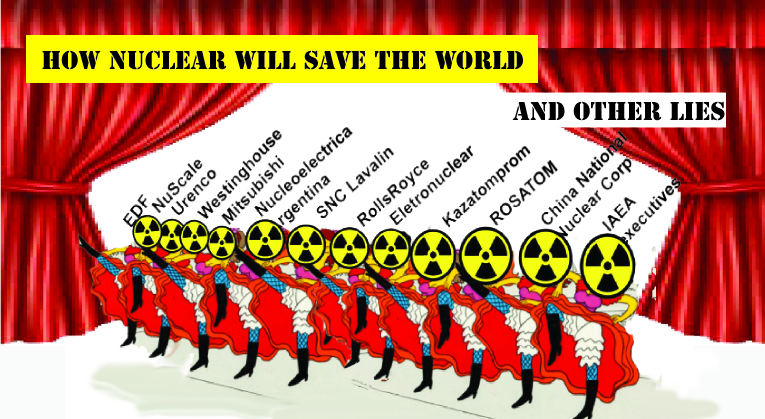
Global nuclear leaders unite in Vienna to create group for future advocacy of industry Power Engineering, 1 Oct 21, The heads of the International Atomic Energy Agency and more than a dozen industry leading firms are going to work more closely together on promoting the role of nuclear technology in dealing with major global challenges.
Those challenges include climate change, disease, hunger and more. Lofty goals, for certain, but the newly formed Group of Vienna believe that their industry is key to helping solve pressing issues worldwide.
IAEA Director General Rafael Mariano Grossi helped guide formation of the so-called Group of Vienna, which includes his agency’s chief executives and top leaders from 13 companies and utilizes in U.S., China, Russia, South America and Europe. They met in Vienna during the latest IAEA general conference……..
In addition to IAEA executives, the Group of Vienna includes founding members from China National Nuclear Corp., EDF, Eletronuclear, NA Kazatomprom, Mitsubishi Heavy Industries, Nucleoelectrica Argentina, NuScale Power, Rolls Royce SMR, ROSATOM, SNC-Lavalin Group, Urenco and Westinghouse Electric Co.
The high-level panel resolves to meet regulatory to discuss the latest developments in the nuclear field and how those contributions can factor into global challenges…..
New-build projects are extremely expensive to complete, such as the $27 billion Vogtle Unit 3-4 expansion in Georgia and the Hinkley Point C in the UK. https://www.power-eng.com/nuclear/global-nuclear-leaders-unite-in-vienna-to-create-group-for-future-advocacy-of-industry/
Russia confirms that ”Nuclear is Green”- George Orwell would be fascinated.

Russia confirms nuclear as green while EU remains undecided NEI, 30 September 2021 The assignment of the status of a “green” energy source to nuclear power generation in the Russian Federation should be a signal for other countries considering the inclusion of nuclear energy in their “green” lists, Rosatom Director General Alexei Likhachev said on 27 September. The previous week, Russian Prime Minister Mikhail Mishustin had approved the criteria for the selection of “green” projects and initiatives in the field of sustainable development for concessional financing.
Among the “green” areas of energy, nuclear energy is separately designated……….
The approval of the Russian“ green ”taxonomy is an important step within the framework of the national climate and environmental agenda, an incentive for the development of green industries and projects,” Likhachev noted. He added that the taxonomy officially established the status of nuclear energy as a “green” source, along with solar, wind and geothermal energy.
“This confirms the effectiveness of nuclear power plants in combating climate change and opens up access to green financing instruments. We hope that the Russian taxonomy will become a signal for foreign countries considering the issue of including nuclear energy in their green lists, he stressed.
Meanwhile, the European Union (EU) has pushed back the deadline for objections to proposed rules for green investments, allowing an additional two months to scrutinise the policy. EU countries will now have until early December, instead of October, to scrutinise these rules………
The Commission is due to publish a second proposal in the coming months, confirming whether the taxonomy will label investments in nuclear and gas as green………… Countries such as France and Hungary are strong supporters of nuclear power, and say investments the low-carbon energy source should be encouraged to fight climate change. Others, including Austria and Luxembourg, are strongly opposed. One EU official said the analysis suggested Austria may consider legal action if the EU included nuclear in the taxonomy, Reuters reported…….. https://www.neimagazine.com/news/newsrussia-confirms-nuclear-as-green-while-eu-remains-undecided-9120845
Entergy faces federal fine for violations at its nuclear power plant near St Francisville
 |
Entergy faces federal fine for violations at its nuclear power plant near St. Francisville, BY KRISTEN MOSBRUCKER | STAFF WRITER
The Nuclear Regulatory Commission is proposing a $150,000 fine against Entergy for three violations related to its River Bend Nuclear Station near St. Francisville.
The federal agency found there was an issue with an exam proctor falsifying a test and submitting it, an operator skimped on safety checks at the plant’s control building and a senior reactor operator gave an unauthorized employee an access key to a room with cybersecurity-related equipment inside.
The violations at the nuclear power plant occurred between 2018 and 2020, according to the commission’s report. ……………….. https://www.theadvocate.com/baton_rouge/news/business/article_e35480aa-22dc-11ec-a3fc-c75f751ef8a3.html
China supports North Korea’s call to revise sanctions, return to nuclear talks
China backs North Korean call to revise sanctions to revive nuclear talks SCMP, 2 Oct 21,
Instead of empty slogans, US should restart UN resolutions and ‘revise sanctions related to humanitarian aspects’, Beijing says
Denuclearisation talks stalled in 2019 and Pyongyang has resumed its missile tests
China has backed North Korea’s calls for the US to revise its sanctions to break the stalemate in denuclearisation talks.
Pyongyang resumed its missile tests last month after a six-month lull, the latest being a new hypersonic missile fired on Tuesday. It first fired a
nuclear-capable cruise missile on September 12, then followed up with two railway-borne ballistic missiles days later – in breach of UN Security Council resolutions.
Although the Chinese foreign ministry has continued to urge restraint from all parties in response to Pyongyang, spokeswoman Hua Chunying also called for North Korea’s “justified and reasonable concerns” to be taken seriously and addressed.
“The US should not fall back on empty slogans calling for dialogue, but should demonstrate sincerity and come up with a realistic dialogue proposal, restart the reversible UN resolutions at the Security Council, and revise sanctions that are related to humanitarian aspects,” Hua said on Thursday……………… https://www.scmp.com/news/china/diplomacy/article/3150921/china-backs-north-korean-call-revise-sanctions-revive-nuclear
Hungary’s nuclear watchdog withholds permits for two new reactors
Hungary watchdog withholds nuclear expansion permits, seeks further info, BUDAPEST, Oct 1 (Reuters) – Hungary’s nuclear watchdog withheld permits for two new reactors at the Paks nuclear power plant pending additional information from the Russia-led project’s managers, further hampering a planned expansion beset by years of delays………………………
Hungary has amended its nuclear safety protocols to allow some work to begin before the entire expansion – initially planned to start in 2018 and with the first bloc set for completion in 2025 – got the regulatory nod.
It was unclear how much more the latest setback could delay construction of a project still in its preliminary stages and on which Russia this year agreed to delay payments for five years. https://www.reuters.com/business/energy/hungary-watchdog-withholds-nuclear-expansion-permits-seeks-further-info-2021-10-01/
Elon Musk , world’s richest man, pays no tax, likes nuclear power

A flippant Elon Musk takes shots at Biden, the SEC and anti-nuclear sentiment , SEP 29 2021 Lora Kolodny Kolodny@lorakolodny
- At an appearance Tuesday at the Code Conference in Beverly Hills, California, Elon Musk criticized Joe Biden for not inviting Tesla to a White House summit on electric vehicles.
- He also poked at the SEC and explained his point of view on taxation practices.
- In addition, he said he didn’t quite understand why renewable energy supporters are against nuclear power.
- SpaceX and Tesla CEO Elon Musk criticized President Joe Biden on Tuesday, deeming his administration “biased” against Tesla and saying it appears to be “controlled” by unions during a speech on stage at the Code Conference in Beverly Hills, California.Musk, in his typically irreverent form, also repeated several of his prior taunts against federal financial regulators at the Securities and Exchange Commission, reiterated his support for cryptocurrency and nuclear energy, and said he is optimistic about Tesla and tech in China despite recent antitrust and cryptocurrency crackdowns there
…………….On taxes. Swisher asked Musk — who is currently the wealthiest person in the world, according to Bloomberg — to respond to criticism that while his companies have received a good deal of government contracts and subsidies, the CEO has avoided paying some taxes personally in the U.S. through creative, if legal, accounting practices.
In June, the investigative news site ProPublica reported on Musk’s tax bill as part of a massive analysis of billionaires’ finances. They found that Musk’s income tax bill amounted to zero in 2018.
- Musk insulted ProPublica’s reporting, calling it “tricky” and “misleading.”Then he said that the number was so low because he does not draw a salary, so his cash compensation is basically zero. Musk borrows money against stock options that vest over time instead.As he has amassed more and more shares in Tesla and SpaceX, he said, he has “not really bothered” to take money off the table by selling a stake……….
- When asked for comment by CNBC, ProPublica responded with the following statement from Editor-in-Chief Stephen Engelberg:
“Elon Musk’s remarks confirm the accuracy of our reporting, which disclosed that he paid no federal income taxes in 2018. As we pointed out in our story, Musk has supported his lifestyle by borrowing money against his stockholdings, a textbook example of the strategy known as ‘buy, borrow and die.’ We noted in our story that his tax payments to the government in recent years were a tiny portion of his multi-billion dollar gains in wealth.”………….
In 2018, the SEC sued Tesla and Musk for securities fraud after the CEO wrote on Twitter that he was considering taking Tesla private for $420 per share and had funding secured.They ultimately settled that lawsuit, with Musk and Tesla each paying a $20 million fine to the feds and Musk relinquishing his role as chairman of the board at Tesla. Musk also agreed to have his tweets reviewed by a compliance officer at Tesla before he posts them if they contain any material company information.
…………….. Crypto and China
Tesla made waves in February when it revealed it had purchased about $1.5 billion worth of bitcoin. After it disclosed the holdings, the price of bitcoin skyrocketed. In May, when Musk said on Twitter that Tesla would stop accepting bitcoin as a payment for its electric cars, the price of bitcoin plummeted.
When Musk tweets an endorsement of a particular coin — as he has done with dogecoin — its price tends to increase, at least temporarily.
When Swisher asked about cryptocurrency regulation, Musk said that the SEC should back off.
“Just let it fly,” he suggested.The People’s Bank of China recently declared all cryptocurrency-related activities illegal. …………
Space and energy Swisher and Musk discussed SpaceX, its competitors, plans to expand satellite internet service Starlink, and ambitions to make humanity a “multi-planet species” at length. During the course of their SpaceX discussion, Musk took the opportunity to mock the phallic shape of Blue Origin’s rocket and berate Jeff Bezos for his aerospace company’s litigiousness.……
…. “I’m also kind of pro-nuclear. And I’m sort of surprised by the public sentiment against nuclear. https://www.cnbc.com/2021/09/29/elon-musk-takes-shots-at-biden-sec-anti-nuclear-sentiment-at-code.html
Russia wants help to clean up sunken nuclear submarines – while it invests in new ones!
Norway celebrates 25-years paying for nuclear-dump cleanup. Russia showcases new reactor weapons
Rosatom officials and Norwegian project partners are Wednesday marking that it is 25 years since the first money check was sent from Oslo to help improve infrastructure at the ill-fated Andreeva Bay dump site for spent nuclear fuel and radioactive waste accumulated from the operation of Cold War submarines. The Barents Observer ,By Thomas Nilsen September 29, 2021
”………………….. Sunken reactors
Andrey Zolotkov with ANO Bellona Murmansk says there are problems in the sphere of nuclear safety that Russia can’t deal with alone.
“This is to raise the sunken nuclear submarines,” he says.
On the seafloor of the Barents Sea, the old November class K-159 that sank in August 2003 has two reactors with spent nuclear fuel on board. The submarine lays in an area of high importance for the fisheries of both Russia, Norway and the European Union. Further east, in the Kara Sea, the submarine K-27 was dumped on purpose, along with several other submarine reactors and thousands of containers with radioactive waste.
Zolotkov fears the submarines may corrode to the worse if nothing is done.
If we constantly postpone this for later, then something may happen. The lifting operation will sooner or later become impossible because supporting structures will be destroyed as a result of corrosion.”
A key question is how eager potential donor nations would be to cash out even more money to assist in reducing the environmental risks caused by the past nuclear legacy, like the dumped reactors in the Kara Sea, as long as Russia itself gives priority to creating nuclear weapons systems beyond what the world ever has seen before.
Rearmament of the north
Russia’s rearmament of the north includes a new generation of both multi-purpose submarines and ballistic missile submarines. Currently, some 12-13 reactor-powered subs are under construction at the Sevmash yard in Severodvinsk. The new vessels will sail for both the Northern Fleet and the Pacific Fleet. Little is known about 4th generation Russian navy reactors and uranium fuel enrichment.
Maybe more frightening than the new submarines are two other reactor-powered weapons systems currently under testing and development in northern Russia: the Poseidon underwater drone and the Burevestnik cruise missile. Both are said to carry nukes and have a nearly unlimited range.
New satellite images
In late August, Google Earth updated its satellite images from above the naval yards in Severodvinsk…………………
Nenoksa accident
In August 2019, five employees from Rosatom were killed when a nuclear object was about to be raised from the seabed outside Nenoksa in the White Sea, only a few kilometers west of Severodvinsk. What exactly happened remains secret, but radiation monitors in Severodvinsk saw a spike, and locals took photos of ambulances where both the interior and the drivers were wearing protective dressed against radiation.
As reported by the Barents Observer, the explosion was most likely involving the reactor from a Burevestnik test. This autumn, Russia’s top-secret testing of the Burevestnik nuclear-powered missile is moved to Novaya Zemlya in the Arctic, an archipelago under full military control and formerly used for real nuclear weapons tests in the atmosphere and underground.
This week, a large area both on land at Novaya Zemlya and in the waters along the west coast on the Barents Sea side is closed off with NOTAM-warnings (Notice to Airmen). The size of the closed-off areas fits with a likely test launch of the nuclear-powered missile……… https://thebarentsobserver.com/en/nuclear-safety/2021/09/while-norway-celebrates-25-years-paying-cleanup-nuclear-dumpsite-russia-gives
Japan’s independent English language newsletter, analysing nuclear issues, is struggling to survive
Japan NPO on nuke power issues struggling to retain English newsletter
September 27, 2021 (Mainichi Japan TOKYO (Kyodo) — A citizens’ organization in Japan that publishes independent analysis in English on nuclear power issues is struggling financially, threatening its ability to remain the major source of specialized public information on Japan’s nuclear industry for an international audience.
The Citizens’ Nuclear Information Center based in Tokyo has published the free bimonthly English newsletter Nuke Info Tokyo since 1987 but is having to crowdfund to keep publishing amid financial difficulties caused by the coronavirus pandemic.
The nonprofit organization, which also produces a monthly newsletter in Japanese for a domestic audience, had previously financed the cost of the English publication by holding paid seminars at which it also solicited donations and sold books, as well as collecting membership fees.
But it has been unable to hold the events since early 2020 when coronavirus infections began to impact Japan, Hajime Matsukubo, CNIC secretary general, told Kyodo News.
Membership — already in decline — has also dropped further amid the pandemic and its effect on the economy, he said.
“Membership decreased by about 100 last year alone under the coronavirus outbreaks and (membership) is around 2,100 now,” Matsukubo said, admitting the decline in membership also owed to a waning of public interest in nuclear issues in recent years.
…………. Philip White, a former editor of Nuke Info Tokyo, wrote that he fielded calls around the clock from the foreign media by referring to the archived English-language articles at the time of the disaster.
“The international media was hungry for critical information to counter the sanitized version offered by the government and the nuclear industry. Our English website offered clearly referenced Nuke Info Tokyo articles,” he wrote……………
Matsukubo argues that the government and electric power companies operating nuclear plants tend to withhold information, not just when accidents occur but also in normal times.
Although the government has said the Fukushima plant is under control, it is uncertain how many more years it will take to deal with over a million tons of treated radioactive water from the plant and decommission damaged reactors.
The government continues to deem nuclear power a major energy source, although, since 2014, it has said it aims to decrease its reliance on such power.
Running the English newsletter, staffed by Stronell, four freelance translators, and an editor who is also co-director of the group, costs around 1.5 million yen ($13,700) per year. While the translators used to work voluntarily, CNIC started to pay them in 2009 — though they receive half or less than the market rate.
At this time, the newsletter, which had been printed and mailed to readers with a postage fee charged only to readers in Japan, was made available for free online. Several hundred readers regularly refer to the newsletter, among them journalists, NGO staff, and academics.
Another co-director of CNIC, Hideyuki Ban, said that researchers worldwide have quoted Nuke Info Tokyo in their work.
“Nuke Info Tokyo is the only newsletter in English that specializes in the situation of nuclear power in Japan and has covered a wide range of issues from citizens’ standpoints for decades,” Ban said.
CNIC was founded in 1975 by scientists, including the late Jinzaburo Takagi, a nuclear chemist who began his career in the nuclear industry but later voiced concerns about atomic power……..
To coincide with the policy discussion, CNIC held a virtual seminar on Friday to draw attention to the issues and help people make up their minds on the right policy for Japan.
Stronell said she hopes to run an article on the seminar given by experts in the newsletter.
“I think the most important thing is having independent experts’ information on nuclear power accidents like Fukushima and other problems to let people make decisions about their own health and future,” Stronell said. “And so for us to continue to do this, and that’s what the crowdfunding project is about, any support is very much appreciated.” https://mainichi.jp/english/articles/20210927/p2g/00m/0na/078000c
Greta Thunberg mocks world leaders’ words at Youth4Climate
The Swedish climate activist, Greta Thunberg, used her speech at the Youth4Climate conference in Milan to mock the words of world leaders, including UK PM Boris Johnson. The 18-year-old used soundbites from Mr Johnson, such as “expensive bunny hugging” and “build back better”, to highlight what she called the “empty words and promises” of politicians.
Later in the speech, she urged people not to give up hope, saying that change is “not only possible, but urgently necessary”. Many countries have announced ambitious targets to reduce their emissions to tackle climate change.
Analysts say some recent announcements, such as China’s statement that it would not build any more coal plants overseas and the US, EU and others pledging to cut methane emissions by 30% by 2030, are signs that progress is being made. But they caution that some major challenges remain.
The UK, for example, has pledged to cut 78% of its emissions by 2035, from a 1990 baseline. But the government’s current plans are projected to deliver less than a quarter of the cuts needed to meet the goal.
BBC 28th Sept 2021
https://www.bbc.co.uk/news/av/world-58726531
No, a nuclear-powered superyacht won’t save the world

Earth to CNN: No, a nuclear-powered superyacht won’t save the world, https://thebulletin.org/2021/09/earth-to-cnn-no-a-nuclear-powered-superyacht-wont-save-the-world/ By Dawn Stover | September 28, 2021 Who knew that a sexy nuclear superyacht could save us from climate catastrophe? That was the awesome news from CNN’s travel desk yesterday.
CNN wasn’t alone. Forbes, BBC Science Focus Magazine, and a host of other media outlets have previously hailed the world-rescuing potential of what CNN described as “an emissions-free megaship that will pit together climate scientists and the wealthy in a daring quest to save the planet.”
“Pit together” sounds like an apt description of a would-be merger between luxury tourism and climate action. You can put those two things together in a sentence, but in the real world they mix about as easily as oil and water.
And there’s another big problem with the plan for this overhyped 300-meter-long vessel and its global research: Earth 300, as the $700 million superyacht is called, will be powered by a molten salt nuclear reactor that doesn’t exist yet and won’t be certified for at least five years. The company’s website illustrates the reactor with a scale model of an experiment done in the 1960s at Oak Ridge National Laboratory.
The website also says the scientists onboard Earth 300 will have the world’s first ocean-going quantum computer. But that, too, has yet to be built.
Meanwhile, the climate crisis needs immediate attention. “We really are out of time,” UN Secretary-General António Guterres warned this month.
While they wait for a modular nuclear reactor that might never come, the developers of Earth 300 say they will use green synthetic fuels. These are liquid fuels derived from coal or natural gas in a process that captures carbon. However, they are much more expensive than fossil fuels. Aaron Olivera, the entrepreneur behind Earth 300, told CNN he plans to “eventually” retrofit the yacht with a reactor being developed by the UK company Core Power in collaboration with TerraPower, a US nuclear engineering firm chaired by Bill Gates.
Globally, there are at least 171 motorized megayachts that are 75 meters (246 feet) or more in length. Jeff Bezos, the world’s richest man, is rumored to be buying a superyacht so big that it will have a dock for its own “support yacht.” Eclipse, an even bigger superyacht owned by Russian-Israeli billionaire businessman Roman Abramovich, has its own missile defense system. The largest yacht currently operating, Azzam, is 180 meters (590 feet) long and consumes 13 metric tons of fuel per hour at its top speed of 33 knots. That’s about 0.01 miles (or a little over 50 feet) per gallon.
And the customers Olivera would like to attract—the wealthiest people in the world—also tend to have the world’s largest carbon footprints, thanks in no small part to their habit of traveling aboard superyachts and private airplanes. According to calculations by two researchers at Indiana University, a superyacht with a permanent crew and helicopter pad is “by far the worst asset to own from an environmental standpoint.”
Earth 300’s luxury suites will each rent for $300,000 a day, which presumably will cover the personnel and expenses needed to operate the ship and its 22 scientific laboratories. But construction won’t begin until 2025 at the earliest, and any groundbreaking scientific discoveries or billionaire epiphanies that could help stabilize the climate are even further into the future.
Construction is already delayed on another 600-foot-long yacht that will combine climate research with charters for paying customers. Financed by Kjell Inge Røkke, a Norwegian billionaire who made his fortune in fishing and oil drilling, REV Ocean will investigate climate change and ocean acidification, plastic pollution, and overfishing, but the nonprofit project is at least three years behind schedule.
Who will be aboard these superyachts? CNN asked Olivera which famous people he’d like to host on his future ship, and he named Elon Musk, Michelle Obama, Greta Thunberg, Naomi Klein and Yvon Chouinard. Like the superyacht itself, some of those potential guests seem more aspirational than realistic.
Greta Thunberg doesn’t take airplanes or motor yachts. Elon Musk doesn’t take vacations. And Bill Gates may be hurt that he’s not on the A-list.
With breathless enthusiasm, media applauds another nuclear lobby confidence trick – ”Earth 300”

Full of deceptive words and phrases – “clean” ”emissions-free” ”solutions to climate change” ”safe and sustainable atomic energy from a molten salt reactor” – journalists can hardly contain themselves as they regurgitate the propaganda from the nuclear lobby. Not so long ago, nuclear proponents were climate change deniers. Now they see that getting on the climate change bandwagon is their only chance to get taxpayers’ money, to fund their failing industry.
Tickets for this nuclear-powered superyacht will cost $3 million for VIPs and be free to scientists and students selected to help study climate change., Business Insider, APR 13, 2021,
The striking behemoth has been dubbed Earth 300‚ with a stated mission to carry out research expeditions in order to “confront earth’s greatest challenges,” according to Jefferson. Featuring naval architecture by NED, it spans an insane 984 feet—300 meters, hence the suffix—which makes it even longer than RMS Titanic (883 feet). The majority of that real estate has been dedicated to scientific equipment and tech straight from Silicon Valley.
The vessel will reportedly be powered by nuclear tech known as molten salt reactors (MSRs). ……he project has gained a number of partners, including IBM, RINA, Triton Submarines and EYOS Expeditions. Iddes anticipates Earth 300 will launch in 2025,- Robb Report 14 Apr 21,
Norway paid to help Russian nuclear submarine waste clean-up – but now – new submarines!
Norway celebrates 25-years paying for nuclear-dump cleanup. Russia showcases new reactor weapons
Rosatom officials and Norwegian project partners are Wednesday marking that it is 25 years since the first money check was sent from Oslo to help improve infrastructure at the ill-fated Andreeva Bay dump site for spent nuclear fuel and radioactive waste accumulated from the operation of Cold War submarines. The Barents Observer ,By Thomas Nilsen September 29, 2021
Hindered from on-site meetings due to the pandemic, today’s 25-years anniversary meeting in Andreeva Bay is long overdue. However, the meeting comes in pole position as the two countries are trying to improve bilateral relations in times of more complex geopolitics and higher tensions between NATO and Russia up north.
……. ensuring nuclear safety is another topic for good bilateral cooperation.
For the Soviet nuclear navy, the Coastal Technical Base in Andreeva Bay became the main storage site for both spent fuel assemblies from submarine reactors, as well as a site to store containers with solid radioactive waste. Focus was not on safety and after years of exposure to Arctic climate, the site became contaminated and the infrastructure started to fall apart. With Russia being broke after the collapse of the Soviet Union, the call for international action was precarious. Norwegian money, and will to solve the problem, was most welcomed……………
Success story
More than 2 billion kroner (nearly €200 million) of Norwegian taxpayers money are spent on helping Russia secure its nuclear legacy since the mid-1990ties. The ground-breaking nuclear safety work initiated on the Kola Peninsula, only some 60 km from the border to Norway, has since been followed by many other countries and international financial grant programs.
For projects in Andreeva Bay, Norway has paid more than €30 million on things like fixing electricity, water pipelines, roads, fences, constructing a new sanitary building and improving the old pier in port with a new lifting crane. About half of the 21,000 spent uranium fuel elements originally stored in three rundown concrete tanks is so far lifted out, repacked and shipped out of Andreeva Bay. First to Atomflot in Murmansk, then by train further to Russia’s reprocessing plant at Mayak in the South Urals. Some 10,000 cubic meters of solid radioactive waste that previously was stored outdoor and exposed to snow and frost is now under roof in a new building erected at the site. Soon, also that will be transported away.
Present at the celebrations in Andreeva Bay is also representatives from the environmental NGO Bellona. It was this organization, with offices both in Murmansk and Oslo, that before the official country-to-country cooperation started, was first to uncover security breaches and the urgency to act before the entire storage site turned out to be a Chernobyl in slow-motion.
“Time has come”
Bellona’s Aleksandr Nikitin says to the Barents Observer that the time has come for Russia to solve its own nuclear challenges, not the international community. “But first we have to complete already started international projects, like the nuclear legacy,” Nikitin says and points to the ongoing work in Andreeva Bay………….
Meanwhile, and unlike the 1990ties, Russia is now investing huge money in building new nuclear-powered submarines and other military nuclear installations. A key question is whether Moscow now is arming the country again into a nuclear age that later could cause similar radiological waste challenges as the legacy from the last Cold War created.
…….. It is a task for Russia and Rosatom. We cannot hire anymore for a rich uncle from the west to come and help again. It was a time when it was necessary, not anymore.”
Meanwhile, Aleksandr Nikitin is glad to see the solution-oriented results of the work in Andreeva Bay.
“Bellona started it, and we have to finish it,” he says………………………………….
A Norwegian intelligence official has previously expressed fears for more accidents with the reactor-powered weapons systems now under testing and development in Norway’s neighboring areas up north.
For Norway, a challenge is to balance the aid-support to nuclear safety with making sure no funding ends up in Russia’s new crazy nuclear weapons programs…………..
The “Serebryanka” dilemma
A review made by the Barents Observer of the publicly available documents on financial aid from Norway and Sweden to equip modern communication and positioning systems on board “Serebryanka” shows that about 9 million kroner (€900,000) were spent on the project in 2013 and 2014. That was shortly before the Burevestnik testing program started.
The Swedish Radiation Safety Authority, in charge of the project, says in its annual overview of Non-Proliferation cooperation for 2013 that the “Serebryanka” was the largest project initiated in the Murmansk region.
Stockholm spent 4,1 million Swedish kroner (SEK) on equipment for “Serebryanka” in 2013 and an additional 217,000 SEK in 2014.
Describing the project, the Radiation Safety Authority writes: “This project is co-financed with Norway and the purpose is to equip the vessel “Serebryanka” with a physical protection system, as well as communications and positioning systems, in order to increase security when transporting nuclear materials and radioactive substances.”
The Norwegian share of the project was 3 million Norwegian kroner, paid as part of the Nuclear Action Plan financed by the Ministry of Foreign Affairs.
Conflict-of-interests
Asked about the potential conflicting interests, State Secretary Audun Halvorsen in Norway’s Foreign Ministry told the Barents Observer upfront of the annual meeting in the Norwegian-Russian Commission on Nuclear Safety this spring that “…. our bilateral cooperation on nuclear safety projects are related to civilian activities only, and questions regarding military activities are therefore considered outside of the scope of the commission by the Russian side.” https://thebarentsobserver.com/en/nuclear-safety/2021/09/while-norway-celebrates-25-years-paying-cleanup-nuclear-dumpsite-russia-gives
No quick fix. Reducing demand is the key to energy supply.

Let’s hope that in the final weeks before vital international climate talks in Glasgow our political leaders show that, although there can be no quick fixes to this crisis, they’ve finally understood the way through.
Only by reducing demand will gas supply no longer be an issue For the electricity the UK will certainly need, we need to rapidly ramp up the rollout of renewable energy projects https://www.independent.co.uk/climate-change/opinion/gas-prices-energy-climate-crisis-b1927213.ht
Doug Parr , 27 Sep 21 As the effect of the gas price shock starts to seep into the lives of ordinary people over the coming weeks and months – causing bills to rise, energy suppliers to go bust and supermarket shelves to empty – many will be left wondering how the government could have allowed this to happen.
While it is true that a global surge in demand, coupled with geopolitical games and electricity supply issues in the UK have resulted in a squeeze on supply and subsequent price hike, this is only half the story.
What ministers are failing to talk about as they reassure us that they do “not expect” supplies to run out this winter, is that it is not supply but the UK’s dependency on gas, and the failure of successive governments to wean us off the stuff years ago, that has left the UK dangerously exposed.
The UK is one of the most gas-dependent countries in Europe – more than four-fifths of homes are still heated by it and almost half of our electricity is produced by burning it. Failed government policy over decades must shoulder much of the blame. The UK has the least energy-efficient housing stock in western Europe. Yet, we still don’t have a programme in place to insulate the millions of homes across the country that desperately need retrofitting.
There’s a pattern to these mistakes. Earlier this year the government botched its Green Homes Grant programme, scrapping it after just six months. Before that George Osborne binned the Zero Carbon Homes initiative after years of development. Before that, David Cameron reportedly told ministers to “get rid of the green crap”.
Insulating the UK housing stock is essential – it would reduce our dependence on gas, our exposure to such price shocks, slash emissions, reduce fuel poverty and, as Greenpeace UK’s recent report pointed out, create up to 138,000 new jobs and inject almost £10bn into the economy.
The latter economic benefit would also require a mass rollout of heat pumps, which would further reduce our dependence on gas. But once again, poor policy decisions have gotten in the way. The UK is last when it comes to the sale per household of these sources of clean heating, behind Poland, Slovakia, Estonia and almost everyone else in Europe.
Those calling for an increase in domestic supply by expanding production in the North Sea or having another go at fracking are completely wrong. This is a price shock, not an availability shock so more domestic gas production can’t and won’t affect global or regional prices – and will have zero impact on the present crisis. Seeking more supply repeats the mistakes of the past.
It also won’t reduce the UK’s carbon emissions, which is fundamental to tackling the climate crisis and something the government is legally bound to do. Reducing demand is the only option to solve the problems of the UK’s gas exposure and the climate crisis simultaneously.
For the electricity the UK will certainly consume, we need to urgently push the rollout of renewable energy projects and the job opportunities that should come with them. The government loves to boast about its record on offshore wind, but it has stalled repeatedly when it comes to onshore wind and solar. The sooner we have a renewables sector that can cater to our energy needs the faster we relieve ourselves of the risks of gas dependence.
Investment in renewables must come with investment in a smarter, more flexible grid and better storage so that even when the wind isn’t blowing or the sun shining, energy supplies and prices don’t become a problem.
New nuclear power cannot realistically help. Continual cost escalation and ever-increasing delivery timeframes have proven that it is not a viable alternative to fossil fuels. According to EDF the next UK plant that could be approved wouldn’t be up and running until 2034 and that’s assuming none of the usual long delays. We can’t wait 13 years or more for a magic nuclear bullet, even if the issues such as waste can be solved.
Aside from taking the shackles off the construction of new renewables power, the upcoming Spending Review is the government’s chance to start righting past wrongs on energy efficiency. Rishi Sunak must commit to an extra £12bn of public investment for the rest of this parliament to improve energy efficiency, green our homes. We also need to properly fund a just transition for fossil fuel workers.
Boris Johnson has spoken at the UN this week of his “frustration” with world leaders at not taking climate change seriously enough. So he must be livid with his government departments, especially the Treasury, for the missteps over the last few years which have over-exposed the electorate and economy to expensive, climate-wrecking fossil gas.
Let’s hope that in the final weeks before vital international climate talks in Glasgow our political leaders show that, although there can be no quick fixes to this crisis, they’ve finally understood the way through.
Dr Doug Parr is Greenpeace UK’s chief scientist
1 This Month

Read the Public Inquiry Report, the Commissioners’ report, Surrendering Australia: The AUKUS Deception is available to download for free at aukuspublicinquiry.com. Or just watch the replay of the National Press Club Luncheon.


19 November – Webinar – The Reality of Reprocessing
Time: 11:00 AM Pacific Time (US & Canada) / 2:00 PM Eastern / 7:00 PM UK / 8:00 PM CET
Register for the Zoom Event Here



Shut down the radiation-damaged Heysham nuclear reactors now
To see nuclear-related stories in greater depth and intensity – go to https://nuclearinformation.wordpress.com

Say No to NASA’s Reckless Nuclear Reactor on the Moon
Say No to NASA’s Reckless Nuclear Reactor on the Moon
-
Archives
- November 2026 (94)
- October 2026 (302)
- September 2026 (339)
- August 2026 (330)
- July 2026 (355)
- June 2026 (287)
- May 2026 (306)
- April 2026 (356)
- March 2026 (251)
- February 2026 (267)
- January 2026 (308)
- December 2025 (358)
-
Categories
- 1
- 1 NUCLEAR ISSUES
- business and costs
- climate change
- culture and arts
- ENERGY
- environment
- health
- history
- indigenous issues
- Legal
- marketing of nuclear
- media
- opposition to nuclear
- PERSONAL STORIES
- politics
- politics international
- Religion and ethics
- safety
- secrets,lies and civil liberties
- spinbuster
- technology
- Uranium
- wastes
- weapons and war
- Women
- 2 WORLD
- ACTION
- AFRICA
- Atrocities
- AUSTRALIA
- Christina's notes
- Christina's themes
- culture and arts
- Events
- Fuk 2022
- Fuk 2023
- Fukushima 2017
- Fukushima 2018
- fukushima 2019
- Fukushima 2020
- Fukushima 2021
- general
- global warming
- Humour (God we need it)
- Nuclear
- RARE EARTHS
- Reference
- resources – print
- Resources -audiovicual
- Weekly Newsletter
- World
- World Nuclear
- YouTube
-
RSS
Entries RSS
Comments RSS

