International groups mobilise to demand that the European Parliament end plan to greenwash nuclear power.
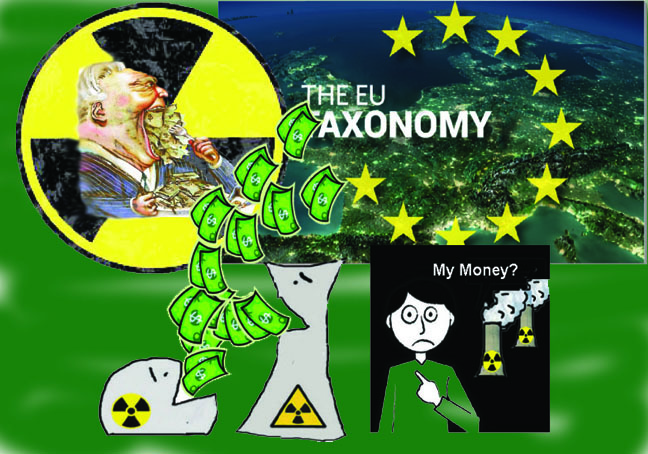
It is time to retake the streets. In July, the European Parliament will
vote on a new taxonomy for gas and nuclear and a coalition of grassroot
groups and NGOs from across the world will show up and demand MEPs stop
this unbelievable act of greenwashing. Join the mobilisations to
Strasbourg, where the European Parliament will vote on the new taxonomy, in
the week of the 4th of July.
Not My Taxonomy 13th June 2022
UK govt scratching for money for new nuclear, hires Barclays to search for investors.

UK ministers tap Barclays to secure investment for new nuclear plant. https://www.ft.com/content/4adac154-2a6d-4f13-95b1-a1b8592aa1fe
Search for 60% of facility’s financing comes as government aims to boost domestic energy supply Nathalie Thomas in Edinburgh and Jim Pickard in London .
UK ministers have hired Barclays to lead a search for investors willing to back a large new nuclear power plant at Sizewell on England’s east coast as part of a push to secure more domestic energy sources, according to four people familiar with the appointment. The government is keen to forge ahead with a 3.2 gigawatt plant, capable of generating electricity for 6mn homes, at Sizewell in Suffolk as part of Prime Minister Boris Johnson’s aim to build eight nuclear reactors by 2030.
Ministers have drawn up plans with Sizewell’s promoter, French state-backed EDF Energy, for a new company to replace the current joint venture that has been working on the Suffolk plant. Both the government and EDF would each take a 20 per cent stake in the new company. Bankers at Barclays have been tasked with finding investors to cover the remaining 60 per cent, according to people familiar with the plans.
The revised structure would force out the Chinese state-backed nuclear company CGN from Sizewell C. CGN owns 20 per cent of the current joint venture, with EDF holding the remaining 80 per cent. But UK ministers want to avoid further Chinese involvement in British nuclear facilities, given a deterioration in diplomatic relations between London and Beijing in recent years. CGN is already funding a third of the cost of the Hinkley Point C plant that is under construction in Somerset and upon which Sizewell C is based.
But nuclear industry experts say the government will have to tread carefully as CGN’s expertise will remain crucial to delivering Hinkley Point C. The company’s Taishan nuclear power plant in southern China was the first in the world to operate using a Franco-German European Pressurised Reactor technology that is being installed at Hinkley, and more than 100 Chinese engineers have been at work on the Somerset facility. Hinkley Point C is already running years behind schedule and billions over budget. EDF said in May that the plant’s estimated construction budget had ballooned by a further £3bn to between £25bn and £26bn, compared with an estimate of £18bn when it received the go-ahead in 2016. The first reactor is not expected to start generating electricity until June 2027.
The impossibility of humans colonising space
Ukraine Is The Most Aggressively Trolled War Of All Time: Notes From The Edge Of The Narrative Matrix, Caitlin’s Newsletter, Caitlin Johnstone 30n June 22
”……………………………………………………………………………..One thing we learned from Covid is that being stuck inside sucks. Space colonization would be like being in permanent lockdown with no windows, no Uber Eats, no birdsong or rain on the roof and no chance of ever going home. Even if it somehow became possible, it’s a dumb idea and I hate it.
And there’s no reason to believe it will ever become possible. Science is nowhere near finished learning about all the countless ways the human organism is inseparably intertwined with Earth. The belief that we can solve our problems with space colonization is unscientific. We’re just going to have to change how we function as a species.

The biggest obstacle remains the fact that science has no idea how to sustain human life in a way that is separate from earth’s ecosystem. We don’t even have any evidence that it’s possible. We’re no closer to being able to do it than we were a thousand years ago; today’s space stations are not independent of Earth’s ecosystem in even the tiniest way. They’re still 100 percent dependent on terrestrial supplies, which is an unsustainable model if you’re talking about actual colonization.
The idea of space colonization appeals to the capitalist mentality because it means we can keep expanding our population and keep expanding the economy and keep harvesting and consuming resources in the way we have been. But there’s literally zero scientific evidence that it’s feasible.
A future of space colonization is a fairy tale we tell ourselves so that we won’t have to change. So we can keep up our egocentric way of functioning without adapting and transcending our self-destructive patterns. We’re like a slacker who refuses to get off their parents’ couch and get their shit together who babbles made-up nonsense about NFT get-rich-quick schemes when asked about their plans for the future.
Collective extinction is easier to imagine than collective ego death. https://caitlinjohnstone.substack.com/p/ukraine-is-the-most-aggressively?utm_source=substack&utm_medium=email
California may rescue its last nuclear power plant — and give PG&E $millions to do it

CalMatters, BY NADIA LOPEZ JUNE 30, 2022,
The California Legislature has just taken the first step toward possibly extending the life of the Diablo Canyon nuclear power plant, the state’s last nuclear facility, past its scheduled closure.
The energy trailer bill negotiated by Gov. Gavin Newsom’s administration and approved by lawmakers late Wednesday allocates a reserve fund of up to $75 million to the state Department of Water Resources to prolong the operation of aging power plants scheduled to close. Diablo Canyon, on the coast near San Luis Obispo, has been preparing to shut down for more than five years.The California Legislature has just taken the first step toward possibly extending the life of the Diablo Canyon nuclear power plant, the state’s last nuclear facility, past its scheduled closure.
The energy trailer bill negotiated by Gov. Gavin Newsom’s administration and approved by lawmakers late Wednesday allocates a reserve fund of up to $75 million to the state Department of Water Resources to prolong the operation of aging power plants scheduled to close. Diablo Canyon, on the coast near San Luis Obispo, has been preparing to shut down for more than five years.
The funding is part of a contentious bill that aims to address a couple of Newsom’s most pressing concerns — maintaining the reliability of the state’s increasingly strained power grid, and avoiding the politically damaging prospect of brown-outs or blackouts.
Should the Newsom administration choose to extend the life of the nuclear plant, the funding would allow that — although the actual cost to keep the 37-year-old facility owned by Pacific Gas and Electric is not known. Newsom’s office and the Department of Water Resources did not immediately respond to multiple requests for comment. Asked for an estimate, PG&E spokesperson Lynsey Paulo did not provide one.
Even if only a contingency fund, the optics of sending millions of state and federal dollars to the state’s largest utility — which has a recent record of responsibility for deadly wildfires and state “bailouts” — are politically problematic
…………………….. While it’s true that the energy bill doesn’t itself authorize the extension of the plant’s life, it does provide the money should state leaders decide to do so. Such a move would require “subsequent legislation and review and approval by state, local and federal regulatory entities,” said Lindsay Buckley, a spokesperson for the California Energy Commission.
………. “The governor requested this language, not as a decision to move ahead with continuing operation of Diablo Canyon, but to protect the option to do that if a future decision is made,” said state Sen. John Laird, a Democrat from San Luis Obispo.
He also said the public should have a chance to weigh in before a final decision is made on the plant’s fate.
“The shuttering of Diablo Canyon has been years in the making, with hundreds of millions of dollars already committed for decommissioning,” Laird said. “Along with the residents of the Central Coast, I’m eager to see what the governor and federal officials have in mind.”…………….
Regardless of the future decision about the lifespan of the nuclear plant, nothing can happen without federal and state funding.
The Biden Administration created a $6 billion Civil Nuclear Credit Program to rescue financially struggling nuclear power plants, and Newsom has said he would consider applying for federal funding to keep Diablo Canyon open past its scheduled 2025 closure……………………………..
changing the federal rules to accommodate PG&E is a bad idea to longtime critics of nuclear power in California. To keep the plant operating, PG&E would have to seismically retrofit the plant and make heavy investments in cooling system and maintenance upgrades — costs that would outweigh the benefits, the anti-nuclear nonprofit San Luis Obispo Mothers for Peace wrote in a letter sent to the Energy Department on Monday.
Linda Seeley, a San Luis Obispo resident and longtime member of the group, said extending Diablo Canyon will cause a “myriad of problems.”
………………… , opponents cite safety threats and problems storing radioactive waste. And the prospect of keeping it open involves numerous technical, financial and logistical challenges. PG&E would need to reapply for licensing with the federal Nuclear Regulatory Commission, which issues the licenses to keep the plant operating, and would need to receive state and federal approval to do so. It would also have to address aging infrastructure problems at the site. ………………… https://calmatters.org/environment/2022/06/california-nuclear-power-pge-diablo-canyon/
Russia open to nuclear weapon talks
Blue Mountains Gazette, 1 July 22, Russian President Vladimir Putin says Moscow is open to a dialogue on strategic stability and nuclear non-proliferation.
Despite Russia’s invasion of Ukraine, both Moscow and Washington have stressed the importance of maintaining communication on the issue of nuclear arms.
The two countries are by far the world’s largest nuclear powers with an estimated 11,000 nuclear warheads between them.
“Russia is open to dialogue on ensuring strategic stability, preserving non-proliferation regimes for weapons of mass destruction and improving the situation in the field of arms control,” Putin said in remarks to a legal forum in his home city of St. Petersburg on Thursday.
He said the efforts would require “painstaking joint work” and would go towards preventing a repeat of “what is happening today in the Donbas”…………….. https://www.bluemountainsgazette.com.au/story/7802591/russia-open-to-nuclear-weapon-talks/?cs=5461
‘Effort and patience’ required to restore Iran nuclear agreement
UN News. Despite diplomatic engagements, restoring the so-called Iran nuclear agreement continues to be hindered by political and technical differences, the UN political and peacebuilding chief told the Security Council on Thursday.
In the landmark accord, formally known as the Joint Comprehensive Plan of Action (JCPOA) – reached in 2015 between Iran, the United States, China, France, Russia, and the United Kingdom – Iran agreed to dismantle much of its nuclear programme and open its facilities to international inspections in exchange for sanctions relief.
In 2018, then-President Trump withdrew the US from the agreement and reinstated the sanctions.
“Achieving the landmark JCPOA took determined diplomacy. Restoring it will require additional effort and patience,” said UN political affairs chief, Rosemary DiCarlo.
Although the landmark Joint Commission to restore the Plan resumed in November 2021, she acknowledged that despite their determination to resolve the issues, the US and other participants are yet to return to “full and effective implementation of the Plan, and [Security Council] resolution 2231”.
Appealing to both
Together with the Secretary-General, she urged Iran and the US to “quickly mobilize” in “spirit and commitment” to resume cooperation under the JCPOA.
They welcomed the reinstatement by the US in February of waivers on nuclear non-proliferation projects and appealed to the country to lift its sanctions, as outlined in the Plan, and extend oil trade waivers.
Together they also called on on Iran to reverse the steps it has taken that are inconsistent with its nuclear-related commitments under the Plan.
Monitoring enrichment
While the International Atomic Energy Agency (IAEA) has been unable to verify the stockpile of enriched uranium in Iran, it estimates that there is currently more than 15 times the allowable amount under the JCPOA, including uranium enriched to 20 and 60 per cent, which Ms. DiCarlo called “extremely worrying”.
Moreover, on 8 and 20 June, IAEA reported that Iran had started to install additional advanced centrifuges at the Fuel Enrichment Plant at Natanz and began feeding uranium into advanced centrifuges at the Fuel Enrichment Plant at Fordow.
In his latest report, IAEA Director General Rafael Grossi, informed the Council that the UN agency’s ability to verify and confirm the peaceful nature of Iran’s nuclear activities are key to the JCPOA’s full and effective implementation.
Iran’s decision to remove site cameras and place them and the data they collected under Agency seals, “could have detrimental implications”…………………………………….. https://news.un.org/en/story/2022/06/1121762....
Pakistan Reaffirms Pledge To Nuclear Non-Proliferation Goals
Eurasia Review , By Sher Bano
1540 Support Unit of Office for Disarmament Affairs (UNODA) hosted a side event entitled “Regional Approaches to Supporting UNSCR 1540 (2004)” on 1st June, 2022. UNSCR 1540 came in 2004 as a response to the threats of WMDs, non-proliferation and terrorism that emerged in 21st century. ……………………….
Pakistan conveyed its consistent view during the general debate that the international instruments and standards that are designed to address the threats to international security and peace posed by WMDs must be developed through multilateral and inclusive negotiations. Pakistan being a responsible nuclear state and member of the Security Council has being fulfilling its obligations under the resolution 1540 in order to strengthen the global framework for the non-proliferation of biological, nuclear and radiological weapons to the non-state actors. …………………….
Pakistan also seeks a non-discriminatory global regime on non-proliferation that is principle-based, inclusive and underpinned by the cardinal principle of equal and undiminished security for all states. Genuine progress on disarmament necessitates a conducive regional and global security environment as well as the resolution of long-standing disputes and conflicts. https://www.eurasiareview.com/01072022-pakistan-reaffirms-pledge-to-nuclear-non-proliferation-goals-oped/
 | |||
|
| |||
|
France to build nuclear reactors in Poland, and is supplying finance
French power utility EDF has signed cooperation agreements with five Polish
firms as part of its efforts to become a strategic partner in the
development of Poland’s first nuclear plants. It has also revealed that the
French government is supporting its involvement, including in securing
financing.
Last year, EDF submitted a preliminary offer to construct four
to six EPR nuclear reactors in Poland at two or three sites, representing a
total installed capacity of 6.6 to 9.9 GW. The French company estimated the
cost of building four reactors at around €33 billion and six at €48.5
billion.
Notes from Poland 29th June 2022
Anger at dangerous nuclear convoys through Lancashire and Cumbria
An unmarked military convoy has sparked fury from campaigners after it was
spotted trundling down a motorway. The procession of olive-green military
trucks was spotted through parts of Lancashire and Cumbria while on its way
to Scotland, and some have been left furious by the “dangerous convoys”
carrying nuclear goods. A convoy of the trucks is said to have passed
Kirkham, Preston, Garstand, Lancaster, Kendal, Penrith and Carlisle on its
way to Scotland.
Daily Star 30th June 2022
https://www.dailystar.co.uk/news/latest-news/very-dangerous-nuclear-warheads-spotted-27362768c
Marine Management Organisation Put “On Notice” Should they Rubber Stamp Possibly “Unlawful” Seismic Blasting Plan in Irish Sea — RADIATION FREE LAKELAND

The Marine Management Organisation are, any day, due to give their decision on Nuclear Waste Services seismic blasting plan for the Irish Sea. A report condemning Nuclear Waste Services plan for seismic blasting has been funded entirely by contributions from the public and written by renowned marine expert Tim Deere-Jones. The threat to the supposedly […]
Marine Management Organisation Put “On Notice” Should they Rubber Stamp Possibly “Unlawful” Seismic Blasting Plan in Irish Sea — RADIATION FREE LAKELAND
Biden officials privately doubt that Ukraine can win back all of its territory
Biden officials privately doubt that Ukraine can win back all of its territory https://edition.cnn.com/2022/06/28/politics/white-house-ukraine-projection/index.html
By Natasha Bertrand, CNN, June 28, 2022 White House officials are losing confidence that Ukraine will ever be able to take back all of the land it has lost to Russia over the past four months of war, US officials told CNN, even with the heavier and more sophisticated weaponry the US and its allies plan to send.
Advisers to President Joe Biden have begun debating internally how and whether Ukrainian President Volodymyr Zelensky should shift his definition of a Ukrainian “victory” — adjusting for the possibility that his country has shrunk irreversibly.
US officials emphasized to CNN that this more pessimistic assessment does not mean the US plans to pressure Ukraine into making any formal territorial concessions to Russia in order to end the war. There is also hope that Ukrainian forces will be able to take back significant chunks of territory in a likely counteroffensive later this year.
A congressional aide familiar with the deliberations told CNN that a smaller Ukrainian state is not inevitable. “Whether Ukraine can take back these territories is in large part, if not entirely, a function of how much support we give them,” the aide said. He noted that Ukraine has formally asked the US for a minimum of 48 multiple launch rocket systems, but to date has only been promised eight from the Pentagon.
And not everyone in the administration is as worried — some believe Ukrainian forces could again defy expectations, as they did in the early days of the war when they repelled a Russian advance on the Ukrainian capital of Kyiv. National security adviser Jake Sullivan has remained highly engaged with his Ukrainian counterparts and spent hours on the phone last week discussing Ukrainian efforts to recapture territory with Ukraine’s defense chief and Chairman of the Joint Chiefs of Staff Gen. Mark Milley, officials familiar with the call told CNN.
The growing pessimism comes as Biden is meeting with US allies in Europe, where he will try to convey strength and optimism about the trajectory of the war as he rallies leaders to stay committed to arming and supporting Ukraine amid the brutal fight.
“We have to stay together. Putin has been counting on from the beginning, that somehow NATO and the G7 would splinter, but we haven’t and we’re not going to,” Biden said Sunday while at the G7 summit in the Bavarian Alps.
The administration announced another $450 million in security assistance to Ukraine last week, including additional rocket launch systems, artillery ammunition and patrol boats. The US is also expected to announce as soon as this week that it has purchased an advanced surface-to-air missile defense system, called a NASAMS, for Ukrainian forces. Biden indicated in an op-ed earlier this month that he is committed to helping Ukraine gain the upper hand on the battlefield so that it has leverage in negotiations with Russia.
The mood has shifted over the last several weeks, though, as Ukraine has struggled to repel Russia’s advances in the Donbas and has suffered staggering troop losses, reaching as many as 100 soldiers per day. Ukrainian forces are also burning through their equipment and ammunition faster than the West can provide and train them on new, NATO-standard weapons systems.
A US military official and a source familiar with Western intelligence agreed it was unlikely that Ukraine would be able to mass the force necessary to reclaim all of the territory lost to Russia during the fighting — especially this year, as Zelensky said on Monday was his goal. A substantial counteroffensive might be possible with more weapons and training, the sources said, but Russia may also have an opportunity to replenish its force in that time, so there are no guarantees.
“Much hinges on whether Ukraine can retake territory at least to February 23 lines,” said Michael Kofman, a Russian military expert at the Center for Naval Analyses. “The prospect is there, but it’s contingent. If Ukraine can get that far, then it can likely take the rest. But if it can’t, then it may have to reconsider how best to attain victory.”
Russian forces gaining ground
Russian forces now control more than half of the eastern Ukrainian region of Donetsk, Pavlo Kyrylenko, the head of the Donetsk region military administration, said Thursday. Ukrainian forces retreated from the key eastern city of Severodonetsk on Friday after weeks of bloody battle.
Russian forces last week also captured ground around Lysychansk, the last city in the eastern Luhansk region still controlled by Ukraine. Ukrainian military commanders are now grappling with the reality that they may have to withdraw from the area to defend territory further west.
In the meantime, Russian oil revenues have only been going up as oil prices have skyrocketed, even amid the harsh sanctions imposed by the West. US officials said on Monday that the US and its allies are going to try capping the price of oil so Russia does not profit from it anymore, but how and when that cap will take effect remains to be seen.
Internally, there is a sense among some in the Biden administration that Zelensky will need to start moderating expectations for what Ukrainian forces can realistically achieve. Zelensky said late last month that he would “consider it a victory for our state, as of today, to advance to the February 24 line without unnecessary losses.”
He reiterated that goal last week.
“We don’t have any other choice left but to move forward — move to liberate all of our territories,” he said in a Telegram post. “We need to kick the invaders out of the Ukrainian regions. Though the width of the frontlines is as long as over 2,5000 km, we feel that we hold the strategic initiative.”
And on Monday, he put a timeline on it: He wants the war over, and for Ukraine to win, by the end of 2022, he told G7 leaders.
Russia is suffering acute combat losses as well, losing as much as a third of its ground force in four months of war, US intelligence officials estimate. Officials have also said publicly that Russia will struggle to make any serious gains further west, using the Donbas region as a staging ground, without a full mobilization of its reserve forces.
But Russia believes it can maintain the fight, wearing down Ukrainian and western resolve as the global economic effects of the war become more severe, officials have told CNN.
The hunt for Soviet-era weaponry
As CNN has previously reported, Russia is looking in particular to exploit the gap between how much Soviet-style ammunition Ukraine and its allies have in their stockpiles, and how long it will take the west to provide Ukraine with modern, NATO-standard weapons and munitions that require time-consuming training.
A senior defense official acknowledged to CNN that the Soviet-era stocks are “dwindling,” but haven’t yet reached “rock bottom.” The official said that some eastern European countries still have more they could provide — but only if they continue to be backfilled by allies with more modern equipment.
The US and its allies, meanwhile, have been scrounging the world for the kind of Soviet-era ammunition that fits the equipment Ukraine already has, including 152 mm artillery ammunition. NATO-standard weapons fire larger, 155mm rounds. But another US defense official told CNN that effort is effectively reaching its end, with almost everything available that countries are willing to provide having already gone in.
Given the prodigious rate at which the Ukrainians have gone through their older ammunition in the bruising artillery fight in the Donbas, the official said, “Soviet-era weapons are being wiped off the earth.”
CNN’s Katie Bo Lillis, Oren Liebermann and Barbara Starr contributed to this report.
Empire To Expand NATO In Response To War Caused By NATO Expansion

Caitlin Johnstone 29 June 22,
Turkey’s President Erdoğan has officially withdrawn Ankara’s objection to the addition of Finland and Sweden to NATO membership, with the three countries signing a trilateral memorandum at a NATO summit in Madrid.
The removal of Erdoğan’s objection was reportedly obtained via significant natsec concessions from the other two nations largely geared toward facilitating Turkey’s ongoing conflict with regional Kurdish factions, and it removes the final obstacle to Finland and Sweden beginning the process of becoming NATO members. Finland’s addition will more than double the size of NATO’s direct border with Russia, a major national security concern for Moscow.
“Sweden and Finland moved rapidly to apply to NATO in the wake of Russia’s invasion of Ukraine, reversing decades of security policy and opening the door to the alliance’s ninth expansion since 1949,” Axios reports.
So the western empire will be expanding NATO again in response to a war that was predominantly caused by NATO expansion. Brilliant.
At the same NATO summit, President Biden announced plans to ramp up US military presence in Europe in response to the Ukraine war.
“Speaking with Spanish Prime Minister Pedro Sánchez, Biden said the US will increase the number of US Navy Destroyers stationed at a naval base in Rota, Spain, from four to six,” Antiwar’s Dave DeCamp reports. “The president said that this was the first of multiple announcements the US and NATO will make at the summit on increasing their forces in Europe, steps being taken in response to Russia’s invasion of Ukraine.”
This news comes out as a new CNN report tells us that the Biden administration does not believe Ukraine has any chance of winning this war, yet still won’t encourage any kind of negotiated settlement to end the bloodshed……………………
This would confirm what I and many others have been saying since Russia invaded: that this proxy war is being waged not with the intention of saving Ukrainian lives by delivering a swift defeat to Moscow but with the intention of creating a costly, gruelling military quagmire to weaken Russia on the world stage.
This is further confirmed by a new Politico report that British Prime Minister Boris Johnson has discouraged France’s President Macron from facilitating a negotiated peace settlement between Moscow and Kyiv, which would support an earlier Ukrainian media report that Johnson had discouraged President Zelensky from such a settlement during his visit to Kyiv in April.
These revelations emerge in the wake of western officials admitting that Ukraine is crawling with CIA personnel and special forces operatives from the US and other NATO countries.
“As usual it appears that the administration wants to have it both ways: assure the American people that it is being ‘restrained’ and that we are not ‘at war’ with the Russians, but doing everything but planting a U.S. soldier and a flag inside Ukraine,” writes Responsible Statecraft’s Kelley Beaucar Vlahos of this admission. “The Russians may not see the distinction and consider this news as further evidence that their war is more with Washington and NATO than with Ukraine.
The empire is guided by so little wisdom in its escalations against Russia that the US congress is now pushing expensive ship-launched nuclear cruise missiles on its naval forces even as the US Navy tells them it doesn’t want those weapons and has no use for them.
Like hey, just take the nukes anyway. What’s the worst that could happen?
We need to really start taking seriously the possibility that a nuclear weapon could detonate as a result of misunderstanding or malfunction amid the chaos and confusion of all these frenzied, foolish escalations and lead to an exchange which ends our entire world. This nearly happened on multiple occasions in the last cold war, and there’s no rational reason to believe we’ll get lucky again.
The only sane course of action here is de-escalation and detente, and all the major players in these escalations are pointed in the exact opposite direction.
This is so much more dangerous than most people are letting themselves consider. It’s being sustained by psychological compartmentalization, emotional avoidance, and a profound lack of wisdom.
As David S. D’Amato recently remarked, “If our species does find a way to survive into the distant future, our descendants will look at right now as the near miss; they’ll think, ‘Wow, that was close.’ How do we convince people in power to preserve that future?” https://caitlinjohnstone.substack.com/p/empire-to-expand-nato-in-response
While Biden Gives Ukrainian Army “The Most Lethal Weapon,” War Profiteer BAE Systems Stock Soars

During the 2020 U.S. election campaign, BAE Systems donated $569,202 to Democratic Party candidates, and $452,594 to Republicans, according to opensecrets.org.
Joe Biden received $102,591 compared to $94,966 for Donald Trump.
This amounts to chump change for the company: Shares in BAE Systems have reached an all-time high since the Russian invasion of Ukraine, rising by 28 percent over ten weeks to give BAE a stock market value of £24 billion and putting it among the largest 25 companies in the Financial Times Stock Exchange.
CovertAction Magazine. By Jeremy Kuzmarov, June 27, 2022
Sending Ukraine a $300 million shipment of powerful M-777 howitzers is a lobbying triumph for BAE Systems, one of the many war industry corporations fattening on the death and destruction of the Ukraine war
n June 15, the Biden administration announced that it was providing an additional $1 billion in military aid to Ukraine in a package that includes shipments of M-777 howitzers, ammunition and coastal defense systems.
While that announcement was being made, the Ukrainian army was shelling Donetsk, the capital of the Donetsk People’s Republic, with the U.S.-supplied howitzers along with French guns, according to The Donbass Insider, killing five civilians and wounding seven firefighters.
The attacks were being carried out from Ukrainian positions in Peski, a village not far from Donetsk airport.
According to a video produced by journalist Patrick Lancaster, a U.S. naval veteran who has reported on the war in eastern Ukraine over the last eight years, there were no military targets in the areas shelled by the Ukrainian army, only civilians.
Bringing Ukraine Closer to Victory?
Consistent with a society that used military technologies to subdue the native populations, most Americans subscribe to the belief that new superweapons can deliver salvation in wars.[1]
They ignore the dictum of German theorist Karl von Clausewitz that war is “politics by other means,” meaning that victory can only be achieved by aligning with the right side—which does not appear to be the case for Ukraine.
The New York Times characterized the M-777 howitzer—which made its debut in Afghanistan in 2005—as “the most lethal weapon the West has provided [to Ukraine] so far.”
Highly portable by land, air and sea, it can fire as far as 40 kilometers away or 25 miles—further than Russia’s primary artillery system—and is capable of striking within 10 meters of a target when coupled with the M982 Excalibur precision guided munition, which Canada has sent to Ukraine.[2]…………..
The American Legion reported that the United States had already sent 108 M-777 howitzers to Ukraine before the most recent aid package was signed by President Biden.
The Pentagon claimed that the howitzers had an immediate impact upon their arrival on May 8, enabling the Ukrainians to “go on the counter-offensive in the Donbas” and “take back some towns the Russians had taken in the past.”
Colonel Roman Kachur, commander of Ukraine’s 55th Artillery Brigade, told The New York Times that “this weapon [the howitzer] brings us closer to victory. With every modern weapon, every precise weapon, we get closer to victory.”
However, The New York Times reported on June 20 that Russian forces “appeared poised to tighten the noose around thousands of Ukrainian troops near two strategically important cities in the Donbas,” mounting an “assault on Ukrainian front lines.”[3]
So a Ukrainian victory appears far off.
The Russian Interior Ministry reported that it had destroyed U.S.-made howitzers through use of attack drones.
Former UN weapons inspector Scott Ritter wrote that Ukrainian dependence on Western artillery they were unfamiliar with resulted in a ten-fold disparity in firepower with Russia which was destroying Ukrainian defensive positions with minimal risk to its troops.
NATO Secretary-General Jens Stoltenberg warned that the Ukraine War could “last for years,” meaning we are looking at another Vietnam.
Merchants of Death
The M-777 howitzer is made by the U.S. division of BAE Systems, the largest arms manufacturer in Europe, which has supplied Ukraine with 400,000 rounds of munitions, anti-tank guided missiles and armored vehicles equipped with anti-aircraft missiles.
Former CIA Director Gina Haspel, who observed waterboarding at a CIA black site, sits on the company’s Board of Directors.
In March, BAE Systems ironically bankrolled an arms fair in Riyadh, Saudi Arabia, where sanctioned Russian weapons makers showed off some of the weapons they were using in Ukraine, including tanks, helicopters and drones.
During the 2020 U.S. election campaign, BAE Systems donated $569,202 to Democratic Party candidates, and $452,594 to Republicans, according to opensecrets.org.
Joe Biden received $102,591 compared to $94,966 for Donald Trump.
Additional recipients of BAE’s largesse included such anti-Russia hawks as House Speaker Nancy Pelosi (D-CA—$7,373); Steny Hoyer (D-MD—$10,000), Chuck Schumer (D-NY—$5,605); Liz Cheney (R-WY—$3,259 and another $5,500 in 2022); Jamie Raskin (D-MD—$4,089); Adam Schiff (D-CA—$8,036); Mitch McConnell (R-KY—$9, 289), James Inhofe (R-OK-$13,300) and Lindsey Graham (R-SC-$11,383).[4]
So far this year, BAE Systems has spent $940,000 on lobbying Congress; in 2021, it spent $3.63 million.[5]
This amounts to chump change for the company: Shares in BAE Systems have reached an all-time high since the Russian invasion of Ukraine, rising by 28 percent over ten weeks to give BAE a stock market value of £24 billion and putting it among the largest 25 companies in the Financial Times Stock Exchange.
In a blatant conflict of interest, a number of Tories in England’s Upper House of Parliament—notably Lord Glendonbrook, Viscount Eccles and Lord Sassoon, and unaffiliated peers Lord Lupton and Lord Gadhia—each own shares of at least £50,000 in BAE Systems.[6]
Samuel Perlo-Freeman, research coordinator for the campaign against the arms trade, said that BAE Systems “like other major world arms companies, are seeing their share prices soar in response to the war on Ukraine, as European countries prepare to massively rearm, doubling down on the very militarism that has created so much death and suffering in Ukraine, Yemen and elsewhere.”[7]
In May, BAE Systems’ CEO, Dr. Charles Woodburn, told investors: “We see opportunities to further enhance the medium-term outlook as our customers address the elevated threat environment.”
Which really means that, by antagonizing the Russians, great profits can be made in the Ukraine War and any compromise or diplomatic solution that might end the war should be rejected.
References: ………………………………………….. https://covertactionmagazine.com/2022/06/27/while-biden-gives-ukrainian-army-the-most-lethal-weapon-war-profiteer-bae-systems-stock-soars/1
NATO and a War Foretold

we’ll make our own prediction based on NATO’s past behavior. Instead of calling for compromises on all sides to end the bloodshed, this dangerous Alliance will instead promise an endless supply of weapons to help Ukraine “win” an unwinnable war, and will continue to seek out and seize every chance to engorge itself at the expense of human life and global security.
NATO and a War Foretold , CounterPunch, BY MEDEA BENJAMIN – NICOLAS J. S. DAVIES 29 June 2,
As NATO holds its Summit in Madrid on June 28-30, the war in Ukraine is taking center stage. During a pre-Summit June 22 talk with Politico, NATO’s Secretary General Jens Stoltenberg bragged about how well-prepared NATO was for this fight because, he said: “This was an invasion that was predicted, foreseen by our intelligence services.” Stoltenberg was talking about Western intelligence predictions in the months leading up to the February 24 invasion, when Russia insisted it was not going to attack. Stoltenberg, however, could well have been talking about predictions that went back not just months before the invasion, but decades.
Stoltenberg could have looked all the way back to when the U.S.S.R. was dissolving, and highlighted a 1990 State Department memo warning that creating an “anti-Soviet coalition” of NATO countries along the U.S.S.R’s border “would be perceived very negatively by the Soviets.”
Stoltenberg could have reflected on the consequences of all the broken promises by Western officials that NATO would not expand eastward. ……………………………………………..
…………………..We can’t go back and undo Russia’s catastrophic decision to invade Ukraine or NATO’s historic blunders. But Western leaders can make wiser strategic decisions going forward. Those should include a commitment to allow Ukraine to become a neutral, non-NATO state, something that President Zelenskyy himself agreed to in principle early on in the war.
And, instead of exploiting this crisis to expand even further, NATO should suspend all new or pending membership applications until the current crisis has been resolved. That is what a genuine mutual security organization would do, in sharp contrast to the opportunistic behavior of this aggressive military alliance.
But we’ll make our own prediction based on NATO’s past behavior. Instead of calling for compromises on all sides to end the bloodshed, this dangerous Alliance will instead promise an endless supply of weapons to help Ukraine “win” an unwinnable war, and will continue to seek out and seize every chance to engorge itself at the expense of human life and global security.
While the world determines how to hold Russia accountable for the horrors it is committing in Ukraine, the members of NATO should do some honest self-reflection. They should realize that the only permanent solution to the hostility generated by this exclusive, divisive alliance is to dismantle NATO and replace it with an inclusive framework that provides security to all of Europe’s countries and people, without threatening Russia or blindly following the United States in its insatiable and anachronistic, hegemonic ambitions.
Medea Benjamin is cofounder of CODEPINK for Peace, and author of several books, including Kingdom of the Unjust: Behind the US-Saudi Connection. Nicolas J. S. Davies is a writer for Consortium News and a researcher with CODEPINK, and the author of Blood On Our Hands: the American Invasion and Destruction of Iraq https://www.counterpunch.org/2022/06/29/nato-and-a-war-foretol..
Swedish and Finnish NATO deal with Turkey triggers fears over Kurdish deportations
Opponents of President Erdoğan in Sweden and Finland worry the deal will bolster efforts by Ankara to extradite them to Turkey, https://www.politico.eu/article/sweden-finland-nato-deal-turkey-trigger-fears-kurdish-deportations/—
BY CHARLIE DUXBURY June 29, 2022,
STOCKHOLM — Relief over Tuesday night’s deal with Turkey unblocking the NATO accession process for Sweden and Finland was palpable on Wednesday, but there were also fears that the two Nordic states could have conceded too much to Ankara over deportations.
Political adversaries of Turkish President Recep Tayyip Erdoğan based in Sweden were quick to label the deal as a sellout, which could strengthen Turkey’s efforts to secure extraditions of Kurdish rights activists and other opponents.
“This is a black day in Swedish political history,” said Amineh Kakabaveh, an independent Swedish lawmaker and longtime advocate for Kurdish rights. “We are negotiating with a regime which does not respect freedom of expression or the rights of minority groups,” Kakabaveh, a former fighter with Kurdish Peshmerga forces in Iran, told the SVT Nyheter television channel.
Since mid-May, Turkey has threatened to veto the NATO applications from Sweden and Finland unless the two states complied with, among other things, its demands to crack down on groups Ankara regards as terrorists.
This has caused political tension because Stockholm and Helsinki don’t agree that all the groups on Ankara’s list are terrorists. For example, all three regard the PKK as terrorists but only Turkey sees the Syria-based Kurdish groups the YPG and PYD as terrorists.
Over the past two months, officials from the three states, as well as from NATO headquarters, have sought to secure a compromise that would allow Erdoğan to claim a diplomatic victory while not undermining Swedish or Finnish human rights laws.
The 10-point deal published late Tuesday ahead of a key NATO summit in Madrid was that compromise.
The most sensitive element was arguably point eight, which included a commitment by Sweden and Finland “to address Türkiye’s pending deportation or extradition requests of terror suspects expeditiously and thoroughly.”
Loose wording
While loosely worded, and arguably vague enough to be potentially insignificant, that clause rattled some Kurds in Sweden. ………………….
a raft of opposition lawmakers, including from longtime NATO membership opponents the Left Party, weren’t reassured.
Håkan Svenneling, the party’s foreign policy spokesperson, said Sweden had made “shameful concessions.”
“Selling us out to Erdoğan went quickly,” said Ulla Andersson, the Left Party’s former economic policy spokesperson.
In Finland, the reaction to the deal seemed notably more muted with the focus more squarely on the brighter prospects for NATO accession the Turkish deal entailed, rather than any eventual damage to human rights the agreement might cause.
This was in part a reflection of the broader parliamentary consensus in Finland behind applying to join NATO than had been achieved in Sweden.
In Sweden, the Left Party and the Green Party remain vocal critics of the NATO membership application, and Green Party joint-leader Märta Stenevi on Wednesday called on Sweden’s foreign minister to explain to the parliament’s foreign affairs select committee what she called “very worrying” developments regarding extraditions to Turkey.
For her part, Kakabaveh, a former member of the Left Party, said she might launch a vote of no-confidence against Foreign Minister Linde.
It was unclear how much support such a move would command in parliament, but a similar vote targeting Justice Minister Morgan Johansson in early June almost brought down the Swedish government, three months ahead of scheduled general election.
Kakabaveh struck a deal with Prime Minister Andersson’s governing Social Democrats as recently as last November guaranteeing more support for the Syria-based PYD and its military affiliate, the YPG.
But Tuesday’s 10-point deal with Turkey said the Swedish and Finnish governments had agreed not to provide such support leaving the Social Democrats’ deal with Kakabaveh on an unclear footing.
Kakabaveh said she hoped the Left Party and the Green Party would join her in seeking to apply pressure to the Swedish government over its concessions to Turkey.
“This is not just about the Kurds, this is about Sweden not bowing to a regime like Erdoğan’s,” she said.
1 This Month



19 November – Webinar – The Reality of Reprocessing
Time: 11:00 AM Pacific Time (US & Canada) / 2:00 PM Eastern / 7:00 PM UK / 8:00 PM CET
Register for the Zoom Event Here



Shut down the radiation-damaged Heysham nuclear reactors now
To see nuclear-related stories in greater depth and intensity – go to https://nuclearinformation.wordpress.com

Say No to NASA’s Reckless Nuclear Reactor on the Moon
Say No to NASA’s Reckless Nuclear Reactor on the Moon
-
Archives
- November 2026 (54)
- October 2026 (302)
- September 2026 (339)
- August 2026 (330)
- July 2026 (355)
- June 2026 (287)
- May 2026 (306)
- April 2026 (356)
- March 2026 (251)
- February 2026 (267)
- January 2026 (308)
- December 2025 (358)
-
Categories
- 1
- 1 NUCLEAR ISSUES
- business and costs
- climate change
- culture and arts
- ENERGY
- environment
- health
- history
- indigenous issues
- Legal
- marketing of nuclear
- media
- opposition to nuclear
- PERSONAL STORIES
- politics
- politics international
- Religion and ethics
- safety
- secrets,lies and civil liberties
- spinbuster
- technology
- Uranium
- wastes
- weapons and war
- Women
- 2 WORLD
- ACTION
- AFRICA
- Atrocities
- AUSTRALIA
- Christina's notes
- Christina's themes
- culture and arts
- Events
- Fuk 2022
- Fuk 2023
- Fukushima 2017
- Fukushima 2018
- fukushima 2019
- Fukushima 2020
- Fukushima 2021
- general
- global warming
- Humour (God we need it)
- Nuclear
- RARE EARTHS
- Reference
- resources – print
- Resources -audiovicual
- Weekly Newsletter
- World
- World Nuclear
- YouTube
-
RSS
Entries RSS
Comments RSS

