Timothy Gardner, WASHINGTON (Reuters) 7 Oct 18, – The United States is close to working with Saudi Arabia on building nuclear power reactors, but talks on tough non-proliferation standards with the kingdom remain a challenge, U.S. Energy Secretary Rick Perry said on Wednesday.
Perry has held talks with several Saudi leaders this year, including King Salman and Crown Prince Mohammed bin Salman, on the kingdom’s ambition of initially building two nuclear power stations. Saudi Arabia wants to ultimately construct 16 reactors in coming decades at a cost of about $80 billion.
Discussions had been held up on Saudi Arabia’s desire to relax nonproliferation standards and potentially allow the country to enrich uranium and reprocess plutonium, technologies that non-proliferation advocates worry could one day be covertly altered to produce fissile material for nuclear weapons.
Perry said progress on non-proliferation standards had been made, but that talks were not going as quickly as either side would have hoped. Perry has shared with Saudi leaders that being “perceived as very, very strong on non-proliferation was a most important message, globally,” he told reporters at the Energy Department headquarters.
Perry said part of the talks center on making sure any nuclear inspections would not be intrusive for sensitive areas in the kingdom.
U.S. General Considered Nuclear Response in Vietnam War, Cables Show, By David E. Sanger, NYT, Oct. 6, 2018 WASHINGTON — In one of the darkest moments of the Vietnam War, the top American military commander in Saigon activated a plan in 1968 to move nuclear weapons to South Vietnam until he was overruled by President Lyndon B. Johnson, according to recently declassified documents cited in a new history of wartime presidential decisions.
The documents reveal a long-secret set of preparations by the commander, Gen. William C. Westmoreland, to have nuclear weapons at hand should American forces find themselves on the brink of defeat at Khe Sanh, one of the fiercest battles of the war.
With the approval of the American commander in the Pacific, General Westmoreland had put together a secret operation, code-named Fracture Jaw, that included moving nuclear weapons into South Vietnam so that they could be used on short notice against North Vietnamese troops.
Johnson’s national security adviser, Walt W. Rostow, alerted the president in a memorandum on White House stationery.
The president rejected the plan, and ordered a turnaround, according to Tom Johnson, then a young special assistant to the president and note-taker at the meetings on the issue, which were held in the family dining room on the second floor of the White House………..
Had the weapons been used, it would have added to the horrors of one of the most tumultuous and violent years in modern American history. Johnson announced weeks later that he would not run for re-election. The Rev. Dr. Martin Luther King Jr. and Robert F. Kennedy were assassinated shortly thereafter.
The story of how close the United States came to reaching for nuclear weapons in Vietnam, 23 years after the atomic bombings of Hiroshima and Nagasaki forced Japan to surrender, is contained in “Presidents of War,” a coming book by Michael Beschloss, the presidential historian.
……….The incident has echoes for modern times. It was only 14 months ago that President Trump was threatening the use of nuclear weapons against North Korea — which, unlike North Vietnam at the time, possesses its own small nuclear arsenal.
………And before he was dismissed in 1951 by President Harry S. Truman, Gen. Douglas MacArthur explored with his superiors the use of nuclear weapons in the Korean War. Truman had feared that MacArthur’s aggressive strategy would set off a larger war with China, but at one point did move atomic warheads to bases in the Pacific, though not to Korea itself…….
What does the UK’s nuclear future look like?,By Chris MasonPolitical correspondent, BBC News, 5 October 2018
Six months out from Brexit, how are those involved with the UK’s nuclear sector viewing the prospect?
The area around the Sellafield nuclear plant in Cumbria is the heartland of the UK’s nuclear industry…….. The word that sums up what everyone told us is “uncertainty”, but a particular kind of uncertainty, grounded in the history of this industry.
Months after Calder Hall opened, the Euratom Treaty established the European Atomic Energy Community. The UK did not formally join straight away but did have a relationship with it.
Euratom oversees nuclear research, sets the rules on where nuclear material is and how it is moved around. It knows, for instance, exactly how much spent uranium is in a storage pond at Sellafield.
But the government has decided leaving the European Union means leaving Euratom, and that is likely to mean potentially huge changes to the way nuclear businesses operate.
Mr Coughlan fears losing out on nuclear decommissioning orders from elsewhere in Europe, especially from Germany and Sweden.
“Once we are out, and no longer part of Euratom, it means we will not be able to participate in those markets,” he says. “The negotiations have been pretty disastrous for the UK,” says Sue Ferns, deputy general secretary of the Prospect trade union, who adds that current “uncertainty” over Brexit negotiations is damaging.
It’s that word again.
So, given such concern, why is the UK leaving Euratom?
After all, former government adviser Dominic Cummings, a leading advocate of Brexit, has described ministers as “morons” for advocating withdrawal from the organisation.
The House of Lords also tried to force the government to keep the UK in Euratom.
The crux of the government’s opposition is the way Euratom itself is overseen by the European Court of Justice (ECJ). The prime minister insists this cannot happen – the UK cannot be subject to the decisions of a foreign court.
The government argues a central driving motivation for Leave voters was the desire to, as the slogan put it, “take back control”, meaning there can be no role for the ECJ.
Instead, ministers say, they will reach alternative arrangements with the EU, and have speeded up arriving at nuclear co-operation agreements with other countries worldwide.
But what do those who work for Euratom have to say about this big change?
Dame Sue Ion, who chairs Euratom’s Science and Technology Committee, says the UK has a lot of world-class expertise and creating new post-Brexit arrangements has meant a huge extra burden of unnecessary work.
She feels that ministers must “keep their foot on the gas pedal” to ensure international nuclear co-operation agreements after Brexit are as broad-based as possible.
The government has set out its plans for the nuclear sector in the event of no deal with the EU. A law has already been passed so that the Office for Nuclear Regulation in the UK, which already exists, could oversee “domestic safeguards” instead of Euratom. New agreements have also been signed with the International Atomic Energy Agency to replace the existing agreements between it, Euratom and the UK.
We understand bringing jobs to the state has been the governor’s chief priority and achievement, and it is one economic benefit of the project. But utility customers should only have to pay for their electric power, not a jobs program without end or limits on how much is spent.
The project, the nation’s only nuclear plant construction still ongoing, is already a year overdue, nowhere near finished and $1 billion overbudget. final cost is expected to reach near $27 billion, more than twice the original $13 billion price tag. Last year’s bankruptcy filing of the project’s lead contractor, Westinghouse, set the deadline back even further.
Yet late last year, the Georgia Public Service Commission fended off pressure from ratepayers and anti-nuclear advocates and voted to back Georgia Power’s request to continue the work.
But now, after years of seemingly exhaustive support for an enterprise with no limits, some are finally fed up enough to say no.
The most recent and crucial rebellion came recently from one of the project’s partner utilities. Oglethorpe Power threatened to pull out of the reactor construction if some effort wasn’t made to ease its financial commitment. Oglethorpe is one of three smaller electric membership corporations that serve as junior partners in the project along with Georgia Power and its parent, the Southern Company.
But though Georgia Power is a for-profit with shareholders to help shoulder the costs, smaller EMCs don’t have that flexibility and must make their customers bear the funding burden.
Oglethorpe balked at reaffirming its partnership and argued its case to lawmakers for relief. They seemed to find sympathetic ears, with 20 legislators, including Hall County Sen. Butch Miller and other influential leaders, urging the partners to consider a cap on the project’s costs before more losses are passed on to consumers.
The new deal doesn’t exactly do that, but it does to ensure that further cost overruns will be shared more equitably among Georgia Power and the owners of the project — Georgia Power, Oglethorpe Power, the Municipal Electric Authority of Georgia and Dalton Utilities. Specifically Georgia Power must take on a greater portion of future deficits.
Yet even with a somewhat more reasonable deal for the owners, it could still leave ratepayers on the hook for the extra costs as the project wobbles toward the finish line.
“We’re very concerned about today’s announcement because it’s clear the Plant Vogtle nuclear project is in serious trouble if this much arm twisting is necessary to keep all four partners at the table,” Stephen Smith, executive director of Southern Alliance for Clean Energy said in an emailed statement.
Liz Coyle, executive director of consumer advocate Georgia Watch, said it “appears the owners have decided to plow ahead with a project that holds continued uncertainty and certainly clear risk of major cost increases and very little, if any true protections for Georgia’s electric customers.”
It’s worth noting that in addition to those who see the reactor construction as an endless money pit, others object over the viability and safety of nuclear power as a long-term solution to ease off carbon-based fuels.
Defenders of the Vogtle reactors argue that the jobs it creates in that part of the state justify its support. Among them is Gov. Nathan Deal, who urged Oglethorpe to stay with construction plans “before walking away from 7,000 Georgia jobs.”
We understand bringing jobs to the state has been the governor’s chief priority and achievement, and it is one economic benefit of the project. But utility customers should only have to pay for their electric power, not a jobs program without end or limits on how much is spent.
Oglethorpe’s resistance to continuing without some guarantees was timely and needed, but it’s only the first step. The only way to ensure customers won’t have to keep paying more is if legislators insist on the cost caps they suggested. Perhaps that would accomplish what the Public Service Commission has thus far been unwilling or unable to do to rein in cost overruns.
Remember, that five-member board voted unanimously last year to allow the utilities to keep charging customers for its boondoggle. It fits the profile of a state agency that over the years has seldom met a rate hike it wouldn’t rubber-stamp for utilities, many of which provide campaign donations to its members.
Yet Georgians do get a say in how this plays out. There’s a statewide election in less than a month and two PSC seats are on the ballot. Perhaps if commissioners got a message from voters making it clear they’re tired of footing the bill, the board wouldn’t be as eager to keep signing off on this and other costly ventures.
Customers of Georgia Power and its partner EMCs already have paid more than their fair share to get the reactors on line. Even if the plant is finished and begins turning out electrical power, it will take years to recoup what has been invested. It’s time to unplug ratepayers from the burden and let the big corporation’s shareholders take that responsibility.
Even the strongest advocates for nuclear power as a replacement for carbon-based energy have to understand there isn’t an endless supply of construction money in the pockets of Georgia utility consumers.
Akkuyu nuclear plant construction site holds Open Doors Day MERSİN, 7 Oct 18 The AkkuyuNuclear Power Plant, whose construction was launched in April in a groundbreaking ceremony, opened its doors on Oct. 6 for the first time.
…..President Recep Tayyip Erdoğan and his Russian counterpart VladimirPutin launched the construction of the Akkuyu plant at a ceremony in Ankara in early April.
…….“In 2023, we will put the first unit into operation and Turkey will thereby join those countries that use nuclear energy … On the anniversary of our republic, we will crown this work with success,” Erdoğan said.
When the nuclear era ends: Struggling Zion, Ill., a lesson for Lacey Township, Press of Atlantic city, MICHELLE BRUNETTI POST Staff Writer , 7 Oct 18
More than 20 years after its nuclear plant closed, Zion, Illinois, is still dealing with the financial and community repercussions of its loss, says its mayor.
Almost all of the $19 million in annual property taxes the dual-reactor plant paid while in operation — about half the town’s tax base — disappeared.
“In five years it went down to $750,000 a year,” Zion Mayor Al Hill said of tax payments from the plant. “We are still trying to figure out how to dig out from under financial troubles created by the closing 20 years later.”
Lacey Township, where the Oyster Creek nuclear plant just closed, is similar in size to Zion — both have populations of about 25,000. Both nuclear plants were owned and operated by Exelon Generation.
But differences in how reliant the towns are on property taxes from their plants may save Lacey from a similar fate……….
Hill said the town knew when the plant was proposed it would have to live with an eyesore of a nuclear power plant. But the plant brought in tax dollars and a lot of jobs, he said, so people decided to go along with the tradeoff.
“But now we have spent fuel storage,” Zion Mayor Al Hill said, which wasn’t part of the agreement………
The spent fuel at Zion is guarded by armed guards with automatic weapons 24 hours a day, seven days a week.
“It’s behind a bunkered building,” Hill said, with the dry casks stored above ground. “You don’t need to do that if nothing can go wrong.”
Exelon officials said at a recent press conference that most of the 700 acre site in Lacey can be redeveloped after decommissioning, even with 753 metric tons of spent fuel stored there. Only the area right around the fuel would be off limits, they said.
But Hill said it won’t be a high value development, such as condos or a resort. That would require a developer to risk too much money, should an accident or attack happen.
Hill, like Lacey Township’s Juliano, is trying to get his U.S. Senators to back a bill to pay towns that host nuclear plants for acting as interim storage facilities for spent fuel rods. The rods are leftover from plant operation and must be carefully stored for hundreds of years or more.
The bill, H.R. 3053, the Nuclear Waste Policy Amendments Act of 2018, is co-sponsored by New Jersey’s Republican Congressman Tom MacArthur. The House of Representatives passed it in May, said MacArthur. But it has not come up for a vote in the Senate, and Juliano said he has not been able to get either of New Jersey’s senators to pay attention to the bill.
But the Energy and Water, Legislative Branch, and Military Construction and Veterans Affairs Appropriations Act of 2019 — H.R. 5895 — has passed and requires the Department of Energy to report on funding for municipalities hosting closed nuclear power plants. It awaits President Donald Trump’s signature.
Exelon transferred its license for the Zion plant to EnergySolutions of Salt Lake City, Utah, for the decommissioning. But Exelon will take the property back and be responsible for longterm storage of spent fuel after the cleanup of the site.
EnergySolutions got control of a $680 million decommissioning fund paid for by ratepayers.
“It’s gone, and they are not done yet,” said Hill, who said the company must come up with the funds to finish. “They are going to finish. They want to do more (cleanups).”
Exelon wants to sell the Oyster Creek plant outright to Holtec International of Camden, which would take over its $900 million decommissioning fund, keep the land and be responsible for handling the spent fuel rods until the federal government finds a storage solution for them.
The NRC said it started reviewing the potential sale this week and usually takes about a year to make a decision. But it will try to finish its review in eight months, at the request of Holtec and Exelon.
Hill cautions Lacey officials and residents not to rely on Exelon for help.
“Be careful. They are not going to do anything for you,” said Hill. “They have a responsibility to their shareholders. Your responsibility is to your constituents.”
Campaigners claim Carlingford Lough dredging proposal could bring “nuclear material” into bay, The Irish News, John Monaghan, 07 October, 2018 CAMPAIGNERS on both sides of the border are objecting to plans to deposit dredged material within Carlingford Lough, claiming it would bring nuclear substances into the bay.
Warrenpoint Port is proposing moving the placing of material collected during its regular dredging – carried out in order to maintain clear access for vessels – from 16 miles out at sea to within the lough.
The port has earmarked a site between Greencastle and Cranfield for the plans.
The Carlingford Ferry crosses close to the proposed zone, from Greencastle in Co Down to Greenore in Co Louth.
Christine Gibson, from Greencastle Keep It Green, said: “We have major concerns about the nuclear and radioactive substances in the lough and how this is going to be dredged and dumped at Greencastle – which is a designated site for its wildlife and natural assets.”
“We are concerned about coastal erosion and how it will affect our air and water quality,” she told the BBC………
Biologist Breffni Martin believes the plan is linked to Brexit.
“The thinking could be that, after Brexit, the European designations could disappear.
In a speech on Oct. 2 in Brussels, U.S. Ambassador to NATO Kay Bailey Hutchison demanded that Russia return to complying with the Intermediate-Range Nuclear Forces (INF) Treaty or else the United States would be forced to develop its own non-INF-compliant weapons to match Russian capabilities. In response, Russian Foreign Ministry spokeswoman Maria Zakharova said that “It seems that people who make such statements do not realize the level of their responsibility and the danger of aggressive rhetoric.”
Some Background on the INF
The INF Treaty is a key arms control pact between the United States and Russia that halted a destabilizing buildup of intermediate-range nuclear missiles in Europe during the 1980s. The pact served as a cornerstone in efforts to end the Cold War. Recently, however, the United States has accused Russia of developing, testing and deploying a type of cruise missile that violates the limits set by the INF, and Moscow in turn has accused Washington of deploying drones and missile launchers that violate the terms of the treaty.
Over the past year, the United States has tried various tactics to get Russia to comply with the treaty. Washington has sanctioned Russian officials and tried to pressure Moscow by deploying tactical nuclear weapons aboard its submarine-launched ballistic missiles. The U.S. Congress has also passed legislation that would pave the way for the development of a missile that, if fielded, would violate the INF treaty. None of these measures appear to have worked yet; the United States and its NATO allies insist that the Russians are still in violation of the treaty.
Why It Matters
Hutchinson’s statements show that the White House is clearly determined to follow Congress’ lead in considering the deployment of U.S. missiles that violate the INF. The first open INF violations from both the United States and Russia will likely lead to many more violations that could kill the already fragile treaty. The demise of the INF would further catalyze a budding and potentially highly destabilizing arms race between the United States and peer competitors Russia and China. It would also be deeply alarming to Washington’s European allies, who would once again sit between Russian and U.S. intermediate range nuclear missile arsenals, just as they did during the Cold War.
An additional concern is that an ugly fight over the status of the INF could spill over into negotiations for the renewal of the other big global nuclear arms control treaty: the New START treaty, which limits the number of U.S. and Russian deployed strategic nuclear weapons and launchers. Unlike the INF, New START is nominally on much surer ground, as Russia and the United States both already have so many strategic nuclear weapons that there are few major incentives to violate it. However, mistrust from the demise of the INF could potentially erode New START anyway. This outcome, although unlikely for now, would lead to a far more serious arms race than is currently taking place.
Paul RichardsNuclear Fuel Cycle Watch South Australia, 6 Oct 18,
This information was tabled in December 2007; as these were the findings of the German KiKK Study,
‘‘Epidemiologische Studie zu Kinderkrebs in der Umgebung von Kernkraftwerken’’ ‘‘Epidemiological Study of Childhood Cancer in the Vicinity of Nuclear Power Stations”^ and then subsequently was made public this decade.
To date, no studies with NRC oversight have attempted to replicate the same methodology used in the 2007 KiKK Study.
Nonetheless, there have been plenty of opinion pieces in response to the study, pontificating why these results exist, how they are wrong, or even claiming the results are inconclusive. Which interestingly, are written by those affiliated with vested interest groups in the nuclear industry.
Where just claiming multiple epidemiology studies prior to this demonstrate contrary data. Unfortunately, this carries little, if any scientific weight.
Furthermore, the effect measured, quantified and subsequently published in Germany has never been discredited by peer review on the basis of replicating the study methods anywhere.
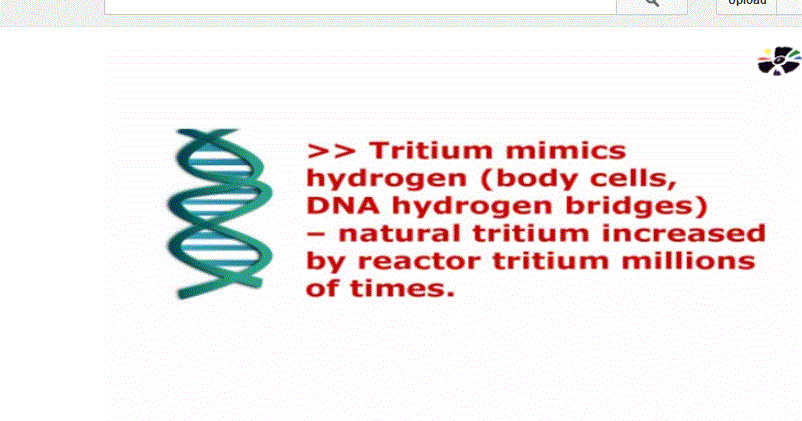
The outcome is the German KiKK Study^ stands alone unchallenged as a new benchmark verifying rapidly dividing cells in the womb and in mothers are actually affected detrimentally by tritium created in nuclear reactors. Creating leukaemia and birth defects in unborn babies.
Which in turn, is one of the central reasons for the phase-out of nuclear reactors in Germany, as most readers here are well aware many other nations have taken the lead on.
____________
^ https://onlinelibrary.wiley.com/doi/epdf/10.1002/ijc.23330
Utilities just voted to continue Vogtle reactor construction; residents want cleanup, By Jeremy Deaton, Nexus Media
You could be forgiven for taking a Geiger counter on a visit to Shell Bluff, Georgia. The town lies just across the Savannah River from a nuclear weapons facility and just down the road from an aging nuclear power plant. The river is one of the most toxic waterways in the country. The weapons facility is one of the most contaminated places on the planet, and the power plant is about to double in size.
Locals are outraged.
“We believe that Plant Vogtle is going to exacerbate the existing contamination that’s already in the area and make things worse,” said Lindsay Harper, deputy director of Georgia WAND, a women-led advocacy group working to end nuclear proliferation and pollution. “We believe that more money should be put toward cleaning up the contamination instead of continuing to produce more.”
Organizers from Georgia WAND and other advocacy groups gathered in Atlanta recently to discuss Plant Vogtle and related environmental issues and to register voters. The town hall marked the first stop on a bus tour organized by environmental leaders from across the South.
The Freedom to Breathe Tour will highlight environmental hazards facing marginalized communities — starting with the expansion to Plant Vogtle, the only nuclear project under construction in the country.
In 2009, Southern Company began building two reactors, which are expected to go online in 2021 and 2022, respectively. The expansion has stoked fears of contamination in what is already a heavily polluted area, leading advocates to call for more testing.
“We need independent monitoring in the area that can help us to paint a larger, broader picture of what’s actually going on,” Harper said.“We need more information. We need more money for information.”
CNN Report – Plant Vogtle
Both the power plant and the weapons facility across the river produce a radioactive form of hydrogen called tritium that has been tentatively linked to Down syndrome in infants. Monitoring has found “elevated levels” of tritium in the groundwater near Plant Vogtle — too little to threaten public health, officials say, but enough to raise eyebrows.
Locals are also worried that pollution from the plant may be causing cancer. Epidemiologist Joseph Mangano found evidence of an uptick in infant mortality and cancer deaths in Burke County, seat of Plant Vogtle, after the facility went online in 1987. It is unclear if the power plant was responsible for the increase.Research has shown that children exposed to radiation are more susceptible to cancer — leukemia, in particular — but it is unclear if nuclear power plants produce enough radiation to threaten public health.
Studies in Germany and France found that the rate of childhood leukemia was significantly higher near power plants, and a study in the United States found that nuclear plant closures were followed by a decline in childhood cancer.
However, similar studies, including one undertaken by the National Cancer Institute, found no evidence of a link. To settle the matter, the federal government undertook a multi-year study on nuclear power and cancer in 2010, but it prematurely halted that effort in early 2017.
Adding to the uncertainty, the federal government stopped paying for monitoring of contamination near Plant Vogtle in 2003, believing the power plant posed little risk. To allay public concerns about radiation, the government is funding an outreach effort to reassure residents that the facilities are harmless, but locals remain unconvinced. Advocates want more rigorous testing and continued research into the risks of exposure to even low levels of radioactive waste……….
Some, however, believe that nuclear is simply too costly and have called for more investment in batteries that can store power generated by solar and wind for when it’s needed.
This is the outcome that locals are hoping for. Many Burke County residents are employed by Plant Vogtle, but they would rather work in wind or solar. “People are having to choose between feeding their families and taking a job that may contaminate their body,” Harper said, referring both to the power plant and the weapons facility. “We want to put our money towards civilians and people, clean economies and clean, sustainable jobs.” https://beyondnuclearinternational.org/2018/09/30/the-most-contaminated-corner-of-georgia/
Why the next three months are crucial for the future of the planet
Two forthcoming major climate talks offer governments an opportunity to respond to this year’s extreme weather with decisive action https://www.theguardian.com/environment/2018/oct/05/why-the-next-four-months-are-crucial-for-future-of-planet-climate-changeFiona Harvey Environment correspondent 5 Oct 2018 This week, scientists are gathering in South Korea to draw together the last five years of advances in climate science to answer key questions for policymakers. The UN’s Intergovernmental Panel on Climate Change (IPCC) celebrates its 30th birthday this year with what is likely to be a landmark report to be released on Monday 8 October. What is expected to emerge will be the strongest warning yet that these unusual occurrences will add up to a pattern that can only be overcome with drastic action.
Thousands of the world’s leading climate experts collaborate on the periodic reports, released roughly every half-decade. They have grown clearer over the years in the certainty of their evidence that climate change is occurring as a result of human actions, and firmer in their warnings of the disruptive consequences.
This time, the scientists will attempt to answer whether and how the world can meet the “aspiration” set in the Paris agreement of 2015 to hold warming to no more than 1.5C, beyond which many low-lying states and islands are likely to face dangerous sea level rises.
When the scientists deliver their verdict, the onus will pass to politicians to translate their advice into concrete action. Already in recent weeks, global initiatives have begun aimed at doing so: the Global Climate Action Summit in San Francisco last month spurred protests, and dozens of local governments and multinational companies to make pledges; the second One Planet Summit saw advances in climate finance; while at the UN General Assembly, secretary general António Guterres urged world leaders to step up, calling climate change “the defining issue of our time”.
The warning signals of climate change that have hit people around the world in the last few months must be heeded by national governments at key meetings later this year, political leaders and policy experts are urging, as the disruption from record-breaking weather continues in many regions.
As the northern hemisphere summer closes, polar observations have just established that the Arctic sea ice narrowly missed a record low this year. The sea ice extent was tied for the sixth lowest on record with 2008 and 2010. Sea currents and wind conditions can have large effects on sea ice extent from year to year, but the trend is starkly evident.
“Put simply, in the last 10 years the Arctic is melting faster than it ever has previously since records began,” said Julienne Stroeve, professor at University College London. “We have lost over half of the summer sea ice coverage since the late 1970’s and it is realistic to expect an ice-free Arctic sea in summer in the next few decades.”
Of particular concern is the decline in thick ice which forms over several years. “The older ice has been replaced by more and more first-year ice, which is easier to melt out each summer,” she explained.
Not all of the effects of this year’s extraordinary weather, which has also seen the UK’s joint hottest summer on record, can be traced directly to climate change. However, scientists are clear that the background of a warming planet has made extremes of temperature, and accompanying droughts and floods, more likely.
This week, scientists are gathering in South Korea to draw together the last five years of advances in climate science to answer key questions for policymakers. The UN’s Intergovernmental Panel on Climate Change (IPCC) celebrates its 30th birthday this year with what is likely to be a landmark report to be released on Monday 8 October. What is expected to emerge will be the strongest warning yet that these unusual occurrences will add up to a pattern that can only be overcome with drastic action.
Thousands of the world’s leading climate experts collaborate on the periodic reports, released roughly every half-decade. They have grown clearer over the years in the certainty of their evidence that climate change is occurring as a result of human actions, and firmer in their warnings of the disruptive consequences.
This time, the scientists will attempt to answer whether and how the world can meet the “aspiration” set in the Paris agreement of 2015 to hold warming to no more than 1.5C, beyond which many low-lying states and islands are likely to face dangerous sea level rises.
When the scientists deliver their verdict, the onus will pass to politicians to translate their advice into concrete action. Already in recent weeks, global initiatives have begun aimed at doing so: the Global Climate Action Summit in San Francisco last month spurred protests, and dozens of local governments and multinational companies to make pledges; the second One Planet Summit saw advances in climate finance; while at the UN General Assembly, secretary general António Guterres urged world leaders to step up, calling climate change “the defining issue of our time”.
Nicholas Stern, co-chair of the Global Commission on the Economy and Climate, which produced the study, said: “Current economic models fail to capture both the powerful dynamics and very attractive qualities of new technologies and structures [that reduce carbon]. Thus we know that we are grossly underestimating the benefits of this new growth story. Further, it becomes ever clearer that the risks of the damage from climate change are immense, and tipping points and irreversibilities getting ever closer.”
The existence of tipping points – thresholds of temperature beyond which certain natural processes become irreversible, such as the melting of permafrost, which may release the greenhouse gas methane and create runaway warming effects – is a key concern of many climate scientists. The faster emissions rise, the sooner we may unwittingly pass some of these key points.
For all these reasons, the IPCC’s special report comes at a crucial point. Scientists and economists have warned that if the world cannot shift course within the next few years, the consequences will be dire, as new infrastructure built now – in energy generation, transport and the built environment – will be made either to low-emissions standards or in the high-emissions habits of the past. As the IPCC’s next comprehensive assessment of climate science will not be available until 2021, this year’s report will be vital in shaping policy.
Ted Chaiban, director of programmes at Unicef, urged governments to seize the opportunities for action offered by this year’s series of political meetings offers for action. “Over the past few months, we have seen a stark vision of the world we are creating for future generations,” he said. “As more extreme weather events increase the number of emergencies and humanitarian crises, it is children who will pay the highest price,” he said.
“It is vital that governments and the international community take concrete steps. The worst impacts of climate change are not inevitable, but the time for action is now.”
After the IPCC publication, the world will face a key test of faith in the 2015 Paris agreement, the only global pact stipulating action on temperature rises. This December in Poland, the UN’s climate change arm will hold a two-week meeting aimed at turning the political resolve reached in Paris three years ago into a set of rules for countries to follow on reducing emissions.
The political situation is more fraught than it was in the runup to Paris. The US is pulling out of the landmark climate agreement and is likely to play little part in the talks. Australia’s government is also in turmoil over climate actions. Now the challenger for Brazil’s presidency, Jair Bolsonaro, is threatening to withdraw its participation – a potential blow to the Paris consensus, as Brazil was a linchpin among rapidly developing nations.
All eyes will be on China, which has shown remarkable progress on renewable energy and emissions reduction, and India, where climate champions have found common cause with opponents of increasingly damaging air pollution. Patricia Espinsoa, the UN’s top climate official, warned that only “uneven progress” had been made so far on the 300-page rulebook for implementing the Paris targets, leaving the rest of the work for December.
While the dangerous weather of the first half of 2018 has raised concerns worldwide that we are seeing climate change in action, many leading experts told the Guardian they were optimistic that political and business leaders this year would help set the world on a different course to avoid the worse predictions of untrammelled warming.
Achim Steiner, administrator of the UN Development Programme, said the past few years had seen “extraordinary progress” in areas such as renewable energy and the take-up of low-carbon technology: “This is real, not in the future but happening now. We are showing that we can do this, we can bring down emissions, it doesn’t need to be a disaster.”
Adopting low-carbon aims now would set developing countries on a course to a brighter future, added Ngozi Okonjo-Iweala, former economic minister of Nigeria and a member of the Global Commission on the Economy and Climate. “Now is the time to do this, before we lock in high-carbon infrastructure,” she said. “Now is the opportunity for real sustainable growth.”
Political leaders will find that global investors back them up in opting for low-carbon policies, predicted Frank Rijsberman of the Global Green Growth Institute. “I see this from investors, from businesses,” he said. “They are ready, and they see low-carbon as the future.”
Felipe Calderón, former president of Mexico, called on political leaders to take note: “We can turn better [economic] growth and a better climate into reality. It is time we decisively legislate, innovate, govern and invest our way to a fairer, safer, more sustainable world.”
Evidence showing that tackling climate change can be an economic boost rather than a brake has been growing. The recently published New Climate Economy report says more than 65m new low-carbon jobs could be created in just over a decade, and that 700,000 premature deaths from air pollution could be avoided every year by government action on climate change. A further $2.8tn could be added to government revenues by 2030 by reforming perverse incentives to burn fossil fuels.
Nicholas Stern, co-chair of the Global Commission on the Economy and Climate, which produced the study, said: “Current economic models fail to capture both the powerful dynamics and very attractive qualities of new technologies and structures [that reduce carbon]. Thus we know that we are grossly underestimating the benefits of this new growth story. Further, it becomes ever clearer that the risks of the damage from climate change are immense, and tipping points and irreversibilities getting ever closer.”
The existence of tipping points – thresholds of temperature beyond which certain natural processes become irreversible, such as the melting of permafrost, which may release the greenhouse gas methane and create runaway warming effects – is a key concern of many climate scientists. The faster emissions rise, the sooner we may unwittingly pass some of these key points.
For all these reasons, the IPCC’s special report comes at a crucial point.
International talks on how to present the science around 1.5C of global warming just ran into overtime in Incheon, South Korea. Climate Home News 5 Oct 18
National delegates are expected to argue well into Saturday about the feasibility of holding temperature rise to 1.5C – the stretch goal of the Paris Agreement – and its implications for sustainable development.
Saudi Arabia is leading the criticism of several elements of the draft summary of the Intergovernmental Panel on Climate Change’s special report, sources told Climate Home News reporter Natalie Sauer in Incheon.
The country’s diplomats want to emphasise the costs of climate action and downplay the sustainable development benefits, a source said.
The version issued to governments before the meeting had some inconvenient conclusions for oil producers. For example, it said fossil fuel investment would fall by a quarter over the next two decades in a 1.5C-compatible scenario.
One observer described the Saudi delegation as “more aggressive and virulent – both in terms of issues and airtime – than any time in my memory”. Others confirmed the Saudis had been vocal, but did not see their behaviour as different to previous meetings.
A week or so earlier, a pro-nuclear lobby group, New Nuclear Watch Institute, which masquerades as a think tank, issued a tendentiously inaccurate 34 page report, arguing that new nuclear is essential to meet carbon emission reduction targets. It was reported in The Guardian
In response I wrote this unpublished letter, below, correcting certain factual mistakes:
Here we go again! Your energy editor’s on line article (“Abandoning nuclear power plans ‘would push up carbon emissions,” 26 Sept) reports lobby group the New Nuclear Watch Institute as claiming nuclear power is both low carbon and its alternatives “ will raise the cost of electricity.
All the robust evidence demonstrates the opposite in both cases. Just over a year ago you published a letter from me challenging the low or even zero carbon claims of nuclear ( “Beware nuclear industry’s fake news on being emissions free,”17 Sept 2017;www.theguardian.com/environment/2017/sep/17/beware-nuclear-industrys-fake-news-on-being-emissions-free)
In my letter from a year ago, I pointed out I had challenged this nuclear low carbon myth in your columns 12 years earlier. (“There is nothing green about Blair’s nuclear dream, “ 20 October 2005<https://www.theguardian.com/politics/2005/oct/20/greenpolitics.world.
I said in my letter a year ago “It is about time this dangerous falsehood was confined to the dustbin of history.”
Sadly it seems, like Freddy, it seems it is going to be resurrected each mellow autumn!
Here are some of the more egregiously challengeable extracts from the report……..
Independent 5th Oct 2018, The UK capital is increasingly vulnerable as a result of sea level rises
and will have to use its main flood defence, the Thames Barrier, more
frequently.
London is among the cities identified as being at risk of major
flooding, according to a new report. Sea levels are expected to rise by
over 40cm unless global warming is limited to 1.5C above pre-industrial
levels, the more ambitious target set by the Paris climate agreement.
An analysis released by Christian Aid as nations meet in Korea to finalise a
major UN climate change report concerning the 1.5C target looks at some of
the coastal cities most at risk. Climate change could act as a “threat
multiplier” to existing problems such as sinking ground and subsidence,
water extraction and bad planning.
Tell Congress: Prevent Nuclear Catastrophe in Iran
Read the Public Inquiry Report, the Commissioners’ report, Surrendering Australia: The AUKUS Deception is available to download for free at aukuspublicinquiry.com. Or just watch the replay of the National Press Club Luncheon.


 Months after Calder Hall opened, the Euratom Treaty established the European Atomic Energy Community. The UK did not formally join straight away but did have a relationship with it.