Despite its anti-nuclear ordinance, Oakland City Council to increase a contract with nuclear weapons maker AECOM
Nuclear Weapons Maker to Receive Extra $420,600 to Help Repair Oakland Bridge https://www.eastbayexpress.com/SevenDays/archives/2018/10/08/nuclear-weapons-maker-to-receive-extra-420600-to-help-repair-oakland-bridge
In addition to managing US nuclear labs, AECOM does billions in business building overseas military bases and maintaining Air Force drones.
The Oakland City Council is considering increasing an existing contract by $420,600 for a total of $1.25 million to repair the 23rd Avenue Bridge, but the modified contract is with AECOM, an engineering company that has been involved in designing and manufacturing nuclear weapons components, and in the past, helped manage a desert test site where nuclear weapons experiments were conducted.
Oakland has an anti-nuclear ordinance that usually bars companies involved in designing and building nukes from doing business with the city. But city staffers are recommending that the council waive the prohibition for AECOM due to the fact that the company, and its URS subsidiary, have been involved with the 23rd Avenue Bridge project since 2003 and finding another firm to do the technical work would be difficult.
AECOM bought URS in 2014 and as a result became a partner in the nuclear labs’ management company. Three months ago, the federal government selected a new team to manage the Los Alamos lab, dropping AECOM as one of the firms involved there. But AECOM is still part of the Livermore Lab group.
Prior to this, AECOM helped manage the Nevada National Security Site where nuclear weapons are tested in “subcritical” experiments that don’t result in fission or fusion explosions.
AECOM has billions of dollars worth of other contracts with the U.S. military, doing everything from building overseas bases to maintaining drone weapons systems. As a result of its nuclear weapons contracts, AECOM was one of several companies that Norway’s sovereign fund put on an investment blacklist last January.
Russia challenges US compliance with nuclear arms treaty
MOSCOW https://www.kwtx.com/content/news/Russia-challenges-US-compliance-with-nuclear-arms-treaty-495949041.html?ref=041 (AP) 8 Oct 18— Russia on Monday challenged the U.S. claim that it has fulfilled its obligations under a pivotal nuclear arms deal, a new argument that could further fuel tensions between Moscow and Washington.
The Russian Foreign Ministry said it “can’t confirm” the latest U.S. State Department data indicating that the U.S. has complied with the thresholds set by the 2010 New START treaty. It limits each country to no more than 1,550 deployed nuclear warheads and 700 deployed missiles and bombers.
The ministry said the U.S. removed 56 Trident II submarine-launched intercontinental ballistic missiles and 41 B-52H strategic bombers from its count of nuclear arsenals after re-equipping them to carry conventional weapons.
But it argued that the U.S. had failed to let Russia verify the move in line with the treaty, and failed to list four land-based missile silos converted for training purposes — a move Russia said didn’t conform to the treaty.
The ministry said the perceived U.S. breach of the treaty’s limits was “unacceptable,” adding that it expects Washington to “show a constructive approach to settling that acute issue.”
The tough statement marked the first time Russia raised the issue of the alleged U.S. non-compliance with the pact signed by President Barack Obama and then-Russian President Dmitry Medvedev amid a brief thaw in Russia-U.S. ties. The New Start came into effect in 2011 and is to expire in 2021 unless the two countries extend it.
Officials in both Russia and the U.S. have given mixed signals about the pact’s future.
Russia-U.S. ties have sunk to their lowest levels since the Cold war times over the Ukrainian crisis, the war in Syria, the allegations of Russian meddling in the 2016 U.S. presidential election and alleged Russian hacking of world anti-doping bodies, athletes, plane investigations and chemical weapons probes, among other disputes.
In the arms control sphere, Moscow and Washington also have been at loggerheads over another arms control treaty — the 1987 Intermediate-range Nuclear Forces Treaty.
The U.S. has accused Russia of deploying a new type of missile in violation of the pact that bans an entire class of weapons — all nuclear and conventional ground-launched ballistic and cruise missiles of intermediate range. Russia has rejected the accusations.
Jeremy Corbyn gives a vision of a smarter, cleaner, more secure and equitable future
 Morning Star 6th Oct 2018, Alan Simpson: If there are seminal
 moments in politics, Jeremy Corbyn’s speech at the 2018 Labour conference will go down as one of them.
Labour’s “programme of investment and transformation, to achieve a 60
per cent reduction in emissions by 2030, will create over 400,000 skilled
jobs.” Pretty unequivocal stuff. But that is just the start. Shadow
chancellor John McDonnell was no less uncompromising. The next government
will have to deliver carbon reductions of 15 per cent per year. To do so,
Britain will need a much more circular economics — not one that makes do
with less but one that certainly wastes and pollutes less.
economics will be rooted. For most people, a more circular economy would
deliver real improvements in their quality of life — from the air we
breathe, the food we eat, the homes we live in to the jobs and skills the
country needs.
renewable energy but in using less energy in the first place. Tackling the
scandal of “cold homes” will save lives as well as cutting carbon.
Clean transport systems offer the same opportunities. These are a world
away from the triple absurdity of the GMB trade union sharing a platform
with the Taxpayers Alliance at the Tory Party conference in support of
fracking.
Corbyn vision of a smarter, cleaner, more secure and equitable future or
just “shop till we drop” with the Tories. The choice is still ours …
but only just.
https://morningstaronline.co.uk/article/labour%E2%80%99s-vision-smarter-cleaner-future
Britain’s Nuclear Decommissioning Authority’s (NDA) Nuclear and Caithness Archive in Scotland – central site for British nuclear records
Wired 8th Oct 2018 Seventy years of British nuclear history lie behind these concrete, stone
and aluminium walls. Since opening in February 2017, Nucleus, the UK
Nuclear Decommissioning Authority’s (NDA) Nuclear and Caithness Archive,
near Wick, Scotland, has been gathering thousands of records, images and
plans about the UK’s civil nuclear industry.
More documents are being transferred from 17 archives across the UK, as the NDA plans to house them
all in this single purpose-built location. The archive contains documents
dating back to the 1950s, and some are classified as Top Secret. Records
are kept in triplicate: a copy on paper, a microfilm and a PDF version, to
reduce wear on the originals.
https://www.wired.co.uk/article/nucleus-archive-uk-nuclear
Dubious claim from Russia, about bacteria “neutralising nuclear waste”
Russian Scientists Discover Bacteria That Neutralizes Nuclear Waste https://sputniknews.com/science/201810081068701682-nuclear-waste-neutralizing-bacteria/ The unique bacteria, discovered in a nuclear waste storage site in Siberia, shows promise as a tool for the creation of a natural barrier to the spread of radionuclides.
Researchers from the Moscow-based Frumkin Institute of Physical Chemistry and the Russian Academy of Sciences’ Federal Research Center for Biotechnology have been able to isolate microorganisms which can be used to safeguard the surrounding environment from liquid radioactive waste.
Scientists made the discovery while conducting microbiological studies of the groundwater at the Seversky deep radiation burial site in Seversk, Tomsk region, Siberia, where liquid radioactive waste from the Siberian Chemical Combine, which supplies and reprocesses low enriched uranium for nuclear fuel, is stored.
Their research, recently published in Radioactive Waste, a Russian scientific journal, suggests that the bacteria is capable of converting radionuclide ions, including those found in uranium and plutonium, into sedentary forms, thereby preventing the spread of dangerous radiation into the surrounding environment. Through lab experimentation, the scientists were able to fine tune the conditions necessary for the bacteria to carry out its useful work.
The researchers say their findings are a first step in creation a biogeochemical barrier for radionuclides for use in deep burial sites containing liquid radioactive waste.
Research into microbiological tools to limit the effects of nuclear waste have been conducted since the 1980s, with scientists from around the world saying microbial processes must be taken into account in projects to bury and store nuclear waste which can otherwise decay over a period of millions or even billions of years.
IPCC Climate Report: world has 10 years to ward off global warming disaster

The report was signed off on by the IPCC delegates on Saturday afternoon in the South Korean city of Incheon after a marathon six days of talks – including an overnighter to end the event.
One delegate who asked not to be identified said the process looked to be “doomed” after delegates from Saudi Arabia objected to the draft report and began “bashing the desk”.
For the first time in a IPCC report, the authors included social and economic impacts. That marked “the end of magical thinking” that sustainable development goals and poverty reduction could be divorced from climate action
‘Next decade critical’: Perils mount at 1.5 degrees of warming, says IPCC , Sydney Morning Herald, By Peter Hannam & Nicole Hasham 8 October 2018 —The amount of coal and other fossil fuels the world can burn without unleashing dangerous climate change that will undermine the livelihoods of hundreds of millions of people and all but wipe out the Great Barrier Reef is “very small”, according to a major climate report.
The Intergovernmental Panel on Climate Change’s special report on a 1.5-degree hotter planet, released on Monday, said limiting warming to that amount remains possible, but only with “rapid, far-reaching and unprecedented changes in all aspects of society”……..
We’re currently heading towards about 3 degrees or 4 degrees of warming by 2100,” said Mark Howden, director of the Climate Change Institute at the Australian National University and one of the review’s editors.
“Limiting global warming to 1.5 degrees is not impossible but would actually require major transitions in many aspects of society, and to do those transitions, the next 10 years are critical.”
Average temperature rises mask extreme events. Temperatures of hot days are forecast to increase three degrees in a 1.5 degree warmer world, and by four degrees if mean temperatures rise by 2 degrees. Continue reading
Science denial in USA government – first about climate change, now about ionising radiation
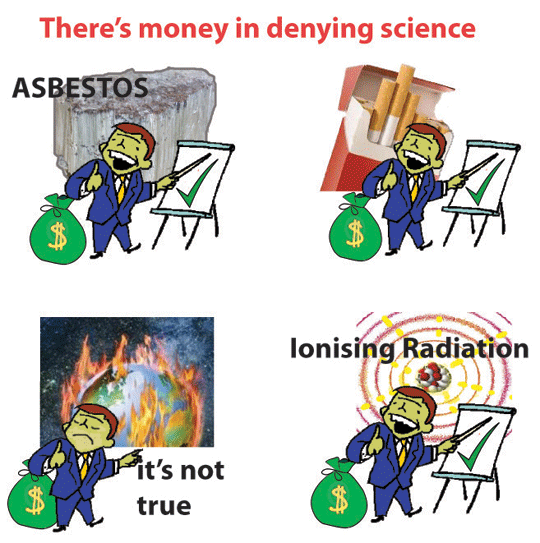
The radiation regulation is supported by Steven Milloy, a Trump transition team member for the EPA who is known for challenging widely accepted ideas about manmade climate change and the health risks of tobacco. He has been promoting Calabrese’s theory of healthy radiation on his blog.
the EPA proposal on radiation and other health threats represents voices “generally dismissed by the great bulk of scientists.”
“The individual risk will likely be low, but not the cumulative social risk,
Turning to scientific outliers, EPA says a little radiation may be healthy, WIVN.com, By: CBS/AP Oct 07, 2018 The Trump administration is quietly moving to weaken U.S. radiation regulations, turning to scientific outliers who argue that a bit of radiation damage is actually good for you — like a little bit of sunlight.
The government’s current, decades-old guidance says that any exposure to harmful radiation is a cancer risk. And critics say the proposed change could lead to higher levels of exposure for workers at nuclear installations and oil and gas drilling sites, medical workers doing X-rays and CT scans, people living next to Superfund sites and any members of the public who one day might find themselves exposed to a radiation release.
The Trump administration already has targeted a range of other regulations on toxins and pollutants, including coal power plant emissions and car exhaust, that it sees as costly and burdensome for businesses. Supporters of the EPA’s new proposal argue the government’s current no-tolerance rule for radiation damage forces unnecessary spending for handling exposure in accidents, at nuclear plants, in medical centers and at other sites.
“This would have a positive effect on human health as well as save billions and billions and billions of dollars,” said Edward Calabrese, a toxicologist at the University of Massachusetts who is to be the lead witness at a congressional hearing Wednesday on EPA’s proposal. “The regulatory agencies are kind of a cult, but they don’t know they’re part of a cult.”
Calabrese, who made those remarks in a 2016 interview with a California nonprofit, was quoted by EPA in its announcement of the proposed rule in April. He declined repeated requests for an interview with The Associated Press. The EPA declined to make an official with its radiation-protection program available……….
As recently as this March, the EPA’s online guidelines for radiation effects advised: “Current science suggests there is some cancer risk from any exposure to radiation.”
“Even exposures below 100 millisieverts” – an amount roughly equivalent to 25 chest X-rays or about 14 CT chest scans – “slightly increase the risk of getting cancer in the future,” the agency’s guidance said.
But that online guidance – separate from the rule-change proposal – was edited in July to add a section emphasizing the low individual odds of cancer: “According to radiation safety experts, radiation exposures of …100 millisieverts usually result in no harmful health effects, because radiation below these levels is a minor contributor to our overall cancer risk,” the revised policy says.
Calabrese and his supporters argue that smaller exposures of cell-damaging radiation and other carcinogens can serve as  stressors that activate the body’s repair mechanisms and can make people healthier. They compare it to physical exercise or sunlight.
Mainstream scientific consensus on radiation is based on deceptive science, says Calabrese, who argued in a 2014 essay for “righting the past deceptions and correcting the ongoing errors in environmental regulation.”……..
The radiation regulation is supported by Steven Milloy, a Trump transition team member for the EPA who is known for challenging widely accepted ideas about manmade climate change and the health risks of tobacco. He has been promoting Calabrese’s theory of healthy radiation on his blog.
But Jan Beyea, a physicist whose work includes research with the National Academies of Science on the 2011 Fukushima nuclear power plant accident, said the EPA proposal on radiation and other health threats represents voices “generally dismissed by the great bulk of scientists.”
The EPA proposal would lead to “increases in chemical and radiation exposures in the workplace, home and outdoor environment, including the vicinity of Superfund sites,” Beyea wrote.
At the level the EPA website talks about, any one person’s risk of cancer from radiation exposure is perhaps 1 percent, Beyea said.
“The individual risk will likely be low, but not the cumulative social risk,” Beyea said.
“If they even look at that – no, no, no,” said Terrie Barrie, a resident of Craig, Colorado, and an advocate for her husband and other workers at the now-closed Rocky Flats nuclear-weapons plant, where the U.S. government is compensating certain cancer victims regardless of their history of exposure.
“There’s no reason not to protect people as much as possible,” said Barrie.
U.S. agencies for decades have followed a policy that there is no threshold of radiation exposure that is risk-free.
The National Council on Radiation Protection and Measurements reaffirmed that principle this year after a review of 29 public health studies on cancer rates among people exposed to low-dose radiation, via the U.S. atomic bombing of Japan in World War II, leak-prone Soviet nuclear installations, medical treatments and other sources.
Twenty of the 29 studies directly support the principle that even low-dose exposures cause a significant increase in cancer rates, said Roy Shore, chief of research at the Radiation Effects Research Foundation, a joint project of the United States and Japan. Scientists found most of the other studies were inconclusive and decided one was flawed.
None supported the theory there is some safe threshold for radiation, said Shore, who chaired the review. If there were a threshold that it’s safe to go below, “those who profess that would have to come up with some data,” Shore said in an interview.
“Certainly the evidence did not point that way,” he said……..
The EPA tucked its proposed relaxation of radiation guidelines into its “transparency in science” proposal in April. The proposal would require regulators to consider “various threshold models across the exposure range” when it comes to dangerous substances. …….https://www.wivb.com/news/turning-to-scientific-outliers-epa-says-a-little-radiation-may-be-healthy/1505019288
Genetic changes in children of soldiers who were exposed to ionising radiation

|
Typical mutations in children of radar soldiers https://www.sciencedaily.com/releases/2018/10/181005111447.htm, October 5, 2018
|
|
|
Dr Keith Barnham goes through some of the terminal problems at the Hinkley C nuclear power station site
Public Enquiry 6th Oct 2018 Dr Keith Barnham goes through some of the terminal problems at the Hinkley
C nuclear power station site
– ‘Radioactive mud’ test have been for gamma radiation, not alpha which shows up plutonium
– Economics of nuclear no longer viable
– Bridgwater Bay tidal lagoon would produce an equivalent amount of electricity
– France and China are not building any more nuclear power but have industries which are looking to expand anywhere guillible enough to take them
– Tory government have put the brakes on renewable energy to artificially prop up the dying nuclear industry
– this is a project the nuclear industry want, but nobody else does. Activists call for halt to ‘nuclear mud’ dumping off Wales. Campaigners say sediment has not been tested properly and may do ‘irreversible harm’ Among those backing
the objectors is the Emeritus Prof Keith Barnham, a distinguished research fellow in the physics department at Imperial College London, who argues it is possible that large amounts of uranium and dangerous levels of plutonium could have reached the mud when cooling water from the decommissioned Hinkley Point A was discharged.
https://www.youtube.com/watch?v=fL5mnD6HrzA&feature=youtu.be
USA’s Nuclear Protection Agency, -sorry, Environment Protection Agency , set to weaken radiation guidelines
 CAN SMALL DOSES OF RADIATION HARM YOU? THE EPA ISN’T CONVINCED. A new rule might open the door for regulation rollbacks on radiation and harmful chemicals. Pacific Standard EMMA SARAPPO OCT 3, 2018 On Tuesday, the Associated Press reported that the Trump administration was quietly seeking to roll back the Environmental Protection Agency’s regulations on radiation exposure. The story took a closer look at a rule the EPA proposed back in April called “Strengthening Transparency in Regulatory Science.” When it was released, most coverage focused on the proposal’s potential limitation of what studies the EPA could and could not use in decision-making—it essentially demanded the EPA not use any studies based on data that isn’t publicly available. Ironically, the transparency rule is hiding another agenda. Paragraphs scattered throughout the document make it clear that the proposed rule is meant to re-evaluate the science behind “the dose response data and models that underlie what we are calling ‘pivotal regulatory science.'” That jargon means the EPA wants to challenge the assumptions that underlie its current guidelines on toxic exposure. “The so-called transparency rule is an insidious dodge,” said Rush D. Holt, a former congressman and current president of the American Association for the Advancement of Science, before a Senate subcommittee on October 3rd. “It apparently is about reducing regulation.” And though the actual rule is vague, comments in the press release and a July update to the EPA guidelines on radiation exposure make it seem that nuclear regulation is on the chopping block. Currently, the nuclear industry, the EPA, and other groups operate on the assumption that there is no safe dose of radiation, no matter how small. This is based on the “linear no-threshold” model (LNT). The LNT model is based on studies of people exposed to high and medium doses of radiation, including survivors of Hiroshima, Chernobyl, and Fukushima. That data shows that the higher the dose of radiation you receive, the more severe the consequences—in other words, that the response to doses is linear. The more radiation, the more health effects. Because it’s much harder to accurately measure small doses of radiation in large populations over long periods of time, there isn’t much data available on the lower end. Still, most scientists agree that the relationship stays the same for small amounts of ionizing radiation: Small doses increase the aggregate risk of cancer by a relatedly small amount. LNT’s prevalence pushes regulatory agencies, professional associations, and medical fields to keep radiation doses “as low as reasonably achievable” in all people, especially considering some groups (children, especially) are more vulnerable to radiation than others. ……..in a larger public-health sense, LNT is cautious and prudent. Just because there isn’t documented proof of harm at very low doses doesn’t mean harm isn’t being done, and an inaccurate model means that it’s also possible that LNT sometimes underestimates cancer risks from low doses. In the absence of more definitive data, multiple groups and studies—the National Academy of Sciences, the International Commission on Radiological Protection, and more—have recommended holding fast to regulations that keep radiation exposure as low as possible, at least until a new model is robustly tested and accepted. Others go even further and argue that small doses of radiation are good for you. Edward Calabrese, a professor at the University of Massachusetts, is quoted in the April EPA press release—he was glad the agency was “recognizing the widespread occurrence of non-linear dose responses,” and he appeared in the October 3rd Senate hearing on the rule.
Calabrese is a major critic of the LNT model. He is famous for championing “hormesis”—the idea that small amounts of radiation are beneficial, or “hormetic,” ……… Although Calabrese focused on more mainstream criticisms of LNT before the Senate, his hormesis work is controversial. In 2010, Kristin Shrader-Frechette used Calabrese’s work as a case study of “special-interest science.” Shrader-Frechette compares Calabrese and others to the Queen of Hearts in Lewis Carroll’s Through the Looking Glass. “Just as the Queen claimed she could believe six impossible things before breakfast, SIS proponents often use scientific concepts/methods in ways that are ‘impossible,'” she wrote. She points out that Calabrese’s CV shows significant research funding from Atlantic Richfield Oil (ARCO), Dow Chemical, ExxonMobil, Proctor and Gamble, and R.J. Reynolds Tobacco. And despite Calabrese’s nearly 20 years of advocacy for the theory, even friendly reviews indicate radiation hormesis needs further scientific support. ……the rule promises to give special consideration to studies exploring “various threshold models across the exposure range” and pledges to “evaluate the appropriateness” of using the LNT model. If it’s approved, the EPA’s accepted scientific standard for acceptable radiation doses could change from “as low as reasonably achievable” to a standard that identifies no effect or positive effects from low doses. That could lead to the repeal of strict regulations on radiation containment, which the EPA might deem unnecessary. https://psmag.com/news/can-small-doses-of-radiation-harm-you-the-epa-isnt-convinced |
|
New research raises further concern about radioactive contamination from US arms testing
 Studies renew worry about contamination from US arms testing, Stars and Stripes, By RALPH VARTABEDIAN | Los Angeles Times October 6, 2018 LOS ANGELES (Tribune News Service) — At the dawn of the nuclear age, the Franklin D. Roosevelt administration placed the nation’s major nuclear weapons production and research facilities in large, isolated reservations to shield them from foreign spies – and to protect the American public from the still unknown risks of radioactivity.
By the late 1980s, near the end of the Cold War, federal lands in South Carolina, Tennessee, New Mexico, Colorado, Ohio and Washington state, among other places, were so polluted with radionuclides that the land was deemed permanently unsuitable for human habitation.
That much has long been accepted as a price for the nation’s nuclear deterrent. But a far more complex problem could emerge if recent research is correct.
Studies by a Massachusetts scientist say that invisible radioactive particles of plutonium, thorium and uranium are showing up in household dust, automotive air cleaners and along hiking trails outside the factories and laboratories that for half a century contributed to the nation’s stockpile of nuclear weapons.
The findings provide troubling new evidence that the federal government is losing control of at least some of the radioactive byproducts of the country’s weapons program.
Marco Kaltofen, a nuclear forensics expert and a professor at Worcester Polytechnic Institute, said he collected samples from communities outside three lab sites across the nation and found a wide variation of particle sizes. He said they could deliver lifelong doses that exceed allowable federal standards if inhaled.
“If you inhale two particles, you will exceed your lifetime dose under occupational standards, and there is a low probability of detecting it,” he said.
A peer-reviewed study by Kaltofen was published in its final form in May in Environmental Engineering Science.
Kaltofen, who also is the principal investigator at the nuclear and chemical forensics consulting firm Boston Chemical Data Corp., released a second study in recent weeks.
The Energy Department has long insisted that small particles like those collected by Kaltofen deliver minute doses of radioactivity, well below typical public exposures.
One of the nation’s leading experts on radioactivity doses, Bruce Napier, who works in the Energy Department’s lab system, said the doses cited by Kaltofen would not pose a threat to public health.
Such assurances have been rejected by nuclear plant workers, their unions and activists who monitor environmental issues at nearly every lab and nuclear weapons site in the nation.
Jay Coghlan, executive director of Nuclear Watch New Mexico, cited a long history of denial about the claims of “down winders,” the residents of Western states who were exposed to radioactive fallout from atmospheric weapons testing.
“We cannot trust self-reporting by the Department of Energy,” he said. “I don’t accept that low levels of radioactivity have no risk.”
Tom Carpenter, executive director of another watchdog group, the Hanford Challenge in central Washington, said as recently as last year that the Energy Department released an unknown quantity of radioactive particles during demolition of a shuttered weapons factory, the Plutonium Finishing Plant.
After a series of three releases during 2017, the Energy Department shut down the demolition and has yet to resume it. Forty-two workers were exposed in the incidents.
“If you work in a coal mine, you go home with coal dust on you,” Carpenter said. “Same with a textile mill; you go home with cotton dust. These Hanford workers went home with plutonium dust.”
The second study by Kaltofen, completed in August, reported that fairly high radioactivity levels were found in 30 samples from the communities around the Hanford nuclear site, near Richland, Wash. The samples found contamination on personal vehicles driven inside the Hanford site that would leave mechanics exposed if they worked around the vehicles, the report said.
Kaltofen also reviewed an internal study in March by an Energy Department contractor, Washington River Protection Solutions, that found a calculated potential dose of 95 millirem for workers, roughly 10 times higher than the federal Environmental Protection Agency standard.
Kaltofen said a broader independent study should look at residual contamination around Hanford. An Energy Department spokesman at the Hanford site said the office had no comment on the studies.
For his studies, Kaltofen collected samples outside the Los Alamos National Laboratory in New Mexico, the former Rocky Flats weapons plant near Denver and the Hanford site.
The samples were collected from the crawl spaces of homes, a trailer park office, vacuum cleaner bags, automotive air filters, furnace filters and along a hiking trail.
He subjected those samples to electronic microscopy analysis to determine exactly what type of element was emitting radiation. He identified isotopes of cesium, thorium, uranium and plutonium, all the results of building nuclear weapons parts.
The communities surrounding these facilities have long adapted to the reality that they are near radioactivity, though they are not willing to take risks that compromise their health. Kaltofen’s sampling found some very high levels of contamination in Los Alamos’ Acid Canyon, a recreational area near a community pool and skate park………
A worker’s exposure to radioactivity, such as walking by a radioactive substance or having particles cling to clothing, is checked by monitors and badges worn by workers at plant sites. Such exposure is like a medical X-ray, which delivers a momentary dose. But inhaling a small particle of plutonium or thorium can go unnoticed by such monitors and deliver a lifetime of alpha radiation right next to lung tissue, Kaltofen said.
“You can walk through a portal monitor without setting it off but you can get a substantial amount of energy from particles in the body,” he said. https://www.stripes.com/news/us/studies-renew-worry-about-contamination-from-us-arms-testing-1.550707#.W7pnK–LpJ4.twitter
US Secretary of State Mike Pompeo talks about breaking USA-North Korea stalemate
POMPEO: U.S., N.KOREA HOPE TO BREAK NUCLEAR STALEMATE https://www.jpost.com/Breaking-News/Pompeo-US-NKorea-hope-to-break-nuclear-stalemate-568823
BY REUTERS OCTOBER 7, 2018 EOUL, – US Secretary of State Mike Pompeo said on Sunday he met North Korean leader Kim Jong Un during his trip to Pyongyang, aimed at breaking a stalemate in nuclear negotiations between the two countries.
Coalition calls to “Make nuclear waste site Ottawa Valley election issue”

 Make nuclear waste site Ottawa Valley election issue: coalition https://www.insideottawavalley.com/news-story/8948934-make-nuclear-waste-site-ottawa-valley-election-issue-coalition/ NEWS Oct 05, 2018 by John Carter Arnprior Chronicle-Guide A group of concerned citizens is making a concerted effort to make the proposed nuclear waste disposal at Chalk River an election issue throughout Renfrew County, especially those municipalities along the Ottawa River.The informal alliance that also includes Ottawa Riverkeeper, the Coalition Against Nuclear Dumps on the Ottawa River and two cottagers groups, has sent a lengthy letter to each municipal candidate, spelling out “major concerns” about the plan. The groups stress they’re not advocating the closure of Chalk River nuclear laboratories but want changes to proposals on how and where radioactive nuclear waste is to be disposed.
It asks candidates to support efforts to petition the federal government to move the proposed radioactive nuclear disposal site “much farther away” from the Ottawa River and to use more-secure containment methods.
“Your constituents are very worried that large amounts of radioactive waste could contaminate the Ottawa River if these plans are not changed,” says the letter. That would affect the drinking water of millions of people.
The letter points out the contract includes the requirement to “seek the fastest, most cost-effective means” to dispose of all the radioactive waste that has been accumulating at Chalk River and other federal nuclear sites. The contract also includes decommissioning and entombing the nuclear reactor at Rolphton, which the coalition calls inappropriate.
The letter says the proposed 27-acre containment “mound” will contain up to one million cubic metres of radioactive nuclear waste, including materials transported in from other Canadian decommissioned nuclear sites. It is to be covered over by a combination of sand, stone, gravel and topsoil that could reach about 25 metres high.
The coalition is particularly concerned because the location is directly over an active earthquake zone, above porous and fractured rock, and less than a kilometre from the Ottawa River. It is beside a small lake that drains directly into the Ottawa River through a small creek, the letter points out.
The letter says the danger is exacerbated if the mound is left uncovered for more than 50 years, as planned. Furthermore, “climate change brings unpredictable, catastrophic weather that could cause permanent radioactive contamination of the Ottawa River,” the letter adds.
It suggests retired Atomic Energy of Canada Ltd. (AECL) senior nuclear scientists have raised serious concerns about the proposal. It quotes Dr. J.R. Walker as saying it “employs inadequate technology and is problematically located” and “does not meet regulatory requirements with respect to the health and safety of persons and the protection of the environment.”
The letter urges candidates, if elected, to introduce resolutions questioning the process and opposing the waste proposals as they currently stand, as well as the importation of nuclear waste to Chalk River from other locations “as more than 135 municipalities in Ontario and Quebec have already done.”
Nuclear Waste Shipments Expose Populations to Toxic Radiation
 around the nation, a radioactive waste watchdog told Radio Sputnik’s Loud & Clear this week.
Given the number of shipments of nuclear waste traveling around the country, “Pregnant women and the fetus and the womb should not be exposed to any ionizing radioactivity if it can be avoided. This is going to happen. Given these kinds of shipment numbers — many thousands — there’s going to be exposures to pregnant women in this country,” says Kevin Kamps, radioactive waste specialist at Beyond Nuclear.
Nuclear waste is shipped past Americans all the time without many of us knowing it. Even waste passing by on a train is emitting radioactive particulates, and some of those can have negative consequences over time.
“It’s like an X-ray. It will cause harm,” Kamps said. Nurses often ask patients to wear protective aprons while taking X-rays to minimize exposure to the radiation, since X-rays are technically a carcinogen according to the World Health Organization. Medical News Today has reported that approximately 0.4 percent of cancers in the US are triggered by CT scans. (CT scans use X-rays and computer imagery to generate pictures of the body to help doctors with diagnoses.)
Transporting nuclear waste products is a risky business for public health outside the US, too
“If you have exterior, or external contamination, on the shipment — which has happened hundreds of times in France, 50 times in the US that we know of — those dose rates increase significantly. In France, on average, it was 500 times the permissible [amount of contamination] on one-third of the shipments. In one case it was 3,300 times [the] permissible [amount]. So if that’s one to two chest X-rays per hour, times 3,300 times permissible, that’s 6,600 chest X-rays per hour,” Kamps told Loud & Clear.
The dangers and unknown challenges of Russia’s plan for floating nuclear power plants in Northeast Asia
 Floating Nuclear Power Plants in Northeast Asia? A Daunting Prospect. Weak multilateral architecture, territorial disputes, and natural disaster vulnerability compound the unknowns of Russia’s new energy platform. The Diplomat, By Tom Corben October 05, 2018 Given the controversy of all things nuclear power in the post-Fukushima era, it was no surprise that the April launch of Russia’s first floating nuclear power plant (FNPP), the Akademik Lomonosov, drew polarizing responses immediately (in spite of the fact that its nuclear fuel was only loaded earlier this week). Russia’s state-owned nuclear utility Rosatom, claimed that the Akademik Lomonosov’s safety precautions exceed “all possible threats,” granting it “invincibility against natural disasters,” and highlighted the enhancements to economic development efforts in Russia’s far-flung territories. Conversely, environmental organizations like Greenpeace labeled the Akademik Lomonosov a “nuclear titanic” or “Chernobyl on ice,” a serious risk to the global environmental and human security. Observers ought to regard warily the sensationalist claims of advocates and opponents of FNPPs alike. Even so, it is difficult not to view Rosatom’s “invincibility” claim without incredulity.
1 This Month


Tell Congress: Prevent Nuclear Catastrophe in Iran

Tell Congress: Prevent Nuclear Catastrophe in Iran

Read the Public Inquiry Report, the Commissioners’ report, Surrendering Australia: The AUKUS Deception is available to download for free at aukuspublicinquiry.com. Or just watch the replay of the National Press Club Luncheon.
To see nuclear-related stories in greater depth and intensity – go to https://nuclearinformation.wordpress.com
Say No to NASA’s Reckless Nuclear Reactor on the Moon
-
Archives
- November 2026 (284)
- October 2026 (302)
- September 2026 (339)
- August 2026 (330)
- July 2026 (355)
- June 2026 (287)
- May 2026 (306)
- April 2026 (356)
- March 2026 (251)
- February 2026 (267)
- January 2026 (308)
- December 2025 (358)
-
Categories
- 1
- 1 NUCLEAR ISSUES
- business and costs
- climate change
- culture and arts
- ENERGY
- environment
- health
- history
- indigenous issues
- Legal
- marketing of nuclear
- media
- opposition to nuclear
- PERSONAL STORIES
- politics
- politics international
- Religion and ethics
- safety
- secrets,lies and civil liberties
- spinbuster
- technology
- Uranium
- wastes
- weapons and war
- Women
- 2 WORLD
- ACTION
- AFRICA
- Atrocities
- AUSTRALIA
- Christina's notes
- Christina's themes
- culture and arts
- Events
- Fuk 2022
- Fuk 2023
- Fukushima 2017
- Fukushima 2018
- fukushima 2019
- Fukushima 2020
- Fukushima 2021
- general
- global warming
- Humour (God we need it)
- Nuclear
- RARE EARTHS
- Reference
- resources – print
- Resources -audiovicual
- Weekly Newsletter
- World
- World Nuclear
- YouTube
-
RSS
Entries RSS
Comments RSS

