nuclear-news

The News That Matters about the Nuclear Industry Fukushima Chernobyl Mayak Three Mile Island Atomic Testing Radiation Isotope

Cancer risk in overuse of radiation-based medical imaging 

Radiation in the ICU: How much is too much?  https://www.wndu.com/content/news/Radiation-in-the-ICU-How-much-is-too-much-504012981.html   By Maureen McFadden | , Jan 07, 2019  

The use of radiation-based imaging has risen dramatically in the past decade, and medical radiation now accounts for a significant proportion of all radiation exposure in the U.S.

Critically ill patients are often subjected to many CT scans and X-rays, but who is keeping track of when enough is enough?

When he noticed one of his patients had undergone 100 X-rays, Cleveland Clinic Dr. Sudhir Krishnan was concerned.

“I said, surely, someone is keeping track of this, some regional, local, or national authority is keeping track on the amount of radiation exposure a patient typically gets,” he said. “And I realized that wasn’t the case. There’s nobody.”

There is a standard federal limit for radiation dosage, but a recent Cleveland Clinic study revealed something shocking.

“Some exceeded a number of more than 100 milisiverts within these six days,” Krishnan said. “By Federal Occupational Standards, that dose cannot be exceeded in five years, and we have that happening in six days.”

As patients move from different facilities, the information about the radiation they have received isn’t transferred, which could lead to bad results.

“Patients could develop a certain kind of cancer because they’ve been exposed to a certain amount of radiation,” Krishnan said.

X-rays, CT scans and fluoroscopic surgery are the most common sources of radiation. But Cleveland Clinic Dr. Charles Martin says something needs to change

“Improving communication amongst the multiple specialties to see if there’s one way to get many pieces of information from one study [is necessary],” Martin said.

Talk to your doctor about it and be sure to ask, as Krishnan suggests, “if there is no suitable alternative and is absolutely necessary, then one would have to weigh the benefits versus risk and proceed with what’s required.”

The Cleveland Clinic is working to develop a tool that tracks radiation doses and uses our electronic medical records as a home for all of this information.

RESEARCH SUMMARY
TOO MUCH RADIATION IN THE ICU?
REPORT #2597

BACKGROUND: Radiation may be defined as energy traveling through space. Non-ionizing radiation is essential to life, but excessive exposures will cause tissue damage. All forms of ionizing radiation have sufficient energy to ionize atoms that may destabilize molecules within cells and lead to tissue damage.
Radiation sources are found in a wide range of occupational settings. If radiation is not properly controlled it can be potentially hazardous to the health of workers. Non-ionizing radiation is described as a series of energy waves composed of oscillating electric and magnetic fields traveling at the speed of light. Non-ionizing radiation includes the spectrum of ultraviolet (UV), visible light, infrared (IR), microwave (MW), radio frequency (RF), and extremely low frequency (ELF). Lasers commonly operate in the UV, visible, and IR frequencies. Non-ionizing radiation is found in a wide range of occupational settings and can pose a considerable health risk to potentially exposed workers if not properly controlled. Ionizing radiation sources may be found in a wide range of occupational settings, including health care facilities, research institutions, nuclear reactors and their support facilities, nuclear weapon production facilities, and other various manufacturing settings, just to name a few. These radiation sources can pose a considerable health risk to affected workers if not properly controlled.
(Source: https://www.osha.gov/SLTC/radiation/ and https://www.osha.gov/SLTC/radiation_nonionizing/index.html and https://www.osha.gov/SLTC/radiationionizing/index.html)

January 10, 2019 Posted by | 2 WORLD, health | Leave a comment

State of Oregon not happy with federal govt plan to declassify some high level nuclear wastes

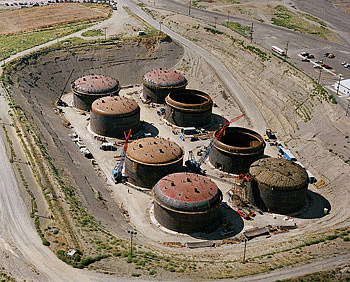
Feds say some Hanford radioactive waste is not so dangerous. Oregon disagrees, Tri City Herald, BY ANNETTE CARY, JANUARY 07, 2019 RICHLAND, WA 

January 10, 2019 Posted by | politics, USA, wastes | Leave a comment

EDF’s plans for construction of the Sizewell C twin-reactor will cause widespread disruption

East Anglian Daily Times 7th Jan 2019 ,Campaigners have been left furious over the latest plans for a new nuclear power plant on the Suffolk coast – and say EDF Energy is still not
listening to residents’ concerns. The construction of the Sizewell C
twin-reactor is expected to cause widespread disruption with concern over
hundreds of trucks using unsuitable roads, the impact on the local economy
and worries over the effect on RSPB Minsmere. A main concern is the use of
land near Eastbridge for a campus for 2,400 workers which campaigners say
are “substantially unchanged” from early designs. Alison Downes,
co-chairman of Theberton and Eastbridge Action Group on Sizewell (TEAGS),
was furious at the lack of consideration being taken of the villages as EDF
clamours to start construction.
https://www.eadt.co.uk/news/edf-energy-sizewell-plan-slated-by-theberton-middleton-eastbridge-activists-1-5840910

January 10, 2019 Posted by | politics, UK | Leave a comment

“Nuclear modernization” a euphemism that ushers in a new and dangerous global nuclear arms race.

Introduction: The wasteful and dangerous worldwide nuclear modernization craze https://www.tandfonline.com/doi/full/10.1080/00963402.2019.1555973

John Mecklin, 07 Jan 2019 The military is a prime breeding-ground for euphemism. During the Vietnam War, “pacification” often meant the shelling and bombing of villages and forced relocation of entire populations. The Reagan administration championed a fearsome, 10-nuclear-warhead intercontinental ballistic missile. Its name? “Peacekeeper.” Russia did not invade or annex Crimea, according to President Putin; it “enhanced” its forces there.

“Nuclear modernization” is a euphemism covering a wide range of activities that constitute, in the view of many experts, a new and dangerous global nuclear arms race. And an expensive one. In the United States, the 30-year cost of the plethora of programs under the nuclear modernization umbrella – including new nuclear-capable bombers, land-based nuclear missiles, and nuclear submarines – has been estimated at $1.2 to $1.7 trillion. Observers who remember the $640 toilet seats and $437 tape measures of Defense Department history11. See http://articles.latimes.com/1986-07-30/news/vw-18804_1_nutView all notes believe that if the entire modernization program were actually funded and carried out, the cost would be much higher than these estimates.

In this issue, Bob Rosner of the University of Chicago and Stanford University’s Lynn Eden – leading nuclear experts who sit on the Bulletin’s Science and Security Board – give an overview of the astonishing complexities of the US modernization program and try to answer the core question: What does the United States need to do – and what could it reasonably not do – to ensure the reliability of its nuclear arsenal but reduce the cost of maintaining it? Another Science and Security Board member – former Obama administration arms control adviser Jon Wolfsthal – suggests that the first step in responsibly managing the US nuclear budget would require the Trump administration to actually develop a nuclear strategy. Andy Weber and Christine Parthemore of the Council on Strategic Risks, meanwhile, look at once-discarded nuclear weapon capabilities that the Trump administration has resurrected – particularly a proposed low-yield warhead for submarine-launched nuclear missiles and other “small nuke” options – and find them unnecessary and destabilizing.

The nuclear modernization craze is hardly restricted to the United States. As Carnegie Moscow Center director Dmitri Trenin notes, Russian leaders have always been keen observers of US nuclear policy, and as Russia nears the end of its own nuclear modernization cycle, strained East-West relations have created a dangerous situation.

“Against a backdrop of deep mistrust,” Trenin writes, “the coming US withdrawal from the Intermediate-Range Nuclear Forces Treaty and the new US emphasis on tactical [nuclear] systems revive the specter of a nuclear war in Europe.” And because the US-China competition is turning “increasingly serious and even hostile,” Tong Zhao of the Carnegie–Tsinghua Center for Global Policy argues, the United States should take a number of steps to ease tensions. After all, Zhao notes, the United States is the most important external influencer of Chinese nuclear policy, and as such could prevent a “more negative cycle of action-and-reaction” involving both nations’ nuclear arsenals.

As Trenin and Zhao explain, United States nuclear policy often drives the nuclear policies of Russia and China. Of course, US officials often suggest the obverse: American nuclear policy initiatives are responses to Russian and Chinese defense policies and programs.

There are reasonable and practical ways to short-circuit the new, self-reinforcing worldwide nuclear arms race that is euphemized as “modernization.”  As Rosner and Eden point out, the United States could save a lot of money without sacrificing security by taking the “hard decision” to eliminate one of the three legs in its nuclear triad, most likely its land-based nuclear ballistic missiles. As Wolfsthal notes, the United States could adequately deter any adversary with a nuclear arsenal and array of delivery platforms that is significantly smaller (and less expensive) than the Trump administration proposes.

The mere official contemplation of such down-sizing moves in the United States would send a global signal. It’s a signal that could well lead to negotiations on slowing or even halting the 21st century modernization sequel to the bad arms race movie the world watched throughout the Cold War. The next Congress should begin contemplating immediately. The world has seen more than enough of this ritual squandering of national resources on weapons of horror that can never reasonably be used.

January 10, 2019 Posted by | USA, weapons and war | Leave a comment

Russia might revive its fearful automatic nuclear weapons launch system

Meet “Dead Hand”: This Might Be Russia’s Most Terrifying Nuclear Weapons Idea Yet https://nationalinterest.org/blog/buzz/meet-dead-hand-might-be-russias-most-terrifying-nuclear-weapons-idea-yet-40937

Perhaps the most terrifying was a Cold War doomsday system that would automatically launch missiles—without the need for a human to push the button—during a nuclear attack.  But the system, known as “Perimeter” or “Dead Hand,” may be back and deadlier than ever, by Michael Peck , 9 Jan 19, If Russia is now discussing Perimeter publicly, that’s reason for the rest of us to worry.

Russia has a knack for developing weapons that—at least on paper—are terrifying: nuclear-powered cruise missiles, robot subs with 100-megaton warheads .

Perhaps the most terrifying was a Cold War doomsday system that would automatically launch missiles—without the need for a human to push the button—during a nuclear attack.

But the system, known as “Perimeter” or “Dead Hand,” may be back and deadlier than ever.

This comes after the Trump administration announced that the United States is withdrawing from the 1987 Intermediate-Range Nuclear Forces Treaty, which eliminated the once-massive American and Russian stockpiles of short- and medium-range missiles. Donald Trump alleges that Russia has violated the treaty by developing and deploying new, prohibited cruise missiles.

This has left Moscow furious and fearful that America will once again, as it did during the Cold War, deploy nuclear missiles in Europe. Because of geographic fate, Russia needs ICBMs launched from Russian soil, or launched from submarines, to strike the continental United States. But shorter-range U.S. missiles based in, say, Germany or Poland could reach the Russian heartland.

Viktor Yesin, who commanded Russia’s Strategic Rocket Forces in the 1990s, spoke of Perimeter/Dead Hand during an interview last month in the Russian newspaper Zvezda [Google English translation here]. Yesin said that if the United States starts deploying intermediate-range missiles in Europe, Russia will consider adopting a doctrine of a preemptive nuclear strike. But he also added this:

Zvezda: “Will we have time to answer if the flight time is reduced to two to three minutes when deploying medium-range missiles near our borders? In this version, all hope is only on Perimeter. And for a retaliatory strike. Or was Perimeter also disassembled for parts?

It is not clear what Yesin meant when he said the system has been “improved,” or even exactly what he meant by “functioning.” Perimeter works by launching specially modified SS-17 ICBMs, which transmit a launch signal to regular nuclear-tipped ICBMs in their silos.

David Hoffman, author of “The Dead Hand,” the definitive book on Perimeter, describes Perimeter in this way:

“Higher authority” would flip the switch if they feared they were under nuclear attack. This was to give the “permission sanction.” Duty officers would rush to their deep underground bunkers, the hardened concrete globes, the shariki. If the permission sanction were given ahead of time, if there were seismic evidence of nuclear strikes hitting the ground, and if all communications were lost, then the duty officers in the bunker could launch the command rockets. If so ordered, the command rockets would zoom across the country, broadcasting the signal “launch” to the intercontinental ballistic missiles. The big missiles would then fly and carry out their retaliatory mission.

There have been cryptic clues over the years that Perimeter still exists.

Which illustrates one of the curiosities of this system, which is that the Soviet Union kept its existence secret from the American enemy whom it was supposed to deter.What is unmistakable is that Perimeter is a fear-based solution. Fear of a U.S. first-strike that would decapitate the Russian leadership before it could give the order to retaliate. Fear that a Russian leader might lose his nerve and not give the order.

And if Russia is now discussing Perimeter publicly, that’s reason for the rest of us to worry.

Michael Peck is a contributing writer for the National Interest. He can be found on Twitter and Facebook.

January 10, 2019 Posted by | Russia, weapons and war | Leave a comment

USA Dept of Energy again confirms its plans to use SRS plutonium for nuclear weapons

DOE reaffirms plans to use SRS plutonium for pit production in New Mexico https://www.aikenstandard.com/news/doe-reaffirms-plans-to-use-srs-plutonium-for-pit-production/article_59e7b02a-1291-11e9-bd1e-936df797de19.html, By Colin Demarest cdemarest@aikenstandard.com, Jan 7, 2019 

      The U.S. Department of Energy has again confirmed its plans to use plutonium currently stored at the

Savannah River Site

       for nuclear weapons purposes.

In a document filed Jan. 4 in Nevada district court, the DOE explained 1 metric ton of plutonium — in pit form at SRS — will eventually be sent to Los Alamos National Laboratory in New Mexico where it will be remanufactured into “new pits.”

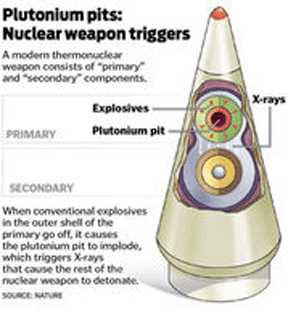
Doing so will further the National Nuclear Security Administration‘s longterm stockpile work, according to the same court document. Plutonium pits are nuclear weapon cores, often referred to as triggers.

NNSA Chief of Staff William “Ike” White in a Nov. 20 letter, which was made public via other court filings, described the weapons-grade plutonium stored at SRS as “mission-essential” and integral to nation’s defense enterprise.

“This material will ultimately be used for vital national security missions and is not waste,” White wrote, later adding: “We will keep you updated on our progress as the pit production mission moves forward.” White’s letter was sent to Nevada government officials. Before the plutonium is relocated to Los Alamos, the nation’s plutonium science and production center of excellence, it will be staged at either the Nevada National Security Site or the Pantex Plant in Texas, according to the NNSA.

The shipments between Nevada and New Mexico would take place over “a period of years,” according to the Jan. 4 filing.

The DOE is removing 1 metric ton of weapons-grade plutonium from SRS — South Carolina, more broadly — to comply with a Dec. 20, 2017, court order. The plutonium must be out of the state no later than 2020, according to the order, which was issued by U.S. District Court Judge J. Michelle Childs.

The prospective weapons use of the SRS plutonium was first fully documented in an NNSA environmental assessment issued last year.

January 10, 2019 Posted by | - plutonium, USA, weapons and war | Leave a comment

The Nuclear Free Local Authorities (NFLA) will brief Scottish Parliament on Hunterston nuclear power plant

The National 8th Jan 2019 ,ANTI-nuclear campaigners will brief MSPs tomorrow on their concerns about the safety of two reactors at the Hunterston B nuclear power plant in North
Ayrshire. Reactors 3 and 4 have been offline since March and October
respectively after cracks were found during a routine inspection. Operators
EDF hope to gain approval for their re-opening in the spring.

The Nuclear Free Local Authorities (NFLA) will give the Scottish Parliament briefing,
which will be chaired by Green MSP Ross Greer. He said: “Long-running
safety and job concerns from the community around Hunterston have increased
significantly.”
https://www.thenational.scot/news/17341200.msps-to-meet-anti-nuclear-campaigners/

January 10, 2019 Posted by | opposition to nuclear, UK | Leave a comment

Vermont-based New England Coalition on Nuclear Pollution will participate in NRC conference on wastes regulation

Local nuke group going to regulatory meeting https://www.recorder.com/Group-to-attend-NRC-meeting-on-casks-22611857 Brattleboro, Vt.-based New England Coalition on Nuclear Pollution will participate in this week’s Nuclear Regulatory Commission enforcement conference on design failures in radioactive-waste storage containers like those at Vermont Yankee and several other nuclear plants. Wednesday’s conference at the federal regulator’s Bethesda, Md. headquarters follows its complaint against Holtec International for its adopted design of steel and concrete spent-fuel casks without federal approval.

NRC officials say the company made changes after discovering a loose “bolt” last March at the San Onofre nuclear power plant in California. The small threaded posts connect to the bottom of shims in the canister of the cask to create space between multiple aluminum shims and the bottom of the canister to keep the basket stabilized in each of the casks.

The nuclear watchdog group’s technical adviser, Raymond Shadis, along with and board member Clay Turnbull, plan to monitor and offer comments on the canisters.

The coalition twice intervened before Vermont’s public utilities commission on using the Holtec steel canister-in-a-concrete-cask design at the Vernon plant, where 58 spent-fuel casks are now in place awaiting eventual transfer to a federal repository. It says its involvement helped result in more frequent radiation and temperature reporting, more conservative cask spacing, a protective line-of-site barrier wall and prohibition of using corrosive de-icing salts.

The coalition, which has repeatedly advocated for partially buried cask or earthen berm protection for the shuttered Vermont plant’s spent fuel, also commented on a previous Holtec design change, which it says resulted in a more in-depth NRC staff safety analysis.

NRC spokesman Neil Sheehan said Holtec altered the cask design without a written evaluation, violating federal safety regulations.

January 10, 2019 Posted by | opposition to nuclear, safety, USA | Leave a comment

Increasing major cracks in Hunterston nuclear reactors: call to close them permanently

Ferret 9th Jan 2019 Pressure is mounting to keep two nuclear power reactors at Hunterston in
North Ayrshire closed after the company that runs them, EDF Energy, said it
had found more cracks and was again postponing plans to restart.
The French company now estimates that there are 370 major cracks in the graphite core
of reactor three and 200 cracks in the core of reactor four.  Reactor three has been closed down since 9 March 2018, and reactor four since 2 October.
The day after The Ferret revealed in November that 350 cracks had been
discovered in reactor three in breach of an operating safety limit, EDF
postponed restarting both reactors to January and February.
On 9 January the group of nuclear-free local authorities is holding a safety briefing on
Hunterston for MSPs in the Scottish Parliament. Experts will call for the
reactors to stay closed rather than risking a nuclear accident, and for new
jobs to be created in Ayrshire. Nuclear policy consultant, Dr Ian Fairlie,
will argue that the increasing number of cracks in the ageing reactors
spelled their end. “There is only one thing you can do and that is close
them, as they cannot be repaired,” he told The Ferret.
https://theferret.scot/cracks-hunterston-reactors/

January 10, 2019 Posted by | safety, UK | Leave a comment

JAPC denies granting local prior consent for Tokai reactor restart

safe_image.php.jpg
The Tokai No. 2 nuclear power plant in Tokai, Ibaraki Prefecture, which is operated by the Japan Atomic Power Co.
January 8, 2019
Although telling six municipalities they have the right to prior consent before restarting the Tokai No. 2 nuclear power plant, operator Japan Atomic Power Co. (JAPC) is apparently reneging on that promise.
JAPC reached a draft agreement with the local governments to obtain their consent before restarting the Tokai No. 2 plant reactor in Ibaraki Prefecture, according to documents from Naka in the prefecture.
The documents, obtained by The Asahi Shimbun through an information disclosure request, detail the six years of negotiations between JAPC and the six local governments and a new safety agreement reached in March 2018.
The six are Tokai village, which hosts the plant, and the five surrounding cities of Hitachi, Hitachinaka, Naka, Hitachiota and Mito.
However, when asked by The Asahi Shimbun if the agreement contained a clause that JAPC would obtain prior consent from the six municipal governments on the restart, the company replied “No.” The six municipalities said the right to prior consent had been agreed upon.
JAPC has apparently changed its stance.
The new safety agreement, concluded on March 29, 2018, stipulates that when JAPC seeks to restart the Tokai No. 2 nuclear plant or extend its operation, it will effectively obtain prior approval from Tokai village and five surrounding municipalities.
The apparent break from tradition to give surrounding local municipalities the right of prior consent drew widespread attention as the “Ibaraki method.”
The concept of working out an agreement started in February 2012 when the heads of the six municipalities met to discuss nuclear power and local vitalization.
Tatsuya Murakami, then Tokai village chief, talked about the wide-ranging effects from the March 2011 accident at the Fukushima No. 1 nuclear power plant.
He said that the issue of whether to allow a restart of the Tokai No. 2 nuclear plant couldn’t be decided by Tokai village alone and that it was necessary for surrounding municipalities to have the same right.
However, JAPC rejected the proposal, saying that it needed to maintain a consistent approach with another nuclear plant it operates.
The negotiations continued, and in March 2017 the circumstances changed. In a meeting held that month, JAPC President Mamoru Muramatsu proposed a new safety agreement to the six municipalities.
As for their prior consent, he said, “We’ve determined that we can’t restart the nuclear plant until we obtain consent from the municipalities.”
The municipalities asked Muramatsu if that effectively meant they had the right to “prior consent.”
The JAPC president replied, “That’s correct.”
On Nov. 22, 2017, JAPC presented a new safety agreement, which included “effective prior consent,” in a meeting of the heads of the municipalities.
The municipalities again asked whether they had the right to prior consent. A JAPC official replied, “Yes.”
On Nov. 24, 2017, JAPC applied to the Nuclear Regulation Authority (NRA) for a 20-year extension of the operation of the nuclear plant. The deadline for the application was Nov. 28, 2017.
On Nov. 7, 2018, immediately after the NRA approved the 20-year extension, however, JAPC Vice President Nobutaka Wachi said, “The word ‘veto power’ can’t be found anywhere in the new agreement.”
The remark caused a backlash from the six municipalities, and Wachi apologized for his remark. However, relations between JAPC and the municipalities have deteriorated.
In the fall of 2018, The Asahi Shimbun conducted a survey of JAPC and the six municipalities. It asked them, “Is there anything in writing that states that JAPC must obtain prior consent from the six municipal governments in the new agreement?”
In response, JAPC said, “No.” A JAPC official explained, “The new agreement is a plan to effectively obtain prior consent from the six municipalities (by continuing to talk thoroughly with them until they grant their consent).”
The Asahi Shimbun told JAPC that official documents have a description that can be interpreted as granting the municipalities the right to prior consent.
The JAPC official said, “We will refrain from making a comment about the content of discussions from closed meetings.”

January 9, 2019 Posted by | Japan | , | Leave a comment

Hanford’s nuclear wastes. How do you navigate a situation where safety is impossible to promise?

January 8, 2019 Posted by | USA, wastes | 2 Comments

Forget party politics- the climate does not care – Katherine Hayhoe

Katharine Hayhoe: ‘A thermometer is not liberal or conservative’ Guardian, Jonathan Watts,  6 Jan 19   Katharine Hayhoe: ‘Fear is a short-term spur to action, but to make changes over the long term, we must have hope.’  

Let Science Speak – Dr. Katharine Hayhoe

The award-winning atmospheric scientist on the urgency of the climate crisis and why people are her biggest hope  “….. In 2018, we have seen forest fires in the Arctic circle; record high temperatures in parts of Australia, Africa and the US; floods in India; and devastating droughts in South Africa and Argentina. Is this a turning point? 
This year has hit home how climate change loads the dice against us by taking naturally occurring weather events and amplifying them. We now have attribution studies that show how much more likely or stronger extreme weather events have become as a result of human emissions. For example, wildfires in the western US now burn nearly twice the area they would without climate change, and almost 40% more rain fell during Hurricane Harvey than would have otherwise. So we are really feeling the impacts and know how much humanity is responsible.

The Intergovernmental Panel on Climate Change released its 1.5C report in October. A month later, the US federal government’s climate assessment – to which youcontributed – came out. How did these two massive studies move our understanding along? 
These assessments are important because there is a Schrödinger’s Cat element to studying climate impacts. The act of observing affects the outcome. If people aren’t aware of what is happening, why would anyone change? Assessments like these provide us with a vision of the future if we continue on our current pathway, and by doing so they address the most widespread and dangerous myth that the largest number of us have bought into: not that the science isn’t real, but rather that climate change doesn’t matter to me personally.

Compared to past studies, how much media attention did these reports receive?

There was significant coverage but a lot of media survive by generating controversy so they bring on opposing voices rather than explaining the scientific facts. Climate change shouldn’t be fodder for commentators who represent the interests of the fossil fuel industry by muddying the science. As a human and a scientist, this focus on controversy is frustrating. A thermometer is not liberal or conservative.

Are there any signs that public opinion is shifting in the US and elsewhere? 

We haven’t yet reached the tipping point to motivate sufficient action. But there has been a change. Ten years ago, few people felt personally affected by climate change. It seemed very distant. Today, most people can point to a specific way climate affects their daily lives. This is important because the three key steps to action are accepting that climate change is real, recognising it affects us, and being motivated to do something to fix it. Opinion polls in the US show 70% of people agree the climate is changing, but a majority still say it won’t affect them.

Trump was dismissive of these reports and has repeatedly tried to deny any link between climate change and extreme weather. What are the politics behind this denial? 

It’s a vicious cycle. The more doom-filled reports the scientists release, the stronger the pushback from politicians whose power, ideology and funding depends on maintaining the status quo, and who are supported by those who fear the solutions to climate change more than they fear its impacts. Opposition to climate change is a symptom of a society that is politically polarised between those who cling to the past and those who recognise the need for a better future. Fossil fuels have brought us many benefits – and I’m grateful for their contribution to my life – but the solution to our current crisis is to stop using them. That change can be scary, especially for those with most to lose financially from this shift. If you feel threatened, the instinctive reaction is to push back………

On current trends, if you had to give a percentage breakdown of the likelihood of the following three outcomes by 2100, what would you give: a) keeping to 1.5C; b) keeping to 2C; c) rising above 3C; and d) overshooting 4C?
I’d put my money on a gradual bend away from a higher scenario, which is where we are now, until accumulating and worsening climate disasters eventually lead to a collective “oh shit!” moment, when people finally realise climate impacts do pose a far greater threat than the solutions. At that point, I would hope the world would suddenly ramp up its carbon reduction to the scale of a Manhattan Project or a moon race and we would finally be able to make serious progress. The multitrillion-dollar question is simply when that tipping point in opinion will come, and whether it will be too late for civilisation as we know it. I hope with all my heart that we stay under 1.5C, but my cynical brain says 3C. Perhaps the reality will be somewhere between my head and my heart at 2C.

What is the best way out of the climate crisis? What policies would make a difference? 
The most important thing is to accelerate the realisation that we have to act. This means connecting the dots to show that the impacts are not distant any more: they are here and they affect our lives. It also means talking about solutions. The technology and knowledge are there. The economics already make sense. In Texas, where I live, the biggest military base, Fort Hood, switched last year to renewables because they were cheaper than natural gas. And finally, it means weaning ourselves off fossil fuels, which is challenged by the fact that the majority of the world’s richest companies have made their money from the fossil fuel economy – so the majority of the wealth and power remains in their hands. ……… https://www.theguardian.com/science/2019/jan/06/katharine-hayhoe-interview-climate-change-scientist-crisis-hope

January 8, 2019 Posted by | 2 WORLD, climate change | Leave a comment

Misgivings in UK about China’s involvement in Bradwell nuclear project, as enthusiasm for ‘new nuclear’ wanes

FT 7th Jan 2019 The Huawei affair has revived the unresolved question of whether the non-Chinese world can trust Chinese companies as the country becomes an industrial superpower. The US has cited Huawei’s alleged breaches of Iranian sanctions to request the extradition of Meng Wanzhou, the company’s chief financial officer, from Canada, but it is clear that the real concern is about the ability of Huawei’s advanced technology to gather information.
The US, Australia and New Zealand have already banned Huawei from future G5mobile projects. The UK will soon have to face up to an additional aspect of the issue as a key decision approaches on Chinese plans to build a series of civil nuclear reactors in Britain, starting with Bradwell B on the site of a former air base in Essex.
But what happens next is not simply a matter for the US and the UK. China itself must decide what place in the world it wants. For the UK, the test of whether to follow the American line
will focus not just on Huawei but also on the proposed development of Bradwell B. The plant is intended to be a joint project between the Chinese nuclear company CGN and France’s EDF, with CGN set to own 66.5 per cent of the venture and use its HPR 1000 nuclear reactor. CGN is, on its own estimation, the world’s third largest nuclear power company but its operations have so far been concentrated in China and Bradwell would be a flagship project for its international ambitions.
The HPR Hualong design is going through the assessment process required by the UK nuclear regulator,but there is no reason to suppose it will fail on technical grounds. For the moment, CGN’s plans to build Bradwell B are going ahead but warning signs are appearing. The company was not encouraged to take up the option of developing the planned nuclear project at Moorside in Cumbria that was abandoned by Toshiba in November.
The UK’s National Infrastructure Commission has said the need for new nuclear is much less clear than envisaged in 2013 when the current plans were drawn up.
https://www.ft.com/content/8a1d7432-0e8b-11e9-a3aa-118c761d2745

January 8, 2019 Posted by | politics, UK | Leave a comment

Bill Gates’ dangerous love affair with plutonium

Bill Gates’ nuclear ambitions go beyond mere ideas. He actually possesses financial holdings in one very dangerous situation indeed – a situation that is presently causing residents around St. Louis, Missouri to live under an all-out nuclear nightmare

Bill Gates’ Plutonium Pipe Dream: Convert Mountains of Depleted Uranium at Paducah to Power Earth for Centuries (Pt. 2)  EnviroNews DC News Bureau on March 14, 2016

“………Cunnings: The man considered by many to be supposedly a humanitarian trailblazer when it comes to combatting disease, has a plan to fast-breed the mountainous heaps of depleted uranium at Paducah into plutonium – one of the most dangerous and disease-causing substance on the face of the planet. Then in turn, this plutonium would be used to power what would be the so-called new fourth-generation nuclear power plants. Let’s listen to Gates articulate his plutonium scheme.

Voice of Bill Gates – Excerpt #2: The concept of this so-called “TerraPower reactor” is that you, in the same reactor, you both burn and breed. So, instead of making plutonium and then extracting it, we take uranium – the 99.3 percent that you normally don’t do anything with – we convert that, and we burn it.

[Editor’s Note: Bill Gates is the current Chairman of the Board of TerraPower — a Washington-based nuclear power technology company.]

Cunnings:Now get this, only 60 seconds after Gates acknowledges the tremendous problem of bringing more plutonium into this world, he turns around and makes a joke about it to a crowd filled with university students from nuclear programs – all this, only a few months after the catastrophic triple melt-through at Fukushima Daiichi.

Bill Gates – Excerpt #3: Our flame is taking the normal depleted uranium – the 99.3 percent that’s cheap as heck, and there’s a pile of it sitting in Paducah, Kentucky that’s enough to power the United States for hundreds and hundreds of years. You’re taking that and you are converting it to plutonium (humorously under his breath) – and then you’re burning that.

Cunnings: Oh yes, Mr. Gates seems to have a little love affair going on with plutonium – and the notion is that we need nuclear power to save ourselves from climate change. ……

Bill Gates Excerpt #8: I love nuclear. It does this radiation thing that’s tricky (laughter). But they’re good solutions. You know, it was interesting; recently, in Connecticut this natural gas plant blew up 11 guys. It just blew them up.

Bill Gates Excerpt #8: Murray: But you are personally investing in nuclear?

Gates: Right.

Cunnings: EnviroNews Editor-in-Chief Emerson Urry chatted with the esteemed nuclear industry expert and whistleblower Arnie Gundersen to explore whether Gates’ plan is a good idea or not.

Emerson Urry: Let’s go back to Bill Gates again, [and] the fourth generation nuclear power. I’ve heard him out there speaking about this, and essentially his ambition to, let’s say, convert Paducah, Kentucky [to plutonium]..

……….. the Paducah site is a very expensive cleanup that is going to take 20 or 30 years to decontaminate. You know, it’s like all of these bomb legacy sites – Hanford in Washington State…

Gundersen:   Hanford is going to take 70 years and cost 110 billion dollars to clean up. So, here we are paying over half of a century for the legacy of building bombs for five years in 1940. And so, Paducah is another one of those sites. It was built to enrich uranium. Why did we do that? Because we had a bomb program. And now we’re stuck with these huge costs that are underfunded or unfunded by Congress. That plant is going to sit there for 30 years. It will create a lot of employment for a lot of people knocking it down, but it also is highly radioactive, and it’s got to be done so cautiously, and it’s a really difficult problem.

Cunnings: There’s no known disintegration of plutonium small enough that doesn’t possess the ability to cause cancer. To be clear, there is no safe amount to be exposed to whatsoever.

Plutonium, though a naturally occurring element was virtually non-existent on planet earth before the dawn of the nuclear age. Now, each of the roughly 400 uranium-powered nuclear reactors in the world create approximately 500 pounds of plutonium each year – or enough to create about 100 nuclear warheads each.

…….. Bill Gates’ nuclear ambitions go beyond mere ideas. He actually possesses financial holdings in one very dangerous situation indeed – a situation that is presently causing residents around St. Louis, Missouri to live under an all-out nuclear nightmare……https://www.environews.tv/031416-paducah-bill-gates-nuclear-pipedream-convert-mountains-depleted-uranium-plutonium-power-earth-centuries/

January 8, 2019 Posted by | - plutonium, secrets,lies and civil liberties, USA | 1 Comment

How does plutonium affect human health?

TOXICOLOGICAL PROFILE FOR PLUTONIUM , Agency for Toxic Substances and Disease Registry Division of Toxicology and Environmental Medicine/Applied Toxicology Branch,  Atlanta, Georgia

” …….Plutonium may remain in the lungs or move to the bones, liver, or other body organs. It generally stays in the body for decades and continues to expose the surrounding tissues to radiation. Lung, liver, and bone cancer You may develop cancer depending on how much plutonium is in your body and for how long it remains in your body. The types of cancers you would most likely develop are cancers of the lung, bones, and liver…….

The risks of mortality and morbidity from bone and liver cancers have also been studied in Mayak workers. Increasing estimated plutonium body burden was associated with increasing liver cancer mortality, with higher risk in females compared to males…….

Cardiovascular Effects. Epidemiological Studies in Humans. Possible associations between exposure to plutonium and cardiovascular disease have been examined in studies of workers at production and/or processing facilities in the United Kingdom (Sellafield)……..  within a cohort of Sellafield workers   morality rate ratios for plutonium workers were significantly elevated for deaths from circulatory disease and ischemic heart disease . ….

the Mayak studies provide evidence for increased risk of cancer mortality (bone, liver, lung) in association with increased internal plutonium-derived radiation dose and/or body burden, with approximately 4-fold higher risks in females compared to males…….

Risks of mortality and morbidity from bone and liver cancers have also been studied in Mayak workers ….. Increasing estimated plutonium body burden was associated with increasing cancer mortality, with higher risk in females compared to males…..

U.K. Atomic Energy Authority and Atomic Weapons Establishment Workers. ………..The mortality rate ratio was significantly elevated for breast cancer  and cerebrovascular disease  in a cohort of female Sellafield workers identified as plutonium workers……..

Comparisons of mortality rates between plutonium workers and other radiation workers yielded significantly elevated mortality rate ratios for all deaths , all cancers , breast cancer, circulatory disease , and ischemic heart disease.

GENOTOXICITY Abundant information is available regarding the genotoxicity of ionizing radiation……….Although epidemiological studies do not provide conclusive evidence that plutonium produces genetic damage in humans, results of some studies provide suggestive evidence of dose-related increases in chromosomal aberrations in plutonium workers with measurable internalized plutonium……. ……https://www.atsdr.cdc.gov/toxprofiles/tp143.pdf?fbclid=IwAR1iffNMF8xj33aBhDW-zhtFzPejF0eNlQ5QUaIgxBhCcujUKU0XRC8NvMc

January 8, 2019 Posted by | 2 WORLD, health, Reference | 1 Comment