Saudi Arabia keen to get nuclear technology from USA
 Saudi Arabia to work closely with US on nuclear power plans, https://www.straitstimes.com/world/middle-east/saudi-arabia-to-work-closely-with-us-on-nuclear-power-plans JAN 10, 2019, RIYADH (REUTERS) – Saudi Arabia aims to work closely with the United States on its plans to build nuclear power generation capacity in the oil producing kingdom, the energy minister said on Wednesday (Jan 9).
 Riyadh wants Washington to be “part and parcel” of Saudi Arabia’s nuclear programme, which will be entirely for peaceful purposes, Energy Minister Khalid al-Falih said.
He also said the United States was a key provider for nuclear technology.
USA electric-power producers call on Supreme Court to overturn state subsidies for nuclear power
 No states’ nuke subsidies, power group tells Supreme Court https://www.reuters.com/article/no-states-nuke-subsidies-power-group-tel/no-states-nuke-subsidies-power-group-tells-supreme-court-idUSL1N1ZB0F6, Barbara Grzincic, – 11 Jan 19
A trade group for electric-power producers has doubled down on its fight against state-mandated subsidies for nuclear power plants, asking the U.S. Supreme Court to overturn two appellate courts that upheld Zero Emission Credit (ZEC) programs in New York and Illinois last fall.
The Electric Power Supply Association, represented by former U.S. Solicitor General Donald Verrilli Jr, argues that the 2016 state regulations infringe on the Federal Energy Regulatory Commission’s power to regulate wholesale electricity rates, which Congress gave to FERC in the Federal Power Act in 1935.
To read the full story on Westlaw Practitioner Insights, click here: bit.ly/2SKaXWt
Kim Jong Un’s New Year’s Speech stressed energy development, and co-operation wit South Korea
Kim Jong Un’s New Year’s Speech: On the Domestic Front, 38 North, BY: GLYN FORD, JANUARY 9, 2019 “……
Kim acknowledged that challenges to this domestic agenda certainly exist, noting especially the misallocation of labor, lack of expertise and poor productivity. In his speech, he instructed a reallocation of labor and resources, both for the military and the Party, to start to address these barriers to success. He also indicated that contingency plans were being explored in case a second summit with Trump fails to set US-DPRK relations back on track.
………Focus on Energy Generation
The country’s principal economic bottleneck is the desperate need for a massive increase in electricity production. A first step is the renovation and modernization of the supply industry. By singling out the Pukchang Thermal Power Complex for praise all the others inevitably lie in its shadow. Yet the most aggravating problem is fuel shortages. Under the current sanctions regime, the short-term solution—and by no means good news for the climate-change lobby—to the electricity shortage is massive increases in productivity in the coal sector. ………..
While hydroelectric plants merit a passing mention, in reality, the North is close to maximizing the use of the water resources available with both floods and droughts sharply reducing output. In the longer term, Kim argued that the country needs to “create a capacity for generating tidal, wind and atomic power under a far-reaching plan.” The last underlines Pyongyang’s perception that denuclearization of the Korean Peninsula does not preclude ambitions to be a civil nuclear power. The ongoing construction of their indigenous Experimental Light Water Reactor (ELWR) at North Korea’s Yongbyon Nuclear Scientific Research Center suggests that light water reactors will form the backbone of the industry, harking back perhaps to the Korean Peninsula Energy Development Organization (KEDO) from the 1990s. ………..
There is no question the Party is now on top as well as on tap with constant references to its primacy. Kim emphasized in his speech that the KPA is to “defend the Party and revolution and the security of the country and the people and continuously perform miraculous feats at all sites of socialist construction.” Echoing that sentiment, the People’s Internal Security Forces are there to protect Party, system and people, in that order.
Delivering peace and prosperity to the Korean Peninsula is the stated goal for both Pyongyang and Seoul. Kim underscored this mandate with:
“When north and south join hands firmly and rely on the united strength of the fellow countrymen, no external sanctions and pressure, challenges and trials will be able to hinder us….We will never tolerate the interference and intervention of outside forces who stand in the way of national reconciliation, unity and reunification with the design to subordinate inter-Korean relations to their tastes and interests.”
The “dog that didn’t bark” is the “end-of-war” declaration. Last summer, Pyongyang complained long and hard that Washington had not delivered on its promise to sign a political declaration ending the Korean War. In Kim’s New Year’s speech, this declaration failed to get even a mention. Pyongyang seems to have moved on, from Washington at least. Kim stated, “it is also needed to actively promote multi-party negotiations for replacing the current ceasefire on the Korean peninsula with a peace mechanism in close contact with the signatories to the armistice agreement so as to lay a lasting and substantial peace-keeping foundation.” The concept of a bilateral US-DPRK declaration signed by Seoul and Beijing has now become a multilateral proposition and negotiation. Which parties would be involved is unclear, but this may have been one of many topics discussed between Kim and Chinese President Xi Jinping during Kim’s birthday visit to Beijing
……….Until now Pyongyang has rigidly adhered publicly to parallel bilateral negotiations, one with Washington looking for a peace settlement accompanied by sanctions relief and a second with Seoul on economic cooperation. Now with the potential for the first set of negotiations to go multilateral, the second set may follow suit, increasing pressure on Moon to put clear blue water between Seoul and Washington with respect to “maximum pressure.”https://www.38north.org/2019/01/gford010919/
The utter complexity of Moving Nuclear Waste Out of San Diego
 North County Report: The Head-Spinning Complexity of Moving Nuclear Waste Out of San Diego, Voice of San Diego, 9 Jan 19
The clock is ticking on attempts to find a suitable destination for nuclear waste from the decommissioned San Onofre power station north of Oceanside, and Carlsbad is sending a new representative to SANDAG. What to do with the spent nuclear fuel at the decommissioned San Onofre power station north of Oceanside — let’s just call it “waste” — is an important question. But I hadn’t spent much time thinking about it because it seemed remote and abstract……
Everyone with a stake in San Onofre seems to agree today that the waste shouldn’t be there, especially as the Pacific Ocean creeps closer. But moving the waste inland is politically difficult because it requires buy-in from outside communities and action at the federal level.
“We have maybe a year to work on this,” said David Victor, a UCSD professor international relations and chair of a San Onofre community engagement panel, “then the presidential election will shut down the conversation.”
Southern California Edison, the station’s majority owner, has long maintained that the waste is safe and being properly stored. Earlier this week, a nonprofit estimated that a major release of radiation on the site could cause upwards of $13 trillion in economic damage…..
San Onofre was closed and then decommissioned in 2013 after the detection of a small radiation leak. When the station’s owners got permission from the California Coastal Commission in 2015 to begin burying the waste in dry bunkers on the beach, they cited a lack of off-site places willing to take it. Several groups filed suit and the owners agreed in 2017 to move the canisters away from the Pacific Ocean. Eventually. And pending the development of a federally approved facility, possibly in New Mexico, Texas or Arizona.
There’s been a growing sense of urgency in recent months, and not just among activist kombucha sellers. Although no one was hurt, an incident in August has given plenty of cause for concern.
Workers at the station were loading a nuclear canister into a bunker when it got wedged near the top and remained that way for about 45 minutes, according to the Nuclear Regulatory Commission. Eventually the workers readjusted and lowered the canister the remaining 18 feet.
SoCal Edison told regulators about the incident the following business day, but the public didn’t learn of it until a contractor blew the whistle at a later community meeting. In response, an independent nuclear expert told the U-T that although the incident posed no threat to public, the station was “tempting fate.”
Even the station’s chief nuclear operator said the incident was unacceptable and suspended the transfer of nuclear fuel from cooling pools into dry bunkers on the San Onofre site. He has also acknowledged a second, previously unreported incident, in July, when workers encountered trouble lowering another canister into place. The Nuclear Regulatory Commission is expected soon to hand down a punishment.
Meanwhile, according to the U-T, former San Diego City Attorney Michael Aguirre, who sued San Onofre’s owners in 2015, is asking the FBI to investigate whether the handling of nuclear waste by a SoCal Edison contractor rises to the level of a criminal violation.
So, Where’s the Nuclear Waste Supposed to Go?
Last year, the U.S. House passed a bill intending to redevelop permanent storage at Yucca Mountain, in Nevada, which had already received billions in investment but had been stalled under the Obama administration thanks to Sen. Harry Reid. That bill had the support of then-Rep. Darrell Issa, a Republican whose district included San Onofre, and was meant to appease lawmakers who were reluctant to hold the waste before it went to the final destination.
In bureaucratic-speak, these facilities are known as “interim storage.”……….
There are dozens of sites across the country where waste is accumulating with nowhere to go……. https://www.voiceofsandiego.org/topics/news/north-county-report-the-head-spinning-complexity-of-moving-nuclear-waste-out-of-san-diego/
Over 600 Environmental Groups lobby U.S. Congress in support of Ocasio-Cortez’s Green New Deal
More Than 600 Environmental Groups Just Backed Ocasio-Cortez’s Green New Deal,Gizmodo, Brian Kahn , 11 Jan 19, Pressure continues to mount on Congress to get its act together on climate change. The latest salvo came on Thursday, as 626 groups delivered a letter to every member of Congress laying out their support for a Green New Deal and their demands.
Will the Rocky Flats Grand Jury Files Finally Be Opened?
The evidence they found was ultimately considered by Colorado’s first-ever special grand jury, empaneled in August 1989. After two years of deliberations, the jurors wanted to indict eight individuals — some from the Department of Energy, some from Rockwell International, which ran the plant for the DOE — for environmental crimes. Instead, in March 1992 the Department of Justice sealed a deal with Rockwell, fining the company $18.5 million, less than it had made in one year of bonuses. No individuals were named.
Pope Francis speaks out on the immorality of having nuclear weapons
Pope Francis Rejects Existence of Nuclear weapons, https://www.plenglish.com/index.php?o=rn&id=37433&SEO=pope-francis-rejects-existence-of-nuclear-weapons Vatican City, Jan 7 (Prensa Latina) Pope Francis said on Monday that the existence of nuclear weapons is functional to a logic of fear that has to do not only with parties in conflict, but with the entire human race.
Francis pointed out that ‘it is especially worrying that nuclear disarmament, so desired and pursued in part in the past decades, is now giving way to new, increasingly sophisticated and destructive weapons.
He also stressed that in the light of the consensus reached at the recent International Climate Conference (COP-24) in Katowice, he expected a more decisive commitment from states to strengthen collaboration to urgently address the worrying phenomenon of global warming.
Climate change: seal levels are rising at different rates around the globe
Explainer: Why sea levels aren’t rising at the same rate globally, A spinning planet, melting ice sheets and warmer waters all contribute to sea level rise, Science news for Students, KATY DAIGLE, CAROLYN GRAMLING, JAN 10, 2019 The sea is coming for the land. In the 20th century, ocean levels rose by a global average of about 14 centimeters (some 5.5 inches). Most of that came from warming water and melting ice. But the water didn’t rise the same amount everywhere. Some coastal areas saw more sea level rise than others. Here’s why:
Swelling seawater As water heats up, its molecules spread out. That means warmer water takes up slightly more space. It’s just a tiny bit per water molecule. But over an ocean, it’s enough to bump up global sea levels……..
Land a-rising Heavy ice sheets — glaciers — covered much of the Northern Hemisphere about 20,000 years ago. The weight of all that ice compressed the land beneath it in areas such as the northeastern United States. Now that this ice is gone, the land has been slowly rebounding to its former height. So in those areas, because the land is rising, sea levels appear to be rising more slowly.
But regions that once lay at the edges of the ice sheets are sinking. ……..
Land a-falling, Earthquakes can make land levels rise and fall…….
Glaciers begone Melting glaciers also can add water to the oceans. But these huge ice slabs affect sea levels in other ways, too.
Huge glaciers can exert a gravitational tug on nearby coastal waters. ……. https://www.sciencenewsforstudents.org/article/explainer-why-sea-level-rise-rate-varies-globally
Five of France’s EDF nuclear reactors shut down, awaiting regulatory approval
Creusot: 5 EDF reactors still without ASN green light. Five nuclear
reactors are still waiting for an operating license from the Nuclear Safety
Authority (ASN) as part of the investigation of the manufacturing records
of the Creusot plant, while the other 53 have already received fire green,
Creusot’s spokesperson said .
“We are still waiting for elements of answers from EDF,” she said to explain the delay of the
investigation which was to end on December 31, 2018. The five reactors
concerned are Cattenom 4 (1,300 MW ), Fessenheim 1 (880 MW), Flamanville 2
(1,330 MW), Golfech 1 (1,310 MW) and Tricastin 2 (915 MW). All five
reactors will be shut down for maintenance in the coming weeks, as follows:
Cattenom 4 (January 19th to April 11th), Fessenheim 1 (January 19th to
March 20th), Flamanville 2 (January 10th to July 10), Golfech 1 (February
16 to March 23) and Tricastin 2 (January 26 to April 1). The reactors will
not be able to restart without prior approval from ASN.
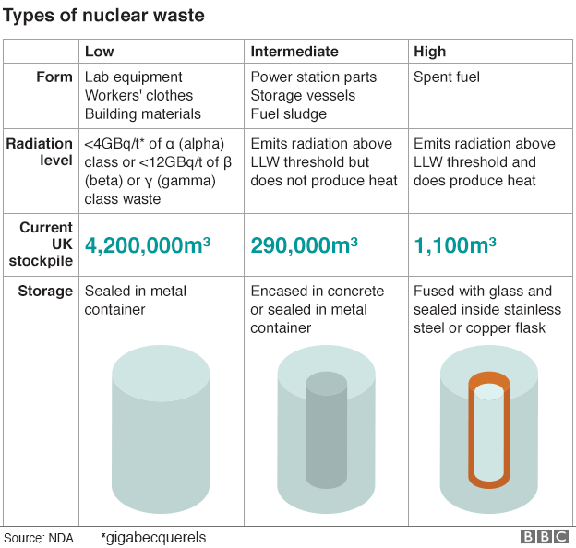
Trump administration’s plan to reclassify nuclear wastes as not “High Level”
New book: former chairman of Nuclear Regulatory Commission opposes nuclear energy
How Dangerous is Nuclear Power and How Bad is Its Regulation? (2019)
Former NRC chairman remains clearly opposed to nuclear energy, Las Vegas Sun, 9 Jan 19, “……… former Nuclear Regulatory Commission Chairman Gregory Jaczko is going on the offensive to explain why nuclear energy is nowhere near a perfect solution to the climate crisis.
In a new book, Jaczko reiterates his longstanding criticism of the nuclear industry and his opposition to development of traditional nuclear power plants, which he says are unsafe despite technological improvements designed to make them safer.
Exhibit No. 1 in Jaczko’s argument is the Fukushima disaster. …, he contends that the catastrophe at Fukushima wiped out environmental gains that Japan made by burning less fossil fuels
…….Meanwhile, he says, the cost of generating electricity through natural gas and renewables is lower in most parts of the country than nuclear generation
……“So to me, the idea that somehow we’re going to preserve these reactors and that’s a climate solution is just wrong,” he said.
Then, of course, there’s the issue with nuclear waste ………
Jaczko’s bottom-line assessment is that despite decades of development, nuclear energy remains too hazardous and costly to be a viable source of power.
“There’s going to be an accident,” he said. “The only question is when and where.”
It’s a compelling argument, and anyone who may be warming to nuclear energy in the fight to reverse climate change should examine it. The book, “
,” is available now at Amazon, Barnes & Noble and other outlets. https://lasvegassun.com/news/2019/jan/09/former-nrc-chairman-remains-clearly-opposed-to-nuc/
Nuclear Power Is Economically Obsolete
 https://www.ecowatch.com/nuclear-power-cost-renewables-2625524662.html, By Grant Smith, 9 Jan 19,
State of Washington opposes federal plan to reclassify Hanford nuclear waste
State opposes federal plan to reclassify Hanford nuclear waste, KATU 2, by NICHOLAS K. GERANIOS , Associated Press, January 9th 2019
The state this week filed its objections to a Trump administration plan to reclassify millions of gallons of waste stored in underground tanks at Hanford Nuclear Reservation. The objections were accompanied by a letter from Gov. Jay Inslee and Attorney General Bob Ferguson.
The U.S. Department of Energy is seeking to reclassify a large percentage of the waste as lower-level waste. That would allow treatment and disposal options that would not guarantee long-term protections.
“This dangerous idea will only serve to silence the voices of tribal leaders, Hanford workers, public safety officials, and surrounding communities in these important conversations,” said Inslee, a Democrat who is considering running for president in 2020. “This is unacceptable, and we will not stand by while this administration plans to abandon its responsibility to clean up their mess.” ……https://katu.com/news/local/state-opposes-federal-plan-to-reclassify-hanford-nuclear-waste
With tax-payer funding, and weakened safety regulation, Bill Gates’ nuclear project could be a goer in USA
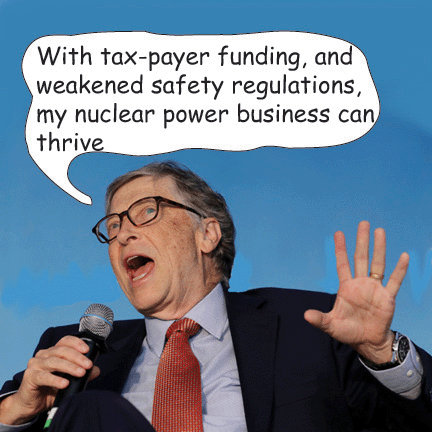
TRUMP ADMINISTRATION WANTS BILL GATES TO DITCH CHINA AND BUILD HIS NUCLEAR PROJECT IN THE US, Daily Caller, Jason Hopkins | Energy Investigator 01/08/2019 | Members of the Trump administration are actively working to convince Bill Gates to relocate his now-scrapped nuclear reactor project in China over to the U.S.
“We hope we can work with them and bring them back,” said Deputy Energy Secretary Dan Brouillette in an exchange with reporters Monday. Brouillette revealed the Energy Department has held “several conversations” with Gates, adding that he was optimistic the U.S. government could streamline the permitting process and entice the billionaire to bring his project stateside…….
“Unfortunately, America is no longer the global leader on nuclear energy that it was 50 years ago. To regain this position, it will need to commit new funding, update regulations, and show investors that it’s serious,” Gates wrote in a year-end blog post, first revealing his botched nuclear plans. ……
In the waning days of December, Congress passed the The Nuclear Energy Innovation and Modernization Act by wide margins in both chambers. The legislation aims to streamline the regulatory process for commercial nuclear plants, with an end game of making the development and commercialization of nuclear technology more affordable.
If signed by President Donald Trump, the bill could make nuclear projects, like the one Gates is spearheading, easier to accomplish. https://dailycaller.com/2019/01/08/bill-gates-nuclear-project/
Russian blogger reveals photo of venting cloud of radioactive dust from 1987 nuclear test gone wrong
Photo shows venting radioactivity from 1987 nuclear bomb tests at Novaya Zemlya https://thebarentsobserver.com/en/security/2019/01/photo-shows-venting-radioactivity-nuclear-bomb-tests-novaya-zemlya
It is two hours past midnight on August 2nd 1987 when the Soviet nuclear weapons scientists push the button triggering a series of five nuclear devises inside a tunnel at the Matochkin Shar nuclear testing site.
A load boom follows and the ground is shaking like an earthquake. A huge dust cloud blows out from the tunnel supposed to be hermetical sealed by meters thick stone- and concrete walls.
The radioactive dust cloud came as a big surprise to the personnel witnessing.
Now, more than 30 years later, a photo from the accident is published by Russian blogger who focuses on nuclear thematic and also posts photos on twitter.
Leakage of radioactivity from the August tests in 1987 is known from before, listed in a 2005 publication by Science and Global Security. Now, the photo from the site gives the public a better understanding of the size of tunnel collapse.
The photo is taken no more than a kilometer from the tunnel entrance and shows a military helicopter parked in in front. Each of the tunnels in the area where underground nuclear weapons testing took place from 1964 to 1990 has its own code number. The one collapsing on this photo is known as tunnel A-37A.
According to a list of all underground nuclear weapons tests at Novaya Zemlya, published by Science and Global Security, the total yield of the five devises exploded on August 2nd were 150 KT, ten times the size of the bomb dropped on Hiroshima in 1945.
The leakages of radioactivity was estimated to 56 TBq. The gamma radiation near the entrance to the tunnel was measured to more than 500 R/h. First radioactive gases were detected 90 seconds after the blast.
500 R/h is about 1000 times the annual dose for an average human. Exposed directly, such dose could be lethal within an hour or two.
In the book USSR Nuclear Explosions about the northern test site at Novaya Zemlya, published in 1991, a group of Soviet radiation experts writes about the accident. «A powerful burst of a radioactive gas-jet.stream occurred just above the mouth of the adit, just 1,5 minutes after the explosion. It was later established that gas penetrated along a geologic fault that extended along the adit axis and hot gases melted the surface ice.»
The authors describe how an emergency program was immediately instituted evacuating all staff within a period of a few minutes. No cases of radiation sickness occurred amon the test site personnel at Novaya Zemlya.
Mountian Moiseev, where the nuclear weapons tests took place, is located about 10 kilometers south of Severny, the military settlement on the shores of the Matochkin Shar serving as the centre for the nuclear test site.
The last real nuclear weapon test at Novaya Zemlya took place on October 24th 1990. Today, only subcritical nuclear weapon tests are conducted on the Russian Arctic archipelago.
1 This Month
Tell Congress: Prevent Nuclear Catastrophe in Iran

Tell Congress: Prevent Nuclear Catastrophe in Iran

Read the Public Inquiry Report, the Commissioners’ report, Surrendering Australia: The AUKUS Deception is available to download for free at aukuspublicinquiry.com. Or just watch the replay of the National Press Club Luncheon.


Shut down the radiation-damaged Heysham nuclear reactors now
To see nuclear-related stories in greater depth and intensity – go to https://nuclearinformation.wordpress.com

Say No to NASA’s Reckless Nuclear Reactor on the Moon
Say No to NASA’s Reckless Nuclear Reactor on the Moon
-
Archives
- November 2026 (238)
- October 2026 (302)
- September 2026 (339)
- August 2026 (330)
- July 2026 (355)
- June 2026 (287)
- May 2026 (306)
- April 2026 (356)
- March 2026 (251)
- February 2026 (267)
- January 2026 (308)
- December 2025 (358)
-
Categories
- 1
- 1 NUCLEAR ISSUES
- business and costs
- climate change
- culture and arts
- ENERGY
- environment
- health
- history
- indigenous issues
- Legal
- marketing of nuclear
- media
- opposition to nuclear
- PERSONAL STORIES
- politics
- politics international
- Religion and ethics
- safety
- secrets,lies and civil liberties
- spinbuster
- technology
- Uranium
- wastes
- weapons and war
- Women
- 2 WORLD
- ACTION
- AFRICA
- Atrocities
- AUSTRALIA
- Christina's notes
- Christina's themes
- culture and arts
- Events
- Fuk 2022
- Fuk 2023
- Fukushima 2017
- Fukushima 2018
- fukushima 2019
- Fukushima 2020
- Fukushima 2021
- general
- global warming
- Humour (God we need it)
- Nuclear
- RARE EARTHS
- Reference
- resources – print
- Resources -audiovicual
- Weekly Newsletter
- World
- World Nuclear
- YouTube
-
RSS
Entries RSS
Comments RSS

