Seabrook nuclear power plant license to be extended NRC planning to allow an additional 20 years, The Eagle Tribune, By Jack Shea Staff Writer, 20 Jan 19, SEABROOK
— The Nuclear Regulatory Commission is set to extend the operating license for the Seabrook nuclear power plant for an additional 20 years, despite an ongoing proceeding related to the plant’s degraded concrete.For several years, NextEra Energy, the plant’s owner, has been seeking a 20-year extension of its current license, which expires in 2030. The plant went online in 1990. Since 2016, NextEra has also been seeking an amendment to the license to express how it plans to deal with concrete degradation caused by alkali-silica reaction, which causes tiny cracks in concrete.
The NRC announced this week that it planned to issue a final no significant hazards consideration determination and license amendment to NextEra “on or about January 22.” The federal commission also said it plans to issue a renewed operating license for Seabrook “on or about January 30.”
………Last year, the local watchdog organization C-10 was granted the right to intervene in an Atomic Safety Licensing Board hearing on concrete degradation at the plant, which is set for this summer. C-10 Executive Director Natalie Hildt Treat expressed frustration this week with the NRC’s decision to approve the license extension before the hearing.
“For the NRC to grant the license amendment — and then approve a license extension out to 2050 – before the public hearing that the ASLB granted on the concrete is just crazy,” Treat said in a press release. “What’s the hurry? Seabrook still has 11 more years on its current operating license. We believe these actions could undermine the safety of the American citizens that NRC is charged with protecting.”
Chris Nord, a Newbury resident and C-10 board member, added, “The unprecedented concrete testing and monitoring methodologies that underpin the license amendment request should be subject to independent peer review prior to their adoption. This is not just good science, but in the case of the deteriorating concrete at Seabrook, this is essential to ensure public safety.” ……. https://www.eagletribune.com/news/seabrook-nuclear-power-plant-license-to-be-extended/article_ada1b3f4-00a0-5944-961b-ec39e27dec6f.html
January 21, 2019
Posted by Christina Macpherson |
safety, USA |
Leave a comment
National Interest, by Zachary Keck 20 Jan 19, There is no reason to think that Israel doesn’t have the technical capability to make its new F-35s nuclear capable
By the end of this year, Israel is expected to become the second country after the United States to declare Initial Operational Capability for its F-35s. Already, Tel Aviv has taken possession of five of the multirole fighters,and following an agreement late last month to buy an additional seventeen planes, will ultimately purchase fifty planes. All fifty F-35s are scheduled to be delivered by the end of 2024.
(This first appeared in 2017.)
Israeli officials typically describe the F-35s purpose as ensuring the country’s continued air superiority in the region. In particular, they focus on how the plane’s stealth capabilities will allow them to evade Iran’s increasingly capable, Russian-built air defense systems. One mission that is not being discussed is that Israel will likely use its F-35s as a nuclear delivery system.
Although the government refuses to officially acknowledge it, Israel is known to have a nuclear arsenal with as many as 100 warheads. The Jewish State is also believed to possess a nuclear triad, consisting of ground-based Jericho missiles, Dolphin-class submarines equipped with sea-launched cruise missiles and some combination of nuclear-capable aircraft.
It’s likely that the F-35 will be the newest addition to the air leg of Israel’s triad……….At the same time, Israel also assured the United States that it would not “introduce” nuclear weapons in the Middle East, which Israel interpreted to mean it could build a nuclear arsenal as long as it didn’t publicly acknowledge its existence. ……https://nationalinterest.org/blog/buzz/super-weapon-israel-could-arm-stealth-f-35s-nuclear-weapons-42097
January 21, 2019
Posted by Christina Macpherson |
Israel, weapons and war |
Leave a comment
MP, Lee Jeong-ho, 20 Jan 19,
- The recent joint operation to remove uranium from Nigeria could provide a template for denuclearisation on the Korean peninsula
- Although the two countries have proved they can still work together, the challenges posed by North Korea are likely to prove far more challenging
China and America’s recent joint nuclear non-proliferation mission in West Africa could provide a precedent for dismantling North Korea’s nuclear arsenal, analysts have said, but warned that the scale and political complexity of the task will be far greater.
This week it emerged that Chinese and American nuclear experts had cooperated on a project to remove highly enriched uranium (HEU) from a reactor in Nigeria to prevent the material falling into the hands of terrorists.
The mission last year, which also involved British and Norwegian experts along with contractors from Russia and the Czech Republic, was completed within a day despite violent clashes in Kaduna province where the reactor was located, according to Defensenews.com.
The logistics and security arrangements needed to fly the material to China were completed within six weeks, showing the capacity of both the US and China to set aside their differences and cooperate when their mutual interests are at stake.
The Nigerian operation was not the first time the two countries had worked together to prevent nuclear proliferation in West Africa; a similar operation to remove HEU to China was carried out in Ghana in 2017.
Because neither China nor America’s interests are served by a nuclear-armed North Korea, similar work could be carried out in the future should talks on denuclearisation come to fruition.
Miles Pomper, a senior fellow at the James Martin centre for non-proliferation studies at the Middlebury Institute of International Studies at Monterey, said: “It is conceivable in the case of denuclearisation that North Korea’s nuclear weapons or material could be taken to China.
“Given the fact that China already has nuclear weapons, the US could likely accept that although the US would likely then push for their disassembly.”
Bruce Bennett, a senior defence researcher at the Rand Corporation, said the two countries would continue to cooperate on dismantling nuclear weapons.
“If instability developed in North Korea, China may well be at greater risk from terrorists or Chinese dissident groups seizing North Korean nuclear weapons and using them against China,” he said……… https://www.scmp.com/news/china/diplomacy/article/2182564/how-us-and-chinas-african-nuclear-mission-could-provide-model
January 21, 2019
Posted by Christina Macpherson |
China, politics international, USA, weapons and war |
Leave a comment
Decision looms on aging nuclear reactor at Genkai https://www3.nhk.or.jp/nhkworld/en/news/20190117_34/ The operator of a nuclear power plant in western Japan says it plans to decide early this year whether to scrap one of the plant’s reactors, or extend its life.
On Thursday, Kyushu Electric Power Company President Kazuhiro Ikebe revealed the plan during a meeting with the governor of Saga Prefecture that hosts the Genkai plant.
Ikebe said his firm is looking into technical aspects of the plan, including whether the aging reactor could meet the stricter regulations introduced after the March 2011 nuclear accident.
The No.2 reactor at Genkai will turn 40 years old in March 2021. It has been offline since January 2011.
Post-disaster guidelines limit the operation of reactors to 40 years in principle, but allow extensions of up to 20 years with approval of the nuclear regulation authority.
Governor Yoshinori Yamaguchi told Ikebe that he hopes society will reduce its dependence on nuclear energy and eventually be nuclear-free.
Yamaguchi said the utility must understand that the decision it takes will come under public scrutiny.
Kyushu Electric put Genkai’s No.3 and No.4 reactors back online last year, but decided to decommission the No.1 reactor.
If the utility wants to extend the operation of the No.2 reactor, it must file an application with the government by March next year and take additional safety measures.
January 21, 2019
Posted by Christina Macpherson |
decommission reactor, Japan |
Leave a comment
UUVs to be Equipped with Nuclear Capabilitieshttps://i-hls.com/archives/88349, Jan 20, 2019 Russia has been making efforts to advance a nuclear-powered unmanned underwater vehicle program. The Russian Navy plans to place more than 30 Poseidon strategic nuclear-capable unmanned underwater vehicles (UUVs) on combat duty.
“Two Poseidon-carrying submarines are expected to enter service with the Northern Fleet and the other two will join the Pacific Fleet. Each of the submarines will carry a maximum of eight drones and, therefore, the total number of Poseidons on combat duty may reach 32 vehicles,”
tass.comreported.
The special-purpose nuclear-powered submarine Khabarovsk currently being built will become one of the organic carriers of the Poseidon nuclear-capable underwater drone, according to
defenseworld.net. Also, special-purpose submarines and Project 949A nuclear-powered underwater cruisers operational in the Russian Navy may be used as the carriers “after their appropriate upgrade”.
In March 2018, Russian President Vladimir Putin mentioned for the first time the country’s efforts to develop a nuclear-powered unmanned underwater vehicle that can carry both conventional and nuclear warheads and is capable of destroying enemy infrastructural facilities, aircraft carrier groups and other targets.
Doubts about the program were raised in
thediplomat.com: “ “The UUV is being designed a weapon of last resort to strengthen Russia’s nuclear deterrence posture vis-à-vis the United States and NATO. Torpedoes equipped with a nuclear propulsion system and fitted with a nuclear warhead for use over long distances were first conceived in the Soviet Union back in the 1950s but were considered impractical and unreliable at the time. There are still questions whether Russia will be capable of building a reliable miniaturized nuclear reactor for the UUV [next to other technical challenges].”
Sea trials of the Poseidon commenced in December 2018. The ongoing tests are part of experimental design work rather than full-fledged sea trials, according to a Russian defense industry source.
January 21, 2019
Posted by Christina Macpherson |
Russia, weapons and war |
Leave a comment
 Nuclear’s Bleak Odds in a Green New Deal
Ocasio-Cortez won’t rule out inclusion of nuclear, but some see sector as incompatible with ‘100% renewable’ focus Morning Consult , January 14, 2019 Lawmakers embracing a transition to 100 percent renewable energy under a Green New Deal have largely left out mention of whether nuclear energy should be included in such a policy package. While Rep. Alexandria Ocasio-Cortez, one of the Green New Deal’s biggest proponents, said she hasn’t ruled out nuclear energy from the platform, other advocates on the left hold long-running concerns that appear to lessen nuclear’s chances of inclusion in the deal.
Rep. Chellie Pingree (D-Maine) is one of over 40 lawmakers who have issued their support for Green New Deal concepts championed by the freshman Democratic representative from New York, who has floated a draft resolution that calls on lawmakers to work toward supplying 100 percent of U.S. power demand from renewables, building a national smart grid and putting money toward a drawdown of greenhouse gases.
“I think on nuclear energy, we all have a general resistance to it,” Pingree said, because of the unsolved quandary of how to deal with nuclear waste, along with remaining environmental and safety issues. “We all think of Japan.”……..
The Sunrise Movement, an environmental group formed in 2017 that has taken up the Green New Deal cause and staged climate protests last year outside the office of now-House Speaker Nancy Pelosi (D-Calif.) is still “working on a policy outline for what a Green New Deal includes and are consulting with experts and other organizations to develop that,” said Stephen O’Hanlon, who handles communications for the group, in an email. That plan will be ready soon, he said.
If the rest of the environmental community is any indication, nuclear’s outlook in a Green New Deal is even grimmer. The Green Party of the United States’ Green New Deal calls for a full phaseout of U.S. nuclear power. And on Thursday, hundreds of environmental groups wrote an open letter in support of a Green New Deal that supports transitioning completely away from nuclear, along with biomass resources and large-scale hydropower.
Mike McKenna, a Republican strategist who worked on President Donald Trump’s Energy Department transition team, said there is “zero chance” of nuclear getting into a Green New Deal…….
January 21, 2019
Posted by Christina Macpherson |
politics, USA |
Leave a comment
Israel’s Secret Nuclear Reactor https://www.jerusalemonline.com/israels-secret-nuclear-reactor/ By JOL Staff -January 20, 2019, Israel began work on the Dimona nuclear reactor in 1958 without informing members of the government or the country’s parliament, Israeli historian and Haaretz contributor Adam Raz revealed, citing a trove of primary documents he reportedly received from a secret source at an academic event.
The papers, which include notes, memorandums, drafts and summaries by senior Israeli officials of the time, including Israel Galili, an adviser to prime ministers Levi Eshkol and Golda Meir, Eshkol himself, cabinet member Yigal Allon and IDF commander Moshe Dayan, defence chief-turned prime minister Shimon Peres, and senior diplomat Abba Eban, helped Raz piece together important details about the clandestine project.
Moral Qualms and Cost Concerns
The papers revealed that Galili had several concerns about the nuclear endeavour, known as “the enterprise,” including its potential to undermine Israel’s “moral status,” or cause then-Egyptian President Gamal Abdel Nasser to attack Israel to try to take out a “justified target.” Finally, he feared that the program could incite Cairo to start work on its own nuclear program.
The documents also indicated that the cost of the Dimona reactor, estimated at about $53 million by Peres in April 1962, was revised upwards by Alon to “three times” the $60 million discussed by the cabinet in 1964. An undated note, presumably written sometime between 1963 and 1966, indicated that the real cost may have been as much as $340 million (about $2.75 billion in present day dollars, accounting for inflation).
“If it were known in advance that it would cost $340 million – would we have voted for Dimona?” the note, written by Eban to Galili, reads.
Meir Proposes Switching From Defense to Offense
The documents showed that after Eshkol succeeded David Ben-Gurion as prime minister in 1963, the new PM’s foreign minister, Golda Meir, proposed admitting the existence of the program in a bid to get support from America’s Jews.
“Our situation will be stronger when the struggle becomes public,” she insisted, adding the need to “switch to offence instead of defence.”
Interestingly, the papers reportedly show that Israeli leaders had to resist pressures to place the project under international supervision, not only from Charles de Gaulle of France, but even from the Kennedy, Johnson and Nixon administrations, who urged Israel to sign on to the non-Proliferation Treaty, which was being developed at the time. In one memo, Peres reportedly told Galili that “in order to overcome the supervision [that the US wanted], cooperation by both sides is needed.”
Nuclear Status Undefined
One particularly important note, again by Galili, seems to indicate that even several years into the reactor’s construction, Tel Aviv did not commit to building actual nuclear bombs. “There is no decision by the government of Israel to manufacture atomic weapons,” the note says.
In another bombshell document cited by Raz, Yigal Allon refers to a phraseology agreed between himself and Nixon Secretary of State Henry Kissinger, whereby a nuclear state is defined as “a state that has exploded a bomb or a device.” This definition allowed the US not to classify Israel as a nuclear state subject to the NPT.
“I am constantly using a phrase agreed with Kissinger — that Israel is not a nuclear state,” Allon wrote in one of the papers.
Nuclear Option in 1973
Finally, without providing any direct quotations from the documents, Raz noted that the subject of the possible use of nuclear weapons during the 1973 Yom Kippur War, in which Israel came dangerously close to defeat at the hands of Egypt and Syria, was also discussed in the papers. In brief, Raz confirmed that Defence Minister Dayan had arrived at defence headquarters in Tel Aviv on the afternoon of 8 October 1973 to recommend preparations to activate the nuclear option.
On October 9, Meir told Israeli Atomic Energy Commission Chief Shalhevet Freier that preparations would not be made without her explicit authorisation. Israel Lior, Meir’s military secretary, similarly indicated to Dayan and Freier that the nuclear option was a no-go.
Citing censorship, Raz indicated that the information he provided addresses “only a small portion of the subject that came up in the notes,” and urged Israeli authorities to allow for a more open discussion of the country’s nuclear program.
January 21, 2019
Posted by Christina Macpherson |
history, Israel, secrets,lies and civil liberties |
Leave a comment
https://www.thehindu.com/news/cities/mumbai/locals-to-go-to-court-against-public-hearing-for-jetty-near-nuclear-plant/article26044843.ece Alok Deshpande, MUMBAI, JANUARY 21, 2019 As the district administration went ahead with the public hearing for building a jetty next to the proposed 9,900 MW Jaitapur Nuclear Power Plant (JNPP) despite instructions against it from the State Environment minister and adverse reports from research institutes, locals have decided to approach the court and the Centre.
I Log Ports Private Limited has proposed developing a jetty at Nate village in Rajapur taluka of Ratnagiri, next to the site selected for the JNPP. The Hindu on Saturday reported that the Bombay Natural History Society (BNHS) in its letter to the Maharashtra Pollution Control Board pointed out that proposed jetty violates conditions stipulated in the clearance for the JNPP. Senior Shiv Sena leader and Environment minister Ramdas Kadam also wrote a letter to Ratnagiri collector Sunil Chavan to not conduct the public hearing on Saturday.
On Saturday, the hearing was conducted amid opposition from locals. District authorities said, they were asked to register their objections but no one came forward.
Satyajit Chavan, convener, Konkan Vinashkari Prakalp Virodhi Samiti, said the public hearing was illegal and unconstitutional. “The hearing shouldn’t have been held as there are legitimate questions against the environment impact assessment report. This project is against the very principle of clearance given to nuclear plant and the minister himself had ordered not to hold the hearing,” he said. There was no question of submitting objection in an illegally-held public hearing. “It was done at the behest of a private company and is unjustified for locals.”
In his letter, BNHS director Deepak Apte said that the proposed captive jetty is against the very principle of the JNPP clearance. The letter also said that Terms of Reference have not been fulfilled and so the project warrants out right rejection, making the public hearing untenable.
January 21, 2019
Posted by Christina Macpherson |
India, Legal |
Leave a comment
Hitachi chief’s remarks on nuclear industry spark debate, Japan Times, BY PHILIP BRASOR , 20 Jan 19, On Jan. 1, Hiroaki Nakanishi, chairman of the Japan Business Federation (Keidanren), held press interviews on the outlook of the business community and, at one point, the discussion turned to nuclear energy.
Nakanishi is also the chairman of Hitachi Ltd., a major supplier of nuclear technology, and he said that the commercial possibilities for nuclear energy in Japan, for both “clients,” meaning power companies, and “vendors,” meaning plant manufacturers such as Hitachi, were increasingly limited. If clients can’t make a profit, then neither can vendors, and that will continue to be the case as long as the public is opposed to nuclear energy. The industry can’t force nuclear power on the citizens of a democracy.
Major media were presumably represented at the interviews, but only one outlet, All-Nippon News Network (ANN), reported Nakanishi’s nuclear-related comments. Jan. 1 was a newspaper holiday, which means that no newspapers were published on Jan. 2, but there was still no other mention of his remarks on Jan. 3. On Jan. 5, journalist Hajime Takano commented on this lack of interest to former Prime Minister Yukio Hatoyama on the latter’s web channel for his East Asian Community Institute. The head of Hitachi, a key company in nuclear technology, had said that the business of nuclear energy is impossible without public support. Since nuclear energy is national policy, the ramifications are huge, Takano said, and yet no other major media had covered the remarks or ANN’s report. Were they afraid of upsetting the government?
As Takano pointed out, the Tokyo Shimbun, which as a regional newspaper doesn’t qualify as “major media” and tends to question the government’s nuclear policy, did mention Nakanishi’s remarks on its front page on Jan. 5, suggesting that the Hitachi chairman was no longer aligned with the administration on nuclear energy. Almost eight years after the disaster at the Fukushima No. 1 nuclear power plant, no nuclear plants in eastern Japan have resumed operation and, without an economic rationale for nuclear power, the policy is pointless.
But the Tokyo Shimbun also reported that Nakanishi said Japan does not have the right environment for renewable energy. This qualification seemed to imply that nuclear power was still preferable, but only if the public could be persuaded to accept it. So while part of Nakanishi’s remarks might give the impression that Japan’s nuclear power industry is throwing in the towel, they need to be contextualized within the larger picture of Hitachi’s business.
……… Ever since Japanese nuclear plant expansion ground to a halt after the Fukushima disaster, the government has promoted overseas nuclear development as a growth strategy, with Prime Minister Shinzo Abe as the lead international salesman. However, proposed projects in Vietnam, Taiwan and other places have stalled one after another. The collapse of the British project, which was formally announced Thursday, may be the final nail in the coffin.
In that light, Nakanishi’s new year remarks sound fatalistic, but pundits hear something different. Nikkan Gendai interviewed former trade ministry official Shigeaki Koga, who pointed out that Japan’s nuclear energy players are dependent on the government. Without support, there was no way private power companies or vendors could have made money on nuclear energy. They essentially stuck with it because it was national policy. Nakanishi’s remarks, Koga said, were really veiled threats directed at the government: If you don’t help us financially and legally, then we will have no choice but to get out of the nuclear business. If you want us to continue, he added, it’s your job to convince the public that nuclear energy is worth it………. https://www.japantimes.co.jp/news/2019/01/19/national/media-national/hitachi-chiefs-remarks-nuclear-industry-spark-debate/#.XETXadIzbGg
January 21, 2019
Posted by Christina Macpherson |
business and costs, Japan |
Leave a comment
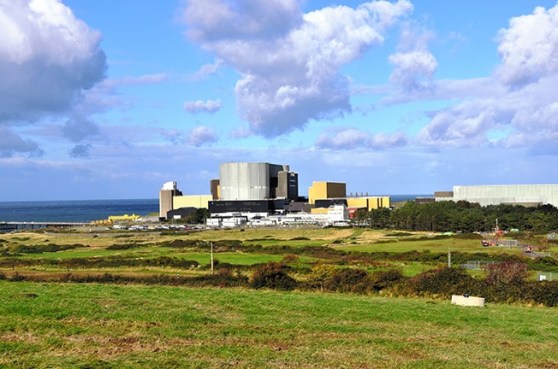
A new nuclear power plant planned by Horizon Nuclear Power Ltd., a subsidiary of Hitachi Ltd., would have been situated on the island of Anglesey in Wales
“Generals always fight the last war” is an aphorism meaning that military leaders tend to draw upon their experiences from the previous war when planning a new strategy.
Their strategy is doomed to failure because of their inability to keep up with the times by staying abreast of technological renovations and exploring new types of warfare.
Their counterparts seem to exist in present-day Japan.
Trying to “fight the last war,” such individuals are to be found among nuclear plant manufacturers as well as within the Prime Minister’s Office and the Ministry of Economy, Trade and Industry.
Apparently, they cannot forget the good old 2000s, the era of global “Nuclear Renaissance.”
Memories of Three Mile Island and Chernobyl were starting to fade into oblivion then, and that helped revive nuclear plant construction. And with the nuclear industry becoming energized in various countries, Japan was determined to grab a share of the pie, and both the public and private sectors joined forces to push nuclear plant export.
And unbelievably, they keep this up even after the Great East Japan Earthquake of 2011.
Did they believe the Fukushima disaster would have little impact on the rest of the world?
They were utterly wrong, of course. Nuclear plant construction costs skyrocketed due to reinforced safety standards.
One after another, export projects were aborted. A Hitachi project in Britain was frozen. Losses amounting to 300 billion yen wiped out the bulk of annual profit.
It is hard to believe that Japanese industry and the government, which bear grave responsibility for the Fukushima disaster, could have been so oblivious to change.
Or could it be that they were simply unable to think straight because they could not find a business they could sell to the rest of the world?
Hitachi Chairman Hiroaki Nakanishi is also chairman of Keidanren (Japan Business Federation). At a recent news conference, Nakanishi created a stir by strongly advocating restarts of off-line nuclear reactors.
Is he growing frustrated and impatient over stalled exports? He obviously is totally out of touch with Japanese public opinion that has grown sensitive to the risks inherent in nuclear power generation.
I am convinced Nakanishi is the proverbial general who keeps fighting the last war.
January 20, 2019
Posted by dunrenard |
Japan | Hitachi, Nuclear Exports |
Leave a comment
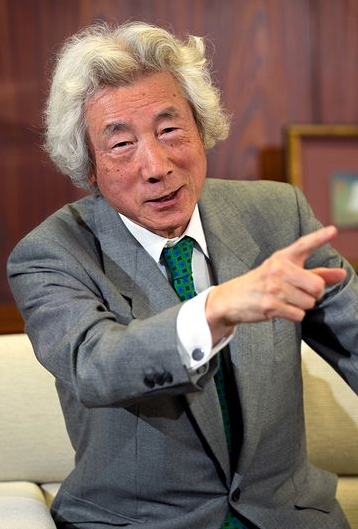
Former Prime Minister Junichiro Koizumi speaks about his zero nuclear power proposal during a Dec. 12 interview in Tokyo.
January 17, 2019
When he was prime minister, Junichiro Koizumi championed the use of atomic power to generate electricity.
Then the 2011 earthquake and tsunami disaster struck, triggering a crisis at the Fukushima No. 1 nuclear power plant in Fukushima Prefecture.
Koizumi, in office from 2001 to 2006, and widely regarded as one of Japan’s most popular postwar leaders, started reading up on the nuclear issue, and had a change of heart.
Koizumi, 76, published his first book by his own hand titled “Genpatsu Zero Yareba Dekiru” (We can abolish all nuclear plants if we try) in December. It is available from Ohta Publishing Co.
In it, he lambasts consumers for lacking a sense of crisis and simply believing a serious accident like the Fukushima disaster will never happen again in Japan during their lifetime.
In a recent interview with The Asahi Shimbun, Koizumi said it was “a lie” to claim that nuclear power is “safe, low-cost and clean,” although that is precisely what he espoused when he held the reins of power.
Excerpts from the interview follow.
Question: An opinion poll by The Asahi Shimbun in February 2018 showed that 61 percent of people oppose the restart of idle nuclear reactors, and yet, reactors are successively being brought back online. What is your view about this?
Koizumi: Many people still support the zero nuclear power generation policy. When I teamed up with Morihiro Hosokawa, (a former prime minister), who ran for the Tokyo governor’s election (in 2014), to call for abolition of nuclear power facilities, voters on the streets showed a positive reaction.
But now many people do not realize how dangerous nuclear reactors are. They probably believe a nuclear accident will never occur again while they live because of all the attention that has been paid to safety since the Fukushima crisis.
However, in the 2012 report compiled by the government’s panel to investigate causes of the disaster, the panel’s chair said, “Things that are possible happen. Things that are thought not possible also happen.”
In other words, there are no totally safe technologies.
Q: Many people seemingly believe that they have no choice but to accept nuclear power because it costs less than other types of electricity generation and electricity rates are cheaper. Do you agree?
A: The argument is doubtful. Nuclear power is relatively cheap just because the government covers part of the costs. Nuclear plants cannot be operated without assistance from the government. Private financial institutions would not extend loans to operators of nuclear facilities if the state did not provide guarantees.
Were it not for governmental support and taxpayers’ money, nuclear power would be more expensive than other kinds of energy.
Renewable energy (such as solar and wind power) currently accounts for 15 percent of total power production in Japan. The percentage is much higher than before the Fukushima crisis. Even if costs slightly increase, citizens would accept the zero nuclear policy.
Q: Is it really possible to replace all the nuclear reactors with other sorts of power plants?
A: No reactors were operated for two years after the Fukushima disaster. But no power shortages were reported during the period. That means Japan can do without nuclear plants. It is a fact.
Q: During your tenure as prime minister (between 2001 and 2006), it emerged in 2002 that Tokyo Electric Power Co. had concealed problems at its nuclear facilities. Didn’t that cause you to lose your trust in nuclear power even then?
A: No. Power supply is important and the risk of power failures could damage the economy. It was then said to be difficult to replace (nuclear plants that produced) 30 percent of the nation’s electricity needs with other power sources.
As there were few facilities to generate power based on renewables at the time, I believed nuclear reactors were essential. I simply trusted the Ministry of Economy, Trade and Industry, which said “nuclear energy is safe, low-cost and clean.”
Although some people argued “nuclear plants are dangerous” even before the Fukushima crisis, I was deceived by the ministry and did not take their words seriously.
I did some soul-searching and decided I ought to spread the word that Japan can do without nuclear plants.
Q: You said “deceived.” Are you working to rectify your past mistake?
A: Yes. I am touring across Japan as I am keen to share my thoughts with many people.
Q: The issue of nuclear plants and their safety has hardly featured in recent national election campaigns. What’s your take on this?
A: The construction of a nuclear reactor is estimated at 1 trillion yen ($9.28 billion) now. Building reactors requires many materials, so many companies are involved in the nuclear power business.
Many tiny, small and midsize companies benefit from nuclear plants. Many of them insist that abolishing nuclear power would throw people out of work.
Some labor unions that support opposition parties are engaged in the nuclear power generation industry, though the (main opposition) Constitutional Democratic Party of Japan says it is in favor of the zero nuclear power policy.
Q: What do you think is important in realizing a nuclear-free society?
A: Prime Minister Shinzo Abe insists nuclear plants are essential, so many lawmakers remain silent about the issue. But there are lawmakers even in the (ruling) Liberal Democratic Party who support the zero nuclear power policy.
If Abe declares the state will abolish all nuclear plants, the situation will drastically change. Both ruling and opposition parties can cooperate over the issue.
Why hasn’t the government set dream-inspiring goals to promote solar, wind and geothermal power generation?
Q: Could you explain the words in your book that “it is regrettable and irritating that I was deceived”?
A: When meeting with Abe, I always tell him, “Be careful not to be deceived by the economy ministry.” But he just smiles a wry smile and does not argue back.
He should not miss the current political opportunity that he has the upper hand (to change the government’s conventional nuclear energy policy).
Q: Do you talk with your son and Lower House lawmaker Shinjiro Koizumi about the issue of nuclear plants?
A: He knows my opinion all too well. He is still young, so he should do what he wants after gaining power.
(This article is based on an interview by Asahi Shimbun Staff Writer Takashi Arichika.)
January 20, 2019
Posted by dunrenard |
Japan | Junichiro Koizumi, nuclear energy |
Leave a comment
This screen capture shows a Resona statement prohibiting lending to entities that develop, produce or possess nuclear weapons.
TOKYO — Resona Holdings Inc., a major financial group in Japan, has announced a policy of not extending loans to borrowers that are involved in the development, production or possession of nuclear weapons.
The statement, the first of its kind by a major Japanese banking institution, came amid similar moves by an increasing number of European banks and institutional investors following the adoption at the United Nations of the Treaty on the Prohibition of Nuclear Weapons in 2017.
Whether other Japanese corporations will follow Resona’s action is a focus of attention for the future. There were other lenders banning loans for the production of nuclear weapons, but the Resona policy prohibits any loans to such companies even when such transactions are for non-nuclear related purposes.
The new posture was incorporated in a document titled “Efforts toward socially responsible investment and loans,” which was announced in November last year. According to the paper, Resona refuses to lend to those that are associated with the development, production or possession of weapons of mass destruction, such as nuclear, chemical and biological weapons, or inhuman weaponry including antipersonnel mines and cluster munitions. Entities that can be subject to relevant restrictions or sanctions, or even those with the potential to be hit with such punitive measures, will be rejected as borrowers, the document says.
An official with Resona, which has never lent to companies making nuclear weapons, explained that the banking group decided to introduce the policy “because we thought it important for providers of funds to make such efforts toward a sustainable society.”
According to the Dutch nongovernmental organization PAX, 63 financial institutions had similar lending policies as of October 2017, an increase of nine from the previous year.
A Mainichi Shimbun poll of four Japanese mega banks — Mitsubishi UFJ Financial Group, Sumitomo Mitsui Financial Group, Mizuho Financial Group and Sumitomo Mitsui Trust Holdings — as well as four major life insurance companies — Nippon, Dai-ichi, Meiji Yasuda and Sumitomo — found that all of the eight companies and groups have policies to refrain from lending and investment over inhuman weapons. Yet the entities did not specify the production of nuclear weapons as a condition to disengage from borrowers.
Officials at Sumitomo Mitsui and Mizuho replied that their companies ban loans to be used in the production of nuclear weapons, while a Mitsubishi UFJ official explained that the company is “making careful judgment in each transaction.”
January 20, 2019
Posted by dunrenard |
Japan | Nuclear Weapons Ban |
Leave a comment
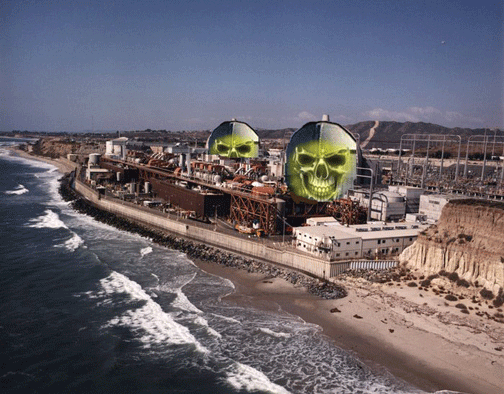
Reports: San Onofre nuclear site ‘fatally flawed’, https://www.thecoastnews.com/reports-san-onofre-nuclear-site-fatally-flawed/Samantha Taylor January 17, 2019,
REGION — Nuclear waste storage facilities at the decommissioning San Onofre Nuclear Generating Station are “fatally flawed” and could cost Southern California nearly $13.4 trillion over a 50-year period if a major release of radiation occurs, according to two reports recently published by the Samuel Lawrence Foundation.
The reports were published during an ongoing Nuclear Regulatory Commission investigation into electric supply company Southern California Edison and its contractor, Holtec International, which designed and built the storage facility.
The investigation stems from an incident on Aug. 3, 2018, when a full canister of spent nuclear fuel came within a quarter-inch of falling 18 feet.
Edison’s plan is to move 73 canisters into the oceanfront storage vault, having already moved 29 by the reports’ publication.
After the August incident, regulators stopped any more canisters from being loaded into the vault, built to hold 3.6 million pounds of nuclear waste at the San Onofre site, located on Marine Corps Base Camp Pendleton on the coastal side of I-5.
The report notes how storage tanks at gas stations in California must be double-walled after experiencing how single-walled containers can leak gasoline into groundwater.
“With a double-walled fuel tank, if a leak occurs it can be detected and the storage container can be repaired or replaced before any gasoline is released,” the report states. “At San Onofre, we certainly should expect that some kind of leak prevention system would be in place to contain extremely toxic high-level radioactive waste.”
At an Aug. 9, 2018, community engagement panel discussing the decommissioning of San Onofre, Occupational Safety and Health Administration inspector David Fritch told attendees about a near-accident at the storage facility.
When workers using a crane were moving a canister containing spent nuclear fuel, it became lodged at the top of the cavity enclosure container into which it was being stored.
Investigations revealed the operators and managers could not see the canister as it was being lowered and became stuck for nearly an hour, hanging 18 feet in the air from the guide ring along the top of the container.
The San Onofre Nuclear Generating Station (SONGS) began operating in 1968 and closed in 2012 after continuous leaks were discovered in the plant’s steam generator tubes.
The first report, titled “San Onofre Nuclear Waste Problems,” examines damage caused to the “thin-walled, steel” canisters as they are lowered into the dry storage vaults. The report refers to this damage as “gouging” and considers it the most serious of the issues facing the storage facility.,
The Del Mar-based nonprofit Samuel Lawrence Foundation’s research determined that had the canister fallen, it could have hit the steel-lined concrete floor of the facility with “explosive energy greater than that of several large sticks of dynamite.” The damage could have caused a large radiation release, according to the report, and could have ruined the facility’s cooling system.
According to the report, each nuclear storage canister contains 37 spent fuel assemblies, which generate “enormous amounts of heat” and are cooled by an air duct system, which could have been blocked by the damage from a canister falling.
If that had happened, great quantities of water would be needed to cool the reaction and prevent or control a meltdown. That water would instantly become radioactive steam, similar to what happened during the 2011 Fukushima Daiichi nuclear disaster in Japan.
In the report, retired U.S. Navy Rear Adm. Len Hering, Sr., who previously served as a nuclear weapons safety officer, provided a scathing assessment of the storage facility’s management practices.
“I find that virtually none of the protocols that should be expected for the safe handling of this dangerous material are present,” he states in the report. “I find that personnel and companies are being hired virtually off the street, no specific qualification standards are present or for that matter even required, training is not specific to the risks of the material involved, and there is no fully-qualified and certified team assembled for this highly-critical operation.”
The report also addresses the risk of storing them so close to the Pacific Ocean, where rising sea levels, frequent high humidity and coastal fog make metal susceptible to short-term corrosion and stress-induced corrosion cracking.
According to the report, the mean high tide level is about 18 inches below the base of the oceanfront storage facility, which means sea level frequently exceeds that height.
It states it’s likely that the present groundwater table will leach into the vault and result in damp storage, which the vault is not designed for.
Rising sea levels due to climate change could make things worse, potentially causing the bottom seven feet of the storage canisters to be submerged and possibility create a similar crisis to Fukushima, where spent fuel was exposed to moisture.
In the second report, titled “Potential Economic Consequences from an Event at the San Onofre Nuclear Generation Station Interim Spent Fuel Storage Installation,” uses economic impact modeling software to estimate economic losses from diminished activities within evacuation zones of one, 10 or 50 miles over one year to 50 years.
In a scenario looking at contamination across a one-mile radius, the report states the most significant loss is likely the disruption of regional transportation for up to a year costing $266 million.
The 1-mile radius, which would only represent a minor event, would still affect I-5 and the rail line.
Looking at evacuation zones of 10 to 50 miles over a one- to 50-year period, residential property losses could amount to $11 billion to $500 billion depending on the evacuation scenario. In the 50-mile impact scenario, about $13.4 trillion in gross regional product could be at risk over a 50-year period.
The first report concludes that the nuclear waste at San Onofre requires “much better storage configuration” and needs to be moved to a “technically defensible storage facility” further away from major transportation corridors like I-5.
“If an accident, natural disaster, negligence, or an act of terrorism were to cause a large-scale release of radiation, the health and safety of 8.4 million people within a 50-mile radius would be put at risk,” the report states.
It also demands that a “complete analysis of canister loading procedure and comprehensive risk assessment” be conducted transparently by an independent party, and recommends a permanent stop to the loading of nuclear storage canisters into the seaside vault, to begin placing spent fuel into “reliable canisters that can be monitored, inspected and repaired” and to move them to a facility at a much higher elevation.
January 19, 2019
Posted by Christina Macpherson |
decommission reactor, USA |
3 Comments
 Ground Zero Nagasaki: Living the nuclear past – and future, Asia Times, By SUSAN SOUTHARD JANUARY 18, 2019 “………. Much of Nagasaki and the world have, of course, moved on from that terrible morning when a 5-ton plutonium bomb plunged at a thousand kilometers an hour toward the city of 240,000 people. Forty-three seconds later, it detonated half a kilometer above Nagasaki’s Urakami Valley. A super-brilliant blue-white flash lit the sky, followed by a thunderous explosion equal to the power of 21,000 tons of TNT. The entire city convulsed
Based on my book Nagasaki: Life after Nuclear War, I often give talks in the US about that unforgettable (or now often-too-forgettable) day when, for only the second time in history, human beings deemed it right to assault their own species with apocalyptic power. At these book talks, I’ve learned to be prepared for someone in the audience to say that the Japanese deserved what they got. It’s still hard to hear.
At its “burst point,” the Nagasaki blast reached temperatures higher than at the center of the sun, and the velocity of its shock wave exceeded the speed of sound. Within three seconds, the ground below had reached an estimated 3,000 to 4,000 degrees Celsius. Directly beneath the bomb, infrared heat rays instantly carbonized human and animal flesh and vaporized internal organs. Did the men, women, and children of Nagasaki really deserve that?
As the mushroom cloud rapidly ascended 3km over the city and eclipsed the sun, the bomb’s vertical blast pressure crushed much of the Urakami Valley. Horizontal blast winds tore through the region at two and a half times the speed of a Category 5 hurricane, pulverizing buildings, trees, animals, and thousands of people.
The blazing heat twisted iron, disintegrated vegetation, ignited clothing, and melted human skin. Fires broke out across the city, burning thousands of civilians alive.
And though no one knew it yet, larger doses of radiation than any human had ever received penetrated deeply into the bodies of people and animals.
…………. the United States bombed and incinerated all or parts of 66 Japanese cities, killing, maiming or irradiating more than 668,000 civilians. In Nagasaki alone, by the end of 1945 when a first count was possible, 74,000 men, women and children were dead. Of those, only 150 were military personnel. Seventy-five thousand more civilians were injured or irradiated.
Today, this kind of indiscriminate killing and harm to civilians would be called “terrorism.”
Despite the history most Americans have learned – that the atomic bombings of Hiroshima and Nagasaki were military necessities that ended World War II and saved a million American lives by obviating the need for an invasion of Japan’s home islands – there is no historical evidence that the Nagasaki bombing had any impact on Japan’s decision to surrender.
What we aren’t taught are the political and military complexities of the last few months of the war or how, in the postwar years, the US government crafted this end-of-war narrative to silence public opposition to the atomic bombings and build support for America’s fast-expanding nuclear-weapons program.
What many don’t realize is that this misleading version of history allows us to turn away from what happened in Hiroshima and Nagasaki and continue to support the development and proliferation of nuclear weapons without ever having to think about what those weapons do.
Still, so many decades later, in a world in which the Trump administration is preparing to withdraw from a key Cold War nuclear agreement with Russia and the US nuclear arsenal is being modernized to the tune of up to $1.6 trillion, it’s worth recalling the other side of the story, the kind of suffering the Hiroshima and Nagasaki bombings caused in August 1945 and long after.
Within weeks, people in both cities began experiencing mysterious symptoms: vomiting, fever, dizziness, bleeding gums, and hair loss from what doctors would later understand as radiation-related sickness. Purple spots appeared all over their bodies. Many died in excruciating pain within a week of the first appearance of such symptoms. Fear gripped Nagasaki. From one day to the next, no one knew when his or her time might come.
In those first nine months, pregnant women suffered spontaneous abortions, stillbirths, or the deaths of their newborn infants. Many of the babies who survived would later develop physical and mental disabilities.
Five years after the bombings, thousands more began dying from leukemia and other illnesses caused by high-dose radiation exposure, initiating cycles of higher than normal cancer rates that would last for decades. The bombs had, from the survivors’ perspective, burned their bodies from the inside out. Parents exposed to radiation feared possible genetic defects in their children and hovered over them year after year, terrified that what looked like a simple cold or stomach ache would lead to severe illness or death.
Even today, radiation scientists are still studying second- and third-generation hibakusha (atomic-bomb-affected people) for genetic effects passed down from their parents and grandparents, reminding us how much we still don’t understand about the insidious nature of radiation exposure to the human body…….. http://www.atimes.com/ground-zero-nagasaki-living-the-nuclear-past-and-future/
January 19, 2019
Posted by Christina Macpherson |
Japan, weapons and war |
Leave a comment
 Times 18th Jan 2019 , One thing that all these new power plants had in common was a reliance on foreign money. The same is true for proposed plants at Bradwell B and Sizewell C. Hitachi, too, was involved in a proposed plant in Gloucestershire, which is now unlikely to progress.
Such is the vast cost of nuclear projects that few companies in the world can afford to finance them alone, and even governments struggle.
In today’s money, Hinkley C is expected to cost twice as much as the Channel tunnel. George Osborne, as
chancellor, guaranteed a return of £92.50 at 2012 prices per megawatt hour (Mwh) generated. For context, one Mwh of offshore wind power, once thought ridiculously expensive, guarantees suppliers £57.50.
Britain now finds itself with a headache. With many already regarding the Cameron government’s trust in Chinese involvement as a potential compromise of national security, it is unlikely that there would be further appetite for
a replacement Chinese partner, even if one could be found.
The French may also consider themselves already overcommitted to British projects.
Ministers will be wary, at any rate, of offering guarantees as expensive as Hinkley. Greg Clark, secretary of state for business and energy, confirmed yesterday that the government planned an energy white paper in the summer
to propose new methods for attracting nuclear financing. Pressing ahead without new nuclear capacity is plausible, but not without a considerable expansion of renewable energy and its storage capabilities. Customers may need to pay more for energy at busier times or invest in domestic storage of their own.
https://www.thetimes.co.uk/article/02d3fb2c-1a9d-11e9-944c-54b267eb465b
January 19, 2019
Posted by Christina Macpherson |
politics, UK |
Leave a comment