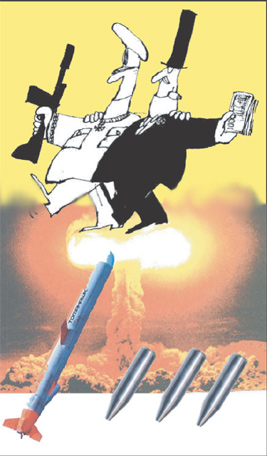
 Here’s how many billions the US will spend on nuclear weapons over the next decade, Defense News
January 26, 2019
Posted by Christina Macpherson |
USA, weapons and war |
Leave a comment
Japan Times, 26 Jan 19, DAVOS, SWITZERLAND – North Korea must make concrete pledges toward curbing its nuclear weapons program, such as dismantling its main nuclear complex and allowing international inspections to confirm the process, when leader Kim Jong Un meets U.S. President Donald Trump as soon as next month, South Korea’s foreign minister said.
Kang Kyung-wha said in an interview at the World Economic Forum in Davos that she is optimistic North Korea will agree to concrete steps toward abandoning its nuclear weapons and ballistic missile programs, developed in violation of United Nations resolutions.
“The (North Korean) leader has promised to his people many times that ‘I’m going to take this country toward economic development.’ He has to deliver that, and he’s not going to get the kind of significant assistance unless he takes concrete steps toward denuclearization and somehow eases the sanctions regime,” she said on Thursday.
“Given the strong political will on the part of the top leaders of the two sides. … I think we will see concrete results.”
Trump and Kim held a historic first summit in Singapore in June. The White House said last week a second summit would be held in late February but did not say where………https://www.japantimes.co.jp/news/2019/01/25/asia-pacific/south-koreas-looks-nuclear-dismantling-pledge-kim-summit-trump/#.XEttNNIzbGg
January 26, 2019
Posted by Christina Macpherson |
politics international, South Korea |
Leave a comment
 World War 3 fears SURGE as experts warn Saudi Arabia could be seeking ‘NUCLEAR weapons’
FEARS Saudi Arabia could be seeking to build nuclear weapons have surged following reports the Kingdom has launched a domestic ballistic missile programme. Express UK By JAMES BICKERTON, Jan 25, 2019 According to a report published in The Washington Post, Saudi Arabia appears to have constructed a ballistic missile factory, which could threaten to trigger a new Middle Eastern arms race. Saudi Arabia already owns foreign-brought ballistic missiles but has yet to construct its own. A number of experts have warned this could signal a Saudi desire to become nuclear armed.
Satellite images taken in November appear to show a ballistic missile factory near the town of Al-Watah, according to the report.
The site is situated next to an existing Saudi Arabian missile base.
A team led by nuclear expert Jeffrey Lewis, from the Middlebury Institute of International Studies, uncovered the pictures.
Mr Lewis said the images raise “the possibility that Saudi Arabia is going to build longer-range missiles and seek nuclear weapons”…..https://www.express.co.uk/news/world/1077486/World-War-3-Saudi-Arabia-nuclear-weapons-Middle-East-arms-race
January 26, 2019
Posted by Christina Macpherson |
Saudi Arabia, weapons and war |
Leave a comment
After meeting Russians, NATO chief says ‘no real progress’ on nuclear treaty, Politico, By DAVID M. HERSZENHORN– 25 Jan 19
‘We don’t want a new Cold War,’ says Jens Stoltenberg. ‘We don’t want a new arms race.’ Russia refused to give any ground during a meeting with NATO on Friday about its alleged violations of a nuclear treaty, leaving the landmark arms control agreement in “real jeopardy,” Secretary-General Jens Stoltenberg said.
NATO says Russia has deployed a new land-based missile, the Iskander 9M729, in violation of the Intermediate-range Nuclear Forces (INF) Treaty, which since 1988 has banned all missiles with a range of 500 to 5,500 kilometers. And U.S. President Donald Trump has said that he will begin withdrawing from the landmark nuclear accord on February 2 unless Russia takes steps to return to compliance.
The Kremlin insists that it has not
breached the INF, and this week a senior Russian defense ministry official showed one of contested missiles to journalists at an event outside of Moscow and said it had a maximum range of 480 kilometers, making it compliant with the treaty.
Western allies urged Russia to return to compliance at the meeting on Friday of the Russia-NATO Council, but Stoltenberg said the session yielded no change in either side’s position……https://www.politico.eu/article/jens-stoltenberg-russia-nato-after-meeting-russians-chief-says-no-real-progress-on-nuclear-treaty/
January 26, 2019
Posted by Christina Macpherson |
politics international, Russia |
Leave a comment
24 years ago today, the world came disturbingly close to ending, The Russian military mistook a research rocket launched by scientists for a US missile attack. https://www.vox.com/future-perfect/2019/1/25/18196416/nuclear-war-boris-yeltsin-1995-norway-rocket By Dylan Matthews@dylanmattdylan@vox.com Jan 25, 2019, Today, January 25, 2019, marks the 24th anniversary of the time that I (and many millions of others) came closest in my lifetime to getting nuked to death.
That day, a group of American and Norwegian researchers launched a Black Brant XII sounding rocket from the Arctic Circle island of Andøya in an effort to study aurora borealis (the northern lights).
The scientists had warned Russia, the US, and 28 other countries that they were planning a launch, as they knew there was a chance that the rocket would be mistaken for a nuclear first strike.
But someone forgot to tell Russian radar technicians. The technicians sent an alert to Moscow suggesting that an American first strike might be incoming.
Within minutes, President Boris Yeltsin was brought his black nuclear-command suitcase. For several tense minutes, while Yeltsin spoke with his defense minister by telephone, confusion reigned,” the Washington Post’s David Hoffman reported a few years after the incident. “Little is known about what Yeltsin said, but these may have been some of the most dangerous moments of the nuclear age.”
It was, Hoffman reported, the first time a Russian or Soviet leader had used a nuclear briefcase in response to an actual alert. Yeltsin concluded that it was not actually a first strike and did not retaliate.
For that, I thank him; I don’t know if a Russian second strike would have sent enough warheads to kill 4-year-old Dylan all the way up in New Hampshire, but I’m also glad we didn’t have to find out.
But, of course, the 1995 incident was hardly the only time in the nuclear area we came close to an accidental nuclear exchange.
On October 27, 1962, Vasili Arkhipov, a Soviet navy officer, was in a nuclear submarine near Cuba when US naval forces started dropping depth charges (a mild explosive meant to signal for the submarine to identify itself). Two senior officers on the submarine thought that a nuclear war had already begun and wanted to launch a nuclear torpedo at a US vessel. But all three senior officers had to agree for the missile to fire, and Arkhipov dissented, preventing a nuclear exchange.
On September 26, 1983, Soviet Lt. Col. Stanislav Petrov was watching the Soviet Union’s missile attack early warning system when it displayed, in large red letters, the word “LAUNCH”; Petrov’s computer terminal gradually indicated that one, then two, then three, and eventually a total of five American missiles were incoming. Petrov declined to report the strike, knowing that if he did, the likely response would be a full nuclear retaliation. And it was good he did, because the Minuteman missiles the detection system thought it saw were actually just the sun’s reflection off clouds.
Oh, and while we’re at it: The Air Force lost a nuclear bomb off the coast of Georgia in 1958, where it remains today. There’s also a nuclear weapon stuck in a field in Faro, North Carolina, because of another time the Air Force screwed up; that bomb came extremely close to detonating.
Also, in 1980, an intercontinental ballistic missile exploded in Damascus, Arkansas, while it had a 9-megaton nuclear warhead — with three times more explosive power than all the bombs of World War II combined — on top of it. The warhead didn’t detonate; if it did, Arkansas wouldn’t exist and you never would have heard of Bill or Hillary Clinton.
We can live safely in the knowledge that much or all of humankind won’t suddenly vanish due to a miscalculation by a radar officer in Russia or the US, and that people near missile sites won’t find themselves incinerated accidentally due to technician error. Or we can continue to have nuclear weapons. But we have to choose.
January 26, 2019
Posted by Christina Macpherson |
history, incidents, Russia |
Leave a comment
$115 million nuclear contract draws scrutiny on Perry, Houston Chronicle, By James Osborne , January 25, 2019 WASHINGTON — Energy Secretary Rick Perry’s decision to award a $115 million no-bid contract to develop an advanced nuclear enrichment facility in Ohio is drawing scrutiny from Senate Republicans.
The Department of Energy said this month it would award the contract to Centrus Energy, a former government-owned contractor that ceased enrichment operations in 2013 before declaring Chapter 11 bankruptcy.
In a letter to Perry this week, Sen. John Barrasso, R-Wyo., chairman of the Senate Environment and Public Works Committee, said the company had a Ohio is drawing scrutiny from Senate Republicans.The Department of Energy said this month it would award the contract to Centrus Energy, a former government-owned contractor that ceased enrichment operations in 2013 before declaring Chapter 11 bankruptcy
In a letter to Perry this week, Sen. John Barrasso, R-Wyo., chairman of the Senate Environment and Public Works Committee, said the company had a mixed history in fulfilling federal contracts for nuclear fuel and questioned whether the money it received would end up supporting the Russian state-owned firm TENEX, from which Centrus buys enriched uranium.
“This contract appears to use American taxpayer funding to bailout Centrus, an unsuccessful business that relies on commercial relationships with Russian state-owned corporations to stay in business,” Barrasso wrote. “Congress did not authorize or fund this project.”
Both the Department of Energy and Centrus declined to comment for this story…….https://www.chron.com/business/energy/article/115-million-nuclear-contract-draws-scrutiny-on-13562022.php
January 26, 2019
Posted by Christina Macpherson |
politics, USA |
Leave a comment
Telegraph 24th Jan 2019, Britain’s nuclear industry is falling inexorably into Chinese hands. At
Hinkley Point in Somerset, after years of debate and delay concrete is now
finally being poured by EDF for the base of Britain’s first nuclear reactor
to be built since Sizewell B.
But plans to build a fleet of new reactors at
other sites where existing plants are due to be retired from service are
tumbling like nine-pins.
Will any more be built? It’s hard to say, but without giant dollops of Chinese cash it looks increasingly improbable.
Amid falling costs for renewable alternatives, Britain’s nuclear dreams are
foundering on the rocks of cold economic reality, just as they did under
Thatcher when a flood of North Sea gas arrived to reshape the nation’s
energy landscape.
EDF, which owns the UK’s existing reactor fleet, and its
Chinese partner CGN remain committed to developing three new nuclear
projects at Hinkley, Sizewell in Suffolk and another at Bradwell in Essex –
a Chinese-led scheme – quite how the £50 billion-odd cost of building them
will be met remains murky. With debts of over 31 billion euros (£27bn),
the French state-owned company is strapped for cash and looks increasingly
reliant on its Beijing-backed partner to get them built.
The dawning reality is that without Chinese money to prop up EDF the industry is a
busted flush. Amid mounting security fears, Britain will have to think hard
about the wisdom of handing over the keys to a large part of its nuclear
fleet to Beijing.
Meanwhile, there are other ways China might seek to boost
its stake in Britain’s nuclear fleet. For starters, CGN has approached the
UK government about developing Moorside, the site adjacent to Sellafield
which has been vacated by Toshiba, using its own technology. It could seek
to do something similar at Wylfa too. Moreover, Centrica is planning to
offload a 20 pc stake it holds in EDF’s existing fleet of UK reactors.
China could be a willing buyer if it is allowed to do so.
Whether or not any of this matters is of course another question, but amid growing
tensions with China over espionage and security, many figures within
Britain’s security establishment view the prospect as alarming.
https://www.telegraph.co.uk/technology/2019/01/24/britains-nuclear-industry-falling-inexorably-chinese-hands/
January 26, 2019
Posted by Christina Macpherson |
politics, politics international, UK |
Leave a comment
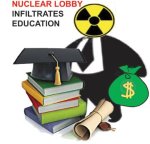 Professor says nuclear energy is safest, most practical energy source, Waste from lifetime of nuclear energy use in US would fit in soda can, professor said, The Badger Herald, by COURTNEY ERDMAN · Jan 24, 2019
University of Wisconsin hosted an international relations professor Thursday, who argued nuclear energy was the safest, most practical power source, and the best one to transition the world away from fossil fuels. ……. Goldstein recognized that many people are also afraid of nuclear waste and how to dispose of it, but their fears are also unfounded.“The actual waste would fit in a soda can if you used your whole lifetime of American-style electricity from nuclear power,” Goldstein said. …….
https://badgerherald.com/news/2019/01/24/professor-says-nuclear-energy-is-safest-most-practical-energy-source/
January 26, 2019
Posted by Christina Macpherson |
spinbuster, USA |
Leave a comment
Hungary working to modify funding for Russian-built nuclear plant, Marton Dunai, BUDAPEST (Reuters) 26 Jan 19- Hungary is working to modify financing for a nuclear plant being built by Russia so it only starts repaying the loan once the two reactors begin supplying power, a Hungarian minister said, after an EU review of the plans contributed to delays in the project.
……..Hungary awarded Russia’s state-owned Rosatom a contract to build a similar-sized plant to replace the existing one, but construction has faced long delays, partly because of a European Union review of the project, including the way it was funded.
“Once we know the deadlines for the technical contract, we will modify this (financing) contract,” said Janos Suli, the minister in charge of the project, adding that this would meet procedures set by the EU executive……….https://www.reuters.com/article/us-hungary-nuclearpower-financing/hungary-working-to-modify-funding-for-russian-built-nuclear-plant-idUSKCN1PJ153
January 26, 2019
Posted by Christina Macpherson |
business and costs, EUROPE |
Leave a comment
With the decision by Hitachi Ltd. to “freeze” its plan to build two nuclear power reactors in the United Kingdom, all of the overseas nuclear power plant projects pursued by Japanese firms — with the backing of the government seeking to promote export of nuclear power technology as a key pillar of its efforts to boost infrastructure sales in overseas markets — have now effectively been derailed. Hitachi cited its judgments on the “economic rationality” of the U.K. project as the reason for halting the plan — an allusion to the declining profitability of the nuclear power business due chiefly to the surging cost of safety investments in the wake of the 2011 meltdowns at Tokyo Electric Power Company Holding’s Fukushima No. 1 nuclear power plant.
Prime Minister Shinzo Abe has long taken the initiative to promote the overseas sale of Japanese nuclear power plants through top-level diplomacy. However, the nuclear power plant business cannot be a part of the nation’s growth strategy if its business feasibility is in doubt. The government and related industries need to face up to the situation surrounding the nuclear power business — which continues to face difficulties domestically as well — and reassess the way forward.
The Fukushima nuclear disaster, triggered by the March 2011 Great East Japan Earthquake and tsunami, has radically changed the global nuclear power market landscape. The cost of nuclear power, which had been promoted as a relatively inexpensive and “clean” source of energy that does not emit carbon dioxide, spiked as additional safety investments inflated plant expenses.
The cost of Hitachi’s project to build the two reactors in Anglesey, Wales, which began in 2012, has ballooned from the initial estimate of ¥2 trillion to ¥3 trillion. Another project pursued by Mitsubishi Heavy Industries Ltd. to build four reactors in Turkey has also been hampered by the swelling cost — which reportedly shot up from an initially estimated ¥2.1 trillion to ¥5 trillion. Toshiba Corp. has pulled out from the overseas nuclear power business after the huge losses incurred by its subsidiary Westinghouse Electric Co. in its nuclear power plant projects in the United States.
Even with a spike in plant construction costs, the nuclear power business would make economic sense if the expected earnings surpass the investments. But Hitachi reportedly decided to halt the U.K. project after it became clear that even with public support from the British government it could not possibly realize profits. The economic competitiveness of nuclear power has also been blunted by the sharp expansion of renewable energy such as solar and wind power after the Fukushima nuclear accident and its plummeting costs — although Japan lags far behind other major economies in this respect.
Behind the government’s drive to promote the sale of nuclear power plants overseas has been the domestic market’s bleak business prospects. While the government and the power industry have pushed for restarting the nation’s nuclear power plants idled in the wake of the Fukushima disaster, once they have cleared the tightened plant safety standards, only nine reactors at five plants have been put back online. The additional costs of safety investments required under the new Nuclear Regulation Authority standards to make the plants more resilient to natural disasters such as earthquakes and tsunami — estimated to range from ¥100 billion to ¥200 billion for each reactor — have prompted power companies to decide to decommission 23 aging reactors so far (including the six at Tepco’s Fukushima No. 1 plant).
As popular opposition in Japan remains strong against reactivating the idled plants, there is no prospect that the construction of new plants will be approved in the foreseeable future. The drive to promote the export of nuclear power plants may have been intended to make up for the loss of demand in the domestic market. But earlier plans for Japanese makers to build plants in Lithuania and Vietnam were canceled, while a civil nuclear cooperation pact signed with India in 2016 — which was aimed at paving the way for Japanese nuclear plant exports to the country — has not resulted in any deal. Along with Hitachi’s decision to halt the U.K. project, Mitsubishi Heavy Industries is reportedly set to abandon its plan in Turkey.
Even without construction of new plants, there will be demand for maintaining Japan’s existing nuclear power plants, and for decommissioning its aging plants. What to do with the spent nuclear fuel and the high-level radioactive wastes from the plants will also be among the challenges that confront Japan’s nuclear power business. There will be plenty of work for the industry, and it will be crucial to develop and maintain the technology and manpower to deal with the tasks.
January 25, 2019
Posted by dunrenard |
Japan | Hitachi, Mistubishi, Nuclear Exports, Toshiba |
Leave a comment
The Latest: Teen climate activist chides Davos elites https://www.newsobserver.com/news/business/article224945785.html,THE ASSOCIATED PRESS, JANUARY 23, 2019 DAVOS, SWITZERLAND
The Latest on the World Economic Forum in Davos, Switzerland
There aren’t many people, if any at all, who spend 32 hours on a train to get to the World Economic Forum in the Swiss ski resort of Davos and then sleep in a tent.
Someone who did is 16-year-old Swedish schoolgirl Greta Thunberg, who was given clearance to miss classes at her Stockholm school to push climate change to the top of the global elites’ agenda.
Thunberg has become her generation’s voice on climate change after inspiring students around the world to go on strike to relay their anger and angst over global warming.
She said Wednesday she is in Davos to “spread the message to people that we are in a crisis and we must take action now.”
Thunberg lambasted attendees who got to Davos by private jet, saying “I think it’s a bit of hypocrisy.”
January 24, 2019
Posted by Christina Macpherson |
2 WORLD, climate change |
Leave a comment

|
Hitachi chairman: Nationalization only way to rescue UK nuclear project
Nakanishi says investor support of power plant has evaporated, Nikkei Asian Review AKIHIRO SANO, Nikkei staff writerJANUARY 24, 2019 DAVOS, Switzerland — Hitachi’s frozen nuclear power plant project in the U.K. could be revived only if the business is nationalized by Britain, Chairman Hiroaki Nakanishi said here on Wednesday.
“Nationalization is the only path” to resuming the project, he told reporters on the sidelines of the World Economic Forum’s annual meeting. Nakanishi said that a scheme under which the company would not be saddled with massive assets is necessary for construction to begin.
For the government to take a majority stake in the business to fill the funding gap left by the private sector, however, legal changes are needed, he said. This clouds the prospect of the project being revived as the tumult of Brexit leaves Theresa May’s government with little political capital to push for such a change.
he added that the investor community had lost the appetite to support the project, after watching other similar nuclear projects around the world stall.
The Japanese company said last Thursday that is was freezing the nuclear project under British subsidiary Horizon Nuclear Power. It also announced an impairment loss and related expenses of around 300 billion yen ($2.74 billion) for fiscal 2018 group earnings…….https://asia.nikkei.com/Business/Companies/Hitachi-chairman-Nationalization-only-way-to-rescue-UK-nuclear-project
|
|
January 24, 2019
Posted by Christina Macpherson |
politics, UK |
Leave a comment
Q&A: Can the UK meet its climate goals without the Wylfa nuclear plant?
Carbon Brief, 21 January 2019 “……. recent analysis from the government’s official advisers the Committee on Climate Change (CCC) shows the UK could meet its power demand and climate goals to 2030 at low cost, without any new nuclear beyond the Hinkley C scheme already being built in Somerset.
This new analysis reflects the dramatic cost reductions seen for renewables in recent years. Greg Clark, the UK’s secretary of state for business, energy and industrial strategy (BEIS), made a similar point last week as he spoke in parliament about the failed Wylfa deal. He told MPs:
“The economics of the energy market have changed significantly in recent years. The cost of renewable technologies such as offshore wind has fallen dramatically…The challenge of financing new nuclear is one of falling costs and greater abundance of alternative technologies, which means that nuclear is being outcompeted.”……….
The CCC’s “central renewables” and “high renewables” scenarios meet the 2030 carbon target without new nuclear beyond Hinkley C. In these scenarios, nuclear generation in 2030 is 35TWh – the estimated output of Hinkley C plus Sizewell B, each running for 90% of available hours……….
each of the 2030 scenarios supplies enough electricity to meet projected demand, meaning the lights would not “go out”. Gas would still supply 20-25% of electricity, most of which would be used to cover peak demand during winter or to fill gaps in variable renewable output.
The CCC scenarios out to 2030 all massively expand renewables, whether or not additional new nuclear plants get built. The renewable share of the mix increases from 33% in 2018 to at least 58% in 2030. Nuclear’s share falls from 18% in 2018 to between 10% and 17% in 2030. At the low end, where no new nuclear is added after Hinkley C, it is renewables that make up the gap.
[The CCC says: “We do not consider [the BEIS 2030] pathway credible.” This pathway sees nuclear’s share hold steady, though, as BEIS notes, this is “not based on [nuclear] developers’ proposed pipeline”. BEIS also assumes imports via electricity interconnectors reach 21% of the total while the CCC assumes net-zero imports, with interconnectors helping balance supply and demand.]
The CCC says expanding wind and solar is a “low-regrets” option as renewables are likely to be cheaper than new gas, with similar costs to running existing gas plants or raising imports, even after accounting for the costs of integrating their variable output onto the grid. The CCC adds:
“If new nuclear projects [beyond Hinkley C] were not to come forward, it is likely that renewables would be able to be deployed on shorter timescales and at lower cost.”
Replacing the output of the shelved new nuclear plants at Wylfa, Moorside and Oldbury with renewables would be 13-33% cheaper, including the costs of balancing variable output, according to quickfire analysis from the Energy and Climate Intelligence Unit.
Note that reductions in per-capita electricity generation have saved the UK the equivalent of four Hinkley Cs of demand since 2005, according to recent Carbon Brief analysis. The CCC assumes continued efficiency improvements to 2030 are offset by demand for electric vehicles and heating. ……https://www.carbonbrief.org/qa-can-the-uk-meet-its-climate-goals-without-the-wylfa-nuclear-plant
January 24, 2019
Posted by Christina Macpherson |
climate change, UK |
Leave a comment
Saudi Arabia Receives Offers from 5 Countries to Build 2 Nuclear Reactors 23 January, 2019 Riyadh – Asharq Al-Awsat
Five countries have submitted their requests for the establishment of two nuclear reactors in Saudi Arabia on the Arabian Gulf coast.
The bid was made after the peaceful Saudi nuclear project met the requirements of the International Atomic Energy Agency (IAEA).
The oil-rich Kingdom launched a tender to define specifications of sites that will host the two reactors, said Chairman of King Abdullah City for Atomic and Renewable Energy (KACARE) Khalid al-Sultan.
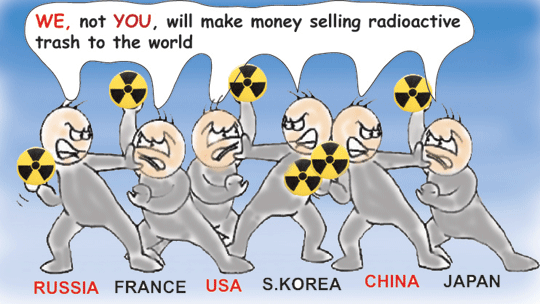
He added that KACARE asked the services providers in the US, Russia, France, South Korea and China to present their preliminary offers……. https://aawsat.com/english/home/article/1558606/saudi-arabia-receives-offers-5-countries-build-2-nuclear-reactors
January 24, 2019
Posted by Christina Macpherson |
marketing, Saudi Arabia |
Leave a comment