nuclear-news

The News That Matters about the Nuclear Industry Fukushima Chernobyl Mayak Three Mile Island Atomic Testing Radiation Isotope

Funds being cut from US Air Force nuclear, space programs

US Air Force nuclear, space programs take hit in border wall reprogramming, Defense News, Joe Gould , Aaron Mehta , and Valerie Insinna 13 May 19,  WASHINGTON — In the wake of the Pentagon reprogramming $1.5 billion in fiscal 2019 funds to support President Donald Trump’s border wall with Mexico, only the U.S. Air Force appears to be losing money appropriated for equipment updates.

May 14, 2019 Posted by | space travel, USA | Leave a comment

USA’s federal government is not likely ever to secure local consent for disposal of spent fuel from commercial nuclear reactors

Former DOE Nuclear Waste Chief Critical of Consent-Based Siting    https://www.exchangemonitor.com/former-doe-nuclear-waste-chief-critical-consent-based-siting/

BY EXCHANGEMONITOR   13 May 19, The federal government is not likely ever to secure local consent for disposal of spent fuel from commercial nuclear reactors, but that approach could nonetheless be tested in a plan for temporary storage of the radioactive material, according to a former head of the Energy Department’s Office of Civilian Radioactive Waste Management (OCRWM).

“Consent-based siting does sound very appealing. I just don’t see it leading to a successful leading to a successful conclusion. Of course, I may be wrong,” Ward Sproat, who managed OCRWM from June 2006 to January 2009 before it was dismantled by the Obama administration, wrote in a May 2 letter to Sens. John Barrasso (R-Wy.) and Tom Carper (D-Del.), the top members of the Senate Environment and Public Works Committee.

Among the obstacles to consent, Sproat wrote: history, as illustrated by failed Private Spent Fuel storage project in Utah; politics, including the potential for elected officials who support a facility to be replaced by opponents; and the need for at least two layers of local approval to analyze a selected location and then to begin licensing.

Still, Sproat indicated support for assessing the viability of a consent-based approach for interim storage discussed before the committee by an attorney with the Natural Resources Defense Council (NRDC).

Geoff Fettus, senior attorney for the NRDC’s nuclear program, was among the witnesses for a May 1 hearing on a draft bill from Barrasso that is intended to advance interim storage and permanent disposal of U.S. spent fuel and high-level radioactive waste. Among the measures, the legislation would authorize the secretary of energy to site, build, and operate at least one monitored retrievable storage facility and to store DOE-held waste in a privately operated facility.

In his prepared testimony, Fettus said the NRDC supports changing existing federal laws to give states more authority for regulating radioactive waste as part of a consent-based approach. A pilot program for interim storage should specifically involve a hardened structure at an operational nuclear power plant, Fettus said.

May 14, 2019 Posted by | USA, wastes | 2 Comments

Nuclear power is subject to human error — and that makes it a poor solution to climate change

May 14, 2019 Posted by | spinbuster, USA | Leave a comment

Education as anti-Russian nuclear strategy: USA’s Department of Energy co-opts another educational institution

Physics department to develop nuclear science program for graduate students, The GW Hatchet,  

Faculty in the physics department will receive funding from the Department of Energy to develop new nuclear science and engineering programming for international students.

Faculty said they are working to form a Nuclear Education Hub that will teach aspects of operating nuclear reactors to graduate students in a partnership with Virginia Tech. The efforts, which faculty aim to complete this fall, will focus on recruiting Ukrainian graduate students by offering them the opportunity to learn about nuclear physics unconstrained by outdated Russian safety standards for nuclear power plants, the standards most Ukrainian plants were built on.

Andrei Afanasev, the director of the project and an associate professor of theoretical physics, said faculty are primarily designing the program for Ukrainian students because Ukraine relies on nuclear power plants to generate electricity and because American nuclear companies have shown increasing interest in Ukraine’s nuclear operations……..

William Briscoe, the chair of the physics department, said the partnership was partly inspired by the desire to separate Ukraine from Russian influence ……He said the program is designed to train students who will likely work at Ukrainian nuclear power plants in the future……. https://www.gwhatchet.com/2019/05/13/physics-department-to-develop-nuclear-science-program-for-graduate-students/

May 14, 2019 Posted by | Education, USA | Leave a comment

Russia’s upgraded nuclear-powered missile cruisers to get advanced torpedo defense systems

Tass, May 13 2019  Both Project 22350 new frigates and Project 20380 corvettes under construction and Project 11442 cruisers undergoing upgrade will be furnished with the Paket-NK system.  MOSCOW, May 13. /TASS/. The advanced Paket-NK torpedo defense system developed by the Research and Production Enterprise ‘Region’ (part of Tactical Missiles Corporation) will be mounted on Project 11442 cruisers during their upgrade, Enterprise CEO Igor Krylov told TASS on Monday……..

As a result of their upgrade, the Project 11442 cruisers will get new Oniks and Kalibr missiles and Tsirkon hypersonic weapons (instead of Granit missiles currently in service). Advanced surface-to-air missile systems, communications, navigation, life support and other systems are due to be mounted on these warships.
The Project 11442 heavy missile cruisers are among the Russian Navy’s largest warships: they are 250 meters long and displace over 26,000 tonnes. The warships have 20 launchers of Granit anti-ship supersonic missiles as their basic armament. The warships have an unlimited operating range due to their nuclear propulsion unit. Russia and the United States are the sole countries that operate warships of this class. http://tass.com/defense/1057894


May 14, 2019 Posted by | Russia, weapons and war | Leave a comment

The false hope of “Small Modular Nuclear Reactors” being pushed in Wales

Beyond Nuclear 12th May 2019 Irene is with a group called CADNO, founded in 1987 and active until the plants closed. The CADNO acronym in Welsh means Society for the Prevention
of Everlasting Nuclear Destruction. It is also the Welsh word for fox.
Now the group is slowly gearing back up, because the Trawsfynydd site is being
talked about as a possible location for a new, small modular reactor (SMR).
CADNO is the fox we actually need to guard this henhouse. The old
Trawsfynydd reactors are decommissioning now, but very slowly. On
Wikipedia, the page proclaims that the decommissioning is expected to take
“almost 100 years.”
The SMR phantom is manifesting itself many places
beyond Trawsfynydd. Being described as “small” and “modular” tends
to mask the reality that it is expensive, of little use for climate change,
and likely still far in the future.
Local politicians, including in Gwynedd, the county in which the Trawsfynydd reactors sit, view the project as an easy jobs handout for a region struggling to employ people. It’s
false hope, of course, because the likelihood of SMRs coming to fruition is
slim and would provide only a handful of jobs.
The area is ripe for more wind power but the UK government remains eager to subsidize new nuclear instead, the only way new nuclear power plants will ever get built.

https://beyondnuclearinternational.org/2019/05/12/the-fox-we-need-to-guard-this-henhouse/

May 14, 2019 Posted by | Small Modular Nuclear Reactors, spinbuster, UK | Leave a comment

Majority of UK voters want to slash greenhouse gases to nearly zero by 2050

Independent 12th May 2019 A majority of voters would support radical action to slash greenhouse gases
to nearly zero by 2050 at a cost of tens of billions of pounds, a new poll
has found. The public has thrown its weight overwhelmingly behind calls by
the government’s independent climate change advisers to make a legally
binding commitment to achieving net zero carbon emissions by the middle of
the century. The exclusive survey by BMG Research found 59 per cent of
voters would support such action, with only 8 per cent opposing it and 34
per cent who had no view.

https://www.independent.co.uk/news/uk/politics/climate-change-greenhouse-gasses-public-support-poll-greta-thunberg-a8909641.html

May 14, 2019 Posted by | climate change, UK | Leave a comment

UK’s Committee on Climate Change urged to consider a carbon tax

FT 13th May 2019 Nick Butler: There is a very simple measure the UK’s Committee on Climate
Change could have flagged. We need a carbon tax to change consumer
behaviour. Introduced at a level designed to alter behaviour (perhaps £50
a tonne), a carbon tax would encourage consumers of all kinds – from
manufacturers to domestic customers – to switch to lower-carbon energy
supplies and encourage the development of technology to make that possible.

Charged at this level a tax would be far more effective than the current
EU-based measures and would allow energy users to identify low-cost
alternatives, or where necessary develop them. In the process, it would
demonstrate whether the most expensive options, such as carbon capture and
the reconstruction of the way we heat buildings, are really necessary.

https://www.ft.com/content/2c5f19d6-7245-11e9-bf5c-6eeb837566c5

May 14, 2019 Posted by | climate change, UK | Leave a comment

Professor Kazuhiko Kobayashi at Sellafield, warns on nuclear radiation and danger to children

Radiation Free Lakeland 12th May 2019 Professor Kazuhiko Kobayashi has done ground breaking work with theUniversity of Tokyo on the impact of climate change on rice nutrition. This is important work and it has been widely featured in national and
international media.

Kazuhiko’s real passion however is to warn people
about the worst criminality against humankind: nuclear power and nuclear
weapons.

Kazuhiko organises respite for children and families who have been
impacted by the ongoing Fukushima disaster.

Members of Radiation Free Lakeland met up with Kazuhiko last autumn to show him the Sellafield area and he told us that there is money for climate research but not so much for
research into the impacts of radiation on our food and health. He is a kind
gentle man and he was visibly shocked to see the scale of Sellafield.

Kazuhiko broke down in tears within the shadow of Sellafield, at the
impacts the nuclear industry is having on our children’s health. His
passionate opposition to nuclear power and weapons, his work for change and
to help those impacted, is an inspiration.

https://mariannewildart.wordpress.com/2019/05/12/worst-criminality-against-humankind-report-from-fukushima-by-kazuhiko-kobayashi/

May 14, 2019 Posted by | Japan, opposition to nuclear | Leave a comment

USA preparing Hanford vitrification plant to deal with 56 million gallons of radioactive waste

May 14, 2019 Posted by | - plutonium, USA | Leave a comment

Fukushima’s mothers became radiation experts to protect their children after nuclear meltdown 

https://www.abc.net.au/news/2019-05-12/fukushima-mums-teach-themselves-how-to-be-radiation-experts/11082520

Key points:

  • Mothers in Fukushima set up a radiation testing lab because they didn’t trust government results
  • The women test food, water and soil and keep the public informed about radiation levels
  • A major earthquake and tsunami caused a nuclear accident at the Fukushima power plant in 2011

They are testing everything — rice, vacuum cleaner dust, seafood, moss and soil — for toxic levels of radiation.

But these lab workers are not typical scientists.

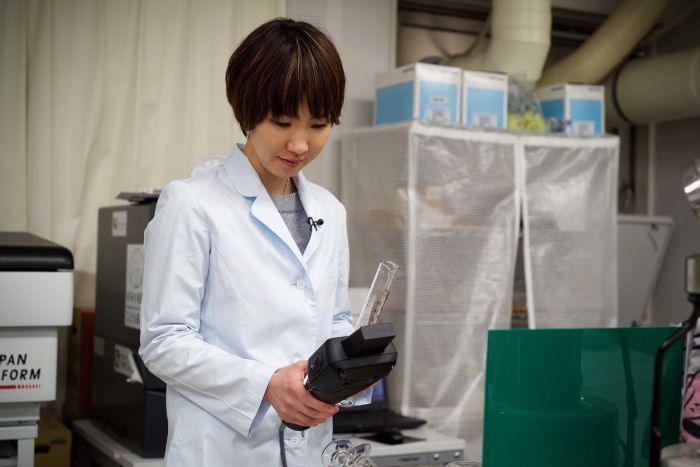
They are ordinary mums who have built an extraordinary clinic.

“Our purpose is to protect children’s health and future,” says lab director Kaori Suzuki.

In March 2011, nuclear reactors catastrophically melted down at the Fukushima Daiichi plant, following an earthquake and tsunami.

Driven by a desperate need to keep their children safe, a group of mothers began testing food and water in the prefecture.

The women, who had no scientific background, built the lab from the ground up, learning everything on the job.

The lab is named Tarachine, a Japanese word which means “beautiful mother”.

“As mothers, we had to find out what we can feed our children and if the water was safe,” Ms Suzuki says.

“We had no choice but to measure the radiation and that’s why we started Tarachine.”

After the nuclear accident, Fukushima residents waited for radiation experts to arrive to help.

“No experts who knew about measuring radiation came to us. It was chaos,” she says.

In the days following the meltdown, a single decision by the Japanese Government triggered major distrust in official information which persists to this day.

The Government failed to quickly disclose the direction in which radioactive materials was drifting from the power plant.

Poor internal communications caused the delay, but the result was that thousands fled in the direction that radioactive materials were flying.

Former trade minister Banri Kaieda, who oversaw energy policy at the time, has said that he felt a “sense of shame” about the lack of disclosure.

But Kaori Suzuki said she still finds it difficult to trust the government.

“They lied and looked down on us, and a result, deceived the people,” Ms Suzuki says.

“So it’s hard for the people who experienced that to trust them.”

She and the other mothers who work part-time at the clinic feel great responsibility to protect the children of Fukushima.

But it hasn’t always been easy.

When they set up the lab, they relied on donated equipment, , and none of them had experience in radiation testing. There was nobody who could teach us and just the machines arrived,” Ms Suzuki says.

“At the time, the analysing software and the software with the machine was in English, so that made it even harder to understand.

“In the initial stage we struggled with English and started by listening to the explanation from the manufacturer. We finally got some Japanese software once we got started with using the machines.”

Radiation experts from top universities gave the mothers’ training, and their equipment is now among the most sophisticated in the country.

Food safety is still an issue

The Fukushima plant has now been stabilised and radiation has come down to levels considered safe in most areas.

But contamination of food from Japan remains a hotly contested issue.

Australia was one of the first countries to lift import restrictions on Japanese food imports after the disaster.

But more than 20 countries and trading blocs have kept their import ban or restrictions on Japanese fisheries and agricultural products.

At the clinic in Fukushima, Kaori Suzuki said she accepted that decision.

“It doesn’t mean it’s right or wrong. I feel that’s just the decision they have made for now,” she says.

Most results in their lab are comparatively low, but the mothers say it is important there is transparency so that people know what their children are consuming.

Fukushima’s children closely monitored after meltdown

Noriko Tanaka is one of many mothers in the region who felt that government officials were completely unprepared for the unfolding disaster.

She was three months pregnant with her son Haru when the disaster struck.

Ms Tanaka lived in Iwaki City, about 50 kilometres south of the power plant.

Amid an unfolding nuclear crisis, she panicked that the radioactive iodine released from the meltdown would harm her unborn child.

She fled on the night of the disaster.

When she returned home 10 days later, the fear of contamination from the invisible, odourless radioactive material weighed deeply on her mind.

“I wish I was able to breastfeed the baby,” she says.

“[Radioactive] caesium was detected in domestic powdered milk, so I had to buy powdered milk made overseas to feed him.”

Ms Tanaka now has two children —seven-year-old Haru and three-year-old Megu. She regularly takes them in for thyroid checks which are arranged free-of-charge by the mothers’ clinic.

Radiation exposure is a proven risk factor for thyroid cancer, but experts say it’s too early to tell what impact the nuclear meltdown will have on the children of Fukushima.

Noriko Tanaka is nervous as Haru’s thyroid is checked.

“In the last examination, the doctor said Haru had a lot of cysts, so I was very worried,” she says.

However this time, Haru’s results are better and he earns a high-five from Dr Yoshihiro Noso.

He said there was nothing to worry about, so I feel relieved after taking the test,” Ms Tanaka says.

“The doctor told me that the number of cysts will increase and decrease as he grows up.”

Doctor Noso has operated on only one child from Fukushima, but it is too early to tell if the number of thyroid cancers is increasing because of the meltdown.

“There isn’t a way to distinguish between cancers that were caused naturally and those by the accident,” he says.Dr Noso says his biggest concern is for children who were under five years old when the accident happened.The risk is particularly high for girls.

Even if I say there is nothing to worry medically, each mother is still worried,” he says.

“They feel this sense of responsibility because they let them play outside and drink the water. If they had proper knowledge of radiation, they would not have done that,” he said.

Mums and doctors fear for future of Fukushima’s children

After the Chernobyl nuclear disaster of 1986, the incidence of thyroid cancers increased suddenly after five years….

“In the case of Chernobyl, the thyroid cancer rate increased for about 10 years. It’s been eight years since the disaster and I would like to continue examinations for another two years.” …….

Some children, whose families fled Fukushima to other parts of Japan have faced relentless bullying.

“Some children who evacuated from Fukushima living in other prefectures are being bullied [so badly that they] can’t go to school,” Noriko Tanaka said.

“The radiation level is low in the area we live in and it’s about the same as Tokyo, but we will be treated the same as the people who live in high-level radiation areas.”

Noriko is particularly worried for little Megu because of prejudice against the children of Fukushima.

“For girls, there are concerns about marriage and having children because of the possibility of genetic issues.”

May 13, 2019 Posted by | Japan, radiation, women | Leave a comment

A key annual defense bill is poised to serve as a battleground over President Trump’s nuclear weapons policy.

May 13, 2019 Posted by | politics, USA | Leave a comment

Nuclear power completely unnecessary in sunblest Middle East

No one in the sun- and gas-soaked Middle East needs nuclear power  https://www.fdd.org/analysis/2019/05/09/no-one-in-the-sun-and-gas-soaked-middle-east-needs-nuclear-power/?utm_content=bufferd1c88&utm_medium=Twitter+(via+Buffer)&utm_source=twitter.com/fdd&utm_campaign=@FDD+via+Buffer+feed  
Mark Dubowitz. Chief Executive, Henry Sokolski, 12 May 19

May 13, 2019 Posted by | MIDDLE EAST, politics | Leave a comment

Chernobyl nuclear accident: how it happened, and the aftermath

In the immediate aftermath of Chernobyl, a total of 31 firemen and plant workers died. Some of their bodies were so radioactive, they had to be buried in lead coffins. A report by the World Health Organization estimated that 600,000 people within the Soviet Union were exposed to high levels of radiation, and of those, 4,000 would die. Those who lived near the Chernobyl site have reported increased instances of thyroid cancer, and they have an increased risk of developing leukemia.

700 Million Years

The Chernobyl accident is one of only two nuclear energy accidents that is classified as a “Level 7 Event,” the highest classification. The other is 2011’s Fukushima disaster in Japan. At the lowest level of Reactor 4 lies the famous “elephant’s foot”, a several-meter wide mass of corium that is still giving off lethal amounts of radiation. The half-life of radioactive elements is defined as the amount of time it takes for the radioactivity to fall to half its original value. The half life of U-235 is 700 million years. 

May 13, 2019 Posted by | incidents, Ukraine, wastes | Leave a comment

U.S. federal board rejects objections to proposed New Mexico nuclear dump 

Federal panel rejects all objections to proposed New Mexico nuclear dump   https://www.krwg.org/post/federal-panel-rejects-all-objections-proposed-new-mexico-nuclear-dump?fbclid=IwAR1ROpcdsAWDegwnW0vib6ICXXy3q2lzDVTrrOuEbKN4ZbM90Q169XCM6Cc

 • MAY 7, 2019  On Tuesday, the Nuclear Regulatory Commission announced that its Atomic Safety and Licensing Board had rejected every objection made by intervenors challenging Holtec International’s application to build a storage facility for high-level nuclear waste in southeast New Mexico.

Among the requests the panel refused to consider was the objection raised by Sierra Club that U.S. law clearly prohibits nuclear waste being moved to interim facilities before a permanent storage site has been identified. No such permanent sites exist in the U.S.

“This ‘interim’ storage facility could well become a permanent repository without the protections of a permanent repository,” Sierra Club attorney Wally Taylor said in response to Tuesday’s ruling. “Now it is up to the people and public officials in New Mexico to protect New Mexicans from this boondoggle.”

“New Mexico citizens should be very concerned about this project,” Sierra Club Rio Grande Chapter Nuclear-Waste Co-Chair John Buchser said. “Energy Secretary Rick Perry has indicated he is OK with the storage-site proposal in Texas, just across the New Mexico border, becoming a permanent facility.  The Sierra Club is very concerned about possible radioactive releases from containers designed for short-term storage. The transport of this highly radioactive waste is even more risky, and the nation’s rail system is not safe enough to transport this waste.”

Taylor, representing the Sierra Club Rio Grande Chapter, and attorneys for Beyond Nuclear, Fasken, AFES and transportation intervenors raised nearly 50 different contentions before the three-judge board during oral arguments in January in Albuquerque.

The panel, charged with ruling on petitioners’ standing and the admissibility of their contentions under NRC regulations, agreed that some of the six petitioners, including the Sierra Club, had standing, but ruled that not not a single one of nearly 50 contentions raised were admissible for even an evidentiary hearing.

“The board won’t even consider transportation risk,” Buchser said.

“This decision is a perfect example and a lesson for the citizens of New Mexico and the United States of how the NRC process is shamelessly designed to prevent the public from participating,” Taylor said.

“It’s clear from the hearings across the state that the people of New Mexico don’t want this. They need to join forces and make that clear to New Mexico officials,” Taylor said. “State officials can pass and enforce laws that would require permits or other protections from the dangers posed by the transport of high-level radioactive waste to southeast New Mexico.”

The next step for Sierra Club is to appeal to the Nuclear Regulatory Commission.

May 13, 2019 Posted by | legal, safety, USA | Leave a comment