Distress in Pacific Island governments, over climate change, and Australia’s inaction on this
UN secretary-general meets Pacific leaders to discuss ‘global catastrophe’ of climate change ABC By foreign affairs reporter Stephen Dziedzic , 15 May 19
- UN secretary-general Antonio Guterres said the Pacific is on the “front line of climate change”
- Pacific leaders have voiced frustration over Australia’s failure to curb its emissions
- Australian politicians say rapidly cutting emissions would be “ruinous” for Australia
Regional heavyweights had gathered at an historic climate change summit convened with the UN secretary-general Antonio Guterres.
Mr Guterres is intent on building global momentum for sharper cuts to emissions, arguing that drastic action is necessary to stave off ecological disaster.
The Pacific is on the “front line of climate change”, Mr Guterres told the meeting.
“It has a unique moral authority to speak out. It’s time for the world to listen.”
Senior Australian officials at the meeting could do little else; sent in the place of Prime Minister Scott Morrison only days before the federal election, they were bound to observer status by the caretaker conventions.
As a result, Australia did not sign up to the final statement by Pacific leaders, which declared climate change a “global catastrophe” and called for “transformative action” to stop it……
while Pacific leaders have praised New Zealand’s announcement that it wants to go carbon neutral by 2050, many are frustrated that Australia has failed to curb its emissions.
One Pacific official told the ABC the meeting’s call for radical action on climate change “really was aimed at the whole globe” but “for those in the room [it] was a message for one country”.
“Of course no-one said Australia. No-one needed to say Australia,” the official said. “What other country in the room could we be referring to?”
The outspoken Prime Minister of Samoa, Tuilaepa Sailele, went much further, wading straight into Australia’s election campaign during the post-summit press conference…….
decision makers in Canberra also know that the Pacific is increasingly impatient about Australia’s long and painful debate on climate policy.
The argument will flare up again in only months when regional leaders gather for the Pacific Islands Forum on tiny Tuvalu, which has long been a vocal champion for drastic climate action.
And this time, Australia will not be sitting on the sidelines. https://www.abc.net.au/news/2019-05-16/guterres-antonio-un-pacific-meeting-climate-change/11115816
Nuclear lobby pushing for tax-payer funds, pretending that nuclear power is “clean”
 Scientists meeting in France seek more funds for nuclear energy https://www.downtoearth.org.in/news/energy/scientists-meeting-in-france-seek-more-funds-for-nuclear-energy-64552 15 May 19, They claim nuclear energy, being clean, [ ??] would help mitigate climate change A number of scientists and other professionals who assembled at an international summit in France on May 13, 2019, have pushed for nuclear energy, arguing it would help mitigate climate change.The scientists had gathered at the International Congress on Advances in Nuclear Power Plants (ICAPP) in Juan-les-Pins, France, to sign a declaration. There were forty nuclear associations who demanded public investment in the nuclear sector as it has experienced almost stagnant public investment since 2000 and private players too have shown little interest. “The current level of public support for nuclear research and development (R&D) has remained constant at around $4 billion per year since 2000, in a business-as-usual situation,” a statement issued by those assembled noted. The scientists gave several reasons for the lack of enthusiasm among the private sector. These included mixed or negative political signals as well as electricity market designs that have had a negative impact on the business case for nuclear energy. They underlined new reactor technologies like small modular reactors, Gen IV reactors and new applications . ike desalination, district heating, process heat for industry and hydrogen production and emphasised on the need of resources for research and development. The meet also raised the issue of R&D infrastructure, which has become obsolete and needs to be renewed. The statement demanded doubling of public investment in nuclear-related R&D and innovation within the next five years, with a focus on innovative applications of advanced nuclear systems to enable the clean energy mix of the future. The meet on May 13 comes just days before the tenth Clean Energy Ministerial (CEM) Conference scheduled on May 28 and 29 in Canada. The CEM consists of the 28-member European Union (EU) as well as 24 other countries. It accounts for 90 per cent of all investment in clean energy globally and is also responsible for around 75 per cent of global greenhouse gas emissions. The ICAPP meet demanded that the CEM Conference should takes nuclear innovation to broad, multilateral discussions on clean energy at both, the ministerial and working levels. The statement says that it will help nuclear energy and in return, the sector will help in decarbonisation goals. It should be noted that after the 2011 Fukushima accident in Japan, many countries decided to phase out nuclear energy. |
|
|
Chinese public’s trust in government means that nuclear power better able to go ahead in China
|
China and the Nuclear Debate, China’s nuclear energy sector is expanding amid the glow of positive public opinion. The Diplomat, By Layne Vandenberg, May 15, 2019 “……… The Diplomat sat down with Tobi Du, a Yenching Scholar at the Yenching Academy at Peking University to discuss nuclear issues in East Asia, how Chinese view nuclear threats, and the development of nuclear energy…….. Although China is one of the five official nuclear weapons states as designated by the Treaty on the Nonproliferation of Nuclear Weapons, China has historically supported North Korea. While China does facilitate denuclearization talks, it definitely does not feel threatened in the same way that the U.S. and Japan do considering North Korea has explicitly stated that its nuclear weapons program is intended to deter the U.S. and its allies. Because of this, people in China are not currently as sensitive to nuclear threats as they are in other countries. …… Despite the lack of public support for development of the nuclear energy industry in most other countries, research shows that the Chinese public is not strongly against nuclear power. …… [following the Fukushima nuclear accident] despite a negative outlook for nuclear energy globally, China is unique in that the public did not become as opposed to the development of nuclear energy. Trust in the government has a lot to do with this. Since Chinese citizens generally possess a low level of knowledge about nuclear energy and related issues, the public places a significant amount of trust in the government to conduct its own assessments and accepts the results. Generally, the Fukushima nuclear accident did not affect the direction of Chinese policy for nuclear energy but prompted a more careful and measured attitude towards implementation. Considering China’s unique ability to interact with and shape public discourse around sensitive topics, public input in decision-making is minimal because of this control. The central government is able to implement the nuclear energy industry in China as it sees fit. In contrast to China’s more receptive public opinion, most countries are keenly cognizant of issues related to nuclear weapons, and mostly focus on these issues and their accompanying negative connotations. ….. So while it is true that Chinese people generally have a more positive opinion of nuclear energy in China than in other countries after Fukushima, it is China’s political governance that allows the country to push forward with nuclear power.…….. https://thediplomat.com/2019/05/china-and-the-nuclear-debate/ |
|
|
How to avoid nuclear confrontation between India and Pakistan

If India’s new government has the wisdom to try once more to move away from confrontation, there is no shortage of confidence-building and nuclear risk-reduction measures to pursue. Every Indian and Pakistani diplomat worth his or her salt can quickly identify a half-dozen worthwhile measures that would not diminish security while helping to place time and space before another clash. If enough time and space are added, there may not be another clash.
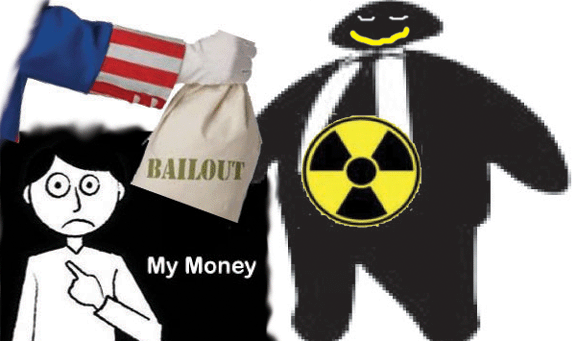
Unnecessary to bail out Ohio’s nuclear and coal plants, but a bonanza for FirstEnergy Solutions
|
IEEFA update: Bailing out Ohio’s nuclear and coal plants unnecessary for supply or rate stability
But $300 million annual charge would be bonanza for FirstEnergy Solutions (IEEFA U.S.) – A bill before the Ohio General Assembly (HB 6), aimed at rescuing FirstEnergy Solutions’ economically uncompetitive aging nuclear and coal-fired power plants is misguided, according to a briefing note released by the Cleveland-based Institute for Energy Economics and Financial Analysis (IEEFA).The briefing note: Bailout Bill a Bonanza for FirstEnergy Solutions, may end up costing Ohio consumers and businesses more than $300 million per year “in perpetuity,” according to IEEFA. “Proponents of this ill-advised bill are using misleading arguments to warn about nonexistent dangers to the electricity supply and rising energy costs,” said IEEFA director of resource planning analysis and author of the briefing note David Schlissel. “The data shows, to the contrary, that Ohio has ample energy supply and that retiring the plants in question would in no way undermine the reliability of the system or raise costs.” The bill would keep open FirstEnergy Solutions’ Davis-Besse and Perry nuclear power plants and could also provide revenue for the Sammis coal-fired plant in Ohio. There is no evidence to suggest that extending their operational lifespans would benefit consumers. EEFA found that:
PJM, the operator of the regional electricity market, has concluded that the deactivation of FirstEnergy Solutions’ nuclear power plants in Ohio and Pennsylvania will have no effect on the reliability of the electric power grid…….. Those studies by the Brattle Group were based on misleading assumptions about the cost of renewables and inflated notions about how much energy the nuclear plants were actually providing to the system,” said Schlissel. “This bill is clearly designed to benefit FirstEnergy Solutions and not Ohio ratepayers.” IEEFA recommends that Ohio follow the lead of New York state and allocate resources to support the tax bases of school districts and communities undergoing economic transition caused by the closure of coal and nuclear plants. The briefing note suggests that the state design a program to support workers who lose their jobs when coal and nuclear plants close. Such a program should also include thorough and timely clean-up and decommissioning of these facilities, with hiring preferences given to former plant employees, according to IEEFA. http://ieefa.org/ieefa-update-bailing-out-ohios-nuclear-and-coal-plants-unnecessary-for-supply-or-rate-stability/?fbclid=IwAR1t8o2qjaqzn995F360PTVYtV5fimZUaPX1ls7R-gDd1q15XyUnO3AjuQA |
|
Highly radioactive chimney at Fukushima No 1 plant to be taken apart
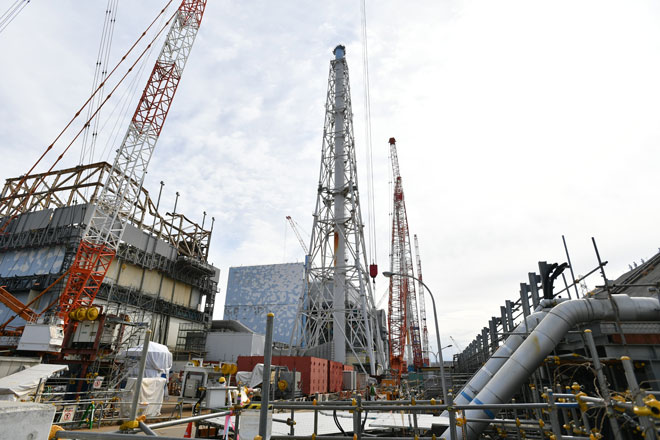
TEPCO to slice dangerous chimney at Fukushima plant http://www.asahi.com/ajw/articles/AJ201905100045.html, By CHIKAKO KAWAHARA/ Staff Writer, May 10, 2019 Tokyo Electric Power Co. plans to start work on May 20 to dismantle a 120-meter-tall, highly contaminated chimney that could collapse at the crippled Fukushima No. 1 nuclear power plant.
It will be the first highly radiated facility at the plant to be taken apart, the company said May 9.
The stack, with a diameter of 3.2 meters, was used for both the No. 1 and No. 2 reactors. TEPCO plans to remove the upper half of the chimney within this year to prevent the structure from collapsing.
The dismantling work will be conducted by remote control because the radiation level around the base of the chimney is the highest among all outdoor areas of the plant. Exposure to radiation at the base can cause death in several hours.
After the Great East Japan Earthquake and tsunami struck in March 2011, pressure increased in the containment vessel of the No. 1 reactor. Vapors with radioactive substances were sent through the chimney to the outside.
TEPCO also found fractures in steel poles supporting the chimney. The damage was likely caused by a hydrogen explosion at the No. 1 reactor building when the nuclear disaster was unfolding.
Since then, the chimney has been left unrepaired because of the high radiation levels.
Immediately after the nuclear accident, a radiation level exceeding 10 sieverts per hour was observed around the base of the chimney. In a survey conducted in 2015, a radiation level of 2 sieverts per hour was detected there.
TEPCO will use a large crane that will hold special equipment to cut the chimney in round slices from the top.
The company set up a remote control room in a large remodeled bus about 200 meters from the chimney. Workers will operate the special cutting equipment while watching footage from 160 video cameras.
If America launched a nuclear war -335 million people killed within the first seventy-two hours.
Overall, an all-out U.S. attack on the Soviet Union, China and satellite countries in 1962 would have killed 335 million people within the first seventy-two hours.
As devastating as these projections are, all readily admit they don’t tell the entire story. While these three studies model the immediate effects of a nuclear attack, long-term problems might kill more people than the attack itself. The destruction of cities would deny the millions of injured, even those who might otherwise easily survive, even basic health care. What remains of government—in any country—would be hard pressed to maintain order in the face of dwindling food and energy supplies, a contaminated landscape, the spread of disease and masses of refugees.
While the threat of nuclear war between the United States and Soviet Union has ended, the United States now faces the prospect of a similar war with Russia or China. The effects of a nuclear war in the twenty-first century would be no less severe. The steps to avoiding nuclear war, however, are the same as they were during the Cold War: arms control, confidence-building measures undertaken by both sides and a de-escalation of tensions.
 335 Million Dead: If America Launched an All-Out Nuclear War https://nationalinterest.org/blog/buzz/335-million-dead-if-america-launched-all-out-nuclear-war-57262 “Under SIOP, “about 1,000” installations that were related to “nuclear delivery capability” would be struck.” major draw of U.S. nuclear weapons to Soviet cities would have also been the presence of local airports, which would have functioned as dispersal airfields for nuclear-armed bombers. On the other hand, the Soviet attack would largely hit ICBM fields and bomber bases in low-population-density regions of the Midwest, plus a handful of submarine bases on both coasts.
It is no exaggeration to say that for those who grew up during the Cold War, all-out nuclear war was “the ultimate nightmare.” The prospect of an ordinary day interrupted by air-raid sirens, klaxons and the searing heat of a thermonuclear explosion was a very real, albeit remote, possibility. Television shows such as The Day After and Threadsrealistically portrayed both a nuclear attack and the gradual disintegration of society in the aftermath. In an all-out nuclear attack, most of the industrialized world would have been bombed back to the Stone Age, with hundreds of millions killed outright and perhaps as many as a billion or more dying of radiation, disease and famine in the postwar period.
During much of the Cold War, the United States’ nuclear warfighting plan was known as the SIOP, or the Single Integrated Operating Plan. The first SIOP, introduced in 1962, was known as SIOP-62, and its effects on the Soviet Union, Warsaw Pact and China were documented in a briefing paper created for the Joint Chiefs of Staff and brought to light in 2011 by the National Security Archive. The paper presupposed a new Berlin crisis, similar to the one that took place in 1961, but escalating to full-scale war in western Europe.
Although the war scenario was fictional, the post-attack estimates were very real. According to the paper, the outlook for Communist bloc countries subjected to the full weight of American atomic firepower was grim. The paper divided attack scenarios into two categories: one in which the U.S. nuclear Alert Force, a percentage of overall nuclear forces kept on constant alert, struck the Soviet Union and its allies; and a second scenario where the full weight of the nuclear force, known as the Full Force, was used. Continue reading
Trump administration’s maximum pressure campaign: paving the way for war against Iran?
 The Trump administration’s maximum pressure campaign: A prelude to war with Iran? Bulletin of the Atomic Scentists By Dina Esfandiary, May 6, 2019 The Trump administration’s “maximum pressure” campaign on Iran has picked up pace. Last month, the administration designated the Revolutionary Guards as a terror organization. Last week, it cancelled waivers from US sanctions that allowed some countries to buy Iranian crude oil, aiming to force Iranian oil exports to zero, and only renewed some of the waivers that allowed foreign countries to engage in civil nuclear cooperation with Iran—key to the functioning of the Iran nuclear deal. This week, the White House stated that a routine deployment of and aircraft carrier strike group to the Persian Gulf was in fact intended to “send a clear and unmistakable message” to Iran. To date, however, the maximum pressure campaign has failed to change Iranian behavior. In fact, it seems designed to push Iran to leave the deal and set the scene for military confrontation…….. The 2015 nuclear agreement, officially known as the Joint Comprehensive Plan of Action (JCPOA), specified that three Iranian facilities—the Fordow enrichment plant, the Arak heavy water reactor, and the Bushehr nuclear power plant—would be converted with the help of foreign countries. The nuclear deal requires both Fordow and Arak to be converted into research facilities; also, Iran needs waivers to continue buying fuel from Russia for the Bushehr plant. There was no fact-based argument in favour of not renewing the nuclear waivers; they enable foreign suppliers and engineers both to work to convert the Iranian facilities so they can’t be used in a nuclear weapons program, and to have insight into Iranian civilian nuclear efforts because of their presence on the ground and access to the facilities. On 3 May, Assistant Secretary of State Christopher Ford announced the renewal of the waivers allowing work to continue on Arak, Fordow, and Bushehr facilities, but only for 90 days, rather than the previous 180. The decision to renew the waivers is welcome to those who hope all remaining parties to the nuclear deal will continue to implement it. But the engineers involved in converting Iranian facilities will not be able to make significant progress in such a short time. This short extension move effectively kicks the can down the road for 90 days. Apparently, the Trump administration did not want to risk looking lenient by renewing all nuclear waivers and so revoked two. The first allowed Iran to ship excess heavy-water to Oman, while the second permitted it to ship excess enriched uranium—any amount above a 300-kilogram limit—in exchange for natural uranium. The JCPOA states that excess enriched uranium can be either down-blended (converting uranium enriched to anything above 3.5 percent back to low enriched uranium) or sold. The US decision prevents Iran from selling the excess enriched uranium, only leaving Tehran with the option of down-blending it……… It is unclear what the Trump administration aims to achieve with its “maximum pressure” campaign. Ceasing the oil waivers only restricts Iran’s ability to purchase much needed humanitarian goods for a population that Secretary Pompeo repeatedly states the administration “stands with.” The renewal of the waivers allowing work to continue on Iran’s nuclear facilities is wise, but the shortening of the timeframe will mean that the administration will merely have to revisit the issue in 90 days. The work contemplated under the Iran nuclear deal can’t possibly be completed within three months. What’s more, far from “tightening restrictions on Iran’s program,” preventing it from shipping or selling excess nuclear material abroad seems designed to interfere with Iran’s efforts to implement its commitments under the JCPOA. Reframing a routine deployment of the USS Abraham Lincoln strike force to the region only serves to unnecessarily heighten tensions and foster the potential for miscalculation. The only reason to do any of this is to push Iran into a corner, paving the way toward military confrontation—something few want because it will achieve little. https://thebulletin.org/2019/05/the-trump-administrations-maximum-pressure-campaign-a-prelude-to-war-with-iran/?utm_source=Bulletin%20Newsletter&utm_medium=iContact%20email&utm_campaign=TrumpMaxPressure_05062019 |
|
|
Presidential candidate Joe Biden is only lukewarm about action on climate change
A Biden Presidency Would Be a ‘Death Sentence,’ Climate Activists Warn https://www.vice.com/en_ca/article/a3x39g/climate-activists-dont-like-joe-biden 12 May 19
The former vice president’s campaign has them very, very worried. Joe Biden backed one of the first climate bills in US history, has a relatively strong score from the League of Conservation Voters, and calls fighting global temperature rise “a matter of survival.” The former vice president—who became the frontrunner for the Democratic presidential nomination shortly after entering the race last month—has the profile, on paper, of someone who should be able to tout his bona fides on climate change and the environment.
It’s difficult to find many climate thinkers or activists these days who are all that excited about Biden’s entry into the Democratic primaries—and some interviewed for this story worry that if he wins he could actually slow down progress at a time when the planet is least able to afford it.
“This is an existential threat that we are talking about for all life on Earth, all Americans,” said Leah Stokes, a political scientist at the University of California, Santa Barbara, who closely follows the politics of climate change and energy. “I don’t trust him at all… I think he’s got some explaining to do about what exactly his plan is to deal with the climate crisis.”
Biden’s campaign website contains only three sentences about the greatest crisis ever to face humankind, and these are located midway down a secondary page. “We must turbocharge our efforts to address climate change and ensure that every American has access to clean drinking water, clean air, and an environment free from pollutants,” the site reads. His campaign did not respond to VICE’s request for more details on the actual policies this would entail.
There are virtually no specifics about how Biden plans to cut emissions in half by 2030—which is what United Nation scientists calculated is required to stabilize the world at or below 1.5 degrees Celsius of warming and keep cities like Houston, London, Shanghai, Jakarta, Bangkok, Lagos, Manila and Dhaka above water.
But the Reuters story sheds light on what a Biden presidency might include when it comes to climate—a return to Barack Obama’s policies of regulating emissions and working with the international community, but not the kind of aggressive action favored by experts and advocates. One of the sources for the Reuters article, Heather Zichal, previously advised Obama on climate change and is now an informal advisor to Biden. She is affiliated with Cheniere Energy, a major liquefied natural gas producer based in Houston.
Unsurprisingly, activists were alarmed by this news.
“A ‘middle ground’ policy that’s supportive of more fossil fuel development is a death sentence for our generation and the millions of people on the frontlines of the climate crisis,” Varshini Prakash, co-founder of the Sunrise Movement, which has been leading the push for a Green New Deal, said in a statement.
Even before the Reuters story, there were plenty of reasons for people like Prakash to be skeptical of Biden on climate. When he launched his campaign for president on April 29 in Pittsburgh he didn’t mention climate change once. Instead, he gave a lengthy shout-out to union leaders in the audience, promising to “restore,” “rebuild,” and “unify” America after four years under Donald Trump. Buried deep in his 40-minute speech, Biden made a passing reference to low-carbon growth, pledging his support for “rebuilding America’s clean, renewable energy.” He went on to brag that “North American energy makes us independent,” a phrase often used in reference to oil and gas production.
Ed Fallon, a former Iowa legislator turned radio talk show host and climate activist who once played a game of pool with Biden, wasn’t impressed. He found the former vice-president to be “an eloquent speaker and an all-around likable guy.” But with Iowa recovering from two months of historic flooding linked in part to global carbon emissions, and Democrat supporters rating climate change as a top concern, Fallon wanted to know how seriously Biden takes human survival on our planet.
So when Biden spoke in Des Moines on May 2, Fallon and 11 others put on penguin masks and stood directly in front of Biden’s podium holding signs that read “Climate is a crisis.” Biden addressed Fallon’s group directly. “Don’t worry, I’ll get to climate change,” he said, adding, “I introduced climate legislation way, way back in 1987,” a reference to a bill he’d pushed urging President Ronald Reagan to back a task force studying global warming. “You’re preaching to the choir,” Biden said.
But Fallon isn’t so sure. Biden at one point told the crowd that “the United States is soon going to be the largest producer of energy of any nation in the world by the end of the 2020s. My lord, what are we so afraid of?” Biden appeared to be referring to the fact that US oil production has rocketed over recent years to 12.1 million barrels per day, surpassing the output of Saudi Arabia and Russia.
“He’s proud of that,” Fallon told VICE. “Joe’s boasting about being the biggest oil producer. You can’t be proud of that and fight climate change.”
Several days later Biden travelled to Los Angeles to speak at some of his campaign’s first fundraising events. At the home of UCLA School of Medicine faculty member Cynthia Telles and media executive Joe Waz, Biden discussed global warming “in passing,” according to notes emailed to reporters from his campaign. Notes from an event at the Jonathan Club, a private Los Angeles social club, don’t mention climate change at all.
“This is not a second-tier problem,” Stokes said. “This is not something we can pretend will be easy to do and we’ll talk about later, this is a fundamental conversation that has to be happening.”
Biden has at times seemed willing to discuss climate change with the urgency it requires. Earlier this year he told the Conference of Mayorsthat the US could easily quadruple the wind power it generates and that half of electricity in North America should come “from non-polluting sources” with six years. If rising seas force millions of people out of their homes, he said, “that’s how wars start.”
Biden received an 83 percent score from the League of Conservation Voters for his support of environmental policy as a US senator, a score that may have been higher if he hadn’t missed votes while several times competing in Democratic presidential primaries, said Tiernan Sittenfeld, the group’s senior vice president for government affairs.
But she said with the impacts of climate change becoming clearer and more deadly all the time, “all candidates who are serious about running for president need to make climate change an absolute top-tier priority.” They must prove every day to voters, Sittenfeld went on, that they’ll “move forward in ambitious ways on combating climate change starting on day one in the Oval Office.” The world as we know it could literally be depending on it.
Geoff Dembicki is the author of Are We Screwed? How a New Generation Is Fighting to Survive Climate Change. Follow him on Twitter. This article originally appeared on VICE US.
European Union countries face deadline to save nuclear deal with Iran
|
Nuclear options, EU countries face a deadline to save a deal with Tehran that neither
party wants to lose, https://www.ft.com/content/1de937ae-7526-11e9-bbad-7c18c0ea0201 Michael Peel , 13 May 19 Iran’s threat to ramp up its nuclear programme sent a shudder through European capitals last week. Now EU countries face a deadline to save a landmark atomic deal with Tehran that neither party wants to lose.
The accord is likely to be raised when the bloc’s foreign ministers gather for a regular meeting in Brussels on Monday. On the table will be Iranian President Hassan Rouhani’s ultimatum issued on May 8, the anniversary of the US withdrawal from the agreement. He warned that the Islamic republic would revive atomic activities restricted under the accord, unless EU countries and fellow agreement-backers China and Russia compensate it for economic benefits lost when Washington unilaterally reimposed sanctions. The conundrum for EU states is that they have very little leeway or leverage to do more.
Efforts to sustain EU-Iran commercial dealings have been hobbled because most big companies have turned away from Tehran for fear of possible US retaliation. The pressure is growing for the Europeans to launch operations of a new company known as Instex, which is backed by France, Germany and the UK to facilitate trade with Iran.
Another idea from Tehran watchers is for European countries to lobby the US to restore waivers that allow countries including China to continue importing Iranian oil. That seems a long shot, given the failure of personal overtures by EU leaders to persuade the Trump administration to stay in the nuclear deal in the first place.
So much for the bad news. EU diplomats looking for positives say they at least have a bit of time, as escalation of the crisis seems not to be in the interests of either Iran or the EU for now. Mr Rouhani and his ministers have tempered their ultimatum with calibration, flagging that it will be at least two months and possibly several more before a possible breach of the deal’s limits.
Another perhaps surprising source of European hope is President Donald Trump. While his lieutenants John Bolton, national security adviser, and Mike Pompeo, secretary of state, back the US “maximum pressure” campaign on Tehran and have shown little interest in negotiations, the president has at least paid lip service to the possibility of dialogue. Last week he spoke repeatedly of his hope that Iran would make contact for talks. ]Such a call seems highly unlikely. But it is another sign that there is still room in this turmoil for diplomacy, rather than an inevitable slide to nuclear deal disintegration — and potentially even destructive conflict.
|
UN chief Antonio Guterres to Pacific islands, warning rich nations about climate impacts
|
UN chief Antonio Guterres hits out at climate change ‘paradox’ ahead of historic Pacific trip https://www.abc.net.au/news/2019-05-13/un-chief-antonio-guterres-talks-climate-historic-pacific-trip/11106622, Pacific Beat 13 May 19, The trip marks the first time a sitting UN secretary-general will meet with Pacific Islands Forum (PIF) leaders in the region. Key points:
“Climate change is running faster than what we are … the last four years have been the hottest registered,” Mr Guterres said yesterday alongside New Zealand’s Prime Minister Jacinta Ardern.
Under the Paris Agreement, many countries agreed to a long-term commitment to keep the rise of global temperatures well below two degrees Celsius above pre-industrial levels in a bid to substantially reduce the effects of climate change. After New Zealand, Mr Guterres will travel to Tuvalu, Vanuatu, and Fiji to meet with leaders who have for years been warning that many of the Pacific’s small island nations face being washed away by rising sea levels due to global warming. Mr Guterres added to those sentiments yesterday warning that Pacific nations are on the frontlines of climate change.
“We need to protect the lives of our people and we need to protect our planet.” However, he praised the efforts of Ms Ardern’s Government who just last week, introduced an ambitious bill that aims to make New Zealand mostly carbon neutral by 2050 while giving some leeway to farmers. ‘With America or Australia — Sydney could go down’In Fiji, Mr Guterres will meet with PIF leaders and senior government officials from the region. Samoa’s Prime Minister Tuilepa Sailele, a leading critic against nations who he believes are ignoring the threats of climate change, told the ABC’s Pacific Beat program that he had a message for Mr Guterres. To impress on him the importance of the smallness of our islands, and the quicker moves that our vulnerable islands would like to see from the bigger countries responsible for all these problems that we are facing today,” he said. Mr Sailele, who has previously blasted countries for ignoring the warnings, added that rising sea levels is not just an issue for the Pacific, but for those very same “bigger countries” as well.
His comments follow a controversial withdrawal from the Paris Agreement’s commitments by United States President Donald Trump in 2017, a move that was praised by former Australian prime minister Tony Abbott who last year said that Canberra should do the same. The secretary-general’s Pacific trip comes ahead of an anticipated Climate Action Summit that he plans to convene in September in New York. |
|
|
Fukushima’s ghost towns
Nuclear wasteland Inside the ghost towns of Fukushima, Eight years on from the tsunami and nuclear meltdown, much of Japan’s Fukushima province remains derelict and deserted. Telegraph, 13 May 19
There was a chilling silence in the town of Tomioka in the days after the March 2011 Fukushima nuclear disaster.
Shoes were left in porches, half-read newspapers lay abandoned next to cups of tea, long gone cold. As night closed in on the seaside town, lights glared out from a few bare windows, while news of the ongoing crisis at the Fukushima No. 1 Nuclear Power Plant just six miles away drifted from a solitary radio.
Nobody was home.
Eight years on, little has changed. Before March 11, 2011 – the day the tsunami engulfed the nuclear facility, forcing the evacuation of more than 150,000 residents across the region – the town had a population of 15,960. Now, just a few hundred people have returned despite the lifting of the evacuation order in April 2017.
“Officially 835 have returned, but many are plant and other clean-up workers who are renting out abandoned houses,” says Takumi Takano, a local councillor who splits her time between Tomioka and temporary digs in Koriyama an hour’s drive away that she and her husband Kenichi have lived in since evacuating.
Of the remaining locals most are either elderly, or only return during the day, she says. Most worryingly, just 14 are children. When night falls, they return to “temporary” homes elsewhere, she says. “It’s like a ghost town.”
A similar situation is found throughout the entire evacuated region, where only 12,859 of the 100,510 residents who were living in the zone before the disasters have returned, a Cabinet Office official says. Like Tomioka, many of them are clean-up workers, local residents say.
…… After almost eight years, residents, especially those with young families, have settled elsewhere, securing new jobs and starting new schools or moving out of Fukushima entirely, says says Kenichi, a former worker at the devastated nuclear plant.. Many are put off returning by the severe shortage of medical facilities in the region.
Then there’s the radioactivity,” he says, as the couple sit outside their caravan, set up on the land of their recently demolished home, which backs on to a 130-square-mile “difficult-to-return-zone” that is still considered too highly contaminated to inhabit.
Eight years on, radioactivity levels have fallen in the reopened parts of Tomioka, though remain 20 times higher than before the disaster. “It’s much higher over there,” he says, pointing to the blockaded zone, where radiation levels exceed 3.8 microsieverts per hour – the designated threshold for issuing evacuation orders.
That zone is a legacy of the nuclear disaster, when multiple reactor meltdowns and explosions, triggered by a magnitude nine earthquake and towering tsunami, spread radioactive materials for hundreds of miles around……..
despite clean-up operations there to reduce radiation levels below the government-set target of 0.23 microsieverts (µSv) per hour, other legacies of the disaster – the crumbling houses and shops, corroding vehicles and overgrown fields, not to mention 16.5 million containers of contaminated earth collected at some 140,000 sites around the region – are impossible to avoid.
The 0.23 µSv figure is significant in that it adds up to an annual dosage level of one millisievert (mSv) (calculated on the premise that a resident spends eight hours a day outdoors), stipulated by the International Atomic Energy Agency as being safe for members of the public.
But while maintaining that level is complicated by recontamination from surrounding woodland, some experts argue the figure says little about the true dangers, or safety, of radiation exposure. That the Japanese government raised this to 20 mSv in the aftermath of the disasters adds weight to their argument…….
Misao Fujita, a doctor who performs thyroid scans at a clinic in Iwaki, about 30 miles south of the nuclear plant, says a connection between the cancers and radiation exposure cannot be ruled out and the screening effect is no reason to disregard the examinations.
“What we do know is that after Chernobyl, many children developed thyroid cancer, and if you take that into account and consider the high risk that Fukushima children were exposed to radiation then I think we should carry out such tests,” Dr Fujita says, adding that thyroid cancer normally occurs in one in one million children.
Noriko Tanaka, whose son is one of Dr Fujita’s patients, says exams revealing cysts in her son’s thyroid are a concern, not least because iodine-131 – a substance that causes thyroid cancer – was contained in the plume released by the Fukushima plant that landed on Iwaki after the disasters. At the time, she was pregnant with her son. “I worry because nobody knows for sure what the future holds,” she says……….
The issue of the one million tons of contaminated water being stored at the stricken nuclear plant is another worry for residents. After receiving assurances from Fukushima plant operator Tokyo Electric Power Company (TEPCO ) that the water had been successfully treated and stripped of all but one radioactive material, tritium, the government announced in 2017 it would start releasing the water into the ocean, despite protests, especially from local fisheries.
TEPCO released convoluted data to demonstrate the water’s safety, but was forced to backtrack last September when further tests showed the sums didn’t add up and 80 per cent of the water was in fact up to 20,000 times higher than the official safe threshold. Furthermore, it contained harmful radionuclides such as iodine, caesium and strontium.
Moreover, while the initial suggestion was that tritium was relatively harmless some studies have shown it to be a cause of infant leukaemia, says Ayumi Iida of NPO Tarachine, which independently analyses seawater samples taken from the ocean near Fukushima’s two nuclear plants.
“Tritiated water is easily absorbed and hazardous when inhaled or ingested via food or water,” she says. “There’s already data indicating infant leukaemia rates are higher near to nuclear plants, and tritium is known to cause DNA damage, so while there are claims that tritium is harmless, there are counterclaims it can adversely affect health, especially among young children.”…….
Shaun Burnie, a nuclear expert with Greenpeace says that discharging the water into the ocean is “the worst option” available, and one whose main consideration is economic.
“The only viable option, and it’s not without risks, is the long-term storage of the water in robust steel tanks over at least the next century, and the parallel development of water processing technology,” he says. ……….
“The reality is there is no end to the water crisis at Fukushima, a crisis compounded by poor decision-making by both TEPCO and the government,” says Mr Burnie.
Among more pressing issues, Mr Burnie says, is 400,000 cubic meters of sludge being stored within the Fukushima plant grounds that contains high concentrations of strontium – known as a “bone-seeker” because, if introduced into the body, it can accumulate in the bones in the same way as calcium does.
With the plant still generating waste, this sludge is expected to nearly double over the next 10 years, he adds.
Strontium releases into the environment from the plant were relatively small following the 2011 disaster, but significantly greater 30 months later, when in 2013 a large strontium-laced plume contaminated land as far away as Minamisoma – a city about 20 km from the plant, Mr Burnie says. Such an event could re-occur, he says.
“Is it a good idea to lift the evacuation orders? Absolutely not. The public are right to be concerned about the possibility of further offsite releases.”
They can also be forgiven for being sceptical over official reassurances that foodstuffs are safe, says Ms Iida of Tarachine, which also runs a produce-testing laboratory and has found “plenty” of items with levels of contamination exceeding the safe limits.
Meanwhile tests on samples of soil – which has no official safe threshold in Japan – have also revealed high levels of radiation in the area, she adds.
Namie’s Obori district, about six miles northwest of the nuclear plant and within the difficult-to-return-zone, is one place where soil radiation levels remain high. In woodland backing the pretty hamlet, which is famed for its pottery but has slowly surrendered to nature, the Telegraph recorded up to 127 µSv per hour – over 350 times the IAEA’s safe threshold……
Donald Trump likes strutting on the global ‘nuclear summit’ stage, but is not interested in genuine arms control
 Beyond the spectacle of summits, Trump isn’t truly dedicated to nuclear arms control https://www.aspistrategist.org.au/beyond-the-spectacle-of-summits-trump-isnt-truly-dedicated-to-nuclear-arms-control/
 National Security Advisor John Bolton rejected North Korea’s preference for a step-by-step, reciprocal approach to talks, in which negotiating carrots such as sanctions relief, economic development, a peace declaration, or diplomatic normalisation could keep pace with corresponding progress towards weapons dismantlement and a verification framework.
Fraud and falsification regarding nuclear safety in France’s EDF reactors?
|
French watchdog investigates potential nuclear safety fraud https://www.reuters.com/article/france-nuclear-fraud/update-1-french-watchdog-investigates-potential-nuclear-safety-fraud-idUSL5N22P2X6 (Adds detail on falsification of identities)PARIS, May 13 (Reuters) – French nuclear regulator ASN said it had launched an investigation into elements of fraud and falsification regarding nuclear safety, after receiving several warnings from whistleblowers.
Last November, the ASN launched a website where the public can highlight irregularities regarding nuclear safety, which followed a 2016 scandal over falsified manufacturing documents at former nuclear reactor maker Areva and a string of problems with weldings and components at EDF nuclear reactors. Areva is now part of state-owned utility EDF and renamed Framatome. The ASN said in a statement on Monday that since then it had received 22 warnings and had launched an investigation into a small number of these as they had the characteristics of potential fraud cases. It also said it had already referred four cases to the criminal court. It declined to give more details about them. The regulator did not identify any companies involved in the investigation. EDF – which operates the 58 nuclear reactors that generate some three quarters of French electricity – said it could not immediately comment on ASN’s statement. The ASN said that initial investigations had revealed several problems, such as the use of inappropriate materials, certain activities, such as welding, carried out by people who did not have the necessary skills, and safety controls that were either missing or executed by internal staff only. The regulator said this could have a number of implications, such as modification of test results, falsification of the identity of staff having and the non-execution of certain operations such as the replacement of components. (Reporting by Geert De Clercq; Editing by Sudip Kar-Gupta and Jane Merriman) |
|
The monstrous destructive power of America’s Ohio-class submarine with up to 192 nuclear warheads
 This Old U.S. Navy Nuclear Submarine Could Nuke 24 Cities (In One Shot) If you do the math, the Ohio-class boats may be the most destructive weapon system created by humankind. National Interest, In short, a full salvo from an Ohio-class submarine—which can be launched in less than one minute—could unleash up to 192 nuclear warheads to wipe twenty-four cities off the map. This is a nightmarish weapon of the apocalypse. |
|
1 This Month
Tell Congress: Prevent Nuclear Catastrophe in Iran

Tell Congress: Prevent Nuclear Catastrophe in Iran

Read the Public Inquiry Report, the Commissioners’ report, Surrendering Australia: The AUKUS Deception is available to download for free at aukuspublicinquiry.com. Or just watch the replay of the National Press Club Luncheon.


Shut down the radiation-damaged Heysham nuclear reactors now
To see nuclear-related stories in greater depth and intensity – go to https://nuclearinformation.wordpress.com

Say No to NASA’s Reckless Nuclear Reactor on the Moon
Say No to NASA’s Reckless Nuclear Reactor on the Moon
-
Archives
- November 2026 (214)
- October 2026 (302)
- September 2026 (339)
- August 2026 (330)
- July 2026 (355)
- June 2026 (287)
- May 2026 (306)
- April 2026 (356)
- March 2026 (251)
- February 2026 (267)
- January 2026 (308)
- December 2025 (358)
-
Categories
- 1
- 1 NUCLEAR ISSUES
- business and costs
- climate change
- culture and arts
- ENERGY
- environment
- health
- history
- indigenous issues
- Legal
- marketing of nuclear
- media
- opposition to nuclear
- PERSONAL STORIES
- politics
- politics international
- Religion and ethics
- safety
- secrets,lies and civil liberties
- spinbuster
- technology
- Uranium
- wastes
- weapons and war
- Women
- 2 WORLD
- ACTION
- AFRICA
- Atrocities
- AUSTRALIA
- Christina's notes
- Christina's themes
- culture and arts
- Events
- Fuk 2022
- Fuk 2023
- Fukushima 2017
- Fukushima 2018
- fukushima 2019
- Fukushima 2020
- Fukushima 2021
- general
- global warming
- Humour (God we need it)
- Nuclear
- RARE EARTHS
- Reference
- resources – print
- Resources -audiovicual
- Weekly Newsletter
- World
- World Nuclear
- YouTube
-
RSS
Entries RSS
Comments RSS

