N.Korea shows former top nuclear envoy, Canberra Times, Joyce Lee , 3June 19
North Korea’s former top nuclear envoy, Kim Yong-chol, accompanied leader Kim Jong Un to an art performance, state news agency KCNA said on Monday, signalling that the former spymaster is alive and remains a force in the power structure.
Sunday’s appearance followed conflicting reports of shake-ups in the team that led engagement with the United States last year, only for nuclear talks to collapse after Kim Jong-un and President Donald Trump failed to strike a pact at a February summit…….
On Friday, South Korean newspaper Chosun Ilbo had said Kim Yong-chol, the leader’s right-hand man and a counterpart of US Secretary of State Mike Pompeo before the failed summit, had been sent to a labour and re-education camp, citing an unidentified North Korean source.
Asked on Sunday about the last US contact with Kim Yong-chol and North Korea in general, Pompeo declined to answer, saying, “We conduct our negotiations in private.”
Asked about reports of a “shake-up” of Kim’s negotiating team in a May 5 interview with ABC News, Pompeo said it did appear that his future counterpart would be somebody else, adding: “But we don’t know that for sure.”……..
As Kim Jong-un’s point man for the nuclear talks, Kim Yong-chol was stripped of a key party post in apparent censure for the summit’s collapse, a South Korean lawmaker said in April.
That move may have cleared the way for long-time diplomats sidelined during last year’s process to take centre stage if talks with the United States resumed, analysts said…….
The Chosun Ilbo report, which Reuters was unable to confirm independently, also said North Korea executed its working-level nuclear envoy to the United States, Kim Hyok-chol. …..
Jun 3, 2019 at 3:51 DURHAM — A citizens’ initiative group is trying to raise money to improve the capabilities to monitor radiation emanating from the Seabrook Power plant.
Citizens Fundraising Effort for Monitoring in New Hampshire is a group of New Hampshire residents who have launched an effort to raise funds to expand the C-10 system into New Hampshire. A meeting at the Durham home of Dudley Dudley, well known political activist, drew about 20 people, mostly current and past legislators and local politicians.
The group was formed by Natalie Hildt-Treat, executive director of C-10, State Representative Peter Somssich, D-Portsmouth, and Portsmouth resident Damon Thomas. The purpose for the meeting was twofold, to explain the need for additional monitoring of the Seabrook Power plant, and to ask for help in funding the initiative privately.
“I have been concerned about Seabrook from the beginning,” said Dudley. “I was arrested there and I am still waiting for my speedy trial. I am giving money to this and I ask that you all consider giving generously, too.”
Natalie Hildt-Treat, executive director of C-10 Research and Education Foundation, a pro-safety group based in Newburyport, Mass., said their organization has been conducting 24-hour monitoring in the communities within the 10-mile radius of the Seabrook Power plant since 1991 when the plant went online.
“The Citizens Radiological Monitoring Network detects and records beta and gamma radiation,” said Treat. “There are two types of radiation releases. Gamma is the most penetrating and damaging to tissue. Beta is more of an indicator, to let you know something is going on.”………
Treat said the monitoring done in New Hampshire currently, per the requirements of the NRC (Nuclear Regulatory Commission) is cumulative, using passive radiological monitoring film strips on poles, collected over a three-month period in the towns. Only Portsmouth, Concord and the plant itself have a form of real-time testing.
“I am told the reports from the three locations are sent to Concord,” said Somssich. “I have asked to see the data. What has ever been detected? My suspicion is nothing unless it’s a big releases because the data is cumulative. I would still like to see the historic data, but knowing I was irradiated three months ago does me no good. This system we are proposing would monitor in real time.”
Treat said there are 23 communities within the 10-mile radius, six in Massachusetts and 17 in New Hampshire.
“New Hampshire has never had public finding for monitoring,” said Treat. “Seabrook monitors at the plan, per requirement of the Nuclear Regulatory Commission (NRC). There have been past legislative attempts to address this, and there was a bill this year that has been put off to the next session. Since the Seabrook Power Plant was just re-licensed to 2050, a decision was made to try and fund the installation of monitoring systems in the New Hampshire town through private funding.”………
We are looking for funding to expand the monitoring from individuals, organizations and municipalities,” Thomas said. “I am happy to say that we have raised about $34,000 so far this year. We are trying to secure pledges for the rest of the funding. So, we are holding meetings to familiarize people with what we are doing and the reasons why.”
Event sponsors for the night included Sen. Martha Fuller Clark, D-Portsmouth; former State Rep Mindi Messmer, D-Rye; and State Rep. Renny Cushing, D-Hampton.
Fusion- some new issueshttp://newrenewextra.blogspot.com/2019/06/fusion-some-new-issues.html–3 June 19, Renewables are doing very well these days, with costs falling, but some say that we will also need other non-fossil options to respond to climate change. Nuclear fission is one, but it is having problems- it’s proving to be expensive and, some say, risky. Some are hopeful that new technology will improve its lot, but for others the big hope is that, at some point in the future, nuclear fusion will be available and will avoid the problems that fission faces.
It is usually claimed that fusion will be cleaner and safer, with no fission products to store and no risks of core melt downs. Moreover, since it uses hydrogen isotopes (deuterium and tritium), which are relatively easily obtained (deuterium from sea water, tritium from lithium), fusion can provide energy more or less indefinitely, into the far future. It may not be a renewed resource, but it is large. An exciting high tech solution – that could, some say, be available soon!
However, the reality is a bit more complex, with there being issues at each stage of the fuel-to-energy process, and a lot more work to do. In terms of fuel, it takes energy to extract deuterium from water, and lithium reserves, although relatively large, may be increasingly depleted given the growing demand for Lithium Ion batteries for electric vehicles. In terms of fusion plant operation, there will be radiation exposure risks and the potential for accidental release of active materials – tritium has a 12.3 year half-life, and tritiated water can be a major health hazard. Depending on the fusion system used, there will also still be some active wastes to deal with- the components and containment structures will be activated by the high radiation fluxes and have to be regularly stripped out. They will be less long-lived than fission wastes, but they are still an issue.
More generally there is the issue of plant operation in power terms. It is early days yet, since we only have experience with small prototype test projects, like JET at Culham, and no detailed plans for full scale power stations. However, it seems likely that the plants will not be run continually, but in pulses. When eventually finished, and fully commissioned (maybe by 2030?) the 500 MW rated €15bn ITER project being built in the south of France is expected to generate power in up to 10 minute bursts, and for at the most 1 hour. The proposed larger DEMO follow up (in the 2040s?) willevidently also only run in bursts, but of 2-4 hours.
One implication of this intermittent generation is that commercial scale fusion reactors, when and if they emerge, may be used not to generate base-load continuous power, but for producing hydrogen in batch-production mode. That can be used as a storable fuel for heating or be converted into various synfuels for vehicle use. It may thus be that fusion will focus on these more lucrative markets rather than trying to compete in the very tight electricity market.
There are other approaches to fusion which might offer other power options. The USA’s laser-fired ‘ignition’ system has its fans. Certainly some see the ‘inertial confinement’ approach, with tiny fuel pellets being compressed, using multiple focused laser beams, to reach fusion conditions, as winning over Tokomak magnetic constriction plasma systems like ITER. We shall see, with Google even entering the field, offering advanced electronics. Germany, Japan, South Korea and China are also in the game, as is Russia, which is where the original Tokomak design came from. TheUK national hopes rest with the MAST spherical Tokomak at Culham and derivatives like the ST40.
Few of these technologies seem likely to be running at full scale before the 2030s or even 2040’s, but some do claim that they can be ready earlier. In 2014, Lockheed surprised everyone by claiming that for their ‘compact fusion’ programe they were aiming for a ‘prototype in 5 years, defence products in 10, clean power for the world in 20 years’. We may see, but for the moment it all seems rather speculative and long term. Some of the rivals may get there faster, but, even assuming everything goes to plan, a commercial-scale ITER follow up is not now seen as likely to be available to feed power to the grid until after 2050!
Breakthroughs in smaller-scale laser fusion or some such are possible, and some reports seem to suggest imminent success (or at least a sustained positive output by 2024), but for the moment, there are the practicalities of the large scale Tokomak approach being developed by ITER to face. Some of the issues are quite worrying. The high radiation fluxes will present some operational safety issues. Indeed, a recent paper in Nature has warned that not enough attention had so far been given to safety.
It compared the current 500MW rated ITER project with the hypothetical DEMO commercial-scale follow-up project, maybe running in the 2040/50s. In ITER, it said, the risk of radiation exposure comes from fusion neutrons emitted from the plasma, γ-radiation emitted by neutron-activated components, X-rays emitted by some heating and current drive generators, and the β-radiation emitted from tritium. DEMO, would have a similar range of radiation – the main difference being the size of the inventories of typical radioactive products. It would presumably be the workforce who were most at risk, but there could also be public exposure issues, especially if there was a major loss of containment
The Nature article says that it’s been calculated that the radioactivity due to materials activation in a future fusion reactor may be three orders of magnitude more than that in a typical fission reactor with the same electrical power output, while the total radioactivity is comparable. It adds ‘from this point of view, fusion reactors may be potentially unsafe if low-activation materials are not deployed. Note that this finding may also be applicable to the more recent fusion reactor concepts with even low-activation materials adopted. This means that radiation exposure control for fusion reactor design and operation is of critical concern […] Thus, several radiation protection provisions, such as confinement barriers, radiation shielding and access control, must be applied in order to meet the maximum public dose limits required by the regulatory body and at the same time to keep individual occupational doses for workers as low as reasonably achievable.’
It also says ‘a fusion demonstration reactor is generally expected to have an order of magnitude more decay heat power than ITER, comparable to that of a fission reactor with the same electrical output power’ And finally, ‘in DEMO, radio-active waste activity after 100years, assuming that low/reduced-activation materials are used for the first wall & structure material, could be around 20–50 times more than for ITER. The larger tritium inventory is also significant for tritiated waste management. In fact, this large amount of radioactive waste and especially tritiated waste will result in a large burden for waste disposal sites in the country where DEMO is located’.
There do seem to be some serious issues, and the ITER project has attracted its fair share of criticism. Breakthroughs are always possible, but artificial fusion may not be the way ahead after all! We may have to rely on the (free) fusion reactor we already have- the sun. Maybe a safer option. And a faster one- we have working renewables now: we don’t need to wait for fusion topossibly start dealing with climate change decades hence.
Business Green 3rd June 2019 Labour launched a national green jobs tour around the UK this weekend, in a
bid to ignite national support for its ‘Green Industrial Revolution’
agenda. Shadow Business Secretary Rebecca Long-Bailey visited Morecambe in
Lancashire on Saturday to discuss the area’s potential for “green jobs” in
sectors such as offshore wind, tidal power and community-owned renewable
energy.
She said the tour aims to help Labour better understand “the skills
and ideas of people throughout society”. “That’s why we’re talking to
unions, businesses and communities across the country to prepare detailed
and ambitious plans to deliver a Green Industrial Revolution,” she said.
Alongside the tour, Labour is hosting an online call for evidence, asking
for input from trade unions, businesses, public sector bodies, party
members, civil society groups and members of the public on its plans to
develop the green jobs market around the UK. The consultation is open until
the end of 2019.https://www.businessgreen.com/bg/news/3076624/labour-launches-green-jobs-tour
Evening Standard 2nd June 2019 Three sailors serving on a submarine which carries 16 nuclear missiles have
been caught taking cocaine, the Ministry of Defence has confirmed. The
Royal Navy submariners failed a Compulsory Drugs Test shortly after HMS
Vengeance visited a US naval facility in Florida.
Beyond Nuclear 2nd June 2019 , At 7pm, on the 6thof June, at the Village East Cinema, in Lower Manhattan,
Pressenza International Press Agency, of which I am a co-director, will
host the World Premiere of our new documentary on the Treaty to Prohibit
Nuclear Weapons.
The title, The Beginning of the End of Nuclear Weapons, is
a reference to the speech made by Setsuko Thurlow to the assembled throng
of dignitaries and International Campaign to Abolish Nuclear weapons (ICAN)
campaigners, during her Nobel Laureate Speech in December 2017 when the
Peace Prize was awarded to ICAN. The film charts the story of the
development of the atomic bomb through to the negotiations to prohibit
nuclear weapons, and is told through the interventions of 14 people whose
roles have been key in the fields of activism and diplomacy.
Capitalism, Fukushima, Creative Reconstruction & The History Of Olympics by Labor Video Project Monday May 27th, 2019
Professor George Wright discusses the history of the Olympics and how privatization and control by the corporations of the world have led to in allowing the Olympics going to Japan and the contaminated Fukushima. The three broken nuclear reactors still have melted nuclear rods which must be cooled with water. He discusses the systemic corruption of the Olympic Committee and how it is now ignored the safety of the athletes and the public.
Capitalism, Fukushima, Creative Reconstruction & The History Of Olympics with Professor George Wright
The Japanese Prime Minister Abe with the support of the Internatonal Olympics Committee is planning to have the 2020 Olympics in Japan with the baseball games and para-olympics taking place in Fukushima.Professor George Wright looks at the history of Olympics and how the commericalization for profit of the Olympics has led to the Olympics Committee approving the having part of the 2020 Olympics in the still contaminated Fukushima. He talks about “created reconstrucation” and how Olympics are driven by political and corporate agendas.
Although Prime Minister Abe has told the Olympic Committee that Fukushima has been “decontaminated” the melted nuclear rods have still not been removed from the broken reactors and there is over one million tons of radioactive water in tanks surrounding the nuclear reactors.
Additionally there are tens of thousand of bags full of radioactive material in bags spread throughout the Fukushima region.
This forum was presented by No Nukes Action on Sunday May 26th, 2019. ……..
Thomas Bach, the head of the Olympics knows about the contamination in Fukushima and the lies by Japan PM Abe about the “decontamination” of Fukushima but continues to move forward with the games in Fukshima. The television companies and other sponsors control the agenda of the Olympic committee.
by Labor Video Project Monday May 27th, 2019 6:30 PM
The Japanese. government is spending tens of millions of dollars to refurbish the Azuma stadium for the Olympic games in Fukushima to whitewash the dangers of the contaminated region. The Olympic Committee is helping to propagandize the people of the world that Fukushima is “safe”. https://www.indybay.org/comment.php?top_id=18823644
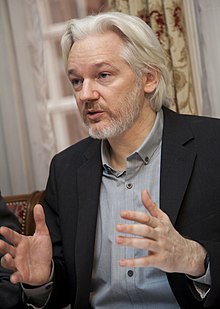
Assange won’t face charges over role in devastating CIA leak The decision surprised national security experts and some former officials, given prosecutors’ recent decision to go after the WikiLeaks founder on Espionage Act charges.
WikiLeaks founder Julian Assange will not face charges for publishing Vault 7, a series of documents detailing the CIA’s arsenal of digital code used to hack devices Politico, By NATASHA BERTRAND, 6/2/19
The U.S. Justice Department has decided not to charge Julian Assange for his role in exposing some of the CIA’s most secret spying tools, according to a U.S. official and two other people familiar with the case.
It’s a move that has surprised national security experts and some former officials, given prosecutors’ recent decision to aggressively go after the WikiLeaks founder on more controversial Espionage Act charges that some legal experts said would not hold up in court. ……
Prosecutors were stymied by several factors. First, the government is facing a ticking clock in its efforts to extradite Assange to the United States from the United Kingdom, where he is being held. Extradition laws require the U.S. to bring any additional charges against Assange within 60 days of the first indictment, which prosecutors filed in March, accusing Assange of helping former Army intelligence analyst Chelsea Manning hack into military computers.
WikiLeaks founder Julian Assange will not face charges for publishing Vault 7, a series of documents detailing the CIA’s arsenal of digital code used to hack devices | Daniel Leal-Olivas/AFP via Getty Images
The U.S. Justice Department has decided not to charge Julian Assange for his role in exposing some of the CIA’s most secret spying tools, according to a U.S. official and two other people familiar with the case.
It’s a move that has surprised national security experts and some former officials, given prosecutors’ recent decision to aggressively go after the WikiLeaks founder on more controversial Espionage Act charges that some legal experts said would not hold up in court. The decision also means that Assange will not face punishment for publishing one of the CIA’s most potent arsenals of digital code used to hack devices, dubbed Vault 7. The leak — one of the most devastating in CIA history — not only essentially rendered those tools useless for the CIA, it gave foreign spies and rogue hackers access to them.
Prosecutors were stymied by several factors.
First, the government is facing a ticking clock in its efforts to extradite Assange to the United States from the United Kingdom, where he is being held. Extradition laws require the U.S. to bring any additional charges against Assange within 60 days of the first indictment, which prosecutors filed in March, accusing Assange of helping former Army intelligence analyst Chelsea Manning hack into military computers.
Second, prosecutors were worried about the sensitivity of the Vault 7 materials, according to an official familiar with the deliberations over whether to charge Assange. Broaching such a classified subject in court risks exposing even more CIA secrets, legal experts said. The CIA has never officially confirmed the authenticity of the leaked documents, even though analysts widely believe them to be authentic……
Together Against Sizewell C chairman, Pete Wilkinson, claims that EDF CEO Jean-Bernard Lévy makes some schoolboy errors in his fatuous defence of nuclear power in his IEA February 25th speech, this having been recently reported by World Nuclear News, 20 May 2019. Pete Wilkinson says “M. Lévy is careful to use the word ‘direct’ when claiming that nuclear power produces electricity without emissions; by this, he presumably means that the only part of the nuclear fuel cycle that can even come close to being ‘low carbon’ is that which ‘burns’ uranium in the reactor. Of course, he knows, as do we all, that across the entire fuel cycle, nuclear requires an acceptance of a carbon footprint from uranium mining, milling, enrichment, fuel production, transport, nuclear plant construction, storage and the still-unknown CO2 burdens created by final spent fuel and waste management conundrums. To claim otherwise is disingenuous, especially from someone in such a position of responsibility.
It is true that the fight against climate change is challenging, but to conclude that nuclear power is essential to winning that fight is wrong and designed to defend a technology which is antiquated, costly, polluting and presents us with a wealth of unresolved health issues related to childhood leukaemia. Sixty studies, including the seminal German government-sponsored KiKK Report indicate elevated rates of leukaemia and other cancers as a result of exposure to ionising radiation.
The Oxford Research Group produced a report some years ago which clearly demonstrated that, given the global nature of the problem of climate change, it would require the building of at least 3000 nuclear plants to have a noticeable impact on the problem – that’s one new plant a week for 60 years. Impossible, yes, but wholly undesirable as well since the nuclear waste legacy that scale of programme would create is unthinkable: we can’t even deal with the 500,000 cubic metres of legacy waste in the UK after 60 years of merrily creating it without a thought about how to manage it safely. Even after ten years of the Nuclear Decommissioning Authority, the UK is still no closer to a universally safe and secure means of dealing with the legacy waste, let alone the hotter and more radioactive waste which M. Levy’s reactors will leave us over the next few decades in return for huge amounts of UK tax payers’ cash should the plant at Hinkley ever be finished and should Sizewell become more than an EdF aspiration.
A further reason why nuclear power cannot hope to have more than a minor role to play in the fight against the climate emergency, is the fact that the plants take so long to build. The ‘nuclear renaissance’ in the UK was mooted on the back of energy security and low carbon. The lights in the UK were, at the time of Blair’s announcement in 2005, predicted to go out in 2017. It is now 2019, the lights didn’t go out and no new nuclear is contributing electricity to the national grid in the UK and is unlikely to be doing so for at least another six or seven years – probably longer, given the historic over-runs of time and budget which accompany nuclear plant. Nuclear is an option for the future, not an imperative: that much has been shown time and again with analyses from highly reputable and responsible green and academic groups. Nuclear just can’t contribute fast enough and even if and when it does, its contribution will be only marginal at best, negative at worst.
By definition, renewables are potentially endless. They rely on the Sun, the wind, the tides and ambient energy. Moreover, the source of the energy arrives free-of-charge, without mining for rare, unstable and potentially lethal metals or digging for fossil fuels to burn, releasing their carbon back into the atmosphere. Combined with efficiency measures, decentralised electricity generation, smart grids and conservation measures which have already seen electricity demand fall in the UK by some 16% in the last decade, we can meet all our climate change, cost and demand targets without nuclear. This has been demonstrated time and time again: nuclear is an option, not an imperative, and it is an option we should refuse.
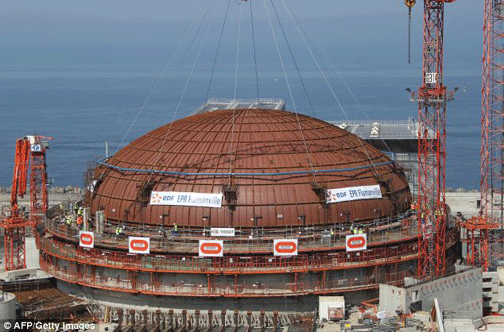
Quite apart from the fact that EdF’s flagship EPR Flamanville plant is facing a further two year delay as a result of ASN’s likely demands that reactor core welds are repaired, it is appropriate to remind M. Lévy that EdF is hugely in debt, that its board of Directors are not united in their view of the company’s new build programme and that the victim communities around the proposed sites for new build are fearful of the wholesale disruption to their lives, the environment and the tranquility they currently enjoy in these largely remote and isolated sites”.
The Democratic takeover of the House refocused the climate conversation in Washington. Freshman Rep. Alexandria Ocasio-Cortez (D-N.Y.) along with Sen. Edward J. Markey (D-Mass.) introduced a nonbinding resolution calling for a Green New Deal, which aims to achieve a “fair and just transition” to net-zero emissions and ties climate action to other progressive goals such as universal health care and a jobs guarantee. The resolution, which became the subject of GOP mockery, has drawn criticism from labor leaders and some Democratic presidential hopefuls.
Climate change has emerged as a key issue in the race for the 2020 Democratic presidential nomination. Candidates frequently discuss climate change on the campaign trail and often face questions from the audience on how they will address the issue.
Where the candidates stand
Here’s where 2020 candidates stand on issues related to climate change, based on candidate statements, voting records and answers to a questionnaire we sent every campaign.
Highlight a candidate
BACKGROUNDPresident Trump intends to withdraw from the Paris climate agreement, under which the United States had pledged by 2025 to cut its greenhouse gas emissions by at least 26 percent of its 2005 levels. This will leave the United States the only country to reject the agreement. As the second-largest global emitter of greenhouse gases, the United States would need to do considerably more than President Obama promised in order to limit warming to 1.5 degrees Celsius, experts say……..
Do you support building more nuclear power plants?
YES, EXPAND NUCLEAR POWER – these answered:
Bennet. Booker. Delaney, Hickenlooper, Moulton, Ryan. Yang
NO NEW PLANTS AT THIS TIME – these answered:
Bullock, Buttigieg, Castro, de Blasio, Inslee. Swalwell
NO AND LET’SPHASE OUT NUCLEAR POWER – these answered:
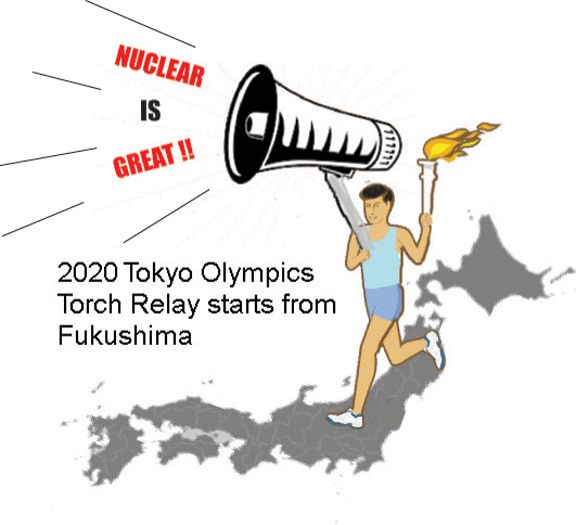
Tokyo 2020 reveals Olympic Torch route will begin in Fukushima, Inside the Games,By Matthew Smith, 1 June 2019
The Tokyo 2020 Organising Committee has revealed the Olympic Torch Relay route, which will take in many of Japan’s most historic and famous sites – and also areas touched by tragedy.
The Flame will be taken all over Japan inside 121 days, culminating in the Olympic Games next summer.
It will begin the final leg of its journey on March 26, 2020 from the J-Village National Training Centre in Fukushima, the training facility of the Japan football team.
The Flame will travel to all 47 prefectures of Japan, with the Organising Committee claiming around 98 per cent of Japan’s population live within one hour’s travel of the proposed route.
The route will take in World Heritage Sites such as Mount Fuji and Itsukushima Shrine, but will also visit areas affected by recent disasters.
Fukushima has been chosen as a start point after the Tohoku region was struck by an earthquake and tsunami in 2011, which also caused a nuclear incident at the Fukushima Daiichi Nuclear Power Plant.
As well as revealing the route, Tokyo 2020 also unveiled the Torchbearer uniforms and how members of the public could apply to take part in the Relay.
The uniform features the Relay emblem on the front and the Olympic symbol on the back.
The most notable design feature is a diagonal red stripe, echoing the sash used in place of batons in Ekiden, Japan’s historic long-distance relays…….
“In Japan, these Games are being referred to as ‘the Recovery Games’ and so the Olympic Flame will start its journey from an area affected by recent natural disasters……
June 2, 2019 Former Congressman and presidential candidate Ron Paul says Julian Assange could die in prison and blames the apparent deterioration in the WikiLeaks founder’s heath on how he is being treated by the US and UK governments.
Speaking on ‘Ron Paul Liberty Report, the 83-year-old accuses the US government of pursuing Assange and says they would like to either challenge him with a death penalty or a life time in prison ‘for being a journalist.’
The Libertarian calls Assange’s a ‘tragic story’ and describes his health as ‘very very bad,’ commenting that friends of the whistleblower are worried that his health may not hold up.
Assange, 47, has been moved to the hospital wing at Belmarsh prison and has been found too unwell to appear by video-link as scheduled at Westminster magistrates’ court.
His lawyers reported it was not possible to have a normal conversation with him.
U.S. authorities accuse Assange of violating the Espionage Act over the publication of secret documents.
Sweden wants to question him about sexual misconduct allegations.
Paul also compares Assange’s plight to the case of Otto Frederick Warmbier, an American college student imprisoned in North Korea in 2016.
In June 2017, Warmbier was released by North Korea in a vegetative state and died soon afterward.
Paul goes on to ask what the ramifications would be if Assange is much sicker than is being revealed and dies in prison as the result of how his case has been handled by Washington and London.
‘If he had a terminal disease or something happens to him, good, bad, or whatever and he dies in the prison, how would we look a lot different to the North Koreans on the surface?’ Paul questions.
Paul’s claims come as an independent expert for the U.N.-backed Human Rights Council who visited Assange in prison says he ‘showed all symptoms typical for prolonged exposure to psychological torture.’
Nils Melzer, the special rapporteur on torture, visited Assange on May 9 with two medical experts in examining potential victims of torture and ill-treatment, as reported by The U.N. human rights office on Friday.
The UK, along with the US and Ecuador, has engaged in a ‘relentless and unrestrained campaign of public mobbing, intimidation and defamation against Mr Assange’, Melzer said.
He added it was ‘obvious’ that Assange’s health had been affected by ‘the extremely hostile and arbitrary environment’ he faced for years.
In ‘Ron Paul Liberty Report,’ Paul goes on to slam the American media and journalists for their lack of reporting on Assange’s health problems, adding that news of his ill health came out via a Swedish newspaper.
Paul adds there is ‘not much good journalism around any more’ and that by not doing more reporting on Assange, journalists ‘don’t want to protect their right to be a journalist.’
Paul defends Assange’s leaking of information saying it is ‘not like he spied for the enemy.’
‘His crime was telling us the truth,’ Paul says. ‘He was telling the truth, he was revealing information … he is a whistleblower in the form of a journalist,’ Paul added.
Assange lived in Ecuador’s Embassy in London in 2012 until he was arrested in April after Ecuadorean officials withdrew his asylum status.
‘Unlimited reach, no safeguards’: Snowden warns of greatest social control scheme in history https://www.rt.com/news/460854-snowden-surveillance-social-control/2 Jun, 2019 The US government has a tendency to hijack and weaponize revolutionary innovations, Edward Snowden said, noting that the natural human desire to communicate with others is now being exploited on an unprecedented scale.
“Our utopian vision for the future is never guaranteed to be realized,” Snowden told the audience in Dalhousie University in Halifax, Canada via live stream from Moscow this week, stressing that the US government “corrupted our knowledge… towards a military purpose.”
They took our nuclear capability and transformed it into the most horrible weapon that the world had ever witnessed. And we’re seeing an atomic moment of computer science… Its reach is unlimited… but its safeguards are not!
The whistleblower, who in 2013 leaked a trove of highly classified information about global spying operations by the National Security Agency, argued that, armed with modern technology and with the help of social media and tech giants, governments are becoming “all-powerful” in their ability to monitor, analyze, and influence behavior.
It’s through the use of new platforms and algorithms that are built on and around these capabilities that they are able to shift our behavior. In some cases, they are able to predict our decisions and also nudge them to different outcomes.
The natural human need for “belonging” is being exploited and users voluntarily consent to surrender virtually all of their data by signing carefully drafted user agreements that no one bothers to read. “Everything has hundreds and hundreds of pages of legal jargon that we’re not qualified to read and assess and yet they are considered binding upon us,” Snowden said.
And now these institutions, which are both commercial and governmental… have structuralized and entrenched it to where it has become now the most effective means of social control in the history of our species.
WATCH Edward Snowden’s full speech: Open Dialogue: Edward Snowden, Live from Russia | Dalhousie University
Youth climate activists set for nationwide rallies ahead of landmark case, Guardian, Lee van der Vooin Oregon, 2 June 19 Young people to hold day of action on Saturday highlighting lawsuit as youth-driven climate movement grows, Students in Austin, Texas, want you to veg out. Kids in Westport, Connecticut will screen a film. And in rural North Carolina, activists will draw on a toxic spill to commemorate the environmental justice movement.
All of these rallies will be part of an international campaign on Saturday to spotlight environmental issues. Their message: I Am Juliana.
The slogan refers to the landmark court case in Oregon in which 21 youths are suing the United States government over climate change.
Named for Kelsey Juliana, a 23-year-old activist and college student, the case was filed in 2015 and is headed back to court on Tuesday. The campaign to raise its profile – dubbed #IAmJuliana or #AllEyesOnJuliana – is the brainchild of Our Children’s Trust, the organization behind the lawsuit, and Future Coalition, the not-for-profit network forged to empower youth after the Parkland shooting.
UN rapporteur on torture: Julian Assange subjected to psychological torture
Assange a victim of torture and Australia shares blame, says UN expert, The Age, By Nick Miller May 31, 2019 London: Julian Assange has been subjected to intense psychological torture comparable to some of the gravest cases from “interrogation prisons” around the world, a United Nations expert says.He accuses the UK, US and Sweden of a “consistent failure” to protect Assange’s human rights – and Australia of a “glaring absence” where it should be helping one of its citizens…..Nils Melzer, a Geneva-based former Red Cross lawyer and human rights expert who is now the UN special rapporteur on torture, spent four hours with Assange in Belmarsh in early May, assessing his psychological and mental state along with two medical specialists.
In a currently confidential report submitted to the British government on Monday, along with letters to the US, Swedish and Ecuadorian governments, Melzer concluded Assange “shows all the symptoms of someone exposed to prolonged psychological ill-treatment”.
“The evidence is overwhelming and clear,” Melzer said. “Mr Assange has been deliberately exposed, for a period of several years, to progressively severe forms of cruel, inhuman or degrading treatment or punishment, the cumulative effects of which can only be described as psychological torture.
“I condemn, in the strongest terms, the deliberate, concerted and sustained nature of the abuse inflicted on Mr Assange and seriously deplore the consistent failure of all involved governments to take measures for the protection of his most fundamental human rights and dignity.”
Melzer said the ill treatment was a combination of the way Assange was confined, isolated and persecuted while inside the Ecuadorean embassy, especially in his last year there, along with death threats and public accusations, the prosecutions pursued against him and the public statements made by US government officials as to how he should be dealt with.
Torture did not just include active efforts, but also covers a situation where a State is “aware your behaviour will have these consequences and not doing anything about it”, Melzer said.
“In 20 years of work with victims of war, violence and political persecution I have never seen a group of democratic States ganging up to deliberately isolate, demonise and abuse a single individual for such a long time and with so little regard for human dignity and the rule of law.”
Melzer told The Sydney Morning Herald and The Age that in his work with the UN and before in the field with the Red Cross he had seen people in rendition for interrogation after 9/11, and prisoners of war who had been ill-treated on a daily basis.
“But [Assange] is really something I’ve never seen in 20 years,” Melzer said. “I’ve seen atrocities in war areas that were physically more horrible but I’ve never seen a single person pursued so relentlessly and with so little foundation.
“[When I saw him] I immediately compared him to some of the graver cases in interrogation prisons in terms of his psychological reaction patterns. That’s what alarmed me so much.”
He said Assange’s treatment was “very close to the intentional, purposeful infliction of coercive measures to try to break him”.
Melzer said his visit on May 9 involved a three-hour psychological and physical assessment based on the “Istanbul Protocol”, a standard manual for assessing torture victims around the world.
Assange, unlike other prisoners, was exposed to multiple major pending legal proceedings with “so much political commotion”, and was not being given enough time to talk to his lawyers and get updates on his case. ……
Melzer said he had seen no sign of Australian assistance for Assange.
“Australia is a glaring absence in this case. They’re just not around, as if Assange was not an Australian citizen. That is not the correct way of dealing with that.”…..
After it was reported Assange had been taken to the hospital prison this week, the Australian government again got in contact with the prison to check on him.
Tell Congress: Prevent Nuclear Catastrophe in Iran
Read the Public Inquiry Report, the Commissioners’ report, Surrendering Australia: The AUKUS Deception is available to download for free at aukuspublicinquiry.com. Or just watch the replay of the National Press Club Luncheon.