Feds offer to speed cleanup of SC’s deadly nuclear waste. But plan isn’t that simple, The State, BY SAMMY FRETWELL
JUNE 06, 2019
The U.S. Department of Energy is proposing to ship what has long been considered some of the world’s most deadly nuclear waste from South Carolina to burial grounds in the western United States under a plan to reclassify some of the atomic refuse as less dangerous.
According to plans, the energy department would classify some of the Savannah River Site’s high-level waste as low-level waste, a type of atomic refuse that is considered less toxic. That, in turn, would allow the material to be shipped to low-level nuclear waste disposal sites in the deserts of Utah and Texas.
“We want to look at taking the waste stream in South Carolina and reclassifying it and moving it out of state,’’ said Paul Dabbar, the energy department’s undersecretary for science.
The DOE’s plan for reclassifying and shipping waste from SRS is part of a larger proposal to change the definition of nuclear waste at weapons complexes in other parts of the country. The agency says it has historically considered much of the waste that resulted from Cold War weapons production to be high-level. Now, it will consider how radioactive the material is, the DOE said.
In addition to the Savannah River Site, nuclear weapons sites in Washington and Idaho that also have high level waste could benefit from the department’s plan to change the definition of nuclear waste, the agency said.
The SRS proposal and a companion plan for nuclear sites across the country, released Wednesday, drew immediate criticism from environmental groups, which said the plans are potentially dangerous.
But the Department of Energy says reclassifying some of the high level waste would occur only after a thorough analysis and environmental studies.
Federal records show the agency will look at whether 10,000 gallons of Savannah River Site wastewater should still should be classified as high level waste or downgraded to another category. For now, the DOE said it is only considering the 10,000 gallons for disposal at a licensed faciliity outside South Carolina, records show. The wastewater comes from the Defense Waste Processing Facility, an industrial plant that converts high-level waste into glass in an effort to neutralize its danger.
Reclassifying waste would speed cleanup at the Savannah River Site, the agency said. The 310-square-mile weapons complex has tons of atomic refuse left over from Cold War weapons production. Much of that waste is held in about four-dozen aging tanks, some of which have cracked. A handful of tanks have been emptied, but most still contain waste……..
Geoff Fettus, who tracks nuclear waste issues for the Natural Resources Defense Council, said reclassifying waste might also allow officials at SRS to avoid cleaning up some material altogether.
Fettus said that if some of the waste at SRS is no longer considered high level, the DOE could leave the material there and walk away. If that happens, it would not be the first time at SRS. In 2002, the energy department offered plans to reclassify waste so some residual material could remain in the tanks.
“That is the big thing,’’ Fettus said. “I think this is just as much about what stays in the tanks, as to what comes out.’’
Fettus said the environmental group has serious reservations about the plan being advanced by President Donald Trump.
“The Trump administration is moving to fundamentally alter more than 50 years of national consensus on how the most toxic, radioactive and dangerous waste in the world is managed and ultimately disposed of,’’ Fettus told The State newspaper. “No matter what they call it, this waste needs a permanent, well-protected disposal option to guard it for generations to come.’’
Tom Clements, who heads Savannah River Site Watch, also said the proposal is unwise and unsafe.
“DOE’s questionable rewriting of the regulations is simply a cost-cutting measure designed to get thousands of HLW (high level waste) containers dumped off site,’’ he said in an email.
Any waste that is reclassified would not be sent to South Carolina’s Barnwell County low-level nuclear waste site near SRS, but to commercial facilities near the Texas-New Mexico border and in Utah, energy officials said. The low-level Utah waste site is owned by the same company that runs the aging Barnwell County low-level waste dump, which has leaked.
“It allows us to dispose of this into facilities … in Texas or in Utah,’’ Dabbar said….. https://www.thestate.com/news/politics-government/article231181298.html
US shared nuclear info with S Arabia after Khashoggi http://www.hurriyetdailynews.com/us-shared-nuclear-info-with-s-arabia-after-khashoggi-143952– 5 June 19, WASHINGTON– Reuters The Trump administration granted two authorizations to U.S. companies to share sensitive nuclear power information with SaudiArabia shortly after the killing of journalist Jamal Khashoggi in October, a U.S. senator who saw details of the approvals said on June 4.The timing of the approvals is likely to heap pressure on the administration of U.S. President Donald Trump from lawmakers who have become increasingly critical of U.S. support for SaudiArabia since Khashoggi was killed in the Saudi consulate in Istanbul in October.
Khashoggi, a native of SaudiArabia, left in 2017 to became a resident of the United States where he published columns in the Washington Post critical of the kingdom’s leadership.
Senator Tim Kaine, a Democrat from Virginia, where Khashoggi lived, called the timing of the approvals “shocking” and adds to a “disturbing pattern of behavior” of the administration’s policy on SaudiArabia. The Department of Energy granted the first part 810 authorization on Oct. 18, 16 days after Khashoggi was killed. The second occurred on Feb. 18.
U.S. authorities have concluded that responsibility for Khashoggi‘s death went to the highest levels of the Saudi government. Riyadh has denied that Crown Prince Mohammed bin Salman was involved.
The authorizations were among seven granted to U.S. companies by Trump’s administration since 2017, as Washington and Riyadh negotiate a potential wider agreement to help SaudiArabia develop its first two nuclear power reactors.
The Energy Department has kept the companies involved in the sharing of nucleartechnology information with the kingdom confidential, citing the need to protect business interests. In the past, 810 approvals have been made available for the public to view at department headquarters. The department did not immediately respond to a request for comment about Kaine’s statement.
Lawmakers have been anxious to be kept updated about talks on nuclear power development between the administration and Riyadh to make sure any deal contains strict nuclear nonproliferation standards.
SaudiArabia and Washington had begun talks about nuclear power development before Trump’s presidency. But progress has been slow as the kingdom opposes measures that would prevent it from enriching uranium and reprocessing plutonium, two potential pathways to making fissile material for nuclear weapons.
Last year the crown prince said the kingdom did not want to acquire a nuclear bomb, but if its archrival Iran did, “we will follow suit as soon as possible.”
Kaine, who had urged the administration to release the authorizations, said the approvals were “one of the many steps the administration is taking that is fueling a dangerous escalation of tension in the region.”
Late last month, Trump declared a national emergency because of tensions with Iran and swept aside objections from Congress to complete the sale of more than $8 billion worth of weapons to SaudiArabia, the United Arab Emirates and Jordan.
Riyadh plans to issue a multibillion-dollar tender in 2020 to build its first two nuclearpower reactors, sources said in April. Originally expected last year, the tender has been delayed several times.
The United States, South Korea, Russia, China and France are competing for the business. Reactor builder Westinghouse, which has been hit by a downfall in the U.S. nuclear power industry, would likely sell components to SaudiArabia in any deal involving U.S. technology. Westinghouse is now owned by Brookfield Asset Management Inc.
Germany’s env min and plant operators dismiss call for nuclear lifetime extensions, Germany certainly does not need to return to nuclear energy and should push through with its energy transition instead, according to environment minister Svenja Schulze. Following isolated calls to extend the lifetime of the country’s nuclear plants, Schulze said the technology is very expensive, on closer inspection not CO₂-neutral, and always carries the risk of an accident. Germany’s remaining nuclear power plant operators RWE, E.ON and EnBW also rejected the idea to upend the country’s societal consensus to phase out nuclear power by the end of 2022.
Germany’s environment minister Svenja Schulze has dismissed recent isolated calls for a postponement of the country’s nuclear exit to protect the climate. “We certainly don’t need a return to nuclear power. That would cause nothing but problems,” Schulze told energy managers at utility association BDEW’s annual conference.
The technology is very expensive, on closer inspection not CO2-neutral, and always carries the risk of an accident, according to Schulze, whose ministry is also in charge of nuclear security……
Opposition to nuclear power has been particularly strong in Germany, and there is a broad societal consensus to phase it out as part of Germany’s landmark Energiewende (energy transition). While the country struggles with aspects of the phase out – such as what to do with the waste – one issue that isn’t a problem is public consent. The vast majority of Germans want to see nuclear power gone sooner rather than later. ……
With reference to Germany’s unsolved challenges of dealing with nuclear waste, Schulze said the country had used nuclear power for only three generations, and now left radioactive waste for thousands of following generations to deal with. Schulze also said nuclear power stations would not fit into Germany’s future electricity system. “Nuclear power would only block the grid. We don’t need more inflexible large power stations in a decentralised flexible system.”……
Plant operators have repeatedly said nuclear power will come to an end by the end of 2022 as planned and utility association BDEWsaid that reaching climate targets in the energy sector does not require a longer operating life for nuclear power plants. “It doesn’t make sense at all to start a discussion about lifetime extensions shortly before reaching the finishing line,” BDEW head Stepan Kapferer said at the conference, adding the operators had already clearly rejected the idea anyway. Nuclear power in Germany “is finished”, plant operators E.ON, RWE and EnBW told Jakob Schlandt for an article in Tagesspiegel Background. “This chapter is over,” said a RWEspokesperson……
The BDEW expressed confidence that its companies can benefit hugely from the energy transition. The Energiewende offered “huge opportunities for growth”, said BDEW head Stefan Kapferer in his opening remarks with reference to renewables and the charging infrastructure for electric mobility. He repeated his association’s call for a CO2 price for heating and transport. “It’s a joke that electricity, as the greenest available form of energy, is also the most expensive,” Kapferer said. https://www.cleanenergywire.org/news/germanys-env-min-and-plant-operators-dismiss-call-nuclear-lifetime-extensions
XY Chelsea (2019) Official Trailer | Chelsea Manning SHOWTIME Documentary
In Showtime’s “XY Chelsea,” filmmaker Tim Travers Hawkins aims to reframe the media’s narrative around the Army whistleblower, who identifies as transgender. HuffPost By Curtis M. Wong, 5 June 19 Filmmaker Tim Travers Hawkins aims to relay former Army intelligence analyst Chelsea Manning’s “sense of principles and sacrifice” in a new, sure-to-be-controversial documentary.
East Anglian Daily Times 3rd June 2019, Growing concern is being voiced over plans for seven major energy projects
in part of east Suffolk – and the lack of coordinated policy to deal with
the concentration of development. Campaigners fear the massive schemes,
which could be built in 25 square miles of rural landscape, could cause
serious harm to an Area of Outstanding Natural Beauty – and devastate the
area’s tourism industry.
Now a new body comprising local action groups has
been set up to fight the Government over the issue and secure a national
plan for where vital infrastructure will be located. Graeme Murray,
chairman of the Anglian Energy Planning Alliance, said the group was not
against the generation and provision of electricity to secure the country’s
future power needs, but wanted “proper planning” to ensure local
communities were treated fairly and precious landscape and habitat was
protected.
The area which will suffer most from being Suffolk’s “energy
hub” is bounded by Friston, Theberton, Thorpeness and Sizewell – small
communities which will see new power stations, wind farm substations, and
national grid interconnector sites to bring power from abroad.
Plymouth Nuclear Power Station Shut Down for Good, BY EXCHANGEMONITOR, 5 June 19,
The Plymouth Nuclear Power Station shut down permanently late Friday afternoon.
Entergy hopes by the end of the year to sell the Cape Cod property to Holtec International, which would assume all responsibility for cleanup and spent fuel management, along with the trust fund that will pay for the work.
In 2015, the New Orleans-based power company announced it would retire Massachusetts’ last nuclear power plant this year, saying increasing operating costs and competition with natural gas as a power source had made the 690-megawatt boiling water reactor economically unviable……
Holtec, an energy technology company based in Camden, N.J., is also planning separate acquisitions for two other Entergy sites: the Palisades Power Plant in Michigan, due for retirement in 2022, and the three-reactor Indian Point site in New York in 2021 after its final reactor shuts down. It also aims to buy Exelon’s newly closed Oyster Creek Nuclear Generating Station in New Jersey. https://www.exchangemonitor.com/plymouth-nuclear-power-station-shut-good/
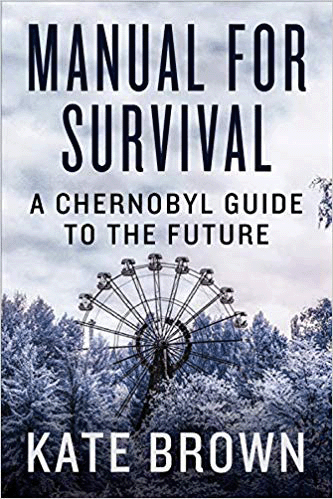
NUCLEAR fall-out from the Chernobyl power station disaster could be responsible for the global rise in cancers and diseases, according to a terrifying new book.
By SIMON OSBORNE Mar 15, 2019US historian Kate Brown has been investigating the impact of radiation from the world’s worst ever nuclear disaster and claims the real death toll has been deliberately covered up by organisations with vested interests. She alleges scientists joined forces with the UN, Red Cross and World Health Organisation to withhold evidence of hundreds of thousands of people who have died as a result of the 1986 nuclear explosion in what is now Ukraine.
She said at the time it was widely agreed and underestimated by scientists that the accident would cause around 200 deaths over 80 years.
But in her book, Manual For Survival: A Chernobyl Guide To The Future, she claims: “International scientists suppressed evidence of a cancer epidemic among children.”
Cancer Research UK acknowledged rates of the disease were rising but said this war largely down to people were living longer coupled with increased consumption of red and processed meats, increasing obesity in the west, and a culture of sunbathing and sunbeds were largely to blame.
One in two people are now likely to develop the disease rather than the previous estimates of one in three.
Ms Brown believes the increase in cancer may be linked to Chernobyl while governments and nuclear industry chiefs have dodged responsibility.
She said: “Minimising both the number of deaths so far and the on-going health consequences of the Chernobyl disaster provided cover for nuclear powers to dodge lawsuits and uncomfortable investigations in the 1990s.”
She criticises a lot of senior figures, both past and present, for not admitting that nuclear radiation is really poisonous and therefore not providing adequate protection or support for people who may still be affected.
Her book details how the threshold for the amount of radiation legally allowed in produce exported for consumption in the US is surprisingly high and could be dangerous.
It also describes what the nuclear plant workers and local residents saw and experienced when the explosion tore through the power station.
It reveals how workers clearing the devastated site were advised by Soviet doctors to drink vodka throughout the day because they claimed it would stimulate the liver and cleanse the body of radiation.
Ms Brown conducted her research over four years and relied on 27 archives of information from Europe, the US and the former Soviet Union.
She reckons the actual death told could be as high as 150,000 for Ukraine alone over the past three decades.
She concludes by calling for the impact of nuclear radiation on human health and the facts and figures surrounding to Chernobyl to be reassessed.
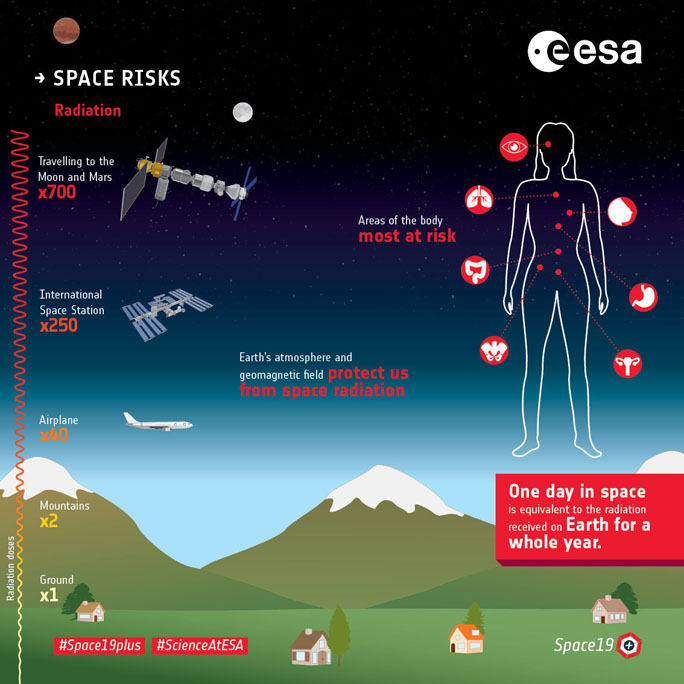
The radiation showstopper for Mars exploration https://phys.org/news/2019-06-showstopper-mars-exploration.html, by European Space Agency3 June 19,An astronaut on a mission to Mars could receive radiation doses up to 700 times higher than on our planet—a major showstopper for the safe exploration of our solar system. A team of European experts is working with ESA to protect the health of future crews on their way to the Moon and beyond.
Earth’s magnetic fieldand atmosphere protect us from the constant bombardment of galactic cosmic rays—energetic particles that travel at close to the speed of light and penetrate the human body.
Cosmic radiation could increase cancer risks during long duration missions. Damage to the human body extends to the brain, heart and the central nervous system and sets the stage for degenerative diseases. A higher percentage of early-onset cataracts have been reported in astronauts.
“One day in space is equivalent to the radiation received on Earth for a whole year,” explains physicist Marco Durante, who studies cosmic radiation on Earth.
Marco points out that most of the changes in the astronauts’ gene expression are believed to be a result of radiation exposure, according to the recent NASA’s Twins study. This research showed DNA damage in astronaut Scott Kelly compared to his identical twin and fellow astronaut Mark Kelly, who remained on Earth.
A second source of space radiation comes from unpredictable solar particle events that deliver high doses of radiation in a short period of time, leading to “radiation sickness” unless protective measures are taken.
Europe’s radiation fight club
“The real problem is the large uncertainty surrounding the risks. We don’t understand space radiation very well and the long-lasting effects are unknown,” explains Marco who is also part of an ESA team formed to investigate radiation.
Since 2015, this forum of experts provides advice from areas such as space science, biology, epidemiology, medicine and physics to improve protection from space radiation.
“Space radiation research is an area that crosses the entire life and physical sciences area with important applications on Earth. Research in this area will remain of high priority for ESA,” says Jennifer Ngo-Anh, ESA’s team leader human research, biology and physical sciences.
While astronauts are not considered radiation workers in all countries, they are exposed to 200 times more radiation on the International Space Station than an airline pilot or a radiology nurse.
Radiation is in the Space Station’s spotlight every day. A console at NASA’s mission control in Houston, Texas, is constantly showing space weather information.
f a burst of space radiation is detected, teams on Earth can abort a spacewalk, instruct astronauts to move to more shielded areas and even change the altitude of the station to minimize impact.
One of the main recommendations of the topical team is to develop a risk model with the radiation dose limits for crews traveling beyond the International Space Station.
ESA’s flight surgeon and radiologist Ulrich Straube believes that the model should “provide information on the risks that could cause cancer and non-cancer health issues for astronauts going to the Moon and Mars in agreement with all space agencies.”
Recent data from ExoMars Trace Gas Orbiter showed that on a six-month journey to the Red Planet an astronaut could be exposed to at least 60% of the total radiation dose limit recommended for their entire career.
“As it stands today, we can’t go to Mars due to radiation. It would be impossible to meet acceptable dose limits,” reminds Marco.
Measure to protect
ESA has teamed up with five particle accelerators in Europe that can recreate cosmic radiation by “shooting” atomic particles to speeds approaching the speed of light. Researchers have been bombarding biological cells and materials with radiation to understand how to best protect astronauts.
“The research is paying off. Lithium is standing out as a promising material for shielding in planetary missions,” says Marco.
ESA has been measuring the radiation dose on the International Space Station for seven years with passive radiation detectors in the DOSIS 3-D experiment. ESA astronauts Andreas Mogensen and Thomas Pesquet wore a new mobile dosimeter during their missions that gave them a real-time snapshot of their exposure.
The same European team behind this research will provide radiation detectors to monitor the skin and organ doses of the two phantoms traveling to the Moon onboard NASA’s Orion spacecraft.
Sweden’s Uppsala District Court has found in favour of Assange: the court ruled NOT to detain Assange in absentia. The preliminary investigation can proceed without Assange’s extradition to Sweden. This was always the case as Assange has always cooperated with the investigation.
Suzie Dawson on Julian Assange’s mistreatment #FreeAssange
Could Trump Trash The Nuclear Test Ban Treaty? Forbes, Michael Krepon, 3 June 19
Think of what the world would be like if Russia, the United States, China, India and Pakistan were testing nuclear weapons. They are not because of the Comprehensive Test Ban Treaty (CTBT) which is responsible for shutting down nuclear testing by major and regional powers for more than two decades. Walking away from the CTBT would be extraordinarily dumb and dangerous, but the Trump administration has taken a step in this direction.
The CTBT was negotiated in 1996, but it isn’t solidly in place. While Russia has signed and ratified it, Senate Republicans rejected it in 1999. China, like the United States, has signed but not ratified.
There are other holdouts, including India and Pakistan. And yet none of these states has tested nuclear weapons since 1998. When a treaty is negotiated, it’s common diplomatic practice not to undercut its objectives while awaiting its entry into force. Hence the two-decades-long moratorium on testing by every nuclear-armed state except North Korea.
How long this can this situation last? The answer is in doubt now that the Director of the Defense Intelligence Agency, Lt. Gen. Robert P. Ashley, Jr., has declared at a public forum that the “United States believes that Russia probably is not adhering to its nuclear testing moratorium.” The Treaty sets a “zero yield” obligation: states aren’t supposed to test even with the slightest yields. The State Department defines this as any explosion “that produce a self-sustaining, supercritical chain reaction.” In other words, you can conduct experiments, but the experiments should not produce any seismic activity.
As a result of General Ashley’s statement, it’s now open season against the CTBT for those who want to trash another treaty. Critics of arms control have begun to call on Donald Trump to “unsign” the CTBT, just as he has walked away from the Iran nuclear deal and the Arms Trade Treaty. (Trump also announced withdrawal from the Intermediate-range Nuclear Forces Treaty, but in this case, evidence of Russian noncompliance is compelling.) By “unsigning” the CTBT, Trump would tell the world that the United States is no longer bound to respect the Treaty’s obligation not to test nuclear weapons.
Before stumbling into this sinkhole, there are three very important things to bear in mind. First, the U.S. Intelligence Community in general, and the Defense Intelligence Agency in particular, have bad track records in assessing Moscow’s compliance with nuclear testing constraints. Second, National Security Adviser John Bolton and others have a track record of fixing intelligence findings to fit their policy preferences, to the great detriment of America’s national security, expeditionary forces, and international standing. And third, walking away from the CTBT would remove constraints on the resumption of nuclear testing by others far more than on the United States.
Now let’s consider details.
General Ashley declared that the United States believes that Russia “probably” is cheating. This suggests an intelligence community-wide agreement, but Time magazine reports that this is not the case. According to Time’s reporters, there is no consensus, and “the Defense Intelligence Agency generally takes the ‘worst case’ position on military matters.” We deserve to know if there is a difference of view within the intelligence community on whether Russia is “probably” cheating, and if this dispute is about inference rather than evidence. We also need to know whether administration officials are seeking to influence intelligence assessments to suit policy preferences…………
It’s unknown whether John Bolton had any involvement with the DIA intelligence assessment, but another reason for investigation is the National Security Adviser’s record of “fixing” intelligence to make the case for a second war against Saddam Hussein, a war predicated on weapons of mass destruction that did not exist. Bolton is on record opposing U.S. ratification and entry into force of the CTBT. Is he once again “fixing the facts” to suit his policy preferences? Is the Defense Intelligence Agency once again guilty of reaching conclusions beyond available evidence, and misrepresenting the evidence it has? Or is there strong evidence of Russian violations of the CTBT’s prohibition on testing?
Arctic Is Thawing So Fast Scientists Are Losing Their Measuring Tools BY Dahr Jamail, Truthout, June 3, 2019
We’ve never experienced anything like this: We are living with the full knowledge of our collapsing biosphere and watching huge portions of it vanishing before our very eyes. Meanwhile, the industrial growth society (as eco-philosopher, author and Buddhist scholar Joanna Macy calls it) continues to grind on, and this veneer of normalcy persists one more day.
Yet simultaneously, a great awakening is occurring. Millions of people around the world are rising to protect what remains, working to mitigate the damage and to adapt to the drastically changing world. They are working to hold space for that which, despite seemingly overwhelming odds, may continue in the wake of this great collapse……….
dear reader, I urge you to find your own work that reconnects — or to find another way to ground yourself, as you read on, and as we each travel through another crises-ridden day into an increasingly bleak future.
That future is perhaps most visible at the poles. Greenland is melting much faster than previously understood, as melting has increased six-fold in recent decades, according to a study published in the Proceedings of the National Academy of Sciences. “We wanted to get a long precise record of mass balance in Greenland that included the transition when the climate of the planet started to drift off natural variability, which occurred in the 1980s,” study co-author Eric Rignottold CNN. “The study places the recent (20 years) evolution in a broader context to illustrate how dramatically the mass loss has been increasing in Greenland in response to climate warming.” Rignot added, “As glaciers will continue to speed up and ice/snow melt from the top, we can foresee a continuous increase in the rate of mass loss, and a contribution to sea level rise that will continue to increase more rapidly every year.”
The study also shows how sea level rise is accelerating, and will continue to do so with each passing year, as the effects compound upon themselves.
Permafrost in the Arctic is now thawing so fast that scientists are literally losing their measuring equipment. This is due to the fact that instead of there being just a few centimeters of thawing each year, now several meters of soil can become destabilized in a matter of days.
Adding insult to injury, another study revealed that this permafrost collapse is further accelerating the release of carbon into the atmosphere, possibly even doubling the amount of warming coming from greenhouse gases released from the tundra.
The recent U.N. report showing that one million species are now in danger of going extinct has grave implications for the future of humanity…..
Earth
Disconcertingly, since 2001 forests in Canada have released more carbon than they have sequestered. This is due largely to climate disruption-fueled drought, higher temperatures and wildfires. ………
Meanwhile, the refugee crisis from rising seas and extreme weather events continues apace in Bangladesh. Already one of the most vulnerable countries in the world to sea level rise, it is now estimated that more than 10 million people there are estimated to lose their livelihoods in the next decade. The larger cities are already overwhelmed with the number of people streaming into them from the submerging coastal areas.
Water
Climate disruption-amplified, flood-inducing extreme weather events continue to make their mark around the planet………….
Fire
Just four months into 2019, the U.K. had already had more large wildfires than it had during the entirety of 2018……….
Air
A recent report shows how much warmer cities across the U.S. will be within one generation (by 2050).
“Every season in every city and town in America will shift, subtly or drastically, as average temperatures creep up, along with highs and lows,” reported Vox, which released the report. “Some of those changes — like summers in the Southwest warming by 4°F on average — will mean stretches of days where it’s so hot, it’ll be dangerous to go outside. Heat waves around the country could last up to a month.”
Denial and Reality
The U.S. is now one of the world’s leaders when it comes to climate change denial………. With the ongoing acceleration of the climate crisis, it is clear that even if we believe the best-case scenarios, governments are not reacting according to the gravity of the situation at hand. Each one of us, knowing what we now know, must take full responsibility for preparing ourselves for the adaptation required to live on this increasingly warming, melting world as civilizations and societies continue to disintegrate. https://truthout.org/articles/arctic-is-thawing-so-fast-scientists-are-losing-their-measuring-tools/
More than two dozen national security pros — including former White House policy directors, former senators, and one former defense secretary — are sending a letter to the leaders of the House and Senate Armed Services committees asking them to act to blunt what they call “the administration’s dangerous impulses” in nuclear policy.
The June 3 letter asks for action in this year’s National Defense Authorization Act, starting with support for extending the New START Treaty. Set to expire in 2021, the treaty is the last remaining strategic arms-control agreement between the United States and Russia. The Trump administration has proposed to let it expire and seek instead a three-way Russia-China-U.S.agreement that few outside the White House believe has any chance of becoming real.
The letter’s 25 signatories also ask Congress to “defund and prohibit deployment of low-yield nuclear weapons in this year’s NDAA to reduce the risk of nuclear escalation.” In the letter, they argue that ”deploying low-yield nukes not only lowers the threshold for the use of nuclear weapons, but it signals to adversaries that the United States would respond reciprocally (rather than overwhelmingly) to a nuclear attack. It incentivizes thinking in Moscow and Beijing that developing and deploying low-yield nuclear weapons is necessary to keep pace with the United States and could be a viable option in theater.”
Finally, the letter warns against overreacting to superfast maneuvering missiles being developed by U.S. rivals. “The development of hypersonic missiles by China and Russia is a serious military challenge, but it does not fundamentally change the logic of nuclear deterrence and therefore should not be cause for dangerous overreaction,” it says.
Among the signatories are former Defense Secretary William J. Perry; Bonnie Jenkins, once the State Department’s coordinator for threat reduction programs; Kelly Magsamen, former principal deputy assistant defense secretary; Ned Price, former senior director of the National Security Council; and Jon Wolfsthal, former NSC senior director for arms control and nonproliferation. The letter to lawmakers also bears the signatures of Sens. Gary Hart and Mark Udall.
The climate change analysis was written by a former fossil fuel executive and backed by the former chief of Australia’s military. A harrowing scenario analysis of how human civilization might collapse in coming decades due to climate change has been endorsed by a former Australian defense chief and senior royal navy commander.
The analysis, published by the Breakthrough National Centre for Climate Restoration, a think-tank in Melbourne, Australia, describes climate change as “a near- to mid-term existential threat to human civilization” and sets out a plausible scenario of where business-as-usual could lead over the next 30 years.
The paper argues that the potentially “extremely serious outcomes” of climate-related security threats are often far more probable than conventionally assumed, but almost impossible to quantify because they “fall outside the human experience of the last thousand years.”
On our current trajectory, the report warns, “planetary and human systems [are] reaching a ‘point of no return’ by mid-century, in which the prospect of a largely uninhabitable Earth leads to the breakdown of nations and the international order.”
The only way to avoid the risks of this scenario is what the report describes as “akin in scale to the World War II emergency mobilization”—but this time focused on rapidly building out a zero-emissions industrial system to set in train the restoration of a safe climate.
The scenario warns that our current trajectory will likely lock in at least 3 degrees Celsius (C) of global heating, which in turn could trigger further amplifying feedbacks unleashing further warming. This would drive the accelerating collapse of key ecosystems “including coral reef systems, the Amazon rainforest and in the Arctic.”
The results would be devastating. Some one billion people would be forced to attempt to relocate from unlivable conditions, and two billion would face scarcity of water supplies. Agriculture would collapse in the sub-tropics, and food production would suffer dramatically worldwide. The internal cohesion of nation-states like the US and China would unravel.
Even for 2°C of warming, more than a billion people may need to be relocated and in high-end scenarios, the scale of destruction is beyond our capacity to model with a high likelihood of human civilization coming to an end,” the report notes.
The new policy briefing is written by David Spratt, Breakthrough’s research director and Ian Dunlop, a former senior executive of Royal Dutch Shell who previously chaired the Australian Coal Association.
In the briefing’s foreword, retired Admiral Chris Barrie—Chief of the Australian Defence Force from 1998 to 2002 and former Deputy Chief of the Australian Navy—commends the paper for laying “bare the unvarnished truth about the desperate situation humans, and our planet, are in, painting a disturbing picture of the real possibility that human life on Earth may be on the way to extinction, in the most horrible way.”
Barrie now works for the Climate Change Institute at Australian National University, Canberra.
Spratt told Motherboard that a key reason the risks are not understood is that “much knowledge produced for policymakers is too conservative. Because the risks are now existential, a new approach to climate and security risk assessment is required using scenario analysis.”
Last October, Motherboard reported on scientific evidence that the UN’s summary report for government policymakers on climate change—whose findings were widely recognized as “devastating”—were in fact too optimistic.
While the Breakthrough scenario sets out some of the more ‘high end’ risk possibilities, it is often not possible to meaningfully quantify their probabilities. As a result, the authors emphasize that conventional risk approaches tend to downplay worst-case scenarios despite their plausibility.
Spratt and Dunlop’s 2050 scenario illustrates how easy it could be to end up in an accelerating runaway climate scenario which would lead to a largely uninhabitable planet within just a few decades.
“A high-end 2050 scenario finds a world in social breakdown and outright chaos,” said Spratt. “But a short window of opportunity exists for an emergency, global mobilization of resources, in which the logistical and planning experiences of the national security sector could play a valuable role.”
By John Mecklin, May 28, 2019 The US political divide on climate change couldn’t be starker: Democrats argue over differences on a Green New Deal that would remake the US energy mix and quickly reduce the carbon dioxide emissions that are heating the planet; the Trump administration denies that human-caused climate change exists and tries to ridicule those silly ducks who believe the overwhelming global scientific consensus on the crisis. That divide has, however, taken on a new and ominous dimension with the Trump administration’s decision to attack the methods by which government climate science is produced.
In a ground-breaking piece, the New York Times reports that the federal government will no longer engage in “what scientists say is one of the most urgent jobs of climate science studies: reporting on the future effects of a rapidly warming planet and presenting a picture of what the earth could look like by the end of the century if the global economy continues to emit heat-trapping carbon dioxide pollution from burning fossil fuels.”
This effort to defang official US climate reporting appears aimed at making sure the government does not reproduce anything like the recent National Climate Assessment, which projected drastic results—”higher sea levels, more devastating storms and droughts, crop failures, food losses and severe health consequences”—unless quick action to counteract climate change is taken. If followed through, the administration’s anti-science effort would limit the time frame allowed in government climate projections, so that, in the case of the US Geological Survey, those projections could not extend beyond 2040, even though the most severe effects of climate change are expected to occur in the decades beyond that arbitrary deadline.
In addition to hamstringing climate assessment methodology to make climate change seem a less serious problem than it is, the Trump administration is trying to create a climate review panel that would examine government regulations from, it seems clear, a climate change-denialist vantage. The effort to create the panel is led by 79-year-old physicist William Happer, a deputy assistant on the National Security Council “who had a respected career at Princeton but has become better known in recent years for attacking the science of man-made climate change and for defending the virtues of carbon dioxide—sometimes to an awkward degree,” the Times says, perhaps understating by use of the word “awkward.”
Among other things, Happer has said, “The demonization of carbon dioxide is just like the demonization of the poor Jews under Hitler.”
I have searched my mind to find a proper description of the administration’s most recent, genuinely Orwellian efforts to distort rational truth-seeking on climate change and cannot come up with anything better than the quote given to the Times by Philip B. Duffy, the president of the Woods Hole Research Center, who served on a National Academy of Sciences panel that reviewed the government’s most recent National Climate Assessment: “What we have here is a pretty blatant attempt to politicize the science—to push the science in a direction that’s consistent with their politics.
N.Korea shows former top nuclear envoy, Canberra Times, Joyce Lee , 3June 19
North Korea’s former top nuclear envoy, Kim Yong-chol, accompanied leader Kim Jong Un to an art performance, state news agency KCNA said on Monday, signalling that the former spymaster is alive and remains a force in the power structure.
Sunday’s appearance followed conflicting reports of shake-ups in the team that led engagement with the United States last year, only for nuclear talks to collapse after Kim Jong-un and President Donald Trump failed to strike a pact at a February summit…….
On Friday, South Korean newspaper Chosun Ilbo had said Kim Yong-chol, the leader’s right-hand man and a counterpart of US Secretary of State Mike Pompeo before the failed summit, had been sent to a labour and re-education camp, citing an unidentified North Korean source.
Asked on Sunday about the last US contact with Kim Yong-chol and North Korea in general, Pompeo declined to answer, saying, “We conduct our negotiations in private.”
Asked about reports of a “shake-up” of Kim’s negotiating team in a May 5 interview with ABC News, Pompeo said it did appear that his future counterpart would be somebody else, adding: “But we don’t know that for sure.”……..
As Kim Jong-un’s point man for the nuclear talks, Kim Yong-chol was stripped of a key party post in apparent censure for the summit’s collapse, a South Korean lawmaker said in April.
That move may have cleared the way for long-time diplomats sidelined during last year’s process to take centre stage if talks with the United States resumed, analysts said…….
The Chosun Ilbo report, which Reuters was unable to confirm independently, also said North Korea executed its working-level nuclear envoy to the United States, Kim Hyok-chol. …..
Tell Congress: Prevent Nuclear Catastrophe in Iran
Read the Public Inquiry Report, the Commissioners’ report, Surrendering Australia: The AUKUS Deception is available to download for free at aukuspublicinquiry.com. Or just watch the replay of the National Press Club Luncheon.