nuclear-news

The News That Matters about the Nuclear Industry Fukushima Chernobyl Mayak Three Mile Island Atomic Testing Radiation Isotope

HBO “Chernobyl”series grasped the truth about the conditions that led to the disaster

August 19, 2019 Posted by | 2 WORLD, media, spinbuster | Leave a comment

Hinkley nuclear project: UK govt faces questions about involvement of US export blacklisted Chinese firm

Telegraph 15th August 2019 The government faces renewed questions over its decision to allow a
state-owned Chinese firm to be involved in the UK’s power generation
programme after the business was placed on a US export blacklist. China
General Nuclear Power Group (CGN), which has partnered with EDF to help
fund a third of the £20bn cost of the nuclear power station at Hinkley
Point, was on Thursday added to the US commerce department’s so-called
“entity list”. The placement effectively blocks American firms from
selling products and services to the company without written approval.

https://www.telegraph.co.uk/technology/2019/08/15/questions-raised-chinas-involvement-hinkley-point-us-trade-blacklist/

August 19, 2019 Posted by | politics international, UK | Leave a comment

Implications for India if it revokes its No First Use nuclear weapons policy

Nuclear rethink: A change in India’s nuclear doctrine has implications on cost & war strategy

A nuclear doctrine states how a nuclear weapon state would employ its nuclear weapons both during peace and war. Economic Times ET Bureau|, Aug 17, 2019,

“……..  revoking the NFU would have its own costs. First, India’s image as a responsible nuclear power is central to its nuclear diplomacy. Nuclear restraint has allowed New Delhi to get accepted in the global mainstream. From being a nuclear pariah for most of the Cold War, within a decade of Pokhran 2, it has been accepted in the global nuclear order. It is now a member of most of the technology denial regimes such as the Missile Technology Control regime and the Wassenaar Arrangement. It is also actively pursuing full membership of the Nuclear Suppliers Group. Revoking the ‘no first use’ pledge would harm India’s nuclear image worldwide.

Parting away with NFU would also be costly otherwise. A purely retaliatory nuclear use is easier to operationalize. Nuclear preemption is a costly policy as it requires massive investment not only in weapons and delivery systems but also intelligence, surveillance and reconnaissance (ISR) infrastructure. The latest estimates of India’s nuclear weapons by the Bulletin of Atomic Scientists point to a small arsenal of 130-150 nuclear warheads even though it has enough militarygrade plutonium to produce 200 warheads.

In fact, when compared with the estimates a decade earlier of 70 nuclear warheads, there has only been a modest increase in India’s nuclear inventory. If India does opt for first use of nuclear weapons and given that it has two nuclear adversaries, it would require a far bigger inventory of nuclear weapons particularly as eliminating adversaries’ nuclear capabilities would require targeting of its nuclear assets involving multiple warheads.  The controversy around the supposed low yield of its Hydrogen weapon test in 1998 further complicates this already precarious calculation.

Similarly, first use of nuclear weapons would require a massive increase in India’s nuclear delivery capabilities. There is yet no evidence suggesting that India’s missile production has increased dramatically in recent times. Moreover, India is yet to induct the Multiple Reentry Vehicle (MRV) technology in its missiles, which is fundamental to eliminating hardened nuclear targets. Finally, India’s ISR capabilities would have to be augmented to such a level where India is confident of taking out most of its adversary’s arsenal. According to a senior officer who had served in the Strategic Forces command, this is nearly an “impossible task”. Finally, India would have to alter significantly its nuclear alerting routine. India’s operational plans for its nuclear forces involve a four-stage process.  Nuclear alerting would start at the first hints of a crisis where decision-makers foresee possible military escalation. This would entail assembly of nuclear warheads and trigger mechanisms into nuclear weapons. The second stage involves dispersal of weapons and delivery systems to pre-determined launch positions. The third stage would involve mating of weapons with delivery platforms.

The last and final stage devolves the control of nuclear weapons from the scientific enclave to the military for their eventual use. Canisterization of missiles has combined the dispersal and mating of weapons into a single step, cutting down the effort required for achieving operational readiness. Even then, this model does not support first use of nuclear weapons as it gives ample warning to the adversary of India’s intentions. There is certainly a need for a reappraisal of India’s nuclear doctrine.

All doctrines need periodic reviews and India’s case is no exception. Given how rapidly India’s strategic environment is evolving, it is imperative to think clearly about all matters strategic. But if Indian policymakers do indeed feel the need to review the nation’s nuclear doctrine, they should be cognizant of the costs involved in so doing. A sound policy debate can only ensue if the costs and benefits of a purported policy shift are discussed and debated widely.  https://economictimes.indiatimes.com/news/defence/nuclear-rethink-a-change-in-indias-nuclear-doctrine-has-implications-on-cost-war-strategy/articleshow/70718646.cms

August 19, 2019 Posted by | depleted uranium, India, politics | Leave a comment

Russia’s ‘flying Chernobyl’ – mystery new nuclear weapon

Russia’s mysterious ‘new’ nuclear weapon a ‘flying Chernobyl’,  https://www.smh.com.au/world/europe/russia-s-mysterious-new-nuclear-weapons-a-flying-chernobyl-20190816-p52ho5.html, By Gregg Herken, August 16, 2019 Washington: Last week, Vladimir Putin’s government cryptically announced that there had been an explosion at a missile test centre in remote northern Russia that involved the release of radioactive materials. Initially, two people were said to have been killed; the death toll was subsequently raised to seven. A nearby village was ordered evacuated, then the villagers were told to stay put.

US analysts think the accident involved the prototype of a nuclear-powered cruise missile that the Russians call Burevestnik, or Petrel, but is known in the West by its NATO designation, Skyfall. Putin has called it “a fundamentally new type of weapon” – an “invincible missile” with virtually unlimited range, easily able to evade US defences.

When Skyfall was first announced, early last year, some Western military analysts started hyperventilating. “That’s a technological breakthrough and a gigantic achievement,” claimed one. “These weapons are definitely new, absolutely new.”

But in fact, these “new” missiles are a throwback to the early days of the Cold War. And back then, it was the United States that developed a nuclear-powered cruise missile, in the early 1960s.

“Project Pluto” was part of a Pentagon program known as Supersonic Low Altitude Missile, a clunky name almost certainly designed to yield its catchier acronym, SLAM. The missile was cancelled in 1964, never having taken flight. Nuclear-powered cruise missiles were not a good idea then, and they are not a good idea now.

That’s not to say that such weapons are not impressive, in a way.

SLAM envisioned a locomotive-sized missile flying at three times the speed of sound near treetop level, tossing out hydrogen bombs along the way and spewing radiation in its wake. (In 1990, when I worked at the National Air and Space Museum, I researched the history of the project for an article in Air and Space magazine.)

There was a reason Pluto’s inventors, at the Livermore nuclear weapons laboratory in California, dubbed it “the weapon from Hell.” The noise level on the ground when Pluto went by was expected to be 150 decibels. (The Saturn V moon rocket, by comparison, produced 200 decibels at full thrust.)

But ruptured eardrums would have been the least of your worries if you were in the neighbourhood.

The shock wave alone might have been lethal. And since Pluto’s nuclear ramjet engine ran at 2500 degrees Fahrenheit (1371 degrees), portions of the missile would have been red-hot — literally “frying chickens in the barnyard” on the way to its targets.

Indeed, SLAM operated on the same principle as the errant low-flying B-52 bomber in Dr Strangelove. As Major Kong observed to his crew, “they might harpoon us, but they dang sure ain’t going to spot us on no radar screen.”

An alternate idea was to tie Pluto to a tether at the Nevada Test Site. (“That would have been some tether,” dryly observed another scientist at the lab.) Finally, what do you do with a highly radioactive missile once it’s been tested? Dumping it in the ocean was the solution offered back then. And it is probably Putin’s preferred solution now.

Ultimately, in the United States, cooler heads prevailed.  Six weeks after the successful static test of Livermore’s nuclear engine in Nevada in July 1964, the Pentagon pulled the plug on Pluto.

Intercontinental-range ballistic missiles promised to destroy targets in the Soviet Union well before Pluto got to them, with equal certainty and a lot fewer associated risks. SLAM, its critics said, stood for “slow, low and messy.”

But Pluto, it seems, has risen again, this time in a Russian incarnation – a nuclear-powered Frankenstein, a flying Chernobyl.

Putin’s Skyfall cruise missile also has a seagoing sibling: a giant nuclear-powered torpedo, dubbed Poseidon, designed to destroy US port cities with a multi-megaton blast.

Poseidon bears a striking resemblance to the idea that Russia’s Nobel Prize-winning physicist, Andrei Sakharov, came up with in the early 1960s. When Sakharov told a Soviet admiral of his proposal, however, the latter was “shocked and disgusted by the idea of merciless mass slaughter.”

Feeling “utterly abashed,” the physicist abandoned the concept and never raised it again. “I’m no longer worried that someone may pick up on the idea,” Sakharov wrote in his memoirs, published in 1990. “It doesn’t fit in with current military doctrines, and it would be foolish to spend the extravagant sums required.”

Plainly, times have changed. Yet as several experts have since noted, it is also possible that Putin’s amazing new weapons are only part of a propaganda campaign, a response to plans announced by the Trump administration to expand and modernise America’s nuclear arsenal.

If so, Putin’s ploy is reminiscent of Soviet Premier Nikita Khrushchev’s hollow Cold War boast that the USSR was turning out ICBMs “like sausages.” (As Khrushchev’s son, Sergei, later observed, his father wasn’t exactly lying: The Soviets weren’t making sausages then, either.)

Of course, flying nuclear reactors and giant nuclear-armed undersea drones could do a lot of damage to cities if they really existed and were ever used. But the real danger of Putin’s Potemkin arsenal is that it will – as Khrushchev’s boast did decades ago – spark a US overreaction and lead to pressure to revive ideas like Livermore’s Pluto and Sakharov’s Poseidon: forgotten relics of Cold War 1.0 that are best left dead and buried.

Herken is an emeritus professor of American diplomatic history at the University of California. From 1988 to 2003, he was the curator of military space at the Smithsonian’s National Air and Space Museum in Washington.

August 19, 2019 Posted by | Russia | Leave a comment

Donald Trump is destroying the international nonproliferation regime

Trump is laying the ground for a nuclear arms race in the Gulf

Trump’s mismanagement of the nuclear issue in the Middle East is damaging the international nonproliferation regime. Alzaeera, by Luciano Zaccara,  Over the past three months since the Trump administration imposed severe sanctions on Iran, which have significantly curbed its oil exports and exacerbated its economic crisis, tensions in the Gulf have escalated. Commercial vessels have been attacked, oil tankers seized and drones shot down. Despite these escalations, both sides are holding back and at least in the short-term, an open conflict so far seems unlikely.


In the long-term, however, the highly-problematic approach that the United States has adopted towards the nuclear issue could have devastating consequences. Two recent developments point in that direction.

First, the Trump administration has given a green light to US companies to work on nuclear projects in Saudi Arabia. According to a report recently released by the US Congress Oversight Committee, “with regard to Saudi Arabia, the Trump Administration has virtually obliterated the lines normally separating government policymaking from corporate and foreign interests.”

The report also stated that the evidence collected and analyzed “raise serious questions about whether the White House is willing to place the potential profits of the President’s friends above the national security of the American people and the universal objective of preventing the spread of nuclear weapons.”

The White House seems committed to allowing the transfer of sensitive nuclear technology without demanding that Riyadh abide by US legal requirements not to engage in activities that can lead to nuclear proliferation.

Second, in response to mounting pressure from the US, Iran has announced that it is going to backtrack on a number of commitments made under the Joint Comprehensive Plan of Action (JCPOA) if the international community does not take measures to ameliorate the effects of US sanctions on its economy.

Iran has already stopped complying with limits on the production of enriched uranium and heavy water, invoking articles 26 and 36 of the agreement, which entitle it to do so if the other parties reintroduce nuclear-related sanctions.

Thus, Washington’s incapacity to deal with the Iranian file in a coherent manner, and its erratic policies on nuclear proliferation, are pushing the Middle East towards a dangerous nuclear competition between Saudi Arabia and Iran.

Nuclear ambitions

The nuclear aspirations of both countries are not new………

A collapsing nonproliferation regime

With its ill-advised policies in the Gulf, the Trump administration is not only encouraging a nuclear race in the region by allowing Saudi Arabia to acquire nuclear technology, but it is also undermining the international non-proliferation regime.

Since nuclear powers agreed in the 1960s to curb the spread of nuclear weapons, there have been a number of cases in which countries – including Israel, India, and Pakistan – have broken international rules in pursuit of nuclearisation and not faced serious consequences.

The double standards applied by the Trump administration have been particularly damaging to international nonproliferation agreements. Trump has pursued normalisation of relations with North Korea – a state that openly tested and detonated nuclear devices – while withdrawing from a nuclear deal with Iran, which was strictly abided by all provisions and was not working on developing a nuclear bomb.

Effectively, the US government destroyed a well-functioning agreement that enjoyed wide international support in order to satisfy the commercial interests of a few individuals close to the White House and give an advantage to one side in the growing regional rivalry in the Middle East.

These actions have thrown the international community into disarray, as now there appears to be no clear consensus on what nuclear activities can be considered a threat, what evidence state actors must present to be regarded as truly committed to nonproliferation and what instruments – legal, economic, or military – should be used to enforce the nonproliferation regulations.

Washington’s unilateral (mis)management of the nuclear issue is endangering the whole nonproliferation regime, weakening any multilateral agreement or negotiation, and leaving solely the White House to decide on how to deal with these abovementioned questions.

In the current volatile situation in the Middle East – with intensifying confrontation along religious, ethnic, territorial and ideological cleavages – the lack of a robust non-proliferation agreement will encourage a nuclear race in the region and increase the chances of pre-emptive military attacks that could lead to large-scale war. Luciano Zaccara is professor of Gulf Politics at the Qatar University Gulf Studies Center. https://www.aljazeera.com/indepth/opinion/trump-laying-ground-nuclear-arms-race-gulf-190801130430388.html

August 18, 2019 Posted by | 2 WORLD, politics international, weapons and war | Leave a comment

Anxiety over risks of radiation and heat at the 2020 Tokyo Olympics


Controversy over radiation and heat surrounding Tokyo Olympics, HANKYOREH  By Kim Chang-geum, staff reporter : Aug.14,2019


  “…… Safety from radiation and heat at the Tokyo Olympics

Most of the issues related to the upcoming Tokyo Olympics, which are now only a year away, boil down to safety concerns over radiation and extreme heat. Some baseball and softball matches are scheduled to be held in a stadium located close to the Fukushima nuclear reactor that took direct damage during the 2011 earthquake. Korean civic groups have also pointed out that the Japanese government has failed to properly control water contaminated by radiation from the reactor. Plans to source some of the rice and ingredients for the Tokyo Olympics Athletes Village from Fukushima are adding to these concerns. Although the level of radiation measured in such rice is within the acceptable standards in Japan, it is believed to exceed Korean standards.


Extreme heat is another potential issue. After an open water test competition in Odaiba Seaside Park, Tokyo, on Aug. 11, Sports Nippon reported, “Many athletes complained about a foul odor and the high water temperature, and one male athlete made the shocking claim that it ‘smelled like a toilet.’” Although the Olympic Committee did not reveal the water temperature on that day, it has been reported that the temperature was 29.9 degrees Celsius at 5am. The International Swimming Federation (FINA) cancels events if the water temperature reaches 31 degrees Celsius. There have also been warnings about road races. On August 8, Yusuke Suzuki, Japan’s star race-walker and world record holder in the men’s 20km, stated, “I tried training on the Tokyo Olympics race-walking course. There was no shade, so it could cause dehydration.”
Tokyo Olympics delegation heads meeting from Aug. 20-22It appears that the issue of safety from radiation and concerns about food ingredients will be conveyed during the upcoming three-day meeting with the leaders of each country’s delegation in Tokyo on Aug. 20-22, and a request will be made to the Japanese Olympic Committee to change the name of Dokdo used on maps. If the representatives from each country do raise the radiation issue, the IOC will have no choice but to intervene. The Korean Sport & Olympic Committee is also considering providing separate Korean food to Korean athletes through specially prepared meals or lunchboxes.  …. http://english.hani.co.kr/arti/english_edition/e_international/905758.html

August 17, 2019 Posted by | climate change, Japan, safety | Leave a comment

Russian doctors kept in the dark about patients being nuclear accident victims

Russian Doctors Say They Weren’t Warned Patients Were Nuclear Accident Victims
One doctor was reportedly later found to have a radioactive isotope in their muscle tissue.   https://www.themoscowtimes.com/2019/08/16/exclusive-russian-doctors-say-they-werent-warned-patients-were-nuclear-accident-victims-a66896


August 17, 2019 Posted by | Russia, secrets,lies and civil liberties | Leave a comment

Russia’s fast nuclear reactor project is postponed

Rosatom postpones fast reactor project, report says, WNN, 13 August 2019

Rosenergoatom is expected to receive about RUB280 billion (USD4 billion) less in state funding for the construction of new nuclear reactors in Russia owing to the postponement of its fast neutron reactor programme, Russian newspaper Kommersant reported last week, citing anonymous sources. Rosenergoatom is the nuclear power plant operator subsidiary of Russian state nuclear corporation Rosatom.

Rosatom’s investment plan received preliminary approval during a meeting in the Russian Energy Ministry on 2 August, according to the article, with funding out to 2035 to total RUB880 billion and not the RUB1.16 trillion Rosatom had allocated for the two new VVER-1200 units under construction for the Kursk II project, units 3 and 4 for the Leningrad II project and a BN-1200 fast reactor at Beloyarsk. Commissioning of the BN-1200 has been postponed to 2036, the article said, from the previous target of 2027.

Financing to pay for the new units will be paid back over 20 years, with an average rate of return on investment of 10.5% per year, the article said. Rosatom is prepared to consider a lower rate of return, it added.

Russia’s new investment cycle for its electricity sector will also take into account modernisation work at thermal power plants, the construction of remote energy facilities and the development of renewable energy sources. The funds must however be “distributed among market participants so that wholesale energy market prices do not rise above inflation”, the article said. The reduction in funding reflects “the restriction on tariff growth by inflation”, it added, and thus the launch of the BN-1200 will “most likely be postponed to 2036 in order to reduce energy market spending”……. http://www.world-nuclear-news.org/Articles/Rosatom-postpones-fast-reactor-project-report-say

August 17, 2019 Posted by | Russia, technology | Leave a comment

Germany shows how it can lead the world in neatly shutting down nuclear power

Spectacular Video Shows Nuclear Power Plant Demolition in Germany

How to demolish a nuclear power plant without blowing it up, By Sheena McKenzie, CNN August 16, 2019 London (CNN Business)This is how you demolish a nuclear power plant German-style. No big red button. No dramatic countdown. No “kaboom!”

August 17, 2019 Posted by | decommission reactor, Germany | Leave a comment

India ponders changing its “no first use” nuclear weapons policy

India hints at changing ‘no first use’ nuclear policy  Channel News Asia,    NEW DELHI: India’s defence minister hinted on Friday (Aug 16) that New Delhi might change its “no first use” policy on nuclear weapons, amid heightened tensions with fellow atomic power Pakistan.

India committed in 1999 to not being the first to use nuclear weapons in any conflict. Among India’s neighbours China has a similar doctrine but arch rival Pakistan does not.

Defence Minister Rajnath Singh made the comment on Twitter after visiting Pokhran, the site of India’s successful nuclear tests in 1998 under then prime minister Atal Vajpayee.

“Pokhran is the area which witnessed (Vajpayee’s) firm resolve to make India a nuclear power and yet remain firmly committed to the doctrine of ‘No First Use’ (NFU),” Singh wrote.

“India has strictly adhered to this doctrine. What happens in future depends on the circumstances,” Singh tweeted.

The statement comes as tensions rise with Pakistan after Prime Minister Narendra Modi’s government stripped Indian-administered Kashmir of its autonomy, a move sharply condemned by Islamabad……..

Observers said Singh’s statement is the clearest so far with regards to a change in India’s nuclear doctrine.
……….https://www.channelnewsasia.com/news/asia/india-hints-at-changing-no-first-use-nuclear-policy-11816218

August 17, 2019 Posted by | India, politics international, weapons and war | Leave a comment

Russian Region Orders Gas Masks After Deadly Nuclear Blast

Russian Region Orders Gas Masks After Deadly Nuclear Blast – Reports top https://www.themoscowtimes.com/2019/08/15/russian-region-orders-gas-masks-after-deadly-nuclear-blast-reports-a66856

August 17, 2019 Posted by | Russia, safety | Leave a comment

Japan’s Government Ultimate Hypocrisy and Arrogance

“Remote-controlled robots that can withstand high radiation exposure are ‘expected in the near future’ to help remove melted nuclear fuel debris out of the reactors”

Uncapable at home to really handle a triple meldown  while sacrificing its own population with an intensive denial and cover-up campaign, Japan is now proposing to the U.S. to help denuclearizing North Korea. Isn’t that the ultimate height of hypocrisy and arrogance?


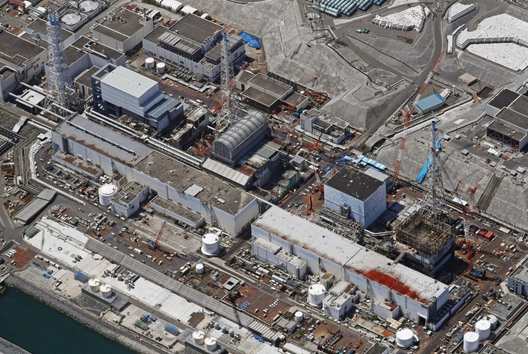
hghkjlmmù.jpg(File photo taken from a Kyodo News helicopter on April 23, 2019, shows the crippled Fukushima Daiichi nuclear power plant in northeastern Japan, where decommissioning work is under way.)


Japan tells U.S. of plan to offer robots for denuclearizing N. Korea

August 16, 2019

Japan has told the United States that it is ready to provide its robot technology for use in dismantling nuclear and uranium enrichment facilities in North Korea as Washington and Pyongyang pursue further denuclearization talks, Japanese government sources said Friday.

As Japan turns to remote-controlled robots it has developed to decommission reactors that suffered meltdowns in 2011 at the Fukushima Daiichi nuclear power plant, it believes the same technology can be used in North Korea, according to the sources.

The offer is part of Japan’s efforts to make its own contribution to the denuclearization talks amid concern that Tokyo could be left out of the loop as the United States and North Korea are stepping up diplomacy.

Tokyo has already told Washington it would shoulder part of the costs of any International Atomic Energy Agency inspections of North Korean facilities and dispatch Japanese nuclear experts.

The scrapping of nuclear facilities such as the Yongbyon complex that has a graphite-moderated reactor will come into focus in forthcoming working-level talks between Washington and Pyongyang.

North Korean leader Kim Jong Un offered to close the complex — seen as the center of the country’s nuclear material production activities — during his meeting with U.S. President Donald Trump in Hanoi in February.

But the Trump-Kim talks broke down after the two leaders failed to reconcile Washington’s demand for denuclearization and Pyongyang’s call for sanctions relief.

Earlier this year, Japan and the United States held a working-level meeting before the Hanoi summit, in which Washington pointed to the possibility of radioactive contamination near North Korea’s facilities due to its lax management of nuclear materials, the sources said.

Japan then offered “any support,” including technological assistance, according to the sources.

Remote-controlled robots that can withstand high radiation exposure are ‘expected in the near future’ to help remove melted nuclear fuel debris out of the reactors at the Fukushima Daiichi plant, crippled since the March 2011 earthquake and tsunami in northeastern Japan.

For such technology to be used in the decommissioning of a nuclear facility, experts need to inspect its internal structure and check radiation levels. Therefore, Pyongyang’s acceptance of such on-site inspections would be essential.

Trump has said on Twitter that he received a letter from Kim stating that the North Korean leader is willing to meet again after joint U.S.-South Korea military exercises end next Tuesday.

North Korea, which sees the joint drills as rehearsals for invasion, has fired a series of short-range missiles in apparent protest, most recently on Friday, but Trump has played down the significance of such launches.

While Prime Minister Shinzo Abe, who places priority on resolving the issue of Japanese nationals abducted by Pyongyang in the 1970s and 1980s, has expressed his hope to meet Kim “without preconditions,” such a summit appears unlikely.

Abe is the only leader yet to meet face-to-face with Kim among the countries involved in the long-stalled six-party talks on Pyongyang’s nuclear program — the two Koreas, China, Japan, Russia and the United States.

Trump has delivered on his promise to Abe to raise the abduction issue during his meetings with Kim. The U.S. president takes the view that neighboring countries such as Japan need to pay for North Korea’s denuclearization and extend economic assistance in return for Pyongyang scrapping its nuclear facilities.

“Japan’s security will be left out if we fail to be part of the U.S.-North Korea negotiations,” a Japanese Foreign Ministry source said.

https://english.kyodonews.net/news/2019/08/4537c0c21988-update1-japan-tells-us-of-plan-to-offer-robots-for-denuclearizing-n-korea.html


August 17, 2019 Posted by | Japan | , , | Leave a comment

Ballooning costs give lie to notion nuclear power is cheapest energy

jjlmùù.jpg
From left: The No. 5, No. 6 and No. 7 reactors at Tokyo Electric Power Co.’s Kashiwazaki-Kariwa nuclear plant in Niigata Prefecture
August 12, 2019
Soaring costs borne by operators of nuclear power plants to safeguard their facilities against natural disasters and terrorist attacks suggest the government is wrong in its longstanding contention that nuclear power is the nation’s cheapest energy source.
A study by The Asahi Shimbun found that the overall estimate for the cost of safety measures by 11 operators stood at 5.074 trillion yen ($48.32 billion) as of July. The operators include those whose nuclear facilities are still under construction.
The combined figure for the 11 companies represents an increase of about 660 billion yen from a year earlier.
The Asahi Shimbun has tallied total estimated safety costs by nuclear plant operators since 2013.
As of January 2013, the combined total was 998.2 billion yen.
New safety regulations implemented after the 2011 Fukushima nuclear disaster obliged power companies to equip their facilities with additional safeguard measures to prevent a severe accident triggered by a powerful earthquake, tsunami, fire, terrorist attack and other emergencies.
The Fukushima disaster was triggered by the Great East Japan Earthquake, which generated towering tsunami that knocked out cooling systems at the Fukushima No. 1 nuclear power plant operated by Tokyo Electric Power Co., setting off a triple meltdown.
The new regulations went into effect in 2013.
TEPCO’s estimated cost to implement safeguard measures doubled to 969 billion yen in the latest study due to steps to counter liquefaction and terrorist strikes at its Kashiwazaki-Kariwa plant’s No. 6 and No. 7 reactors in Niigata Prefecture.
Kansai Electric Power Co. reported an additional 130.8 billion yen as the cost of building an emergency facility to respond to a terrorist attack on its Oi nuclear plant’s No. 3 and No. 4 reactors in Fukui Prefecture.
In the survey, The Asahi Shimbun for the first time asked power companies about their most recent estimates for countermeasures against terrorism and the previous estimate when they applied for certification of their anti-terror facilities by the government’s Nuclear Regulation Authority.
The responses showed that anti-terror measures are proving to be two times to five times more expensive than the companies initially envisaged.
Kyushu Electric Power Co. replied that such steps for the No. 1 and No. 2 reactors at its Sendai nuclear plant in Kagoshima Prefecture grew five-fold from 43 billion yen to 220 billion yen.
Kansai Electric Power Co. said it plans to spend 125.7 billion yen on anti-terror measures for the No. 3 and No. 4 reactors at its Takahama plant in Fukui Prefecture, up from 69.1 billion yen.
In the case of Shikoku Electric Power Co., the utility said measures to safeguard the No. 3 reactor at its Ikata nuclear plant in Ehime Prefecture from a terror attack surged from 32 billion yen to 55 billion yen.
Shikoku Electric said the increase is due to a change in the design and construction method following the NRA’s safety examination.
Of the 11 companies surveyed, six did not include costs for terrorism countermeasures in their estimates for safeguard mechanisms, which means that overall costs for safety measures, including those against terrorism, can only grow.
gjklmùù.jpg
Nine reactors at five nuclear facilities are now back online after clearing the more stringent standards set by the NRA.
The safety cost for each of those reactors ranged from 130 billion yen to 230 billion yen.
It appears likely that plans by Chugoku Electric Power Co., Tohoku Electric Power Co. and Japan Atomic Power Co. to restart reactors will cost each of the operators more than 300 billion yen per reactor in safety measures, if the cost of implementing terrorism countermeasures is added.
With the ballooning safety costs, the government’s argument that nuclear energy is cheaper than hydro power and coal is increasingly in doubt.
In 2015, a government study put the cost to generate 1 kilowatt-hour of energy for hydro power at 11 yen, coal-fired thermal power at 12.9 yen and nuclear power at 10.3 yen or more.
The government study estimated the cost for safety measures per nuclear reactor at about 100 billion yen.
The power generation cost for a reactor will rise 0.6 yen for an increase of every 100 billion yen that will be set aside for safeguard measures.

August 16, 2019 Posted by | Japan | , | Leave a comment

Confusion and secrecy following Russian explosion, backflip on evacuation of village

Russian military orders village evacuation, then cancels it, following explosion that killed five nuclear scientists, Secrecy surrounding an explosion that killed five nuclear scientists and caused a spike in radiation levels has sparked fears of a cover-up in Russia, with authorities backflipping on orders to evacuate a nearby village. https://www.abc.net.au/news/2019-08-14/russian-nuclear-explosion-mystery/11411470

Key points:

  • Medics who treated victims of an accident have been sent to Moscow for medical examination
  • Russia’s state weather service said radiation levels spiked in Severodvinsk by up to 16 times
  • Many Russians spoke angrily on social media of misleading reports reminiscent of Chernobyl

The explosion took place on Thursday at a naval weapons range on the coast of the White Sea in northern Russia.

State nuclear agency Rosatom said the accident occurred during a rocket test on a sea platform.

The rocket’s fuel caught fire after the test, causing it to detonate, it said in a statement carried by Russian news agencies.

Two days later, after a spike in radiation levels was reported, Rosatom conceded the accident involved nuclear materials.

On Tuesday (local time), the Russian military ordered residents of the small village of Nyonoksa to temporarily evacuate, citing unspecified activities at the nearby navy testing range.

But a few hours later, it said the planned activities were cancelled and told the villagers they could go back to their homes, said Ksenia Yudina, a spokeswoman for the Severodvinsk regional administration.

Local media in Severodvinsk said Nyonoksa residents regularly received similar temporary evacuation orders, usually timed to tests at the range.

Russia’s state weather service said radiation levels spiked in the Russian city of Severodvinsk, about 30 kilometres west of Nyonoksa, by up to 16 times following the explosion.

Emergency officials issued a warning to all workers to stay indoors and close the windows, while spooked residents rushed to buy iodide, which can help limit the damage from exposure to radiation.

‘People need reliable information’

Many Russians spoke angrily on social media of misleading reports reminiscent of the lethal delays in acknowledging the Chernobyl accident three decades ago.

US experts said they suspected the cause was a botched test of a nuclear-powered cruise missile commissioned by President Vladimir Putin.

Boris L Vishnevsky, a member of the St. Petersburg City Council, told the New York Times that dozens of people had called asking for clarification about radiation risks.

“People need reliable information,” Mr Vishnevsky told the Times.

“And if the authorities think there is no danger, and nothing needs to be done, let them announce this formally so people don’t worry.”

The five scientists that died in the explosion were buried Monday in the closed city of Sarov — which houses a nuclear research facility and is surrounded by fences patrolled by the military.

While hailing the deceased as the “pride of the atomic sector”, Rosatom head Alexei Likhachev pledged to continue developing new weapons. “The best tribute to them will be our continued work on new models of weapons, which will definitely be carried out to the end,” Mr Likhachev was quoted as saying by RIA news agency.

Medics who treated victims sent to Moscow

Medics who treated the victims of an accident were sent to Moscow for medical examination, TASS news agency cited an unnamed medical source as saying on Tuesday.

The medics sent to Moscow have signed an agreement promising not to divulge information about the incident, TASS cited the source as saying.

US President Donald Trump said on Twitter on Monday the United States was “learning much” from the explosion and the United States had “similar, though more advanced, technology”.

He said Russians were worried about the air quality around the facility and far beyond, a situation he described as “Not good!”

But when asked about his comments on Tuesday, the Kremlin said it, not the United States, was out in front when it came to developing new nuclear weapons.

“Our president has repeatedly said that Russian engineering in this sector significantly outstrips the level that other countries have managed to reach for the moment, and it is fairly unique,” Kremlin spokesman Dmitry Peskov said.Mr Putin used his state-of-the nation speech in 2018 to unveil what he described as a raft of invincible new nuclear weapons, including a nuclear-powered cruise missile, an underwater nuclear-powered drone, and a laser weapon.

Tensions between Moscow and Washington over arms control have been exacerbated by the demise this month of a landmark nuclear treaty.

August 15, 2019 Posted by | incidents, Russia, secrets,lies and civil liberties, weapons and war | Leave a comment

USA abandoned the Nuclear-Powered Missile long ago due to its extreme danger. It seems that Russia just tried it again.

Why the U.S. Abandoned Nuclear-Powered Missiles More Than 50 Years Ago

President Donald Trump says the U.S. has a missile like the one that killed seven in the Russian arctic. That’s untrue, because the U.S. abandoned the idea decades ago.

August 15, 2019 Posted by | Russia, Small Modular Nuclear Reactors, technology, weapons and war | 1 Comment