No long term solution to the accumulating radioactive water at Fukushima
 Fukushima: Nuclear-contaminated water raises 2020 Games site fears,The Weather Network, Caroline Floyd ,
There may be another hitch in the road to recovery, however, and it’s looming on the horizon for next year.
Tremendous amounts of water flooded the reactors in the wake of the disaster, both from the tsunami itself and from water added to cover the melted reactors and allow them to cool as part of the efforts to clean up the site and decommission the plant. Since then, groundwater has also infiltrated the site. All of this water has been contaminated by radioactive substances, like cesium and tritium. While the cesium can be removed via processing, tritium generally remains, meaning the still-contaminated water must be stored.
TEPCO, the utility which operated the reactor, has installed about 1,000 large storage tanks at the site to hold the contaminated water; currently, more than 1.05 million tons of radioactive water are being stored in the tanks, and roughly 150 tons are added every day.
While more tanks can be installed, a long-term solution is still being sought and, so far, most of them aren’t going over well with the locals.
Setting a deadline on the current storage situation puts additional pressure on Japanese authorities and the public to reach a consensus.

Will the propaganda ploy – the Tokyo 2020 Olympics really revitalise the nuclear industry and Fukushima
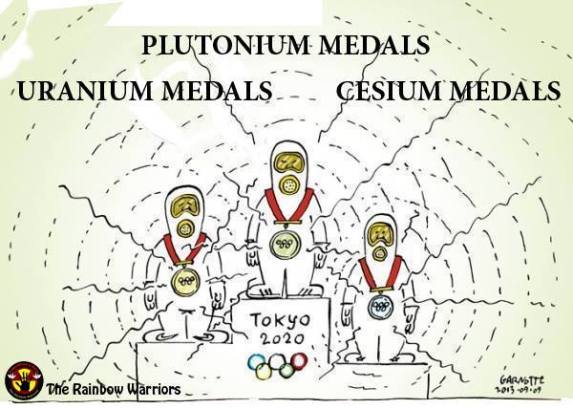 Can 2020 Summer Olympics help Fukushima rebound from nuclear disaster?, LA TIMES, DAVID WHARTON, AUG. 12, 2019
Under the moniker of the “Reconstruction Olympics,” they have plotted a torch relay course that begins near the crippled Fukushima Daiichi plant and continues through adjacent prefectures — Miyagi and Iwate — impacted by the disaster. The region will host games in baseball, softball and soccer next summer.
“We are hoping that, through sports, we can give the residents new dreams,” said Takahiro Sato, director of Fukushima’s office of Olympic and Paralympic promotions. “We also want to show how far we’ve come.”
The effort has drawn mixed reactions, if only because the so-called “affected areas” are a sensitive topic in Japan.
Some people worry about exposure to lingering radiation; they accuse officials of whitewashing health risks. Critics question spending millions on sports while communities are still rebuilding.
“The people from that area have dealt with these issues for so long and so deeply, the Olympics are kind of a transient event,” said Kyle Cleveland, an associate professor of sociology at Temple University’s campus in Japan. “They’re going to see this as a public relations ploy.”……
The populace began to question announcements from the Tokyo Electric Power Co. (Tepco) about the scope of the contamination, said Cleveland, who is writing a book on the catastrophe and its aftermath.
“In the first 10 weeks, Tepco was downplaying the risk,” he said. “Eventually, they were dissembling and lying.”……..
Reliable data on radiation risks is difficult to obtain, said Jonathan Links, a public health professor at Johns Hopkins University. …….
In terms of athletes and coaches visiting the impacted prefectures for a week or two during the Olympics, Links said the cancer risk is proportional, growing incrementally each day.
The Japanese government has raised what it considers to be the acceptable exposure from 1 millisievert to 20 millisieverts per year. Along with this adjustment, officials have declared much of the region suitable for habitation, lifting evacuation orders in numerous municipalities. Housing subsidies that allowed evacuees to live elsewhere have been discontinued.
But some towns remain nearly empty.
“People are refusing to go back,” said Katsuya Hirano, a UCLA associate professor of history who has who has spent years collecting interviews for an oral history. “Especially families with children.”……..
With infrastructure repairs continuing throughout the region, evacuee Akiko Morimatsu has a skeptical view of the Tokyo 2020 campaign.
“They have called these the ‘Reconstruction Games,’ but just because you call it that doesn’t mean the region will be recovered,” Morimatsu said.
Concerns about radiation prompted her to leave the Fukushima town of Koriyama, outside the mandatory evacuation zone, moving with her two young children to Osaka. Her husband, a doctor, remained; he visits the family once a month.
“The reality is that the region hasn’t recovered,” said Morimatsu, who is part of a group suing the national government and Tepco. “I feel the Olympics are being used as part of a campaign to spread the message that Fukushima is recovered and safe.”….. https://www.latimes.com/sports/olympics/story/2019-08-12/tokyo-olympics-2020-fukushima-nuclear-disaster
Donald Trump caught in a rather serious lie about USA’s “more advanced” nuclear missile technology
 Trump tries to brag about ‘advanced’ US nuclear technology and gets immediately called out https://www.indy100.com/article/trump-nuclear-cruise-missile-advanced-technology-russia-explosion-national-security-9055336
On Thursday, five Russian nuclear engineers were killed in a rocket engine explosion, which is thought to be linked to tests for a nuclear-powered cruise missile announced by Vladimir Putin in March 2018.
In his typically tactless style, Trump shared his thoughts on the explosion yesterday by claiming the US was “learning much” from the blast and had even more advanced technology.
Trump’s tweet caught the attention of national security experts because it meant one of two things:
- Trump had just revealed a secret US nuclear-powered cruise missile programme
- He was bluffing about a missile programme that the US does not have
It doesn’t exactly take, ahem, a rocket scientist to know that both of those explanations are quite bad.
For example, Michael McFaul, who worked both for the US National Security Council and as Barack Obama’s Ambassador to Russia, had no idea what Trump was talking about.
In fact, there was once a programme to develop a nuclear-powered cruise missile during the Cold War, called Project Pluto, but the US abandoned it because it was believed to be too dangerous – potentially creating missiles for which there was no known defence.
Arctic sea ice could disappear completely through September if temps increase 2 degrees
Arctic could be iceless in September if temps increase 2 degrees, Science Daily
- Date:
- August 13, 2019
- Source:
- University of Cincinnati
- Summary:
- Arctic sea ice could disappear completely through September each summer if average global temperatures increase by as little as 2 degrees, according to a new study.
-
Arctic sea ice could disappear completely through September each summer if average global temperatures increase by as little as 2 degrees, according to a new study by the University of Cincinnati.
The study by an international team of researchers was published in Nature Communications.
“The target is the sensitivity of sea ice to temperature,” said Won Chang, a study co-author and UC assistant professor of mathematics.
“What is the minimum global temperature change that eliminates all arctic sea ice in September? What’s the tipping point?”
The study predicted that the Arctic Ocean could be completely ice-free in September with as little as 2 degrees Celsius of temperature change. Limiting warming to 2 degrees is the stated goal of the 2009 Paris Agreement, the international effort to curb carbon emissions to address warming. The Trump Administration withdrew the United States as a participant in 2017……..
- The less summer sea ice the Arctic has, the longer it takes for the Arctic Ocean to ice back over for the polar winter. That could spell bad news for Arctic wildlife such as seals and polar bears that rely on sea ice to raise pups and hunt them, respectively.
The researchers applied the new statistical method to climate model projections of the 21st century. Using the climate models, the authors found at least a 6% probability that summer sea ice in the Arctic Ocean will disappear with warming of 1.5 degrees above pre-industrial levels. At 2 degrees, the likelihood increases to 28%…….https://www.sciencedaily.com/releases/2019/08/190813160526.htm
Revealed: mental health crisis at Hinkley Point C nuclear construction site
Guardian 13th Aug 2019 Several workers on nuclear plant have killed themselves or attempted to,
says union. Hinkley is grappling with a mental illness crisis, with several
attempted suicides since work began in 2016, a Guardian investigation can
reveal.
building project, a central plank in Britain’s future energy strategy. But
according to union officials, there has been a surge in suicide attempts
this year, a rise in the number of people off sick with stress, anxiety and
depression, and an increase in workers suffering from mental distress.
attempts in the first four months of 2019. The Guardian understands at
least two workers connected to the project have taken their lives since
construction started in earnest in 2016.
appear to be loneliness, relationship breakdown and the struggle of being
sometimes hundreds of miles away from family. At Hinkley, workers live on
special campuses in nearby Bridgwater, or else in converted digs in the
town. They work a variety of shift patterns and are shuttled to and from
the site on scores of buses. Some contractors work as much as 11 days on
with three days off, including an extra weekend day for travelling home.
But the Guardian understands that most people can cope with the stress and
pressure of the work. The problems start once they clock off.
Guardian 13th Aug 2019 Angie Young, the health and wellbeing manger at the Hinkley Point C (HPC)
site, does not hesitate when asked what the main cause of mental health
issues there is. “It’s loneliness. You’re living away from home,
living without your family. Loneliness is the big thing.” But a major
complicating factor is that tough men who build stuff are not always great
at talking about feelings. “Our guys are construction guys – they are
macho. The average age is 45-55. They haven’t got someone nagging them to
go and see someone. We’re trying to address that.”
https://www.theguardian.com/uk-news/2019/aug/13/no-more-man-up-better-mental-health-hinkley-point-c
UK’s nuclear waste plans – squabbles in a local Council
storage vaults for radioactive waste amid “moral” concerns.
prompting the council to come up with a statement that was broadly
supportive of the project but also non-committal in terms of the
authority’s involvement.
council’s Strategic Nuclear and Energy Board (SNEB) this week that panel
members disagreed over the council’s current position. The board heard
that some councillors were “fundamentally” opposed to the very idea of
a multi-million-pound underground Geological Disposal Facility (GDF).
criticised the GDF plans. Mr Pollen said he was not in a position to argue
with experts over the facility but stressed that “morality and ethics”
should also be considered. He questioned the “rush” to develop a GDF
amid concerns over safety and the lack of “retrievability” of the waste
once deposited. The councillor, who works at Sellafield, said the waste was
now stored “extremely safely” on the Sellafield site which he described
as a “big tick in a box for me”.
https://www.newsandstar.co.uk/news/17834550.councillors-split-search-n-waste-site/
The Anthropocene is not an epoch. It’s a passing blink in geological time

Humans are now living in a new geological epoch of our own making: the Anthropocene. Or so we’re told. Whereas some epochs in Earth history stretch more than 40 million years, this new chapter started maybe 400 years ago, when carbon dioxide dipped by a few parts per million in the atmosphere. Or perhaps, as a panel of scientists voted earlier this year, the epoch started as recently as 75 years ago, when atomic weapons began to dust the planet with an evanescence of strange radioisotopes.These are unusual claims about geology, a field that typically deals with mile-thick packages of rock stacked up over tens of millions of years, wherein entire mountain ranges are born and weather away to nothing within a single unit of time, in which extremely precise rock dates—single-frame snapshots from deep time—can come with 50,000-year error bars, a span almost 10 times as long as all of recorded human history. If having an epoch shorter than an error bar seems strange, well, so is the Anthropocene.
So what to make of this new “epoch” of geological time? Do we deserve it? Sure, humans move around an unbelievable amount of rock every year, profoundly reshaping the world in our own image. And, yes, we’re currently warping the chemistry of the atmosphere and oceans violently, and in ways that have analogues in only a few terrifying chapters buried deep in Earth’s history. Each year we spew more than 100 times as much CO2 into the air as volcanoes do, and we’re currently overseeing the biggest disruption to the planet’s nitrogen cycle in 2.5 billion years. But despite this incredible effort, all is vanity. Very little of our handiwork will survive the obliteration of the ages. If 100 million years can easily wear the Himalayas flat, what chance will San Francisco or New York have?
The idea of the Anthropocene is an interesting thought experiment. For those invested in the stratigraphic arcana of this infinitesimal moment in time, it serves as a useful catalog of our junk. But it can also serve to inflate humanity’s legacy on an ever-churning planet that will quickly destroy—or conceal forever—even our most awesome creations.
What paltry smudge of artifacts we do leave behind, in those rare corners of the continents where sediment accumulates and is quickly buried—safe from erosion’s continuous defacing—will be extremely unlikely to be exposed at the surface, at any given time, at any given place, tens of millions or hundreds of millions of years in the geological future. Sic transit gloria mundi……..
Unless we fast learn how to endure on this planet, and on a scale far beyond anything we’ve yet proved ourselves capable of, the detritus of civilization will be quickly devoured by the maw of deep time.
Geological time is deep beyond all comprehension……..
For context, let’s compare the eventual geological legacy of humanity (somewhat unfairly) to that of the dinosaurs, whose reign spanned many epochs and lasted a functionally eternal 180 million years—36,000 times as long as recorded human history so far. But you would never know this near-endless age was so thoroughly dominated by the terrible reptiles by looking to the rock record of the entire eastern half of North America. Here, dinosaurs scarcely left behind a record at all. And not because they weren’t here the entire time—with millions of generations of untold dinosaurs living, hunting, mating, dying, foraging, migrating, evolving, and enduring throughout, up and down the continent, in great herds and in solitary ambushes. ……
What, then, will a few decades of industrial civilization get us? This is the central question of the Anthropocene—an epoch that supposedly started, not tens of millions of years ago, but perhaps during the Truman administration…….
The most enduring geological legacy, instead, will be the extinctions we cause. The first wave of human-driven extinctions, and the largest hit to terrestrial megafauna since the extinction of the dinosaurs, began tens of thousands of years ago, as people began to spread out into new continents and islands, wiping out everything we tend to think of as “Ice Age” fauna—mammoths, mastodons, giant wombats, giant ground sloths, giant armadillos, woolly rhinoceroses, giant beavers, etc. This early, staggered, human-driven extinction event is as reasonable a starting date as any for the Anthropocene and one that has, in fact, been proposed. However, a few thousand years—or even a few tens of thousands of years—will be virtually indistinguishable in the rocks a hundred million years hence. That is, it would not be obvious to the geologists of the far future that these prehistoric human-caused extinctions were not simultaneous with our own modern-day depredations on the environment. …… To future geologists, the modern debate about whether the Anthropocene started 10 minutes ago or 10,000 years ago will be a bit like arguing with your spouse on your 50th wedding anniversary about which nanosecond you got married.
What humans are doing on the planet, then, unless we endure for millions to tens of millions of years, is extremely transient. In fact, there exists a better word in geology than epoch to describe our moment in the sun thus far: event. ….
The idea that we’re in a new epoch is a profoundly optimistic one, for it implies that we’ll persist into the future as an industrial technological civilization on something like a geological timescale…….
The idea of the Anthropocene inflates our own importance by promising eternal geological life to our creations. It is of a thread with our species’ peculiar, self-styled exceptionalism—from the animal kingdom, from nature, from the systems that govern it, and from time itself. This illusion may, in the long run, get us all killed. ……https://www.theatlantic.com/science/archive/2019/08/arrogance-anthropocene/595795/
Solar power is now cheaper than grid electricity in cities across China
which could drive a surge in uptake, according to new research. Some
experts thought China would have to wait decades until solar generation
cost the same as electricity from the grid.
combination of technological advances and support from the government,
“grid parity” has already been reached. Scientists found that all of the
344 cities they looked at could have cheaper electricity powered by solar
energy, according to the study published in the journal Nature Energy.
Twenty-two per cent of cities could also have solar systems that would
generate lower cost electricity than coal, according to the researchers,
led by Jinyue Yan from the Royal Institute of Technology in Stockholm.
No it wasn’t the wind turbines that caused a UK blackout
likely to benefit from reaction In the aftermath of last Friday’s blackout
the usual suspects are blaming wind turbines’, but that’s not what the
electricity market nerds are saying.
power outages have happened before the age of large-scale renewable energy
penetration and that stories of crisis at the National Grid are well
overblown. I certainly remember the blackout of 2008 which was caused by
the near simultaneous disconnection of Sizewell B (nuclear) and Longannet
(coal), but then of course we did not see anything in the media about how
it was all the fault of nuclear or coal-fired power plant.
offshore windfarm. Now there is talk of how the grid has become more
unstable because of increasing renewable energy penetration (now around 35%
of electricity on an annual basis) and how, depending on people’s interest
a) we ought to stop this nonsense and get back to having real large power
plant or b) we need more batteries and/or other stuff.
Nigel Cornwall. He tweeted in response to stories that the National Grid
was beset with a splurge of ‘near misses’ and last-gasp efforts: “Near
misses” and “last minute contracts” is the way the system – and all
electricity systems – is designed to operate. (National Grid) has done a
huge amount to modernise its balancing services, and I am struggling to
understand whose agenda this is. Two large power stations failed at the
evening peak, when the system was already calling for more output/demand
turndown. This was almost an occurrence of Titanic probabilities. You can
of course contract for a huge amount of extra reserve but at immense cost
to consumers’
https://realfeed-intariffs.blogspot.com/2019/08/no-it-wasnt-wind-turbines-that-caused.html
Church Rock America’s Forgotten Nuclear Sacrifice Zone

|
Church Rock, America’s Forgotten Nuclear Disaster, Is Still Poisoning Navajo Lands 40 Years Later. https://www.vice.com/en_us/article/ne8w4x/church-rock-americas-forgotten-nuclear-disaster-is-still-poisoning-navajo-lands-40-years-later Residents say they’ve been ignored even as they struggle with contaminated water and worry about having children. By Samuel Gilbert; photos by Ramsay de Give, Aug 12 2019,
Early in the summer of 1979, Larry King, an underground surveyor at the United Nuclear Corporation’s Church Rock Uranium mine in New Mexico, began noticing something unusual when looking at the south side of the tailings dam. That massive earthen wall was responsible for holding back thousands of tons of toxic water and waste produced by the mine and the nearby mill that extracted uranium from raw ore. And as King saw, there were “fist-sized cracks” developing in that wall. He measured them, reported them to his supervisors, and didn’t think anything more of it.
A few weeks later, at 5:30 a.m. on July 16, 1979, the dam failed, releasing 1,100 tons of uranium waste and 94 million gallons of radioactive water into the Rio Puerco and through Navajo lands, a toxic flood that had devastating consequences on the surrounding area. “The water, filled with acids from the milling process, twisted a metal culvert in the Puerco,” according to Judy Pasternak’s book Yellow Dirt: A Poisoned Land and the Betrayal of the Navajos. “Sheep keeled over and died, and crops curdled along the banks. The surge of radiation was detected as far away as Sanders, Arizona, fifty miles downstream.” According to a Nuclear Regulatory Commission report, radioactivity levels in the Puerco near the breached dam were 7,000 times that of what is allowed in drinking water. The heavily contaminated water flowed over the river banks, creating radioactive pools. “There were children up and down the river playing in those stagnant pools, and they were deadly poisonous,” Jorge Winterer, a doctor with Indian Health Service in Gallup, New Mexico, said after the spill. Earlier this year, standing in his yard next to an old Chevy, King pointed in the direction of the now dry Rio Puerco. “It came right through there,” said King. The unleashed river of waste had flowed through his family’s land just a half-mile from his house. “I remember the terrible odor and the yellowish color of the water.” He recalls seeing an elderly woman who had burned her feet crossing the Puerco while watering her sheep that day. King still lives on the family land, two miles downstream of the rebuilt dam in the Church Rock chapter of the Navajo Nation. His home is surrounded by a beautiful, unforgiving landscape of red rock cliffs, a scattering of Navajo residences and, if you look closely, fencelines with KEEP OUT signs marking the numerous abandoned uranium sites. Forty years later, the Church Rock spill remains the largest single largest accidental release of radioactivity in U.S. history, worse in terms of total radiation than that of the partial meltdown at Three Mile Island and second in world history only to the 1986 Chernobyl catastrophe, both of which have loomed much larger in the cultural imagination. The effects of the spill have lingered for an entire generation: In 2007, the Church Rock Uranium Mining Project found widespread contamination of drinking water sources in the Church Rock area. Navajo residents say they have not been given the attention given to other victims of nuclear accidents, even as they remain under the catastrophe’s long shadow, dealing with poisoned livestock and ongoing health problems amid other aftereffects. “We have never been a priority,” said King. “Forty years after the spill and nothing has been done.” “Our generation is afraid of having children,” said Faith Baldwin, who grew up on the Navajo nation surrounded by abandoned uranium mines. “Cancer runs in our family but it shouldn’t. Cancer, diabetes were nonexistent in Navajo rez.” During the Cold War, Navajo lands provided much of the raw material for the burgeoning nuclear industry. From 1944 to 1986 some 30 million tons of uranium ore were extracted from mines, but as demand for uranium decreased the mines closed, leaving over a thousand contaminated sites, few of which have been cleaned up. The Church Rock Chapter has some 20 such contaminated uranium sites, including the mine where King worked. Navajo workers at these places were often poorly paid, underprotected, and uninformed about the danger of radiation exposure. And even before the spill, King said, UNC would routinely pump uranium-contaminated water from the mine into the Puerco, turning the seasonal wash into a toxic “man-made stream.” According to a 1994 report by the U.S. Geological Survey on levels of radioactive elements in the Rio Puerco and Little Colorado River basins, “at least 300 times more uranium and 6 times more total gross alpha activity were released by day-to-day pumping from the underground mines than was released by the spill.” As a child King remembers playing in the dry Puerco wash, its banks often coated with a “yellowish slime.” And ranchers used the Puerco to water their livestock. Residents couldn’t have known that the Church Rock dam was at risk of rupturing, but there’s evidence that the United Nuclear Corporation did. King wasn’t the first to notice cracks in the dam: An Army Corps of Engineers report would later find that UNC was aware of the cracks as early as 1977, two years before the breach. That report concluded that UNC failed to properly reinforce the tailings dam, ignored advice from its own engineering consultant that might have prevented the coming disaster, and did not report the cracks to regulators. “The company was remiss in not heading the problem off,” said Chris Shuey, director of the Uranium Impact Assessment Program at the Southwest Research and Information Center, an organization providing information to the public about the impacts of energy development and resource extraction. Shuey said that UNC failed to repair cracks in the dam while simultaneously overfilling the uranium mill’s toxic tailing ponds that were being held back by that cracking wall. The cleanup process after the spill was also lacking. Only 1 percent of solid radioactive waste was removed, according to Paul Robinson, the research director at the Southwest Research and Information Center, and no compensation for the nearby residents was provided. In contrast, those affected by the Three Mile Island disaster were paid thanks to the company that operated that plant and its insurers. “Governments took meaningful measures to deal with the Three Mile Island accident,” said Eric Jantz, a lawyer from the New Mexico Environmental Law Center, “while neither the federal nor New Mexico governments have taken any steps to remediate the Church Rock spill even after 40 years.” As time went on, the impacts of uranium exposure became more evident to residents. King watched as his former mine coworkers died early deaths. Community members complained of health problems that prior to the entrance of the uranium industry were foreign: kidney disease, bone cancer, and lung cancer afflicting non-smokers. According to King, the only warnings about radioactivity were a few signs telling residents not to water their livestock in the wash. UNC’s cleanup efforts consisted of hiring some temporary workers to shovel waste from the wash into five-gallon buckets and haul it away, according to Colleen Keane, who made a documentary about the aftermath of the spill called The River That Harms. In the early 90s, King joined the Eastern Navajo Diné Against Uranium Mining (ENDAUM), a grassroots organization fighting against new uranium projects and trying to mitigate the negative impacts of mining operations. Through that work, King began hearing troubling stories from nearby Red Water Pond Road, a small community sandwiched between three uranium sites where residents “unwittingly used water from contaminated wells to drink, bathe, and hydrate their livestock,” according to a 2017 Reveal article. “Their sheep were born hairless… like baby rats,” said King. There were also the stories of butchered animals whose insides had turned a sickly yellow. A few years back, one of King’s neighbors killed a sheep. Instead of white, the stomach fat was yellow, “more yellow than those happy faces,” said King, pointing to a stuffed smiley face pinned above his couch. “They got concerned and decided to butcher another one. Pretty soon there was a pile of carcasses, all the same… They burned the whole thing.” he health impacts of the spill on residents remain poorly understood, with only a few authoritative heath studies having been conducted. One of the few government studies that came out after the spill did limited testing on both residents (six in total) and livestock. The resulting 1983 report from the New Mexico government, based on Centers for Disease Control (CDC) tests, concluded that Rio Puerco water “may be hazardous if used over several years as the primary source of drinking water, livestock water or irrigation water.” The report goes on to state that “the severity of these hazards is not well known at the time.” But since then, it’s become more obvious that the spill has had long-lasting and serious effects. In 2015, Tommy Rock, a doctoral student of earth science, uncovered uranium contamination in Rio Puerco water in Sanders, a town in eastern Arizona, by looking at tests stretching back to 2003. “The Church rock spill was the single most likely cause,” he said. “For decades people were unknowingly drinking poisoned tap water.” The water company did not report the contamination to residents, and after Rock’s findings a new company took over operations and is drawing on a different well. For many residents, the spill has come to embody the broader toxic legacy of the uranium industry on the indigenous lands of the West. According to the EPA, there are over 500 abandoned uranium mines, mill sites, and waste piles on Navajo Nation land that continue to contaminate water, soil, livestock and housing. “The Church Rock spill symbolizes the governmental and societal indifference to the impacts of uranium development on Indigenous lands,” said Jantz. “The Church Rock spill is the third largest nuclear accident after Fukushima and Chernobyl, and the largest in the US in terms of radiation released, but nobody knows about it.” “Three Mile Island had more coverage and people were compensated right away,” said King. “I always say we don’t get the same attention because we live in impoverished native community… We live in a sacrifice zone.” |
|
|
‘Dirty bomb’: Mystery Russian ‘superweapon’ kills five
An on-board reactor would give an engine almost unlimited range. In the case of a guided cruise missile, it could circle the world before receiving orders to attack from out of the blue.
But they’re not easy to control.
They operate at extremely high temperatures. They use explosive fuels, such as liquid hydrogen. And any accident could have devastating, long-lasting effects.
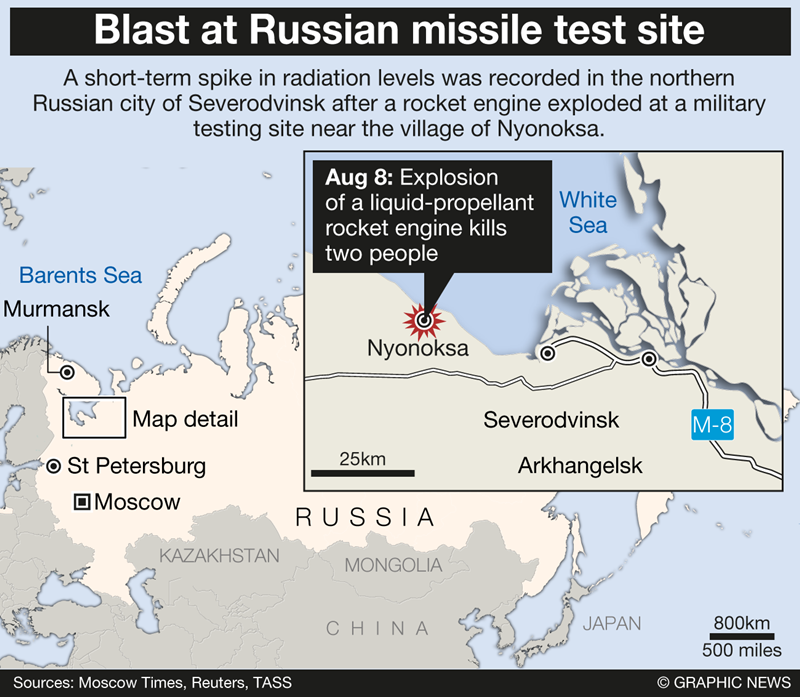
|
‘Dirty bomb’: Mystery Russian ‘superweapon’ kills five https://www.news.com.au/technology/innovation/military/dirty-bomb-mystery-russian-superweapon-kills-five/news-story/c3f85442bc12c6fea43cc4cf67df392e 13 Aug 19It was an explosion, played down by Russian officials — until they were forced to admit five people were dead and many more are at risk.
Jamie Seidel When an experimental missile exploded at a secret Russian base, things were immediately odd. Children from the nearby city of Severodvinsk were sent home from school. Its 185,000 residents were told to stay indoors. Doses of Iodine were distributed. All shipping was barred from the area for at least 30 days. What could cause such a reaction? How could a relatively small explosion cause such confusion? Russia’s nuclear energy agency Rosatom eventually stepped forward: It explained that a missile testing an “isotope power source for a liquid-fuelled rocket engine” had misfired. Rosatom conceded the accident on Thursday night had killed five, and three were being treated for burns. Russian officials said elite scientists Alexey Vyushin, Yevgeny Koratayev, Vyacheslave Lipshev, Sergey Pichugin and Vladislav Yanovsky — were killed during tests on a liquid propulsion system Little else is officially known. But military analysts have been speculating. Was it some sort of “dirty bomb”, with a radioactive warhead? Could it have been a failed launch from a nuclear-powered submarine? Suspicion has also fallen on one of President Vladimir Putin’s vaunted new “superweapons”. STORMY PETREL The idea of using a nuclear-reactor powered ramjet isn’t new It appears to have been thought up by Nazi rocket scientists during the dying days of World War II. With the fall of Berlin, these experts were divided up between the United States and the Soviet Union. Both nations embarked upon experimental nuclear-powered missile projects in the 1950s. It was quickly recognised the radiation-spewing technology was far too perilous to be practical. But a boisterous President Putin revealed what he called the 9M730 Burevestnik (Petrel) early last year as one of six new “superweapons”. NATO calls it the SSC-X-9 “Skyfall”. “Since its range is unlimited, it can manoeuvre as long as you want. No one in the world has anything like that,” Mr Putin boasted. “It may appear some day, but by that time we will develop something new.” The accompanying presentation showed the missile weaving its way between radar stations in the mid-Atlantic, passing around South America’s Cape Horn and worming its way up towards Hawaii. Mr Putin said the missile was successfully tested in late 2017 and was “invincible against all existing and prospective missile defence and counter-air defence systems”. “I want to tell all those who have fuelled the arms race over the last 15 years, sought to win unilateral advantages over Russia, introduced unlawful sanctions aimed to contain our country’s development: Aall that you wanted to impede with your policies have already happened,” Mr Putin declared. “You have failed to contain Russia.” But things don’t appear to be going to plan. EXPLOSIVE POTENTIAL Nuclear propulsion is promising — but also problematic. Continue reading |
Russia says small nuclear reactor blew up in deadly accident
|
August 13, 2019 The failed missile test that ended in an explosion killing five scientists last week on Russia’s White Sea involved a small nuclear reactor, according to a top official at the institute where they worked.
The institute is working on small-scale power sources that use “radioactive materials, including fissile and radioisotope materials” for the Defence Ministry and civilian uses, Vyacheslav Soloviev, scientific director of the institute, said in a video shown by local TV.
The men, who will be buried on Monday, were national heroes and the “elite of the Russian Federal Nuclear Centre,” institute Director Valentin Kostyukov said in the video, which was also posted on an official website in Sarov, a high-security city devoted to nuclear research less than 400 kilometers east of Moscow.
The blast occurred on August 8 during a test of a missile that used “isotope power sources” on an offshore platform in the Arkhangelsk region, close to the Arctic Circle, Russia’s state nuclear company Rosatom said over the weekend. The Defence Ministry initially reported two were killed in the accident, which it said involved testing of a liquid-fuelled missile engine. The ministry didn’t mention the nuclear element.
Rosatom declined to comment on the incident on Monday and a spokeswoman for the Sarov institute couldn’t immediately be reached.
Russian media have speculated that the weapon being tested was the SSC-X-9 Skyfall, known in Russia as the Burevestnik, a nuclear-powered cruise missile that President Vladimir Putin introduced to the world in a brief animated segment during his state-of-the-nation address last year.
The incident comes after a series of massive explosions earlier last week at a Siberian military depot killed one and injured 13, as well as forcing the evacuation of 16,500 people from their homes. Russia’s navy has suffered numerous high-profile accidents over the years. In July, 14 sailors died in a fire aboard a nuclear-powered submarine in the Barents Sea in an incident on which officials initially refused to comment. A top naval official later said the men gave their lives preventing a “planetary catastrophe.”
Russia’s worst post-Soviet naval disaster also occurred in the Barents Sea, when 118 crew died on the Kursk nuclear submarine that sank in after an explosion in August 2000. https://www.theage.com.au/world/asia/russia-says-small-nuclear-reactor-blew-up-in-deadly-accident-20190813-p52gfm.html
|
|


Fukushima’s ticking time-bomb, as space is running out for radioactive water storage
IN THREE YEARS, FUKUSHIMA COULD OVERFLOW WITH RADIOACTIVE WATER, https://futurism.com/the-byte/fukushima-overflow-radioactive-water AUGUST 9TH 19__DAN ROBITZSKI_
Ticking Clock
The effort to safely decommission Japan’s Fukushima Daiichi nuclear power plant just got hit by a looming deadline.
In about three years, the plant will run out of space for the massive quantities of treated but still-radioactive water that officials have been storing there, according to The Associated Press. While a government panel came up with a few possible courses of action, the 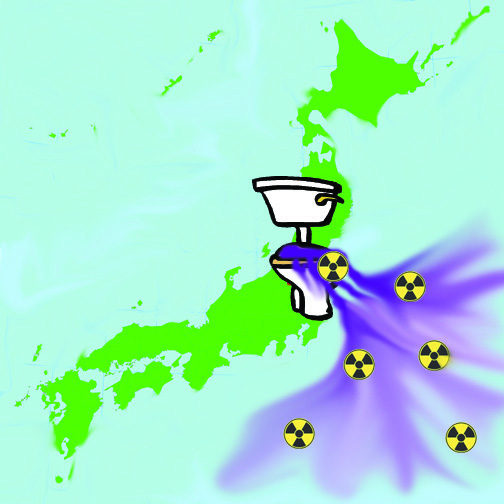 most feasible one at the moment is to simply dump the water into the Pacific — a bleak sign for nuclear disasters in the future.
Maximum Capacity
At the moment, Fukushima has over 1 million tons of water stored in almost 1,000 on-site tanks, the AP reports. Plans are in place to build enough to store nearly 1.4 million more tons, but that even those will reach capacity by mid-2022.
Local fishers and residents of the area say that dumping the water would devastate the area’s fishing and agriculture industry, per the AP. Other options considered by the panel include vaporizing the radioactive water or injecting it deep underground.
“When we talk about Fukushima’s reconstruction, the question is if we should prioritize the decommissioning at the expense of Fukushima people’s lives,” University of Tokyo professor of disaster social science Naoya Sekiya told the AP. “The issue is not just about science.”
Putin’s silence on mysterious radiation accident
 Russia nuclear leak: Mysterious footage of hazmat officials escalates radiation panic https://www.express.co.uk/news/world/1164125/Russia-nuclear-leak-radiation-Putin-iodine-hazmat
CHILLING footage from Russia has intensified fears of a nuclear radiation accident after ambulances were spotted lined with protective chemical sheets and hospitals workers were seen wearing hazmat suits.
Rostam added that the explosion took place during the testing of an “isotope power source”.
The official said five of its employees had died as a result of the accident and three more were being treated for burns.
However, the extent of the incident and threat of radiation has not been disclosed, amid growing global concern.
The Archangelsk naval base has been placed under emergency lockdown for a month, with the nearby White Sea also closed to commercial shipping.
A sudden radiation spike detected in the region following the explosion prompted the initial speculation that the incident was related to a nuclear missile test.
The radiation level was recorded as 20 times higher than the normal level in the nearby city of Severodvinsk.
This has been reinforced by chilling footage filmed in the aftermath of the incident.
One video showed hospital workers wearing hazmat suits while they loaded the injured into an ambulance. Another terrifying video revealed a security escort of ambulances transporting the injured to Moscow.
In this footage, one of the ambulance is clearly coated in a chemical protection film.
A defence ministry source said that the worker’s clothes had been burned as soon as they were hospitalised with suspected radiation. Experts have linked the incident to the testing of the new nuclear-powered cruise missile Burevestnik mentioned during a speech by Vladimir Putin last year.
Local people have reportedly been urged to take precautions against radiation, with children from local kindergartens taken indoors after the blast.
There has also been a rush to buy iodine in Russia’s far north.
Russian expert Dr Mark Galeotti said the incident was “clearly a bigger issue than the Russians are letting on”.
He told the BBC: “Despite what the Kremlin have said, there must have been some sort of radiation leak – and they want people to not just stay out of harm’s way, but also don’t want people coming to the site with Geiger Counters.”
India and Pakistan on Hair-Trigger Nuclear Alert Over Kashmir
 Hair-Trigger Nuclear Alert Over Kashmir, Common Dreams, India and Pakistan, where people starve in the streets, waste billions on military spending because of the Kashmir dispute. Now some of India’s extreme Hindu nationalists warn they want to reabsorb Pakistan, Bangladesh, and even Sri Lanka into Mother India. by Eric Margolis 11 Aug 19
Kashmir has been a flashpoint since Imperial Britain divided India in 1947. India and Pakistan have fought numerous wars and conflicts over majority Muslim Kashmir. China controls a big chunk of northern Kashmir known as Aksai Chin.
In 1949, the UN mandated a referendum to determine if Kashmiris wanted to join Pakistan or India. Not surprisingly, India refused to hold the vote. But there are some Kashmiris who want an independent state, though a majority seek to join Pakistan……
What makes this confrontation so dangerous is that both sides have important tactical and nuclear forces arrayed against one another. These are mostly short/medium-ranged nuclear tipped missiles, and air-delivered nuclear bombs. Strategic nuclear weapons back up these tactical forces. A nuclear exchange, even a limited one, could kill millions, pollute much of Asia’s ground water, and spread radioactive dust around the globe – including to North America. ….https://www.commondreams.org/views/2019/08/11/hair-trigger-nuclear-alert-over-kashmir
1 This Month
19 November – Webinar – The Reality of Reprocessing
Time: 11:00 AM Pacific Time (US & Canada) / 2:00 PM Eastern / 7:00 PM UK / 8:00 PM CET
Register for the Zoom Event Here

Tell Congress: Prevent Nuclear Catastrophe in Iran

Tell Congress: Prevent Nuclear Catastrophe in Iran

Read the Public Inquiry Report, the Commissioners’ report, Surrendering Australia: The AUKUS Deception is available to download for free at aukuspublicinquiry.com. Or just watch the replay of the National Press Club Luncheon.


Shut down the radiation-damaged Heysham nuclear reactors now
To see nuclear-related stories in greater depth and intensity – go to https://nuclearinformation.wordpress.com

Say No to NASA’s Reckless Nuclear Reactor on the Moon
Say No to NASA’s Reckless Nuclear Reactor on the Moon
-
Archives
- November 2026 (190)
- October 2026 (302)
- September 2026 (339)
- August 2026 (330)
- July 2026 (355)
- June 2026 (287)
- May 2026 (306)
- April 2026 (356)
- March 2026 (251)
- February 2026 (267)
- January 2026 (308)
- December 2025 (358)
-
Categories
- 1
- 1 NUCLEAR ISSUES
- business and costs
- climate change
- culture and arts
- ENERGY
- environment
- health
- history
- indigenous issues
- Legal
- marketing of nuclear
- media
- opposition to nuclear
- PERSONAL STORIES
- politics
- politics international
- Religion and ethics
- safety
- secrets,lies and civil liberties
- spinbuster
- technology
- Uranium
- wastes
- weapons and war
- Women
- 2 WORLD
- ACTION
- AFRICA
- Atrocities
- AUSTRALIA
- Christina's notes
- Christina's themes
- culture and arts
- Events
- Fuk 2022
- Fuk 2023
- Fukushima 2017
- Fukushima 2018
- fukushima 2019
- Fukushima 2020
- Fukushima 2021
- general
- global warming
- Humour (God we need it)
- Nuclear
- RARE EARTHS
- Reference
- resources – print
- Resources -audiovicual
- Weekly Newsletter
- World
- World Nuclear
- YouTube
-
RSS
Entries RSS
Comments RSS

