Illinois energy Bill increases public costs, but benefits nuclear company Exelon
Exelon accused of seeking nuclear bailout http://www.fierceenergy.com/story/exelon-accused-seeking-nuclear-bailout/2015-02-27 February 27, 2015 | By Barbara Vergetis Lundin Exelon yesterday introduced its “Low Carbon Portfolio Standard” — legislation that is receiving opposition from groups like AARP Illinois and the BEST (Better Energy Solutions for Tomorrow) Coalition who are urging state lawmakers to reject this legislation, saying it would increase electric bills in order to “bail out Exelon’s nuclear plants.”
A 2014 analysis by Crain’s Chicago Business found that Exelon’s Illinois nuclear fleet is profitable and Exelon CEO Chris Crane even stated “Exelon had a strong year, both operationally and financially…our generation fleet and utilities continued to perform at high levels.”
For Exelon’s part, it says it is not seeking a bailout. Exelon made more than $2 billion in 2014.
This bill rewrites Illinois energy policy to increase costs for public and private entities statewide and benefits only Exelon,” said Steve Davis, legislative co-chair for Illinois Association of Wastewater Agencies, a BEST Coalition member. “Policy like this will increase the cost of doing business in Illinois and make Illinois less competitive.”
The organizations attempting to block Exelon’s Low Carbon Portfolio Standard claim that even if Exelon has financial issues with its Illinois nuclear fleet, although contrary to publicly available information, those issues will be resolved, in part, by a recently approved rate increase for Exelon’s subsidiary ComEd that will increase ComEd revenue by approximately $232 million.
For more:
– visit this website
Fort Calhoun nuclear waste not going anywhere?
Fort Calhoun Nuclear Waste Needs A Home By: Brian Mastre – WOWT.com , Feb 27, 2015 Nebraskans have paid hundreds of millions of dollars to the federal government to store used nuclear fuel from the state’s two nuclear power plants, but the feds aren’t doing anything with it. Yet, the government keeps the money. Where is the nuclear waste going in the meantime and what’s happening to our dollars?…….http://www.wowt.com/home/headlines/Fort-Calhoun-Nuclear-Waste-Needs-A-Home-294370321.html
If a nuclear warhead detonated above midtown Manhattan?
What would happen if an 800-kiloton nuclear warhead detonated above midtown Manhattan? Bulletin of the Atomic Scientists, 25 Feb 15 Steven StarrLynn EdenTheodore A. Postol Russian intercontinental ballistic missiles are believed to carry a total of approximately 1,000 strategic nuclear warheads that can hit the US less than 30 minutes after being launched. Of this total, about 700 warheads are rated at 800 kilotons; that is, each has the explosive power of 800,000 tons of TNT. What follows is a description of the consequences of the detonation of a single such warhead over midtown Manhattan, in the heart of New York City.

The initial fireball. The warhead would probably be detonated slightly more than a mile above the city, to maximize the damage created by its blast wave. Within a few tenths of millionths of a second after detonation, the center of the warhead would reach a temperature of roughly 200 million degrees Fahrenheit (about 100 million degrees Celsius), or about four to five times the temperature at the center of the sun.
A ball of superheated air would form, initiallly expanding outward at millions of miles per hour. It would act like a fast-moving piston on the surrounding air, compressing it at the edge of the fireball and creating a shockwave of vast size and power.
After one second, the fireball would be roughly a mile in diameter. It would have cooled from its initial temperature of many millions of degrees to about 16,000 degrees Fahrenheit, roughly 4,000 degrees hotter than the surface of the sun.
On a clear day with average weather conditions, the enormous heat and light from the fireball would almost instantly ignite fires over a total area of about 100 square miles.
Hurricane of fire. Within seconds after the detonation, fires set within a few miles of the fireball would burn violently. These fires would force gigantic masses of heated air to rise, drawing cooler air from surrounding areas toward the center of the fire zone from all directions.
As the massive winds drove flames into areas where fires had not yet fully developed,the fires set by the detonation would begin to merge. Within tens of minutes of the detonation, fires from near and far would joinhave formed a single, gigantic fire. The energy released by this mass fire would be 15 to 50 times greater than the energy produced by the nuclear detonation……….
No survivors. Within tens of minutes, everything within approximately five to seven miles of Midtown Manhattan would be engulfed by a gigantic firestorm. The fire zone would cover a total area of 90 to 152 square miles (230 to 389 square kilometers). The firestorm would rage for three to six hours. Air temperatures in the fire zone would likely average 400 to 500 degrees Fahrenheit (200 to 260 Celsius).
After the fire burned out, the street pavement would be so hot that even tracked vehicles could not pass over it for days. Buried, unburned material from collapsed buildings throughout the fire zone could burst into flames when exposed to air—months after the firestorm had ended.
Those who tried to escape through the streets would have been incinerated by the hurricane-force winds filled with firebrands and flames. Even those able to find shelter in the lower-level sub-basements of massive buildings would likely suffocate from fire-generated gases or be cooked alive as their shelters heated to oven-like conditions.
The fire would extinguish all life and destroy almost everything else.Tens of miles downwind of the area of immediate destruction, radioactive fallout would begin to arrive within a few hours of the detonation.
But that is another story.
Editor’s note: This article is adapted from “City on Fire” by Lynn Eden, originally published in the January 2004 issue of the Bulletin of the Atomic Scientists. http://thebulletin.org/what-would-happen-if-800-kiloton-nuclear-warhead-detonated-above-midtown-manhattan8023
Effect of ionising radiation on health, shown through Baby Tooth Survey
 They found that the radioactive strontium-90 levels in the baby teeth of children born from 1945 to 1965 had risen 100-fold and that the level of strontium-90 rose and fell in correlation with atomic bomb tests.
Early results from the Baby Tooth Survey, and a U. S. Public Health Service study that showed an alarming rise in the percentage of underweight live births and of childhood cancer, helped persuade President John F. Kennedy to negotiate a treaty with the Soviet Union to end above-ground testing of atomic bombs in 1963.
St. Louis Baby Tooth Survey, 1959-1970, Washington University School of Dental Medicine Though many members of the group were vocally against nuclear testing, CNI never took an official position for or against the testing of nuclear weapons. Scientific facts were assembled, studied by the Committee and its Scientific Advisory Group, and then made available to the public through regular bulletins, newsletters, and a speaker’s bureau…. Continue reading
Washington State Senator Sharon Brown enthusiastically pushing for Small Modular Nuclear Reactors
 Nuclear Advocate Pushes For Modular Reactor Presence In Washington State http://www.icontact-archive.com/uY4CWN-9Ks3su6iHyVeY7nHzrprAq8_d?w=1 Feb 25 2015 A state senator in Washington, Sharon Brown, R-Kennewick, is promoting nuclear energy with a focus on technology that has yet to be put into operation.
Bills that Brown have sponsored nudge the state towards acceptance of modular, factory-built nuclear reactors, The Olympian reported Tuesday.
Brown has called for a relatively modest $176,000 study to identify sites for nuclear power reactors that are in frequent discussions, but have yet to be built – reactors with a generation capacity of 300 MW or less.
In neighboring Oregon, NuScale Power is developing reactors that will built in one location and shipped by truck or rail to their final destination
“We need to make sure we’re not left behind,” said Brown at a hearing Tuesday. She also said, “It’s really important that as a state we get our arms around small nuclear reactors.”
Brown, who is pushing the state to nudge the federal government on construction of a federal waste repository, has sponsored other nuclear power-friendly bills that cleared a critical deadline last week. These include a bill to provide sales tax relief for small reactor production and one that mandates the Commerce Department support small reactors development for commercial use.
She has also sponsored measures that would allow energy from modular reactors to count as part of the state’s renewable energy targets, although these initiatives have strong opposition from environment groups.
The initiatives follow up on a previous state study, completed in September, that said a modular reactor facility was feasible for the Hanford Site nuclear facility.
USA’s climate change denial machine investigate by Democrats
 Democrats Target Climate-Deniers-for-Hire , http://www.newrepublic.com/article/121131/democrats-demand-fossil-fuel-disclosure-climate-denier-studies by Rebecca Leber, Over the weekend, The New York Times and The Guardian reported that the fossil fuel industry paid astrophysicist Wei-Hock “Willie” Soon $1.25 million in grants in exchange for 11 scientific papers that cast doubt on the role humans play in climate change. Soon never disclosed the grants from the Charles G. Koch Foundation, ExxonMobil, Southern Company, and American Petroleum Institute, while publishing research that blamed climate change on anything but pollution (Soon faulted the sun) and spun the impact as a net benefit for the environment (helping trees and polar bears thrive, according to Soon).

By itself, the revelation isn’t likely to slow Soon’s lucrative romp through GOP talking points. When the Boston Globe reported in 2013 that the same companies had contributed more than a million dollars to Soon’s climate research, Republicans continued to cite his work and his double-barrelled affiliation with the Harvard-Smithsonian Center for Astrophysics. Which is why two Democrats are launching investigations into the climate-change denial machine. Continue reading
Federal Court decision could hasten the closure of Diablo Nuclear Power Facility
 Landmark Federal Court Decision: Will It Speed Diablo Nuke’s Demise? Ecowatch Harvey Wasserman | February 24, 2015 New revelations about earthquake dangers have shaken the future of California’s Diablo Canyon nukes.
In a rare move, Washington DC’s Federal U.S. Court of Appeals will hear a landmark challenge to their continued operation. The suit says Diablo’s owners illegally conspired with the Nuclear Regulatory Commission (NRC) to weaken seismic standards. “This is a big victory,” says Damon Moglen of Friends of the Earth. “The public has a right to know what the Nuclear Regulatory Commission and Pacific Gas & Electric won’t admit—hundreds of thousands of people are put at immediate risk by earthquake danger at Diablo Canyon.”
Diablo is also vulnerable on state and federal water quality regulations, economic concerns and more. Citizen activism has also shut operating reactors at Humboldt, Rancho Seco and San Onofre. Proposed projects have been cancelled at Bodega Bay and Bakersfield.
California’s two remaining reactors are surrounded by more than a dozen seismic fault lines. The Shoreline fault runs within 600-700 yards of the Diablo cores, which also sit just 45 miles from the massive San Andreas fault—half Fukushima’s distance from the epicenter of the quake that destroyed it.
The two 1,100-plus megawatt Diablo nukes overlook a Pacific tsunami zone, nine miles southwest of San Luis Obispo. Since the 1980s they’ve hosted some 10,000 arrests—more than any other U.S. site.
U.S. courts generally treat the nuclear industry as a law unto itself and rarely question NRC proceedings.
But in this case, says Friend of the Earth’s S. David Freeman, “PG&E’s recent study revealed that the earthquake threat at Diablo Canyon, as measured by its original license, could be far greater than that for which the reactors were designed. So PG&E and the NRC secretly amended the license to relax the safety requirements.”
Freeman is former head of the Tennessee Valley Authority, Los Angeles Department of Water and Power and the Sacramento Municipal Utility District. Dr. Michael Peck, the NRC’s own chief seismic expert, warned that the Diablo reactors could not meet seismic safety standards. Peck was then transferred to NRC offices in Chattanooga.
The case follows a successful FOE filing showing that the NRC conspired with Southern California Edison to ignore steam generator violations at San Onofre. Amidst a massive grassroots upheaval, San Onofre was officially shut in 2013 (similar violations at Ohio’s Davis-Besse reactor have had little impact).
Safe energy activists staged major January gatherings in San Luis Obispo and San Francisco. A “Don’t Frack/Nuke Our Earth” conference may soon follow in the Bay Area.
Earthquake issues are not the only ones poised to doom Diablo.
The two reactors dump huge quantities of hot wastewater directly into the ocean. They’re out of compliance with state and federal water quality standards. So PG&E might soon be required by state law to build cooling towers, with cost estimates ranging from $2 billion to $14 billion.
The state Water Resources Control Board may meet on the issue this spring. The San Luis Obispo Mothers for Peace and others ask the public to write the board and attend its next public hearing.
If required to build those towers, which might take years to do, PG&E would ask the California Public Utilities Commission to make the public pay for them. A vehement grassroots opposition would instantly erupt.
PG&E is much hated. Its negligence caused a 2010 gas explosion that killed eight people in San Bruno. Huge state and federal fines, criminal indictments and visceral public contempt have followed.
The CPUC is also under public fire amidst an astonishing array of scandals and law-breaking. …….http://ecowatch.com/2015/02/24/court-ruling-diablo-nukes-demise/
Apple’s two Entirely Renewable Energy Data Centres – $2.5 Billion investment
Apple’s Investing $2.5 Billion On Two Entirely Renewable Energy Data Centres http://www.gizmodo.com.au/2015/02/apples-investing-2-5-billion-on-two-entirely-renewable-energy-data-centres/
GERALD LYNCH – GIZMODO UKApple has just announced that it is to invest €1.7 billion ($2.5 billion) in two new “state-of-the-art” data centres for Europe, located in Ireland and Denmark. The sites in County Galway and Denmark’s central Jutland will use 100 per cent renewable energy and power Apple’s iTunes Store, App Store, iMessage and Maps applications and Siri voice assistant.Measuring 166,000 square metres apiece, the data centres will begin operations in 2017, and each will support a specific local initiative too. The County Galway project will include a scheme to recover land previously used for the harvesting of non-native trees and return native flora to the area, along with an outdoor education space for schools. The Danish data centre will capture excess heat and return it to the district’s heating system to warm local homes.
It’s the latest in a recent burst of green-friendly moves by Apple, with the company also recently announcing plans to build a giant solar farm in Monterey, California.
Look out – Nuclear Lobby ! – Christians are turning to Solar Energy
Roberta Combs, president of the group, titled her post “For God and Country, Indiana and America Need Better Energy Policies,” writing,
Indiana’s utilities are interested in keeping us reliant on traditional fuel sources that hurt our national security and weaken our economy. We must allow homes, businesses, public organizations, and churches to create local, American power by installing solar.
As conservatives, we stand up for our country’s national security and the health of our economy. And, as Christians, we recognize the biblical mandate to care for God’s creation and protect our children’s future
 Solar energy’s new best friend is … the Christian Coalition WP By Chris Mooney February 20 The politics of solar power keeps getting more and more interesting.
In Indiana, a fight over net metering — basically, whether people with rooftop solar can return their excess power to the grid and thereby lower their utility bills — has drawn out groups ranging from the state chapter of the NAACP to the conservative TUSK (Tell Utilities Solar won’t be Killed) in favor of the practice.
Arrayed on the other side of the issue, meanwhile, are the Indiana Energy Association, a group of utilities, and Republican Rep. Eric Koch, sponsor of a bill that would potentially change how net metering works in the state. The legislation, in its current form, would let utility companies ask the Indiana Utility Regulatory Commission to include various “tariffs, rates and charges, and credits” for those customers generating their own energy at home. Continue reading
Nuclear Regulatory Commission to take over environmental review of Yucca project
 Energy Secretary Ernest Moniz recently reiterated that Yucca Mountain doesn’t have public support and is not a workable solution, a point that three Nevada lawmakers — Senate Democratic Leader Harry Reid and Republicans Sen. Dean Heller of Nevada and Gov. Brian Sandoval — hammered home in a letter to The Washington Post this week.
“If Yucca Mountain has taught us anything, it is that continuing to try to force the repository on Nevada only gets the nation further away from a real solution,” the senators and Sandoval wrote.
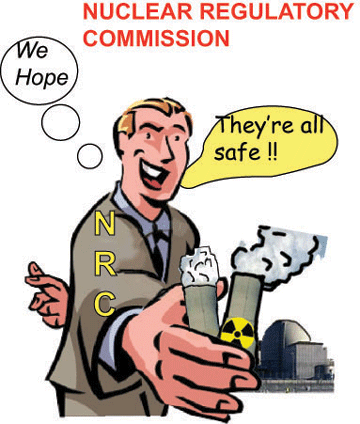 NRC will complete environmental review of Yucca project — chairman http://www.eenews.net/stories/1060013577 Hannah Northey, E&E reporter Greenwire: Tuesday, February 17, 2015 The Nuclear Regulatory Commission intends to complete an environmental review of the contentious waste repository under Yucca Mountain in Nevada because the Energy Department has refused to do so, the NRC’s chairman said today.
“The decision is we will do that since [the Department of Energy] told us they won’t be doing it,” NRC Chairman Stephen Burns told reporters at the Platts 11th Annual Nuclear Energy Conference in Washington, D.C., today. “We have the funds that are left over from the carryover for high-level waste, will cover the preparation of the supplemental [environmental impact statement].” Continue reading
USA’s Tea Party – 85 groups join movement for solar energy!
Floridians for Solar Choice, the group behind the initiative, is an inchoate alliance of libertarians, Christian Coalition conservatives, liberal environmentalists, and eighty-five Tea Party groups
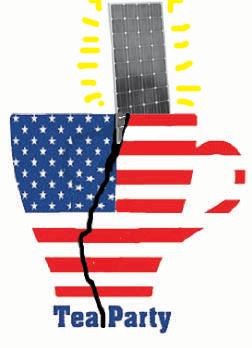 Greening the Tea Party, New Yorker BY CAROLYN KORMANN 18 Feb 15 The solar-energy business is booming. The average cost of installing solar panels has dropped by half since 2010, and a new solar electric system is now installed somewhere in the United States every four minutes.
The growth extends well beyond the rooftops of American homes and small businesses; last week, Apple announced that it is investing in an eight-hundred-and-fifty-million-dollar solar farm in Monterey County, California, which it says will power its operations in the state by the end of 2016. Although solar is still small, supplying less than one per cent of the country’s electricity, its growth has alarmed the energy industry’s old guard—coal, oil, and utility companies. Continue reading
Nuclear industry revving up campaign to win public support and public money
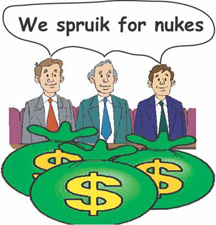 NRC will complete environmental review of Yucca project — chairman http://www.eenews.net/stories/1060013577 “……..’Right-sizing’ the NRC Burns is taking the agency’s reins at a critical time for both the NRC and the U.S. nuclear industry, which has embarked on a public campaign to tout the financial and climate benefits of reactors struggling in competitive power markets.
The industry is facing stiff competition from cheap gas, weak demand in the power markets, and new safety regulations after the 2011 Fukushima Daiichi nuclear disaster in Japan. While five new reactors are under construction and the NRC staff today recommended that another project move forward at DTE Energy Co.’s Fermi nuclear plant in southeastern Michigan, the industry has seen a recent spate of plant closures in California, Wisconsin, Florida and Vermont.
Touching on those closures, a number of executives from nuclear giants Exelon Corp. and FirstEnergy Corp. spoke at the conference about the need for market fixes to bolster struggling reactors.
Donald Moul, vice president of commodity operations for FirstEnergy Solutions, said at least 40,000 megawatts of baseload power — mostly older coal plants but also reactors — could be forced to prematurely retire in the Midwest and Mid-Atlantic, and grid operators and U.S. EPA need to do more to credit reactors under its Clean Power Plan. Moul said nuclear plants are facing a “lack of revenue certainty,” and their closure will only make it more difficult for states to comply with the Obama administration’s climate goals.
David Brown, senior vice president of government affairs for Exelon, the nation’s largest operator of commercial reactors, said there are no “silver bullets,” but market reforms in the PJM Interconnection are a “big start.” On the state level, Brown said, Illinois has developed a handful of options, and a low-carbon energy standard is most likely to gain traction.
“A lot of people thought [EPA’s Clean Power Plan] would be a real savior for the industry, but … that rulemaking was off the mark,” Brown said.
Burns signaled that the NRC in coming weeks and months intends to slim down to match a declining lot of license applications.
NRC senior staff, he said, is focused on “right-sizing” the agency — streamlining operations, making more timely decisions and establishing clearer agencywide priorities through a program dubbed “Project AIM 2020” that began last year.
NRC commissioners will be briefed on staff’s recommendations for slimming the agency tomorrow, and the proposal will be made public soon, he added.
Burns also noted that the agency’s fiscal 2016 budget proposal reflects a reduction of 140 full-time workers and of $27.3 million from the prior year’s request. Burns said the agency’s fiscal 2015 fee rule — expected in coming months — will also likely reflect a dip in licensee fees.
“No organization can remain static,” Burns said.
Twitter: @HMNorthey | Email: hnorthey@eenews.net
California’s solar industry boosting jobs
Report: California adds nearly 7,500 solar jobs to its nation-leading total http://www.sacbee.com/news/business/article10468988.html BY MARK GLOVER MGLOVER@SACBEE.COM 02/16/2015
California’s solar industry added nearly 7,500 jobs in 2014, boosting its nation-leading total to 54,690, according to a new report by the Washington, D.C.-based Solar Foundation.
That represented a 15.8 percent gain over 47,223 reported in 2013. Nearly 60 percent of the current jobs are in the solar installation sector, according to the report.
Massachusetts was a distant second in the 2014 job rankings, with 9,400 solar industry jobs.
“California’s solar industry has once again proven to be a powerful engine of economic growth and job creation,” Andrea Luecke, foundation president and executive director, said in a statement accompanying the figures.
The report also noted that California is projected to add nearly 10,000 more solar industry jobs in 2015.
The foundation said there were 2,094 solar companies in California as of November 2014, also No. 1 nationally. The Golden State also topped the nation in the number homes powered by solar energy, at more than 2.38 million.
Nationally, the foundation said 173,807 held jobs in the solar industry near the end of 2014, up 21.8 percent from the previous year.
“Clean Coal” not a goer, for White House – support withdrawn
 The White House Walks Away from Clean Coal A $1 billion Illinois project, meant to be the poster child for coal’s climate-friendly future, gets scuttled. Bloomberg, Feb 15, 2015 Jim Snyder Mark Drajem Matthew Philips
The resurrection was short-lived. On Feb. 3, the Department of Energy announced it was withdrawing support. Environmentalists who want investment in renewable power technologies rather than fossil energy cheered the decision. “We don’t need it, and we can’t afford it,” Bruce Nilles, head of the Sierra Club’s Beyond Coal campaign, says of carbon-capture projects……
The Illinois project, called FutureGen, was supposed to be a model for coal’s climate-friendly future. It was backed by some of the world’s biggest coal mining companies, who created a nonprofit, the FutureGen Industrial Alliance, to oversee the plant’s conversion. The White House saw FutureGen as a way to show leaders in China and India, where coal fuels more than half of electricity generation, that they can address their own carbon emissions without compromising economic growth. About 40 percent of man-made carbon emissions come from power plants……http://www.bloomberg.com/politics/articles/2015-02-14/the-white-house-walks-away-from-clean-coal
A Troubling Spike, Infant Deaths in Alaska: a Fukushima Effect?
A recent article from the Anchorage Alaska Dispatch News on 02-14-15, “Rash of sleep-related infant deaths troubles health officials” bears consideration.
Many of the infant deaths are attributed to babies sleeping with parents, alcohol abuse, poor parenting, etc. Notably, the article stated: “Almost of the families who suffered a recent baby death were low income.” But, has infant care and poverty varied that much in the past decade?
Infant mortality in Alaska has been falling for years, however 122 infants died in 2012-2013, compared to 85 deaths two years before.
Research of causes of this highly unexpected increase is needed, and consideration should be given to the arrival of radioactive fallout from Fukushima after the 2011 meltdown. Radiation levels were highest in Alaska, Hawaii and the Pacific west coast .
Since we know the un-born and young are at greater risk from exposure to nuclear radiation, effects that have been documented since the Marshall Islands nuclear tests, x-rays of pregnant women, and the Chernobyl catastrophe of 1986.
According to the CDC, infant (<1 year) deaths in Alaska have been falling steadily, but increaseds after 2011:
2010-2011 390.82 per 100,000 births(86 deaths)
2012-2013 533.66 per 100,000 births (122 deaths)
This is a 37% increase in the rate per 100,000
Few data exist, but CDC did collect gross beta in air (picocuries per cubic meter). The period March 15 to April 30 in 2011 was the peak period when Fukushima fallout entered the environment.
For Anchorage AK, the levels are:
March 15 to April 30, 2010 (14 measurements) .0029 pCi/m3
March 15 to April 30, 2011 (13 measurements) .0113 pCi/m3
Dividing .0113 / .0029 and you get a ratio 3.86 times higher in 2011.
The 2011/2010 ratio for the rest of the year was 0.79 (2010 was actually higher than 2011).
Gross beta isn’t the most precise measure, but it is indicative of other isotopes that are documented from Fukushima.
After Chernobyl, and significantly, in Belarus, data confirmed elevated Cs-137 levels and adverse effects upon the blood, blood vessels and hearts of children. This research, by Bandashevsky demonstrated the link between Cs-137 and heart damage in Belarus’ children and in laboratory animals, and earned him a prison sentence.
We know that high and continuing levels of isotopes, including Cs-137 are being released from the damaged Fukushima plants. Cs-137, like potassium becomes deposited in soft tissue.
As for the infant deaths in Alaska, we hope that careful and complete autopsies were performed on the dead children, and that levels of radioisotopes be measured in humans and wildlife.
1 This Month
23-25 October – on Zoom – World BEYOND War’s annual global conferenc

To see nuclear-related stories in greater depth and intensity – go to https://nuclearinformation.wordpress.com

Say No to NASA’s Reckless Nuclear Reactor on the Moon
Say No to NASA’s Reckless Nuclear Reactor on the Moon
-
Archives
- October 2026 (160)
- September 2026 (339)
- August 2026 (330)
- July 2026 (355)
- June 2026 (287)
- May 2026 (306)
- April 2026 (356)
- March 2026 (251)
- February 2026 (267)
- January 2026 (308)
- December 2025 (358)
- November 2025 (359)
-
Categories
- 1
- 1 NUCLEAR ISSUES
- business and costs
- climate change
- culture and arts
- ENERGY
- environment
- health
- history
- indigenous issues
- Legal
- marketing of nuclear
- media
- opposition to nuclear
- PERSONAL STORIES
- politics
- politics international
- Religion and ethics
- safety
- secrets,lies and civil liberties
- spinbuster
- technology
- Uranium
- wastes
- weapons and war
- Women
- 2 WORLD
- ACTION
- AFRICA
- Atrocities
- AUSTRALIA
- Christina's notes
- Christina's themes
- culture and arts
- Events
- Fuk 2022
- Fuk 2023
- Fukushima 2017
- Fukushima 2018
- fukushima 2019
- Fukushima 2020
- Fukushima 2021
- general
- global warming
- Humour (God we need it)
- Nuclear
- RARE EARTHS
- Reference
- resources – print
- Resources -audiovicual
- Weekly Newsletter
- World
- World Nuclear
- YouTube
-
RSS
Entries RSS
Comments RSS

