Medical disability for radiation awarded to airman who attended UFO site 30 years ago

Was this “UFO” in fact part of a secret nuclear military program?
Airman Wins Full VA Benefits For UFO Radiation Exposure http://dailycaller.com/2015/03/06/airman-ufo/ For 30 years, U.S. airman John Burroughs has been trying to convince the military that after investigating a UFO in Rendlesham Forest, he suffered from massive amounts of radiation and ultimately needed heart surgery.
Now, after a long legal battle, the VA is finally giving Burroughs full medical disability for the incident.
The incident took place in December of 1980. At the time, Burroughs, a policeman in the U.S. Air Force stationed in Suffolk, England, was investigating a mysterious craft in the forest, The Inquisitr reports. As Burroughs and his team ventured into the forest and closer to the source, the lights suddenly disappeared, leaving the team grasping for an explanation.
The next day, the lights reappeared, and the team again investigated. Burroughs stated that he came in direct contact with lights flying around the forest—in other words, UFOs. Out of nowhere, the lights beaming down blasted him with a wave of radiation. The UK government eventually confirmed the incredibly high levels of radiation in that exact location.
“I’m still trying to work out what I saw,” Burroughs told The Mirror. “I think this is a phenomenon the government is aware of, but are still trying to work out exactly what it is.
This exposure to radiation left him sick, and since then, he’s been battling the military for over 30 years to receive benefits. For him, it isn’t about proving the existence of UFOs, but rather convincing the military that because he suffered from serious radiation exposure, he should receive the health treatment he needs.
Republican Sen. John McCain eventually decided to advocate for his cause, but was ultimately unable to track down all of the necessary medical records to prove his case.
Finally, the legal team working with Burroughs found documents from the British Ministry of Defense which proved that significant levels of radiation were detected at exactly the location where Burroughs encountered the strange lights. After the documents surfaced, the U.S. government could no longer deny that Burroughs suffered from radiation exposure, and now the Department of Veterans Affairs is set to grant Burroughs full medical disability.
“In citing the [MoD radiation documents] and in granting John Burroughs full disability for his injuries in Rendlesham Forest, the US Government has by de facto acknowledged the existence of unidentified aerial phenomena which, in John Burroughs’ case, resulted in physical injury,” Pat Frascogna, a ‘UFO Lawyer’said in an email to The Mirror.
Nuclear scientists press for more tax-payer money for research into nuclear energy

 Scientists Outline Research Wish List for Nuclear Energy, abc news, ALBUQUERQUE, N.M. — Mar 5, 2015, By SUSAN MONTOYA BRYAN Associated Press “……Groups gathered at the University of New Mexico, the Massachusetts Institute of Technology and a few other sites around the country as part of an effort by the U.S. Department of Energy to narrow the list of critical research problems the nation needs to address when it comes to nuclear energy.
The findings outlined by the six groups are meant to guide decisions on what research to fund…….
Participants outlined numerous recommendations and areas where the U.S. could do better to boost innovation in nuclear energy. Everything from stable funding and safety to regulatory changes, new reactor designs, the availability of water and the public’s perception of nuclear power was discussed during the three-day workshops……
Environmental groups that have been pushing for more solar and wind power have raised concerns about the potential environmental effects of nuclear generation and the cleanup and decommissioning costs…..
TerraPower, a Washington-based company chaired by billionaire Bill Gates, hopes to build a next-generation, prototype reactor by 2025 and have commercial plants ready a decade later.http://abcnews.go.com/US/wireStory/scientists-outline-research-list-nuclear-energy-29426621
Halliburton & Co used fracking to Inject Nuclear Waste Underground for Decades
Shock: Fracking Used to Inject Nuclear Waste Underground for Decades By Aaron Dykes and Melissa Melton Global Research, March 06, 2015 Activist Post 5 March 2015 Unearthed articles from the 1960s detail how nuclear waste was buried beneath the Earth’s surface by Halliburton & Co. for decades as a means of disposing the by-products of post-World War II atomic energy production.
Fracking is already a controversial practice on its face; allowing U.S. industries to inject slurries of toxic, potentially carcinogenic compounds deep beneath the planet’s surface — as a means of “see no evil” waste disposal — already sounds ridiculous, dangerous, and stupid anyway without even going into further detail.Alleged fracking links to the contamination of the public water supply and critical aquifers, as well as ties to earthquake upticks near drilling locations that are otherwise not prone to seismic activity have created uproar in the years since the 2005 “Cheney loophole,” which allowed the industry to circumvent the Safe Drinking Water Act by exempting fracking fluids, thus fast tracking shale fracking as a source of cheap natural gas.
Now, it is apparent that the fracking industry is also privy to many secrets of the nuclear energy industry and, specifically, where the bodies are buried, err… dangerous nuclear waste is buried, rather — waste that atomic researchers have otherwise found so difficult to eliminate. Continue reading
Link between earthquakes and fracking: scientists under pressure to deny this
 Oklahoma scientists pressured to downplay link between earthquakes and fracking Grist By John Light on 4 Mar 2015 Oklahoma has been experiencing an earthquake boom in recent years. In 2014, the state had 585 quakes of at least magnitude 3. Up through 2008, it averaged only three quakes of that strength each year. Something odd is happening.
But scientists at the Oklahoma Geological Survey have downplayed a possible connection between increasing fracking in the state and the increasing number of tremors. Even as other states (Ohio, for example) quickly put two and two together and shut down some drilling operations that were to blame, OGS scientists said that more research was needed before their state took similar steps.
Now, though, emails obtained by EnergyWire reporter Mike Soraghan reveal that the University of Oklahoma and its oil industry funders were putting pressure on OGS scientists to downplay the connection between earthquakes and the injection of fracking wastewater underground.
n 2013, a preliminary OGS report noted possible correlation between the two, and OGS signed on to a statement by the U.S. Geological Survey that also noted such linkages. Soon after, OGS’s seismologist, Austin Holland, was summoned to meetings with the president of the university, where OGS is housed, and with executives of oil company Continental Resources. Continental CEO Harold Hamm was a major university funder, while the university president David Boren serves on Continental’s board, for which he earned $272,700 in cash and stock in 2013. From EnergyWire:……..
Other scientists at OGS weren’t happy to see the agency downplay the link between one oil and gas project, called the Hunton dewatering, and an earthquake swarm near Oklahoma City. One wrote to a family member, “I am dismayed at our seismic people about this issue and believe they couldn’t track a bunny through fresh snow!”
Even the USGS picked up on something fishy when Holland suggested alternative hypotheses to explain earthquakes instead of linking them to fracking processes. A science adviser with the federal agency wrote to Holland saying one alternative theory was “unlikely” and “could be very distracting from the larger issue of earthquake safety in Oklahoma … and the role that wastewater injection may be playing.”
In July 2014, Holland told Bloomberg that if a link between fracking and the quakes were to be discovered, he’d have to advise the state to shut some drilling operations down. “If my research takes me to the point where we determine the safest thing to do is to shut down injection — and consequently production — in large portions of the state, then that’s what we have to do,” he said. “That’s for the politicians and the regulators to work out.”
The research is there, even if UO President David Boren or Continental CEO Harold Hamm aren’t pleased about it. Let’s see what those politicians and regulators do next. http://grist.org/news/oklahoma-scientists-pressured-to-downplay-link-between-earthquakes-and-fracking/?utm_campaign=daily_feed&utm_medium=email&utm_source=newsletter
USA nuclear power companies feeling the financial pain- future very dubious
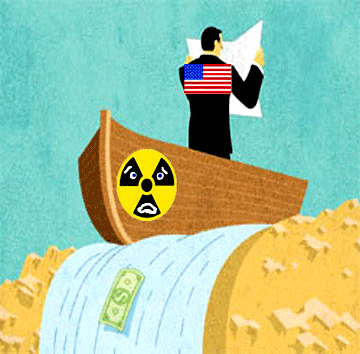 Nuclear Power Firms Feel Squeeze Cost overruns, delays plague current projects, clouding development of future reactors WSJ, By REBECCA SMITH rebecca.smith@wsj.com
Future nuclear power plant development in the U.S. looks dismal as cost overruns and multiyear delays plague four new reactors under construction in Georgia and South Carolina.
Southern Co. , the Atlanta-based power utility that dominates much of the Southeastern U.S., recently told Georgia regulators that costs have ballooned by $1.4 billion for its minority stake in the Vogtle nuclear power plant expansion in Waynesboro, Ga. The company’s Georgia Power utility is now on the hook to spend $7.5 billion for its 46% share, while municipal utilities own the rest.
Southern is trying to recoup some of the cost from its vendors, but the company recently notified the state utility commission that it may try to pass on much of the expense to customers, protecting its shareholders from the hit.
The company’s disclosure shines a light on a persistent industry problem. What was once seen as a major strength of new nuclear reactor designs—a streamlined construction method —is now proving to be an Achilles’ heel……http://www.wsj.com/articles/nuclear-power-firms-feel-squeeze-1425591380
Investigation needed into Entergy Nuclear’s finances
Vermont AG and DPS join request for NRC investigation of Entergy Nuclear finances Rutland Herald By Susan Smallheer Staff Writer | March 05,2015 MONTPELIER — The attorney general’s office and the Shumlin administration have joined Massachusetts, New York and some anti-nuclear groups in asking the Nuclear Regulatory Commission to investigate Entergy Nuclear’s finances.Vermont joined the petition to the NRC almost two years after it was filed by a consortium of anti-nuclear groups, including the Citizens Awareness Network.
Scot Kline, an assistant Vermont attorney general, said Wednesday the state had been “monitoring” the petition before the NRC, and decided in January to file a formal request with the NRC.
“We have had consultations with the New York attorney general and the Massachusetts attorney general,” Kline said. “This was an appropriate time for us to join.”
In a two-page letter dated Jan. 27, William Griffin, the chief assistant attorney general, and Christopher Recchia, commissioner of the Vermont Department of Public Service, said they were concerned about Entergy’s finances and its corporate parent’s ability to cover the costs of decommissioning the Vermont Yankee nuclear power plant.
Entergy’s latest estimates put the full cost of decommissioning at $1.2 billion in 2014 costs……..http://www.rutlandherald.com/article/20150305/NEWS02/703059883
Stop nuclear wastes coming to Idaho – former governors to take legal action
 Former Idaho Governors Aim to Stop Nuclear Waste Shipments MagicValley.com KEITH RIDLER Associated Press OISE (AP) 5 Mar 15 | Former Idaho Govs. Phil Batt and Cecil Andrus have filed a notice of their
intent to sue the federal government over proposed shipments of spent commercial nuclear fuel rods to Idaho.
The former governors sent the notice Thursday to the U.S. Department of Energy seeking to halt the shipments scheduled to arrive in June and December at the Idaho National Laboratory in eastern Idaho.
Batt, a Republican, and Andrus, a Democrat, both fought commercial nuclear waste shipments during their terms that spanned portions of the 1970s, 1980s and 1990s, culminating with a 1995 agreement, often called the Batt Agreement. That agreement bans commercial nuclear waste shipments and requires cleanup of nuclear waste stored at the Idaho National Laboratory.
Specifically, the governors contend in the possible lawsuit that the Department of Energy will be violating federal environmental laws by shipping the waste to Idaho………http://magicvalley.com/news/local/govt-and-politics/update-former-idaho-governors-aim-to-stop-nuclear-waste-shipments/article_433b083e-c369-11e4-926a-83ba5c8b914a.html
One way to dispose of SOME of the nuclear waste burden
 Can’t We Just Throw Our Nuclear Waste Down A Deep Hole? http://www.forbes.com/sites/jamesconca/2015/03/05/cant-we-just-throw-our-nuclear-waste-down-a-deep-hole/ James Conca 5 Mar 15 Um…yes, we can. It’s called Deep Borehole Disposal and is pretty easy for some nuclear waste. Especially some highly radioactive materials that have sat in some fairly small capsules for almost 40 years.
This was exactly the topic of discussion in Washington this week when Secretary of Energy Ernest Moniz answered questions from Rep. Dan Newhouse (R-WA) at a House Science, Space and Technology committee hearing (Tri-City Herald).
The answer from Moniz was positive. He discussed a pilot project that would demonstrate the idea of deep borehole disposal using these capsules.
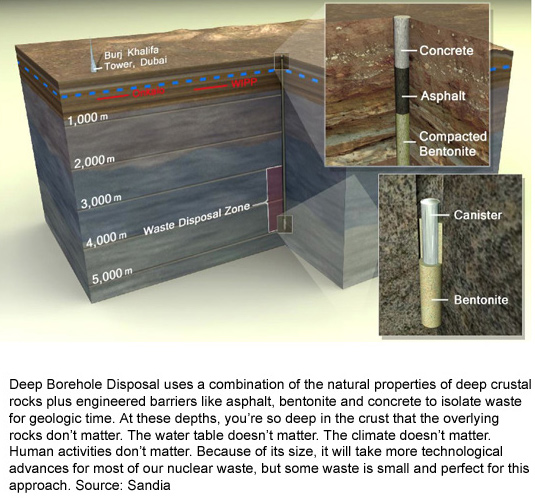
Deep borehole disposal is simple. Drill a very deep hole – 3 miles or so – put the waste in it and fill it up with some special layers, but mainly crushed rock and cement. As geologists, we know how many millions of years it takes for anything to get up from that depth in the Earth’s crust.
As long as you don’t put it under an active volcano!
The nice thing about deep borehole disposal is that it doesn’t matter where you put it in the country. At that depth, you’re so deep in the crust that the overlying rocks don’t matter. The water table doesn’t matter. The climate doesn’t matter. Human activities don’t matter.
But why these capsules? Because the material, cesium-137 and strontium-90 chloride salts (137CsCl and 90SrCl2), is in an easy waste form compared to that sludgy gooey stuff that makes up most of the tank waste left over from weapons production. These capsules are dry solid material in relatively small containers – less than 3-inches in diameter and only 2-feet long – very small compared to the large spent fuel assemblies and high-level waste glass logs usually discussed in geologic disposal plans.
Deep borehole disposal for the larger waste containers is trickier and more expensive because we haven’t yet drilled large-diameter holes that deep. Like all technological advances, we will (Sandia National Labs; Ethan Bates et al 2014). But these capsules are less than 3-inches wide, and we’ve drilled 6 and 8 inch holes that deep many times, so nothing really new needs to be developed for this project.
There are 1,936 capsules filled with radioactive 137CsCl and 90SrCl2 that are stored underwater at the Waste Encapsulation Storage Facility at DOE’s Hanford site in Washington State. Because these radionuclides, left over from plutonium production for weapons, are the primary heat-generator in nuclear waste, they were separated from the rest of the waste almost 40 years ago to reduce heat in the tanks, as well as to use in research.
But there is a time-sensitive nature to these capsules. Although CsCl doesn’t melt until 645°C (1,193°F), it goes through a bizarre solid-state phase change at 450°C (842°F). This means that without melting it’s atoms change their arrangement in space from one structure to another with a very different density. So as the temperature changes across this boundary, the material swells and shrinks. And that tends to degrade the containers it’s in.
The existing containers are beginning to get a little degraded, so best to get rid of them as soon as possible. They’re small, so deep borehole disposal would be cheap and easy.
Since there isn’t much of this boutique nuclear waste, only 5 cubic yards, and it’s in a great form, this is a perfect opportunity to demonstrate deep borehole disposal and clean out this facility.
Like all really hot nuclear waste, these capsules were destined for the proposed deep geologic nuclear waste repository at Yucca Mountain, Nevada, which was halted in 2010. Since a new permanent federal repository for high-level waste won’t be chosen for decades, we need to rethink our nuclear disposal program.
And this is a good idea, one of the few looked at by thePresident’s Blue Ribbon Commission on America’s Nuclear Future that was formed to come up with a new strategy in the wake of Yucca Mountain’s closure. Their recommendations were basically to pick disposal options suited to the waste and the need. And to get everyone to buy off on them before you start!
These capsules “could be very well suited perhaps for much earlier disposal through a borehole approach,” Moniz said. “We have to drill — we have to do the demonstration project, do the science, which is what we want to do in 2016.”
Budget proposal documents show $2 million for technology development to support plans in fiscal 2016 for what is anticipated to be a multi-year test using a non-radioactive waste substitute. Since Yucca Mountain was projected to cost over $200 billion, this is a steal.
The test would demonstrate technology for sealing the borehole, tools to characterize waste in the borehole and controls on waste isolation. DOE has also sought communities interested in being the site for the borehole test.
Progress in Tesla’s $5B solar-powered Gigafactory in Nevada
Construction of Tesla’s $5B solar-powered Gigafactory in Nevada is progressing nicely, Tree Hugger Michael Graham Richard (@Michael_GR) February 26, 2015
3,000 construction jobs for 3 years To change the world of transportation and leave oil behind in favor of clean sources of energy, you need batteries. Lots of them. Cheaply. That’s what Tesla is trying to do with its Gigafactory project — make as many advanced lithium-ion batteries in one location as the whole world is making today, driving down costs by at least 30%. This Gigafactory will be making 50 GWh of battery capacity per year by 2020, enough for 500,000 Tesla cars (mostly the cheaper upcoming Model 3), and the whole factory will be powered by clean energy. This is a $5 billion investment that will create 6,500 on-site jobs……http://www.treehugger.com/cars/construction-tesla-5-billion-solar-powered-gigafactory-nevada-progressing-nicely.html
Conservationist question Vogtle Nuclear’s plan for water release to Savannah River
In December, the EPD issued a permit to Southern Nuclear to draw up to 74 million gallons of water daily from an intake site on the river. Southern Nuclear was required to install oxygen injection systems, commonly called “bubblers,” in the Savannah Harbor to offset concerns about oxygen levels.
“This will affect other dischargers and those using the waters, including the harbor and the lakes,” said Savannah Riverkeeper Tonya Bonitatibus. “We have permits that are expired and have not been renewed, and this one is being put forward prematurely.”…….Environmentalists underscored that the Vogtle project is nearly three years behind schedule and said the EPD should take more time to consider the potential damage to the river and the Savannah Harbor.
In December, the EPD issued a permit to Southern Nuclear to draw up to 74 million gallons of water daily from an intake site on the river. Southern Nuclear was required to install oxygen injection systems, commonly called “bubblers,” in the Savannah Harbor to offset concerns about oxygen levels.
“This will affect other dischargers and those using the waters, including the harbor and the lakes,” said Savannah Riverkeeper Tonya Bonitatibus. “We have permits that are expired and have not been renewed, and this one is being put forward prematurely.” http://chronicle.augusta.com/latest-news/2015-03-03/conservationists-nuclear-proponents-comment-vogtle-hearing
U.S. Secretary of State John Kerry speaks up for the nuclear negotiations between the Westand Iran

 U.S. deserves ‘benefit of the doubt’ on getting Iran nuclear deal, Kerry says BY WILL DUNHAM AND DIANE BARTZ WASHINGTON Sun Mar 1, 2015 (Reuters) – U.S. Secretary of State John Kerry pressed the case on Sunday for completing nuclear diplomacy with Iran despite Israeli opposition, saying the United States deserves the benefit of the doubt on getting a deal that would prevent any need for military action to curb Tehran’s atomic ambitions.
Two days before Israeli Prime Minister Benjamin Netanyahu is due to address the U.S. Congress to warn against an Iran deal, Kerry delivered a stout defense of talks that are entering a critical phase with a key March 31 deadline looming.
Kerry said he hoped Netanyahu’s speech does not turn into “some great political football” but said the Israeli leader is “welcome to speak in the United States, obviously.”
Six powers – the United States, Russia, China, Britain, France and Germany – are negotiating with Iran toward an agreement to restrain Tehran’s nuclear program in exchange for easing economic sanctions. Netanyahu has spoken scathingly about a possible deal and says a nuclear-armed Iran would pose an existential threat to the Jewish state.
Netanyahu was invited to speak by Republican congressional leaders, but they did not inform President Barack Obama’s administration about the speech in advance. Signs are growing that the speech could damage Israel’s country’s broad alliance with the United States.
In an interview with the ABC program “This Week,” Kerry said of the Iran negotiations: “It is better to do this by diplomacy than to have to do a strategy militarily which you would have to repeat over and over again and which everybody believes ought to be after you have exhausted all the diplomatic remedies.”
Kerry said he could not promise that a deal can be reached, but said that “we are going to test whether or not diplomacy can prevent this weapon from being created.”…..http://www.reuters.com/article/2015/03/01/us-usa-israel-kerry-idUSKBN0LX1HJ20150301
Nuclear lobby hype shows that the industry is desperate
The nuclear industry’s sense of desperation is palpable. Activists need to understand what the industry obviously knows: it’s in serious trouble. This is our time to really join together, ramp up our efforts, and kick more of these reactors over the edge; they’re already teetering. They’re dangerous, they can’t provide cost-effective electricity, they don’t have a solution to their radioactive waste and they exist now only because they were built decades ago and the utilities want to milk them for everything they can before they surrender to the inevitable and have to begin spending huge sums of money again–but this time it won’t be to build new reactors, it will be to decommission their dinosaurs.
 You know the nuclear industry is desperate when… Michael Mariotte Greenworld April 1, 2014 You know the nuclear power industry is getting desperate when it solicits its CEOs to start piling on ghost-written op-eds in publications chosen for their reach to key audiences. And you know the industry is really desperate when it brings out big guns like a couple of paid-for former U.S. Senators to support nuclear power in The Hill newspaper, which, as its name implies, is aimed at current legislators. And you know the industry is super desperate when it pulls out none other than Rudy Giuliani, who continues stuffing his wallet with nuclear-powered green. Continue reading
U.S. lawmakers want defense budget of $577 billion
 Thornberry’s Defense Budget Exceeds Pentagon’s Request by $16 Billion, DoD Buzz By Richard Sisk | Friday, February 27th, 2015 A lawmaker in the U.S. House of Representatives is calling for a fiscal 2016 defense budget that would exceed spending caps by $50 billion.
Rep. William “Mac” Thornberry, R-Texas, chairman of the House Armed Services Committee, submitted the proposal in a letter Friday to Rep. Tom Price, R-Georgia, and chairman of the House Budget Committee.
Thornberry and most of his colleagues on the defense panel recommended a national defense budget of $577 billion. The figure is $16 billion more than the Obama administration’s request — which already exceeds spending caps for the Defense Department’s base budget by about $35 billion. More importantly, it signals a growing divide within the GOP over how much funding the Pentagon should receive at a time when the U.S. military is taking on new missions in the Middle East, Europe and Asia……..
While defense hawks like Thornberry and Sen. John McCain, R-Arizona, are pushing for more military spending and an end to automatic budget cuts known as sequestration, budget hawks such as Price are trying to reduce overall federal spending to cut the deficit and balance the budget………http://www.dodbuzz.com/2015/02/27/thornberrys-defense-budget-exceeds-pentagons-request-by-16-billion/
Competition from clean energy results in Illinois Bill to help Exelon nuclear corporation
Consumer advocates and business groups, however, quickly questioned the need for legislation that would benefit a single company.
Exelon, critics gird for battle as pro-nuclear bill is filed in Ill. Jeffrey Tomich, E&E reporter EnergyWire: Friday, February 27, 2015 The stage is set for an energy policy showdown in Illinois after lawmakers from both parties introduced a bill aimed at aiding three Exelon Corp. nuclear plants that have struggled in recent years in the face of increasing competition from wind energy and natural-gas-fired generation.
The legislation filed in the House and Senate would replace the Illinois renewable energy standard with a low-carbon portfolio standard requiring 70 percent of electricity used in areas served by large investor-owned utilities to come from low-carbon sources of generation……. Continue reading
Illinois energy Bill increases public costs, but benefits nuclear company Exelon
Exelon accused of seeking nuclear bailout http://www.fierceenergy.com/story/exelon-accused-seeking-nuclear-bailout/2015-02-27 February 27, 2015 | By Barbara Vergetis Lundin Exelon yesterday introduced its “Low Carbon Portfolio Standard” — legislation that is receiving opposition from groups like AARP Illinois and the BEST (Better Energy Solutions for Tomorrow) Coalition who are urging state lawmakers to reject this legislation, saying it would increase electric bills in order to “bail out Exelon’s nuclear plants.”
A 2014 analysis by Crain’s Chicago Business found that Exelon’s Illinois nuclear fleet is profitable and Exelon CEO Chris Crane even stated “Exelon had a strong year, both operationally and financially…our generation fleet and utilities continued to perform at high levels.”
For Exelon’s part, it says it is not seeking a bailout. Exelon made more than $2 billion in 2014.
This bill rewrites Illinois energy policy to increase costs for public and private entities statewide and benefits only Exelon,” said Steve Davis, legislative co-chair for Illinois Association of Wastewater Agencies, a BEST Coalition member. “Policy like this will increase the cost of doing business in Illinois and make Illinois less competitive.”
The organizations attempting to block Exelon’s Low Carbon Portfolio Standard claim that even if Exelon has financial issues with its Illinois nuclear fleet, although contrary to publicly available information, those issues will be resolved, in part, by a recently approved rate increase for Exelon’s subsidiary ComEd that will increase ComEd revenue by approximately $232 million.
For more:
– visit this website
1 This Month
23-25 October – on Zoom – World BEYOND War’s annual global conferenc

To see nuclear-related stories in greater depth and intensity – go to https://nuclearinformation.wordpress.com

Say No to NASA’s Reckless Nuclear Reactor on the Moon
Say No to NASA’s Reckless Nuclear Reactor on the Moon
-
Archives
- October 2026 (152)
- September 2026 (339)
- August 2026 (330)
- July 2026 (355)
- June 2026 (287)
- May 2026 (306)
- April 2026 (356)
- March 2026 (251)
- February 2026 (267)
- January 2026 (308)
- December 2025 (358)
- November 2025 (359)
-
Categories
- 1
- 1 NUCLEAR ISSUES
- business and costs
- climate change
- culture and arts
- ENERGY
- environment
- health
- history
- indigenous issues
- Legal
- marketing of nuclear
- media
- opposition to nuclear
- PERSONAL STORIES
- politics
- politics international
- Religion and ethics
- safety
- secrets,lies and civil liberties
- spinbuster
- technology
- Uranium
- wastes
- weapons and war
- Women
- 2 WORLD
- ACTION
- AFRICA
- Atrocities
- AUSTRALIA
- Christina's notes
- Christina's themes
- culture and arts
- Events
- Fuk 2022
- Fuk 2023
- Fukushima 2017
- Fukushima 2018
- fukushima 2019
- Fukushima 2020
- Fukushima 2021
- general
- global warming
- Humour (God we need it)
- Nuclear
- RARE EARTHS
- Reference
- resources – print
- Resources -audiovicual
- Weekly Newsletter
- World
- World Nuclear
- YouTube
-
RSS
Entries RSS
Comments RSS

