Another $8 billion added to the $14 billion cost of Nuclear Plant Vogtle

 Monitors: Southern Co. might spend $8B on nuclear plant http://www.pennenergy.com/articles/pennenergy/2015/02/monitors-southern-co-might-spend-8b-on-nuclear-plant.html February 16, 2015 By Ray Henry, Associated Press ATLANTA (AP) — Southern Co. might spend more than $8 billion to finish building a nuclear power plant in Georgia, or roughly 30 percent more than it originally budgeted, according to a recent analysis prepared for state utility regulators.
Power company officials disclosed in January that builders expect it will take three years longer than first expected to construct two new reactors at Plant Vogtle. Construction delays can significantly run up the cost of building and financing a nuclear plant.
Southern Co. subsidiary Georgia Power would spend about $8 billion if construction is delayed just short of three years, according to an analysis that the head of the Public Service Commission’s utilities division sent Jan. 8 to an elected regulator. That estimate is consistent with the potential delays Southern Co. and other Vogtle owners announced later in January, after the analysis was written.
Ongoing lawsuits could raise costs. Georgia Power’s cost would rise to $8.3 billion if the power company paid half the money the plant’s designer, Westinghouse Electric Co., and builder, Chicago Bridge & Iron Co., are seeking in a lawsuit.
Georgia Power spokesman Brian Green said the company could not immediately comment on the state agency’s analysis. Utility officials last projected Georgia Power would spend $6.7 billion on its share of the plant. Company officials will file an updated budget Feb. 27 that is expected to show roughly $720 million in additional charges due to delays.
A project using the same plant design in South Carolina previously announced similar delays priced at more than $1 billion.
Overall we continue to maintain that building these units correctly, and safely, is more important than building them quickly,” Green said.
Georgia Power’s customers will pay for the cost of the new plant unless state regulators intervene. The documents show staffers at the Public Service Commission are compiling a record of testimony showing how Southern Co. executives promised the plant’s original cost estimate was reasonable and rejected suggestions they budget more for the possibility of delays or other difficulties.
Georgia Power owns a 46 percent stake in the new reactors at Plant Vogtle. The other owners include Oglethorpe Power Corp., the Municipal Electric Authority of Georgia and the city of Dalton.
The owners estimated the plant would cost a total of $14 billion. Estimating the precise cost now is difficult because each utility faces different borrowing costs and other charges. If the other companies faced costs similar to Georgia Power, the plant’s total price tag would stand at more than $17 billion.
Southern California Edison plotted to stop investigation into un-safety at San Onofre nuclear facility
 SCE Admits to plotting nuke fail cover-up Southern California Edison makes official admission of colluding with Peevey in nuke cover-up scheme Charles Langley <langleycharles@gmail.com>Mon, Feb 16, 2015
Southern California Edison Executives in planning a
cover-up to kill an investigation into the $5 Billion nuke
failure and near-miss safety disaster at San Onofre.
Peevey outlined key elements
of what Mr. Peevey regarded as
potential elements of a settle-
ment of the Commission’s
investigation into the technical
and shut-down issues at San
Onofre.”
Diego U~T. Contact Charles Langley at (858) 752-4600
Is a Connecticut nuclear facility changing the ecology of Long Island Sound by heat pollution?
 Suffolk legislator wants study on warming of LI Sound, NewsDay, February 17, 2015 By WILL JAMES AND RICK BRAND will.james@newsday.com,rick.brand@newsday.com A Suffolk lawmaker wants to know whether a Connecticut nuclear plant is warming the Long Island Sound and changing its ecology by discharging billions of gallons of heated water a day.
Legis. Jay Schneiderman (I-Montauk) has asked the county to spend $112,000 on a three-month study by Stony Brook University scientists that would examine the Millstone Power Station’s impacts on the Sound and… (subscribers only) http://www.newsday.com/long-island/towns/millstone-new-england-s-largest-nuclear-power-plant-could-be-warming-long-island-sound-says-pol-1.9948566
14 organisations urge against building a new nuclear reactor in Virginia
 No to nuclear nonsense: Groups call on Dominion to abandon plans for North Anna 3 reactorhttp://www.foe.org/news/archives/2015-02-groups-call-on-dominion-to-abandon-plans-for-north-anna-3-reactor Feb. 16, 2015 / Kate Colwell
WASHINGTON, D.C. — Friends of the Earth, with 13 other organizations, submitted a letter to Governor Terry McAuliffe, Members of the Virginia General Assembly, Nuclear Regulatory Commissioners and energy company Dominion Resources urging against building a third nuclear reactor at the North Anna Power Station in Louisa County, Virginia. This proposed reactor would sit on an active earthquake fault and lacks a reliable water supply for cooling three reactors. The letter also emphasized the project’s high cost, a lack of any safe waste disposal solution and other inherent safety concerns related to nuclear reactors.
Friends of the Earth’s former president Brent Blackwelder issued the following statement:
The nuclear tragedy at Fukushima should have made it clear that the risks of nuclear reactors are too great. Yet Dominion Virginia Power and the state of Virginia continue to flirt with disaster. It is unconscionable to spend a single cent on an energy source that carries the inherent risks of nuclear reactors. These risks are exacerbated at North Anna because the reactor sits on a known fault line. This is the same fault that just shook Washington, D.C. in 2011, damaging the Washington Monument and the National Cathedral. Safe, renewable and distributed energy alternatives already exist; and it is time that we stopped investing in false solutions.
Expert contact: Brent Blackwelder, (202) 422-7753, brentblackwelder@yahoo.com
Communications contact: Kate Colwell, (202) 222-0744, kcolwell@foe.org – See more at:http://www.foe.org/news/archives/2015-02-groups-call-on-dominion-to-abandon-plans-for-north-anna-3-reactor#sthash.hQ9lDM55.dpuf
Google’s big investment in renewable energy, $US1.5 billion and more
 Google joins Apple in turning to renewable energy, SMH February 12, 2015 Matt O’Brien Google has spent $US1.5 billion ($1.95 billion) around the world on clean energy projects cutting the pollution from millions of users clicking on search links, watching YouTube videos and sending emails, but now it’s found a powerful electricity source close to home. The company will announce Wednesday that it is buying power from the Altamont Pass, one of the nation’s oldest, largest and most iconic wind farms that is about to get a Google-funded makeover.
The tech giant has no plans to brand the blades with its multicolored logo, but its 20-year power purchase agreement with Florida-based NextEra Energy will dramatically transform the rolling, treeless landscape that connects the Bay Area with the Central Valley here. About 770 old turbines from the 1980s will be replaced this year by 48 new machines producing twice as much energy, enough to power Google’s corporate campus in Mountain View with 100 percent renewable power.
It’ll be majestic,” said Sam Arons, an energy strategist at Google. “Today there are many small turbines of all different sizes, all different vintages. It’s kind of a hodgepodge out there. Once this project is done, you’ll see a lot of tall, sleek, majestic turbines that will really de-clutter the landscape.”
Google’s involvement is the latest green power play from a company that has spent a decade dropping money on wind, solar and geothermal projects from West Texas to South Africa and the Netherlands, and is an investor in Ivanpah, the massive solar thermal power plant built by BrightSource Energy in the Mojave Desert. Google says it operates with 35 percent renewable power worldwide.
Last year, it spent $US3.2 billion to acquire Nest Labs, maker of the slick “learning thermostat.” It also quietly named John Woolard, the former CEO of Brightsource, as a vice president for energy. It has several previous deals with NextEra – for wind farms in Iowa, North Dakota and Oklahoma – and recently invested in Utah’s largest solar plant.
But unlike most of those projects, Google’s Altamont venture is more than a capital investment. Just 50 miles from Mountain View, it will do more to reduce the Googleplex’s carbon footprint than any of the quirky projects on the corporate campus, from the 1.9-megawatt solar array to the plant fueled by landfill gas.
Google is the second Silicon Valley tech giant this week to announce a major local green energy project. On Tuesday, Apple announced an $US850 million agreement to buy power and help build a 280-megawatt solar farm in Monterey County……..
The price of wind has declined very, very substantially over the past couple of years and the technology has improved,” said Ryan Wiser, a staff scientist who studies electricity markets at the Lawrence Berkeley National Laboratory. “The cost of wind energy is so low that it’s not as if these companies are taking an enormous financial risk in locking into these agreements. The price is stable.” http://www.smh.com.au/environment/climate-change/google-joins-apple-in-turning-to-renewable-energy-20150211-13cdge.html
Solar Powering your home, and perhaps the grid, too, with new Tesla battery
 This new Tesla battery will power your home, and maybe the electric grid too, WP, By Brian Fung February 12 Tesla is working on a battery that can power your home and even help large-scale utilities store energy more efficiently, according to company chief executive Elon Musk.
On an investor call Wednesday, Musk said the designs for a home or business battery are already complete and will likely be unveiled to the public “in the next month or two.” Production could be as little as six months away, he added…..
Tesla’s battery and charging technology could ultimately wind up saving you money on your electric bill. Although many of today’s homes draw energy directly from the electricity grid, the spread of cheap solar panels means it’s never been easier to generate some of your own energy. Storing renewables efficiently has been a big bottleneck for consumers and for utilities alike, but if Tesla’s stationary battery takes off, it could change the way electricity is priced and traded on a market scale…….http://www.washingtonpost.com/blogs/the-switch/wp/2015/02/12/this-new-tesla-battery-will-power-your-home-and-maybe-the-electric-grid-too/?tid=pm_business_pop
Obama – Modi discussions resulted in no deal for USA nuclear salesmen
The same stumbling block over parallel safeguards in perpetuity has held up India’s conclusion of nuclear deals with Japan and Australia
 India’s bitter experience over the 1984 gas leak from an American-owned Bhopal city plant that killed about as many people as the Fukushima disaster. Indeed, Japan’s dual liability laws, which indemnify suppliers and make plant operators exclusively liable, should serve as a sobering lesson for India: GE built or designed all the three Fukushima reactors that suffered core meltdowns in 2011, yet the U.S. firm went scot-free, despite a fundamental design deficiency in the reactors.
With complex legal, pricing and other issues still pending, the deal’s commercialization is anything but imminent. In fact, the two sides are yet to sign the administrative arrangements, which they announced had been “finalized.”
It is an open question whether the deal will ever yield substantive energy benefits for India, given the exorbitant price of foreign-origin reactors, the concomitant need for India to heavily subsidize the electricity from such plants, and grassroots safety concerns over the Fukushima-type multi-plant nuclear parks earmarked by India for Westinghouse, GE-Hitachi and Areva, each of which is to sell prototype LWR models presently not in operation anywhere in the world.
The U.S.-India nuclear breakthrough that wasn’t, Japan Times 12 Feb 15 BY BRAHMA CHELLANEY During U.S. President Barack Obama’s recent India visit, a stalled, decade-old civil nuclear deal took center-stage, with the two sides announcing a breakthrough on the contentious issues blocking its implementation — a development that promised to potentially open the path for a Japan-India nuclear deal. It now appears that the breakthrough was more hype than reality and that there is little prospect of the U.S.-India deal’s early commercialization……..
it has now become apparent that the U.S. and India are still locked in negotiations to tie up loose ends and that the much-trumpeted breakthrough was little more than an effort to project a substantive advance during a presidential visit rich in pageantry and symbolism. Obama was the chief guest at India’s Jan. 26 Republic Day parade, a year after Prime Minister Shinzo Abe had that honor.
While claiming a breakthrough, neither side released any details, including on how another sticking point had been resolved: a U.S. demand that New Delhi accept nuclear-material tracking and accounting arrangements Continue reading
India’s Nuclear Liability Law is a major deterrent to USA Nuclear companies
for the U.S., the “right to recourse” clause remains a major deterrent.The law has stalled the implementation of deals for new reactors that India signed with the U.S., Russia, and France in 2008, when the Nuclear Suppliers Group (NSG) allowed India to import nuclear fuel technology without being a member of the multinational body concerned with reducing nuclear proliferation. India said the breakthrough deal with Russia reached this April after four years of negotiations takes into account the liability law when pricing four more Russian reactors meant for India’s Kundankulam plant in Tamil Nadu (each of which is valued at $2.5 billion) as well as four or six other VVER-1200 units planned for Haripur, West Bengal. The deal essentially calls for India’s public sector General Insurance Co. to evaluate each component of the Russian reactors and prescribe a 20-year insurance premium it will charge to cover Russia’s liability for an accident.
Russia’s state-owned nuclear firm Rosatom reportedly has indemnity from any liability arising from an accident at the VVER-1000s at Kundankulam Unit 1 (Figure 2), which attained criticality in July 2013 and is expected to come online later this year, and Unit 2, expected to be operational in October 2014. Observers note that contracts for those plants were signed in 1998, before India’s domestic liability legislation had even been contemplated.
Before Indian legislation on civil nuclear liability—The Civil Liability for Nuclear Damage Bill—finally passed both houses of parliament in August 2010, exempting suppliers from all liability had been India’s typical practice, starting in 1962, when India signed its first nuclear cooperation agreement with the U.S. to allow General Electric to supply two 200-MW reactors to India’s Tarapur site. The practice of liability exemption was modeled on America’s own 1957-passed nuclear liability law, the Price Anderson Act, and went on to extend indemnity protection to Atomic Energy of Canada Ltd. for two reactors in Rajasthan in 1965, and later to Russia. Continue reading
Risky Radioactive Trash Shipments Would be Terrorist Targets
Public Citizen outlined five key objections to the plan, most of which were raised by Texas’s own Commission on Environmental Quality (TCEQ) last year:
 1. Waste shipments would be targets for sabotage or blackmail by terrorists. TCEQ noted that the waste is more vulnerable to accidents or attacks while in transit than if left it where it is, because security is lighter then and fewer radiation shields would be available. Shipments from reactors around the country — passing through dozens of population centers — could last over 24 years. The Energy Dept. estimates that there would be about 10,700 shipments if done by rail; about 53,000 shipments (others say 100,000) if done by truck.
2. WCS would have only limited liability, while the public would be put at risk from transport accidents, leaks and terrorism.
3. So-called “short-term” storage may become permanent — an unearned trophy for the nuclear industry. The complex scientific analysis required for any permanent waste site would take about 10 years and has not been done.
4. The WCS site is too close to the Ogallala Aquifer, which provides water to eight states.
 High-Level Rad Waste Dump Called “All Risk and No Reward for Texas” http://www.counterpunch.org/2015/02/11/high-level-rad-waste-dump-called-all-risk-and-no-reward-for-texas/
A high-level radioactive waste “parking lot” — proposed for West Texas — poses both terrible and unnecessary risks for people throughout the country — Texas in particular — and should not be built.
That’s the position of a coalition of public interest groups that declared its opposition to the plan February 9. Continue reading
AREVA joins US Waste firm to cash in on radioactive trash storage
 AREVA and WCS Sign Agreement for Independent Interim Used Nuclear Fuel Storage Site http://www.newswiretoday.com/news/150345/ NewswireToday – /newswire/ – Paris, Ile-de-France, France, 2015/02/10 – AREVA has signed an agreement with Waste Control Specialists LLC (WCS) to assist with their license application and environmental report for the construction of an interim used nuclear fuel storage facility – WCSTexas.com / AREVA.com.
WCS filed a letter of intent on February 6, 2015 with the Nuclear Regulatory Commission (NRC) stating their intention to seek a license to operate an offsite Independent Spent Fuel Storage Installation at their 14,000-acre facility in Andrews, TX.
WCS filed a letter of intent on February 6, 2015 with the Nuclear Regulatory Commission (NRC) stating their intention to seek a license to operate an offsite Independent Spent Fuel Storage Installation at their 14,000-acre facility in Andrews, TX.
“AREVA is pleased to provide WCS with its licensing experience and global expertise for the safe storage, transport and management of used nuclear fuel,” said David Jones, senior vice president, of AREVA’s Back End division, North America. “This initiative, which already has the consent of local stakeholders, will deliver an economically viable option for used fuel management while more permanent solutions are addressed.”
AREVA (areva.com) is a global leader in the transportation and storage of used nuclear fuel. More than 40% of American utilities use AREVA’s advanced NUHOMS® horizontal storage technology. The group has already sold 900 storage canisters in the U.S., making it the leading supplier for this solution.
One soldier’s story of radiation exposure on Pacific nuclear test site KALAMA ISLAND,
 by terryrs, 12 Feb 15 I am a first hand victim of radiation exposure when I was assigned to the DOE designated nuclear test site at KALAMA ISLAND, Johnston Island. I experienced many detonations and was on island where plutonium debree was bured both on island and in the ocean. Our nation admitted to their responsibility and enacted the EEOICPA ACT to provide for victims, unfortunately it was exclusive in that only DOE workers were provided, DISCRIMINATION!. I worked for the DOD which operated under a joint effort with DOE.
I applied for medical assistance under RECA but it also denied and failed to provide medical or equal compensation as that of EEOICPA.
Subsequently we have learned we are denied because we are just too “expensive”. Can you imagine when they needed us we were cheap and now we are to expensive?
President Clinton authorized continued funding for EEOICPA and cited that our nation must be responsible but still signed an act that denies and is exclusive.
Amendment legislation has been on going for many years only to die in committees. You wonder whether the authors are interested in votes or to really help victims harmed by America.
I lost my bladder and prostrate, stage 4 cancer and was given months to live without removal. I payed all medical expenses even though my employer was supposed to provide compensation. It appears they did not and now I am in a lawsuit. I wonder if the courts will be just as past history demonstrates they are not. Most all cases were dismissed for lack of evidence, “the cloak of secrecy” our nation uses.
The result of all of this is ” WE WILL DIE WAITING “
How the USA govt dismissed Nuclear Zero Lawsuit

 Bush-Appointed Judge Dismisses Nuclear Zero Lawsuit; Marshall Islands to Appeal http://www.truth-out.org/opinion/item/28997-bush-appointed-judge-dismisses-nuclear-zero-lawsuit-marshall-islands-to-appeal# Monday, 09 February 2015 By David Krieger, Truthout
The Republic of the Marshall Islands (RMI), a Pacific Islands country of 70,000, took bold action on April 24, 2014, on nuclear disarmament. It brought lawsuits at the International Court of Justice (ICJ), the world’s highest court, against the nine nuclear-armed countries, accusing them of violating their obligations under international law to negotiate in good faith to end the nuclear arms race and for total nuclear disarmament.
Because of the importance of the United States as a nuclear power and the fact that it does not accept the compulsory jurisdiction of the ICJ, the Marshall Islands at the same time brought a similar lawsuit against the United States in US federal district court in Northern California.
In the United States, rather than engaging in the case in good faith, the government responded by filing a motion to dismiss the case on jurisdictional grounds. Continue reading
Sending more nuclear weapons to Europe is the wrong move
The Wrong Move: Adding Nuclear Weapons to the Russia-Ukraine Conflict Defense One, FEBRUARY 9, 2015 BY LT. GEN. ROBERT GARDGREG TERRYN
Despite the wishes of two key Congressmen, more nuclear weapons in Eastern Europe is a bad idea.
You may have missed it, but last month two key members of Congress asked the military to move additional U.S. nuclear weapons and dual-capable aircraft into Eastern Europe. Reps. Mike Rogers, R-Ala., chairman of the House Armed Services Subcommittee on Strategic Forces, and Mike Turner, R-Ohio, chairman of the Tactical Air and Land Forces Subcommittee, sent a joint letter to Defense Secretary Chuck Hagel and Secretary of State John Kerry advocating the addition of new sites in Eastern Europe for the deployment of additional U.S. nuclear weapons and dual-capable aircraft.
In their letter, the two chairmen extend a Russian statement claiming its sovereign “right” to deploy nuclear weapons in Crimea to an “intention” to do so. They also assert Russian “moves to deploy nuclear-capable Iskander short-range ballistic missiles as well as nuclear-capable Backfire bombers in the illegally occupied territory [Crimea].”
There is no evidence that Russia has taken or is preparing to take any of these actions; but the letter alleges that they pose a new military threat to U.S. allies and our forces in Europe, and that the U.S. must respond “to change President [Vladimir] Putin’s calculus.”
Fortunately, nuclear weapons have played no overt role in Russia’s annexation of Crimea or its ongoing aggression in eastern Ukraine. And while the U.S. and its European allies must react, introducing a nuclear confrontation into the already dangerous situation is more likely to cause Putin to respond in kind than to change his calculus. Declared U.S. policy is to reduce the role of nuclear weapons in our national security, not to employ them in hopes of intimidating a hostile head of state……..
Deploying additional U.S. tactical nuclear weapons to Europe would make them more vulnerable to a Russian preemptive attack, even with conventional weapons, in the event of an escalating crisis. Also, it is well-known that Russia possesses a far larger stockpile of tactical nuclear weapons than the U.S.has in its inventory. Russia could be tempted to employ its tactical nuclear weapons superiority to take out the U.S.weapons deployed in Europe in the mistaken belief that it could confine the conflict to Western Europe. ……
Deploying additional U.S. tactical nuclear weapons and more dual-capable aircraft in Europe provides no advantage: It would be an expensive initiative that would add nothing to our security, divert funds from higher priority defense expenditures, likely provoke Russia to deploy nuclear weapons in Crimea, increase the possibility of nuclear war, and be divisive amongst our NATO allies http://www.defenseone.com/ideas/2015/02/wrong-move-adding-nuclear-weapons-russia-ukraine-conflict/104940/
Westinghouse cagey about paying more for delays in new nuclear power
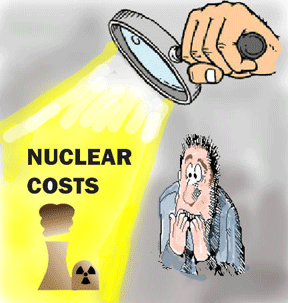 Will Westinghouse pay for another nuclear delay? Power Source, February 10, 2015 A strange argument went down on Dec. 16 among electric utility Georgia Power and its regulator, the Georgia Public Service Commission, and entangled local nuclear firm Westinghouse Electric Co.
Cranberry-based Westinghouse and its partners in the construction of the first two AP1000 reactors in the United States had, up to that point, resisted telling Georgia Power when the project would be completed. The company provided a list of activities planned through December 2015, but would not forecast further, Georgia Power told the commission.
The utility tried time and again to obtain an integrated project schedule, it told regulators. Already, the project originally set to be completed by April 2016 was 21 months behind.
The regulators, in turn, wondered who’s running the show — the utility that hired the consortium of nuclear builders for an estimated $14 billion project or its contractors.
When Westinghouse and its main construction partner, Chicago Bridge & Iron, finally submitted the long sought-after document in January, they revealed another 18-month delay, projecting the first plant would be ready for service in mid-2019 and the second in 2020.
Georgia Power has placed the estimated cost of the delay at $720 million, or $40 million a month. That’s on top of more than $1 billion in delay- and design-related costs that the two sides have been suing each other over since 2012.
The utility hasn’t agreed to the new dates, its parent company, Atlanta-based Southern Co. said in a public filing Jan. 29. Nor does it believe that Westinghouse and its partners have done everything possible to mitigate the delay. And, as has been the pattern with cost overruns in the project, Southern Co. told investors it expects the latest expenses to become part of the lawsuit.
The company’s CEO Tom Fanning said on Bloomberg Television last week, “Southern Co. won’t absorb those costs. The contractors will.”
Chicago Bridge & Iron has denied that claim. Westinghouse declined to address the comment………..
The likelihood of delays is so ingrained in nuclear construction that the Public Service Commission requires its analysts to continuously update the cost of potential delays spanning as many as four years.
Deviating from original construction schedules and budgets has been the norm for all past nuclear construction projects in this country, one of the main criticisms of undertaking such efforts.
As a result, a lot is seen as riding on the Vogtle construction. With cheap natural gas flooding U.S. markets, nuclear has to prove there’s an economic advantage to investing in such capital-heavy construction instead of throwing up a couple of natural gas power plants in a few years’ time at a fraction of the cost……..http://powersource.post-gazette.com/powersource/companies-powersource/2015/02/10/Will-Westinghouse-pay-for-another-nuclear-delay/stories/201502100014
A field guide to “nuclear environmentalists”
 Former Nuclear Regulatory Commissioner and state regulator Peter Bradford sees the finance issue as the nuclear industry’s Kryptonite.
“Trying to solve climate change with nuclear is like trying to solve world hunger with caviar,” he said
Straight.com. Peter Dykstra, 9 Feb 15 “…In recent years, some major science and environmental players have come forward to endorse nuclear power. Former EPA administrator and Obama climate czar Carol Browner is one of the glitziest.
Browner signed up for the newest and shiniest effort to sell nuke plants, the year-old Nuclear Matters, founded by electric giant Exelon in 2014.
Nuclear Matters is run by public relations agency Sloane & Associates. Critics call it a nuclear front group, but Sloane prefers to bill it as “starting a national conversation on nuclear power,” and adds that other utilities, nuke builders and suppliers have joined Exelon as sponsors.
The group recruited several other bipartisan political heavyweights as paid spokespeople but none that are catnip for the environmental community, where opposition to nuclear power is the rule, not the exception.
So when Nuclear Matters hauled in Browner as a spokesperson of its Leadership Council last year, she was a big catch.
Browner said she typically devotes a few hours a week to Nuclear Matters and is compensated for her time, but neither she nor Nuclear Matters will discuss her fee. Continue reading
1 This Month
23-25 October – on Zoom – World BEYOND War’s annual global conferenc

To see nuclear-related stories in greater depth and intensity – go to https://nuclearinformation.wordpress.com

Say No to NASA’s Reckless Nuclear Reactor on the Moon
Say No to NASA’s Reckless Nuclear Reactor on the Moon
-
Archives
- October 2026 (160)
- September 2026 (339)
- August 2026 (330)
- July 2026 (355)
- June 2026 (287)
- May 2026 (306)
- April 2026 (356)
- March 2026 (251)
- February 2026 (267)
- January 2026 (308)
- December 2025 (358)
- November 2025 (359)
-
Categories
- 1
- 1 NUCLEAR ISSUES
- business and costs
- climate change
- culture and arts
- ENERGY
- environment
- health
- history
- indigenous issues
- Legal
- marketing of nuclear
- media
- opposition to nuclear
- PERSONAL STORIES
- politics
- politics international
- Religion and ethics
- safety
- secrets,lies and civil liberties
- spinbuster
- technology
- Uranium
- wastes
- weapons and war
- Women
- 2 WORLD
- ACTION
- AFRICA
- Atrocities
- AUSTRALIA
- Christina's notes
- Christina's themes
- culture and arts
- Events
- Fuk 2022
- Fuk 2023
- Fukushima 2017
- Fukushima 2018
- fukushima 2019
- Fukushima 2020
- Fukushima 2021
- general
- global warming
- Humour (God we need it)
- Nuclear
- RARE EARTHS
- Reference
- resources – print
- Resources -audiovicual
- Weekly Newsletter
- World
- World Nuclear
- YouTube
-
RSS
Entries RSS
Comments RSS

