Revolving door for job between US Department of Energy and nuclear corporation
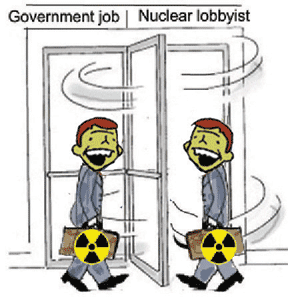 Critics view former DOE official’s $1.7 million job at uranium-enriching corporation with concern, Daily Kos, 16 Mar 15 by Meteor Blades It’s another story of the revolving-door between the corporate world and high-level government officials. But this one about the uranium enrichment company—Centrus Energy Corp.—is unique.
For nearly five years Dan Poneman was deputy secretary of the U.S. Department of Energy and as acting secretary before Ernest Moniz got the post. Effectively, he was the department’s chief operating officer. During that time, DOE directed hundreds of millions of dollars to the struggling Centrus, which was then called the United States Enrichment Corporation (USEC). The company emerged from a Chapter 11 bankruptcy just last September.
Later this month Poneman, who left DOE in October, will take over as president and CEO for an annual paycheck of $1.7 million. That has disturbed some people:
Tyson Slocum, director of the energy program for the consumer advocacy group Public Citizen, said Poneman’s move is one of the most glaring examples of the revolving door he has seen. The move also shows that the government’s decision to privatize the company in the 1990s—spinning the company off from DOE—has failed, he said.”This doesn’t really pass the smell test,” he said. “You’re putting a top former government official in charge of the company; it’s safe to say his appointment as CEO is all about maximizing their influence with key federal officials for all types of federal support.”
……..in 2009, the government said it wouldn’t provide a $2 billion loan guarantee to USEC because the proposed plant had technological issues and was not ready to go fully operational. That, plus the move away from nuclear power in some countries because of the Fukishima reactor meltdowns, caused the market for concentrated uranium to contract and USEC’s stock price plunged. The bankruptcy filing followed.
And then there was a Government Accountability Office report that concluded DOE had violated the law several times when it arranged four uranium transfers in 2012 and 2013 to bolster USEC. DOE argued the GAO had got the law wrong.
Last September, the company emerged from bankruptcy with its new name—Centrus—and a bland branding slogan: “Fueling the future of nuclear power.” Last week, Senator John Barrasso (R-WY) sent a letter to Secretary Moniz, reminding him of the transfers and asking for more transparency in such matters in the future: He also wrote:
DOE has long had an improper relationship with USEC. Mr. Poneman’s appointment as President and CEO only promises to make that record worse. His appointment to the Board of Directors of the Traxys Group, the sales agent for the current recipient of publicly-owned uranium, is also troubling. For these reasons, I ask that you conduct a rulemaking, with full notice and public comment, before authorizing all future sales or transfers of uranium. Only by adhering to the transparency and accountability requirements of the Administrative Procedure Act will DOE be able to restore confidence in its management of publicly-owned uranium.”
On the barbs being addressed at him and Centrus, Poneman says:
“It’s got to operate successfully on its own two feet as a viable commercial operation to get away from the perception that it’s running to the government all the time,” he said.
Given the volatility of the business he’s in, that could be a tall order.
ORIGINALLY POSTED TO METEOR BLADES ON MON MAR 16, 2015 HTTP://WWW.DAILYKOS.COM/STORY/2015/03/16/1371313/-CRITICS-VIEW-FORMER-DOE-OFFICIAL-S-TOP-POSITION-AT-URANIUM-ENRICHMENT-COMPANY-WITH-CONCERN?UTM_SOURCE=FEEDBURNER&UTM_MEDIUM=FEED&UTM_CAMPAIGN=FEED%3A+DAILYKOS%2FINDEX+%28DAILY+KOS%29&UTM_CONTENT=ICEROCKET+BLOG+SEARCH#
100% renewable energy for Hawaii by 2040
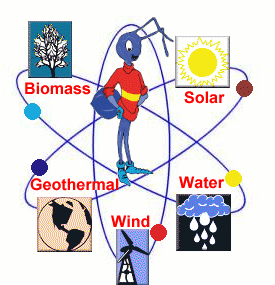 Hawaii aims for 100% renewable energy by 2040, REneweconmy By Ari Phillips on 13 March 2015 Hawaii is on track to pass legislation this year requiring the state to go 100 percent renewable by 2040.
Earlier this month, committees in the Hawaii House and Senate both unanimously recommended bills that would raise the state’s Renewable Portfolio Standard (RPS) from the current target of 70 percent by 2030 to the ultimate goal of 100 percent by 2040. Hawaii has 100% renewabl eenergy had an RPS since 2001, and right now the state gets just over 21 percent of its power from renewable sources — a 12 percent increase in just six years.
“Even our utility is saying we can hit 65 percent by 2030, so 100 percent is definitely doable,” Sen. Mike Gabbard (D), sponsor of the Senate bill, SB 2181, and chair of Hawaii’s Energy and Environment Committee, told ThinkProgress. “This is huge for our state’s future. Each year, we spend $3 to $5 billion importing fossil fuels to power our economy. Our electricity bills are roughly three times the national average.”
The Aloha state is 2,500 miles from Los Angeles — about the same distance as New York City to L.A. — and its energy situation bears little resemblance to the mainland’s. Along with Alaska and Texas, it is one of only three states to have its own electricity grid — in fact, it has three of them for three different islands. In 2013, the state had the highest electricity prices in the nation due to its heavy reliance on imports. More than two-thirds of electricity generation on the island archipelago comes from imported oil; in the rest of the U.S., oil accounts for less than one percent of electricity generation.
As recently six years ago, more than 90 percent of Hawaii’s yearly electricity generation came from coal and oil. With renewable technologies rapidly advancing, Hawaii’s abundant solar, wind, hydro, and geothermal sources are moving in quickly as replacements for costly fossil fuels.
“We are on the leading edge of the 21st century renewable energy transformation,” Chris Lee (D), Sponsor of the House version of the bill, HB 623, and chair of the House Energy and Environment Committee, told ThinkProgress. Lee said he’s been pushing for a 100 percent RPS bill for three years, but that this is the first year there’s been overwhelming support to move forward……….http://reneweconomy.com.au/2015/hawaii-aims-for-100-renewable-energy-by-2040
Very few parents aware of the danger to children from UV radiation
Although 85 % of Americans recognizing that UV rays can damage the eyes, only 65 % wear sunglasses as protection, and ensure even fewer report that their children wear sunglasses* forzest ranbaxy review .
To parents, carers and other help to understand better, the risks to take with UV irradiation to the eyes and UV exposure UV exposure, Healthy Women, the leading independent health information source for women, offers a free education to minimize resource, Fast Facts for your Health related: The Sun & your Eyes: What You Need to Know. It may take years before you can have a harmful effect of the sun on your eyes, but do some damage may occur on short notice, says Elizabeth Battaglino Cahill, Fast Facts Healthy Women. This latest in our series of Fast Facts for Your Health resources can help families understand the potential damage that UV can, can cause to their eyes and eyesight. It’s a quick read on the unexpected sources of UV radiation damage as well as simple, practical advice to reduce the risks of UV radiation. .
US Congress is urged not to sabotage Iran nuclear negotiations

 Iran nuclear talks: White House urges Congress to stand down, Guardian, Paul Lewis in Washington and Julian Borger in Lausanne, 16 Mar 15 Obama administration warns Republicans could ‘potentially prevent’ deal that has been years in the making and damage relations with allies across the world. The White House has warned that Republicans in Congress could “potentially prevent” a groundbreaking deal to stop Iran from obtaining a nuclear weapon, scuppering an agreement that has been years in the making and damaging relations with allies across the world.
Hours before talks were due to resume in Switzerland on Sunday, White House chief of staff Denis McDonough sent a letter to a senior Republican critic, urging him to shelve legislation that would clip the administration’s wings.
Bob Corker, chairman of the Senate foreign relations committee, is bringing a bill that would require Congress to vote on any deal with Iran and remove the waiver authority that allows President Barack Obama to suspend sanctions imposed by the legislature.
“The legislation would potentially prevent any deal from succeeding by suggesting that Congress must vote to ‘approve’ any deal, and by removing any existing sanctions waver authorities that have already been granted to the president,” McDonough said.
“We believe the legislation would likely have a profoundly negative impact on the ongoing negotiations – emboldening Iranian hardliners.”
Calling on Corker to hold off the bill until a deal is reached, McDonough also warned that if the US was blamed for negotiations falling apart, Washington would be unable to muster the international support needed to ratchet-up sanctions on Tehran.
“Put simply, it would potentially make it impossible to secure international cooperation for additional sanctions, while putting at risk the existing multilateral sanctions regime,” he said…….
A framework agreement between the international powers and Iran is supposed to set out the key element of a deal in which Iran accepts limits of its nuclear activities for a number of years (expected to be at least 10) in return for sanctions relief. The negotiators would then have until the end of June to complete detailed annexes on how the deal would be implemented and verified.
With days to go until the deadline for a framework deal, there are still said to be gaps remaining on the central issues of Iran’s future uranium enrichment capacity and the question of which sanctions will be lifted and when. Diplomats from all sides have voiced readiness to stay in Lausanne through the Persian New Year holiday, Nowruz, which begins next weekend, but western negotiators are reluctant to push the first deadline beyond the end of the month.
“We believe very much that there’s not anything that’s going to change in April or May or June that suggests that at that time a decision you can’t make now will be made then,” Kerry told CBS News before arriving in Lausanne.
“If it’s peaceful, let’s get it done. And my hope is that in the next days that will be possible.” http://www.theguardian.com/world/2015/mar/15/iran-nuclear-talks-white-house-warns-congress-stand-down
Nuclear lobby looking for tax-payer funded guinea pigs to test their new gimmicks
Scientists Outline Research Wish List for Nuclear Energy, abc news, ALBUQUERQUE, N.M. — Mar 5, 2015 By SUSAN MONTOYA BRYAN Associated Press Engineers and researchers from national laboratories and universities around the country said Thursday that the United States needs to develop a proving ground where the latest innovations in nuclear energy can be put to the test…….
Utah’s environmental regulatory boards getting cosier with nuclear industry
Merger of environmental boards stokes concerns, opposition from Utah Radiation Control Board, Deseret News, By Amy Joi O’Donoghue, March 12 2015 SALT LAKE CITY — The Utah Radiation Control Board voted unanimously to voice its opposition to the state Legislature’s move to dismantle the organization, declaring the change is ill-advised and members should have been consulted.
In an emergency vote on a “position statement” Wednesday, the five members present approved sending the document to all 104 members of the Utah Legislature and Gov. Gary Herbert.
The action is in response to SB244, sponsored by Sen. Margaret Dayton, R-Orem, which passed the Utah Senate on Wednesday and now awaits Herbert’s signature.
Dayton’s measure, which has the nod of Utah Department of Environmental Quality’s executive director Amanda Smith, combines two divisions under Smith’s purview — Radiation Control and Solid and Hazardous Waste……..
Representatives from the radiological community, Smith added, feel their numbers have been “diluted” because the board’s composition is bigger…….
Radioactive waste watchdog organizations such as HEAL Utah complained that the board composition weakens oversight of industry in general and EnergySolutions in particular. EnergySolutions operates the low-level radioactive waste dump in Tooele County.
“We decided early on that we didn’t have any problem with the merger,” said Matt Pacenza, HEAL Utah director. “We waited and waited and waited to see what the board composition would look like, and we were really unhappy. It is significantly more dominated by the industry it regulates. It is going to make it that much more challenging of an environment to raise issues on nuclear waste and hazardous waste and that concerns us.”……..
Pacenza said Utah’s environmental regulatory boards are already too cozy with industry, and Dayton’s bill takes that relationship to an expanded degree of warmth.

“It’s not like it is an easy environment now for passing rules to require more strict oversight of industry,” he said.
Email: amyjoi@deseretnews.com
Twitter: amyjoi16 http://www.deseretnews.com/article/865624038/Merger-of-environmental-boards-stokes-concerns.html?pg=all
Our sick society uses dolphins to guard nuclear weapons
Military dolphins help defend the world’s largest stockpile of nuclear weapons, Business Insider,
“Nearly one-quarter of America’s 9,962 nuclear weapons are now assigned to the Bangor submarine base on Hood Canal, 20 air miles northwest of downtown Seattle,” the Seattle Timesreported in 2006.
Bangor was the name of a base that merged with another to form Kitsap in 2004.
“This makes Bangor the largest nuclear weapons storehouse in the United States, and possibly the world,” according to the Seattle Times……http://www.businessinsider.com.au/the-worlds-largest-stockpile-of-nuclear-weapons-is-defended-by-dolphins-2015-3
U.S. news media coverage of the Fukushima disaster largely minimized health risks to the general population.
 News coverage of Fukushima disaster minimized health risks to general population http://www.sciencedaily.com/releases/2015/03/150311124202.htm March 11, 2015 Source: American University
A new analysis by American University sociology professor Celine Marie Pascale finds that U.S. news media coverage of the disaster largely minimized health risks to the general population. Pascale analyzed more than 2,000 news articles from four major U.S. outlets following the disaster’s occurrence March 11, 2011 through the second anniversary on March 11, 2013. Only 6 percent of the coverage — 129 articles — focused on health risks to the public in Japan or elsewhere. Human risks were framed, instead, in terms of workers in the disabled nuclear plant.
Disproportionate access
“It’s shocking to see how few articles discussed risk to the general population, and when they did, they typically characterized risk as low,” said Pascale, who studies the social construction of risk and meanings of risk in the 21st century. “We see articles in prestigious news outlets claiming that radioactivity from cosmic rays and rocks is more dangerous than the radiation emanating from the collapsing Fukushima Daiichi nuclear plant.”
Pascale studied news articles, editorials, and letters from two newspapers, The Washington Post and The New York Times, and two nationally prominent online news sites, Politico and The Huffington Post. These four media outlets are not only among the most prominent in the United States, they are also among the most cited by television news and talk shows, by other newspapers and blogs and are often taken up in social media, Pascale said. In this sense, she added, understanding how risk is constructed in media gives insight into how national concerns and conversations get framed.
Pascale’s analysis identified three primary ways in which the news outlets minimized the risk posed by radioactive contamination to the general population. Articles made comparisons to mundane, low-level forms of radiation;defined the risks as unknowable, given the lack of long-term studies; and largely excluded concerns expressed by experts and residents who challenged the dominant narrative.
The research shows that corporations and government agencies had disproportionate access to framing the event in the media, Pascale says. Even years after the disaster, government and corporate spokespersons constituted the majority of voices published. News accounts about local impact — for example, parents organizing to protect their children from radiation in school lunches — were also scarce.
Globalization of risk
Pascale says her findings show the need for the public to be critical consumers of news; expert knowledge can be used to create misinformation and uncertainty — especially in the information vacuums that arise during disasters.
“The mainstream media — in print and online — did little to report on health risks to the general population or to challenge the narratives of public officials and their experts,” Pascale said. “Discourses of the risks surrounding disasters are political struggles to control the presence and meaning of events and their consequences. How knowledge about disasters is reported can have more to do with relations of power than it does with the material consequences to people’s lives.”
While it is clear that the Fukushima Daiichi nuclear meltdown was a consequence of an earthquake and tsunami, like all disasters, it was also the result of political, economic and social choices that created or exacerbated broad-scale risks. In the 21st century, there’s an increasing “globalization of risk,” Pascale argues. Major disasters have potentially large-scale and long-term consequences for people, environments, and economies.
“People’s understanding of disasters will continue to be constructed by media. How media members frame the presence of risk and the nature of disaster matters,” she said.
Story Source:
The above story is based on materials provided by American University. The original article was written by Rebecca Basu. Note: Materials may be edited for content and length.
US Republican Senators undermine nuclear talks: reactions from Iran and White House
 Iran condemns ‘untrustworthy’ America as Senate letter casts doubt over nuclear deal Philip Hammond, the Foreign Secretary, warns that the letter from 47 Republican Senators “could become a spanner in the works” of nuclear talks Telegraph By David Blair, and Peter Foster in Washington 10 Mar 2015
Philip Hammond, the Foreign Secretary, warned that the letter “could become a spanner in the works” of the negotiations, due to resume on Monday, with an “unpredictable effect on opinion” inside Iran.
The US senators sent an unprecedented “open letter” to the “leaders of the Islamic Republic of Iran”, warning that a future US president might “revoke” any agreement on the country’s nuclear programme “with the stroke of a pen”. Continue reading
USA Republicans tried to derail Iran nuclear talks
Iran’s foreign minister, Mohammad Javad Zarif, also poured derision on the Republican letter in a statement expressing astonishment that members of Congress would seek to undermine a US administration by writing directly to a foreign power, and suggesting that the letter’s authors had much to learn about international and even US law.
However, the sharpest reaction to Monday’s open letter came from the White House. President Obama accused its 47 Republican signatories of “wanting to make common cause with the hardliners in Iran”.
The US vice-president, Joseph Biden, said the letter, drafted by Tom Cotton, a freshman senator from Arkansas, was “expressly designed to undercut a sitting president in the midst of sensitive international negotiations”.
It was “beneath the dignity of the institution I revere”, Biden said in a statement. Continue reading
Pressure on sick sailors, cover-up of radiation effects on USS Ronald Reagan
 Fukushima Coverup: Sick US Navy Sailors’ Class Action Law Suit, Government Doctors Bury Truth about Fukushima Radiation By David Gutierrez Global Research, March 10, 2015 U.S. Navy sailors exposed to radioactive fallout from the Fukushima nuclear disaster have been falling ill, even as the Defense Department insists that they were not exposed to dangerous levels of radiation. Many of the sailors have now joined in a class action lawsuit against Fukushima operators and builders Tokyo Electric Power Company (Tepco), Toshiba, Hitachi, Ebasco and General Electric.
Even if they wanted to — which many do not — the sailors would be unable to sue the Navy. According to a Supreme Court ruling from the 1950s known as the Feres Doctrine, soldiers cannot sue the government for injuries resulting directly from their military service.
Mocked and attacked
On March 11, 2011, a massive earthquake and tsunami triggered multiple meltdowns at the Fukushima Daiichi nuclear power plant in Japan. It was the worst nuclear disaster in history, releasing twice as much radioactive material as the 1986 Chernobyl disaster.
That same day, the aircraft carrier USS Ronald Reagan was redirected to the coast of Japan to participate in relief work for tsunami survivors. When sailors from the ship later began to fall ill, Congress asked the Defense Department for a report on the issue. The Pentagon report concluded that the sailors had not been exposed to enough radiation or contaminated water to cause health effects.
Yet in the four years since the disaster, at least 500 sailors have fallen ill, and 247 of them have joined the class-action suit. The 100-page legal complaint chronicles their symptoms: an airplane mechanic suffering from unexplained muscle wasting; a woman whose baby was born ill; a sailor told his health problems must be genetic, even though his identical twin is perfectly healthy; and case after case of cancer, internal bleeding, abscesses, thyroid dysfunction and birth defects.
The defendants initially claimed that they could not be sued in a U.S. court, so plaintiffs’ attorney Paul Garner asked the sailors to come to a court hearing in San Diego, to offer moral support.
Nearly all of them refused, for fear of public attack. Initial plaintiff Lindsey Cooper, for example, had already been mocked by atomic energy experts on CNN and by conservative radio hosts. Others were afraid of being perceived as anti-military, or un-American.
Powerful interests at stake…….http://www.globalresearch.ca/cover-up-us-navy-sailors-disappear-as-government-doctors-bury-rruth-about-fukushima-radiation/5435745
We need a democratically controlled, people-focused clean energy system built from the grassroots up.
In January this year, the energy researcher Jeremy Leggett made a bold claim. He told the Guardian newspaper that we should expect a major oil firm to turn its back on fossil fuels soon and shift to renewable energy. ‘One of the oil companies will break ranks,’ he said, ‘and this time it is going to stick.’1
Leggett points to the collapsed oil price, the falling costs of renewable-energy generation and potential government action on climate change as key factors that could persuade an oil corporation to jump ship. His comments were excitedly shared online by anti-fossil fuel campaigners.
But hang on a minute. Would this really be good news? To avoid catastrophic global climate change, we need to leave at least 80 per cent of known fossil fuels in the ground, and renewable energy will have a major part to play in that. But do we want our new, clean energy system to be owned and operated by the same corporations that have got us into our current mess? Do we trust the likes of BP, Exxon and Total to develop renewables in a fair and sustainable way?
To answer this question, we don’t need to look far. All over the world, companies and governments that have grown rich on our current fossil-fuelled system are doing their best to slow down, interfere with, co-opt and control the growth of renewable energy. We need to fight back with a different vision: of a democratically controlled, people-focused clean energy system built from the grassroots up.
A renewables revolution? Continue reading
Big utilities fight back against rooftop solar
“Independent studies show that distributed solar benefits all ratepayers by preventing the need to build new, expensive power plants or transmission lines,” said Matthew Kasper, a fellow at the Energy & Policy Institute, a pro-solar think tank. “Utilities make their money by building big, new infrastructure projects and then sending ratepayers the bill, which is exactly why utilities want to eliminate solar.”
“It’s really about utilities’ fear that solar customers are taking away demand,” said Angela Navarro, an energy expert with the Southern Environmental Law Center. “These customers are installing solar at their own cost and providing a valuable resource: additional electricity for the grid at the times when the utilities need it most. And it’s all carbon-free.”.

 Utilities wage campaign against rooftop solar WP By Joby Warrick March 7 Three years ago, the nation’s top utility executives gathered at a Colorado resort to hear warnings about a grave new threat to operators of America’s electric grid: not superstorms or cyberattacks, but rooftop solar panels.
If demand for residential solar continued to soar, traditional utilities could soon face serious problems, from “declining retail sales” and a “loss of customers” to “potential obsolescence,” according to a presentation prepared for the group. “Industry must prepare an action plan to address the challenges,” it said.
The warning, delivered to a private meeting of the utility industry’s main trade association, became a call to arms for electricity providers in nearly every corner of the nation. Three years later, the industry and its fossil-fuel supporters are waging a determined campaign to stop a home-solar insurgency that is rattling the boardrooms of the country’s government-regulated electric monopolies.
The campaign’s first phase—an industry push for state laws raising prices for solar customers—failed spectacularly in legislatures around the country, due in part to surprisingly strong support for solar energy from conservatives and evangelicals in traditionally “red states.” But more recently, the battle has shifted to public utility commissions, where industry backers have mounted a more successful push for fee hikes that could put solar panels out of reach for many potential customers. Continue reading
America’s nuclear-weapons sites vulnerable to terrorism – pacifist activists demonstrate this

According to Matthew Bunn, a nuclear-security expert and a professor at Harvard University’s John F. Kennedy School of Government, during the nineteen-fifties and sixties “the Atomic Energy Commission (AEC) literally imposed no rules at all concerning how private companies with weapons-usable nuclear material had to secure such stocks.” The A.E.C. assumed that the financial value of the fissile material would encourage companies to safeguard it carefully. That wasn’t the case. For decades, plutonium was shipped across the United States without armed guards. In 1972, the terrorist attack on the Munich Olympics prompted much tougher federal oversight of fissile materials. The subsequent rise of international terrorism and the 9/11 attacks tightened the security even further. And yet, until the opening of the Highly Enriched Uranium Materials Facility, in 2010, tons of weapons-grade uranium were still being stored at Y-12 in a wooden building constructed during the Manhattan Project.
The traditional reliance on “guns, gates, and guards” for nuclear security may overlook a serious vulnerability at nuclear sites: the insider threat…….
Kirby had asked, “What do you think about what they do at Y-12?”
“I think with sadness that they are making a huge amount of money,” Sister Megan said.
Walli, Boertje-Obed, and Sister Megan were convicted by the jury on all counts. The three were now classified as violent offenders, because of the conviction for attacking government property. They were handcuffed, shackled, and led from the courtroom to jail…….

the walls of the penitentiary guarding this pacifist were taller and more impenetrable than any of the fences at Y-12. ♦http://www.newyorker.com/magazine/2015/03/09/break-in-at-y-12?mbid=social_twitter.http://www.newyorker.com/magazine/2015/03/09/break-in-at-y-12?mbid=social_twitter
Nuclear developments on hold, as Areva asks NRC to suspend nuclear reactor design review
 Areva asks NRC to suspend nuclear reactor design review http://www.power-eng.com/articles/2015/03/areva-asks-nrc-to-suspend-nuclear-reactor-design-review.html 03/06/2015 Areva Inc. has asked the U.S. Nuclear Regulatory Commission (NRC) to suspend its design certification review of Areva’s European Pressurized Reactor (EPR).
The announcement also puts on hold plans for the Calvert Cliffs 3 nuclear unit in Maryland, which was going to use the EPR reactor design. Unistar Nuclear Energy also asked the NRC to suspend review of its combined operating license application just days after Areva’s request.
The U.S. EPR is based on the EPR reactor currently under construction in France and Finland and planned for construction at Hinkley Point C in the UK, the article said.
1 This Month
23-25 October – on Zoom – World BEYOND War’s annual global conferenc

To see nuclear-related stories in greater depth and intensity – go to https://nuclearinformation.wordpress.com

Say No to NASA’s Reckless Nuclear Reactor on the Moon
Say No to NASA’s Reckless Nuclear Reactor on the Moon
-
Archives
- October 2026 (149)
- September 2026 (339)
- August 2026 (330)
- July 2026 (355)
- June 2026 (287)
- May 2026 (306)
- April 2026 (356)
- March 2026 (251)
- February 2026 (267)
- January 2026 (308)
- December 2025 (358)
- November 2025 (359)
-
Categories
- 1
- 1 NUCLEAR ISSUES
- business and costs
- climate change
- culture and arts
- ENERGY
- environment
- health
- history
- indigenous issues
- Legal
- marketing of nuclear
- media
- opposition to nuclear
- PERSONAL STORIES
- politics
- politics international
- Religion and ethics
- safety
- secrets,lies and civil liberties
- spinbuster
- technology
- Uranium
- wastes
- weapons and war
- Women
- 2 WORLD
- ACTION
- AFRICA
- Atrocities
- AUSTRALIA
- Christina's notes
- Christina's themes
- culture and arts
- Events
- Fuk 2022
- Fuk 2023
- Fukushima 2017
- Fukushima 2018
- fukushima 2019
- Fukushima 2020
- Fukushima 2021
- general
- global warming
- Humour (God we need it)
- Nuclear
- RARE EARTHS
- Reference
- resources – print
- Resources -audiovicual
- Weekly Newsletter
- World
- World Nuclear
- YouTube
-
RSS
Entries RSS
Comments RSS

