Diablo Canyon—An American nuclear plant with troubling similarities to Fukushima
Doomsday Clock Moves Closer to Midnight As California’s Last Active Nuke Plant Puts Millions at Risk, Eco Watch Greg Schwartz | March 24, 2015 Humanity’s clock is ticking but few in power seem to recognize how late it’s getting. The Bulletin of the Atomic Scientists has been keeping time though with their “Doomsday Clock,” established in 1947 to convey threats to humanity and the planet in the new atomic age launched by the Manhattan Project two years before. Widely recognized as an indicator of the world’s vulnerability to catastrophe from nuclear weapons, global climate change and other emerging technologies, the Doomsday Clock was moved forward two minutes in January to 11:57 p.m. It’s the closest the clock has been to midnight since the height of the Cold War in 1984……..
Diablo Canyon—An American nuclear plant with troubling similarities to Fukushima Continue reading
US Congress move to limit nuclear weapons spending is opposed by military officials
 DoD leaders push back against move to limit nuclear spending, Air Force Times, 24 Mar 15 Military officials are pushing back against a move on Capitol Hill to reduce funding for the nuclear mission, including provisions to delay the Air Force’s next-generation bomber and cancel the nuclear capability of the F-35.
Sen. Ed Markey, D-Mass., and Rep. Earl Blumenauer, D-Ore., on Monday introduced the Sane Approach to Nuclear Expenditures Act, which aims to cut $100 billion from the nation’s nuclear weapons budget. The measure would cut the B-61 gravity bomb development and cancel the development of an air-launched cruise missile, delay the long-range strike bomber development, cancel the F-35’s ability to carry a nuclear weapon and defer development of new intercontinental ballistic missiles for the Air Force. The bill would also cut the number of nuclear submarines and cancel the construction of nuclear weapons processing facilities.
“We are robbing America’s future to pay for unneeded weapons of the past,” Markey said in a statement. “As we debate the budget and Republicans rally around devastating cuts to Medicare, Head Start and investments in research and science, it makes no sense to fund a bloated nuclear arsenal that does nothing to keep our nation safe in the 21st century.”
Congress instead should work to find savings in existing programs and the Pentagon needs to aim for a one-third reduction in its deployed weapons, Blumenauer said…….
A major part of this [air force] plan is the long-range strike bomber, which is expected to enter service in the mid-2020s. The service expects to award a contract for engineering, manufacturing and development within the next several months, James said. The bomber is expected to replace the B-52, which will fly until 2040 when it hits about 80 years of service, and the B-2 Spirit. The goal is a fleet of 80 to 100 new bombers. http://www.airforcetimes.com/story/military/capitol-hill/2015/03/24/dod-leaders-oppose-nuclear-funding-restrictions/70387158/
USA wants new nuclear waste storage (doesn’t occur to them to stop making this trash)
 Under current law, the DOE is responsible for nuclear waste generated by electric utilities. The department has already paid out US$4 billion for failing to meet its obligation to remove waste that is now building up at nuclear power plants. It could be forced to shell out up to $23 billion more over the next 50 years if the issue isn’t resolved, Moniz said
US government seeks new sites for nuclear-waste storage Department of Energy pursues interim plan for commercial fuel and permanent location for defence waste. Nature Jeff Tollefson 24 March 2015 The US Energy Department will seek interim storage facilities for commercial nuclear waste and a permanent geologic repository for radioactive material from the country’s nuclear weapons programme, energy secretary Ernest Moniz said on 24 March. Continue reading
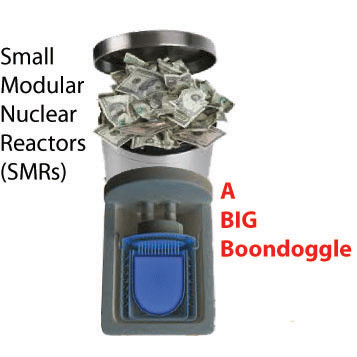
Financially in trouble AREVA is nevertheless advising on marketing Small Modular Nuclear Reactors
 NuScale hires an energy giant to help get its nuclear plant certified Feb 17, 2015, Wendy Culverwell
Staff Reporter-Portland Business Journal Portland-based NuScale Power has entered an agreement with AREVA to support testing and design of its nuclear power system as it prepares to submit a Design Certification Application to the U.S. Nuclear Regulatory Agency….The agreement gives NuScale access to AREVA’s fuel technology as well as its nuclear testing capabilities…..
NuScale Power is developing a small, modular nuclear power system that is built under factory conditions and deployed to a client’s site….
It expects to submit the document by late 2016 and to secure approval in time for a 2020 commercial launch…..

Fluor Corp. (NYSE: FLR) is its majority investor.http://www.bizjournals.com/portland/blog/sbo/2015/02/nuscale-hires-an-energy-giant-to-help-get-its.htm
NusCale company pushing for NRC approval to commercialise Small Modular Nuclear Recators
 Oregon’s nuclear startup adds execs to prepare for regulatory push Portland Business Journal
NuScale, which is looking to make a small-scale nuclear power plant, wants the NRC to allow for full commercialization of its nuclear power technology…….
NuScale is backed by Fluor Corp. (NYSE: FLR) and U.S. Department of Energy grants. It has more than 600 employees and is working to develop its factory-built nuclear power system, which will be submitted to government regulators for approval in 2016. Its system consists of modules each producing 50 megawatts of electricity.
It expects to deploy the first working model to a coalition of Western states that will station a power plant in Idaho, possibly near the Idaho National Energy Laboratory.http://www.bizjournals.com/portland/blog/sbo/2015/03/oregons-nuclear-startup-adds-execs-to-prepare-for.html
Significant actions by President Obama to address climate change
 The Emergence and Importance of President Obama’s Climate Policy, Huffington Post
…federal agencies over the next decade to cut their emissions by an average of 40 percent compared with their levels when he won office in 2008, and to increase their use of electricity from renewable sources by 30 percent.
This move is wholly within the president’s power as the nation’s chief executive and will have a significant impact on the market for energy efficiency and renewable energy goods and services. The federal government is the nation’s largest organization. It employs more people and buys more goods and services than anyone else. It is also a powerful role model for the private sector. As Ms. Davis observes:
…because the federal government is the largest user of energy in the United States economy — encompassing 360,000 buildings, 650,000 fleet vehicles and $445 billion in annual spending on goods and services — it has the potential to influence private companies to step up their emissions-cutting targets.
When coupled with EPA’s slow and steady progress to regulate greenhouse gas emissions under the Clean Air Act, this change in government’s own operations begins to resemble a meaningful federal climate policy………http://www.huffingtonpost.com/steven-cohen/the-emergence-and-importa_b_6922614.html?utm_hp_ref=green
New book on hydrogen bombs – author defies USA govt attempts to censor
Feds Attempt To Censor Parts of a New Book About the Hydrogen Bomb HughPickens.com writes:http://slashdot.org/ 24 Mar 15, The atom bomb — leveler of Hiroshima and instant killer of some 80,000 people — is just a pale cousin compared to the hydrogen bomb, which easily packs the punch of a thousand Hiroshimas. That is why Washington has for decades done everything in its power to keep the details of its design out of the public domain. Now William J. Broad reports in the NY Times that Kenneth W. Ford has defied a federal order to cut material from his new book that the government says teems with thermonuclear secrets. Ford says he included the disputed material because it had already been disclosed elsewhere and helped him paint a fuller picture of an important chapter of American history. But after he volunteered the manuscript for a security review, federal officials told him to remove about 10 percent of the text, or roughly 5,000 words. “They wanted to eviscerate the book,” says Ford. “My first thought was, ‘This is so ridiculous I won’t even respond.'” For instance, the federal agency wanted him to strike a reference to the size of the first hydrogen test device — its base was seven feet wide and 20 feet high. Dr. Ford responded that public photographs of the device, with men, jeeps and a forklift nearby, gave a scale of comparison that clearly revealed its overall dimensions.
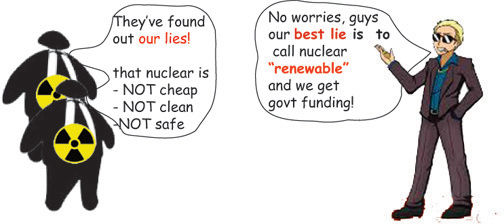
Push for small nuclear reactors – portrayed as “renewable energy”
NuScale targets 2016 to apply for NRC approval for its nuclear power system Portland Business Journal
It will submit the document in late 2016 and expects the NRC to take 39 months to review, putting it on track for a 2020 commercial launch……. The 570MWe complex of 12 units will be sited in Idaho, potentially near the U.S. Department of Energy’s Idaho national Laboratory Site near Idaho Falls. The deal makes UAMPS NuScale’s first official customer, subject to NRC certification of the system……. NuScale also benefits from Congress’s recent move to extend renewable energy tax incentives through the end of 2014, putting nuclear on equal footing with its carbon-free rivals…….
Mention climate change in Florida – and you lose your job!

 Florida environment official dismissed for mentioning climate change at work, Rt.com March 20, 2015 An employee from the Florida Department of Environmental Protection (DEP) has been suspended for mentioning climate change at work.
The complaint filed Thursday by the Public Employees for Environmental Responsibility (PEER) comes after reports that Employees from the Florida Department of Environmental Protection were told to avoid terms like “climate change” and “global warming” in official communications after Governor Rick Scott took office.
Barton Bibler is a long term employee of the DEP and until the recent disagreement with his superiors was in the position of Land Management Plan Coordinator in the division of State Lands.
He is in trouble for doing nothing more than talking about climate change at an official meeting and then making notes of that discussion in the minutes of the meeting.
During a session of the Florida Coastal Managers Forum on February 27 at which climate change and sea level were explicitly being discussed, Mr Bibler was told not to mention climate change.
He was then given a letter of reprimand and on March 9 was told not to return to work and that he would be charged for his personal leave time. Two days after this he received a medical release form requiring him to have a medical examination to look at his behavior and “medical condition” before being allowed to return to work.
Mr Bibler has no idea if he will ever be allowed to return to his job.
However, it seems that the actions of Florida Govenor Rick Scott and other state officials who operate a policy of rejecting climate change has backfired……..http://rt.com/usa/242425-florida-environment-worker-climate-change/
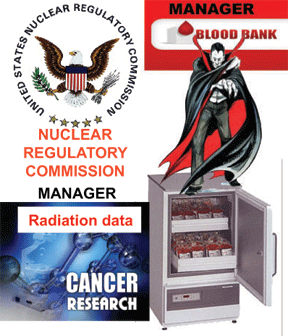
Nuclear Regulatory Commission trickery on radiation rules favours the nuclear industry, not the public interest
The NRC needs to recall that its name is the Nuclear Regulatory Agency and so its job is to regulate the industry, rather than to work for the nuclear industry. Its job is to help the EPA keep a high safety standard for water, air, soil. They both appear to have forgotten or be oblivious to their purpose, which is to protect the people and environment from radionuclides from the nuclear industry.
Nuclear Facilities also are allowed to emit so many radionuclides, that it takes 50 pages to list them, including plutonium 239 to the air, along with the water. But, like the water, to talk about concentrations in the air – as opposed to amounts – is really meaningless for anything but the shortest-lived radionuclides.
US NRC Radioactive Dilute and Deceive Scam – Comment Deadline June 22nd (Extended) Mining Awareness Plus, 18 Mar 15 US NRC Comment Deadline extended to 22 June 2015:https://www.federalregister.gov/articles/2014/11/20/2014-27519/radiation-protection http://www.regulations.gov/#!documentDetail;D=NRC-2009-0279-0098 “………..The disgusting truth is that research on ionizing radiation has been ongoing since 1895. At the beginning of the nuclear age, focus was on how dangerous radiation was. Many animal and even human experiments have been done. The human experiments were both official experiments and unofficial making the population at large act as guinea pigs. They have known from the beginning the dangers. Somewhere along the way they seem to have switched from doing experiments to see how dangerous it was to doing endless experiments in an attempt at proving that it is safe. Despite their efforts to prove the contrary, they have only succeeded in proving that ionizing radiation is even more dangerous than their early results showed. As the National Academy of Science has stated endlessly in their BEIR reports, there is no safe dose of ionizing radiation. Increased dose is increased risk. This is even more true for high-LET internal alpha radiation and high LET neutrons.
The US EPA has a “clean water” water “standard” for drinking water, though it has none for water emissions from nuclear facilities – which makes no sense. Who, if anyone, pays to clean up the difference between radionuclides emitted by nuclear facilities and that allowed in drinking water?
Furthermore, the “Clean Water” drinking water standard appears to be inadequately protective, as well. It allows 740 Bq/liter of tritium in drinking water. The Canadian nuclear lobby was reportedly satisfied with a 20 Bq/liter standard for tritium in drinking water, recommended by the Ontario Water Advisory Commission (OWAC), even though Canadian CANDU reactors produce more tritium than other reactors. OWAC started with the idea that “the target derived risk level should be 1 in a million or 10-6 (meaning 1 new excess cancer occurrence over existing background cancer rates in 1,000,000 people); the target derived risk level should be over a lifetime of exposure of 70 years, and based on cancer incidences above background (occurrences) rather than mortality (deaths);” This led to models ranging from 7 Bq/L to 109 Bq/L.http://www.odwac.gov.on.ca/reports/052109_ODWAC_Tritium_Report.pdfhttp://www.odwac.gov.on.ca/reports/052109_Tritium_Report_Cover_Letter.pdf
Notice the number was chosen based on cancer morbidity (illness), not just mortality (death). (Unfortunately, if there are cooling towers they could send the balance of tritium out into the air.) Contrary to what TEPCO, AREVA, and EnergySolutions want everyone to believe, there are several ways to filter tritium………
Yes, they need water standards but they need real standards and strict standards, which account for all radionuclides emitted in air and water and per facility. The actual quantities of the radionuclides must be measured and not the concentration! Continue reading
Michael Marriotte exposes Senator Lamar Alexander’s nuclear fantasies
Actually, 100 new reactors not only seems high, it’s pure fantasy. With the experience of Vogtle, and the similar experience at two reactors under construction at the Summer site in South Carolina, no one is lining up to build new reactors. At this point, it’s unlikely even the four under construction will be online by 2020, much less 96 more new ones.
 Lamar Alexander’s nuclear fantasyland Green World, Michael Mariotte March 9, 2015 Back in 2008, when presidential candidate John McCain was calling for construction of 45 new reactors in the U.S. (and presidential candidate Barack Obama was calling for “safe” nuclear power), Tennessee Senator Lamar Alexander outdid his colleague: he issued a call for construction of 100 new nuclear reactors.
In 2008, the nuclear “renaissance” was in full swing. McCain’s call didn’t seem–at least to nuclear backers–far-fetched in the least. After all, the NRC at the time already had some 30 applications for licenses for new reactors.
Nearly seven years later, McCain doesn’t talk much about nuclear power. President Obama’s Department of Energy approved a taxpayer loan for two new reactors at Vogtle, a move DOE may be beginning to regret asconstruction costs spiral out of control and the schedule delays keep pushing the project further back. Otherwise, the president these days talks about promoting renewables.
Most people are able to adjust to reality–in this case the reality that the short-lived nuclear “renaissance” is long over.
But not Senator Alexander, who is now chair of the Senate Appropriations Subcommittee on Energy & Water Development. Continue reading
Nuclear regulatory Commission deceives on nuclear radionuclides
 US NRC Radioactive Dilute and Deceive Scam – Comment Deadline June 22nd (Extended) Mining Awareness Plus, 18 Mar 15 US NRC Comment Deadline extended to 22 June 2015:https://www.federalregister.gov/articles/2014/11/20/2014-27519/radiation-protection http://www.regulations.gov/#!documentDetail;D=NRC-2009-0279-0098
The most strange and deadly scam, which the US NRC is running, is the dilute to deceive scam, where they actually tell the nuclear industry (and labs) that if they dilute the radionuclides with a certain amount of water (or air), then it is ok to put it into the rivers, ocean, air and even into regular sewerage drains! This is what they call “effluent concentration”. Even then the amounts allowed exceed amounts allowed under the EPA’s Clean Water Act, though it doesn’t really matter because what matters is how much radionuclide is actually emitted into the environment and how many months, years, decades, centuries, it’s going to stay there.
So, now it is easy to see that the following question by the NRC is meaningless BS. The actual amounts – not concentration – of the various radionuclides must be modelled. And, how long they stay in the environment:
“Q1-3: How should the calculations of effluent concentration, currently in the 10 CFR part 20 radiation protection regulations, be modified to reflect advances in modeling that are now available? In particular, the NRC is interested in preliminary views on the age and gender averaged approach.”
What the F(ukushima Daiichi) would age and gender averaged approach mean? Assuming they were speaking of actual amounts, then the amounts should be “appropriate” for the most fragile. If you are considering age and gender then the fragile must be considered – period. There is no average! Fragility varies according to disease. But, until they start modeling for actual emissions and actual half-life of the radionuclides, then it is meaningless. Half-life in the body is also meaningless because at some point the body will enter steady-state with the environment. And, actually the “appropriate” amount of exposure is none.
Here’s another crazy NRC question “Q1-4: Should the public dose limit of 0.5 mSv (50 mrem) continue to be the basis for the effluent concentration limits for the radionuclides in 10 CFR part 20, appendix B, Table 2, Columns 1 and 2? Should it be reduced or otherwise modified?”
As noted above, effluent concentrations are a dilute to deceive scam. What matters is the amounts and not the concentration. 10 CFR part 20, appendix B, Table 2 should be modified to reflect actual amounts allowed and not concentrations. And, really, any short-lived radionuclides should be contained until they are no longer radioactive, and long-lived radionuclides should never be emitted at all.
It’s not clear where they are getting the 0.5 mSv from. On the NRC web site 1 mSv per year is mentioned. Is this right or wrong? The US EPA has a standard of 0.25 mSv for the body and 0.75 mSv for the thyroid. The ICRP 103 (2007) which they pretend to be coming up to speed with has a dose constraint of less than or equal to 0.1 mSv per year where “prolonged component from long-lived nuclides” (p. 116)
How many cancers will there be in a lifetime from the 1 mSv per year proposed by the US NRC? According to National Academy of Sciences BEIR report, it would be 1 (or more) per 100 people. The ICRP has it at about 0.55 which would round up to one. However, this is assuming that the 1 mSv per year is new, whereas the radionuclides will be building up in the environment and even in the body. If half of the 1mSv emitted were short lived, the next year there would still be 1 mSv emitted plus 0.5 mSv (half) already emitted. Some of the radionuclides (cesium and strontium) have half-lives of about 30 years; other radionuclides like plutonium-americium in the 100s or 1000s of years: “The half-life of plutonium-239 is 24,065 years. This half-life is short enough that 1 microgram of material will undergo more than 2000 decay events per second, but it is long enough to allow that microgram to decay at an approximately constant rate for thousands of years. If plutonium had uranium’s half-life of 4 billion years, there would be so few decays over the span of a human’s lifetime that the radiological toxicity of plutonium would be much less severe. [3] However, that is not the case… [3 Uranium is also much more soluble than plutonium and leaves the body rapidly.]” Los Alamos Science Number 26 2000, p. 78 (That’s straight from the heart of the beast – Los Alamos Nuclear Lab – hardly anti-nuclear!)
Plutonium 241 has a half life of 14 years, which is used to trick people since it becomes more dangerous 241 Americium with a half life of around 432 years.
Furthermore, BEIR is based on low-LET external, radiation. ICRP appears more appropriate for low-LET, as well. ICRP inappropriately lumps medical radiology and the nuclear industry together. BEIR is excluding more dangerous high-LET and internal radiation in their calculation. However, they recognize high LET such as alpha and neutrons as more dangerous. Most of the ICRP research would seem to be based on either external or very short-lived internal low LET radiation. While they are supposed to add weighting factors for high LET and amount of time spent in the body, it’s difficult to see if they can or will add enough weighting factors to thoroughly account for plutonium and americium, which even in a totally clean environment would stay in the body for a lifetime. It takes 20 to 50 years to excrete one half of them, in a clean environment. Furthermore, the US gov has at least one so-called expert who has messed up the formula, making more radiation safer and less more dangerous! Then he’s prancing around the world as an “expert”:https://miningawareness.wordpress.com/2014/07/31/nuclear-effective-dose-radiation-icrp-vs-us-epa/ (This topic is important for the March 24th deadline too.) To err is human, but there is no room for blunders with something so dangerous as radiation, especially not gross blunders………https://miningawareness.wordpress.com/2015/03/18/us-nrc-radioactive-dilute-and-deceive-scam-comment-deadline-march-24th/
Radioactive waste produced by fracking for gas
Fracking Radiation– North Dakota Considers Weaker Landfill Rules, Less Oversight , CounterPunch, MARCH 19, 201 by JOHN LaFORGE
Radioactive waste produced by hydraulic fracturing or “fracking” is making headlines all over gas land, particularly in North Dakota’s booming Bakken gas and oil field.
National news coverage of the scandalous illegal dumping of radioactive filter “socks” there — on Indian Reservations no less — has led North Dakota’s legislature to consider changes to its radioactive waste laws so that fracking’s contaminated wastes can be dumped in ordinary landfills.
One current bill would permit fracking’s radioactive waste in state landfills to be contaminated with 10 times the radioactivity that state law now allows — as long as it’s covered with 10 feet of dirt. Radioactive fracking waste that’s not being illegally discarded — no Victoria, mobster dumping probably hasn’t ended — is supposed to be being trucked out of state.
ND House Bills 1113 and 1114 — reportedly requested by the State Health Department — are being contested by some law makers and journalists who question the right of the department to set its own rules.
The ND Newspaper Association and the ND Broadcasters Association complained that one bill eliminates mandatory public hearings about landfill rule changes and instead permits them “when appropriate.” The bill also cancels public notification of the permitting process for disposition of radioactive materials.
Dave Glatt of the State Health Department told the Bismarck Tribunethat his agency commissioned Argon National Laboratory in Chicago to study the issue and make recommendations. The department wanted to know “radiation limits that would be safe for workers and the public.” Glatt forgets that there are no safe radiation doses, only legally permitted ones.
Locals are Worried
“We don’t want to have, when this oil and coal is gone, nothing left here, a wasteland, and I’m afraid that’s what might happen,” said Underwood farmer Gene Wirtz to KXNET news reporter Ben Smith in January. Wirtz is worried about the increased radioactivity in local landfills. “Any amount of radiation beyond what you’re already getting is not a good thing,” he said.
Radioactive isotopes that contaminate fracking industry waste and its machinery include radon, radium-226, uranium-238, and thorium-232. According to the Health Department’s website, these long-lived radioactive pollutants come in six forms:
* “Produced water” which is injected underground but later brought to the surface as waste;
* “Sulfate scales,” which are hard, insoluble deposits that accumulate on frack sand and inside drilling and processing equipment;
* Contaminated soil and machinery;
* Filter socks, contaminated by filtering “produced water”;
* Synthetic “proppants” or sand; and
* Sludge and “filter cake” solids of mud, sand, scale and rust that precipitate or are filtered out of contaminated “produced water. They build up in “filter socks,” and in waste water pipes and storage tanks that can leak.http://www.counterpunch.org/2015/03/19/fracking-radiation/
All ratepayers are helped by solar rooftops
Rooftop solar benefits all ratepayers http://safeenergy.org/2015/03/18/rooftop-solar-benefits-all-ratepayers/ Michael Mariotte The utility and fossil-fuel industries continue to spread a crude canard against the growing popularity of rooftop solar across America.
The lie goes something like this: Households and business that install photovoltaic panels are doing so at the expense of other electricity ratepayers because they are “subsidized” by those that don’t have solar panels.
The truth is this: Rooftop solar provides substantial benefits for everyone, regardless of who installs it. It helps power the homes and shops that adopt it, to be sure, but it has far-reaching benefits for other customers as well. If Jane Doe in Anywhere, USA, puts a solar panel on her roof, every other electricity ratepayer within the footprint of whatever regional grid Jane Doe is tied into will benefit as well.

Honest purveyors of utility-industry fact know this, of course, and say it quite often. So, more and more, does Wall Street.No less a titan than Sanford Burstein & Co., one of the perennially best-rated firms in Institutional Investor’s annual rankings of investment researchers, has studied the issue deeply over the past couple of years and comes away with an unequivocal take on the issue: Rooftop solar, aka photovoltaic solar, means lower peak-hour energy prices for all.
Bernstein lays out the supporting research in a reported published last month that found that the rapid increase in the amount of solar PV available on the electricity grid in California—a seven-fold expansion in only four years, from 0.7 gigawatts in 2010 to 4.8 GW in 2014— had helped reduce system loads so much that peak prices were put off until later in the day, when demand was lower. Lower demand means lower prices.
That report went on to predict that the effect will be amplified inevitably across the state as growth in solar capacity continues. This will probably reduce the value of incremental additions of solar capacity on the California grid, but that’s not the point. The overarching conclusion is that all power consumers in California benefit from lower afternoon power prices, not just those that have rooftop solar PV panels.
The February report builds on earlier important work by Burstein & Co, notably a report the firm distributed to clients in November 2013. Titled “Tilting at Windmills: How Conventional Generators are Losing the Battle with Renewables,” that research found that the rapid growth of solar and wind resources (rooftop solar included) in four of the nation’s major electricity regions had suppressed the output of conventional coal and natural-gas fired generators. That’s good news because the trend also eroded the price at which the output of those conventional generators could be sold. Solar- and wind- powered electricity, in other words, drove market prices down.
This happened—and continues to happen—because renewable resources, which have zero variable costs, have displaced higher-cost conventional generation, lowering the marginal cost of supplying power competitively in wholesale markets or in states that do not regulate the retail price of electricity.
That particular Bernstein & Co. research also noted that by suppressing the output of conventional power plants, solar and wind generation had reduced demand for coal and natural gas. The firm estimated that some 52 million megawatt-hours of coal-fired generation and 42 million megawatt-hours of gas-fired generation was displaced in 2012 alone by wind and solar resources in the four regions it studied. This translates into a reduction of “coal burn” by approximately 30 million tons and “gas burn” by approximately .07 billion cubic feet/day. Bernstein & Co. also said this trend will continue too.
But back to rooftop solar for a second. In addition to driving energy market prices down, it brings environmental benefits by reducing dependence on fossil fuels, and it acts as a hedge against fossil-fuel price spikes.
It’s in every ratepayer’s best interest. And that’s the truth.
Karl Cates is IEEFA’s director of media relations; David Schlissel is IEEFA’s director of resource planning analysis.
The original post on IEEFA’s website is here. http://ieefa.org/truth-rooftop-solar-capacity-benefits-all-ratepayers/
Utilities in USA finding it uneconomic to extend life of nuclear reactors beyond 60 years
Senator: Utilities see little value in extending nukes beyond 60 years SNL, By Matthew Bandyk 5 Mar 15 High-level energy company executives have told Sen. Lamar Alexander, R-Tenn., that they will not ask federal regulators for permission to extend the operation of many of their nuclear power reactors beyond 60 years of operation, the senator said at a March 4 hearing that scrutinized the U.S. Nuclear Regulatory Commission’s $1.03 billion budget request for fiscal year 2016.
While he did not name names, Alexander said that in private conversations, company executives have indicated that in many cases it might not make economic sense to pay for all the upgrades that the NRC would require if a nuclear plant wanted a 20-year license extension to run for 80 years. While about 75 of the 99 operating reactors in the U.S. have received license extensions to stay online for up to 60 years, no plant has yet asked to be licensed beyond that period, creating fears among the industry and outspoken nuclear proponents such as Alexander that after the next decade the amount of nuclear capacity will fall off a cliff as plants start to hit their 60-year lifespans and retire…….
“Big utility operators tell me they are not even thinking about asking for extensions of time that their reactors will stay online … because it’s not economic to operate them,” he also said…..
The NRC’s fiscal-year 2016 budget request is down $27.3 million compared to the proposal in fiscal year 2015, reflecting a decrease of about 140 full-time employees due to decreased workload in the offices of New Reactors and Fuel Facilities, according to a statement from the NRC…….https://www.snl.com/InteractiveX/Article.aspx?cdid=A-31556548-11565
1 This Month
23-25 October – on Zoom – World BEYOND War’s annual global conferenc

To see nuclear-related stories in greater depth and intensity – go to https://nuclearinformation.wordpress.com

Say No to NASA’s Reckless Nuclear Reactor on the Moon
Say No to NASA’s Reckless Nuclear Reactor on the Moon
-
Archives
- October 2026 (149)
- September 2026 (339)
- August 2026 (330)
- July 2026 (355)
- June 2026 (287)
- May 2026 (306)
- April 2026 (356)
- March 2026 (251)
- February 2026 (267)
- January 2026 (308)
- December 2025 (358)
- November 2025 (359)
-
Categories
- 1
- 1 NUCLEAR ISSUES
- business and costs
- climate change
- culture and arts
- ENERGY
- environment
- health
- history
- indigenous issues
- Legal
- marketing of nuclear
- media
- opposition to nuclear
- PERSONAL STORIES
- politics
- politics international
- Religion and ethics
- safety
- secrets,lies and civil liberties
- spinbuster
- technology
- Uranium
- wastes
- weapons and war
- Women
- 2 WORLD
- ACTION
- AFRICA
- Atrocities
- AUSTRALIA
- Christina's notes
- Christina's themes
- culture and arts
- Events
- Fuk 2022
- Fuk 2023
- Fukushima 2017
- Fukushima 2018
- fukushima 2019
- Fukushima 2020
- Fukushima 2021
- general
- global warming
- Humour (God we need it)
- Nuclear
- RARE EARTHS
- Reference
- resources – print
- Resources -audiovicual
- Weekly Newsletter
- World
- World Nuclear
- YouTube
-
RSS
Entries RSS
Comments RSS

