The nuclear industry’s plight – the COSTS OF RADIOACTIVE TRASH DISPOSAL
 The politics of nuclear waste disposal, The Hill, 8 Dec 15 By Mark R. Maddox, The closure of nuclear power plants — seven at last count — and the role of nuclear power in a low carbon world has received a fair amount of media coverage, including a piece in The Hill. What hasn’t, however, is what to do about the nuclear waste stored at these plants and which will continue to be stored at these abandoned facilities for many decades to come. While the topic has become a political hot potato, some in Congress, like Illinois Rep. John Shimkus (R), a senior member of the House Energy and Commerce Committee, recognize its importance and the need to address it in short order.
First, it’s important to understand the reasons for the trend toward closures. The U.S. nuclear fleet is old. While many licenses to operate have been extended, required upgrades are expensive and regulatory oversight is extensive. Compounding the problem is the availability of reliable and cost-effective alternative power sources: shale production in the United States has contributed to a significant drop in gas prices and made natural gas-generated electricity comparatively cheap; also, increased accessibility to lower-cost renewable energy due to declining costs and supportive policies for investment has squeezed the profitability of nuclear generation. Finally, demand for electricity has declined due to a combination of efficiency improvements and manufacturing shifts.
As one analyst described the plight of nuclear energy: You cannot roll back the rules of economics…….
Not surprisingly, the government inactivity has led to a shift in the conversation away from plants producing electricity and creating waste to plants being decommissioned and the waste being stranded on site. If Yucca Mountain is taken off the table as a permanent storage site, every nuclear power plant that has been storing nuclear waste on an interim basis could become its own version of Yucca Mountain. The Maine Yankee Plant, closed in 1997, is still home to 60 nuclear casks and 550 metric tons of waste. As well, the Pilgrim plant in Massachusetts recently announced it is to be closing and is estimated to have 3,000 radioactive rods in storage that will be stored on-site indefinitely.
Utilities owning a nuclear plant are now caught in real bind. According to press reports, every dismantling decision has been accompanied by a request to divert reserved funds to also cover costs for long-term fuel storage. In the case of Vermont Yankee, this is a double-whammy. Not only are its reserve funds insufficient, forcing the utility to mothball the plant for 60 years until the dismantlement fund is adequate, the utility is pursuing an additional line of credit of $145 million to build a storage facility and estimates that it will take an additional $225 million for storage operation and security…….http://thehill.com/blogs/pundits-blog/energy-environment/262407-the-politics-of-nuclear-waste-disposal
10 Control Rods accidentally dropped into nuclear reactor core – Indian Point
 Gov’t: Shutdown at U.S. nuclear plant after 10 control rods accidentally fall into reactor core — Caused by ‘smoldering’ event, Fire Brigade on scene — Incident of this type could lead to overheating, potentially resulting in ‘supercriticality’ — Official: No ‘immediate’ concern (VIDEO) http://enenews.com/govt-shutdown-nuclear-plant-after-rods-accidentally-fall-reactor-core-caused-smoldering-event-fire-brigade-scene-incident-could-lead-overheating-potentially-resulting-supercriticality-officia?utm_source=feedburner&utm_medium=email&utm_campaign=Feed%3A+ENENews+%28Energy+News%29
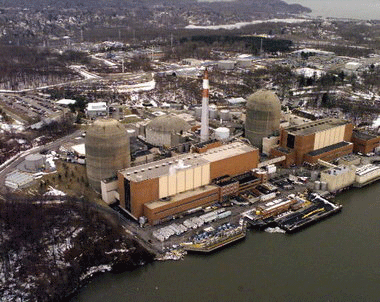 U.S. Nuclear Regulatory Commission Event Notification Reports, Dec 7, 2015 (emphasis added): MANUAL REACTOR TRIP INITIATED DUE TO MULTIPLE DROPPED CONTROL RODS — At 1731 [EST] on December 5, 2015, Indian Point Unit 2 Control Room operators initiated a Manual Reactor Trip due to indications of multiple dropped Control Rods. The initiating event was a smoldering Motor Control Center (MCC) cubicle in the Turbine Building that supplies power to the Rod Control System… The affected cubicle has ceased smoldering and is being monitored by on-site Fire Brigade trained personnel… The cause of the smoldering MCC is being investigated and a post reactor trip evaluation is being conducted by the licensee… The licensee has notified the NRC Resident Inspector and appropriate State and Local authorities.
The Journal News, Dec 7, 2015: One of Indian Point’s two nuclear reactors will remain shut down for the next couple of days following a power loss on Saturday, a company spokesman said Sunday. Unit 2 was powered down around 5:20 p.m. Saturday by operators after about 10 control rods “dropped” into the reactor core, according to the Nuclear Regulatory Committee… Neel Sheehan, a spokesperson for the NRC, said a preliminary investigation indicated the problem stemmed from a sudden power loss to the mechanism holding the rods. The plant’s control rods, made of materials that can absorb neutrons, are used to control the fissioning of atoms that generate power… Government inspectors visited Indian Point on Saturday and Sunday. “No immediate concerns were identified,” Sheehan said in an e-mail, adding that inspectors would return to the site “to follow up on troubleshooting, repair activities and restart planning.”
Gothamist, Dec 6, 2015: In a statement, Gov. Cuomo… said he’s sending a team from the Department of Public Service to investigate the incident and monitor the process of bringing the reactor back online.
Several control rods also appear to have dropped at Virginia’s North Anna nuclear power plant after an earthquake in 2011:
- U.S. NRC Event Notification, Aug 29, 2011: EMERGENCY DECLARED… North Anna Power Station declared an Alert due to significant seismic activity
- U.S. NRC email, Sept 2011: RE: North Anna… At this point, it appears that the grippers for several of the control rods deenergized and dropped.
- Westinghouse patent: A dropped rod… will initially result in a reduction in the total power generated by the core. The reactor will then attempt to meet the load… byincreasing power in the remainder of the core which could lead to local overheatingelsewhere in the core.
- Satoshi Sato, Nuclear Engineer, April 28, 2015 (emphasis added): “I don’t know if you remember, there was the earthquake in 2011 in Virginia. That was a big one… enough to cause vibration to the North Anna reactor resulting in a big spike of neutron flux — orreactor power… and somehow caused the additional radioactivity into the core. So that’ssomething scary, potentially resulting in a supercriticality.” (IEER: “The neutron spike accompanying a sudden supercriticality can lead to an explosion of the reactor core. It is this sort of event which occurred at the Chernobyl reactor”)
Bill Gates’ nuclear power – Wrong Kind of Green
 THE BIG THREE: THE 21ST CENTURY “CLEAN ENERGY” REGIME Wrong Kind of Green Dec 07, 201 5 Bill & Melinda Gates Foundation
December 7, 2015 The “big three” that comprise the 21st century “clean energy” regime are Mission Innovation, Breakthrough Energy Coalition (BEC), and the Global Apollo Programme, with BEC in the driving seat.
What we are witnessing is militarized advertising campaign for pseudo ‘public interest’ purposes. This is an example of ‘gray ops’ in psywar terminology. Promoting it as a patriotic mission sets up the opposition as ‘unpatriotic’. A massive and unspoken con for a pre-orchestrated bailout under the guise of “climate solutions”. A last ditch effort to save an ailing capitalist economic system which has become dangerously stagnant for those in power.
Mission Innovation was announced by Bill Gates at COP21 on 30 November 2015, on stage with President Obama, President Hollande and Prime Minister Modi. [Source] Its link to private sector investment is via the Breakthrough Energy Coalition group of private investors, also spearheaded by Bill Gates and which formed in parallel at COP21.”[Source]
Several example technologies were mentioned at the launch of the initiative: biofuel, carbon capture and storage, airborne wind turbines, nuclear fission and nuclear fusion. [Source] http://www.wrongkindofgreen.org/2015/12/07/the-big-three-the-21st-century-clean-energy-regime/
California’s drought brings uranium contamination to drinking water
 Fear at the tap: Uranium contaminates water in the West Yahoo News, By ELLEN KNICKMEYER and SCOTT SMITH, 7 Dec 15 “…. Uranium, the stuff of nuclear fuel for power plants and atom bombs, increasingly is showing in drinking water systems in major farming regions of the U.S. West — a natural though unexpected byproduct of irrigation, drought, and the overpumping of natural underground water reserves.
An Associated Press investigation in California’s central farm valleys — along with the U.S. Central Plains, among the areas most affected — found authorities are doing little to inform the public at large of the risk.
That includes the one out of four families on private wells in this farm valley who, unknowingly, are drinking dangerous amounts of uranium. Government authorities say long-term exposure to uranium can damage kidneys and raise cancer risks, and scientists say it can have other harmful effects.
In this swath of farmland, roughly 250 miles long and encompassing cities, up to one in 10 public water systems have raw drinking water with uranium levels that exceed safety standards, the U.S. Geological Survey has found.
More broadly, nearly 2 million people in California’s Central Valley and the U.S. Midwest live within a half-mile of groundwater containing uranium over the health limits, University of Nebraska researchers said in a study in September.
Entities ranging from state agencies to tiny rural schools are scrambling to deal with hundreds of tainted public wells……
he uranium gleaned from local water systems is handled like the nuclear material it is — taken away by workers in masks, gloves and other protective garments, said Ron Dollar, a vice president at Water Remediation Technology, a Colorado-based firm. It is then processed into nuclear fuel for power plants, Dollar said.
Before treatment, Westport’s water tests up to four times state and federal limits. After treatment, it’s safe for the children, teachers and staff to drink…….http://news.yahoo.com/fear-tap-uranium-contaminates-water-west-051313046.html
Most of “Breakthrough Energy Coalition’s ” members are nuclear obsessives
perhaps the Breakthrough Billionaires Club will yet come to the realization that from a clean energy generation perspective we have already broken through. The innovations needed are not in abstract research but into deployment; and into enabling technologies led by low cost electricity storage and conversion into fuels.
The Breakthrough Energy Coalition must tear itself away from the fascination of tinkering in a laboratory and instead do something real, practical and hands-on with their money. However, the group’s assertion that “the foundation of this program must be large funding commitments for basic and applied research”, does not provide much reason for optimism.
A tennis coach I used to know would tell his team after a loss that “breakdowns come before breakthroughs.” We’ve caused the climate breakdown and we’ve made the energy breakthroughs. Now we just need to start winning
The first question that crossed my mind when reading about the latest Bill Gates investment venture was “is this a cover to divert yet more money into nuclear energy?”
Gates unveiled hisBreakthrough Energy Coalition at the start of the COP21 climate talks in Paris with much fanfare but few details, including the size of the financial commitment.
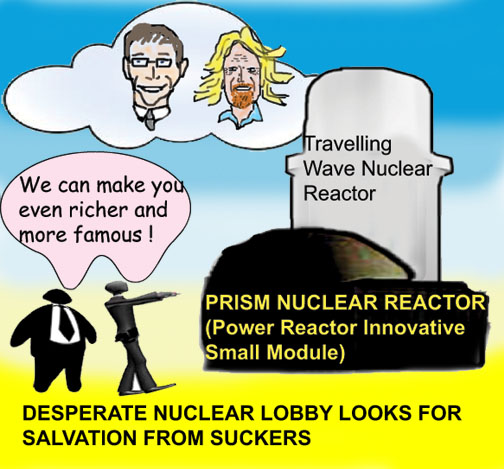
My suspicions were triggered not only by Gates’ already public commitment to nuclear energy research, but by the name selected for this collection of 28 of the world’s richest people (mainly men).
The Breakthrough Institute, after all, is the name of the pseudo-green nuclear energy front group whose people promoted and starred in the 2013 nuclear power propaganda film, Pandora’s Promise. But so far the Breakthrough Institute is lying low on the Breakthrough Energy Coalition, although I suspect not for long.
At first glance, the mission of the Breakthrough Energy Coalition, whose collective wealth is $350 billion, sounds reasonable enough, even if it takes a while to get ones head around that kind of disposable income.
Madness in the method Continue reading
North America’s West Coast getting record levels of Fukushima radiation
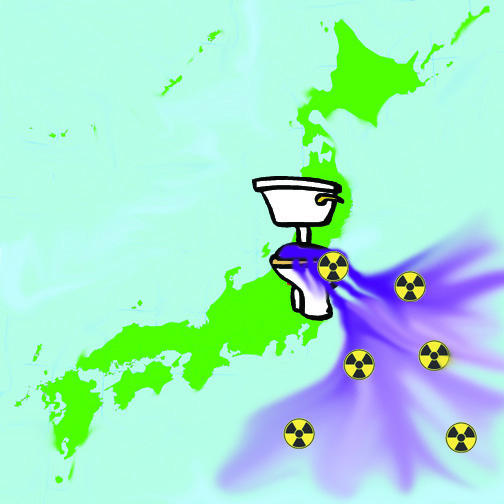 Record levels of Fukushima radiation detected off West Coast — Massive plume stretches for more than 1,000 miles — Reuters: Contamination is spreading off U.S. shores — Radioactive cesium reaches 11 Bq/m3 at multiple locationshttp://enenews.com/record-levels-fukushima-radiation-detected-west-coast-massive-plume-stretches-1000-miles-cesium-reaches-11-bqm3-multiple-locations-map?utm_source=feedburner&utm_medium=email&utm_campaign=Feed%3A+ENENews+%28Energy+News%29(MAP)
Woods Hole Oceanographic Institution, Dec 3, 2015 (emphasis added): Higher levels of Fukushima cesium detected offshore — Scientists monitoring the spread of radiation in the ocean from the Fukushima nuclear accident report finding an increased number of sites off the US West Coast showing signs of contamination from Fukushima. This includes thehighest detected level to date from a sample collected about 1,600 miles west of San Francisco. The level of radioactive cesium isotopes in the sample, 11 Becquerel’s per cubic meter… is 50 percent higher than other samples collected along the West Coast so far… Working with Japanese colleagues, [Ken Buesseler, a WHOI marine radiochemist] also continues to independently monitor the ongoing leaks from Fukushima Dai-ichi by collecting samples… During his most recent trip this October they collected samples of ocean water, marine organisms, seafloor sediment and groundwater along the coast near the reactors. Buesseler says the levels of radioactivity offFukushima remain elevated – some 10 to 100 times higher than off the US West Coast today, and he is working with colleagues at WHOI to try to determine how much radioactive material is still being released to the ocean each day.
Ken Buesseler, WHOI: “These new data are important for two reasons… the changing values underscore the need to more closely monitor contamination levels across the Pacific. Second, these long-lived radioisotopes will serve as markers for years to come for scientists studying ocean currents and mixing in coastal and offshore waters… [F]inding values that are still elevated off Fukushima confirms that there is continued release from the plant.”
Statesman Journal, Dec 3, 2015: Higher levels of Fukushima radiation detected off West Coast— Higher levels of radiation from Japan’s 2011 Fukushima nuclear accident are showing up in the ocean off the west coast of North America, scientists from the Woods Hole Oceanographic Institution reported today. And an increased number of sampling sites are showing signs of contamination… This year, Buesseler has added about 110 new sample results to 135 already on the project’s web site. They include the highest detected level to date, from a sample collected about 1,600 miles west of San Francisco.
Reuters, Dec 3, 2015: Radiation from Japan nuclear disaster spreads off U.S. shores… andcontamination is increasing at previously identified sites… Tests of hundreds of samples of Pacific Ocean water confirmed that Japan’s Fukushima nuclear power plant continues to leak… The latest readings measured the highest radiation levels outside Japanese waters to date some 1,600 miles (2,574 km) west of San Francisco. The figures also confirm that the spread of radiation to North American waters is not isolated to a handful of locations, but can be detected along a stretch of more than 1,000 miles (1,600 km) offshore.
Dr Ken Buesseler reports cesium-134 from Fukushima in ocean waters off North America shores
 Fukushima radiation detected off North America shores http://www.presstv.ir/Detail/2015/12/04/440253/Fukushima-radiation-Japan-California-North-America-Buesseler Researchers detect higher levels of radiation from Japan’s 2011 Fukushima nuclear disaster off North America’s shores.Ken Buesseler of the Woods Hole Oceanographic Institution said on Thursday recent tests of Pacific Ocean water revealed that the Fukushima nuclear power plant continues contamination of the ocean with radioactive isotopes.
Buesseler said samples taken from several hundred miles off the shores of Oregon, Washington and California as well as Canada’s Vancouver island over the past few months tested positive for cesium-134.
Cesium-137 isotope was also detected at low levels in almost all seawater samples tested by Buesseler and his fellow researchers.
“Despite the fact that the levels of contamination off our shores remain well below government-established safety limits for human health or to marine life, the changing values underscore the need to more closely monitor contamination levels across the Pacific,” said Buesseler.
Last year, Buesseler said Fukushima radiation was detected in samples taken off the coast of northern California. In April, radiation was also identified off Canada’s shores.
The latest figures show that the spread of Fukushima radiation is not limited to certain locations, but can be found along a stretch of 1,000 miles offshore. n March 2011, a massive tsunami triggered by a magnitude-9 quake filled the Fukushima nuclear cooling systems with water, sending some reactors into meltdown and sparking a decades-long cleanup effort by the Japanese government.
Shortly after the accident, radiation was released into the sea, food chain, and air, and now the Fukushima incident is the worst nuclear accident since the 1986 Chernobyl disaster in Ukraine.
High cancer levels in those who lived near Coldwater Creek’s nuclear wastes, St Louis County

 Nuclear waste uncovered along Coldwater Creek; Residents fear higher risk for cancer http://fox2now.com/2015/12/03/nuclear-waste-uncovered-along-coldwater-creek-residents-fear-higher-risk-for-cancer/ FLORISSANT, MO (KTVI) – There are clean up concerns for people who believe they’re sick because of Coldwater Creek. A federal agency is reaching out to the community after uncovering nuclear waste along the creek’s banks and beyond.
Coldwater Creek runs through several communities and neighborhoods in north St. Louis County. People in those communities are concerned because of nuclear waste officials say has been found along the creeks banks and beyond. Residents fear waste from work on the Manhattan Project back in the forties has put them and their loved ones at a higher risk for cancer.
Residents say they’ve noted more than 2,000 people with cancer who live or grew up near this body of water.
Authorities say Coldwater Creek was contaminated with uranium residue stored near the airport during the development of atomic weapons decades ago. The Army Corps of Engineers cleaned up that site but the effects of the contamination will take much longer to get rid of.
Now the federal agency for toxic substances and disease registry is reaching out to families, beginning a study to find sick people and document their exposure.
They met Wednesday night and resident have lots of skepticism and concerns about incurable illnesses.
Global warming is increasing wildfires (and increasing the danger from nuclear facilities)
 New research finds that global warming is intensifying wildfires, Guardian, John Abraham, 3 Dec 15 A new study finds a human fingerprint in growing California wildfire risks A new paper was just published which provides a glimpse into the future of wildfires. The paper is titled “Extreme fire season in California: A glimpse into the future?” It was published as the second chapter of “Explaining Extreme Events of 2014” which is from by the American Meteorological Society and it is available here. The lead-in summary to the article is very much to the point. It states,
The fire season in northern California during 2014 was the second longest in terms of burned areas since 1996. An increase in fire risk in California is attributable to human-induced climate change.
The authors, Jin-Ho Yoon and colleagues make the point that California has been under drought conditions since 2012 and that the drought worsened recently. As is obvious, drought exacerbates the threat from wildfires. Last year, the California Department of Forestry and Fire Protection saw many more fires than have occurred in the prior five-year averages……
The authors then project into the future and ask what the current trends portend over the next few centuries. The predicted results are striking. We can expect to see increases in the drought index, the area under extreme threat of fires, and the days of fire danger. The following statement from the report provides a great summary.
The increase in extreme fire risk is expected within the coming decade to exceed that of natural variability and this serves as an indication that anthropogenic climate warming will likely play a significant role in influence California’s fire season…..http://www.theguardian.com/environment/climate-consensus-97-per-cent/2015/dec/03/new-research-finds-that-global-warming-is-intensifying-wildfires
USA about to set off a new nuclear arms race – former Defense Secretary Perry
 Former SecDef Perry: US on ‘Brink’ of New Nuclear Arms Race, Defense News, By Aaron Mehta December 3, 2015 WASHINGTON — The US is on the “brink” of kicking off a new nuclear arms race that will elevate the risk of nuclear apocalypse to Cold War levels, former Secretary of Defense William Perry warned Thursday.
Perry also called for the breaking of the nuclear triad by dismantling the intercontinental ballistic missile (ICBM) stockpile.
“We’re now at the precipice, maybe I should say the brink, of a new nuclear arms race,” Perry said at an event hosted by the Defense Writer’s Group. “This arms race will be at least as expensive as the arms race we had during the Cold War, which is a lot of money.”
The Pentagon is starting a major overhaul of its nuclear triad, made up of bomber, submarine and ICBM nuclear options. The Air Force is starting work on its Long Range Strike-Bomber (LRS-B) program, a conventional bomber that later could be nuclear-certified; it is also planning a new version of the ICBM. Meanwhile, the Navy is figuring out funding plans for the Ohio-class submarine nuclear replacement program.
In an August assessment, the Center for Strategic and Budgetary Assessments projects that it will cost more than $700 billion over the next 25 years to recapitalize the nuclear triad.
Speaking on Wednesday, Pentagon acquisition chief Frank Kendall indicated the nuclear modernization programs would be protected in the fiscal 2017 budget and remain a priority for the department going forward.
To Perry, who served in a number of Pentagon positions before becoming the 19th US secretary of defense under President Bill Clinton, spending that money is foolish when the US is both short of cash for other programs and capable of a robust nuclear deterrence already.
The risk of nuclear war is exacerbated by the dismantling of the relationship between Russia and the US that had been formed after the fall of the Soviet Union. Without clear military-to-military communication between those two nations, the risk of an accidental conflict increases…… http://www.defensenews.com/story/defense/policy-budget/2015/12/03/former-secdef-perry-us-brink-new-nuclear-arms-race/76721640/
Britons fear Donald Trump might use NATO nuclear weapons, if he becomes President
 Britons seek to ban Donald Trump, eliminate nuclear weapons he might use as president,
Oregon Live, Douglas Perry 3 Dec 15 It’s beginning to look like Donald Trump really could win the Republican nomination for president, and the party’s mainstream leaders are starting to panic.
Across the pond, some Britons are way past panic. They’re rallying support to formally ban Trump from the British Isles. And, just in case the businessman/reality-TV star does become the U.S. commander in chief, there’s a separate effort from the Scottish National Party to end Britain’s Trident nuclear-weapon program, noting that the U.S. president is the de facto decider when it comes to NATO countries using nuclear weapons.
“The UK’s independent nuclear deterrent isn’t, I believe, all that independent,” SNP defense spokesman Brendan O’Hara said in Parliament last week. “In reality, it will be an American commander-in-chief who will ultimately decide, and in 18 months time that commander-in-chief could be President Donald Trump.”…….http://www.oregonlive.com/politics/index.ssf/2015/12/britons_seek_to_ban_donald_tru.html
Entergy will definitely shut down Fitzpatrick nuclear power plant
 Entergy rejects Exelon’s offer to cover FitzPatrick’s fuel cost By PAYNE HORNING , 3 Dec 15 “•…………We have explored every legitimate commercial arrangement that might have changed the decision regarding Fitzpatrick’s retirement,” Holden [Fitzpatrick spokeswoman Tammy Holden] said in a statement. “The [nuclear] plant will retire at the end of 2016 or early 2017, as we have previously announced and formally advised the NRC.”…..http://wrvo.org/post/entergy-rejects-exelons-offer-cover-fitzpatricks-fuel-cost#stream/0
Bill Gates’ nuclear dream doesn’t stand up to critical analysis
Germany gives rise to much optimism. With solar resources no better than Alaska, solar power has nevertheless reached nearly 6% of the total electricity mix in the country. Ten years ago, solar power essentially didn’t exist there. In the U.S., the cost of installing solar has fallen from more than $8/watt to less than $3 in the past eight years, the industry has 175,000 working in it — more than twice the number of people that mine coal — and the value of solar installations reached $18 billion last year, according to the Solar Energy Industries Association.
Thiel and Gates are using their megaphones to make different points, but they actually share much in common. Gates is an investor in TerraPower, one of the companies trying to build the kind of advanced nuclear reactor Thiel wants to see the regulatory environment pave the way for. Gates talks up far-out technologies like making fuels directly from the sun, perhaps pulling carbon from the air to do it. Like Thiel’s nuclear, it’s not remotely clear any of this is going to make economic sense and its very unlikely any of it will be useful for a decade or more……..
There are paths to 100% renewable energy using existing technologies and aggressive deployment efforts.
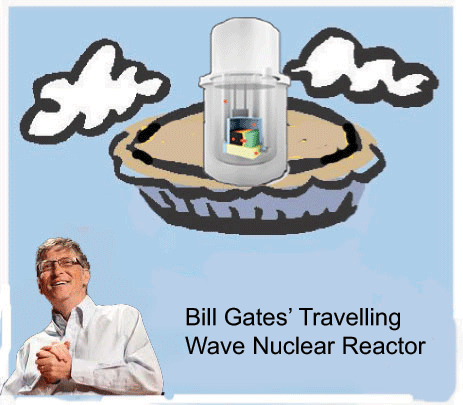 One Tech Billionaire Sees Nuclear As The Path To Clean Energy, But Is He Right?, Forbes, 30 Nov 15
Mark Rogowsky ,
The United Nations climate summit begins today in Paris and already there are headlines. The world’s richest man, Bill Gates, and a slew of his fellow billionaires have announced the Breakthrough Energy Coalition: an effort to take private money to advance promising clean-energy ideas from the lab to the marketplace. Gates suggests wind and solar have made good progress, but given the daunting scale of the challenge ahead, we need to look everywhere we can for promising ideas and develop them as quickly as possible. One thing he doesn’t talk up much is nuclear power, which just days earlier got some very positive words from another tech billionaire, number 234 on the Forbes list, Peter Thiel, who penned “The New Atomic Age We Need” for The New York Times…….
nuclear has established a safety record that argues for a rebirth, right? Perhaps if today were 1979. Unfortunately, the world has changed and nuclear hasn’t changed quickly enough……
The French, however, are set to lower the share that nuclear contributes to 50% over the coming decade. With the average French reactor now three decades old, at least part of the story is economic and technological. Thiel argues that what’s holding back nuclear is: “Designs using molten salt, alternative fuels and small modular reactors have all attracted interest not just from academics but also from entrepreneurs and venture capitalists like me ready to put money behind nuclear power… However, none of these new designs can benefit the real world without a path to regulatory approval.”
What he neglects to mention is that none of these designs are remotely ready to be put into use either. Although molten-salt reactors date back to the 1960s, the current designs haven’t left the research phase. Even in countries like China where U.S. regulatory approval isn’t a gating factor, when the scientists and engineers working on building a production reactor to make power dates like 2032 are tossed around. There are a number of other promising technologies being researched, but still the timeframes for first deployment are all between 2020-30. The U.S. regulatory regime isn’t holding these up, the slow path to development of incredibly complex systems is….. Continue reading
The Strange Politics of Global Warming and Nuclear Power
in 2013 and 2014, the top five U.S. nuclear energy companies and NEI spent a combined total of $60.4 million to lobby Congress and federal agencies.
Despite its legitimate urgency, global warming should not trigger a race to build more nuclear power plants. Rather, an upsurge in political momentum is needed to support the rapid rise of renewable energy. Democratic and Republican presidential contenders have failed to clarify their own ideas about the future of nuclear power within our energy mix, and the time is ripe for a meaningful public conversation. Regardless of affiliations and preconceptions, the question of whether to rely on nuclear power in a warming world is too important to ignore
The Curious Politics of Global Warming and Nuclear Power, HP, Charles B. Strozier Professor of History, The City University of New York Kelly A. Berkell Attorney and Research Fellow, Center on  Terrorism at John Jay College, Dec 15 In the lead-up to the 2016 election, the most formidable candidates vying to serve as our next president have largely avoided the topic of nuclear power. Indeed, they have encountered little pressure to address it even as the Paris climate talks open, with none of the Republican or Democratic debates so far including a single, specific question on nuclear energy. Only one Republican candidate, Chris Christie, and one former Democratic candidate, Jim Webb, broached the subject during the past debates. Christie strongly endorsed nuclear energy, arguing that if we want to mitigate climate change, “nuclear needs to be back on the table in a significant way.” In a subsequent forum across the aisle, Webb essentially agreed.
Bernie Sanders appears to be the only candidate to reject expressly an increased reliance on nuclear power. Continue reading
A new nuclear dream: Westinghouse wants its employees to produce new reactor designs
 Westinghouse, again, looks for the next generation of nuclear reactors, Power Source, December 1, 2015 By Anya Litvak / Pittsburgh Post-Gazette Westinghouse Electric Co.’s CEO Danny Roderick in January challenged his employees to come up with the next big thing in nuclear energy — the next generation reactor.
It had been a very long time since such words were uttered at the Cranberry-based nuclear company……
No new nuclear reactor has been built in the U.S. on time and on budget, and the overruns haven’t been trivial. That track record, along with cheap and plentiful natural gas and a lack of environmental policy that incentivizes low carbon generation, has held back the nuclear renaissance predicted a decade ago.
Even operating nuclear plants with capital costs far behind them are having trouble competing. A handful are headed for premature retirement.
For that reason, economics and scale are top priorities…….
DOE seeks new ideas for reactors Last month, Westinghouse submitted its proposal to the Department of Energy, which had solicited ideas about advanced nuclear reactors that could be built by 2035. The agency plans to award $80 million to two teams over the next five years, but that depends on Congress’ approval going forward. In the meantime, the department is getting ready to announce the winners of a much smaller opportunity.
Westinghouse hasn’t said yet who else it has enlisted to be part of its team, only that there are more than a dozen entities and that they include universities, national labs and vendors.
A spokesman for the agency said the response has been strong with more than a dozen teams vying for funding. The winners — there will be two, and each will be awarded $6 million — are expected to be announced before the end of the year.
By nuclear standards, that’s a drop in the bucket.
“At one time, there was a fair amount of investment going on in Generation IV,” said Larry Foulke, adjunct professor at the University of Pittsburgh’s Swanson School of Engineering……“A number of nations were working together on these reactors,” he said. “But as with most research activities where you’re studying reactors on paper and not making them,” investment dwindles.
“Generation IV reactors are suffering from a lack of funding worldwide,” he said…..http://powersource.post-gazette.com/powersource/companies/2015/12/01/Westinghouse-again-looks-for-the-next-generation-of-nuclear-reactors/stories/201512010005
1 This Month
15 October. Joint Appeal for Nuclear Abolition Day -presentation to the UN on October 15 will be live on UNWebTV
Endorse the Nuclear Abolition Day Appeal
23-25 October – on Zoom – World BEYOND War’s annual global conference

To see nuclear-related stories in greater depth and intensity – go to https://nuclearinformation.wordpress.com
-
Archives
- October 2026 (139)
- September 2026 (339)
- August 2026 (330)
- July 2026 (355)
- June 2026 (287)
- May 2026 (306)
- April 2026 (356)
- March 2026 (251)
- February 2026 (267)
- January 2026 (308)
- December 2025 (358)
- November 2025 (359)
-
Categories
- 1
- 1 NUCLEAR ISSUES
- business and costs
- climate change
- culture and arts
- ENERGY
- environment
- health
- history
- indigenous issues
- Legal
- marketing of nuclear
- media
- opposition to nuclear
- PERSONAL STORIES
- politics
- politics international
- Religion and ethics
- safety
- secrets,lies and civil liberties
- spinbuster
- technology
- Uranium
- wastes
- weapons and war
- Women
- 2 WORLD
- ACTION
- AFRICA
- Atrocities
- AUSTRALIA
- Christina's notes
- Christina's themes
- culture and arts
- Events
- Fuk 2022
- Fuk 2023
- Fukushima 2017
- Fukushima 2018
- fukushima 2019
- Fukushima 2020
- Fukushima 2021
- general
- global warming
- Humour (God we need it)
- Nuclear
- RARE EARTHS
- Reference
- resources – print
- Resources -audiovicual
- Weekly Newsletter
- World
- World Nuclear
- YouTube
-
RSS
Entries RSS
Comments RSS

