Real possibility of accidental nuclear war between USA and Russia
 “An Accidental Nuclear War between the U.S. and Russia is Possible”. Nuclear Holocaust in Just 30 Minutes – Former US Navy Advisor By Dr. Theodore Postol and Sophie Shevardnadze
Global Research, December 13, 2015
The Nuclear End of the World never happened. When the Cold War finally ended, the whole world sighed in relief as the threat of total annihilation seemingly passed. And yet, 25 years later, both the US and Russia once again are pumping up their nuclear arsenal, and the Doomsday Clock shows it’s just three minutes before midnight. Is nuclear destruction looming once again over humankind? And, even if no state is actually ready to press the button – could Atomic Armageddon happen by accident? We ask these and many other questions to a specialist on nuclear technology, a professor from MIT and a former adviser to the US Chief of Naval Operations. Dr. Theodore Postol is on Sophie&Co……
That could take 10 or 15 minutes. In the case of actually launching a rocket, that would take 40-60 seconds, more or less, depending on procedures – which are easily changed. The rocket will then ignite, it would fly out of its silo or its launch hall in the submarine, it would typically undergo powered flight for about… between 150 and 300 seconds, depending on whether or not the rocket is what’s called a “solid-propellant” or “liquid propellant”, so in one case 5 minutes, in other cause, maybe, 2,5 minutes – and then it would release warheads. The warheads would float in the near vacuum of space under the influence of gravity and momentum, and in about 20-28 minutes would arrive at their targets, re-enter the atmosphere and explode. So the world could be, basically, finished off in anywhere from half hour to an hour upon the arrival of these warheads. People who think about these things generally expect – nobody really knows what to expect – but if you have a massive exchange, most nuclear warheads would be delivered in a very short time, probably within half hour or an hour interval.
SS: Now, the bombs that Russia and the U.S. have in their arsenal right now – they are 100 times more powerful than the ones that were used in Hiroshima and Nagasaki. How devastating would be the aftermath of the nuclear explosion be today?
Dr.TP: They are more than 100 times more powerful. Typical warhead from a Russian missile like what we call the SS-18, the one of these warheads – this rocket can carry up to 10 warheads – one of these warheads, detonated over New York city, for example – one! – would essentially destroy all of Manhattan, most of Staten Island, probably all of it, basically. Large parts of New Jersey to the west. basically, the borough of Brooklyn and most of Queens and the Bronx out to a range range of, maybe, anywhere from, I’d say, 10 kilometers range from the central area where it exploded. If you had a similar warhead from the U.S. over Moscow, it would destroy, again, most of the city. It would, again, destroy a 150 square kilometers of the city easily and that’s only one warhead. There would be many warheads targeted on each of these great cities by the other side.
SS: Now, you wrote that there’s a lack of quality staff in the American nuclear forces. Are you saying nuclear arsenal is not being looked after properly, or is it safe?
Dr.TP: I think, there are very serious problems with the nuclear arsenal at the current time. Basically, what is going on is there is a catastrophic falling of morale among the troops…….
the leadership of the U.S. has domestic – again, I want to underscore this, domestic political, not international, political commitments to doing missile defence. The Congress is deeply committed to it. I think, the big defence companies that do the work wanted to keep their contracts and the American Congress is strongly influenced by the ability of these companies to influence elections through their money. I think the President has not behaved…has not shown leadership in this particular area. He has backed away from his original scepticism, which was well-justified, about the value of these missile defences in terms of their technical capability, and…
The U.S. has vast industrial power, vast wealth. It has shown that it is more than able to engage in irrational military activities, and the Russian military cannot be assured that the U.S. won’t make some kinds of changes in some unforeseen future scenario to this missile defence. So you can have a missile defence, like the Americans have, which technically speaking is a joke – I want to underscore it, it’s a technical joke in terms of what it can do – but, the Russian military has almost no choice but to treat it as if it is a serious concern. So you get the worst of both worlds. Even from an american point of view – a missile defence that doesn’t work, but is treated by the Russian side as if it works……. http://www.globalresearch.ca/an-accidental-nuclear-war-between-the-u-s-and-russia-is-possible-nuclear-holocaust-in-just-30-minutes-former-us-navy-advisor/5495548
Gloomy prediction for USA’s nuclear industry
new designs are at least 10-30 years away from being commercially viable. “It’s not a technology problem, it’s an engineering and project management problem,” he said. “[Nuclear] is a fundamentally flawed technology.”
“The idea that we would have fusion this century is not credible,” he said. “This is not an engineering problem, it’s a lack of physics understanding
 The Outlook For Nuclear Power In The US Really Sucks, Gizmodo, 13 Dec 15 JENNIFER OUELLETTE “……. what’s really killing nuclear power in this country is garden-variety economics: in the emerging energy market of the 21st century, nuclear just can’t compete — particularly with ultra-cheap natural gas.
“There are a lot of climate scientists talking about how we need nuclear power or we can’t solve climate change,” said Greg Jaczko, a former chair of the NRC who is now a consultant in Washington, DC. “I hear that and I think, well, then we’re never gonna solve climate change, because nuclear power is not gonna do it. We’re not doing today what would need to be done to maintain that massive fleet of reactors in the future.”
Jaczko estimates that it would cost $US540 ($750) billion to build 90 new plants over the next 20 years — equivalent to the entire Department of Defence budget. Even if you staggered that, building five new plants each year, that still amounts to $US30 ($42) billion per year — equivalent to the entire Department of Energy (DOE) budget. And that’s assuming energy demand stays constant, when it is far more likely to increase.
Koonin acknowledges that construction costs for nuclear plants are heavily front loaded, but he argues that once that considerable initial investment is paid off, there are just operating costs like fuel, maintenance and personnel to contend with. “It’s basically a cash machine,” he told Gizmodo.
Investors don’t seem to share his optimism. “I talk to the kinds of people who finance these projects, and they’re very supportive of the technology, but privately they will tell me, we’d love to go nuclear, but the performance just hasn’t been good enough to justify the capital investment,” said Jaczko. “Nobody is investing in nuclear power plants.”
So how about upgrading existing plants instead? The NRC is doling out licensing extensions bit by bit, but Jaczko is sceptical that this will be a viable solution, since fully 80% of existing plants would need licence extensions to meet the country’s electricity needs. The oldest plants in particular would require expensive refurbishment, and they still would not be able to compete, price-wise, with natural gas. The profit margins just aren’t there. “Bottom line, most [nuclear] plants in the country are going to shut down in two decades or or so,” said Jaczko.
It’s already begun. Entergy shut down its Vermont Yankee nuclear plant in January of this year after 42 years in operation, even though it is licensed to operate until 2032. The company is also closing its Fitzpatrick plant in Oswego, New York; that facility is expected to lose around $US40 ($56) million in 2016 alone. Also closing: the Kewaunee facility in Wisconsin and Florida’s Crystal River plant.
In northern Illinois, Excelon will likely be closing its small single reactor plant, even though the NRC agreed to relicense the plant for another 20 years. But it did so on the condition that the plant be refurbished, which could cost as much as $US1 billion. The company can build a shiny new combined cycle gas-fired plant for a comparatively affordable $US500 ($694)-$US600 ($833) million. ……..
There are some innovative new reactor designs on the horizon, such as small modular reactors — a design favoured by Koonin, and being developed by a startup called NuScale. Then there is TerraPower, a project that Bill Gates is developing with China: it uses sodium as a coolant and depleted uranium as fuel. Thiel is backing a company called Transatomic Power, founded by two MIT graduate students. That design can burn liquid uranium (LWRs burn solid uranium); the startup claims its reactor should be able to run on the spent fuel of other nuclear reactors, thereby addressing the waste storage issue as well.
But Jaczko says new designs are at least 10-30 years away from being commercially viable. “It’s not a technology problem, it’s an engineering and project management problem,” he said. “[Nuclear] is a fundamentally flawed technology.”
And what about fusion? Despite the recent news of an experimental fusion reactor, the Wendelstein 7-X(W7X), starting up on Germany, Rosner — who served on the DOE’s fusion energy advisory committee — insists that the fusion option just isn’t on the table right now. “The idea that we would have fusion this century is not credible,” he said. “This is not an engineering problem, it’s a lack of physics understanding, both for magnetic and inertial fusion.”……
Legacy of death from their occupation – the radiation toll on nuclear workers

 US Nuclear Weapons Complex Leaves ‘Legacy of Death on American Soil’ http://www.globalresearch.ca/us-nuclear-weapons-complex-leaves-legacy-of-death-on-american-soil/5495206 By Deirdre Fulton Global Research, December 11, 2015
The reporting, which comes as the nation prepares to upgrade its aging nuclear arsenal to the tune of $1 trillion over the next 30 years, reveals the abundant health and safety risks from radiation exposure at atomic weapons facilities. It’s based on more than 100 interviews at current and former weapons plants and in the towns that surround them, as well as analysis of more than 70 million records in a federal database obtained under the Freedom of Information Act.
According to McClatchy, 107,394 Americans have been diagnosed with cancers and other diseases after building the nation’s nuclear stockpile over the last seven decades. And at least 33,480 former nuclear workers who received compensation from a special fund—created in 2001 for those sickened in the construction of America’s nuclear bombs—are dead.
Declaring that “the great push to win the Cold War has left a legacy of death on American soil,” McClatchy notes that the death toll “is more than four times the number of American casualties in the wars in Afghanistan and Iraq.”
“Now with the country embarking on an ambitious $1 trillion plan to modernize its nuclear weapons,” the investigation reads, “current workers fear that the government and its contractors have not learned the lessons of the past.”
Among the investigation’s other findings, as per journalists Rob Hotakainen, Lindsay Wise, Frank Matt, and Samantha Ehlinger:
- Federal officials greatly underestimated how sick the U.S. nuclear workforce would become. At first, the government predicted the program would serve only 3,000 people at an annual cost of $120 million. Fourteen years later, taxpayers have spent sevenfold that estimate, $12 billion, on payouts and medical expenses for more than 53,000 workers.
- Even with the ballooning costs, fewer than half of those who’ve applied have received any money. Workers complain that they’re often left in bureaucratic limbo, flummoxed by who gets payments, frustrated by long wait times and overwhelmed by paperwork.
- Despite the cancers and other illnesses among nuclear workers, the government wants to save money by slashing current employees’ health plans, retirement benefits and sick leave.
- Stronger safety standards have not stopped accidents or day-to-day radiation exposure. More than 186,000 workers have been exposed since 2001, all but ensuring a new generation of claimants. And to date, the government has paid $11 million to 118 workers who began working at nuclear weapons facilities after 2001.
McClatchy produced this short video to accompany its piece: [on original]
The new reporting adds fuel to the call for global nuclear disarmament, which reverberatedacross the world on the 70th anniversary of the U.S. atomic bombings of Hiroshima and Nagasaki earlier this year.
“This 70th anniversary should be a time to reflect on the absolute horror of a nuclear detonation,” Ann Suellentrop of Physicians for Social Responsibility-Kansas City said at the time, “yet the new Kansas City Plant is churning out components to extend U.S. nuclear weapons 70 years into the future.”
And along with those components, McClatchy‘s exposé suggests, “more unwanted fallout.”
The push for Small Modular Nuclear Reactors goes on in Idaho
E. Idaho eyed as site for small commercial nuclear reactors, Idaho Statesman, BY KEITH RIDLER Associated Press BOISE, IDAHO , 11 Dec 15
U.S. Department of Energy officials and an energy cooperative with members in eight states are negotiating a plan that could lead to the construction of small commercial nuclear reactors at an eastern Idaho federal nuclear site.

Officials with Utah Associated Municipal Power Systems said the 890-square-mile site containing the Idaho National Laboratory is their preferred choice for what are called small modular reactors…….
The Energy Department on Wednesday confirmed that the area is being considered but offered no details. The agency contracts with Battelle Energy Alliance to run the Idaho National Laboratory….
Oregon-based NuScale Power would build the reactors……. NuScale Chief Commercial Officer Mike McGough said said the company is in the process of completing an application to the Nuclear Regulatory Commission for the reactors. He described the application as a 12,000-page book that will undergo a 40-month review. If everything advances, work on the modules could begin before 2020…..
Cost is a big concern for Utah Associated Municipal Power Systems, said LaVarr Webb, company spokesman, Utah Associated Municipal Power Systems , noting that the group is relatively small compared to larger power suppliers in the region…..http://www.idahostatesman.com/news/business/article48867830.html
USA’s new nuclear weapons plan stirs up tensions with Russia
 America’s modernized nuclear arms roil diplomatic waters, McClatchy DC December 11, 2015 By Lindsay Wise lwise@mcclatchydc.com WASHINGTON U.S. plans to build a precision-guided nuclear bomb already are raising hackles in Russia.
With a new tail-kit to increase accuracy, the B61-12 will be an upgrade of a free-falling gravity bomb first built in the 1960s. President Barack Obama asked Congress to allocate $643.3 million for the project for fiscal year 2016. The total cost of refurbishing the bombs could exceed $10 billion.
After the U.S. successfully tested a non-nuclear version of the bomb in Nevada this summer, Russia’s deputy defense minister, Anatoly Antonov, decried the move as “irresponsible” and “openly provocative.”
A few months later, when a German TV station reported in September that the U.S. would deploy the bomb in Germany, Kremlin spokesman Dmitry Peskov shot back that such a move “could alter the balance of power in Europe.”
“And without a doubt it would demand that Russia take necessary countermeasures to restore the strategic balance and parity,” Peskov said at a press conference.
t’s important what impression potential adversaries get about what the U.S. is up to, said Hans Kristensen, director of the nuclear information project at the Federation of American Scientists, a national security group dedicated to preventing nuclear war.
“If they’re seeing us increasing the accuracy of our gravity bombs, will they conclude that we’re contemplating using nuclear weapons more readily in a conflict than otherwise?” Kristensen said. “It can have real significant implications for how nuclear weapon states perceive each other.”
Kristensen and other critics believe the B61-12 could violate the2010 Nuclear Posture Review, a pledge by the Obama administration that “life-extension programs” to modernize old nuclear weapons won’t result in new military capabilities.
“What they’re doing is taking a dumb bomb and turning it into a smart bomb and claiming that it’s not a new military capability,” said Jay Coghlan, executive director at Nuclear Watch New Mexico, a nonproliferation group. “It just doesn’t square with reality.”……
In an opinion column published Oct. 15 in The Washington Post, former Secretary of Defense William J. Perry and Andy Weber, a former assistant secretary of defense for nuclear, chemical and biological defense programs, urged Obama to halt the development of the cruise missile.
They also suggested a global ban on such weapons to prevent unintended escalation.
The problem is that other states wouldn’t have any way of knowing if a cruise missile that had just been launched had a conventional warhead or a nuclear warhead until it detonated, Perry and Weber wrote…..http://media.mcclatchydc.com/static/features/irradiated/Modernizing.html
Too many nuclear workers sick and dying from radiation induced illnesses, without compensation
“Despite 20 years of study and multiple reports, the federal government has not implemented a lasting solution,” the attorney general’s office said in a statement, “and workers continue to get sick.”
Ailing, angry nuclear-weapons workers fight for compensation ‘Too often, workers die waiting’ for help, senator says, Center For Public Integrity, By Jim Morris
 emailJamie Smith Hopkinsemail…. 11 Dec 15 “…….. After retiring, Brogdon and at least eight other former guards developed prostate cancer, which they blame on radiation exposures at Portsmouth. Fifteen years ago, Congress created a compensation program for people like them.
But they have not fared well. Brogdon and others who filed claims saw them denied by the U.S. Department of Labor, which has the authority to provide lump-sum payments and cover medical care for ex-employees of the U.S. nuclear weapons complex who fell ill after working in environments where production trumped safety. Many other civilian veterans of the Cold War are similarly demoralized, having failed to navigate a Byzantine program, troubled from the start, that tries to estimate toxic exposures at secrecy-cloaked sites where records often were lost, destroyed, falsified — or simply didn’t exist. Continue reading
USA’s Nuclear Plant Vogtle in more trouble, more delay and facing a legal challenge
 More delays for Plant Vogtle, Savannah Morning News December 11, 2015 By WALTER C. JONES ATLANTA — Work to add two nuclear reactors to Plant Vogtle is growing further behind schedule, according to experts hired by state regulators to monitor construction who testified Thursday.
William Jacobs, a nuclear engineer who has managed the construction and startup of seven reactors, testified at a hearing before the Public Service Commission that efforts to catch up haven’t been successful. Instead, the commission consultant said delays have gotten worse despite assurances from Georgia Power executives…….
The hearing is part of the commission’s review of the money spent every six months, which totaled $148 million in the period between January and June……
The anti-nuclear group’s spokeswoman, Glenn Carroll, testified that Georgia Power’s existing power plants only operate at 58 percent capacity and demand hasn’t grown by the 4 percent annually the company predicted when it planed Vogtle’s expansion……
Another group trying to halt construction is taking a different approach. The Blue Ridge Environmental Defense League announced Thursday it had filed a petition with the U.S. Nuclear Regulatory Commission along with the Concerned Citizens of Shell Bluff accusing the electric utilities that own Plant Vogtle of seeking construction shortcuts that would harm workers and nearby residents……http://savannahnow.com/news/2015-12-11/more-delays-vogtle#
Nuclear proponent Ernest Moniz in Paris touts Small Reactors
 Mini-reactors could crack nuclear industry’s financing problem: Moniz, Reuters, PARIS | BY GEERT DE CLERCQ 11 Dec 15 Mini-versions of current-generation nuclear reactors could be the solution for the industry’s problems in finding financing for new atomic power stations, U.S. Energy Secretary Ernest Moniz said on Wednesday.
The construction of new reactors in developed countries has virtually ground to a halt in recent years…..
shttp://www.reuters.com/article/us-climatechange-summit-nuclear-moniz-idUSKBN0TS2GO20151209#3xYYrAagmvgYXt8L.99
Carbon tax is best method to tackle global warming, say influential USA leaders
From Paris with love: US policy leaders see elegance in a carbon tax http://www.theage.com.au/comment/from-paris-with-love-us-policy-leaders-see-elegance-in-a-carbon-tax-20151211-gll7ye.html#ixzz3u4Og6BLZ Scot Lehigh
A group of influential academics say a carbon tax offers greater potential to combat
global warming than any other policy As negotiators labour away in Paris on climate change solutions, some United States policy luminaries are urging a simple, elegant remedy: a carbon tax.
“This single policy change … offers greater potential to combat global warming than any other policy, with minimal regulatory and enforcement costs,” they say in a public letter to the Paris participants.
So far, that idea has been embraced more by the left than the right, but signatories include George Shultz, who held four cabinet-level posts under Republicans presidents, culminating in his more than six years as secretary of state under Ronald Reagan; and Greg Mankiw, chairman of the Council of Economic Advisers under George W. Bush.
Three Nobel prize winners in economics have signed on: Columbia’s Joseph Stiglitz, former chief economist at the World Bank; University of Maryland economist Thomas Schelling; and Kenneth Arrow, professor emeritus at Stanford. And add a Nobel winner in physics to that list: Stanford’s Steven Chu, President Obama’s first secretary of energy.
So why a carbon tax? Because it’s comparatively easy to administer and would help get prices right. Although carbon dioxide emissions are the primary contributor to man-made global warming, the price of carbon-based energy doesn’t reflect the environmental harm it causes.
“This is pollution just like water pollution and other forms of air pollution,” notes Chu. “There are long-term costs … that should be incorporated in the cost of the fuel.” If a tax were assessed based on an energy source’s carbon content, the price of fossil fuels would rise significantly, rendering it less attractive compared with cleaner energy. Then markets could work their wonders.
The letter, sent under the auspices of the nonprofit Carbon Tax Center, lists these guiding principles: The tax should be calibrated to an energy source’s carbon content (the heaviest impact, obviously, would be on coal) and assessed at the industry level, which means on extractors or importers of coal, oil, and natural gas. The levy should start low but rise relatively quickly, on a predictable trajectory, to a substantial level. At least some of the resulting revenue should be used to offset the effect on lower-income households.
Chu, who wants all the carbon-tax revenue to be returned to citizens, says that could be done by giving seniors a bump in government-funded retirement pensions, employees a tax break, and the self-employed an income tax cut.
A common-across-multiple-countries carbon tax would be much easier to agree on and administer than a cap-and-trade system for carbon emissions, because there are far fewer points of potential disagreement, notes Harvard economist Martin Weitzman.
Further, there’s an easy solution to the free-rider effect: If several large countries implemented such a tax, they could then assess tariffs on products from countries that failed to do so. A desire to recoup that revenue for themselves “could be enough to induce countries to participate,” says Weitzman.
There’s one big problem, however: political resistance in the US, where, unlike in other countries, the conservative approach to global warming has been to wish it away.
But that’s changing. And as it does, the logic of a revenue-neutral carbon tax that complements markets may become more apparent.
“One scenario is that one, and then three, and then a dozen, and then a few dozen Republicans will peel away from the monolith, enough to allow for a congressional majority,” says Charles Komanoff, executive director of the Carbon Tax Center.
After all, it’s an idea with real appeal. Once you resign yourself to living in the real world, that is.
Climate Change Denialism – money buys opinion
Follow the money to climate science denial https://independentaustralia.net/environment/environment-display/follow-the-money-to-climate-science-denial,8472 Graham Readfearn 10 December 2015, A Greenpeace investigation uncovers a complex climate science denial machine involving cash from big business in exchange for “peer review” studies.Graham Readfearn from DeSmogBlogreports.
AN UNDERCOVER INVESTIGATION by environment group Greenpeace has found some of the world’s most vocal climate science denial groups were willing to accept cash from fossil fuel interests in return for writing articles and reports that reject the impacts of greenhouses gases. Continue reading
Still secret: where are the radioactive hot spots near Coldwater Creek, st Louis County?
 New nuclear hot spots near Coldwater Creek still a secret , St Louis Post Dispatch, 10 Dec 15 By Blythe Bernhard It’s too early to name the seven new radioactive hot spots found near Coldwater Creek in north St. Louis County, federal officials said Wednesday. “We have contacted the owners (of the properties) but are not yet ready to release the locations until we are sure what we’ve found,” Bruce Munholand, a manager for the Army Corps of Engineers nuclear cleanup program, said at a community meeting at the Florissant civic center.
About 300 people attended the meeting, many with cancers and other health issues they believe could be linked to the creek. Earlier this year, corps officials announced that radiological contamination had been discovered at St. Cin Park, St. Louis Archdiocese’s St. Ferdinand Cemetery and five residential backyards along Palm Drive in Hazelwood and in Duchesne Park in Florissant.
Close to 10,000 soil samples have been collected and tested from the creek, its banks and the surrounding flood plain. Recent testing turned up additional radiological contamination at three residential and four commercial properties, Munholand said earlier this week. Businesses in the area currently being tested between Frost Avenue to the St. Denis Street bridge include Schnucks, Walgreens and Dierbergs on North Lindbergh…..
Samantha Meyer of Lake Saint Louis came to the meeting because she believes the leukemia she developed as an infant could be linked to living near the creek at the time.
“With a room full of sick people, it’s not a coincidence,” said Meyer, 17.
The federal Agency for Toxic Substances and Disease Registry will start a study next year of a potential link between the creek’s contamination and cancer cases in the area. Missouri health officials had asked for federal assistance after a state report in 2014 showed high rates of leukemia, breast, colon and other cancers in the areas surrounding the creek. Current and former residents have taken their own surveys and found unusual numbers and types of diseases, including 48 cases of rare appendix cancers in the area.
Late next year the testing of the creek is expected to move to the area between the St. Denis Street bridge and Old Halls Ferry Road, and then onto the Missouri River. It could be another decade before the entire creek is cleared, officials said.
Jacob Barker of the Post-Dispatch contributed to this report. http://www.stltoday.com/news/local/metro/new-nuclear-hot-spots-near-coldwater-creek-still-a-secret/article_f215445d-ebc4-51ec-8f99-bd13f4f31bd2.html
Bill in Wisconsin to lift the State’s moratorium on new nuclear power stations
 Panel OKs bill lifting nuclear moratorium http://www.postcrescent.com/story/news/2015/12/09/panel-oks-bill-lifting-nuclear-moratorium/77052324/ MADISON – A legislative committee has approved a bill that would lift Wisconsin’s moratorium on new nuclear power plants.
Under current law, state regulators can’t approve a new nuclear power plant unless a federal storage facility for waste from nuclear plants nationwide exists and the plant wouldn’t burden ratepayers. No centralized federal repository exists. Nuclear plants have been storing waste on-site.
Republican Rep. Kevin Peterson’s bill would erase the storage facility and ratepayer language from state law, in effect clearing the way for new plants.
The Assembly’s energy committee approved the bill unanimously without discussion during a hearing Wednesday. A spokeswoman for Assembly Speaker Robin Vos says the full chamber will take up the measure next month.
Wisconsin is currently home to only one operational nuclear plant.
Ontario’s nuclear emergency plan is inadequate
Activists say Ontario’s 10 km primary response zone at nuclear plants isn’t safe enough http://news.nationalpost.com/news/canada/activists-say-ontarios-10-km-primary-response-zone-at-nuclear-plants-isnt-safe-enough Keith Leslie, The Canadian Press | December 10, 2015 TORONTO — Environmentalists want the Ontario government to provide evidence for its 10-kilometre limit around nuclear power plants for distribution of potassium iodide (KI) pills that help fight radiation, and say it should be expanded.
Greenpeace and the Canadian Environmental Law Association filed a request under the Ontario environmental bill of rights asking the ministry of health to do an evidence-based review of the policy surrounding distribution of the KI pills.
Radioactive iodine is released in the event of a nuclear accident, and the potassium iodide pills can help protect against thyroid cancer.
The pills were sent to about 200,000 households and businesses around the Pickering, Darlington and Bruce nuclear stations in October, and were given to another 12,500 people who asked for them.
Stensil believes the evidence will show the distribution zone for the pills should be expanded to as much as 50 kilometres.
“Four years after the (2011) Fukushima disaster in Japan — cancer takes a while to develop — a study found increased incidences of thyroid cancer 50 kilometres from the plant,” he said. “All we’re saying is let’s make the decision based on evidence.”
Most nuclear issues are a federal responsibility, but off-site safety plans are the province’s responsibility. Greenpeace says a little-used section of Ontario’s environmental bill of rights requires a government response to their request for a medical review of the policy, and if it refuses, the environmental commissioner must investigate and report to the public.
Last week, the city of Toronto’s executive committee asked the medical officer of health and office of emergency management to investigate the “appropriateness” of the 10 kilometre zone at nuclear plants and whether it should be expanded to 50 kms.
Ontario Power Generation’s Pickering nuclear generating station is 50 kilometres from downtown Toronto.
“Real-world experience and international best practices suggest Ontario’s nuclear emergency plans aren’t sufficient to protect Ontarians in the event of a nuclear accident,” said Theresa McClenaghan, Executive Director of the CELA.
The province initially balked at the Canadian Nuclear Safety Commission’s order to distribute the pills, insisting the federal regulator didn’t have jurisdiction to issue it, so the CNSC made it a condition of renewing licences for Ontario’s nuclear plants.
“The federal regulator stepped into the provincial realm because it felt Ontario was avoiding its responsibility to protect the public in the event of a nuclear accident,” said Stensil.
Don’t fall for the Breakthrough Energy Coalition ‘s nuclear boondoggle
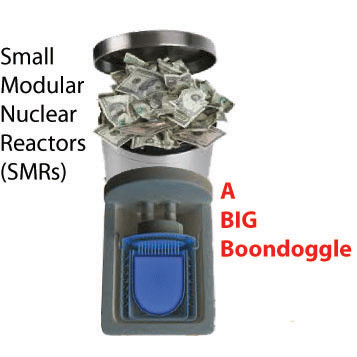 Breakthrough Boondoggle leaders fawn over the Breakthrough Energy Coalition as world saviors promoting so-called ‘climate solutions’, the reality is that these con artists are setting us up for a global heist that we’ll be paying for long into the future.
Astronauts teaching doctors on the hazards of ionising radiation?
 Doctors, astronauts learn radiation dangers from each other Dr. Diethrich developed a brain tumor – one he believes came from years of exposure to radiation KHOU.com 8 Dec 15 HOUSTON — Each year in the Texas Medical Center, hundreds of experts in medicine, energy, aerospace and academia gather to share ideas and collaborate across disciplines, finding ways their industries can learn from each other.
This year at the ninth annual Pumps and Pipesgathering at Houston Methodist, a celebrated surgeon offered his misfortune as a warning to travelers in a seemingly unrelated field: Future astronauts bound for Mars.
Dr. Edward Diethrich is one of the world’s foremost experts on endovascular surgery. He studied under Michael E. DeBakey, M.D. at Houston Methodist Hospital and started the Arizona Heart Institute. But a few years ago he developed a brain tumor – one he believes came from years of exposure to radiation.
“We didn’t know anything about radiation. We were surgeons,” Diethrich said. “I was being radiated from dusk to dawn not even thinking about it. We had to do what we had to do. We wanted to make patients well. Didn’t even think about ourselves.”…..
Diethrich was a pioneer in fluoroscopy – X-ray guided surgical procedures. And, in his presentation Monday, offered his dilemma has a warning and a challenge to NASA scientists designing radiation protection for future Mars-bound astronauts…….
“There is no such thing as good radiation. So that’s really the message that needs to come out of this. Whatever we can do to mitigate it is important,” said Alan B. Lumsden, MD, Medical Director, Methodist DeBakey Heart & Vascular Center. “I think that particularly we as surgeons, and I’m sure probably astronauts probably worse than we are in that respect, often tend to think you’re indestructible.”……http://www.khou.com/story/news/health/2015/12/08/doctors-astronauts-learn-radiation-dangers-from-each-other/76965756/
1 This Month
15 October. Joint Appeal for Nuclear Abolition Day -presentation to the UN on October 15 will be live on UNWebTV
Endorse the Nuclear Abolition Day Appeal
23-25 October – on Zoom – World BEYOND War’s annual global conference

To see nuclear-related stories in greater depth and intensity – go to https://nuclearinformation.wordpress.com
-
Archives
- October 2026 (139)
- September 2026 (339)
- August 2026 (330)
- July 2026 (355)
- June 2026 (287)
- May 2026 (306)
- April 2026 (356)
- March 2026 (251)
- February 2026 (267)
- January 2026 (308)
- December 2025 (358)
- November 2025 (359)
-
Categories
- 1
- 1 NUCLEAR ISSUES
- business and costs
- climate change
- culture and arts
- ENERGY
- environment
- health
- history
- indigenous issues
- Legal
- marketing of nuclear
- media
- opposition to nuclear
- PERSONAL STORIES
- politics
- politics international
- Religion and ethics
- safety
- secrets,lies and civil liberties
- spinbuster
- technology
- Uranium
- wastes
- weapons and war
- Women
- 2 WORLD
- ACTION
- AFRICA
- Atrocities
- AUSTRALIA
- Christina's notes
- Christina's themes
- culture and arts
- Events
- Fuk 2022
- Fuk 2023
- Fukushima 2017
- Fukushima 2018
- fukushima 2019
- Fukushima 2020
- Fukushima 2021
- general
- global warming
- Humour (God we need it)
- Nuclear
- RARE EARTHS
- Reference
- resources – print
- Resources -audiovicual
- Weekly Newsletter
- World
- World Nuclear
- YouTube
-
RSS
Entries RSS
Comments RSS

