Radioactive spill at Cotter’s defunct uranium mill in central Colorado
Uranium mill line leaks 1,800 gallons near Cañon City http://gazette.com/uranium-mill-line-leaks-1800-gallons-near-caon-city/article/1564689 By: Bruce Finley – The Denver Post December 1, 2015 Colorado health officials were reviewing an explanation from Cotter Corp. on Monday after a spill at Cotter’s defunct uranium mill in central Colorado — one of the nation’s slowest superfund cleanups.
A pipeline leaked about 1,800 gallons last week on Cotter’s 2,538-acre property uphill from Canon City and the Arkansas River.
Well tests in July found water in the waste pipeline area contained elevated uranium (577 parts per billion, above a 30 ppb health standard) and molybdenum (1840 ppb, above a 100 ppb standard).
This spill was the latest of at least five since 2010. Federal authorities in 1984 declared an environmental disaster and launched a superfund cleanup. Read more at denverpost.com
Connection between Hosgri fault and another larger crack: hazard for Diablo Nuclear Station
Research: Major fault near reactors links to second crack, WT . By MICHAEL R. BLOOD – Associated Press – Sunday, November 29, 2015 LOS ANGELES (AP) – The Diablo Canyon nuclear power plant and earthquake faults have been uneasy neighbors for decades. Even before the twin reactors produced a single watt of electricity, the plant had to be retrofitted after a submerged fault was discovered 3 miles offshore during construction.
That cleft in the earth, known as the Hosgri fault, has long been considered the greatest seismic threat to a plant that stands within a virtual web of faults. But new questions are being raised by sophisticated seafloor mapping that has found that the Hosgri links to a second, larger crack farther north, the San Gregorio fault.
In general, the longer the fault, the stronger its potential shaking power. Together, the two faults create a strand about 250 miles long, more than double the length of the Hosgri alone……
Earlier this year, the Nuclear Regulatory Commission directed Diablo Canyon to conduct additional, in-depth analysis on earthquake risks by June 2017, part of a broad review of seismic threats following Japan’s Fukushima Dai-ichi disaster. The agency found that among commercial U.S. nuclear plants, the California plant is among those that face the highest hazard when potential strong ground shaking is evaluated against the plant design. http://www.washingtontimes.com/news/2015/nov/29/research-major-fault-near-reactors-links-to-second/
New York City and State Department oppose relicensing of Indian Point nuclear plant
 New York expresses opposition to relicensing Indian Point as NRC hears issues 18 Nov 2015. New York Governor Andrew Cuomo is strongly opposed to the renewal of the operating licenses for the two reactors at the 2,069-MW Indian Point nuclear plant and has asked the US Nuclear Regulatory Commission to deny Entergy’s application to extend its operations.
In a letter dated Monday, Jim Malatras, director of New York state operations, reiterated the state’s opposition to relicensing the units as the Atomic Safety and Licensing Board began hearings to address issues raised during the application process.
The hearings began Monday and will continue through the week.
The plant’s proximity to a major population center, with more than 20 million people within 20 miles of the two-unit plant makes it impossible to have an effective safety and evacuation plan, Malatras said. The reactors generate about 25% of the power for New York City and Westchester County. http://www.platts.com/latest-news/electric-power/birmingham-alabama/new-york-expresses-opposition-to-relicensing-21495027
NY agency objects to relicensing Indian Point nuclear plant November 12, 2015. A New York agency has objected to relicensing the Indian Point nuclear plant on the Hudson River, saying it kills millions of fish larvae and sits near seismic faults with an earthquake threat to millions of people.
The Department of State said the plant is incompatible with the estuary’s ecology and safety of New York City 24 miles downstream. The Nuclear Regulatory Commission is prohibited from relicensing the Indian Point reactors unless the U.S. commerce secretary overrides the objection on appeal, Secretary of State Cesar Perales wrote.http://finance.yahoo.com/news/ny-agency-objects-relicensing-indian-173916667.html
Pacific Gas and Electric Co. faces problems in trying to extend last Californian nuclear station’s license
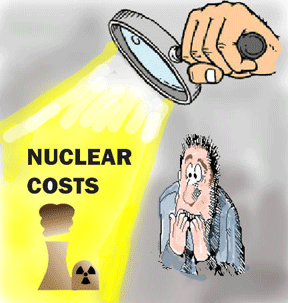 Californians debate future of state’s last nuclear plant , The Oregon, MICHAEL R. BLOOD, Associated Press, 29 Nov 15 LOS ANGELES (AP) — Six years ago, the company that owns California’s last operating nuclear power plant announced it would seek an extended lifespan for its aging reactors. Pacific Gas and Electric Co. envisioned Diablo Canyon as a linchpin in the state’s green energy future, with its low-carbon electricity illuminating homes to nearly midcentury.
Now, with a much changed nuclear power landscape, the company is evaluating whether to meet a tangle of potentially costly state environmental requirements needed to obtain renewed operating licenses.
If it doesn’t move forward, California’s nuclear power age will end.
That prospect is remarkable considering it was once predicted that meeting California’s growing energy needs would require a nuclear power plant every 50 miles along its coast. But vast fields of solar panels, wind turbines that in places are as common as fence posts and developments in power storage speak to changed times.
“We are not talking about either go dark or go nuclear. There are clearly now so many alternatives,” said former California Environmental Secretary Terry Tamminen, a green energy advocate who served under Republican Gov. Arnold Schwarzenegger.
The issues in play at Diablo Canyon range from a long-running debate over the ability of structures to withstand earthquakes — one fault runs 650 yards from the reactors — to the possibility PG&E might be ordered by state regulators to spend billions to modify or replace the plant’s cooling system, which sucks up 2.5 billions of gallons of ocean water a day and has been blamed for killing fish and other marine life……..
Without new operating licenses, the plant can’t run past 2025. Renewing a nuclear power license is a lengthy proposition, and so even with years to go it’s fast becoming a late hour.
The uncertainty around PG&E’s 3-decade-old plant comes at a challenging time for the company and the U.S. nuclear industry, once thought on the verge of a renaissance. Continue reading
We don’t talk about the terrorism danger to nuclear facilities: it’s not polite
 Don’t ask, don’t tell – terrorism and the nuclear threat http://thehill.com/blogs/congress-blog/presidential-campaign/261344-dont-ask-dont-tell-terrorism-and-the-nuclear-threat By Robert Dodge, MD, 27 Nov 15 With recent tragic events in Paris the world is once again reminded that there is no safe haven from the threat of terrorism.
In a nuclear world one can only imagine what the outcome would be if the perpetrators had nuclear materials. In a world with over 15,000 nuclear weapons the potential for such a scenario is very real.
Yet with the threat posed by the existence of nuclear weapons and materials, there has been no questioning of or statements by our presidential contenders on how to address and eliminate this threat to all of humanity. As though there was a conspiracy of silence and a fear that one would somehow appear weak if advocating for the abolition of nuclear weapons.
Failing to address the existential threat posed by the continued existence of nuclear weapons while failing to deal with the causation of terrorism is ultimately a recipe for disaster.
This is particularly true now after the Paris attacks, when like after 9/11, all the world has a sense of being Parisian. As long as the ingredients for terrorism exist, no nation will be immune to the potential risk of terrorist attacks. Now is the time for nations to come together. The international leadership void that calls for a joining of efforts to address the causation allows the continued fermentation of the elements.
As per the question of nuclear weapons and their very real and growing threat to human existence, no one is speaking to the humanitarian consequences of nuclear weapons and nuclear war. Probability theorists place the threat of nuclear war by design or accident conservatively at 1 percent per year with some as high as 2-3 percent. A child born today has an unlikely chance of reaching his or her 30th birthday without a nuclear war in their world.

Studies have now confirmed that a limited regional nuclear exchange using less than ½ of 1 percent of the global nuclear arsenals would have global implications ultimately killing up to 2 billion people on the planet from the resulting climate change and devastating effects on agricultural production in the years to follow. This scenario is a very real possibility with the ongoing tensions between the nuclear armed nations of India and Pakistan.
With growing tensions in Ukraine and Syria and with the U.S. and Russia on opposing sides, either side unleashing only their nuclear weapons on hair trigger WITHOUT RETALIATION would result in massive devastation beyond that of the limited regional scenario, possibly ending human life on this planet.
With such a threat we must demand a response from our future leader to tell us what their administration will do to achieve nuclear disarmament, or under what circumstances would they propose such a suicide mission?
Yet who among the candidates for commander-in-chief, who is sworn to protect and serve the United States, has the courage to speak about this greatest threat to our country and indeed to humanity itself? And who in the media is willing to pose the questions about this grave threat? Until we address this issue we will face the possibility in the words of Albert Einstein of “unparalleled catastrophe” continuing to rely on luck as a defense strategy.
Dodge is a family physician practicing full time in Ventura, California. He serves on the National and Los Angeles boards of Physicians for Social Responsibility (www.psr.org,www.psr-la.org,). He also serves on the board of the Nuclear Age Peace Foundation (www.wagingpeace.org) and Citizens for Peaceful Resolutions (www.c-p-r.net). He writes for PeaceVoice (www.PeaceVoice.info).
Dead nuclear reactors still leave an intractable wastes problem
Security, storage concerns linger at closed nuclear sites US regulators still seek safe site for waste, Boston Globe, By David Abel GLOBE STAFF NOVEMBER 26, 2015 VERNON, Vt. — Across from an elementary school, a short road leads to a gate topped by barbed wire and a stark sign that warns in large letters:
“Security personnel are authorized to use deadly force.”
The Vermont Yankee nuclear plant stopped producing power last year, but rigorous security measures, including heavily armed guards in bulletproof towers, are still in place and will be for decades to protect hundreds of tons of radioactive waste that remain behind the gate. The spent fuel will stay here along a bend of the Connecticut River, just 10 miles from the Massachusetts border, until the federal government can resolve a decades-old political battle over where to store the waste from the nation’s nuclear plants.
Across the United States, there are 22 decommissioned plants that have become heavily guarded repositories of spent fuel, their owners waiting indefinitely for a federal decision on where to permanently store the radioactive waste. About 150 miles away in Plymouth, Mass., the Pilgrim Nuclear Power Station will enter the same phase after it closes sometime in the next four years and moves its waste into massive casks.
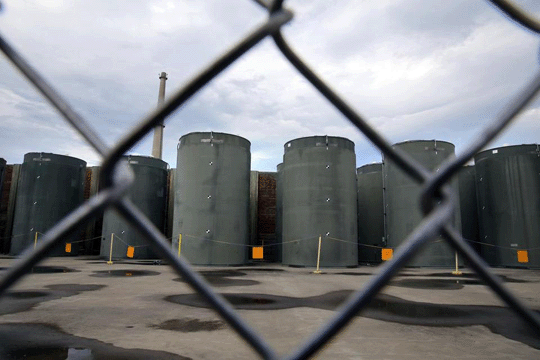
The issue of nuclear waste has long been a political quandary, one that has become increasingly urgent as more of the nation’s aging nuclear plants are shuttered…….
“We don’t think Yucca Mountain will be a viable approach,” said Secretary of Energy Ernest Moniz during a recent meeting with reporters and editors at the Globe.
Moniz said his staff is reviewing a proposal to build a temporary storage site in Andrews County, Texas, which already hosts two radioactive waste disposal facilities. The government will also have to overcome concerns and potential challenges over transporting the fuel through a variety of jurisdictions.
Until then, the waste will remain atop specially built concrete pads at the nation’s nuclear plants. That means the properties cannot be redeveloped for other uses, major security measures will remain in force at sites scattered across the country, and many of their neighbors will continue to live in fear.
“We’re talking about a colossal amount of dangerous waste,” said Deb Katz, executive director of Citizens Awareness Network, who lives 18 miles from Vermont Yankee. “The radioactive plume from an accident could travel more than 100 miles within 24 hours, depending on which way the wind blows.”
Entergy Corp., a Louisiana-based conglomerate that owns the plants in Vernon and Plymouth, plans a decommissioning process at Pilgrim similar to the one it has started at Vermont Yankee.
On its compact campus in Vernon, Vermont Yankee’s remaining 285 employees — about 600 people worked at the plant until last December — have transferred all of the remaining fuel to a 37-foot-deep pool suspended seven stories above ground in a concrete containment building. There are 2,996 spent fuel assemblies cooling in the pool.
After they’re moved into safer, dry storage, the plant will have 58 of the 18-foot-tall, 300,000-pound casks on the outdoor pad along the Connecticut River.
Activists who live near Vermont Yankee have urged the plant to move the spent fuel more quickly from the pools, which they fear could catch fire if an earthquake or other natural disaster caused a leak or cut power to the plant. They have also raised concerns about storing the casks closely together out in the open, rather than below ground or in a hardened building.
“Should someone be interested in shooting them up, they’re sitting ducks,” said Nancy Braus of the Safe and Green Campaign in Brattleboro. “They’re easy targets, very visible.”………. David Abel can be reached at dabel@globe.com. Follow him on Twitter @davabel. https://www.bostonglobe.com/metro/2015/11/26/the-long-road-decommissioning-nuclear-power-plant/k5VWUQzLKCIz2VuYs8RhoO/story.html
Nuclear weapons on hair-trigger alert: time to take steps towards safety


 Could U.S.-Russia Tensions Go Nuclear? Politico Believe it or not, hair-trigger launch alerts are still with us—and perhaps even more dangerous than during the Cold War. By Bruce Blair November 27, 2015 The Russian warplane recently shot down inside Turkey’s border with Syria fits a pattern of brinkmanship and inadvertence that is raising tensions and distrust between Russia and U.S.-led NATO. Low-level military encounters between Moscow and Washington are fanning escalatory sparks not witnessed since the Cold War. And there exists a small but steadily growing risk that this escalation could morph by design or inadvertence into a nuclear threat.
The backdrop for these concerns is that both the United States and Russia maintain their nuclear command posts and many hundreds of strategic nuclear warheads on hair-trigger alert. This is a long-standing practice, or habit, driven by the inertia of the Cold War. The two sides adopted the accident-prone tactic known as launch-on-warning in order to ensure that their strategic forces could be fired before incoming warheads arrived. President Barack Obama’s recent nuclear employment guidance reiterated the need to preserve this option. Our nuclear command system and forces practice it several times a week. So do the Russians.
And believe it or not, Russia has shortened the launch time from what it was during the Cold War. Today, top military command posts in the Moscow area can bypass the entire human chain of command and directly fire by remote control rockets in silos and on trucks as far away as Siberia in only 20 seconds.
Why should this concern us? History shows that crisis interactions, once triggered, take on a life of their own. Military encounters multiply; they become more decentralized, spontaneous and intense. Safeguards are loosened and unfamiliar operational environments cause accidents and unauthorized actions. Miscalculations, misinterpretations and loss of control create a fog of crisis out of which a fog of war may emerge. In short, the slope between the low-level military encounters, the outbreak of crisis and escalation to a nuclear dimension is a steep and slippery one.
Somewhere along this slope, a psychological construct known as “deterrence” is supposed to kick in to prevent the use of nuclear weapons. But deterrence can become an extreme sport during a confrontation, a game of taking and manipulating existential risk, morphing into games of chicken, bluff, coercion and blackmail. The basic idea is to instill fear in an adversary’s mind that events could spin out of control and result in a nuclear war.
That’s especially true since the public doesn’t realize just how little time exists for our leaders to make a decision to use nuclear weapons, even today—and if anything the atmosphere has become even more hair trigger with the threat of cyberwarfare. A launch order is the length of a tweet. Missile crews in turn transmit a short stream of computer signals that immediately ignite the rocket engines of many hundreds of land-based missiles. For the United States, this takes 1 minute. As a former nuclear-missile launch officer, I personally practiced it hundreds of times. We were called Minutemen. U.S. submarine crews take a little longer; they can fire their missiles in 12 minutes.
The last time the U.S. brandished nukes wholesale for the purpose of deterrence was in 1973………
Do U.S. leaders understand that the Russians may fear a decapitation threat is emerging, and that this threat may be the underlying driver raising the stakes for Russia to the level of an existential threat warranting preparations for the use of nuclear weapons? I doubt they do.
At some point one side or the other may blink and back off, or maybe not.
Tensions could continue to rise until the crisis escalates by intention or inadvertence to the threshold of nuclear use. In the case of Russia, this threshold is low. Russia’s strategy in Europe was devised by President Vladimir Putin himself in the year 2000 in response to NATO’s bombing of the Balkans. The strategy is called “de-escalatory escalation,’ which unleashes tens to hundreds of nuclear weapons in a first strike meant to shock an adversary into paralysis. And so it might, or it might just escalate into a nuclear exchange………
It is aggravated by a murky new threat—cyberwarfare. Given our poor comprehension of this cyberthreat, it seems imprudent in the extreme to keep U.S. and Russian command systems poised to launch on warning, and nuclear missiles poised to fly as soon as they receive a short stream of computer signals, whose origin may not be authorized.
Given all this risk-taking, which extends with even greater force to other nuclear weapons countries, and given that deterrence itself is nothing more or less than the manipulation of nuclear risk, we cannot reasonably expect nuclear weapons never to be used..
The obvious solution is to eliminate nuclear weapons entirely, but of course that will not happen overnight. Meanwhile, the following seven measures would help move the dial further away from nuclear midnight. They draw upon the recent report of the Global Zero Commission on Nuclear Risk Reduction……..
One. The United States and Russia could agree to eliminate launch-on-warning from their strategy………
Two. They could agree to begin taking their strategic missile forces off of hair trigger,……
Three. All the nuclear weapons countries could agree to refrain from putting any nuclear forces on high alert except under tightly controlled conditions…..
Four. The U.S. and Russia could work with other nuclear establishments to share knowledge, best practices and technologies in the area of safety and security..
Five. The U.S. and Russia, perhaps with China, could lead an effort to ban cyberwarfare…..
Six. Confidence-building measures agreed to through military-to-military dialogue ……
http://www.politico.com/magazine/story/2015/11/russia-us-tensions-nuclear-cold-war-213395#ixzz3sirbYxpC
Sudden mass kill of fish in Mississippi River due to shutdown of Monticello nuclear power plant
Sudden shutdown of Monticello nuclear power plant causes fish kill, By David Shaffer Star Tribune NOVEMBER 25, 2015 The sudden drop in temperature in the discharged cooling water resulted in a fish kill in the Mississippi River.
In a report to the U.S. Nuclear Regulatory Commission, Xcel Energy said it shut down the plant while operating at 100 percent power after a problem arose with a reactor pump. The utility said shutdown happened safely, with no release of radiation and no risk to the public.
But the sudden drop in temperature in the discharged cooling water resulted in a fish kill. Xcel said it counted 59 dead fish. The fish were crappies, sunfish, bass, catfish and carp, according to the state Department of Natural Resources, which was notified of the incident.
During unexpected shutdowns, the water temperature near the plant can drop from about 65 degrees to 40 degrees in a few hours, said Harland Hiemstra, a DNR information officer. The fish can’t cope with the sudden change in temperature, he said. “It is thermal shock,” he added…….http://www.startribune.com/sudden-shutdown-of-monticello-nuclear-power-plant-causes-fish-kill/354007091/
USA’s nuclear operators want to extend reactor lives to 80 years!

If the nuclear reactor is 75 years old and faulty – will the company still be around to pay the costs?
“Just like a car and plane, power reactors get old year by year,” Yoshiaki Himeno, a professor at the Tokyo Institute of Technology, said by e-mail. While owners refurbish parts and renew the systems, “the question is how long they can continue those repairs and renewals from economical and safety points of view.
America Set to Decide Whether a Nuke Can Outlive a Human, Bloomberg, Jonathan Crawford , 26 Nov 15
-
Dominion Resources first to request extension to 80 years
-
Move to push reactor life beyond 78.8-year human average
The majority of the nation’s 99 reactors have already received 20-year extensions to their original 40-year operating licenses. Now, operators led by Dominion Resources Inc. want to expand the time frame further, potentially creating a precedent for an aging global fleet at a time when the economics of the industry are undergoing dramatic change.
Dominion said earlier this month it will request an extension from the U.S. Nuclear Regulatory Commission, which oversees the industry. The plan has already raised the ire of anti-nuclear campaigners who cite decades of wear and tear on the nation’s reactors, as well as the 2011 Fukushima disaster in Japan. The NRC will release a draft report next month outlining safety measures needed to extend the time line.
Nuclear waste dump a danger to water, threat to Nevada’s farming community
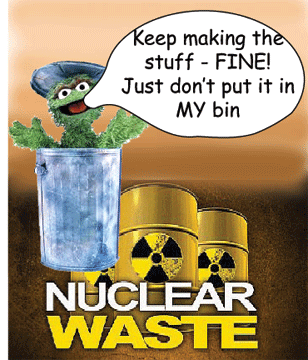 Nevada says national nuclear dump could harm farm community,Naples
Herald, By Associated PressNov 23, 2015 BY KEN RITTER LAS VEGAS (AP) —  Radioactive well-water contamination could threaten some 1,400 people in a rural farming community if federal regulators allow the nation’s deadliest nuclear waste to be buried in the Nevada desert, state officials said in a report issued Friday.
A 53-page document submitted to the U.S. Nuclear Regulatory Commission derides environmental assessments of the proposed Yucca Mountain repository as legally inadequate. It also characterizes the project itself as “an unworkable waste management plan at an unsafe repository site.”
“In the end, there are real people there,” said Robert Halstead, chief of the Nevada Agency for Nuclear Projects and the top state official leading opposition to the project.
“That’s the thing about the way the NRC has approached the whole process,” Halstead said Friday. “Their maps imply there is no population there. They label it as the Amargosa desert.”
George Gholson, chairman of the Timbisha Shoshone Tribe, submitted additional comments Friday accusing commission officials of failing to evaluate effects that building the project would have on tribal members.
“Radioactive contamination of groundwater and springs … affronts the Timbisha’s way of life, is disrespectful to cultural beliefs, and constitutes an environmental justice infringement on the rights of a sovereign nation,” the letter said.
The documents amount to the state staking its legal ground to oppose the Yucca Mountain project. They came on the last day of an environmental study comment period ahead of yet-to-be-scheduled licensing hearings and amid calls from some in Congress to restart the long-mothballed project.
Commission officials didn’t immediately respond to messages seeking comment.
More than three decades of study yielded findings that water seeping through tunnels containing some 77,000 tons of spent nuclear reactor waste could become contaminated and slowly migrate into groundwater west along the normally dry course of the ancient Amargosa River, toward Death Valley in California……..
A federal appeals court breathed new life into the project in 2013 with an order that the Nuclear Regulatory Commission either approve or reject the Energy Department license application.
Officials say a full slate of licensing hearings could take at least three years. http://naplesherald.com/2015/11/23/nevada-says-national-nuclear-dump-could-harm-farm-community/
USA anxious about nuclear proliferation, but keen to market nuclear technology to South Korea
 US, South Korea ratify deal on nuclear energy http://www.dw.com/en/us-south-
 korea-ratify-deal-on-nuclear-energy/a-18875053 A pact between Seoul and Washington on nuclear energy has officially entered into effect. The deal, almost five years in the making, stops short of allowing South Korea to reprocess nuclear fuel from the US. The 20-year accord came into force on Wednesday, with South Korea’s foreign minister and the US ambassador exchanging documents in Seoul.
South Korea is among top five consumers of nuclear energy in the world, and home to 23 nuclear power plants.
However, all of the nuclear fuel in the country is provided by the US.
Seoul has repeatedly urged Washington to allow South Korea to develop uranium enrichment and reprocessing capabilities, citing energy concerns and environmental issues. The US is opposing the move, fearing that such technology could also be used for weapons-grade nuclear material.
The US government is concerned about sparking the nuclear rivalry between Seoul and North Korea,the country that already conducted three successful nuclear tests.
The latest accord denies South Korea the right to reprocess and enrich the US-origin fuel.
However, Seoul and Washington agreed to establish a high-level committee to discuss the issue, which South Korean officials described as a step towards securing a possible consent from Washington in the future.
South Korea is also seeking to become a key exporter of atomic power plants.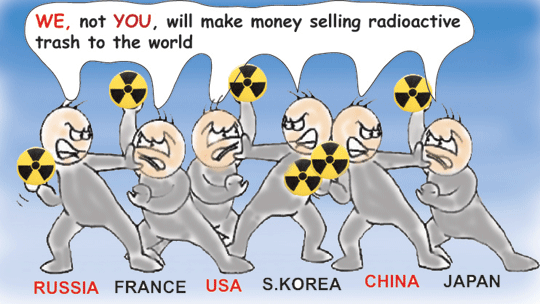
The US ally could also research technologies such as “pyroprocessing” which are generally considered safe from the proliferation standpoint.
Call on President Obama to protect precious groundwater from uranium mining in Grand Canyon
Huffington Post, 24 Nov 15, [Good maps] “…….The mining industry’s statement counts on readers to be ignorant
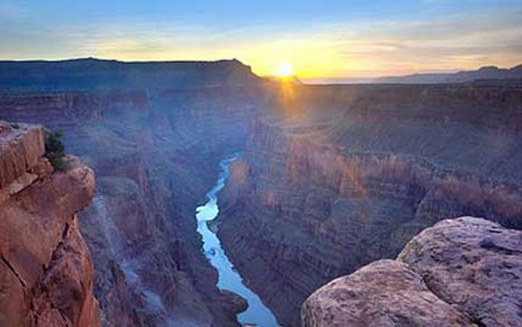 of the fact that federal and state agencies do not require wells to measure water pollution more than a thousand feet underground, where uranium mining threatens aquifers that feed springs deep within the Grand Canyon. No monitoring means contamination is undetected: out of sight, out of mind.
But that’s changing as the U.S. Geological Survey pieces together samples taken from existing wells and places where groundwater flows downward into the Grand Canyon. These show that mining has already polluted 15 springs and five wells within the Grand Canyon’s watershed with toxic levels of uranium.
As I’ve said with regards to oil and gas development, one well contaminated or one person made sick is one too many. The same is true for uranium mining, making the situation around the Grand Canyon a disaster where we can least afford one.
In 2012, this sorry history led my friend and fellow Coloradan, Interior Secretary Ken Salazar, to impose a 20-year ban on new uranium mining in the watersheds that drain directly into the Grand Canyon. His action came in response to thousands of new mining claims filed in the preceding decade. Science and prudence also guided his decision, coupled with the knowledge that nearly $1 billion in annual economic activity is generated by this greatest of earth’s geological treasures.
Need for Permanent Ban on Grand Canyon Uranium Mining
The bill aims to protect 1.7 million acres of historical tribal homeland, including water sources and sacred sites.
Unfortunately, there’s almost no chance that the legislation will gain approval in today’s gridlocked Congress. But the 1906 Antiquities Act gives the president unilateral authority to set aside federal lands as protected national monuments to stop the looting of archaeological sites and for reasons of “historic or scientific interest.”
I’ve long believed we will be judged by the nation we leave to future generations. After all, we don’t inherit the earth from our parents — we borrow it from our children. The president should act now to protect the Grand Canyon from irresponsible development around this national treasure.
The National Mining Association may not be willing to stop digging — literally or figuratively — but the president owes it to us all to help them.
California Governor appeased utilities while SanOnofre nuclear station was under scrutiny?
Email Suggests Governor Appeased Utilities During Calls For San Onofre Investigation, KPBS, AMITA SHARMA, Investigative Reporter | Contact, November 24, 2015
San Onofre’s new steam generators were supposed to last 40 years.
But less than one year after they were installed, hundreds of tubes had shown wear, causing a radioactive leak in January 2012. The leak forced the plant’s closure and stuck San Diego and other Southern California ratepayers with a multibillion dollar bill.
By May 2013, U.S. Sen. Barbara Boxer had in her possession two key documents. They showed that Edison officials knew there was potential for premature tube wear before those steam generators were installed but didn’t allow for fixes. One reason, according to internal documents was that the company wanted to avoid a rigorous government review.
Boxer was incensed.
The California Democrat called on the U.S. Justice Department to open a criminal investigation into whether Edison had lied to federal regulators about what it knew before the faulty equipment was turned on.
“At that point, it was clear that things had gone very seriously awry,” said John Geesman, an attorney for the Alliance for Nuclear Responsibility……….
Meanwhile, a series of bills intended to reform the PUC passed the Legislature this year. One would have compelled the commission to release the sought-after communications between regulators and Brown’s office on San Onofre.
The governor vetoed the reforms, calling them important but technical and conflicting. http://www.kpbs.org/news/2015/nov/24/email-suggests-governor-sided-utilities-over-san-o/
Tennessee unhappy about new radioactive trash plans for Oakridge.
Tennessee raises concerns about proposed Oak Ridge nuclear landfill http://www.timesfreepress.com/news/local/story/2015/nov/22/tennessee-raises-concerns-about-proposed-oak-ridge-nuclear-landfill/337007/ November 22nd, 2015by Associated Press OAK RIDGE, Tenn. — Tennessee officials are raising concerns about the U.S. Department of Energy’s plans for a new nuclear landfill at Oak Ridge.

The Tennessee Department of Environment and Conservation is pushing DOE to consider other Oak Ridge sites beyond the agency’s preferred one, the Knoxville News Sentinel reported.
The federal agency’s preferred site is adjacent to an existing landfill on the government reservation and only 650 yards from the city boundary.
“We are continuing to work with the DOE and EPA on this issue and taking the matter very seriously,” Kelly Brockman, communications chief for TDEC, said in an email response to questions.
The Department of Energy’s current landfill for cleanup wastes is approaching capacity. That’s largely due to the mountains of hazardous and radioactive debris generated by the demolition of K-25 and other former uranium-processing facilities in Oak Ridge. Continue reading
“The Third Way” – front group for new nuclear spinning hard for Paris climate Conference
 Washington think tank, has taken upon itself the unenviable task of trying to convince liberal Democrats that nuclear energy is an important part of the battle against global warming…….
1 This Month
15 October. Joint Appeal for Nuclear Abolition Day -presentation to the UN on October 15 will be live on UNWebTV
Endorse the Nuclear Abolition Day Appeal
23-25 October – on Zoom – World BEYOND War’s annual global conference

To see nuclear-related stories in greater depth and intensity – go to https://nuclearinformation.wordpress.com
-
Archives
- October 2026 (139)
- September 2026 (339)
- August 2026 (330)
- July 2026 (355)
- June 2026 (287)
- May 2026 (306)
- April 2026 (356)
- March 2026 (251)
- February 2026 (267)
- January 2026 (308)
- December 2025 (358)
- November 2025 (359)
-
Categories
- 1
- 1 NUCLEAR ISSUES
- business and costs
- climate change
- culture and arts
- ENERGY
- environment
- health
- history
- indigenous issues
- Legal
- marketing of nuclear
- media
- opposition to nuclear
- PERSONAL STORIES
- politics
- politics international
- Religion and ethics
- safety
- secrets,lies and civil liberties
- spinbuster
- technology
- Uranium
- wastes
- weapons and war
- Women
- 2 WORLD
- ACTION
- AFRICA
- Atrocities
- AUSTRALIA
- Christina's notes
- Christina's themes
- culture and arts
- Events
- Fuk 2022
- Fuk 2023
- Fukushima 2017
- Fukushima 2018
- fukushima 2019
- Fukushima 2020
- Fukushima 2021
- general
- global warming
- Humour (God we need it)
- Nuclear
- RARE EARTHS
- Reference
- resources – print
- Resources -audiovicual
- Weekly Newsletter
- World
- World Nuclear
- YouTube
-
RSS
Entries RSS
Comments RSS

