Tim Fernholz When the US entered the nuclear age, it did so recklessly. New research suggests that the hidden cost of developing nuclear weapons were far larger than previous estimates, with radioactive fallout responsible for 340,000 to 690,000 American deaths from 1951 to 1973.
From 1951 to 1963, the US tested nuclear weapons above ground in Nevada. Weapons researchers, not understanding the risks—or simply ignoring them—exposed thousands of workers to radioactive fallout. The emissions from nuclear reactions are deadly to humans in high doses, and can cause cancer even in low doses. At one point, researchers had volunteers stand underneath an airburst nuclear weapon to prove how safe it was:
The emissions, however, did not just stay at the test site, and drifted in the atmosphere. Cancer rates spiked in nearby communities, and the US government could no longer pretend that fallout was anything but a silent killer.
The cost in dollars and lives
Congress eventually paid more than $2 billion to residents of nearby areas that were particularly exposed to radiation, as well as uranium miners. But attempts to measure the full extent of the test fallout were very uncertain, since they relied on extrapolating effects from the hardest-hit communities to the national level. One national estimate found the testing caused 49,000 cancer deaths.
Those measurements, however, did not capture the full range of effects over time and geography. Meyers created a broader picture by way of a macabre insight: When cows consumed radioactive fallout spread by atmospheric winds, their milk became a key channel to transmit radiation sickness to humans. Most milk production during this time was local, with cows eating at pasture and their milk being delivered to nearby communities, giving Meyers a way to trace radioactivity across the country.
The National Cancer Institute has records of the amount of Iodine 131—a dangerous isotope released in the Nevada tests—in milk, as well as broader data about radiation exposure. By comparing this data with county-level mortality records, Meyers came across a significant finding: “Exposure to fallout through milk leads to immediate and sustained increases in the crude death rate.” What’s more, these results were sustained over time. US nuclear testing likely killed seven to 14 times more people than we had thought, mostly in the midwest and northeast.
A weapon against its own people
When the US used nuclear weapons during World War II, bombing the Japanese cities of Hiroshima and Nagasaki, conservative estimates suggest 250,000 people died in immediate aftermath. Even those horrified by the bombing didn’t realize that the US would deploy similar weapons against its own people, accidentally, and on a comparable scale.
And the cessation of nuclear testing helped save US lives—”the Partial Nuclear Test Ban Treaty might have saved between 11.7 and 24.0 million American lives,” Meyers estimates. There was also some blind luck involved in reducing the number of poisoned people: The Nevada Test Site, compared to other potential testing facilities the US government considered at the time, produced the lowest atmospheric dispersal.
The lingering affects of these tests remain, as silent and as troublesome as the isotopes themselves. Millions of Americans who were exposed to fallout likely suffer illnesses related to these tests even today, as they retire and rely on the US government to fund their health care.
“This paper reveals that there are more casualties of the Cold War than previously thought, but the extent to which society still bears the costs of the Cold War remains an open question,” Meyers concludes.
Troubled $25 Billion Nuclear Project Gets OK to Continue US News, By JONATHAN LANDRUM Jr., Associated Press ATLANTA (AP) 21 Dec 17— Georgia‘s utility regulators are allowing construction to continue on two new nuclear reactors, despite massive cost overruns for the multibillion-dollar project.
Thursday’s unanimous decision by the state’s Public Service Commission will shape the future of the nation’s nuclear industry, partly because the reactors at Plant Vogtle were the first new ones to be licensed and to begin construction in the U.S. since 1978.
The project, co-owned by Georgia Power, Oglethorpe Power, MEAG Power and Dalton Utilities, has been plagued by delays and spiraling costs, compounded when the main contractor filed for bankruptcy. Westinghouse Electric Co., the U.S. nuclear unit of Japan’s Toshiba Corp., filed for bankruptcy in March.
Georgia Gov. Nathan Deal praised the PSC’s decision……
The Sierra Club, meanwhile, slammed the vote, calling the project a disaster. Ted Terry, director of the group’s Georgia chapter, said the project should have been halted……
Officials say the PSC vote means Georgia consumers will pay more for power, starting in 2021……
David Schlissel, a utility consultant and analyst who has previously testified against Vogtle, criticized Thursday’s vote, saying regulators were letting Georgia Power and its parent, the Southern Company, off the hook.
“The commission’s own monitors have identified that Southern mismanaged the project,” he said. “Now the commission is giving them unanimous approval to spend even more money.”
He added, “In Georgia, you apparently have commissioners who are fine having ratepayers shovel money into a bottomless pit.”…….
By May 2015, regulators said there was a “high probability” that construction would be delayed even longer than the three years already announced by the owners, according to an analysis obtained by The Associated Press. Estimates from regulators at that time put the utility company’s costs at $8.2 billion.
The rising construction costs hit an industry already under financial pressure, after 2011 a tsunami in Japan triggered meltdowns at the Fukushima Dai-ichi nuclear plant. Meanwhile, the price of natural gas dropped, lessening the incentive to build new nuclear power.
In South Carolina, Santee Cooper and South Carolina Electric & Gas Co. abandoned the construction of a similar nuclear project in July, blaming the decision primarily on the bankruptcy of lead contractor Westinghouse.
Under state law, Georgia Power’s customers will ultimately reimburse the state-regulated monopoly for the flagship plant as they pay their monthly electricity bills. That law allows Georgia Power to charge its customers now for the interest it pays on the borrowed money needed for the project. Under an older law, the utility had to wait until the plant was operating to collect those interest charges from its customers, a practice that meant the interest owed grew during the construction period.
Cost overruns were also an issue with the original reactors at Vogtle. The cost of building the existing reactors at the site jumped from $660 million to nearly $9 billion by the time they started producing power in the late 1980s.
Kempner: Georgia underdogs confront power, get smacked By Matt Kempner – The Atlanta Journal-Constitution, 21 Dec 17, “……..the Georgia Public Service Commission was holding days of hearings recently, but there was no question where it ultimately would end up: keeping the troubled nuclear expansion of Plant Vogtle alive and giving the monopoly Georgia Power approval to squeeze captive customers for billions of dollars more in cost overruns and extra company profits.
It approved all of Georgia Power’s newly projected spending on the unfinished project, decided in advance that it is all reasonable (though not yet prudent) and set the stage for the company to pocket billions in additional profits because of the delays. ……..
Georgia Power and its contractors busted budgets in every conceivable way. Yet, the company has cautioned that its latest cost projections could still be off. And the PSC’s own staff highlighted Georgia Power’s “mismanagement” of the project and said the expansion is “uneconomic” for ratepayers under cost and risk parameters the company proposed this year……….
In a recent hearing, Prenovitz [opposing the nuclear development] asked company witnesses about Vogtle-related costs that they said they weren’t sure of. Then he started punching numbers into a calculator to help the witnesses along with other figures.
Wise, the PSC’s chairman, wasn’t happy.
“I don’t know if it is your style or your personality or your obstinance or some other adjective or just basically your lack of understanding or that you just don’t even care about the process ….”
Prenovitz told me he doesn’t know if he’ll continue to ask tough questions about Vogtle. Preparing filings can take days. Hearings last for hours. “It’s grueling.”
And so, the billions of tons of silt that has accumulated in Lake Mead and Lake Powell serve as archives of sorts. They hold the sedimental records of an era during which people, health, land, and water were all sacrificed in order to obtain the raw material for weapons that are capable of destroying all of humanity.
Jonathan ThompsonPERSPECTIVE Dec. 18, 2017 This article was originally published on The River of Lost SoulsBeneath the murky green waters on the north end of Lake Powell, entombed within the tons of silt that have been carried down the Colorado River over the years, lies a 26,000-ton pile of unremediated uranium-mill tailings. It’s just one radium-tainted reminder of the way the uranium industry, enabled by the federal government, ravaged the West and its people for decades.
In 1949, the Vanadium Corporation of America built a small mill at the confluence of White Canyon and the Colorado River to process uranium ore from the nearby Happy Jack Mine, located upstream in the White Canyon drainage (and just within the Obama-drawn Bears Ears National Monument boundaries). For the next four years, the mill went through about 20 tons of ore per day, crushing and grinding it up, then treating it with sulfuric acid, tributyl phosphate and other nastiness. One ton of ore yielded about five or six pounds of uranium, meaning that each day some 39,900 pounds of tailings were piled up outside the mill on the banks of the river.
In 1953 the mill was closed, and the tailings were left where they sat, uncovered, as was the practice of the day. Ten years later, water began backing up behind the newly built Glen Canyon Dam; federal officials decided to let the reservoir’s waters inundate the tailings. There they remain today.
If you’re one of the millions of people downstream from Lake Powell who rely on Colorado River water and this worries you, consider this: Those 26,000 tons of tailings likely make up just a fraction of the radioactive material contained in the silt of Lake Powell and Lake Mead.
During the uranium days of the West, more than a dozen mills — all with processing capacities at least ten times larger than the one at White Canyon — sat on the banks of the Colorado River and its tributaries. Mill locations included Shiprock, New Mexico, and Mexican Hat, Utah, on the San Juan River; Rifle and Grand Junction, Colorado, and Moab on the Colorado; and in Uravan, Colorado, along the San Miguel River, just above its confluence with the Dolores. They did not exactly dispose of their tailings in a responsible way.
At the Durango mill the tailings were piled into a hill-sized mound just a stone’s throw from the Animas River. They weren’t covered or otherwise contained, so when it rained tailings simply washed into the river. Worse, the mill’s liquid waste stream poured directly into the river at a rate of some 340 gallons per minute, or half-a-million gallons per day. It was laced not only with highly toxic chemicals used to leach uranium from the ore and iron-aluminum sludge (a milling byproduct), but also radium-tainted ore solids.
Radium is a highly radioactive “bone-seeker.” That means that when it’s ingested it makes its way to the skeleton, where it decays into other radioactive daughter elements, including radon, and bombards the surrounding tissue with alpha, beta, and gamma radiation. According to the Toxic Substances and Diseases Registry, exposure leads to “anemia, cataracts, fractured teeth, cancer (especially bone cancer), and death.”
It wasn’t any better at any of the other mills. In the early 1950s, researchers from the U.S. Public Health Service sampled Western rivers and found that “the dissolved radium content of river water below uranium mills was increased considerably by waste discharges from the milling operations” and that “radium content of river muds below the uranium mills was 1,000 to 2,000 times natural background concentrations.”
That was just from daily operations. In 1960, one of the evaporation ponds at the Shiprock mill broke, sending at least 250,000 gallons of highly acidic raffinate, containing high levels of radium and thorium, into the river. None of the relevant officials were notified and individual users continued to drink the water, put it on their crops, and give it to their sheep and cattle. It wasn’t until five days later, after hundreds of dead fish had washed up on the river’s shores for sixty miles downstream, that the public was alerted to the disaster.
Of course, what’s dumped into the river at Shiprock doesn’t stay in Shiprock. It slowly makes its way downstream. In the early 1960s, while Glen Canyon Dam was still being constructed, the Public Health Service folks did extensive sediment sampling in the Colorado River Basin, with a special focus on Lake Mead’s growing bed of silt, which had been piling up at a rate of 175 million tons per year since Hoover Dam started impounding water in 1935. The Lake Mead samples had higher-than-background levels of radium-226. The report concludes:
“The data have shown, among other things, that Lake Mead has been essentially the final resting place for the radium contaminated sediments of the Basin. With the closure of Glen Canyon Dam upstream, Lake Powell will then become the final resting place for future radium contaminated sediments. The data also show that a small fraction of the contaminated sediment has passed through Lake Mead to be trapped by Lakes Mohave and Havasu.”
And so, the billions of tons of silt that has accumulated in Lake Mead and Lake Powell serve as archives of sorts. They hold the sedimental records of an era during which people, health, land, and water were all sacrificed in order to obtain the raw material for weapons that are capable of destroying all of humanity.
Saudi-US talks on civilian nuclear program to begin within ‘weeks’ Riyadh’s energy minister insists kingdom seeks energy for peaceful purposes, but will not agree to American limitations on uranium enrichment
By TOI STAFF , 21 Dec 17, Saudi Arabia’s energy minister said the US and Riyadh will begin talks within weeks on cooperation over the kingdom’s emergent civilian nuclear program. Falih noted that Saudi Arabia has already “signed agreements with China, Russia, with France, so their technologies will be competing for the Saudi national nuclear project.”
US law forbids cooperation with nations that have not signed a so-called Section 123 Agreement, which limits nuclear work to peaceful uses only. Though Riyadh has said it does not seek a military program, it has said it seeks “self-sufficiency in producing nuclear fuel” and has in the past refused to sign an agreement that would limit its ability to enrich uranium…….https://www.timesofisrael.com/saudi-us-talks-on-civilian-nuclear-program-to-begin-within-weeks/
Ratepayers win victory in fight to recover money from failed SCE&G nuclear project BY SAMMY FRETWELL sfretwell@thestate.comDECEMBER 20, 2017 SCE&G customers who have paid nearly $2 billion for a failed nuclear construction project scored a victory Wednesday that could lead to a cut in power bills of up to 18 percent.
The S.C. Public Service Commission denied SCE&G’s request to throw out a legal case that seeks to eliminate charges customers now pay for the shuttered project. The commission also agreed not to dismiss a case that seeks potentially billions of dollars in customer refunds from SCE&G.
Wednesday’s decision was a rare win for ratepayers and a blow to SCE&G, which faces withering criticism for failing to complete the V.C. Summer nuclear project with its state-owned partner Santee Cooper.In deciding to keep the rate cases alive, the PSC now plans to hold a hearing next year to determine whether cutting the charges and making refunds are wise ideas. The hearing is among several ways ratepayers could be reimbursed. The Legislature also is considering bills to help reduce charges by SCE&G for the nuclear project…..
Whether the commission will eventually order rate cuts or refunds won’t be known until next year, but SCE&G’s critics were elated Wednesday that the PSC supported customers over the Cayce-headquartered power company.
They said the PSC has sided with SCE&G consistently in the past on the company’s plan to bill ratepayers for the V.C. Summer project. Customers have been hit with nine rate hikes to pay for the nuclear expansion effort under a 2007 law that made financing the project easier…….
Two legislative committees on Wednesday unanimously approved a controversial bill that could raise New Jerseyans’ utility bills $41 a year to subsidize the state’s largest energy company.
Public Service Electric & Gas officials say the $320 million subsidy would stave off the premature closure of nuclear plants in Salem County, which will be in the red within two years……..
Stefanie Brand, director of the state’s Division of Rate Counsel that represents utility consumers, said Wednesday that the utility company has not demonstrated are hurting financially “other than bald assertions and ultimatums issued by the company.”
“The Legislature has a duty to to its constituents to test those assertions and not simply succumb to the company’s threats,” she said, adding that the review of its financials described in the legislation falls short of what is required for a thorough analysis.
Congress moves to aid Georgia’s troubled nuclear project, Politically Georgia, By Tamar Hallerman, WASHINGTON — Senators on Wednesday began laying the groundwork to aid the country’s only remaining new nuclear project under construction, the Augusta-area Plant Vogtle, less than a day before Georgia utility regulators are scheduled to rule on its fate.
The leaders of the tax-writing Finance Committee unveiled legislation that would guarantee the project roughly $800 million in federal tax credits, money Vogtle’s operators have long been counting on for their balance sheets.
The language, which Georgia’s congressional delegation has been lobbying hard for this year, would end the 2021 sunset date for the previously-promised nuclear production tax credits. Vogtle’s operators would receive the credits only after the new units go fully into operation.
The extension was needed since the project is not scheduled to be complete until 2022.
It is still unclear when both chambers of Congress will consider the legislation. Nuclear industry lobbyists have been pushing for lawmakers to consider the language as part of a must-pass government spending agreement later this week, but time on Capitol Hill is in short supply before the holiday break. U.S. Sen. Johnny Isakson suggested Tuesday that Congress could wait until January and then make the credits retroactive…..http://politics.blog.myajc.com/2017/12/20/congress-moves-to-aid-georgias-troubled-nuclear-project/
US preparing ‘bloody nose’ attack on North Korea, New York Post, By Yaron Steinbuch, December 21, 2017 The US is preparing plans to deliver a “bloody nose” attack against North Korea to knock out its nuclear weapons program.
The White House has “dramatically” ramped up its military plans amid fears that diplomacy won’t thwart North Korean despot Kim Jong Un from making good on his threats, sources told the UK’s Telegraph.
One option is destroying a launch site before the rogue regime uses it for a new missile test, while another is targeting weapons stockpiles, according to the news outlet.
The Trump administration hopes that pre-emptive action would show the trigger-happy dictator that the United States is serious about stopping his bellicose pursuits and persuading him to negotiate.
The Telegraph cited three anonymous sources, one inside the administration and two former officials familiar with the White House thinking.
North Korea nuclear weapons up for grabs if regime falls,THE United States has revealed what would happen if it entered North Korea and what its first objective would be after entering. Debra Killalea and AFP news.com.auDECEMBER 19, 2017 WASHINGTON has told China how it plans to secure North Korea’s nuclear arsenal in the event of a Kim regime collapse.
The plan, which aims to avoid a clash between the rival powers, was revealed by US Secretary of State Rex Tillerson last week and would see America enter North Korea searching for weapons.
During a talk to the Atlantic Council last week, Mr Tillerson said the Trump administration has provided assurances to Beijing that if US troops landed in North Korea they would do their job, but would not stay.
The comment aimed to reassure China that the United States would not occupy North Korea if the Kim regime fell.
Beijing views North Korea as a buffer state preventing the 28,500 US troops in South Korea from camping on its doorstep.
Mr Tillerson said the US and China “have had conversations about in the event that something happened — it could happen internal to North Korea; it might be nothing that we from the outside initiate — that if that unleashed some kind of instability, the most important thing to us would be securing those nuclear weapons they’ve already developed and ensuring that they — that nothing falls into the hands of people we would not want to have it.”
He said the US was not seeking regime collapse or that the country planned to send forces north of the demilitarized zone. …….
Beijing had refused US calls to discuss the possible collapse of its neighbour for years, but according to Mr Tillerson top US and Chinese military officials have finally met to discuss the once-taboo topic.
New York-based Political analyst and Asian specialist Sean King told news.com.au he wasn’t sure what to make out of Mr Tillerson’s remarks.
US could broaden its use of nuclear weapons, Trump administration signals
Wider role for weapons to counter ‘non-nuclear strategic attacks’ unveiled as part of Trump’s new security strategy, which also failed to address climate change, Guardian, Julian Borger , 19 Dec 17, The Trump administration signaled that it could broaden the use of nuclear weapons as part of a new security strategy, unveiled by the president on Monday.
The wider role for nuclear weapons against “non-nuclear strategic attacks” was one of several ways in which Trump’s approach differed from his predecessor. The threat of climate change went unmentioned. The word “climate” was used only four times in the National Security Strategy (NSS), and three of those mentions referred to the business environment. Americans were instead urged to “embrace energy dominance”.
Announcing the NSS, Donald Trump depicted his election victory and his presidency as an unprecedented turning point in US history……..
Under the slogan of “peace through strength”, Trump emphasised the military buildup he had ordered, involving what the president described (wrongly) as a record in defence spending, $700bn for 2018.
“We recognise that weakness is the surest path to conflict, and unrivaled power is the most certain means of defence,” he said.
The NSS policy document criticises the downgrading of the role of nuclear weapons in the US security strategy by previous administrations since the cold war, and suggested it had not prevented nuclear-armed adversaries expanding their arsenals and delivery systems.
“While nuclear deterrence strategies cannot prevent all conflict, they are essential to prevent nuclear attack, non-nuclear strategic attacks, and large-scale conventional aggression,” the NSS said.
“Non-nuclear strategic attacks” represents a new category of threat that US nuclear weapons could be used to counter, and points towards likely changes in the Nuclear Posture Review expected in the next few weeks…….
Hans Kristensen, the director of the nuclear information project at the Federation of American Scientists. “It’s a taste of what will come in the Nuclear Posture Review. What is interesting is the broadening of the nuclear weapons mission against non-nuclear attacks. The question is – are we creating more pathways to potential nuclear war?”
Trump Drops Climate Threats from National Security Strategy, Scientific American, The president claimed yesterday that the true danger to U.S. security is not climate change, but regulations By Jean Chemnick, ClimateWire on December 19, 2017President Trump argued yesterday that the true threat to national security is not climate change but regulations that get in the way of U.S. economic and energy “dominance.”
Trump introduced his first National Security Strategy, in which he broke from the Obama administration in not listing climate change as a chief threat. His remarks at times sounded like an economic address, frequently veering into discussion of tax and trade, industrial deregulation, and a celebration of the stock market. Trump insisted that wealth and national security go hand in hand.
“Economic vitality, growth and prosperity at home is absolutely necessary for American power and influence abroad,” he said in an address that heavily focused on global competition over cooperation……
It was a sentiment that permeated the 56-page security strategy, and in particular the section titled “Embrace Energy Dominance,” which dealt with energy and climate issues…….
FAA names seven nuclear research labs as no-drone zones Drones are now prohibited from flying within 400 feet of the facilities.Engadget Mariella Moon, @mariella_moon 20 Dec 17The FAA has granted DOE’s request to make seven of its facilities no-drone zones — and they’re all nuclear research laboratories. Starting on December 29th, you can no longer fly your UAVs within 400 feet of Hanford Site in Franklin County Washington, Pantex Site in Panhandle Texas, Los Alamos National Laboratory in New Mexico, Idaho National Laboratory, Savannah River National Laboratory in Aiken South Carolina, Y-12 National Security Site in Oak Ridge Tennessee and Oak Ridge National Laboratory. Some of them are no longer operational — the Hanford site where plutonium was produced for the nuclear bomb detonated over Nagasaki, for instance, is now mostly decommissioned — but some are still active……https://www.engadget.com/2017/12/19/faa-nuclear-research-labs-no-drone-zone/
The legacy of the Radium Girls lives on through the ripples that their deaths created in labor law and our scientific understanding of the effects of radioactivity.
“Almost everything we know about radiation inside the human body, we owe to them,”
Radium Girls: The dark times of luminous watches
Jacopo Prisco, CNN 20th December 2017 A century ago, glow-in-the-dark watches were an irresistible novelty. The dials, covered in a special luminous paint, shone all the time and didn’t require charging in sunlight. It looked like magic.
One of the first factories to produce these watches opened in New Jersey in 1916. It hired about 70 women, the first of thousands to be employed in many such factories in the United States. It was a well-paid, glamorous job.
For the delicate task of applying the paint to the tiny dials, the women were instructed to point the brushes with their lips. But the paint made the watches glow because it contained radium, a radioactive element discovered less than 20 years earlier, its properties not yet fully understood. The women were ingesting it with nearly every brushstroke.
They became known as the “Radium Girls.”.
A miracle cure
Radium was discovered by Nobel laureate Marie Curie and her husband Pierre in 1898. It was quickly put to use as a cancer treatment.
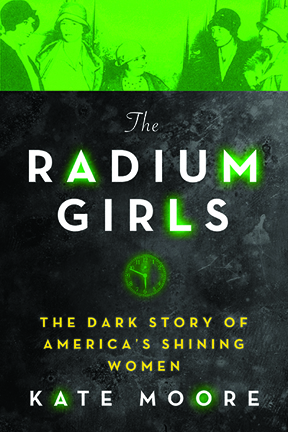
“Because it was successful, it somehow became an all-powerful health tonic, taken in the same way as we take vitamins today — people were fascinated with its power,” said Kate Moore, author of “The Radium Girls,” in a phone interview………
A slow killer
When ingested, radium is particularly dangerous: “Chemically, it behaves very much like calcium,” said Jorgensen. “Since the body uses calcium to make bone, ingested radium is mistaken for calcium and gets incorporated into bone. So the major health risk of ingesting radium is radiation-induced bone necrosis and bone cancers. How soon they develop depends upon the dose, but at the very high doses that the Radium Girls were exposed to, just a few years.”
The luminous paint, which worked by converting the radiation into light through a fluorescent chemical, was one of the most successful radium-based products. By putting the brushes in their mouths, the Radium Girls were especially at risk — so why did they do it? “Because it was the easiest way to get a fine point on the brush, to paint on numbers as small as a single millimeter in width,” said Moore.
But the girls didn’t embrace this technique blindly. “The first thing they asked was (whether) the paint was harmful, but the managers said it was safe, which was the obvious answer for a manager of a company whose very existence depended on radium paint.”
Not all that glitters
When the luminous watches grew fashionable in the early 1920s, the world was already becoming aware of the risks of radioactivity. But radiation poisoning isn’t immediate, so years went by before any of the workers developed symptoms…….
Radium jaw
In the early 1920s, some of the Radium Girls started developing symptoms like fatigue and toothaches. The first death occurred in 1922, when 22-year-old Mollie Maggia died after reportedly enduring a year of pain. Although her death certificate erroneously stated that she died of syphilis, she was actually suffering from a condition called “radium jaw.” Her entire lower jawbone had become so brittle that her doctor removed it by simply lifting it out. “The radium was destroying the bone and literally drilling holes in the women’s jaws while they were still alive,” said Moore.
Yet it would take another two years before the company that owned the factory, the United States Radium Corporation, took any action at all, through an independent investigation commissioned mostly to investigate the declining business rather than the health of the workers.
In 1925 Grace Fryer, one of the workers from the original New Jersey plant, decided to sue, but she would spend two years searching for a lawyer willing to help her. She finally filed her case in 1927 along with four fellow workers, and made front-page news around the world.
The case, settled in the women’s favor in 1928, became a milestone of occupational hazard law. By this time, the dangers of radium were in full view, the lip-pointing technique was discontinued and the workers were being given protective gear. More women sued, and the radium companies appealed several times, but in 1939 the Supreme Court rejected the last appeal.
The survivors received compensation, and death certificates would start reporting the correct cause of death. The year before, the Food and Drug Administration banned the deceptive packaging of radium-based products. Radium paint itself was eventually phased out and has not been used in watches since 1968.
It’s hard to calculate how many women suffered health problems due to the ingestion of radium, but the certainly number in the thousands, according to Moore. Some of the effects would only be felt much later in life through various forms of cancer. With a half-life of 1,600 years, once the radium was inside the women’s bodies, it was there for good.
The legacy of the Radium Girls lives on through the ripples that their deaths created in labor law and our scientific understanding of the effects of radioactivity. “In the 1950s, during the Cold War, many agreed voluntarily to be studied by scientists, even with intrusive examinations because they had been exposed for prolonged periods of time,” said Moore.
The latest joint training operation practised infiltrating North Korea and removing nuclear weapons in the event of war.
According to South Korea news agency Yonhap the “Warrior Strike” exercise held at Camp Stanley involved hundreds of troops from both sides and ran from Tuesday to Friday.
Camp Stanley is an army camp located north of Seoul and has around 5000 soldiers.
The display comes as North Korea’s neighbours China and Russia also carried out an antimissile drill in Beijing last week. The joint five-day drill, which finished on Saturday, included servicemen from both militaries and was headed by top brass in the Russian and Chinese air force, Newsweek reported.
The latest joint exercise between Washington and Seoul follow joint aerial drills Vigilant Ace in South Korea earlier this month.
The five-day drill was meant to improve the allies’ wartime capabilities and preparedness, according to South Korea’s defence ministry said.
The Vigilant Ace exercises, which lasted five days, involved more than 230 warplanes and 12,000 soldiers from both sides.
United States troops also used the hi-tech F-35 Lightning IIs and F-22 Raptors.
South Korea is a key US ally in the region and relies on US military assistance for security against the North.
Troops from the two countries routinely train together, each time prompting outbursts from Pyongyang.
Meanwhile Russia warned against fresh preconditions for any potential US and North Korea talks. Deputy foreign minister Sergei Ryabkov on Saturday warned of a risk of escalation after Washington toughened its stance on North Korea nuclear talks and US President Donald Trump accused Moscow of failing to help.
“It’s sad that this powerful element of demands for further pressure on Pyongyang has once again appeared in the American position,” he told RIA Novosti news agency.
“It’s high time to stop this race of threats, pressure, blackmail and presentation of preconditions and shift to a real search for a political solution.”
Mr Ryabkov said that both Pyongyang and Washington are now putting forward preconditions for talks and there is a “risk of uncontrolled escalation”.
His comments came one day after US Secretary of State Rex Tillerson backed away from an earlier offer of unconditional talks to end the stand-off with Pyongyang following White House pressure.