Fake scientists and radiation quackery – the message from nuclear front site “Environmental Progress”

Exposing the misinformation of Michael Shellenberger and ‘Environmental Progress’ Jim Green, Nuclear Monitor Issue: #853 4689 30/10/2017 “………….Fake scientists and radiation quackery
Environmental Progress’s UK director John Lindberg is described as an “expert on radiation” on the EP website.38 In fact, he has no scientific qualifications whatsoever let alone specialist qualifications regarding the health effects of ionizing radiation. Likewise, a South Korean article39 reposted on the EP website (without correction) falsely claims that Shellenberger is a scientist; in fact, he has a degree in cultural anthropology.
Lindberg is an ‘Associate Member’ of Scientists for Accurate Radiation Information (SARI)40, a group comprised mostly of quacks, cranks, non-scientists and conspiracy theorists whose views are directly at odds with those of scientific associations such as UNSCEAR.
SARI is at war with the linear, no-threshold (LNT) model ‒ the group’s short ‘Charter & Mission’ insists three times that LNT is “misinformation”.41 Yet LNT enjoys heavy-hitting scientific support. For example the 2006 report of the US National Academy of Sciences’ Committee on the Biological Effects of Ionizing Radiation states that “the risk of cancer proceeds in a linear fashion at lower doses without a threshold and … the smallest dose has the potential to cause a small increase in risk to humans.”34 Likewise, a report in the Proceedings of the National Academy of Sciences states: “Given that it is supported by experimentally grounded, quantifiable, biophysical arguments, a linear extrapolation of cancer risks from intermediate to very low doses currently appears to be the most appropriate methodology.”42
A 2010 UNSCEAR report isn’t sold on the linear part of LNT but it is at odds with SARI (and EP) on the question of a threshold. The UNSCEAR report states that “the current balance of available evidence tends to favour a non-threshold response for the mutational component of radiation-associated cancer induction at low doses and low dose rates.”43By contrast, SARI promotes hormesis ‒ the discredited view that low-dose radiation exposure is beneficial to human health.44 https://wiseinternational.org/nuclear-monitor/853/exposing-misinformation-michael-shellenberger-and-environmental-progress
What now for South Carolina, having wasted $9 Billion on Nuclear Reactors that will never work
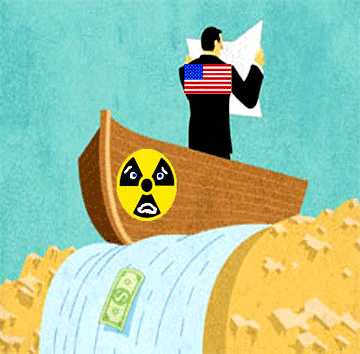 South Carolina Spent $9 Billion on Nuclear Reactors That Will Never Run. Now What? The legislature must decide whether residents will keep being charged, possibly for decades, for the failed project. Governing. | JANUARY 2018 It has to be one of the greatest wastes of money in any state’s history. Last summer, two utility companies halted construction on nuclear reactors in South Carolina. They had already sunk more than $9 billion into the project, which will never be completed or generate a kilowatt of power. The state is now trying to figure out who’s to blame, and who will pay.
Michael Shellenberger’s misinformation on Chernobyl and Fukushima
 Exposing the misinformation of Michael Shellenberger and ‘Environmental
  Progress’ Jim Green,
Shellenberger says that at a recent talk in Berlin: “Many Germans simply could not believe how few people died and will die from the Chernobyl accident (under 200) and that nobody died or will die from the meltdowns at Fukushima. How could it be that everything we were told is not only wrong, but often the opposite of the truth?”4
There’s a simple reason that Germans didn’t believe Shellenberger’s claims about Chernobyl and Fukushima ‒ they are false.
Shellenberger claims that “under 200” people have died and will die from the Chernobyl disaster. In fact, the lowest of the estimates of the Chernobyl cancer death toll is the World Health Organization’s estimate of “up to 9,000 excess cancer deaths” in the most contaminated parts of the former Soviet Union.29 And of course there are higher estimates for the death toll across Europe.30,31
Shellenberger claims that the Fukushima meltdowns “killed precisely no one” and that “nobody died or will die from the meltdowns at Fukushima”.4 An EP report has this to say about Fukushima: “[T]he science is unequivocal: nobody has gotten sick much less died from the radiation that escaped from three meltdowns followed by three hydrogen gas explosions. And there will be no increase in cancer rates.”3
In support of those assertions, EP cites a World Health Organization report that directly contradicts EP’s claims. The WHO report concluded that for people in the most contaminated areas in Fukushima Prefecture, the estimated increased risk for all solid cancers will be around 4% in females exposed as infants; a 6% increased risk of breast cancer for females exposed as infants; a 7% increased risk of leukaemia for males exposed as infants; and for thyroid cancer among females exposed as infants, an increased risk of up to 70% (from a 0.75% lifetime risk up to 1.25%).32
Applying a linear-no threshold (LNT) risk factor to the estimated collective radiation dose from Fukushima fallout gives an estimated long-term cancer death toll of around 5,000 people.33 Nuclear lobbyists are quick to point out that LNT may overestimate risks from low dose and low dose-rate exposure. But LNT may also underestimate the risks. The 2006 report of the US National Academy of Sciences’ Committee on the Biological Effects of Ionizing Radiation (BEIR) states: “The committee recognizes that its risk estimates become more uncertain when applied to very low doses. Departures from a linear model at low doses, however, could either increase or decrease the risk per unit dose.”34 And the BEIR report states that “combined analyses are compatible with a range of possibilities, from a reduction of risk at low doses to risks twice those upon which current radiation protection recommendations are based.”34
Fukushima evacuation
Shellenberger claims that the Fukushima evacuation was “entirely unnecessary and indeed counterproductive” and it was the “outcome of the kind of fear-mongering engaged in by Moon, FOE, and Greenpeace.”4 But of course Moon Jae-in, FOE and Greenpeace had nothing to do with the evacuation of 160,000 people in the aftermath of the Fukushima disaster. Evacuations were ordered not on the basis of fear-mongering by nuclear critics; they were ordered on the basis of multiple fires, hydrogen explosions and presumed meltdowns.
EP states: “In 2013, the United Nations Scientific Committee on the Effects of Atomic Radiation (UNSCEAR) concluded that the vast majority of the Fukushima evacuation zone is safe and nearly all residents could have returned long ago ‒ indeed, most should never have left.”3 But the UNSCEAR report didn’t conclude that the vast majority of the Fukushima evacuation zone is safe or that nearly all residents could have returned long ago, and it didn’t state that most evacuees should never have left.35 The UNSCEAR report states: “The actions taken to protect the public significantly reduced the radiation exposures that could have been received. This was particularly the case for settlements within the 20-km evacuation zone and the deliberate evacuation zones, where the protective measures reduced the potential exposures in the first year by up to a factor of 10.”35
An EP report berates the Japanese government for failing to follow “normal protocols” by ordering Fukushima residents to evacuate instead of sheltering in place.3 EP cites a 2015 IAEA report36 in support of that argument, but nowhere in the IAEA report (or any IAEA report) is there a proscription against evacuation in response to nuclear accidents. No IAEA report states that sheltering in place should be the “normal protocol” in the event of a nuclear accident ‒ the appropriate response depends entirely on the circumstances. A 2011 IAEA report points to the impracticality of sheltering in place as a long-term response to elevated radiation levels following nuclear accidents: “Lesson 12: The use of long term sheltering is not an effective approach and has been abandoned and concepts of ‘deliberate evacuation’ and ‘evacuation-prepared area’ were introduced for effective long term countermeasures using guidelines of the ICRP [International Commission on Radiological Protection] and IAEA.”37
The 2015 IAEA report notes that radiation levels were astronomical in some areas in the days after the Fukushima disaster ‒ even in some locations beyond the 20 km exclusion zone, dose rates of the order of a few hundred microsieverts per hour were measured from 15 March 2011 onward.36 Thus the annual public limit of 1 millisievert from anthropogenic sources would be reached in just a few hours, and the Japanese government’s new limit of 20 millisieverts in Fukushima-contaminated regions would be reached in just a few days.https://wiseinternational.org/nuclear-monitor/853/exposing-misinformation-michael-shellenberger-and-environmental-progress
Are we all safe now from nuclear attacks? New York Removes Old Nuclear Fallout Shelter Signs
 New York Removes Old Nuclear Fallout Shelter Signs in Move That Seems Premature, Gizmodo
Help for nuclear power workers with mesothelioma
Mesothelioma Compensation Center Now Offers Guidance for a Nuclear Power Worker or Navy Veteran With Mesothelioma to Ensure They Hire the Nation’s Top Lawyers for Compensation, https://www.prnewswire.com/news-releases/mesothelioma-compensation-center-now-offers-guidance-for-a-nuclear-power-worker-or-navy-veteran-with-mesothelioma-to-ensure-they-hire-the-nations-top-lawyers-for-compensation-300575560.html NEW YORK, Dec. 28, 2017 /PRNewswire/ — The Mesothelioma Compensation Center says, “We are the only group in the nation that specializes in assisting nuclear power plant workers or US Navy Veterans who have been diagnosed with mesothelioma and our number one objective is a person like this receives the very best possible financial compensation. If a nuclear power worker or Navy Veteran calls us at 800-714-0303 we will have them talking directly to some of the nation’s most skilled, experienced and capable mesothelioma attorneys typically within 20 or 30 minutes.” http://MesotheliomaCompensationCenter.Com
According to the Mesothelioma Compensation Center, “The mesothelioma lawyers we suggest work their mesothelioma compensation claims extremely hard and they typically get the best financial compensation results for their clients on a nationwide basis.
A case work up typically involves every single place or instance where a diagnosed person could have been exposed to asbestos. Further there is no charge for their services if there is not a financial settlement.
“When it comes to receiving the best possible mesothelioma financial compensation it is absolutely vital you hire the most qualified mesothelioma attorneys, as we would like to discuss anytime at 800-714-0303 – especially if you are a nuclear power plant worker or US Navy Veteran. The potential compensation for a nuclear power worker or Navy Veteran with mesothelioma could easily exceed a million dollars provided they have the best legal representation.” http://MesotheliomaCompensationCenter.Com
The Mesothelioma Compensation Center is especially focused on assisting nuclear power workers or Navy Veterans with mesothelioma in the following states:
- California
- New York
- Texas
- Florida
- Washington
- Connecticut
- Arizona
- Georgia
- South Carolina
- Pennsylvania
- Michigan
- Ohio
- Tennessee
- Maine
For more information, a nuclear power worker or a US Navy Veteran with confirmed mesothelioma, or their family members, are encouraged to call the Mesothelioma Compensation Center anytime at 800-714-0303 for their unsurpassed free services, or they can contact the group via its web site at http://MesotheliomaCompensationCenter.Com
The Mesothelioma Compensation Center specializes in assisting US Navy Veterans, power plant workers, shipyard workers, oil refinery workers, public utility workers, hydro-electric workers, chemical plant workers, nuclear power plant workers, manufacturing workers, oil and gas field production workers, plumbers, electricians, millwrights, pipefitters and welders who have been diagnosed with mesothelioma. In most instances these people were exposed to asbestos during the1950’s, 1960’s, 1970’s, or 1980’s.
US Navy Veterans account for a significant portion of all diagnosed victims of mesothelioma each year. The average age for a diagnosed victim of mesothelioma is about 70 years old. Each year between 2,500 and 3,000 US citizens will be diagnosed with mesothelioma. Mesothelioma is attributable to exposure to asbestos.
According to the CDC, the states indicated with the highest incidence of mesothelioma include Maine, Massachusetts, Connecticut, Maryland, New Jersey, Pennsylvania, Ohio, West Virginia, Virginia, Michigan, Illinois, Minnesota, Louisiana, Washington, and Oregon. However, a nuclear power plant worker or Navy Veteran who worked on nuclear reactors with mesothelioma could live in any state including California, New York, Florida, Texas, Illinois, Ohio, Missouri, North Carolina, Kentucky, Tennessee, Georgia, Alabama, Kansas, Nebraska, New Mexico, Arizona, Nevada, Idaho, or Alaska.
For more information about mesothelioma please refer to the National Institutes of Health’s web site related to this rare form of cancer: https://www.cancer.gov/types/mesothelioma.
Media Contact:
Michael Thomas
800-714-0303
186798@email4pr.com
SOURCE Mesothelioma Compensation Center
Related Links
Cold weather in USA in no way refutes climate change
The other thing to point out is that because one part of the world is cold (in that valley), there is likely another part of the world experiencing abnormally warm conditions (in the hill part of the wave pattern). In the temperature map tweeted by long-time weather observer Joe Stepansky, it is clear that on December 28th the United States and parts of Canada are experiencing the anomalously cold weather. …..
there are some studies that suggest that a warming climate (because more water vapor is available to a warmer atmosphere) may fuel bigger blizzards or snowstorms. That science is also emerging…….https://www.forbes.com/sites/marshallshepherd/2017/12/28/a-response-for-people-using-record-cold-u-s-weather-to-refute-climate-change/#4a0c5c6a5680
Michael Shellenberger uses disinformation to attack environmental groups
Exposing the misinformation of Michael Shellenberger and ‘Environmental Progress’ Jim Green, Nuclear Monitor Issue: #853 4689 30/10/2017
“…….Attacking environment groups
Shellenberger reduces the complexities of environmental opposition to nuclear power to the claim that in the 1960s, an “influential group of conservationists within Sierra Club feared that cheap, abundant electricity from nuclear would result in overpopulation and resource depletion” and therefore decided to campaign against nuclear power.4
If such views had any currency in the 1960s, they certainly don’t now. Yet EP asserts that Greenpeace and FOE “oppose cheap and abundant energy”3 and Shellenberger asserts that “the FOE-Greenpeace agenda has never been to protect humankind but rather to punish us for our supposed transgressions.”4 And Shellenberger suggests that such views are still current by asserting that the anti-nuclear movement has a “long history of Malthusian anti-humanism aimed at preventing “overpopulation” and “overconsumption” by keeping poor countries poor.”8 Again we see Shellenberger’s M.O. of relentless repetition of falsehoods in the hope that mud will stick.
In an ‘investigative piece’ ‒ titled ‘Enemies of the Earth: Unmasking the Dirty War Against Clean Energy in South Korea by Friends of the Earth (FOE) and Greenpeace’ ‒ Shellenberger lists three groups which he claims have accepted donations “from fossil fuel and renewable energy investors, as well as others who stand to benefit from killing nuclear plants”.4 FOE and Greenpeace don’t feature among the three groups even though the ‘investigative piece’ is aimed squarely at them.
Undeterred by his failure to present any evidence of FOE and Greenpeace accepting fossil fuel funding (they don’t), Shellenberger asserts that the donors and board members of FOE and Greenpeace “are the ones who win the government contracts to build solar and wind farms, burn dirty “renewable” biomass, and import natural gas from the United States and Russia.”4 Really? Where’s the evidence? There’s none in Shellenberger’s ‘investigative piece’.
In an article for a South Korean newspaper, Shellenberger states: “Should we be surprised that natural gas companies fund many of the anti-nuclear groups that spread misinformation about nuclear? The anti-nuclear group Friends of the Earth ‒ which has representatives in South Korea ‒ received its initial funding from a wealthy oil man …”45He fails to note that the donation was in 1969! And he fails to substantiate his false insinuation that FOE accepts funding from natural gas companies, or his false claim that natural gas companies fund “many of the anti-nuclear groups”.
Shellenberger’s ‘investigative piece’ falsely claims4 that FOE keeps its donors secret, and in support of that falsehood he cites an article8 (written by Shellenberger) that doesn’t even mention FOE. EP falsely claims that FOE has hundreds of millions of dollars in its bank and stock accounts.3
EP has an annual budget of US$1.5 million, Shellenberger claims, and he asks how EP “can possibly succeed against the anti-nuclear Goliath with 500 times the resources.”8
An anti-nuclear Goliath with 500 times EP’s budget of US$1.5 million, or US$750 million in annual expenditure on anti-nuclear campaigns? Shellenberger claims that Greenpeace has annual income of US$400 million to finance its work in 55 nations8 ‒ but he doesn’t note that only a small fraction of that funding is directed to anti-nuclear campaigns. FOE’s worldwide budget is US$12 million according to EP3 ‒ but only a small fraction is directed to anti-nuclear campaigns.
Donald Trump’s Path to Nuclear War – a 2017 Timeline
 Timeline of Trump’s Path to Nuclear War https://www.globalresearch.ca/timeline-of-trumps-path-to-nuclear-war/5623937 By Walt Gelles Global Research, December 26, 2017 Donald Trump’s reckless policies, belligerence, volatile personality, and rejection of diplomacy have brought the world to the brink of war in Korea. Such a war could rapidly turn nuclear, killing hundreds of thousands or millions of people, spreading deadly radiation across the planet, and likely involving China and Russia. North Korea will never give up its nuclear and ballistic missile program under pressure, as it views the program as an indispensable bulwark against U.S. aggression.
2017 – the year of the Trump – Kim nuclear standoff
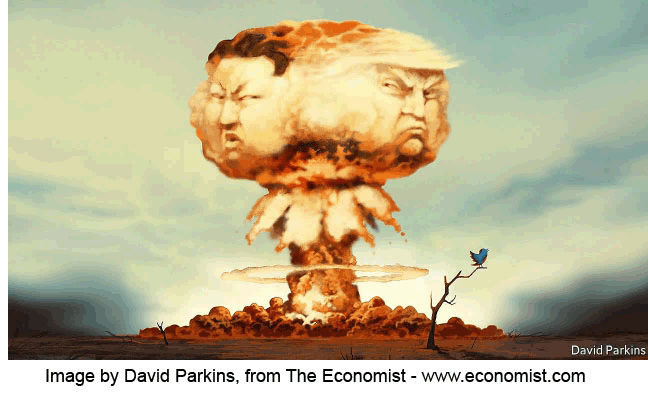 ‘Dotard’ vs. ‘Rocketman’: The Nuclear Standoff That Rattled 2017 http://www.huffingtonpost.com.au/entry/dotard-vs-rocketman-the-nuclear-standoff-that-rattled-2017_us_5a3e8bdce4b0b0e5a7a27be6 Days after Donald Trump was elected president of the United States, he received a stark warning from America’s outgoing leader.
Clashes between Donald Trump and Kim Jong Un dominated headlines this year.
North Korea’s Nuclear Strides
The Pentagon’s efforts to stave off conflict with North Korea have been marred by a string of “decisive failures” this year, according to new analysis published this month from the Brookings Institution, a Washington-based think tank.
“The United States and [North Korea] have engaged in bellicose rhetorical brinksmanship, making war between the two states seem increasingly likely,” wrote Katy Collin, a post-doctoral fellow at the Brookings Foreign Policy program. “Public acceptance of the possibility of conflict within the United States has ballooned. Mechanisms to head off escalation caused by misunderstandings do not exist.”
North Korea made remarkable technological advances to its internationally condemned nuclear program throughout 2017. It conducted its sixth and most powerful nuclear teston Sept. 3, which the regime claimed was a hydrogen bomb loaded onto an intercontinental ballistic missile (ICBM). Subsequent analysis of seismic data revealed the test was approximately 17 times stronger than the blast that decimated the Japanese city of Hiroshima during World War II.
Pyongyang has also expanded the reach of its missiles this year: The entire continental U.S. is now believed to be within ICBM striking range. Experts have expressed concern at North Korea’s alarming progress, and worry that it is on track to outpace America’s abilities to defend itself and its allies in the region.
The regime’s most recent missile launch in late November exceeded 8,100 miles in range. As tested, such a rocket would be able to travel more than enough distance to reach Washington, D.C., or New York City, although it is unclear if it could transport a warhead that far.
“North Korea knows what they’re doing,” David Wright, a physicist and the co-director of the global security program at the Union of Concerned Scientists, told HuffPost at the time. “It’s hard to say if it’s six months or two years before they can deliver a nuclear warhead, but it’s heading in that direction.”
Donald Trump’s Fire And Fury
Yet Trump, undermining diplomatic efforts by his own Secretary of State Rex Tillerson, has repeatedly confronted North Korea’s provocations with aggravations of his own. He infamously vowed in August to meet the defiant country with “fire and fury,” prompting Pyongyang’s threat to launch a missile at the U.S. island territory of Guam.
Months later, Trump said the U.S. would “totally destroy” North Korea, which is home to an estimated 25 million people, if provoked. “Rocketman is on a suicide mission for himself and for his regime,” Trump said in his first speech before the United Nations General Assembly, referring to Kim.
In an extremely rare personal address, Kim responded by pledging to “tame the mentally deranged U.S. dotard with fire.” Soon after, North Korean Foreign Minister Ri Yong-ho said the regime might detonate an H-bomb in the Pacific Ocean.
As hostilities boiled over, experts urged the “America First” leader to “stick to the script” and avoid making incendiary comments about North Korea during his 12-day trip through Asia last month. But Trump couldn’t help himself:
The president’s taunts “create an incentive for the North Koreans to stage provocations to show him up,” Jeffrey Lewis, a nuclear weapons expert at the Middlebury Institute of International Studies, told HuffPost in November.
If the situation deteriorates into an acute crisis, such remarks from Trump could give North Korea the impression a military strike is imminent, Lewis added. “If that happens, my belief is the North Koreans would use their nuclear weapons first, in order to try to repel an invasion.”
A turbulent 2017 has stirred fears and uncertainty for the year ahead.
“Trump has been impatient with multilateral, diplomatic containment of nuclear proliferation,” Collin said. “While diplomacy, sanctions, and targeted engagement have been successful in preventing conflict on the Korean peninsula for decades, 2017 marks decisive failures in terms of North Korea’s nuclear capacities.”
Shaky economics, as Georgia Public Service Commission decides to save the nuclear industry

Regulators Rescue Troubled Vogtle Nuclear Plant https://oilprice.com/Energy/Energy-General/Regulators-Rescue-Troubled-Vogtle-Nuclear-Plant.html
Executives from Atlanta-based Southern Company defended their long delayed and way over-budget nuclear construction project, the Vogtle plant, before the Georgia Public Service Commission. But this time, Anthony Quinn won. The Georgia PSC commissioners gave Southern the ok to keep building.
The PSC had a choice: recommend cancellation of the huge project or let it proceed. But cancellation would require still another unpleasant discussion and decision: who foots the bill for the incomplete plant? Not the sort of decisions politicians like to make on their watch.
So the PSC ruled that power-generating alternatives to nuclear, such as combined cycle combustion turbines, would cost more than completing the plant (a conclusion that requires judgment about gas prices). And it made some modifications that will supposedly cut $700 million off what the plant will cost Southern’s consumers (that’s $18 million per year over the projected life of the plant, so no big deal.)
Economists warn decision makers to ignore sunk costs. But those sunk costs apparently did weigh on regulators. Explaining to the governor and to voters that the billions of dollars of plant investment made on their watch is now worthless… well, that’s a decision few regulators would choose to make.
The public reasoning behind today’s Georgia PSC decision involved assumptions about future energy costs, the company’s need for a diverse energy mix, and the desirability of adding low carbon emitting generating resources.
For all the attention this decision received, probably didn’t play a significant role. Nobody we’ve ever met could accurately forecast trends in energy consumption, power technology and costs at the same time over any reasonable planning horizon. To accurately forecast these over the 40-60 year projected life of the Vogtle plant turns an impossible task ridiculous. That is the key to the problem regulators faced today, and the reason why a decision to build a large nuclear plant is so risky.
Two Greentech Media journalists saw today’s PSC decision as an “infusion of hope for large-scale nuclear… and the last chance to prove the viability of the industry” in the U.S. The verdict of the financial community was far more muted. The common shares of Southern Company fell 1 percent.
How will an over-budget, late and marginally economic nuclear power generating facility encourage others to dive into the nuclear new-build game?
Georgia regulators cited other reasons to approve this project, including the need to reduce carbon omissions and to maintain America’s nuclear power generating capability. But the big question is why should the electricity consumers of Georgia, alone, bear the burden of meeting relatively high-cost national energy goals?
Given the size and risks inherent in building new nuclear projects, especially with relatively new designs, shouldn’t the risk be spread throughout the nation? There’s something bizarre about the electricity consumers of Georgia and South Carolina (where an identical project was recently canceled) incurring possibly $25-$50 billion of financial risk for the sake of the nation’s nuclear power generating capability.
Given the size and risks inherent in new nuclear projects, shouldn’t the risk be spread throughout the nation, if—as the regulators imply—the entire nation actually benefits? The electricity consumers in Georgia and South Carolina shouldn’t incur significant financial risk for the sake of the nation’s nuclear capability—especially when no other domestic utility management appears ready to follow suit.
As a supposedly patriotic gesture, we can certainly applaud the sentiment. But the economics remain shaky.
In America Renewable Energy is beating Fossil Fuels

 Report: U.S. Renewables Outpace Fossil Fuels, Nuclear, https://solarindustrymag.com/report-u-s-renewables-outpace-fossil-fuels-nuclear, Joseph Bebon, ecember 26, 2017, The amount of U.S. renewable energy grew during the first 10 months of 2017 while electricity generation from fossil fuels and nuclear power declined, according to a new analysis from the SUN DAY Campaign.
Phony group in St Louis – “Coalition to Keep Us Safe” – attacks JustMomsSTL
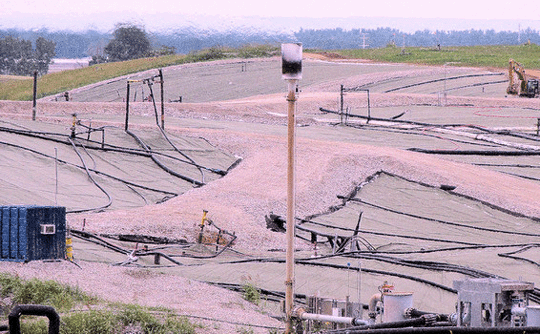 Repugnant practices by Republic Services, http://www.stltoday.com/opinion/columnists/repugnant-practices-by-republic-services/article_eb94c468-c084-5e8c-bd30-4d85fdfd156a.html By Dr. Stuart Slavin, 26 Dec 17,
Forget the climate argument: in Central Texas, wind energy means JOBS
 In Central Texas Where Wind Power Means Jobs, Climate Talk Is Beside the Point, Wind turbines bring jobs, tax dollars for new schools, income security for farmers and energy independence. To these Texans, climate change has little to do with it. BY MEERA SUBRAMANIAN, INSIDECLIMATE NEWS
DEC 26, 2017 “……….. Wind’s Ascent
Wind energy development in Nolan County dates back to 2001, when the first wind farmswere constructed in the area. A perfect confluence of events led to the growth of the industry since then.
There was a supportive state government, led by Republicans George W. Bush and then Rick Perry, pushing for wind by putting the regulatory and infrastructure pieces in place to make it successful. The state’s nearly autonomous electric grid meant no troublesome cross-border or federal approval was needed to get wind electricity from places like Sweetwater to the green-leaning urban markets clamoring for renewable energy. And then there were the Texans themselves, ever eager to use their land and diversify their revenue sources, especially as recurring droughts killed off the cotton and the livestock, and oil fields were either going dry or failing to pay for themselves. At the same time, federal incentives came (and went, and came again) in the form of production tax credits that helped the wind industry offset large investment costs.
If Texas were a nation, it would be the sixth-largest wind energy producer in the world. The bulk of that power is coming from the Nolan County region. And so the reddest parts of Texas are responsible for supplying upwards of 12 percent of the state’s energy needs every month with clean, green kilowatts. Occasionally, as happened one day in the blustery month of October this year (a time when those energy-sucking A/C units are switched off and electricity usage is low), it provided more than half of the electricity to the state’s power grid.
The Lure of Wind Industry Jobs
As the wind industry grew through the early 2000s, so did a desperate need for skilled labor. What emerged was the 2008 launch of TSTC’s Wind Energy Technology program, where James enrolled in 2010 and where he returned to teach in 2013 after working in the field for a couple of years.
According to the Bureau of Labor Statistics, wind technician is currently the second-fastest growing job in America (beat out only by solar photovoltaic installer). By the end of last year, there were more than 100,000 jobs related to the wind industry nationwide, at least one-fifth of them in Texas. When the American Wind Energy Association (AWEA) launched a seal of approval for wind technician programs in 2011, TSTC was one of only three schools in the U.S. to receive it.
The students James teaches are a slice of the next generation of wind workers for an industry that, at least in this part of the country, has already established itself. They include veterans and women, those leaning politically right and left, environmentalists and climate change skeptics, the civically engaged and those who never vote. The clean energycomponent seems to be a bonus for some, but it was not the primary reason they chose this field. There is the laid-off gas worker who noticed all the wind turbines on the horizon and thought there must be an opportunity there. The English major who couldn’t find a job and remembered how much she liked the outdoor work on her family’s farm in the Texas panhandle. The two veterans who liked the element of risk and heights and the sweet spot of job independence and camaraderie………..
wind energy had bolstered the local economy.
“In pre-wind, our county taxable value was $500 million,” Ken explained. “In 2008, it was $2.8 billion,” a five-fold increase that translated to new schools and grand expansions at the local hospital. That’s money for the town, but also a steady income for local landowners, some of whom earn up to $1,000 per month from having a single commercial turbine on their property—and most of the region’s world-class wind farms are dotted across private land. Many say they’re “not sure they’d even have the ranch today if the wind didn’t come on,” Ken told me……..
complementary industries are the ecosystem that wind power belongs to—and its reach is growing. Repowering, which vastly increases efficiency by either replacing old turbines for more powerful ones or upgrading components, means more megawatts with the same footprint. It also means a whole new category of jobs. While I was there, evidence of these peripheral industries was everywhere. I watched 80-foot blades swapped out for ones twice as long. (The production tax credits helped these efforts, too.) I visited Global Fiberglass Solutions of Texas, which was setting up shop in an old aluminum recycling plant to process the decommissioned blades—which were being amassed in a 10-acre field—into building panels and other materials…….
The best places for wind are often the places that are struggling to keep rural communities alive.
What was happening in Nolan County proved that the debate about how we generate our kilowatts doesn’t have to be about climate change. It could be about embracing whatever clean energy options are available to help make small-town America economically viable. In this deeply red place, it was the embodiment of President Barack Obama’s all-of-the-above strategy. At the close of 2016, 86 percent of the country’s onshore wind turbines were located in Republican districts, according to the 2016 U.S. Wind Industry Annual Market Report. Indeed, Republican Sens. Rob Portman of Ohio and John Thune of South Dakota were some of the primary advocates responsible for keeping the PTC in place in the final version of the tax overhaul bill, which was signed Dec. 22…….. https://insideclimatenews.org/news/26122017/wind-energy-jobs-booming-texas-clean-renewable-power-climate-change
University of Arkansas-Fayetteville unable to afford clean-up of old nuclear reactor site
 Funds sought for cleanup at UA nuclear reactor test site, The Commercial, Pine Bluff 26 Dec 17 FAYETTEVILLE — Cleanup at a nuclear reactor test site built in the late 1960s began this year after three decades of waiting. Thousands of pounds of low-level radioactive waste have since been trucked away from rural Washington County to specialized waste facilities outside the state.
Now the University of Arkansas-Fayetteville, the site owner, faces the possibility of another delay as it awaits news of federal funding to finish the cleanup of the Southwest Experimental Fast Oxide Reactor, often referred to as SEFOR.
“We need $10.1 million dollars in FY 18 appropriations,” said Mike Johnson, UA’s associate vice chancellor for facilities, referring to the federal fiscal year.
If the money comes through by mid-January, the final stage of remediation — removal of the reactor core, the radioactive heart of the site — will begin without interruption, he said. …….
Future work scheduled through March includes cutting away sections of a containment shield designed to prevent radiation from escaping into the atmosphere and also cutting down portions of a thick wall that shielded workers from radiation. The schedule calls for a temporary roof and weather shield to be affixed to what remains. The reactor, built with funding from the U.S. Atomic Energy Commission, according to UA, never was hooked up to turbine equipment so no electricity was produced, but it did work as planned.
The site ceased operations in the early 1970s, with UA taking ownership in 1975 to use it for research. By 1986 the site fell out of use…….http://www.pbcommercial.com/news/20171225/funds-sought-for-cleanup-at-ua-nuclear-reactor-test-site
Investigation finds that USA’s Nuclear Regulatory Commission downplays safety warnings
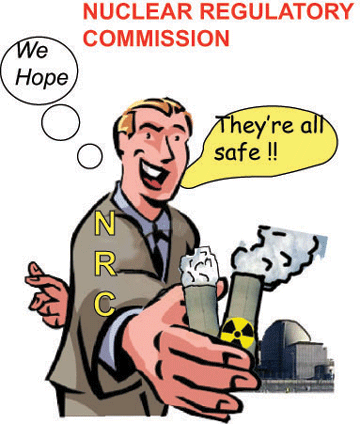 Nuclear Regulatory Commission downplays safety warnings, investigation finds, CBS News, 20 Dec 17, The federal agency responsible for safety at the nation’s 61 nuclear power plants routinely downplays warnings from plant workers and its own experts about problems, including some with potential for disaster, a Better Government Association investigation found.
Employees from U.S. nuclear power plants filed nearly 700 complaints with the United States Nuclear Regulatory Commission in recent years, claiming retaliation for raising safety concerns, records show. The agency found no wrongdoing.
NRC officials also overruled recommendations from their own technical experts on how to protect plants from potential catastrophe spurred by floods, equipment failures, power outages and other problems.
This article was provided to The Associated Press by the nonprofit news outlet Better Government Association.
Interviews with more than 20 current and former NRC and nuclear plant employees reveal a pattern of top officials dismissing safety warnings rather than impose costly fixes on plant operators. Some said careers suffered as potential threats were never fully addressed.
“It’s the NRC’s longstanding practice to consistently declare the plants are safe and to avoid directly answering any questions that might suggest otherwise,” said Lawrence Criscione, an NRC risk analyst.
NRC officials would not consent to an interview. But NRC spokeswoman Viktoria Mitlyng responded in writing to BGA questions……..
The nuclear industry, through its trade group and individual companies, often downplays the seriousness of problems highlighted by NRC experts. Exelon and others in the industry bat down potential rules and regulations by pleading to NRC’s top managers……….
The problem, say people who conduct government reviews, is that the NRC’s final rulings often don’t reflect warnings from its experts.
“Management tells you where they want the answer to go. If you push, you’re not going to get promoted again – there are other people who are willing to say it’s not a serious issue,” said Richard Perkins, one of Criscione’s NRC colleagues involved in exposing flooding concerns.
One case in point is the emergency safety valve issue at Exelon’s Byron and Braidwood plants……..
Underscoring that frustration is the NRC’s record of handling whistleblower complaints lodged by plant employees. From 2010 through 2016, workers filed 687 complaints. The NRC investigated just 235 and upheld none.
The largest number of complaints, 84, were filed by employees at the two nuclear plants operated in Georgia by Southern Nuclear, records show. Next were the 70 complaints lodged by nuclear workers in South Carolina, 58 by workers in Tennessee and 50 in California. Illinois ranked 12th, with 21 whistleblower cases filed. https://www.cbsnews.com/news/nuclear-regulatory-commission-downplays-safety-warnings-investigation-finds/
1 This Month





PLEASE OPPOSE HR 8255 AND S.3639 – bills would accelerate satellite deployment, with no environmental review or safeguards – https://ncstd5li.quorum.us/campaign/169331/
To see nuclear-related stories in greater depth and intensity – go to https://nuclearinformation.wordpress.com
-
Archives
- October 2026 (58)
- September 2026 (339)
- August 2026 (330)
- July 2026 (355)
- June 2026 (287)
- May 2026 (306)
- April 2026 (356)
- March 2026 (251)
- February 2026 (267)
- January 2026 (308)
- December 2025 (358)
- November 2025 (359)
-
Categories
- 1
- 1 NUCLEAR ISSUES
- business and costs
- climate change
- culture and arts
- ENERGY
- environment
- health
- history
- indigenous issues
- Legal
- marketing of nuclear
- media
- opposition to nuclear
- PERSONAL STORIES
- politics
- politics international
- Religion and ethics
- safety
- secrets,lies and civil liberties
- spinbuster
- technology
- Uranium
- wastes
- weapons and war
- Women
- 2 WORLD
- ACTION
- AFRICA
- Atrocities
- AUSTRALIA
- Christina's notes
- Christina's themes
- culture and arts
- Events
- Fuk 2022
- Fuk 2023
- Fukushima 2017
- Fukushima 2018
- fukushima 2019
- Fukushima 2020
- Fukushima 2021
- general
- global warming
- Humour (God we need it)
- Nuclear
- RARE EARTHS
- Reference
- resources – print
- Resources -audiovicual
- Weekly Newsletter
- World
- World Nuclear
- YouTube
-
RSS
Entries RSS
Comments RSS

