PSEG said that its two nuclear plants account for between 40 and 50 percent of electricity production in New Jersey, but are in danger of becoming financially unviable within two years. They said that would cost the state 1,600 jobs.
America has only one nuclear power plant in construction, and its future is doubtful
 The fate of America’s only nuclear plant under construction will be decided Thursday, Washington Examiner, by Josh Siegel | Dec 18, 2017, The Georgia Public Service Commission on Thursday is set to decide the fate of Plant Vogtle, the only nuclear reactor under construction in the U.S., which is years behind schedule and billions of dollars over budget.
At Thursday’s hearing, a commission made of five elected officials, all Republicans, will vote on whether to permit Georgia Power’s new plan for the project, which includes an updated cost projection and construction timeline, or to cancel it.
Georgia Power is estimating $12.2 billion in costs for its 45.7 percent share of the project, and for the reactors to be producing electricity by 2021 or 2022.
This cost estimate is nearly double the company’s original projection, and the timeline is five years behind schedule. The cost of the project for Georgia Power and its co-owners exceeds $20 billion.
The commission’s decision will come days after the embattled nuclear industry learned that House and Senate Republicans as part of a tax reform package would not grant the extension of a key tax credit for new nuclear production that could have benefited the Southern Co. plant…….
The public power companies building the plant have asked the Public Service Commission to allow Georgia Power to recoup Vogtle’s new costs from customers. But commission staff filed a document this month arguing that customers would incur too high of a cost to justify the economics of the project.
“Assuming the project is completed, ratepayers would incur significantly higher revenue requirements and a reduced economic benefit while the company’s profits would increase,” wrote PSC staff consultants Phil Hayet and Lane Kollen, and Tom Newsome, the PSC staff’s utilities finance director.
Kurt Ebersbach, a senior attorney at the Southern Environmental Law Center in Atlanta, who is advocating the commission oppose the plan, said the company’s expectations are unfair to ratepayers.
“It’s a very lopsided, heavy-handed proposal for Georgia Power to say we want the commission to approve a revised cost schedule and additional years of delay, in addition to assurances we will recover every last penny from customers,” Ebersbach told the Washington Examiner. “It’s unreasonable.”…….. http://www.washingtonexaminer.com/the-fate-of-americas-only-nuclear-plant-under-construction-will-be-decided-thursday/article/2643697
US Secretary of State Rex Tillerson changes his mind: now will not talk with North Korea without “conditions”
 Tillerson backtracks on offer of unconditional North Korea talks https://www.dailytelegraph.com.au/news/world/tillerson-backtracks-on-offer-of-unconditional-north-korea-talks/news-story/2236599a83ed87f95c79af52af2a9279 16 Dec 17,
Trump’s disturbing willingness to sell nuclear technologies without the usual restrictions, to Saudi Arabia
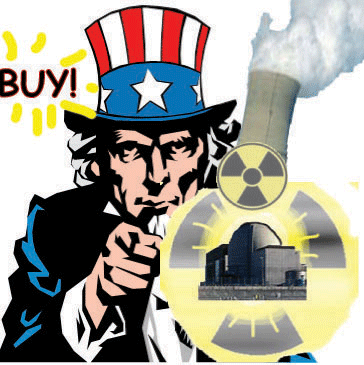
 U.S. To Boost Saudi Nuclear Power Development. Lobe Log., DECEMBER 14, 2017, Almost a decade has passed since President George W. Bush promised that the United States would help Saudi Arabia develop commercial nuclear energy plants. When he visited Riyadh in May 2008, he pledged to sign a “memorandum of understanding,” or MOU, committing the United States to “assist the Kingdom of Saudi Arabia to develop civilian nuclear power for use in medicine, industry and power generation” and “establish a comprehensive framework for cooperation in the development of environmentally sustainable, safe, and secure nuclear energy.”
In return, Saudi Arabia, a signatory to the Nuclear Nonproliferation Treaty, would also join the worldwide Proliferation Security Initiative, a U.S.-sponsored program to confront the threat of nuclear proliferation.
The text of that MOU has never been made public, and nothing much happened as a result of it until last week. Then, Energy Secretary Rick Perry, after meeting senior officials in the kingdom, urged the Saudis to choose a U.S.-based vendor, Westinghouse Electric Co., to participate in the nuclear energy program to which the Saudis have long been committed.
The Energy Department’s official statement about Perry’s talks with Khalid Al-Falih, Saudi Minister of Energy, Industry, and Mineral Resources, did not use the word “nuclear,” but numerous reports from the region said the Saudis heard Perry’s arguments for Westinghouse and were receptive to them.
“We heard that message that … ‘we want the United States to be our partner in this’,” Perry told the Reuters news agency. Westinghouse spokeswoman Sarah Casella said in a statement to Bloomberg News that “Westinghouse is pleased that Saudi Arabia has decided to pursue nuclear energy. We are fully participating in their request for information and are pleased to provide the AP1000 plant, the industry’s most advanced technology.” The Energy Department did not respond to several requests to go beyond its original statement or to confirm Perry’s reported remarks, but neither has it denied them.
There was a time when the words “nuclear” and “Saudi Arabia” in the same sentence would set off alarms all over Washington, because any such development in Saudi Arabia is bound to raise fears that the Saudis would use their program to develop nuclear weapons to counter what they fear is happening in Iran……….
Saudi Arabia has discussed nuclear development with China, Russia, and France, among other potential suppliers.
Under U.S. law, Westinghouse or any other U.S.-based vendor can sell material and technology to Saudi Arabia only after the two countries negotiate a nuclear cooperation agreement, known as a 123 Agreement for the section of the law setting the requirement. The U.S.-Abu Dhabi agreement is known in the industry as the “gold standard,” because the government of the United Arab Emirates agreed to forgo both ends of the nuclear fuel cycle–it will neither enrich its own uranium nor reprocess its spent fuel to extract the plutonium.
The Saudis have made clear that they do not want to accept the same restrictions because their country has extensive uranium resources, which they want to process domestically. In articles in the trade press in 2010, an executive of a Finnish firm that was consulting with the Saudis on their program said that it could eventually include enrichment of uranium.
That was a non-starter while Barack Obama was president, but reports of Perry’s commitment to expedite an agreement have ignited speculation that the United States is preparing to soften its terms to accommodate the Saudis on this point, especially because of the close ties that have developed between the Trump administration and Crown Prince Mohammed bin Salman, the kingdom’s de facto ruler…….
Daryl Kimball, executive director of the Arms Control Association, said in a statement that “The Trump administration’s willingness bend key rules and standards designed to restrict the spread of sensitive nuclear technologies that can be used to make nuclear weapons to in order to help U.S. companies profit from nuclear commerce with Saudi Arabia is disturbing and counterproductive.” He said Congress, “which will have to review any such agreement, should insist on the highest possible nonproliferation standards for nuclear commerce, especially in a troubled and unstable region.”……..https://lobelog.com/u-s-to-boost-saudi-nuclear-power-development/
Cyber security at nuclear facilities: US-Russian joint support needed
 https://thebulletin.org/cyber-security-nuclear-facilities-us-russian-joint-support-needed11354 15 DECEMBER 2017, Anna Wagner. In April 2016, operators at the Gundremmingen nuclear power plant in Germany discovered two computer viruses, W32.Ramnit and Conficker. The viruses had attacked office computers, removable drives, and visualization software used to move nuclear fuel rods. Fortunately, all critical systems at the plant were isolated from the Internet, and the viruses only caused “some disruption,” according to International Atomic Energy Agency (IAEA) Director Yukiya Amano. He said, however, that the issue of cyber attacks on nuclear facilities “should be taken very seriously.”
The 2016 incident is not an isolated case. The nuclear industry encounters cyber threats on a daily basis, and it is only a matter of time until control systems are compromised.
Cyber security is obviously a controversial topic in US-Russian relations. The political climate, including Edward Snowden’s revelations in 2013 and Russian interference in the 2016 US presidential election, has made the cyber domain a no-go zone for discussion. Cooperative efforts and confidence-building measures that were discussed in 2013 are long forgotten. Nevertheless, both states face an ongoing need to address this emerging threat and to work against third parties—such as terrorist groups—before a large-scale incident occurs. A scientific partnership focused on the civilian nuclear industry is a potential way to restart a cyber security dialogue in the future.
The United States and Russia have worked extensively, both bilaterally and multilaterally, on the enhancement of nuclear security domestically and globally. It has always been one of a few topics on which both states could find common ground. Assisting other countries, especially nuclear newcomers, by building capacity in the nuclear cyber security field can be the first step toward bilateral talks on this issue.
Cyber security at nuclear facilities. Cyber attacks are never entirely virtual, because they can have direct impacts on physical and human infrastructure. A malicious intrusion into control systems at a nuclear power plant, for instance, could cause a radiological accident or an intentional release of radioactive material. In a worst-case scenario, interference with the command and control of nuclear weapons could lead to unprecedented consequences, such as an unauthorized missile launch.
Civilian nuclear facilities require thousands of digital systems to support their operation. Software patches and updates are even more challenging than routine maintenance, and tech support usually comes from a single vendor. Contrary to popular belief, a computer system that is isolated from unsecured networks (or “air-gapped”) is not immune to cyber attacks, which can come from a compromised supply chain or from insiders. The Stuxnet computer worm, for example, destroyed about 1,000 Iranian centrifuges between 2009 and 2010, despite the fact that critical systems were air-gapped. The worm spread to these systems from infected USB thumb drives.
A number of states lack stringent requirements or national policies to protect nuclear facilities from cyber attacks. This is a dangerous situation, considering the growing number of incidents: for instance, the SQL Slammer worm that infected the Davis-Besse nuclear power plant in Ohio in 2003, the 2014 attack at the Korea Hydro and Nuclear Power plant that resulted in the leak of 10,000 workers’ personal details, and the 2015 intrusion into Supervisory Control And Data Acquisition (SCADA) systems of the Ukrainian power grid that caused outages for several hours. These cases not only show that security practices are in need of further improvements, but also reinforce a negative image of the nuclear industry.
Building a cyber framework by supporting other states. As leading powers in the nuclear domain, the United States and Russia play a special role in preventing an act of nuclear terrorism. Their long history of relations in this field has contributed to protecting and securing nuclear material around the world. Examples include a number of agreements on nuclear weapons control, lab-to-lab cooperation, the Megatons to Megawatts program, the Warhead Safety and Security Exchange agreement, and the Plutonium Production Reactor Agreement. The nuclear partnership continued to evolve until the recent deadlock over issues ranging from Ukraine to Syria.
Because of the renewed tensions, many agreements are collapsing or being revoked. Abandoning bilateral relations in the nuclear field sends worrying signals to other states. Fortunately, the United States and Russia still agree on curtailing Kim Jong-un’s nuclear ambitions, and there is still a glimpse of hope that the Iran nuclear deal will not be dismantled.
Building on previous nuclear cooperation, the US and Russia can enhance cyber nuclear security in other states where possible. By doing so, they can improve international security and facilitate the use of clean energy. Examples of potential activities and projects include:
- Establishing a set of minimum standards or recommendations to help assess cyber personnel qualifications at newly built plants. Russia, for example, provides a national educational program for nuclear cyber security, while the United States has various training and certification programs for cyber security specialists working in the critical infrastructure sector. Protecting computer systems at a nuclear facility is a complicated task, and a country with no experience in the field can lack trained human capital.
- Joint research on new developments in the field of computer security. For example, blockchain technology, originally developed to secure transactions made with the Bitcoin currency, is being introduced into the energy sector. Guardtime, a cyber security firm, is currently providing blockchain solutions to protect nuclear power plants in Great Britain and recently became one of the contractors chosento protect the energy sector in the United States.
- Creating a communication link between Russian and US Computer Emergency Response Teams. This can provide coordination during large-scale incidents.
- Technical exercises during scientific workshops. Such activities, led by the United States and Russia, can complement IAEA training and enhance the agency’s manuals. For instance, workshops can target topics such as patch management, detection of supply chain vulnerabilities, and the development of “human firewalls” to reduce the risk of human error. Working together on educational and training projects can help address pressing nuclear security challenges around the world and facilitate collaboration between Russian and US scientists.
A small step forward. The current political environment that surrounds cyber issues leaves slim prospects for a US-Russian dialogue. New developments in offensive cyber capabilities exacerbate the situation. Cyber weapons are perfect tools for an aggressor: They can damage critical infrastructure remotely and untraceably, with no casualties for the aggressor, at any given time. Bearing in mind the potential for a nuclear disaster triggered by a cyber attack, it would be beneficial for the United States and Russia to establish some sort of connection through support of other countries.
It is easy to overlook small cases, such as the malicious software discovered at the Gundremmingen plant last year, but they are evidence of the greater dangers that cyber attacks pose to nuclear facilities. A future incident could turn out to be a large-scale event, perhaps even one with irreversible consequences.
The United States and Russia have the best techniques for addressing these unique challenges. A cooperative exchange of expertise with other nations would be a small step toward stronger international security and a better-trained workforce in nuclear energy. Cyber defense is evolving, but so is the offense. The risks of nuclear terrorism are real. That is why the international community needs stronger policies to prevent terrorist groups from using cyber weapons.
Does Georgia even need two additional nuclear reactors?
Critics Of Plant Vogtle Say Georgia Doesn’t Need New Nuclear, WABE, • Next week, Georgia regulators will decide on the future of the country’s only nuclear power construction project.
One big issue is how much completing the expansion at Plant Vogtle will cost, after years of delays, rising prices and the bankruptcy of the lead contractor – and how much of that cost Georgia Power ratepayers are likely to bear.
But another question is, does Georgia even need two additional nuclear reactors?………
the demand for energy didn’t grow as much as Georgia Power projected when it began the Vogtle expansion. The Great Recession took a bite out of business growth and the ensuing expected energy need. Increasing use of energy-efficient appliances has made a difference, too, according to energy consultant Matt Cox, CEO of the Greenlink Group.
“Georgia’s GDP has been growing pretty healthily for the past several years while our electricity consumption has not been doing the same,” Cox said.
According to Cox’s calculations, Georgia Power could get by without the Vogtle expansion. He said the company could boost energy efficiency, add more renewables and buy power from other companies.
Cox testified this week at the Georgia Public Service Commission’s hearings on Plant Vogtle on behalf of critics of the project…….
Georgia is the only state in the nation with active nuclear power construction. Earlier this year, South Carolina utilities canceled a similar expansion project. That leaves Vogtle as the only project left of what was supposed to be a “nuclear renaissance.”
“No one in their right mind would start a new nuclear plant from scratch today. It’s twice as expensive as other ways of providing the same energy needs,” said Peter Bradford, a professor at Vermont Law School who served on the U.S. Nuclear Regulatory Commission. He also testified on behalf of Vogtle critics at the hearings this week.
“Even half-finished, it’s not at all clear that it isn’t cheaper to cancel and meet the needs some other way,” he said.
The Georgia Public Service Commission will vote Thursday on whether to allow construction on the two nuclear reactors to continue. https://www.wabe.org/critics-plant-vogtle-say-georgia-doesnt-need-new-nuclear/
Bill to Help Rescue New Jersey Nuclear Plants Is Unveiled
 New Jersey’s electric utilities would be required to purchase credits from nuclear power plants to help rescue the industry under new legislation. U.S. News, By MICHAEL CATALINI, Associated Press, 15 Dec 17 TRENTON, N.J. (AP) — New Jersey‘s electric utilities would be required to pay for credits from nuclear power plants under legislation lawmakers unveiled Friday as part of an effort the state’s largest energy company says is needed to rescue a major source of power in the state’s energy grid.
Trump, ready to make it easy for Saudi Arabia to get ‘peaceful” nuclear, AND nuclear weapons
Trump Considers Easing Nuclear Rules for Saudi Project https://www.bloomberg.com/news/articles/2017-12-12/trump-is-said-to-consider-easing-nuclear-rules-for-saudi-project By Jennifer Jacobs, Ari Natter,and Jennifer A Dlouhy
-
Westinghouse is looking for new markets after bankruptcy
-
Past deals barred uranium enrichment for overseas projects
The Trump administration is encouraging Saudi Arabia to consider bids by Westinghouse Electric Co. and other U.S. companies to build nuclear reactors in that country and may allow the enrichment of uranium as part of that deal, according to three people familiar with the plans.
Energy Secretary Rick Perry visited Saudi Arabia this month where the projects were discussed, according to two people. The people familiar asked not to be identified discussing the confidential negotiations.
Previous U.S. agreements have prohibited the enrichment and reprocessing of uranium, and that had scuttled negotiations to use U.S. technology in Saudi nuclear projects during the Obama administration. The administration is mulling easing that requirement now as a way to help Westinghouse and other companies win Saudi Arabian contracts, two people said.
A meeting to hammer out details of the nuclear cooperation agreement, known as a 123 Agreement for the section of the U.S. Atomic Energy Act that requires it, will be held at the White House Wednesday, two administration officials said.
A successful U.S. bid would help deliver on President Donald Trump’s promise to revive and revitalize the domestic nuclear industry, helping American companies edge out Russian and Chinese competitors to build new fleets around the world. Saudi Arabia plans to construct 16 nuclear power reactors over the next 20 to 25 years at a cost of more than $80 billion, according to the World Nuclear Association.
Westinghouse, the nuclear technology pioneer that is part of Toshiba Corp., went bankrupt in March, after it hit delays with its AP1000 reactors at two U.S. plants. After it declared bankruptcy, Westinghouse — whose technology is used in more than half the world’s nuclear power plants — said it shifted its focus to expanding outside the U.S.
Winning contracts in Saudi Arabia could provide a new market that Westinghouse needs and provide at least a partial vindication for the investment in the AP1000 technology.
“Westinghouse is pleased that Saudi Arabia has decided to pursue nuclear energy,” Sarah Cassella, a spokeswoman, said in a emailed statement. “We are fully participating in their request for information and are pleased to provide the AP1000 plant, the industry’s most advanced technology.”
Daryl Kimball, executive director of the Washington-based Arms Control Association, said weakening the prohibition against enrichment and reprocessing, often referred to as “the gold standard,” is disturbing given what he said was Saudi Arabia’s “sub-par nuclear nonproliferation record.”
“We shouldn’t compromise our longstanding efforts to stop the spread of nuclear weapons in order to play favorites with certain companies or countries,” he said in an email, calling the idea “disturbing and counterproductive.”
— With assistance by Chris Martin
Climate change effects intensify – and California burns
 California burns as the effects of climate change intensify, Independent Australia Norm Sanders As the California fires continue to rage and over 200,000 homes are evacuated, Trump, Abbott and others can deny it all they want but climate change is to blame, writes Dr Norm Sanders. “………At this writing, more than 210,000 acres had burned and 200,000 people had had to flee their homes. The flames were approaching the eastern edge of Santa Barbara at Montecito where I had lived with my family. Residents have been ordered to evacuate. Some are staying put. …..
Is climate change to blame? California Governor Jerry Brown thinks so. Governor Brown has told the State’s residents to get used to destructive wildfires in winter, declaring them “the new normal”. He said it will take “heroic” efforts in the U.S. and abroad to stem climate change and urged Congress to pay more attention to dealing with natural disasters such as fires, floods and earthquakes. He told network television that Donald Trump did not appreciate that actions such as withdrawing the U.S. from the Paris climate deal might contribute to more such devastating events.
The California fire season was once largely confined to the hotter months when rain is scarce, but firefighters are coming to realise that climate change is now a year-round threat. It is now official: 2017 is the deadliest and most destructive year on record for wildfires in California. Dry conditions, high temperatures, roaring winds and bone-dry trees and brush are all factors responsible for the devastation. A key factor is wind.
UCLA climate scientist Daniel Swain told KPCC radio:……..
Lack of rain is another factor. Between 2012 and 2016, California was riddled with extreme drought. Droughts in and of themselves aren’t uncommon, but the most recent one was made worse by human-caused climate change, according to a paper written by A. Park Williams, a climate scientist at Columbia University. (There has been no rain in Los Angeles at all so far in this “wet” season.)
The current lack of rain can be blamed on a ridge of high pressure sitting off the west coast of North America, blocking storms from passing over the State.
USDA agriculture meteorologist Brad Rippey said:
“Hopefully this’ll [SIC] be a temporary feature, maybe it’ll stick around for just a couple of weeks, but man, I sure hope it’s not going to stick around for the entire winter.”
Abundant research supports the theory that warming in the western tropical Pacific is associated with the arrival of blocking ridges This area seems to be warming faster than the other parts of the ocean.
The melting of Arctic sea-ice could also contribute to the formation of ridges off the West Coast according to another recent study. Caused by global warming, the Arctic could be ice-free during the summer months resulting in large shifts in climatic patterns.
The other important factor in the fires is the fuel load. There was enough rain last winter to promote grass growth and there was also an abundance of dead brush, which had died during the drought. The grass has become tinder dry since then, not only from a lack of rain but also because of the heat during the record-setting summer and fall.
As temperatures rise, so does the speed at which moisture evaporates from the soil. Higher temperatures combined with a lack of rain and dry hills covered in brush create perfect conditions for rapidly spreading fires……..https://independentaustralia.net/environment/environment-display/california-burns-as-the-effects-of-climate-change-intensify,11022
Why New Jersey really doesn’t need a nuclear industry bailout
 New Jersey’s considering a nuclear bailout. Here’s why we don’t need it. http://blogs.edf.org/energyexchange/2017/12/12/new-jerseys-considering-a-nuclear-bailout-heres-why-we-dont-need-it/
We don’t need a nuclear bailout, especially since the utility acknowledges that its plants are profitable. To approve subsidies for PSEG’s power plants during this time would be misguided because the company hasn’t provided any proof that their facilities are in need of financial assistance to serve customers or what, if anything, customers would get out of the deal.
Where’s the proof?
There is no proof that PSEG needs subsidies. PSEG has refused to release any information or analysis that supports the idea that their nuclear plants are struggling financially. Has PSEG opened its books so independent market analysis can be conducted, or considered how its request will affect people’s electricity bills? Has the legislature considered how this will impact clean energy investments, or jobs and economic development? The answer is no.
Who pays for what?
Bailing out these plants would surely pad PSEG’s bottom line, but what about the customers who would foot the bill?
PSEG has 2.2 million electricity customers throughout New Jersey. If this bill is passed, customers could pay $350 to $400-million dollars a year within the next 10 years. New Jersey residents and businesses will be ill-served if the focus of this debate remains solely on PSEG’s corporate strategy.
To protect customers’ interest in the future, we must consider this bailout in context, not isolation. If the bailout PSEG is requesting is granted solely to support uneconomic nuclear plants, how will that impact state investment in other clean energy alternatives like energy efficiency and solar?
How is PSEG double-dipping?
The New Jersey legislature isn’t the only venue in which PSEG is seeking a bailout. PSEG was one of a few electric utilities that submitted comments in support of U.S. Energy Secretary Rick Perry’s proposed rulecurrently before the Federal Electricity Regulatory Commission (FERC) to prop up aging coal and nuclear plants, rather than allowing market competition.
Secretary Perry’s proposal has attracted nearly universal opposition – from gas, solar and wind companies, Democrat and Republican members of Congress, conservative organizations, environmental and consumer advocacy groups, free-market advocates, and others in the business community. It’s not an exaggeration to say the only groups that support the Department of Energy’s proposal are those in the coal or nuclear industry who stand to benefit or those lobbying on their behalf. In fact, several utility companies that own fossil fuel assets came out against the DOE proposal because they believe in competitive markets.
Where do we go from here?
Let’s slow down. There are legitimate reasons to be concerned about the premature retirement of these plants, including the loss of low carbon-emitting energy sources before the transition to clean energy is complete and the loss of jobs and contributions to the local tax base. But the issues are complex and can’t be considered in a rushed lame duck legislative session.
Before the debate continues, and certainly before there’s any decision on whether or not to provide subsidies, PSEG must provide proof that its plants are in financial distress, and an independent analysis using all available market data must be conducted.
Moving in favor of PSEG’s proposed bailout now would put the state’s economy and energy future on the wrong course. These issues are too complex and too important to be rammed through.
America’s trillions of dollars militaristic economy
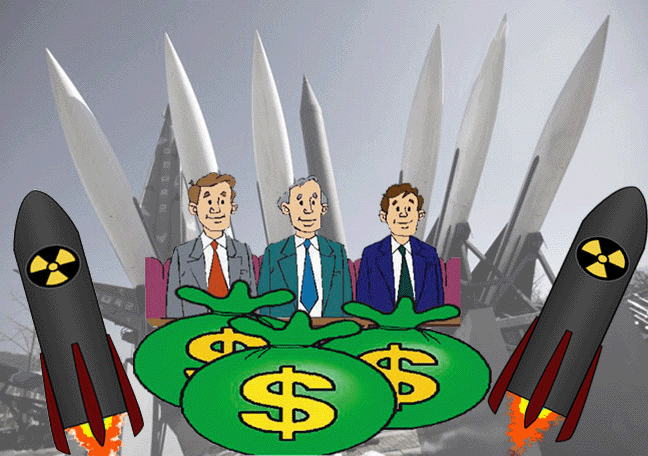
The US Military Is the Biggest “Big Government” Entitlement Program on the Planet , December 10, 2017, By JP Sottile, Truthout |The US economy is caught in a trap. That trap is the Department of Defense: an increasingly sticky wicket that relies on an annual, trillion-dollar redistribution of government-collected wealth. In fact, it’s the biggest “big government” program on the planet, easily beating out China’s People’s Liberation Army in both size and cost. It is not only the “nation’s largest employer,” with 2.867 million people currently on the payroll, but it also provides government benefits to 2 million retirees and their family members. And it actively picks private sector winners by targeting billions of dollars to an elite group of profit-seeking contractors.
The top five overall recipients collectively pulled in $109.5 billion in FY2016, and their cohorts consistently dominate the government’s list of top 100 contractors. They reap this yearly largesse through a Rube-Goldberg-like system of influence peddlers, revolving doors and wasteful taxpayer-funded boondoggles. Finally, it is all justified by a deadly feedback loop of perpetual warfare that is predicated on a predictable supply of blowback.
But this belligerent cash machine doesn’t just produce haphazard interventions and shady partnerships with a motley assortment of strongmen, proxies and frenemies. It also has Uncle Sam caught in a strange cycle of taxpayer-funded dependence that may ultimately be the most expensive — and least productive — jobs program in human history………
Too Big to Fail?
The US stands alone as a globe-spanning empire with 787 overseas bases, “lily pad” deployments and host country facilities in 88 nations and territories, according to the most recent accounting by scholar David Vine. At home, a Google Maps search reveals another 603 bases, depots, arsenals and assorted military facilities peppered around the 50 states. The US dominates the land, sea and skies, and is moving to dominate space…….
taxpayers’ only end product is a larger military with more bases and more weapons. However, without a serious shift toward non-defense government priorities, cutting the defense budget would mean, in the immediate term, many Americans losing their jobs. In the absence of non-military jobs programs and other forms of robust social spending, these workers depend on military tax dollars to fund their livelihoods, their health care and their kids’ educations. Tax dollars sustain the military-driven local and regional economies within which they live and work. Not coincidentally, this misallocated investment in a “war and weapons-based economy” is, as Major Gen. (Ret.) Dennis Laich and Col. (Ret.) Lawrence Wilkerson write, also reflected in the inherent “unfairness” that feeds off the “all-volunteer force.”……….
So, what are the options now that the US finds itself stuck in this paradigmatic trap? There are three possible alternatives.
One is to simply slash the budget. The downside is that it will dislocate millions of people who rely directly and indirectly on defense spending. The upside is that it will force an immediate retreat from both empire and military Keynesianism. This also could stoke some economic growth if the half to three-quarters of a trillion in annual savings was “returned” to taxpayers in the form of a rebate check. Basically, Americans would finally get the “peace dividend” almost 30 years after the Cold War ended.
The second option is the post-WWII demobilization model. That influx of manpower was met with the GI Bill, tax breaks for new homeowners and investments in infrastructure. This is a truly Keynesian solution. Infrastructure jobs and educational subsidies would provide relief to Americans currently reliant on military Keynesianism for their livelihoods. The original GI Bill “returned $7 to the American economy for every $1 invested in the GI Bill,” notes Jared Lyon of the Institute for Veterans and Military Families. And a study by Costs of War Project determined allocating resources to “clean energy and health care spending create 50 percent more jobs than the equivalent amount of spending on the military,” and “education spending creates more than twice as many jobs” as defense spending.
Frankly, either of these two solutions is far better than the third option, which is to continue to misallocate hundreds of billions in precious capital away from the productive economy while wreaking havoc at home and abroad. And that’s the ultimate no-win situation for a militarized economy that has manufactured its share of bloody, no-win situations since the end of World War II. http://www.truth-out.org/news/item/42829-the-us-military-is-the-biggest-big-government-entitlement-program-on-the-planet
Revelations that Westinghouse knew of nuclear reactor problems
Sounding new nuclear alarms https://www.postandcourier.com/opinion/editorials/sounding-new-nuclear-alarms/article_be2fb7ca-dc42-11e7-8c26-0305d23937e2.html Westinghouse knew, as far back as 2011, that its designs for two new nuclear reactors in South Carolina were virtually guaranteed to face construction delays and serious cost overruns.
A shocking document published on Friday by The Post and Courier reveals that a Westinghouse engineer raised several alarms about the viability of the reactor plans just two years after construction began.
Worse, it suggests that Westinghouse officials all but ignored the conclusions and proceeded with construction on the now abandoned reactors anyway.
“The AP1000 Design is not complete, although it is currently under construction,” reads the document. “This virtually assures large numbers of changes will occur to both systems and structures.”
The author estimated that related delays could cost as much as $300 million in “claims which will be difficult to defend.”
The report also drew attention to the fact that Westinghouse chose not to require a “professional engineer seal” on plans for the reactors, which could call into question both the designs’ legal status and whether they could be safely built.
That particular flaw, and the existence of the report, were both documented in a September article by The Post and Courier.
If state lawmakers and officials can prove that SCANA or Santee Cooper were aware of Westinghouse’s own internal concerns about the nuclear project as far back as 2011, it would be the most damning piece of evidence yet that the utilities acted imprudently in continuing to funnel money into the new reactors at customer expense.
Today, The Post and Courier is publishing a thorough investigation not just of the failure of the two South Carolina reactors, but of a number of other projects in other states that have cost electric ratepayers tens of billions of dollars.
The report paints a troubling picture of money and influence wielded to shape public policy that benefits electric utilities at the cost of their customers.
In South Carolina, the 2007 Base Load Review Act paved the way for a $9 billion nuclear disaster that could impact hundreds of thousands of ratepayers for the next six decades. The law passed with near unanimous support at the Statehouse.
At least 11 states have similar pieces of legislation. That leaves millions of people nationwide at risk of similarly devastating economic impacts.
Even if Westinghouse never mentioned its concerns to SCANA or Santee Cooper officials, the two South Carolina power companies certainly knew that they were facing problems. Cost overruns and delays plagued the project almost from the start.
Then in 2015, engineering firm Bechtel produced an alarming audit that raised numerous red flags about construction schedules, design flaws and other potentially fatal problems. But work continued and utility officials publicly touted the project’s progress.
That shameful duplicity insults the electric ratepayers of South Carolina, who are paying higher rates for the project, and are faced with years more without state intervention. The situation must be rectified by state lawmakers, regulatory officers and Gov. Henry McMaster when the Legislature returns to session in January.
And as today’s report confirms, other states should take notice.
North Korea – open to talks with USA?


 North Korea ready to open direct talks with US, says Russia’s Sergei Lavrov https://www.theguardian.com/world/2017/dec/07/north-korea-ready-direct-talks-us-sergei-lavrov
Pyongyang ‘wants above all to talk to the US about guarantees for its security’
Lavrov says he informed Rex Tillerson in Vienna on Thursday, Guardian, Julian Borger in Washington, 8 Dec 17, North Korea is open to direct talks with the US over their nuclear standoff, according to the Russian foreign minister, Sergei Lavrov, who said he passed that message to his counterpart, Rex Tillerson, when the two diplomats met in Vienna on Thursday.
There was no immediate response from Tillerson but the official position of the state department is that North Korea would have to show itself to be serious about giving up its nuclear arsenal as part of a comprehensive agreement before a dialogue could begin.
Lavrov conveyed the apparent offer on the day a top UN official, Jeffrey Feltman, met the North Korean foreign minister, Ri Yong-ho, in Pyongyang, during the first high-level UN visit to the country for six years. Feltman is an American and a former US diplomat, but the state department stressed he was not in North Korea with any message from Washington.
“We know that North Korea wants above all to talk to the United States about guarantees for its security. We are ready to support that, we are ready to take part in facilitating such negotiations,” Lavrov said at an international conference in Vienna, according to the Interfax news agency. “Our American colleagues, [including] Rex Tillerson, have heard this.”
The diplomatic moves come amid an increased sense of urgency to find a way of defusing the tensions over North Korea’s increasingly ambitious nuclear and missile tests. The standoff reached a new peak on 29 November, when North Korea tested a new intercontinental ballistic missile (ICBM), the Hwasong-15, capable of reaching Washington, New York and the rest of the continental United States. The missile launch followed the test of what was apparently a hydrogen bomb in September.
Pyongyang has said that current joint exercises by the US and South Korea involving hundreds of warplanes, along with “bellicose remarks” by US officials have “made an outbreak of war on the Korean peninsula an established fact”.
“The remaining question now is: when will the war break out,” a foreign ministry spokesman said on Wednesday.
North Korean officials have said in recent informal meetings that they are particularly concerned by the threat of a surprise “decapitation” strike, aimed at killing the country’s leaders and paralysing military command and control systems before Pyongyang could launch its missiles.
The heightened tensions and threatening language have increased fears around the world that the two sides could blunder into war through miscalculation, mistaking war games for a real attack or misreading blurred red lines.
US and North Korean positions are currently far apart, with Pyongyang rejecting any suggestion that its nuclear disarmament would be on the table at any future negotiation. The regime wants the US to recognise it as a nuclear weapons power and cease its “hostile policies” to North Korea, including sanctions and military manoeuvres off the Korean peninsula.
For its part, the US has rejected a “freeze-for-freeze” proposal advanced by Russiaand China, by which North Korea would suspend nuclear and missile tests while the US would curtail its military exercises.
State department spokeswoman Heather Nauert said on Thursday that direct talks with North Korea were “not on the table until they are willing to denuclearize.”
However, the two sides have had informal contacts this year, involving Joseph Yun, the US special representative for North Korea policy. Those contacts, known as the “New York channel” were cut by the North Koreans after threatening remarks by Donald Trump during the UN general assembly in September. But there have been some recent signs that Pyongyang might be interested in restoring the channel.
At a meeting in Stockholm that brought together western experts and officials from Pyongyang in late November, a North Korean representative appeared to raise, for the first time, the possibility of a channel for military-to-military communication with the US.
“In an informal discussion that we had in Stockholm, an official made an observation that there isn’t at present a way for the US and North Korea to work together to prevent an accident. I thought that was an interesting observation that I had not heard them say before,” said Suzanne DiMaggio, a senior fellow at the New America thinktank who has played a leading role in back-channel contacts with Iran and North Korea, and who attended the Stockholm meeting.
“I think the US would be best served by putting aside the focus on denuclearisation and instead look at ways to prevent accidents, reduce risks and de-escalate. Those to me seem like achievable goals.”
Sue Mi Terry, a former CIA analyst who was director for Korea, Japan and Oceanic affairs at the national security council in the Bush and Obama administrations, said Washington might be amenable to such a military hotline being established.
“I think even this administration recognises that some sort of an open channel is needed for that, not to negotiate but to have a little more transparency,” she said. “I think everyone recognises that is needed.”
Terry, who was deputy national intelligence officer for east Asia at the national intelligence council from 2009 to 2010, said that it was also possible that Yun could re-establish the New York channel with Pyongyang. But she added there was little sign such contacts would lead to substantive negotiations in the current climate.
“This latest test put a big hole in the possibility of negotiation at this moment, she said. “Ambassador Yun might do that but it’s different with the White House. I’m not sure he has strong White House support.”
USA internationally isolated as Donald Trump continues menacing North Korea
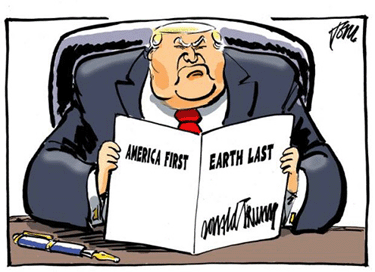 Donald Trump’s menacing talk on North Korea is leaving the US isolated https://www.theguardian.com/us-news/2017/nov/30/donald-trump-menacing-talk-north-korea-us-isolated
The US president seems oblivious to the consequences of war, and international support for his belligerence is weakening, Guardian, Simon Tisdall, 1 Dec 17, Donald Trump’s latest threat to destroy North Korea’s regime by force produced an angry response from Russia on Thursday. Yet elsewhere, the menacing talk from Washington was mostly met with uncomfortable silence.
While there is no shortage of international concern about Kim Jong-un’s latest, “breakthrough” missile test on Wednesday, Trump’s bellicose talk of war is rendering the US increasingly isolated.
Sergei Lavrov, Russia’s foreign minister, appeared to voice doubts shared by other countries when he claimed on Thursday that Trump was deliberately pushing Pyongyang towards military confrontation. “It seems they have done everything on purpose to make Kim lose control and make another desperate move,” he said.
Lavrov rejected imposing additional sanctions demanded by Trump. Lavrov suggested previously unscheduled US military exercises in December were part of an undisclosed plan to trigger a conflict. “The Americans need to explain to us all what they are actually up to. If they seek a pretext to destroy North Korea, they should openly say so.”
Reacting to Wednesday’s test, Trump’s ambassador to the UN, Nikki Haley, upped the ante again, pinning blame wholly on Kim’s shoulders. “If war does come, it will be because of continued acts of aggression like we witnessed yesterday … If war comes, make no mistake, the North Korean regime will be utterly destroyed,” she said.
It’s a view rejected by China which, like Russia, has repeatedly urged Trump to halt the military buildup and start talking. The official China Daily said opportunities created by Beijing to launch a dialogue had been “casually wasted” by the US. By re-designating North Korea as a sponsor of state terrorism, Trump had reignited a crisis that had abated since September, the paper said.
Trump’s uncanny ability to lose friends and alienate people makes it unlikely Xi Jinping, China’s president, will heed his latest appeal, made in a personal telephone call, for a full oil embargo on North Korea.
Trump continues to taunt Kim. Speaking in Missouri this week, he added the insult “sick puppy” to his previous, mocking description of Kim as “little rocket man”. This kind of playground name-calling and casual presidential rudeness is becoming familiar to allies as well as foes, as Theresa May discovered this week.
Whatever his military advisers may be telling Trump about the feasibility of “taking out” Kim’s regime, there seems scant understanding in Trump’s White House of the human, political and diplomatic consequences of forcible regime change. The US relationship with Xi’s China would be wrecked by any unilateral, potentially illegal military action in Beijing’s backyard. It could dash Trump’s hopes for more balanced economic ties. It might also induce China to increase defence spending and redouble its efforts to supplant the US as the Asia-Pacific’s leading military power.
Russia would take full advantage of such a rift, which could extend to the US-Europe and Nato relationships. It cannot be assumed the western alliance, frequently denigrated by Trump, would support the US in such a scenario. On past form, France and Germany would be reluctant to back what most of the world would certainly view as US aggression against a weaker adversary. The split over Iraq in 2003 might be magnified many times over.
An outbreak of hostilities undoubtedly risks large-scale loss of life. Even if North Korea failed to retaliate effectively – a big if – public and political outrage in South Korea and Japan would seriously damage America’s regional interests. Japan’s hawkish prime minister, Shinzo Abe, a Trump golf buddy, would be likely to face a fierce backlash. There would be renewed pressure to close US bases in both countries.
Meanwhile, the negative effect on the global economy, stock markets, oil prices and business can only be guessed at. Trump’s obliviousness to the possible consequences of his actions is the main reason why international support for Washington’s increasingly menacing stance seems to be weakening, even as the North Korean conundrum intensifies. By threatening Armageddon, Trump may ensure Kim wins.
President Trump throws a diplomatic bomb into the Middle East peace process
 With Jerusalem Move, Trump Sabotages His Own Mideast Peace Process, By Robin Wright December 6, 2017
Climate crisis in America – California’s wildfires
California’s Climate Emergency, Rolling Stone, By Eric Holthaus, 8 Dec 17 Fires continue to burn Southern California, and climate scientists have warned us for years that the region was entering a year-round fire regime In the hills above the Pacific Ocean, the world crossed a terrifying tipping point this week.
As holiday music plays on the radio, temperatures in Southern California have soared into the 80s, and bone-dry winds have fanned a summer-like wildfire outbreak. Southern California is under siege.
As the largest of this week’s fires skipped across California’s famed coastal highway 101 toward the beach, rare snowflakes were falling in Houston, all made possible by a truly extreme weather pattern that’s locked the jet stream into a highly amplified state. It’s difficult to find the words to adequately describe how weird this is. It’s rare that the dissonance of climate change is this visceral.That one of California’s largest and most destructive wildfires is now burning largely out of control during what should be the peak of the state’s rainy season should shock us into lucidity. It’s December. This shouldn’t be happening.
The Thomas fire is the first wintertime megafire in California history. In a state known for its large fires, this one stands out. At 115,000 acres, it’s already bigger than the city of Atlanta. Hundreds of homes have already been destroyed, and the fire is still just 5 percent contained.
In its first several hours, the Thomas fire grew at a rate of one football field per second, expanding 30-fold, and engulfing entire neighborhoods in the dead of night. Hurricane force winds have produced harrowing conditions for firefighters. Faced with such impossible conditions, in some cases, all they could do is move people to safety, and stand and watch.
“We can’t control it,” firefighter and photographer Stuart Palley told me from a beach in Ventura. “In these situations, you can throw everything you’ve got at it, tanker planes dropping tens of thousands of gallons of flame retardant, thousands of firefighters, hundreds of engines, you can do everything man has in their mechanical toolbox to fight these fires and they’re just going to burn and do whatever the hell they want. We have to learn that.” As we spoke, another wall of flames crested a nearby ridge, reflecting its orange glow off the sea.
The Thomas fire isn’t the only one burning right now. At least six major fires threaten tens of thousands of homes and have forced hundreds of thousands of people to flee in recent days. “California fires enter the heart of Los Angeles” read one New York Timesheadline, a statement so dire it could double as a plot synopsis in a nearby Hollywood movie studio. Million-dollar mansions in Bel Air were evacuated, and the 405 freeway, one of L.A.’s busiest, was transformed into a dystopian hellscape during the morning commute. Ralph Terrazas, the Los Angeles fire chief, called the conditions the worst he’s seen in his entire 31-year career. “There will be no ability to fight fires in these kinds of winds,” said Ken Pimlott, the state fire chief. Shortly after these statements, state officials sent an unprecedented push notification to nearly everyone in Southern California, ominously warning millions of people to “stay alert.”
For years, climate scientists have warned us that California was entering a year-round fire regime. For years, climate campaigners have been wondering what it would take to get people to wake up to the urgency of cutting fossil fuel emissions. For years, we’ve been tip-toeing as a civilization towards a point of no return.
That time is now.
The advent of uncontrollable wintertime megafires in California is a turning point in America’s struggle to contain the impacts of a rapidly changing climate. …….http://www.rollingstone.com/culture/features/southern-california-wildfires-climate-change-emergency-w513659
1 This Month





PLEASE OPPOSE HR 8255 AND S.3639 – bills would accelerate satellite deployment, with no environmental review or safeguards – https://ncstd5li.quorum.us/campaign/169331/
To see nuclear-related stories in greater depth and intensity – go to https://nuclearinformation.wordpress.com
-
Archives
- October 2026 (58)
- September 2026 (339)
- August 2026 (330)
- July 2026 (355)
- June 2026 (287)
- May 2026 (306)
- April 2026 (356)
- March 2026 (251)
- February 2026 (267)
- January 2026 (308)
- December 2025 (358)
- November 2025 (359)
-
Categories
- 1
- 1 NUCLEAR ISSUES
- business and costs
- climate change
- culture and arts
- ENERGY
- environment
- health
- history
- indigenous issues
- Legal
- marketing of nuclear
- media
- opposition to nuclear
- PERSONAL STORIES
- politics
- politics international
- Religion and ethics
- safety
- secrets,lies and civil liberties
- spinbuster
- technology
- Uranium
- wastes
- weapons and war
- Women
- 2 WORLD
- ACTION
- AFRICA
- Atrocities
- AUSTRALIA
- Christina's notes
- Christina's themes
- culture and arts
- Events
- Fuk 2022
- Fuk 2023
- Fukushima 2017
- Fukushima 2018
- fukushima 2019
- Fukushima 2020
- Fukushima 2021
- general
- global warming
- Humour (God we need it)
- Nuclear
- RARE EARTHS
- Reference
- resources – print
- Resources -audiovicual
- Weekly Newsletter
- World
- World Nuclear
- YouTube
-
RSS
Entries RSS
Comments RSS

