Trump administration keen for nuclear power, – so is Joe Biden
 Trump Administration Pivots To Nuclear Energy, Finds Lever Against China, Russia, Forbes, Dipka Bhambhani, 9 Aug 20, Trump Administration Pivots To Nuclear Energy, Finds Lever Against China, Russia, Forbes, Dipka Bhambhani, 9 Aug 20, Expanding U.S. commercial nuclear power abroad could become the Trump administration’s strongest lever against Chinese hegemony and Russian expansion in the global market. The U.S. Department of Energy, which is leading the national initiative, is on an aggressive timeline—five to seven years—to bring new advanced nuclear reactors for electric power to the international market. A senior Energy Department official told Forbes it’s a matter of national security……. a year ago, President Trump asked his Energy Secretary, Dan Brouillette, to assemble a nuclear energy working group to find ways to expand the U.S. nuclear energy industry in an effort to compete globally. ……
This May, DOE released Restoring America’s Competitive Nuclear Energy Advantage, a blueprint to transform a U.S. nuclear industry notorious for massive facilities, long construction timelines, cost overruns and a sour public opinion.
Baranwal has launched the $230 million Advanced Reactor Demonstration Program (ARDP) currently calling on the U.S. private sector to apply to demonstrate they can construct smaller, more efficient, more affordable advanced reactors that can be commercially available within five to seven years. Applications are due August 12.
…..the issue is bipartisan, giving it breath to continue regardless of who wins in the presidential election in November.
For about a dozen years, the U.S. government poured money into nuclear energy research and development (R&D) at DOE’s national laboratories. Now, the U.S. government will use those existing platforms, resources, materials and expertise to help commercialize private sector innovation and bring new nuclear reactors to the world market. ……. Government Financing for Nuclear is Lining Up DOE’s blueprint tacitly instructed the U.S. Development Finance Corporation (DFC), formerly the Overseas Private Investment Corporation, to remove legacy policies that prevented it from investing in nuclear power projects overseas. A few weeks ago, DFC did just that. It said it would “prioritize support of advanced nuclear technology in emerging and frontier markets that adheres to the highest safety standards.” DOE also cited a role for the U.S. Export-Import Bank (EXIM Bank). Last November, Republican and Democratic lawmakers agreed to President Trump’s request to reauthorize the country’s export credit agency. EXIM Bank is chartered to finance and facilitate the sale of U.S.-made products for export. Forbes reported extensively on the long-term value of the reauthorization, proving useful for global nuclear energy. …… Chinese officials told Forbes the country would be willing to sign new 123 agreements with the U.S. and welcomes continued cooperation, not an adversarial relationship. China and the U.S. established a 123 agreement about two decades ago led by the DOE’s assistant secretary of international affairs in the Clinton administration, Robert Gee, now president of Gee Strategies Group in Washington. Zheng Dongdong, director of China’s Department of Energy Research, said, “Nuclear energy expansion is a global issue that should be considered with global perspective.” Zheng is also China’s assistant secretary-general of the Energy Investment Professional Committee under the Investment Association of China, an administrative arm of China’s Ministry of Civil Affairs, which promotes global investment in China. Zheng said the energy relationship with the U.S. has not always been strained. In 2007, China, the United States, France, Japan, and Russia jointly established the Global Nuclear Energy Partnership, a multilateral effort to share R&D of advanced nuclear energy technologies, adopt safe, reliable global nuclear energy power systems and promote nonproliferation. “This is a good platform and a very effective means to strengthen global nuclear energy cooperation,” Zheng said…… https://www.forbes.com/sites/dipkabhambhani/2020/08/07/trump-administration-pivots-to-nuclear-energy-finds-lever-against-china-russia/#70baa6f547b1 |
|

Nuclear testing: ‘Why do we need to start a new arms race?’
|
Nuclear testing: ‘Why do we need to start a new arms race?’
Provision in National Defense Authorization Act to ban testing, Big Country, by: Alexandra Limon Aug 7, 2020 WASHINGTON (Nexstar) — The United States has not conducted live nuclear weapons tests for 28 years. But reports indicate the Trump Administration has discussed re-starting the nuclear testing program.
That has Democrats from the areas impacted by past testing — in Nevada and Utah — pushing a provision in this year’s National Defense Authorization Act to ban new nuclear tests. “It would prevent this administration or any in the future from using funds to restart nuclear weapons testing,” said Nevada Rep Dina Titus, who introduced the bill with support from Utah’s Ben McAdams. “Thousands and thousands of Utahns have developed cancer and died from those tests. And I think it’s important that we don’t see that testing resume,” he said. The ban on live nuclear testing was included in the House version of the NDAA, but it’s unclear if it will make it into the final version. “We can test our stockpile without doing tests with yield and our scientists have been doing it for over 20 years,” Titus said. “Why do we need to start a new arms race?”……. The National Defense Authorization Act likely won’t be finalized until after the November election. https://www.bigcountryhomepage.com/news/politics/nuclear-testing-why-do-we-need-to-start-a-new-arms-race/ |
|
Anti-nuclear protests at Kings Bay Naval Submarine Base
Anti-nuclear protests at Kings Bay https://thebrunswicknews.com/news/local_news/anti-nuclear-protests-at-kings-bay/article_8ac11cdb-6416-579b-b298-961419776e2a.html By GORDON JACKSON gjackson@thebrunswicknews.com ST. MARYS 7 Aug 20,
Organizers of an annual protest against nuclear weapons at Naval Submarine Base Kings Bay expected a large crowd to commemorate the 75th anniversary of the first atomic bomb dropped on Hiroshima, Japan, to help hasten the end of World War II.
Five people ended up standing outside a base gate Thursday holding signs with anti-nuclear weapons messages.
Glenn Carroll, coordinator of Nuclear Watch South, said the ongoing COVID-19 pandemic compelled many who were planning to attend to stay home for health concerns. But Carroll said her trip from Atlanta to join others with concerns about nuclear weapons Thursday was worth the time.
“Our mission is to stop the arms race,” Carroll said. “It’s a security risk and phenomenally expensive. This has become a business model and it’s deadly.”
Kings Bay is home to six ballistic missile submarines and two guided missile submarines. The base employs more than 9,000 civilian workers and active-duty sailors. Supporters say the ballistic missile submarines are a vital deterrent to nuclear attack.
“Thank God they were non violent,” she said. “They did highlight you cannot secure this base with this kind of power. It’s called an illusion of security.”
Grady said the military’s priorities “are all messed up” by continuing to develop powerful nuclear weapons.
“There is nothing they can do but kill,” she said.
She also expressed concerns about the length of time the growing stockpile of nuclear waste will need to be contained.
Carroll said she and others will continue to share their concerns about nuclear weapons. While Carroll said she’s anti-nuclear, she’s not anti-military.
“We need a defense,” she said. “We don’t need a weapons system unmatched on this planet.”
Another Hiroshima is Coming…Unless We Stop It Now
Today, an unprecedented campaign of propaganda is shooing us all off like rabbits. We are not meant to question the daily torrent of anti-Chinese rhetoric, which is rapidly overtaking the torrent of anti-Russia rhetoric. Anything Chinese is bad, anathema, a threat: Wuhan …. Huawei. How confusing it is when “our” most reviled leader says so.
The target is China. Today, more than 400 American military bases almost encircle China with missiles, bombers, warships and nuclear weapons. From Australia north through the Pacific to South-East Asia, Japan and Korea and across Eurasia to Afghanistan and India, the bases form, as one US strategist told me, “the perfect noose”.
In the Sydney Morning Herald, tireless China-basher Peter Hartcher described those who spread Chinese influence in Australia as “rats, flies, mosquitoes and sparrows”. Hartcher, who favourably quotes the American demagogue Steve Bannon, likes to interpret the “dreams” of the current Chinese elite, to which he is apparently privy. These are inspired by yearnings for the “Mandate of Heaven” of 2,000 years ago. Ad nausea.
To combat this “mandate”, the Australian government of Scott Morrison has committed one of the most secure countries on earth, whose major trading partner is China, to hundreds of billions of dollars’ worth of American missiles that can be fired at China.
At a quarter past eight on the morning of August 6, 1945, she and her silhouette were burned into the granite.
I stared at the shadow for an hour or more, then I walked down to the river where the survivors still lived in shanties.
I met a man called Yukio, whose chest was etched with the pattern of the shirt he was wearing when the atomic bomb was dropped.
He described a huge flash over the city, “a bluish light, something like an electrical short”, after which wind blew like a tornado and black rain fell. “I was thrown on the ground and noticed only the stalks of my flowers were left. Everything was still and quiet, and when I got up, there were people naked, not saying anything. Some of them had no skin or hair. I was certain I was dead.”
Nine years later, I returned to look for him and he was dead from leukaemia.
“No radioactivity in Hiroshima ruin” said The New York Times front page on 13 September, 1945, a classic of planted disinformation. “General Farrell,” reported William H. Lawrence, “denied categorically that [the atomic bomb] produced a dangerous, lingering radioactivity.”
Only one reporter, Wilfred Burchett, an Australian, had braved the perilous journey to Hiroshima in the immediate aftermath of the atomic bombing, in defiance of the Allied occupation authorities, which controlled the “press pack”.
“I write this as a warning to the world,” reported Burchett in the London Daily Express of September 5,1945. Sitting in the rubble with his Baby Hermes typewriter, he described hospital wards filled with people with no visible injuries who were dying from what he called “an atomic plague”.
For this, his press accreditation was withdrawn, he was pilloried and smeared. His witness to the truth was never forgiven.
The atomic bombing of Hiroshima and Nagasaki was an act of premeditated mass murder that unleashed a weapon of intrinsic criminality. It was justified by lies that form the bedrock of America’s war propaganda in the 21st century, casting a new enemy, and target – China.
During the 75 years since Hiroshima, the most enduring lie is that the atomic bomb was dropped to end the war in the Pacific and to save lives.
“Even without the atomic bombing attacks,” concluded the United States Strategic Bombing Survey of 1946, “air supremacy over Japan could have exerted sufficient pressure to bring about unconditional surrender and obviate the need for invasion. “Based on a detailed investigation of all the facts, and supported by the testimony of the surviving Japanese leaders involved, it is the Survey’s opinion that … Japan would have surrendered even if the atomic bombs had not been dropped, even if Russia had not entered the war [against Japan] and even if no invasion had been planned or contemplated.”
The National Archives in Washington contains documented Japanese peace overtures as early as 1943. None was pursued. A cable sent on May 5, 1945 by the German ambassador in Tokyo and intercepted by the US made clear the Japanese were desperate to sue for peace, including “capitulation even if the terms were hard”. Nothing was done.
The US Secretary of War, Henry Stimson, told President Truman he was “fearful” that the US Air Force would have Japan so “bombed out” that the new weapon would not be able “to show its strength”. Stimson later admitted that “no effort was made, and none was seriously considered, to achieve surrender merely in order not to have to use the [atomic] bomb”.
Stimson’s foreign policy colleagues — looking ahead to the post-war era they were then shaping “in our image”, as Cold War planner George Kennan famously put it — made clear they were eager “to browbeat the Russians with the [atomic] bomb held rather ostentatiously on our hip”. General Leslie Groves, director of the Manhattan Project that made the atomic bomb, testified: “There was never any illusion on my part that Russia was our enemy, and that the project was conducted on that basis.”
The day after Hiroshima was obliterated, President Harry Truman voiced his satisfaction with the “overwhelming success” of “the experiment”.
The “experiment” continued long after the war was over. Between 1946 and 1958, the United States exploded 67 nuclear bombs in the Marshall Islands in the Pacific: the equivalent of more than one Hiroshima every day for 12 years. Continue reading
NuScam’s (sort of) small nuclear reactors rejected by Utah Taxpayers Association

Critics of planned nuclear power project urge Utah cities to pull out before it’s too late, Utah Taxpayers Association warns it believes proposal is too costly, not transparent DeseretNews, By Amy Joi O’Donoghue@Amyjoi16 Aug 4, 2020 SALT LAKE CITY — The Utah Taxpayers Association and a former member of the U.S. Nuclear Regulatory Commission are urging cities that have signed on to a planned nuclear power plant in Idaho to get out while they can before costs become too great.
NuScale’s Small Modular Reactor is planned for construction at the Idaho National Laboratory near Idaho Falls and would provide 720 megawatts of power, or enough energy for 720,000 homes.
The Carbon Free Power Project is promoted as the next generation design for nuclear power, featuring 12 distinct modules, with the first scheduled to come online in 2029 with the 11 others following the next year.
The project is a collaborative effort involving the U.S. Department of Energy, NuScale and the Utah Associated Municipal Power Systems, a political subdivision of the state of Utah. ……
there are several off-ramps in those phases for cities to exit, one of which is coming up Sept. 14. That deadline prompted the taxpayers association to urge cities to get out now before they get trapped into paying millions for a technology it says is unproven.
“Small modular reactor power is just not cost competitive,” said Rusty Cannon, vice president of the taxpayer group, adding participating cities and districts should hold a public vote to withdraw from the project……..
Peter Bradford, a former member of the U.S. Nuclear Regulatory Commission, said enthusiasm over new developments in nuclear technology that turned out to be flawed have cost ratepayers and taxpayers in multiple states billions of dollars.
He said that of 31 projects pending before the commission in 2009, only two remain — with the rest canceled or indefinitely postponed.
“The stranded costs of nuclear plants paid off by customers in the 1990s exceeded $50 billion nationwide,” he said. “Each period of abject failure is followed by an array of new proposals.”…….
The project is backed heavily by the U.S. Department of Energy, which gave NuScale a competitive award of $226 million in 2013 to develop the technology. Two years later, the federal agency gave NuScale $16.7 million for licensing preparation……..
Cannon and Bradford also criticized the municipal power association for not being transparent enough because its briefing meetings are exempt from the Utah open meetings law and are closed……… https://www.deseret.com/utah/2020/8/4/21354171/critics-nuclear-power-project-urge-utah-cities-pull-out-nuscale-small-modular-reactor-idaho
USA could save millions of lives, by combating global heating
 US could avoid 4.5M early deaths by fighting climate change, study finds
https://thehill.com/policy/energy-environment/510726-us-could-avoid-45m-early-deaths-by-fighting-climate-change-study BY REBECCA BEITSCH – 08/05/20
The U.S. stands to avoid 4.5 million premature deaths if it works to keep global temperatures from rising by more than 2 degree Celsius, according to new research from Duke University.
The same study found working to limit climate change could prevent about 3.5 million hospitalizations and emergency room visits and approximately 300 million lost workdays in America.
“The avoided deaths are valued at more than $37 trillion. The avoided health care spending due to reduced hospitalizations and emergency room visits exceeds $37 billion, and the increased labor productivity is valued at more than $75 billion,” Drew Shindell, a professor at Duke University, told lawmakers Wednesday.
On average, this amounts to over $700 billion per year in benefits to the U.S. from improved health and labor alone, far more than the cost of the energy transition.”
Shindell, who conducted the study alongside researchers at NASA, unveiled the findings during a House Oversight Committee hearing on the economic and health consequences of climate change.
The study aimed to show the benefits to the U.S. if the nation sticks with the goal of the Paris Climate Accord, which President Trump has formally moved to leave. The U.S. cannot officially exit the agreement until Nov. 4 — the day after the presidential election.
Shindell encouraged committee members to transition away from fossil fuels, a move that would help ease climate change while also spurring health benefits from reduced air pollution.
The benefits could be seen in the relatively short term.
“Roughly 1.4 million lives could be saved from improved air quality during the next 20 years. As we’ve seen with the coronavirus lockdowns in many places, air pollution responds immediately to emissions reductions,” he said.
“Our work shows that action now means benefits now.”
Democrats have introduced a number of bills to combat climate change, but they’ve failed to get much traction.
The House passed a $1.5 trillion green infrastructure package in July, but the Republican-led Senate isn’t expected to take it up.
Just one day earlier, the House Select Committee on the Climate Crisis unveiled its road map for solving the climate crisis.
Committee Chair Carolyn Maloney (D-N.Y.) said lawmakers need to focus on tackling the problem despite the current coronavirus pandemic.
“Handling one crisis does not negate our responsibility to face another.”
Bribery scandal haunts Exelon – casts doubt on future of Exelon’s Illinois Nuclear Plants
 ComEd Bribery Scandal Clouds Picture for Exelon’s Illinois Nuclear Plants ComEd Bribery Scandal Clouds Picture for Exelon’s Illinois Nuclear Plants
Exelon wants state legislation to keep its Illinois nuclear plants open. Subsidiary ComEd’s involvement in a bribery scandal is not helping politically. GreenTech Media, JEFF ST. JOHN AUGUST 04, 2020 Exelon may be forced to close its Illinois nuclear plants if state legislation is not passed to bolster their eroding financial prospects. But subsidiary utility Commonwealth Edison’s involvement in a bribery scandal has complicated this and other key policy efforts in its home state.CEO Chris Crane outlined these challenges during the Chicago-based utility’s second-quarter earnings conference call on Tuesday. Last month, ComEd agreed to pay a $200 million fine as part of a deferred prosecution agreement with federal prosecutors to avoid criminal liability in an alleged bribery scheme involving Illinois House Speaker Michael Madigan. ……. Exelon owns the country’s largest nuclear generating fleet and other generation assets; it operates utilities in Illinois, Maryland, Delaware and Washington, D.C. …… Exelon’s nuclear plants hang in the balanceA December decision from the Federal Energy Regulatory Commission is forcing mid-Atlantic grid operator PJM to impose minimum prices on a wide array of state-supported grid resources. That rule is expected to include Exelon’s Clinton and Quad Cities nuclear power plants, which receive hundreds of millions of dollars per year in zero-emissions credits created by Illinois’ Future Energy Jobs Act. Exelon is seeking to extend the zero-emissions credits to its Braidwood, Byron and Dresden nuclear plants, which failed to clear PJM’s last capacity auction in 2018 and could face early retirement without additional financial support. While FERC has not approved PJM’s plan to comply with its order, and PJM has not yet set a date to resume its long-delayed capacity auction, “there’s a strong sense…that some of the nuclear units will not be picked up in that auction” when it occurs, Crane said. “Some are uneconomic right now, and some may become uneconomic.” …….. the bribery scandal has driven a wedge between the utility and state lawmakers, while the COVID-19 pandemic forced the legislature to curtail much of its work this spring and focus on responses to the public health crisis. The Clean Energy Jobs Act failed to move ahead during an emergency session in May, as did an alternative, less ambitious clean energy bill called Path to 100. llinois Governor JB Pritzker suspended the Energy Working Group involved in crafting the Clean Energy Jobs Act after the deferred prosecution agreement was announced, saying through a spokesperson that future legislation “will not be written by utility companies.” …….Absent a legislative solution to Exelon’s nuclear plants’ challenges in Illinois, Crane said, “If we can’t find…a path to profitability, we will have to shut them down.” But Exelon “will not allow the balance sheet to be further deteriorated by operating noneconomic assets,” he said. Exelon has successfully won zero-carbon credits in New York and New Jersey, but it has also laid plans to shut down its Three Mile Island nuclear plant in Pennsylvania if that state does not create similar supports. Formula rate extension and Chicago grid takeover both remain uncertain ComEd also faces an uphill battle in efforts to win an extension of a plan in place since 2011 that allows it to file its capital expansion plans under formula rate updates, rather than through a traditional rate-making process with the Illinois Commerce Commission. A bill that would have extended the formula rate structure past its 2022 expiration failed to pass the legislature this year
………. the utility’s $9.53 billion capital plan for 2020 through 2023, which will take effect under the formula rate structure, will add more than $5 billion to its capital rate base and lead to price hikes for customers in future years. ……. https://www.greentechmedia.com/articles/read/comed-bribery-scandal-affects-exelons-illinois-nuclear-plants-ratemaking-policy
|
|
|
Utah Taxpayers – NuScam nuclear power project costly and public kept in the dark
 New Information Disclosed in Meeting Closed to Public Points to Major Budget Commitments, Delay Risks in UAMPS Power Project https://utahtaxpayers.org/new-information-disclosed-in-meeting-closed-to-public-points-to-major-budget-commitments-delay-risks-in-uamps-nuclear-power-project/
by Tax Watchdog | Aug 4, 2020 “We Need Public Hearings and We Need Public Votes”: UTA Calls for Full Transparency and Accountability Ahead of September 14th Deadline; Parallels Seen to Ohio, Illinois and South Carolina Nuclear Controversies Where Public Was Kept in the Dark.
SALT LAKE CITY – August 4, 2020 – Utah Associated Municipal Power Systems (UAMPS) and NuScale Power held an “online town hall meeting” on July 21st, but there was just one problem: due to a quirk in Utah’s open meeting laws, the town was not invited. Not only did UAMPS/NuScale fail to be transparent in terms of the meeting about their controversial small modular nuclear reactor plans, but they also failed to disclose new and troubling information that emerged during the behind-closed-doors virtual session, according to the nonprofit Utah Taxpayers Association (UTA). UTA and Peter Bradford, a former U.S. Nuclear Regulatory Commission (NRC) member, warned that potentially higher costs, project delays, and other risks could be costly for UAMPS members and ratepayers.
A total of 34 municipalities in Utah, Idaho, New Mexico and California (see full list below) are participating in the UAMPS small modular nuclear project. Ratepayers will be locked into more than $100 million in commitments by a September 14th deadline and billions of dollars of risks later on if UAMPS members do not opt out of the project. The need for openness is particularly important while the nuclear industry is currently facing major credibility problems with scandals in Ohio, Illinois, and South Carolina.
On July 21st, UAMPS and NuScale held a so-called “online town hall meeting,” which was not made open to the media under a special Utah exemption for UAMPS for open meeting requirements. A video copy of the UAMPS/NuScale event was acquired after the fact. (The timecodes shown below refer to various points in the video.)
Rusty Cannon, Vice President, Utah Taxpayers Association, said: “The UAMPS project will lock in 27 municipalities in Utah and several in surrounding states for a share of billions of dollars in costs and unclear risk in the pursuit of a cluster of small modular reactors (SMRs) touted by Oregon-based NuScale Power, which repeatedly has delayed timelines and increased costs associated with its SMRs.”
Cannon added: “This risky project with massive cost escalations is being conducted largely out of the public eye. Most recently the public was barred from a late July online ‘town hall meeting,’ the content of which has since come to light and which raises serious concerns about what has not been disclosed to the general public. The Utah Taxpayers Association urges elected officials involved with UAMPS to disclose all relevant information to the public so decisions can be made in the open and city officials can be held accountable. We are urging city councils in Utah that are subscribed to the project to vote in a public meeting before the September deadline to withdraw from the project.”
Also speaking at today’s news event was Peter Bradford, a former member of the U.S. Nuclear Regulatory Commission who served as chair of both the New York Public Service Commission and the Maine Public Utilities Commission. He has been an expert witness in many cases involving nuclear power economics, and he has taught Nuclear Power and Public Policy at the Vermont Law School as well as Energy Policy and Environmental Protection at the Yale School of the Environment.
Peter Bradford said: “There is the very real possibility of large rate increases to the customers in these communities due to inadequate safeguards in this project. It is difficult to understand the case for taking on this risk given the certainty of cheaper clean energy alternatives as clearly shown by recent purchases of firm combinations of renewables, energy efficiency plus storage elsewhere in the West. The cost of lack of transparency plus unwise and secretive deals has resulted in the nuclear energy industry becomingembroiled in multiple debacles. UAMPS members and ratepayers should take heed and avoid making the same mistakes.”
Just what is UAMPS and NuScale failing to disclose to the public?
- RAPIDLY ESCALATING CONSTRUCTION COSTS. NuScale’s website currently explains to the public: “The estimated construction cost for the first NuScale 684 MWe (net) plant is about $3 billion.” However, during the July 2020 “town hall,” UAMPS contractor Bob Squires (MPR Associates) calls the project a “roughly $5 billion nuclear power plant development project with first of a kind technology.” (3:47:24) Even worse: NuScale’s 2020 Amended Budget & Plan of Finance projects a total cost of approximately $6.1 billion.
- MAJOR MISSED DEADLINES. In 2008, NuScale explained: “With timely application for a combined construction and operating license (COL), a NuScale plant could be producing electricity by 2015-16.” In 2019, UAMPS publicly announced that the NuScale nuclear power plant would begin construction in 2023, “with the first 60 MW module becoming operational in 2026 [and] [o]ther modules would come on-line soon thereafter.” However, during the non-public July “town hall,” Glenn Neises, nuclear director, Burns & McDonnell, announced for the first time that completion is now projected for June 2030, and the first module is not expected to become operational until June 2029. (3:22:25) And things could get even worse. Warning of possible new delays, Neises said: “I’d also like to stress that this is the current schedule and expect it to change as we see changes in funding, engineering moves forward, and as licensing advances.” (3:22:25)
-
- LOW-BALLED ENERGY PRICE. Doug Hunter, UAMPS CEO, said an undisclosed Economic Competitiveness Test (ECT) determined the UAMPS project power that could be generated would cost $55/MWh in 2018 dollars. (24:30) The UAMPS/NuScale estimate contrasts sharply with other independent utility projections (PacifiCorp’s estimate of $95/MWh and Idaho Power’s estimate of $125/MWh). Doug Hunter confirms this in answering a question as to why large investor-owned utilities are not pursuing this project: “Right now they’re still relying on existing capacity, most of them, to fill in energy with renewables because that happens to be the lowest IRP.” (2:28:20)
- DEPENDENCE ON UNPREDICTABLE FEDERAL SUBSIDIES. Mason Baker, UAMPS chief legal officer, admitted during the “town hall” that project organizers are now banking on a “massive increase” in the federal government’s contribution to UAMPS, a jump from $60 million to $1.4 billion. (48:30) UAMPS now acknowledges taxpayer subsidies are necessary to achieve the $55 per MW/h price point. (53:50) In effect, U.S. taxpayers are being asked to subsidize roughly 25 percent of the UAMPS SMR project to artificially hold down energy costs. However, taxpayer subsidies of this sort are both objectionable on their merits, entirely unpredictable as to passage, and subject to being withdrawn at any time.
- The Utah Taxpayers Association also noted that no town or city of more than 100,000 has opted into the UAMPS SMR project, which has not been successful in securing investments in it by investor-owned utilities. It is not apparent that any UAMPS member so far opting into the SMR project has been able to afford to do its own independent financial evaluation of the project, and, instead, may be over relying on assurances from the promoter, NuScale. Committing a municipal government to a long-term contract of this magnitude could result in massive sunk costs and higher rates and taxes on citizens.
- The following are the UAMPS members currently subscribed to the SMR project: Utah (Beaver City, Blanding, Bountiful, Brigham City, Enterprise, Ephraim City, Fairview City, Fillmore City, Heber City Light & Power, Holden Town, Hurricane City, Hyrum City, Kanosh Town, Kaysville City, Lehi, Logan City, Monroe City, Morgan City, Mt. Pleasant City, Murray City, Oak City, Paragonah Town, Parowan, Payson City, Santa Clara City, South Utah Valley Electric Service District, Spring City, Washington City, and Weber Basin Conservancy District); Idaho (Idaho Falls Power and Salmon River Electric Cooperative, Inc.); California (Lassen Municipal Utility District and Plumas-Sierra Rural Electric Cooperative); and New Mexico (Los Alamos County). The total size of the subscriptions is 160.4 megawatts, with 133.4 megawatts going to the state of Utah.
The Utah Taxpayers Association is a non-profit 501(c)(4) organization that works to limit state and local taxes, making Utah an attractive place to live and do business. www.utahtaxpayers.org
Important note: The Utah Taxpayers Association has no position on nuclear energy. The Association’s interest in this matter is limited to the extent to which public business of interest to ratepayers/taxpayers is conducted in an open and transparent manner in order to ensure maximum accountability to the public.
Joe Biden’s pro nuclear plan ignores the nuclear waste question
|
Biden’s Clean Energy Plan Will Fix Everything and Nothing https://www.realclearenergy.org/articles/2020/07/31/bidens_clean_energy_plan_will_fix_everything_and_nothing_500581.html. By Oliver McPherson-Smith, July 31, 2020
The year 2020 has been one of upheaval and change, but the American love for the outdoors has remained constant. Unsurprisingly, climate change and protecting the environment are two key issues in this year’s election cycle. To pitch his vision for the future, former vice president Joe Biden has unveiled his revamped plan “to build a modern, sustainable infrastructure and an equitable clean energy future.” However, for a plan that takes aim at greenhouse emissions, the manifesto is filled with an excessive amount of hot air. Flashy spending targets and en vogue nomenclature are an unsustainable alternative to detailed policy.
The 7,000-word plan draws from the Democratic nominee’s initial climate plan, albeit renovated in light of the Coronavirus pandemic and the suggestions of Bernie Sanders and John Kerry. At the cost of $2 trillion, this new and improved version roams from rebuilding infrastructure to restoring wetlands, while constructing 1.5 million energy efficient homes and public housing units en route. It also sets the target of creating millions upon millions of jobs in industries as diverse as auto manufacturing and “climate-smart agriculture.”
The problem with these lofty ambitions is that they are often vague, and sometimes outright misleading. For example, the plan calls for the creation of an ”Environmental and Climate Justice Division” within the Department of Justice (DOJ). The plan doesn’t, however, detail why the lawyers and regulators in the DOJ, Environmental Protection Agency, and Department of Energy are so beyond reform that taxpayers need to hire more bureaucrats. Rather than marshalling a platoon of Erin Brockoviches, this eco-vanity department with no clear rationale risks emulating the seriousness and legal rigor of Greta Thunberg.
Even the clearest promises are short on details. Take the aim to convert “all 500,000 school buses in our country — including diesel — to zero emissions.” In principle, clean school transportation from door to desk is an easy sell for most Americans, but who is going to convert the buses and how much of the $2 trillion budget will be eaten up by it? Detailing the practical implementation of these ambitions would take them from fantasy to fact.
In its most egregious moments, Biden’s Clean Energy plan plays dirty with reality. One of the plan’s ambitious objectives is to make the American power sector “carbon pollution-free” by 2035. To achieve this, the plan carves out a role for greater nuclear power, offering reliable, emissions-free energy for consumers.
But the plan conveniently omits how a Biden administration would manage the nuclear waste created in the process. The former vice president has been a long-time critic of the perpetually beleaguered Yucca Mountain nuclear repository, and some have credited him with axing the project during the Obama administration. So where will the waste be stored? Which community gets to host America’s inaugural “carbon pollution-free” nuclear dumping ground?
In its most egregious moments, Biden’s Clean Energy plan plays dirty with reality. One of the plan’s ambitious objectives is to make the American power sector “carbon pollution-free” by 2035. To achieve this, the plan carves out a role for greater nuclear power, offering reliable, emissions-free energy for consumers. But the plan conveniently omits how a Biden administration would manage the nuclear waste created in the process. The former vice president has been a long-time critic of the perpetually beleaguered Yucca Mountain nuclear repository, and some have credited him with axing the project during the Obama administration. So where will the waste be stored? Which community gets to host America’s inaugural “carbon pollution-free” nuclear dumping ground?
|
|
|
|||||||
Florida’s nuclear power stations could be at risk in hurricane times
|
Hurricane Isaias projected to strafe eastern side of Florida over the weekend, S and P Global
HIGHLIGHTSUncertainty over where it may make landfall
Utilities and energy companies to keep close eye Houston — In a late July 31 advisory, the National Oceanic and Atmospheric Administration’s National Hurricane Center said heavy rains associated with Hurricane Isaias could begin to affect south and east central Florida late Friday night and the eastern Carolinas by early next week, potentially resulting in isolated flash flooding. NOAA said the Category 1 hurricane was expected to reach the east coast of Florida on Saturday morning. It said that storm surge along the northeastern Florida coast could come late in the weekend, and spread northward along the remainder of the US East Coast through early next week. Florida Power & Light said July 31 it had a restoration workforce of more than 10,000 “ready to respond to Hurricane Isaias amid the global COVID-19 pandemic.” It said it will bring in crews from sister company Gulf Power and has secured more than 2,000 additional restoration personnel from nearly 10 states. “We are committed to restoring service in between bands of severe weather, as long as winds are below 35 MPH,” the company said. FPL owns the two-reactor, 1,600-MW Turkey Point Nuclear Generating Station located two miles east of Homestead, Florida, and about 25 miles south of Miami. According to preliminary mapping of Isaias’ path, the Turkey Point facility may escape the storm’s more severe western rain bands on Saturday. FPL’s 1,880-MW St. Lucie Nuclear facility located further up the Florida coast on Hutchinson Island, may not be so lucky. The center of the storm eye could pass offshore of the St. Lucie facility early on Sunday morning. In a statement, Duke Energy Florida said it believed its customers in central and eastern Florida may experience weather-related outages. …… https://www.spglobal.com/platts/en/market-insights/latest-news/natural-gas/073120-hurricane-isaias-projected-to-strafe-eastern-side-of-florida-over-the-weekend |
|
Australia gets anti-China propaganda, funded by USA, in cahoots with Falun Gong

Before becoming Australia’s Defence Minister, Linda Reynolds worked as a project director at Raytheon (weapons manufacturer).
Propaganda Wars: US state department funds anti-China news outlet in Australia https://www.michaelwest.com.au/propaganda-wars-us-state-department-funds-anti-china-news-outlet-in-australia/
by Marcus Reubenstein | Aug 4, 2020 Office bearers of US-backed Chinese language news service Decode China are linked with Falun Gong, the spiritual group that has spent millions backing Donald Trump through fake social media accounts. The same people are on the board of the National Foundation for Australia China Relations, raising scepticism about its ability to repair fractured relationships. Marcus Reubenstein investigates US state funding of anti-China media in Australia and links to global arms dealers via ASPI.
The US State Department is quietly funding a Chinese-language news service in Australia, a move more typically associated with China’s state media propagandists.
And two of the three office bearers of the news service, Decode China, are members of a taxpayer-funded independent board advising the Australian government on engagement with China.
Corporate records show Dr Wai Ling Yeung and Maree Ma became secretary and director, respectively, of Decode China Pty Ltd just eight weeks before Foreign Minister Marise Payne appointed them to the board of the National Foundation for Australia China Relations. The NFACR replaced the Australia China Council (ACC), which was set up by the Fraser government in 1978 and later chaired by former prime minister Gough Whitlam.
The retired Curtin University academic Dr Yeung is a vocal critic of the Chinese government, while Ma is the general manager of the Falun Gong-aligned, largely anti-Chinese government Vision Times newspaper. According to journalist and former Australian Falun Gong practitioner Ben Hurley, Vision Times is part of the apparatus of Falun Gong media in Australia, led by The Epoch Times and New Tang Dynasty Television.
The spiritual group Falun Gong is banned in China and there is substantial evidence that its mainland Chinese followers are harshly persecuted by the Chinese government.
However, former practitioners say it’s a dangerous cult, whose leaders claim to have the power of levitation and tell followers that aliens from other planets are responsible for interracial marriage and mixed-race children.
Falun Gong-aligned media affiliates in the US have been accused of pouring millions of dollars into fake social media accounts and Facebook advertising, since banned, supporting Donald Trump. A recent investigation by the ABC’s Foreign Correspondent and Background Briefing programs revealed Falun Gong-affiliated media in the US have spent more than US$11.5 million in social media advertising to promote Trump.
ASPI lurking in the background Continue reading
USA’s Nuclear Regulatory Commission plans to weaken safety standards for smaller nuclear reactors
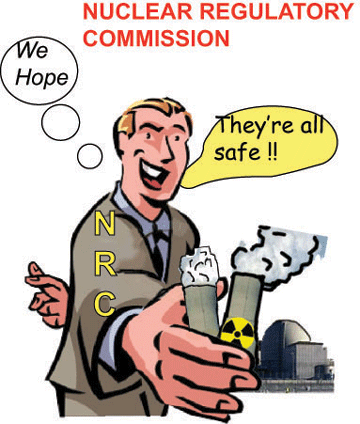 Smaller Nuclear Plants May Come With Less Stringent Safety Rules, npr, August 1, 2020
The NRC is considering whether to shrink emergency planning and evacuation zones around these newer reactors — from a 10-mile radius to, in some cases, the boundary of the plant site.
Nuclear energy critics say that would be a mistake.
“When you’re talking about a reactor that’s never been built or operated, you have to take with a big grain of salt the claims that it’s actually safer or more secure,” says Edwin Lyman at Union of Concerned Scientists.
He says the industry also wants to use weaker reactor containment shells, and in some cases they don’t want to have to keep an operator at the site.
Lyman thinks companies should build plants under current rules first. “You have to work out the kinks of these new plants,” he says. “And then over time you might be able to adjust your requirements accordingly. But you don’t do that at the get-go.”
A National Nuclear Security Administration (NNSA) official recently echoed some of Lyman’s concerns in comments sent to the NRC. The NNSA is a semi-autonomous agency within the Department of Energy.
Deputy Under Secretary Jay Tilden called the proposed rule a major departure from “the successful 42-year-old practice of using a 10-mile plume exposure emergency planning zone.” That existing regulation, he wrote, provides “the last layer of a defense-in-depth for low-probability, high-consequence accidents.” ………
Who flew drones over the nuclear reactors?
|
Mystery at Arizona’s Palo Verde nuclear plant: Who flew drones over the reactors? AZ Central,
Ryan RandazzoArizona Republic, Security guards at Palo Verde Nuclear Generating Station west of Phoenix noticed something odd on a September night last year.Five or six drones buzzed over the perimeter fence of the nuclear plant— the largest power generator in the United States — 50 miles west of Phoenix. They went across the open desert where security guards practice “force-on-force” simulated combat drills to sharpen their skills to ward off an assault, over heavy-duty gates and arrived at the protected area around the concrete-domed reactors. They stayed for nearly an hour, and came back the next night for a repeat performance. Nobody except the drones’ pilots knows whether this was a case of hobbyists touring the plant out of curiosity, or something much more nefarious, intended to disrupt a massive power source for customers from Texas to California. And nobody in any official capacity seems to know who piloted the drones that night or the next……… Security guards at Palo Verde Nuclear Generating Station west of Phoenix noticed something odd on a September night last year. Five or six drones buzzed over the perimeter fence of the nuclear plant— the largest power generator in the United States — 50 miles west of Phoenix. They went across the open desert where security guards practice “force-on-force” simulated combat drills to sharpen their skills to ward off an assault, over heavy-duty gates and arrived at the protected area around the concrete-domed reactors. They stayed for nearly an hour, and came back the next night for a repeat performance. Nobody except the drones’ pilots knows whether this was a case of hobbyists touring the plant out of curiosity, or something much more nefarious, intended to disrupt a massive power source for customers from Texas to California. And nobody in any official capacity seems to know who piloted the drones that night or the next……… Security guards at Palo Verde Nuclear Generating Station west of Phoenix noticed something odd on a September night last year. Five or six drones buzzed over the perimeter fence of the nuclear plant— the largest power generator in the United States — 50 miles west of Phoenix. They went across the open desert where security guards practice “force-on-force” simulated combat drills to sharpen their skills to ward off an assault, over heavy-duty gates and arrived at the protected area around the concrete-domed reactors. They stayed for nearly an hour, and came back the next night for a repeat performance. Nobody except the drones’ pilots knows whether this was a case of hobbyists touring the plant out of curiosity, or something much more nefarious, intended to disrupt a massive power source for customers from Texas to California. And nobody in any official capacity seems to know who piloted the drones that night or the next……. The Palo Verde incidents are apparently not the first time something like this has happened. One NRC email discusses “several high-speed” drone overflights of the Limerick Generating Station in Pennsylvania approximately eight months prior. Another indicates there had been 42 drone incidents in three years. APS officials said some of those were at Palo Verde. What if the pilots meant harm?At least one person in the NRC was concerned last year that an airspace restriction from the FAA wasn’t sufficient. “I would point out that restricted airspace will do nothing to stop an adversarial attack and even the detection systems identified earlier in this email chain have limited success rates, and there is even lower likelihood that law enforcement will arrive quickly enough to actually engage with the pilots,” wrote Joseph Rivers, a senior security adviser with the Nuclear Regulatory Commission who recently retired…… A columnist for Forbes went even further, speculating that the drones could have made three-dimensional maps of the power plant to assist a later attack. …… https://www.azcentral.com/story/money/business/energy/2020/07/31/drones-flew-over-palo-verde-nuclear-plant-arizona-pilots-unknown/5551928002/ |
|
|
South Carolina’s $9 billion nuclear fiasco – another legal saga develops, criminal investigation coming

3 years later: How the fallout from SC’s $9 billion nuclear fiasco continues Post and Courier, By Avery G. Wilks and Andrew Brown awilks@postandcourier.com abrown@postandcourier.com, Jul 31, 2020
- It has been three years since two of South Carolina’s largest electric utilities abandoned their $9 billion effort to build two nuclear reactors, but the legal, political and financial consequences continue to ripple across the Palmetto State.
The scuttled V.C. Summer expansion in Fairfield County is now widely considered one of the biggest business failures in the state’s history. The announcement of the project’s cancellation on July 31, 2017, shook South Carolina’s power industry, state government and business community.
The two homegrown S.C. utilities that partnered on the project were thrown into disarray. Investigations were initiated by state lawmakers, financial regulators and federal law enforcement officials.
The state and federal court systems were flooded overnight with lawsuits by investors, ratepayers, construction workers and lenders. The state regulatory system that backed the project for nearly a decade was called into question.
And more than 1.7 million utility customers with S.C. Electric & Gas, Santee Cooper and the state’s 19 local electric cooperatives realized they might be forced to pay billions of dollars more for a power plant that will never produce a watt of electricity.
Much has changed since Santee Cooper and SCE&G’s leaders suddenly announced the project’s collapse. But the saga isn’t over quite yet. Here is a breakdown of where things stand. Continue reading
Mystery over drone swarm above America’s largest nuclear power station
 ‘Drone Swarm’ Invaded Palo Verde Nuclear Power Plant Last September — Twice Forbes Jul 30, 2020, David Hambling
Documents gained under the Freedom of Information Act show how a number of small drones flew around a restricted area at Palo Verde Nuclear Power Plant on two successive nights last September. Security forces watched, but were apparently helpless to act as the drones carried out their incursions before disappearing into the night. Details of the event gives some clues as to just what they were doing, but who sent them remains a mystery.
Details of the events were obtained from the Nuclear Regulatory Commission by Douglas D. Johnson on behalf of the Scientific Coalition for UAP Studies (SCU) using the Freedom of Information Act (FOIA). The SCU’s main interest is in anomalous aerospace phenomena, what other people term UFOs. In this case though the flying objects were easily identifiable as drones, although their exact mission and origin are unknown. Johnson passed the information to The War Zone who give a detailed account.
Palo Verde Nuclear Power Plant is the largest in the U.S., producing over three gigawatts, 35% of Arizona’s total power capacity. It supplies electricity to Phoenix and Tucson, as well as San Diego and Los Angeles. It is a critical piece of strategic infrastructure; during the 2003 Iraq War, National Guard troops were deployed to Palo Verde to defend against a possible terrorist threat. In normal times, as with other nuclear installations, it is protected by armed security guards.
The armed guards, gates, fences and barriers were useless on the night of September 29th. According to the official report:
Officer noticed several drones (5 or 6) flying over the site. The drones are circling the 3 unit site inside and outside the Protected Area. The drones have flashing red and white rights [sic] and are estimated to be 200 to 300 hundred [sic] feet above the site. It was reported the drones had spotlights on while approaching the site that they turned off when they entered the Security Owner Controlled Area. Drones were first noticed at 20:50 MST and are still over the site as of 21:47 MST. Security Posture was normal, which was changed to elevated when the drones were noticed.”
The drones departed at 22:30, eighty minutes after they were first spotted. The security officers estimated that they were over two feet in diameter. This indicates that they were not simply consumer drones like the popular DJI Phantom, which have a flight endurance of about half an hour and is about a foot across, but something larger and more capable. The Lockheed Martin Indago, a military-grade quadcopter recently sold to the Swiss Army, has a flight endurance of about seventy minutes and is more than two feet across. At several thousand dollars apiece minimum, these are far less expendable than consumer drones costing a few hundred. All of which suggests this was not just a prank.
The next night events were repeated:…….
Despite this incident, two months later the NRC decided not to require drone defenses at nuclear plants, asserting that small drones could not damage a reactor or steal nuclear material. It is highly likely that such sites are still vulnerable to drone overflights.
Are such drones a genuine threat to nuclear facilities?…….
their ability to strike pinpoint targets to hit control systems and failsafes. While this would be unlikely to cause a Chernobyl, it might well shut the plant down, taking out 35% of Arizona’s electricity at a stroke. The successful attack on the Abqaiq facility last year, in which about twenty garage-built drones knocked out a heavily-defended oil facility in Saudi Arabia, should be a wakeup call that such unmanned precision strikes are not just the preserve of state actors any more………
the intruders, as well as establishing that Palo Verde lacks effective drone defenses, may now have highly detailed maps of the facility, showing the exact location of every valve, pipe, switch and control. Perhaps they simply aim to sell these on the dark web to anyone who will pay. Or perhaps they have something else in mind. Either way, it is an alarming demonstration of how easily drone intruders can now go anywhere anytime they wish. https://www.forbes.com/sites/davidhambling/2020/07/30/drone-swarm-invaded-palo-verde-nuclear-power-plant/#78cb15aa43de
1 This Month
26 April – Chernobyl: Inside the Meltdown airs on National Geographic on Sunday 26th April from 4pm

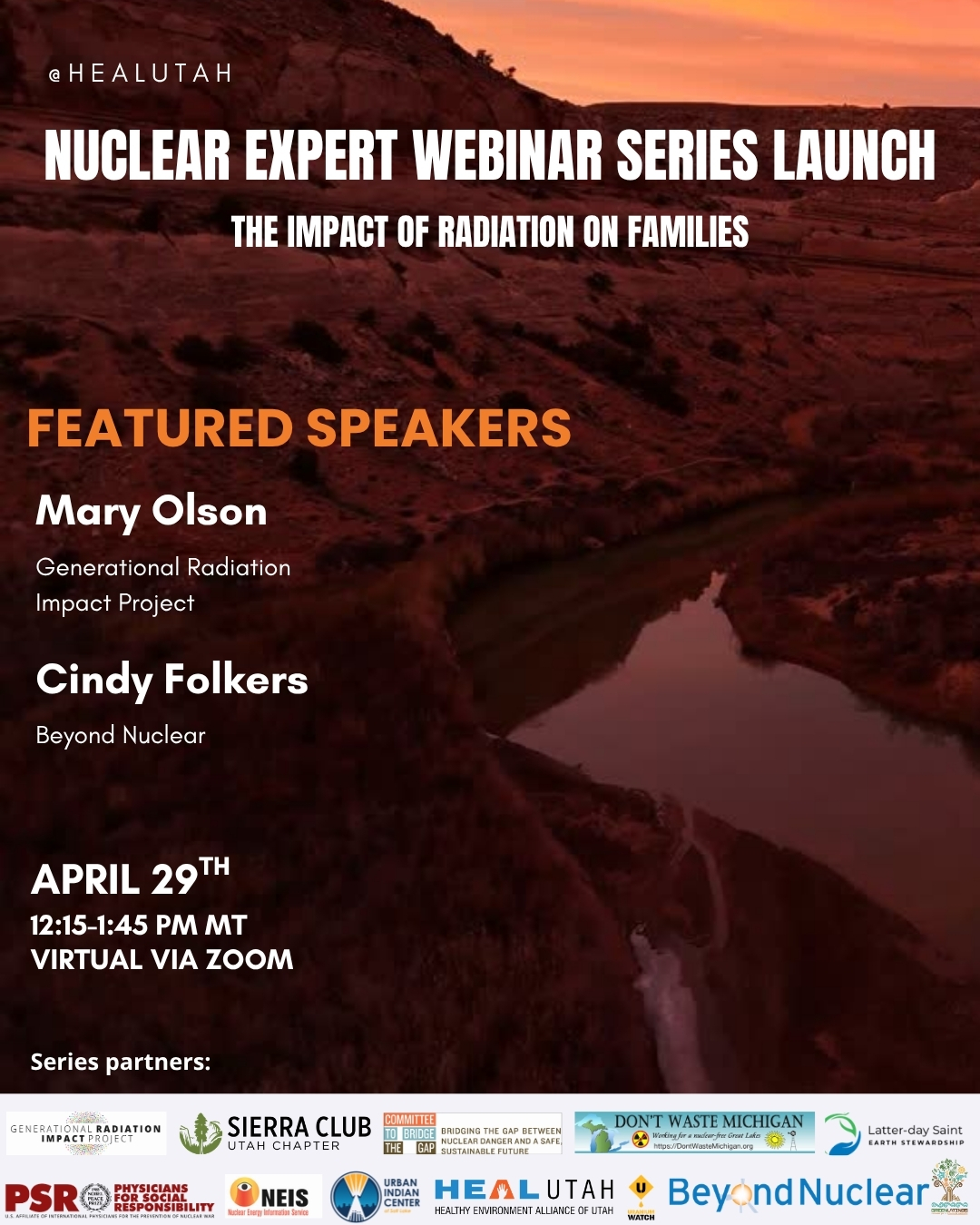
29 April – Nuclear Expert Webinar #1 – Radiation Impacts on Families with Mary Olson and Cindy Folkers
- 12:15 PM MT – 1:45 PM MT
- Location: Virtual – REGISTER TODAY

4 May -West Suburban Peace Coalition to discuss Iran war at May Educational Forum
Monday, May 4, 7:00 – 8:00 PM Central Standard Time
Title: : How Trump’s Narrative Tries to Shape the Reality of the War on Iran.
Contact Walt Zlotow, zlotow@hotmail.com 630 442 3045 for further information
14 May – online event From Bombs to Data Centres: the Face of Nuclear Colonialism

Pine Ridge Uranium is the real threat, not Tehran- Tell Burgum: Stop the Extraction.
Chernobyl: The Lost Tapes – A good documentary on Chernobyl on SBS available On Demand for the next 3 weeks– https://www.sbs.com.au/ondemand/tv-program/chernobyl-the-lost-tapes/2352741955560
To see nuclear-related stories in greater depth and intensity – go to https://nuclearinformation.wordpress.com
-
Archives
- May 2026 (25)
- April 2026 (356)
- March 2026 (251)
- February 2026 (268)
- January 2026 (308)
- December 2025 (358)
- November 2025 (359)
- October 2025 (376)
- September 2025 (257)
- August 2025 (319)
- July 2025 (230)
- June 2025 (348)
-
Categories
- 1
- 1 NUCLEAR ISSUES
- business and costs
- climate change
- culture and arts
- ENERGY
- environment
- health
- history
- indigenous issues
- Legal
- marketing of nuclear
- media
- opposition to nuclear
- PERSONAL STORIES
- politics
- politics international
- Religion and ethics
- safety
- secrets,lies and civil liberties
- spinbuster
- technology
- Uranium
- wastes
- weapons and war
- Women
- 2 WORLD
- ACTION
- AFRICA
- Atrocities
- AUSTRALIA
- Christina's notes
- Christina's themes
- culture and arts
- Events
- Fuk 2022
- Fuk 2023
- Fukushima 2017
- Fukushima 2018
- fukushima 2019
- Fukushima 2020
- Fukushima 2021
- general
- global warming
- Humour (God we need it)
- Nuclear
- RARE EARTHS
- Reference
- resources – print
- Resources -audiovicual
- Weekly Newsletter
- World
- World Nuclear
- YouTube
-
RSS
Entries RSS
Comments RSS
 nuclear-news