Nuclear bomb devastation killed ove 90% of the doctors and nurses in Hiroshima
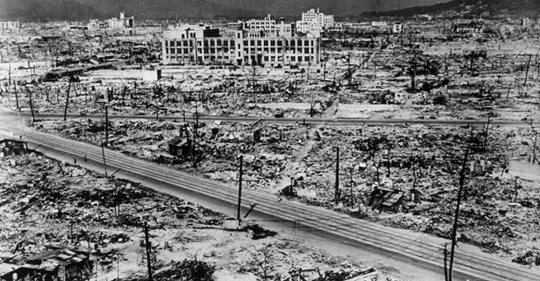
The horrific impact of the bomb was exacerbated by the fact that more than 90 percent of Hiroshima’s doctors and nurses were killed or injured by the bomb, while the blast left 42 out of 45 of the city’s civilian hospitals and two large army hospitals non-functional, according to the The International Campaign to Abolish Nuclear Weapons (ICAN).
This meant it was nearly impossible for the scores of injured to access aid, and most died without any care to ease their suffering from severe burns and radiation poisoning.
Before the attack Hiroshima had around 200 doctors, but the vast majority perished leaving only about 30 physicians who were able to perform their normal duties, according to a report created by the United States Strategic Bombing Survey.
Furthermore, more than 1,600 nurses out of nearly 1,800 were also killed, while medical stocks and supplies were also mostly destroyed.
Any hospitals within around 3,000 feet of ground zero were completely destroyed with almost everyone in them dying.
Two other large hospitals made from reinforced concrete that were located nearly 5,000 feet from the blast’s epicenter remained standing. However, the interiors suffered severe damage and around 90 percent of the occupants died, with many killed due to falling plaster, flying glass and fire.
Several medical centers that were located more than 7,000 feet away from ground zero also remained standing, although many were so badly damaged that they were not able to function.
The lack of medical facilities and staff only served to exacerbate the situation, as one eyewitness to the aftermath, Father Siemes, a German-born Jesuit professor who was in Hiroshima when the bomb fell, described, recounting the scene at an improvised first aid station.
“Iodine is applied to the wounds but they are left uncleansed. Neither ointment nor therapeutic agents are available. Those that have been brought in are laid on the floor and no one can give them any further care. What could one do when all means are lacking? Among the passersby, there are many who are uninjured,” he wrote.
“In the official aid stations and hospitals, a good third or half of those that had been brought in died. Everything was lacking, doctors, assistants, dressings, drugs, etcetera.”
Medical help had to be sent into the city from the outside, however, this took some time to arrive and several individuals who came to assist also ended up dying due to the high levels of lingering radiation.
On the 75th anniversary of the bombing, the International Physicians for the Prevention of Nuclear War (IPPNW), the only international medical organization dedicated to the abolition of nuclear weapons, told Newsweek that there can be “no useful medical response” to even a single nuclear attack on one city in their view.
“The infrastructure necessary would be destroyed and the personnel needed would be killed or badly wounded,” Chuck Johnson, IPPNW Director of Nuclear Programs, said. “Even a relatively small nuclear war would have atmospheric effects beyond the immediate blast, fire, and radiation, which could threaten billions of people with starvation due to crop failure. An all out nuclear war between the U.S. and Russia would end civilization and threaten to extinguish all human life.”
“We agree with President Reagan’s statement that ‘nuclear war can never be won and must never be fought,’ and are greatly concerned by the growing development of a new nuclear arms race among the nine nuclear weapons states.”
However, Johnson said the organization was “greatly encouraged” on the 75th anniversary of the first nuclear weapons attack on a human population, that three more nations—Nigeria, Ireland, and Niue—have become states parties to the UN Treaty on the Prohibition of Nuclear Weapons. This leaves only seven more states to submit ratification papers for the nuclear ban treaty to enter into force.”
“We look forward to the day when the UN declares that rogue nations which persist in developing and possessing nuclear weapons must listen to the world community and cease their activities which threaten all of us.”
Ways to get rid of nuclear weapons – ideas from Africa

Lessons from two pan-African giants on how to achieve genuine nuclear disarmament, The Conversation August 6, 2020 Joelien Pretorius, Associate Professor in Political Studies, University of the Western Cape “…………There are at least two traditions of African thought on nuclear weapons, traceable to their most vocal exponents: Kwame Nkrumah, the scholarly first president of independent Ghana, and Ali Mazrui, the renowned Kenyan scholar.
Both Nkrumah and Mazrui associated nuclear weapons with imperialism and racism, but proposed different approaches to address the problem they present. Nkrumah’s was an abolitionist non-violent approach. He argued for nuclear non-proliferation and disarmament and saw nuclear imperialism as the exploitation of smaller states and indigenous people and territory for nuclear tests and uranium mining.
Mazrui, on the other hand, argued for nuclear proliferation before nuclear disarmament could take place. His view was that the dominant policy towards nuclear weapons afforded some states the political privilege of having them, while denying this right to others. What he called nuclear imperialism.
Nkrumah’s approach arguably became the African approach to nuclear weapons. As a leading member of the Non Aligned Movement, Africa’s participation in the global nuclear order was directed through the organisation in the pursuit of nuclear disarmament. Closer to home, the achievement of an Africa Nuclear Free Zone treaty in 2009 was a direct outflow of Nkrumah’s approach.
Mazrui’s approach never had much official traction.
I argue that to end nuclear imperialism, African states have to reconcile Nkrumah’s and Mazrui’s approaches to nuclear weapons.
Reconciling the two approaches
Tackling nuclear imperialism would require African countries to sign up to the Treaty on the Prohibition of Nuclear Weapons, or the Ban Treaty, of 2017. This treaty is a first step toward eliminating the weapons themselves and the systems of control and exploitation they make possible. African states participated in the treaty process. More than 20 have signed the treaty and five have so far ratified it.
It would also require African states to withdraw from the Nuclear Non Proliferation Treaty. All African states are currently members of this treaty. But, after 50 years in existence, there is little hope that it will deliver genuine nuclear disarmament.
Reconciling Nkrumah’s idealism and Mazrui’s realism helps us see these treaties for what they are: the Ban Treaty is based on humanitarian concerns and the equality of states; the Non Proliferation Treaty legalises a few states’ nuclear hegemony indefinitely.
It is time for African states to lead in creating a new non-nuclear order.
Where both of them stood
An internationalist and pan-Africanist, Nkrumah saw abolition as the answer to nuclear weapons. He saw them as the “sword of Damocles” hanging over humanity. Embedded in the global peace movement of the time, he advocated for “positive action” – an outflow of Gandhiist non-violence. He attended and hosted several conferences with an anti-nuclear agenda, including an assembly in 1962 on the theme “A world without the bomb”.
Although many Africans lost faith in the value of non-violence and preferred a military solution to imperialism, Nkrumah’s approach to nuclear weapons did not fade. It was enmeshed with the position espoused by the Non Aligned Movement, and was the position adopted by the African National Congress in South Africa in 1994.
For his part, Mazrui believed African states should not pursue a nuclear weapon free zone and should leave the 1970 Nuclear Non Proliferation Treaty……
Mazrui saw the Non Proliferation Treaty as a trap that smacked of racism, where major powers got to say “such and such a weapon is not for Africans and children under 16”.
Mazrui was thus “advocating nuclear proliferation as the only realistic path to nuclear disarmament. This was a total inversion of the Western consensus.”
Wasted opportunities
The five nuclear powers have wasted many opportunities to negotiate the nuclear disarmament that the 50-year-old Non Proliferation Treaty binds them to. Instead, key nuclear arms control treaties have been discarded and all the nuclear weapon states are modernising their arsenals.
The treaty has also not stopped proliferation: four other states have since acquired nuclear weapons – Israel, India, Pakistan and North Korea.
Mazrui was right. In practice, the treaty is at most a status quo treaty that has come to legalise a small club being able to wield nuclear weapons – what India calls nuclear apartheid.
The treaty is not just about separating states into haves and have nots; it is also a stick to beat the have nots into submission.
In the Iraq War of 2003 the US used stopping nuclear proliferation as a false premise to justify making war on that country and is today doing the same to sanction Iran. States without nuclear weapons accepted the Non Proliferation Treaty in the hope that it would deliver a world without nuclear weapons, but that hasn’t happened and their patience is running out.
The efforts of the majority of states that went outside the Non Proliferation Treaty forum to negotiate the Treaty on the Prohibition of Nuclear Weapons three years ago, to make nuclear weapons illegal for all, without exception, need to succeed. The Ban Treaty will enter into force when 50 states have ratified it. The number currently stands at 40.
The Ban Treaty was only possible because of a broad international coalition emphasising the unacceptable humanitarian consequences of nuclear weapons.
To end nuclear imperialism, African states have to reconcile Nkrumah and Mazrui’s approaches by not only joining the Ban Treaty, but also withdrawing from the Non Proliferation Treaty. This will signal that African states will only take part as equals in global nuclear governance where these weapons are illegal for all. https://theconversation.com/lessons-from-two-pan-african-giants-on-how-to-achieve-genuine-nuclear-disarmament-144009
Australia’s ICAN and Conservation Council of Western Australia commemorate Hiroshima Day


On August 5th, people from across Australia gathered, via Zoom, to commemorate the nuclear bombing of Hiroshima, and to hear speakers from ICAN Autralia (International Campaign to Abolish Nucleat Weapons).
Medlissa Clarke spoke of the human effects of this catastrophe, and of the efforts over time, towards disarmament. The biggest leap forward in this has been, in 2017, the U.N. Treaty on the Prohibition of Nuclear Weapons. The Treaty now has over 200 nations signed up, with 40 ratifications – not far from the 50 required to make it international law.
Most Australians want a nuclear weapons free world.But Australia’s policy does endorse nuclear weapons. A future Labor government might change that.
Dimity Hawkins described the misery experienced by the Japanese, the agonising stories of the survivors. Since Hiroshima, the nuclear bombs developed are greatly stronger, and have been tested over many years, on the Marshall Islands, on Maralinga, South Australia, and on other Pacific Islands, in nuclear colonialism that has never properly been cleaned up. Australia is part of that nuclear chain. But now,the survivors are speaking out. Red Cross and Red Crescent, the world’s greatest non government emergency service is strongly behind the Treaty movement, and the indigenous people, particularly Australia’s Aboriginals .
Former Senator Scott Ludlam commemorated the Hibakusha, and the impact of the nuclear weapons industry on indigenous people world-wide. He drew attention to the ?proud statement of U.S. Strategic Command – that their nuclear weapons are to be used in a “safe, secure and lethal way”.
The Treaty was an Australian initiative, brought about by the work of, at first, a few, who by-passed official systems, and went out getting signatures, setting up ICAN, which became an international movement.-, – showing that people can do this, have an effect and an influence. As cities will be the places to bear the catastrophe of nuclear annihilation, many Mayors of many have City Councils have signed up to the Treaty. The Treaty shows that no-one can now claim that nuclear weapons are acceptable, in the same way as biological and chemical warfare are unacceptable.
For information on the continuing CCWA webinar series go to http://www.ccwa.org.au/yellowcake_country_webinar_series
Russia will regard any incoming missile as a nuclear attack
|
Russia warns it will see any incoming missile as nuclear VLADIMIR ISACHENKOV
MOSCOW (AP) 7 Aug 20, — Russia will perceive any ballistic missile launched at its territory as a nuclear attack that warrants a nuclear retaliation, the military warned in an article published Friday. The harsh warning in the official military newspaper Krasnaya Zvezda (Red Star) is directed at the United States, which has worked to develop long-range non-nuclear weapons. The article follows the publication in June of Russia’s nuclear deterrent policy that envisages the use of atomic weapons in response to what could be a conventional strike targeting the nation’s critical government and military infrastructure. In the Krasnaya Zvezda article, senior officers of the Russian military’s General Staff, Maj.-Gen. Andrei Sterlin and Col. Alexander Khryapin, noted that there will be no way to determine if an incoming ballistic missile is fitted with a nuclear or a conventional warhead, and so the military will see it as a nuclear attack. “Any attacking missile will be perceived as carrying a nuclear warhead,” the article said. “The information about the missile launch will be automatically relayed to the Russian military-political leadership, which will determine the scope of retaliatory action by nuclear forces depending on the evolving situation.”……….https://apnews.com/888e0816c6fa7f58b9ad4f1e97993643 |
|
|
It’s Up to us to stop the building of nuclear weapons
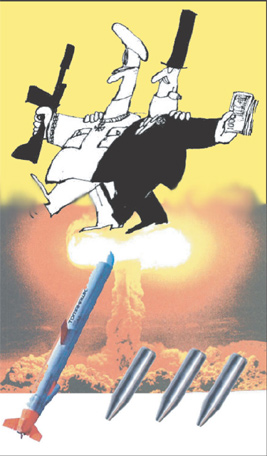 Up to us to stop the building of nuclear weapons, Greenfield Recorder, Sherrill Hogen , Charlemont. 6 Aug 20 https://www.recorder.com/my-turn-hogen-Hiroshima-35463074 Change! Finally, after 400 years, White America may be ready to start addressing the wrongs that brought our country into being. Racism and genocide are life-threatening poisons to our very soul. Yet there are other poisons that have not yet consumed us, but might still do so. For one, our planet might burn up from climate disasters before we can stop it. For another, human folly might unleash nuclear war — a more instantaneous incineration of all that we hold dear.
You might think that we are smarter than that. But we humans have not proven that we are so smart when it comes to settling our differences.
You might believe that war is inevitable and just hope that no one pushes the nuclear button. But hoping doesn’t keep it from happening. So, just as we are awaking to what it might take to address the legacies of slavery and the extermination of Native Americans, we must address the real possibility of nuclear annihilation. It is hard to do when the warnings are not in the news.
And isn’t that interesting…. Why isn’t such an enormous threat to our very existence in the media and in our daily conversations? I wonder if our arms industry and military superstructure would rather keep such knowledge buried.
If we do wake up to this danger, we might raise up another voice along with Black Lives Matter, Water is Life, Me Too, and Save our Planet: NO MORE WAR, NO NUCLEAR WEAPONS.
It has been 75 years since the U.S. dropped atomic bombs on Hiroshima and Nagasaki, Japan. For 75 years we humans have managed to ignore the reasons and results of that horrific act. I hope we can change course on this issue as we are doing on others.
One step in that direction is to recognize the dates the bombs fell, Aug. 6 and 9, 1945.
One event was already held Aug. 6 in Turners Falls. Join us Aug. 8, 11 a.m. to noon on the Greenfield Town Common; and Aug. 9 at the library in Easthampton at 7 p.m.
As we strive to recognize the value of every human being and every living thing, our government and arms industry are building nuclear weapons every day, and it is up to us to stop them.
Conservative politicians in UK gathering opposition to China’s involvement in nuclear projects
|
China tensions raise doubts over UK nuclear projects
After Huawei’s ban, rebel Tory MPs turn their sights on CGN and its plans to build a new plant Ft.com
Jonathan Ford and Jim Pickard in London and Nathalie Thomas in Edinburgh AUGUST 6 2020 Flushed with their success at changing UK government policy towards Huawei, rebel Conservative MPs are now turning their attention to a proposed Chinese project to build a nuclear power station at Bradwell-on-Sea in the south-east of England.
In their sights is an agreement forged by the government of David Cameron, that would allow the Chinese nuclear group CGN to build its own nuclear plant in return for backing two giant French-led nuclear projects in Britain. The first of those French projects — a plant at Hinkley Point in the south west of England that could cost £22.5bn — is well under way and CGN has already pumped billions into the scheme.
“There are an awful lot of Tory MPs who will use their summer break to get their heads around the CGN situation,” said one person close to the rebel MPs. “Bradwell will be the focus of attention.” Just as with the decision to remove telecoms company Huawei from Britain’s 5G mobile phone networks by 2027, they are being encouraged by a US administration vocal in its opposition to China’s involvement in Britain’s nuclear programme.
In 2018, the US assistant secretary for international security and non-proliferation, Christopher Ashley Ford, warned the UK against partnering with the company, saying Washington had evidence it was taking civilian technology and converting it to military uses. CGN declined to comment.
At a private meeting with MPs last month, the subject of CGN’s activities was raised by US secretary of state Mike Pompeo, according to one person in the room. The senior Tory MP, Iain Duncan Smith has called for a review of nuclear contracts on the grounds that China is not a “trusted vendor”, and has likened Britain’s commercial dealings with Beijing to 1930s appeasement.
The closer scrutiny of China’s role in Britain’s nuclear programme comes at a crucial moment. The UK’s Committee on Climate Change has said that the country might need 38 per cent of its power from non-weather-dependent sources to help achieve “net zero” carbon emissions by 2050. Supporters of nuclear say it is the only proven technology capable of delivering that target. Yet despite this, plans to build a fleet of new reactors using private sector funding have stalled. ……..
Some MPs believe that Britain no longer needs CGN’s money because Boris Johnson’s government may be willing to contemplate public subsidies. The government last year launched a consultation on an alternative funding model, Regulated Asset Base (RAB), which is used for other infrastructure such as the Thames Tideway “super sewer” and would see consumers pay for nuclear plants upfront via their energy bills. Some experts have also floated the idea of the state taking direct stakes in schemes. …….
So far CGN has invested £3.8bn in the UK, the majority in Hinkley. CGN is funding a third of the construction costs for Hinkley and 20 per cent of the development costs of Sizewell C in Suffolk. ………
Ministers are yet to deliver their verdict on the RAB funding model and have continuously delayed a white paper on energy, originally expected last year, and which nuclear industry executives hope will emerge in October.
Last week the managing director of Hinkley Point C, Stuart Crooks, said the UK government “needs to decide if it wants nuclear or not.” ……..
environment groups such as Greenpeace insist there are far cheaper, greener ways of meeting the future country’s energy needs, such as offshore wind power. …… https://www.ft.com/content/9d0d3a75-d3f4-4cab-9176-be582140987c
|
|
Opening the floodgates at Fukushima
- Ken O. Buesseler
See all authors and affiliations
Vol. 369, Issue 6504, pp. 621-622
DOI: 10.1126/science.abc1507
Summary
Summary
In the time since Japan’s triple earthquake, tsunami, and nuclear disaster in 2011, much has improved in the ocean offshore from the Fukushima Daiichi Nuclear Power Plant (FDNPP). Concentrations of cesium isotopes, some of the most abundant and long-lived contaminants released, are hundreds of thousands of times lower than at their peak in April 2011. Since mid-2015, none of the fish caught nearby exceed Japan’s strict limit for cesium of 100 Bq/kg (1, 2). Yet, enormous challenges remain in decommissioning the reactors and clean-up on land. Small, and sometimes unexpected, sources of contaminants still continue to enter the ocean to this day (3). Two of the biggest unresolved issues are what to do with the more than 1000 tanks at the site that contain contaminated water and the impact of releasing more than 1 million tons of this water into the ocean.
http://www.sciencemag.org/about/science-licenses-journal-article-reuse
This is an article distributed under the terms of the Science Journals Default License. View Full Text
Nuclear testing: ‘Why do we need to start a new arms race?’
|
Nuclear testing: ‘Why do we need to start a new arms race?’
Provision in National Defense Authorization Act to ban testing, Big Country, by: Alexandra Limon Aug 7, 2020 WASHINGTON (Nexstar) — The United States has not conducted live nuclear weapons tests for 28 years. But reports indicate the Trump Administration has discussed re-starting the nuclear testing program.
That has Democrats from the areas impacted by past testing — in Nevada and Utah — pushing a provision in this year’s National Defense Authorization Act to ban new nuclear tests. “It would prevent this administration or any in the future from using funds to restart nuclear weapons testing,” said Nevada Rep Dina Titus, who introduced the bill with support from Utah’s Ben McAdams. “Thousands and thousands of Utahns have developed cancer and died from those tests. And I think it’s important that we don’t see that testing resume,” he said. The ban on live nuclear testing was included in the House version of the NDAA, but it’s unclear if it will make it into the final version. “We can test our stockpile without doing tests with yield and our scientists have been doing it for over 20 years,” Titus said. “Why do we need to start a new arms race?”……. The National Defense Authorization Act likely won’t be finalized until after the November election. https://www.bigcountryhomepage.com/news/politics/nuclear-testing-why-do-we-need-to-start-a-new-arms-race/ |
|
1 This Month
15 October. Joint Appeal for Nuclear Abolition Day -presentation to the UN on October 15 will be live on UNWebTV
Endorse the Nuclear Abolition Day Appeal
23-25 October – on Zoom – World BEYOND War’s annual global conference

To see nuclear-related stories in greater depth and intensity – go to https://nuclearinformation.wordpress.com
-
Archives
- October 2026 (139)
- September 2026 (339)
- August 2026 (330)
- July 2026 (355)
- June 2026 (287)
- May 2026 (306)
- April 2026 (356)
- March 2026 (251)
- February 2026 (267)
- January 2026 (308)
- December 2025 (358)
- November 2025 (359)
-
Categories
- 1
- 1 NUCLEAR ISSUES
- business and costs
- climate change
- culture and arts
- ENERGY
- environment
- health
- history
- indigenous issues
- Legal
- marketing of nuclear
- media
- opposition to nuclear
- PERSONAL STORIES
- politics
- politics international
- Religion and ethics
- safety
- secrets,lies and civil liberties
- spinbuster
- technology
- Uranium
- wastes
- weapons and war
- Women
- 2 WORLD
- ACTION
- AFRICA
- Atrocities
- AUSTRALIA
- Christina's notes
- Christina's themes
- culture and arts
- Events
- Fuk 2022
- Fuk 2023
- Fukushima 2017
- Fukushima 2018
- fukushima 2019
- Fukushima 2020
- Fukushima 2021
- general
- global warming
- Humour (God we need it)
- Nuclear
- RARE EARTHS
- Reference
- resources – print
- Resources -audiovicual
- Weekly Newsletter
- World
- World Nuclear
- YouTube
-
RSS
Entries RSS
Comments RSS

