USA is not facing up to the climate threats to its nuclear wastes
 US is Ill-Prepared to Safely Manage its Nuclear Waste from Climate Threats. More than 150 sites across the country have to be managed for radioactive waste for centuries or millennia. But there’s no plan in place for how this will be done, says GAO report. Earth Island Journal , CHARLES PEKOW, December 29, 2020 The Cold War never erupted into the nuclear nightmare that the world feared for decades. But the legacy of the never-used nuclear weapons remains a ticking time bomb that could endanger countless people and lead to environmental catastrophe any time.
The GAO report, “Environmental Liabilities: DoE Needs to Better Plan for Post-Cleanup Challenges Facing Sites” (pdf), issued earlier this year, found, among other things, that the DoE doesn’t have a plan for how to address challenges at some sites that may require new cleanup work that is not in the scope of LM’s expertise.
some of these sites have already been creating serious problems.
Among the many other problem sites, the Legacy Management office is struggling to figure out what to do with contaminated groundwater at the Shiprock nuclear waste dump on the Navajo Nation Indian Reservation in northwest New Mexico. Contaminated water, the legacy of uranium mining for nuclear power plants and weapons, is being pumped to an evaporation pond there.
nuclear watchdog groups aren’t satisfied with the slow progress on this front. The nation needs “a reverse Manhattan project,” to figure out how to safely diffuse the radioactive waste, says Schaeffer of the Alliance for Nuclear Accountability. https://www.earthisland.org/journal/index.php/articles/entry/us-is-ill-prepared-to-safely-manage-its-nuclear-waste-from-climate-threats
Doubtful that aging Los Alamos National Laboratory could safely produce plutonium triggers, no matter how much funding it gets
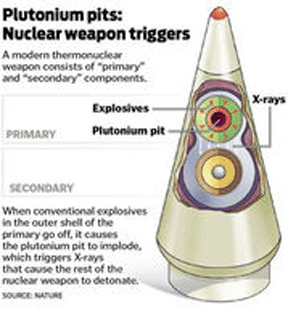 Los Alamos National Laboratory may get boost in nuclear funding, Santa Fe New Mexico By Scott Wyland swyland@sfnewmexican.com– 30 Dec 20, Los Alamos National Laboratory may get boost in nuclear funding, Santa Fe New Mexico By Scott Wyland swyland@sfnewmexican.com– 30 Dec 20, Los Alamos National Laboratory will get a hefty funding boost — including for its work on plutonium pit production — in the military spending bill held up by a presidential veto. Many predict the veto will be overridden, and if it is, the lab’s budget will increase to $3.3 billion from the $2.3 billion allocated last year. The bill puts $837 million into the lab’s plutonium operations, more than double the previous year’s $308 million, as Los Alamos pursues production of 30 nuclear bomb cores by 2026 — a goal critics have questioned. Plans call for the Savannah River Site in South Carolina to make an additional 50 plutonium pits by 2030, so the two facilities will produce a combined 80 pits per year as stated in the 2018 Nuclear Posture Review……..
Watchdog groups call the Trump administration’s more aggressive push to bolster the nuclear stockpile hawkish and unsustainable, and expressed uncertainty about how much the incoming Biden administration might pull back. …… Tom Clements, executive director of SRS Watch, another watchdog group, said the 2021 budget will have to be carried out, and it will take time for President-elect Joe Biden’s administration to draft a new nuclear posture review. But Biden is likely to examine the nuclear modernization program in the coming months, including whether it’s feasible to convert Savannah River’s unfinished mixed-oxide fuel plant into a pit factory, Clements said. “There are growing signs that the SRS pit plant is gonna get a thorough review by the new administration,” Clements said……… Mello said he remains doubtful the aging plutonium facility that never produced more than a dozen pits in a year can be upgraded to crank out 30-plus pits yearly, no matter how much money is spent. “There’s a question of whether Los Alamos will ever be able to do so safely,” Mello said. https://www.santafenewmexican.com/news/local_news/los-alamos-national-laboratory-may-get-boost-in-nuclear-funding/article_cd55c8a6-49f5-11eb-8718-2333908445b5.html |
|
Hanford’s dangerous collection of nuclear waste sites, including 177 underground leaky tanks
Washington’s new nuclear waste lead takes on Hanford’s aging tanks, OPB, By Anna King (Northwest News Network), Dec. 30, 2020.
David Bowen is charged with holding the U.S. Department of Energy accountable for its cleanup of a site that once produced plutonium for nuclear weapons.
At the Hanford site in southeastern Washington, along the Columbia River, millions of gallons of radioactive sludge are cradled in aging underground tanks.
Nearly 2,000 capsules filled with cesium and strontium rest unquietly in an old, glowing-blue pool of water. Two reactors along the Columbia still need to be sealed up and cocooned.
And those are just some of the bigger waste sites out of hundreds at the 580-square-mile cleanup site.
177 underground tanks filled with radioactive waste It’s a lot to ponder and a steep learning curve for freshly hired David Bowen. …..He started his new job Dec. 16 as the Nuclear Waste Program lead for Washington’s Department of Ecology in Richland.
he’ll hold the U.S. Department of Energy accountable for its cleanup at the site using the Tri-Party Agreement. That’s a 1989 document struck between Ecology, the federal Department of Energy and the U.S. Environmental Protection Agency.
Hanford houses leftovers from World War II and the Cold War, when it was the nation’s factory for plutonium. Trenches, pits and buildings are all contaminated with loads of chemicals and radioactive waste generated at breakneck speed.
The stickiest problem: 177 tanks — some of them leakers — filled with radioactive waste.
“Some of [the underground tanks] are 50-plus years old,” Bowen said. “And they weren’t designed to last this long. There are still fluids in them, millions of gallons, in sludge, et cetera. So, there’s the opportunity for that to escape and get into the Columbia River — or the groundwater is high.”
A massive waste treatment plant is being built in the desert at Hanford to treat that tank waste. But the cleanup timeline has been pushed back several times since the 1980s. It could be pushed back more because of the pandemic.
……. Aging infrastructure, aging expertsHanford is much like a complex small city: thousands of commuting workers, miles of highways and intertwining roads.
Then there are all the stakeholders: multiple tribes, Seattle-based Hanford watchdog groups, salmon and Columbia River advocates and multiple government agencies. Losing Hanford experts to retirement or attrition to other agencies is a big problem — and a growing one. Some key Ecology experts have recently been lured away to federal posts or to work as Hanford contractors. And many have already retired. Bowen said he’s well aware he needs to work fast……… https://www.opb.org/article/2020/12/29/washington-nuclear-waste-program-manager-hanford/
Avril Haines is unfit for Director of National Intelligence, with her history of coverup of tortures.
|
The Trouble With Avril Haines for Intelligence, December 29, 2020 Biden’s nominee is a drone assassin who played a key role in covering up the U.S. torture program, Consortium News, By Medea Benjamin and Marcy Winograd
World BEYOND War Even before President-Elect Joe Biden sets foot in the White House, the Senate Intelligence Committee may start hearings on his nomination of Avril Haines as director of national Intelligence. President Barack Obama’s top lawyer on the National Security Council from 2010 to 2013 followed by CIA deputy director from 2013 to 2015, Haines is the proverbial wolf in sheep’s clothing. She is the affable assassin who, according to Newsweek, would be summoned in the middle of the night to decide if a citizen of any country, including our own, should be incinerated in a U.S. drone strike in a distant land in the greater Middle East. Haines also played a key role in covering up the U.S. torture program, known euphemistically as “enhanced interrogation techniques,” which included repeated water boarding, sexual humiliation, sleep deprivation, dousing naked prisoners with ice cold water and rectal rehydration. For these reasons, among others, the activist groups CODEPINK, Progressive Democrats of America, World Beyond War and Roots Action have launched a campaign calling on the Senate to reject her confirmation. These same groups ran successful campaigns to dissuade Biden from choosing two other warmongering candidates for critical foreign policy positions: China-hawk Michele Flournoy for secretary of defense and torture apologist Mike Morell for CIA director. By hosting calling parties to senators, launching petitions and publishing open letters from DNC delegates, feminists—including Alice Walker, Jane Fonda and Gloria Steinem—and Guantanamo torture survivors, activists helped derail candidates who were once considered shoo-ins for Biden’s cabinet. Now activists are challenging Avril Haines. In 2015, when Haines was CIA deputy director, CIA agents illegally hacked the computers of the Senate Intelligence Committee to thwart the committee’s investigation into the spy agency’s detention and interrogation program. Haines overruled the CIA’s own inspector general in failing to discipline the CIA agents who violated the U.S. Constitution’s separation of powers. According to former CIA whistleblower John Kiriakou, she not only shielded the hackers from accountability but even awarded them the Career Intelligence Medal. Redacting Role And there’s more. When the exhaustive 6,000-page Senate Intelligence Committee report on torture was finally complete, after five years of investigation and research, Haines took charge of redacting it to deny the public’s right to know its full details, reducing the document to a 500-page, black-ink-smeared summary. This censorship went beyond merely “protecting sources and methods.” It avoided CIA embarrassment, while ensuring her own career advancement. Moreover, Haines supported torture apologist Gina Haspel as Trump’s CIA director. Haspel ran a secret black site prison in Thailand where torture was regularly inflicted. Haspel also drafted the memo ordering the destruction of almost 100 videotapes documenting CIA torture. As David Segal of Demand Progress told CNN, “Haines has an unfortunate record of repeatedly covering up for torture and torturers. Her push for maximalist redactions of the torture report, her refusal to discipline the CIA personnel who hacked the Senate and her vociferous support for Gina Haspel — which was even touted by the Trump White House as Democrats stood in nearly unanimous opposition to the then-nominee to lead the CIA — should be interrogated during the confirmation process.” This sentiment was echoed by Mark Udall, a Democratic senator on the intelligence committee when it finished the torture report…………….. Empty Words on Paper Haines’s policy guidance also states that the U.S. would respect other states’ sovereignty, only undertaking lethal action when other governments “cannot or will not” address a threat to the U.S. This, too, became simply empty words on paper. The U.S. barely even consulted with the governments in whose territory it was dropping bombs and, in the case of Pakistan, openly defied the government. In December 2013, the National Assembly of Pakistan unanimously approved a resolution against U.S. drone strikes in Pakistan, calling them a violation of “the charter of the United Nations, international laws and humanitarian norms” and Pakistan’s former Prime Minister Nawaz Sharif stated: “The use of drones is not only a continual violation of our territorial integrity but also detrimental to our resolve and efforts at eliminating terrorism from our country.” But the U.S. ignored the pleas of Pakistan’s elected government……………. There are many other reasons to reject Haines. She advocates intensifying crippling economic sanctions on North Korea that undermine a negotiated peace, and “regime change”—hypothetically engineered by a U.S. ally — that could leave a collapsed North Korea vulnerable to terrorist theft of its nuclear material; she was a consultant at WestExec Advisors, a firm that exploits insider government connections to help companies secure plum Pentagon contracts; and she was a consultant with Palantir, a data-mining company that facilitated Trump’s mass deportations of immigrants. But Haines’ record on torture and drones, alone, should be enough for senators to reject her nomination. The unassuming spy — who got her start at the White House as a legal adviser in the Bush State Department in 2003, the year the U.S. invaded Iraq—might look and sound more like your favorite college professor than someone who enabled murder by remote control or wielded a thick black pen to cover up CIA torture, but a clear examination of her past should convince the Senate that Haines is unfit for high office in an administration that promises to restore transparency, integrity, and respect for international law……… https://consortiumnews.com/2020/12/29/the-trouble-with-avril-haines-for-intelligence/ |
|
USA’s Nuclear Regulatory Commission “sanitises” report, wipes off safety findings about nuclear license renewals
 Inviting Nuclear Disaster Counterpunch BY KARL GROSSMAN, 30 Dec 20, “……….Paul Gunter points to what happened to a report which the NRC commissioned the DOE’s Pacific Northwest National Laboratory to make. “The federal laboratory was contracted by the NRC to develop the criteria and guidance document to address and close numerous ‘knowledge gaps’ in the license renewal safety review process to provide the ‘reasonable assurance’ that the reactors could be operated reliably and safely into the license extension period,” relates Gunter. The 2017 report raised many significant issues regarding extending the operating licenses of nuclear plants.
The report is titled “Criteria and Planning Guidance for Ex-Plant Harvesting to Support Subsequent License Renewal.”
It “was publicly posted by Pacific Northwest National Laboratory to its website in December 2017,” relates Gunter, “as well as to the websites of the Department of Energy Office of Scientific and Technical Information and the International Atomic Energy Commission’s International Nuclear Information System.”
But then Gunter attended a public meeting at the NRC’s headquarters in Rockville, Maryland on September 26, 2018 on operating license extensions “and I started asking questions citing the report” of the year before. The NRC officials there “were quite surprised.”
And the NRC “wiped all three websites of the report.”
The NRC was to repost the report, but it was then “scrubbed clean of dozens of references to safety-critical knowledge ‘gaps’ pertaining to many known age-related degradation mechanisms described in the original published report,” says Gunter. “The NRC revision also scrubbed Pacific Northwest National Laboratory findings and recommendations to ‘require’ the harvesting of realistic and representative aged materials from decommissioning nuclear power stations—base metals, weld materials, electric cables, insulation and jacketing, reactor internals and safety-related concrete structures like the containment and spent fuel pool—for laboratory analyses of age degradation. The laboratory analyses are intended to provide ‘reasonable assurance’ of the license extension safety review process for the projected extension period.”
However, Beyond Nuclear had downloaded and saved a copy of the original report which you can view here.
And you can view what Gunter terms the “sanitized version” of the report which has the same title but is dated March 2019. It’s here.
The omissions start with what is headed “Abstract” in the original 2017 report. The “Abstract” states: “As U.S. nuclear power plants look to subsequent license renewal (SLR) to operate for a 20-year period beyond 60 years, the U.S. Nuclear Regulatory Commission and the industry will be addressing technical issues around the capability of long-lived passive components to meet their functionality objectives. A key challenge will be to better understand likely materials degradation mechanisms in these components and their impacts on component functionality and safety margins. Research addressing many of the remaining technical gaps in these areas for SLR may greatly benefit from materials sampled from plants (decommissioned or operating). Because of the cost and inefficiency of piecemeal sampling, there is a need for a strategic and systematic approach to sampling materials from structures, systems and components in both operating and decommissioned plants.”
But in the 2019 version of the report, this “Abstract,” among other material, is gone.…… ……..https://www.counterpunch.org/2020/12/30/inviting-nuclear-disaster/?fbclid=IwAR1YQ614qqcsQZ3mwVCo9UV2JlqCfVBgmS358L7DCCwcShjKDJFtzH-nZ0k
Ohio Supreme Court stops collection of nuclear plant subsidy
  Ohio Supreme Court stops collection of nuclear plant subsidy Ohio Supreme Court stops collection of nuclear plant subsidyThe order comes a week after a judge in Franklin County issued a preliminary injunction to stop collection of the fees. Associated Press 10 WBNS, December 28, 2020 The Ohio Supreme Court on Monday issued a temporary stay to stop collection of a fee from nearly every electric customer in the state starting Jan. 1 to subsidize two nuclear power plants, a provision included in a scandal-tainted bill approved by the state Legislature in July 2019. The order signed by Chief Justice Maureen O’Connor comes a week after a judge in Franklin County issued a preliminary injunction to stop collection of the fees. Common Pleas Judge Chris Brown in his ruling from the bench last Monday said, “To not impose an injunction would be to allow certain parties to prevail. It would give the OK that bribery is allowed in the state of Ohio and that any ill-gotten gains can be received. The Ohio Manufacturers’ Association appealed to the Supreme Court earlier this month after the Public Utilities Commission of Ohio in August cited the legislation known as HB6 in issuing an order approving collection of the fees and then refused to reconsider the group’s request for a new hearing. The law calls for the plant’s new owner, Energy Harbor, to receive as much as $150 million a year and nearly $1 billion in total. Another $20 million a year from the fees are earmarked for five large solar projects, none of which are operational. The maelstrom surrounding the subsidies began in late July when U.S. Attorney David DeVillers announced the arrests of then-Ohio House Speaker Larry Householder and four others for their roles in what he called the biggest bribery scandal in state history. Householder is accused of controlling an effort secretly funded by Akron-based FirstEnergy to win legislative approval for the nuclear plant subsidies and to stop a referendum on the bill……….. https://www.10tv.com/article/news/local/ohio/ohio-supreme-court-stops-collection-of-nuclear-plant-subsidy/530-91a539b5-687e-429b-b512-8249d65a416a |
|
Plowshare anti nuclear-weapons activists again face prison .
 Longtime Anti-Nuke Activists Face Prison, Again, After Breaking Into Naval Base https://www.npr.org/2020/12/28/948116757/longtime-anti-nuclear-activists-face-prison-again-after-breaking-into-naval-base
December 28, 20205: Heard on Morning Edition
EMMA PEASLEE. Dressed in black, the seven intruders cut through a fence and stole along the perimeter of the naval base, trying to avoid detection from the guard towers, as a loudspeaker overhead blared: “Deadly force is authorized!”
Patrick O’Neill, who had a GoPro strapped to his head, tried to reassure himself by remembering a scene in the Bible where Jesus escapes unscathed from a wrathful mob that wants to throw him off a cliff.
When O’Neill and the others reached their target, they poured their own blood on the shield of the Kings Bay naval base in Georgia and attached a poster of Martin Luther King Jr. to a mock-up of a Trident II D5 ballistic missile at the welcome area.
The anti-nuclear activists — Roman Catholics who call themselves Plowshares, from the Biblical passage about “beating swords into plowshares” — followed the metaphor quite literally and took a hammer to the replica of the warhead.
The break-in on the night of April 4, 2018, ended with the arrest and conviction on charges of trespassing and destruction of property for the seven activists aged 58 to 81.
And in the midst of a pandemic that’s wreaking havoc on prisons and disproportionately affecting older people, six of them have been sentenced to up to 33 months in prison. The seventh is scheduled to be sentenced in February.
The Plowshares activists were seeking to revive the anti-nuclear movement by committing acts of civil disobedience.
They are part of a larger faith-based movement that has been around since the 1980s, when anti-nuclear protests used to draw millions into the streets.
Those days are long gone, but the threat of nuclear warfare isn’t. According to some atomic scientists, the threat may be even greater now, and the activists are frustrated that in their view hardly anyone is paying attention.
Which is one reason why they have broken into military bases and sometimes succeeded in doing damage to actual nuclear armaments. In a highly publicized protest in 1980, Plowshares activists hammered two missile nose cones at a General Electric complex in King of Prussia, Pa., causing tens of thousands of dollars worth of damage. In 2012, another group that included an 82-year-old Catholic nun defaced a bunker holding weapons-grade uranium at the Y-12 National Security Complex in Oak Ridge, Tenn.
People are always astounded that a bunch of old people or unarmed people or whatever people can gain access to these weapons at all,” said O’Neill, 64.
Martha Hennessey, 65, had already been to prison three times before beginning her sentence at a federal prison in Danbury, Conn., on Dec. 14. She is the granddaughter of the journalist-turned-activist Dorothy Day, who founded the pacifist Catholic Worker Movement in the 1930s.
Rather than dwell on her own sentence, she drew attention to the mass incarceration of people who have committed minor offenses.
“I mean, there are people being thrown into prison for years for, you know, things that are not even crimes,” she said in an interview before reporting to prison.
Members of the Plowshares group prefer not to talk about the risks they might face in prison, but their families are worried.
“I’m afraid that my dad might die in prison,” said Maura O’Neill, 26, one of O’Neill’s eight children. “I worry that he might contract COVID and get really sick, and it feels like a real possibility.”
Joe Biden reported to be considering cuts to America’s $1.2trillion nuclear modernization program
|
Joe Biden ‘is eyeing cuts to America’s $1.2trillion nuclear modernization program and could reverse Trump administration’s efforts to develop a new warhead’
Daily Mail, By CHRIS JEWERS FOR MAILONLINE 30 December 2020 President-elect Joe Biden is eyeing cuts to America’s $1.2 trillion nuclear modernization program and could reverse the Trump administration’s efforts to develop a new warhead, sources have said. According to CNN, two transition officials and an outside adviser to the incoming administration have said that Biden instead intends to place a greater emphasis on arms control. The incoming commander in chief plans to reassess the more than $1 trillion nuclear modernization program and determine whether it warrants the large expenditure, the three sources told the news organisation. According to the experts, the issue is partly due to finances, with the program taking up a large proportion of the Pentagon’s budget that could be allocated to evolving conventional and asymmetric weaponry. …….. The issue is particular pertinent as a Cold War-era nuclear agreement with Moscow expires just 16 days after Biden takes office on January 20. Many experts believe that the modernization program has grown bloated under President Donald Trump, CNN reports, and instead sustained increases in overall military spending are required in the coming decades………. According to the Congressional Budget Office, the Trump administration aimed to spend nearly $500 billion – accounting for inflation adjustments – on maintaining and replacing its nuclear arsenal over the coming decade……. While progress has been made in reducing Cold War nuclear arsenals, the world’s overall nuclear inventory remains at a very high level – although this number is also coming down gradually. Approximately 91 percent of all nuclear warheads belong to either Russia or the US, each of which has around 4,000 warheads in their stockpiles….. https://www.dailymail.co.uk/news/article-9096071/Joe-Biden-eyeing-cuts-Americas-1-2trillion-nuclear-modernization-program.html |
|
How the marketing of American weapons determines U.S. foreign policy on China

Key Pentagon Official Turned China Policy Over to Arms Industry & Taiwan Supporters October 28, 2020, The triumph of  corporate and foreign interests over one of the most consequential decisions regarding China is likely to bedevil U.S. foreign policy for
  years to come, writes Gareth Porter. https://consortiumnews.com/2020/10/28/key-pentagon-official-turned-china-policy-over-to-arms-industry-taiwan-supporters/ By Gareth Porter
The Grayzone
When the United States finalized a set of seven arms sales packages to Taiwan in August, including 66 upgraded F-16 fighter planes and longer-range air-to-ground missiles that could hit sensitive targets on mainland China, it shifted U.S. policy sharply toward a much more aggressive stance on the geo-strategic island at the heart of military tensions between the United States and China.
Branded “Fortress Taiwan” by the Pentagon, the ambitious arms deal was engineered by Randall Schriver, a veteran pro-Taiwan activist and anti-China hardliner whose think tank had been financed by America’s biggest arms contractors and by the Taiwan government itself.
Since assuming the post of assistant secretary of defense for Asian and Pacific security affairs in early 2018, Schriver has focused primarily on granting his major arms company patrons the vaunted arms deals they had sought for years.
The arms sales Schriver has overseen represent the most dangerous U.S. escalation against China in years. The weapons systems will give Taiwan the capability to strike Chinese military and civilian targets far inland, thus emboldening those determined to push for independence from China.
Although no U.S. administration has committed to defending Taiwan since Washington normalized relations with China, the Pentagon is developing the weapons systems and military strategy it would need for a full-scale war. If a conflict breaks out, Taiwan is likely to be at its center.
Returning Favors
Schriver is a longtime advocate of massive, highly provocative arms sales to Taiwan who has advanced the demand that the territory be treated more like a sovereign, independent state. His lobbying has been propelled by financial support from major arms contractors and Taiwan through two institutional bases: a consulting business and a “think tank” that also led the charge for arms sales to U.S. allies in East Asia.
The first of these outfits was a consulting firm called Armitage International, which Schriver founded in 2005 with Richard Armitage, a senior Pentagon and State Department official in the Reagan and George W. Bush administrations.
Schriver had served as Armitage’s chief of staff in the State Department and then as deputy sssistant secretary of state for East Asian and Pacific affairs. (Armitage, a lifelong Republican, recently released a video endorsement of Joseph Biden for president).
As a partner in Armitage International, Schriver was paid consulting fees by two major arms contractors — Boeing and Raytheon — both of which hoped to obtain arms sales to Taiwan and other East Asian allies to compensate for declining profits from Pentagon contracts.
Schriver started a second national-security venture in 2008 as president and CEO of a new lobbying front called The Project 2049 Institute, where Armitage served as chairman of the board. The name of the new institution referred to the date by which some anti-China hawks believed China intended to achieve global domination.
From its inception, The Project 2049 Institute focused primarily on U.S. military cooperation with Northeast Asian allies — and Taiwan in particular — with an emphasis on selling them more and better U.S. arms.
Schriver, known as the Taiwan government’s main ally in Washington, became the key interlocutor for major U.S. arms makers looking to cash in potential markets in Taiwan. He was able to solicit financial support for the institute from Lockheed Martin, General Atomics, BAE and Raytheon, according to Project 2049’s internet site, which provides no figures on the amounts given by each prior to 2017.
Equally important, however, is The Project 2049 Institute’s heavy dependence on grants from the government of Taiwan. The most recent annual report of the institute shows that more than a third of its funding in 2017 came either directly from the Taiwan government or a quasi-official organization representing its national security institutions.
Project 2049 received a total of $280,000 from the Taiwan Ministry of Defense and Taiwan’s unofficial diplomatic office in Washington (TECRO) as well as $60,000 from the “Prospect Foundation,” whose officers are all former top national-security officials of Taiwan. In 2017, another $252,000 in support for Schriver’s institute came from the State Department, at a time when it was taking an especially aggressive public anti-China line.
By creating a non-profit “think tank,” Schriver and Armitage had found a way to skirt rules aimed at minimizing conflicts of interest in the executive branch.
The Executive Order 13770 issued by President Donald Trump in early 2017 that was supposed to tighten restrictions on conflicts of interest barred Schriver from participation for a period of two years “in any particular matter that is directly and substantially related to my former employer or former clients….”
However, the financial support for Project 2049 from Boeing, Lockheed-Martin, General Atomics, Northrop Grumman and Raytheon, and from Taiwanese official and quasi-official bodies were considered as outside that prohibition, because they were not technically “clients.”
Big Wins for Supporters
Brought into the Pentagon at the beginning 2018 to push China policy toward a more confrontational stance, Schriver spent 2018 and the first half of 2019 moving proposals for several major arms sales to Taiwan — including the new F-16s and the air-to-ground missiles capable of hitting sensitive targets in China — through inter-agency consultations.
He secured White House approval for the arms packages and Congress was informally notified in August 2019, however, Congress was not notified of the decision until August 2020. That was because Trump was engaged in serious trade negotiations with China and wanted to avoid unnecessary provocation to Beijing.
Lockheed Martin was the biggest corporate winner in the huge and expensive suite of arms sales to Taiwan. It reaped the largest single package of the series: a 10-year, $8 billion deal for which it was the “principal contractor” to provide 66 of its own F-16 fighters to Taiwan, along with the accompanying engines, radars and other electronic warfare equipment.
The seven major arms sales packages included big wins for other corporate supporters as well: Boeing’s AGM-84E Standoff Land Attack Missile (SLAM), which could be fired by the F-16s and hit sensitive military and even economic targets in China’s Nanjing region, and sea-surveillance drones from General Atomics.
In February 2020, shortly after Schriver left the Pentagon, the Taiwanese President Tsai Ing-wen received the lobbyist in her office in Taipei and publicly thanked him for having “facilitated the sale of F-16V fighter jets to Taiwan and attached great importance to the role and status of Taiwan in the Indo-Pacific region.” It was an extraordinary expression of a foreign government’s gratitude for a U.S. official’s service to its interests.
Having delivered the goods for the big military contractors and the Taiwan government, Schriver returned to The Project 2049 Institute, replacing Armitage as chairman of the board.
Neocon Vision
The arms sales to Taiwan represented a signal victory for those who still hoping to reverse the official U.S. acceptance the People’s Republic of China as the legitimate government of all of China.
Ever since the 1982 U.S.-China Joint Communique, in which the United States vowed that it had “no intention of interfering in China’s internal affairs or pursuing a policy of “two China’s” or “one China, one Taiwan,” anti-China hardliners who opposed that concession have insisted on making the 1979 Taiwan Relations Act, which called for the United States to sell Taiwan such arms “as may be necessary to enable Taiwan to maintain a sufficient self-defense capability” as keystone of U.S. Taiwan policy.
The neoconservative Project for a New American Century (PNAC) led by William Kristol and Robert Kagan wanted to go even further; it pushed for the United States to restore its early Cold War commitment to defend Taiwan from any Chinese military assault.
Thus a 1999 PNAC statement called on the United States to “declare unambiguously that it will come to Taiwan’s defense in the event of an attack or a blockade against Taiwan, including against the offshore islands of Matsu and Kinmen.”
After leaving the World Bank in 2008 amidst a scandal involving his girlfriend, Paul Wolfowitz – the author of that 1999 statement on East Asia – turned his attention to protecting Taiwan.
Despite the absence of any business interest he was known to have in Taiwan, Wolfowitz was chairman of the board of the U.S.-Taiwan Business Council from 2008 to 2018. The Project 2049 Institute was a key member of the council, along with all the major arms companies hoping to make sales to Taiwan.
During the first days of Wolfowitz’s chairmanship, the U.S.-China Business Council published a lengthy study warning of a deteriorating air power balance between China and Taiwan. The study was obviously written under the auspices of one or more of the major arms companies who were members, but it was attributed only to “the Council’s membership” and to “several outside experts” whom it did not name.
The study criticized both the George W. Bush and Obama administrations for refusing to provide the latest F-16 models to Taiwan, warning that U.S. forces would be forced to defend the island directly if the jets were not immediately supplied. It also called for providing Taiwan with land-attack cruise missiles capable of hitting some of the most sensitive military and civilian targets in the Nanjing province that lay opposite Taiwan.
The delicacy of the political-diplomatic situation regarding Taiwan’s status, and the reality of China’s ability to reunify the country if it chooses to do so has deterred every administration since George H.W. Bush sold 150 F-16 fighter jets to Taiwan. That was, until Shriver’s provocative “Fortress Taiwan” sale went through.
The triumph of corporate and foreign interests in determining one of the most consequential U.S. decisions regarding China is likely to bedevil U.S. policy for years to come. At a moment when the Pentagon is pushing a rearmament program based mainly on preparation for war with China, an influential former official backed by arms industry and Taiwanese money has helped set the stage for a potentially catastrophic confrontation.
Gareth Porter is an independent investigative journalist who has covered national security policy since 2005 and was the recipient of Gellhorn Prize for Journalism in 2012. His most recent book is The CIA Insider’s Guide to the Iran Crisis, co-authored with John Kiriakou, just published in February.
This article is from The Grayzone
Ohio a clear example of corporate power and dark money shaping public policy

What happened in Ohio is a clear example of corporate power combined with the growth of “dark money” organizations following the 2010 Citizens United Supreme Court decision to shape public policy decisions. The reasons why FirstEnergy engaged in such activities are not hard to guess. Any entity that invests so heavily in these dark money organizations, media strategies, lobbyists, and political contributions will be expecting a sizeable return on its investments. And indeed, it has been rewarded handsomely. The irony is that an industry that acknowledges that it is not economically competitive is spending massively on lobbying. It is the ratepayers and taxpayers who bear the cost of these twisted priorities.
 A dirty battle for a nuclear bailout in Ohio https://thebulletin.org/2020/04/a-dirty-battle-for-a-nuclear-bailout-in-ohio/# By Shakiba Fadaie, M. V. Ramana,
  April 21, 2020 Last July, Ohio’s governor signed House Bill 6 (HB6) to provide FirstEnergy (now Energy Harbor), a large electric utility, with subsidies of nearly $150 million per year to keep its Perry and Davis-Besse nuclear power plants operating. Ohio is only the fifth US state to offer such subsidies; other states include New York, Illinois, New Jersey, and Connecticut. Although the subsidies are justified by some as necessary for climate mitigation, in the latter four states, electricity generation from natural gas, which results in greenhouse gas emissions, has increased since 2017, when these subsidy programs started kicking in. Moreover, in Ohio, subsidies are also being extended to coal power plants, providing the clearest illustration that what underlies the push for subsidies to nuclear plants is not a result of a real commitment to climate mitigation but a way to use climate concerns to bolster the profits of some energy corporations.
The enormous lobbying effort that won the subsidies used dark money–backed organizations that spent millions of dollars to sway voters and politicians. But it didn’t stop with the bill being signed into law—the lobbying also thwarted the ability of citizens to put the proposal to a democratic vote through a referendum, including by funding television advertisements that falsely claimed that China was “intertwining themselves financially in our energy infrastructure” and threatening “national security,” implying that not going through with the nuclear bailout would somehow lead to Chinese control of Ohio’s power grid. As confronting climate change gets in the way of corporate profits, such dirty battles are sure to emerge more often.
Electricity economics. It has been known since the late 1970s that the cost of constructing nuclear plants in the United States is very high, but the cost gap between nuclear electricity and other alternatives has increased dramatically in the last decade. In its most recent estimate, the Wall Street firm Lazard estimated that a new nuclear plant will generate electricity at an average cost of $155 per megawatt hour, nearly four times the corresponding estimates of around $40 per megawatt hour each for new wind and solar energy plants. The average cost for natural gas plants is $56 per megawatt hour.
The gap will only grow larger. While the costs of nuclear power have been increasing, the costs of wind and solar power have declined by around 70 to 90 percent in the last decade. Even solar projects that offer some amount of storage to meet demand when the sun no longer shines are becoming cheaper. Last year, the city of Los Angeles signed such a contract at $33 per megawatt hour. So new nuclear power plants are simply not competitive in the US electricity market.
But what about already operating nuclear plants, those that don’t have to worry about borrowing money for construction or repaying the money they have already borrowed? Herein lies the real cost problem for electric utilities that own nuclear plants. For each megawatt hour of electricity generated in 2019, the average nuclear power plant in the United States spent $30.42 on fuel, repairs and maintenance, and wages; some spent much more. Those costs are comparable to the overall generation costs (including the cost of construction) of solar and wind power listed above.
Renewable energy plants, of course, cost very little to operate since they don’t need any fuel. Thus, already existing renewable plants will remain far cheaper than nuclear plants. With natural gas plants, the comparison with nuclear plants depends on the cost of natural gas; thanks to fracking, for the last many years, natural gas plants have also lowered their operational costs to way below that of nuclear reactors.
The net result is that nuclear electricity is no longer competitive, and that is a problem for utilities that operate in states where electricity is traded on the market. (Other states, where a state regulator approves electricity projects, allow utilities to pass on the high costs of nuclear power to rate payers.) The number of nuclear plants this trend affects is quite large. In 2018, Bloomberg analysts estimated that “more than one quarter of all nuclear plants don’t make enough money to cover their operating costs.”
Political games. This state of affairs has led electric utilities in various states to try and get taxpayers and ratepayers to pay more to keep up their profits. Ohio’s FirstEnergy started early, in 2014, when it asked Ohio regulators to allow its distribution utilities to enter into agreements to purchase the outputs of its coal and nuclear plants at a set price that significantly exceeded wholesale electricity market prices. Ohio ratepayers would end up paying for electricity from these plants even if the distribution companies could have purchased electricity from other providers at cheaper prices. The proposal was approved in 2016, but the Federal Energy Regulatory Commission blocked the deal because it would have been unfair to consumers.
Since then, FirstEnergy has regularly tried to get subsidies in one form or another—until it succeeded in 2019 with HB6. In summary, that bill forces electricity consumers in Ohio to pay a surcharge on their monthly bills, and the resulting amounts go to subsidizing two nuclear power plants owned by FirstEnergy—Perry and Davis-Besse—and two coal-fired plants owned by Ohio Valley Electricity Corporation. The bill also weakens (and will eventually gut) Ohio’s requirements for a minimum amount of electricity to be provided by renewable sources and reduces its targets for improving energy efficiency.
There has been a recent history of growth of renewables in Ohio, albeit from a pitifully low base. According to the US Energy Information Administration, between 2011 and 2017, Ohio’s wind and solar production grew by factors of 7.6 and 4.3 respectively. The reasons for this growth presumably have to do with the economic factors mentioned earlier. Likewise, energy efficiency programs saved twice as much as was spent on implementing them, and were projected to save $4 billion over 10 years. An increase in renewable energy production combined with energy efficiency improvements was shown to be the most economical way to reduce Ohio’s emissions by over 30 percent between 2012 and 2030 as part of the 2014 proposed Clean Power Plan of the US Environmental Protection Agency.
What do those in favor of the bill say? The arguments being used by pro-nuclear groups can be categorized into two sets of claims: economic and environmental. The environmental argument is that nuclear power is a clean power source and a source of “clean air,” a claim made by, for example, Judd Gregg, former governor and senator from the state of New Hampshire and a member of the advocacy council of Nuclear Matters. The problem with that argument is two-fold. First, it does not explain why the bill would support the continued operation of old coal power plants. Second, it doesn’t fit well with the fact that renewables and energy efficiency are far cheaper sources of clean air, and this bill guts both of those.
The economic argument has to do with the fact that nuclear power plants are a source of employment among those communities living near the facilities. When they are shut down, those jobs would obviously disappear. Naturally, some labor unions, those with many members working in the nuclear industry, supported the bill. The International Brotherhood of Electrical Workers website, for example, proudly announced that its “activists have been hard at work, pressing representatives from both political parties to support this job-saving bill and urging all of their Buckeye State brothers and sisters to do the same,” with a union official going on to offer the tip: “No form letters or petitions, but one-on-one contact with the people that vote for them… It’s the personal touch that works.”
But, as with the environmental argument, the economic argument is dubious. The Perry and Davis-Besse nuclear power plants employ an estimated 700 workers each. Even generous estimates that include “additional jobs … that result from the overall economic boost associated with lower electricity prices and more in-state production” assert that the two plants create a combined 4,270 jobs. While these claims don’t square with the higher electricity costs that drive the need for subsidies, even these figures are just a fraction of the “over 81,000 workers” employed in the energy efficiency sector in the state.
More to the point, the number of jobs at these nuclear plants is very small when viewed in the context of the millions of dollars offered as subsidies to FirstEnergy, which, if invested in other energy resources, would create work for many more people. Per unit of electricity generated, nuclear power creates somewhere between one-half and one-sixth the number of jobs created by solar photovoltaic electricity. Because solar energy costs much less to install or generate, nuclear power employs even fewer on a per dollar basis.
The big fight. None of these arguments is exactly rocket science, and the fact that HB6 amounted to a corporate bailout was clear to many. Coalitions of Ohio companies, the state’s manufacturers’ association, environmental groups, and economists testified against the bill. A consumer group ran targeted radio advertisements pointing out how the bill was intended “to subsidize FirstEnergy’s failing investments.” All to no avail.
FirstEnergy’s lobbying power was overwhelming. Politicians were targeted directly and were offered campaign contributions. FirstEnergy and a political action committee they created contributed millions to political candidates and parties in Ohio. Although the details remain murky, much of the funding is documented by two main sources: state and federal campaign-finance filings and records from bankruptcy proceedings that FirstEnergy had entered into. Among the more egregious examples of this funding was the use of payroll deductions from FirstEnergy’s roughly 15,000 employees to raise and pay nearly a million dollars in political contributions between 2017 and 2019, most of it going to Republicans. The effort also included at least $9.5 million in television advertisements, much of which came from a dark money group. There is evidence, however, that FirstEnergy paid at least $1.9 million to this group.
Although Republicans received the majority of the financial contributions, Democrats were also recipients, and therefore support for (and opposition to) the bill was not strictly along party lines. On the Democratic side, those who supported the bill typically cited “a desire to retain union jobs at the endangered plants.” On the other side of the aisle, those Republicans who opposed it invoked problems with subsidies in general.
The raw political and economic power of the industry was on display even after the bill was passed. Having been defeated within the legislature, grassroots organizations such as Ohioans Against Corporate Bailouts and Ohio Consumers Power Alliance took to the streets and tried to collect signatures on a petition calling for a referendum question about HB6 to be included in the 2020 elections. It was a tough task, since those opposing the bailout had less than two months to gather over a quarter of a million valid signatures.
FirstEnergy tried to stop them with a two-pronged approach. The first was a legal trick. It went to the state’s supreme court and argued that the monthly charges on customers “should be considered tax increases, which cannot be challenged by a referendum.” But the court dismissed the case, saying there was “no ‘justiciable controversy’ for it to decide.” For the main part, though, the response from FirstEnergy and other beneficiaries was more of the same: dark money–backed organizations spending millions to undo the grassroots efforts by urging voters to refuse signing the petition.

Among these organizations was one called Ohioans for Energy Security, which sponsored television advertisements that falsely claimed that China is “intertwining themselves financially in our energy infrastructure,” threatening “national security,” and implying that not going through with the bailout campaign would lead to Chinese control of Ohio’s power grid. The watchdog organization Energy and Policy Institute quickly identified that some of the people featured in the TV advertisement were in fact FirstEnergy employees. In other words, there was reason to suspect that FirstEnergy was behind the advertisement. Ohioans for Energy Security also mailed thousands of letters to state residents with bold lettering behind a Chinese flag imploring, “Don’t give the Chinese government your personal information.” The hyperbolic allegations about China apparently are connected to natural gas-fired power plants in Ohio that were partially financed by a Chinese government-owned bank, although FirstEnergy has itself borrowed money from the same bank.
There were also accusations that the law’s supporters were trying to buy off circulators and take their petitions. Another front group, Protect Ohio Clean Energy Jobs, whose spokesperson was registered as a lobbyist for FirstEnergy Solutions, used “targeted ads on social media” to urge people who had already signed the referendum petition to withdraw their names.
The point of all these actions by FirstEnergy and its front or allied organizations was to dissuade voters from participating—and they succeeded. In October of last year, Ohioans Against Corporate Bailouts announced that it would not file the referendum petition, and HB6 went into effect.
Lessons. What happened in Ohio is a clear example of corporate power combined with the growth of “dark money” organizations following the 2010 Citizens United Supreme Court decision to shape public policy decisions. The reasons why FirstEnergy engaged in such activities are not hard to guess. Any entity that invests so heavily in these dark money organizations, media strategies, lobbyists, and political contributions will be expecting a sizeable return on its investments. And indeed, it has been rewarded handsomely. The irony is that an industry that acknowledges that it is not economically competitive is spending massively on lobbying. It is the ratepayers and taxpayers who bear the cost of these twisted priorities.
Although they have not been so egregious in their strategies and the energy and environmental policy outcomes have not been so detrimental, electricity utilities in New York, Illinois, New Jersey, and Connecticut have also pursued profits at a financial cost to customers. As in the case of Ohio, the concerned electricity utilities all have investments in fossil fueled plants as well, and they have a vested interest in maintaining those plants for as long as possible.
Adding up all the bailouts to utilities with nuclear plants in the five aforementioned states would result in roughly $15 billion going from consumers to these corporations over the next several years. Although such a sum might seem small when compared to the much larger bailouts that have been paid out in the aftermath of the economic crashes in 2008 and 2020, it is nevertheless a large amount of money within the electricity sector. More important, the funds go to maintaining the profits of large energy corporations, often under the guise of climate mitigation, but without delivering the real and rapid reductions of emissions that are urgently needed.
Climate change is a serious concern, and finding ways of rewarding electric utilities for maintaining the status quo is not the way to tackle it. Even worse, by diverting much-needed resources and investment away from renewables and related technologies, these subsidies undermine efforts to decarbonize the electricity sector and further entrench companies that invest in high-risk energy sources, be they nuclear or fossil-fueled.
NuScale’s nuclear reactor looks suspiciously like an old design, (that melted down)
 Why Does NuScale SMR Look Like a 1964 Drawing of Swiss Lucens Nuclear Reactor (which suffered a major meltdown in 1969)?
https://miningawareness.wordpress.com/2015/08/31/why-does-nuscale-smr-look-like-a-1964-drawing-of-swiss-lucens-nuclear-reactor-which-suffered-a-major-meltdown-in-1969/
Whatever NuScale is, or is not, it clearly isn’t “new”. The Bible must have foreseen the nuclear industry when it said that there was no new thing under the sun. While there might be something new about it, certainly its scale is not. And, it seems mostly a remake of old military reactors, perhaps with influence from swimming pool reactors.
The main ancestor seems to be the US Army’s SM-1, made by the American Locomotive Company, making its most distant ancestor the steam locomotive.
Government subsidizes for NuScale are a deadly taxpayer rip rip-off. Even without an accident, nuclear reactors legally leak deadly radionuclides into the environment during the entire nuclear fuel chain, as well as when they are operating. Then, the nuclear waste is also allowed to leak for perpetuity.
The 1964 Lucens Design certainly looks like the one unit NuScale. Did MSLWR, now NuScale, take from Lucens or from an earlier common design ancestor?
NuScale 12 years ago when it was called MASLWR and still an official government project, 2003, INEEL/EXT-04-01626.

This is for single reactors. They want to clump them together.
Is there a common ancestor in either the US nuclear power station in Greenland or Antarctica? Actually, the main “parent” for the underground concept, according to the Swiss documentation, is underground hydroelectric power stations, dating from the 1800s. These caverns have been known to collapse, which, along with the WIPP collapse, points to another risk associated with underground nuclear reactors, besides leakage and corrosion.
being mostly in an underground cavern proved to be a liability rather than an asset for Lucens. The cavern leaked water and contributed to corrosion issues that ultimately led to nuclear meltdown.
Despite its tiny size, tinier than NuScale, it still is classified as a major nuclear accident. Furthermore, the cavern did not keep the nuclear fallout from escaping into the environment. There was 1 Sv (1000 mSv) per hour of
radiation in the cavern. Radiation was measured in the nearby village, and the cavern still leaks radiation. Continue reading
Donald Trump’s dangerous nuclear legacy
 Donald Trump Is A Nuclear President—His Legacy Is More Nukes, Fewer Controls https://www.forbes.com/sites/davidaxe/2020/12/24/donald-trump-is-a-nuclear-president-his-legacy-is-more-nukes-fewer-controls/?sh=4d5b0d4abd47
David Axe, Forbes Staff In his single term in the White House, Donald Trump expanded America’s nuclear arsenal and undermined decades of arms-control efforts. While President-elect Joe Biden could reverse some of Trump’s atomic initiatives, it’s highly unlikely he can undo all of them.And it’s impossible for Biden to travel back in time and seize opportunities for nuclear arms-reduction that Trump squandered—with North Korea, in particular.
Kingston Reif, a missile expert at the Arms Control Association in Washington, D.C., neatly summarized Trump’s nuclear initiatives on Twitter in mid-December. To paraphrase:
1. Trump nudged the Pentagon to double the number of low-yield nuclear weapons, which according to experts raise the risk of nuclear war by making nukes seemingly more “useable” in an armed clash between major powers. At the same time, Trump’s nuclear doctrine expanded the list of external threats that officially justify nuclear retaliation. Perhaps most notably, the list of threats now includes a major hacking event. The U.S. Navy subsequently deployed the low-yield W76-2 variant of its Trident II submarine-launched ballistic missile.
2. At the opposite end of the yield spectrum, the billionaire president accelerated development of high-yield SLBMs and canceled a Pentagon plan to decommission the megaton-class B83-1 gravity bomb.
3. To arm these new weapons, Trump took steps to restart production of plutonium cores for nuclear warheads, despite arguments that the United States already possesses plenty of cores. The core-production falls under a roughly $9-billion budgetary boost that Trump helped push through for the U.S. National Nuclear Security Agency, which oversees America’s nukes.
4. Citing Russian development of banned weapons, Trump withdrew the United States from the 1987 Intermediate-Range Nuclear Forces, which limited ground-launched nukes in Europe. The former reality TV star also pulled America out of the 1992 Open Skies Treaty, which allows the United States, Russia and many European states to monitor each other’s atomic arsenals via photographic-reconnaissance flights. Finally, Trump has been reluctant to approve an extension—due in February—of the 2010 New START, a U.S.-Russian accord that puts a cap on nuclear weapons and helped both countries reduce their atomic arsenals in the years prior to Trump’s presidency. It’s possible Biden could bring the USA back into Open Skies while also scrambling to extend New START, but the INF Treaty almost certainly is dead, as both the United States and Russia now openly are developing intermediate-range nukes.
5. After failing several times to negotiate any kind of enforceable arms limitations with North Korea, Trump became the first president since the 1960s not to negotiate any new nuclear arms-control agreement. Instead, he did the very opposite—loosened controls, encouraged proliferation and, as a result, is “the first post-Cold War president not to reduce the size of the nuclear warhead stockpile,” according to Reif.
“The Trump administration’s nuclear legacy is one of failure,” Reif said. “The administration inherited several nuclear challenges, to be sure, but it has made nearly all of them worse.”
Ohio lawmakers make no attempt to stop the corruptly set up nuclear power bailout
|
Ohio lawmakers ended their 2020 legislative session late Tuesday without repealing or replacing House Bill 6. The scandal-tainted bill will provide a $1 billion dollar bailout for two Ohio nuclear power plants. Customers across Ohio were to begin paying a monthly fee starting in January to subsidize the plants. A judge in Columbus gave the legislature a temporary reprieve Monday by issuing a preliminary injunction to stop fees from being collected. In July, the former speaker of the Ohio House Larry Householder and four others are facing federal charges in a bribery scheme to get the bill pass. Governor Mike DeWine says it up to the Ohio House and Senate to get something done.
“The legislature is a separate branch of government. They are working their will. We will see what they send me. I have made it clear that my preferences is total repeal and replace. Because I think when we look behind the curtain and saw how this bill became law it looks unseemly and was unseemly and this kind of stinks up the whole room,” says Gov. Mike DeWine. “And so we are better off starting over again.”
A new company acquired the nuclear plants and other first energy assets in February in a bankruptcy court deal.
|
|


Joe Biden administration might consider cutting nuclear weapons spending
 Biden to Review U.S. Nuclear-Weapons Programs, With Eye Toward Cuts
President-elect promised to reduce ‘excessive’ spending on nuclear arsenal and shrink its role in strategy, but critics say updates are overdue, WSJ, By Michael R. Gordon, Dec. 24, 2020 WASHINGTON—The incoming Biden administration is planning a review of the nation’s $1.2 trillion nuclear-modernization program with an eye toward trimming funding for nuclear weapons and reducing their role in Pentagon strategy
President-elect Joe Biden promised during the campaign to reduce the U.S.’s “excessive expenditure” on nuclear arms and criticized President Trump’s decision to develop new sea-based weapons, including a submarine-launched cruise missile.
The new administration is also likely to review the Pentagon’s decision to develop a new land-based intercontinental ballistic missile, which is estimated to cost more than $100 billion when its warhead is included, some former officials said.
“We have to modernize our deterrent,” said one former official. “But we cannot spend the amount of money that is currently being allocated.”
The expectation that Mr. Biden will take a fresh look at the modernization programs has spurred a debate over the future of the U.S. nuclear deterrent……. (subscribers only) https://www.wsj.com/articles/biden-to-review-u-s-nuclear-weapons-programs-with-eye-toward-cuts-11608805800
U.S. Dept of Energy pouring $millions into new nuclear gimmicks
 DOE selects advanced reactor concepts for funding https://www.world-nuclear-news.org/Articles/DOE-selects-advanced-reactor-concepts-for-funding, 23 December 2020
DOE expects to invest about USD600 million over the next seven years in ARDP, which aims to help domestic private industry demonstrate advanced nuclear reactors in the USA.
The department issued an ARDP funding opportunity announcement in May this year, which included the ARC-20 awards, the Advanced Reactor Demonstration awards, and the Risk Reduction for Future Demonstration awards. For the ARC-20 projects, DOE expects to invest a total of about USD56 million over four years with its industry partners providing at least 20% in matching funds. The goal of the ARC-20 programme is to assist the progression of advanced reactor designs in their earliest phases.
DOE yesterday announced the selection of three US-based teams to receive ARC-20 funding. These are:
- Inherently Safe Advanced SMR for American Nuclear Leadership. Advanced Reactor Concepts will deliver a conceptual design of a seismically isolated advanced sodium-cooled reactor facility that builds upon the initial pre-conceptual design of a 100 MWe reactor facility. The total award value over three-and-a-half years is USD34.4 million, with the DOE’s share being USD27.5 million.
- Fast Modular Reactor Conceptual Design. General Atomics will develop a fast modular reactor conceptual design with verifications of key metrics in fuel, safety and operational performance. The design will be for a 50 MWe fast modular reactor. Total award value over three years is USD31.1 million (DOE share is USD24.8 million).
- Horizontal Compact High Temperature Gas Reactor. Massachusetts Institute of Technology will mature the Modular Integrated Gas-Cooled High-Temperature Reactor (MIGHTR) concept from a pre-conceptual stage to a conceptual stage to support commercialisation. The total award value over three years is USD4.9 million (DOE cost share is USD3.9 million)………..
On 16 December, DOE selected five teams to receive USD30 million in initial funding for risk reduction projects under its ARDP programme. All five of the selected designs have the potential to compete globally once deployed, DOE said. The five projects are: the BWXT Advanced Nuclear Reactor; Westinghouse’s eVinci Microreactor; Kairos Power’s Hermes Reduced-Scale Test Reactor; the Holtec SMR-160 light-water small modular reactor; and the Molten Chloride Reactor Experiment, a project led by Southern Company Services Inc.
Two projects led by TerraPower and X-energy were selected in October to receive USD160 million in initial funding for under the DOE’s Demonstration projects pathway to develop and construct two advanced nuclear reactors that can be operational within seven years……https://www.world-nuclear-news.org/Articles/DOE-selects-advanced-reactor-concepts-for-funding
-
Archives
- October 2026 (120)
- September 2026 (339)
- August 2026 (330)
- July 2026 (355)
- June 2026 (287)
- May 2026 (306)
- April 2026 (356)
- March 2026 (251)
- February 2026 (267)
- January 2026 (308)
- December 2025 (358)
- November 2025 (359)
-
Categories
- 1
- 1 NUCLEAR ISSUES
- business and costs
- climate change
- culture and arts
- ENERGY
- environment
- health
- history
- indigenous issues
- Legal
- marketing of nuclear
- media
- opposition to nuclear
- PERSONAL STORIES
- politics
- politics international
- Religion and ethics
- safety
- secrets,lies and civil liberties
- spinbuster
- technology
- Uranium
- wastes
- weapons and war
- Women
- 2 WORLD
- ACTION
- AFRICA
- Atrocities
- AUSTRALIA
- Christina's notes
- Christina's themes
- culture and arts
- Events
- Fuk 2022
- Fuk 2023
- Fukushima 2017
- Fukushima 2018
- fukushima 2019
- Fukushima 2020
- Fukushima 2021
- general
- global warming
- Humour (God we need it)
- Nuclear
- RARE EARTHS
- Reference
- resources – print
- Resources -audiovicual
- Weekly Newsletter
- World
- World Nuclear
- YouTube
-
RSS
Entries RSS
Comments RSS

