Trump’s nuclear message to Iran? Pentagon reveals rare location of missile submarine after rejecting Tehran deal
11 May 26, https://www.ynetnews.com/article/skbelo1kzg
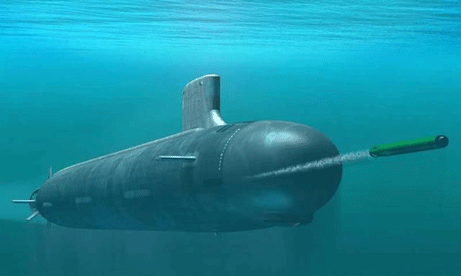
The USS Alaska, one of America’s most secretive nuclear-armed submarines, surfaced in Gibraltar as Trump warned the ceasefire with Iran was on ‘life support’ and dismissed Tehran’s counteroffer as ‘totally unacceptable’.
The Pentagon made an unusually public show of force this week, revealing the location of a U.S. Navy nuclear-armed submarine just a day after President Donald Trump rejected Iran’s latest proposal to end the war.
The Ohio-class ballistic missile submarine arrived Sunday in Gibraltar, the British territory on Spain’s southern coast, the US Sixth Fleet said Monday. Such announcements are rare because the locations of America’s nuclear-armed submarines are usually among the military’s most closely guarded secrets
The Sixth Fleet did not initially identify the submarine by name, but local reports said it was the USS Alaska — one of the largest and most powerful submarines in the US Navy.
“The port visit demonstrates U.S. capability, flexibility and continuing commitment to its NATO allies,” the Sixth Fleet said in a statement. “Ohio-class ballistic missile submarines are undetectable launch platforms for submarine-launched ballistic missiles, providing the U.S. with its most survivable leg of the nuclear triad.”
The timing of the visit immediately drew attention. It came after Trump said the US ceasefire with Iran was on “life support” and described it as “unbelievably weak.” On Sunday, he rejected Iran’s counterproposal to end the war, calling it “totally unacceptable.”
Iran’s reported demands included war reparations, recognition of its sovereignty over the Strait of Hormuz and an end to US sanctions. Trump’s rejection has raised fears that Washington and Tehran are drifting back toward escalation.
The public disclosure of the submarine’s location appeared to send a clear signal. Ohio-class ballistic missile submarines are designed to remain hidden at sea for extended periods, forming the most survivable part of the US nuclear triad. Their mission is deterrence: to guarantee that the United States can respond even if its land-based missiles and bombers are targeted.
The Ohio class includes 14 ballistic missile submarines and four guided-missile submarines. Ballistic missile versions can carry Trident II D5 missiles capable of delivering nuclear warheads. Guided-missile variants can carry more than 150 Tomahawk cruise missiles.
The USS Alaska’s arrival in Gibraltar also carried a diplomatic message. The submarine bypassed the nearby US naval base in Rota, Spain, about 141 kilometers away, and instead docked at the British-controlled territory. British Royal Marines were deployed to receive it, and a 200-meter exclusion zone was set up around the vessel.
The move comes amid strained relations between Washington and Madrid. Spanish Prime Minister Pedro Sánchez has criticized the US war in Iran and reportedly refused to allow the United States to use Spanish bases in Rota and Morón as part of its offensive. Trump responded by threatening to “cut off all trade” with Spain and said he would “probably” remove American troops from the country, where about 3,800 US personnel are stationed.
Spain has objected before to US nuclear submarine stops in Gibraltar. In 2022, Madrid protested after US submarines used services there instead of Rota, arguing that the Spanish base had special protocols for nuclear vessels meant to reduce environmental risk and protect public safety.
The USS Alaska has visited Gibraltar before, including in June 2021. Other Ohio-class submarines, including the USS Florida, USS Rhode Island and USS Georgia, also made stopovers there in 2022.
Authorities have not said how long the Alaska will remain in Gibraltar or what the purpose of the visit is beyond the official US statement about capability, flexibility and commitment to NATO allies.
But the message was hard to miss. As Trump weighs his next move on Iran, the United States has chosen to publicly place one of its most secretive nuclear platforms at the edge of the Mediterranean — close enough to be noticed, rare enough to matter, and powerful enough to remind Tehran what is at stake.
The schism between the Pentagon and the Vatican
In the days that followed, the doors of the Pentagon were closed to “the family” (including the Catholic Church). Only pastors of the Communion of Evangelical Reformed Churches (CREC), the Christian Zionist Church of Pete Hegseth, are now authorized there, for the monthly religious service of the Armies. Also, during the next service, on March 18, 2026, Secretary of War Pete Hegsteh delivered the homily himself.
He prayed that U.S. troops would inflict “overwhelmingly violent action against those who deserve no mercy… We ask this with bold confidence in the name of Almighty Jesus Christ.
by Thierry Meyssan, Voltaire Network | Paris (France) | 9 May 2026
Seen from the outside, we do not perceive the metamorphosis of the United States: in four months, it has changed its political ideology (they are no longer “Jacksonians”), its military doctrine (they no longer apply the “Rumsfled-Cebrowski” strategy), and faith (they no longer believe in the plurality of religions). We are publishing a study on this change which requires us to completely revise our perception of this country.
In January 9, 2026, Pope Leo XIV presented his New Year wishes to foreign ambassadors. He declared in particular: “These days, the weakness of multilateralism on the international level is particularly worrying. Diplomacy that promotes dialogue and seeks consensus among all is replaced by diplomacy by force, individuals or groups of allies. War has come back into fashion and warlike fervor is spreading. The principle established after World War II, which prohibited countries from using force to violate other people’s borders, was violated. [1]. We no longer seek peace as a gift and a desirable good in ourselves “in the pursuit of an order willed by God, which implies a more perfect justice between men”, auto_awesome [2] but we seek it by arms, as condition for asserting one’s own domination. This seriously threatens the rule of law which is the foundation of all peaceful civil coexistence. ” [3].
This speech greatly displeased the United States Secretary of War, Pete Hegseth. He is a Christian Zionist, member of the Communion of Evangelical Reformed Churches (CREC), the sect of Pastor Douglas Wilson. Since September 30, 2025, he has been reforming the Pentagon, dismissing officers who had been appointed in favor of woke ideology and the rules of “diversity, equity and inclusion” (DEI) [4]. Above all, he questioned the role of “the family”, International Christian Leadership, within the Pentagon itself. This association of military chaplains of all faiths was created in 1935 by the Methodist pastor Abraham Vereide. It had become, after the Second World War, the main justification for the Cold War: the struggle of the armies of the United States, defenders of the Faith, against the atheist communist armies. All the chiefs of staff were part of it until last year, and many politicians, American and allied, frequented it [5]. For 73 years, Pastor Billy Graham was its spokesperson. It was in this capacity that he was the spiritual advisor to twelve presidents of the United States, from Truman to Obama [6]. In France, the President of the Senate, Alain Poher, prayed within this group.
Also, on January 22, the Secretary of War summoned the apostolic nuncio to Washington, the French Cardinal Christophe Pierre. In principle, only foreign ministers can summon the ambassador of the Holy See. This was an exception. The prelate was not received by the secretary, but by his deputy, Elbridge Colby.
It is common knowledge that Pete Hegseth is more concerned with the culture war against the woke movement than with military issues. Elbridge Colby, for his part, is responsible for the strategy of the United States armies. He is a Catholic, grandson of William Colby who was director of the CIA during the Nixon mandate and knight of the Sovereign Order of Malta. Elbridge played a central role during Donald Trump’s first term and wrote a strange book: The Strategy of Denial: American defense in an age of great power conflict [7]. He explains that, to be free, the United States must prevent any other state from becoming more powerful than itself. There he developed a strategy to stop China’s development, not by waging war directly against it, but by waging war against its suppliers of energy and raw materials.
Elbridge Colby explained to His Eminence Christophe Pierre that the Holy See must have known for a long time that the United States is its best allies and that the pope should be more “loyal” (sic). The tone of the discussion escalated and Colby reminded the prelate that when a pope came into conflict with a king of France, the latter had a second pope elected. From 1378 to 1417, two popes, that of the Vatican and that of Avignon, mutually excommunicated each other within the framework of the “great Western schism”. Similarly, when it came to Protestant churches when they were the majority in the United States, his own grandfather, William Colby, launched the International Congress on World Evangelism with Pastor Billy Graham to compete with the World Council of Churches (WCC) which spoke out against the Vietnam War. At the end of the interview, Elbridge Colby manifested the schism, in a gesture of defiance, by placing his pistol on the table.
The scene was recounted in different ways by several news outlets after The Free Press reported on it. [8]. The version that I am giving you was previously explained to me by a collaborator and friend who played a role in the Vatican. April 9, on the occasion of the new apostolic nuncio taking office in Washington, His Eminence Gabriele Caccia, the spokesperson for the Holy See, the British Matteo Bruni, confirmed that this meeting did take place, but did not wish to report on its progress. He just said the media reports were “absolutely false”. For his part, the United States Ambassador to the Holy See, Brian Birch, “categorically refu His Eminence ted” the reconstruction of the events presented by The Free Press.
Regardless, the Holy Father canceled his planned trip to the United States.
[10]. Later in the day, his department announced that the number of religions accepted in the armies would no longer be 200 or so, but 31. In addition, military chaplains would no longer wear their rank on their uniform and would instead wear religious insignia [11]. It seems that the Secretary of War wishes on the one hand to refocus the work of chaplains on the propagation of their faith and no longer on the personal problems of their flock [12] and, on the other hand, to gradually impose a particular conception of religion, breaking with current diversity [13]…………………………………………………………………………………………………………………………………
The poison of the political instrumentation of religion is spreading. On April 12, 60 Minutes (CBS) broadcast a report in which three US cardinals support Pope Leon XIV’s statements against the war in Iran and President Trump’s anti-migratory policy. President Trump responded the next morning on Truth Social with this declaration of war: Pope Leo XIV is weak on crime, and terrible on foreign policy. ……………………………………………………………………………………………………………………………………..
On April 15, the third religious service of the new system was broadcast on YouTube. The Secretary of War alluded to the heroic rescue operation of a pilot shot down in Iran. In reality, it was an operation aimed at seizing stocks of enriched uranium. The pilot was not saved. He is still a prisoner of the Revolutionary Guards. Never mind. Hegseth cited a prayer from the Sandy 1 team of the combat search and rescue unit. He said, referring to the Book of Ezekiel: The path of the righteous man is assailed on every side by the injustices of the selfish and the tyranny of evil men. Blessed is he who, in the name of charity and good will, guides the weak through the valley of darkness………………. And you will know that my name is the Lord when I unleash my vengeance on you. “Alas! the quote does not refer to the Bible, but to the script of the film Pulp Fiction.
………………………………….A few hours later, Leo XIV published on X: “Woe to those who manipulate religions and the very name of God for their own military, economic and political ends, dragging what is sacred into darkness and filth!” [17]………………………………
The “Kulturkampf” has just begun. The “fight for civilization” was a policy of Chancellor Otto von Bismarck to sever ties between the German Empire and the Catholic Church. This time, it is a break between the United States and the Holy See, while, due to Mexican immigration, the country’s population is now 40% Catholic [19]. It is also a backlash after Pope Francis’ support for Democratic President Joe Biden [20].
(To be continued…) Translation
Jean-Sébastien La Tour https://www.voltairenet.org/article224466.html
Israel Accuses The New York Times Of Antisemitic Journalism, And Other Notes
Caitlin Johnstone, May 12, 2026, https://www.caitlinjohnst.one/p/israel-accuses-the-new-york-times?utm_source=post-email-title&publication_id=82124&post_id=197296942&utm_campaign=email-post-title&isFreemail=true&r=1ise1&triedRedirect=true&utm_medium=email
The Israeli government is currently accusing The New York Times of antisemitic blood libel for publishing a report on Israel’s already well-documented systemic rape of Palestinian prisoners.
Contrary to popular belief, the highest award in journalism is not the Pulitzer. The highest award in all of journalism is being accused of antisemitism by the Israeli government for factual reporting.
But the New York Times is unworthy of this award. The Times has been running cover for the Gaza holocaust from the very beginning with extensively documented biases in its reporting, and played a leading role in promoting the atrocity propaganda about mass rapes on October 7. Israel’s abuses were actively facilitated by the New York Times, including its systemic sexual abuse of Palestinian prisoners.
The Times didn’t even run the report as a news story; they put it in the “opinion” section. You can see their bias on its surface by the fact that they ran their notoriously discredited “Screams Without Words” piece as a hard news story.
Non-western and non-mainstream media sources have been covering the facts about Israeli sexual abuse for years. Human rights groups have been warning about the systemic rape of Palestinian prisoners since long before the onslaught in Gaza began. The only reason we’re hearing about it from the mainstream press now is because they got the destruction of Gaza they were seeking, and now the crosshairs of the war machine have moved on to places like Lebanon and Iran.
The New York Times does not deserve credit for its too-little, too-late, ass-covering reporting, and it does not deserve the honor of being accused of blood libel by the Israeli government. It deserves nothing but scorn and derision for failing to cover this completely unhidden story until May 2026.
There’s orders of magnitude more evidence for the systemic rape of Palestinian prisoners than there ever was for mass rapes on October 7, and there always has been. Anyone who claims otherwise is a hasbarist.
❖
It’s downright poetic all the different words that Reuters editors can find to avoid saying Israel violated a ceasefire.
A Reuters headline from May 10 reads “Israeli strikes kill three people in Gaza, medics say, testing fragile ceasefire”.
One from May 7 reads, “Israel strikes Beirut for the first time since the ceasefire”
April 27: “Israeli strikes hit east Lebanon, expanding scope despite ceasefire”
April 22: “Attacks in south Lebanon strain ceasefire on eve of Washington talks”
It’s such a trip how all these dusty old newsroom liches who’ve never created an ounce of art in their lives can spontaneously transform into wildly creative wordsmiths when they need to run cover for Israeli abuses.
Speaking of headlines, The New York Times recently altered the title of an article by House Democrats Pramila Jayapal and Jonathan L. Jackson about their visit to Cuba, wording it to remove blame from the United States for the suffering created by the US blockade on the island. The original headline read “What We’re Doing to Cuba Isn’t Just Unlawful. It’s Cruel.” New York Times editors changed it to “What We Saw in Cuba Shocked Us”. They deliberately shifted it to a passive-voice observation without a named perpetrator.
Speaking of headlines, The New York Times recently altered the title of an article by House Democrats Pramila Jayapal and Jonathan L. Jackson about their visit to Cuba, wording it to remove blame from the United States for the suffering created by the US blockade on the island. The original headline read “What We’re Doing to Cuba Isn’t Just Unlawful. It’s Cruel.” New York Times editors changed it to “What We Saw in Cuba Shocked Us”. They deliberately shifted it to a passive-voice observation without a named perpetrator.
One of the silliest contradictions in the Zionist narrative is that it is simultaneously (A) antisemitic to criticize Israel and (B) antisemitic to conflate Israel with all Jews.
Zionists will officially claim that it is possible to criticize Israel without being antisemitic, but that’s not actually their position in practice. We know this because there is not a single vocal and forceful critic of Israel who isn’t regularly accused of antisemitism by Zionists. Not one. They might let you get away with a rare timid critique of individual Israeli officials, but consistently and vocally criticizing the apartheid state of Israel itself (and your own government’s alliances with it) is strictly forbidden.
When you consistently slam literally all of Israel’s critics as antisemites, you are communicating that all criticism of Israel is antisemitic, and that Israel therefore represents all Jews. You are therefore necessarily doing the very thing you decry as antisemitic.
Are Trump’s nuclear plans illegal?

“Fifty years ago, the Atomic Energy Commission was abolished because they became too much of a promoter and lost the confidence of Congress and the public over safety,” said Paul Gunter, director of the reactor oversight project at Beyond Nuclear. “The NRC was established to provide a regulator that prioritizes safety and is obligated not to take shortcuts for a production agenda. Instead, half a century later, we are on the same dangerous collision course, casting aside the NRC in favor of the DOE, which doesn’t have the experience or the staff to get the industry in line with safety and security. This capitulation to the Trump agenda could lead to the NRC being abolished altogether, because nobody will have confidence in them.”
May 11, 2026, https://beyondnuclear.org/are-trumps-nuclear-plans-illegal/
13 organizations, including Beyond Nuclear and Nuclear Information & Resource Service, have filed comments to the US Nuclear Regulatory Commission, suggesting Trump’s nuclear “orders” may violate long-standing legislation
The so-called “Rubber-Stamp Rule”, an effort by the Trump administration to “Make America Nuclear Again”, violates key components of the Atomic Energy Act (AEA) and Energy Reorganization Act, according to comments filed this week by 13 organizations including the Nuclear Information and Resource Service (NIRS) and Beyond Nuclear. The Nuclear Regulatory Commission’s (NRC) proposed rule will allow reactor designs that the Department of Energy (DOE) and Department of Defense (DOD) have approved to bypass required safety reviews by the NRC.
In a separate comment filing in March, 11 state attorneys general concurred with the organizations’ findings that the Department of Energy ‘s new policy to exclude “pilot reactors” from both NRC licensing and environmental reviews violates existing law. In that case, the Department of Energy announced, in violation of federal law, that it would exempt previously untested reactors that it approves to be built and operated from any review of their environmental impacts.
“Along with the DOE’s environmental ‘free pass’ policy, the whole ‘expedited licensing’ regime the administration is attempting to set up appears to be illegal,” said Tim Judson, executive director of NIRS and co-author of comments filed to the NRC. “The White House is trying to create a ‘regulatory tunnel’ around NRC’s safety regulations. That would mean DOE’s biases and obviously false assumptions about the safety of nuclear power plants become the new normal, exposing the public to unacceptable dangers to our health and safety.”
The NRC’s proposed regulation would allow companies that want to build a nuclear reactor of the same design as one DOE has previously approved to merely submit documentation of that approval and claim that the previously built reactor “is safe.” Such companies would likely never have to go through a detailed safety review by NRC to build and operate such reactors. In 1974, Congress amended the Atomic Energy Act to prohibit such a scheme.
“Fifty years ago, the Atomic Energy Commission was abolished because they became too much of a promoter and lost the confidence of Congress and the public over safety,” said Paul Gunter, director of the reactor oversight project at Beyond Nuclear. “The NRC was established to provide a regulator that prioritizes safety and is obligated not to take shortcuts for a production agenda. Instead, half a century later, we are on the same dangerous collision course, casting aside the NRC in favor of the DOE, which doesn’t have the experience or the staff to get the industry in line with safety and security. This capitulation to the Trump agenda could lead to the NRC being abolished altogether, because nobody will have confidence in them.”
The groups also told NRC that it cannot simply “rubber-stamp” reactors that the military builds, either. “And while the law allows the DOD to build its own nuclear reactors,” said Tim Judson of NIRS, “it does not allow the NRC to skip safety reviews for civilian nuclear plants just because they use the same designs. The military routinely exposes its personnel to dangers that civilians are supposed to be protected from.”
“In its eagerness to short-circuit reactor safeguards, the Trump administration is once again doing what it does best – demonstrating a complete disregard for the law,” said Linda Pentz Gunter, executive director of Beyond Nuclear. “But nuclear technology is too inherently dangerous to operate as an outlaw. Ignoring those dangers will put millions of Americans at risk of another catastrophic nuclear accident.”
- NIRS, BN, et al comments on NRC Proposed Rule — https://www.nirs.org/wp-content/uploads/2026/05/DocketID_NRC-2025-1503_Comments_-BeyondNuclear-NIRS-etal.pdf
- Comments on DOE Categorical Exclusion Policy — https://www.nirs.org/wp-content/uploads/2026/03/2026.03.04-NIRS-et-al-Comments-re-DOE-categorical-exclusion-for-advanced-nuclear-reactors.pdf
Will Trump’s failed Iran war provoke his break from Netanyahu’s ironclad grip?
10 May 2026 AIMN Editorial – Walt Zlotow, West Suburban Peace Coalition Glen Ellyn IL, https://theaimn.net/will-trumps-failed-iran-war-provoke-his-break-from-netanyahus-ironclad-grip/
On Iran war day 71 it’s clear Trump has not only lost his war, he’s blundered the world into a looming economic catastrophe. As horrendous as that is, it wasn’t even Trump’s idea. Trump was simply following orders from his real boss, Israeli Prime Minister Benjamin Netanyahu. On February 11, Netanyahu arrived at the White House with Mossad Director David Barnea. They encouraged – if not demanded – invasion. The Netanyahu-Barnea tag team argued Iran would collapse within a couple of days from a combination of assassinating Iran’s leader Ali Khamenei, massive bombing, Mossad-fomented civil unrest and ground incursions by Kurdish fighters.
That couple of days has morphed into 71 days of arguably the greatest military disaster in US history. Instead of collapsing within a couple of days, Iran retaliated against the massive US, Israeli bombing onslaught with their own. Result? All 13 US bases in the neighboring Gulf States are damaged or destroyed. Gulf States infrastructure has suffered massive damage. So has Israel, suffering its worst bombing in its 78 years.
Worst of all, Iran shut down the Strait of Hormuz, choking off a fifth of world oil supply which may cause a worldwide recession, if not depression. The Netanyahu-Barnea presentation was a blizzard of lies Trump swallowed whole in spite of Intelligence assessments to the contrary.
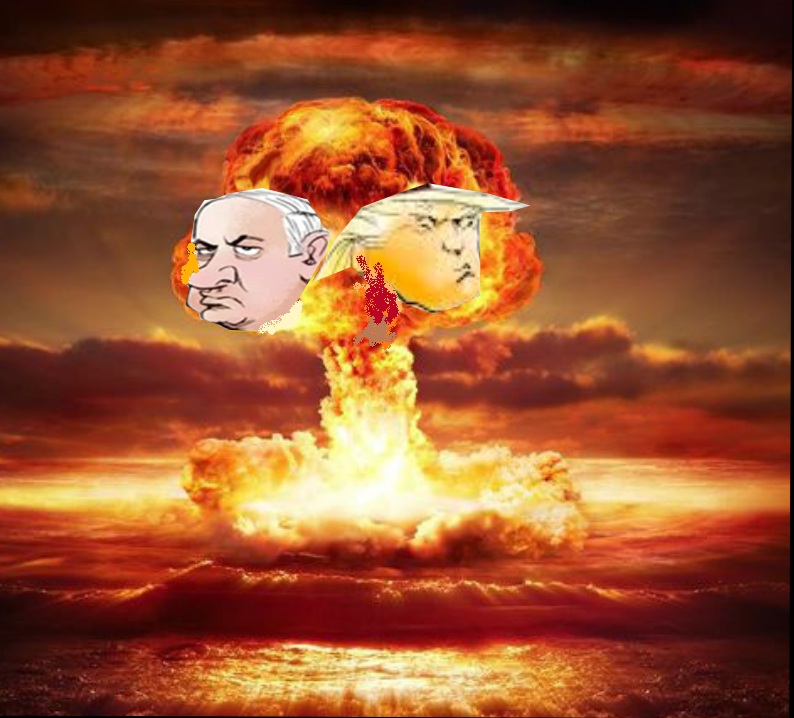
As the world careens toward economic catastrophe, Trump is completely out of options to achieve any of his war goals. Check that. Friday he alluded to striking Iran with nuclear weapons. Trump told reporters on whether the ceasefire if off: “If there’s no ceasefire you’re just going to have to look at one big glow coming out of Iran.”
Assuming he either doesn’t order nuclear strikes, or his military commanders disobey this directive to do so, Trump is facing the worst military defeat in America’s 250 years, all brought on by his fealty to Benjamin Netanyahu. What motivated Trump’s caving to the Israeli Prime Minister? Was it the hundreds of millions in campaign cash showered upon Trump and his Republican Congress? Was it the ‘Epstein Button’, damaging evidence related to the Epstein pedophile enterprise that Trump dare not risk being exposed? Is Trump simply an ardent Zionist believing that any Israeli murder and mayhem to further Israeli expansion and Middle East dominance is worthy of Trump’s enabling?
While we’ll likely never know, Trump must be contemplating the enormity of the disaster he’s inflicted on the Middle East, and very soon the US and entire world. The one benefit that may result from Trump’s immoral, criminal war is he may be rethinking his special relationship with the man who brought on the greatest calamity of his life, Benjamin Netanyahu. Trump needs to truly become the peace president he campaigned to be in 2016. He can do that by quitting his senseless and lost Iran war. He needs to jettison his subservience to Netanyahu’s vision of Greater Israel. He needs to cut off all US military aid to Israel till Netanyahu or his successor end the genocide in Gaza, near genocide in Lebanon and quest to destroy its hegemonic rival, Iran.
If Trump refuses to do the right thing, events on the battlefield and the world economy may push Trump aside and hopefully implement that peace initiative without him.
Christiane Amanpour Lays Out Her Fear for CNN With Blistering Attack on David Ellison’s CBS ‘Realignment’
David Gilmour, May 6th, 2026, https://www.mediaite.com/media/tv/christiane-amanpour-lays-out-her-fear-for-cnn-with-blistering-attack-on-david-ellisons-cbs-realignment/
Veteran CNN journalist Christiane Amanpour pointed to the “ideological realignment” at CBS News on Wednesday as she expressed her “concern” at what her own network might look like under the oversight of incoming owner David Ellison.
Speaking in London at the Truth Tellers Sir Harry Evans Investigative Journalism Summit on Wednesday, Amanpour voiced “concern” over Ellison’s influence on CBS News and what it potentially meant for CNN as his Paramount Skydance acquisition of the network’s parent company, Warner Bros. Discovery, moves forward.
The deal would place Ellison, the son of Oracle co-founder and Trump donor Larry Ellison, in control of the network where Amanpour has worked since 1983, alongside CBS News, which has already undergone sweeping changes under Paramount and Skydance leadership.
“[Defense Secretary] Pete Hegseth, the world’s favorite frat boy supremo, has said that the sooner David Ellison owns CNN, the better. And CNN has become this sort of lightning rod, hasn’t it, for this administration?” asked moderator Emily Maitlis, as the topic of corporate ownership takeover came up. “Does it change what you do? Do you fear what is coming at you now in terms of a change?”
“Clearly I’m concerned, and I’m not sure how much I’m allowed to say about a corporate thing that’s underway, but I am, obviously, as a person, as a journalist with a record, concerned,” Amanpour said. “And I’m concerned based on what’s happened to the other things that he’s taken over already like CBS News right? I mean, do I have to list what’s happening there?”
Amanpour then delivered a blistering takedown of the CBS News under Ellison’s leadership.
“I mean hemorrhaging viewers, probably hemorrhaging money, this ideological realignment of CBS and the destruction potentially of 60 Minutes,” she said.
In a passionate case for 60 Minutes, she praised the show as “one of literally the legacy” programs in American television journalism, adding: “Nobody can match 60 Minutes for a brilliant television magazine show that’s been doing hard news and cultural news, and for decades and decades.”
The comments come amid mounting scrutiny over the future editorial direction of major news outlets as billionaire-backed consolidation reshapes the media landscape.
Amanpour suggested staff at CNN were anxious about preserving newsroom autonomy under new ownership.
“I would like to think that we would have the very basic, which is editorial independence, I’m hoping for that,” she said. “I know many of us at CNN are incredibly – including leadership – are very, very committed to that clearly.”
Press groups demand records on potentially corrupt Paramount acquisitions
May 7, 2026 / Freedom of the Press Foundation, https://freedom.press/issues/press-groups-demand-records-on-potentially-corrupt-paramount-acquisitions/
New York, May 7, 2026 — Today, Freedom of the Press Foundation (FPF) and Reporters Without Borders, Inc. demanded records from Paramount Skydance Corp. regarding potentially corrupt acquisitions and deals that could result in relinquishing editorial control of major news outlets to the Trump administration. Public reports suggest that David Ellison and his father Larry may have tried to secure regulatory approval to acquire Paramount and now Warner Bros. Discovery by, among other things:
- Making a “side deal” to settle President Trump’s spurious lawsuit against “60 Minutes” by providing $15 million to $20 million worth of free advertising.
- Installing a pro-Trump GOP donor without journalism experience as “ombudsman” at CBS News to evaluate complaints of “bias” and to eliminate all diversity, equity, and inclusion practices.
- Promising to make “sweeping” changes to CNN, and to potentially fire anchors and commentators whom Trump dislikes.
Since Paramount Skydance announced its most consequential Trump-friendly changes at CBS News in October — acquiring The Free Press and appointing Bari Weiss as editor-in-chief — the company’s market capitalization has decreased by 40%, wiping out more than $8 billion in shareholder value. Ratings for key programs, like “CBS Evening News with Tony Dokoupil,” have also dropped precipitously. Freedom of the Press Foundation and Reporters Without Borders, which are both shareholders in Paramount Skydance Corp., are entitled to inspect the company’s books and records related to these developments under Section 220 of the Delaware General Corporation Law.
“Shareholders are entitled to know when the government uses its leverage over corporate transactions as a backdoor to meddle in editorial decisions that the First Amendment leaves to the press,” said Seth Stern, chief of advocacy at Freedom of the Press Foundation. “Larry and David Ellison’s capitulation not only harms the public and our democracy, it hurts Paramount by producing news shows people don’t want to watch and tanking the reputations of news outlets in order to appease Trump. If the Ellisons can’t stand up to their friends in the administration and defend the First Amendment, they should stay away from the news business.”
“We need to know what the Ellisons may have promised the president to secure these deals,” said Clayton Weimers, executive director of Reporters Without Borders, Inc. “This acquisition has all the warning signs of a political capture. The American public deserves to know whether the Ellisons are sacrificing editorial independence to appease Donald Trump and secure regulatory approval from an administration that is openly hostile to press freedom.”
“Our clients are entitled to the same records as any other shareholder in Paramount, and legally, the company must comply,” said Brendan Ballou, CEO of the Public Integrity Project. “If Paramount fails to do so, we are prepared to vindicate our clients’ rights in court.”
Under Delaware law, Paramount has five business days to respond to the shareholders’ request. Freedom of the Press Foundation and Reporters Without Borders are being represented by the Public Integrity Project and Ron Poliquin of The Poliquin Firm.
Please email Seth Stern (seth@freedom.press) for any follow-up questions or inquiries.
America’s Suicide Pact

Trump is not an outlier. He is the naked, stripped-down expression of this suicidal pact. He does not pretend the system he inherited works. He lies with less finesse. He crassly enriches himself and his family. He speaks in crude vulgarities. He dismantles any government agency dedicated to the common good, including the Environmental Protection Agency, the Department of Education and the U.S. Postal Service. But he embodies what came before him, albeit without the liberal façade.
America’s suicidal march began long before Donald Trump. Trump and the buffoons around him are the inevitable final chapter of the decaying empire.
Chris Hedges, May 9, 2026 , https://scheerpost.com/2026/05/09/americas-suicide-pact/
Civilizations, as the historian Arnold J. Toynbee famously argued, “die from suicide, not by murder.” They collapse from within. They fall prey to moral, social and spiritual decay. They are seized by a parasitic ruling class. Democratic institutions seize up. The citizenry is immiserated, wealth is funneled upwards to the ruling class and coercion is the principle form of control.
Our suicidal march began long before Donald Trump and his bizarre court of buffoons, sycophants, grifters and Christian fascists took power. It began when the ruling class, especially under the Reagan and Clinton administrations, set out to harvest the country and empire for personal profit.
There is a word for these people. Traitors.
These traitors, ensconced in the leadership of the two ruling parties, stripped us of assets and power slowly. They used subterfuge, lies and legalized bribery. They pretended to honor electoral politics, checks and balances, a free press and the rule of law while subverting all of these democratic pillars. That old system, however flawed, was hollowed out. It was turned over to the amoral and the idiotic — look at the Supreme Court or Congress — those willing to do the bidding of the billionaire class.
Armed with billions by the mortal enemy of the demos — the oligarchs and corporations — the political elites, Republicans and Democrats, destroyed the careers of those politicians who resisted. They crushed labor unions. They blacklisted honest journalists and consolidated the press into the hands of a handful of corporations and oligarchs. They slashed regulations that constrained unfettered greed and protected the population from predatory corporations and environmental toxins. They passed legislation that created a de facto tax boycott for the rich — Trump famously paid no federal income taxes in 10 of the 15 years prior to his presidency — while stripping the country of its industry and throwing some 30 million people out of work. Wealth is no longer created by producing or manufacturing. It is created by manipulating the prices of stocks and commodities and imposing a crippling debt peonage on the public.
These parasites cut or abolished social programs, militarized the police, built the largest prison system in the world and pumped funds into a bloated and out-of-control war industry. German socialist and politician Karl Liebknecht, on the eve of the suicidal folly of World War I, called German imperialists “the enemy at home.” Our rulers, our enemies at home, mounted a series of futile wars that degraded the empire’s global hegemony and poured trillions of dollars of taxpayer money into their bank accounts. Iran is the most recent example.
Trump is not an outlier. He is the naked, stripped-down expression of this suicidal pact. He does not pretend the system he inherited works. He lies with less finesse. He crassly enriches himself and his family. He speaks in crude vulgarities. He dismantles any government agency dedicated to the common good, including the Environmental Protection Agency, the Department of Education and the U.S. Postal Service. But he embodies what came before him, albeit without the liberal façade.
“Trump is not an anomaly,” I wrote in “America: The Farewell Tour”
He is the grotesque visage of a collapsed democracy. Trump and his coterie of billionaires, generals, half-wits, Christian fascists, criminals, racists, and moral deviants play the role of the Snopes clan in some of William Faulkner’s novels. The Snopeses filled the power vacuum of the decayed South and ruthlessly seized control from the degenerated, former slaveholding aristocratic elites. Flem Snopes and his extended family — which includes a killer, a pedophile, a bigamist, an arsonist, a mentally disabled man who copulates with a cow, and a relative who sells tickets to witness the bestiality — are fictional representations of the scum now elevated to the highest level of the federal government. They embody the moral rot unleashed by unfettered capitalism.
The Epstein files, a window into the degeneracy of our ruling class, included not only Trump, but former U.S. president Bill Clinton — who allegedly took a trip to Thailand with Epstein — Prince Andrew, Microsoft founder and billionaire Bill Gates, hedge fund billionaire Glenn Dubin, the former New Mexico governor Bill Richardson, former secretary of the treasury and former president of Harvard University Larry Summers, cognitive psychologist and author Stephen Pinker, Epstein’s lawyer and arch Zionist Alan Dershowitz, billionaire and Victoria’s Secret CEO Leslie Wexner, the former Barclays banker Jes Staley, former Israel prime minister Ehud Barak, magician David Copperfield, actor Kevin Spacey, former CIA director William Burns, real estate mogul Mort Zuckerman, former Maine senator George Mitchell and disgraced Hollywood producer and convicted rapist Harvey Weinstein. They all orbited Epstein’s perpetual Bacchanalia.
Anand Giridharadas, who wrote “Winners Take All: The Elite Charade of Changing the World,” notes that the circle of powerful men, and a handful of women who surrounded Epstein, are emblematic of a privileged caste that lack empathy in the suffering and abuse of others, whether that is sexual abuse, including that of children, financial meltdowns they orchestrate, wars they back, addictions and overdose they enable, the monopolies they defend, the inequality they turbocharge, the housing crisis they milk and the intrusive technologies they refuse to protect people against:
People are right to sense that as the emails lay bare, there is a highly private merito-aristocracy at the intersection of government and business, lobbying, philanthropy, start-ups, academia, science, high finance and media, that all too often takes care of its own more than the common good. They are right to resent that there are infinite second chances for members of this group even as so many Americans are deprived of first chances. They are right that their pleas often go unheard, whether they are being evicted, gouged, foreclosed on, A.I.-obsolesced — or, yes, raped.
“The Epstein emails, in my view,” Giridharadas writes, “together sketch a devastating epistolary portrait of how our social order functions, and for whom. Saying that isn’t extreme. The way this elite operates is.”
“If this neoliberal-era power elite remains poorly understood,” he continues, “it may be because it is not just a financial elite or an educated elite, a noblesse-oblige elite, a political elite or a narrative-making elite; it straddles all of these, lucratively and persuaded of its own good intentions.”
“These people are,” Giridharadas reminds us, “on the same team. On air, they might clash. They promote opposite policies. Some in the network profess anguish over what others in the network are doing. But the emails depict a group whose highest commitment is to their own permanence in the class that decides things. When principles conflict with staying in the network, the network wins.”
You can see my interview with Giridharadas here.
The entire system is rotten. It will not reform itself.
The Democratic Party has hit on the novel campaign issue of reducing taxes to win this year’s midterm elections. It will, no doubt, anoint another vapid, issue-less and genocide-supporting presidential nominee. Democratic donors pumped a staggering $1.5 billion into Kamala Harris’s abridged 15-week celebrity-fueled presidential campaign. She became the first Democratic presidential candidate to lose the national popular vote in two decades and be defeated in every battleground state.
The Democratic Party is not a functioning political party. It is a corporate mirage. Its members can, at best, select preapproved candidates and act as props in choreographed conventions and rallies. Party members have zero influence on party politics.
The more the diminishing power of the empire becomes apparent, evidenced in Trump’s debacle with Iran, the more a confused population retreats into a fantasy world, a world where hard and unpleasant facts do not intrude.
In the final days of a civilization, a population wallows in self-delusional hubris and trumpets false virtues. It looks for scapegoats to explain its failures — Muslims, undocumented workers, Mexicans, African-Americans, feminists, intellectuals, artists and dissidents.
Magical thinking and the myth of American exceptionalism dominate public discourse and are taught in schools. Art and culture are degraded to nationalist kitsch. Science is dismissed, even in the midst of the environmental crisis. Cultural and intellectual disciplines that allow us to see the world from the perspective of the other, that foster empathy, understanding and compassion, are replaced by a grotesque and cruel hypermasculinity and hypermilitarism.
Trump is perfectly tailored for these death throes. He is not a freak or an anomaly. He is the naked visage of our pathological sickness.
War Dividends: Potential U.S. Arms Sales to the Middle East Surge in Q1 2026

On March 19, the U.S. approved $8.5 billion in potential sales to the UAE, split across four potential deals. These approvals included a $4.5 billion sale of a Long Range Discrimination Radar (LRDR) for integration with the Terminal High Altitude Area Defense (THAAD) air-defense system, a $2.1 billion sale of counter-UAS equipment, a $1.2 billion deal for 400 AIM-120C AMRAAM air-to-air missiles, and a $644 million sale of F-16 munitions. Kuwait was approved to purchase eight Lower Tier Air and Missile Defense Sensor (LTAMDS) radars on the same day, at a cost of $8 billion. The U.S. also signed off on $70.5 million in aircraft and munitions support for Jordan
– by Jon Hemler and Derek Bisaccio, https://dsm.forecastinternational.com/2026/04/23/us-foreign-military-sales-q1-2026-middle-east-iran-war/
During the first quarter of 2026, the U.S. government approved over $45 billion in potential Foreign Military Sales (FMS) with the overwhelming majority supporting Middle Eastern allies. Of total global approvals, the region garnered 81 percent, or over $36.6 billion in estimated sales value for defense equipment.
Direct comparisons between first-quarter FMS approvals and the combat systems currently being used by the United States, Israel, and allied Arab states are imperfect. Approved agreements do not automatically translate into deliveries. Follow-on contracts, payments and shipments might not materialize for months or years, if at all. Even so, FMS activity can be a meaningful indicator of geopolitical and industrial trends. This is increasingly true given the scale of combat, stakeholders involved, and weapons consumption driven by the Iranian War.
Middle East
Countries in the Middle East spend heavily on defense, devoting some $177.5 billion to military expenditure in their FY26 budgets by conservative estimates. Many of the region’s governments, moreover, possess immense reserve assets that can be leveraged to support procurement when needed.
Over 81 percent of FMS approvals in the first quarter of 2026 covered potential sales to American partners in the Middle East, corresponding with the deterioration in the regional security environment during this timeframe. These approvals can be generally grouped into two tranches, with the first set announced around the end of January. On January 30, the U.S. approved a Saudi request for 730 Patriot PAC-3 MSE missiles, which, together with support equipment, carry an estimated price tag of $9.0 billion. That same day, the U.S. also approved four sales to Israel worth a combined $6.6 billion, with the largest being a potential $3.8 billion sale of 30 AH-64E attack helicopters.
The U.S. and Israel began military operations against Iran on February 28, beginning a weeks-long air campaign in retaliation for the country’s brutal crackdown on protesters the month before and aiming to dismantle Iran’s offensive military capabilities and nuclear program. Iran retaliated with missile and drone salvoes targeting Israel, regional U.S. military bases, and the Gulf Cooperation Council (GCC) countries. According to some estimates, Iran fired as many as 6,400 missiles and drones at the GCC countries and Jordan across 41 days of operations. The majority of these attacks were intercepted, but Iranian attacks did manage to penetrate Gulf air defenses and hit sensitive sites. Amid these barrages, the GCC countries made a series of requests for ammunition and radar systems from the U.S., leading to a group of FMS approvals in mid-March.
On March 19, the U.S. approved $8.5 billion in potential sales to the UAE, split across four potential deals. These approvals included a $4.5 billion sale of a Long Range Discrimination Radar (LRDR) for integration with the Terminal High Altitude Area Defense (THAAD) air-defense system, a $2.1 billion sale of counter-UAS equipment, a $1.2 billion deal for 400 AIM-120C AMRAAM air-to-air missiles, and a $644 million sale of F-16 munitions. Kuwait was approved to purchase eight Lower Tier Air and Missile Defense Sensor (LTAMDS) radars on the same day, at a cost of $8 billion. The U.S. also signed off on $70.5 million in aircraft and munitions support for Jordan
All six of the deals announced on March 19 were approved under an emergency exception to Section 36(b) of the Arms Export Control Act, waiving the typical Congressional review requirement. That process would normally take roughly 30 to 40 days, during which the sides would be unable to move forward with contract negotiations.
Europe
Around $3.8 billion in FMS approvals in the first quarter of 2026 – 8.5 percent of the overall total – target European requirements. A sizable chunk of this total comes from Spain’s $1.7 billion request for mid-life upgrades to its Álvaro de Bazán-class frigates. The upgrade program will principally include integrating the AEGIS weapon system to expand the warships’ air-defense capabilities.
On March 10, the State Department approved the sale of 20 M142 High Mobility Artillery Rocket Systems (HIMARS) to Sweden, with a price tag of $930 million. Should Stockholm move forward with a purchase agreement, it would become the eighth or ninth European customer for the multiple rocket launcher, joining Croatia, Estonia, Italy, Latvia, Lithuania, Poland, and Romania. (Hungary, another potential customer, announced plans to acquire HIMARS on April 9, ahead of the incumbent government’s loss in general elections several days later.)
The U.S. also approved an FMS deal with Denmark, blessing the sale of 100 AGM-114R HELLFIRE air-to-surface missiles at a possible cost of $45 million. Relations between Washington and Copenhagen have become turbulent in the second Trump administration over Greenland’s political future, but beneath the headlines, the two countries remain strong defense partners.
Only one FMS approval for Ukraine (which Forecast International groups in the Eurasia region) was announced in the first quarter of 2026, on February 6. Kyiv requested to buy spare parts for its U.S. Army-supplied vehicles and weapons, at an expected cost of $185 million.
Over time, European countries are aiming to reduce their dependency on the U.S. for military equipment, pursuing various national and intra-European projects to improve the continent’s own defense industry. This process was jump-started in 2022, in the wake of Russia’s invasion of Ukraine, and has accelerated over the past year as European capitals increasingly worry that the U.S. may withdraw from the NATO Alliance.
Europe (not including Ukraine and Russia) is expected to spend $508.9 billion on defense in FY26, up from around $300 billion on the eve of Russia’s war on Ukraine. Five years ago, only a handful of NATO countries met the Alliance’s 2 percent of GDP target, but most are now at least at that threshold, if not well exceeding it.
Industry Trends
From a weapons systems standpoint, missiles and related equipment represent the largest category of approved potential sales from the quarter at nearly $16.0 billion and 35 percent of the total. Relatedly, the three highest-cost possible deals involve various offensive and defensive missile and networked electronic systems that have featured prominently in military operations during the war in Iran.
Of these, American defense giants Lockheed Martin and RTX are well-positioned to capitalize on a prospective windfall of over $21 billion in the aforementioned FMS to Saudi Arabia, Kuwait, and the UAE. Domestically, Lockheed Martin and RTX both emerged as beneficiaries of several historic multi-year framework agreements with the Pentagon during Q1 2026, to boost precision munitions and interceptor production for the U.S
Like FMS approvals, these agreements do not indicate signed contracts or solid revenue. However, subsequent large-scale contacts are likely to follow in the coming years as the U.S. moves to surge critical munitions production. Some related contracts are already unfolding. In early April, Lockheed Martin received a $4.76 billion award supported by U.S. Army and FMS allocations for PAC-3 Missile Segment Enhancement missiles.
Raytheon, an RTX company, also won a handful of LTAMDS contracts from the U.S. government during the first quarter, including a $905 million production contract on April 16 that contributes to an overall $5.36 billion cumulative framework.
Strategic pivot
The awards to Lockheed Martin and RTX, alongside FMS approvals for key systems emerging from the Iranian War, underscore a broader shift in Washington’s approach to weapons deals. On February 6, 2026, the White House issued an Executive Order entitled “America First Arms Transfer Strategy” to reshape priorities for foreign military equipment sale policy.
Though the Trump Administration’s order references arms transfers as a foreign policy tool, the text primarily focuses on strengthening the U.S. defense industrial base. Indeed, the order states that the strategy “will ensure that future arms sales prioritize American interests by using foreign purchases and capital to build American production and capacity.” A deeper read of the subsections signals a reprioritization of strategy – one that emphasizes utilizing arms sales to bolster domestic industry over foreign policy objectives.
With launches slated to grow a hundredfold, Space Force seeks more sites, money, people, and AI

Even today’s accelerated pace strains decades-old launch facilities.
Defense One Thomas Novelly, Senior Reporter, May 7, 2026
CAPE CANAVERAL, Florida—The guardians manning screens in the mission-ops center here oversaw the launch of five types of rockets in April, a new record that involved NASA’s Artemis II, the first reused New Glenn booster, and a Falcon 9 lofting the final GPS III satellite. But tomorrow’s Space Force may have no time to mark even epochal missions. Within a decade, service leaders say, Cape Canaveral Space Force Station will be launching hundreds of rockets a year.
To facilitate the Pentagon’s fast-growing demand for orbital capability, the Space Force is looking for more launch sites, more money, more troops, and more AI.
“In 2025, the Space Force saw a drastic increase in mission requirements across space access, global mission operations, and space control. This trend shows no signs of slowing,” Gen. Chance Saltzman, the Space Force’s top uniformed leader, told House lawmakers last week. “The Space Force we have today is not the Space Force we will need in the future.”
Nestled on a thin stretch of land just miles from nature preserves and cruise-ship ports, the historic Cape Canaveral facility launched 36 rockets in 2021, its first year as a Space Force facility. Last year, it sent 110 into the heavens, while its California counterpart, Vandenberg Space Force Base, launched another 65.
This year, Space Force leaders intend to launch more than 200 rockets from their two main launch sites. And by 2036, they project, the pair will launch as many as 3,000 annually, according to a service document released last month.
That’s going to take more launchpads…………………………………………………………………………………………………………….
Pushing policy
The Space Force’s top brass has been making that pitch as well.
Last month at the Space Symposium in Colorado, Chief of Space Operations Gen. Chance Saltzman unveiled “Objective Force 2040,” an ambitious vision with a section on expanding the service’s launch capabilities.
“As the space domain becomes increasingly linked both to national security and to economic prosperity, the importance of space access grows commensurately,” the document said. “This is a significant challenge because the Space Force has supported exponential growth in launch cadence over the past few years using the same physical infrastructure first built decades ago. The future operating environment will only exacerbate this strain, with booming government and commercial demand as well as new mission requirements for responsive and scalable space access.”…………………………………………………………………………………………………………………………..
People problems
Increasing the number of launches will require more than money. Top Space Force officers have recently called for doubling the service’s end-strength over the next decade.
But even that won’t be enough, they say. Guardians will need to lean on AI to help. ………………………….. The Objective Force document calls for a service that can “operate at machine speed, leveraging artificial intelligence and autonomous systems while maintaining the primacy of human judgment for critical decisions.”……………………. https://www.defenseone.com/threats/2026/05/launches-slated-grow-hundredfold-space-force-seeks-more-sites-money-people-and-ai/413403/?oref=defense_one_breaking_nl&utm_source=Sailthru&utm_medium=email&utm_campaign=Defense%20One:%20Breaking%20%285/7%29%20launches&utm_term=newsletter_d1_alert
CNN journalist Christiane Amanpour expresses ‘concern’ over the future of the network, citing ‘idealogical realignment at CBS

Dominick Mastrangelo, Thu, May 7, 2026 , https://www.yahoo.com/news/articles/amanpour-expresses-concern-over-future-171317075.html?ncid=redditnewsus&guccounter=1&guce_referrer=aHR0cHM6Ly93d3cucmVkZGl0LmNvbS8&guce_referrer_sig=AQAAAHVoY-FvEsZDNw98FelEskBLQG1bup54CvssULXm_j7NIF2G4lS4nTZgIgRg7TW1unhwmBehMPDJ92nP0Ge8HQEiYxCZaEHey9RdUVWhQUvjBXQhW4CBjRKIFsNBA-a6eqQwTBIVcFc-wbaf2WviF1SKDvhT-D8aQ0WSKJvWMiua
CNN journalist Christiane Amanpour voiced discomfort with the possibility of Paramount Skydance taking over her outlet if the cable channel’s parent company is allowed to merge with the David Ellison-led media conglomerate.
“Clearly I’m concerned, and I’m not sure how much I’m allowed to say about a corporate thing that’s underway, but I am obviously as a person as a journalist with a record, concerned,” Amanpour said during a journalism summit this week. “And I’m concerned based on what’s happened to the other things that he’s taken over already, like CBS News, right? I mean do I have to list what’s happening there?”
Amanpour also bemoaned what she called the “ideological realignment of CBS and the destruction potentially of ’60 Minutes.’”
The journalist’s comments were first highlighted by Mediaite.
Paramount Skydance is seeking to purchase Warner Bros. Discovery, which owns CNN, a network President Trump has sparred with for years. He said in recent months that he wishes to see the network operate under new ownership.
The president on Wednesday marked the death of CNN founder Ted Turner by saying the news outlet he founded has been “destroyed” by what Trump called the channel’s “woke” coverage.
The president on Wednesday marked the death of CNN founder Ted Turner by saying the news outlet he founded has been “destroyed” by what Trump called the channel’s “woke” coverage.
David Ellison, a media mogul that is seen as an ally of the president, has retooled CBS News in recent months to cater to what he has called a more “diverse” audience, a move seen by many as a rightward shift at the network.
“I would to think we would have the very basic which is editorial independence,” Amanpour said. “And I don’t think I need to say more about that.”
Will the Trump administration’s ‘nuclear campus’ plan break the US nuclear waste gridlock?

The Energy Department’s compressed timeline risks inviting hastily assembled nuclear development plans that may appear viable on paper but lack the stable funding streams, operational specificity, and negotiated community agreements required to succeed.
By bundling spent fuel siting with advanced reactor deployment, the Energy Department’s nuclear campus plan exposes nuclear waste policy to the broader politics of nuclear deregulation.
Bulletin, By Vincent Ialenti | Analysis | May 6, 2026
Imagine a vast industrial landscape taking shape at the edge of a rural community in your region. Survey stakes trace the outlines of future access roads, rail spurs, and transmission corridors. Earthmovers sit beside graded pads where nuclear reactors, fuel fabrication lines, and waste-handling systems are expected to be built. The site is expansive—a terrain engineered to co-locate several stages of the nuclear fuel cycle: uranium enrichment, advanced reactors, reprocessing, and waste disposal. The projections arrive early, years before the infrastructure does. Plans circulate in briefing decks and glossy pamphlets. And the numbers are impressive: 50,000 direct jobs, up to 150,000 more across supply chains and regional services, 10,000 new housing units, and billions in projected annual wages.
In late January, the Energy Department moved to translate this vision into policy when it invited states to express interest in hosting what it calls “Nuclear Lifecycle Innovation Campuses.” The model draws on industrial clustering strategies used in sectors such as semiconductor manufacturing and petrochemicals. Through voluntary federal-state partnerships, states are asked to compete for the campuses as engines of economic development, workforce training, and infrastructure investment.
But the proposal also serves a second purpose. It reframes a longstanding political obstacle: securing a host for the deep geological disposal of spent fuel from US nuclear power plants.
By bundling nuclear waste management within a larger economic development package, the Energy Department is inviting states to compete for nuclear campuses that include facilities long considered politically untenable on their own. A state willing to include a deep geologic repository in its proposal could allow the Trump administration to claim victory on a policy impasse that has persisted for more than four decades—even as questions of geological suitability, facility financing, and host community consent remain unresolved.
The federal-state partnership approach responds to state-level resistance, which has been an Achilles’ heel of US nuclear waste policy. In 2010, the Energy Department halted the Yucca Mountain repository after sustained opposition from Nevada officials. Soon after, the Skull Valley Private Fuel Storage project was stymied by litigation and resistance from Utah leadership. Most recently, Holtec abandoned its New Mexico interim storage project in 2025 following a 2023 state law barring spent fuel storage without explicit state consent. And despite the Interim Storage Partners’ project in Texas securing a legal victory last June when the Supreme Court ruled that the state lacked standing to challenge its Nuclear Regulatory Commission (NRC) license, it continues to face opposition and has yet to translate that ruling into forward progress.
The Trump administration’s nuclear campus plan attempts to lower political barriers like these. But it harbors significant structural vulnerabilities. The history of the defunct Yucca Mountain repository shows how fragile nuclear consent can be. A single misstep in the siting process or safety perception can trigger litigation, political backlash, cascading mistrust, and delays or even the cancellation of projects. Embedding the US nuclear waste program in a financially uncertain, logistically underspecified, fast-tracked campus plan risks further eroding public confidence in the federal government’s ability to sustain a durable, long-horizon spent nuclear fuel strategy.
Fast timelines, uncertain financing. The Trump administration’s nuclear campus plan operates on an unusually aggressive timeline. The solicitation gave states just over two months to identify specific sites and provide supporting details on geology, community engagement, and transportation access. It also expressed a preference for states willing to proceed on “more ambitious timelines,” asking them to identify pathways for regulatory streamlining and expedited permitting. The Energy Department envisions facilities coming online as early as 2027. This ambition is complicated by the initiative’s unresolved financial structure.
A geological repository would, in principle, draw on the US Nuclear Waste Fund, the reactor-operator fee-based account established for long-term storage and permanent disposal of commercial spent fuel. However, the Energy Department asks states to look to the private sector for funding most of the other nuclear campus facilities. The solicitation gave states just over two months to propose financing plans built around private capital—venture firms, technology companies, nuclear industry partners, or private equity—alongside state and local contributions. Federal support is limited to near-term coordination, cost-sharing, technical assistance, and loan guarantees to de-risk early investments.
The Energy Department’s compressed timeline risks inviting hastily assembled nuclear development plans that may appear viable on paper but lack the stable funding streams, operational specificity, and negotiated community agreements required to succeed. Including spent fuel siting in such a fragile arrangement introduces a legitimacy risk to the nation’s nuclear waste program. Prospective host states might reasonably question whether a 25-page solicitation—covering the entire nuclear fuel cycle—constitutes a credible multi-generational development framework or, rather, an overextended political vision vulnerable to market volatility.
The nuclear campus initiative also arrives amid a wave of deregulatory pressure.
In May 2025, the Trump administration directed the NRC to revise its rules to accelerate nuclear licensing timelines, raising questions about the agency’s independence. National policy directives emphasize fixed deadlines for reactor licensing decisions and reduced staff for advisory review. Oversight of nuclear waste has also weakened. In July 2025, the White House dismissed seven members of the Nuclear Waste Technical Review Board, leaving the body with a single sitting member. More recently, the Energy Department expanded National Environmental Policy Act exclusions for advanced nuclear reactors, allowing some projects to proceed without full environmental review. In February, an NPR investigation reported that the Energy Department revised reactor safety rules—reportedly cutting roughly 750 pages of requirements, including protections for groundwater, security, and oversight—for reactors on its property.
By bundling spent fuel siting with advanced reactor deployment, the Energy Department’s nuclear campus plan exposes nuclear waste policy to the broader politics of nuclear deregulation. Prospective host communities may question whether pressures on regulatory independence are being adequately weighed in state proposals—and whether core health, safety, and environmental protections will remain intact.
Policy whiplash and the limits of public trust. The nuclear campus plan is the latest move in a multi-decade saga of nuclear waste policy reversals. After the Obama administration cut funding for the Yucca Mountain repository in 2009, the Blue Ribbon Commission on America’s Nuclear Future proposed a new siting strategy grounded in voluntary participation and community consent—an approach that had proven effective in Finland, Sweden, and Canada. A consent-based siting model was launched by President Barack Obama, shelved by President Donald Trump, revived by President Joe Biden, and is now sidelined again under Trump’s second administration. Each change of administration introduced new visions before prior commitments had time to mature. The cumulative effect of these recurrent policy resets has been to signal that federal assurances may be short-term and provisional rather than long-term and binding. A prospective host community might reasonably ask: Will the Energy Department’s nuclear campus vision endure beyond the current administration—or is it another turn in a cycle of partisan whiplash?
………………………………………………………………………………………………….From acceleration to endurance. The nuclear campus plan wedges a long-term strategy for managing the nation’s spent fuel into a near-term push for accelerated reactor deployment. This creates three core legitimacy risks: that fast-tracked timelines will exacerbate financial and logistical uncertainty; that deregulatory pressures will undermine public safety perceptions; and that recurrent policy resets will weaken the Energy Department’s credibility in issuing long-term assurances to prospective host communities. This third risk is perhaps the most consequential. Without institutional structures capable of enduring beyond political cycles, the effort risks becoming just another episode in the long-running pattern of stop-start partisan reversals that has defined US nuclear waste governance for decades.
……………………………………………………….In a polarized US political environment, bipartisan enthusiasm for nuclear power is a rare point of convergence. Nuclear energy is increasingly framed as a solution for climate mitigation, grid reliability, national security, economic growth, and the electricity demands of artificial intelligence data centers. But if the nuclear campus plan becomes a quiet pathway for states to advance communities as hosts for nuclear waste repositories—without the level of geological prescreening, institutional trust, and durable local consent that underpinned progress in Finland, Sweden, and Canada—the United States risks reintroducing volatility into nuclear waste siting while allowing federal officials to claim premature progress on a problem that remains politically unresolved. https://thebulletin.org/2026/05/will-the-trump-administrations-nuclear-campus-plan-break-the-us-nuclear-waste-gridlock/?utm_source=ActiveCampaign&utm_medium=email&utm_content=What%20the%20Pentagon%20s%20missing%20on%20its%20%20critical%20technologies%20%20list&utm_campaign=20260507%20Thursday%20Newsletter
Infant mortality rates in San Luis Obispo County in proximity to the Diablo Canyon Nuclear Power Plant.

Radiation and Public Health Project (RPHP) Joseph J. Mangano MPH MBA, April 29, 2026
EXECUTIVE SUMMARY
The two Diablo Canyon nuclear reactors in San Luis Obispo County CA began operations in 1984
and 1985. They have generated enormous amounts of highly radioactive waste. Most is stored at
the site, but some is routinely released into the environment – and into humans through breathing,
food, and water. However, no studies on health effects to the local population have been done.
Exposure to radiation is especially harmful to the fetus and infant. This report analyzes trends and
current patterns of newborn and infant health in San Luis Obispo County, compared to the state of
California. Results show that county rates have shifted from below to above the state:
Infant Deaths. Before Diablo Canyon opened (1968-1984), the county death rate under one year
was 16% below the state. Most recently (2010-2024), the county was 1% above the state, including
11% and 23% higher for white non-Hispanics and white Hispanics.
Premature Births. In the earliest period available (1995-1999), the county rate of premature births
(<36 weeks gestation) was 21% below the state. Most recently (2020-2024), the rate was 3% above
the state (8% and 31% higher for white non-Hispanics and white Hispanics).
Birth Defects. In the period 2016-2024, the county rate of 12 types of birth defects was 114%
greater than (more than double) the state, 3rd highest among the 35 largest California counties.
Other Newborn Health Measures. In addition, the county also has higher current (2016-2024) rates
of common newborn risk factors, including those requiring assisted ventilation, those with low
five-minute Apgar scores (a measure of infant health), and newborns transferred to another facility.
Child Cancer. Child cancer is believed to often be an adverse outcome that began in pregnancy.
Early in Diablo Canyon’s operation (1988-1992), county cancer incidence 0-19 was 26% below
the state; in the 30 years since then (1993-2022), the county rate was just 2% below the state.
No explanation for these findings is apparent, as risk factors in the county are not elevated.
Compared to the state, the county has low rates of minorities, uninsured, foreign born, and
languages other than English spoken at home; and similar rates of income, education, and poverty.
The county rate of the most common maternal birth risk factors are below the state
(overweight/obese mothers, mothers <20 or >35, mothers on WIC or Medicaid, and previous
Cesarean section).
Further review of county health patterns is warranted to assess what role exposures to radioactivity
from Diablo Canyon has played in these trends. Results should be made available to officials and
the public. No major decision on the future of the plant should be made without a thorough
understanding of the impact exposures have had on local health………………………………………………………………………………………………………………………………………………………………………………………………………………………………https://radiation.org/wp-content/uploads/2026/04/Diablo-Canyon-report-November-2025.pdf
Epic Nonsense: Trump Shelves Project Freedom

8 May 2026 Dr Binoy Kampmark , https://theaimn.net/epic-nonsense-trump-shelves-project-freedom/
The waxwork figures of the Pentagon recently glowed with excitement with the announcement that the US military would be finally called upon to reopen the Strait of Hormuz. With the ceasefire between Teheran and Washington barely holding, President Donald Trump, as far as his attention span would allow, gingerly put Operation Epic Fury to the side in favour of a new mission. The effort to protect and navigate stranded and blocked vessels with US armed might would be dubbed Project Freedom.
As with everything in this cerebrally cloudy and foolish conflict, descriptions and names are untethered to a discernible reality. Was Project Freedom separate from the blockade of Iran? Yes, said certain administration officials. Was it an annex to Operation Epic Fury? No one quite knew.
Some details were provided on May 5 by the US Secretary of War, Pete Hegseth, at a press briefing. “To be clear [Project Freedom] is separate and distinct from Operation Epic Fury. Project Freedom is defensive in nature, focused in scope and temporary in duration, with one mission: protecting innocent commercial shipping from Iranian aggression.” Iran had been “the clear aggressor” in the Strait, “harassing civilian vessels, threatening mariners from every nation indiscriminately and weaponizing a critical chokepoint for its own financial benefit, or at least trying to.” No mention, naturally, on why Iran had resorted to such measures in the first place.
Much of Hegseth’s press address was a bleat, a complaint that the Iranians had simply not played by the rules, rules happily broken by the Trump administration and their Israeli allies when they felt necessary. Iran had attempted to “impose a tolling system,” using “a form of international extortion.” Project Freedom was the celebrated antidote. “Two US commercial ships, along with American destroyers, have already transited the strait, showing the lane is clear.”
The account untethered to reality followed on cue. Iran had been “embarrassed” by the successful transit of these two vessels. “They say they control the strait. They do not. So, American ships led the way, commercial and military shouldering the initial risk from the front, as Americans always do. And right now, hundreds more ships from nations around the world are lining up to transit.” With lavish immodesty, the Secretary noted that US Central Command (CENTCOM) had, along with partner nations, “been in active communication with hundreds of ships, shipping companies and insurers.” The US had provided a “direct gift” to the world in the form of “a powerful red, white and blue dome over the strait.”
With the counterfeit, grubby appeal of an advertiser’s pitch, Hegseth went on to declare Project Freedom “humanitarian” in nature. “By breaking Iran’s illegal stranglehold, we’re protecting the lives and livelihoods of sailors from dozens of countries, securing global energy routes and preventing shortages that hit the world’s poorest people the hardest.”
Chairman of the Joint Chiefs of Staff Gen. Dan Caine was also on hand to explain that CENTCOM had “established an enhanced security area on the southern side of the strait that is now protected by US land, naval and air assets to help defeat further Iranian aggression against commercial shipping.” He noted that Iranian fast boats and attack drones had been defeated. And how could they not be, given the presence of “more than 100 fighters, attack aircraft and other manned and unmanned aircraft, synchronized by the 82nd Airborne Division” engaged in the air for 24 hours a day guarding “the enhanced security area and its approaches.”
With twenty-four hours, this elaborate, exaggerated, purplish vision of American deliverance from Iranian control to an anxious world had collapsed. On May 6, Trump announced that he would be halting Project Freedom. Another round of proposals had been placed on the carousel of confusing diplomacy that might negate the need to resume bombing under Operation Epic Fury. Claiming that Pakistan and other specified countries had wished so, and given “the fact that Great Progress has been made toward a Complete and Final Agreement with the Representatives of Iran,” the blockade would remain in place but “Project Freedom (The Movement of Ships through the Strait of Hormuz) will be paused for a short period of time to see whether or not the Agreement can be finalized and signed.”
Later that day, Trump posted another message. “Assuming Iran agrees to give what has been agreed to, which is, perhaps, a big assumption,” he declared on Truth Social, “the already legendary Epic Fury will be at an end, and the highly effective Blockade will allow the Hormuz Strait to be OPEN TO ALL, including Iran.” The inevitable, clownish threat followed: “If they don’t agree, the bombing starts, and it will be, sadly, at a much higher level and intensity than it was before.”
The rapid demise of Project Freedom, more aborted than halted, had less to do with the emergence of a new desire to pursue negotiations so much as logistical inconvenience. The Gulf States, by and large, have not been impressed by the impulsive measure, given the potential resumption of hostilities. Tehran was always going to blunt US efforts to break the blockade of the Strait, a point demonstrated by attacks on the United Arab Emirates on May 4 that left an oil refinery in the eastern emirate of Fujairah ablaze and three Indian nationals wounded.
According to a report from NBC News, the Kingdom of Saudi Arabia was disgruntled enough by the American initiative in the Strait to inform Washington that it would deny the US military any use of the Prince Sultan Airbase to enforce the mission or permit US aircraft to use Saudi airspace to that end. This was despite a call taking place between Trump and the Saudi Crown Prince Mohammed bin Salman.
An unnamed Saudi source was cited as saying that Saudi Arabia was “very supportive of the diplomatic efforts” led by Pakistan in aiding Iran and the US terminate the conflict, while a US official put it in simple terms as to why Project Freedom could only dissipate in impotence: “Because of geography, you need cooperation from regional partners to utilize their airspace along their borders.”
From the embers of the Trump administration’s latest bungle emerged a one-page memorandum of understanding Washington has reportedly drawn up for further discussions with Tehran. It reportedly contains 14 points, covering, for instance, a declaration ending the war and the commencement of a 30-day period of negotiations on a detailed agreement that would see Iran reopen the Strait over that duration. This would be complemented by the lifting of the US naval blockade. Restrictions on Iran’s nuclear program and the lifting of US sanctions also feature. Failing all that, the blockade or a resumption of military operations could take place. How chillingly close this is to those remarks of T. S. Eliot in the Four Quartets: “What we call the beginning is often the end/And to make and end is to make a beginning. The end is where we start from.” This war was a beginning, and an end, we never needed.
1 This Month

22 June – Virtual Event –Climate Change: New Data, New Debate

Monday, June 22, 2026 2:30 p.m. – 3:15 p.m. CT
YouTube. Register here

Protect Sazan Island from the Trump family! https://secure.avaaz.org/campaign/en/protect_sazan_island_from_the_trump_family_loc/?bqFCVab&v=174511&cl=22707147157&_checksum=5e9dde668860e8231c33699735e16a1fbf22ab2cb01da50c999fe8732b9775ef&utm_source=email&utm_medium=blast_email&utm_campaign=174511
25 June- THE PUKE ON NUKES
Thursday, June 25, 2026
7pm Central Time (8pm ET, 6pm MT, 5pm PT) UTC – 5
From NRC & DOE Deregulation to Techno-Fascist Billionaires Going Nuclear, Plus a Few Songs from Atomic Cabaret REGISTER
26 June – Radiation Trainwreck at the NRC / Join the Protect Better Campaign – https://us02web.zoom.us/meeting/register/4ZlZ5_qLSHGiLSCg8FF6Bg#/registration


Cuba Is Not a Failed State – It Is a Besieged State
PETITION: “Global Appeal to Endorse Palestinian Right of Return of Refugees”
To see nuclear-related stories in greater depth and intensity – go to https://nuclearinformation.wordpress.com
-
Archives
- June 2026 (211)
- May 2026 (306)
- April 2026 (356)
- March 2026 (251)
- February 2026 (268)
- January 2026 (308)
- December 2025 (358)
- November 2025 (359)
- October 2025 (376)
- September 2025 (257)
- August 2025 (319)
- July 2025 (230)
-
Categories
- 1
- 1 NUCLEAR ISSUES
- business and costs
- climate change
- culture and arts
- ENERGY
- environment
- health
- history
- indigenous issues
- Legal
- marketing of nuclear
- media
- opposition to nuclear
- PERSONAL STORIES
- politics
- politics international
- Religion and ethics
- safety
- secrets,lies and civil liberties
- spinbuster
- technology
- Uranium
- wastes
- weapons and war
- Women
- 2 WORLD
- ACTION
- AFRICA
- Atrocities
- AUSTRALIA
- Christina's notes
- Christina's themes
- culture and arts
- Events
- Fuk 2022
- Fuk 2023
- Fukushima 2017
- Fukushima 2018
- fukushima 2019
- Fukushima 2020
- Fukushima 2021
- general
- global warming
- Humour (God we need it)
- Nuclear
- RARE EARTHS
- Reference
- resources – print
- Resources -audiovicual
- Weekly Newsletter
- World
- World Nuclear
- YouTube
-
RSS
Entries RSS
Comments RSS
 nuclear-news