Calgary, Canada succeeds brilliantly with wind-powered Light Rail Transport
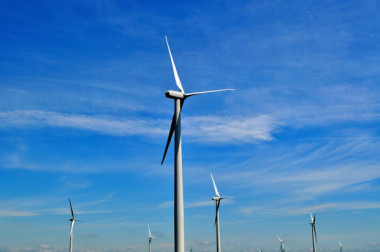
 Calgary’s wind-powered LRT an incredibly successful system: Nenshi , Green Energy Futures July 6, 2015 “Every one of these three-car trains that goes by has a capacity of 600 people. That means it’s taking about 550 cars off the road. It makes a lot of sense,” says Calgary Mayor Naheed Nenshi. By David Dodge and Duncan Kinney
The CTrain in Calgary is one of the greatest examples of electrified transport in Canada.
It is overwhelmingly popular with residents, boasting an average weekday ridership of 325,000. It has kickstarted smarter, denser development around its stations. And, best of all, it and the City of Calgary’s operations are 100 per cent powered by renewable energy.
“It’s hugely important to me. I wish I could take it every day, but it’s an incredibly successful transit system,” says Calgary mayor Naheed Nenshi. “It has amongst the highest ridership of any LRT system anywhere — about 50 per cent of the people who travel downtown every day come downtown by public transit, and the majority of those use the CTrain system.”
But it’s when you compare Calgary to the other transit systems in Canada that it starts to get really interesting. The Pembina Institute has compiled some fascinating data, released in its Fast Cities report last year (disclosure: Green Energy Futures is presented by the Pembina Institute).
Calgary takes home the top spot when it comes to the amount of existing rapid transit lines per million residents; over the past ten years it has laid the most track out of any other city in the report. Continual investment in the system is an important factor that too many cities ignore.
City building
A full three-car CTrain carries 600 people. Not only does the CTrain take a lot of cars off the road, it also helps the city grow in a smarter, denser way………….
Powered by the wind
Perhaps the greatest coup of Calgary’s CTrain system is that it is powered by wind energy. In 2001, Calgary city council voted to purchase 21,000 megawatt-hours of wind power a year for 10 years. That’s the amount of electricity that the LRT uses in a year.
Now, the LRT does not run on electrons delivered straight from wind turbines — instead, it’s connected to the standard electricity grid. But while that grid is still dominated by natural gas and coal, Calgary’s 2001 investment meant 12 wind turbines were erected.
Then in 2012, Calgary went all-in on renewable energy, purchasing 100 per cent renewable power for all of the city’s operations. This investment meant two wind farms got built, totaling 144 megawatts of installed wind capacity.
While the CTrain is still 100 per cent powered by wind, the city’s other operations use a mix of renewable energies: wind, hydro, biomass and solar power. The power purchase agreement totals 450,000 megawatt-hours a year or the equivalent power demand of over 65,000 Calgary homes.
This is one of the killer apps of electrified rail transport: the ability to choose cleaner, greener options. By purchasing wind power, Calgary Transit reports they are saving 56,000 tonnes of carbon dioxide emissions per year.
Cities like Calgary are playing a leadership role without breaking the bank. While the City of Calgary wouldn’t disclose the terms of their power purchase agreement with ENMAX, wind is the cheapest source of electricity in Alberta. The 2013 average pool price for wind according the Alberta Electric System Operator was 5.5 cents per kilowatt-hour while coal was 7.7 cents per-kilowatt hour.
In December 2014 when Quebec issued requests for proposals to build 450 MW of wind power, the average price for accepted bids was 7.6 cents per kWh, including 1.3 cents per kwH transmission costs. Solar power purchase agreements are being signed for as low as 5.84 cents a kWh in Dubai and at 8 cents/kWh in Brazil.
The bottom line is Calgary’s LRT and city operations are running on 100 per cent renewable energy, making the city a leader in Canada. Doubly cool are the phenomenal ridership numbers Calgary has achieved for its LRT — something that is reducing congestion, bringing down emissions and building the clean energy economy of the future. http://www.greenenergyfutures.ca/episode/c-train-success-nenshi-calgary
Natural Resources officials to meet Canadian Nuclear Safety Commission about allegations of nuclear unsafety
 CNSC head to meet with officials to tackle allegations in anonymous letter, GLORIA GALLOWAY, OTTAWA — The Globe and Mail, Jul. 19, 2016 Natural Resources officials will meet with the head of the Canadian Nuclear Safety Commission to discuss allegations that information was withheld from commissioners as they made critical decisions about the licensing of the country’s nuclear plants.
An anonymous letter, purportedly written by specialists at the nuclear regulator, was sent five weeks ago to CNSC president Michael Binder. It points to five separate cases in which the commission’s staff sat on relevant information about risk or non-compliance that might have called the safety of a nuclear plant into question…….
The anonymous letter writers say nuclear hazards have been underestimated, plant operators have been permitted to skip requirements of the licensing regime, and assessments outlining what could happen in the event of a major nuclear disaster – such as the one that occurred in Fukushima, Japan in 2011 – have been withheld from the commissioners and the public……
Among other allegations, the writers of the anonymous letter to Mr. Binder say an evaluation of the effects of a Fukushima-scale nuclear disaster in Canada has never been released to the commissioners or the public.
In a 2014 e-mail obtained by the environmental group Greenpeace under access to information laws, François Rinfret, a director at the regulator, said a scenario for a Fukushima-size disaster would “become the focal point of a licence renewal and, despite brilliant attempts to caution readers … would be used malevolently at a public hearing” by people concerned about nuclear energy. http://www.theglobeandmail.com/news/politics/anonymous-letter-accuses-cnsc-of-withholding-critical-information/article30998523/
Allegations that nuclear risk information was withheld from Canadian Nuclear Safety Commission
 Letter claims info on nuclear risks withheld from safety commissioners GLORIA GALLOWAY OTTAWA — The Globe and Mail, Jul. 18, 2016 The Canadian Nuclear Safety Commission is investigating allegations contained in an anonymous letter claiming to be written by specialists at the nuclear regulator that says information has been withheld from commissioners while making critical decisions about the licensing of this country’s nuclear plants.
The letter, which was sent several weeks ago to CNSC president Michael Binder, points to five separate cases in which the commission’s staff sat on relevant material about risk or non-compliance that might have called the safety of a plant into question.
The letter says hazards have been underestimated, plant operators have been permitted to skip requirements of the licensing regime and assessments outlining what could happen in the event of a major-scale nuclear disaster – such as the one that occurred in Fukushima, Japan, in 2011 – have been withheld from the commissioners and the public…….
The letter was also sent to representatives of two environmental groups, as well as to a current and former CNSC commissioner.
Although it is impossible to verify that the letter was written by CNSC specialists, environmentalists who received copies of the document say the level of detail, the manner of speaking and the amount of complexity suggest it was written by someone with inside knowledge. And, they say, the problems are symptomatic of a culture at the commission in which employees are expected to act as boosters of the nuclear industry rather than watchdogs of nuclear safety.
The letter writers, who say they are remaining anonymous because they are not confident of whistle-blower protection, are asking Dr. Binder to assign an independent expert to review the accuracy of their claims. They make eight additional recommendations for improving the licensing regime, many of them relating to specific issues at the Darlington Nuclear Generating Station on Lake Ontario, just east of Toronto, and at the Bruce plant on Lake Huron.
“Our primary concern is that CNSC commissioners do not receive sufficient information to make balanced judgments,” the letter says. And “because insufficient information is made available, other branches of government cannot make informed decisions. For example, the government of Ontario cannot make a good decision about financing the refurbishment of Darlington without knowing all the facts.”
Dr. Binder was appointed by the former Conservative government of Stephen Harper after it fired then-CNSC president Linda Keen when she balked at skirting safety rules. Ms. Keen now serves as a corporate director for various organizations and does consulting work.
“We’ve seen the CNSC become a cheerleader for the nuclear industry since the Harper government fired former CNSC president Linda Keen,” said Shawn-Patrick Stensil, a senior energy analyst with Greenpeace Canada who was one of the two environmentalists to receive a copy of the letter. “The Trudeau government needs to restore the independence of Canada’s nuclear regulator,” he said.
The letter writers refer to a number of cases in which, they say, the commissioners have made decisions without knowing all of the facts…….
Theresa McClenaghan, executive director of the Canadian Environmental Law Association, who was the other environmentalist sent a copy of the letter, said actions of this sort – in which whistle-blowers make such specific allegations – are both rare and surprising. But, she said, she has no doubt it was written by someone inside the CNSC.
“We are often very concerned that commissioners are not getting the full story from the proponents or the regulatory staff,” Ms. McClenaghan said. “In the hearings, we really do see a frustrating amount of apologetics for the industry going on by staff.”
Mr. Stensil, of Greenpeace, said the most serious issue raised in the letter is the allegation suggesting that CNSC staff knows about additional risks being posed by reactors, but is ignoring them. That is what happened at Fukushima, he said.
“That’s not a nuts-and-bolts or an engineering issue,” Mr. Stensil said. “That’s a safety culture issue.” http://www.theglobeandmail.com/news/politics/anonymous-letter-claims-info-on-nuclear-risks-withheld-from-safety-commissioners/article30964195/
Aging Pickering Nuclear Station that is well past its prime: time to shut it
Liberals Should Shutter Nuclear Plant Well Past Its Prime Huff Post Mike Schreiner Leader of the Green Party of Ontario 07/18/2016 Ontario could save money, increase public safety and create jobs if it closes the Pickering Nuclear Station when its operating licence expires on Aug. 31, 2018. Yet, the Liberal government has approved plans to extend Pickering’s operating life to 2024.
Pickering is already 15 years past its best before date. It’s the fourth oldest nuclear station in North America and the seventh oldest nuclear station in the world. Given its age, it is not surprising that Pickering is one of the most unreliable and poorestperforming nuclear plants in North America. Or that is has the highest operating costs of any nuclear station in North America.
Best before dates are important — not only for the milk you drink but also for the nuclear plant you live by. Pickering is surrounded by over 2.2 million people who live within the 30-kilometre high-risk zone. The Liberals are rolling the dice on a nuclear station that is surrounded by more people than any nuclear plant in North America………
Ontario is currently selling excess electricity at a loss. Ontario’s total electricity exports (22.6 billion kWh) exceeded the total output of the Pickering Nuclear Station (22.6 billion kWh) in 2015. Ontario’s peak hour demand for electricity has declined by 17 per cent in the past decade.
Even if electricity demand goes up because of the Ontario’s efforts to electrify the transportation system, Ontario can purchase electricity from other sources at a lower cost.
We live next door to the world’s fourth largest producer of water power — Quebec. Quebec has a large and growing supply of water power available for export. On average, Quebec water power sells at one third the price of power from Pickering. Why not use this low cost source of clean power to meet possible increases in demand and to cover gaps from the anticipated temporary shut down of the Darlington Nuclear Station?
Ontario can also do more to stretch our energy dollars by investing in energy efficiency measures. The cheapest source of energy is the energy we save. According to the Independent Electricity System Operator (IESO), large industrial energy efficiency programs save electricity at an average cost of 1.5 cents per kWh. Residential, commercial and small industrial energy efficiency programs save electricity at an average cost of 3.5 cents per kWh — far below OPG’s estimate cost of power from Pickering of around nine cents per kWh.
The Liberals seem more interested in making the nuclear lobby happy than in making smart energy choices for the people of Ontario.
And while I understand why the nuclear lobby would fight to protect jobs at Pickering, I believe the Liberal government has a responsibility to make energy decisions that benefit all the people of Ontario even if it means cancelling their $100,000 dinners with the premier.
Moreover, what if we could convert operating jobs at Pickering into jobs decommissioning Pickering–making the area safer for residents while establishing Ontario’s expertise in the decommissioning of nuclear plants. Doing this would create 16,000 person years of employment according to a study by Torrie Smith Associates. This could establish Ontario’s global expertise in decommissioning nuclear plants. With a number of nuclear plants around the world reaching their best before dates, Ontario nuclear workers could benefit from becoming the global experts in shutting down nuclear plants.
The Liberals have a choice to make — give the nuclear lobby what it wants or provide the people of Ontario with an affordable, clean electricity supply; a supply that doesn’t include an old and aging Pickering Nuclear Station that is well past its best before date. http://www.huffingtonpost.ca/mike-schreiner/pickering-nuclear-plant_b_11051446.html
Canada’s aging nuclear plants – renewal of licenses due, but concrete decaying
Decaying concrete raising concerns at Canada’s aging nuclear plants, National Post Ian MacLeod, Postmedia News | July 8, 2012 Decaying concrete at nuclear power plants is the latest concern for nuclear safety authorities.
At Quebec’s sole atomic power station, Gentilly-2, eroding concrete has prompted federal licensing officials to suggest that any provincial attempt to refurbish and re-license the 30-year-old plant must satisfy federal concerns over the aging concrete’s ability to stand up to another two or three decades of service.
The move comes as economic pressures force nuclear utilities to consider refurbishing their nuclear plants and operating them well past their 25- to 30-year initial lives.
With Gentilly-2 at the end of its service life, the Quebec government is under pressure to decide soon whether to order a refit or shut down the plant permanently. Refurbishment estimates range from $2 billion to $3 billion. A shutdown is pegged at $1.6 billion.
Of particular concern for any “life extension” is the dome-shaped containment building that encloses the 675-megawatt CANDU 6 reactor. The metre-thick, steel-reinforced concrete structure serves as the final physical barrier against radioactive contamination escaping into the atmosphere around Becancour, on the south shore of the St. Lawrence River across from Trois-Rivieres and an hour’s drive northeast of Montreal.
“Special attention is needed for the containment structure in the longer term since it has been identified that containment concrete suffers from” a common type of concrete decay called alkali-silica reaction (ASR), says a 2010 report by the Canadian Nuclear Safety Commission (CNSC) in Ottawa.
Despite those long-term concerns, the CNSC last year renewed the plant’s operating licence until 2016.……..http://news.nationalpost.com/news/canada/decaying-concrete-raising-concerns-at-canadas-aging-nuclear-plants
Close Pickering Nuclear Station – Former Minister of Energy
Former Minister of Energy calls for closure of Pickering Nuclear Station in 2018, Angela Bischoff, Outreach Director, Ontario Clean Air Alliance Ontario Clean Air Alliance , 30 June 16 Yesterday, George Smitherman, former Deputy Premier and Minister of Energy for Ontario, called for the closure of the Pickering Nuclear Station in a deputation to the City of Toronto’s Executive Committee. (View Mr. Smitherman’s remarks).
Mr. Smitherman suggested that Ontario extend its “cash for clunkers” program to include Pickering and noted that he was informed as Energy Minister as early as 2007 that the plant was nearing the end of its useful life. He also warned that Pickering was an example of badly outdated technology with weak radioactive containment systems.
Mr. Smitherman went on to note that Ontarians are far too passive about the threat posed by an aging nuclear plant on the doorstep of its largest city and suggested that the City of Toronto had every right to express concern, given the likely impacts on residents and first responders of an accident at North America’s 4th oldest nuclear plant. Asked what had motivated him to speak out about Pickering, Mr. Smitherman simply replied “I’m here in my capacity as a father.”
Mr. Smitherman was speaking in favour of Councillors Glenn De Baeremaeker’s and Gord Perks’ motion that the City of Toronto request the Government of Ontario close the Pickering Nuclear Station in 2018 when its licence expires. He was among a number of speakers who addressed the threats posed by Pickering, including routine releases of radioactive tritium and the continued build up of high level radioactive waste.
Unfortunately, the executive committee adopted precisely the passive response that former Minister Smitherman warned about, and voted to defer the motion indefinitely. Deputy Mayor Minnan-Wong’s motion was supported by Mayor Tory and Councillors Crawford, Di Giorgio, Pasternak, Robinson and Thompson.
The Deputy Mayor’s motion was opposed by Councillors Ainslie, Holland, McMahon and Shiner.
Ontario Power Generation wants a whopping 69 per cent increase in price it gets for nuclear power
 OPG applies for rate increases to fund nuclear station refurbishing Hamilton Spectator By Keith Leslie TORONTO, 2 June 16 — Ontario Power Generation has applied for a whopping 69 per cent increase in the amount it is paid for nuclear power over the next five years.
OPG says it needs the increase to help pay for the $12.8-billion refurbishment of the Darlington nuclear station, which the government announced in January to extend the life of the reactors by another 30 years.
The government-owned utility is also asking for a small increase — less than the rate of inflation — in the rate it’s paid for hydroelectric power……
The Ontario Clean Air Alliance says OPG’s application shows it wants nine cents a kilowatt hour for the power produced from Darlington, which is more expensive than the 8.6 cents a kWh it pays for wind power.
“Our electricity rates are already too high, and we shouldn’t increase them even further when we can actually lower our bills by choosing a cleaner and safer option,” said Alliance chair Jack Gibbons.
“Why are we putting our children at risk of a nuclear accident when there are lower-cost options?”
Gibbons said Ontario should also consider signing long-term contracts to import more clean, renewable electricity from Quebec to offset the nuclear generation……
In addition to the Darlington refurbishment, which is supposed to extend its life until 2050, OPG is also undertaking work to squeeze about four more years of life out of reactors at the Pickering nuclear generating station.
And Bruce Power is spending $13 billion to refurbish six reactors at the nuclear generating station it operates under contract to the government near Kincardine……
Ontario pouring good money after bad in its failing nuclear dream
Ontario’s misguided love affair with nuclear power, The Star, 31 May 16 Instead of seeing principled leadership in Ontario, we are seeing the opposite – a stealthy effort to keep an old and uneconomic nuclear dinosaur on life support. By JACK GIBBONS
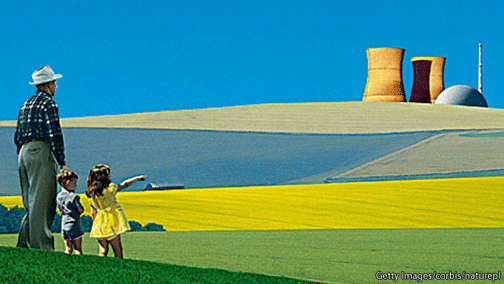
Construction on Pickering began in the 1960s and its first reactors were powered up in 1971 – the same year Led Zepplin released Stairway to Heaven. Despite 45 years of operation, its owner, Ontario Power Generation (OPG), only recently decided to see if the millions of people living around the plant are aware of its plans for what they should do in the event of an emergency at the plant. It quickly found out that a) local residents had no clue what they were supposed to do; and b) they weren’t buying OPG’s plan to “shelter in place” (stay put) during a high-level emergency.
No other nuclear plant in North America even comes close to having as many people on its doorstep as the Pickering Nuclear Generating Station. …….
Pickering is already sucking up $900 million per year in out-of-market subsidies for its power. As one of the highest-cost nuclear plants on the continent, keeping Pickering running means higher electricity rates.
And it’s not like we need its power: In 2015, Ontario exported more power than Pickering produced – and lost money doing it.
So why after promising to close Pickering by 2020 at the latest are the Liberals now working to keep it limping along? It could be like your Buick: You bit the bullet on that costly new transmission and just can’t admit it was a big mistake. Repairs to Pickering’s reactors in the late 1990s went massively over budget and were years late in being completed.
The truth is, however, that “fixing” Pickering is like fixing your aging Buick – it is an ongoing and costly battle. One reactor has recently been offline for months for repairs and breakdowns and “incidents” are regular occurrences at North America’s fourth oldest nuclear station. Pickering was the site of the worst loss of coolant accident at a Canadian reactor, during which workers had to siphon heavy water off the floor of the containment building and back into the reactor in 1984.
Designed in the 1950s and ‘60s, Pickering is an unusual nuclear facility: It has multiple reactors sharing a single containment building and has no secondary fast shutdown system. Separate containment for individual reactors and redundant fast shutdown systems have been standard issue for most nuclear plants for years.
The real reason the government wants to keep Pickering going is that our energy planners remain some of the last people on the planet who still believe that nuclear energy is the best way to meet our need for a brightly lit home or a cold drink. Only France outranks us for dependence on nuclear energy……
The problem is, we are all going to pay the price for their love affair with this outdated technology. https://www.thestar.com/opinion/commentary/2016/05/30/ontarios-misguided-love-affair-with-nuclear-power.html
Canada’s wildfires – surrounding a radioactive trash site
 The nuclear waste site at the heart of Canada’s wildfires http://www.euronews.com/2016/05/18/the-nuclear-waste-site-at-the-heart-of-canadas-wildfires/#.V0M0ugThEm0.twitterJust south of the Canadian city of Fort McMurray, in an area partly ravaged by flames, sits a nuclear waste site.
Situated at the extreme north of the Beacon Hill landfill tip, it contains some 42,500 m3 of radioactive minerals, including uranium and cesium.
But does it pose a threat to society today? According to information gained by euronews reporter Renaud Gardette, the site lies in the middle of the huge wildfires, blazing uncontrollably since May 1.
Why was the landfill created?
To understand the origins of the landfill site, we must first go back to 1982 when Canada launched an extensive exploration and containment of low-level radioactive land programme all over the territory. It was piloted by the Low-Level Radioactive Waste Management Office (LLRWMO).
In Fort McMurray, radioactive minerals were regularly discharged and used along the Northern Transportation Road. Built in the 1930s, the thoroughfare was initially used to transport uranium from the Port Radium mine (Northwest Territories) to Fort McMurray. From there, uranium was also transported by train to Port Hope, Ontario.
The Port Radium mine closed in 1960. Thefts and pillages occurred along the road and that is where the contamination is most visible.
The LLRWMO detected more radioactive sites around Fort McMurray. Work began in 1992 and, up to 2003, 42,500m3 of waste were sent to a specially-engineered landfill with a double layer of clay, several management systems, protection and monitoring, as well as a layer of earth and grass.
The site is monitored annually by the LLRWMO.
Does the site really exist?
The site’s existence is confirmed in several reports, including the Inventory of Radioactive Waste in Canada, published in 2012 by the LLRWMO.
What if?
Several questions have arisen. Was the site burnt in the wildfires? Have radioactive particles been emitted into the atmosphere? What is the risk to the environment?
For the moment, no specific warning has been triggered.
The response from the Canadian authorities
(Translated from French)
Canadian Nuclear Laboratories and our Low-Level Radioactive Waste Management Office are responsible for managing historic low-intensity radioactive waste located in the Beacon Hill dump at Fort McMurray. The site is at the north end of the Beacon Hill landfill site, which itself is south of the city of Fort McMurray and west of Highway 63. The approximate coordinates are: 56 degrees 39 ’10 “ N, 111 degrees 20 ’56 “W.
- CNL manages these sites on behalf of Atomic Energy of Canada Ltd, the federal corporation that is ultimately responsible for the safe management of historic low-intensity radioactive waste.
- The low-intensity waste at Beacon Hill consists of uranium ore residue, mixed with soil and placed in isolation (in a separate cell), which is covered with a thick layer of low-permeability soil, then another, dense layer of clean earth. In total, there are at least 45 centimetres of clean soil over the contaminated soil.
- According to the information available, it appears that the site was affected by the fires. That said, this does not pose any immediate risk to the health and safety of people and the environment. There are also no concerns about the physical integrity of the cell.
- Given the composition of the contaminated soil, that is to say, ore residue mixed with earth, there is no risk that it will catch fire. In a similar way to a field or garden, fire can ignite the grass, but the earth itself does not catch fire.
- We continue to monitor the situation closely.
Canadian nuclear company SNC-Lavalin Named In Panama Papers
The numerous allegations against SNC-Lavalin and its subsidiaries helped Canada dominate a World Bank blacklist of corrupt companies.
Canadian companies represented 117 of the 600 firms on the list in 2013, that were banned from doing business with the World Bank. Most of them were SNC subsidiaries.
The federal Liberal government last year allowed SNC-Lavalin to continue bidding on government contracts while the criminal charges against it are resolved.
Under new procurement rules brought in by the previous Conservative government last year, companies convicted of corruption are banned for 10 years from bidding on government contracts.
 SNC-Lavalin Named In Panama Papers http://www.huffingtonpost.ca/2016/05/18/snc-lavalin-panama-papers_n_10031200.html The Huffington Post Canada | By Daniel Tencer 05/19/2016 Canadian construction and engineering giant SNC-Lavalin, already embroiled in corruption scandals in numerous countries around the world, can add one more black mark to its reputation: It has been named in the Panama Papers leak of offshore accounts, according to news reports.
Among the 11.5 million files in the Panama Papers were documents showing SNC-Lavalin paid a company in the Caribbean nearly $22 million to help secure contracts in Algeria, according to an investigation by the CBC and The Toronto Star.
The two news outlets are the Canadian partners of the consortium that has released the Panama Papers.
The CBC reports that the setup described in the Panama Papers is similar to how SNC-Lavalin operated in Libya, where the company has been accused of bribery.
The RCMP laid charges against SNC-Lavalin last year, alleging the company offered some $47 million in bribes to Libyan officials in the hopes of securing work there between 2001 and 2011.
It also alleged the company committed fraud worth $130 million in its dealings in Libya for paying bribes so it could secure contracts for infrastructure projects there.
A former SNC vice-president, Riadh Ben Aissa, was convicted of bribery in a Swiss court in relation to the Libyan allegations. Continue reading
Canadian wildfires – huge release of carbon to the atmosphere
The Fort McMurray fire’s stunning pulse of carbon to the atmosphere, WP By Chris Mooney May 20 The Fort McMurray wildfire, which seems likely to be the costliest disaster in Canada’s history, continues to grow. According to the government of Alberta, as of Friday morning it had burned over 500,000 hectares of land, or more than 1.2 million acres…..
Steve Taylor, a research scientist with the Canadian Forest Service said the fire already ranks in the top six or seven largest fires seen in Canada in the satellite era, starting in 1970, when observations became most reliable. Especially since this is occurring in May, early in the wildfire season, that’s pretty incredible.
And so is another detail about this fire — the amount of carbon that it is apparently pouring into the atmosphere.
Taylor’s colleague, Werner Kurz, is a senior research scientist at the Canadian Forest Service and heads its carbon accounting team. He said he generally estimates that for every hectare of forest land consumed in a fire like this one, about 170 tons of carbon-dioxide-equivalent emissions — so dubbed because they actually include not only carbon dioxide but also methane and nitrous oxide, two other greenhouse gases — head into the atmosphere.
That would mean that this single fire has contributed — for a rough estimate — some 85 million tons of carbon-dioxide-equivalent emissions.
The fire has also, at least temporarily, worsened the entire nation of Canada’s emissions of carbon dioxide…….
the burning of northern forests can also leave behind a dark upper surface layer that absorbs sunlight, heats up and then thaws permafrost, or frozen soil, beneath the surface. Fort McMurray is located in a zone of Canada that’s still far enough south to see only “isolated patches” of permafrost beneath the ground — but if any of that thaws in the wake of this fire, it will emit carbon into the atmosphere. And that might not get put back in the ground again, at least not on any time frame relevant to the immediate future.
The threat of megafires to permafrost becomes more and more of an issue as you travel farther north in Canada, Alaska and Siberia, which is why northern wildfires can be such a major problem — especially if they are worsening, as appears to be the case…….https://www.washingtonpost.com/news/energy-environment/wp/2016/05/20/the-fort-mcmurray-fires-stunning-pulse-of-carbon-to-the-atmosphere/
Climate change exacerbates wildfires – Canada’s tragedy
 As Alberta wildfire rages, thousands who fled must wait weeks to go home
The more than 88,000 Fort McMurray residents evacuated during the wildfire must wait until June to begin a phased re-entry plan, says Alberta premier, Guardian, Ashifa Kassam , 19 May 16, The wildfire in northern Alberta continues to rage out of control, growing to more than 423,000 hectares as officials said it would be at least another two weeks before the tens of thousands of evacuated Fort McMurray residents would be allowed to return to the city.
Relief – in the form of cooler weather and slight precipitation – may be on the way for fire crews, Rachel Notley, the Alberta premier, said on Wednesday. “So of course we’re all crossing our fingers that that happens.”
While the fire had expanded by 68,000 hectares in the past day, making it more than six times the size of Toronto, much of the fire’s growth has been confined to remote forested areas.
Earlier this week, shifting winds forced the evacuation of 8,000 non-essential staff from more than a dozen camps and sites north of Fort McMurray. Hours later, the fire consumed an oil sands camp belonging to Horizon North Logistics, and authorities warned the fire was fast approaching the Syncrude and Suncor Energyfacilities in the area.
On Wednesday the government said firefighters had been able to hold off the fire from the oil sands facilities. “We were very successful in some of the areas there to the north, so the fire hasn’t encroached as far as we had first feared,” said Chad Morrison, Alberta’s manager of wildfire prevention. “It was very unfortunate that we lost one lodge and that’s obviously due to the extreme fire behaviour.”
In early May, the fire transformed from one that was largely in controlto a raging wildfire that breached the city of Fort McMurray. Amid heavy smoke and flames that licked city streets, more than 88,000 residents were ordered evacuated.
The Alberta premier said that residents would be able to return to the city beginning 1 June, in a phased re-entry plan that would see residents in the least-damaged areas be allowed in first. By 4 June, residents of neighbourhoods like Beacon Hill, where the fire destroyed an estimated 70% of homes, will be allowed to return.
The dates are tentative, stressed Notley, and contingent on the fire’s behaviour in the coming weeks. “This is our best guess,” she said. “If conditions change as they did just this week, the voluntary re-entry may begin later than 1 June.”…….
Speaking in Ottawa on Wednesday, Don Forgeron, the chief executive of the Insurance Bureau of Canada said the fire will likely be the costliest natural disaster in Canadian history, estimating that the cost to insurers would land somewhere between C$3 billion and C$9 billion.
The world, he said, was now in a new era in which disasters such as fires and floods were happening more often. He pointed to a recent report by Canada’s parliamentary budget officer predicting that disasters linked to climate change could cost the government an average of C$902m a year over the next five years. “Climate change … has moved from future threat to present danger,” Forgeron said. http://www.theguardian.com/world/2016/may/18/alberta-wildfires-fort-mcmurray-residents-must-wait-to-return-canada
Growing opposition in both Canada and USA to nuclear waste dumping near the Great Lakes
Opposition to the project, though, has swelled. More than 180 county boards, city councils and other local elected bodies near the Great Lakes in both countries have passed proclamations urging a veto of the plan.

Plan to store nuclear waste near Great Lakes proves radioactive, WP By Steve Friess May 16 KINCARDINE, Ontario — If there was an off-key moment during the otherwise flawlessly executed trip to the U.S. Capitol this spring by the new Canadian prime minister, Justin Trudeau, it might have come when he was cornered by Rep. Debbie Dingell.
“We never want to see nuclear waste in the Great Lakes,” the freshman Democrat from Michigan sternly told Trudeau during a visit to the office of House Minority Leader Nancy Pelosi (D-Calif.). Continue reading
Indigenous residents of Yellowknif, Canada, send Terrestrial Energy nuclear salesmen packing
 ‘Go home!’ N.W.T. residents tell Ontario nuclear power advocate, Presentation met with hostile responses Thursday night in Yellowknife By Mitch Wiles, CBC News May 13, 2016 A Thursday evening forum in Yellowknife about bringing nuclear energy to Canada’s North quickly turned hostile, with local aboriginal people telling one presenter to “Go home!”
Robin Rickman of Oakville, Ont.-based Terrestrial Energy attempted to present a new design of a nuclear reactor to a packed room of N.W.T. residents interested in lowering the cost of energy, but he was repeatedly shouted down.
“Where are the chiefs?” yelled Dehcho region resident Roxanne Landry. “You are not welcome on Dene land!”……
Frame Lake MLA Kevin O’Reilly was at the presentation and says too many questions were left unanswered. “There are still lots of issues of what do you do with the waste,” he said. “It’s nowhere near a feasibility stage. None of these facilities have been built anywhere. I don’t know where the financing would come from. Lots of problems.”
O’Reilly said he doubted whether the project could be safely regulated.That concern was echoed by Landry. She pointed to the contaminated Giant Mine site, just outside of Yellowknife, as a hard lesson in putting too much trust in the industry or regulators……..http://www.cbc.ca/news/canada/north/go-home-nwt-resident-ontario-nuclear-power-advocate-1.3581509
Canadian wildfire approaches oil sands project
Canada wildfire explodes in size, approaches oil sands project, The Age, May 8, 2016 Rod Nickel Gregoire Lake, Alberta: A raging Canadian wildfire grew explosively on Saturday as hot, dry winds pushed the blaze across the energy heartland of Alberta and threatened to burn close to an oil sands project.
The fire that has already prompted the evacuation of all 88,000 people who lived in the city of Fort McMurray was set to double in size on Saturday, the seventh day of what is expected to be the costliest natural disaster in Canada’s history.
Provincial officials praised evacuees for their patience and, in a sign of how long the crisis could drag on, said the cities of Calgary and Edmonton, many hundreds of kilometres to the south, were the best place to receive longer-term support such as medical care and emergency payments.
Firefighting officials said the inferno, propelled north-east towards the neighbouring province of Saskatchewan by high winds and fuelled by tinder-dry forests, was set to double in size to 300,000 hectares by the end of Saturday.
Fort McMurray is the centre of Canada’s oil sands region. About half of the nation’s crude output from the sands, or one million barrels per day, had been taken offline as of Friday, according to a Reuters estimate………
At least 10 oil sands operators have cut production due to evacuations and other emergency measures.
Syncrude oil sands project said it would shut down its northern Alberta operation and remove all personnel from the site due to smoke. There was no imminent threat from the fire….
Mr Morrison told a briefing that firefighters started tackling the fire as soon as it was spotted south-west of the city last Sunday. The blaze is now expected to reach the border with Saskatchewan, some 80 kilometres away, by the end of the day…….
Entire neighbourhoods were reduced to ruins, but most evacuees fled without knowing the fate of their own homes. The majority got away with few possessions, some forced to leave pets behind……http://www.theage.com.au/world/canada-wildfire-explodes-in-size-approaches-oil-sands-project-20160508-gop2yx.html
1 This Month


Tell the Ukrainian Government to Drop Prosecution of Peace Activist Yurii Sheliazhenko

Petition to revoke the licensing of the Near Surface Nuclear Disposal Facility (NSDF) at Chalk River. https://www.ourcommons.ca/petitions/en/Petition/Details?Petition=e-7247


of the week – STOP SMALL MODULAR REACTORS IN CANADA
To see nuclear-related stories in greater depth and intensity – go to https://nuclearinformation.wordpress.com
-
Archives
- March 2026 (212)
- February 2026 (268)
- January 2026 (308)
- December 2025 (358)
- November 2025 (359)
- October 2025 (376)
- September 2025 (258)
- August 2025 (319)
- July 2025 (230)
- June 2025 (348)
- May 2025 (261)
- April 2025 (305)
-
Categories
- 1
- 1 NUCLEAR ISSUES
- business and costs
- climate change
- culture and arts
- ENERGY
- environment
- health
- history
- indigenous issues
- Legal
- marketing of nuclear
- media
- opposition to nuclear
- PERSONAL STORIES
- politics
- politics international
- Religion and ethics
- safety
- secrets,lies and civil liberties
- spinbuster
- technology
- Uranium
- wastes
- weapons and war
- Women
- 2 WORLD
- ACTION
- AFRICA
- Atrocities
- AUSTRALIA
- Christina's notes
- Christina's themes
- culture and arts
- Events
- Fuk 2022
- Fuk 2023
- Fukushima 2017
- Fukushima 2018
- fukushima 2019
- Fukushima 2020
- Fukushima 2021
- general
- global warming
- Humour (God we need it)
- Nuclear
- RARE EARTHS
- Reference
- resources – print
- Resources -audiovicual
- Weekly Newsletter
- World
- World Nuclear
- YouTube
-
RSS
Entries RSS
Comments RSS
 nuclear-news