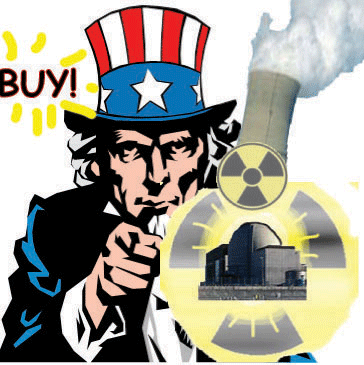
Saudi Arabia and Israel have been itching for an attack on Iran. That would be a dangerous move by either of those States. But hey! What if you get get America to do this on their behalf? With Trump now surrounding himself with belligerent advisors, like Mike Pompeo and John Bolton, and with Trump’s son-in-law Jared Kushner cosying up to Israel and Saudi Arabia – there’s every chance that USA will move closer to the military brink. After all, Trump recently warned Iran that if it started enriching uranium “there will be very severe consequences,” and “something will happen”
Of course, it’s a different story for the Trump and the USA, when it comes to letting the Saudi Arabians enrich uranium. Westinghouse is keen to sell U.S,. nuclear technology to Saudi Arabia, and the Trump administration is writhing about trying to bypass the “123 rule” which prohibits uranium enrichment.
Saudi Arabia has been quick to militarily attack in the past – Bahrain 1994 and 2011 – Yemen recently.
The regime’s brutality towards its own citizens should surely give the world pause to think about how it might behave towards other people, when it’s in possession of nuclear bombs. Cruelty and beheadings are “normal” for crimes -not only for murders, but also for apostasy, blasphemy, atheism.
Of course, super salesman Donald Trump would find this irrelevant, indeed encouraging. After all, 12 months ago, Trump visited Riyadh , returning with a $350 Billion arms contract for America.
Nuclear power for Saudi Arabia becomes an absurd idea, when you consider that Saudi Arabia is not only the “Saudi Arabia” of oil, but also of sunshine. Their motivation for nuclear weapons is clear.
Trump Outsources US Foreign Policy to Riyadh, Tel Aviv Over Iran Deal – Analysts https://sputniknews.com/us/201805101064310160-usa-trump-iran-foreign-policy/ Jonathan Ernst 17 10.05 WASHINGTON (Sputnik) – The United States by exiting the Iran nuclear agreement has now essentially outsourced US foreign policy in the Middle East to both Israel and Saudi Arabia, analysts told Sputnik.
On Wednesday, White House Press Secretary Sarah Sanders told reporters the United States is ready to announce an additional set of sanctions against Iran as early as next week in response to its alleged development of nuclear weapons.
President Donald Trump on Tuesday announced that the United States was withdrawing from the 2015 Joint Comprehensive Plan of Action (JCPOA), signed by the P5+1 and EU, which ensures Iran’s nuclear program remains peaceful in exchange for sanctions relief. In addition, the US Treasury said it would reimpose the highest-level economic sanctions possible on Iran.
In the week prior to Trump’s decision Israeli Prime Minister Benjamin Netanyahu in an internationally-broadcast address presented old intelligence and tried to claim that Tehran was continuing to develop nuclear weapons.
In fact, Iran has remained compliant under the conditions of the JCPOA as verified by the IAEA in 11 reports since January 2016 — a reality US Secretary of State Michael Pompeo even admitted during his confirmation hearings.
Israeli, Saudi Victory
Retired US Army Major and historian Todd Pierce told Sputnik that Trump’s announcement was a triumph for the leaders of Israel and Saudi Arabia, both of whom want the United States to confront Iran.
“Trump has placed US foreign policy in the hands of the coalition of Israel under Netanyahu and Saudi Arabia under [Crown Prince] Mohammad bin Salman, which his son in law Jared Kushner helped bring together to collectively wage war against Iran and Syria,” he said.
Trump’s statement on why he was pulling out of the international nuclear agreement with Iran was expressed in terms that made it sound like Trump was determined to go to war, Pierce observed.”Constructively, in effect, Trump’s talk sounded like a declaration of war against Iran, with the first step being to tighten up the ‘blockade’ of Iran, meaning in the 21st century version of that, US sanctions,” Pierce said.
Trump’s address was also notable for how closely it followed the arguments made eight days earlier by Netanyahu in his efforts to persuade the US government and Congress to scrap the agreement, Pierce pointed out.
Trump, like his ally and friend Netanyahu had shown scant regard for factual accuracy in his presentation.Trump was not an extremist or aberration in setting such policies but was fulfilling goals that had been followed for decades, Pierce pointed out.
Tehran Undaunted
Global peace activist and expert on the medical dangers of nuclear energy, Dr. Helen Caldicott, told Sputnik that she expected Tehran to continue honoring its commitmentsunder the 2015 nuclear accord.
“I think there will not be a nuclear arms race in the Middle East despite the fact that Israel was vehemently opposed to the treaty and surreptitiously lobbied against it with the powers that be in the US,” Caldicott said.
Caldicott, founder of Physicians for Social Responsibility, the organization that was the co-winner of the 1985 Nobel Peace Prize, noted that Iranian President Hassan Rouhani had pledged to remain in the accord.
“Rouhani says that Iran will abide by the JCPOA, a stand which I intuitively had predicted,” she said. “It also seems clear that the European nations will definitely not abide by Trump’s terms of increased sanctions, after begging him to comply.”
The United States still needed to realize that Russia was not an ideological enemy of the West any more the way the Soviet Union had been throughout the Cold War, Caldicott maintained.
“If America could come to its senses and decide that all nuclear weapons are useless symbols of annihilation and have absolutely nothing to do with ‘defense’ it could lead the world to sanity, survival and nuclear disarmament,” she said.
Saudi Foreign Minister Adel Jubeir said on Wednesday that the country may start development of nuclear weapons if Iran continues its nuclear program.
Caldicott is the author of many books, including “The New Nuclear Danger: George W. Bush’s Military Industrial Complex” and “War in Heaven:” The Arms Race in Outer Space.” The Smithsonian Institution has named her one of the most influential women of the 20th century.
A senior executive at engineering giant Bechtel told CNBC on Thursday that U.S. businesses should be involved in Saudi Arabia’s civilian nuclear energy ambitions.
The presence of American firms would likely be welcomed by the Saudis and should also be welcomed by the U.S. government, according to Stuart Jones, regional president for Europe and Middle East at Bechtel.
Saudi Arabia has plans to construct 16 nuclear power reactors over the next 20 to 25 years, costing more than $80 billion.
Saudi Arabia says backs U.S. decision to withdraw from Iran nuclear deal, Reuters Staff RIYADH (Reuters) 9 May 18- Saudi Arabia welcomed President Donald Trump’s decision on Tuesday to withdraw the United States from the international nuclear agreement with Iran and to reimpose economic sanctions on its arch-foe Tehran.
The kingdom, a key U.S. ally, said it would work with the United States and the international community to address Iran’s nuclear program as well as its ballistic missile program and support of militant groups in the region……..
It confirmed “the need to deal with the danger that Iran’s policies pose to international peace and security through a comprehensive view that is not limited to its nuclear program but also includes all hostile activities” in the region……..
Saudi Arabia has called the 2015 nuclear deal a “flawed agreement”, and in March Saudi Crown Prince Mohammed bin Salman told CBS news that his kingdom would “without a doubt” develop nuclear weapons if Iran did so.
The Sunni Muslim kingdom has been at loggerheads with Shi’ite Iran for decades. They have fought a long-running proxy war in the Middle East and beyond, backing opposing sides in armed conflicts and political crises including in Iraq, Syria, Lebanon and Yemen.
some skeptics think the whole energy argument coming out of Riyadh is merely a cover for its military ambitions.
Trump might be distracted by the prize of winning multibillion-dollar contracts for US nuclear construction companies in desperate need of business. The temptation to settle for a deal that gives the Saudis a path to the bomb might just be too great to overcome.
Saudi Arabia is an outstanding candidate for using solar energy to power much of the country. Its vast and extremely sunny deserts are naturally suited to providing electricity to the country during the day.
Given that Saudi Arabia can build solar power facilities and produce solar energy at incredibly low costs, Romm says, it “doesn’t make a lot of sense from an energy point of view” that Saudi is leaning so much toward the nuclear option, which is notoriously expensive.
The power play shows that the world’s most iconic oil giant is serious about reducing its near-total reliance on oil — and it’s also raising questions about whether the country intends to seek out nuclear weapons in the future.
Saudi Arabia says it’s looking to expand its energy portfolio. If it uses nuclear reactors to generate electricity, that will allow the Gulf country to export more of its oil rather than consume it at home. More exports mean more money for the country’s government.
Energy experts say that Saudi Arabia is trying to make money from its oil reservesas quickly as possible because global demand is expected to decline in the future, with breakthroughs in renewable energy technology and the eventual ubiquity of electric cars. In the long run, it’s aiming to diversify its economy away from oil to generate revenue from sectors like tech and entertainment services.
Currently, Riyadh is in talks with firms from more than 10 countries about buying nuclear technology to build its first two reactors — and American firms are top candidates. But before any US sale, the Trump administration needs to strike a nuclear cooperation pact, known as a “123 agreement,” with Saudi Arabia. In those agreements, countries make promises about how they will and won’t use the powerful nuclear equipment they could buy from the US in the future.
Talks between the Trump administration and Saudi Arabia about such a deal are already underway — US Energy Secretary Rick Perry met with Saudi officials in London earlier this month to discuss the matter, and President Trump almost certainly discussed it during his meeting with Saudi Crown Prince Mohammed bin Salman last week.
But nuclear proliferation experts and US lawmakers from both parties are deeply worried about the deal. They’re concerned that Riyadh could try to use the technology to start a nuclear weapons program and make one of most volatile regions in the world even more unstable. In fact, some skeptics think the whole energy argument coming out of Riyadh is merely a cover for its military ambitions.
It’s more than just a hunch. In an interview with CBS’s 60 Minutes on March 18, the Saudi crown prince, widely known as MBS, openly admitted it was a possibility: “Saudi Arabia does not want to acquire any nuclear bomb, but without a doubt, if Iran developed a nuclear bomb, we will follow suit as soon as possible.”
The Trump administration can try to ensure that never happens. In the 123 agreement, it can get the Saudis to make a legally binding pledge that they won’t pursue uranium enrichment or spent fuel reprocessing down the road — the activities that would allow it to build nuclear weapons.
But the Trump administration is reportedly considering allowing Saudi Arabia to enrich uranium in current negotiations. Experts say there are two main reasons the president may do this.
Second, Trump might be distracted by the prize of winning multibillion-dollar contracts for US nuclear construction companies in desperate need of business. The temptation to settle for a deal that gives the Saudis a path to the bomb might just be too great to overcome.
Saudi says it wants nuclear power for energy purposes. That may not be the whole story.
Saudi Arabia has generally described its ambitions for a civil nuclear energy program as a way to increase energy production and said it doesn’t want to use the program to build weapons.
“Not only are we not interested in any way to diverting nuclear technology to military use, we are very active in non-proliferation by others,” Saudi Energy Minister Khalid al-Falih said at a joint press conference with Secretary Perry in December.
Energy experts say that it certainly makes sense for Saudi Arabia to look into new ways to generate energy so that it can export more of its oil before the value of oil plunges in the future. But they also say that it’s strange that the country is focusing so much on nuclear, rather than renewable, energy.
Joe Romm, a former assistant secretary of the Department of Energy during the Clinton years, told me that Saudi Arabia is an outstanding candidate for using solar energy to power much of the country. Its vast and extremely sunny deserts are naturally suited to providing electricity to the country during the day.
Given that Saudi Arabia can build solar power facilities and produce solar energy at incredibly low costs, Romm says, it “doesn’t make a lot of sense from an energy point of view” that Saudi is leaning so much toward the nuclear option, which is notoriously expensive.
Comparing Saudi Arabia’s plans to invest in renewable energy versus its planned investments in nuclear energy, Romm estimated that Riyadh would be trying to generate at least three times more electricity from nuclear reactors than from renewable energy.
And American foreign policy and nuclear nonproliferation experts generally think that the motive behind emphasizing one program over the other is obvious: building weapons.
“I think a main driver, if not the main driver [of Saudi Arabia’s nuclear program], is its security competition with Iran,” Kingston Reif, a nonproliferation expert at the Arms Control Association, told me.
Iran is Saudi Arabia’s archrival in the Middle East, and Saudi Arabia is worried that Iran could use its civil nuclear program to make weapons in the future, and tip the balance of power in the region in its favor. The nuclear deal that Iran signed on to in 2015 heavily restricts Iran’s ability to make the materials required for a nuclear bomb, but crucial restrictions in the agreement begin to expire around 2030.
Since MBS has openly admitted that Saudi Arabia would feel compelled to chase after a bomb if Iran did, it’s clear that it must see a civil nuclear program as a potential military asset.
Can Trump actually make a strong deal with the Saudis?
The Trump administration is currently in ongoing talks with the Saudis about a nuclear cooperation agreement, and it probably came up when the crown prince met with Trump at the White House on March 20. (Neither Saudi Arabia nor the US’s official readouts of the meeting explicitly mention the nuclear cooperation agreement, but both allude to “new commercial deals.”)
Recent reports suggest that the White House may allow Saudi Arabia to enrich uranium as part of the arrangement. A country can enrich uranium to produce fuel for its nuclear reactors, but that same process can also be used to make an atomic bomb — and that has US lawmakers on both sides of the aisle very concerned.
“The Crown Prince’s interview just last week is reason enough to have the administration pump the breaks on the negotiations and insist that there will be no 123 agreement that includes enriching and reprocessing,” Rep. Ileana Ros-Lehtinen (R-FL), the chair of the House Foreign Affairs Subcommittee on the Middle East and North Africa, said in a statement on Wednesday.
“Unfortunately, from the little we do know from the administration, it is looking at this deal in terms of economics and commerce, and national security implications only register as a minor issue, if at all,” she said.
Sen. Bob Corker (R-TN), the chair of the Senate Foreign Relations Committee, has told the administration that there’s bipartisan opposition in Congress to a 123 agreement that allows for enrichment.
The White House has to submit the agreement to Congress for review, and lawmakers have the option to pass a joint resolution of disapproval to block it.
But if that were to happen, it could ultimately backfire: The Saudis might turn to Russian or Chinese bidders for nuclear tech if they’re rebuffed by the US. And analysts say the Russians and Chinese are less likely to be stringent about restricting Saudi Arabia’s enrichment or reprocessing ambitions. For that reason, some analysts argue that Washington might have to consider a compromise with Riyadh.
“I would prefer to have America’s nuclear industry in Saudi Arabia than to have Russian or China’s, so I think it’s useful that we’re reengaging with the Saudis. We should try to get the best restraints on enrichment and reprocessing, including a ban for some significant length of time, say 20 or 25 years,” Robert Einhorn, a former State Department adviser for nonproliferation and arms control, told the Washington Post. “We should show some flexibility.”
Saudi Arabia considers the ability to enrich uranium its “sovereign” right, and it wasn’t able to settle on a 123 agreement with the Obama administration precisely because President Obama refused to grant them that capacity.
Alexandra Bell, an Obama-era State Department arms control expert, told me that the Saudis won’t budge “without high-level pressure from the White House.” That means sustained pressure from people like the president himself or top officials like Energy Secretary Perry are key to extracting any kind of concession on enrichment from Saudi Arabia.
But Trump might not be all that interested in staying focused on that goal. He looks at the issue through a different lens than his predecessor — the prospect of boosting American business could eclipse security concerns for him. Last year, when Trump struck his enormous $110 billion arms deal with the Saudis, he was eager to sell it to the public as a way to create “jobs, jobs, jobs” for the US.
In this case, a deal to build nuclear tech with the Saudiswould provide a boost to struggling US nuclear construction companies. Westinghouse, the most prominent US bidder,is currently going through bankruptcy proceedings and has shed thousands of US jobsbecause of it.
When the Saudis negotiate with the Trump administration in the coming weeks, they’ll probably consider Trump’s eagerness to claim another job-creating deal to be a source of leverage.
“My view is… that he will get rid of this deal on his own, for domestic reasons,” said French President Emmanuel Macron at the end of a three-day state visit to the U.S.
France is a party to the agreement between Iran, the United States and four other nations. Macron has tried to convince Trump to stay in. But the president has continued to criticize the deal and has to decide by May 12 whether or not the U.S. will withdraw and reimpose sanctions. That action could lead to the deal’s collapse.
“Any rapprochement between the United States and Iran — such as the nuclear agreement under President Obama — is viewed with intense suspicion and fear as it threatens the Saudi position as the leading American client in the region.”
Al-Rasheed is a visiting professor at the London School of Economics and is the editor of “Salman’s Legacy: The Dilemmas of a New Era in Saudi Arabia.
She says the reimposition of sanctions would, in the Saudi view, constrain Iran’s influence across the Middle East. “The Kingdom seeks the shrinking, even the collapse, of the Iranian economy under sanctions,” she says.
Domestic Politics Drive Hostility
The hostility toward Iran by the Saudi government, under its powerful crown prince Mohammed bin Salman, is being driven primarily by domestic politics. “Prince Mohammed knows that a fearful enemy is a key to his own strength,” al-Rasheed says. “The crown prince has used the rivalry with Tehran to deflect attention from the complexity of his own domestic uncertainties.”
“He rubs out the criticism of his domestic policies by reminding the marginalized royals and the commoners that he is fighting an existential threat from expansionist Iran,” according to al-Rasheed.
Kingdom Seeks Economic Advantage
Saudi Arabia also seeks to maintain its economic superiority over its neighbors, she notes. The reimposition of sanctions by the United States, and possibly the United Nations, limit economic competition from Iran.
“For domestic reasons, Saudi Arabia is fundamentally trying to mitigate the possibility of the reintegration of Iran in the global community,” al-Rasheed says. “The conflict between the two countries will dissipate only if the domestic uncertainties subside or fade away.”
Saudi Arabia And The Nuclear Temptation. Lobe Log THOMAS LIPPMAN
Saudi Arabia’s crown prince and defense minister, Mohammed bin Salman, seems to have gotten what he wanted from his long glad-handing tour through the United States and several European capitals. He met President Trump and brand-name business tycoons and potential investors, and took home some actual deals, including a commitment by the giant French oil company Total to invest billions in a new petrochemical complex.
What he should have gotten but did not were stern lectures excoriating his glib, casual attitude about acquiring or developing nuclear weapons. Asked by Norah O’Donnell of CBS what Saudi Arabia would do if Iran obtained such weapons, he replied, “Saudi Arabia does not want to acquire any nuclear bomb, but without a doubt if Iran developed a nuclear bomb, we will follow suit as soon as possible.”
Either the young prince was badly briefed or his knowledge of history and international security affairs is thin. He does not seem to realize that his grand plans for modernizing his country and restructuring its economy, which are based on full integration into the global industrial and financial system, would fall apart if the United States and its allies thought that Saudi Arabia was pursuing nuclear arms. He could forget those big investments and deals, and most of his country’s sources of military equipment and training would dry up. The damage to his country that pursuit of nuclear weapons would cause would far outweigh any conceivable strategic gain. Does he not know why Iran was subjected to crippling economic sanctions for all those years before the multinational agreement of 2016 curtailed its nuclear program? Does he not know why North Korea is a pariah state?
Saudi Arabia is a party to the Nuclear Nonproliferation Treaty (NPT), which prohibits signatories other than the five recognized nuclear powers from acquiring or developing a nuclear arsenal. Israel, India, and Pakistan have gotten away with their weapons programs because they are not parties to the NPT and thus have no legal obligation to abide by its terms. Even so, Pakistan did not escape the wrath of the U.S. Congress when it tested nuclear weapons in the 1990s, as bipartisan majorities enacted laws that authorized Presidents George H.W. Bush and Bill Clinton to impose stiff sanctions, which they did.
Saudi Arabia, which has few friends in Congress, would be unlikely to escape the same fate. The kingdom cannot afford to become an international outlaw, like North Korea, or to see its oil sales curtailed and its access to global financial markets cut off, like Iran. That would put an end to the grand development plan the prince has styled “Vision 2030.” ………..
According to many reports, the Saudis are asking that a bilateral deal, known as a “123 Agreement” for the section of the law that requires it, permit them to control both ends of the nuclear fuel cycle. In that way, they could enrich their own uranium and reprocess fuel once it is used up to extract the plutonium generated by the chain reaction. An existing agreement between the United States and Saudi Arabia’s neighbor Abu Dhabi permits neither. That agreement is known in the industry as the “gold standard.” But Saudi Arabia does not want to accept the “Abu Dhabi model” because the international agreement limiting Iran’s nuclear program does not prohibit enrichment.
Enriched uranium fuel for nuclear reactors is plentiful in world markets, but Prince Mohammed has said that Saudi Arabia wants to take advantage of its own domestic resources by doing its own enrichment. Even if there is a valid argument to be made for enrichment, however, the Saudis cannot make a legitimate argument for reprocessing to capture plutonium, which has limited civilian uses but is primarily a fuel for nuclear weapons.
Sen. Edward Markey (D-MA), who has long opposed nuclear energy in any form, can be expected to lead congressional opposition to a 123 agreement that allows reprocessing. “Saudi Arabia’s crown prince has confirmed what many have long suspected—nuclear energy in Saudi Arabia is about more than just electrical power, it’s about geopolitical power,” Markey said in a statement last month. “The United States must not compromise on nonproliferation standards in any 123 agreement it concludes with Saudi Arabia.” He said Saudi Arabia is interested more in “megatons than megawatts.”
The Saudis could obtain civilian nuclear power reactors from other countries—South Korea provides those in Abu Dhabi—and it would not need an agreement with the United States to do that. But if it rejects a 123 agreement because it insists on retaining the right to reprocess, it will be sending an unmistakable and ill-advised signal. https://lobelog.com/saudi-arabia-and-the-nuclear-temptation/
SAUDI ARABIA WANTS TO DUMP NUCLEAR WASTE ON THE QATARI BORDER TO MAKE ITS ARCH ENEMY AN ISLAND, NewsWeek , BY DAVID BRENNAN
Saudi Arabia is planning to escalate its isolation of regional rival Qatar by using nuclear waste and a 650-foot wide canal to turn its neighbor into an island.
According to reports in the state-linked al-Riyadh and Sabq newspapers, the project—which would establish a military zone, nuclear waste dump and canal—would separate the two countries along the entire length of the 37.5-mile border.
The two nations have been locked in a crisis since the imposition of a Saudi-led diplomatic blockade on Qatar in June 2017. Saudi Arabia and its allies—including Bahrain, the United Arab Emirates (UAE) and Egypt—accuse Qatar of supporting terrorism in the Middle East, a charge Doha denies.
Apparently, Riyadh is not content with traditional isolation. The so-called “Salwa Marine Canal Project” would establish a military base in one area of the border and a nuclear waste site in another. The waste would come from the nuclear reactors that Saudi Arabia is planning to build. The border would then be clearly demarcated by a wide canal. The UAE would also build a nuclear waste site at its border’s closest point to Qatar.
Sabq reported that the canal would be dug by Egyptian companies using experience gained in the construction of the Suez Canal and would take around a year to complete. Costing around $750 million, the waterway would be roughly 650 feet wide and 66 feet deep. It would be financed by private Saudi and Emirati investors.
Facing reality in the US-Saudi nuclear agreement: South Korea https://thebulletin.org/facing-reality-us-saudi-nuclear-agreement-south-korea11683, Victor Gilinsky, Henry Sokolski, 10 Apr 18 The Trump administrations is on the verge of signing a nuclear agreement with Saudi Arabia that is reportedly “flexible” on Saudi acquisition of centrifuge technology to enrich uranium—the technology that can provide material for nuclear weapons and that was the central concern in regard to Iran’s nuclear program. This flexibility is necessary, the administration argues, to ensure the Saudis choose Westinghouse as their nuclear power reactor supplier. But Westinghouse, which performed abysmally on its last two US projects and is in bankruptcy as a result, is far less likely to win the bid than the South Korean construction firm whose work force is coming off successful completion of a large nuclear project nearby in the United Arab Emirates. This increases the importance of striking a tight US-Saudi agreement to ensure the Saudis don’t get to enrich under their nuclear cooperative agreement with Seoul.
The administration’s pitch that Congress should go along with “flexibility” pulls out all the usual bogeymen. Energy Secretary Rick Perry told the Senate Armed Services Committee on March 22 that, “Either Russia or China is going to be a partner in building civil nuclear capability in the Kingdom of Saudi Arabia, or the United States.” The Saudis, guided by several Washington lobbying firms, have been pushing this line, which much of the Washington establishment has swallowed, adding that allowing Moscow to gain a nuclear foothold in Saudi Arabia would deal a serious blow to US regional influence and prestige.
But the Saudis are not so foolish as to choose Russia or China. Moscow is nuclear supplier to Saudi Arabia’s foe, Iran, and Beijing has yet to bring a power reactor online outside of China. The Saudis already have a significant history of nuclear involvement with South Korea. They signed an agreement for “cooperation in the peaceful uses of nuclear energy” in 2011 and a memorandum of understanding in 2015, with a view to buying two smaller, so-called small modular (SMART) Korean reactors. Dozens of Saudis have gone to South Korea for nuclear training.
In these circumstances, the enrichment provision in the 2011 Saudi-South Korean agreement is of vital concern. It reads as follows: “Uranium transferred pursuant to this Agreement or used in any equipment so transferred shall not be enriched to twenty (20) percent or more in the isotope U-235 unless the Parties otherwise agree.” In other words, the 2011 agreement permits installation of Saudi enrichment facilities generally, and in particular the enrichment to 20 percent of uranium supplied under the agreement. A reason this is worrying—and was worrying in the case of Iran—is that, although it may seem counter intuitive, to further enrich the 20 percent product to a bomb explosive level takes only an additional one-tenth of the work it took to get to 20 percent. It becomes especially worrying when coupled with the Saudi Crown Prince’s hair-trigger promise (see this 60 Minutes interview) that if Iran got a bomb, the Kingdom would, too, “as soon as possible.”
This means that if we intend to bar Saudi Arabia’s path to nuclear weapons, and we absolutely should, we have to insist on a provision in our agreement with Saudi Arabia like that included in the agreement with its UAE neighbor: that the country will not engage in its territory in activities related to enrichment or reprocessing (extracting plutonium from spent nuclear fuel—the other path to a bomb). And we need to make sure South Korea agrees to hold off on moving forward on Saudi reactors until such a provision is in place.
Why would Saudi Arabia agree to such a restrictive provision? And why would South Korea agree to cooperate in ensuring it is in place. The short answer is that both countries depend on our protection. If we can pressure countries on trade terms—something the administrations brags about—surely, we can do so in the interest of security. As US Sen. Jack Reed, ranking member of the Armed Services Committee, said in response to Perry’s testimony, “The proliferation dangers are so great that we should be able to wield all of the influence we have, which goes way beyond just this one transaction, to insist [on the] same standards we applied to the Emirates.” And as President Gerald Ford said many years ago, “nonproliferation objectives must take precedence over economic and energy benefits if a choice must be made.”
This of course assumes the administration adheres to the traditional US policy objective of preventing the spread of nuclear weapons, even among friends. An especially worrying aspect of this entire affair is that there seems to be a sense, born of hostility to Iran, that a Saudi nuclear weapon option might not be such a bad thing—in fact that it might even be useful to frighten Iran. All that can be said about such thinking is: This way lies chaos. We should move in the opposite direction, starting with barring Saudi Arabia from getting nuclear weapons.
They mention Burson-Marsteller but avoid mentioning WPP LLC (Its parent company) who are behind the scenes covering up SCL (Cambridge Analytica) election voting scandals, The BP Gulf Oil Disaster, The Fukushima nuclear disaster etc etc. A great bit of investigative Journalism by Christine Maguire here;
“…Previously, the small firm didn’t have a record of dealing with governments, but has ties to Trump. President Jacob Daniels was chief of staff at Trump’s Michigan campaign and owner Robert Stryk is a Republican operative who represented former Trump campaign manager Corey Lewandowski.
The list of US firms on the Saudi payroll is extensive. Other companies include The Harbour Group, Burson-Marsteller, Hill & Knowlton, King & Spalding, Brownstein Hyatt Farber Schreck LLP, Fleishman-Hillard Inc, Hogan & Hartson. The FT reported in September the kingdom’s information ministry was seeking to set up ‘hubs’ in Europe and Asia “to promote the changing face of KSA to the rest of the world and to improve international perception of the kingdom.”
Despite the best efforts of the multitude of PR firms, Saudi Arabia’s attempts to completely rebrand have fallen short. Bin Salman’s war in Yemen and the subsequent blockade on aid remains a sore point. Then there’s his November crackdown on corruption, which saw hundreds of businessmen and members of the royal family imprisoned in a luxury hotel where accusations of torture soon emerged.
The kingdom’s much-touted reform when it comes to women is the best PR for the country. However, with multiplereports that bin Salman has imprisoned his own mother to prevent her from influencing his father, not to mention the other obstacles imposed on the women of Saudi Arabia, the crown prince has a long way to go before he can truly be considered any sort of feminist, as Amnesty International noted on Thursday….”
May 2011 (Post Fukushima)
“…Crisis management may, in its turn, mitigate the cost and impact of disasters, even those that are the product of mismanagement. Anterooms to the executive suite are suddenly crowded with advisers eager to point out that BP’s bill would have been lower if it had fostered better political connections before, and communicated and lobbied differently after, the Gulf of Mexico catastrophe. ...”
Please note that the extensive articles posted on this blog on this companies connection to industrial disaster crisis management for governments and corporations, that mentioned WPP LLC complicity to the Fukushima nuclear disaster are not accessible as the new Google search algorythm (since July 2017) seems to block much of the content posted on this (and other websites, blogs etc) blog (Shaun aka arclight2011). Some evidence for that here;
Mohammed bin Salman (commonly referred to as MBS) is on a historic visit – the first in nearly 75 years – to Saudi Arabia’s closest ally, the US. In an interview with The Wall Street Journal this week, he called for restrictions that would “create more pressure” on Tehran.
“If we don’t succeed in what we are trying to do [imposing sanctions on Iran], we will likely have war with Iran in 10-15 years,” MBS, who has become the true power behind his aging father, King Salman, said.
Tehran and Riyadh have clashed over various issues in recent years. The Syrian crisis – especially the future of Syria’s government under President Bashar Assad – remains one of the major stumbling blocks.
The trip to the US of the prince’s entourage and meeting with Donald Trump only added fuel to the fire amid already strained relations. Iran sees the whole tour as a cynical exercise in self-promotion ahead of Bin Salman’s assumed ascension to the Saudi throne.
Prior to his coast-to-coast US trip, in which he rubbed shoulders with top politicians and Silicon Valley executives, the 32-year-old Saudi prince said that his country would enter the nuclear arms race if Iran is ever successful in developing a weapon of mass destruction. He also called Iran’s supreme leader the “new Hitler.”
The Iranian Foreign Ministry described MBS as “delusional” and “naïve,” following his allegations that Iran is hosting Al-Qaeda leaders.
The oil-rich kingdom and the US – under President Trump – have repeatedly slammed the landmark 2015 Iranian nuclear deal. Trump seems to be advancing a plan to confront Saudi Arabia’s number 1enemy in the region.
According to Vladimir Sazhin, a senior research associate at the Institute of Oriental Studies of the Russian Academy of Sciences, by withdrawing from the Iranian nuclear agreement, “the US would become a pariah,” since the international community largely approves of the deal and confirms that Tehran is sticking to its obligations.
Times 29th March 2018, Saudi Arabia has announced a $200 billion plan to build the world’s biggest
solar-power project, which would end the country’s dependence on oil. The
project, which would result in panels taking up vast tracts of the desert
equivalent to a million football pitches, has been secured by Crown Prince
Mohammed bin Salman and could mark a change in the world’s environmental
management.
Telegraph 28th March 2018, Saudi Arabia has cast light on its $200bn (£141bn) plans to cut its
reliance on oil by rolling out the world’s most ambitious solar power
project through a deal with SoftBank. The agreement will drive investment
in a series of solar parks across the kingdom to be built by 2030, capable
of generating enough power for 150 million homes. https://www.telegraph.co.uk/business/2018/03/28/saudi-arabia-curb-oil-addiction-141bn-softbank-solar-deal/
Saudi Prince’s Nuclear Bomb Comment May Scuttle Reactor Deal, Bloomberg By Ari Natter
Fresh scrutiny for plan to build U.S. reactors in Saudi Arabia
Lawmakers say Saudis shouldn’t be allowed to enrich uranium
Opposition to a deal for the U.S. to provide nuclear power technology to Saudi Arabia is growing after Crown Prince Mohammed Bin Salman said the kingdom would develop a nuclear weapon if Iran did.
The potential for U.S. companies to participate in the construction of as many as 16 nuclear reactors sought by the kingdom has been seen as a potential lifeline to Westinghouse Electric Co. and others suffering from the flagging nuclear industry at home.
To further that effort, the Trump administration is said to be considering allowing the Saudis the right to enrich uranium, a break from the so-called “gold standard” included in the nuclear-sharing agreement with the United Arab Emirates, which allows power generation but prohibits the enrichment and reprocessing of uranium.
But that idea ran into a buzzsaw during a House hearing on Wednesday, with lawmakers from both parties saying prince’s admission that his country might seek to build nuclear weapons was cause to halt negotiations between the two nations. Energy Secretary Rick Perry met with Saudi officials earlier this month in London to begin talks on the deal. …….https://www.bloomberg.com/news/articles/2018-03-21/saudi-prince-s-nuclear-bomb-comment-may-scuttle-reactor-deal
One of the people MBS told about the discussion with Kushner was UAE Crown Prince Mohammed bin Zayed, according to a source who talks frequently to confidants of the Saudi and Emirati rulers. MBS bragged to the Emirati crown prince and others that Kushner was “in his pocket,” the source told The Intercept.
The Washington Post reported this week that former Secretary of State Rex Tillerson and National Security Adviser H.R. McMaster “expressed early concern that Kushner was freelancing U.S. foreign policy.” According to the Post, Tillerson once asked staffers in frustration: “Who is the secretary of state here?”
Indeed, Kushner has grown so close to the Saudi and Emirati crown princes that he has communicated with them directly using WhatsApp, a reasonably secure messaging app owned by Facebook and popular in the Middle East, according to a senior Western official and a source close to the Saudi royal family.
UNTIL HE WAS stripped of his top-secret security clearance in February, presidential adviser Jared Kushner was known around the White House as one of the most voracious readers of the President’s Daily Brief, a highly classified rundown of the latest intelligence intended only for the president and his closest advisers.
Kushner, who had been tasked with bringing about a deal between Israel and Palestine, was particularly engaged by information about the Middle East, according to a former White House official and a former U.S. intelligence professional. Continue reading →
Saudi energy deal push sparks nuclear weapon concerns,The Hill, BY REBECCA KHEEL – 03/18/18 Nuclear nonproliferation advocates are sounding the alarm about a potential nuclear energy deal between Saudi Arabia and the United States, saying the exceptions the kingdom is seeking could lead to nuclear proliferation in a volatile region.
At issue is a deal that would allow the United States to sell nuclear reactors to Saudi Arabia. The Trump administration has already started negotiations, with Energy Secretary Rick Perry reportedly meeting with senior Saudi officials in London last month.
Such deals, known as “123 agreements” after the section of the law that requires them, allow for transfers of nuclear material, equipment or components from the United States to another nation if the other country commits to a set of nine nonproliferation criteria.Saudi Crown Prince Mohammed bin Salman is visiting Washington next week and is sure to press President Trump on the issue.
But comments the crown prince made this week that Saudi Arabia would develop a nuclear bomb “as soon as possible” if Iran does are raising red flags for lawmakers who were already skeptical of the kingdom’s intentions.
“Saudi Arabia’s crown prince has confirmed what many have long suspected — nuclear energy in Saudi Arabia is about more than just electrical power, it’s about geopolitical power,” Sen. Ed Markey (D-Mass.) said in a statement. “The United States must not compromise on nonproliferation standards in any 123 agreement it concludes with Saudi Arabia.”
When the United States entered into a 123 agreement with the United Arab Emirates (UAE) in 2009, the UAE voluntarily agreed to prohibitions on enriching uranium or reprocessing spent fuel to produce plutonium — essential steps in producing nuclear weapons.
Such deals, known as “123 agreements” after the section of the law that requires them, allow for transfers of nuclear material, equipment or components from the United States to another nation if the other country commits to a set of nine nonproliferation criteria.
Saudi Crown Prince Mohammed bin Salman is visiting Washington next week and is sure to press President Trump on the issue.
That agreement has become known as the “gold standard” that nonproliferation advocates say should be part of all 123 agreements. …….
A House Foreign Affairs subcommittee is scheduled to hold a hearing on the potential agreement Wednesday, while Mohammed is still in town. Outside experts are slated to testify.
Rep. Ileana Ros-Lehtinen (R-Fla.), chairwoman of the subcommittee, said she expects the hearing to cover the status of Saudi Arabia’s nuclear plans, the implications of a deal without the gold standard and legislative options to increase congressional oversight “so that the U.S. can ensure national security interests always take precedence over political or commercial considerations in any future nuclear agreement.”
“The administration has been moving full speed ahead on its negotiations with Saudi Arabia regarding a potential 123 nuclear cooperation agreement, and unfortunately, Congress has been left mostly in the dark,” she said in a statement Friday. “The potential ramifications, including proliferation and the easing of enrichment and reprocessing restrictions, highlight the need for long-needed reforms to the outdated congressional review process.” http://thehill.com/policy/defense/378868-saudi-energy-deal-push-sparks-nuclear-weapon-concerns