The push for nuclear power for Saudi Arabia raises fears of weapons proliferation in Middle East

 Saudi energy deal push sparks nuclear weapon concerns,The Hill, BY REBECCA KHEEL – 03/18/18 Nuclear nonproliferation advocates are sounding the alarm about a potential nuclear energy deal between Saudi Arabia and the United States, saying the exceptions the kingdom is seeking could lead to nuclear proliferation in a volatile region.
At issue is a deal that would allow the United States to sell nuclear reactors to Saudi Arabia. The Trump administration has already started negotiations, with Energy Secretary Rick Perry reportedly meeting with senior Saudi officials in London last month.
But comments the crown prince made this week that Saudi Arabia would develop a nuclear bomb “as soon as possible” if Iran does are raising red flags for lawmakers who were already skeptical of the kingdom’s intentions.
“Saudi Arabia’s crown prince has confirmed what many have long suspected — nuclear energy in Saudi Arabia is about more than just electrical power, it’s about geopolitical power,” Sen. Ed Markey (D-Mass.) said in a statement. “The United States must not compromise on nonproliferation standards in any 123 agreement it concludes with Saudi Arabia.”
When the United States entered into a 123 agreement with the United Arab Emirates (UAE) in 2009, the UAE voluntarily agreed to prohibitions on enriching uranium or reprocessing spent fuel to produce plutonium — essential steps in producing nuclear weapons.
Such deals, known as “123 agreements” after the section of the law that requires them, allow for transfers of nuclear material, equipment or components from the United States to another nation if the other country commits to a set of nine nonproliferation criteria.
Saudi Crown Prince Mohammed bin Salman is visiting Washington next week and is sure to press President Trump on the issue.
That agreement has become known as the “gold standard” that nonproliferation advocates say should be part of all 123 agreements. …….
A House Foreign Affairs subcommittee is scheduled to hold a hearing on the potential agreement Wednesday, while Mohammed is still in town. Outside experts are slated to testify.
Rep. Ileana Ros-Lehtinen (R-Fla.), chairwoman of the subcommittee, said she expects the hearing to cover the status of Saudi Arabia’s nuclear plans, the implications of a deal without the gold standard and legislative options to increase congressional oversight “so that the U.S. can ensure national security interests always take precedence over political or commercial considerations in any future nuclear agreement.”
“The administration has been moving full speed ahead on its negotiations with Saudi Arabia regarding a potential 123 nuclear cooperation agreement, and unfortunately, Congress has been left mostly in the dark,” she said in a statement Friday. “The potential ramifications, including proliferation and the easing of enrichment and reprocessing restrictions, highlight the need for long-needed reforms to the outdated congressional review process.” http://thehill.com/policy/defense/378868-saudi-energy-deal-push-sparks-nuclear-weapon-concerns
Crown Prince of Saudi Arabia warns they will develop nuclear weapons, if Iran does
Saudi Arabia raises the stakes in Middle East with Iran nuclear threat https://www.smh.com.au/world/middle-east/saudi-arabia-raises-the-stakes-in-middle-east-with-iran-nuclear-threat-20180316-p4z4lt.html, Riyadh: Saudi Arabia will develop nuclear weapons if its arch-rival Iran does so, the kingdom’s crown prince said in remarks released on Thursday, raising the prospect of a nuclear arms race in a region already riven with conflict.
“Saudi Arabia does not want to acquire any nuclear bomb, but without a doubt if Iran developed a nuclear bomb, we will follow suit as soon as possible,” Prince Mohammed bin Salman told CBS in a 60 Minutes interview that will air in the United States on Sunday.
He also reiterated previous comments he has made likening Iran’s supreme leader Ayatollah Ali Khamenei to Hitler.
“He wants to create his own project in the Middle East very much like Hitler, who wanted to expand at the time,” the prince says in the interview.
“Many countries around the world and in Europe did not realise how dangerous Hitler was until what happened, happened. I don’t want to see the same events happening in the Middle East.”
The Sunni Muslim kingdom has been at loggerheads with revolutionary Shi’ite Iran for decades. The countries have fought a long-running proxy war in the Middle East and beyond, backing rival sides in armed conflicts and political crises including in Iraq, Syria, Lebanon and Yemen.
Prince Mohammed, who also serves as Saudi defence minister, said last year that the kingdom would make sure any future struggle between the two countries “is waged in Iran”, prompting Iranian threats to hit back at most of Saudi Arabia except the holy cities of Mecca and Medina.
Riyadh has criticised the 2015 deal between world powers and Tehran under which economic sanctions on Iran were lifted in return for the Islamic Republic curbing its nuclear energy program. US sanctions will resume unless President Donald Trump issues fresh “waivers” to suspend them on May 12.
The comments by Prince Mohammed, who at 32 is heir to the throne, also have implications for Israel, another US ally which neither confirms nor denies the widespread assumption that it controls the Middle East’s only nuclear arsenal.
Israel has long argued that, should Iran develop nuclear weapons, it would trigger similar projects among the Persian power’s Arab rivals and further destabilise the region.
It has never joined the 1970 nuclear Non-Proliferation Treaty (NPT) and has said it would consider inspections and controls under the NPT only if was at peace with its Arab neighbours and Iran.
Civilian projects
Saudi Arabia is stepping up plans to develop a civilian nuclear energy capability as part of a reform plan led by Prince Mohammed to reduce the economy’s dependence on oil.
The world’s top oil exporter has previously said it wants nuclear technology only for peaceful uses but has left unclear whether it also wants to enrich uranium to produce nuclear fuel, a process which can also be used in the production of atomic weapons.
The United States, South Korea, Russia, France and China are bidding on a multi-billion dollar tender to build the country’s first two nuclear reactors.
Prince Mohammed’s comments, ahead of a trip to the United States next week, could impact the bid by a consortium that includes Toshiba-owned Westinghouse.
US companies can usually transfer nuclear technology to another country only if the United States has signed an agreement with that country ruling out domestic uranium enrichment and the preprocessing of spent nuclear fuel — steps that can have military uses.
In previous talks, Saudi Arabia has refused to sign up to any agreement that would deprive it of the possibility of one day enriching uranium.
Reactors need uranium enriched to around five percent purity but the same technology in this process can also be used to enrich the heavy metal to a higher, weapons-grade level. This has been at the heart of Western and regional concerns over the nuclear work of Iran, Saudi Arabia’s arch-rival which enriches uranium domestically.
Riyadh approved a national policy for its atomic energy programme on Tuesday, including limiting all nuclear activities to peaceful purposes, within the limits defined by international treaties.
Reuters
Saudi Arabia lobbying USA hard to get nuclear technology including enriching uranium
 Saudis Enlist Washington Lobbyists in Bid for Nuclear Plants https://www.bloomberg.com/news/articles/2018-03-09/saudi-arabia-enlists-lobbyists-in-quest-to-build-nuclear-plants By Jennifer A Dlouhy,
-
Three firms file disclosures to consult with Saudi Arabia
-
Deal faces obstacles over fears about uranium enrichment
Saudi Arabia is enlisting blue-chip lobbyists in Washington as it prepares for a fight over its ambition to build nuclear power plants.
The flurry of registrations underscores the high stakes in Saudi Arabia’s bid to build as many as 16 nuclear reactors over the next quarter century. Trump administration officials, eager to revive the moribund American nuclear industry, are pushing the kingdom to consider a consortium of U.S. companies for the job instead of competitors from Russia, China and other countries.
DOJ Filings
Among the key players is Jeff Merrifield, a former presidential appointee on the Nuclear Regulatory Commission who now leads Pillsbury’s energy practice.
King and Spalding LLP used almost identical language in a Feb. 21 filing with the Justice Department, which maintains registrations of foreign agents in the U.S. The firm said it would be paid as much as $450,000 for an initial 30-day contract, which could be extended.
And in a third registration on Feb. 20, David Kultgen, a lawyer and retired Saudi Arabian Oil Company executive, said he was recruited in early October to provide legal and consulting services to Saudi Arabia, including on its national atomic energy project.
Plutonium Warnings
Lawmakers and nonproliferation experts warn that without strict prohibitions, a deal to supply Saudi Arabia with nuclear power plants could allow spent fuel to be reprocessed into weapons-grade plutonium.
Energy Secretary Rick Perry met with Saudi officials in London last week to discuss the possible nuclear plant deal, even as the Trump administration reluctantly prepares to offer the Saudis an accord that falls short of a so-called “gold standard” prohibition on enriching and reprocessing of uranium that was embedded in a nuclear-sharing agreement with the United Arab Emirates a decade ago.
At least one other such “123 agreement” to share nuclear technology — named after a section of the U.S Atomic Energy Act — contains similar prohibitions, but more than a dozen others fall short of that “gold standard.”
Supporters of a nuclear plant agreement are girding for a fight. Even if the Trump administration agrees to share nuclear technology with Saudi Arabia, the deal faces bipartisan criticism in Congress. Federal law requires congressional approval of and consultation over any 123 agreements laying out the framework for nuclear cooperation, with a special role reserved for the House Committee on Foreign Affairs and the Senate Committee on Foreign Relations.
Netanyahu’s Concerns
Under some scenarios, a 123 agreement can enter into force after 60 days unless Congress adopts a joint resolution disapproving it, according tothe Congressional Research Service.
Israeli Prime Minister Benjamin Netanyahu shared his concerns about Riyadh’s nuclear power goals with the Senate Foreign Relations Committee earlier this week, telling lawmakers he opposed any agreement allowing the Saudis to enrich uranium and reprocess plutonium.
The chairman of that committee, Senator Bob Corker, a Republican from Tennessee, said that “there will be a lot of attention paid as to how this is crafted.”
And that scrutiny is bipartisan. Senator Ed Markey, a Democrat from Massachusetts who also sits on the Foreign Relations panel, said any watering down of the gold standard “would set a negative precedent for the entirety of the Middle East.”
“It would be hard to say to the United Arab Emirates, to the Egyptians, and for that matter other countries around the world, that they shouldn’t also have uranium enrichment and plutonium reprocessing,” Markey said in an interview.
— With assistance by Ari Natter
Henry Sokolski Blows Up 5 Myths about Saudi Arabia’s Nuclear Program
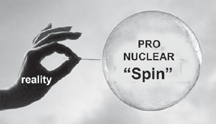
 5 Myths about Saudi Arabia’s Nuclear Program, Enabling Riyadh would only make the region’s nuclear landscape riskier. http://nationalinterest.org/feature/5-myths-about-saudi-arabias-nuclear-program-24771
Much has been written about Saudi Arabia’s plans for nuclear power since the Trump administration announced last fall that it would conclude a civilian nuclear cooperative agreement with Riyadh. Almost all of this commentary suggests Washington must accommodate the kingdom’s desire to enrich uranium and reprocess plutonium, two activities that bring states to the brink of making bombs. In particular, commentators repeatedly raise five points—none of which are sound.
Myth #1: Saudi Arabia needs nuclear power to meet its growing electrical demand.
Most recently, the Saudis announced that instead of sixteen large power reactors, they are only building two. Some have argued that this slippage reflects the kingdom’s desire to finance reactor construction with its oil revenues. With the price of oil dropping from $100 a barrel several years ago to roughly $60 a barrel today, the schedule for nuclear construction had to slide. If true, this suggests the Saudi nuclear “imperative” is less than urgent.
A more compelling explanation is that Saudis don’t need nuclear power. In fact, recent studies found that the Saudis could more cheaply meet their energy and environmental requirements by developing its natural-gas resources and investing in renewables—photovoltaic, concentrated solar power and wind. They also found economic value in upgrading the kingdom’s electrical grid and reducing subsidies that artificially drive up electrical demand. This should not be surprising. The United Arab Emirates, Riyadh’s next-door neighbor, which began construction of four power reactors several years ago, just announced that the UAE would not be building any more nuclear plants. Why? Cheaper alternatives: in addition to plentiful natural gas and wind resources, the Emirates are now investing in photovoltaic systems and solar thermal storage systems, which together can operate twenty-four hours a day more cheaply than nuclear. These findings also apply to Saudi Arabia.
Myth #2: Without a formal nuclear cooperative agreement with Riyadh, America will forgo billions of dollars of nuclear hardware and know-how exports to the kingdom.
This point presumes that the kingdom will stick with its 2012 energy plan, which it has already backed away from. It also mistakenly assumes that America still manufactures export reactors. The only American-headquartered firm that is actively interested in exporting to the kingdom is Westinghouse. It is entirely foreign owned and is a reactor designer, not a manufacturer. It’s currently in bankruptcy proceedings, and is eager to be bought by a Canadian holding firm. Naturally, Westinghouse would like its prospective buyers to believe that it has a clear shot at the Saudi market.
Unfortunately it’s, at best, a long shot. Westinghouse’s design, the AP1000, has yet to operate anywhere. The reactor’s construction is embarrassingly behind schedule and over budget both in China and the United States. Mismanagement by Westinghouse caused two reactors in South Carolina to be terminated after an expenditure of $9 billion, which, in turn, nearly bankrupted Westinghouse’s Japanese owner, Toshiba. Finally, American nuclear know-how and other nonnuclear electrical generating parts can and have been exported in support of non-American reactors abroad without a formal nuclear cooperative agreement. These goods would likely make up a majority of American nuclear exports to the kingdom but, again, their export does not require negotiating a nuclear cooperative agreement.
Myth #3: If Westinghouse does not win the bid, the Russians or Chinese will, reducing American nuclear influence in the region.
This argument is perhaps the most egregious. Consider: an unspoken motive for the kingdom to pursue a nuclear program is to develop an option to make nuclear weapons, if needed, to deter Iran. This would all but preclude buying Russian. Rosatom, after all, is building Iran’s reactors. If Saudi Arabia buys Russian, it is all but asking Moscow to let Iran know exactly what the kingdom is doing in the nuclear realm. Consider also Russia’s recent ill-fated nuclear dealings with South Africa (a contributing factor in forcing President Zumafrom office) and Turkey (where Rosatom’s financial inflexibility prompted Turkey’s private financiers, who were underwriting half of the undertaking, to pull out of the project).
As for buying Chinese, doing so is also risky. The Chinese recently encountered “safety concerns” that delayed operation in Taishan of both its Westinghouse AP1000, and a French-based design. As for China’s top export nuclear design, the Hualong One (HPR 1000) reactor, the British won’t be done certifying it until 2022. China’s other possible export system, the CAP 1400, based on the yet-unproven AP1000, has yet to operate anywhere.
What’s left? The kingdom’s original bid requirements were for two reactors that would produce 2,800 megawatts. The only country that has a reactor that is operating, that is properly licensed, and that has been built roughly on time and on budget that could meet this requirement is Korea’s APR-1400. The Saudis only changed their original bid requirements after the United States, China, Russia and France all complained. Given Korea’s relative success in building four APR-1400 reactors on time and on budget in the United Arab Emirates, and its success in operating a licensed APR-1400 in South Korea, the Korean reactor is still the odds-on favorite to win the Saudi bid.
No, it doesn’t. Saudi nuclear backers argue that the kingdom should enrich, given the uranium reserves the Saudis have discovered. Uranium, however, is plentiful globally and priced at historic lows (less than $22 a pound), as are uranium-enrichment services. More important, the kingdom would have to spend billions on a variety of plants to enrich uranium and produce its own nuclear fuel. Starting such an undertaking might make economic sense if the kingdom had roughly a dozen large reactors up and running. It currently has none, and has only opened a process to buying two.
Myth #5: United States has more to gain by accommodating Saudi Arabia’s demand that it be allowed to enrich uranium than resisting it.
Trumpeting these myths, proponents of a permissive U.S.-Saudi nuclear deal argue that Washington lacks the leverage to secure a Saudi pledge not to make enrich or reprocess. The best Washington can do, it is argued, is to ask Riyadh to defer such dangerous nuclear activities for several years. Some even suggestthat acceding to Riyadh’s wishes is in Washington’s interest, since allowing the Saudis the capacity to make nuclear weapons–usable fuels might help “deter” Iran from acquiring nuclear weapons.
None of this seems sound. As already noted, the Korean APR-1400 is most likely to win the Saudi contract. Given this reactor’s American technical content, senior Korean officials are convinced they cannot export it to the kingdom unless the Saudis first reach a nuclear cooperative agreement with the United States. For this reason (and others besides), Seoul is inclined to take American guidance. Meanwhile, President Trump is trying to get the European parties to the Iran nuclear deal to devise a tighter follow-on understanding. A riskier approach would be for the United States to break from its policy (solidified in the 2009 U.S.-UAE nuclear cooperative agreement) to get non-weapons states in the Middle East to forswear enriching and reprocessing.
Besides the odd optics of looking like a version of the 2015 Iran nuclear deal (which President Trump says is “the worst deal ever”), allowing Riyadh to enrich and reprocess would immediately excite the humors of the UAE and Egypt. Both have U.S. nuclear cooperative agreements that allow them to request their agreements be modified if the United States offers any of their neighbors a more generous nuclear deal. Then there’s Morocco and Turkey: their nuclear agreements with Washington are up for renewal in 2021 and 2023. They too are likely to ask for equal treatment as soon as possible. How this serves anyone’s long-term interest is, at best, unclear.
Henry Sokolski is executive director of the Nonproliferation Policy Education Center and the author of Underestimated: Our Not So Peaceful Nuclear Future. He served as deputy for nonproliferation policy in the office of the U.S. secretary of defense from 1989 to 1993.
If Saudi Arabia is to have a prosperous economic future, we are told, it must meet its growing power requirements by burning less oil. For this, nuclear proponents insist, the Saudis need sixteen large reactors. Although often repeated, this is not true. In 2012, the Saudis announced their intention to build sixteen reactors by 2032. By 2017, Saudi planners had pushed this back to 2040. Shortly thereafter, Crown Prince Mohammed bin Salman backed an national development plan for 2030 that didn’t mention nuclear power, but instead focused on investing in renewables.
Most recently, the Saudis announced that instead of sixteen large power reactors, they are only building two. Some have argued that this slippage reflects the kingdom’s desire to finance reactor construction with its oil revenues. With the price of oil dropping from $100 a barrel several years ago to roughly $60 a barrel today, the schedule for nuclear construction had to slide. If true, this suggests the Saudi nuclear “imperative” is less than urgent.
A more compelling explanation is that Saudis don’t need nuclear power. In fact, recent studies found that the Saudis could more cheaply meet their energy and environmental requirements by developing its natural-gas resources and investing in renewables—photovoltaic, concentrated solar power and wind. They also found economic value in upgrading the kingdom’s electrical grid and reducing subsidies that artificially drive up electrical demand. This should not be surprising. The United Arab Emirates, Riyadh’s next-door neighbor, which began construction of four power reactors several years ago, just announced that the UAE would not be building any more nuclear plants. Why? Cheaper alternatives: in addition to plentiful natural gas and wind resources, the Emirates are now investing in photovoltaic systems and solar thermal storage systems, which together can operate twenty-four hours a day more cheaply than nuclear. These findings also apply to Saudi Arabia.
Myth #2: Without a formal nuclear cooperative agreement with Riyadh, America will forgo billions of dollars of nuclear hardware and know-how exports to the kingdom.
This point presumes that the kingdom will stick with its 2012 energy plan, which it has already backed away from. It also mistakenly assumes that America still manufactures export reactors. The only American-headquartered firm that is actively interested in exporting to the kingdom is Westinghouse. It is entirely foreign owned and is a reactor designer, not a manufacturer. It’s currently in bankruptcy proceedings, and is eager to be bought by a Canadian holding firm. Naturally, Westinghouse would like its prospective buyers to believe that it has a clear shot at the Saudi market.
Unfortunately it’s, at best, a long shot. Westinghouse’s design, the AP1000, has yet to operate anywhere. The reactor’s construction is embarrassingly behind schedule and over budget both in China and the United States. Mismanagement by Westinghouse caused two reactors in South Carolina to be terminated after an expenditure of $9 billion, which, in turn, nearly bankrupted Westinghouse’s Japanese owner, Toshiba. Finally, American nuclear know-how and other nonnuclear electrical generating parts can and have been exported in support of non-American reactors abroad without a formal nuclear cooperative agreement. These goods would likely make up a majority of American nuclear exports to the kingdom but, again, their export does not require negotiating a nuclear cooperative agreement.
Myth #3: If Westinghouse does not win the bid, the Russians or Chinese will, reducing American nuclear influence in the region.
This argument is perhaps the most egregious. Consider: an unspoken motive for the kingdom to pursue a nuclear program is to develop an option to make nuclear weapons, if needed, to deter Iran. This would all but preclude buying Russian. Rosatom, after all, is building Iran’s reactors. If Saudi Arabia buys Russian, it is all but asking Moscow to let Iran know exactly what the kingdom is doing in the nuclear realm. Consider also Russia’s recent ill-fated nuclear dealings with South Africa (a contributing factor in forcing President Zumafrom office) and Turkey (where Rosatom’s financial inflexibility prompted Turkey’s private financiers, who were underwriting half of the undertaking, to pull out of the project).
As for buying Chinese, doing so is also risky. The Chinese recently encountered “safety concerns” that delayed operation in Taishan of both its Westinghouse AP1000, and a French-based design. As for China’s top export nuclear design, the Hualong One (HPR 1000) reactor, the British won’t be done certifying it until 2022. China’s other possible export system, the CAP 1400, based on the yet-unproven AP1000, has yet to operate anywhere.
What’s left? The kingdom’s original bid requirements were for two reactors that would produce 2,800 megawatts. The only country that has a reactor that is operating, that is properly licensed, and that has been built roughly on time and on budget that could meet this requirement is Korea’s APR-1400. The Saudis only changed their original bid requirements after the United States, China, Russia and France all complained. Given Korea’s relative success in building four APR-1400 reactors on time and on budget in the United Arab Emirates, and its success in operating a licensed APR-1400 in South Korea, the Korean reactor is still the odds-on favorite to win the Saudi bid.
Myth # 4: It makes economic sense for the kingdom to enrich uranium to fuel its own reactors.
No, it doesn’t. Saudi nuclear backers argue that the kingdom should enrich, given the uranium reserves the Saudis have discovered. Uranium, however, is plentiful globally and priced at historic lows (less than $22 a pound), as are uranium-enrichment services. More important, the kingdom would have to spend billions on a variety of plants to enrich uranium and produce its own nuclear fuel. Starting such an undertaking might make economic sense if the kingdom had roughly a dozen large reactors up and running. It currently has none, and has only opened a process to buying two.
Myth #5: United States has more to gain by accommodating Saudi Arabia’s demand that it be allowed to enrich uranium than resisting it.
Trumpeting these myths, proponents of a permissive U.S.-Saudi nuclear deal argue that Washington lacks the leverage to secure a Saudi pledge not to make enrich or reprocess. The best Washington can do, it is argued, is to ask Riyadh to defer such dangerous nuclear activities for several years. Some even suggestthat acceding to Riyadh’s wishes is in Washington’s interest, since allowing the Saudis the capacity to make nuclear weapons–usable fuels might help “deter” Iran from acquiring nuclear weapons.
None of this seems sound. As already noted, the Korean APR-1400 is most likely to win the Saudi contract. Given this reactor’s American technical content, senior Korean officials are convinced they cannot export it to the kingdom unless the Saudis first reach a nuclear cooperative agreement with the United States. For this reason (and others besides), Seoul is inclined to take American guidance. Meanwhile, President Trump is trying to get the European parties to the Iran nuclear deal to devise a tighter follow-on understanding. A riskier approach would be for the United States to break from its policy (solidified in the 2009 U.S.-UAE nuclear cooperative agreement) to get non-weapons states in the Middle East to forswear enriching and reprocessing.
Besides the odd optics of looking like a version of the 2015 Iran nuclear deal (which President Trump says is “the worst deal ever”), allowing Riyadh to enrich and reprocess would immediately excite the humors of the UAE and Egypt. Both have U.S. nuclear cooperative agreements that allow them to request their agreements be modified if the United States offers any of their neighbors a more generous nuclear deal. Then there’s Morocco and Turkey: their nuclear agreements with Washington are up for renewal in 2021 and 2023. They too are likely to ask for equal treatment as soon as possible. How this serves anyone’s long-term interest is, at best, unclear.
Henry Sokolski is executive director of the Nonproliferation Policy Education Center and the author of Underestimated: Our Not So Peaceful Nuclear Future. He served as deputy for nonproliferation policy in the office of the U.S. secretary of defense from 1989 to 1993.
Senator Ed Markey warns on danger in allowing Saudi Arabia to enrich uranium, reprocess spent nuclear fuel
US lawmaker concerned over nuclear overtures to Saudi https://au.news.yahoo.com/world/a/39343667/us-lawmaker-concerned-over-nuclear-overtures-to-saudi/, 28 Feb 18, Washington (AFP) – An American legislator has expressed concern over the Trump administration’s efforts to sign a nuclear cooperation accord with Saudi Arabia, which is preparing to build several reactors.
Democratic Senator Ed Markey, of Massachusetts, says any deal is “almost certain” to require a non-proliferation accord, known as a “123 agreement,” of the type the United States has previously signed with South Korea and India, and which is designed to prevent the spread of nuclear weapons.
“Previous US efforts to conclude a 123 agreement with Saudi Arabia have been unsuccessful because of its long-standing refusal to commit to foregoing any uranium enrichment or spent-fuel reprocessing on its territory — the so-called… ‘gold standard’ for 123 agreements,” Markey, of the Senate Foreign Relations Committee, said in a letter to Secretary of State Rex Tillerson and Energy Secretary Rick Perry.
AFP on Tuesday obtained a copy of the letter, which is dated February 26.
Riyadh plans to announce at the beginning of March its short list of firms which will bid to build its nuclear reactors.
Besides the US company Westinghouse, Russian, French, Chinese and South Korean firms are in the running.
A nuclear accord between Riyadh and Washington would allow US corporations to export their nuclear technology to Saudi Arabia, while tensions are high surrounding the civil nuclear program of Riyadh’s regional rival Iran.
US President Donald Trump has threatened to tear up a 2015 global pact under which Iran — facing suspicions it was working towards a nuclear bomb — agreed to curb its nuclear program in exchange for a lifting of sanctions.
Both Washington and Riyadh have complained of Iran’s “destabilizing” acts in the Middle East.
Markey says Saudi Arabia’s “unwillingness” to commit to a “gold standard” 123 agreement “is particularly concerning in light of comments made by Saudi officials and members of the royal family suggesting that a nuclear program may be as much for geopolitical purposes as for electricity generation.”
According to several US media reports, Saudi Arabia’s Crown Prince Mohammed bin Salman — the main driver of a more aggressive regional push by the kingdom — is to visit the United States in early March to meet with Trump.
The visit has not been officially confirmed by either country.
Ties between the kingdom and Washington have strengthened since Trump assumed office early last year. His first official trip abroad was to Saudi Arabia, which is trying to diversify its oil-based economy and energy sources.
Energy Secretary Rick Perry ready to make concession to Saudi Arabia – to market US nuclear power to that country

 Perry Plans Nuclear-Energy Talks With Saudis, Sources Say https://www.bloomberg.com/news/articles/2018-02-26/u-s-energy-chief-is-said-to-plan-nuclear-deal-talks-with-saudis, By Ari Natter , Jennifer Jacobs , and Jennifer A Dlouhy February 27, 2018,
Talks come as U.S. considers allowing Saudi uranium enrichment
· Energy Secretary Perry delays India trip for visit to London
Energy Secretary Rick Perry will travel to London to discuss nuclear energy with officials from Saudi Arabia on Friday as the Trump administration pursues a deal to build reactors in the kingdom, according to two people familiar with the plans.
Perry scrapped a trip to New Delhi to accommodate meetings at the White House this week, creating an opening for him to lead an inter-agency delegation to London, said the people, who asked not to be named to discuss administration strategy.
The administration is considering permitting Saudi Arabia to enrich and reprocess uranium as part of a deal that would allow Westinghouse Electric Co. and other American companies to build nuclear reactors in the Middle East kingdom.
The meetings in London between Perry and Saudi Arabia’s Minister of Energy and Industry Khalid Bin Abdulaziz Al-Falih are seen as a critical step in months of ongoing discussions over a potential nuclear cooperation agreement, bringing together key deal makers from each country.
Some American agreements with other countries have prohibited the enrichment and reprocessing of uranium in exchange for the use of nuclear technology, and that had scuttled negotiations for Saudi projects during the Obama administration.16 Power Plants
The administration is mulling whether to ease that requirement now as a way to help Westinghouse and other companies win Saudi contracts. Saudi Arabia plans to construct 16 nuclear power reactors over the next 20 to 25 years at a cost of more than $80 billion, according to the World Nuclear Association.The Energy Department confirmed the cancellation of Perry’s India trip but a spokesman did not reply to a question about the London talks.
Any agreement they reach must be approved by Congress, which will have 90 days to weigh in. The potential deal has drawn opposition from anti-nuclear proliferation advocates and some lawmakers, such as Senator Ed Markey, a Massachusetts Democrat.
On Monday, Markey asked the Trump administration to detail its efforts to sign a nuclear cooperation agreement with the Saudis and share information about U.S. negotiations with the country.
“Congress remains in the dark about what exactly is being considered, why we may be re-evaluating our nonproliferation objectives and standards, and how and when this information is being conveyed to Saudi Arabia and other countries around the world,” Markey said in a letter to Perry and Secretary of State Rex Tillerson.
Saudi Arabia’s Crown Prince Mohammed Bin Salman is expected to visit the U.S. in March.
The grave danger of USA permissively selling nuclear power to Saudi Arabia
 No to a permissive US-Saudi nuclear deal, Bulletin of the Atomic Scientists, Victor Gilinsky, Henry Sokolski , 22 Feb 18,
Concern in USA Congress over Saudi Arabia’s real aims in going for nuclear energy
 Congress skeptical of Saudi nuclear energy demands, AL-Monitor February 21, 2018
After years of informal negotiations, the United States is facing mounting pressure to reach a civilian nuclear agreement with Saudi Arabia or risk getting shut out of the Gulf kingdom’s lucrative energy market.
But Riyadh’s refusal to give up on certain capabilities that could be used in a nuclear weapons program has caused concern among lawmakers that the Donald Trump administration may be too keen to strike a deal.
Under Section 123 of the US Atomic Energy Act of 1954, Congress must review any agreement to supply a foreign state with US nuclear technology. While the Trump administration has yet to publicly rule out any concessions, Saudi insistence on retaining the right to enrich uranium and to reprocess plutonium faces significant roadblocks on Capitol Hill.
“I think we have made clear — not that it was necessary — that a 123 agreement that in any way contemplated an enrichment program is going to face a lot of opposition in Congress,” a congressional source familiar with the debate told Al-Monitor. “So I just don’t think that the executive branch is going to go there.”……….
Energy Secretary Rick Perry visited Saudi Arabia and discussed Riyadh’s solicitation for bids to build its first two nuclear reactors late last year. Soon after, Bloomberg reported that the administration was actively considering a 123 agreement that would grant the Saudis wide latitude to pursue uranium enrichment and plutonium reprocessing.
Nonproliferation champions in Congress have been pushing back since. The Wall Street Journal reported this week that Sen. Ed Markey, D-Mass., who sits on the Senate Foreign Relations Committee, told the Saudi ambassador last month that he would force a floor vote and debate on any proposed 123 agreement with Riyadh.
“It seems crazy to loosen important nonproliferation standards just to try to secure an uncertain commercial deal,” Markey told the Journal………
“Members of the Saudi royal family have suggested that they may have an interest in nuclear weapons at some point in the future,” Daryl Kimball, the executive director of the Arms Control Association, told Al-Monitor. “There is considerable concern in Congress about any nuclear cooperation with Saudi Arabia that does not somehow make it harder for the Saudis to acquire enrichment and reprocessing technology in the future.”
……….. http://www.al-monitor.com/pulse/originals/2018/02/congress-skeptical-saudi-nuclear-energy-demands.html#ixzz57rsqvui8
Saudi Arabia, Egypt wanted US to bomb Iran
Kerry: Saudi Arabia, Egypt wanted US to bomb Iran https://www.middleeastmonitor.com/20180219-kerry-saudi-arabia-egypt-wanted-us-to-bomb-iran/ February 19, 2018
Trump Might Bend Nuclear Security Rules To Help Saudi Arabia get nuclear power
For Saudi Arabia’s crown prince Mohammed bin Salman, the reactors are a matter of international prestige and power, a step toward matching the nuclear program of Shia rival Iran while quenching some of the kingdom’s domestic thirst for energy.
For the Trump administration, the contest poses a thorny choice between promoting U.S. companies and fighting nuclear proliferation. If the administration wants to boost the chances of a U.S. consortium led by Westinghouse, it might need to bend rules designed to limit nuclear proliferation in an unstable part of the world. That could heighten security risks and encourage other Middle Eastern countries to follow suit.
“If the Saudis were to get an agreement without restrictions, it would set a dangerous precedent in the region and [be] a significant break with American nuclear policy for the last 50 years,” said Jon Wolfsthal, a consultant on nuclear weapons who was a director for arms control and nonproliferation at the National Security Council under President Barack Obama.
The issue is a test of President Donald Trump’s foreign policy and his self-professed bargaining prowess. Trump, his son-in-law, Jared Kushner, and Energy Secretary Rick Perry have made pilgrimages to Riyadh to cozy up to the young crown prince and win big contracts for U.S. firms. Yet little has come to fruition.
The key rules governing nuclear sales to Saudi Arabia are spelled out in a document known as a 123 agreement, named after a section in the 1954 Atomic Energy Act.
The United States has 123 agreements with 23 countries, Taiwan and Euratom, a group of 27 nations. The 123 agreement for Saudi Arabia imposes limits on uranium enrichment and the reprocessing of spent fuel, both of which could be used to produce material for nuclear bombs.
Saudi Arabia has argued that it should be free to mine and enrich its own uranium deposits, as long as it abides by the international Non-Proliferation Treaty,which bars the diversion of materials to a weapons program. The China National Nuclear Corp. has signed preliminary agreements with the Saudis to explore nine potential uranium mining areas. Former intelligence chief Prince Turki al-Faisal told Reuters in December that Saudi Arabia would “have the same right as the other members of the NPT, including Iran.”
Mohammed, who harbors ambitions for an invigorated, more diverse Saudi economy, invited foreign firms to submit proposals last fall. In mid-November, executives from the world’s five leading nuclear reactor design and construction firms – including the Pennsylvania-based Westinghouse – made presentations to Saudi officials.
Khalid Al-Falih, Saudi Arabia’s energy and natural resources minister, told Reuters on Dec. 20 that he aims to sign contracts by year’s end.
Henry Sokolski, the executive director of the nonprofit Nonproliferation Policy Education Center who served in President George H.W. Bush’s Pentagon, asked, “How do we feel about the stability of the kingdom? The reactors are bolted to the ground for a minimum of 40 years and a maximum of 80 years. That’s enough for the whole world to change.”
But others say that if the United States doesn’t build the reactors, then Russia’s Rosatom or the China Nuclear Engineering and Construction Group will, providing fewer safeguards against proliferation and eroding U.S. diplomatic strength in the region.
“I would prefer to have America’s nuclear industry in Saudi Arabia than to have Russian or China’s, so I think it’s useful that we’re reengaging with the Saudis. We should try to get the best restraints on enrichment and reprocessing, including a ban for some significant length of time, say 20 or 25 years,” said Robert Einhorn, a senior fellow at the Brookings Institution and a former State Department adviser for nonproliferation and arms control. “We should show some flexibility.”
The need to build nuclear reactors in Saudi Arabia, which has the world’s largest petroleum reserves, isn’t obvious. The kingdom says it wants to curtail the burning of oil to generate electricity at home. Doing so would free up more oil for exports, the kingdom’s main source of revenue.
Saudi electricity consumption doubled between 2005 and 2015. During the peak summer months, when temperatures soar past 120 degrees Fahrenheit, the kingdom burns about 700,000 barrels of oil a day for air conditioning. Add industrial and transportation use, and Saudi Arabia’s domestic crude consumption has neared 3 million barrels a day, more than a quarter of its total output.
Prestige is another lure for Saudi Arabia. Its smaller oil-rich neighbor, the United Arab Emirates bought four South Korean-model nuclear reactors now under construction.
“If ever there was a place that could take care of own energy needs without nuclear, it’s the UAE,” said F. Gregory Gause, a professor of international affairs at Texas A&M University. “I think it becomes a prestige thing, like international airports.”
But the UAE also signed a 123 agreement in January 2009 that is called the gold standard. It agreed not to enrich or reprocess – although a passage says it could reconsider if others in the region start doing so. It plans to buy uranium from the United States and ship spent fuel to Britain or France for reprocessing.
For Saudi Arabia, the UAE’s gold standard set a high bar. “During the Obama administration, we were at an impasse,” said Gary Samore, a former White House arms control coordinator now at Harvard’s Kennedy School of Government. “We wanted them to make a commitment similar to what Abu Dhabi did. We never overcame that issue in our negotiations.”
Saudis want nuclear energy to ‘save oil’ (nothing to do with chance for nuclear weapons?)
The world’s largest oil exporter, Saudi Arabia, is exploring the use of nuclear energy for domestic energy consumption as part of its transition away from an oil-based system.
“We are looking at a number of countries that have nuclear technology for peaceful purposes… so that we can save the oil and export it in order to generate revenue,” Foreign Minister Adel Al-Jubeir said at the Munich Security Conference.
A new arms race – for the Middle East? Saudi Arabia’s nuclear power plan is not economic
How a Saudi nuclear reactor could accelerate an arms race. https://www.economist.com/news/middle-east-and-africa/21736575-kingdoms-nuclear-ambitions-make-little-economic-sense-how-saudi-nuclearThe kingdom’s nuclear ambitions make little economic sense, 8 Feb 18
IN THE desert 220km (137 miles) from Abu Dhabi, the capital of the United Arab Emirates (UAE), a South Korean firm is close to finishing the Arab world’s first operational nuclear-power reactor. The project started ten years ago in Washington, where the Emiratis negotiated a “123 agreement”. Such deals, named after a clause in America’s export-control laws, impose tough safeguards in return for American nuclear technology. When the UAE signed one in 2009, it also pledged not to enrich uranium or reprocess spent fuel into plutonium. Both can be used to make nuclear weapons. Arms-control wonks called it the gold standard of 123 deals.
Saudi Arabia only wants bronze. The kingdom has its own ambitious nuclear plans: 16 reactors, at a cost of up to $80bn. But, unlike the UAE, it wants to do its own enrichment. Iran, its regional rival, is already a step ahead. The most controversial provision of the nuclear deal it signed with world powers in 2015 allows it to enrich uranium. Iran did agree to mothball most of the centrifuges used for enrichment, and to process the stuff only to a level far below what is required for a bomb. Still, it kept the technology. The Saudis want to have it, too.
Lawmakers in Washington are worried. Granting the Saudis such a deal could prompt other countries, such as the UAE, to ask for similar terms. It may undermine global efforts at non-proliferation. Indeed, critics of the Iran deal fear that a Saudi enrichment programme would compromise their effort to impose tighter restrictions on Iran. But Donald Trump, America’s president, is less concerned. He has close ties with the Saudis. He has also pledged to revitalise America’s ailing nuclear industry. Among the five firms bidding for the Saudi project is Westinghouse, an American company that filed for bankruptcy last year. It would not be able to join the project without a 123 agreement.
Even some critics of the proposed deal concede that it may be the least bad option, because it would give America influence over the Saudi programme. The kingdom has other suitors. One is Rosatom, Russia’s state-owned nuclear-power company, which is pursuing a frenetic sort of nuclear diplomacy in the Middle East. In December it signed a $21.3bn contract to build Egypt’s first power reactor. Jordan inked a $10bn deal with the Russians in 2015. Despite their differences, particularly over Syria, the Saudis are keen to have closer ties with the region’s resurgent power. King Salman spent four days in Moscow in October, the first such visit by a Saudi ruler.
Yet nuclear energy does not make much economic sense for the kingdom. Saudi Arabia burns 465,000 barrels of oil per day for electricity, forgoing $11bn in annual revenue. But the last nuclear reactors will not go online until the 2030s. They will generate less than one-sixth of the 120 gigawatts needed during periods of peak demand. In a country with vast deserts, it would make more sense to use gas and invest in solar energy. Today the kingdom generates almost none: its largest solar farm, at the headquarters of the state oil company, powers an office building.
Negotiations continue, as USA keen to market nuclear technology to Saudi Arabia
 Bulletin of Atomic Scientists 12th Jan 2018, After a lengthy hiatus, negotiations will soon resume between the United
States and Saudi Arabia on an agreement for civil nuclear cooperation.
Concluding a bilateral civil nuclear agreement (often called a “123
agreement,” after the section of the Atomic Energy Act mandating such
agreements for nuclear cooperation with other countries) would enable US
companies to participate in the Saudi Kingdom’s ambitious plans to build a
fleet of nuclear power reactors to meet its growing electricity
requirements.
uranium enrichment, with the United States insisting that Saudi Arabia
accept a legally binding commitment not to engage in enrichment or
plutonium reprocessing and the Saudis refusing to foreclose what they
regard as their sovereign right to pursue nuclear technologies of their
choosing for peaceful purposes.
https://thebulletin.org/us-saudi-civil-nuclear-negotiations-finding-practical-compromise11426
A recipe for global catastrophe? Nuclear power for Saudi Arabia
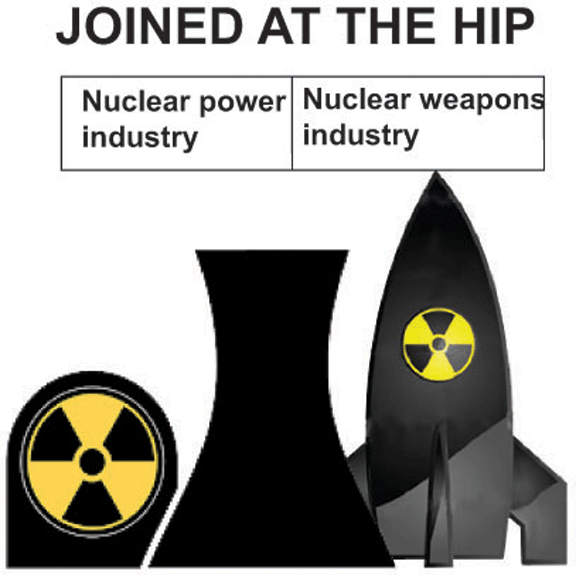 Financial Tribune (Iran) 26th Dec 2017 A lawmaker denounced the prospect of a US uranium enrichment deal with Saudi Arabia, predicting a “global catastrophe” should the oil kingdom mix
nuclear technology with its takfiri ideology.
In a recent talk with ICANA, Heshmatollah Falahatpisheh, a member of Majlis National Security and
Foreign Policy Commission, said, “Unfortunately, even human rights and international laws have not stopped the Saudi crimes in Yemen. Now, if Saudi Arabia is allowed the uranium technology, it would certainly use it in its military.” Takfiris are hardliners who accuse anyone, including Muslims, not following their extreme interpretation of Islam as infidels and apostates punishable by death.
https://financialtribune.com/articles/national/78650/us-nuclear-deal-with-saudis-could-lead-to-catastrophe
Saudi Arabi keen for nuclear power – and for nuclear weapons?
Saudi-US talks on civilian nuclear program to begin within ‘weeks’ Riyadh’s energy minister insists kingdom seeks energy for peaceful purposes, but will not agree to American limitations on uranium enrichment
1 This Month


Shut down the radiation-damaged Heysham nuclear reactors now
To see nuclear-related stories in greater depth and intensity – go to https://nuclearinformation.wordpress.com

Say No to NASA’s Reckless Nuclear Reactor on the Moon
Say No to NASA’s Reckless Nuclear Reactor on the Moon
-
Archives
- October 2026 (247)
- September 2026 (339)
- August 2026 (330)
- July 2026 (355)
- June 2026 (287)
- May 2026 (306)
- April 2026 (356)
- March 2026 (251)
- February 2026 (267)
- January 2026 (308)
- December 2025 (358)
- November 2025 (359)
-
Categories
- 1
- 1 NUCLEAR ISSUES
- business and costs
- climate change
- culture and arts
- ENERGY
- environment
- health
- history
- indigenous issues
- Legal
- marketing of nuclear
- media
- opposition to nuclear
- PERSONAL STORIES
- politics
- politics international
- Religion and ethics
- safety
- secrets,lies and civil liberties
- spinbuster
- technology
- Uranium
- wastes
- weapons and war
- Women
- 2 WORLD
- ACTION
- AFRICA
- Atrocities
- AUSTRALIA
- Christina's notes
- Christina's themes
- culture and arts
- Events
- Fuk 2022
- Fuk 2023
- Fukushima 2017
- Fukushima 2018
- fukushima 2019
- Fukushima 2020
- Fukushima 2021
- general
- global warming
- Humour (God we need it)
- Nuclear
- RARE EARTHS
- Reference
- resources – print
- Resources -audiovicual
- Weekly Newsletter
- World
- World Nuclear
- YouTube
-
RSS
Entries RSS
Comments RSS

