U.S. Makes Shortlist for Saudi Nuclear-Plant Deal, One stumbling block: Negotiations over restrictions meant to prevent spread of weapons. WSJ By Timothy Puko, Sept. 26, 2018
Saudi Arabia has put the U.S. on its shortlist of potential partners competing to build nuclear-power plants in the kingdom, while the two countries negotiate how to do a deal without spreading nuclear weapons, Energy Secretary Rick Perry said.
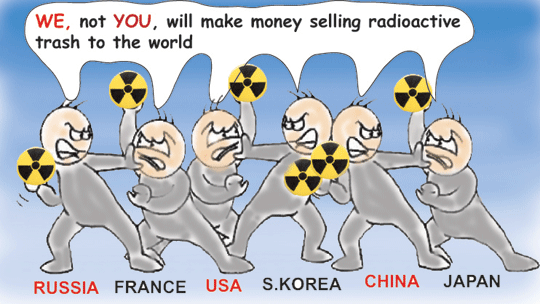
The kingdom has been hearing offers from several countries, including Russia, South Korea and China, for what could be the biggest new market for nuclear power. Mr. Perry told reporters Wednesday the kingdom recently made a decision that keeps U.S. businesses— foremost Westinghouse… (subscribers only) https://www.wsj.com/articles/u-s-makes-shortlist-for-saudi-nuclear-plant-deal-1538006144
Trump mulls inviting Saudi Crown Prince Mohammad bin Salman to UN nuclear meeting, CBS News, ByKYLIE ATWOODCBS NEWSSeptember 20, 2018,In a show of President Trump’s staunch support of Saudi Arabia, his administration is mulling the possibility of having that nation’s young leader, Crown Prince Mohammad bin Salman, speak at the U.S.-hosted UN Security Council meeting next week, according to sources familiar with its planning.But now that the U.S. agenda has shifted away from a narrow focus on Iran, pulling off this diplomatic showcase will be hard to finagle.
Nikki Haley, the U.S. Ambassador to the UN, initially declared that Mr. Trump would host a UN Security Council meeting on “to address Iran’s violations of international law” and its actions to sow instability in the region. But that meeting has since changed to focus more broadly on counter-proliferation……
The Trump administration holds the reins on the agenda for the meeting because the U.S. is chairing the Council this month. …..
If Iran had remained the focus, the country would have been offered a seat, and a voice, at the table. But now they will not, as administration officials wanted to avoid a possible confrontation between Mr. Trump and his Iranian counterpart, Hassan Rouhani. Now they say Mr. Trump will have more breathing room and, in theory, avoid getting bashed on the world stage for exiting the Iran deal. ….
moving away from Iran as the meeting’s focus also makes it logistically more complicated to secure a role for Saudi Arabia, which is not a member of the Security Council……
As of now, Saudi Arabia has not been invited to partake in the discussion. When asked about the possibility of inviting another country to speak at the meeting, a Security Council diplomat explained that “in theory” it could happen, but was not certain it would. ….
Saudi Official Pushes Plans to Make Qatar an Island, Dump Nuclear Waste There, Sputnik News, 30 Sep 18 No man is an island – but the peninsular nation of Qatar just might become one, as it looks increasingly likely that Saudi Arabia will move ahead with plans to build a canal across the peninsula, cutting the nation off from the mainland.
Reports have steadily emerged since April that the Saudi government was considering a canal across the Qatari peninsula roughly half a mile from the border. A Friday tweet by a prominent government official seems to further signal that the plans could be legitimate and not simply a public relations stunt or attempt at intimidation.
As a citizen, I am impatiently waiting for the details of the implementation of the East Salwa island project. This great and historic project will change the region’s geography,” Saud al-Qahtani, a senior adviser to Saudi Crown Prince Mohammed bin Salman, tweeted on Friday, according to Reuters. The news agency noted that Qahtani has mentioned the canal several times on Twitter over the past few months.
And if that wasn’t petty enough, the half-mile gap between the canal and the Qatar border would be turned into a nuclear waste dump, Press TV reported Friday. The waste would come from the 16 nuclear reactors the monarchy plans to open in the next 25 years.
The South China Morning Post noted in April that the United Arab Emirates would be building a nuclear waste dump at the part of its country closest to Qatar, too.
The Salwa Marine Canal Project would be roughly 37 miles long, 650 feet wide and 65 feet deep and would service a military base and tourist resort in addition to the nuclear waste dump, exiting to the Persian Gulf at the Saudi cities of Salwa and Khor al-Adeed, Gulf News reported in June when the Saudi government closed construction applications by interested companies.
In the latest you-can’t-make-this-stuff-up event, Saudi Arabia’s furious campaign of economic retaliation against Canada — in response to Canadian foreign minister Chrystia Freeland’s criticism of the arrest of Saudi women’s rights activists — threatens to dash Westinghouse’s hopes for a lucrative nuclear deal with the Saudis. And, ironically, it may help to preserve tough rules on nuclear exports (“gold standard”) that the Saudi deal might otherwise scuttle.
On Aug. 7, the Saudis recalled their ambassador and expelled Canada’s ambassador, canceled flights to and from Canada, ordered Saudi students and even Saudis in Canadian hospitals to leave Canada, ordered the immediate sale of Saudi-owned Canadian assets “no matter the cost,” and — what is most important for our story — suspended all new business with Canada.
Why this matters takes a bit of background. The story has, as they say, many moving parts.
The White House has been working hard for months to negotiate a U.S.-Saudi nuclear cooperation agreement to permit the sale of Westinghouse nuclear power plants to Saudi Arabia. Although headquartered in Pennsylvania, it was until recently owned by Toshiba Nuclear Energy Holdings. But it is headquartered near Pittsburgh and it has over 5,000 US employees in Pennsylvania, an important political state.
The company has not done well recently. After losing money through its mismanagement of two large US nuclear construction projects, Westinghouse was forced seek protection in Chapter 11 bankruptcy in March 2017. The one remaining two-unit construction project formerly run by Westinghouse, the Vogtle plant in Georgia, now has an estimated completion cost of $27 billion, double the original cost estimate. Toshiba, the parent company, which itself lost money from backing Westinghouse, decided it had enough and sold Westinghouse to Brookfield Asset Management. The deal became final on Aug. 8, and thereby pulled Westinghouse out of bankruptcy. The kicker is that Brookfield is a Canadian-owned company, one that presumably falls under the new Saudi edict.
The Trump White House is unlikely to let go. The Saudi nuclear business was supposed to be worth untold billions. The Saudis had announced they would start with a twin-unit nuclear plant and claimed they would go on to build a dozen more. That they would do so, and that they would choose Westinghouse was always implausible — it made much more sense for the Saudis to hire a South Korean construction team, and there are cheaper alternativesto nuclear power.
Last fall, the White House was reported to be “flexible” on the gold standard, a critical nonproliferation issue. This concerned whether to leave open in the U.S.-Saudi agreement the possibility of the Saudis reprocessing their spent (irradiated) fuel to extract the contained plutonium and, even more importantly, operating uranium enrichment plants. Such enrichment plants could also produce highly enriched uranium. Plutonium and highly enriched uranium are, of course, the basic nuclear explosives in nuclear weapons. Conceding that Saudi Arabia had the right to produce these explosives would be a major setback for US nonproliferation policy.
The United States had previously negotiated a gold standard agreement with the United Arab Emirates that ruled out reprocessing and uranium enrichment. The Saudis, and their paid supporters in Washington, have insisted that the Kingdom is too proud and too important — being the major weapons buyer in the world — to submit to such conditions. Moreover, the Saudi Crown Prince, in an interview during his charm tour of the United States, famously said that, although he was negotiating an agreement for “peaceful” nuclear cooperation and did not intend to make bombs, if Iran produced a nuclear weapon, so would Saudi Arabia. He made it unambiguous that Saudi Arabia intended to match Iran in uranium enrichment, and that the purpose was not to make fuel, but to have the capacity to make nuclear explosives.
Which presented a dilemma for the White House. It wanted to accommodate the Saudis, but the gold standard is precisely the restriction it wants to impose on Iran, and letting Saudi Arabia get into enrichment would make it much harder to get Iran to quit the technology. Significantly, the Israelis urged a tough US nonproliferation standard for the Saudis. The Trump administration told Congress it would stick with the tough standard. Nevertheless, hard cases make bad law, and the betting within the Beltway has been that the Trump White House, in its eagerness for the putatively lucrative deal, might soften the nonproliferation rules for the Saudis.
Now, however, the Saudi hysterical response to Canadian criticism has upended the betting. The Saudis appear to have left themselves no room for retreat. Nor does it seem that Canada will back down. If that remains so, it should become clear that the Westinghouse option is dead and that it will not help to weaken U.S. nuclear export rules. In that case, the nonproliferation gold standard may be left standing, which would be a clear win for nonproliferation.
Victor Gilinsky served on the U.S. Nuclear Regulatory Commission under Presidents Gerald Ford, Jimmy Carter, and Ronald Reagan. He is program adviser for the Nonproliferation Policy Education Center. Henry Sokolski is executive director of the Nonproliferation Policy Education Center and the author of Underestimated: Our Not So Peaceful Nuclear Future. He served as deputy for nonproliferation policy in the office of the U.S. Secretary of Defense from 1989 to 1993.
World Nuclear News 4th July 2018 , French engineering group Assystem is to conduct site characterisation and
impact studies for Saudi Arabia’s first nuclear power plant under a
contract from the King Abdullah City for Atomic and Renewable Energy
(KA-CARE). The contract was awarded recently following an international
call for tenders launched by KA-CARE. Assystem said the services to be
provided under the contract include site characterisation studies –
including geological and seismic analyses – as well as studies on the
impact of a nuclear power plant on the environment, demographics and on
electricity grids. These services will be provided over an 18-month period. http://www.world-nuclear-news.org/NN-Assystem-to-assess-potential-Saudi-sites-0407185.html
“We were informed by our Saudi counterpart, King Abdullah City for Atomic and Renewable Energy, that KEPCO was shortlisted for a nuclear project in Saudi Arabia,” the ministry said in a statement.
The statement said the winner of the tender was expected to be chosen in 2019. Saudi Arabia, the world’s top oil producer, plans to build two nuclear plants to diversify its energy supply and has been in talks with companies from South Korea, the United States, Russia and China for the tender.
In May, Saudi Arabian Energy Minister Khalid al-Falih met South Korean Energy Minister Paik Un-gyu in Seoul. Falih told reporters on the sidelines of an industry event that he was “optimistic” about South Korea being on the tender shortlist.
South Korea, the world’s fifth-biggest nuclear power user, is seeking to export its nuclear reactors abroad.
In 2009, a South Korean consortium led by KEPCO won an $18.6 billion (14.08 billion pounds) deal to construct four nuclear plants in the United Arab Emirates, the country’s ever nuclear export success.
KEPCO was also selected as a preferred bidder in December last year for Toshiba’s NuGen nuclear project in Britain and the Korean company planned to talk with Toshiba to buy a stake in the project.
Reporting By Jane Chung and Cynthia Kim. Editing by Jane Merriman
Analysis: Israeli regime backs Saudi nuclear ambitions: Tactic or Strategy?, July 1, 2018 – (AhlulBayt News Agency) – On Tuesday, the Israeli Energy Minister Yuval Steinitz said that Tel Aviv will support Saudi Arabia’s entry to the club of nuclear states if Riyadh signs the treaty preventing nuclear weapons proliferation, NPT.
Steinitz, addressing World Gas Conference in Washington, said that the Israeli regime supports the development of nuclear power in the Arab kingdom if it includes the gold standard protections and if the kingdom purchases uranium from the US.
The remarks on the Saudi nuclear ambitions on the one hand signal the sensitivity and significance of a nuclear Saudi Arabia in the Israeli security strategy and on the other hand carry hallmarks of an eased tone of Tel Aviv on Riyadh’s nuclear ambitions after the Arab monarchy showed a will to support Arab-Israeli diplomatic normalization efforts. Saudis are winning the Israeli positive stance as they are deeply engaged in an endeavor to pave the way for the “deal of the century” on al-Quds (Jerusalem) through putting strains on the Palestinians to bow.
The oil-rich Arab monarchy has designed ambitious plans to develop the nuclear energy as part of a futuristic roadmap. A royal decree issued in 2010 by then-King Abdullah led to setting up a nuclear power and renewable energies research center, dubbed (KA-Care), in the capital Riyadh. The facility was meant to suggest solutions to address energy and water needs of the country in the future. A year later, the center announced the kingdom aims to build 16 nuclear reactors to produce about 20 percent of its electricity by 2032.
The nuclear roadmap resulted in nuclear cooperation agreements with a series of nuclear technology holders, including France, Argentina, South Korea, and Kazakhstan. According to the deals, Saudi Arabia will see its nuclear industry fully operational and production-ready by 2040. In June 2017, Prince Mohammed bin Salman replaced Prince Mohammad bin Nayef as crown prince. The young crown prince very soon started his motion to get the US green light and technology allowing the Saudis to enrich the uranium on their soil. Media reports suggested that nuclear cycle acquisition was a top case in the prince’s negotiations with the American officials during his March visit to the US.
Despite the Saudi show of desire to become a nuclear state, some factors affect the nuclear technology acquisition possibility: The argument on the type of nuclear power use, Tel Aviv’s role-playing in this course, and the Israeli insistence on keeping its military superiority in the region through nuclear weapons monopoly.
Now a question presents itself: Is the Israeli compromise to the Saudi nuclear ambitions a fruit of Prince Mohammed-led pro-normalization policy, concession to the Israelis, and turning a blind eye to US embassy relocation to al-Quds at the price of the Palestinian cause?
…….. Another reason for Saudi Arabia to move towards developing nuclear arms is its military weakness and vulnerability caused by its geopolitical position. With its 2.15 million square kilometers of area size, Saudi Arabia is a big country. The capital is in the center, but the income sources and facilities, like oil facilities, are located on the Persian Gulf and the Red Sea coasts, hence being an easy target for military action from air and sea. The failure to win a war waged against Yemen in 2015 after three years has exhibited the Saudi military weakness.
Israel vehemently opposes any effort by the Saudi Arabia to relax “gold standard” non-proliferation limits on enriching uranium or reprocessing nuclear fuel in any deal between the two countries, Yuval Steinitz, Israel’s energy minister, told Reuters in an interview.
“Once you allow one country to enrich uranium or reprocess fuel, it will be extremely difficult to tell other countries in this vicinity or elsewhere in the world not to do so,” he said.
Steinitz, in Washington for the World Gas Conference, met this week with people in the Trump administration about Saudi Arabia’s quest to build at least two nuclear power stations with the help of U.S. technology. He did not identify who he met with.
U.S. Energy Secretary Rick Perry has been working with Saudi Arabia on a civilian nuclear agreement that could allow the kingdom to enrich uranium and reprocess plutonium, practices that non-proliferation advocates worry could one day be covertly altered to produce fissile material for nuclear weapons.
The Energy Department did not immediately respond to a request for comment about the status of the nuclear power talks with Saudi Arabia.
Israel and Saudi Arabia do not have diplomatic relations, but they share concern about Iranian influence in the Middle East.
If the United States allows Saudi to relax the standards, “then you deteriorate the non-proliferation effort, so I am confident the Americans would listen to our concern,” Steinitz said.
Steinitz said it would support Saudi Arabia’s development of nuclear power only if it included the gold standard protections and if the kingdom purchases uranium from the United States.
Saudi Arabia has said if it does not get U.S. assistance to build reactors it could turn to other international partners. The kingdom is also in talks with companies from Russia, China, South Korea and other countries on nuclear power., Reporting by Timothy Gardner; Editing by James Dalgleish
US Promised Saudis to ‘Kill Iran Nuclear Deal’ – AnalystSputnik News, 14 June18 Saudi Arabia made its defense cooperation with the US conditional on Washington exiting the 2015 nuclear deal with Iran, the founder of the Ibero-Persia consultancy firm has said.
“The large-scale US arms supplies to Saudi Arabia in May 2017 made it perfectly clear that the sanctions against Iran were coming back and the nuclear deal was dead,” Sharoj Habibi claimed in an interview with Sputnik Mundo.
According to Habibi, the contract for the delivery of delivery of $350 billion worth of US-made THAAD air defense missile systems to Riyadh was negotiated, among others, by President Trump’s son-in-law Jared Kushner.
“Obviously, if you let your son-in-law clinch such a deal, this big-time operation is bound to offer very lucrative bonuses,” Habibi noted adding that the Trump family could have earned a very comfortable, though undisclosed, commission from the deal.
He alleged that as part of the contract, the US authorities “promised to do everything possible to kill the nuclear agreement with Tehran, which made it possible for Iran to economically outpace Saudi Arabia and develop its gas producing sector. Iranian gas would effectively sideline America’s Middle Eastern ally, Saudi Arabia,” the expert said.
He added that because Riyadh’s ultimate goal is to ”control everything that is happening in the Middle East,” it needs to bring the US into play. With Donald Trump’s arrival inat the White House, he continued, the Saudis jumped on the occasion.
“Therefore, instead of calling Trump crazy or dumb, I would say that he is an unscrupulous or ruthless businessman,” Habibi noted.
During his May 2016 official visit to Saudi Arabia, President Trump signed off on a historic arms delivery deal with Riyadh to the tune of up to $350 billion.
Washington sees the agreement as a means of boosting the Gulf kingdom’s defense capabilities and supporting its efforts to counter terrorist groups operating in the region
…….Iran has been in full compliance with the terms of agreement as verified in 11 inspection reports of the International Atomic Energy Agency (IAEA).On June 8, 2018, President Trump announced that the United States was walking out of the nuclear agreement with Tehran, a decision that has been strongly criticized by other signatories to the deal, including the EU, Russia and China.https://sputniknews.com/middleeast/201806141065411103-saudi-us-arms-deal/
Israel ‘is selling nuclear information’ to Saudi Arabia, Middle East Monitor, May 31, 2018
Western security agencies believe that Israel is selling nuclear information to Saudi Arabia, Arabi21 has reported. According to Israeli writer Ami Dor-on, such information will give the government in Riyadh nuclear weapons capabilities. Writing on the News One website, Dor-on said that the joint intention is to make sure that Iran will not be the only country in the region that possesses such weapons which threaten the security and safety of the Kingdom.
“This information should shock us,” he said, “as we see the world is changing for the worse, following the race for the possession of nuclear weapons that pass right over our heads in the Middle East.” Saudi Arabia no longer conceals its wish to develop nuclear weapons, the writer added.
However, General Amos Yadlin, former chief of Israel’s Military Intelligence Directorate, has suggested that the Saudis would not wait to get nuclear capabilities. “They will go to Pakistan, and take whatever they want,” he claimed……..
While Pakistan could clearly simply transfer a nuclear bomb to Saudi Arabia, that would not be Israel’s intention. “Israel may transfer information and nuclear expertise to the Kingdom that would enable it to develop its advanced capabilities in this specific area,” Dor-on clarified. “Yadlin’s comments as a senior Israeli intelligence official gives credibility to the leaks of the Western intelligence services.”
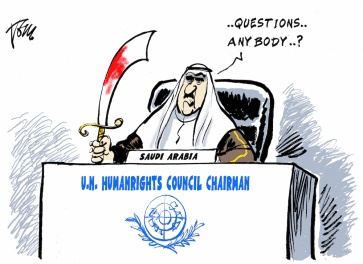
Saudi Arabia: Thousands Held Arbitrarily, Dramatic Increase in Detention Without Trial Human Rights Watch , 6 May 18, (Beirut) – Saudi Arabia is detaining thousands of people for more than six months, in some cases for over a decade, without referring them to courts for criminal proceedings. Saudi Arabia’s attorney general should promptly charge or release all criminal defendants and stop holding people arbitrarily.
Human Rights Watch analyzed data from a public online Interior Ministry database, which revealed that authorities have detained 2,305 people who are under investigation for more than six months without referring them to a judge. The number held for excessively long periods has apparently increased dramatically in recent years. A similar Human Rights Watch analysis in May 2014 revealed that only 293 people had been held under investigation for that period.
“If Saudi authorities can hold a detainee for months on end with no charges, it’s clear that the Saudi criminal justice system remains broken and unjust, and it only seems to be getting worse,” said Sarah Leah Whitson, Middle East director at Human Rights Watch.
“It seems that MBS’s ‘Vision2030’ plan better describes the length of detentions without charge than an aspirational time horizon for reforms.”
Saudi Arabia’s use of arbitrary detention has faced increasing scrutiny since the November 4, 2017 mass arrest of 381 people on corruption allegations. The arrests raised human rights concerns and appeared to take place outside of any recognizable legal framework, with detainees forced to trade financial and business assets for their freedom.
…….Human Rights Watch analyzed the data on April 2, which was updated through March 31. Of the 5,314 people in the database, 3,380 had been held for over six months without a conviction or their “case file under judicial review,” including 2,949 for more than a year and 770 for over three years. The database indicated Saudi authorities were holding 2,305 people “under investigation” for more than six months, 1,875 for more than a year, and 251 for over three years.
Saudi authorities have held one Saudi citizen without a conviction since September 2003 and another “under investigation” since December 2006. Of the 251 held “under investigation” for over three years, 233 are Saudis.
“We’ve reverted to a Saudi version of Kafka when authorities detain citizens for over a decade without charge because they are ‘under investigation’,” Whitson said. “This effectively means that Saudi authorities can detain and jail anyone they want by claiming they are investigating them, however endless the investigation.”………..
Extended detention without charge or trial or without an appearance before a judge is arbitrary, and violates both Saudi law and international human rights standards.
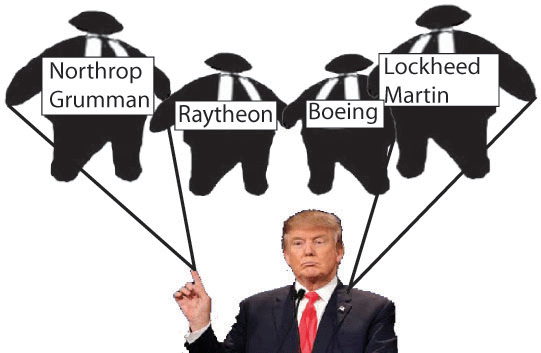
The Pentagon is speeding up US weapons deliveries to allied militaries such as Saudi Arabia, Romania, Japan, and South Korea through new “pilot authorities that change how it can design and execute contracts” according to news reports.
Defense One, quoted Ellen Lord, US defense undersecretary for acquisition and sustainment, as saying, Wednesday “we have a whole variety of specific programs where we are focused on applying these authorities: Patriot Missiles for Romania; Global Hawk for Japan, THAAD [high-altitude air defense missiles] for Saudi Arabia, and TOW [vehicle-launched missiles] for multiple foreign military sales partners.”
These new authorities will allow the Pentagon to shave “years” off the time it takes to deliver weapons to friendly militaries, Lord said at the annual SOFIC event here.
The report added that Saudi Arabia is a frequent target of missile strikes by Houthi rebels. Regional authorities routinely fret about Iran’s growing missile capabilities.
The Trump administration, working to increase exports of US-made weapons, has started the process to execute the sale 120,000 precision-guided munitions to allies Saudi Arabia and the United Arab Emirates.
Reuters said Tuesday that the White House asked the US Congress to review the deal.
Last year, the Trump administration approved the sale of about $7 billion of the precision-guided weapons to Saudi Arabia.
Raytheon Co is the largest maker of the PGMs in the United States.
Administration and congressional sources confirmed that the informal 40-day review period to sell the munitions to the two countries was under way.
Loujain is a well-known campaigner for women’s right to drive in the ultra-conservative kingdom. Late last week, we learned that she had been arrested from her home. She was one of at least six prominent women’s rights activists detained by the Saudi Arabian authorities.
Loujain has been arrested several times in recent years for campaigning for women’s right to drive and the abolition of the male guardianship system. Now, she is the victim of a state-orchestrated smear campaign, designed to undermine the important campaigning that she and other human rights activists have been undertaking.
Along with the other human rights activists, Loujain has been detained and accused of crimes including “suspicious contact with foreign entities” and undermining the “security and stability” of the country. She was branded a ‘traitor’ to the country by state-aligned media. These arrests come one month before Saudi Arabian authorities will lift the ban on women driving in the kingdom. It is a cruel irony that the very women who championed the right to drive campaign may not be able to benefit from their activism – instead, they may be behind bars instead of behind the wheel.
These accusations are nothing more than ludicrous lies, intended to silence strong feminist voices speaking up for women’s rights.
The following morning, it only got worse. A vile and unprecedented smear campaign took over the front pages of Saudi newspapers and spread across social media platforms. Local newspapers like Okaz and Al-Jazirah were filled with aggressive front-page headlines, photos and countless opinion articles, calling the activists spies. On Twitter, one graphic was widely shared, revealing the faces and names of these activists with the word “traitor” stamped across their photos.
We fear that they, like many other peaceful activists and human rights defenders, will be tried and sentenced to lengthy prison terms for their activism. This continued criminalization of peaceful activism and human rights work is repulsive. It’s been a week since their arrests, and we still don’t know where the activists are, if they have been presented with clear legal charges, or have had access to a lawyer of their choosing.
In recent weeks, Saudi Arabia’s Crown Prince Mohammad bin Salman has travelled the world on a PR blitz, shaking hands with fellow leaders while promising positive change in the kingdom. MbS (as he’s known) claims women’s rights will be respected as part of his reforms. These arrests show those promises to be a lie.
How can the Crown Prince tell the world that he is an advocate for women’s rights while locking up activists who have called for the reforms he claims credit for? How can he claim to support women’s empowerment when the brave activists who have sacrificed their freedom for the rights and freedoms of Saudi Arabian women in the country won’t be able to drive next month?
For government leaders around the world who have been taken in by MbS’ talk of reform, we have a simple message: as long as human rights activists are deemed a threat to state security, and as long as the rights to freedom of expression, association, and assembly are equated with terrorism, Saudi reform is not meaningful.
It is clear that underneath all the PR hype and spin, Crown Prince Mohammad bin Salman doesn’t care about women’s rights and real human rights reforms. Saudi Arabian authorities cannot continue to publicly state they are dedicated to reform, while treating women’s rights campaigners in this cruel way. It’s time to end the systematic discrimination against women and the repression of the human rights community in Saudi Arabia.
Samah Hadid is Amnesty International’s Middle East Director of Campaigns
Saudi Arabia has widened its crackdown on women’s rights activists, bringing the number of arrests up to 11 people, according to human rights groups.
Since the sweep began on May 15, the detained activists, most of whom are women, have been branded “traitors” by pro-government news outlets and social media accounts, according to Human Rights Watch. Over the weekend, several state-linked newspapers published the names and photographs of those detained in what rights groups dubbed a “smear campaign“.
Those arrested reportedly include prominent women’s rights defenders who have long advocated for ending the ban on women driving, among them, Loujain al-Hathloul, Aziza al-Yousef and Eman al-Nafjan, along with Mohammed al-Rabea, an activist, and Ibrahim al-Modaimeegh, a human rights lawyer. They may face charges for “suspicious contact with foreign parties” and undermining “stability,” according to the Presidency for State Security, an office which reports to the king.
Since the kingdom is expected to soon lift its prohibition on women driving, rights groups said the motivation behind the escalating arrests remains unclear.
King Salman bin Abdulaziz Al Saud and his son, Crown Prince Mohammed bin Salman, drew international plaudits last year when they announced the ban on female drivers would end on June 24.
But now international outrage over the arrests threatens to derail the crown prince’s image as liberalizer.
“The crown prince, who has styled himself as a reformer with Western allies and investors, should be thanking the activists for their contributions to the Saudi women’s rights movement,” Sarah Leah Whitson, HRW’s Middle East director said in a statement. “Instead, the Saudi authorities appear to be punishing these women’s rights champions for promoting a goal bin Salman alleges to support — ending discrimination against women.”
The cloak that hides the dagger – nuclear deals and geopolitics, Daily Maverick , Saliem Fakir • 18 May 2018The nature of nuclear plants make them very prone to sovereign compromise if national governments can no longer pay their debt bills.
Nuclear deals should not be seen as pure commercial arrangements but sometimes an apparatus of geo-politics, especially in state-to-state relations. They are always more than what you can see from the surface. Perhaps, what is true about nuclear may be true about other technologies and large-scale infrastructure or resource extraction deals.
The question arises as to whether South Africa is not long overdue in having a foreign investment review process for private or state foreign firms in matters that of national security and where investments could pose a sovereign risk to the national economy
Large-scale infrastructure projects concentrate capital (usually debt), technical expertise and long-term supply and maintenance arrangements with foreign firms. Unpaid debt can be converted into odious obligations by a foreign power.
There has been some focus on Russia’s nuclear interests, via Rosatom, in South Africa’s bid to secure a nuclear fleet – with somewhat dubious reasons under Jacob Zuma’s presidency.
While, the Russians got the lion’s share of attention the courts in fact ruled, in the case brought by Earthlife Africa (ELA) and the South African Faith Communities Environment Institute (SAFCEI), against all agreements signed by the South Africa government forcing a retreat from early agreements signed with the US, South Korea, China and Russia.
The courts sent the government back to the drawing board with parliament to debate and vet these agreements in future.
This is all now a moot point given that nuclear power is unlikely to be pursued as part of South Africa’s energy mix under President Cyril Ramaphosa. This being said some future insights can be gained on the nexus between large infrastructure programmes and their relation with geo-politics and geo-economics.
This is a topic less of a focus here and hardly debated nor appreciated given how much of the world is now in the throes of multi-polarity and geopolitical rivalry. In this world – state-to-state relations will gain ascendency even if market mechanisms are used. When it comes economic rebooting even ‘non-interfering’ states in liberalised market economies are willing to do the bidding of their flagship firms. Foreign relations easily mesh with geo-economic interests.
This is because liberal economists see the utopia of markets and not the world as it is, and the world as it is, is being slowly shaped by great power rivalries, in a range of geographies vital to sustaining such power.
On the geographical point consider Djibouti: its strategic location at a crucial choke-point and Sea Lane of Communication (SLOC), through which vital shipping passes between Europe and Asia, is home to multiple military bases of rival powers. Djibouti’s economy is highly dependent on revenue from these military bases and its entire economic logic is shaped by security concerns in the Gulf of Aden and Bab-al-Mandeb – the narrowest point going through the Red Sea given the situation of conflict in Somalia and Yemen.
………The irony is that the hand of geopolitics is everywhere to be seen but little examined here on our shores both in theory and as its existence manifests within the sinews of each deal that involves state-to-state relations or even seemingly independent market pursuits by flagship multinationals who are also proud carriers of their national flag.
……….The nature of nuclear plants make them very prone to sovereign compromise if national governments can no longer pay their debt bills.
If one is beholden to a long continuity of dependence (given the long life-span of nuclear plants) for expertise and debt obligations then autonomy will have to soften and give way to compromise and concessions in other arenas of the economy if these obligations cannot be met. A quick scan of the history of sovereign debt and foreign relations will easily make clear the poignancy of the narrative presented above.
…….A geopolitical story is unfolding as Saudi Arabia is seeking to build nuclear plants putting the US in a Catch-22.
The US has to give permission to the Saudi requests for it to go ahead with a nuclear power programme as US companies are also keen to bid and be freed up to supply the necessary technology and materials to the Saudis through the behest of the NSG. Otherwise the Saudis will turn to others.
Naturally, the US is concerned about nuclear arms race in the Middle East in the light of the now collapsing nuclear deal with Iran under the Joint Comprehensive Plan of Action (JCPOA) given that the US has withdrawn from it. Other fronts where national interests confront foreign control over strategic assets are the interest of China Nuclear Gen’s bid to buy a stake in Britain’s NuGen in Moorside. The British desperately want foreign investment but also do not want to have their economy held at ransom to Chinese nuclear plant operators if Britain is still part of the western alliance. China’s bid has not been short of anxious Brits concerned about national security.
The litany of examples need not be given further detail here as the point has been made.
The question of geopolitics and sovereign geo-economic interests will become more the norm than not in the future. A foreign investment review process is long overdue in the light of the fact that South Africa nearly saw itself caught up in a foreign power’s geopolitical games: even when hidden under the cover of commerce there is the fear that behind the silky cloak there is possibly also a dagger. DM https://www.dailymaverick.co.za/opinionista/2018-05-18-the-cloak-that-hides-the-dagger-nuclear-deals-and-geopolitics/#.WwHjPDSFPGg