The eternal cost of dealing with dead, but radioactive, nuclear reactors
Turkish nuclear power – an unwarranted venture, Hurriyet Daily News, ERHUN KULA, 12 April 12 “……Studies in France (available from the author), the most nuclear dependent nation, reveal that nuclear energy is more expensive then hydro and fossil fuel powered units, even when the end cost of nuclear power plants – which is decommissioning and storing highly dangerous nuclear wastes in repositories for thousands of years – is ignored. The most expensive and risky problem with nuclear energy is the safe disposal of the radioactive waste. It has to be transported over long distances, stored and monitored over a very long period of time.
A few months ago the Mersin Akkuyu Nuclear Electricity Production Corporation commissioned an “independent” engineering company, DOKAY, to carry out an environmental impact assessment of the proposed nuclear power unit. In its over 100 page report, DOKAY provided a “pleasing” document to its sponsor. As for nuclear wastes – the end product – only a few sentences are reserved, which is quite outrageous.
There are more than 400 nuclear reactors operating in various countries. A nuclear power station has 35-40 years of operating life. After that it must be dismantled and the area must be cleaned up (the decommissioning process). But so far, no nuclear power station has been completely decommissioned in the world. It has been estimated that decommissioning could last about 50 years and it would cost more than the construction cost.
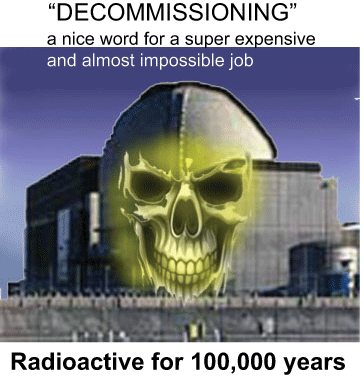
One of the earliest decommissioning efforts is taking place at Dounrey plant, on the northern tip of Scotland. It started more than 15 years ago and we need at least 30 years more to finish the job. After that, waste must be stored in nuclear graves (waste repositories) for thousands of years. United States regulations require the storage period to be at least 10,000 years.
The cost of decommissioning and waste storage will fall upon future generations at huge costs. My American colleague, Prof. S. Frachette, argues that large quantities of nuclear waste is likely to endanger the health, safety and civil liberties of generations yet to be born.
Professor Erhun Kula, from Istanbul’s Bahçesehir University, researched economic and moral aspects of nuclear power in the U.K., the United States and Sweden, and has published widely in this field. http://www.hurriyetdailynews.com/turkish-nuclear-power–an-unwarranted-venture.aspx?pageID=238&nID=18223&NewsCatID=396
Nuclear power for Turkey – pleases Russian sales, not the Turkish people
more than two thirds of the Turks do not want nuclear power. A government that constantly argues that it represents the will of the people is actually acting against the will of the people in this case….

 Turkish nuclear power – an unwarranted venture, Hurriyet Daily News, ERHUN KULA, 12 April 12 On Nov. 9, 2007, the ruling Justice and Development Party passed a law in the Turkish Parliament to build nuclear power plants in Turkey, which started the nuclear ball rolling. The government argued that this venture would provide “cheap,” “clean,” “safe” and sustainable energy to help rapidly expanding and diversifying Turkish industry. Of course, none of these claims about nuclear power is true. In fact, it is extremely expensive, unclean, unsafe and unsustainable. Continue reading
Compromise offer by Iran on uranium enrichment
 Iran’s nuclear chief floats compromise on enrichment issue ahead of talks with world powers, Washington Post, By Associated Press, April 8, TEHRAN, Iran — Iran’s nuclear chief signaled Tehran’s envoys may bring a compromise offer to the talks this week with world powers: Promising to eventually stop producing its most highly enriched uranium, while not totally abandoning its ability to make nuclear fuel.
The proposal outlined late Sunday seeks to directly address one of the potential main issues in the talks scheduled to begin Friday between Iran and the five permanent Security Council members plus Germany…… http://www.washingtonpost.com/world/middle_east/irans-nuclear-chief-floats-compromise-on-enrichment-issue-ahead-of-talks-with-world-powers/2012/04/09/gIQAcyJP5S_story.html
Stop corrupt nuclear power programme – call by Jordan’s Islamists
“We [the IAF] eye the nuclear project as unjustifiable with suspicions of corruption surrounding it and demand halting the project… we call for investing in safe alternative energy resources, with which Jordan is rich,”
Jordan- Islamists call for halt to nuclear programme MENAFN – Jordan Times – 09/04/2012 The Islamist movement on Sunday called for halting the Kingdom’s nuclear programme, claiming that information about the project’s goals and financing were vague and misleading.
Islamist leaders described the project as ambiguous and suspicious, accusing officials in charge of the programme of not being transparent about the programme’s agenda. Continue reading
Brazil, Russia, India, China, and South Africa (BRICS) recognise Iran’s right to nuclear energy
BRICS nations recognize Iran’s right to peaceful use of nuclear energy, http://www.tehrantimes.com/component/content/article/96476 Tehran Times , 29 March 12, TEHRAN – Brazil, Russia, India, China, and South Africa, the leading emerging economies in the world which are known as the BRICS, on Thursday recognized Iran’s right to peaceful use of nuclear energy consistent with its international obligations, the Hindu Business Line reported. Continue reading
Attack on Iran would not prevent its nuclear development
Iran could recover from attack on its nuclear sites within six months, says U.S. report U.S. congressional report says Israel and U.S. do not know exact location of Iran nuclear facilities, which may be dispersed in such a way that an Israeli attack would not be successful. By Haaretz , 28 March 12, Continue reading
General agreement that Iran is nowhere near having the nuclear bomb
Intel shows Iran nuclear threat not imminent, Business Recorder, MARCH 24, 2012 The United States, European allies and even Israel generally agree on three things about Iran’s nuclear program: Tehran does not have a bomb, has not decided to build one, and is probably years away from having a deliverable nuclear warhead. Continue reading
Disastrous consequences of an attack on Iran
I think the mischief and misery and unintended consequences of an attack on Iran would be beyond belief.”…..
Ian McEwan: misery of attack on Iran would be beyond belief. Lisa Allardice guardian.co.uk, 25 March 2012 Author says regime is ‘looking very wobbly,’ but that an attack would reunite the country behind its leaders Continue reading
Israel to replace nuclear reactor with linear accelerator for nuclear medicine
 Israel to phase out civilian atomic reactor by 2018 Particle accelerator to replace aging, fuel-short reactor By Dan Williams SOREQ, Israel, March 20 (Reuters) – Israel is phasing out a civilian nuclear reactor to which it has admitted foreign inspectors while keeping a second reactor, widely believed to have produced atom bombs, off-limits, officials said on Tuesday.
The small facility at Soreq, which began operations in 1960 with a one-time stock of uranium fuel from the United States, will be replaced by 2017 or 2018 by a particle accelerator fulfilling many of the same research and medical functions…..
http://www.reuters.com/article/2012/03/20/israel-nuclear-idUSL6E8EK3AS20120320
Israel agrees that Iran has not decided to develop nuclear bomb
[includes video] Israel: Iran Nuclear Bomb Construction Not Yet Decided On, Huffington Post,18 Mar 12, JERUSALEM (AP) — Despite saber-rattling from Jerusalem, Israeli officials now agree with the U.S. assessment that Tehran has not yet decided on the actual
construction of a nuclear bomb, according to senior Israeli government and defense figures. Continue reading
Iran offers full transparency in return for nuclear power assistance
 VIDEO Iran Official Offers ‘Permanent Human Monitoring’ of Nuclear Sites http://abcnews.go.com/Blotter/iran-official-offers-human-monitoring-nuclear-sites/story?id=15930677#.T2Ow4cWPX_M abc News, 15 March 12, A high-level advisor to Iran’s supreme leader said his country is ready to allow “permanent human monitoring” of its nuclear program in exchange for Western cooperation but also warned Iran is prepared to defend itself against military strikes.
Mohammad Javad Larijani, who serves as Secretary-General of Iran’s Human Rights Council and key foreign policy advisor to Ayatollah Khamenei, said the West should sell Iran 20 percent enriched uranium and provide all the help that nuclear nations are supposed to provide to countries building civilian nuclear power plants. He also said the U.S. and the West should accept his country’s right to continue what Iran calls its peaceful nuclear program.
In return for cooperation from the West, he said, Iran would offer “full transparency.”…..
http://abcnews.go.com/Blotter/iran-official-offers-human-monitoring-nuclear-sites/story?id=15930677#.T2Ow4cWPX_M
A nuclear weapons free Middle East in the interests of Israel and Iran
 the US can build trust with Iran by supporting a nuclear-free Middle East. While critics would label such a policy stand unrealistic and such a regional agreement far-fetched, it may be in the best interests of both Israel and Iran.
Insisting on zero-enrichment for Iran seems to have already become unrealistic
America needs to change tack on handling Iran Washington can build trust with Tehran by committing itself to a nuclear-free Middle East Gulf News, By Hooshang Amirahmadi and Shahir Shahidsaless, Christian Science Monitor March 12, 2012 If the US wants to
avoid military strikes on Iran and still wants a diplomatic settlement for the nuclear dispute with the Islamic Republic, Washington must stop talking from both sides of its mouth. Continue reading
Conciliatory approach by Iran’s supreme leader
Iran’s supreme leader praises Barack Obama over war stance,
Iran’s supreme leader took the unusual step of praising President Barack Obama for eschewing the language of war on Thursday, raising hopes that he may genuinely be seeking a negotiated solution to Tehran’s nuclear impasse with the West. Telegraph, By Adrian Blomfield, 08 Mar 2012 Ayatollah Ali Khamenei chose to ignore a toughening in US rhetoric towards Iran in recent days, focusing instead on Mr Obama’s insistence that there was still a “window of opportunity” to resolve the dispute with Tehran in a peaceful manner.
“We heard two days ago that the US president said that (they) are not thinking about war with Iran,” the Iranian leader was quoted as saying. “These words are good words and an exit from delusion.”
Although the ayatollah’s compliment was undoubtedly barbed, it represented a significant departure from the virulently anti-Western demagoguery he normally employs, leading some observers to suggest that he was sending a conciliatory message to Washington…..
http://www.telegraph.co.uk/news/worldnews/middleeast/iran/9131974/Irans-supreme-leader-praises-Barack-Obama-over-war-stance.html
Time that Israel came clean about its secret nuclear weapons

 Come Out of the Nuclear Closet, NYT, Micah Zenko MARCH 8, 2012 Israel has been a nuclear weapons state since May 1967, when Prime Minister Levi Eshkol ordered the assembly of two nuclear devices to be driven to the Egyptian border, in the event that Arab troops defeated the Israeli forces.
Over the past 45 years, Israel has refused to sign the Nuclear Nonproliferation Treaty, place its civilian nuclear program under International Atomic Energy Agency safeguards, or even
acknowledge that it has the bomb. Instead, Israeli officials such as Prime Minister Netanyahu have maintained, “We won’t be the first to introduce nuclear weapons into the Middle East.”
It is time for Israel to come out of the nuclear closet.By maintaining this fiction, Israel has pigeonholed itself as an international pariah, allowing adversaries and the nonaligned movement to use Israeli intransigence as an excuse to slow progress on nuclear nonproliferation objectives, including preventing a nuclear Iran…..
There are three concrete steps that the Israeli government should take. First, provide transparency about the size, command and control, nuclear security features, and nonproliferation objectives of its nuclear arsenal, following the example of other states that have not signed the nonproliferation treaty. Second, in light of its intention to pursue civilian nuclear energy, sign a safeguards agreement with the International Atomic Energy Agency covering all existing or future nuclear facilities. Third, actively participate in international forums, like the conference on the W.M.D.-free Middle East to be held in Finland later this year. http://www.nytimes.com/roomfordebate/2012/03/08/should-israel-accept-a-nuclear-ban/come-out-of-the-nuclear-closet
Misunderstanding, wrong translation of Ahmadinejad’s supposed words “Israel must be wiped off the map”
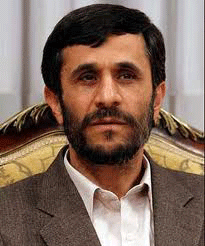 from Wikileaks: Translation controversy Many news sources repeated the Islamic Republic of Iran Broadcasting statement by Ahmadinejad that “Israel must be wiped off the map”,[5][6] an English idiom which means to “cause a place to stop existing”,[7] or to “obliterate totally”,[8] or “destroy completely”.[9]
Ahmadinejad’s phrase was “بايد از صفحه روزگار محو شود” according to the text published on the President’s Office’s website.[10]
The translation presented by the official Islamic Republic News Agency has been challenged by Arash Norouzi, who says the statement “wiped off the map” was never made and that Ahmadinejad did not refer to the nation or land mass of Israel, but to the “regime occupying Jerusalem”. Norouzi translated the original Persian to English, with the result, “the Imam said this regime occupying Jerusalem must vanish from the page of time.”[11] Juan Cole, a University of Michigan Professor of Modern Middle East and South Asian History, agrees that Ahmadinejad’s statement should be translated as, “the Imam said that this regime occupying Jerusalem (een rezhim-e eshghalgar-e qods) must [vanish from] the page of time (bayad az safheh-ye ruzgar mahv shavad).[12] According to Cole, “Ahmadinejad did not say he was going to ‘wipe Israel off the map’ because no such idiom exists in Persian.” Instead, “he did say he hoped its regime, i.e., a Jewish-Zionist state occupying Jerusalem, would collapse.”[13] The Middle East Media Research Institute (MEMRI) translated the phrase similarly, as “this regime” must be “eliminated from the pages of history.”[14]
Iranian government sources denied that Ahmadinejad issued any sort of threat. On 20 February 2006, Iran’s foreign minister Manouchehr Mottaki told a news conference: “How is it possible to remove a country from the map? He is talking about the regime. We do not recognize legally this regime.”[15][16][17]
1 This Month




PLEASE OPPOSE HR 8255 AND S.3639 – bills would accelerate satellite deployment, with no environmental review or safeguards – https://ncstd5li.quorum.us/campaign/169331/
To see nuclear-related stories in greater depth and intensity – go to https://nuclearinformation.wordpress.com
-
Archives
- September 2026 (330)
- August 2026 (330)
- July 2026 (355)
- June 2026 (287)
- May 2026 (306)
- April 2026 (356)
- March 2026 (251)
- February 2026 (267)
- January 2026 (308)
- December 2025 (358)
- November 2025 (359)
- October 2025 (375)
-
Categories
- 1
- 1 NUCLEAR ISSUES
- business and costs
- climate change
- culture and arts
- ENERGY
- environment
- health
- history
- indigenous issues
- Legal
- marketing of nuclear
- media
- opposition to nuclear
- PERSONAL STORIES
- politics
- politics international
- Religion and ethics
- safety
- secrets,lies and civil liberties
- spinbuster
- technology
- Uranium
- wastes
- weapons and war
- Women
- 2 WORLD
- ACTION
- AFRICA
- Atrocities
- AUSTRALIA
- Christina's notes
- Christina's themes
- culture and arts
- Events
- Fuk 2022
- Fuk 2023
- Fukushima 2017
- Fukushima 2018
- fukushima 2019
- Fukushima 2020
- Fukushima 2021
- general
- global warming
- Humour (God we need it)
- Nuclear
- RARE EARTHS
- Reference
- resources – print
- Resources -audiovicual
- Weekly Newsletter
- World
- World Nuclear
- YouTube
-
RSS
Entries RSS
Comments RSS

